• Home
  • About me/Chi sono
  • Contact

Un po' di pepe

~ …… (oon∙poh∙dee∙PEH∙peh) Cristina writes about interesting stuff /Cristina scrive di cose interessanti

Un po' di pepe

Monthly Archives: June 2020

Ravioli di Ricotta e Spinaci

30 Tuesday Jun 2020

Posted by Un po' di pepe in Mangiamo!, Recipes

≈ 26 Comments

Tags

Homemade ricotta, Italian cooking, Pasta, Pasta fatta a mano, Ravioli, Stuffed pasta, Vegetarian pasta

Ravioli di ricotta e spinaciStuffed pasta is more of a special occasion dish than an ‘everyday’ pasta, and really fun to make by hand. I especially like large ravioli, as they look like little gift packages-and everyone loves presents!

Making ravioli is more efficient and fun as a team effort.  I recently spent a morning with my nipotina Francesca making ravioli with a creamy ricotta and spinach filling. Since I needed to measure out the recipe for her, I decided to share it in a post.Ravioli di ricotta e spinaci

Pasta naming can be confusing, and there are also regional differences.  Ravioli are usually square, but can also be round or mezzalune –half moons.  They are usually made with a filling between 2 thin pasta sheets, sealed and cut.  Large ravioli are sometimes called agnolotti- a sub category of ravioli where pasta sheets are folded over a filling, sealed and cut.  One example is agnolotti del plin.  As you see in the photos, some of our ravioli were made folded over, and some not, so we just call them all ravioli.ravioli di ricotta e spinaci
To make the pasta:

Fresh egg pasta is generally made with 1 egg to every 100g flour.  I use finer OO (doppio zero) flour as it makes a more elastic dough which is more likely to stay al dente. All purpose flour can be used as well, or a combination of the 2.

Depending on the size of the eggs, an extra yolk may need to be added, or a bit less flour.  The dough should not be too dry, or the ravioli will not seal properly and will open while cooking.

I usually use 5 eggs and 500g 00 flour, which will use up all of the filling. This makes about 75-80 ravioli 5cm (2 inch) square.

Tip the flour onto a wooden board.  Make a wide hole in the center of the flour and add the eggs.  Move a few tablespoons of the flour off to the side in case it is not needed.  This prevents needing to add water because the pasta is too dry!Pasta all uovo

Beat the eggs with a fork and slowly start to mix in some flour.  Keep adding flour from the inner edge of the wall.  When the egg mixture is no longer runny, start kneading by hand.

Knead for 10 min using the whole hand.  Keep folding and turning until the dough is shiny and elastic.  Shape into a ball.  Cover with an overturned bowl and let the dough sit for 30-60 min.  This lets the gluten relax, and the dough will be more elastic and workable.

A stand mixer or food processor can be used to make the dough, but it does not come out as nice, plus I find it more work to wash the appliances than to mix it myself.

To make the filling:

The filling can be made the night before, or while the pasta is ‘relaxing’. I do not really measure the ingredients.  Use less ricotta and more spinach if you like.  I often make them without any spinach.  These are the approximate amounts:

500-600 g (~2 cups) ricotta, drained

80-100g Parmigiano Reggiano, grated (¾ -1 cup)

2 egg yolks

500g fresh spinach, cooked, drained and chopped finely, or 200g frozen spinach, thawed and drained

A pinch of freshly grated nutmeg

Salt and pepper qb*
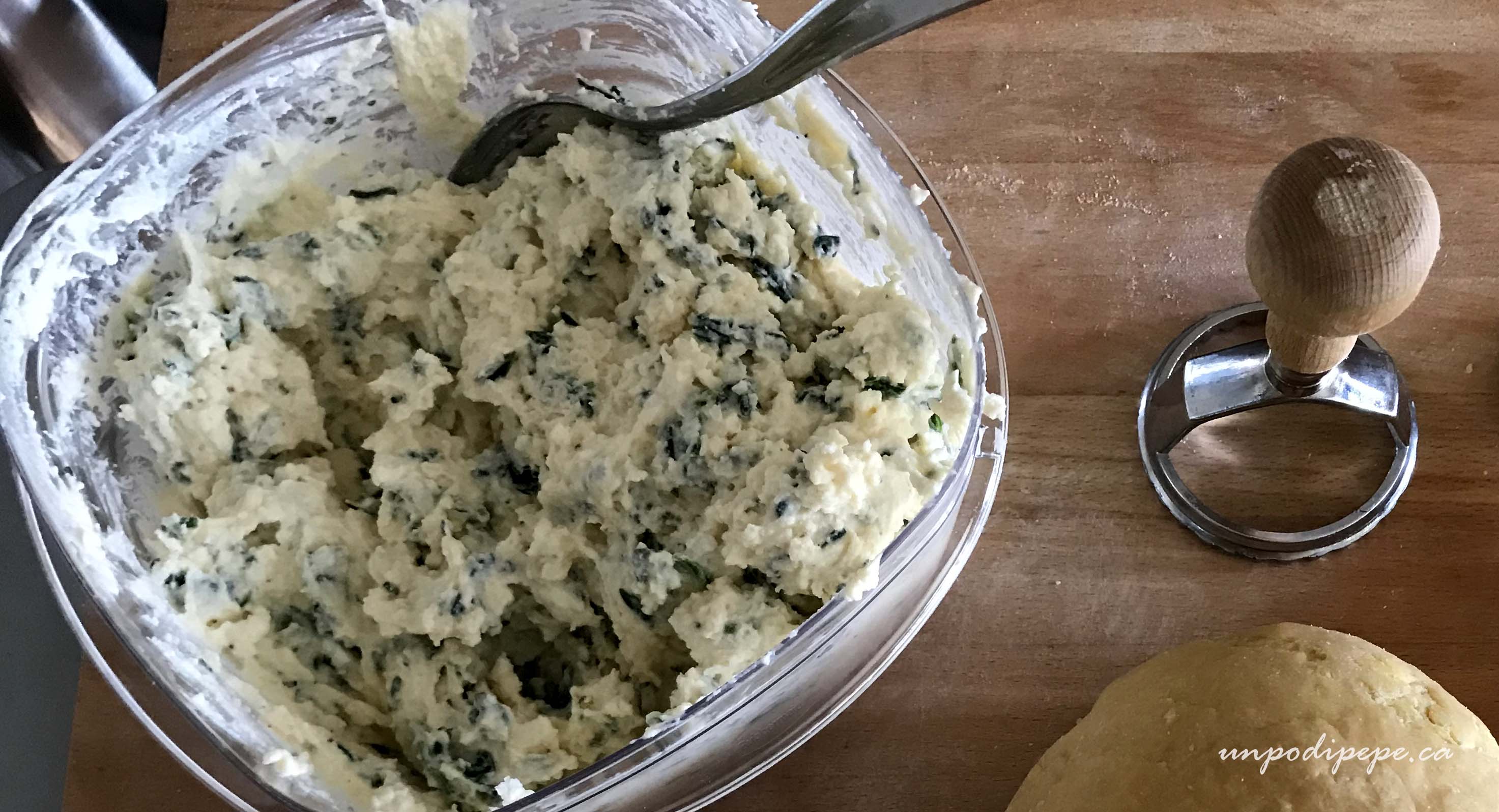
The ricotta I use comes in its own little draining basket.  The basket can sit in a colander over a bowl to drain for a few hours.  To make your own ricotta, check out the post Ricotta fatta in casa.  Make sure to squeeze out all of the water from the spinach as well. Extra moisture will produce soggy ravioli.  Yuck!  Mix all ingredients with a fork.  Cover and store in the fridge until the ravioli are ready to fill.

To make the ravioli:

Cut off one piece of dough at a time (~1/8th of the total) and leave the rest under the bowl so it does not dry out.  Lightly flatten the dough with fingers and run it through the pasta machine twice on the widest setting.  Gradually run the dough through at thinner settings, until the second thinnest setting.

Since ravioli is double layered, the pasta should be as thin as possible.  The green spinach should be visible through the pasta!Ravioli di ricotta e spinaci

The dough can also be rolled out by hand, but it takes real talent and years of practice to roll out a sfoglia thin enough for ravioli!

Work with only 1 piece of dough at a time-or the pasta will dry out and not stick together.  Try not to add any extra flour to the dough or the board when making stuffed pasta as this will also prevent sticking.Ravioli mold RaviolampRaviolamp ravioli mold

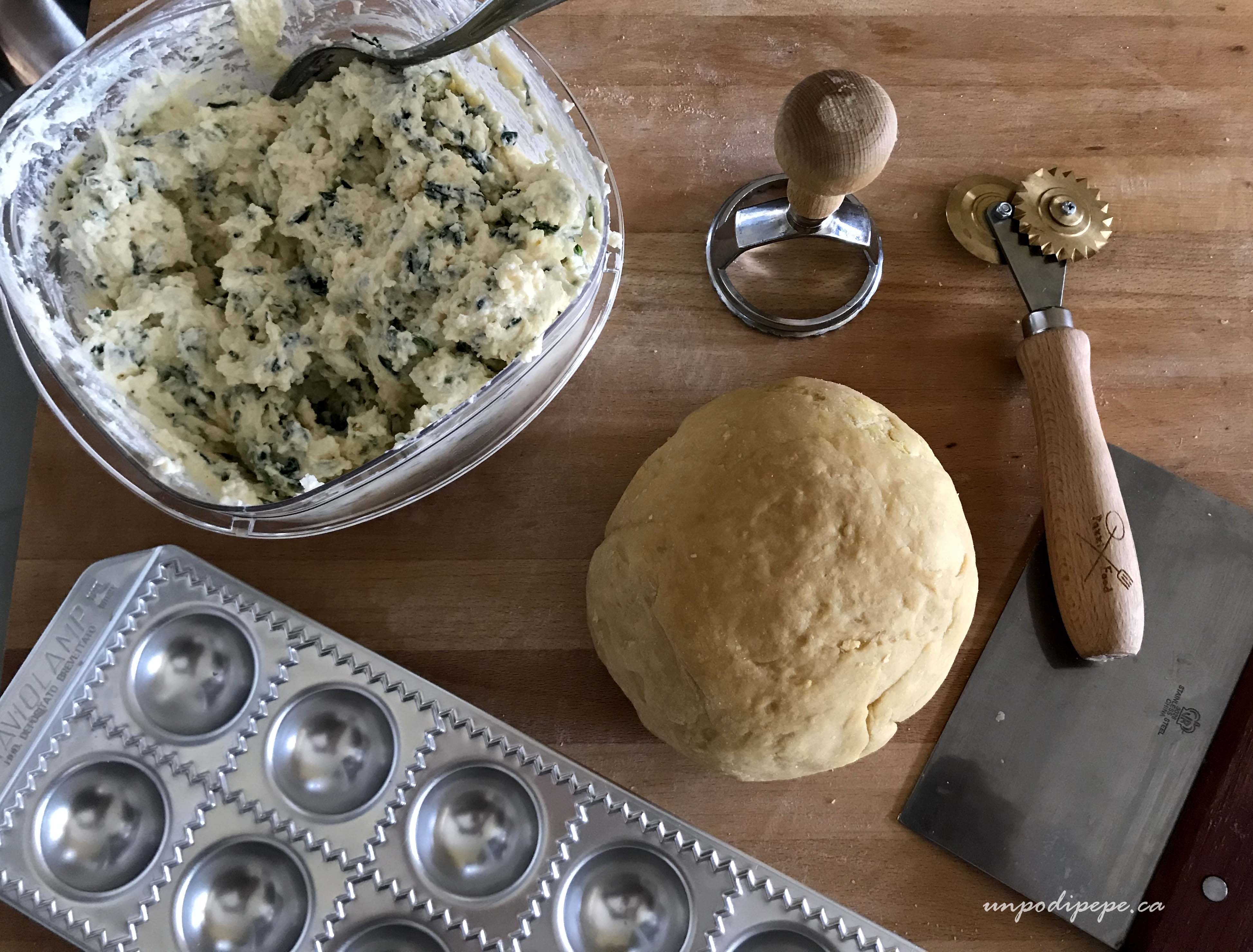
I have a ravioli mold called a Raviolamp, and a round ravioli cutter, but I also like to make them ‘freeform’.  We made a combination of all 3 so that Francesca could try them all!  They do not have to all look the same-but try to make them all the same size so they take the same time to cook.Ravioli di ricotta e spinaci

Using 2 teaspoons, drop 1 heaping teaspoon of filling on the pasta sheet 2 fingers apart.  Either use 2 sheets, 1 for the top and 1 for the bottom, or 1 long sheet and fold it over.  Press in between the filling with the heel of hand, making sure to remove any air. The filling can be piped out of a pastry bag if you want to get fancy.Ravioli di ricotta e spinaci

Cut the squares with a fluted pastry wheel or ravioli cutter.  The Raviolamp makes 12 ravioli stuck together, then they can be cut apart with the pastry wheel.Ravioli mold RaviolampI use the leftover dough to make a few ‘freeform’ ravioli rather than putting it through the pasta machine again.  Use the leftover bits as soon as possible so they do not dry out. The finished ravioli can go on a floured tea towel on a cookie sheet until they are ready to cook or be frozen. Ravioli di ricotta e spinaci

Cook the ravioli in a large pot of boiling salted water.  If cooking frozen ravioli, do not defrost.  Drop them into the boiling water directly from the freezer.  Cook for ~4 minutes, or 1 minute after they float to the top.  Remove with a slotted spoon.Ravioli di ricotta e spinaci

These ravioli should be served with simple sauces.  While they are cooking heat up olive oil with some garlic and fresh sage.  They are also delicious with a simple tomato sauce. For either sauce, top with freshly grated Parmigiano Reggiano and bite into them!Ravioli di ricotta e spinaci

Buon appetito, Cristina & Francesca

*qb=quanto basto meaning however much is needed.  This is what you commonly see in recipes written in Italian

Share this:

  • Share on Facebook (Opens in new window) Facebook
  • Share on Pinterest (Opens in new window) Pinterest
  • Share on X (Opens in new window) X
  • Email a link to a friend (Opens in new window) Email
  • Share on WhatsApp (Opens in new window) WhatsApp
Like Loading...

Lucca

15 Monday Jun 2020

Posted by Un po' di pepe in Italia, Photography, Travel

≈ 31 Comments

Tags

Daytrips from Firenze, Daytrips from Siena, Italian history, Lucca, Torre Guinigi, Toscana, UNESCO World Heritage Sites

Lucca Torre GuinigiLucca is one of my favourite smaller cities in Italia.  While writing my last post, I realized that I have not yet dedicated a whole post to Lucca!   Founded by the Etruscans as Luk, meaning marsh, Lucca became a Roman colony in 180 BC.  In the 12th-13th centuries, the silk trade and banking were responsible for economic development and population increase.  Lucca was an independent republic for 500 years, until Italian unification. Today the population is 88,000 and Lucca has been a UNESCO World Heritage Site since 2006.Porta Santa Maria Lucca

Lucca does not have 1 or 2 monumental sites-the city itself is the attraction!  Lucca is best known for the well preserved, intact Renaissance walls encircling it.  The complex defense network is still mostly intact, 12 m high and 30 m wide, with 6 porte – entrance gates and 10 ramparts.  The only thing missing is the moat, which was filled in the 1800’s.Lucca medieval walls

On top of the walls is Via delle Mura Urbane, a wide 4.2 km tree lined pathway that is popular for walking, cycling and running.  When entering Lucca, the 16th C walls from can be seen from below. Bike rentals are available near most of the entry gates.Lucca

Lucca has a real ‘lived in’ feel to it.  Walking through one of the gate tunnels is like stepping back in time.  Lucca is flat, with a random street layout.  Most of the centro storico is pedestrian only and full of biciclette to photograph.  Lucca bicicletta rossaThe streets are narrow and flanked by tall, narrow buildings.  The many towers and other landmarks are often not visible from below, so it is easy and fun to get lost among the historic architecture and cobblestone streets.Lucca

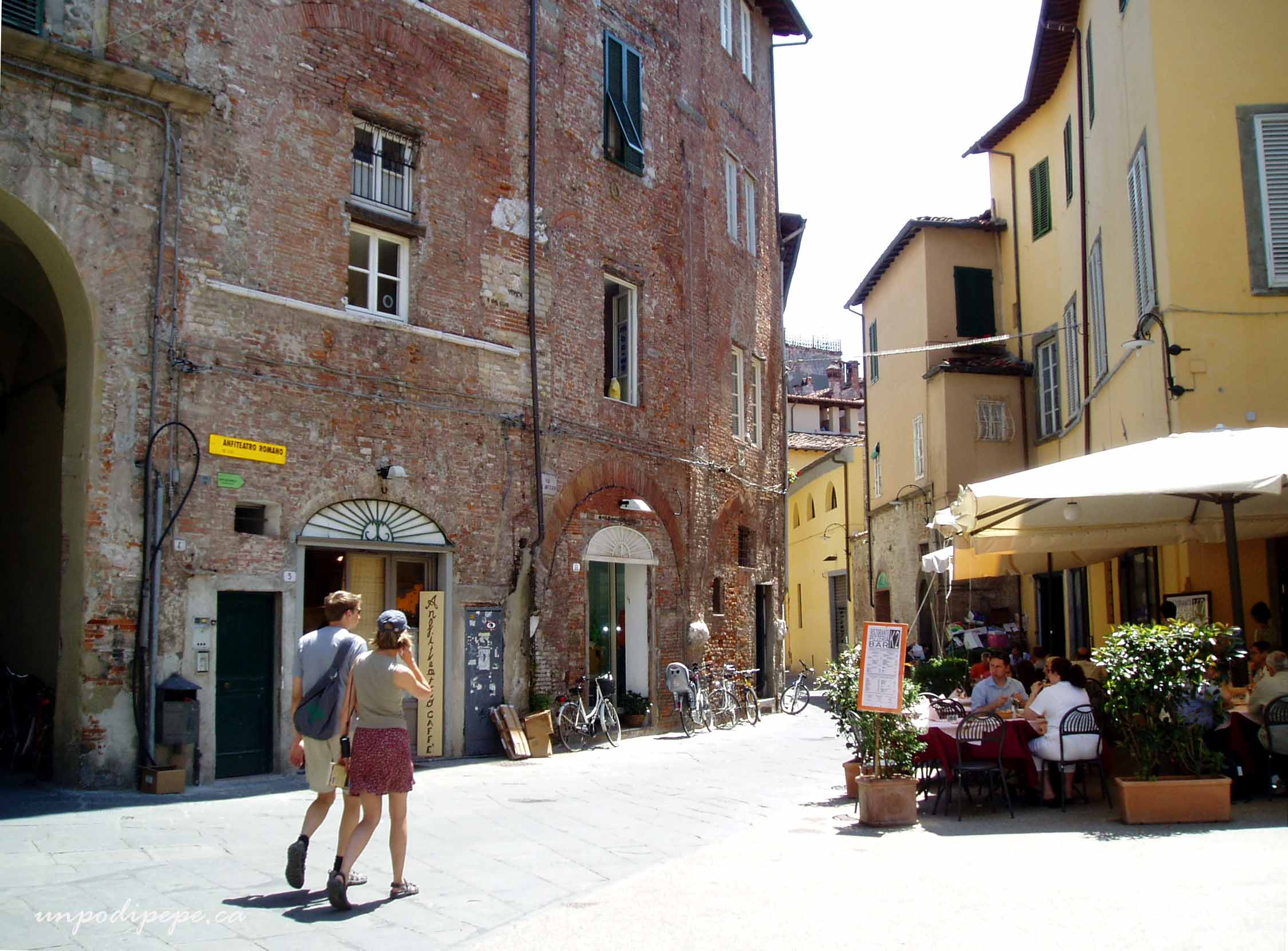
The main street, Via Fillungo has beautiful storefronts and buildings.  It connects Piazza Anfiteatro and Piazza San Michele.  Piazza Anfiteatro’s oval shape is the ‘ghost’ of the 10,000 seat Roman amphitheater that once stood there.  Entrance to the piazza is through brick tunnels.The stones were looted to build other structures, but the tall buildings in shades of yellow and cream with green shutters were built following the shape of the former amphitheater.Piazza AnfiteatroPiazza Anfiteatro Lucca

As in San Gimignano, defense towers were a status symbol for Lucca’s wealthy families in the 1300’s. Lucca’s skyline has several towers, the most famous being the 45 m Romanesque Gothic red brick Torre Guinigi.  Built in 1384 by the Guinigi family of silk merchants, the tower is 45 m tall with 7 Holm Oak trees growing on top, symbolizing rebirth.  Torre Guinigi, LuccaThe rooftop was originally used for dining, with the kitchen on the floor below.  Imagine carrying dishes the 232 steps to the top!  Admission is €5 single/ €8 family. A 2 day combination ticket can also be purchased that includes Torre delle Ore and Orto BotanicoView from the top of Torre Guinigi Lucca

At 50m Torre delle Ore is the tallest tower in Lucca.  It started as a personal defensive tower, and when defense was no longer needed, it was turned into a clock in 1390.  The present clock mechanism is from the 1700’s.  It even has its own resident ghost legend-in 1623, a Lucchese woman who had sold her soul to the devil ran up to the top to try to stop time, but she didn’t make it.  Climb the top to see rooftop Lucca and the best views of Torre Guinigi. In the photo below you can see Torre delle Ore and the campanile of San Martino.View from Torre Guinigi

Lucca has over 70 churches.  The Gothic/Pisan Romanesque church of San Martino was started in 1070.  It has a mismatched 14th C campanile-the top is white like the church, but the lower half is red quartz stone.  The church façade has 3 levels of open arches and each of the 37 columns are different.  There was a contest for the design of the columns and each artist submitted one.  Instead of awarding a winner, all of the columns were used without paying the artists.  Che furbi!  San Martino is home to the famous relic, a cedar crucifix known as  il Volto Santo di Lucca (the holy face) and works of art by Jacopo della Quercia, Ghirlandaio and Tintoretto.

Like much of Lucca, the church of San Michele in Foro was built on a much earlier structure.  Piazza San Michele was formerly the Roman Forum.  The façade has 4 rows of ornate arches and columns, similar to San Martino.  I do not think artists contributed these columns for free! San Michele has works by Tuscan superstars Luca della Robbia and Filippino Lippi.San Michele in Foro, Lucca

The oldest church in Lucca, 6th C San Frediano has a beautiful golden  mosaic façade.  Lucca San Frediano

Lucca is the birthplace of Giacomo Puccini, and the house where he was born is now Museo Puccini.  Admission is €7. If you are in Lucca in the evening, it is common to hear music coming from churches, piazze and the opera house Teatro del Giglio.Lucca San Giusto

Lucca is beautiful to visit any time of the year……except for the first week of November!  Unless you are attending, avoid visiting during Lucca Comics and Games.  Lucca is NW of Firenze, closer to Pisa.  The train station is right across the street from Porta San Pietro, one of the entry gates, making Lucca an easy day trip -90min from Firenze and 30 min from Pisa.  Lucca really deserves a few days of its own though, and also makes a great base to see the rest of Toscana.Lucca, bicicletta

The photos in this post were taken on 4 separate visits over a 15 year period, which explains the dramatic weather fluctuations!

Lucca is also mentioned in the posts Viaggio con Isabella and Autunno in Italia

Photos of San Martino and San Frediano from wikimedia commons.

Buon viaggio, Cristina

Share this:

  • Share on Facebook (Opens in new window) Facebook
  • Share on Pinterest (Opens in new window) Pinterest
  • Share on X (Opens in new window) X
  • Email a link to a friend (Opens in new window) Email
  • Share on WhatsApp (Opens in new window) WhatsApp
Like Loading...

Enter your email address to follow 'un po' di pepe' and receive notifications of new posts by email.

Join 509 other subscribers
Follow Un po' di pepe on WordPress.com

Popular Posts

  • Dante Alighieri
    Dante Alighieri
  • Hairstyling in Ancient Roma
    Hairstyling in Ancient Roma
  • Uffa, allora, purtroppo, magari, ….mannaggia!
    Uffa, allora, purtroppo, magari, ….mannaggia!
  • Halifax and the Titanic
    Halifax and the Titanic
  • L'ultimo Caravaggio
    L'ultimo Caravaggio
  • Palazzo Massimo alle Terme, Roma
    Palazzo Massimo alle Terme, Roma
  • Ruote di Trani
    Ruote di Trani

Recent Posts

  • Bloghiversario #12
  • Pane e Salute
  • Sanremo 2026
  • Cucina Italiana Patrimonio UNESCO
  • 2025~Un po’ di pepe Year in Review
  • Castel del Monte
  • ‘The Nuances of Love’
  • Hostaria Antica Roma~Eat like an Ancient Roman
  • Santa Maria in Aracoeli
  • Casino dell’Aurora~Villa Boncompagni Ludovisi
  • Nasoni di Roma
  • Bloghiversario #11
  • Fontana di Trevi
  • Acqua Vergine
  • Giubileo 2025
  • Sanremo 2025
  • In Vino there are Memories
  • A Literary Harvest
  • 2024~Un po’ di pepe Year in Review
  • Buon Natale 2024
  • Il Bicerin
  • Mercato Porta Palazzo
  • Torino
  • Catanzaro, Calabria
  • Il Pumo Pugliese

Categories

Amici e Famiglia Architecture Art Art history Art projects Bilingual posts Blogging Canada Culture Feste Firenze Inspiration Italia Italian Folklore Italian language Italian life Italocanadesi Libri Mangiamo! Orsara di Puglia Parole piacevoli Photography Puglia Recipes Roma Travel Travel tips Uncategorized Vino

Archives

Un po’ di pepe on Facebook

Un po’ di pepe on Facebook

Start a Blog at WordPress.com.

  • Subscribe Subscribed
    • Un po' di pepe
    • Join 509 other subscribers
    • Already have a WordPress.com account? Log in now.
    • Un po' di pepe
    • Subscribe Subscribed
    • Sign up
    • Log in
    • Report this content
    • View site in Reader
    • Manage subscriptions
    • Collapse this bar

Loading Comments...

    %d