• Home
  • About me/Chi sono
  • Contact

Un po' di pepe

~ …… (oon∙poh∙dee∙PEH∙peh) Cristina writes about interesting stuff /Cristina scrive di cose interessanti

Un po' di pepe

Monthly Archives: April 2023

Bloghiversario #9

25 Tuesday Apr 2023

Posted by Un po' di pepe in Blogging, Inspiration

≈ 24 Comments

Tags

25 Aprile, Blogging, Inspiration, Liberazione d'Italia

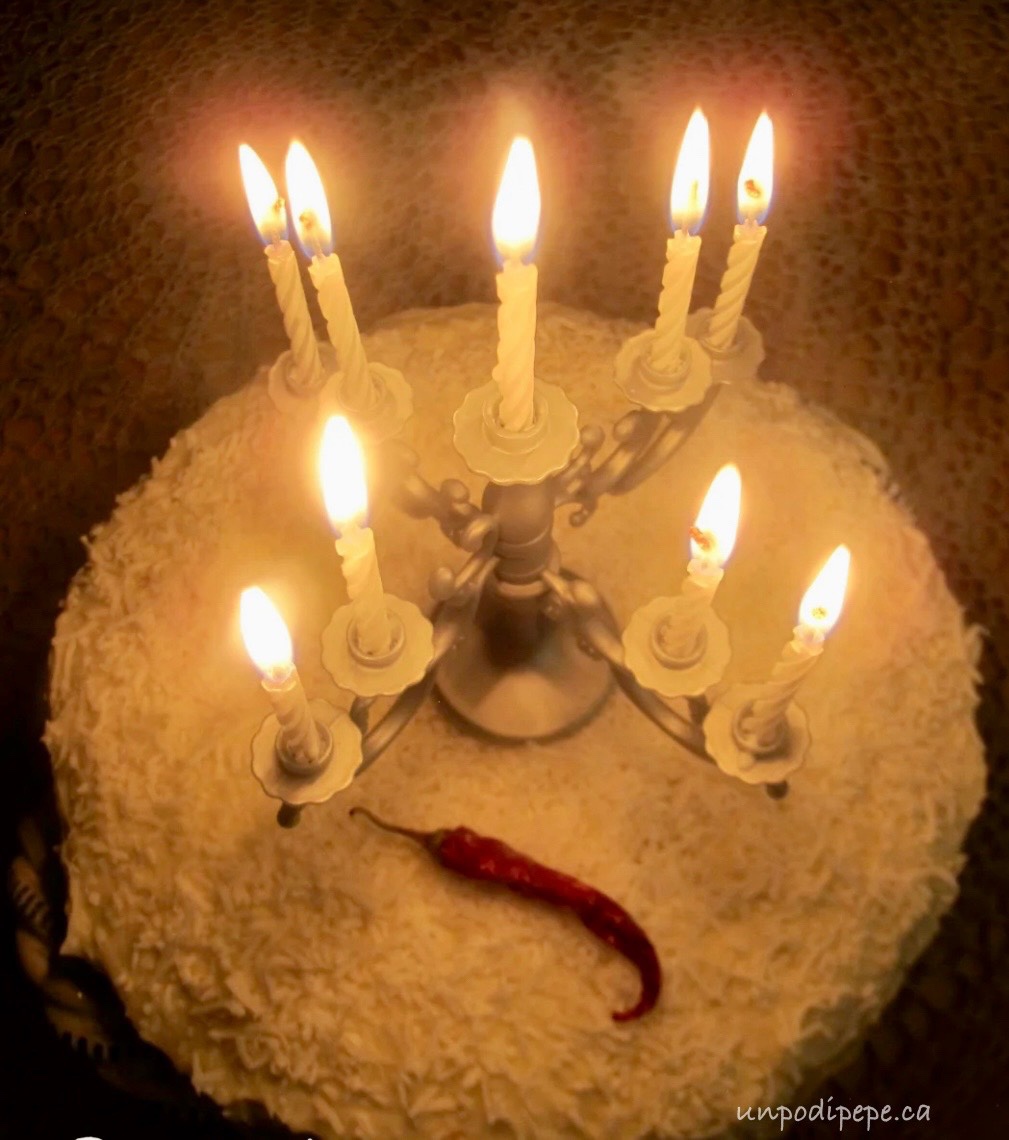
Auguri a me! Oggi Un po’ di pepe compie 9 anni! Yeah me! Today Un po’ di pepe turns 9! Another bloghiversario– blog anniversary.  It is hard to believe it has already been 9 years since starting Un po’ di pepe.  Where did the time go?  It feels like only yesterday I had trouble coming up with a blog name that was not already taken. This has been an amazing, rewarding experience and I have ‘met’ so many virtual friends and even reconnected with old ones. The first thing I published was my ‘Perché questo blog/Why write a blog?’, which can be read here. My first actual post was Il Gigante, about Michelangelo’s David.

Last month, I published post #200!  To celebrate this milestone, I held a giveaway.  The names of the 10 readers who left a comment on the post Bialetti Moka were placed in a bowl and drawn by Mamma.  The 3 winning readers of my linocut print ‘Espresso per uno‘ are Daniel P, Joanne S and Anna M!  Your prints are in the mail and I hope you like them.

The actual 200th post was a link to a 90 minute zoom workshop I gave on creating a mixed media self portrait collage.  It was part of a post pandemic grant received by Accenti magazine and is now up on Youtube.  To read more about it or to participate in the activity, the link is Countering Isolation with Creativity and the post outlines the materials needed.

In 2022, I only published 13 posts, but I feel like I am finally recovering from the post pandemic writing blahs. Yipee! I was also away a lot, trying to make up for almost 3 years of no travel.  Take a peak at my adventures in Post Pandemic Travel Postcard.  I have upcoming posts about Torino, Venezia, Peggy Guggenheim, Ostia Antica, Napoli and a recipe for polpo e patate…maybe even off-topic ones on Paris and Santorini!

One of my posts was sort of a public service.  Anyone planning summer travel to Italia needs to read Beat the heat-Surviving Summer in Roma.  Prego! I only participated in the monthly ‘In my kitchen’ worldwide blog community once last year, and it was from my kitchen in Puglia.

April 25th is also La Festa della Liberazione d’Italia, the anniversary of the liberation of Italia from Fascist occupation in 1945.  Since 1946 it has been a national holiday.  Viva la libertà!

Grazie to all of you for taking the time to read, comment, send messages and especially for giving me an excuse to share my images and research and write about things that interest me!   You know….’Devo fare ricerca per il blog’ (I need to do research for my blog) is my reason to do all the things I want to do! If you have any suggestions for future posts or just want to say ‘ciao‘, leave me a comment.

Grazie a tutti i lettori di ‘Un po’ di pepe’ per continuare a leggere e per avermi dato una scusa per usare le foto che ho scattato e per scrivere di cose che mi piacciono. Ormai posso usare la scusa ‘devo fare ricerca per il blog’ per tutto quello che voglio fare. Lasciatemi un messaggio se avete delle idee per un post o se semplicemente volete dire ‘ciao’. Frecce Tricolori Festa della Liberazione 25 Aprile

Un abbraccio, Cristina

Share this:

  • Share on Facebook (Opens in new window) Facebook
  • Share on Pinterest (Opens in new window) Pinterest
  • Share on X (Opens in new window) X
  • Email a link to a friend (Opens in new window) Email
  • Share on WhatsApp (Opens in new window) WhatsApp
Like Loading...

Bialetti Moka

10 Monday Apr 2023

Posted by Un po' di pepe in Inspiration, Italian life

≈ 27 Comments

Tags

Alfonso Bialetti, Caffettiera, Espresso, Italian design, Moka Express, Renato Bialetti

The Bialetti Moka caffettiera (coffee maker) is an icon of Italian design, along with the Vespa and Fiat Cinquecento.  An economical, easy to use product, the Moka revolutionized the coffee habits of Italian households around the world.  It is a time-tested piece of functional art and part of the permanent collection of MoMA, the Museum of Modern Art in New York.

Alfonso Bialetti spent 10 years in France working as a smelter, learning to cast aluminum shells.  These were cast iron molds able to produce multiple copies of the same object.  When Alfonso returned to Italia in 1919, he opened a workshop producing aluminum parts.

In 1933, Bialetti built his first coffee maker or caffettiera all thanks to ….laundry!  He was inspired by watching wife Ada use the lisciveuse, a French ancestor to the washing machine.  It was a steel tub, an insert with a central perforated chimney, and a lid.  Clothes and soap were placed inside, then it was filled ¾ of the way with water and placed on the fire.  Boiling water ‘percolated’ up the chimney and fell on the wet clothes.

Bialetti’s caffettiera had 3 parts:  a cast aluminum boiler with an octagonal base, a funnel shaped strainer and an angular pitcher with a hinged lid. Pressurized-water heats in the boiler and steam forces water upward through coffee grounds in the funnel and into the top pitcher chamber. His design was inspired by Art Deco architecture and Signora Bialetti! Her broad shoulders, narrow waist, pleated skirt, and arm on her hip are reflected in the Moka design.

Bialetti produced at an artisanal level, selling 10,000 caffettiere per year at markets all over Piemonte.  Sales were interrupted by WW2 and a shortage of aluminum.  Alfonso’s son Renato was a prisoner of war in Germany for 2 years and took over the company when he returned.  Renato had a modern marketing vision, with an ad strategy that included the 1948 Fiera di Milano, installations, billboards and an export plan.  He took production to an industrial level.

Renato named their product ‘Moka Express’.  ‘Moka’ for the city of Mokha in Yemen, a historic exporter of quality coffee, and ‘Express’ because espresso could now be made at home, without having to go to the bar.  The Moka design and safety valve were patented in 1950.

In 1953 Renato became the actual face of his product with the famous cartoon logo printed on every Moka. ‘L’Ometto con i baffi’– the little man with a moustache.  His finger is raised, as if ordering an espresso.  Billboards and TV commercials made him an advertising icon.  By 1956 18,000 Moka per day (4,000,000 per year) were produced. To date, 300 million have been produced.

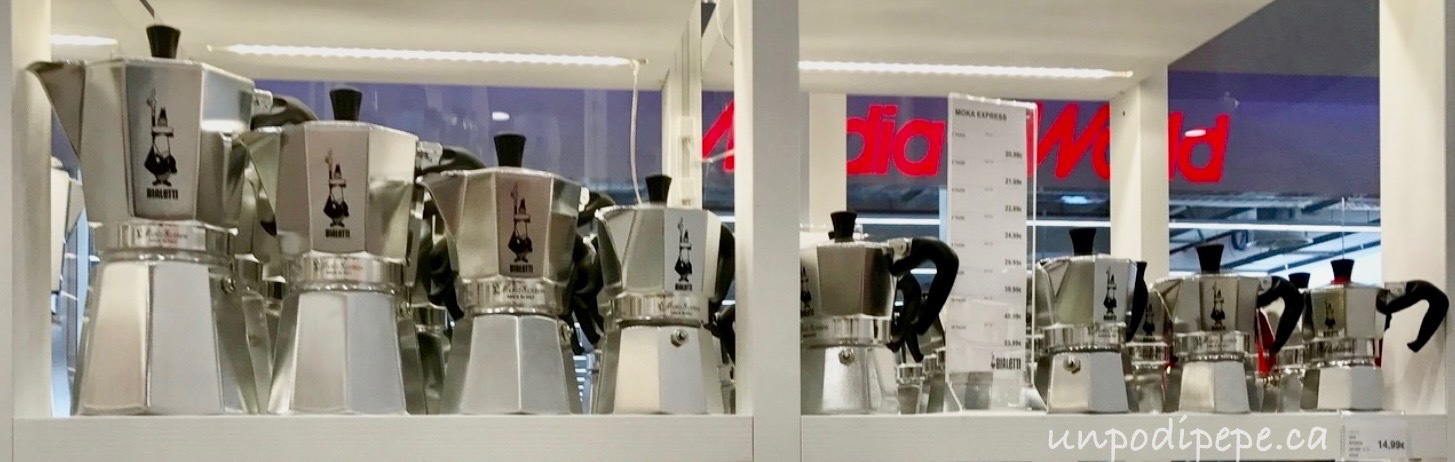
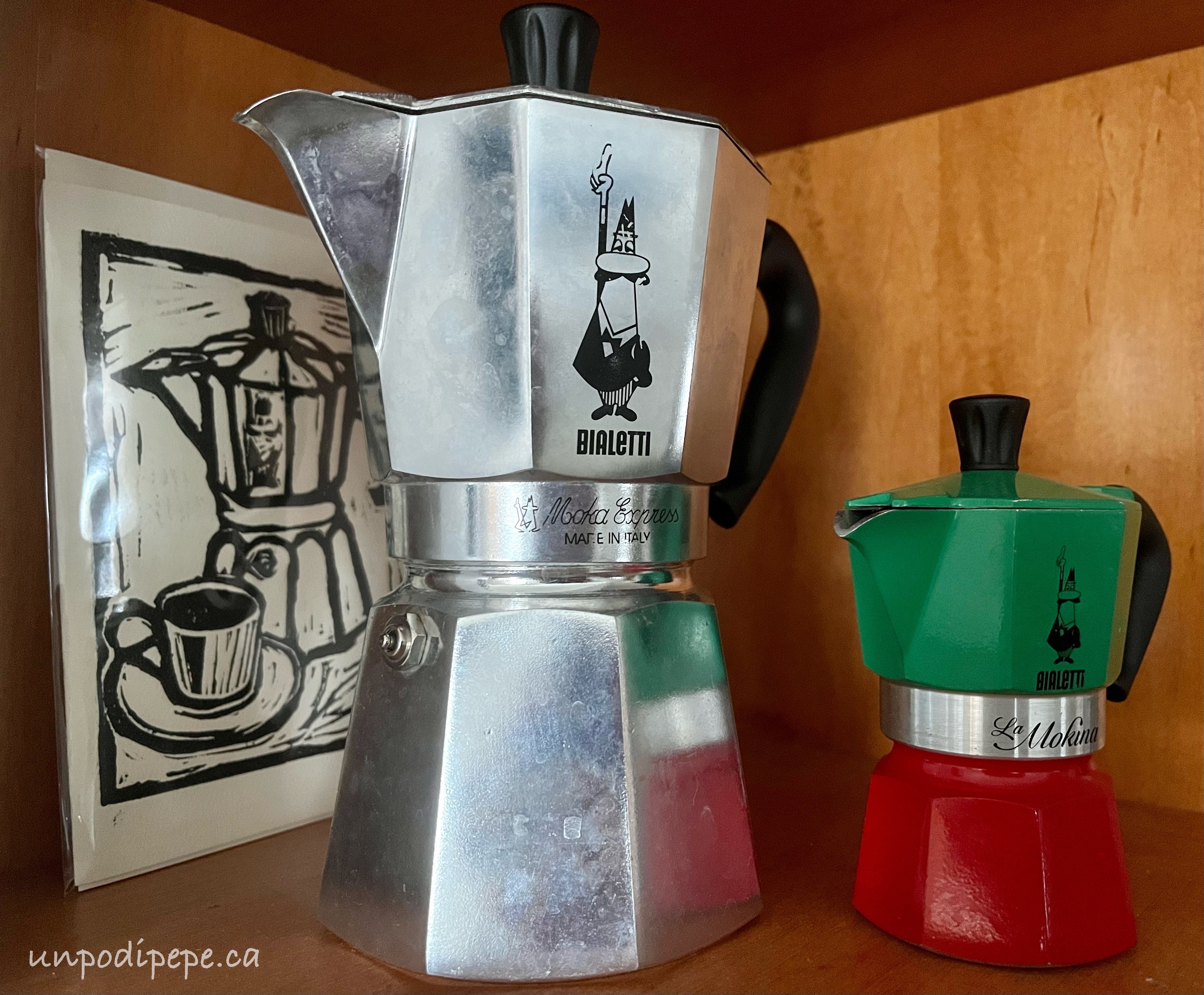
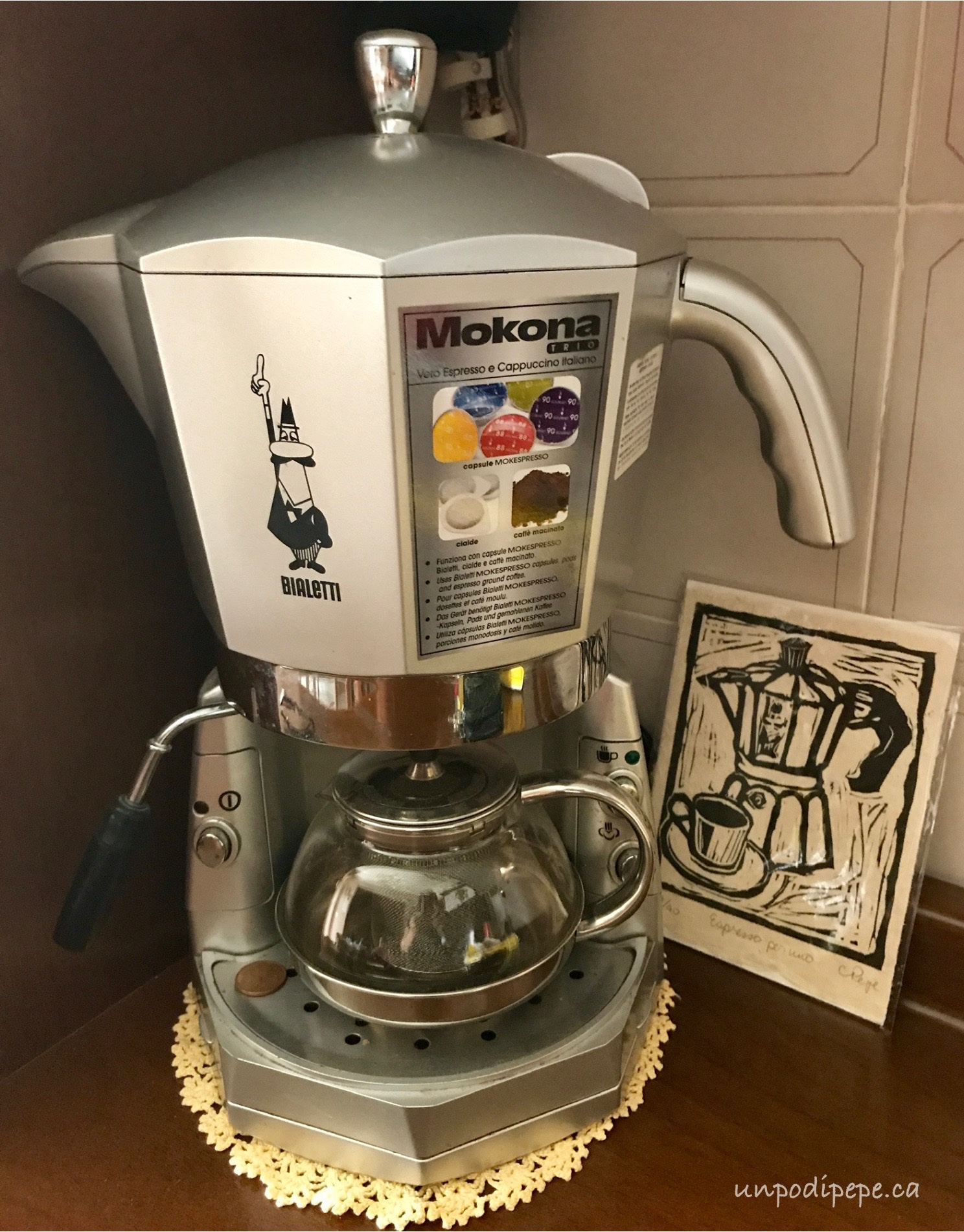
The original Moka was a 3 tazze (3 espresso cups) size, for single or small family use.  Now it is available in the tiny ½ tazza Mokina to the 18 tazze Moka Express. Also available are stainless steel models, the cow-hide patterned Mukka Express that froths milk at the same time-making a cappuccino, electric plug-in models, and even a red Dolce & Gabbana patterned Moka! I so need one of those!  I love Franco’s green ‘Alpina‘ model with the Alpini hat and feather!

When Renato Bialetti died in 2016 at age 93, his ashes were placed in a specially made large Moka. It was about the size of this one…..

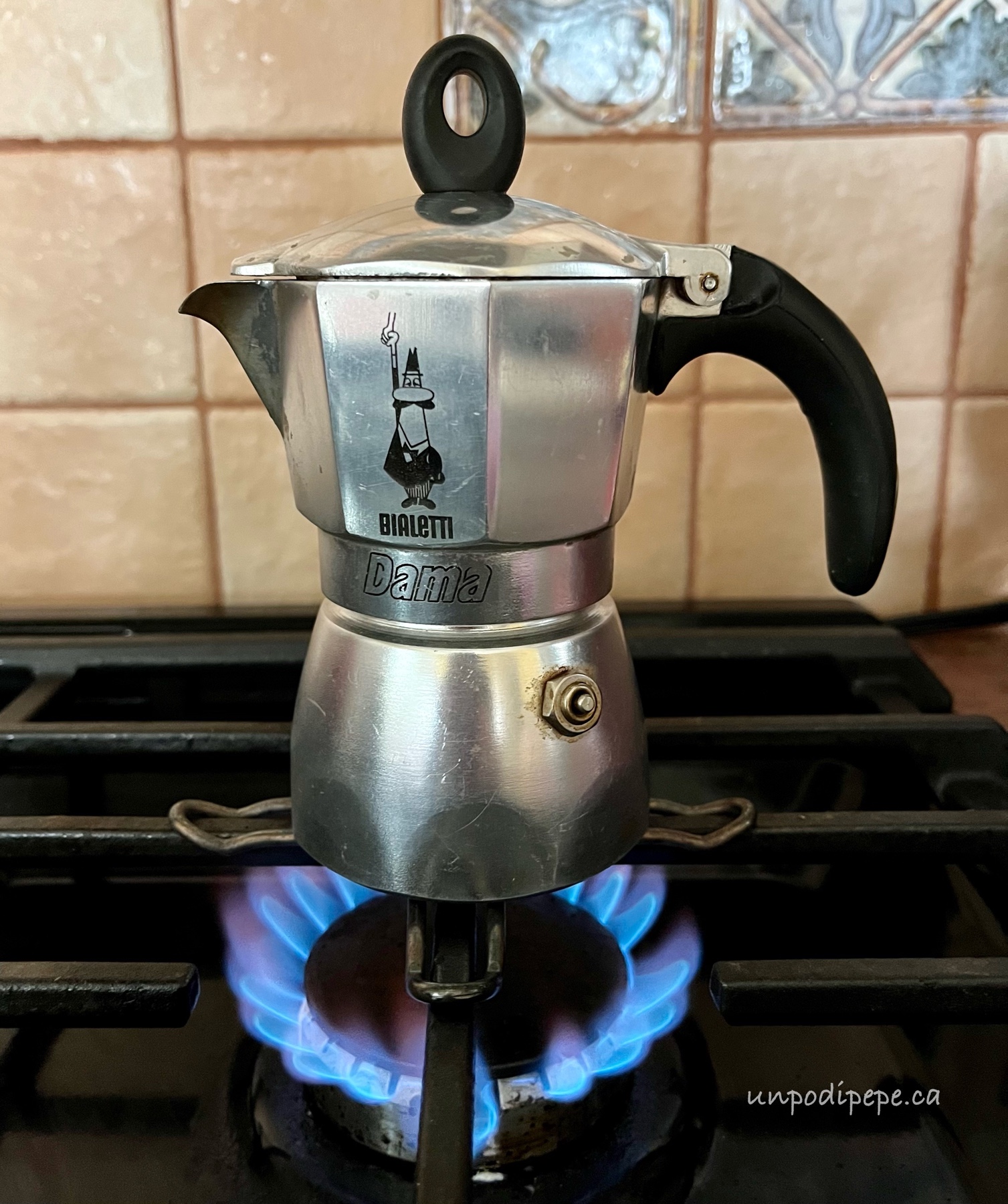
My 3 cup size, in the following photo, and the red one in the olive grove are the ‘Moka Dama‘.  A few of the features are different, but the design always remains similar to the original ‘retro’ look.

To use the Moka:

1 Pour room temperature water into the boiler until it reaches the safety valve. More water will result in watery caffè – or ‘acqua di cicoria’, as mamma calls it!

2 Drop the funnel into the boiler and fill generously with espresso ground coffee -avoid pressing it down

3 Place Moka on a small burner with a low flame

4 When you hear the gorgoglio – the gurgling sound, caffè is ready.  Remove from the burner and enjoy.

Since aluminum is porous, it absorbs the coffee aroma over time and improves its taste.  With a new Moka, ‘season’ it by making 2 consecutive pots and throwing out the caffe.  If the Moka has not been used for a long time, make a pot with just water, and also throw out the first pot of caffè.  Do not clean with detergent, just warm water.  Do not put your Moka in the dishwasher! A well-used Moka with a patina makes the best caffè. The rubber gasket needs to be replaced every year or so, depending on how much it is used.  If taken care of, the Moka will last a lifetime.

The Moka is an eco-friendly, sustainable way to make caffè.  There is zero waste -the grounds are 100% organic and compostable, no detergents are needed, it is long-lasting and made of 100% recyclable aluminum.

90% of Italian kitchens have a Moka.  Alfono Bialetti described the Moka as ‘fast, strong and resistant, like caffeine’.  With the Moka, a daily act was revolutionized, as caffè almost as good as you could get at the bar was brought into homes ‘in casa un espresso come al bar’.

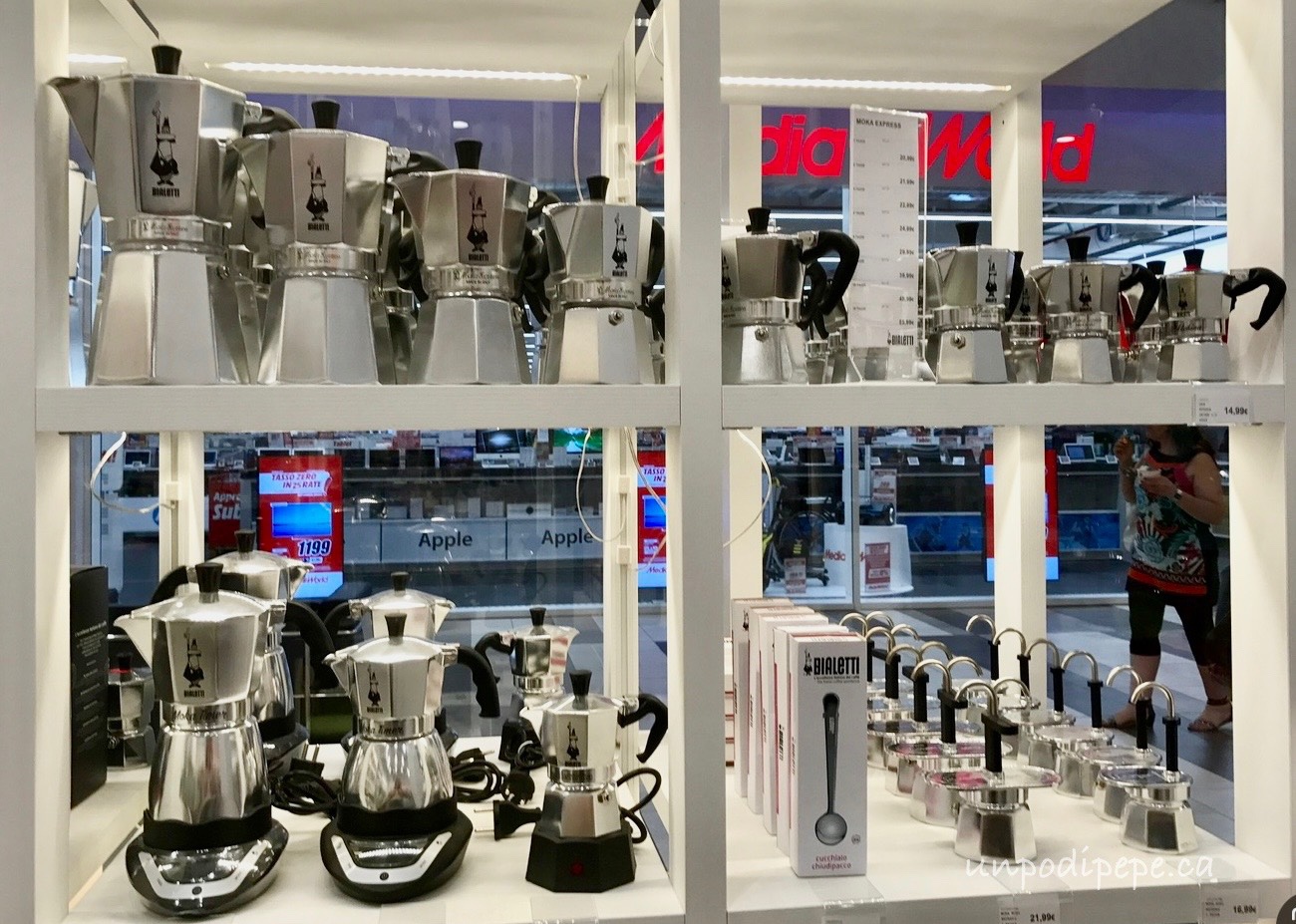
The photos in this post are of Moka caffettiere that belong to me or family members, and some were taken at the Bialetti store at the Centro Commercial GrandApulia.  The cartoon is from the Bialetti website.  Do you have a Moka?

***Somehow, I missed the fact that the previous post was my 200th!  So……to celebrate this milestone, I am giving away 2 signed copies of my linocut edition on handmade paper ‘Espresso per uno’.  Next week, I will put the names of everyone who left a comment on this post into a hat and draw 2 winners.  In bocca al lupo! Ciao, Cristina

Share this:

  • Share on Facebook (Opens in new window) Facebook
  • Share on Pinterest (Opens in new window) Pinterest
  • Share on X (Opens in new window) X
  • Email a link to a friend (Opens in new window) Email
  • Share on WhatsApp (Opens in new window) WhatsApp
Like Loading...

Enter your email address to follow 'un po' di pepe' and receive notifications of new posts by email.

Join 504 other subscribers
Follow Un po' di pepe on WordPress.com

Popular Posts

  • Pane e Salute
    Pane e Salute
  • Hairstyling in Ancient Roma
    Hairstyling in Ancient Roma
  • Italiano per Ristoranti~How to pronounce your restaurant menu
    Italiano per Ristoranti~How to pronounce your restaurant menu
  • Benvenuti ad Orsara di Puglia
    Benvenuti ad Orsara di Puglia
  • Artemisia Gentileschi
    Artemisia Gentileschi
  • Acqua Vergine
    Acqua Vergine
  • Ostia Antica
    Ostia Antica

Recent Posts

  • Pane e Salute
  • Sanremo 2026
  • Cucina Italiana Patrimonio UNESCO
  • 2025~Un po’ di pepe Year in Review
  • Castel del Monte
  • ‘The Nuances of Love’
  • Hostaria Antica Roma~Eat like an Ancient Roman
  • Santa Maria in Aracoeli
  • Casino dell’Aurora~Villa Boncompagni Ludovisi
  • Nasoni di Roma
  • Bloghiversario #11
  • Fontana di Trevi
  • Acqua Vergine
  • Giubileo 2025
  • Sanremo 2025
  • In Vino there are Memories
  • A Literary Harvest
  • 2024~Un po’ di pepe Year in Review
  • Buon Natale 2024
  • Il Bicerin
  • Mercato Porta Palazzo
  • Torino
  • Catanzaro, Calabria
  • Il Pumo Pugliese
  • Artemisia Gentileschi

Categories

Amici e Famiglia Architecture Art Art history Art projects Bilingual posts Blogging Canada Culture Feste Firenze Inspiration Italia Italian Folklore Italian language Italian life Italocanadesi Libri Mangiamo! Orsara di Puglia Parole piacevoli Photography Puglia Recipes Roma Travel Travel tips Uncategorized Vino

Archives

Un po’ di pepe on Facebook

Un po’ di pepe on Facebook

Start a Blog at WordPress.com.

  • Subscribe Subscribed
    • Un po' di pepe
    • Join 504 other subscribers
    • Already have a WordPress.com account? Log in now.
    • Un po' di pepe
    • Subscribe Subscribed
    • Sign up
    • Log in
    • Report this content
    • View site in Reader
    • Manage subscriptions
    • Collapse this bar
 

Loading Comments...
 

    %d