• Home
  • About me/Chi sono
  • Contact

Un po' di pepe

~ …… (oon∙poh∙dee∙PEH∙peh) Cristina writes about interesting stuff /Cristina scrive di cose interessanti

Un po' di pepe

Tag Archives: Musei Nazionale Romano

Beat the heat: Surviving Summer in Roma

19 Sunday Jun 2022

Posted by Un po' di pepe in Italia, Roma, Travel, Travel tips

≈ 16 Comments

Tags

Ferragosto, Italy travel tips, Musei Nazionale Romano, Roma, Roma travel, Summer in Italy, Summer in Roma, Surviving summer in Italy

Visiting Roma this summer? Summer in Roma can be hot, humid, sticky and crowded.  The temperature is usually >30° C (85°F) and the humidity can make it feel even hotter. I often hear people say ‘the worst time to go to Roma/Italy is in the summer-it’s too hot!’  Well…anytime is a good time to go.  Whatever time works for you.  You will just have a different experience depending on the season.  Teachers, students, school employees and families with bambini in school can only travel in summer, so advising them to visit at another time is not helpful.
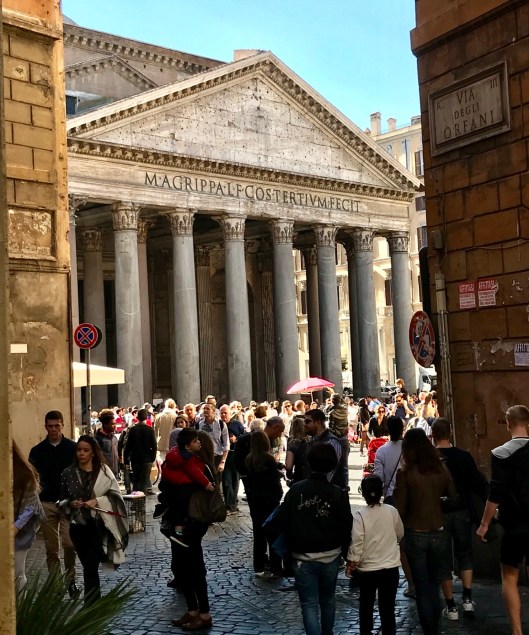
For those of us that go to visit family, especially in smaller villages, August is often the best time to be there.  In my small mountain village in Puglia there are feste and concerts, my friends and relatives have time off work, and those who have moved away for work come back to visit. This is why I go in summer.

Roma will have a decreased amount of Romans for the 2 weeks around Ferragosto Aug 15th. Many Romans head to ‘la spiaggia’ so it will be less crowded with fewer cars on the road.  Office and public workers are off or have decreased working hours. A lot of smaller businesses are closed as well. Do not worry, there will be more than enough restaurants open that nobody will starve. August 15th is a national holiday, so definitely avoid travel on that particular day. Public transportation will be reduced and nearly everything will be closed. Museums and cultural sites will be open. July is actually more crowded than August. For more info on this, read the post Chiuso per Ferie.

I visit Roma for a few days every summer at the beginning or end of my trip to Puglia and consider myself quite the expert on managing the intense heat and crowds. Here are my tips for surviving summer in Roma:

1-Schedule the day like an Italian!  Quando a Roma, fai come i Romani/ When in Roma…..

A- Mattina/Morning Wake up early and do your stuff in the morning. Visit ‘non shady’ sites in the morning, as they will be too hot to do in the afternoon. These include the Colosseo, Foro Romano, Piazza Navona and Passeggiata all’Aventino.
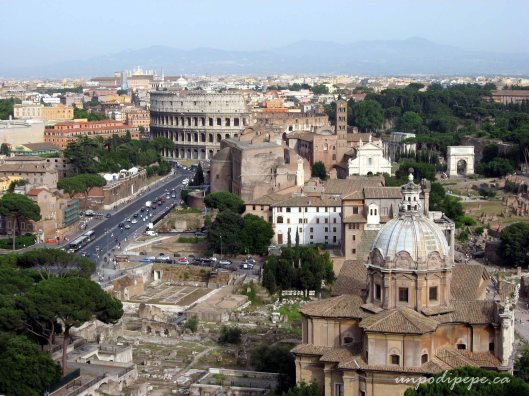
B Pomeriggio/afternoon During the hottest part of the day-1-5 pm, participate in the riposo or ‘pausa pranzo’.  (**Note that this is not known as siesta in Italian) This is a ‘rest period’ and many places are closed. This is not always the case in the larger cities or touristy areas, but it makes sense to follow when it is hot.  Have pranzo-the main meal, at 1pm, enjoying the interior of a cool restaurant, then if your lodgings are close by, have a rest, take a nap or check email. Keep it dark with closed shutters/curtains while staying indoors, and also while you are out, so it stays cool.

If it is not feasible or you do not want to participate in the ‘pausa pranzo’  visit cool places during this time. For example:

1-Visit churches! Roma has >900 churches- they are dark, cool, free and may even have seats.  Some, like San Luigi dei Francesi and Sant’Agostino even have their own Caravaggio works for you to drool over. For the full walking tour, go to  Caffè con Caravaggio a Roma.  Santa Maria Sopra Minerva, the Pantheon and Santa Prassede are 3 other favourites of mine.  Smaller churches may be closed during pausa pranzo, but many are open. Sometimes you even find things by happy accident. I once stepped into Santa Brigida, a very traditional Scandinavian church in Piazza Farnese for a 3 pm Mass which included otherworldly sounding chanting and singing by cloistered nuns.
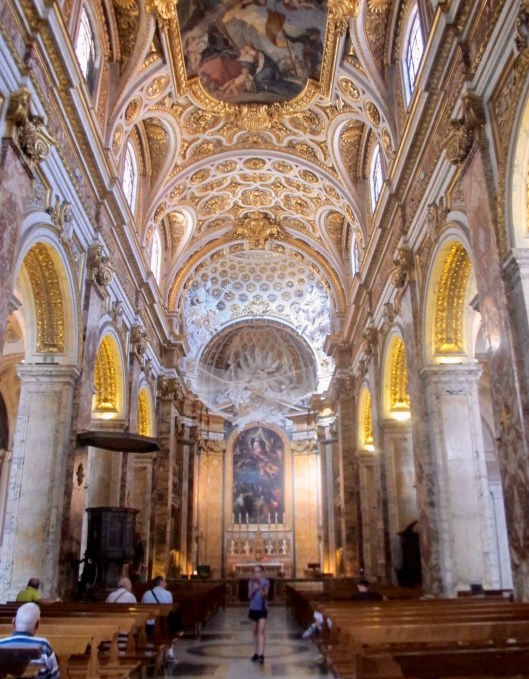
***Important Note about churches – Churches are primarily places of worship, so please be respectful.  Dress appropriately, speak quietly-if the artwork does not render you speechless. Avoid Mass times, especially on Sundays.  It may not be possible to visit unless you are attending Mass. There is no charge to visit most churches, but I always like to light a candle when I visit (€.50-€1).

2 –Visit museums Most are air conditioned and open until 1900 (7pm). My favourites are Centrale Montemartini and Palazzo Massimo alle Terme which is downright cold-especially the top  floor where the fresco villas are.

Both of these museums are never crowded, even in high season. Galleria Borghese requires a reservation and you can only stay 2 hours.  If you time the visit right, go to Villa Borghese afterwards and find shade under a tree.

Smaller museums might not have air conditioning.  **A note on AC.  Electricity is expensive in Europe.  The AC is cool, but not cold like it usually is in North America. Read my amusing post Aria Pericolosa for more on this topic!

3- Go underground and visit the Catacombs of Domitilla, 12 km of cool underground tunnels from the 2nd to the 5th Century or the Basilica San Clemente which has 3 layers of churches, ending in a Mithrean temple.

C Sera/evening Get back out in the early evening, then stay out late enjoying the fresh air and longer days. Go for aperitivo! Pop up restaurants, wine bars and stands line the Tevere in summer near Ponte Sisto and Isola Tiberina.

Villa Celimontana holds an outdoor evening jazz festival from June-August. This is also a great time for a passeggiata in Piazza Navona or Trastevere.  There is a  Colosseo night tour as well as tour of the underground and the Forum. These can be booked online.  Roma also has several roof bars including the Terrazza Borromeo, Hotel Pantheon and Hotel Minerva.

More hot weather advice:

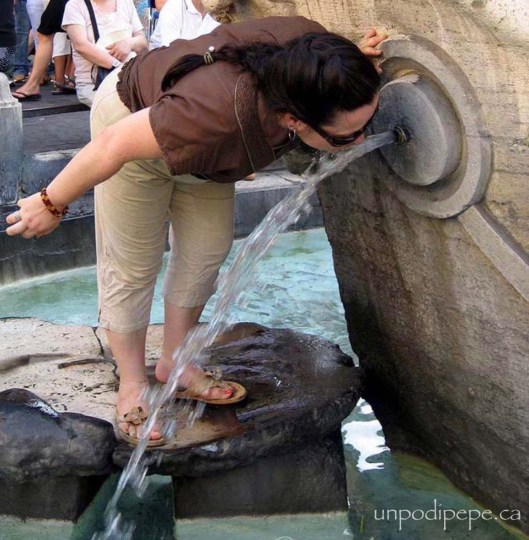
2 Keep hydrated Bring a water bottle and drink from from the >2500 cast iron nasoni or ‘big noses’.  These are running water fountains all over the city, most with SPQR stamped on the front.  This one in front of the Pantheon is one of the 3 oldest nasoni, with dragon spouts.
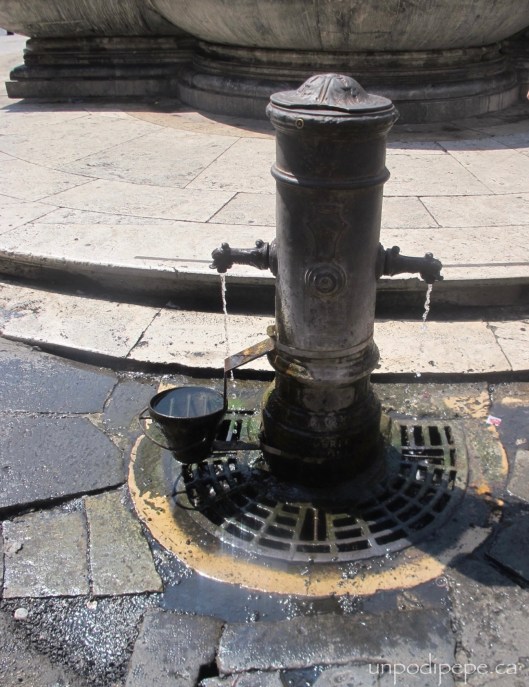
Nasoni were installed in 1874 to make cold drinking water from acqueducts free and accessible to all. Place your hand under the main flow and drink from the gush out the top. My favourite place to drink is La Barcaccia in Piazza di Spagna. The water comes straight from Acqua Vergine, an ancient aqueduct, and is absolutely freddissima!
3 Granita e gelato! Gelato will keep you cool. As if an excuse for more gelato is ever needed! I find the fruit flavors most refreshing, especially limone and pompelmo rosa (pink grapefruit).  You must try a granita di caffè at Tazza d’oro near the Pantheon. Also refreshing are Caffé Shakerato, Affogato and Grattachecca. It is hard to find bad gelato. There is Gelato del Teatro, Grom, Gelato San Crispino and 9 locations of Fatamorgana. My favourite is Danielgelo, a small family run gelateria near where I usually stay, in the San Paolo area.

Granita di caffe

4 Dress appropriately Wear a hat! Use sunscreen and dress lightly in layered breathable fabrics such as linen or cotton. Bring a light shawl or coverup if planning to visit churches, especially the Vatican. Walk on the shady side of the street, if possible. Buy a souvenir folding Roma fan.  They are available at all the souvenir stands for 2-3 Euro.

Should you avoid going to Italia in August? Absolutely not! If that is when you are able to go-then do it! Hopefully my tips will help. Be sure to click on the post links. Also remember the positive things about summer in Italia-the long days and wonderfully cool evenings, sky so blue it does not look real, the cast shadows of the mid afternoon sun and the seasonal summer food 😋.

Buon viaggio, Cristina

Share this:

  • Share on Facebook (Opens in new window) Facebook
  • Share on Pinterest (Opens in new window) Pinterest
  • Share on X (Opens in new window) X
  • Email a link to a friend (Opens in new window) Email
  • Share on WhatsApp (Opens in new window) WhatsApp
Like Loading...

Palazzo Massimo alle Terme, Roma

16 Monday Jan 2017

Posted by Un po' di pepe in Art, Culture, Italia, Roma, Travel

≈ 15 Comments

Tags

Augustan Villa of the Farnesina, Musei Nazionale Romano, Palazzo Massimo alle Terme, Roma, Villa Livia

giardinovillaliviaOne of the best museums in Roma is nascosto in piena vista. Hidden in plain sight near Stazione Termini, Palazzo Massimo alle Terme contains one of the most important collections of classical art.  It is right across the street from Stazione Termini, visible from the bus loop on the way to Piazza dei Cinquecento. The first time I visited Palazzo Massimo was in 2006 when my friend who lives in Roma recommended it. There were only about 10 other people in the building!palazzomassimo

When I was in Roma this summer, it was too hot to be out in the afternoon, so I decided to visit the museum. This turned out to be a great idea, since the top floor with the mosaics and detached frescos is downright cold!  Brrrr!  It was so refreshing! There were more than 10 people in the museum this time, but I still felt like I almost had the place to myself.

Built by Principe Massimiliano Massimo for the Jesuit Collegio Romano, the Palazzo became the first Liceo (high school) in Roma in 1871. Except for a brief period as a WWII military hospital,l the Liceo was open until 1960.  In the 1980’s, in a state of neglect, it was purchased for the Museo Nazionale Romano.  Renovations were completed in 1998.  Palazzo Massimo is now 4 stories of classical amazingness.  700 years (200 BC to 500 AD) of Ancient Roman history, myths, artistic culture and everyday life are on display in the form of sculpture, fresco, mosaic, jewellery and coins.

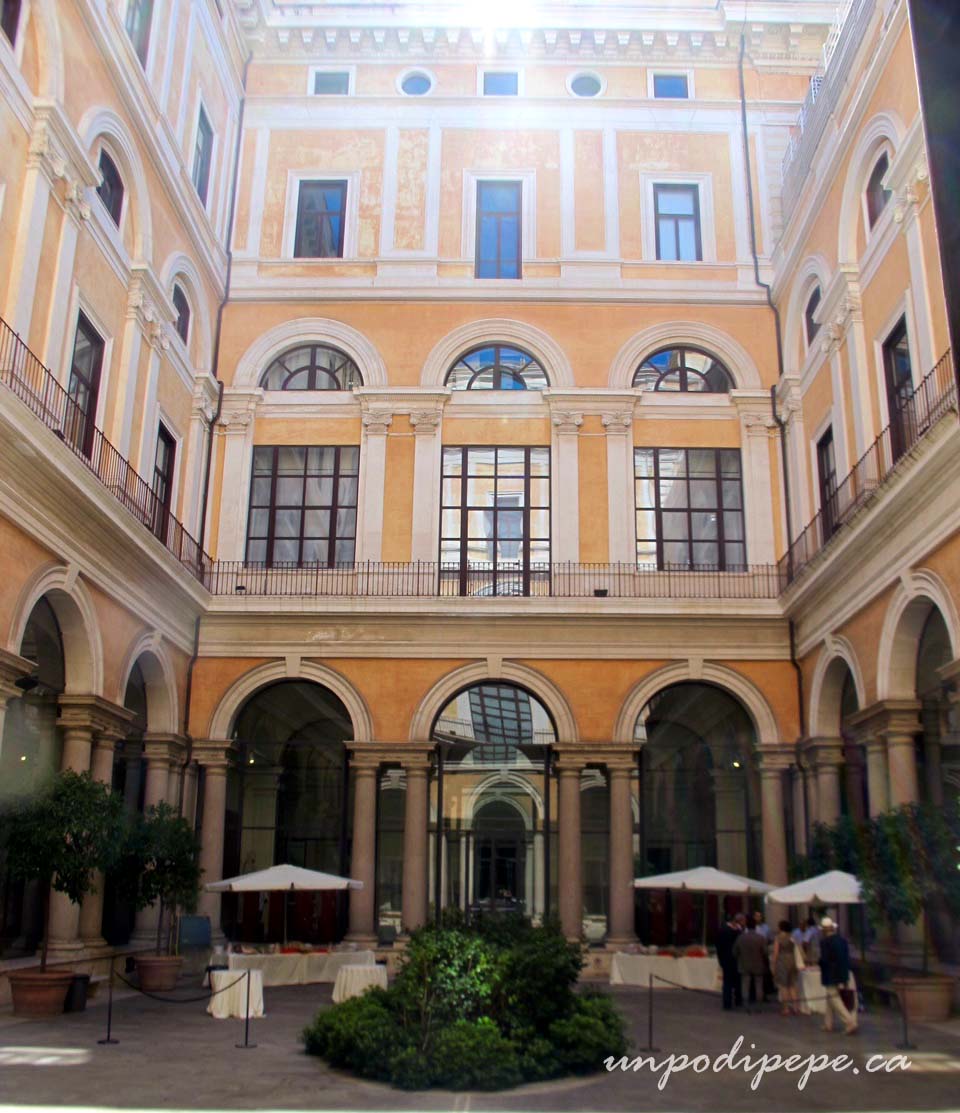
Central Courtyard, Palazzo Massimo

Central Courtyard, Palazzo Massimo

What is extra cool about the artifacts in Palazzo Massimo is how they got to be there. Previous to the museum opening, most of this priceless stuff was in storage in the Roma city works yard!  In a city as old as Roma, anywhere you break dirt, something will be found.  During construction of the Metro, new roads, or any municipal work involving digging, artifacts were found, tagged and stored. Every piece in the museum has a sign with a written description in Italian and English.  In between the two is stated (in Italiano only) precisely where and when it was found, and in some cases by whom.  For example ‘Roma, Piazza Venezia, Construction of National Monument to Vittorio Emanuele II’, or ‘Subiaco, recovered by the Guardia di Finanza (revenue or tax police, involved in recovery of stolen artifacts)’.  Reading these signs is exciting because you may have walked over that very spot the day before!  Ok, maybe you won’t be as excited as me, but I am a total archeology geek so I find this fascinating!

The ground floor of Palazzo Massimo displays Greek originals discovered in Roma, such as The Dying Niobid, and the magnificent Pugile in riposo, the 2nd Century BC bronze Boxer at Rest, wearing leather hand wraps.  He is so realistic with his broken nose, cuts and deformed ears, you can feel the emotion in his face.

'Pugile a Riposo' Found in 1885 on the Quirinale Hill, where the Baths of Constantine once were.

‘Pugile a Riposo’ Found in 1885 on the Quirinale Hill, where the Baths of Constantine once were.

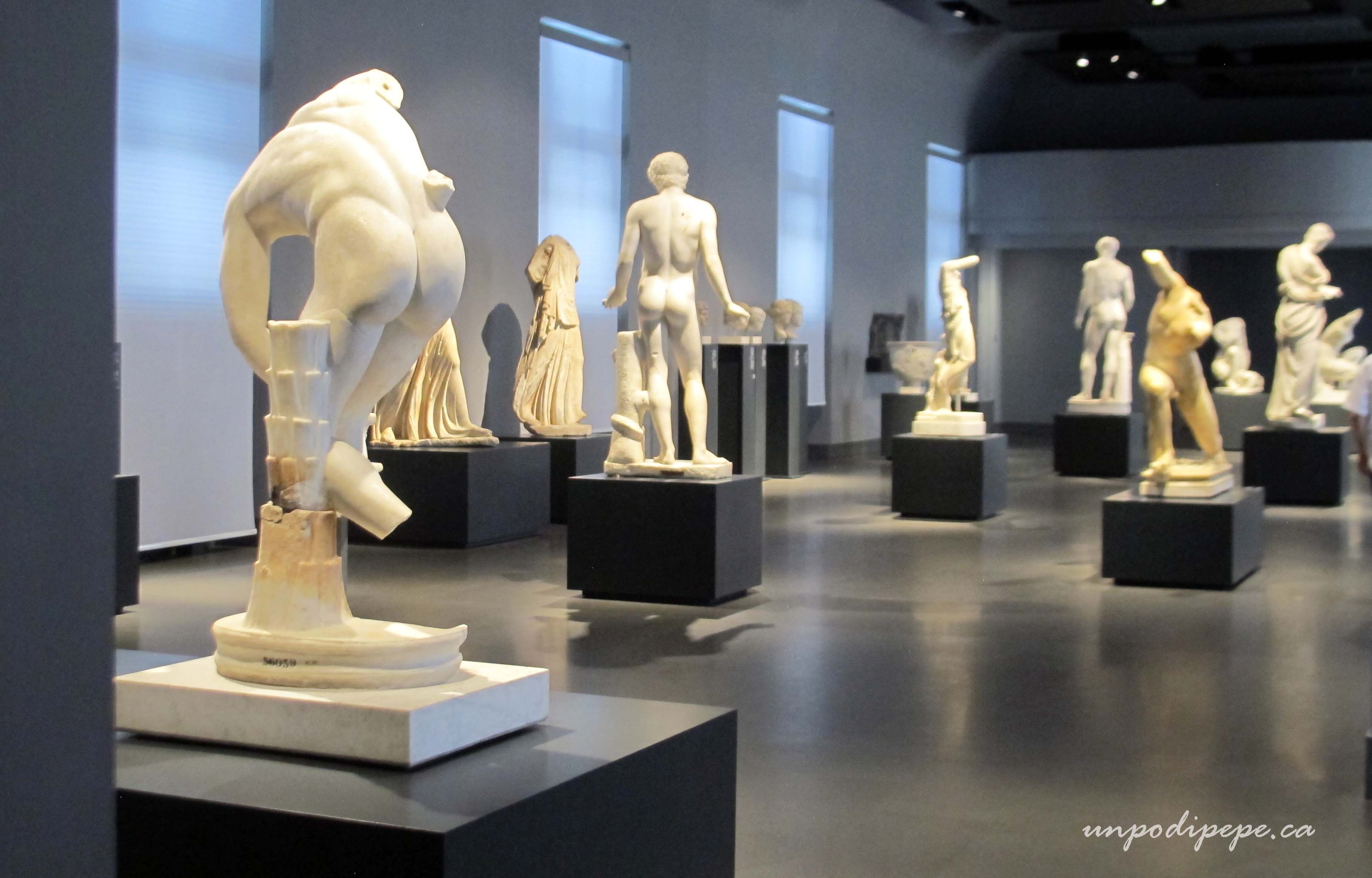
This floor also has a Roman calendar, portraiture from the Republican and Imperial ages, and sarcophagi, such as the sarcophagus of Portonacci with battle scenes carved in relief.statuarypalazzomassimo

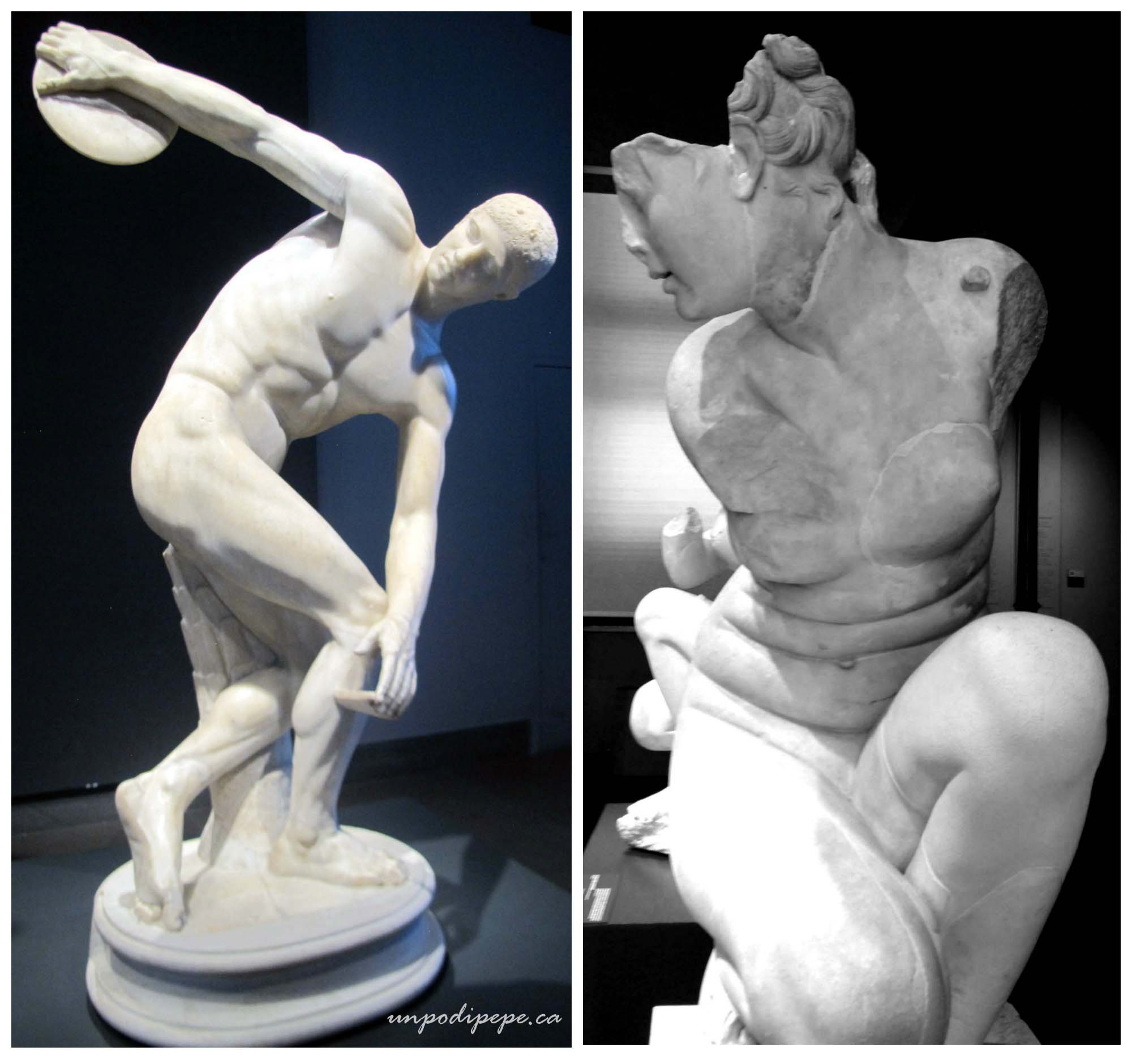
The first floor (2nd floor to North Americans) has masterpieces of statuary, including the Maiden of Antium, Il Discobolo, a Crouching Aphrodite after Diodalses found at Villa Adriana in Tivoli in 1920, and the Sleeping Hermaphrodite.  There are also all the surviving bronze sculptures, fittings and a head of Medusa that decorated Caligula’s floating palaces, the Nemi ships.  These vessels were recovered in the 1920’s by draining Lago di Nemi, only to be destroyed by enemy fire in 1944.

Il Discobolo and a Crouching Aphrodite from Villa Adriana in Tivoli. Both are Roman reproductions of Greek originals

Il Discobolo and a Crouching Aphrodite from Villa Adriana in Tivoli. Both are Roman reproductions of Greek originals

The top floor takes us on an intimate tour of the domestic decor inside Roman homes. An amazing discovery was made right across the street in 1947, during the renovations to Termini and construction of Metro line B. It was a complex from 130-140 AD built in a grid system of private homes, public baths, warehouses, and apartments with shops at street level.  There was pavement and a functioning drainage system. It was all destroyed to make way for quick construction of the new buildings! Aaaahhh!  Luckily the site was well-documented so that the 270 m² of wall frescos and pavement mosaics that were preserved could be reassembled. Part of it is displayed here where 3 rooms of a Domus (Roman house) have been reconstructed to their original size.  Ironically, these rooms face a window looking out at where they used to be.

The 1948 photo from Palazzo Massimo of the site across the street. You can see that the mosaic is the same one that is now in the museum

The 1948 photo from Palazzo Massimo of the site across the street. You can see that the mosaic is the same one that is now in the museum

The Augustan Villa of the Farnesina was discovered in Trastevere in 1879 during work along the river.  The site has since been destroyed, but the vibrantly coloured frescoes were detached and stored for 120 years before being installed in Palazzo Massimo, in accurately reconstructed rooms of their original dimensions.  There is a portico, dining room and 2 Vermillion coloured cubicola (bedrooms) with mythological and erotic paintings, and several hallways.  The rooms are reassembled how they were, so it is like walking through a Roman villa.  Decorating the walls of upper class houses with paintings of mythological or literary subjects was supposed to stimulate cultured conversation. In this villa, there are many references to the Egyptian world in the decorations, celebrating the conquest of Egypt. The owner is thought to have been General Marcus Vipsanius Agrippa, son-in-law of Augustus, who defeated Marc Anthony and Cleopatra at the Battle of Actium in 31 BC.villafarnesinacollage

The final treasure is the 1st Century BC frescoes from Villa Livia, discovered on Via Flaminia in 1863.  The villa belonged to Livia Drusilla, wife of Emperor Augustus.  The paintings of a lush green garden with birds, pomegranate and lemon trees, roses, irises and other plants decorated a vaulted room that was half underground. The large room is recreated here.  It was probably a cool triclinium, a living and dining room for  the summer. villaliviaThe basement has the history of the Roman Empire in coins. It has been converted into a vault for the Medagliere, the coin cabinet and jewellery.

Palazzo Massimo is one of 4 musei that make up the Museo Nazionale Romano. Tickets are €7 for adults, valid for 3 days for all 4 sites.  The other sites are:  Terme di Diocleziano, Palazzo Altemps and Crypta Balbi. Open Tues to Sunday 0900-1945. If you love antiquities, don’t miss it! Ciao, Cristina

Share this:

  • Share on Facebook (Opens in new window) Facebook
  • Share on Pinterest (Opens in new window) Pinterest
  • Share on X (Opens in new window) X
  • Email a link to a friend (Opens in new window) Email
  • Share on WhatsApp (Opens in new window) WhatsApp
Like Loading...

Enter your email address to follow 'un po' di pepe' and receive notifications of new posts by email.

Join 511 other subscribers
Follow Un po' di pepe on WordPress.com

Popular Posts

  • Hairstyling in Ancient Roma
    Hairstyling in Ancient Roma
  • Cucina Italiana Patrimonio UNESCO
    Cucina Italiana Patrimonio UNESCO
  • Grano Arso
    Grano Arso
  • Napoli Street Art
    Napoli Street Art
  • Hostaria Antica Roma~Eat like an Ancient Roman
    Hostaria Antica Roma~Eat like an Ancient Roman
  • Italiano per Ristoranti~How to pronounce your restaurant menu
    Italiano per Ristoranti~How to pronounce your restaurant menu
  • Italian Christmas Vocabulary
    Italian Christmas Vocabulary

Recent Posts

  • Cucina Italiana Patrimonio UNESCO
  • 2025~Un po’ di pepe Year in Review
  • Castel del Monte
  • ‘The Nuances of Love’
  • Hostaria Antica Roma~Eat like an Ancient Roman
  • Santa Maria in Aracoeli
  • Casino dell’Aurora~Villa Boncompagni Ludovisi
  • Nasoni di Roma
  • Bloghiversario #11
  • Fontana di Trevi
  • Acqua Vergine
  • Giubileo 2025
  • Sanremo 2025
  • In Vino there are Memories
  • A Literary Harvest
  • 2024~Un po’ di pepe Year in Review
  • Buon Natale 2024
  • Il Bicerin
  • Mercato Porta Palazzo
  • Torino
  • Catanzaro, Calabria
  • Il Pumo Pugliese
  • Artemisia Gentileschi
  • Cavalli di San Marco
  • Panzerotti

Categories

Amici e Famiglia Architecture Art Art history Art projects Bilingual posts Blogging Canada Culture Feste Firenze Inspiration Italia Italian Folklore Italian language Italian life Italocanadesi Libri Mangiamo! Orsara di Puglia Parole piacevoli Photography Puglia Recipes Roma Travel Travel tips Uncategorized Vino

Archives

Un po’ di pepe on Facebook

Un po’ di pepe on Facebook

Start a Blog at WordPress.com.

  • Subscribe Subscribed
    • Un po' di pepe
    • Join 511 other subscribers
    • Already have a WordPress.com account? Log in now.
    • Un po' di pepe
    • Subscribe Subscribed
    • Sign up
    • Log in
    • Report this content
    • View site in Reader
    • Manage subscriptions
    • Collapse this bar
 

Loading Comments...
 

    %d