• Home
  • About me/Chi sono
  • Contact

Un po' di pepe

~ …… (oon∙poh∙dee∙PEH∙peh) Cristina writes about interesting stuff /Cristina scrive di cose interessanti

Un po' di pepe

Category Archives: Roma

Hostaria Antica Roma~Eat like an Ancient Roman

26 Friday Sep 2025

Posted by Un po' di pepe in Mangiamo!, Roma

≈ 8 Comments

Tags

Ancient Roma, Apicius, Cetara, Colatura di alici, De re Coquinaria, Garum, Gastronomic history, Moretum, Paolo Magnanimi, Traditional recipes, Via Appia Antica

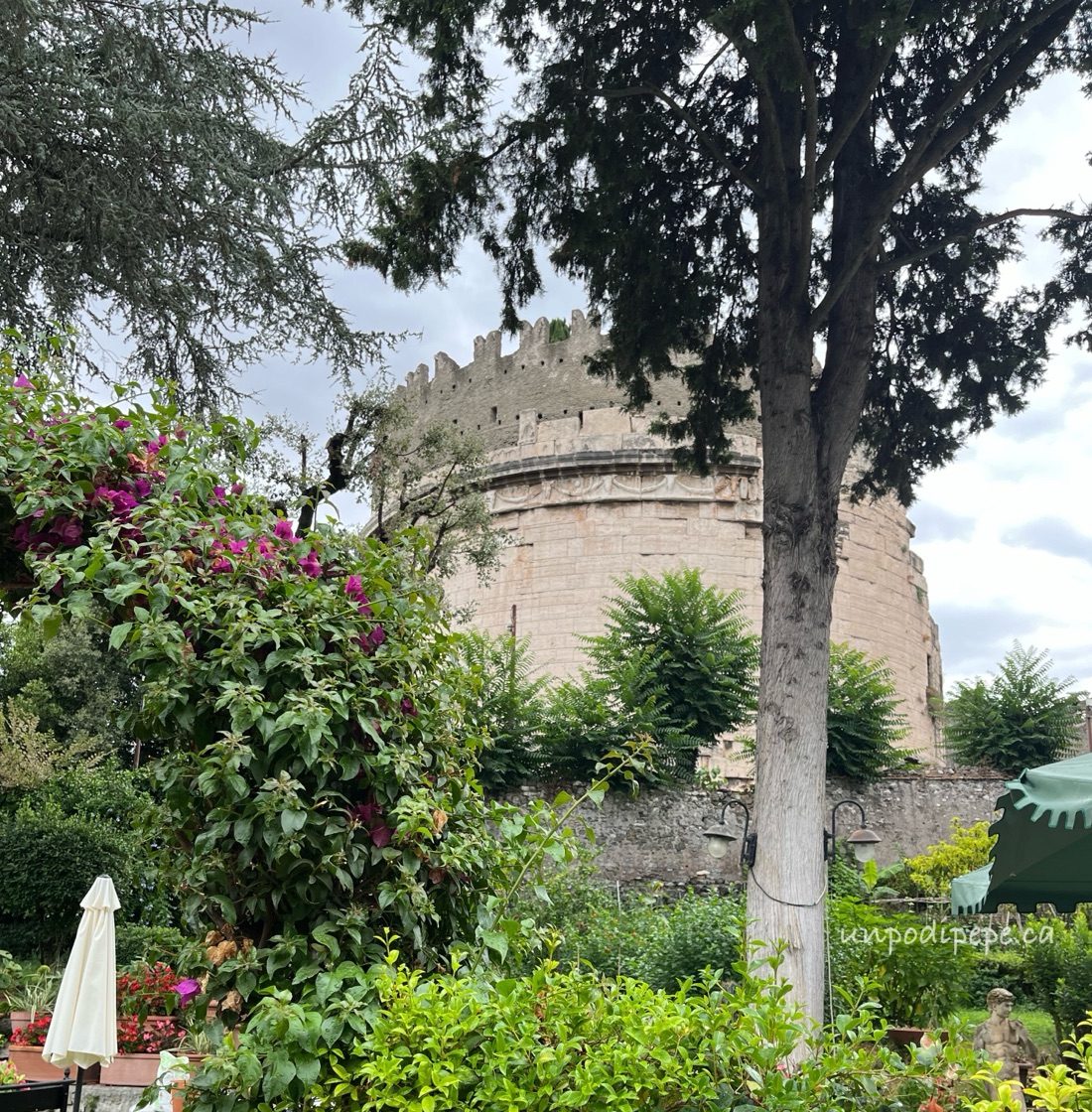
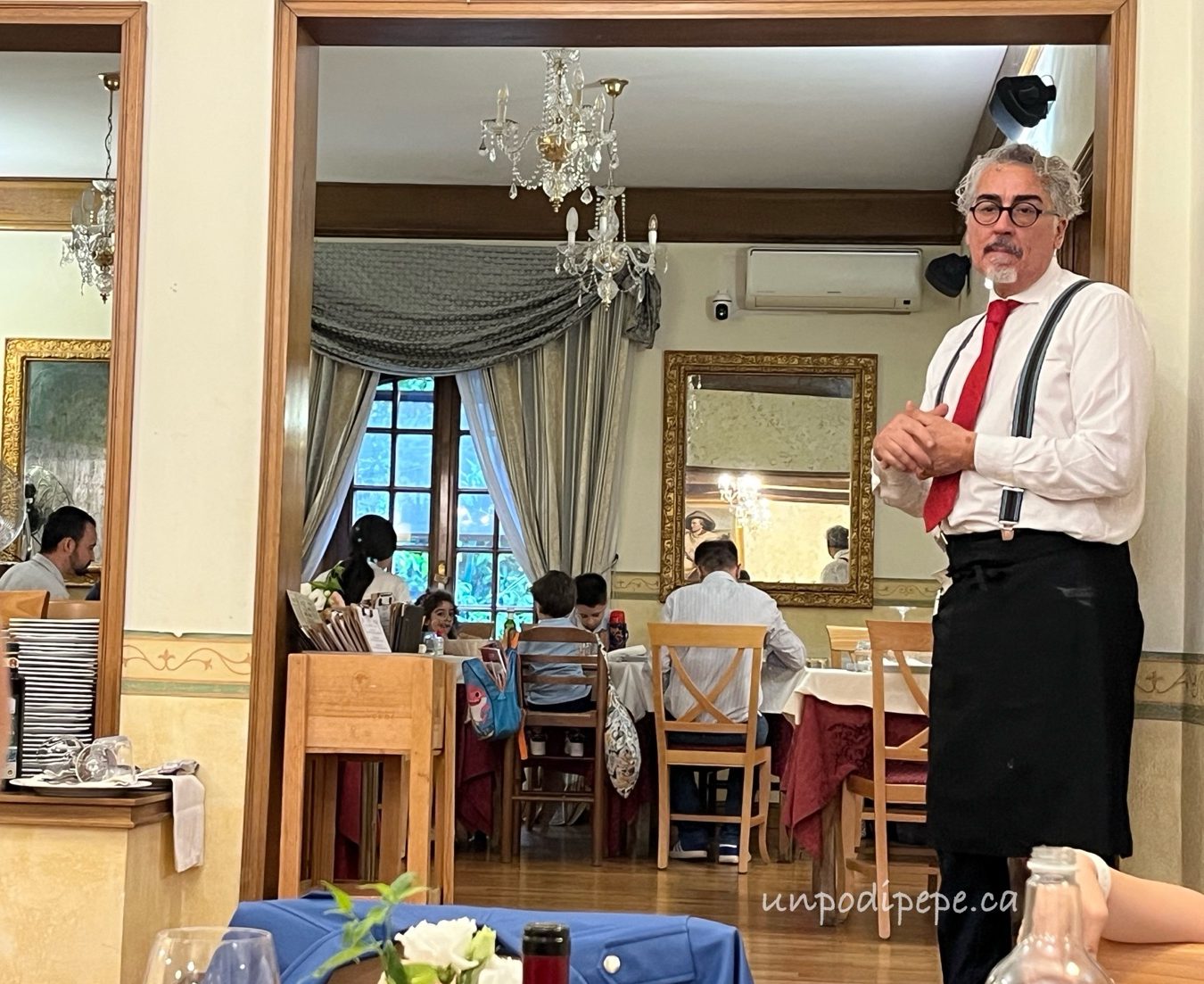
What do you do when a planned daytrip from Roma is cancelled because of pouring rain?  Go and have a meal like the ancient Romans! My friend and I went to Via Appia Antica-the Ancient Appian Way, a road from Roma to Brindisi. Close to the Catacombs of Domitilla, and almost right below the cylindrical Tomba di Cecilia Metella is Hostaria Antica Roma. Here, at his family’s ristorante, Paolo Magnanimi, an amateur gastronomic archeologist, has researched and is reviving 2,000 year old ancient Roman recipes. We enjoyed a delicious meal, enriched by explanation and commentary from Paolo.  It was an educational culinary journey into the past.
The restaurant serves traditional ‘modern’ Roman cuisine, but also a tasting menu called ‘A Tavola con Apicio’ (At the table with Apicius) closely based on the recipes in the 1st Century AD ‘De Re Coquinaria’ /On the subject of Cooking’, the only surviving cookbook from Ancient Roma. It is thought to have been compiled by Apicio -Marcus Gavius Apicius, a wealthy epicure/food lover. He was described by Pliny the Elder as ‘the most gluttonous gorger of all spendthrifts’.  Ouch! Just like Nonna’s, the ancient recipes only include ingredients, not quantities, proportions or instructions.  Paolo recreates the dishes using -as much as possible-only ingredients available at the time.  Ingredients inclucing sugar, chocolate, basil and tomato were not available in the 1stCentury.
We started off with ‘Gustum’ an antipasto platter consisting of a selection of everyday ancient snacks made with local products.  I believe this menu item usually needs to be ordered in advance.  Fortunately for us, a table had reserved for 6 people, but only 5 were there, so we were able to take the extra one!  Clockwise from the top of the photo:

Libum di Catone a bread described by Cato as a sacred symbol of devotion.  It was made with wheat flour, sheep milk ricotta, eggs and honey, and baked on a layer of bay laurel leaves. Now I know what I will do with my extra bay leaves!

Moretum was described by the poet Virgil as an everyday dish of the ancient Romans. This is the ancestor of Pesto, but named after the mortar instead of the pestle.  Moretum is made with pecorino-fresh sheep milk cheese, garlic, herbs such as coriander and celery seed, salt, nuts and olive oil. It can be eaten on its own or spread onto libum.  Paolo grinds together his ingredients with the mortar and pestle, just as described by Virgil.

Prosciutto cotto (ham) with honey and fresh pecorino

Epityrium a spread, similar to a tapenade, of olives and herbs, including cumin, fennel, coriander and sometimes mint. It was served on bread

For our primo or first course, we had the ancestor of modern lasagne, Patina Cotidiana, which is Latin for ‘daily dish’.  The pasta sheets are called laganum.  If any of you believe Marco Polo brought pasta to Italy from China in the 13th Century, that is ‘leggenda metropolitana’, an urban myth.  Boiled laganum are layered with ground beef, fennel and pecorino.  It is ‘in bianco’, meaning no tomato, since the tomato did not arrive in Europe until the 1500’s, and was not even an edible product at that time. Click on Il Pomodoro for the history of the modern tomato.
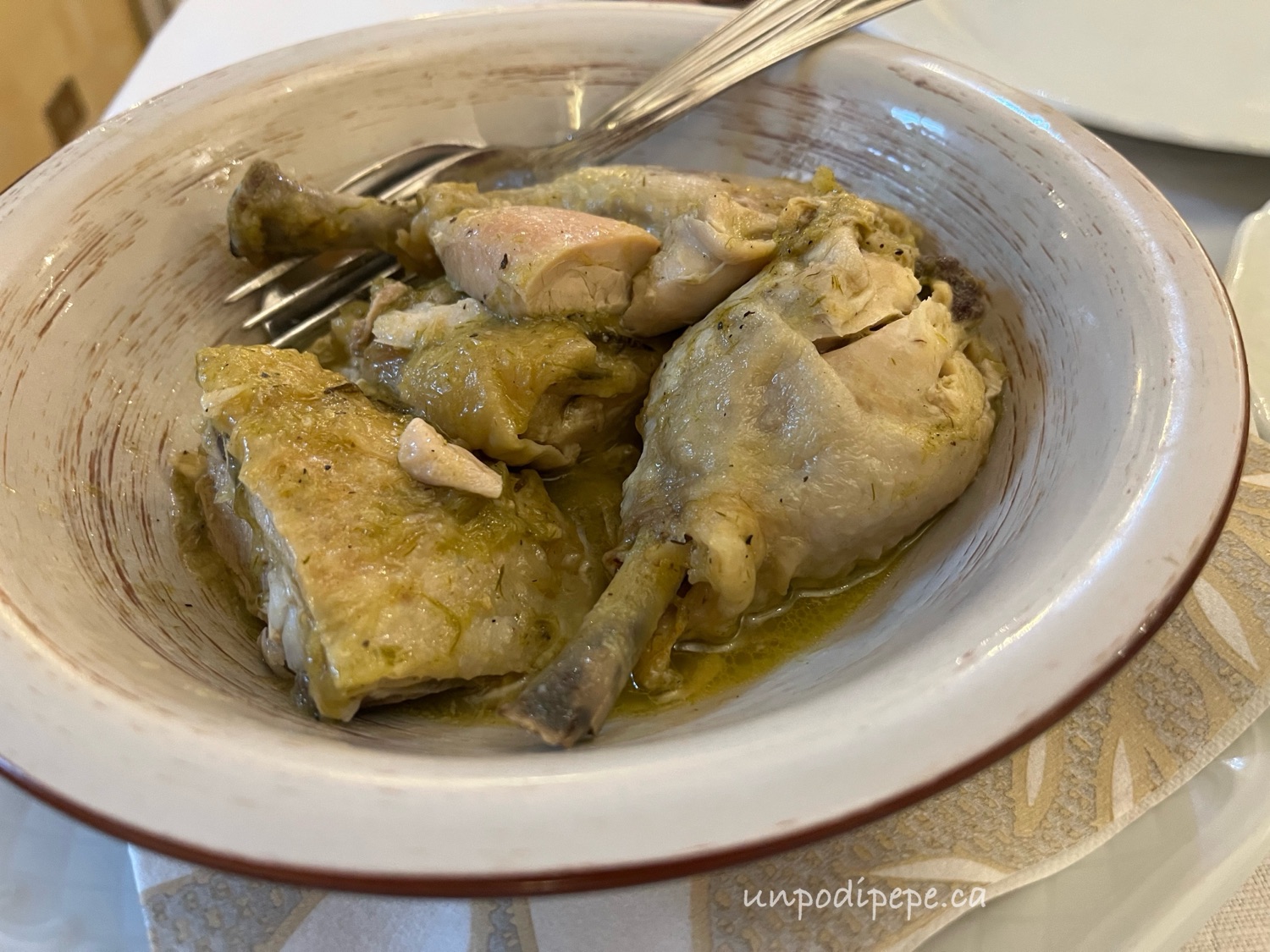
Our secondo or second course was Pollum Oxizomum, chicken cooked with pieces of leek, olive oil, vinegar and garum.  Garum was a fermented fish sauce that was a staple condiment in the ancient Roman kitchen.  75% of the recipes in De re Coquinaria include garum!  At the archeological site of Ostia Antica, one of the market stalls with fish mosaics likely sold the intensely flavoured Garum!  Today, colatura di alici di Cetara is the best substitute for garum.  Colatura di alici means anchovy drippings and this can be considered the ‘Italian version’ of an Asian fish sauce.

In the small Amalfi Coast fishing village of Cetara, they have been making colatura di alici the same way for centuries.  Anchovy fillets and sea salt are layered in small chestnut wood barrels called terzigni with a heavy weight on top. The anchovies are left to ferment for a long time-up to 3 years!  This process produces a clear amber liquid with an intense flavour that floats to the top.  A hole is made in the bottom of the barrel to collect the colatura after it passes through the layers of anchovies.  Online, a 50 ml bottle is about $25 (USD).  Surprisingly, our pollo did not taste fishy or overly salty.  It was delicious!

Finally, for dessert /dolce we had Tiropatina a predecessor of custard or crème caramel.  It was made with whole milk, eggs and honey, with a drizzle of honey and a sprinkling of freshly ground black pepper on top.  The ancient Romans believed pepper to be an aphrodisiac.

A few other items on the ancient menu that we did not try include: Pulsa con copadia, rustic polenta with an aromatic beef stew, Isicia Omentata, pork polpette (meatballs) in grape sauce and La Cassata di Oplontis, a dessert made with almond flour, sheep milk ricotta, honey, dried and candied fruit.

I absolutely recommend a visit to Hostaria Antica Roma, especially if you are fascinated by the history of ancient Roma and gastronomic history.  The fact that everything was delicious does not hurt either!  The week after our visit in July, Paolo was being interviewed by the BBC.

De Re Coquinaria 2021 edition, translated by Terra Nectare corrects previously incorrect translations

Hostaria Antica Roma, Via Appia Antica 176Open Tuesday-Saturday 12:30-1500 and 19:30-22:30, Sun 12-3, Monday closed.

Grazie to to my amica Anna for joining me.  Buon appetito!
 

Share this:

  • Click to share on Facebook (Opens in new window) Facebook
  • Click to share on Pinterest (Opens in new window) Pinterest
  • Click to share on X (Opens in new window) X
  • Click to email a link to a friend (Opens in new window) Email
  • Click to share on WhatsApp (Opens in new window) WhatsApp
Like Loading...

Santa Maria in Aracoeli

12 Friday Sep 2025

Posted by Un po' di pepe in Amici e Famiglia, Architecture, Roma

≈ 2 Comments

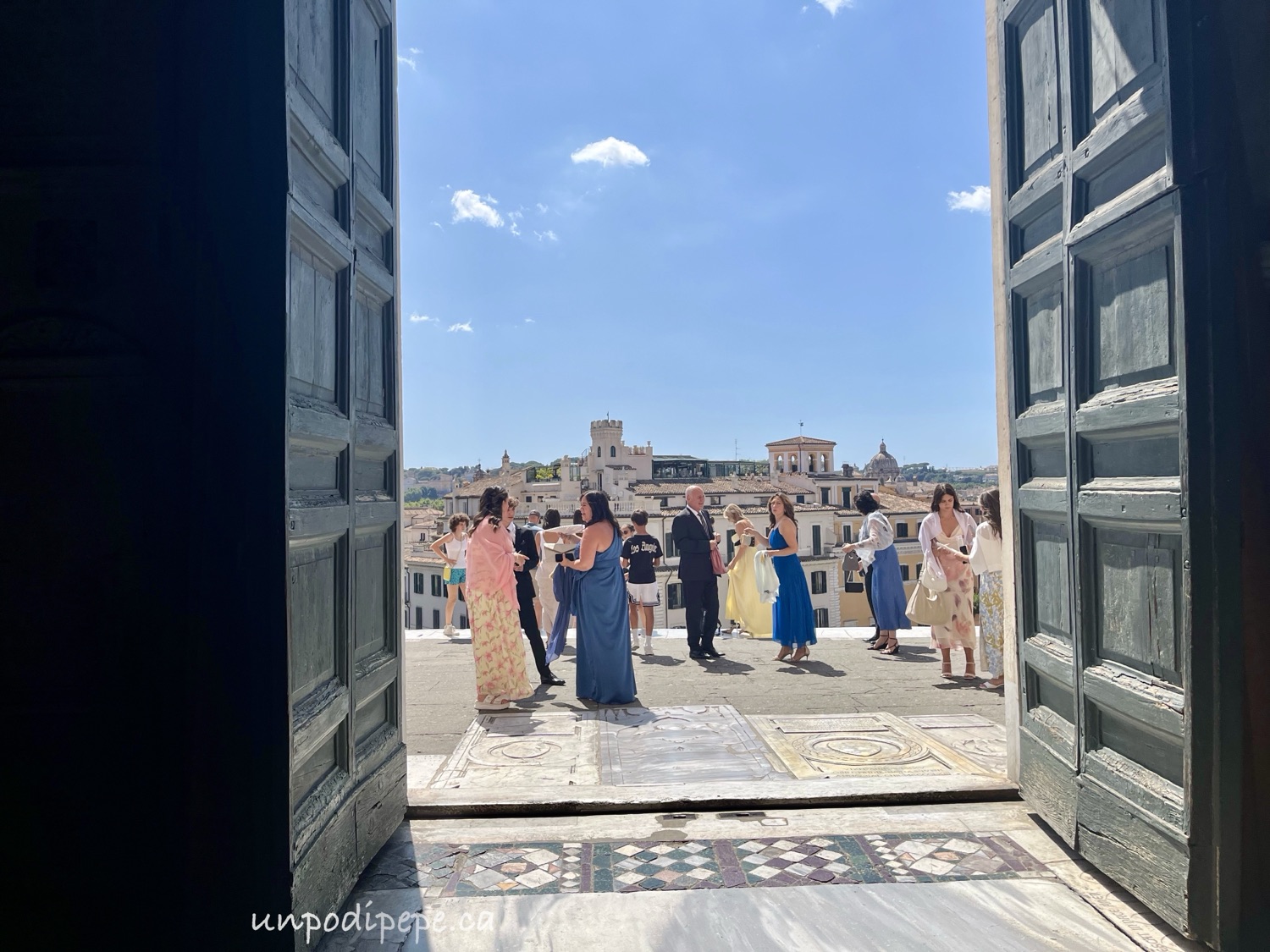
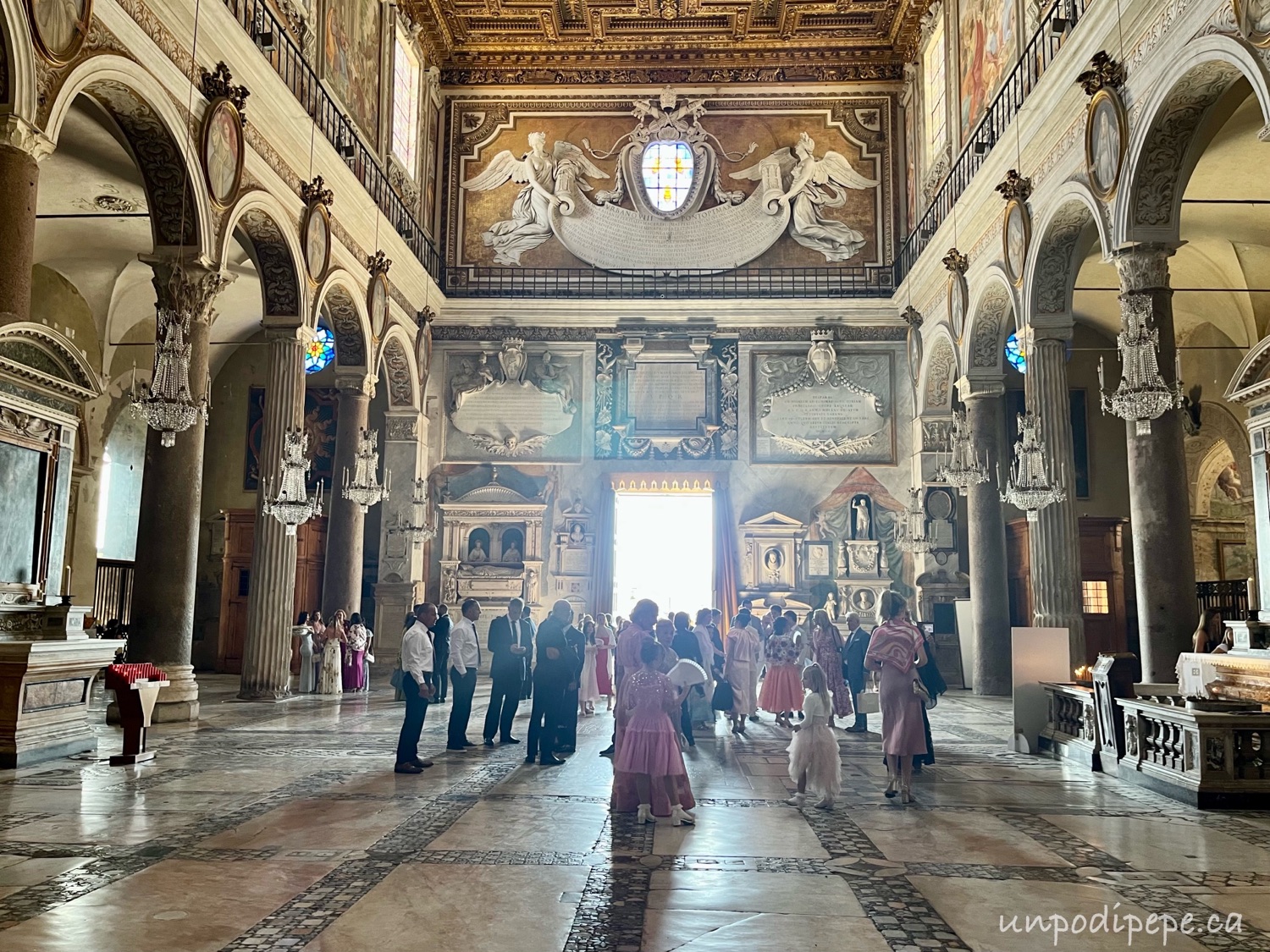
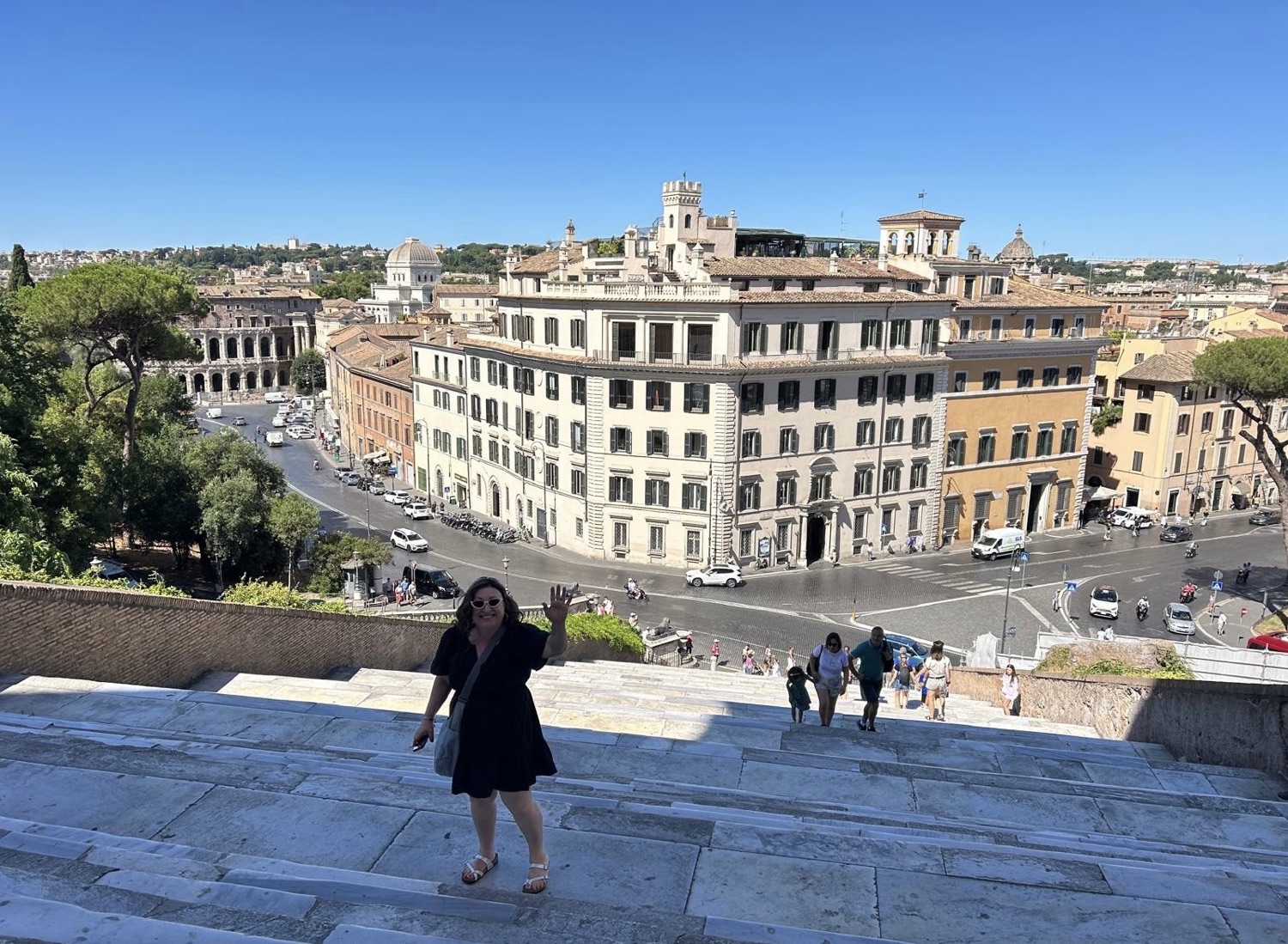
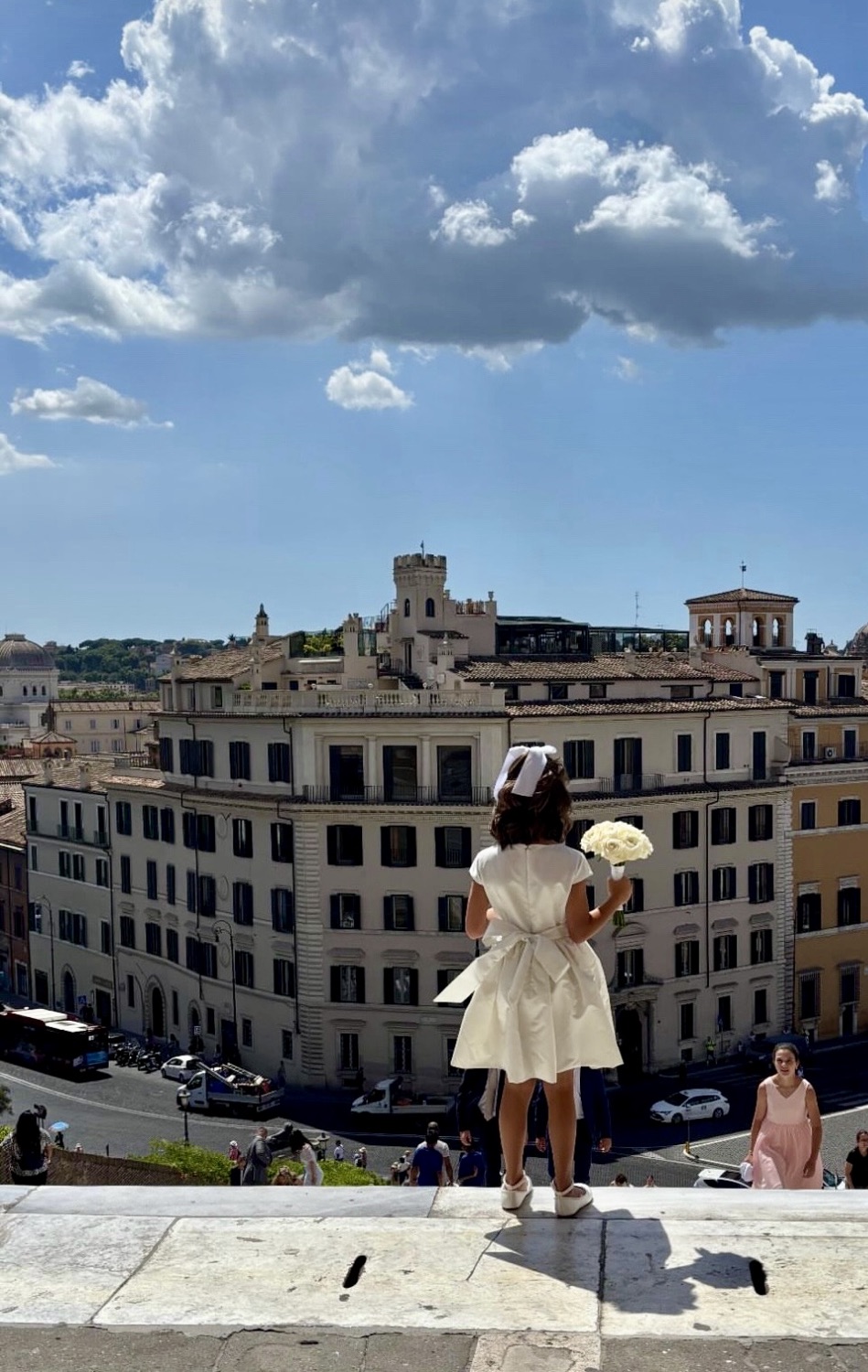
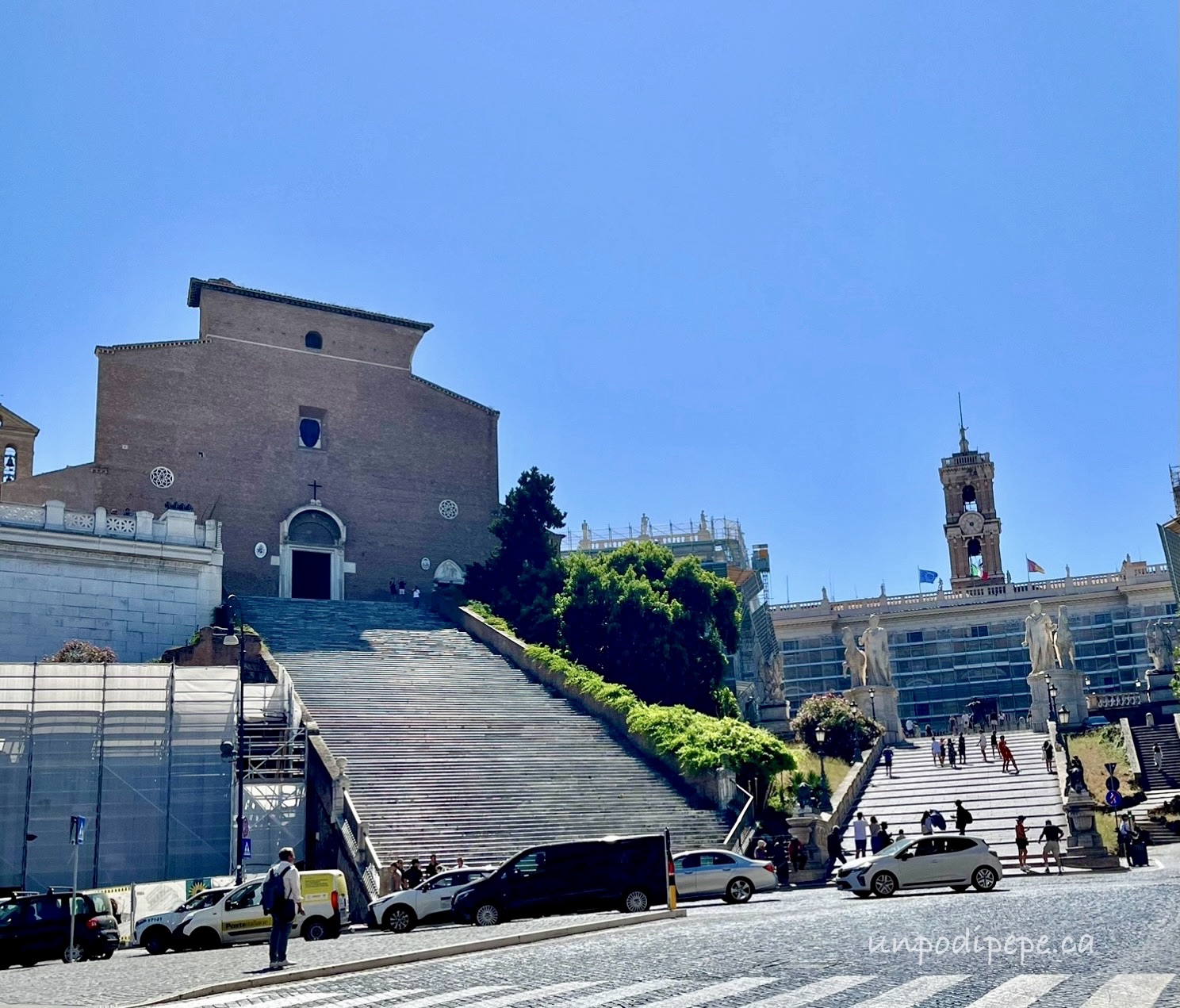
I recently attended a family wedding in one of the most beautiful churches in Roma, the Basilica Santa Maria in Aracoeli (pronounced Ah*rah*CHEH*lee). Because of its location on the highest point of the Capitoline Hill, sandwiched between Il Vittoriano and the staircase to Il Campidoglio, most visitors have seen it from the outside-but they have no idea what treasures the interior holds. Photos in this post are from the July rehearsal and wedding of Isabella and John.Translated from Latin, Santa Maria in Aracoeli means ‘Santa Maria of the altar in Heaven’. The Romanesque Gothic Basilica was built on the site of a Temple to Giunone (Juno) in the year 574.  Originally a Greek Byzantine church, it was taken over by the Benedictines in the 9th Century, then later the Franciscans in 1249.  Santa Maria in Aracoeli is one of the principal churches of Roma and the designated church of the city council and the Senate and people of Roma (SPQR). The Municipio, or City Hall of Roma is conveniently located behind the Basilica, on the Campidoglio.  During the French occupation of 1797, the Basilica was turned into a stable for the French cavalry!  It was almost demolished in the 1880’s during construction of its massive neighbour Il Vittoriano /L’Altare della Patria. In the photo above, the white monument is Il Vittoriano, the building behind it with the steep staircase is Santa Maria in Aracoeli and the staircase on the right leads to Piazza del Campidoglio, where the Capitoline Museum and Municipio are located.The interior is elaborately decorated, with a coffered and gilded wooden ceiling (1575).  The exquisite cream and pink marble floor is decorated with Cosmati, an inlay geometric style of Medieval stonework. The arches are supported on 22 columns scavenged and upcycled from diverse ancient ruins throughout the city. This is why no 2 of the columns are alike.  52 gorgeous Murano glass chandeliers hang in the nave and sanctuary. They were all lit during the wedding.

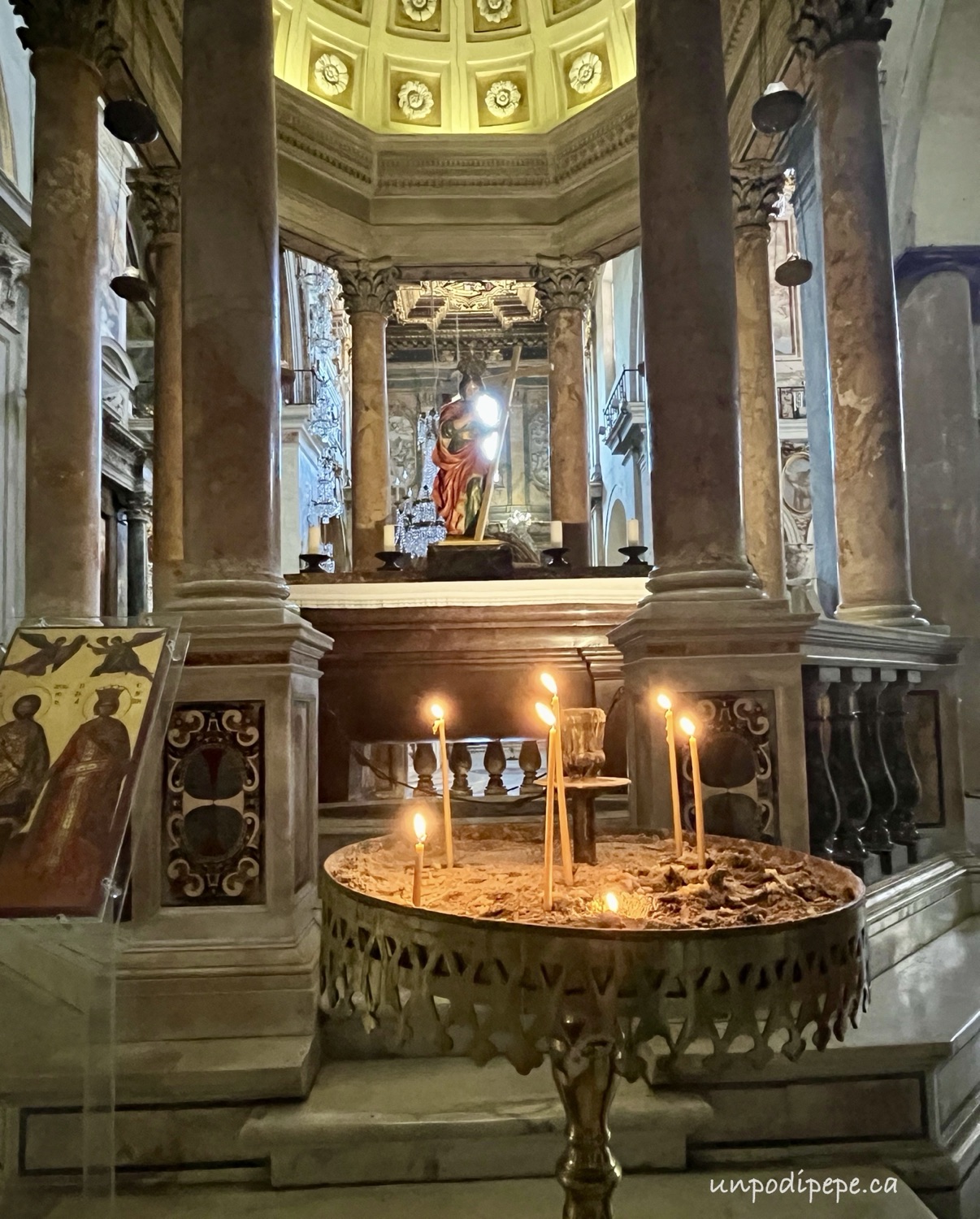
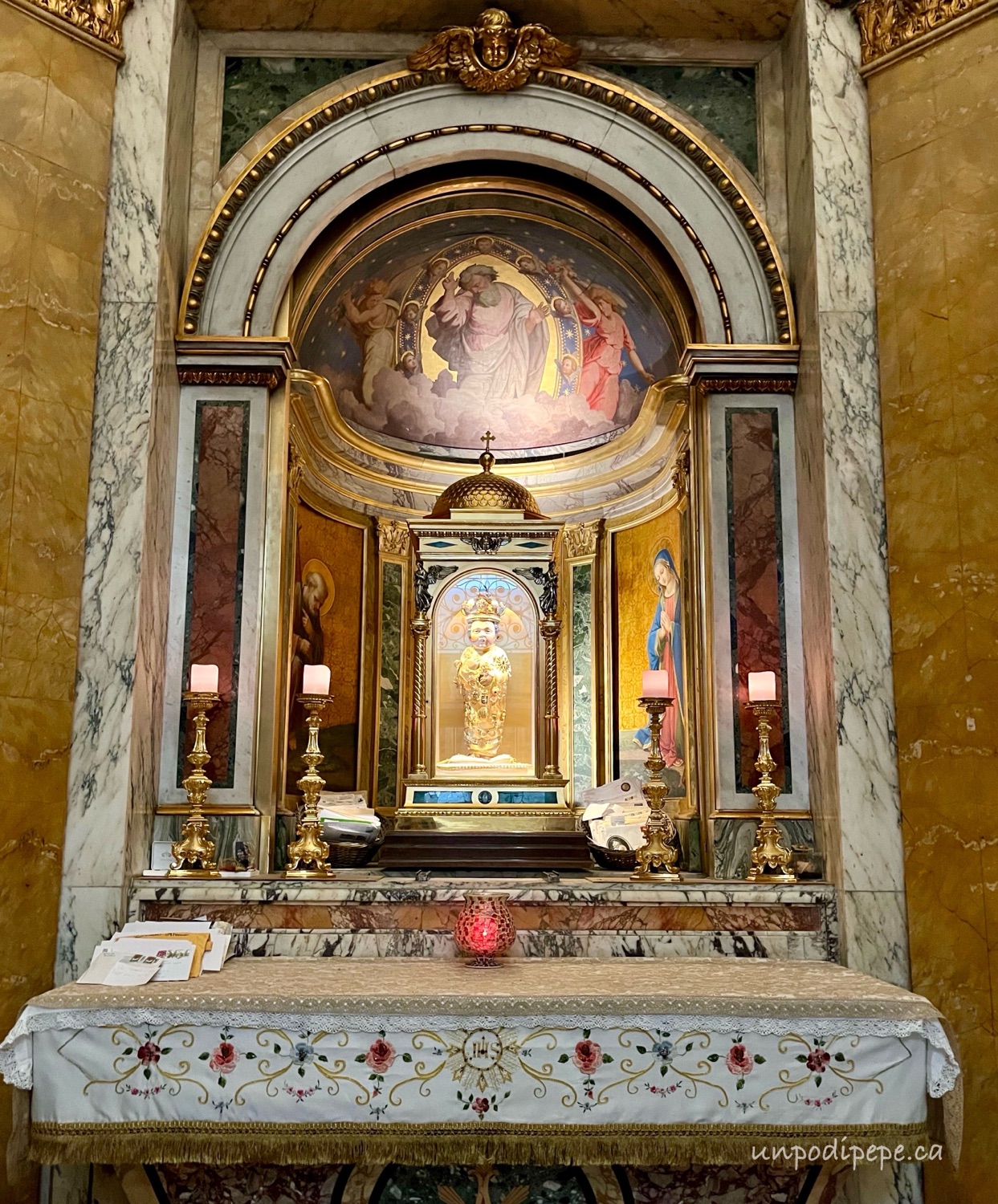
On the altar, is a 10th Century Byzantine icon painted on beech wood, la Madonna di Aracoeli. She is holding up her hand, which is painted in gold.  La Madonna di Aracoeli was carried through the streets of Roma during the Black Plague outbreak in 1348, and is credited with the shorter duration of the epidemic. To the left of the altar an octagonal tempietto or shrine contains the Byzantine relics of Sant’ Elena (St. Helena), the mother of Emperor Constantine. Cappella Bufalini, the first chapel on the right of the entrance, contains a series of 15th Century frescoes by Pinturicchio.  There are also frescoes by Pietro Cavallini and Arnolfo di Cambio, and countless other works of art.The most famous item in the church is the Santissimo Bambinello, a 15th Century bejewelled wooden sculpture of baby Jesus carved out of olive wood from the gardens of Gethsemane in Jerusalem, and baptised in the river Jordan.  It is believed to have healing powers. Unfortunately, he was stolen in 1994, and is still missing.  Today, the Bambinello in a private chapel by the small gift shop is a replica.

La Scala Santa, the staircase of 124 marble steps leading to the main entrance of the church, was designed in 1348 on the occasion of the end of the Black Death. The stairs are considered sacred, and people have been known to climb up on their knees, hoping for a miracle.  Luckily, none of the wedding guests chose to do this, but there were many wobbly stilettos climbing the stairs, and one extremely dirty wedding train!  Viva gli sposi!

Ciao, Cristina

Share this:

  • Click to share on Facebook (Opens in new window) Facebook
  • Click to share on Pinterest (Opens in new window) Pinterest
  • Click to share on X (Opens in new window) X
  • Click to email a link to a friend (Opens in new window) Email
  • Click to share on WhatsApp (Opens in new window) WhatsApp
Like Loading...

Casino dell’Aurora~Villa Boncompagni Ludovisi

21 Thursday Aug 2025

Posted by Un po' di pepe in Art, Art history, Italia, Roma

≈ 6 Comments

Tags

Art history, Aurora, Caravaggio, Caravaggio Roma, Guercino, Jubilee2025, Jupiter Neptune and Pluto

Caravaggio 2025 at Palazzo Barberini, the exhibit coinciding with Giubileo 2025, was extended by 2 weeks. Yippee!! This was great for me, since I arrived in Roma the day after it was supposed to end.  As soon as I heard about the extension, I booked tickets before they sold out. It was amazing, and I will post about it after I get home. With the code from my ticket purchase, I was also able to book one of the limited weekend tickets to Casino dell’ Aurora, Villa Boncompagni Ludovisi, a private home, which is not normally open to the public.

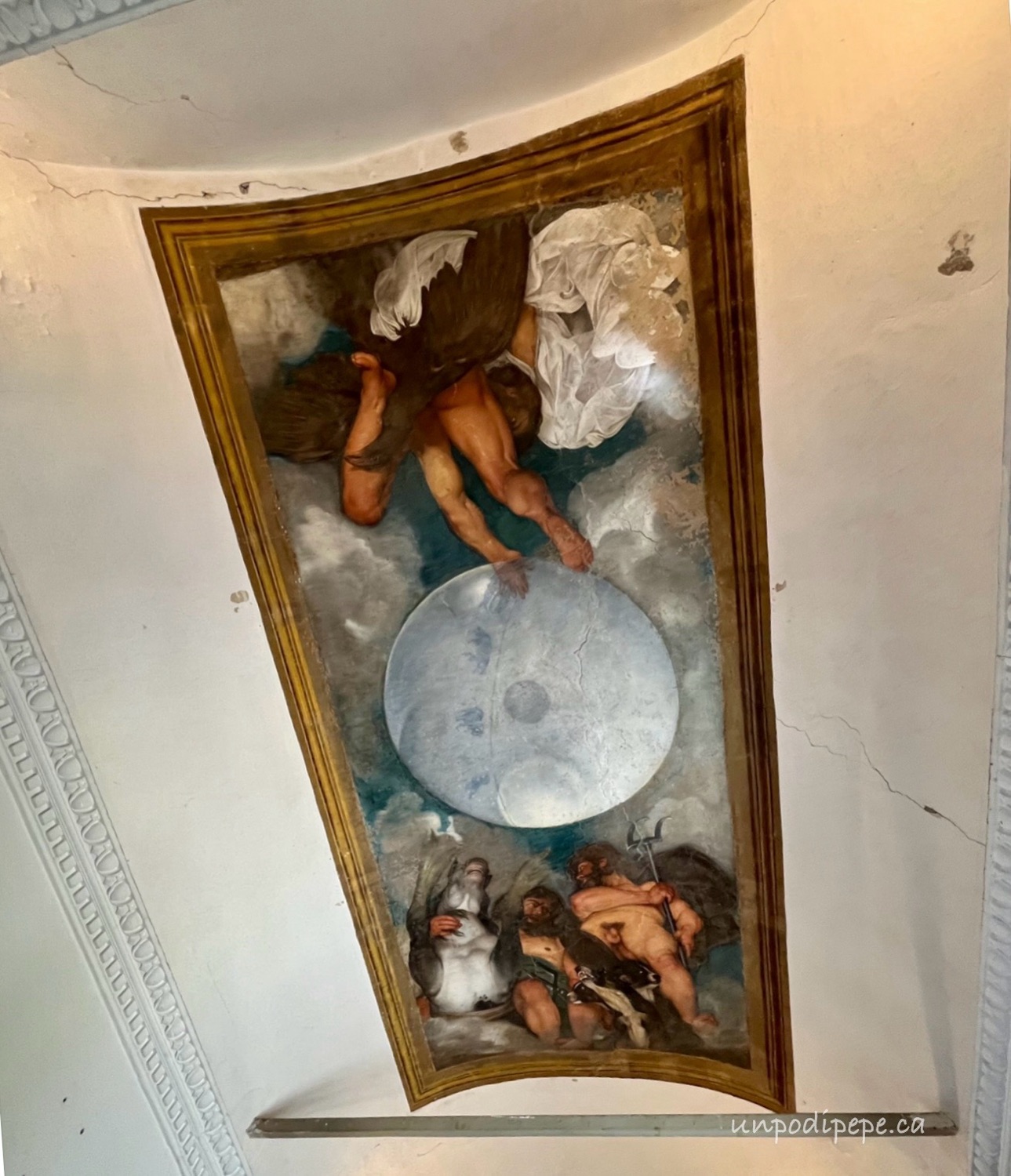
Why am I so excited about this? Villa Boncompagni Ludovisi contains the only ceiling painted by Caravaggio, one of his least accessible masterpieces.

The Villa is the only remaining part of a large suburban retreat, built by Cardinal Francesco del Monte in the 16 th Century. The cardinal was an early patron of Caravaggio and he had an interest in alchemy*. He commissioned 25 year old Caravaggio to paint the ceiling of his small alchemy lab in 1597.

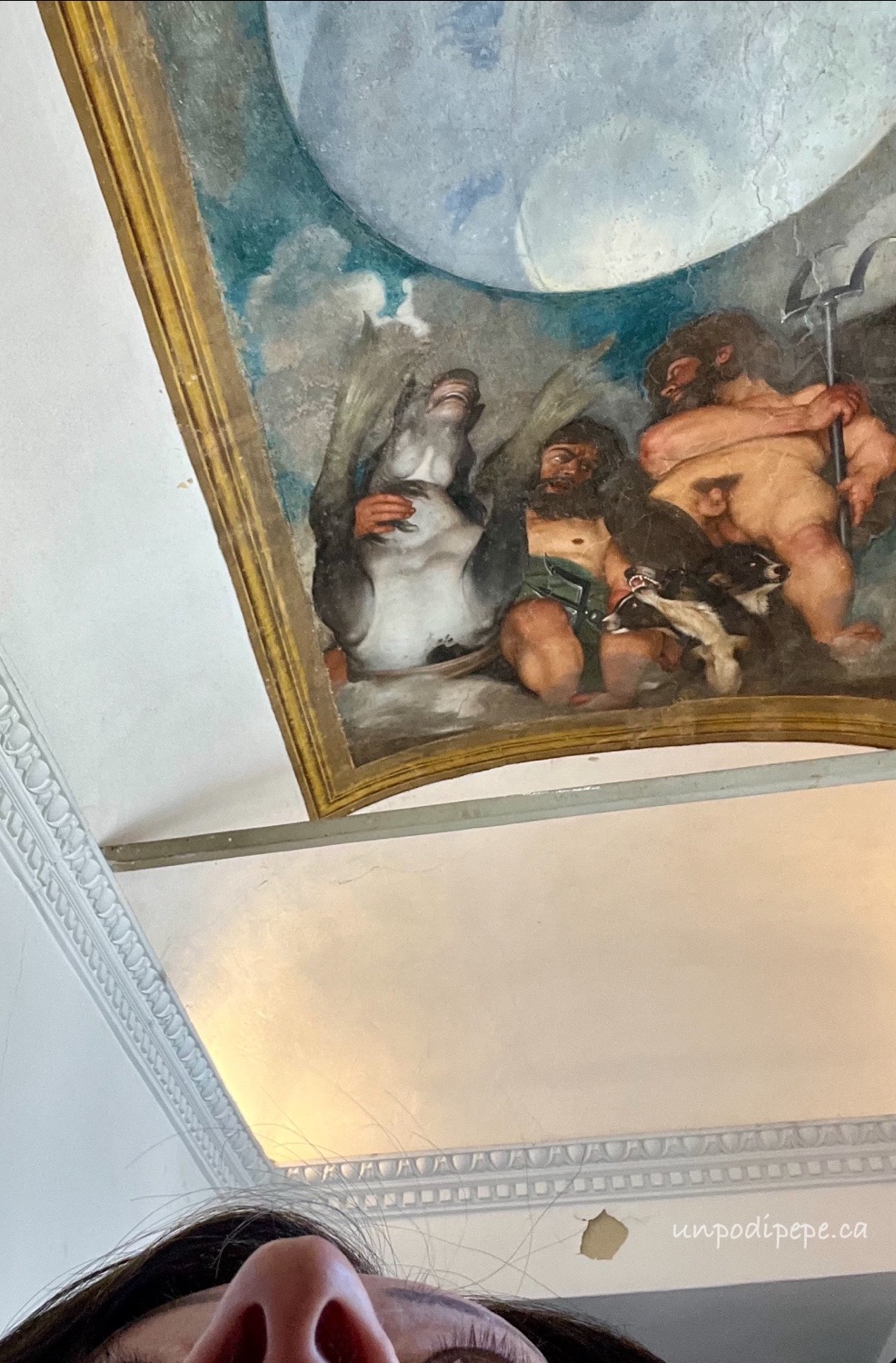
The painting ‘Giove, Nettuno e Plutone’ -Jupiter, Neptune and Pluto is an alchemical allegory with the 3 Olympian gods and their symbols and animals from classical mythology. For Jupiter these are air, sulphur and the eagle, for Neptune water, mercury, a trident and the hippocampus (a mythological seahorse) and for Pluto, earth, salt and Cerberus the 3 headed dog.

This painting may have been a middle finger salute early in his career to critics who accused Caravaggio of having a poor sense of perspective. The 3 figures are foreshortened in the most dramatic way possible. Jupiter floats in the sky with an eagle and reaches out to move a luminous celestial sphere where the sun revolves around the earth. Zodiac signs are barely visible in the center. Neptune and Pluto appear to be standing right over you, with Neptune’s private parts dangling above your head!

Caravaggio used his own face for all 3 figures. It was common for him to insert his self-portrait into a painting, but not as the main focus.  In this case, it is likely because this early in his career, he could not afford to pay a model, and he had not started using everyday people as models.  Since the 3 figures are supposed to be brothers, it worked. Cerberus may have been painted from his own dog.

This ceiling painting is unusual as it is oil paint on dry plaster, so essentially it is a mural. It is not a fresco, which is painted with pigments directly into wet plaster. The painting does not have that ‘chalky’ look of a fresco. The size is 300 by 180 cm, about 10’ by 6’. It is on the upper floor, reached via the staircase seen below, in the main ‘Aurora’ reception room.

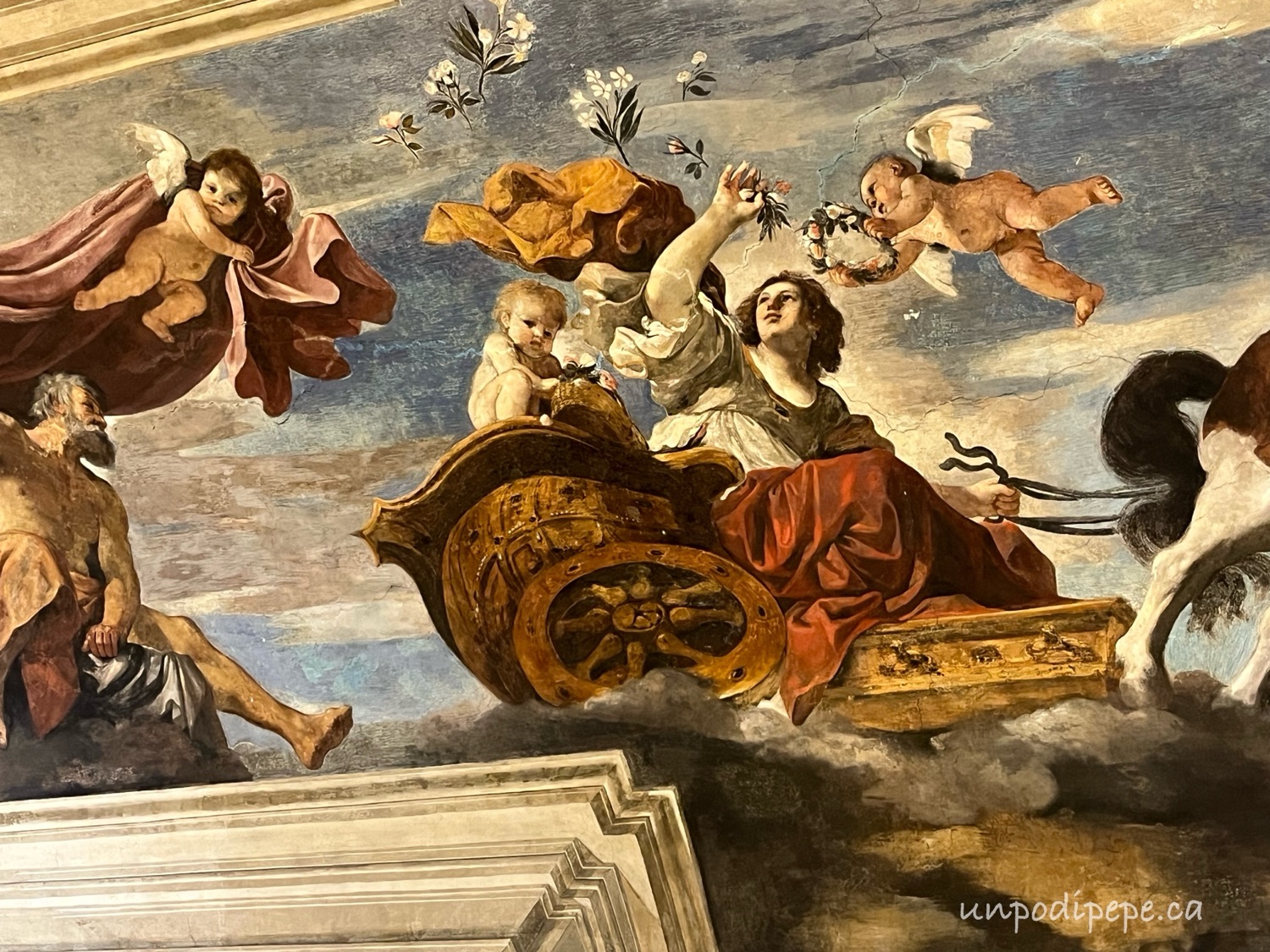
In 1621, del Monte sold the villa and grounds, a 30 hectare (74 acre) area between Porta Pinciana and Porta Salaria, to Cardinal Ludovico Ludovisi. In 1621, Guercino also completed the Aurora fresco on the ceiling of the main reception hall. This is why the villa is also referred to as Casino dell’Aurora or Villa Aurora. Guercino had help with the illusionist architectural details by the notorious Agostino Tassi. Read more about him in the post Artemisia Gentileschi.

The princes Boncompagni-Ludovisi subdivided and sold the property in 1883. Roma’s Ludovisi district is on these former grounds. The 2200 m² (2400 sq ft) villa and a small  parcel of land remained with the Ludovisi family.

Since the 2018 death of the owner, Prince Niccolò Boncompagni Ludovisi, there has been an inheritance dispute between his American widow and the 3 sons from his first marriage. The widow was evicted in 2023 and a court ordered sale made the villa the most expensive house ever to go on the market. Valued at €470 million, it is still for sale and also needs €10 million worth of restoration work $$$! Hopefully the family comes to some sort of agreement and Villa Boncompagni Ludovisi will eventually become a museum. I will purchase Lotto tickets in the meantime 🤞.

Casino dell’Aurora, Villa Boncompagni-Ludovisi is located at Via Lombardia 46, a short walk from Porta Pinciana and the Marriott Grand Hotel Flora. It is not open to the public and there are no plans for public viewing at this time.  If you somehow happen to get the opportunity-definitely go! Now that I have seen Giove, Nettuno e Plutone, I have seen all 25 of Caravaggio’s paintings in Roma!
*Alchemy was a precursor to actual science. It was aimed at discovering the ‘Philosopher’s Stone’ to turn other metals into gold, and the elixir of youth.

Share this:

  • Click to share on Facebook (Opens in new window) Facebook
  • Click to share on Pinterest (Opens in new window) Pinterest
  • Click to share on X (Opens in new window) X
  • Click to email a link to a friend (Opens in new window) Email
  • Click to share on WhatsApp (Opens in new window) WhatsApp
Like Loading...

Nasoni di Roma

18 Sunday May 2025

Posted by Un po' di pepe in Italia, Roma

≈ 4 Comments

Tags

Aqua Virgo, Roman Fountains, Summer in Roma

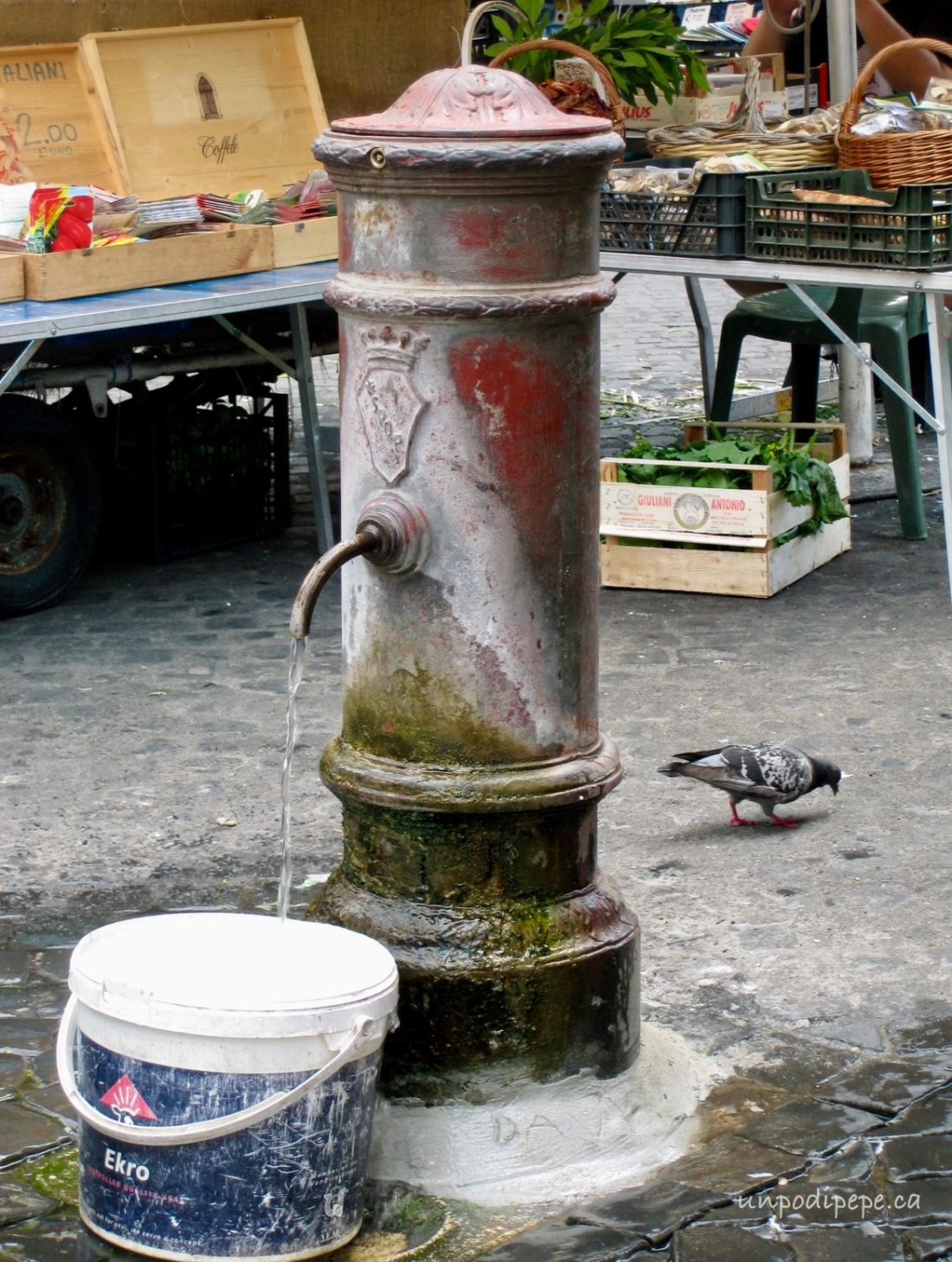
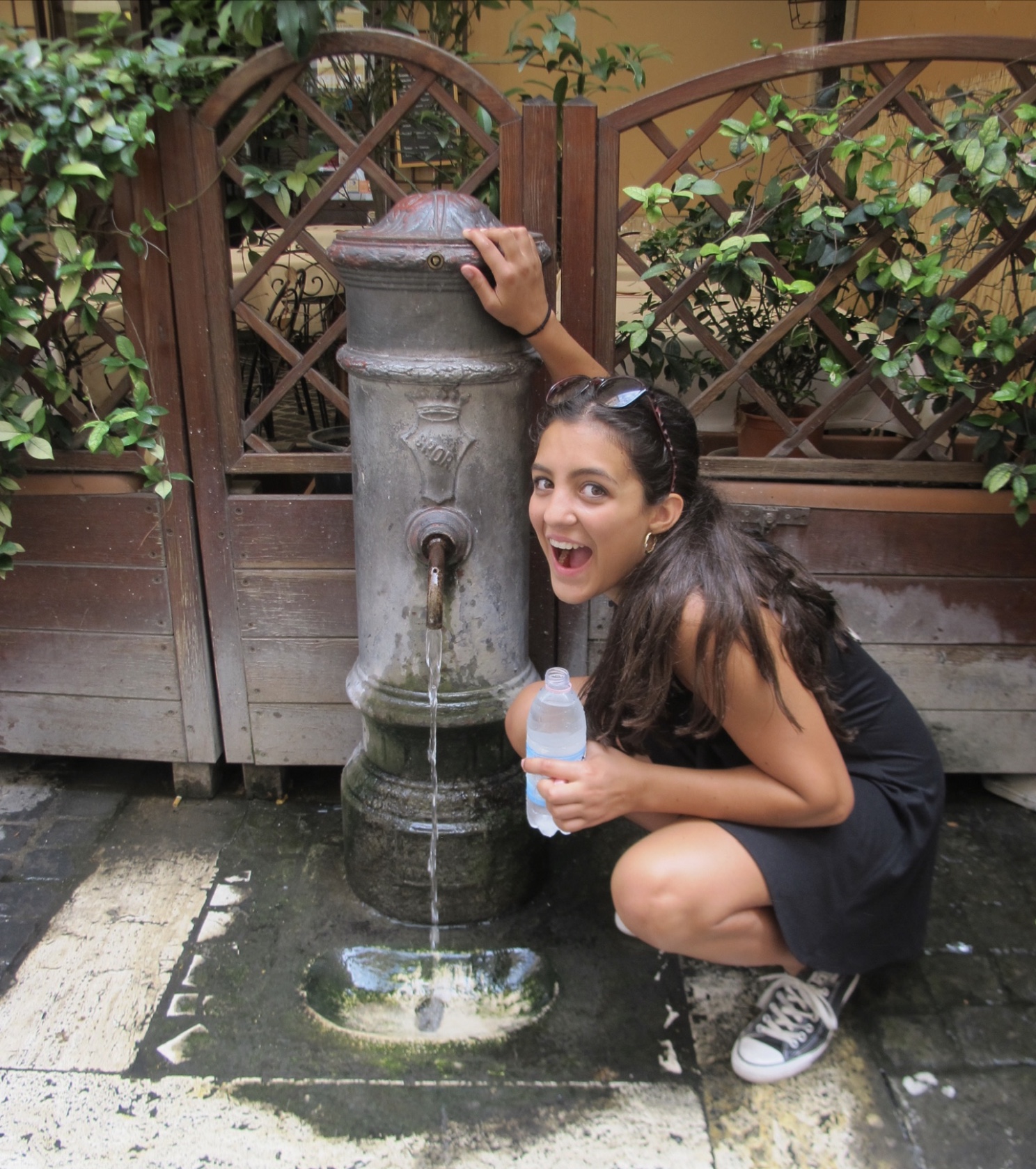
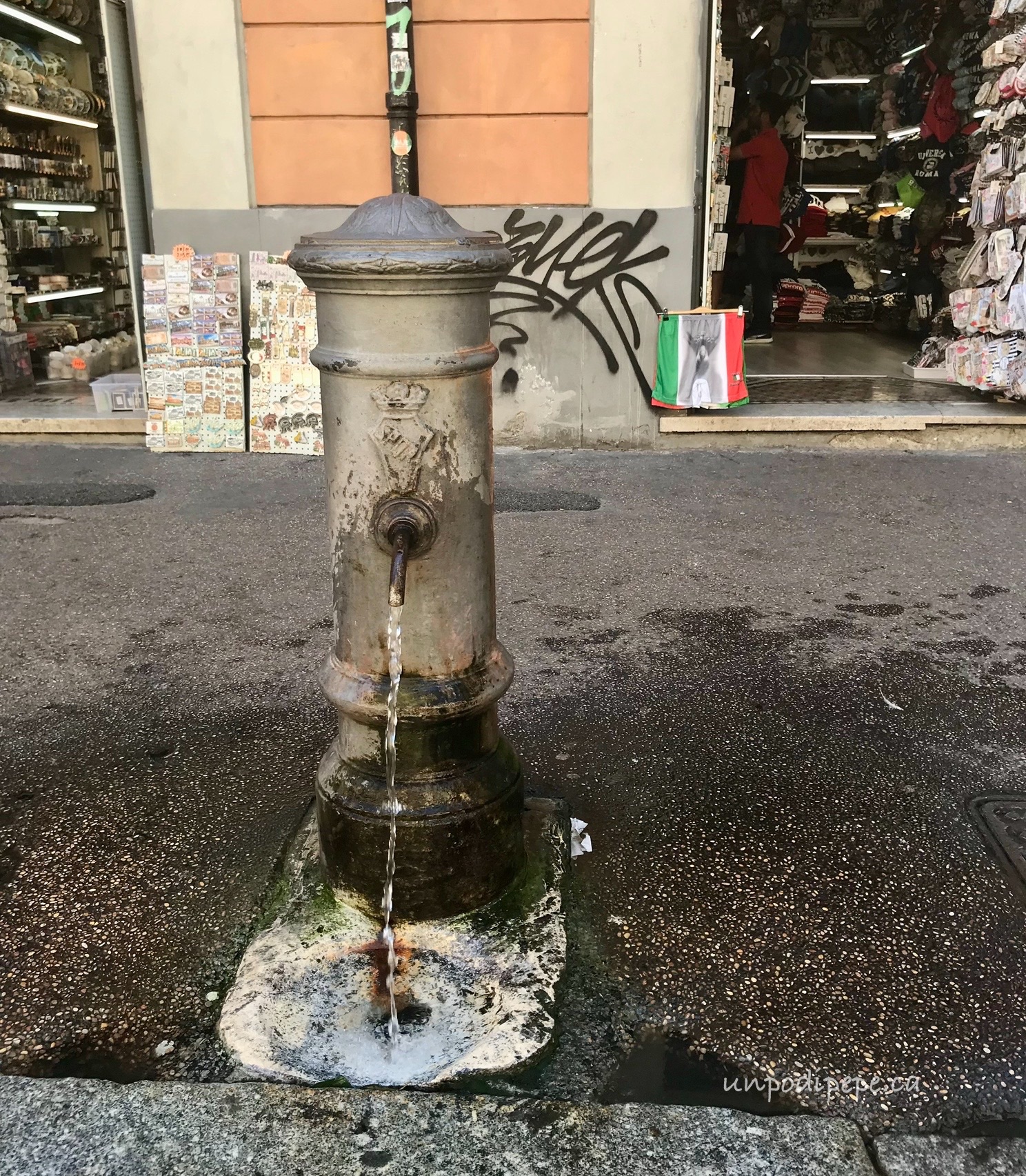
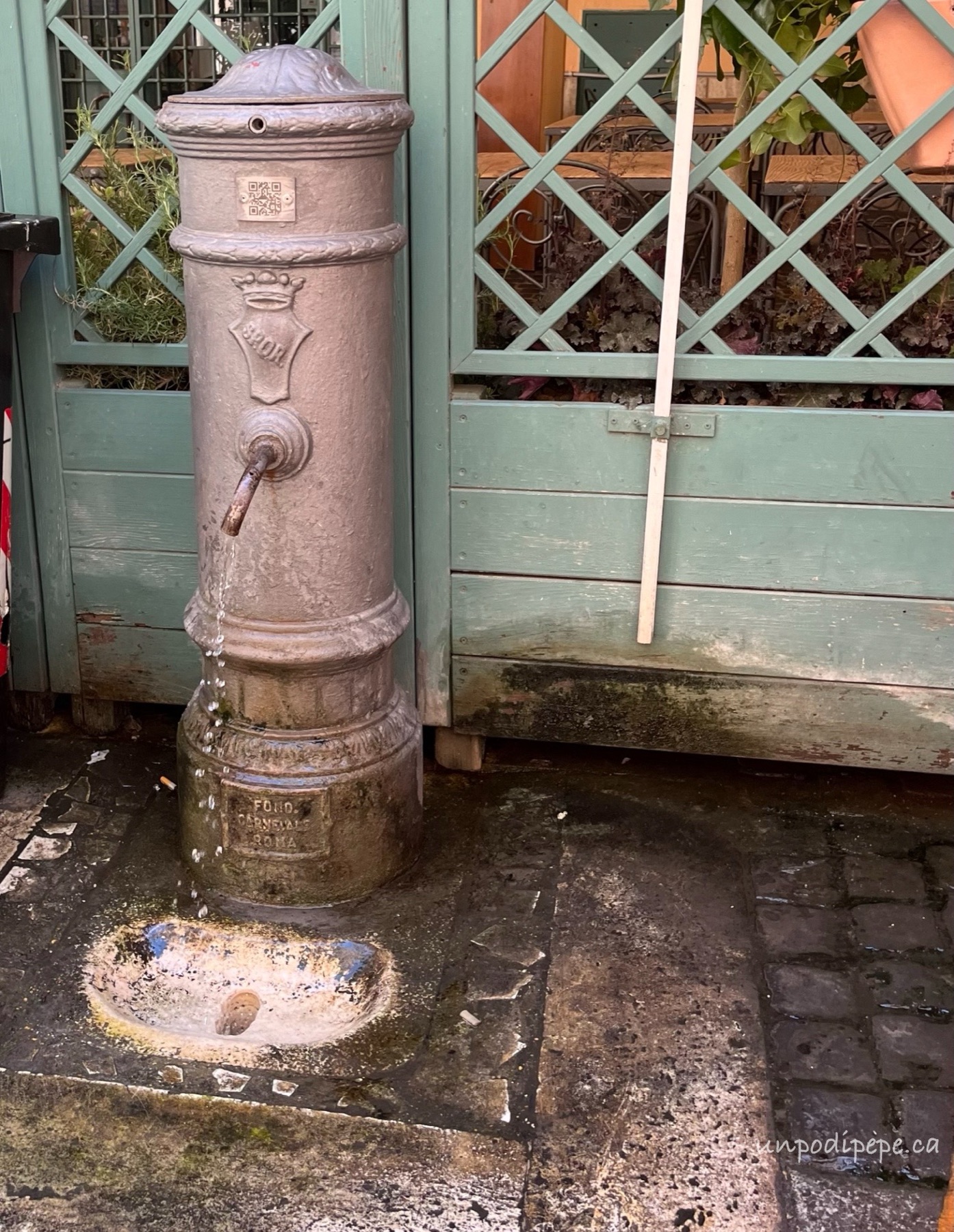
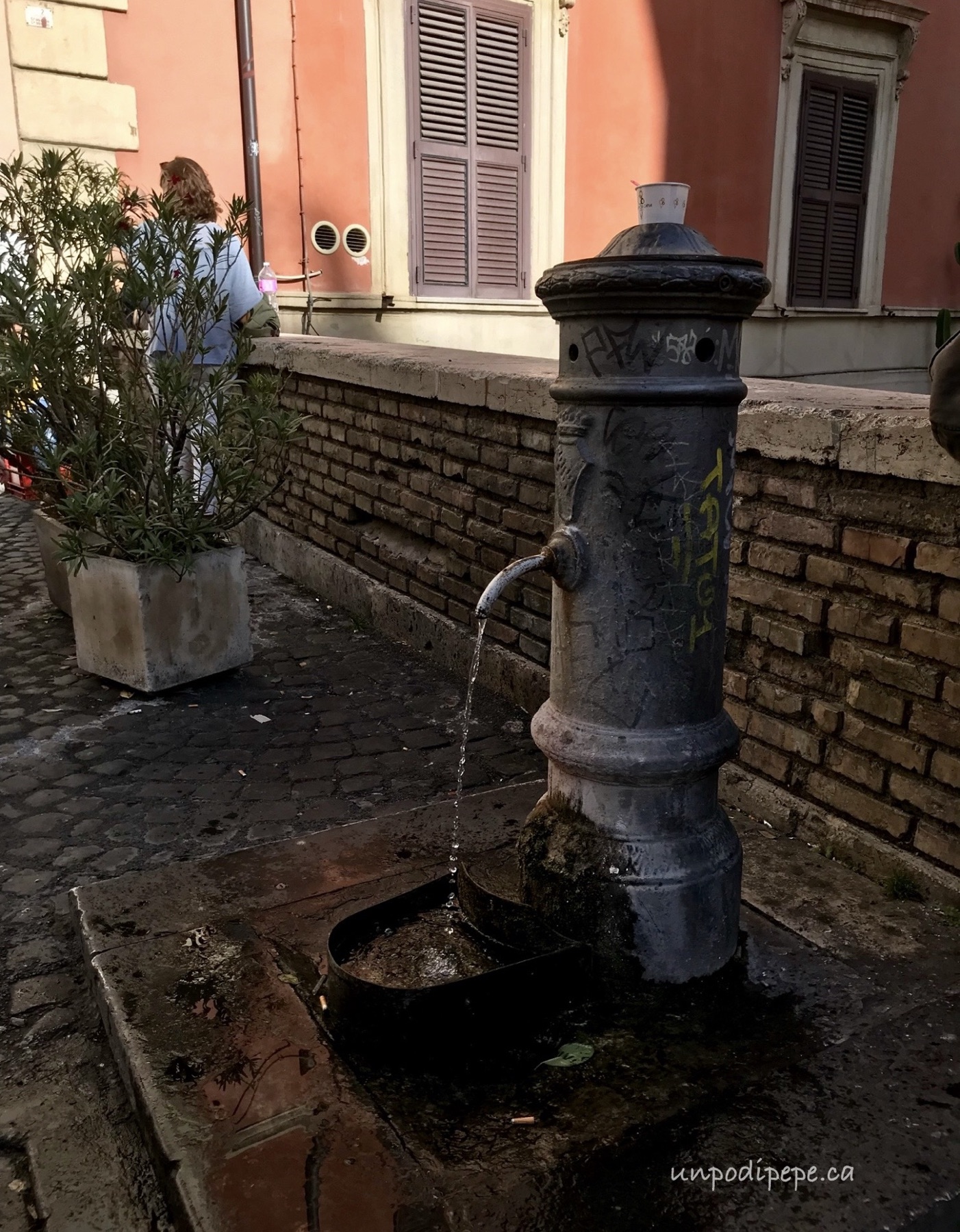
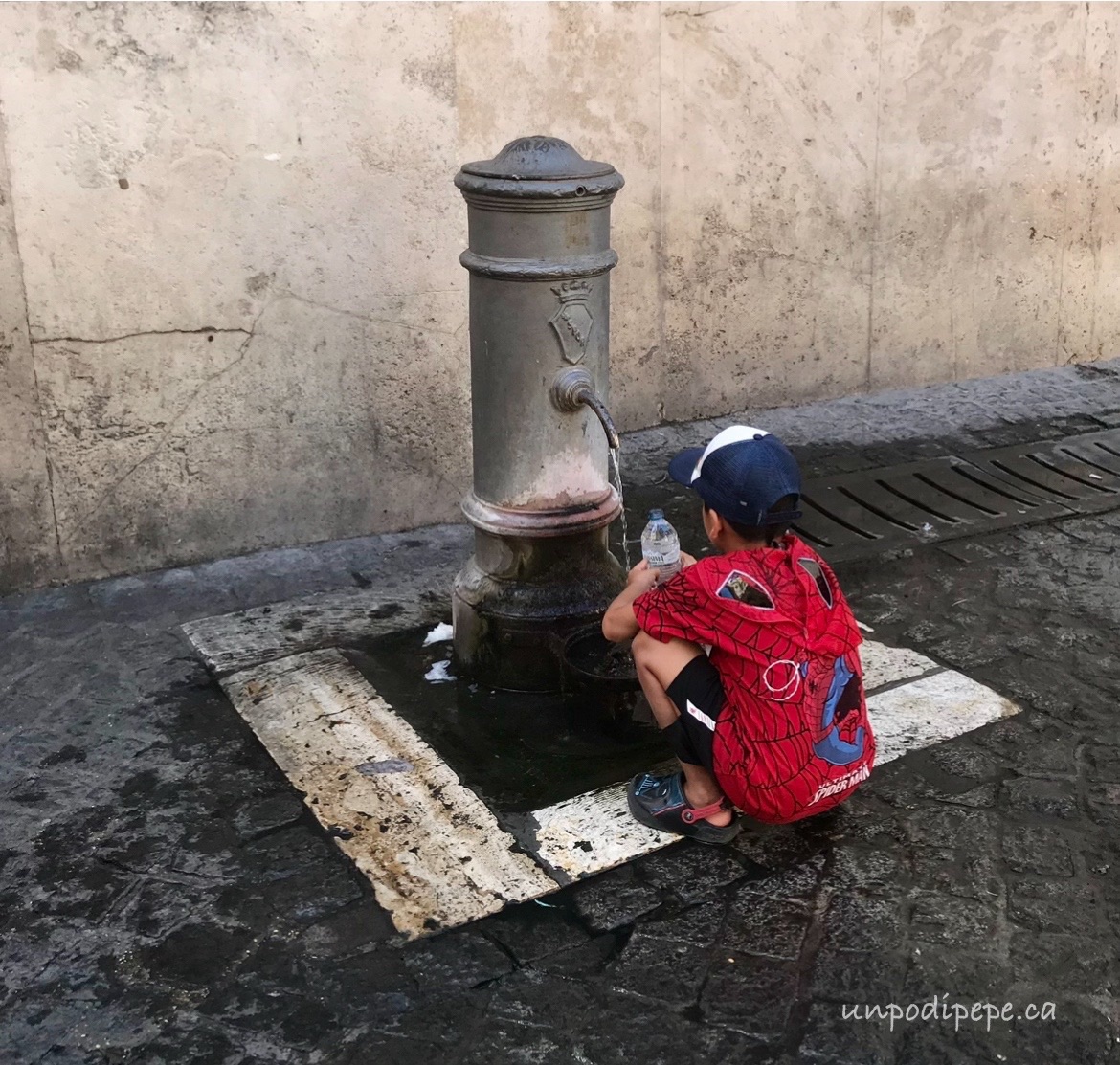
The characteristic cast iron fontanelle, small drinking fountains found throughout Roma, are affectionately known as nasoni.  Nasoni means ‘big noses’, and refers to the curved metal spout, which has a small hole at the top of the arch.  Blocking the spout with your finger will force the water up from hole in an arc, like a drinking fountain.  This is handy if you want to drink but do not have a water bottle!

The nasoni date back to 1874, after Italian unification when mayor Luigi Pianciani installed fountains to provide free, accessible public drinking water for the health and hygiene of Romans and visitors.   This is often referred to as ‘l’acqua del sindaco’, ‘the water of the mayor’.  Some of the fountains in central Roma are supplied by a functioning ancient aqueduct, the Acqua Vergine. Nasoni get their water from Roma’s main drinking water reserve, Lago di Bracciano, 32 km (20 mi) to the northwest.

There were originally 5,000 nasoni, but the number decreased as it became more common to have domestic water connections.  Today there are over 2500 nasoni in greater Roma, including 280 in the historic center, and 114 in outer areas, such as Fiumicino. For the 150th anniversary of the Nasoni in 2004, 3 new ones were installed near the Colosseo.A nasone (singular) weighs ~100 kg and is 1.2 m high (almost 4 ft). Its classic cast iron cylindrical shape allows drinking water to flow continuously. Most nasoni have a metal grate to collect the water.  The first Nasoni had 3 spouts, decorated with dragon heads.  In the 1920’s the dragons became an endangered species and since then, nasoni are cast iron cylinders with a single smooth curved ‘naso’ spout.  Some of them have the SPQR insignia and quite a few are decorated with graffiti.  The 3 oldest nasoni are the original dragon spout design.  They can be found on Via di San Teodoro, in Piazza della Rotonda in front of the Pantheon, and at the Fontana delle tre Cannelle on Via della Cordonata near Palazzo Quirinale.

Besides quenching the thirst of Roma, nasoni also have a hydraulic purpose.  They act as surface ventilation valves for the underground water supply system.  This releases pressure in pipes, and the continuous flow of water keeps it from stagnating, preventing uncontrolled bacterial growth.  The continuous flow may seem like a waste of drinking water, but in fact the percentage of waste is only about 1%, while waste due to old leaky pipes in poor condition would be over 30%.  It costs the city €3-5/day to operate each nasone, depending on the water flow.

The water company ACEA has the Waidy Wow waterfinder App that maps out 50,000 drinking water points including nasoni and other fountains throughout the country. Wanted in Rome, an online English magazine has a Nasoni map of Rome. The Nasoni di Roma App focuses specifically on locating nasoni.With the nasoni, plus 90 ornamental fountains offering uninterrupted drinking water, Roma is the city with the most drinking fountains in the world.  Installed to provide accessible fresh drinking water for thirsty Romans and visitors, the nasoni are now iconic symbols of Roma, representing community and hospitality.  Don’t forget to bring a water bottle! If you are visiting in summer, check out Beat the heat: Surviving Summer in Roma.

Buon Viaggio, Cristina

Share this:

  • Click to share on Facebook (Opens in new window) Facebook
  • Click to share on Pinterest (Opens in new window) Pinterest
  • Click to share on X (Opens in new window) X
  • Click to email a link to a friend (Opens in new window) Email
  • Click to share on WhatsApp (Opens in new window) WhatsApp
Like Loading...

Fontana di Trevi

13 Sunday Apr 2025

Posted by Un po' di pepe in Architecture, Italia, Photography, Roma

≈ 13 Comments

Tags

Aqua Virgo, Fontana di Trevi, La Dolce Vita, Palazzo Poli, Roman Fountains, UNESCO World Heritage Sites

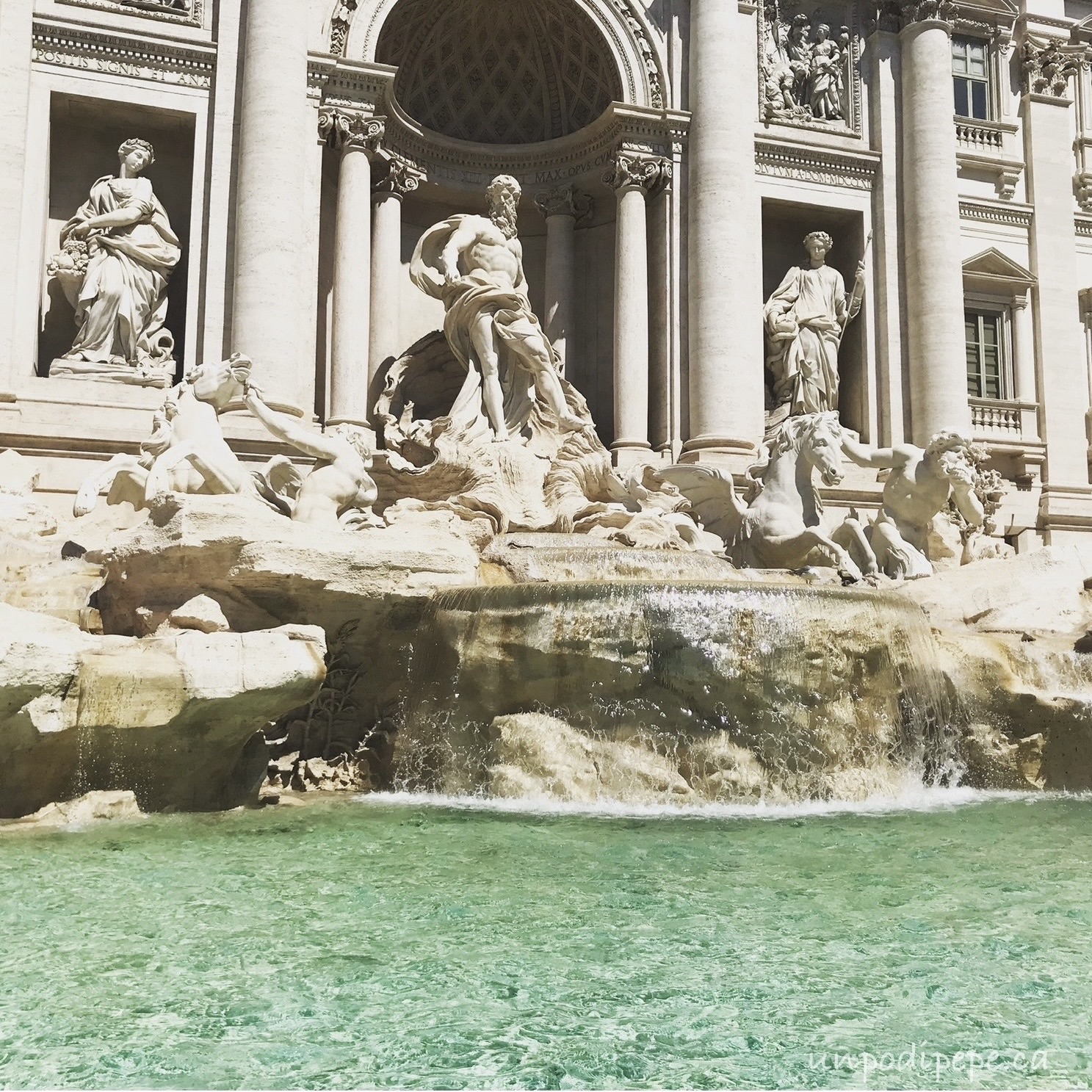
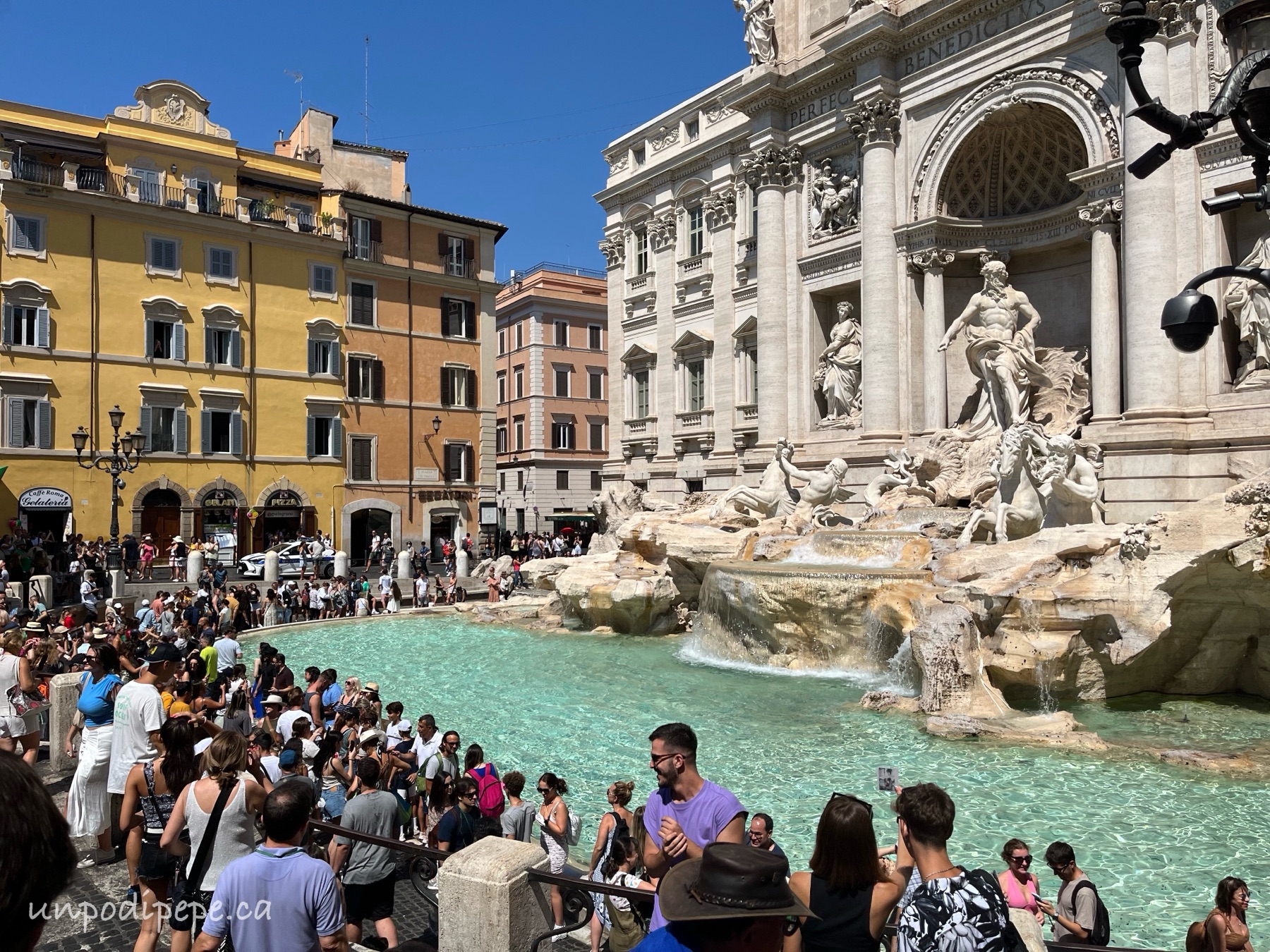
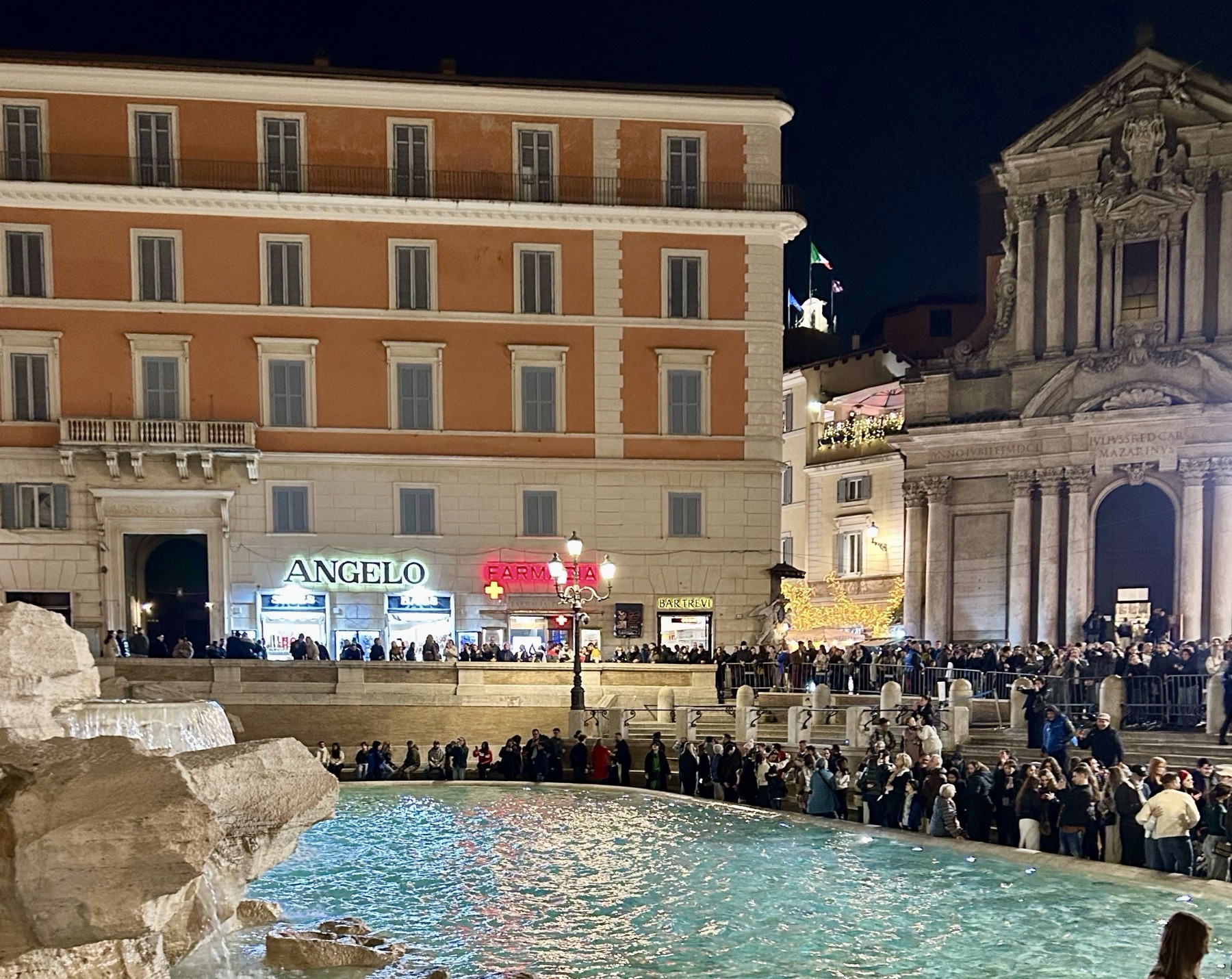
The Fontana di Trevi is one of the most iconic structures in Roma-a Baroque masterpiece with a direct link to the Ancient Roman Empire.  Every year, millions of tourists visit, trying to capture a perfect photo, tossing in a coin to ensure a return visit to Roma.  Sometimes it can feel like a mosh pit! The water comes from an ancient aqueduct, Aqua Virgo (Acqua Vergine in Italiano), 9 m below ground, built in 19 BC.  It still functions today and provides water to the fountains in Central Roma.  Find out more in the previous post Acqua Vergine.

The Fontana di Trevi is named for the piazza. Tre vie means 3 roads, refering to Via De’Crocicchi, Via Poli and Via delle Muratte that come together at Piazza Trevi. The Fontana di Trevi is the final destination of Acqua Vergine.

There was always a fountain to mark the end point of Acqua Vergine. The medieval fountain was a simple rectangular shape with 3 spouts pouring water into 3 basins.  In the Baroque era, when everything was over the top and extravagantly decorated, Pope Urban found the existing fountain too boring.  He commissioned the Master, Gian Lorenzo Bernini to sketch a design, but they both died before it got going.  The next Pope held a contest, and Nicola Salvi’s design was chosen.  Construction started in 1732, with many artists involved during the 30 years it took to complete. In a very modern fashion, construction of the Fontana di Trevi was financed with proceeds from the Roman lottery.

The symmetrically balanced theme ’Taming the Waters’ was built right onto the existing building. Palazzo Poli was given a new façade featuring a giant order of Corinthian columns. The main sculpture is Greek Titan Oceanus, not Neptune as is commonly thought.  He is in a large half-shell pulled by 2 seahorses and tritons (sea messengers) with a sea reef below them.  The façade and sea reef are made of Travertine from Tivoli, and the sculptures are Carrara marble. Above and on either side of Oceanus are 2 bas reliefs illustrating the origins of Acqua Vergine.  One depicts Marcus Agrippa ordering construction of the aqueduct and the other the vergine, a young girl leading Roman soldiers to the spring.  The Fontana di Trevi is 26 m (~85 ft) high and 49 m (~160 ft) wide. It spills 80,000 cu m (2, 825,000 cu ft) of water per day! Today the water is continually recycled.

Tossing a coin in the water with the right hand over the left shoulder while facing away from the fountain is thought to ensure a return to Roma. I never miss this opportunity-even during renovation in 2015 I found a way to toss one in! This tradition dates back to the Ancient Romans who tossed coins in water so the gods would protect them on their journey and ensure a safe return. Throw in a second coin to find true love and a third for wedding bells! I believe these last 2 are just from the 1954 movie ‘3 coins in the Fountain’, not the Ancient Romans!  According to another old tradition, drinking the water with your beloved will ensure eternal love and fidelity. Do not drink the water! 

Although the water comes straight from a spring via an ancient aqueduct, it is now continually recirculated. In 1998 when the Fontana was refurbished, recirculating pumps were installed. On the far right and up a few stairs is the Fontanella degli Innamorati (Little Lovers’ Fountain) a small rectangular basin with 2 crossing spouts. Take a drink from this instead-the water is also from Acqua Vergine!

All of those coins in the water can’t be hygienic either.  Approximately €3,500 per day is collected nightly and given to the charity Caritas. The money funds a program providing supermercato cards Roma’s needy.   There are regular attempts to steal the coins from the basin, which of course is illegal.  The water has been vandalized many times, painted red and most recently dyed black with charcoal by climate eco anarchists.

In 2014 Fendi sponsored a 1.5 year, €2.2 million restoration and cleaning, including installation of LED lights to improve night illumination. Most recently, in late 2024 a 3 month restoration also secured the lower basin to restrict access to only 400 visitors at a time. Crowds are expected to be bigger than usual during Giubileo 2025.  Early in the morning is usually a good time to visit.

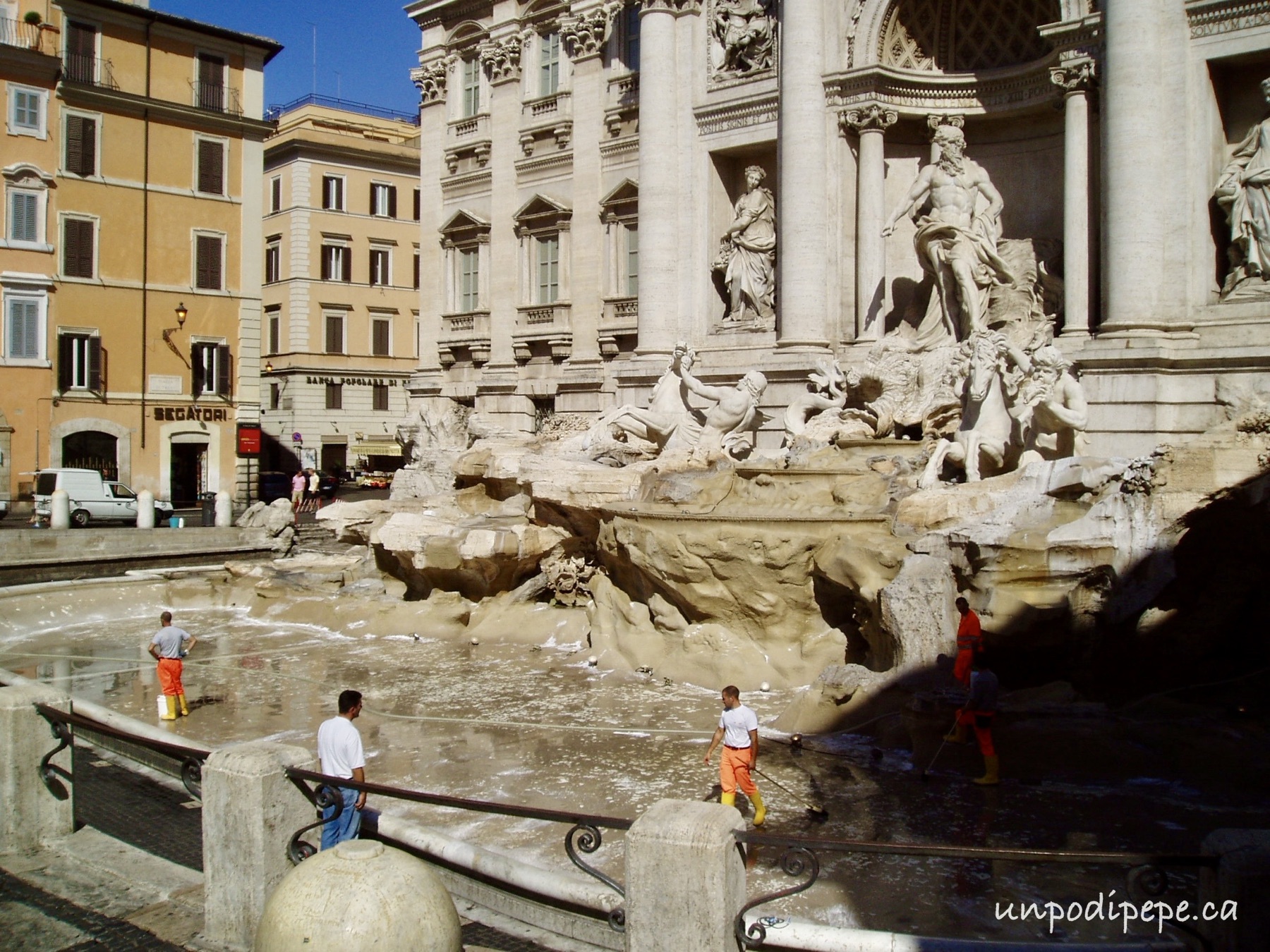
As an outdoor public monument, the Fontana di Trevi is free and always open, so unless it is under renovation, you can check it out at any time.  Access to the lower basin may be limited at some times, and cleaning takes place on certain Monday and Friday mornings. Since it is fed by an aqueduct and powered only by gravity, it never needs to be turned off.

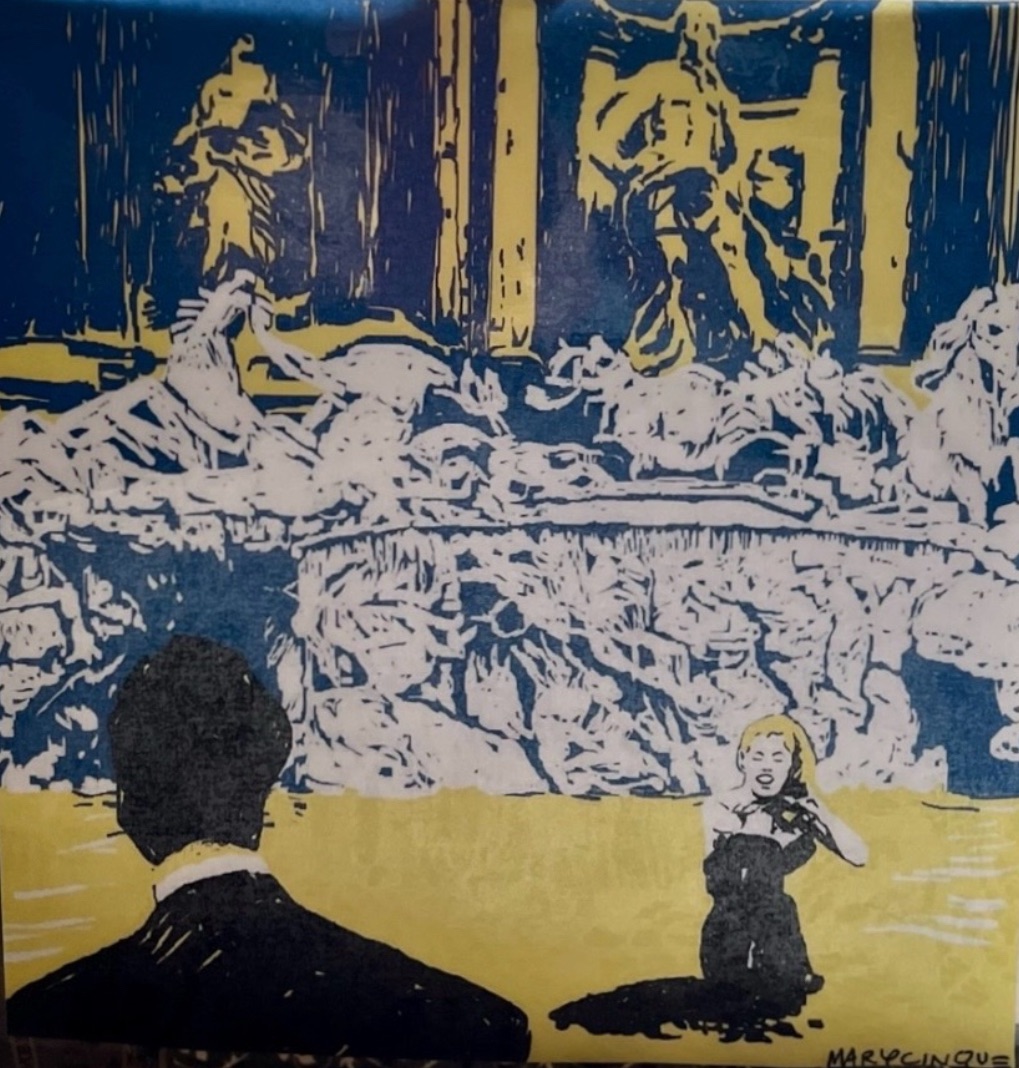
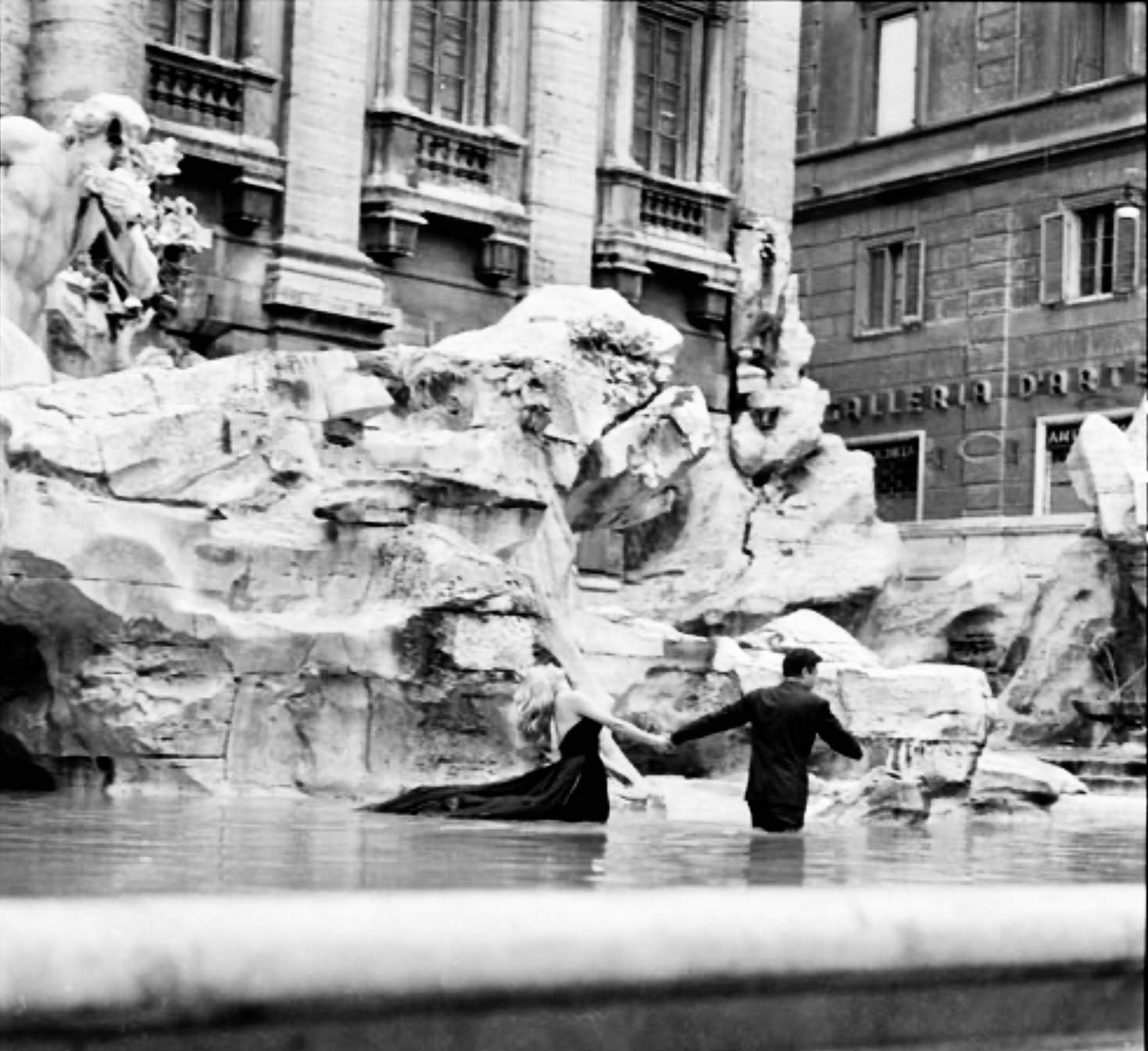
The Fontana was immortalized in film in 1960 when Anita Ekberg walked in with her clothes on in the Fellini classic La Dolce Vita.  Do not be like Anita-you will be immediately slapped with a €450 fine. When her costar Marcello Mastroianni died in 1996, the Fontana di Trevi was draped in black, the water and lights turned off in his honour. Below is part of a poster-note how dirty the stone was in 1960!  The spouts of Fontanella degli Innamorati can be seen on the far right.

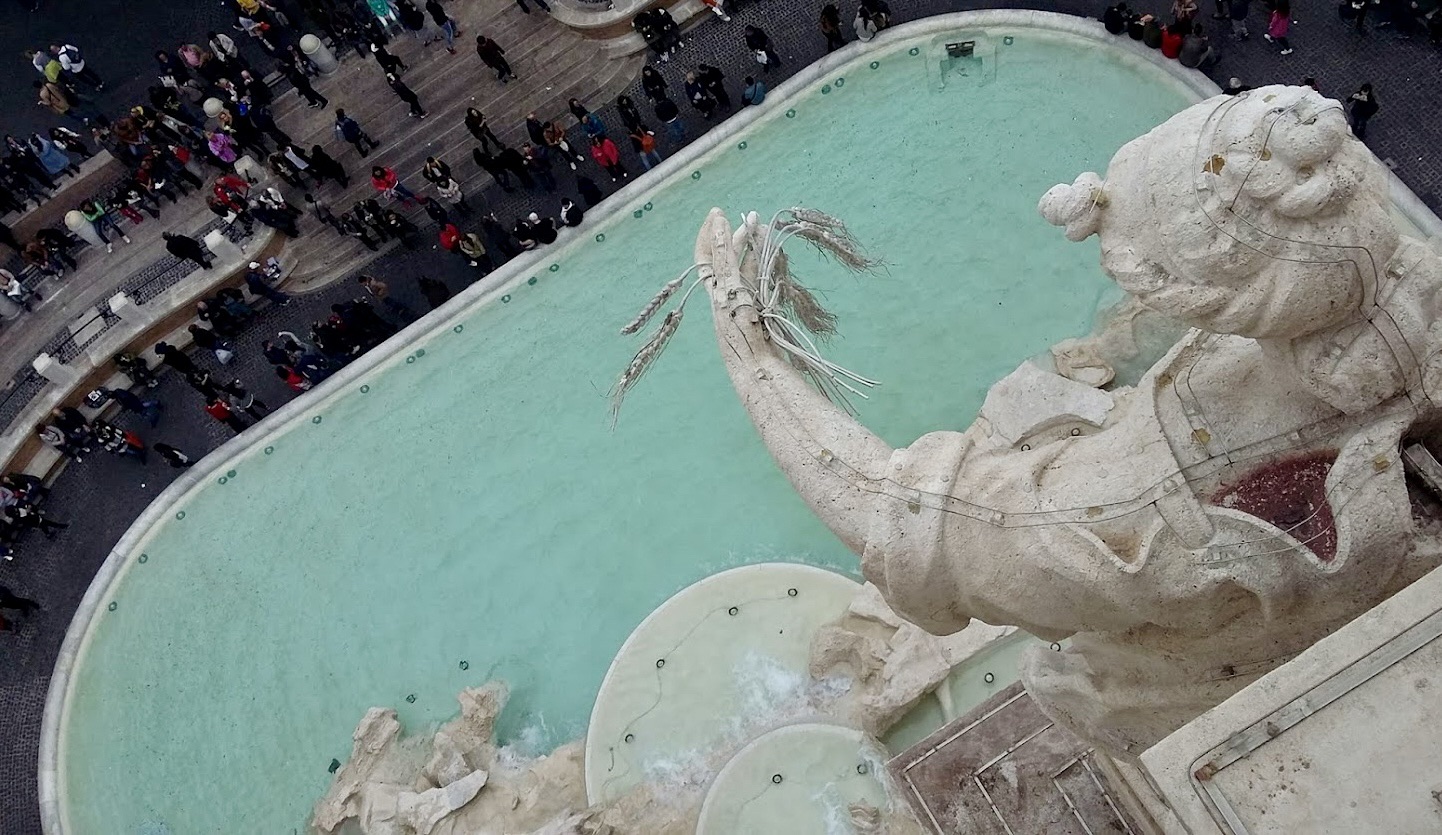
I have a cool Trevi memory.  In 2004, I attended a printmaking exhibit with a friend.  The entrance was at Via della Stamperia 6, 150 m from Piazza Trevi, down the side street past Fontanella degli Innamorati.  I remember climbing a lot of stairs and walking through corridors to get to the exhibit, which was amazing.  Then I wandered off to explore the gorgeous architectural details of the building, and heard the sound of running water as I walked past one of the tall, heavily curtained windows. Moving the curtain, I was right above the Fontana di Trevi!  It had not even occurred to me that there was a real building behind it.  Of course, this was before the time of cell phone cameras! This photo is from the Istituto’s website and was taken from farther up, possibly the roof.  Palazzo Poli was once a private residence, expropriated in 1885.  It is now theIstituto Centrale per la Grafica (Central institute for Graphics) a museum and exhibition space created to preserve and promote cultural heritage documenting graphic art.  Open Monday to Friday 09-17 and weekends 09-14.  Admission is free.  The room I wandered into is usually closed, unless you are attending a classical music performance.

9 m below the Fontana di Trevi, an archeological site was discovered during 2001 renovation of the former Trevi Cinema. Excavations uncovered a building complex from the Imperial Age (27 BC to 476 AD) and a fancy domus (Roman home), including canals still carrying clear water from Acqua Vergine to a holding tank for the domus. The site is called Vicus Caprarius, or “City of water” Vicolo del Puttarello 25.  Open Tuesday to Sunday 11-17 Reservations are recommended on weekdays, required weekends and holidays.  There are several underground tours, ranging from 30 minutes with audio guide to several hours long. I plan to see it in July!

The photos in this post were taken between 2004 and 2025.  Night view and bas reliefs taken by my sorella Lucia in Feb 2025.  ‘La Dolce Vita’ oil pastel on paper by the amazing Mary Cinque.

Ciao, Cristina

Share this:

  • Click to share on Facebook (Opens in new window) Facebook
  • Click to share on Pinterest (Opens in new window) Pinterest
  • Click to share on X (Opens in new window) X
  • Click to email a link to a friend (Opens in new window) Email
  • Click to share on WhatsApp (Opens in new window) WhatsApp
Like Loading...

Acqua Vergine

28 Friday Mar 2025

Posted by Un po' di pepe in Architecture, Roma

≈ 5 Comments

Tags

Ancient Roma, Ancient Roman engineering, Fontana di Trevi, La Barcaccia, Roman Fountains, UNESCO World Heritage Sites

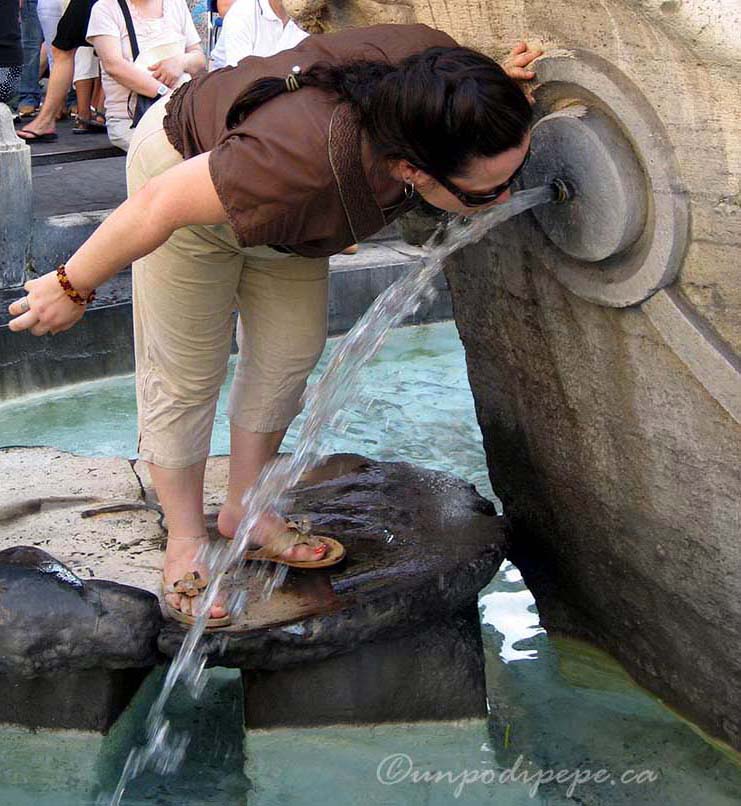
The Ancient Romans were masters of engineering.  One of the greatest examples of this is their aqueducts.  These systems of waterways transported fresh water from springs and melting snow long distances via pipes and tunnels.  The ability to provide a fresh, safe supply of drinking water is one of the reasons the Roman Empire became so powerful. In Roma, 11 aqueducts were built over a period of ~500 years.  Aqueduct #6 out of 11, called Aqua Virgo (Acqua Vergine in Italiano) lives on today.  Not only is it still with us, but it is still functioning, providing water to the most important fountains in central Roma.  The pure, cold, fresh water is drinkable*, constantly flowing and powered by gravity.

Mmmm! Acqua freddissima!

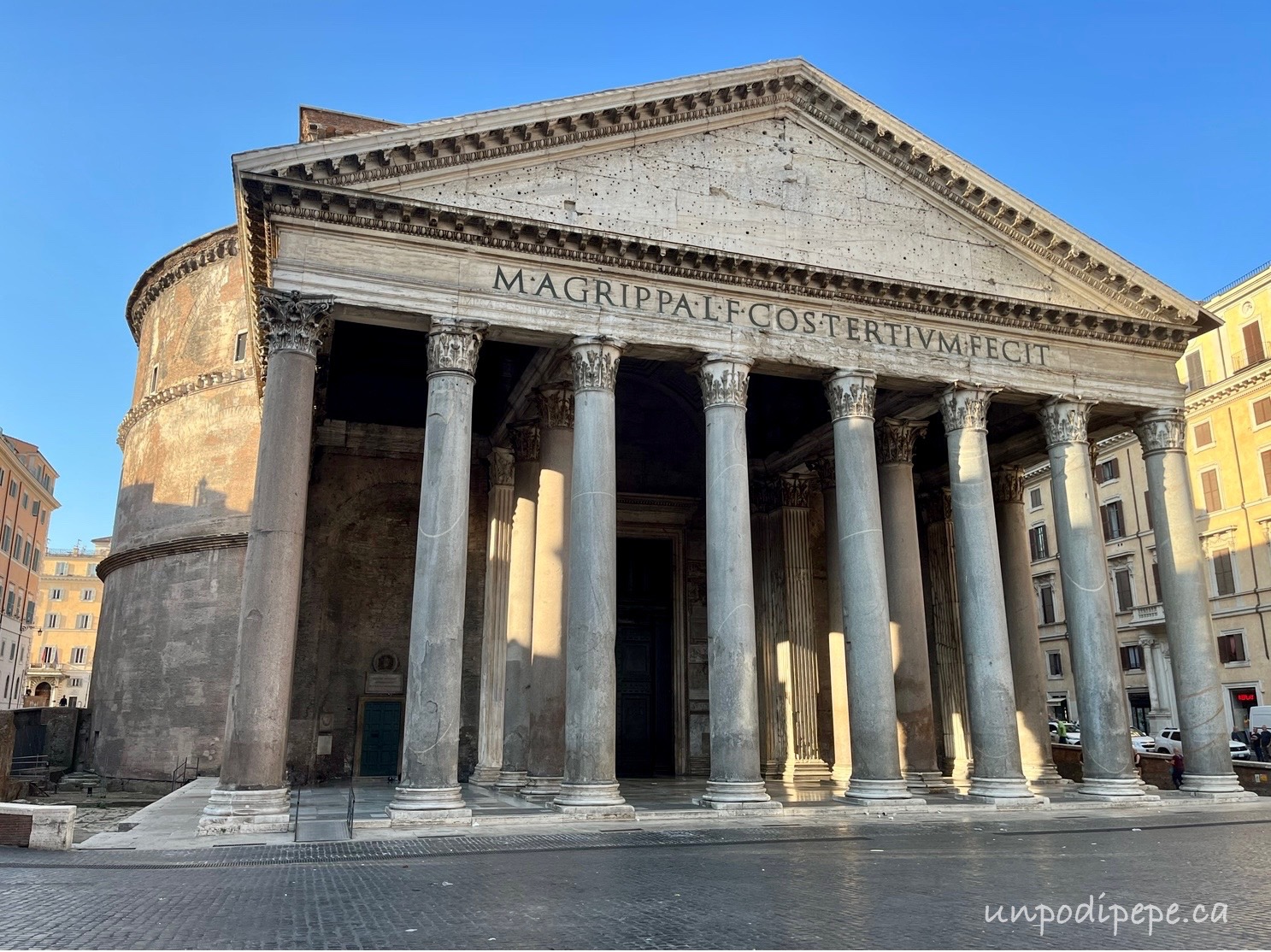
Aqua Virgo was constructed in 19 BC by Marcus Vipsamius Agrippa, son in law and general of Emperor Octavian Augustus.  Yes- the same Marcus Agrippa whose name is carved into the front of the Pantheon. He constructed the original Pantheon, before it burnt down.  Marcus had the aqueduct built to supply water for the thermal baths of Agrippa in the Campo Marzio area near the Pantheon.

Aqua Virgo/Acqua Vergine probably refers to the freshness and purity of the water, but according to legend, in 19 BC, a young girl led Roman soldiers to a spring -the source for the aqueduct.  The source is in the hills 13 km away, at Agro Lucellano between Via Tiburtina and the 8th milestone of Via Collatina (2 of the roads that led to Roma) near present day Salone.  The source is actually only 24m (79 ft) above sea level. Aqua Virgo is 21 km long via indirect route to Roma, making a wide arc.  This is to make use of gravity by shallow downward gradient. 19 km of Acqua Vergine are 9m below ground, with short stretches of brick arches above ground.

There were 1352 fountains in Roma in the 4th Century.  Aqua Virgo was damaged by the invasion of 537 and repaired. It remained in use through the Middle Ages with a few renovations during the Renaissance.  Early Renaissance Popes started to decorate the end point of restored aqueducts with large, ornate fountains.The Fontana di Trevi is the final destination of the original Acqua Vergine and Piazza del Popolo the end of an offshoot.  Carved above the statues next to Oceanus on the Fontana di Trevi, 2 bas reliefs illustrate Marcus Agrippa ordering construction of the aqueduct and the young girl leading Roman soldiers to the source.  They can both be seen in the photo below:

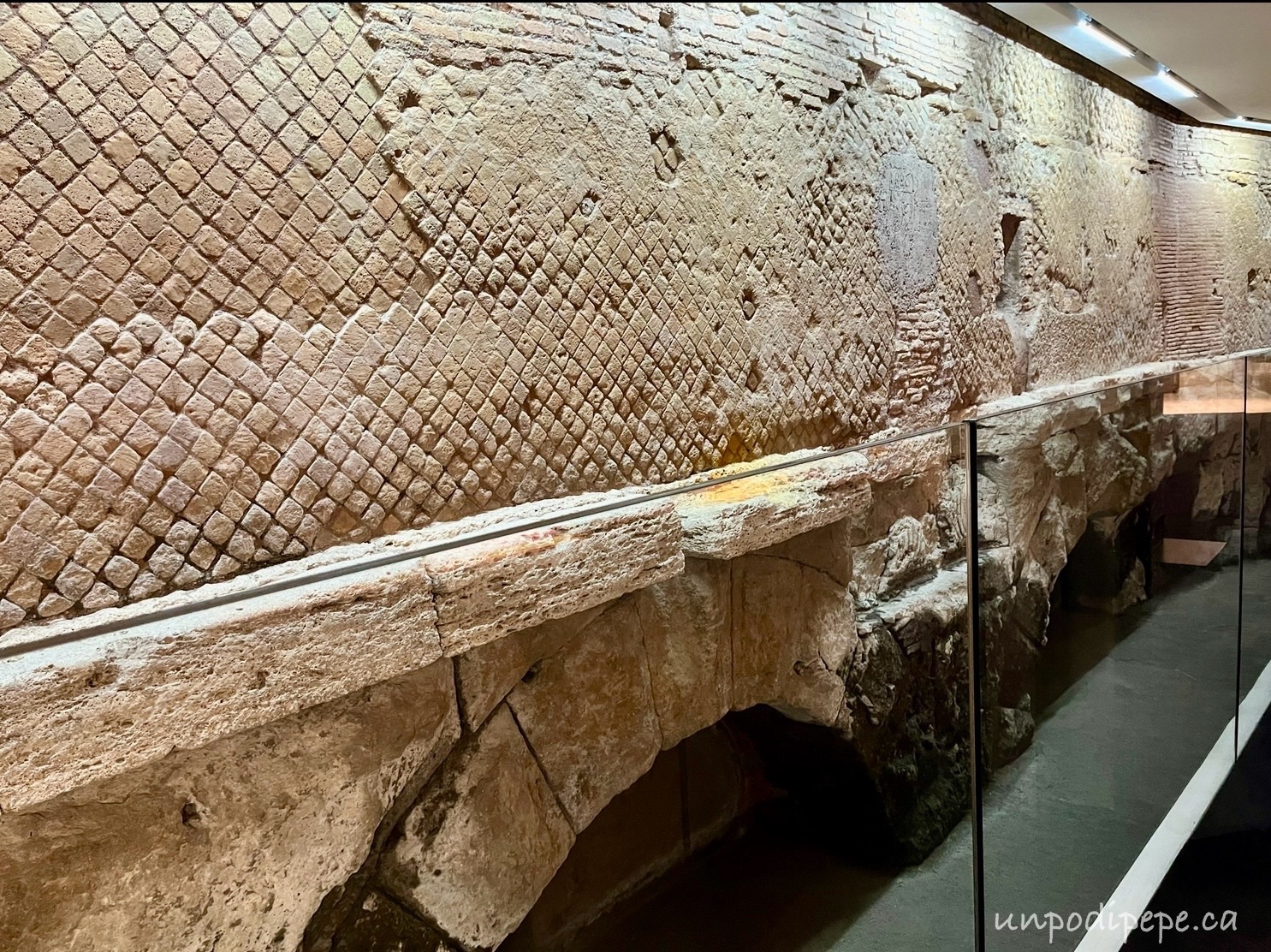
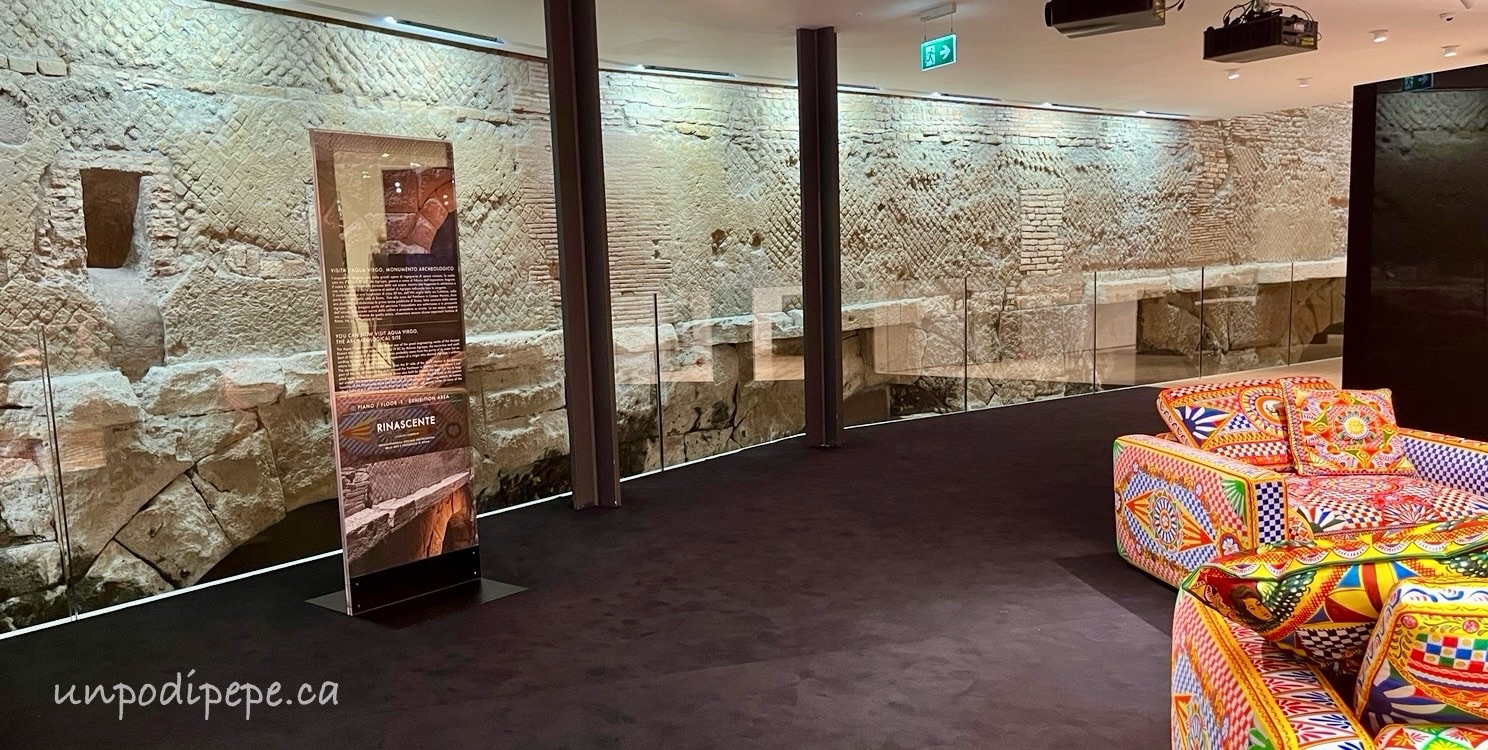
Acqua Vergine Antica runs under Villa Borghese and Villa Medici to Piazza di Spagna and Fontana di Trevi. In 1930 renovated Aqua Vergine Nuova goes behind Piazza di Spagna to Piazza through Giardini Borghese to Piazza Flaminio and Piazza del Popolo. Most of the aqueduct’s 21 km are 9m underground, except for the last stretch running partly on arches as it approached the Campo Marzio area, emerging from the hill by the present La Rinascente Department store. There is also an arch standing on Via del Nazareno, north of Trevi.  Part of Aqua Virgo was found during construction of the new La Rinascente department store location, delaying the opening by 2 years. In 2017 the new Flagship La Rinascente store on Via Tritone 61 opened, including a basement archeological site with a 60 m (197 ft) section of Aqua Virgo on display. Admission is free.  When I went, there was a Dolce and Gabbana furniture exhibit! Just take the escalator down to the bottom floor any time the store is open. Where else but Roma can you combine high end shopping and archeology?

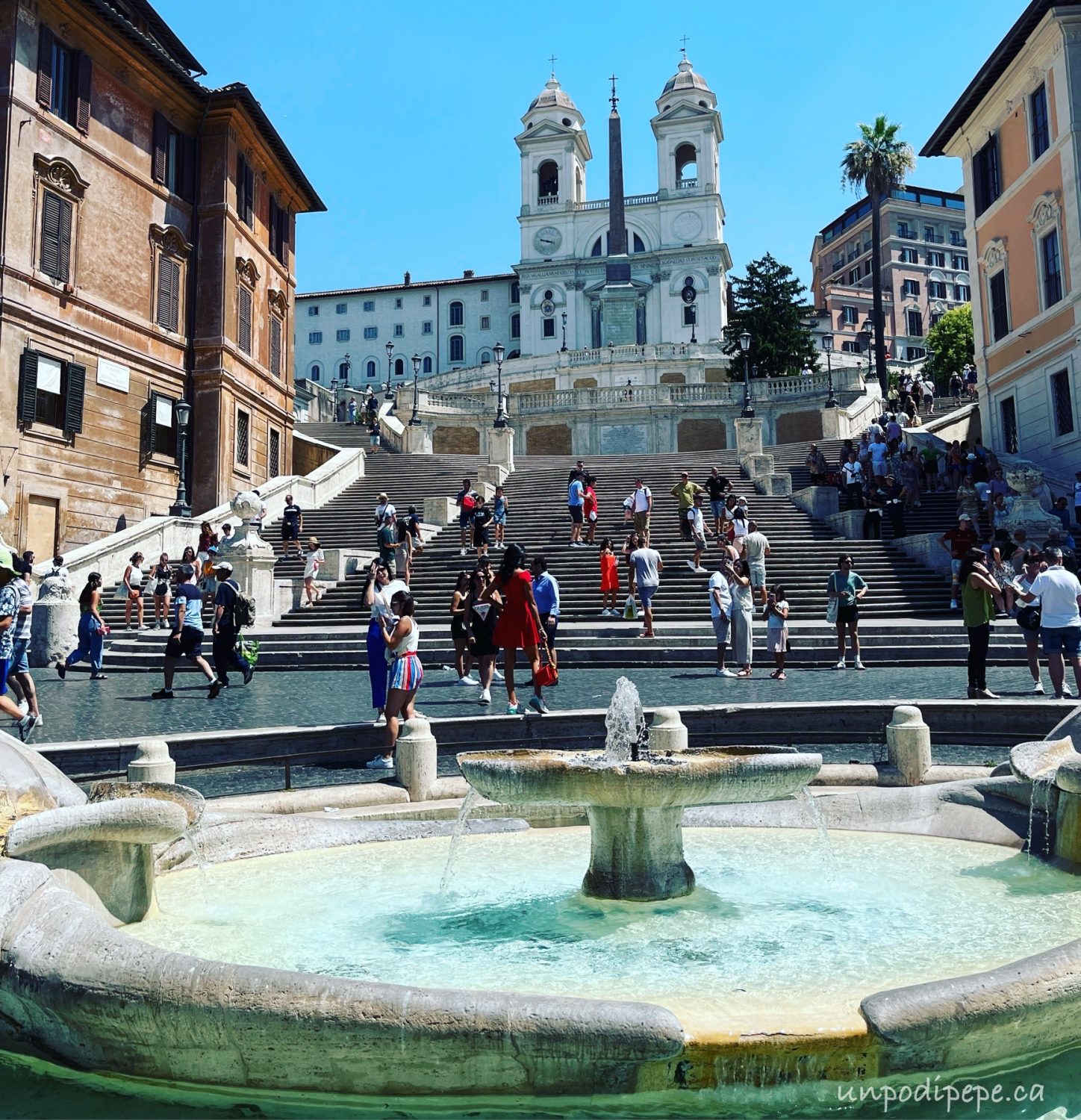
Today Acqua Vergine supplies water to the fountains in Piazza della Rotonda outside the Pantheon, Piazza Mattei (Fontana delle Tartarughe) Fontana del Babuino, Piazza Navona (the 2 outer ones, not the Fontana dei Quattro Fiumi), Campo dei Fiori, Piazza del Popolo (Fontana dei quattro leoni, Fontana di Nettuno and Fontana della Dea di Roma), Piazza Trevi, and my all-time favourite in Piazza di Spagna, La Barcaccia which resembles a sinking ship.  

Don’t forget to bring a water bottle to Roma!  Buon Viaggio, Cristina

*Since 1998, the water in the Fontana di Trevi is recycled, so no longer drinkable.  With €3000 of coins thrown in daily, it was hardly drinkable anyways! Read more about this in my next post!

Photo credits:  Drinking from La Barcaccia by Shannon Milar, Photo with bas reliefs by my sorella Lucia.

Share this:

  • Click to share on Facebook (Opens in new window) Facebook
  • Click to share on Pinterest (Opens in new window) Pinterest
  • Click to share on X (Opens in new window) X
  • Click to email a link to a friend (Opens in new window) Email
  • Click to share on WhatsApp (Opens in new window) WhatsApp
Like Loading...

Giubileo 2025

17 Monday Feb 2025

Posted by Un po' di pepe in Feste, Italia, Roma

≈ 4 Comments

Tags

Jubilee2025, Roma photography, UNESCO World Heritage Sites, Vatican City

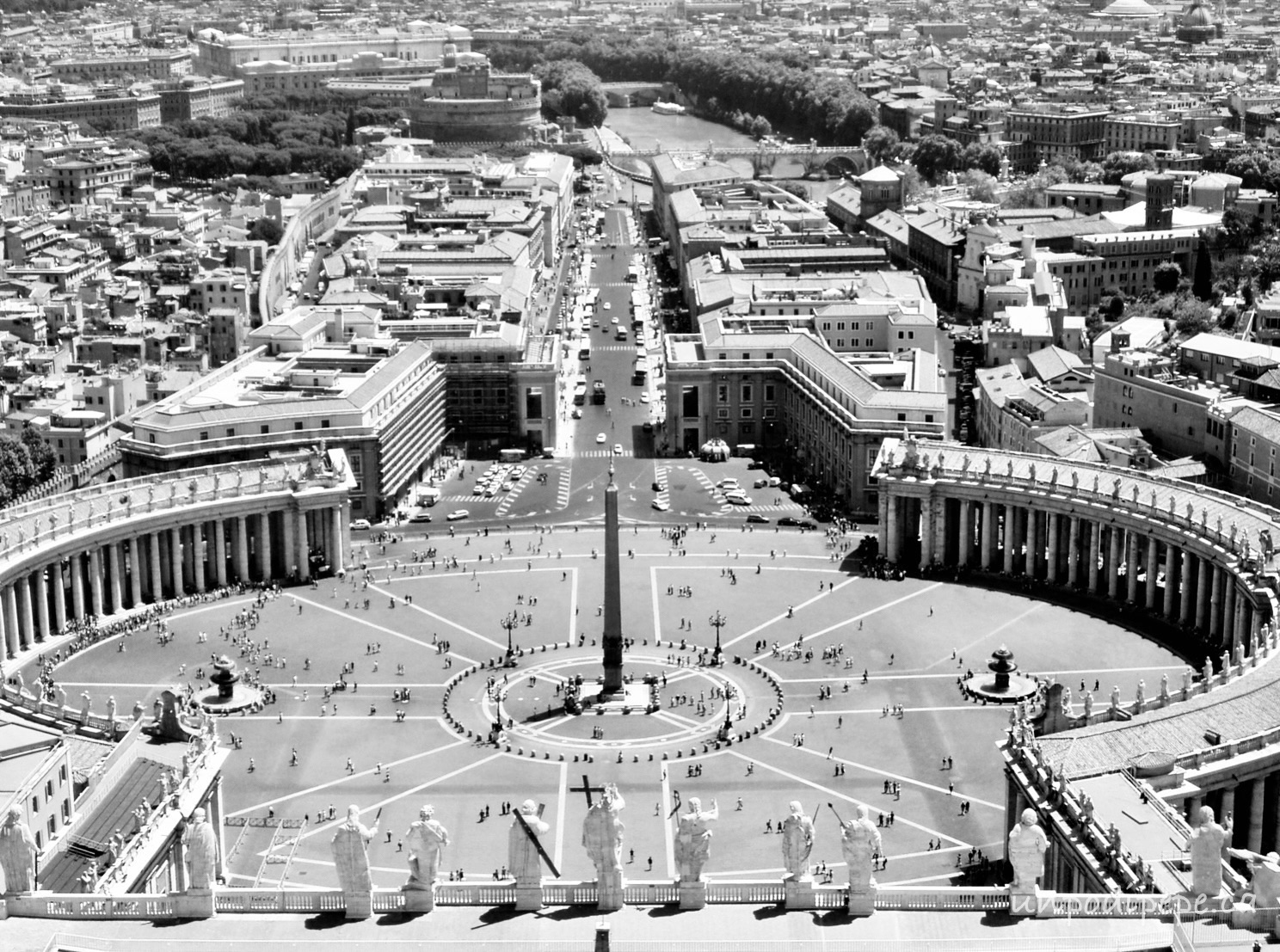
2025 is a Giubileo or Jubilee, also known as a Holy Year or Anno Santo-a Vatican celebration of spirituality and reconciliation, held every 25 years.  Roma and Vatican City- the smallest country in the world, will be a destination for millions of pilgrims.  The event is expected to attract 32 million people from all over the world.  As a reference, in 2023 Roma had 13 million visitors!

The Jubilee has been a tradition in the Catholic Church since the year 1300, started by Pope Boniface VIII as a special year for spiritual renewal, works of mercy, forgiveness and celebration.  It was also seen as an opportunity for a fresh start.  Originally held every 100 years, the timing was changed to every 25 years to give each generation an opportunity to participate.

The theme of Giubileo 2025 is Pellegrini di Speranza– Pilgrims of Hope.  The theme was chosen by Pope Francesco to emphasize hope as a driving force of the Christian faith.  He calls on everyone to embrace values such as peace, solidarity and unity, reflecting on the broader world and the role each person can play in fostering a hopeful, compassionate society. The Giubileo is for anyone-those who are Catholic, curious or just passing through.  In addition to religious observance, it also a cultural celebration, with special exhibitions, concerts and cultural events.

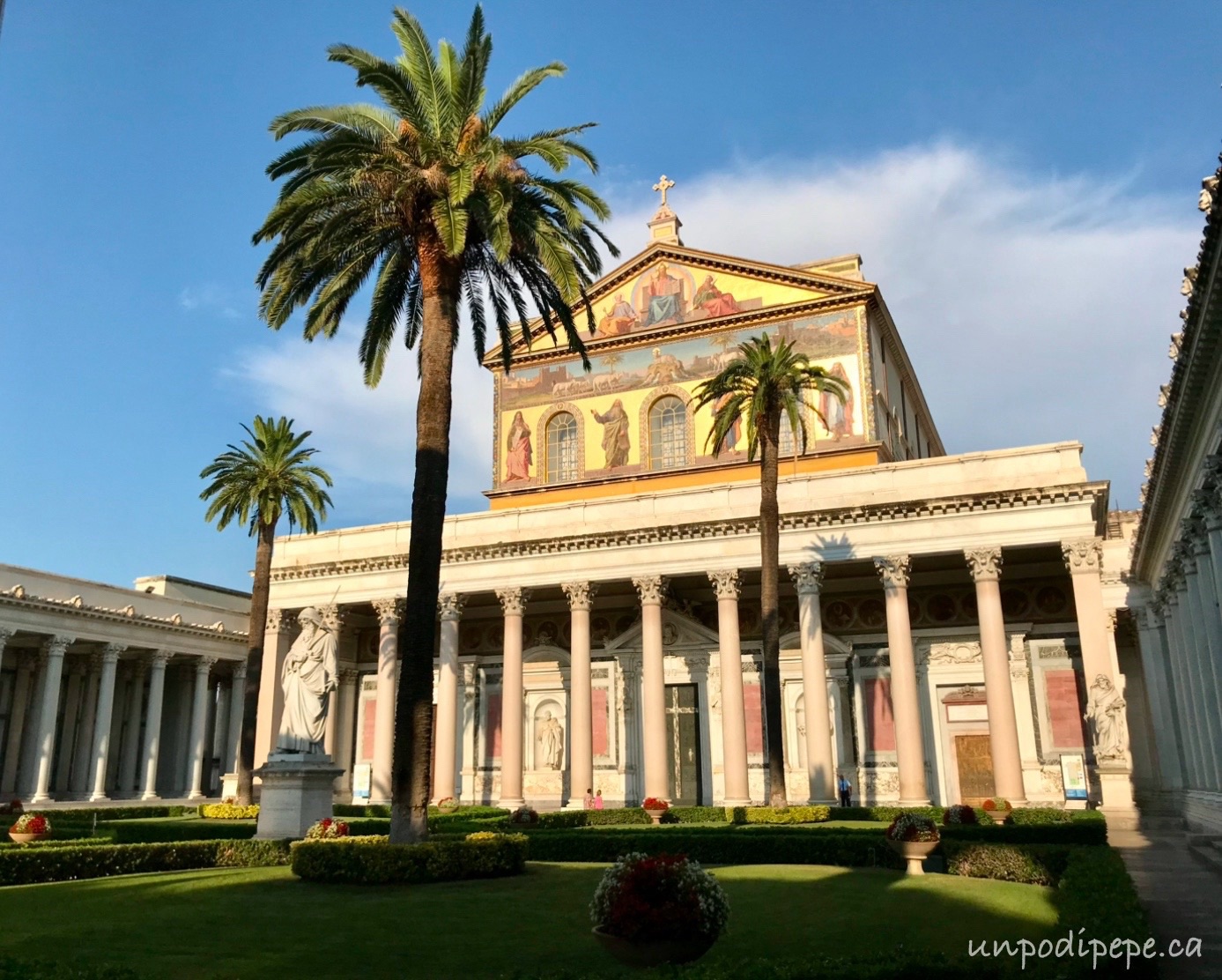
A central part of the pilgrimage is passing through the Holy Doors, which symbolizes the transition from sin to grace.  Each of the 4 Papal Basilicas has a Holy Door.  They are usually sealed shut and opened only during a Holy Year.  The main one, San Pietro at the Vatican, was the first to be opened on Dec 24th.  The other 3 in Roma are- Santa Maria Maggiore, San Giovanni in Laterano and San Paolo Fuori le Mura.  The doors will be sealed shut again on Jan 6th, 2026 until the next Holy Year in 2050.

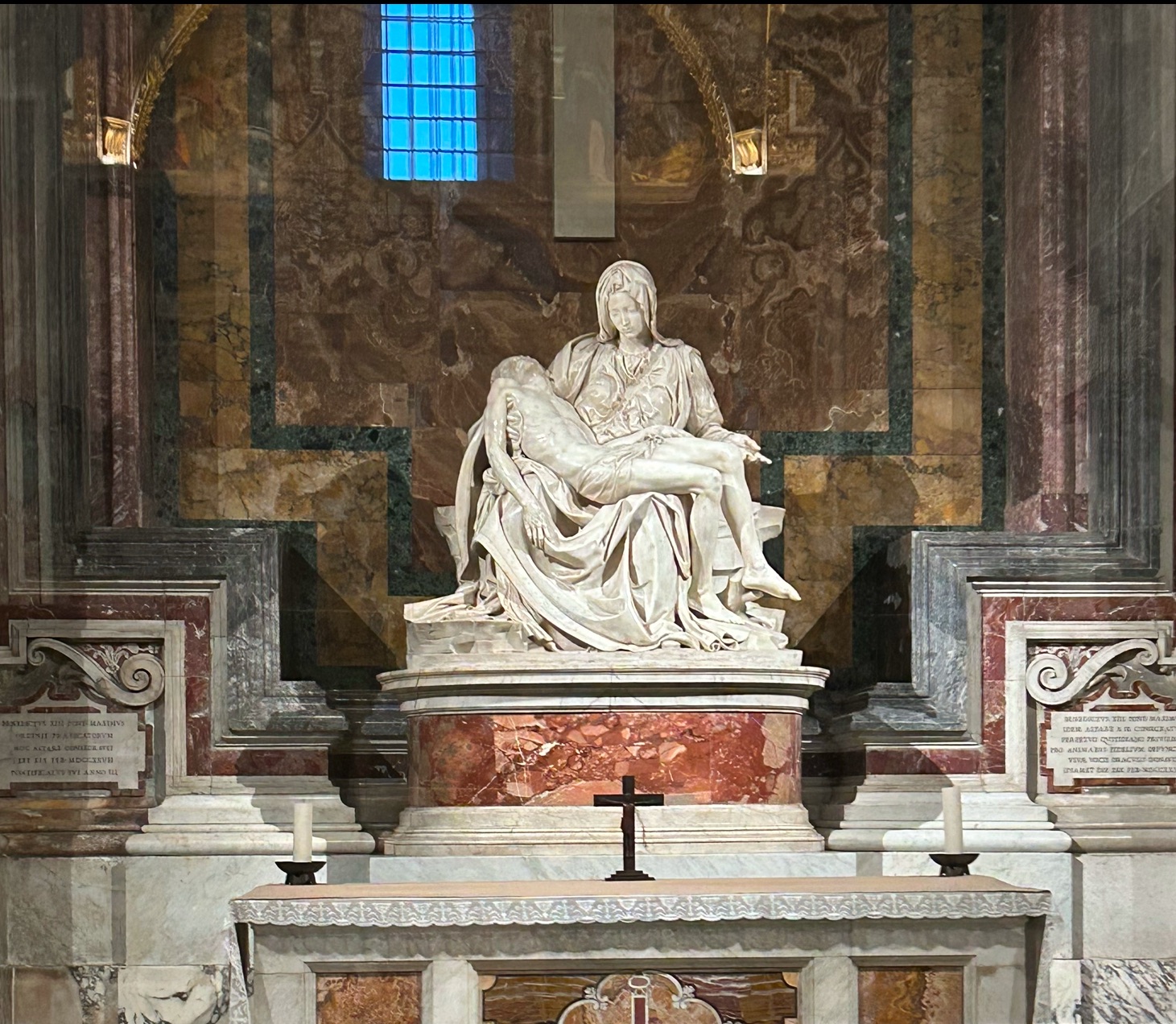
In July, I will be in Roma to attend a family wedding!  We are all excited-and not afraid of crowds or heat!  This will not be my first Holy Year in Roma.  In 1975, very young me and my family spent 3 days in Roma with Don Michele, Papa’s cousin who was a priest.  Not only did I pass through all 4 Holy Doors, but I actually touched Michelangelo’s Pietà before it was surrounded by bulletproof glass, and we may have visited every major church in Roma!  I also had my introduction to Pasta Carbonara at a Vatican cafeteria for pilgrims.  Carbonara should NOT be made for large groups….but I will leave that story for another time.

Roma has been a massive construction zone in preparation for 2025, so it should be all shiny and clean, hopefully with improved public transit.  There will still be ongoing work on Metro line C at Piazza Venezia, but most of the other renovation projects are completed.  Ancient monuments have been restored and refinished.  Bernini’s 29 meter high (94 feet) Baldacchino (altar canopy) in San Pietro has been polished for the first time in 150 years. A large area between Vatican City and Castel Sant’Angelo are now pedestrian only, since they have built an underground tunnel for car traffic.  Like everything in Roma, tunnel construction was delayed because during construction, they found ruins -the remains of a 2nd Century Roman wash house. 55 fountains have been restored including the one in front of the Pantheon, Fontana dei Quattro Fiumi in Piazza Navona and the Fontana di Trevi.  There will now only be 400 people at one time allowed to enter the small piazza to throw throw in their coins  and take photos.

Caravaggio 2025 at Galleria d’Arte Antica at Palazzo Barberini is on from March 7th -July 6th!!!!  This is one of the most ambitious Caravaggio exhibits ever.  More info here. I arrive in Roma July 7th.  Mannaggia!  Ecce Homo, which lives at the Prado Museum in Madrid and has only recently been attributed to Caravaggio will be included in the exhibit, as well as Napoli’s Sant’Orsola, the last Caravaggio, painted shortly before his death!  Martirio di Sant'Orsola Caravaggio's last paintingAdmission is €18 for adults.  Book your tickets now!  Run!  Make me jealous!  If they run out of tickets and you want to see 6 Caravaggio works for free, take yourself on my Caffè con Caravaggio walking tour!

What to expect in Roma this year?

Roma always has lots of visitors, even in ‘low’ season, which is only from January 7th until the beginning of March.  This year there will be increased crowds, especially in the areas around the Vatican.  If you are crowd-averse and not interested in any of the Giubileo activities in Roma, you may want to consider delaying your visit to Roma until 2026.  The busiest times are expected during Easter/Holy Week April 13-21st, Pentecost June 5th and at Christmas.  Different times of year are also aimed at various groups, for example, Jubilee of the sick and health care workers April 5-6th, teens Apr 25-27th, persons with disabilities April 28-30th. Artists, volunteers, public service workers and migrants all have their dates too.  It looks like April is definitely a month to avoid, unless you are attending a specific event!  Luckily none of the special dates are in the summer.  Here is the link to the calendar of events  Tickets are not required but you may need to book on the App.

Tickets for Colosseo, Galleria Borghese, Musei Vaticani and admission to the Basilica di San Pietro and the Pantheon will be in high demand.  Book early! If possible, plan to visit in the early am or evening. Look for accommodation that is not near the Vatican. for more info on how to ‘schedule like an Italian’, read Surviving Summer in Roma.

Download the Iubilaeum 25 APP  from the App store or Play store (android) and apply for a Pilgrim’s card a free digital pass needed for most Jubilee events.  This Portal allows individual or groups to register for events and highlight any special needs or access requirements.

It may be worth buying a 72 hour Roma Pass for €58.50.  The 36 hour Roma pass is already sold out! A Metro pass is always a good idea.

Don’t forget to read my post ‘Beat the heat:  Surviving Summer in Roma’

For some of my favourite things to do in Roma-‘Un Giorno a Roma‘.

If you need to get out of town to get away from the crowds, go to ‘Ostia Antica‘.  Buon Viaggio e Buon Giubileo!  Cristina

Grazie to Lucia for a few of the Vatican photos!

Share this:

  • Click to share on Facebook (Opens in new window) Facebook
  • Click to share on Pinterest (Opens in new window) Pinterest
  • Click to share on X (Opens in new window) X
  • Click to email a link to a friend (Opens in new window) Email
  • Click to share on WhatsApp (Opens in new window) WhatsApp
Like Loading...

Artemisia Gentileschi

08 Monday Jul 2024

Posted by Un po' di pepe in Art, Art history, Firenze, Inspiration, Roma

≈ 7 Comments

Tags

autoritratto, Baroque art, Caravagisti, Casa Buonarroti, Orazio Gentileschi

Artemisia Gentileschi was born July 8, 1593, 431 years ago today.  One of the greatest artists of the Baroque period, she is best known for using her paintbrush to create empowered female subjects, portraying them from a female perspective, in ways male artists rarely had. Rather than sitting passively, Artemisia’s women are active participants, strong, capable and defiant.

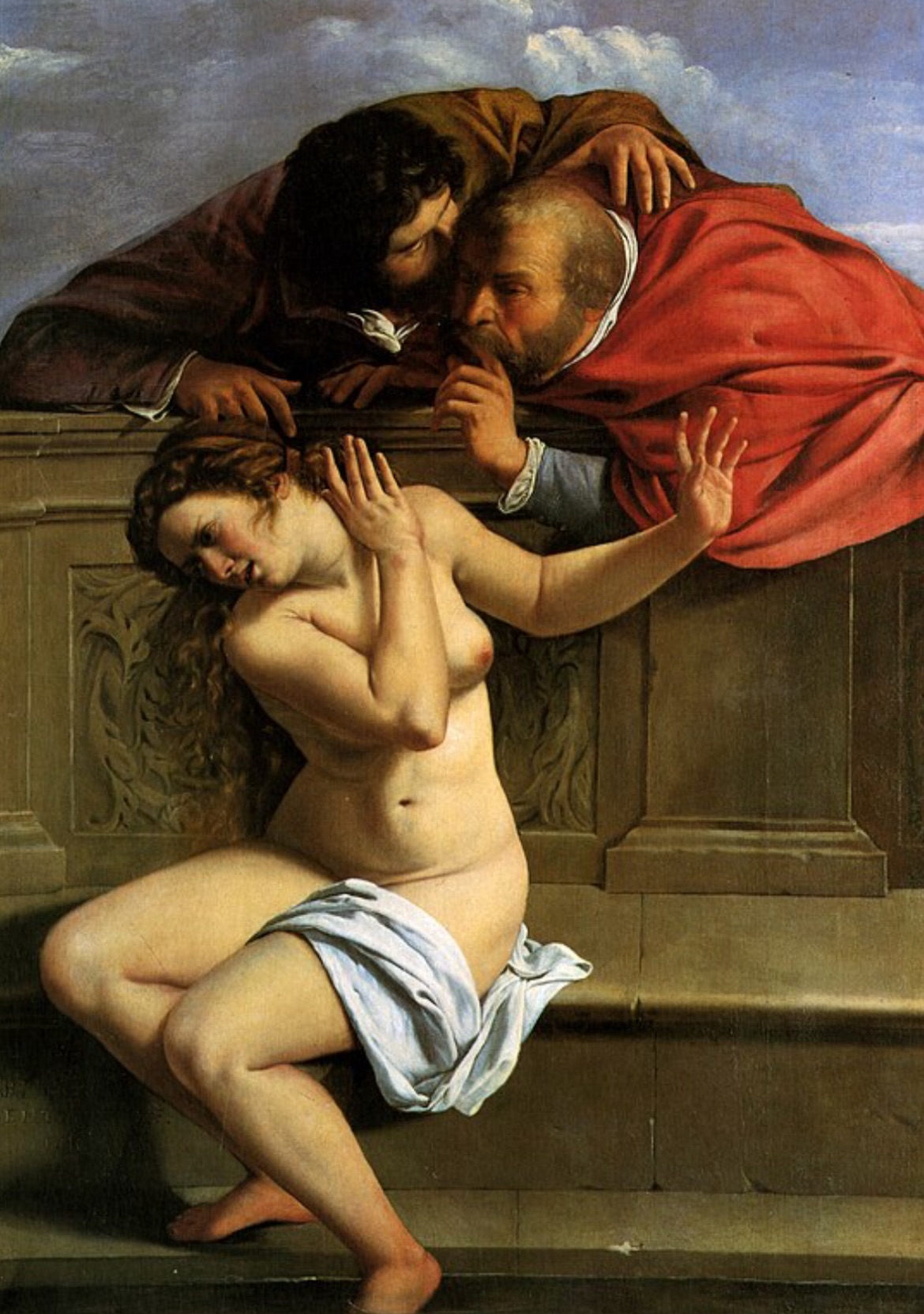
Introduced to art and trained by her father Orazio Gentileschi, an early follower of the dramatic style of Caravaggio, Artemisia worked along with her 3 younger brothers.  She was the only one to show talent and interest, producing her own work by age 15. In 1610, at age 17, she painted her earliest surviving work ‘Susanna and the Elders’ which for years was incorrectly attributed to Orazio. Unlike other painters’ versions, her Susanna is distraught and shields herself from the oglers, as an early depiction of sexual harassment. Artemisia painted this subject 7 times.

Susanna and the Elders (1610)

In 1611 Orazio decorated a palazzo in Rome with painter Agostino Tassi.  He hired Tassi to tutor 17-year-old Artemisia to help refine her painting skills.  During one of their sessions, he raped her.  They started a relationship, since she believed they were going to be married, as societal norms of the time required.  When it became apparent that Tassi was not going to marry Artemisia, Orazio took the unusual route of pressing charges against him for rape.  The trial went on for 7 months, revealing scandalous details -that Tassi had an affair with his sister-in-law and allegedly hired bandits to murder his missing wife.  Artemisia was subjected to a gynecological exam, and tortured with thumbscrews to verify the truthfulness of her testimony!  Luckily there was no permanent damage to her fingers and this did not affect her ability to paint. Tassi was convicted, and sentenced to 2 years in prison.  He was also exiled from Roma, but this was never enforced.

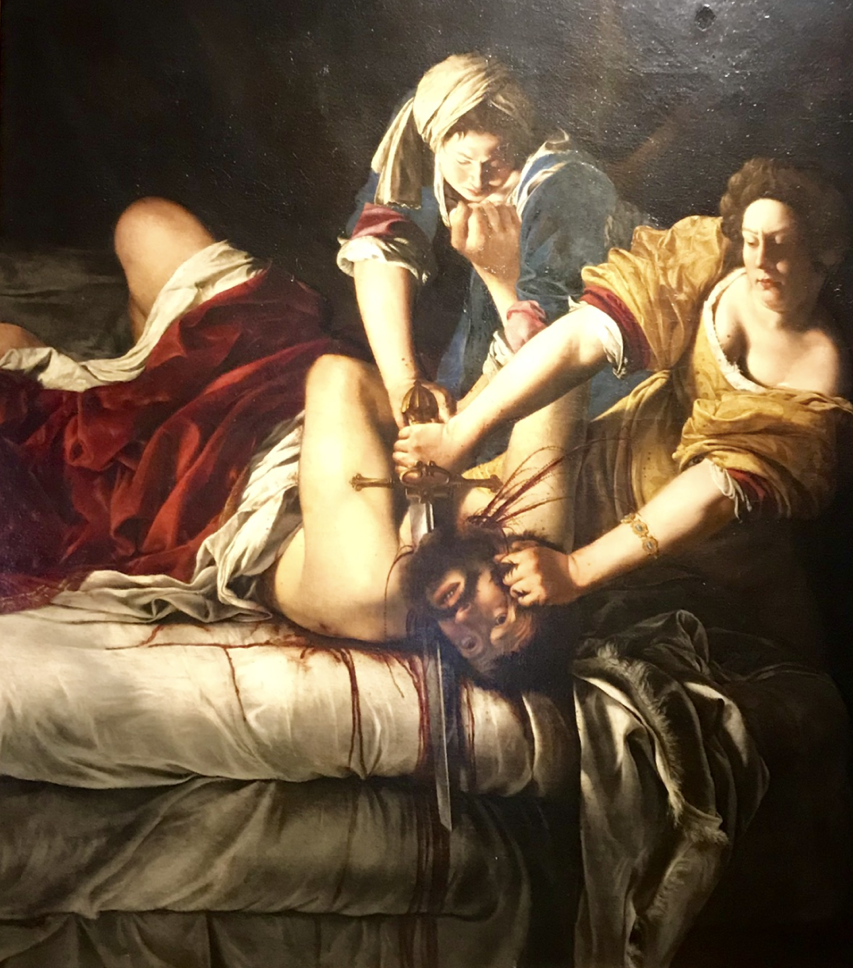
Judith Slaying Holofernes 1620 Galleria degli Uffizi, Firenze

After this ordeal, many of Artemisia’s paintings feature women being attacked or in positions of power, seeking revenge. In 1612 she painted her first of 6 versions of Judith Slaying Holofernes, which is in Museo Capodimonte, Napoli.  The 1620 version in the Galleria degli Uffizi, Firenze is ‘bloodier’ than the first one. I like to imagine Artemisia having a scientific discussion with Galileo about realistic blood spatter patterns!  Below is Caravaggio’s 1598-99 version of the scene, which is a masterpiece, but Judith looks like the 90 pound weakling who is worried about breaking a nail or getting blood on her dress, and her servant just stands there.  In Artemisia’s version, both women mean business, practically sitting on Holofernes to get the job done. 

Judith Beheading Holofernes Caravaggio 1598-99 Palazzo Barberini

After the trial, Orazio arranged for Artemisia to marry artist Pierantonio Stiattesi and they moved to his home city Firenze, where she had a successful career as an artist and an impressive clientele.  She had the support of Cosimo II de Medici and was friends with Galileo.

Allegory of Inclination (1615) Casa Buonarroti

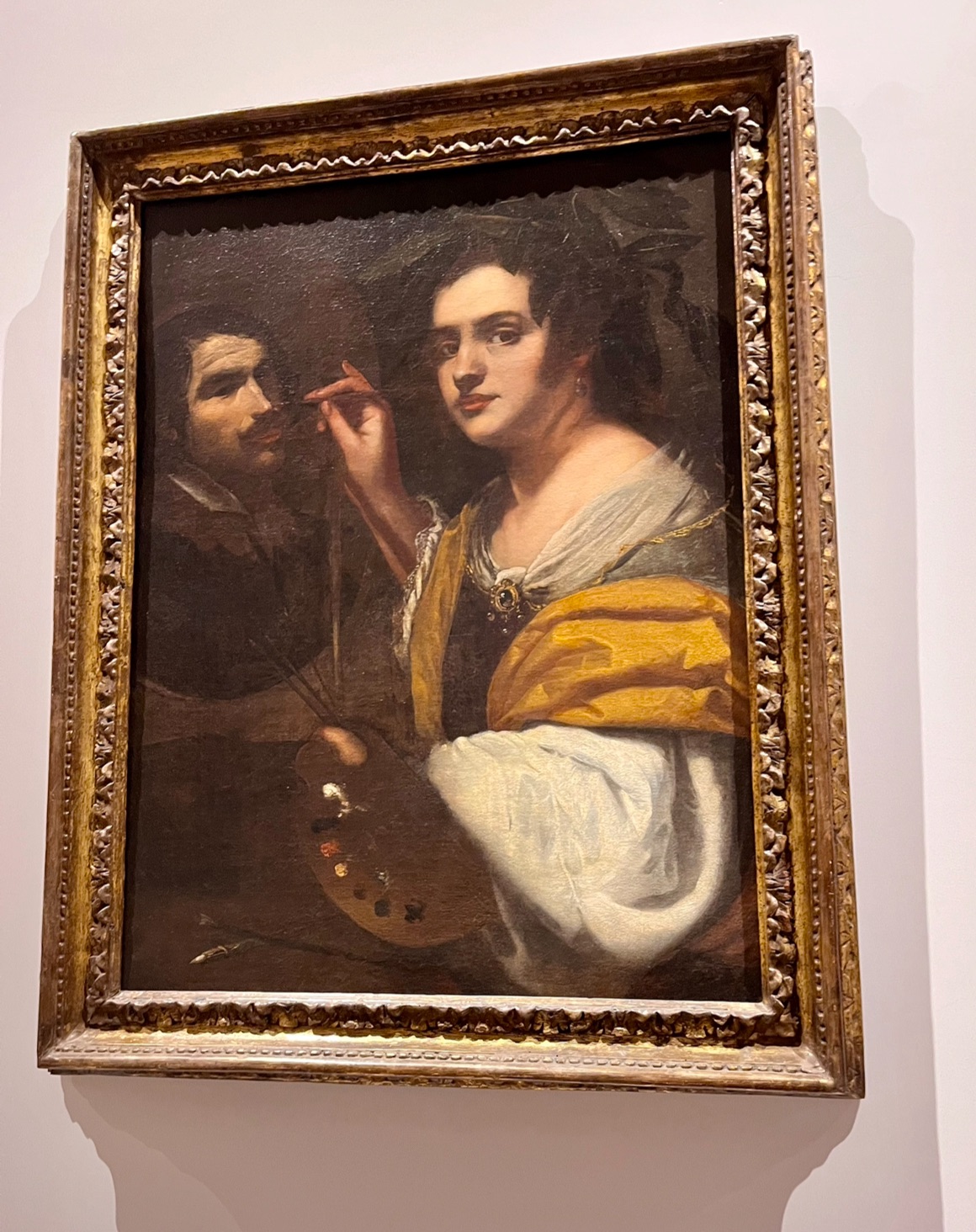
At age 21, Artemisia was the first woman accepted into the prestigious Firenze Accademia delle Arte del Disegno.  This was a major accomplishment!  She was now able to sign her own contracts and purchase art materials without permission from her husband!  In 1615, she was commissioned to paint one of the ceiling frescoes at Casa Buonarroti, former home of Michelangelo, being turned into a museum by his great-nephew. Artemisia was paid more than the male artists working on the frescoes were! ‘Allegory of Inclination’, like many of her paintings, was likely a self-portrait.  Why self-portraits?  The model is free and always available!

Self-portrait, Galleria Barberini 1630-35

In 1618 Artemisia had a daughter named Prudentia, the only one of her 5 children to survive infancy.  She trained Prudentia as an artist, although none of her work survives that we know of.  Artemisia had an affair with Florentine nobleman Francesco Maria di Niccolo Maringhi, which is documented in a series of 36 letters, discovered in 2011.  Her husband also corresponded with Maringhi, who helped support them financially.  Fed up with her husband’s financial and legal issues, she returned to Roma with her daughter in 1621-1626.  Artemisia continued to be influenced by Caravaggio as she worked with some of his followers, Carravagisti, including Simon Vonet.  She also spent 3 years in Venezia working on commissions.

Sansone e Dalila/Samson and Delilah 1630-38 Galleria d’Italia, Napoli

Artemisia relocated to Napoli in 1630 and worked with many well-known artists such as Massimo Stanzione. In 1638, she was invited to the court of Charles I of England in London, where Orazio had been court painter for 12 years. He was the only Italian painter in London and the first to introduce the style of Caravaggio there.  Orazio and Artemisia had not seen each other for 17 yrs.  She worked alongside Orazio on an allegorical fresco for Greenwich, residence of the Queen. Orazio was 75 and needed her help to complete the work before he died suddenly in 1639.  Artemisia painted some of her most famous works while in England, including Self Portrait as Allegory of Painting (1639), which she likely painted with 2 mirrors, one on either side of her. In 2017 I had the opportunity to see this painting at the Vancouver Art Gallery exhibit from the Royal Collection.

Self-portrait as the Allegory of Painting 1638-39 Royal Collection, Windsor Castle

Once she finished her commissions, Artemisia left England before 1642, returning to Napoli.  The last letter from her agent was dated 1650, which implies she was still painting.  There is additional evidence to suggest she was still working in Napoli in 1654 and likely died during the plague in 1656.

Artemisia’s legacy is complex and full of controversy.  She defied the odds and was well respected as an artist during her own lifetime.  She thrived in a time when women had few opportunities to pursue artistic training, let alone actually work as professional artists.  After her death, Artemisia Gentileschi was almost omitted from the history of art.  The fact that her style was much like her father’s and some of her works were incorrectly attributed to Orazio and even Caravaggio may have something to do with that.  More likely, those documenting art history did not think a woman was worth mentioning.

In the early 1900’s, her work was rediscovered and championed by Caravaggio scholar Roberto Longhi.  In all accounts of her life, Artemisia’s talent and achievements are overshadowed by the story of her rape and trial.  This is partly due to a 1947 over-sexualized fictional novel by Longhi’s wife Anna Banti.  1970’s and 80’s feminist art historians began to reassess Artemisia and her reputation, focusing on her significant artistic achievements and influence on the course of art history rather than events that happened in her life.

A 1976 exhibition ‘Women artists 1550-1950’ proposed that Artemisia was the first female in the history of Western art to make a significant and important contribution to the art of her time.  Following centuries of near obscurity, today Artemisia’s paintings are again celebrated around the world.  An ornate plate rests in her honour at the table of contemporary feminist art as part of Judy Chicago’s iconic 1979 work ‘The Dinner Party’.

Artemisia has left us with 60 paintings, not including collaborations with Orazio.  40 of them feature females from the Bible or mythology. Only 19 of her paintings are signed and 13 are in Private collections!  Can you imagine owning your own Artemisia??? Famous quotes from Artemisia include ‘My illustrious lordship, I’ll show you what a female can do’ and ‘As long as I live, I will have control of my being’.

Enjoy the Monologue ‘Becoming Artemisia'(May 2024) directed by Antonio D’Alfonso, text by Mary Melfi (17 min).

Google doodle of Artemisia GentileschiBuon Compleanno Artemisia!

Photo credits: Susanna and the Elders and Allegory of Inclination, Wikipedia

Google Doodle by Hélène Leroux, July 8, 2020

All other photos taken by Cristina

Share this:

  • Click to share on Facebook (Opens in new window) Facebook
  • Click to share on Pinterest (Opens in new window) Pinterest
  • Click to share on X (Opens in new window) X
  • Click to email a link to a friend (Opens in new window) Email
  • Click to share on WhatsApp (Opens in new window) WhatsApp
Like Loading...

Ostia Antica

27 Tuesday Feb 2024

Posted by Un po' di pepe in Art history, Italia, Roma, Travel

≈ 9 Comments

Tags

Ancient Roma, Archeology, Daytrips from Roma, Italian history, Lazio, Roma, Roman walks

Ostia Antica, 30 km southwest of Rome was once a thriving town and commercially important seaport. It is now a well-preserved archeological site and at 150 hectares, one of the largest archeological parks in Europe. Founded in 620 BC to harvest sea salt at the ‘ostium’ or mouth of the Tevere (Tiber River), Ostia Antica was Rome’s first colony, a naval base and main ancient seaport.  With a population of 60,000 in the 2nd and 3rdcenturies AD, it was the hub for import of grain, olive oil, wine, marble, cloth and other goods destined for Rome.

Originally located on the coast, Ostia Antica is now 3 km inland. After the fall of Rome and barbarian raids, the port was neglected and the harbour eventually silted up. It was completely abandoned in the 9th century AD.  Sand dunes and mud covered the city, helping to preserve the ruins and mosaics for us like a time capsule from Ancient Rome.

Ostia Antica was a working class port city, as opposed to Pompeii, which was a resort getaway and playground for the rich and famous.  The ruins provide insight into regular, daily life in Ancient Rome and give us a sense of urban planning for the time.  There are well preserved cobbled streets, magnificent mosaics, temples, shops, apartment buildings, warehouses, private homes, public baths, warehouses, taverns, inns, a public laundry, theater and even a firefighting service.  The earliest identified synagogue in Western Europe (41-54 AD) was discovered in 1961.

Excavation started in the early 19th Century, but most of it was done from 1938-1942. Only 40% of the site has been excavated! There is a lot to see in Ostia Antica.  Here are some of the highlights:

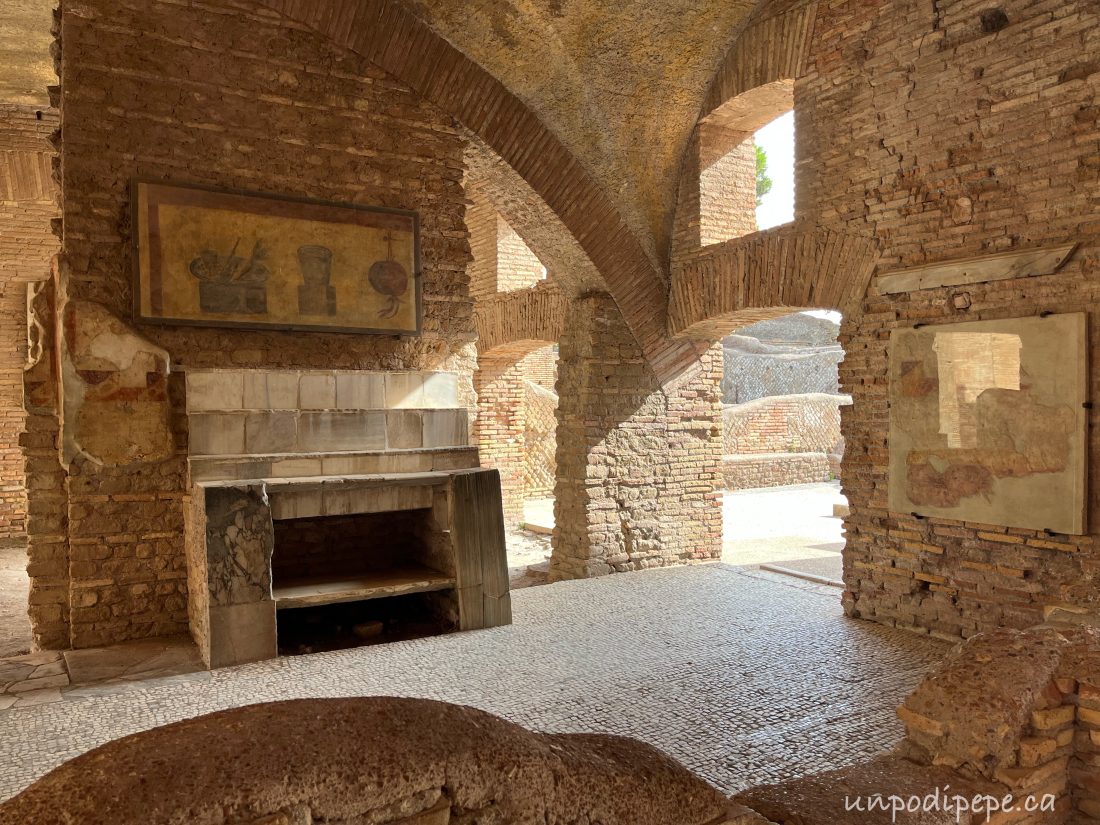
Thermopolium di Via di Diana Thermopolium is Greek for ‘place where hot food is sold’.  A 3rd C ancient fast-food joint and wine bar with windows that open out onto the street and a marble take-out counter, long table to serve hot food, shelves and a courtyard with a fountain for outdoor dining. Amphorae with cheap wine were stored under the counter.  A large fresco ‘menu’ on one wall shows a plate with carrots and beans, a glass of wine, a jar of olives and large onions or pomegranates.
Customers likely topped their food with an ancient condiment called Garum.  It was a pungent rotten fish sauce and makes ketchup sound appetizing.  On the side of the Thermopolium is a single gated public toilet!

Mulino di Silvano A multiroom bakery built in 120 AD. One room has 3 intact lava millstones for grinding the grain into flour, one for kneading the flour into dough and another still has the ovens for baking the loaves.  The bread was sold on site and also transported to sell in Rome.

Teatro Ostia’s semicircular theater survives in excellent condition.  Built in the first century BC and expanded later, it is one of the oldest masonry theaters in the world.  It can seat 4,000 spectators and is still used for summer concerts.

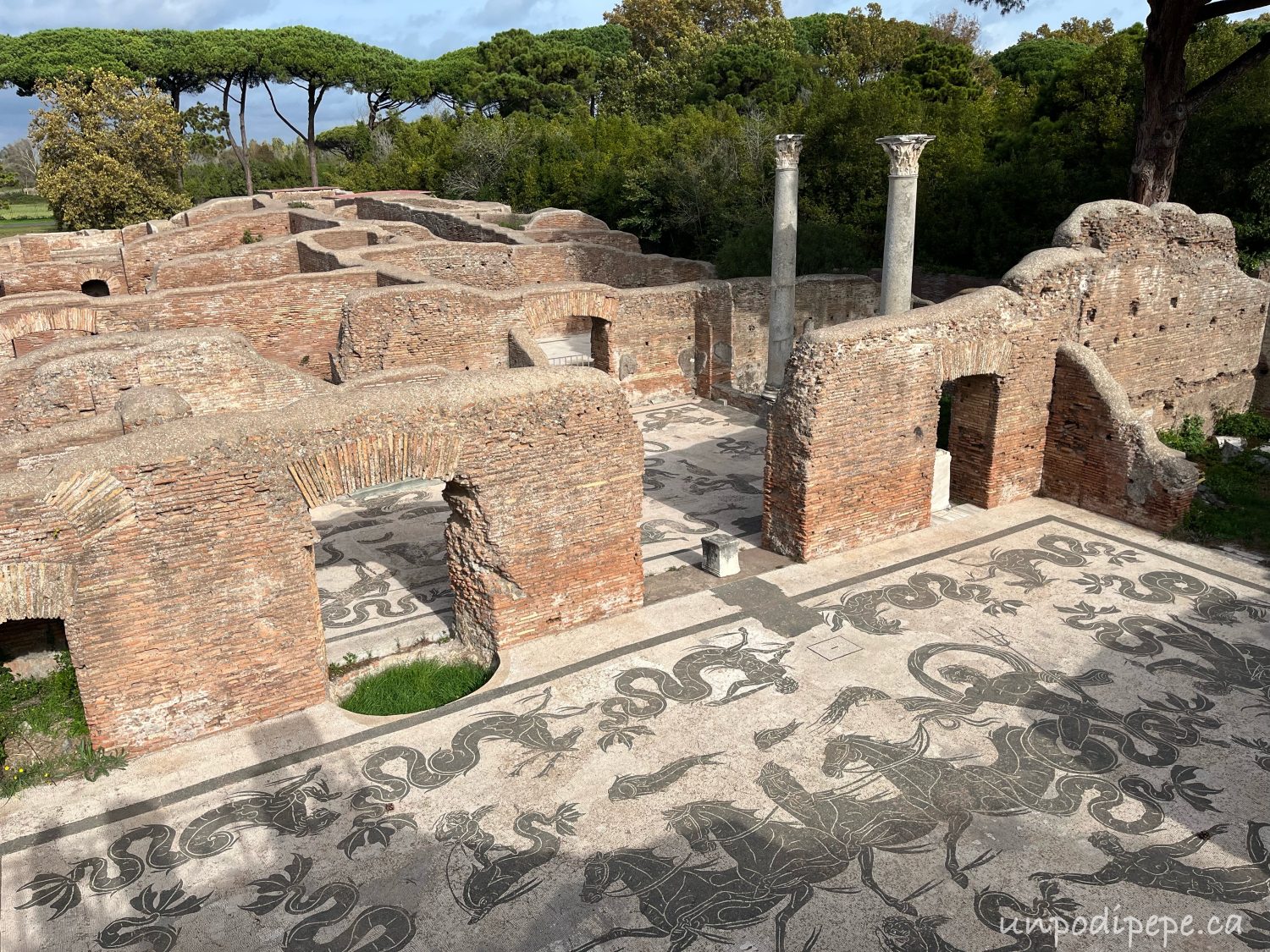
Public Baths  There are several public baths in Ostia.   The Baths of Neptune have incredibly preserved mosaic floors of Neptune and sea creatures.  We can thank the mud that covered them for centuries!  These are often covered up in the winter to protect from the harsh weather.

Public toilets A fine example of Roman plumbing. The toilets consist of a communal marble bench along 3 walls with 20 seats. Each seat had a hole leading down towards a single drain channel fed with running water to flush away waste. Since toilet paper was not a thing yet, a sea sponge attached to a stick was kept in a bucket of saltwater or vinegar for patrons of the toilets to wipe themselves. Yuck!

Piazzale delle Corporazioni (Piazza of the Corporations/Guilds) Located behind the theater, the piazza is a large open air market square with stalls along all 4 sides. Merchants and craftsmen from all over the Mediterranean sold their goods.A small metal model of the piazzale has descriptions written in Braille and Italian.The beautiful black and white mosaics in front of the stalls advertised the goods or services being sold. Stalls included shipbuilders, ropemakers, leather tanners, sailmakers, grain and wine importers, as well as fish and food products.  One of the stalls with fish mosaics likely sold the pungent Garum fish gut sauce!

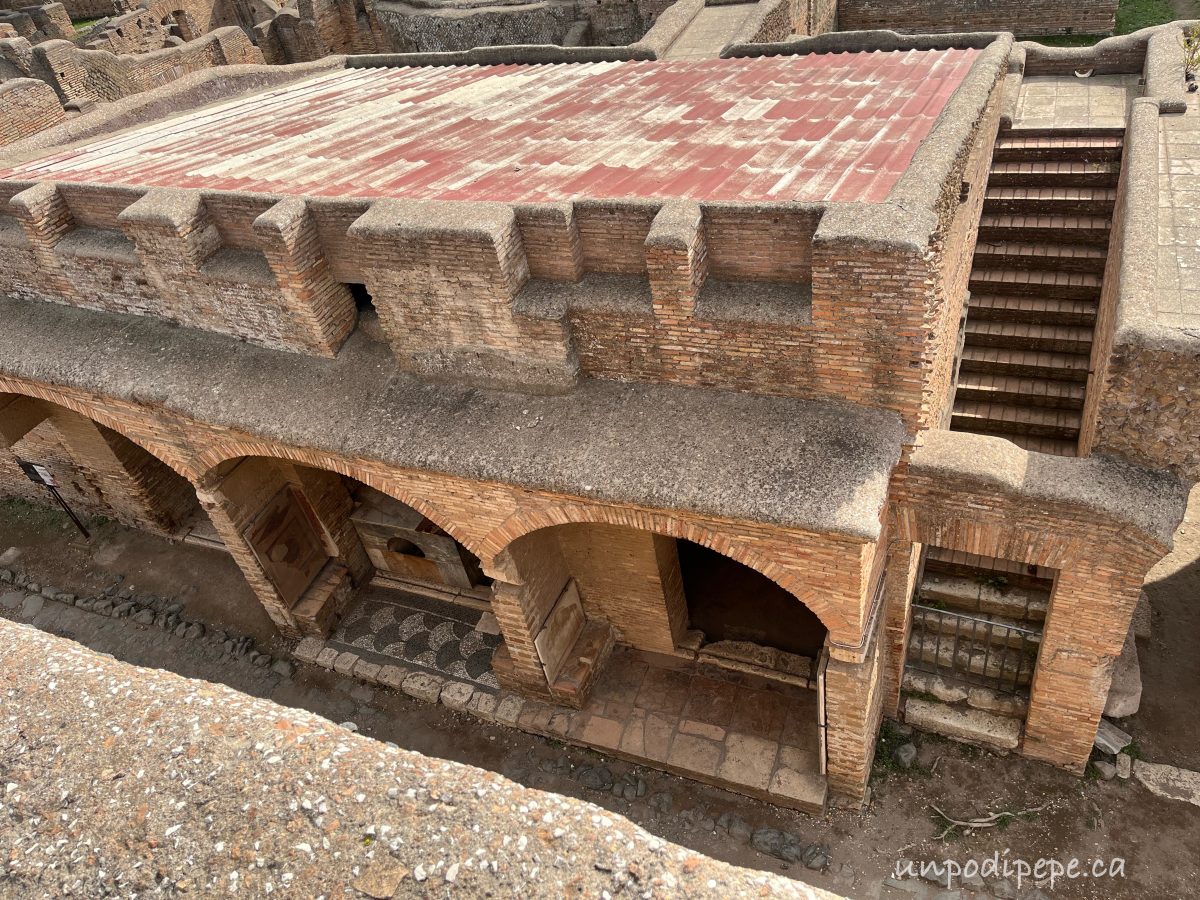
Casa di Diana A complex multifunction residential building -urban planning centuries ahead of its time.  Called an insula, this multilevel apartment has ground floor shops, accommodation for the shopkeepers on the 1stfloor and more modest accommodation on the upper floors.  A 150 AD painting of Diana was found inside.  It is possible to climb the stairs of other insulae to get to the upper floors.

A visit to Ostia Antica is a nice, half day trip from Roma, although it can be a whole day excursion if you explore more of the huge site and have lunch at one of the restaurants nearby.  Ostia Antica is grossly under visited, so it is never crowded! Bring water, a hat, sunscreen and good walking shoes.

Open Tues to Sat 8:30-4:30 in winter 8:30- 7 pm in summer. Admission fee is €18. Free admission the first Sunday of the month.  Tickets can be booked online on the official website .  A PDF guide can also be downloaded from the website.  The museum is worth seeing, but is closed at present.

Getting there by public transportation is easy and cheap: Take Metro line B (Blue line) to San Paolo (or Piramide*) metro station and take the ‘Lido’ commuter train to Ostia. Get off at ‘Ostia Antica’. The ride is 23 minutes. (Do not get off at Ostia Lido Nord or Ostia Lido Centro unless you are going to the beach!)

Use the footbridge to cross the road and walk 5-10 minutes to the main entrance of the Parco Archeologico Ostia Antica. Trains leave every 20 minutes and use the regular metro/bus tickets €1.50.

*If getting there from Piramide, walk out of the metro station and go to Porta San Paolo train station next door to find the Lido commuter train.

Buon viaggio!

Share this:

  • Click to share on Facebook (Opens in new window) Facebook
  • Click to share on Pinterest (Opens in new window) Pinterest
  • Click to share on X (Opens in new window) X
  • Click to email a link to a friend (Opens in new window) Email
  • Click to share on WhatsApp (Opens in new window) WhatsApp
Like Loading...

Pantheon update

28 Sunday May 2023

Posted by Un po' di pepe in Architecture, Photography, Roma, Travel

≈ 11 Comments

Tags

Ancient Roma, Italy travel tips, Lazio, Pantheon, Roma photography, Roma travel, Santa Maria ad Martyres, UNESCO World Heritage Sites

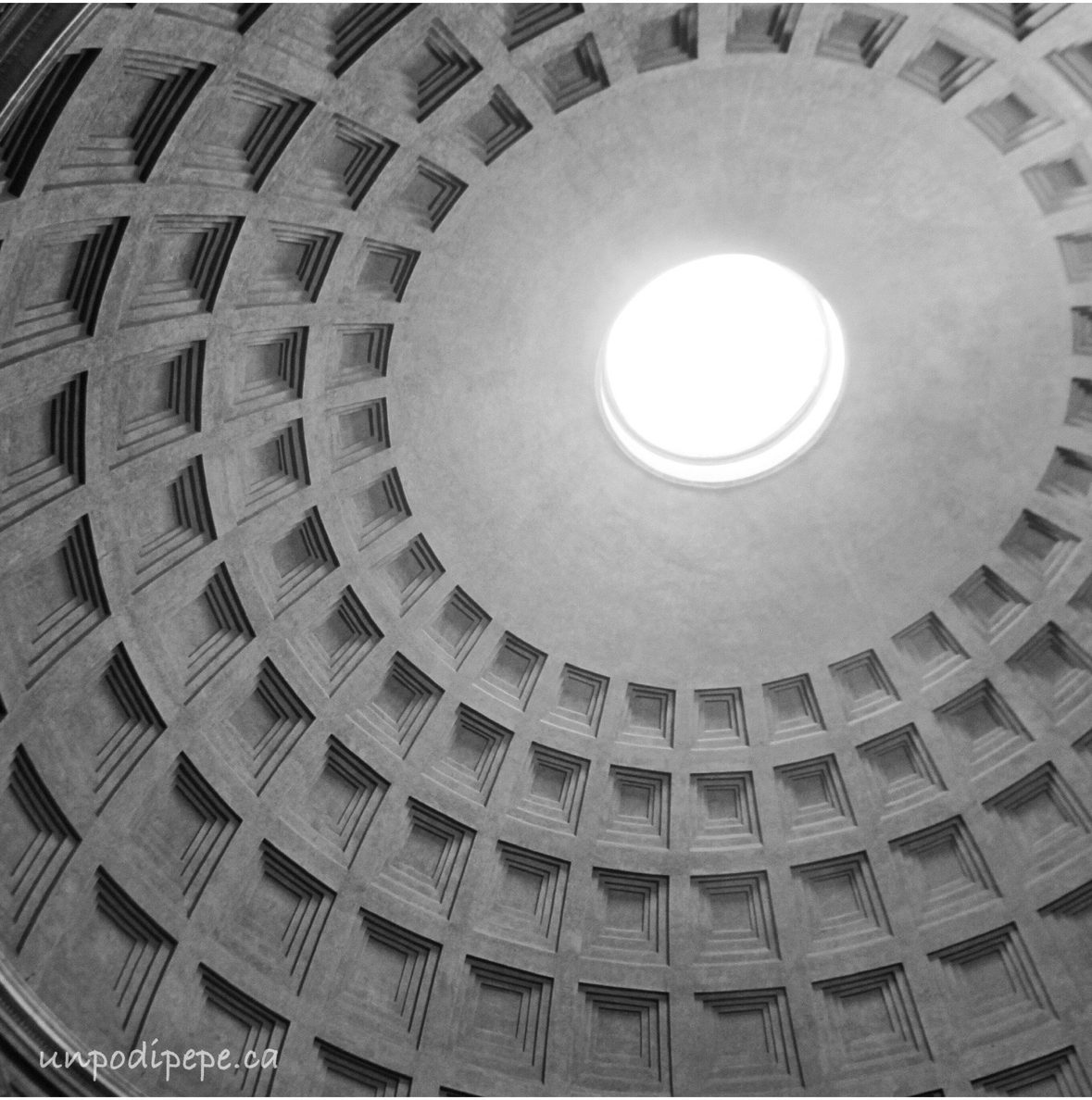
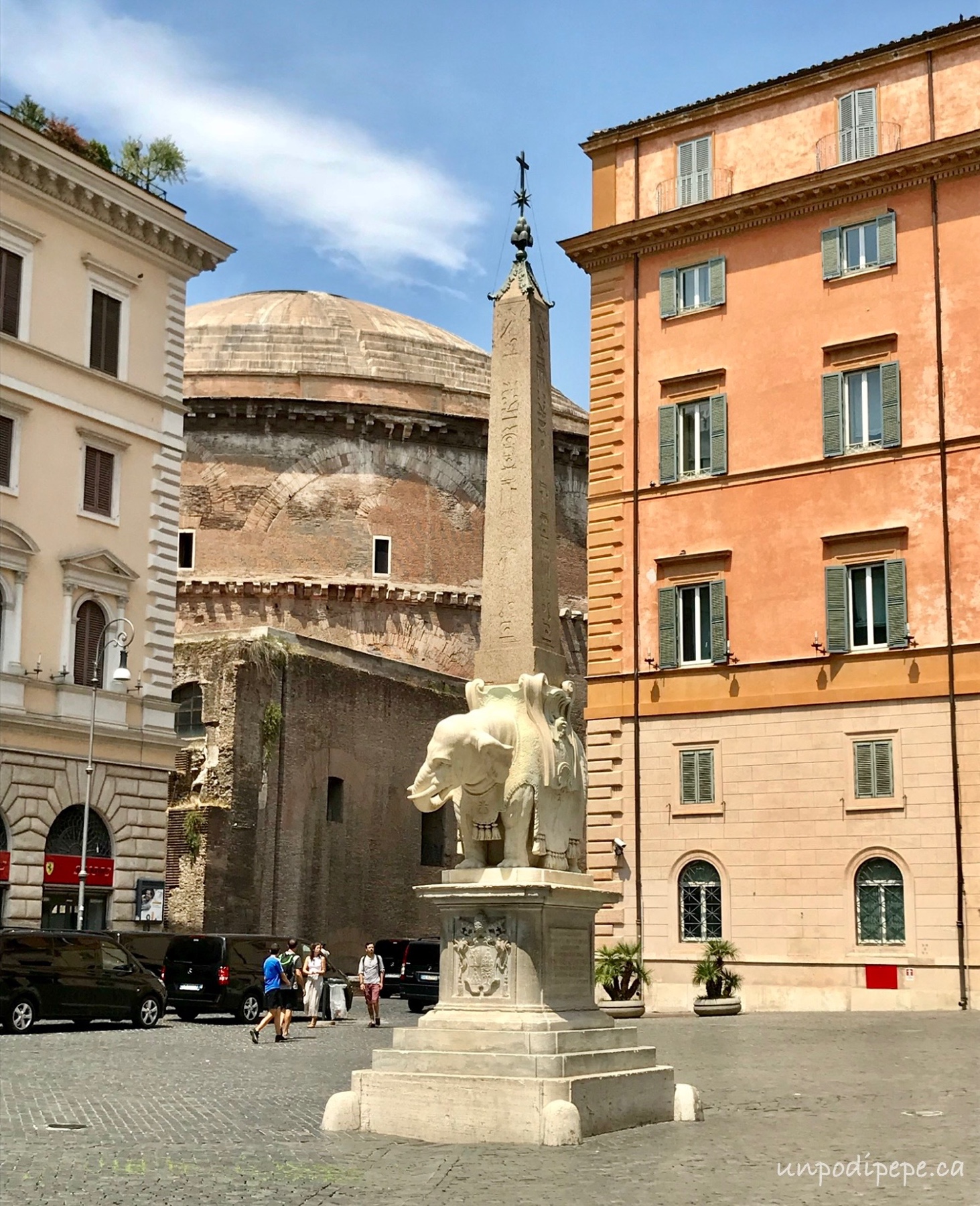
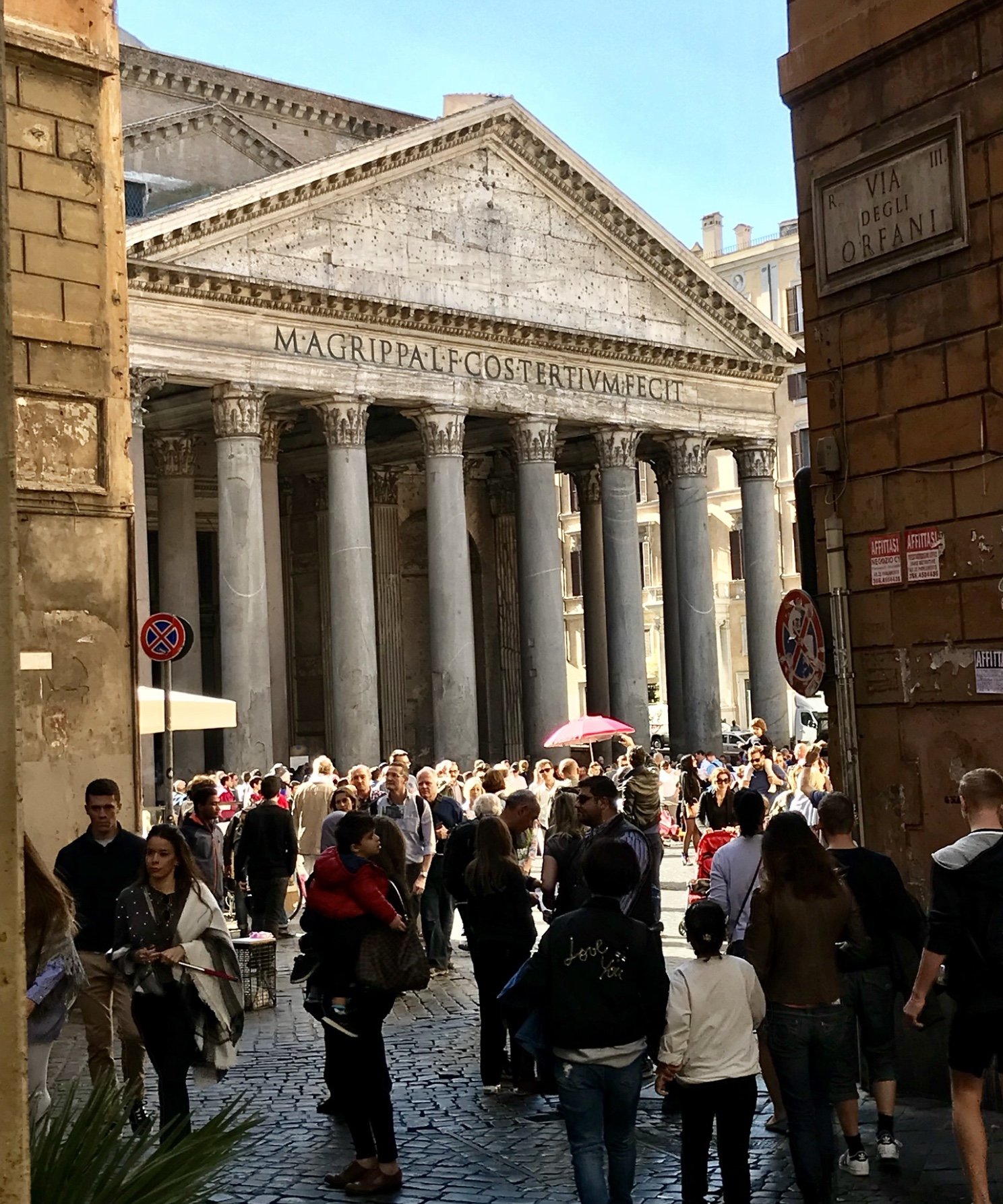
Roma is full of amazing buildings. The most amazing and best-preserved of all is the Pantheon.  Imagine Michelangelo entering the Pantheon 500 years ago, looking up and saying “this looks more like the work of angels than humans’-that is how amazing it is! The perfect mathematical proportions of the Pantheon have provided inspiration for architects for almost 2,000 years. Check out the post Il Pantheon for more details on the history and structure.Admission has always been free, and there has been talk of charging an entry fee for many years…in fact, it has been ‘announced’ several times.  Well….purtroppo, the time has come.  Starting July 1st 2023, there will be a €5 admission fee for entry for tourists/visitors.  Admission will still be free for residents of Roma, those under 18 years old and those attending Mass. Until then, admission remains free, with booking required at least 1 day in advance only on weekends and holidays.

The Pantheon is a classical masterpiece and a monument that requires expensive upkeep, so the need for a modest admission fee is understandable. Since the 7th century it also functions as the Church of Santa Maria ad Martyres.  In Roma entry into churches is free-so that is why there has been so much effort to not charge an admission fee.

Mass is at 5 pm Saturdays, 10:30 am Sundays and public holidays, and midnight on Christmas Eve.  Shoulders, midriff and knees need to be covered, although this is not as strictly enforced as the Vatican.

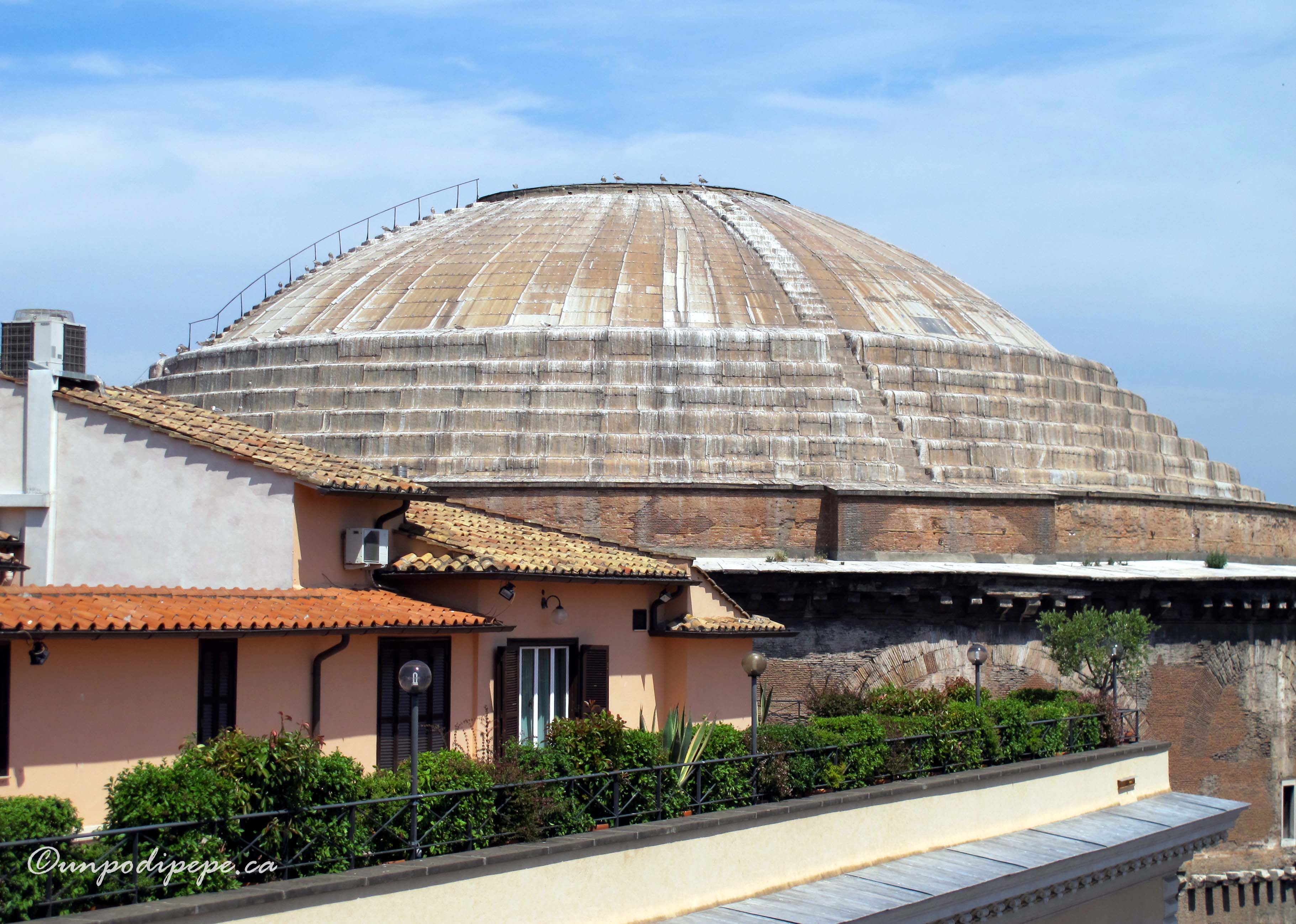
‘La Pioggia delle Rose al Pantheon’ (the rain of roses) is on my list of things to see in my lifetime. This takes place on Pentecost Sunday, 50 days after Easter.  At noon, right after Mass, Roma’s Vigili del Fuoco (fire fighters) climb to the top of the dome and drop thousands of rose petals through the oculus as choirs sing.  The rose petals symbolize the Holy Spirit coming down to earth.  Pentecost Sunday happens to be today! I saw a video of the event this morning, and even Michelangelo would be impressed! Tickets or advance booking are not available for this event.  Arriving by 7am for the 10:30 Mass is apparently necessary to get a spot inside! The ladder used by the vigili to get to the oculus is visible in the foto:

The dome and oculus, viewed from the roof of Grande Hotel de la Minerve

Visiting the Pantheon takes about 45 minutes. It is open daily 0900-1700 Sun 09-1800 with last entry at 18:30. The Pantheon is closed Jan 1, May 1, Aug 15 and Dec 25.  An audio guide with an App can be prebooked for ~€8.50, or a 45 minute guided tour for ~€20.

Details are not yet available on how to book admission, but they should be available soon on the website. Roma is a popular weekend destination for European and Italian travelers, so I imagine tickets will easier to book during the week.  There is really no ‘off season’ except for possibly the period from January 7 until the end of February.

The Pantheon is centrally located, in Piazza della Rotonda.  I walk slower than most people, but it is about a 20 minute walk to Piazza di Spagna, the closest Metro stop.  It is about a 20 minute walk to the Fontana di Trevi, 10 minutes to Piazza Navona and 40 minutes to Colosseo.

Read more about the Pantheon in Caffè con Caravaggio a Roma, Un Giorno a Roma  and Autunno in Italia.

Buon Viaggio, Cristina

Share this:

  • Click to share on Facebook (Opens in new window) Facebook
  • Click to share on Pinterest (Opens in new window) Pinterest
  • Click to share on X (Opens in new window) X
  • Click to email a link to a friend (Opens in new window) Email
  • Click to share on WhatsApp (Opens in new window) WhatsApp
Like Loading...
← Older posts

Enter your email address to follow 'un po' di pepe' and receive notifications of new posts by email.

Join 511 other subscribers
Follow Un po' di pepe on WordPress.com

Popular Posts

  • Hairstyling in Ancient Roma
    Hairstyling in Ancient Roma
  • Espresso Cookies
    Espresso Cookies
  • Il Pumo Pugliese
    Il Pumo Pugliese
  • Panforte di Siena
    Panforte di Siena
  • Internment of Italian Canadians
    Internment of Italian Canadians
  • San Nicola
    San Nicola
  • Panettone Fatto in Casa
    Panettone Fatto in Casa

Recent Posts

  • Castel del Monte
  • ‘The Nuances of Love’
  • Hostaria Antica Roma~Eat like an Ancient Roman
  • Santa Maria in Aracoeli
  • Casino dell’Aurora~Villa Boncompagni Ludovisi
  • Nasoni di Roma
  • Bloghiversario #11
  • Fontana di Trevi
  • Acqua Vergine
  • Giubileo 2025
  • Sanremo 2025
  • In Vino there are Memories
  • A Literary Harvest
  • 2024~Un po’ di pepe Year in Review
  • Buon Natale 2024
  • Il Bicerin
  • Mercato Porta Palazzo
  • Torino
  • Catanzaro, Calabria
  • Il Pumo Pugliese
  • Artemisia Gentileschi
  • Cavalli di San Marco
  • Panzerotti
  • Torcello
  • 10 years of Un po’ di pepe!

Categories

Amici e Famiglia Architecture Art Art history Art projects Bilingual posts Blogging Canada Culture Feste Firenze Inspiration Italia Italian Folklore Italian language Italian life Italocanadesi Libri Mangiamo! Orsara di Puglia Parole piacevoli Photography Puglia Recipes Roma Travel Travel tips Uncategorized Vino

Archives

Un po’ di pepe on Facebook

Un po’ di pepe on Facebook

Start a Blog at WordPress.com.

  • Subscribe Subscribed
    • Un po' di pepe
    • Join 511 other subscribers
    • Already have a WordPress.com account? Log in now.
    • Un po' di pepe
    • Subscribe Subscribed
    • Sign up
    • Log in
    • Report this content
    • View site in Reader
    • Manage subscriptions
    • Collapse this bar
 

Loading Comments...
 

    %d