• Home
  • About me/Chi sono
  • Contact

Un po' di pepe

~ …… (oon∙poh∙dee∙PEH∙peh) Cristina writes about interesting stuff /Cristina scrive di cose interessanti

Un po' di pepe

Category Archives: Travel tips

Un Giorno a Roma

15 Monday Sep 2014

Posted by Un po' di pepe in Italia, Roma, Travel, Travel tips

≈ 11 Comments

Tags

Bernini, Caravaggio, Colosseo, Elefantino, Fontana di Trevi, Il Vittoriano, Italia, La Barcaccia, Pantheon, Roma, Roma photography, Roma walking tour, Roman Forum, San Luigi dei Francesi, Tazza d'oro

TreviRoma truly is ‘la Città Eterna‘-the eternal city! I usually fly in and out of Roma then take the train to Foggia on my way to Orsara di Puglia. I often have one full day in the city at the beginning or end of my trip. When i’m in Roma for just 1 day, I have a usual ‘itinerary’. I do not actually recommend anyone go to Roma for just one day, especially for the first time. 5 days will do but more is better.  One day only gives you enough time to visit a few sites, so it is mostly an entire day of exploring the city on foot. The sites I choose to visit change a bit each time, but the route is basically the same. I also recommend reading Beat the heat-Surviving Summer in Roma.

I stay with a friend in the Basilica San Paolo area so I take the Metro blue line to the Colosseo stop, exit the station and take a few minutes to absorb the view across the street, which never fails to impress.

The view across the street from the 'Colosseo' metro stop!

The view across the street from the ‘Colosseo’ metro stop!

Then I turn right and walk along Via dei Fori Imperiali.  If you visit Il Colosseo, the ticket includes entry to the Forum, so you can walk through there.  Visiting these 2 awesome sites will take all morning, so they are not usually part of my ‘1 day’ itinerary.
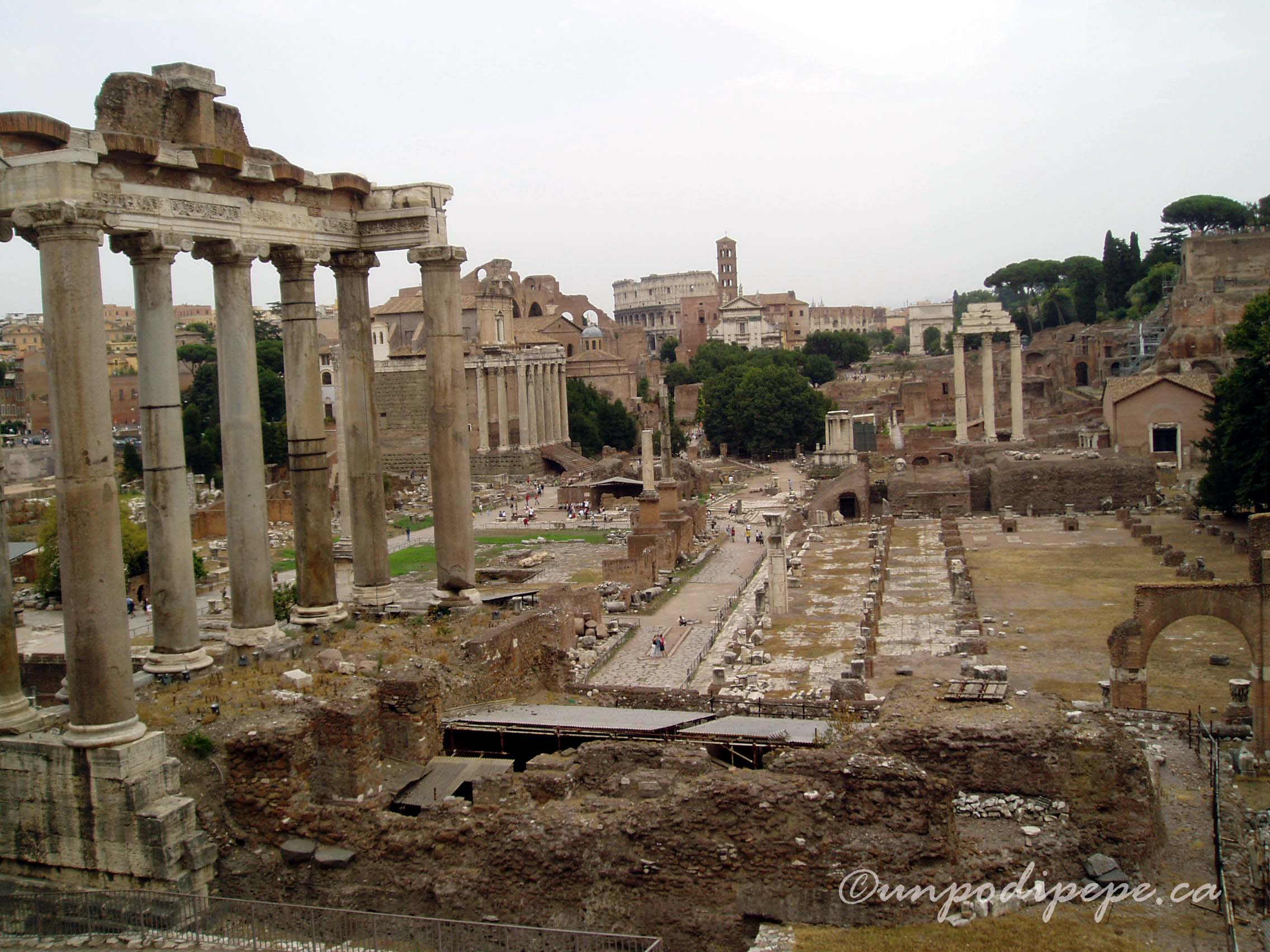
View of the Roman Forum (Foro Romano)

View of the Roman Forum (Foro Romano)

Old meets new at the Foro Romano

Old meets new at the Foro Romano

I walk along Via dei Fori Imperiali all the way to Piazza Venezia and Il Vittoriano, which is the neo-classical monument that looks like a giant wedding cake .
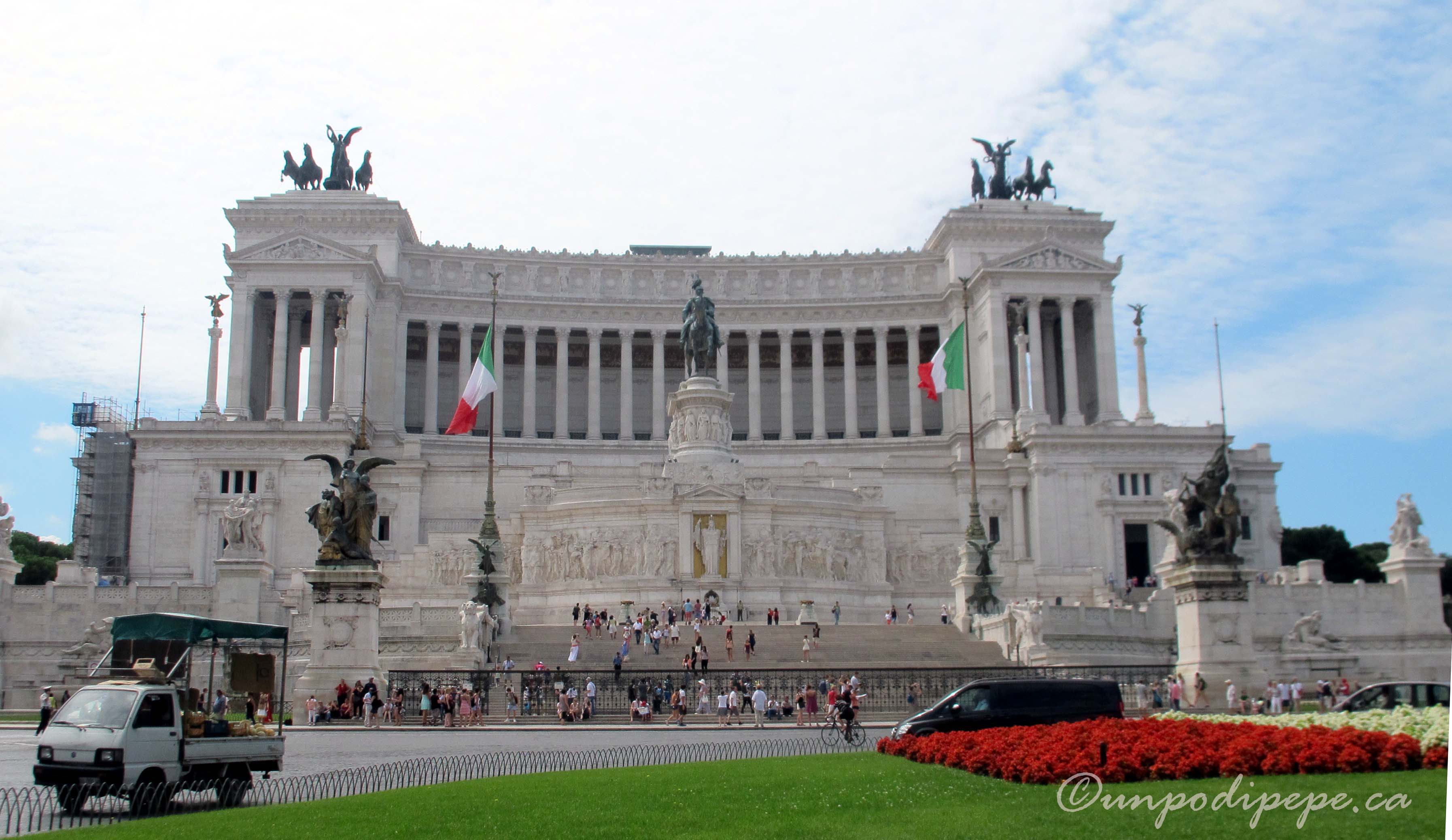
Il Vittoriano

Il Vittoriano

If you want some great views of Roma and are not afraid of heights, take the glass elevator to the rooftop terrace.

'Roma dal cielo' view from the roof of Il Vittoriano

‘Roma dal cielo’ view from the roof of Il Vittoriano

Then I turn right again and cross Piazza Venezia, which can be a bit of a challenge, and walk along Via del Corso. Via del Corso is lined with shops and goes all the way to Piazza del Popolo.

Crossing the street can be challenging! Photo taken by Vito!

Crossing the street can be challenging! Photo taken by Vito!

I turn into one of the side streets on the left and walk to the Pantheon-the domed architectural masterpiece that is absolutely not to be missed! The 2000 year old roof is the largest unreinforced concrete dome in the world.*IlPantheonAcross the street I have an incredible granita di caffè at Tazza d’Oro.
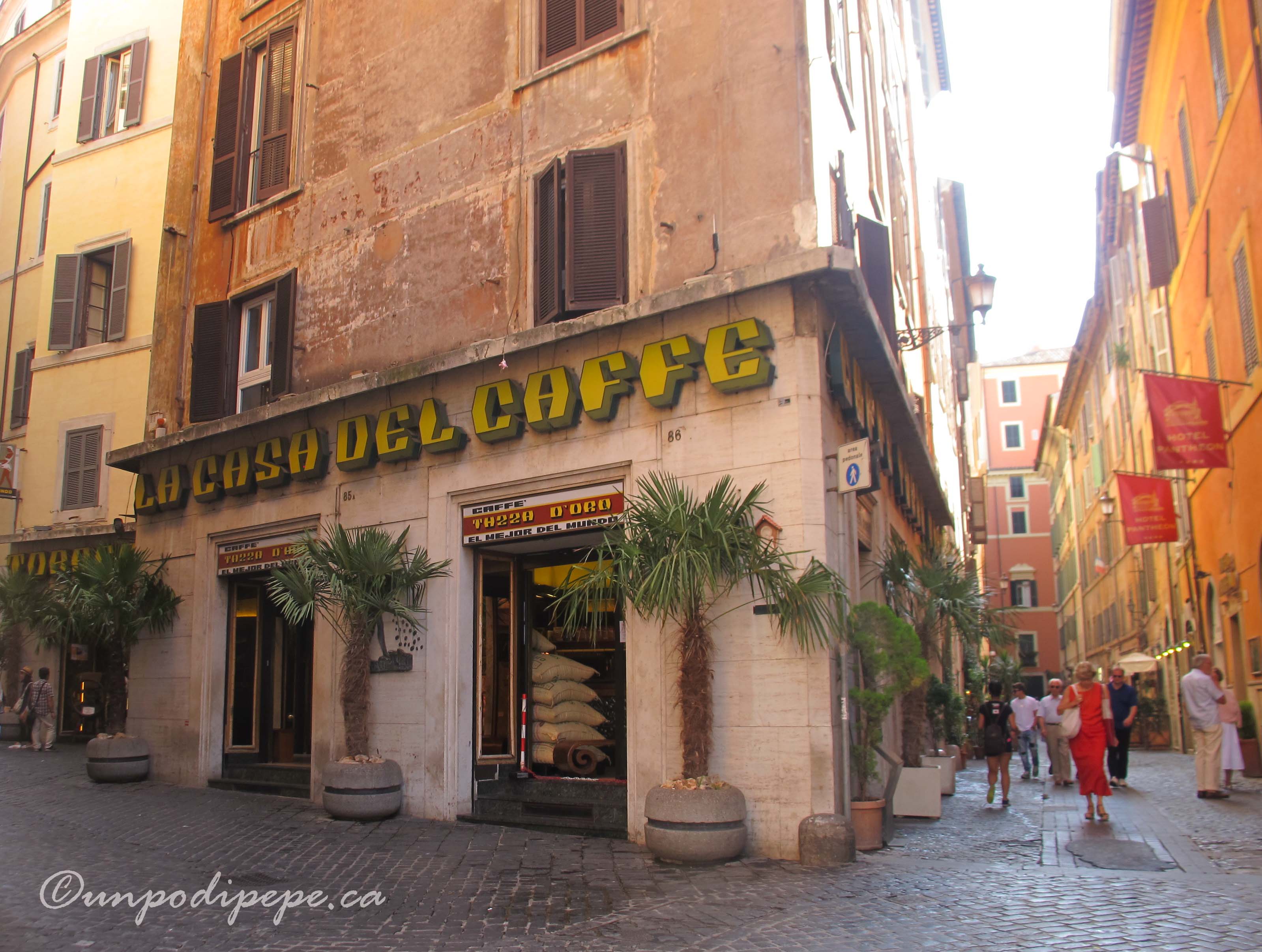
Tazza d'Oro, Via degli Orfani 84

Tazza d’Oro, Via degli Orfani 84

Granita di caffe

Granita di caffe

Behind the Pantheon is Santa Maria Sopra Minerva with Bernini’s adorable ‘elefantino’ sculpture in the piazza.  I sometimes like to sit and sketch the pudgy little elephant carrying a 5m Egyptian obelisk on its back.

Bernini's elefantino in Piazza Minerva. Behind the obelisk, you can see the domed roof of the Pantheon.

Bernini’s elefantino in Piazza Minerva. Behind the obelisk, you can see the domed roof of the Pantheon.

The molto fancy ‘Grande Hotel de la Minerve’ across from the church has a roof bar with incredible views. Down a side street – Via del Gesù- is Poggi art supplies www.poggi1825.it , so of course I have to stop there and drool at all the stuff I can’t carry home. I also pop into the little Baroque gem San Luigi dei Francesi, which is the National church of France in Roma. It has 3 incredible Caravaggio paintings-the ‘San Matteo’ cycle, in the Capella Contarelli which you can see for free! No lineups, no online bookings!  I always put a coin in the box and light a candle when I visit a church. If you have more time, go on my Caffè con Caravaggio walking tour.

I walk down some side streets and get back onto Via del Corso going left.  A few blocks down I cross the street and walk to the Fontana di Trevi to toss in my coin. I am very superstitious about this, so I have to do the coin toss or I’m afraid I might not return to Roma!  That would be awful! Fontanaditrevi

Fontana di Trevi

Fontana di Trevi

I look at all the tourists then head to my last stop- Piazza di Spagna. I never miss drinking from the Fontana della Barcaccia.  This is the Baroque fountain at the bottom of the steps that looks like a sinking ship. It was sculpted by both Bernini, Pietro and Gianlorenzo (father and son).  La Barcaccia has the best water ever, especially on a hot day –it comes straight from an ancient acqueduct Acqua Vergine and is always ice cold and refreshing. Bring a water bottle to fill up at I Nasoni di Roma, all over the city.

La Barcaccia, Piazza di Spagna
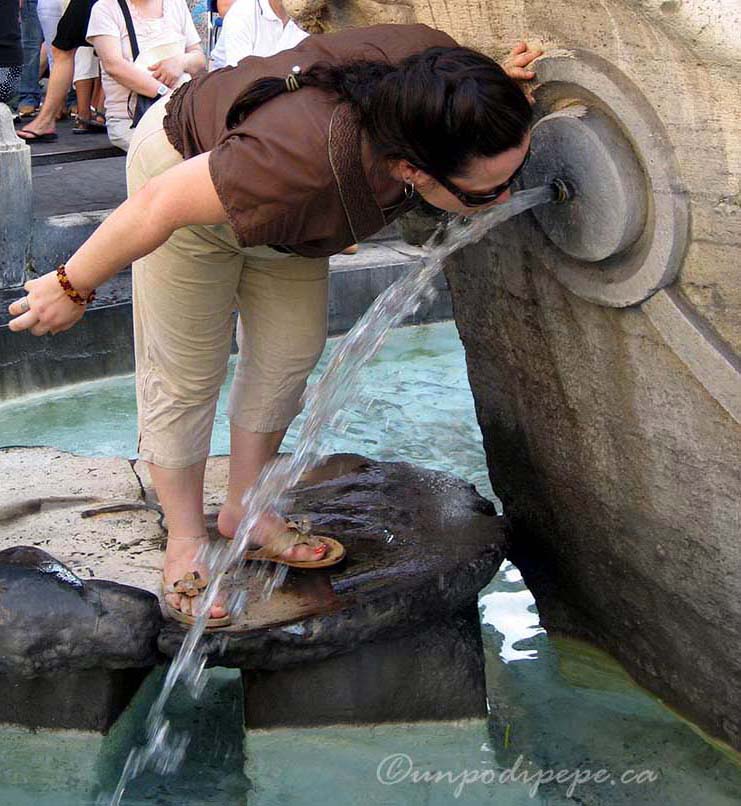
La Barcaccia, Piazza di Spagna

Mmmm! Acqua freddissima!

Mmmm! Acqua freddissima!

From here I usually walk all the way back to the Colosseo metro stop to take the metro back home to San Paolo and pick up take-out suppli on the way. If I am too tired or have evening plans, I take the metro at Piazza di Spagna (red line) to Stazione Termini then change to the blue line for San Paolo.

Ci vediamo a Roma! Buon viaggio, Cristina
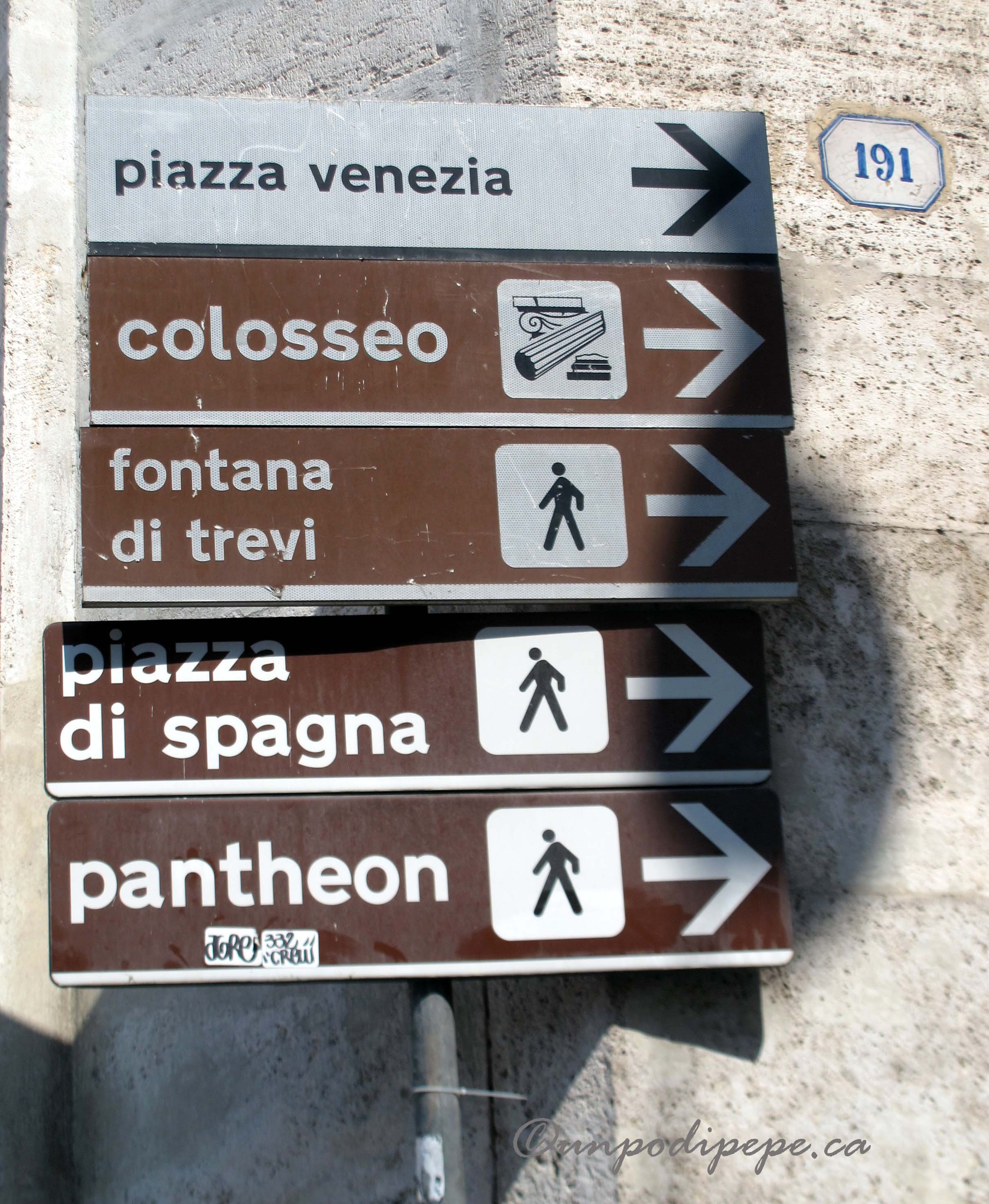
Handy signs at Piazza del Popolo

Handy signs at Piazza del Popolo

*Update:  Entry into the Pantheon was free until july 2023.  Now there is a €5 entry fee for adults.  Tickets can be prebooked online on the official Italian Museums site here or puchased onsite with cash or credit card.  They can also be bought online on site, by scanning a barcodeat the entrance-to avoid the ticket lineup.  Do not buy from other sites, as they are 3rd party sites. Tickets are usually only available 2-3 weeks in advance.  Admission is free the first Sunday of the month, but there are usually long lines, unless you go in January. Since the Pantheon is a church, admission is also free during specific religious services.  Church dress code applies, so shoulders and knees need to be covered.

The Pantheon is open from 0900-1830 every day except January 1, August 15 and December 25.

Check out more posts on things I like to do if I have more than one day in Roma:

  • Trastevere at night
  • Centrale Montemartini
  • Palazzo Massimo
  • Galleria Borghese
  • Visit more Caravaggio paintings for free at Santa Maria del Popolo
  • Go to Mass sung by cloistered nuns at Santa Brigida near Piazza Farnese

©2014 unpodipepe.ca

Piccoli gladiatori! Beware of fierce gladiators in training!

Piccoli gladiatori! Beware of fierce gladiators in training!

Share this:

  • Share on Facebook (Opens in new window) Facebook
  • Share on Pinterest (Opens in new window) Pinterest
  • Share on X (Opens in new window) X
  • Email a link to a friend (Opens in new window) Email
  • Share on WhatsApp (Opens in new window) WhatsApp
Like Loading...

Italiano per Ristoranti~How to pronounce your restaurant menu

20 Friday Jun 2014

Posted by Un po' di pepe in Italian language, Travel tips

≈ 41 Comments

Tags

Downloadable pronunciation guide, Italian language, Italian menu, Italian pronunciation guide, Italiano per ristoranti, Restaurant Italian

Bruschetta (broo.SKET.tah)

Bruschetta (broo.SKET.tah)

When I’m at a restaurant and I hear BROO∙sheda, FOKA∙sia, pra∙skew∙do, spug∙eddy, la∙TAY, EX∙preso or worst of all, GA∙noh∙chee.…I have to cover my ears. This post is my small effort to encourage everyone to get to know the beauty of the Italian language. Whether you are planning a trip to Italia, or to your local Trattoria, learning how to pronounce the words on the menu is worth the effort!

Italian pronunciation is very different from English. Pronouncing Italian words is easier than it looks, because every letter has a purpose. Words are pronounced phonetically-the way they are spelled.  There are no silent letters as in English, except h at the beginning of a word.  My name ‘Cristina’ has no h because there is no reason for it. In Italian, you won’t find crazy words like ‘enough’ that don’t sound at all like they are written (?inaf).  If you know the sounds made by certain letters and combinations, you can pronounce all of those big long words with lots and lots of vowels.  Pronouncing Italian correctly will also help with reading.

Note…. It isn’t easy to ‘speak’ with writing, and no written material can replace listening to and speaking Italian on site! This is a basic, practical introduction….just the facts! I’ve written the approximate pronunciations so that someone who speaks English can understand them.

2 important things to know:

  • There are only 21 letters in the Italian alphabet. There is no j, k, w, x or y, except in foreign words. J is used in some dialetti (regional dialects) including Orsarese, and is pronounced like a y
  • Emphasis is usually on the next to last syllable. If the emphasis is on the last syllable, the vowel at the end of the word has an accent. For example, tiramisù (teera∙ mee∙ SOO), ragù (ra ∙GOO) menù (meh∙NOO), supplì (soop∙PLEE), bignè (bee∙NYEH), tè (TEH), or caffè (caf∙FEH).  This is very important to remember, as it is what gives the Italian language its musicality. If you pronounce everything the same, then the words will sound monotonous.

Accents/accenti are used:

  • When emphasis is on the last syllable of a word as described above
  • 1 syllable words with 2 vowels, as in può, più
  • 1 syllable words that can have 2 meanings, as in te (you) or tè (tea), e (and) or è (is)

Unlike other languages, in Italian the accent is almost always l’accento grave (GRAH∙veh) sloping down towards the right as in à,è,ì,ò,ù. L’accento acuto, as in é and ó is not used often. We can safely say that 99% of the time, l’accento acuto is only used for sé, né and words ending in ché (perché, finché, giaché, etc). In all other cases, use the accento grave.

Pronouncing vowels

  • • A is pronounced ah as in Mamma or amore (ah∙ MOH∙ reh)
    • I is like the ee sound in green, as in piselli (pee∙ SEL∙ lee). Followed by a vowel, i can also sound like the y in yoga, as in ieri (YEH∙ree)
    • U is like the u in June or the oo in food. Musica is moo∙SEE∙ca, nutella is noo∙TEL∙lah
  • E has 2 slightly different pronunciations that are hard to express in writing, and also vary from region to region. For the purpose of pronouncing food, we will just say that e is pronounced eh like the e in egg.  My favourite example is pepe (PEH∙peh).  Many pronunciation guides make the mistake of stating that e makes the sound ‘ay’.  This is not correct.  Do not pronounce e this way unless you want to sound like Tony Soprano!
    • O is oh like the o in no – calzone (cal∙ZOH∙neh) or the o in hot- cotto (COT∙toh). You may not know which sound the o makes unless you have heard the word spoken correctly, and there is also regional variation

Italian words are full of vowels and most words end in a vowel. If there are 2 or more vowels in a row, each one is pronounced. They may be in the same syllable, as in ciao (CHEEAH∙oh) and ieri (YEH∙ree). An awesome word with 4 vowels in a row is gioia (GEEOH∙yah)! Try saying that with a grumpy face!

Pronouncing consonants
C and G
• C and g are ‘duro’ or hard (as in corso or grande) – except if followed by an e or an i
• C or g followed by an e or i are ‘dolce’ or soft, like the ch in church and the g in gem
• If c or g are followed by an h and then an e or i, the pronunciation is hard once again

Ci = chee                        chi = kee
Ce = cheh                       che = ke (as in keg)
Gi = gee                         ghi = ghee
Ge = jeh (as in jelly)        ghe =as in ghetto

Pesce (PEH∙sheh) = fish…pesca (PES∙kah) = peach…pesche (PES∙keh) = peaches. If you want succo di pesca/pesche (peach juice or nectar) but ask for succo di pesce, you are asking for fish juice. Yuk! Don’t make my Bellini with that!

H (acca/AK∙kah)
• H is muta (MOO∙tah=silent).
• H is used to change the pronunciation of c and g (see above), or to distinguish 2 words that sound the same (anno/hanno, o/ho, a/ha)
• H is only used with c or g if followed by i or e, not if followed by u, a or o. Remember this handy rhyme: ‘cu ca co, acca no/gu ga go, acca no’
Gn/Gl
• Gn is ‘nyuh’ like the n and y in ‘can you’ if you say it quickly and nasally – try bagno (BAH∙nyo) and gnocchi (NYOK∙Kee). Gn sounds similar to the Spanish letter ñ as in señor and piñata. It should not sound like a hard g
• Gl is ‘lyah’ like the l and y in ‘will you’ said quickly. Gl is followed by ia or io as in foglia (FO∙lyah) or aglio (AHL∙yoh)

S combinations
• Sce is sheh like the ‘she’ sound in shelter… pesce = PEH∙sheh
• Sci is shee as in prosciutto (pro∙SHEEOOT∙toh)
• Sb is zb as in sbottonata (zbot∙toh∙NAH∙tah) = unbuttoned, sbriciolata (zbree∙cheeoh∙LA∙tah) = crumbled
R’s are rrrolled.  T’s sound like T, not like D.

Double consonants are both pronounced.  You need to hold the sound for an extra fraction of a second.  Take cappuccino for example.  You pronounce 2 p’s and 2 c’s.  It’s cap∙ pooch ∙CHEE ∙no, not cap∙a∙chee∙no.

Double r’s are rrreally rrrolled as in burrata (boor∙RAT∙ah)

Pronouncing double consonants as single can change the meaning of the word and can even lead to embarassing situations.  For example, if you want to order penne (PEN∙neh) al pomodoro, but you ask for pene (PE∙neh) al pomodoro, you have just ordered penis in tomato sauce!

Plurals

Unlike English and Spanish, adding an s to the end of an Italian word doesn’t make it plural.  In Italian, everything has a gender.

  • Masculine things usually end in an o and are plural with an i
  • Feminine things usually end in a and are plural with an e

Biscotto (bee∙SCOT∙toh) is singular, biscotti (bee∙SCOT∙tee) is plural.  Do not ask for a biscotti. You ask for 1 biscotto or 2 biscotti.

The plural of birra (beer) is birre, so it’s una birra (BEE∙rah) or due birre (BEE∙reh)

Panino is singular, panini is plural.  Since panini is already plural, ‘paninis’ is ‘sandwicheses’!  It sounds just as silly in Italian!

Some foods have been given a sex change in North America. Remember that zucchine, fettucine and linguine are all female and do not end in i

  • Things ending in e, whether masculine or feminine, are plural with an i. For example, a glass is un bicchiere, 2 glasses are due bicchieri (beek∙KYEH∙ree), un salame, due salami
  • Things ending in io become plural with i. Kiss is bacio (BAH∙cheeoh), many kisses are baci (BAH∙chee)

Some words don’t change when plural:

  • Words that are abbreviations like auto and euro (eeoo∙roh)
  • Imported words like computer and taxi. These are usually masculine
  • one syllable words
  • Words that end in a consonant or an accented vowel (il caffè/i caffè)

There are exceptions to these. For example egg-l’uovo (oo∙oh∙voh) is masculine, but the plural is the feminine le uova (oo∙oh∙vah)-not ‘uovi’. Il dentista, il programma and il problema are masculine, but end in a because they come from the Greek, ending in ‘ma’ or ‘ta’.   Sometimes the exception is simply because it sounds awkward.

Using the wrong vowel at the end can completely change the meaning of a word. For example, if you want to order agnello alla menta (lamb cooked with mint) but you ask for agnello al mento (lamb with chin) I’m not sure which body part will be brought to your table!

Now you are ready to read the menu at Trattoria ‘Un po’ di pepe’……. Buon appetito!

This post is available as a downloadable PDF at the end of the menu. Ebook coming soon!

ilmenu

Il menù Trattoria Un po’ di pepe:

Focaccia Genovese (foh∙KACH∙cheeah  Jen∙oh∙VEH∙seh)•Genoa style focaccia

Mozzarella di bufala Campana (motz∙za∙REL∙la dee BOO∙fa∙lah Cam·PAH·nah)•Fresh mozzarella from the region of Campania, made with milk from water buffalo

Prosciutto e melone (pro∙sheeoot∙toh e meh∙LOH∙neh)•Prosciutto wrapped around slices of canteloupe

Gnocchi al pomodoro (NYOK∙kee ahl poh∙moh∙DOH∙roh)•Gnocchi in a tomato sauce

Tagliatelle al cinghiale (ta∙lyah∙TEL∙leh ahl ceen∙ghee∙AH∙leh)•tagliatelle (ribbon-like egg pasta) with wild boar sauce

Penne all’arrabbiata (PEN∙neh ahl ar∙rab∙BYAT∙tah)•Penne in an ‘angry’ spicy sauce

Orecchiette con cime di rapa (oh∙rek∙KYET∙the con CHEE∙meh dee RAH∙pah)•Orecchiette (Pugliese pasta shaped like little ears) with rapini

Spaghetti aglio, olio e peperoncino (spah∙GET∙tee AHL∙yoh ohl∙yo eh peh∙peh∙ron∙CHEE∙noh)•Spaghetti with garlic, olive oil and chili pepper

Risotto ai frutti di mare (ree∙SOT∙toh ahee frut∙tee dee MAH∙reh)•Seafood risotto

Pesce spada con salsa di acciughe (peh∙sheh spa∙da con sal∙sa dee ach∙chee∙OO∙geh)•Swordfish with anchovy sauce

Polpette della nonna (pohl∙PET∙teh  del∙la NON∙nah)•Nonna’s meatballs

Coniglio arrosto con patate  (coh∙NEE∙lyoh ar∙ROS∙toh con pah∙TAH∙teh)•Roast rabbit with potatoes

Melanzane ripiene al forno (meh∙lan∙ZAH∙neh ree∙PYEH∙neh)•Baked stuffed eggplant

Crostata con Nutella, mascarpone e pere (cro∙STA∙tah con noo∙TEL∙la, mas∙car∙POH∙neh e PEH∙reh)•Nutella, mascarpone and pear tart

Panettone con mandorle (pah∙net∙TOH∙neh con man∙DOR∙leh)•Panettone (sweet bread) with almonds

Zabaglione (zah∙bah∙LYOH∙neh)•A custard type of dessert made with egg yolks, sugar and marsala

Italiano per Ristoranti Downloadable PDF ©2016 unpodipepe.ca

BUON APPETITO!

Share this:

  • Share on Facebook (Opens in new window) Facebook
  • Share on Pinterest (Opens in new window) Pinterest
  • Share on X (Opens in new window) X
  • Email a link to a friend (Opens in new window) Email
  • Share on WhatsApp (Opens in new window) WhatsApp
Like Loading...
Newer posts →

Enter your email address to follow 'un po' di pepe' and receive notifications of new posts by email.

Join 509 other subscribers
Follow Un po' di pepe on WordPress.com

Popular Posts

  • Marostica~Partita a Scacchi
    Marostica~Partita a Scacchi
  • Gallerie d'Italia Napoli
    Gallerie d'Italia Napoli
  • Caravaggio
    Caravaggio
  • Hairstyling in Ancient Roma
    Hairstyling in Ancient Roma
  • Il Pumo Pugliese
    Il Pumo Pugliese
  • Nasoni di Roma
    Nasoni di Roma
  • Internment of Italian Canadians
    Internment of Italian Canadians

Recent Posts

  • Polignano a Mare 2.0
  • Via dell’ Amore~Riomaggiore
  • AICW Conference, Viterbo
  • Bloghiversario #12
  • Pane e Salute
  • Sanremo 2026
  • Cucina Italiana Patrimonio UNESCO
  • 2025~Un po’ di pepe Year in Review
  • Castel del Monte
  • ‘The Nuances of Love’
  • Hostaria Antica Roma~Eat like an Ancient Roman
  • Santa Maria in Aracoeli
  • Casino dell’Aurora~Villa Boncompagni Ludovisi
  • Nasoni di Roma
  • Bloghiversario #11
  • Fontana di Trevi
  • Acqua Vergine
  • Giubileo 2025
  • Sanremo 2025
  • In Vino there are Memories
  • A Literary Harvest
  • 2024~Un po’ di pepe Year in Review
  • Buon Natale 2024
  • Il Bicerin
  • Mercato Porta Palazzo

Categories

Amici e Famiglia Architecture Art Art history Art projects Bilingual posts Blogging Canada Culture Feste Firenze Inspiration Italia Italian Folklore Italian language Italian life Italocanadesi Libri Mangiamo! Orsara di Puglia Parole piacevoli Photography Puglia Recipes Roma Travel Travel tips Uncategorized Vino

Archives

Un po’ di pepe on Facebook

Un po’ di pepe on Facebook

Start a Blog at WordPress.com.

  • Subscribe Subscribed
    • Un po' di pepe
    • Join 509 other subscribers
    • Already have a WordPress.com account? Log in now.
    • Un po' di pepe
    • Subscribe Subscribed
    • Sign up
    • Log in
    • Report this content
    • View site in Reader
    • Manage subscriptions
    • Collapse this bar
Loading Comments...
%d