Sbandieratori~Accenti Magazine Photo Contest

Tags

, , , , , , ,

Sbandieratori

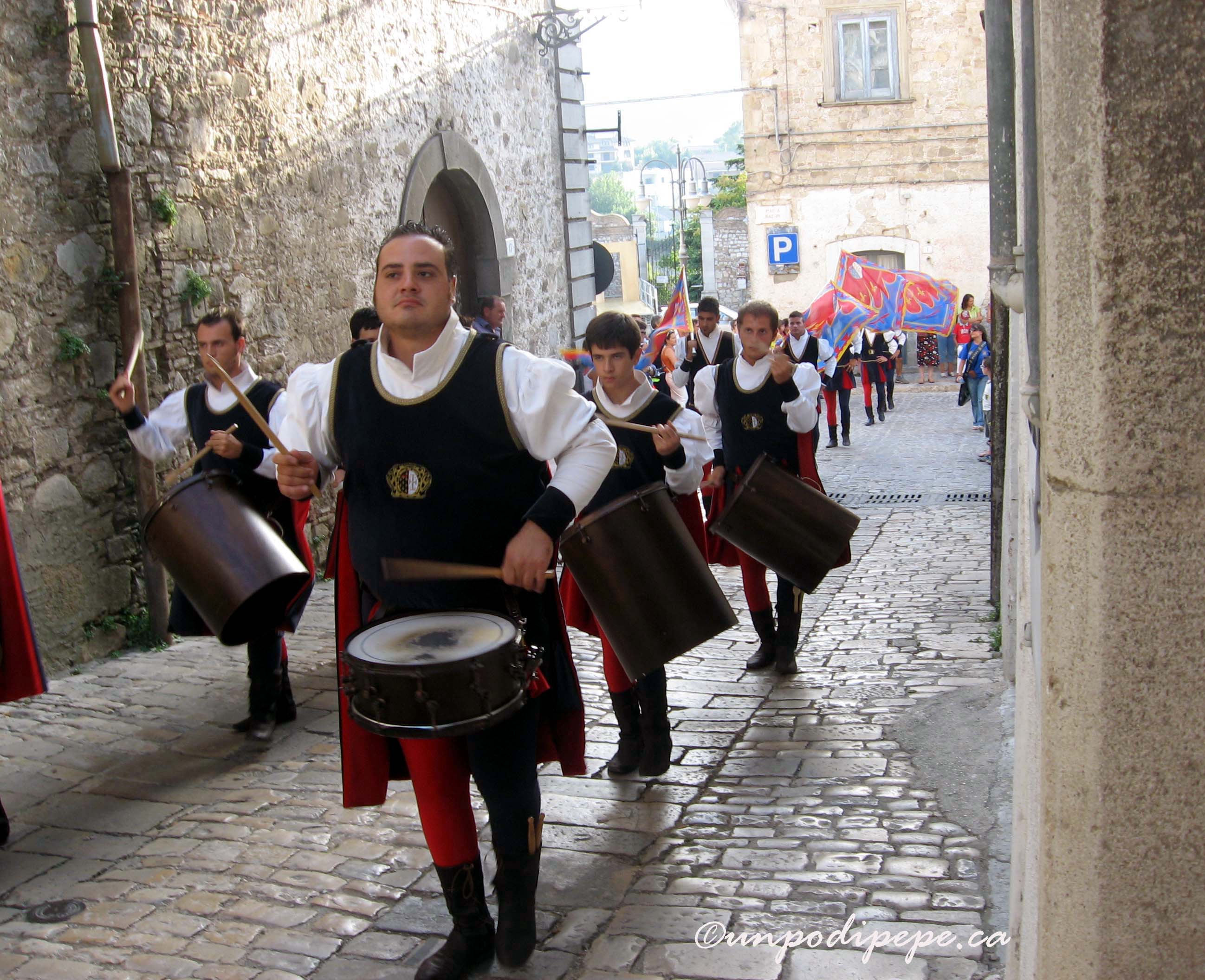
The 7th annual Accenti Magazine ‘Capture an Italian Moment’ Photo Competition results were just released at the Accenti Magazine Awards during the Blue Metropolis Montreal International Literary Festival. My photo, ‘Sbandieratori’ came in second place!

This photo was taken in Orsara di Puglia during the ‘Corteo Storico’, a parade in period costume, reenacting the history of the village. These sbandieratori (flag throwers) came from nearby Lucera to perform. Here, they are in between performances, engaged in casual conversation. What struck me about this image were the bold colours and composition of the costumes and flags. I was also curious to know what their conversation was about….was it early Renaissance gossip, or the latest cell phone app?

In Italiano:

Questa foto è stata scattata ad Orsara di Puglia durante il ‘corteo storico’, una sfilata in costume medioevale, che racconta la storia del paese.  Questi sbandieratori sono venuti da Lucera.  Qui li vediamo in attesa di sfilare, impegnati in una conversazione.  Quello che mi ha colpito sono stati I colori vibranti e la composizione che si è create tra I costume e le bandiere.  Ero anche curiosa di sapere di cosa parlavono…..chiacchiere medioevale o dell’uscita di una nuova app per il telefono?

The mission of Accenti, “the magazine with an Italian accent,” and Accenti Online http://www.accenti.ca is to bring together readers and writers around the idea of shared cultural experience, encourage creative expression, and act as a bridge between cultures. The 2015 photo and writing competition is now accepting submissions. If you are interested in finding out more, go to http://www.accenti.ca/photo-contest or http://www.accenti.ca/writing-contest.

The word Sbandieratori is related to the word bandiera (flag) and is pronounced zban∙ dee∙ ear ∙a∙ tow∙ ree. Say it a few times….now say it faster.

Here are a few more photos from the ‘Corteo Storico’ in Orsara di Puglia:

Sbandieratori, corteo storico, Orsara di Puglia

Sbandieratori, corteo storico, Orsara di Puglia

Corteo Storico, Orsara di Puglia

Corteo Storico, Orsara di Puglia

Autoritratto~Mixed-Media Collage

Tags

, , , ,

Autoritratto, 2013

Autoritratto, 2013

Autoritratto (ow∙tow∙ree∙TRAT∙tow) means self-portrait. Who says ‘selfies’ can only be done via phone? Try this mixed-media collage project to make your own selfie at home.

You will need:

  • 3 self portraits on paper, all close to the same size
  • a hard surface such as a wood panel, cradled wood panel or board
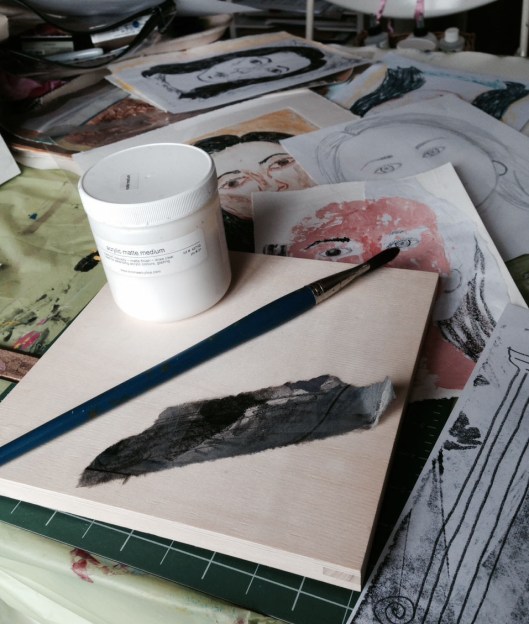
  • acrylic matte medium. This is acrylic paint without the colour, and it can be used as a glue and also as a protective coating over top of your work.  (white glue can also be used if you do not have matte medium, but it is not archival).
  • bits and pieces of old artwork to collage

selfiestuff

  1. Draw or paint 3 ‘selfies’ on paper. If you are like me, you have lots of them lying around from different art classes. You can also make 3 photocopies of the same image, and colour each one differently.
  2. Crumple each selfie into a ball.
  3. Open them up again and tear into several pieces.
  4. Find your ‘inner Picasso’.  Create a new mixed-media selfie using the torn, crumpled pieces from the original 3. Collage them onto a firm surface with acrylic medium. I recycled a cradled wood panel that was previously painted and sanded by my nipotino Vito. I let parts of his original underpainting show through, such as the blue squiggle on my forehead. We think it makes me look smart!
  5. Collage in other bits of paper. My selfie actually looked a bit creepy before I added the hair! The hair is old pieces of monotypes and lift prints on rice paper. I also added some text using photocopy transfer with acrylic medium.
  6. Add more details to the selfie with acrylic paint, ink, oil or chalk pastels.
  7. When it is done, brush on a few coats of acrylic matte medium to protect the surface. Use gloss medium if you prefer a shiny surface. If chalk pastels were used, spray with a fixative before brushing on the medium.

Ecco, fatto! Un autoritratto tecnica mista!

Ciao, Cristina

‘Il Gigante’- Michelangelo’s David

Tags

, , , , , ,

Davide
The sculpture of David by Michelangelo Buonarroti is one of the most recognizable pieces of art in the world. David was in progress from 1501-1504, carved from a ginormous piece of ‘flawed’ Carrara marble. It weighed over 6,000 kilos! 2 other sculptors had previously attempted to use it, and there was a big gaping hole going right through it-between where the legs were going to go. It was nicknamed ‘Il Gigante’ and was sitting in the Opera del Duomo (the works yard of Santa Maria del Fiore) for over 30 years. Several other artists had been to see it, but it was considered useless; too tall and too thin on one side for a figure…and then there was that hole.

Michelangelo was already a bit of a minor celebrity, having just completed his first ‘capolavoro’ (masterpiece), La Pietá, in Roma at the age of 25. He convinced the Operai to let him have the marble. He decided to use it for the originally intended subject; David, the boy who killed the Philistine giant Goliath with his slingshot, 1 rock, and a lot of help from God.  Michelangelo strategically planned his figure in contrapposto, with most of the weight on the right leg, so that it would fit precisely around the large hole in the marble. He even had to leave some of the chisel marks on the chest area made by Simone da Fiesole, one of the previous sculptors because it was such a tight fit. David was supposed to go on one of the pedestals at the end of the buttresses on the roofline of Santa Maria del Fiore (often referred to simply as Il Duomo) with 12 other Old Testament sculptures.

David was originally planned for one of these pedestals on the buttresses of Santa Maria del Fiore

David was originally planned for one of these pedestals on the buttresses of Santa Maria del Fiore

When David was completed in 1504, he was so big-9 arms lengths or 3 times human size, it became apparent they were not going to be able to hoist him up to the roofline of Il Duomo! He was so magnificent that it was also thought to be a waste to put him so high up where no one could see him. According to the original art historian, Giorgio Vasari,  ‘To be sure, anyone who sees this statue need not be concerned with seeing any other piece of sculpture done in our times or in any period by any other artist’. Not everyone was a fan though-some said he didn’t look like a boy, he looked like a grown man, others thought he should be wearing armour-or at least something, and there was no head of Goliath at his feet. This David was captured in the moments before slaying Goliath. His right hand is starting to tense, and the contrapposto stance makes it seem like his body could twist to the left to be in line with his head.

A committee was formed to decide where David should live. Members included Leonardo da Vinci, Sandro Botticelli, and Filippino Lippi. They decided to place David on a pedestal outside the Palazzo Vecchio, the town hall of Firenze in the Piazza della Signoria. This was partly a political statement. David was the ‘little guy’ who defeated the giant. He became of symbol of the new Republic of Firenze, democratic ideals, and a warning to enemies. It was not an accident that his eyes faced Roma. Moving ‘Il Gigante’ took 40 men 4 days to move the distance of less than 1 km from the studio. David was suspended in a sling in a tall cart and rolled over 14 greased logs. The men would take the back log and move it to the front as the cart moved along.

In 1527, during an anti-Medici protest, David’s left arm was broken in 3 pieces by a bench thrown out the window of the Palazzo Vecchio to ward off the protesters. The pieces were picked up by 2 boys who braved the mob. I’ve read in a few places that one of these boys was Giorgio Vasari, who would have been 16 at the time. He doesn’t mention this in his 1560’s bestseller ‘The Lives of the Most Excellent Painters, Sculptors and Architects’, which makes me think this might just be Renaissance urban legend. The 3 pieces were eventually reattached with copper nails, and the 2 joint lines are visible. In 1873, David was moved to his present home in the Galleria dell’Accademia to prevent further environmental damage.
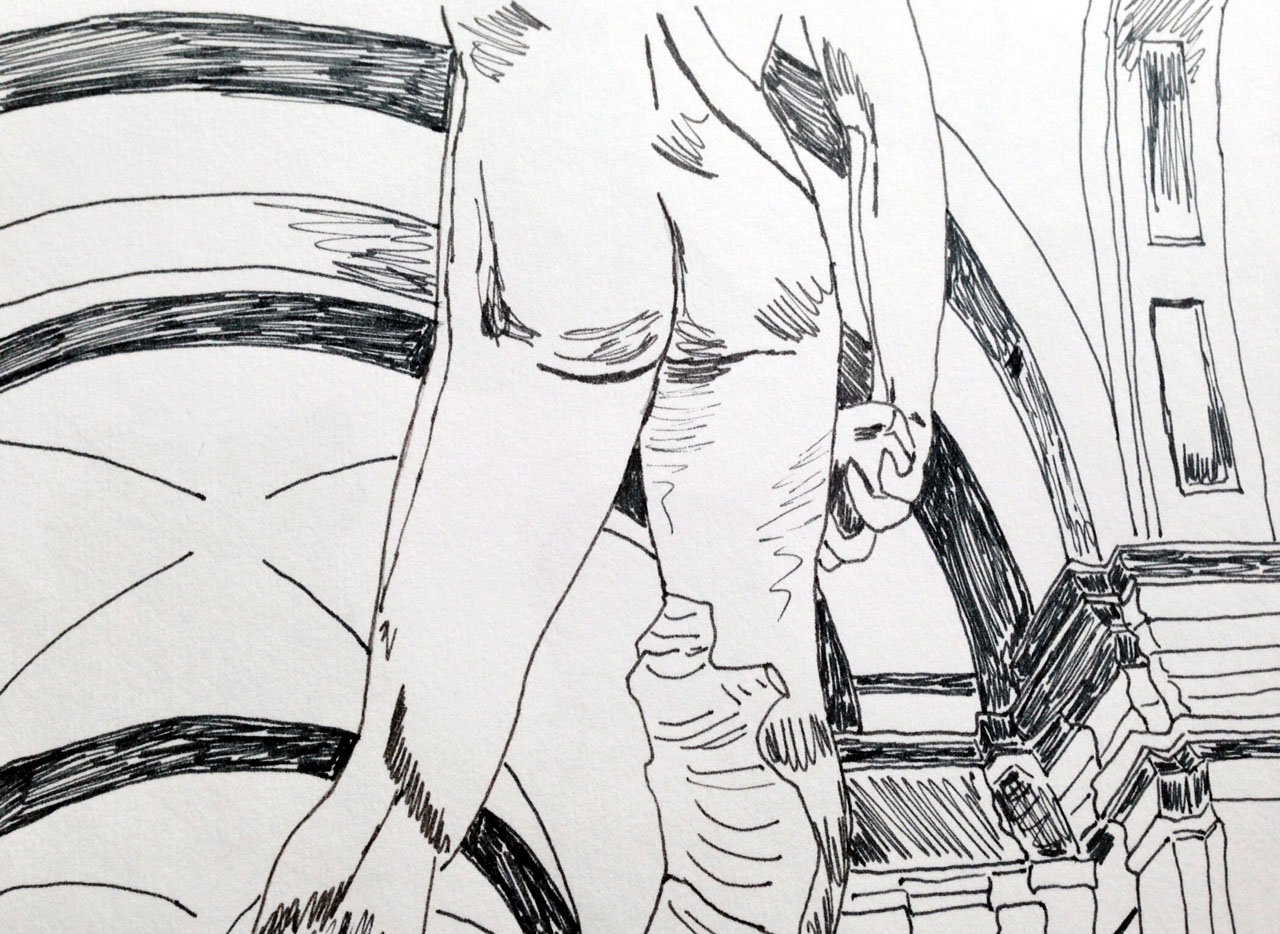
'Galleria dell'Accademia' 2004. My preferred view of David.

‘Galleria dell’Accademia’ 2004. My preferred view of David.

In 1910, ‘Falso Davide’, as I like to call the replica, was installed outside the Palazzo Vecchio where the original stood for 369 years.
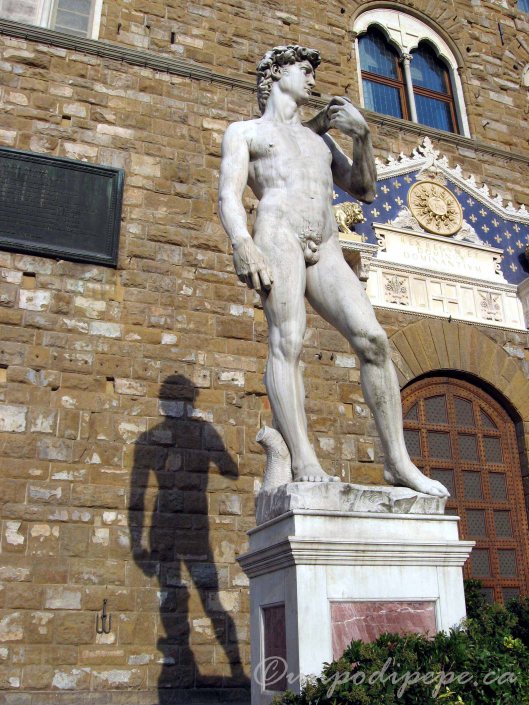
'Falso Davide' as I like to call him, outside the Palazzo Vecchio in Piazza della Signoria

‘Falso Davide’ as I like to call him, outside the Palazzo Vecchio in Piazza della Signoria

Perché questo blog? / Why write a blog?

Tags

, , , ,

Sono contenta che hai trovato il mio blog/ I’m glad you found my blog. Why did I decide to start writing a blog? I’ve been thinking about it for a long time. The biggest reason is creative inspiration and stimulation. I don’t remember when I didn’t have a passion for words and images. I could always be found with my nose in a book, reading, writing, or sketching. This is a place I can combine all of my interests; writing, art, photography, travel, and exploring Italian culture. I can share my photos, images, and all of the half-drafted ideas I have lying around. Whenever I think of something interesting, I scribble notes down on scraps of paper… post-it notes… menus….the computer, and now even on my phone, because ‘one day’ I’ll write an article about it. Well, ‘one day’ isn’t happening. I also have several emails I keep sending over and over to friends who are planning travel to Italy, and this is a better place to share that information. I have a strong belief in maintaining cultural ties, and I travel to Italy every year. I hope to encourage the same in other ‘italocanadesi’ who read my blog and to connect with others who have a passion for art, Italy,and anything else I think is interesting. I hope you learn something new every time you visit, whether it’s about a new place you’d like to visit, discovering a new artwork, learning a few new words in Italian, or maybe you’ll even be inspired to pick up a brush and starting painting yourself! I might write a few of my posts in Italian, but for now, it will be just little snippets. I’ll apologize in advance for any grammatical errors I might make! I don’t like to use online translating because it makes more mistakes than I do! Let me know if you have any suggestions for new posts. You can read more in ‘About me/Chi sono’  and L’Intervista con Silvia. The name ‘Un po’ di pepe’ means ‘a bit of pepper’….because everything can use some spicing up! Iniziamo l’avventura! / Let’s start the adventure!

In Italiano:
Sono contenta che hai trovato il mio blog! Perché ho iniziato a scrivere un blog? Ho vari motivi. È da tanto tempo che ci sto pensando. Mi piace scrivere, e questo è un posto dove posso scrivere di tutte le cose che mi piacciono. Posso usare tutte quelle cose scritta a metà e poi abbandonate, scritte o schizzate su un pezzetto di carta strappata…su un menù….sul computer, e adesso anche sul telefono, perché ‘un giorno’, queste mi serviranno per scrivere un articolo interessante. Nel frattempo, questo ‘un giorno’ sembra non arrivare mai!
Credo molto nel significato di mantenere legami con le miei radici italiane, e vado in Italia tutti gli anni. Spero con il mio blog di incoraggiare lo stesso interesse in altri italocanadesi. Scriveró di tutto quello che mi piace, soprattutto di arte e cultura italiana. Spero che ogni volta che lo visitarete, vi possiate imparare una cosa nuova…che si tratti di scoprire un’opera d’arte nuova, un posto da visitare, di imparare qualche parola nuova in italiano (o per quelli che parlano già l’italiano, di imparare qualche nuova parola in inglese!) o di essere ispirati a prendere un pennello in mano e cominciare un’opera d’arte tutta vostra! Forse scriveró anche delle volte in Italiano, ma per ora saranno piccolo frammenti. Fatemi sapere se avete qualche suggerimento per nuovi post. Chiedo scusa in anticipo per i miei eventuali errori grammaticali! Potete leggere un po’di più in ‘About me/ Chi sono’  o in L’Intervista con Silvia.

Ponte Vecchio, Firenze. Photo Shannon Milar

Ponte Vecchio, Firenze. Photo Shannon Milar