It is finally here! Today I received ‘A LITERARY HARVEST: Canadian Writing about Wine and other Libations’ (previously known as The Canadian Wine Anthology). When a book with your writing arrives in the mail, it is so exciting! I am one of the 42 writers in this anthology.
A LITERARY HARVEST: Canadian Writing about Wine and Other Libations, Eds. Licia Canton, Giulia De Gasperi and Decio Cusmano. From the blurb ‘The writings presented in A Literary Harvest give us new understanding and diverse perspectives in making and drinking wine and other libations. This volume introduces or re introduces the writing of 42 authors. Their text and unique drinking voices form a potable Canadian Literature’.
Contributors: Nic Battigelli Carolyn Bennett, Licia Canton, Glenn Carley, George Elliott Clarke, Renée Cohen, V.A. Colucci, Joan Crate, Sheldon Currie, Domenic Cusmano, Victoria Dickenson, Francesca Favaro, Terri Favro, Amanda Feder, Anna Fornari, Anna Foschi Ciampolini, Keith Foster, Veena Gokhale, Jacob Hogeterp, Karen Klassen, Alexandra Korey, Penelope Laurence, CarolL. Mackay, Antonio Mauriello, Aislinn McDougall, Adam McDowell, Heather McGuire, Rosanna Micelotta Battigelli, Carmelo Militano, Earl Murphy, Mariam S. Pal, Cristina Pepe, Damiano Pietrapaolo, Giovanna Riccio, Peppino Ruggeri, Laura Sanchini, Jeremy R. Saunders, Christopher Sisca, Christine Sigismondo, Glen Sorestad, Carmine Starnino and Carolyne Van Der Meer
My contribution is titled ‘In Vino there are Memories‘ and it is about my family’s wine and winemaking traditions. It may be featured it in a blog post soon, but for now, if you have great vision, try and read a few paragraphs here:
To order a copy for yourself or for all of the wine enthusiasts in your life, order on the Accenti magazine site here or email info@longbridgebooks.com. Publication date January 2025, ISBN: 978-1-928065-27-2, 310 pages, $34.95. Free delivery in Canada/US for orders of $60 or more. The gorgeous cover will go well with any wine collection. Grazie mille to the editors for all of their hard work!
This week, we celebrate Settimana della lingua italiana nel mondo – Week of the Italian Language in the World. The theme this year is Dante, the Italian, because 2021 is the 700th anniversary of his death. I already wrote a Dante themed post earlier this year 700 years of Dante, so instead I am featuring a post on a topic that has a special significance for me-and probably any of you that grew up in an Italian immigrant household. The rest of you will hopefully find it interesting too.
Italiese is a language created by Italian immigrants in English speaking countries to express things they did not already have words for. It is a combination of Italian, anglicized Italian words, italianized English words, and dialetto. I grew up with Italiese, and I still sometimes use it with my parents, family and paesani. When joking around with my siblings and cousins, it is like our own private language. Some of my favourite Italiese words are disciuascia (dishwasher), i muscirums (mushrooms), boolsheet and sonamabeitch. I will let you figure out the last 2 words! Click the blue button to watch a short video :
Renowned Italiese scholar and fellow AICW member Dr Diana Iuele Colilli graciously agreed to answer some questions for me.
What made you want to study Italiese?
I wanted to research Italiese for my PhD dissertation, but my thesis director strongly discouraged me as he said I would be researching Italiese for my entire career. He was right. I have always been intrigued by language. When I embarked on the path of a PhD in Italian linguistics I naturally gravitated toward the “language” that was used extensively in my home, alongside Calabrese. My parents had a grocery store on St. Clair, so I heard Italiese all the time. The variations fascinated me.
Why is Italiese important to Italocanadesi and the Italian diaspora in general?
Italiese is extremely important because it documents the language that Italian immigrants had to create when they arrived in Canada. It demonstrates their resilience and their desire to fit in their adopted land. However, Italiese is a language of passage that is destined to die. It has never been standardized, it is not used in literature or any other formal setting. Once the immigrants die there will be no need to use it anymore. As the child of immigrants, I use it every day with my parents and immigrant relatives. I use it with my siblings (who grew up with it) for fun. My children recognize it but don’t really use it beyond a few terms (garbiggio, ghellifrendi, etc) because they use standard English, French and Italian. Italiese is also important as a marker. In Canada Italians have left their mark in so many industries (construction, food, fashion, etc). It is important that we document how they spoke, how they assimilated linguistically. If we don’t document it or keep it alive, as Italians assimilate into the Canadian fabric, we will have generations of Canadians of Italian extraction only. Language is at the core of culture. WIthout it, culture gets watered down to memories only. If we don’t do everything possible to document Italiese, it will get to the point that we won’t know that Italians even immigrated to Canada. That’s why Christine Sansalone, my late husband Paul Colilli and I have been frantically documenting Italiese through our theatre productions. We now have 13 published plays that document Italiese in its purest form of the post-WWII period to today with its code-switching.
Does Canada differ from other countries in their Italian/English hybrid language?
It doesn’t. That’s the beauty and the universality of Italiese. Italiese is a hybrid language that has at its base (phonology, morphology and syntax) an Italian dialect but the terminology (lexicon) is that of the adopted English speaking country. So, we have American Italiese, British Italiese, Canadian Italiese, Australian Italiese, South African Italiese …. the dialect mixed with the local English. The differences will be found in the lexicon. In Canada we say garbage, so the Italiese word is /garbíggio/. However, in the US the term is trash, so the Italiese term is “tréscio” and the Australian term is “rábbiscia” because rubbish is used for our garbage.
How can we keep Italiese alive?
By using it. By continuing to do research on it. However, it needs to be used not only in homes, but in businesses, offices and most importantly in literature. If Italian-Canadian writers would incorporate Italiese in their writings, it would give it much more prestige.
I have my own strong opinion on this, but what do you make of people who are embarrassed by Italiese or dialetto?
I think people are much more embarrassed of their dialects. Many people who utilize Italiese don’t even realise that they’re using it. The stigma of using the dialect stems from social stigma of using it Italy. At the time of immigration, the dialect was a marker for low social status. There is a generation of Italians who were raised without. Only in the last few years has there been a resurgence of the dialects. Those stigmas were also felt by the immigrants who left their homeland. We need to encourage the children and the grandchildren of Italian immigrants to use the “language” (dialect/italiese/mix of the two) that was passed on to them. In a world in which English is the lingua franca, it’s easy to relegate the dialect/Italiese to the home, or to not use it all.
Grazie Diana! Who would have thought the word garbage could be so interesting! For more information check out the website for Italiese TV and the You Tube video below.
Diana Iuele-Colilli holds a PhD in Italian Linguistics from the University of Toronto. She was born and grew up in the Little Italy of St. Clair and Dufferin in Toronto. Diana is an Emeritus Professor of Italian at Laurentian University in Sudbury, Ontario, where she still continues her research toward a dictionary of Italiese. She is the author of many books dedicated to the Italian experience in Canada. She is the co-author of 13 plays written in Italiese in its various forms. She is also the president of the Paul Colilli Foundation, a non-profit organization that promotes and disseminates the positive image of Italy and Italian Canadians in Ontario.
Now I am motivated to write some poetry in Italiese! If you have been exposed to Italiese in your country, let us know in the comments. Ciao, Cristina
The Italian Cultural Institute of Montreal and the Association of Italian Canadian Writers (AICW), as part of a webinar series dedicated to writing, an experience animated by Italian-Canadian authors, translators, journalists, publishers and bloggers, are pleased to present “Can you smell the garlic? Writing About Italian-Canadian Food Culture”
Tuesday, September 8, 2020 – 5:00 pm EST
Nonna stirs tomato sauce bubbling in a cauldron in the garage, papà proudly pours a glass of his homemade wine, zie gather to make taralli and biscotti in the basement kitchen…
These culinary traditions are a treasure trove of material for the Italian-Canadian writer. How does nostalgia affect the relationship to food and writing about food? Push past the clichés, what complicates the rosy images? Is it more difficult to write in a critical or unsentimental mode about food and Italian-Canadian identity?
Domenico Capilongo, Monica Meneghetti, Cristina Pepe and Jim Zucchero will read mouth-watering prose and poetry and talk about the connections between food and their writing. The webinar will be moderated by former restaurant critic, Francesca M. LoDico. The series is hosted by the Secretary of the AICW Executive, Giulia Verticchio.
I will be reading about Grano Arso. The webinar will be available to view later on the Istituto Italiano di Cultura-Montreal’s website and Facebook page.
In Italiano:
L’Istituto Italiano di Cultura di Montréal e l’Associazione degli Scrittori italo-canadesi (AICW), nell’ambito della serie di webinar dedicata all’opera della scrittura, un’esperienza animata da autori italocanadesi, traduttori, registi, giornalisti, editori, bloggers…, sono lieti di presentare il webinar intitolato “Senti l’aglio? Scrivere sulla cultura culinaria italocanadese”.
Nonna mescola la salsa di pomodoro che ribolle in un calderone nel garage, papà versa orgoglioso un bicchiere del suo vino fatto in casa, le zie si riuniscono per fare taralli e biscotti nella cucina del seminterrato… Queste tradizioni culinarie sono un tesoro di materiale per lo scrittore italo-canadese. In che modo la nostalgia influenza il rapporto con il cibo e la scrittura sul cibo? Superare i cliché, cosa complica le rosee immagini? È più difficile scrivere in modo critico o non sentimentale sul cibo e sull’identità italo-canadese?
Domenico Capilongo, Monica Meneghetti, Cristina Pepe e Jim Zucchero leggeranno brani e poesie da “leccarsi i baffi” e parleranno delle connessioni tra il cibo e la loro scrittura. Il webinar sarà moderato dal già critico di ristoranti, Francesca M. LoDico. La serie è ospitata dalla Segretaria dell’Esecutivo AICW, Giulia Verticchio.
 It is finally here! Today I received ‘A LITERARY HARVEST: Canadian Writing about Wine and other Libations’ (previously known as The Canadian Wine Anthology). When a book with your writing arrives in the mail, it is so exciting! I am one of the 42 writers in this anthology.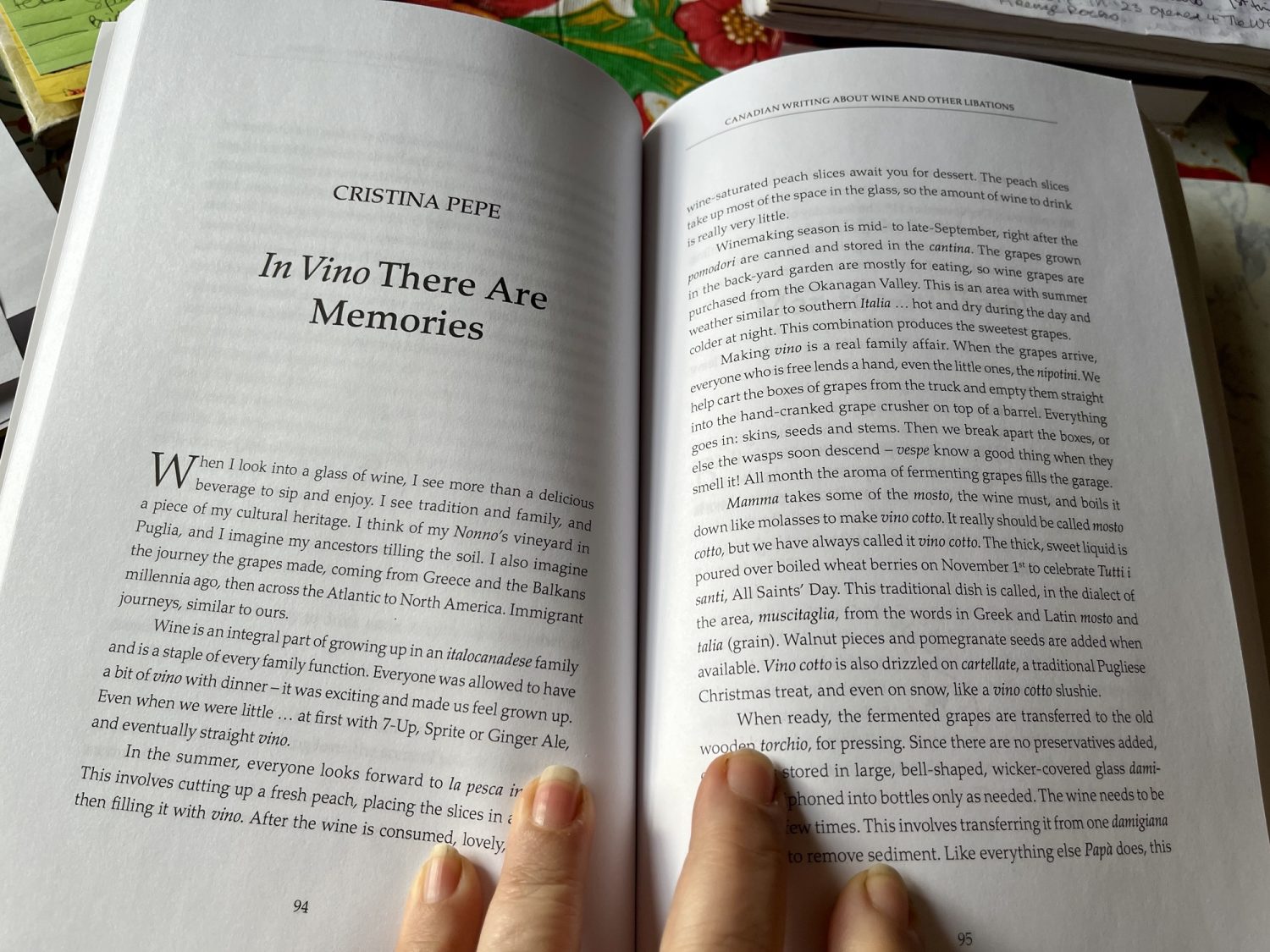

 Un po' di pepe