The Pumo is an artisanal decorative ceramic object in the form of a bud just about to flower, enclosed by acanthus leaves. It symbolizes the capacity to regenerate and form new life. The acanthus leaves, the same ones found on ancient Greek and Roman Corinthian columns, symbolize long life and immortality. For these reasons the pumo is a traditional Pugliese good luck charm, providing protection and bringing prosperity, happiness, good fortune and fertility.
The name pumo comes from the latin words pomum (fruit) and pumum (pine cone) and is tied to the cult of the goddess Pomona, protector of fruit.
Centuries ago, noble Pugliese families used pumi (plural) as ornaments on building facades, staircases, balconies, and at the foot of the bed of newly married couples. They were also frequently given as wedding gifts. Pumi were originally only available to wealthy families, since they were the only ones who could afford decorative ceramics. Today the pumo is an emblem of Puglia and is often used as a piece of jewellery, a bomboniera (wedding favour) or a souvenir from Puglia. Sometimes they are in the shape of a rose bud or pine cone and can even be room fragrance diffusers, decorative lamps, candleholders or bottles.
In Italiano
Il Pumo è un oggetto decorativo artigianale in ceramica a forma di un bocciolo in procinto di sbocciare, chiuso tra foglie di acanto. Simboleggia la capacità di rigenerarsi e formare nuova vita. Le foglie di acanto, le stesse che si trovano sulle antiche colonne corinzie greche e romane, simboleggiano lunga vita e immortalità. Per queste ragioni il pumo è un portafortuna tradizionale pugliese, che fornisce protezione e porta prosperità, felicità, buona fortuna e fertilità.
Il nome pumo deriva dalle parole latine pomum (frutto) e pumum (pigna) ed è legato al culto della dea Pomona, protettrice della frutta.
Secoli fa, le famiglie nobili pugliesi utilizzavano i pumi come ornamenti sulle facciate degli palazzi, sulle scale, sui angoli delle ringhiere dei balconi e ai piedi del letto delle coppie di novelli sposi. Venivano anche spesso offerti come regali di nozze. I pumi erano originariamente disponibili solo per le famiglie ricche, poiché erano le uniche che potevano permettersi ceramiche decorative.Oggi il pumo è un emblema della Puglia e viene spesso utilizzato come gioiello, bomboniera o souvenir pugliese. A volte ha la forma di un bocciolo di rosa o di una pigna e può anche essere un diffusore di fragranze per ambienti, una lampada decorativa, un portacandele o una bottiglia.
November 1st is Tutti i Santi-All Saints’ Day and is a national holiday in Italia. It was created in the 9th century when the Pope superimposed a Christian feast day onto existing rituals, so this festa has been around for a very long time. Tonight is also an ancient festa celebrated in Orsara di Puglia called Fucacoste e Cocce Priatorje which is dialetto Orsarese for ‘Falò e teste del Purgatorio’. This translates to ‘Bonfires and heads from purgatory’ the ‘heads’ being zucche lanterne-carved pumpkin lanterns. For simplicity, it is also called ‘Tutti i Santi’ or ‘La Festa dei Morti’.
The night between November 1stand 2nd provides the opportunity to honour, reconnect and pay respect to the spirits of loved ones. I wrote about the festa in a 2014 post Fucacoste e Cocce Priatorje, but at that time I had not attended. I had only heard about it from my parents, family and friends. Last year I had the opportunity to attend. It was cold but the night was clear and an absolutely amazing, magical, spriritual experience-for me and at least 20,000 others. Orsaresi who live in other parts of Italia and Europe come home for the festa, and visitors come from all over Puglia. Since it is a holiday, many families are able to take an extra long weekend known as il Ponte dei morti.
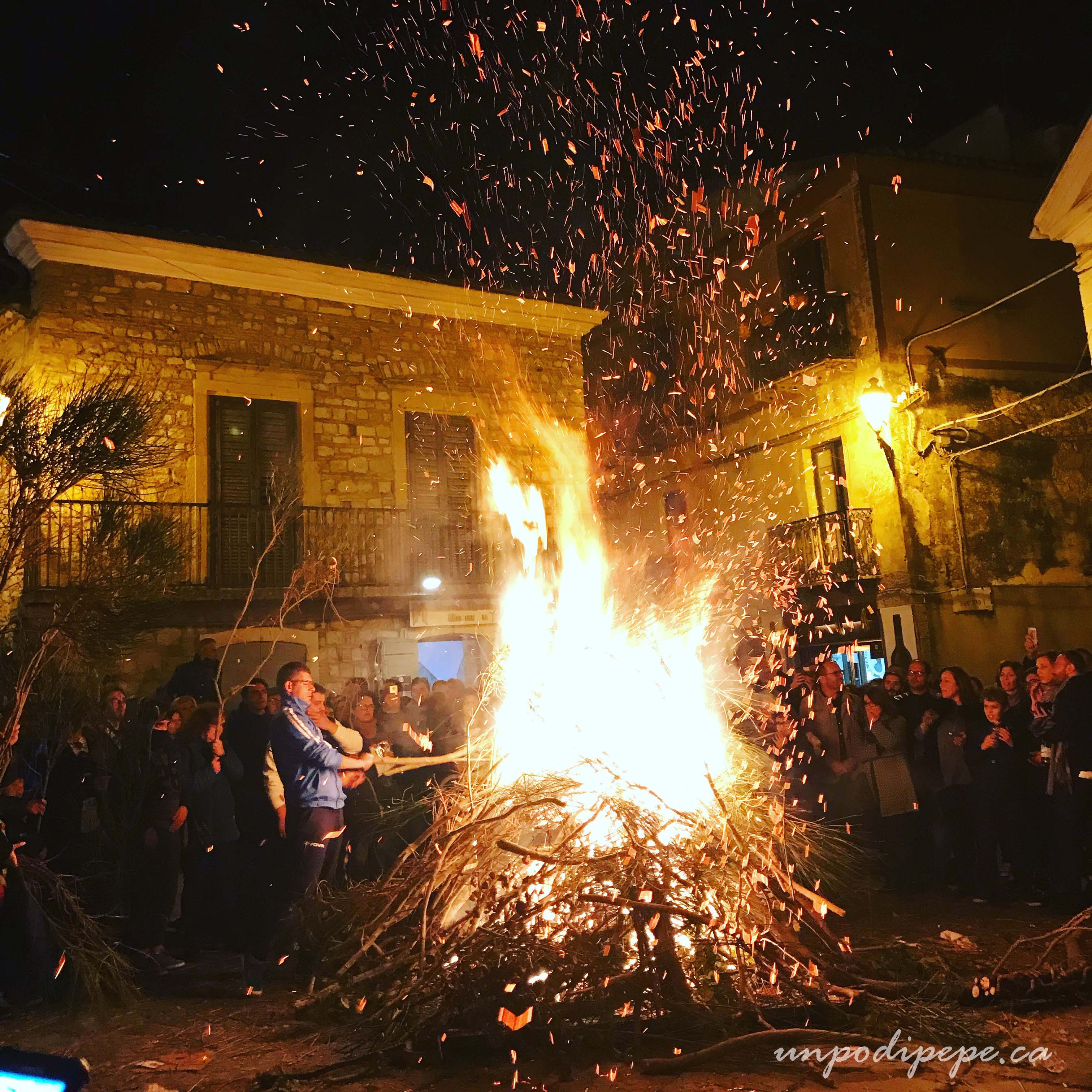
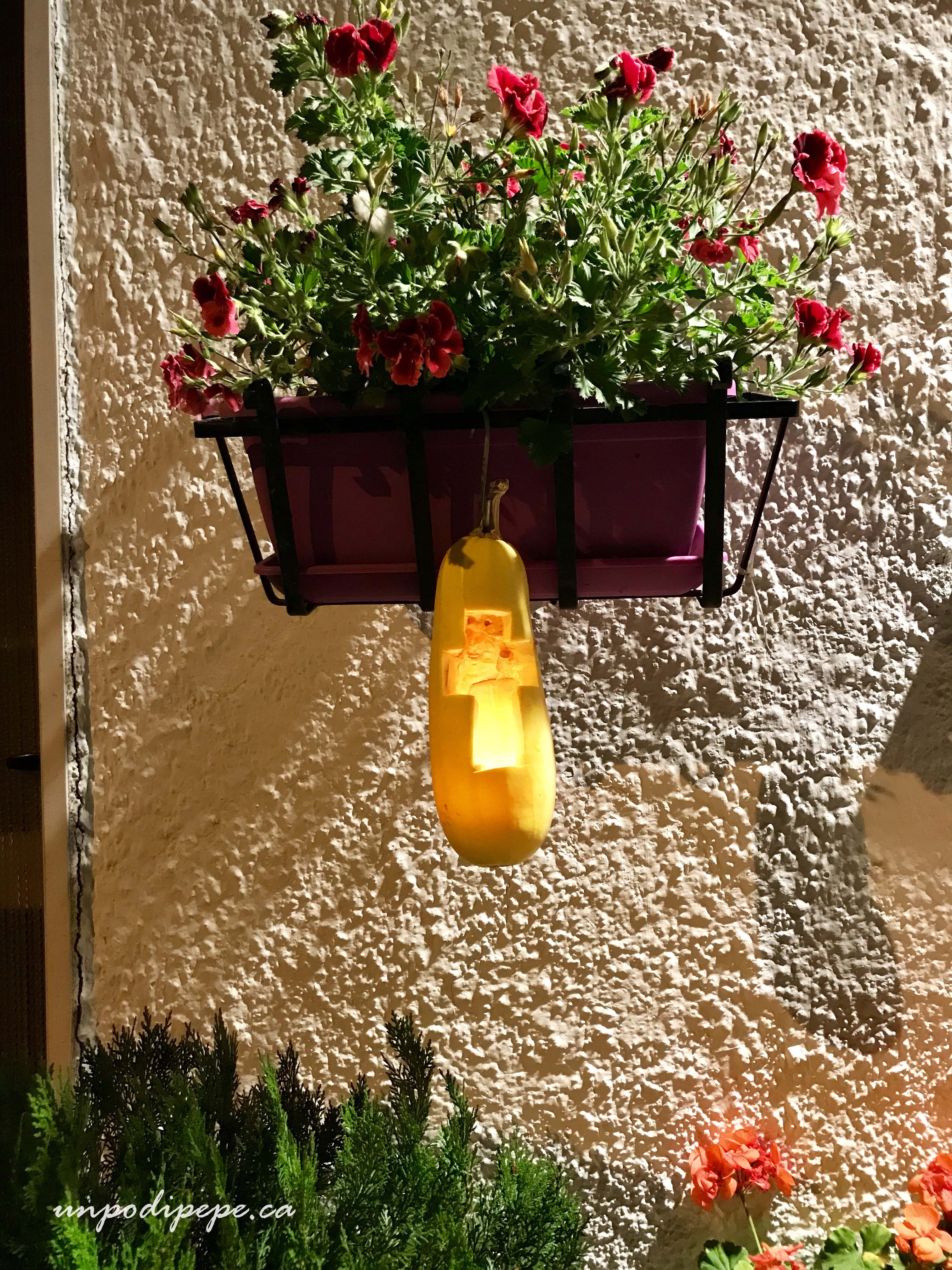
It is believed that this night between Nov 1 and 2, the souls of the recently dead return among the living to visit their relatives and their former homes before moving on to Paradiso. Bonfires are lit with wood and branches of ginestra (broom). The light of the fires and the crackling and sparks of the ginestra reaching for the sky attract the spirits, to reunite the living with those who continue to live only in our memories. The light inside ‘cocce priatorje’, pumpkin lanterns carved to look like heads or carved with crosses-light their way to find their former home.
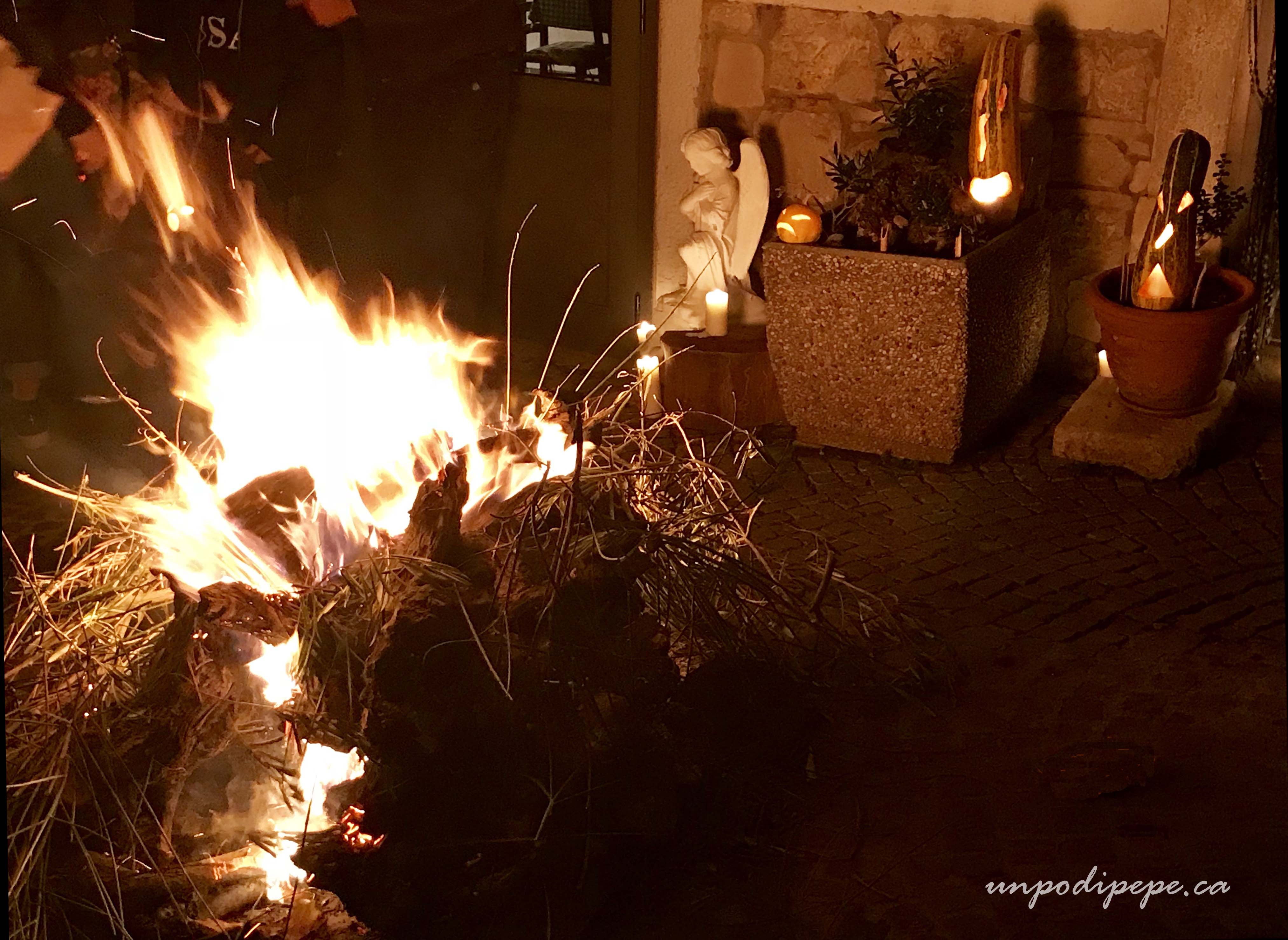
My paesani are busy preparing for the festa for days. Preparation involves gathering firewood and ginestra, preparing food for family and friends and picking hundreds of locally grown zucche which are carved and placed all over Orsara. Restaurants and bars prepare for one of their busiest nights of the year. There is even a laboratorio di intaglio delle zucche– a pumpkin carving workshop. My street, balcony and front door were decorated with zucche. In the evening zucche are exhibited and there is a contest for ‘la zucca più bella’.
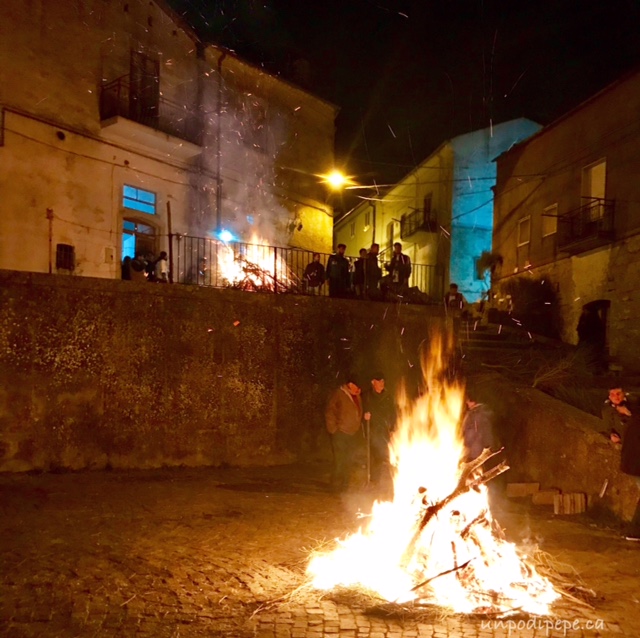
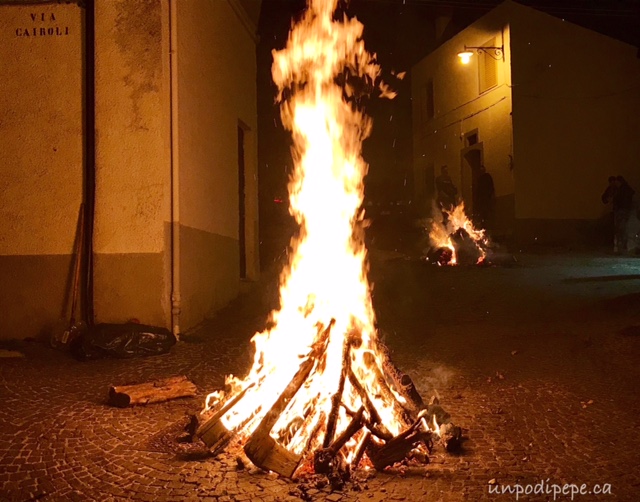
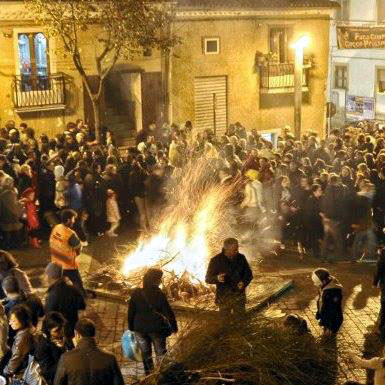
When the campanile, the church bell tower, strikes 1900 hours, Orsara di Puglia ‘catches fire’. Bonfires are simultaneously lit in every street and piazza and remain lit through the night. The fires, illuminated zucche, music and people in the streets create a magical, enchanted atmosphere. There are 3 large municipal falò, and every quartiere – neighbourhood, and many families also light their own.
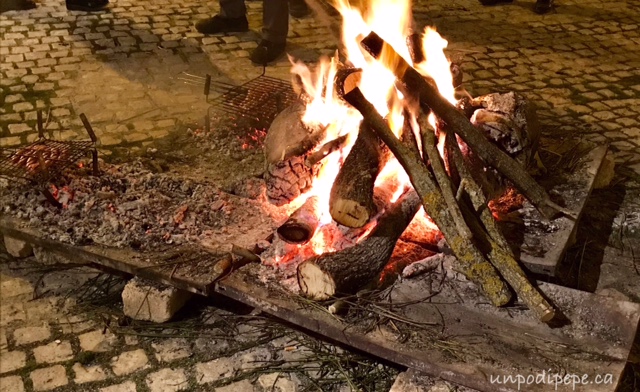
I made a point of getting off of the main Corso to visit some of the smaller personal falò. In honour of the dead, simple but symbolic seasonal foods are cooked on the open fires and also served as cibo di strada-street food. These include patate -potatoes, cipolle-onions, salsicce-sausages, castagne-chestnuts and pane cotto-bread cooked with garlic, potatoes and greens.
Salsicce e pancetta nel fuoco
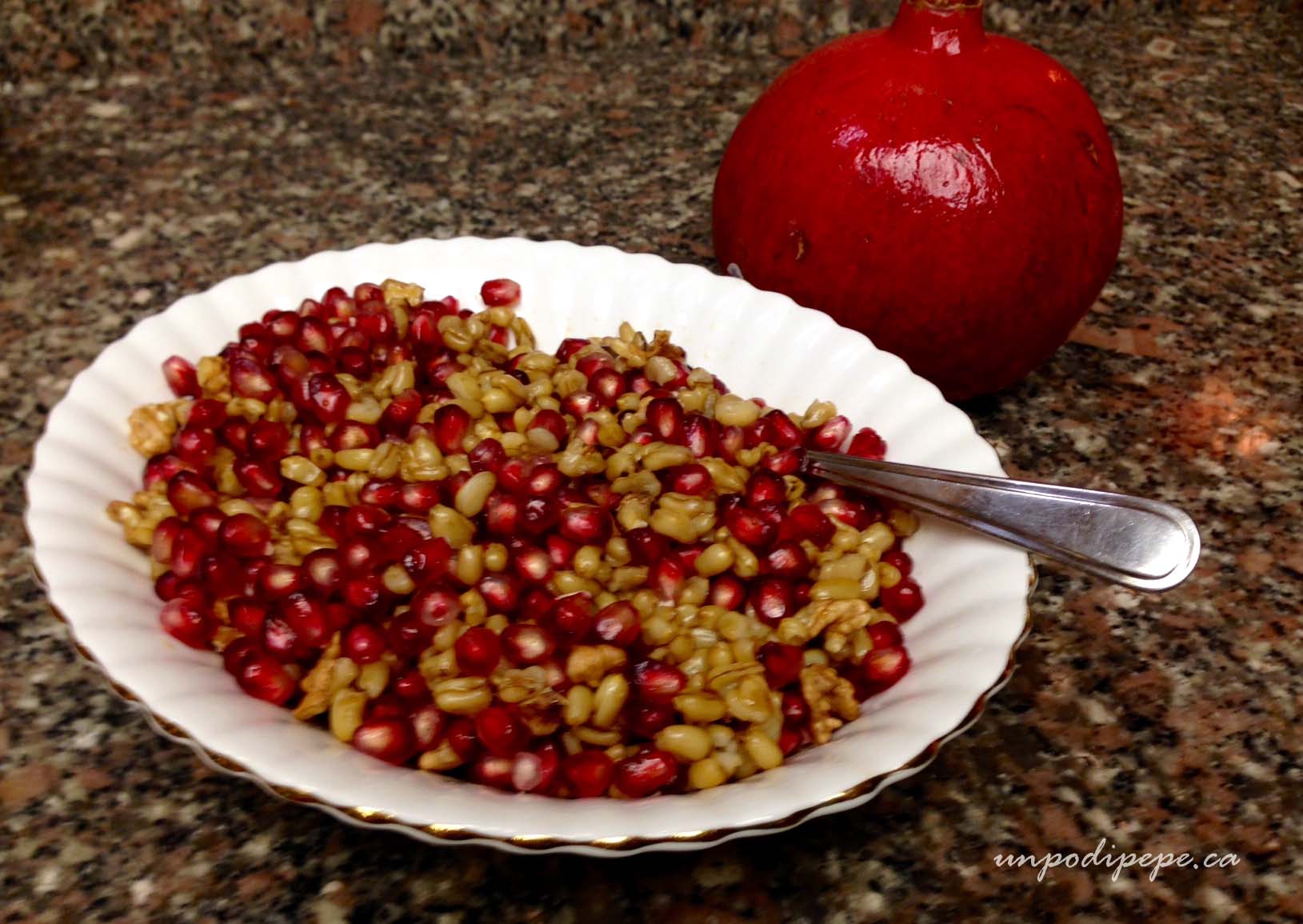
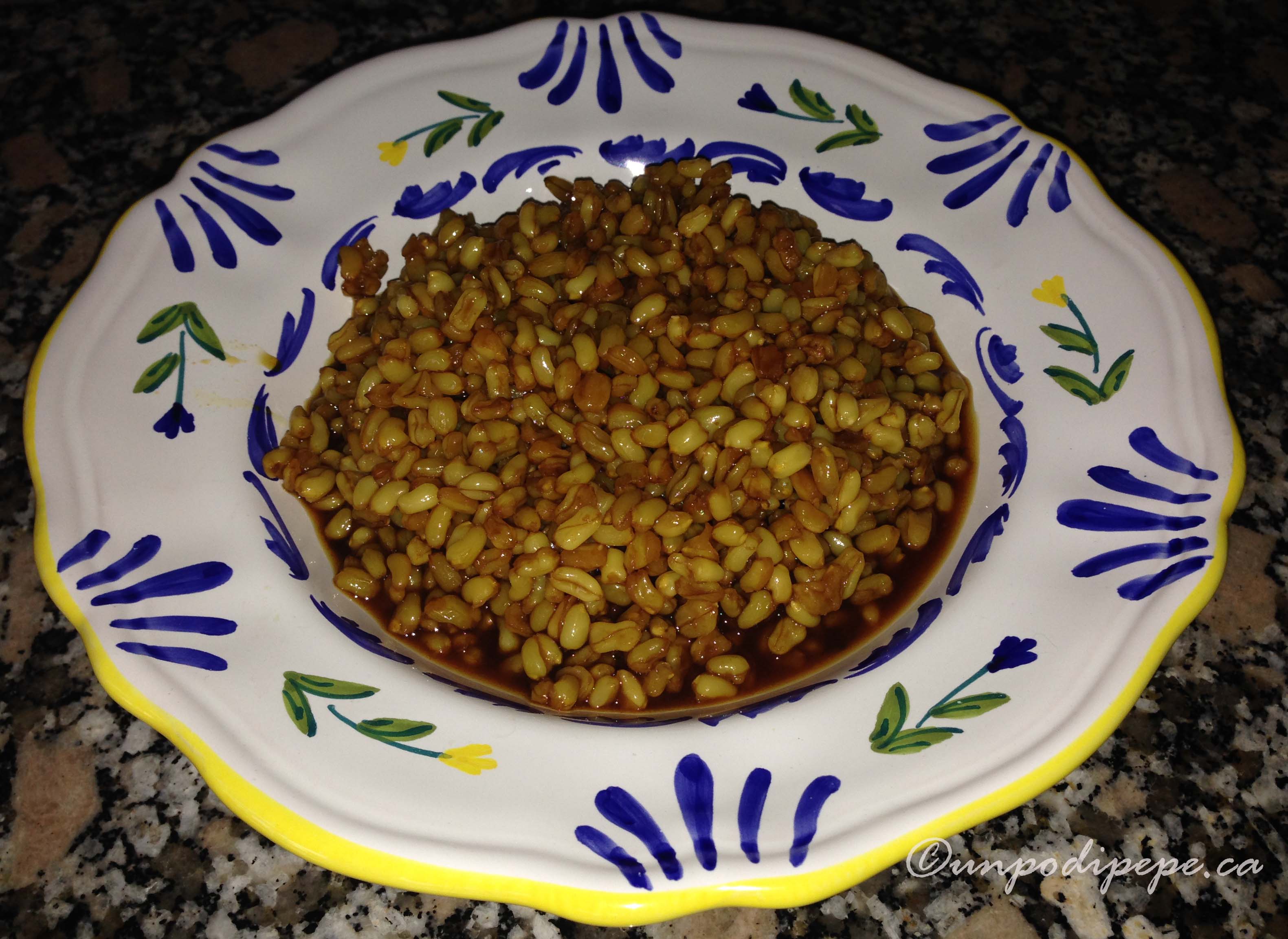
Muscitaglia (moo•shee•tah•lyah) is a traditional dish served November 1st likely dating back from the ancient Greeks and Byazantines. Muscitaglia is made up of the Greek and Latin words mosto (wine must) and talia (grain). The ingredients include boiled grain and vino cotto. Semi di melagrana e pezzi di noci -pomegranate seeds and walnut pieces are often added. These ingredients are symbols of fertility and abundance, but also of honour and respect for the dead.
Il fuoco e le zucche di Antonella e Domenico
Fucacoste e Cocce Priatorje has often been confused by visitors with the Anglosaxon Hallowe’en, but it is an entirely different event. Besides the obvious fact that the date is different, dressing up in costume is not part of the custom and there is nothing scary or evil about it. This is the reason for the hashtag #quinonèhalloween. There are more similarities with Mexico’s Dia de los Muertos/Day of the Dead. This event is about being together in community to celebrate the bond between the living and those who we remember in our hearts. It is also to remind us that our time on earth is precious. The following day, November 2nd is l’Anime dei Morti-All Soul’s Day, and it is customary to go to the cemetery to pay respects at the resting place of loved ones.
The 9 minute video below features 94 year old Z’Gaetan talking about the festa and its significance.
This lively 48 second video from 2016 featuring the music of Tarantula Garganica will make you all wish you were there tonight:
If you did not watch the video….watch it now! I did not make it there this year, but am looking forward to my next trip to Fucacoste e Cocce Priatorje! Now I am off to my Mamma’s to have muscitaglia! Ciao, Cristina
‘Culture Shock’ is this month’s topic for the Dolce Vita Bloggers group. I was born in Italia, grew up in an Italian family in an italian/multicultural neighbourhood and have been travelling to Italia my whole life. There isn’t much culture shock going on for me to write about.
However……because in my ‘real job’, I work as a health care professional, there are a few malattie…illness related things that just drive me pazza! Repeat after me ….. illnesses are caused by viruses! Le malattie sono causate dai virus (pronounced VEE•roos).
A unique category of illnesses exists exclusively in Italia, caused by wind, cold, sweat and wet hair! The thing they all have in common is sudden changes in temperature or extreme temperature fluctuations. Anyone who is from an Italian family will instantly relate to all of these. My title Aria Pericolosa! means ‘dangerous air’. We now know malaria is caused by mosquitoes, but in the past this was not known. The word mal aria actually means ‘bad air’! These health beliefs are generally left over or adapted from times when we did not know the cause of disease.
Colpo d’aria means literally a smack, strike or big hit of air. An example of this is going from outside on a hot day into a shopping mall blasted with air conditioning. Someone who has cold symptoms or a sore back, headache, earache or even indigestion might say ‘ho preso un colpo d’aria’. Italians are somewhat distrustful of air conditioning, using it only when really necessary- in sharp contrast to the North American obsession with it. Severe back spasm is often called ‘colpo della strega’- Strike of the witch.
Un colpo d’aria can also come from ‘la corrente’ which is an air current or a draft. Walking or sitting in a corrente is thought to cause illness. A draft caused by 2 open windows or doors directly opposite each other is considered bad luck in Feng Shui, because the good Chi goes in one window and out the other, however… winds and drafts do not carry disease! I’ve had many meals in a place as hot as a sauna because they refused to open both windows or doors at the same time-only one or the other! Mannaggia!
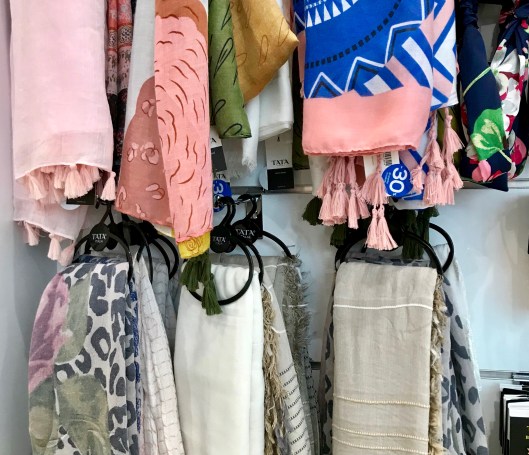
La cervicale is another classic condition related to colpo d’aria. This is a stiff neck cause by the neck being exposed to cold. And you thought everyone wore scarves just to be fashionable!
Running around sudato -with a sweaty body is also thought to cause illness. I suppose hot and sweaty are 2 temperature fluctuations! This is especially applicable to bambini, running around playing, and also wearing sweaty clothes. You may here ‘è sudato!’ exclaimed on the playground by many an Italian Mamma. Italian bambini are always provided with multiple changes of clothes for when they get sweaty, even at the beach! They wear canottiere, undershirts made of wool in winter and cotton in summer to absorb sudore. These are sometimes referred to as a ‘maglietta della salute’/health shirts. Being sudato then sitting in a corrente—you are doomed to illness!
Let’s not forget capelli bagnati! Going outside with wet hair is thought to cause illness, even pneumonia….even death! I always air dry my hair, as it takes too long to blowdry. I compare this to drying the dishes. Why dry the dishes when nature will dry them on their own? If I leave the house with wet hair in Italia, I inevitably will get asked the obvious ‘ma c’hai i capelli bagnati?’ Being in a corrente while sweaty with wet hair and senza giacca -without a jacket….you might as well call the funeral home!
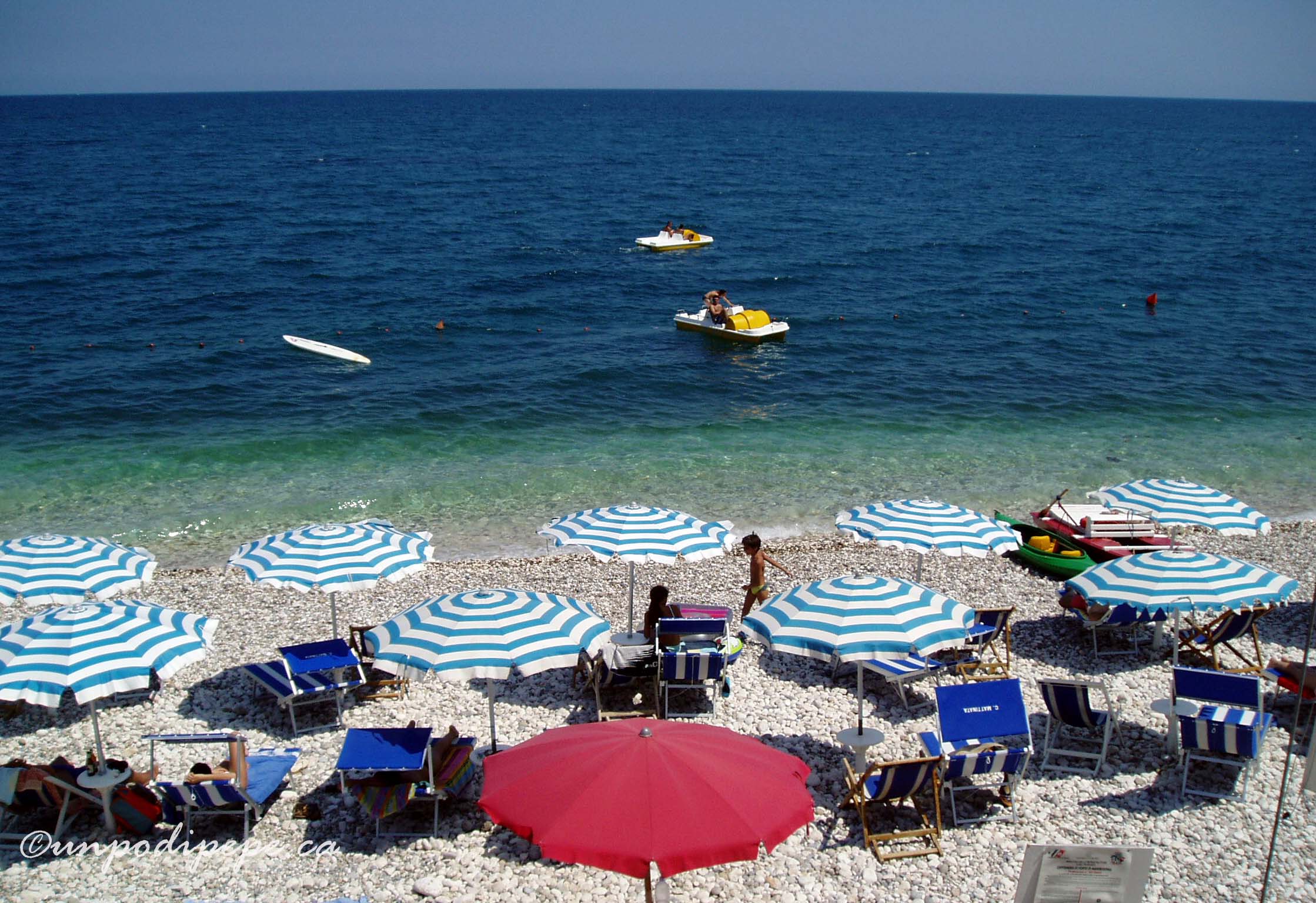
Swimming within 3 hours after eating is thought to cause cramps and this will cause you to drown. In Italia, the main meal is usually pranzo, around 1pm. Yes, even on the beach it is often a full on meal and not just a panino. This means the meal is heavier while at the beach, but it certainly doesn’t take 3 hours to digest the food. I am ready for my next gelato by this time. Noon until 3 pm is also the hottest time of the day, so it is not such a bad thing to be in the shade under an ombrellone at this time, it is the reasoning that drives me nuts. One of my colleagues is from India, and she tells me her family says the same thing, so this one m ay not beexclusive to italia. Perhaps it was originally related to eating questionable food before refrigeration was available? Still, I have yet to hear about someone drowning because they went swimming on a full stomach!
I could go on and on, but I need to go back out and enjoy the Pugliese sunshine. All of these malattie might lead you to believe Italia is a uniquely immunocompromised country, but Italians are generally in very good health! I try to explain that these ailments exist exclusively in Italia, but I give up! None of these are harmful, but they can get annoying, especially to a health care professional. Remember….. Le malattie sono causate dai virus! You can still follow Nonna Mari’s advice and ‘metti la giacca!’
This post is written as part of the monthly #dolcevitabloggers linkup, hosted by Jasmine of Questa Dolce Vita, Kelly of Italian at Heart and Kristie of Mamma Prada the 7th -14th of every month.
Note-I will be Chiuso per Ferie without a computer, so may not be able to link this post to the other ‘Culture Shock’ posts until I get home. If the links do not work, check back later.
FYI ‘Aria pericolosa‘ can also refer to the lingering smell that keeps on giving after a smelly fart!
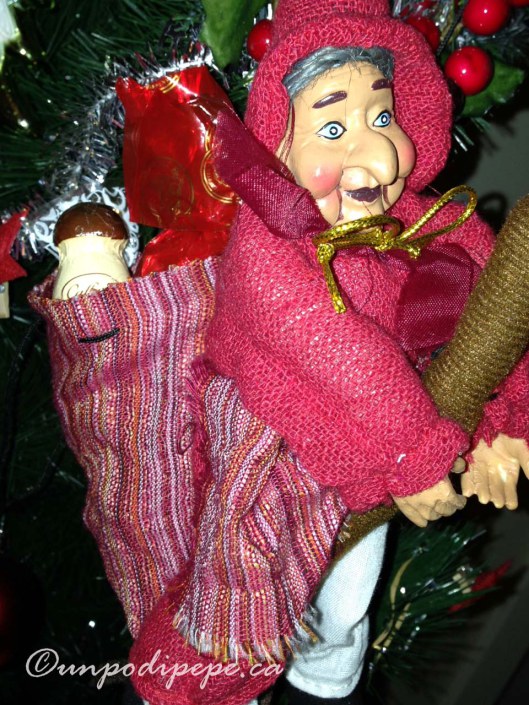
Ogni anno, nella notte tra il 5 e 6 di gennaio, volando cavalcando la scopa, La Befana porta regali ai bambini nella speranza che uno di loro sia il Bambino Gesù……
Today is la Festa dell’Epifania in Italia, celebrating the arrival of i Re Magi (the 3 Wise Men) Gasparre, Melchiorre & Baldassarre with their gifts of oro, incenso e mirra (gold, frankincense …
Continue reading original post: La Befana in English and Italiano. Buona Befana!
Muscitaglia (moo•shee•TAH•lyah) is a traditional dish served on November 1st in Orsara di Puglia. It probably dates back from the ancient Greeks and Byzantines. Muscitaglia, in both Greek and Latin is made up of the words mosto (wine must) and talia (grain). The ingredients include boiled grain and vino cotto, which is actually mosto cotto- boiled down grape must which becomes a thick, sweet liquid. Pomegranate seeds and walnut pieces are also added when available. These ingredients are simple and symbolic of fertility and abundance, but also of honour and respect for the dead.
November 1st is the night of Tutti i Santi (All Saints), a night which provides the opportunity to reconnect and pay respects to deceased loved ones. My post on the ancient festival Fucacoste e Cocce Priatorje which takes place in Orsara di Puglia has more information on the traditions and festivities.
Muscitaglia
Watch the video ‘#quinonèhalloween’featuring recently deceased Zi’ Gaetan talking about Fucacoste e Cocce Priatorje and its significance. I’m sure a few homes in Orsara will put out a chair tonight for Zi’ Gaetan so he can rest on his way to Paradiso. https://www.youtube.com/watch?v=9W5RD0-9H-A
Today is la Festa dell’Epifania in Italia, celebrating the arrival of i Re Magi (the 3 Wise Men) Gasparre, Melchiorre & Baldassarre with their gifts of oro, incenso e mirra (gold, frankincense and myrrh) for newborn Bambino Gesù (baby Jesus).
The night between January 5th and 6th is also the 12th night between Christmas and the Epiphany, and marks the end of the Christmas holiday season. As the proverb says, ‘L’Epifania tutte le feste porta via’. What does this have to do with La Befana, the ‘Buona Strega’?
La Befana is the traditional ‘gift-bringer’ in Italian folklore. According to legend, which varies from region to region, she is an old woman who prides herself on being a good housekeeper. While she was sweeping, the 3 Wise Men stopped at her house to ask for directions to Bethlehem. She didn’t know the way…
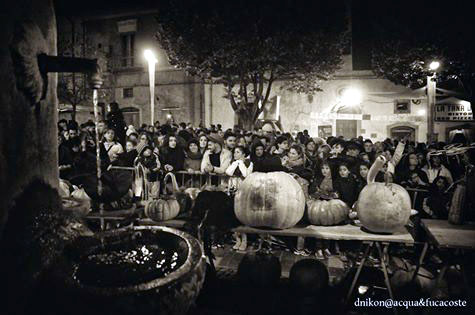
Piazza San Pietro. Photo courtesy of International Photo Correspondent Donato Narducci
Tonight is a big festa in Orsara di Puglia, so I am reposting this from last year.
Fucacoste e cocce priatorje is dialetto Orsarese for ‘Falò e teste del Purgatorio’. This translates to ‘Bonfires and heads from purgatory’. It is an ancient festival unique to Orsara di Puglia celebrated on November 1st, the night of ‘Tutti i Santi’ (All Saints Day). All Saints Day was created in the 9th century when the Pope superimposed a Christian feast day onto existing rituals, so this festa has been around for a very long time. It is a night where people have the opportunity to honour, reconnect and pay respect to the spirits of their loved ones. Carabinieri estimate that the town of 3,000 had 40,000 visitors attend the festa tonight, with 9,000 cars parked up to 3 km away!
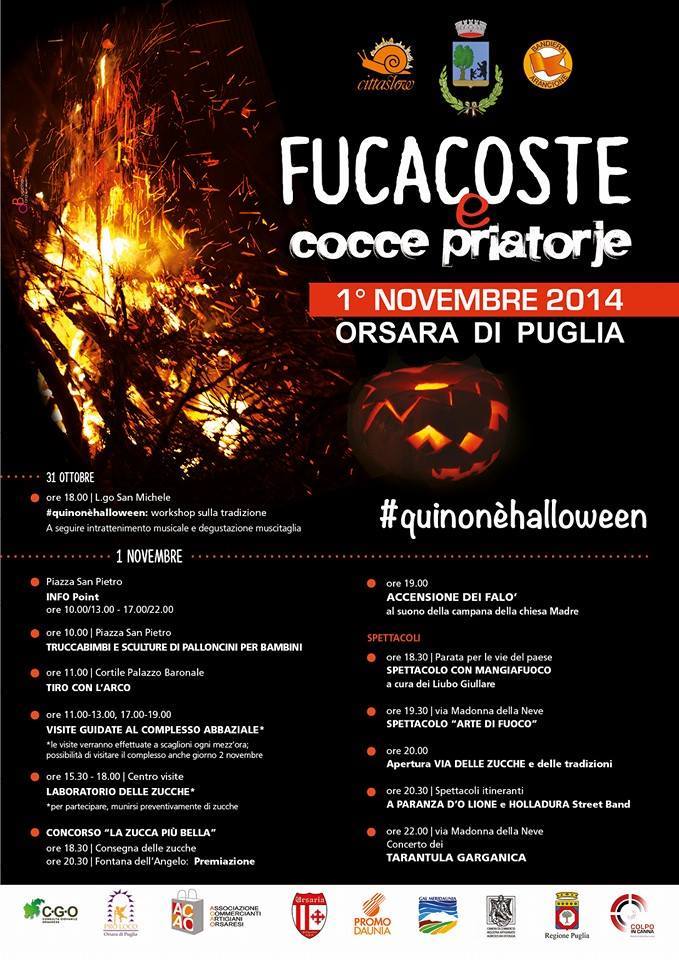
2014 poster for Fucacoste e cocce priatorje
It is believed that the souls of the dead return among the living to visit their relatives and their former homes before moving on to Paradiso. The bonfires are lit with wood and branches of ginestra (broom). The light of the fires and the crackling and sparks of the ginestra attract the spirits to reunite the living with those who continue to live only in their memories. The souls of the dead loved ones collect ashes from the fires. The gleam of light inside ‘cocce priatorje’, pumpkins carved to look like heads-light their way to find their former home.
Preparation for the festa involves gathering firewood and ginestra, preparing food and carving zucche (pumpkins). There is even a BYOZ (bring your own zucca) pumpkin carving workshop. Later in the evening zucche are exhibited and there is a contest for ‘la zucca più bella’-the best zucca.
In honour of the dead, simple but symbolic foods are prepared. These include potatoes, onions, salsicce (sausages) and castagne (chestnuts) cooked in open fire. Muscitaglia is a traditional dish served on November 1st which probably dates back from the ancient Greeks and Byzantines. Muscitaglia (moo•shee•tah•lyah) in both Greek and Latin is made up of the words mosto (wine must) and talia (grain). The ingredients include boiled grain and vino cotto (literally cooked wine-also called mosto cotto). Pomegranate seeds and walnut pieces are sometimes added. These ingredients are symbols of fertility and abundance, but also of honour and respect for the dead.
Muscitaglia
When the campanile (church bell tower) strikes 1900 hours (7 pm), Orsara di Puglia ‘catches fire’. Over 100 bonfires are simultaneously lit in every street and piazza and remain lit through the night. The fires, pumpkin lanterns, music and people in the streets create a magical, enchanted atmosphere.
Fucacoste e Cocce Priatorje has often been confused with Hallowe’en, but it is a very different event. Besides the fact that the date is different, dressing up in costume is not part of the custom, there is nothing scary about it and there are no evil spirits to chase away. It has more similarities with the Mexican Dia de los Muertos, Day of the Dead. This is an event about being together in community to celebrate the bond between the living and those who we remember in our hearts, and to remind us that our time on earth is precious.
Today is la Festa dell’Epifania in Italia, celebrating the arrival of i Re Magi (the 3 Wise Men) Gasparre, Melchiorre & Baldassarre with their gifts of oro, incenso e mirra (gold, frankincense and myrrh) for newborn Bambino Gesù (baby Jesus).
The night between January 5th and 6th is also the 12th night between Christmas and the Epiphany, and marks the end of the Christmas holiday season. As the proverb says, ‘L’Epifania tutte le feste porta via’. What does this have to do with La Befana, the ‘Buona Strega’?
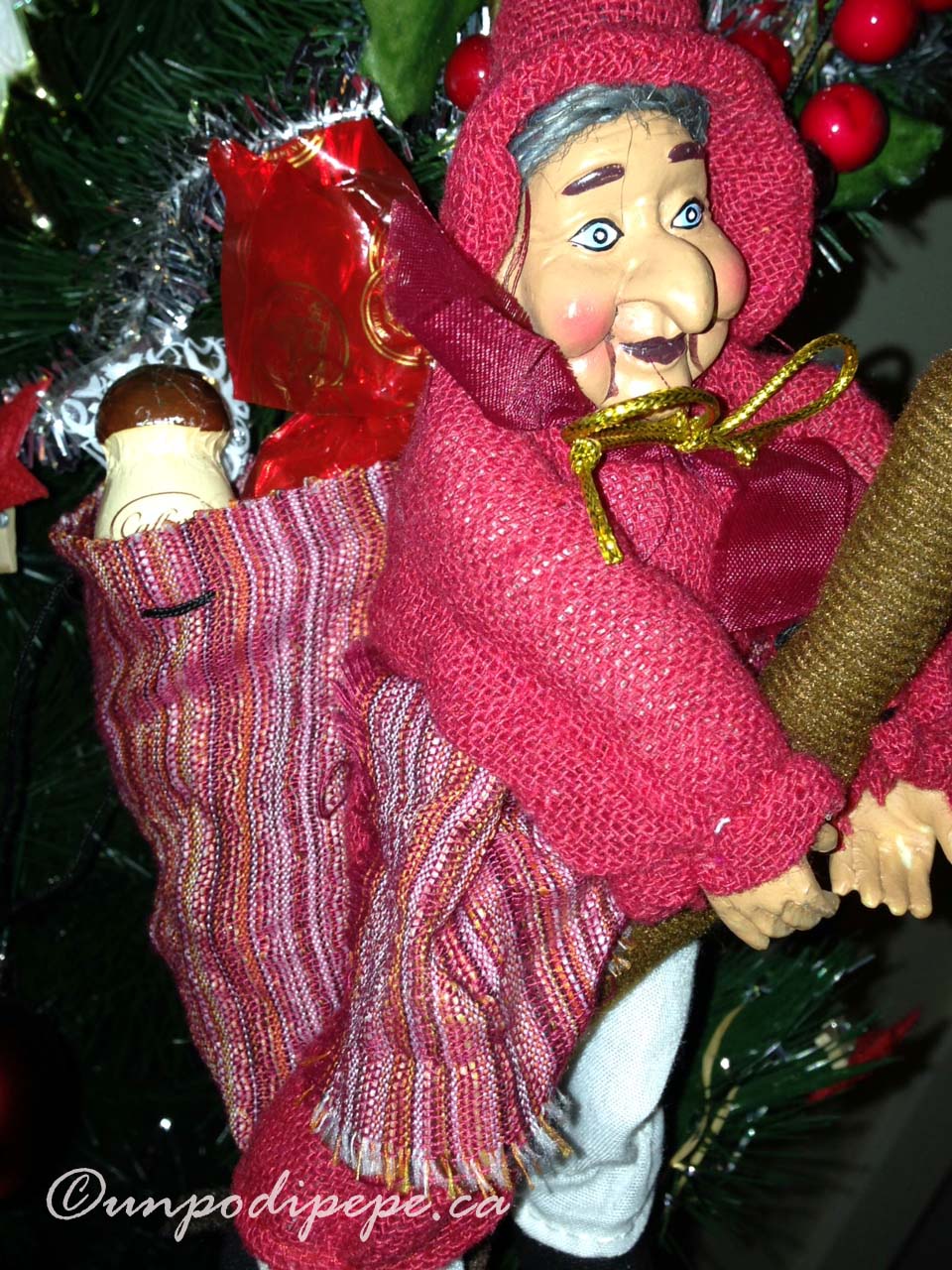
La Befana is the traditional ‘gift-bringer’ in Italian folklore. According to legend, which varies from region to region, she is an old woman who prides herself on being a good housekeeper. While she was sweeping, the 3 Wise Men stopped at her house to ask for directions to Bethlehem. She didn’t know the way but they invited her to join them to greet the newborn king and bring him gifts. She was quite abrupt and told them she had housecleaning to do and could not possibly join them.
Once they had left, she realized she had made a very big mistake not going with them. Befana quickly gathered food and gifts for the newborn King into a sack and uno scialle (a shawl) in case she was cold and set off to join the Wise Men. She even brought her scopa (broom) so she could sweep the floor for Bambino Gesù. Befana searched and searched but could not catch up to the 3 kings. She did not know they had taken a different route home.
To make up for the opportunity she missed, every year on the eve of l’Epifania, Befana flies on her broom delivering small gifts to children, in the hope that one of them is Bambino Gesù. Traditionally she fills calze (socks) with ‘caramelle o carbone’ (candies or coal). She leaves dolcetti (sweets), fichi secchi, noci, mandarini, cioccolatine (dried figs, nuts, mandarine oranges, little chocolates) and torrone for children who have been nice and leaves carbone (coal), cenere (ashes), cipolle e aglio (onions and garlic) for cattivoni (naughty children). Christmas markets in Italia sell black candy that looks like lumps of coal! A glass of vino and mandarini or biscotti are left on the kitchen table for La Befana and she sweeps the floor before she leaves. La Befana and her broom also symbolize the old year that is ‘swept away’ after the Christmas festivities.
Her name comes from Epifania which turned into Befania in dialetto and eventually Befana. ‘Una Befana’ can also mean an ugly old hag. If someone calls you a Befana it is not a compliment-unless they are referring to your gift-giving generosity!
‘La Befana vien di notte
Con le scarpe tutte rotte
S’è scucito la sottana
Viva viva la Befana!
Porta cenere e carboni
Ai bambini cattivoni
Ai bambini belli e buoni
Porta chichi e tanti doni!’
In Italiano
Oggi è la festa dell’Epifania in Italia. Si ricorda la visita dei tre Re Magi a Betlemme con regali di oro, incenso e mirra per il neonato Bambino Gesù. La notte tra il 5 e il 6 gennaio è anche la dodicesima notte dopo il Natale e la fine delle feste Natalizie. Il proverbio dice ‘L’Epifania tutte le feste porta via’. Ma questo che c’entra con La Befana, la buona strega?
Si dice che La Befana era una vecchietta molto preoccupata con il lavoro di casa. Mentre scopava fuori, i Re Magi hanno chiesto se lei conosceva la strada per andare a Betlemme perchè là era nato il nuovo Re. La Befana non conosceva la strada. I Re Magi l’hanno invitata ad andare con loro a portare dei regali al Bambino, ma lei ha detto che aveva troppo lavoro da fare e non era possibile. Dopo che se n’erano andati, La Befana ha capito che aveva sbagliato e ha deciso di raggiungere i 3 Re per andare a trovare il Bambino Gesù. Con uno scialle e un sacco con dolcetti e regali sulle spalle se n’è andata. Ha portata anche la scopa, per pulire il pavimento per il Bambino Gesù. La Befana ha cercato dappertutto ma i Re Magi erano già troppo lontani. Allora, ogni anno, nella notte tra il 5 e 6 di gennaio, volando cavalcando la scopa, La Befana porta regali ai bambini nella speranza che uno di loro sia il Bambino Gesù. Lei reimpie le calze dei bambini con ‘caramelle o carbone’. Dolcetti per i bambini bravi e cenere e carbone per i cattivoni. Si lascia un bicchiere di vino e un mandarino o biscotti sul tavolo per La Befana e lei scopa il pavimento prima di andare via.
Piazza San Pietro. Photo courtesy of International Photo Correspondent Donato Narducci
Fucacoste e cocce priatorje is dialetto Orsarese for ‘Falò e teste del Purgatorio’. This translates to ‘Bonfires and heads from purgatory’. It is an ancient festival unique to Orsara di Puglia celebrated on November 1st, the night of ‘Tutti i Santi’ (All Saints Day). All Saints Day was created in the 9th century when the Pope superimposed a Christian feast day onto existing rituals, so this festa has been around for a very long time. It is a night where people have the opportunity to honour, reconnect and pay respect to the spirits of their loved ones. Carabinieri estimate that Orsara (pop 3,000) had 40,000 visitors attend the festa tonight, with 9,000 cars parked up to 3 km away!
2014 poster for Fucacoste e cocce priatorje
It is believed that the souls of the dead return among the living to visit their relatives and their former homes before moving on to Paradiso. The bonfires are lit with wood and branches of ginestra (broom). The light of the fires and the crackling and sparks of the ginestra attract the spirits to reunite the living with those who continue to live only in their memories. The souls of the dead loved ones collect ashes from the fires. The gleam of light inside ‘cocce priatorje’, pumpkins carved to look like heads-light their way to find their former home.
Preparation for the festa involves gathering firewood and ginestra, preparing food and carving zucche (pumpkins). There is even a BYOZ (bring your own zucca) pumpkin carving workshop. Later in the evening zucche are exhibited and there is a contest for ‘la zucca più bella’-the best zucca.
In honour of the dead, simple but symbolic foods are prepared. These include potatoes, onions, salsicce (sausages) and castagne (chestnuts) cooked in open fire. Muscitaglia is a traditional dish served on November 1st which probably dates back from the ancient Greeks and Byzantines. Muscitaglia (moo•shee•tah•lyah) in both Greek and Latin is made up of the words mosto (wine must) and talia (grain). The ingredients include boiled grain and vino cotto (literally cooked wine-also called mosto cotto). Pomegranate seeds and walnut pieces are sometimes added. These ingredients are symbols of fertility and abundance, but also of honour and respect for the dead.
Muscitaglia
When the campanile (church tower bell) strikes 1900 hours (7 pm), Orsara di Puglia ‘catches fire’. Over 100 bonfires are simultaneously lit in every street and piazza and remain lit through the night. The fires, pumpkin lanterns, music and people in the streets create a magical, enchanted atmosphere. In 2017 I attended the festa and took photos. They are in the post Tutti i Santi.
Fucacoste e Cocce Priatorje has often been confused with Hallowe’en, but it is a very different event. Besides the fact that the date is different, dressing up in costume is not part of the custom, there is nothing scary about it and there are no evil spirits to chase away. It has more similarities with the Mexican Dia de los Muertos/Day of the Dead. This is an event about being together in community to celebrate the bond between the living and those who we remember in our hearts, and to remind us that our time on earth is precious.
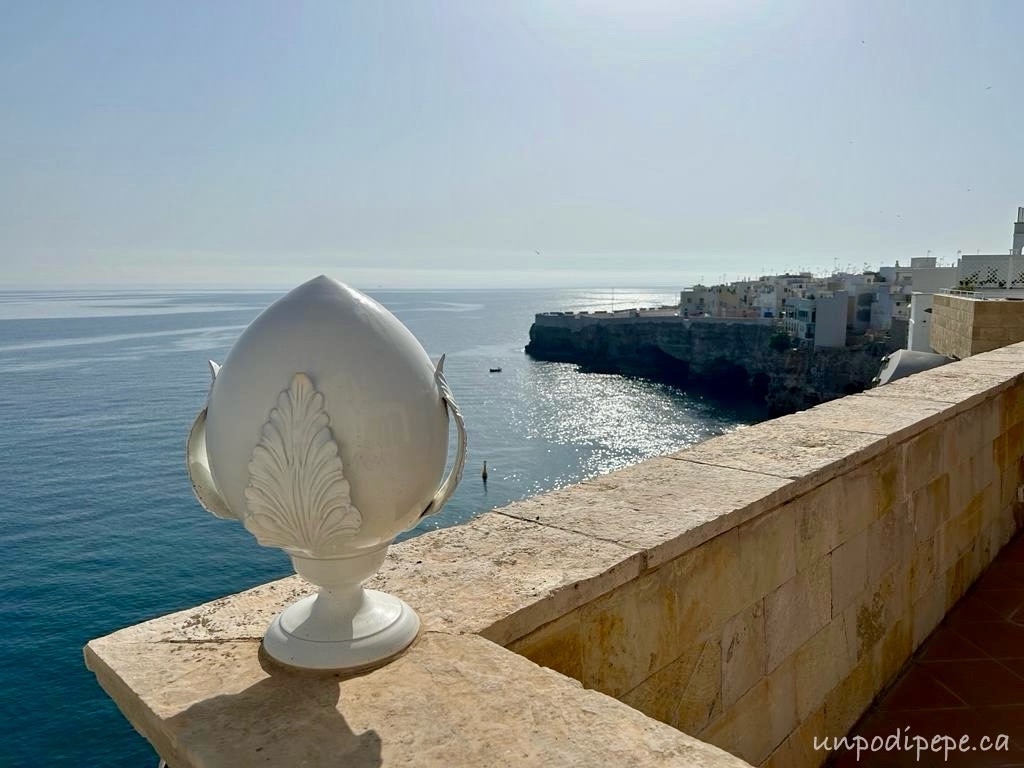 The Pumo is an artisanal decorative ceramic object in the form of a bud just about to flower, enclosed by acanthus leaves. It symbolizes the capacity to regenerate and form new life. The acanthus leaves, the same ones found on ancient Greek and Roman Corinthian columns, symbolize long life and immortality. For these reasons the pumo is a traditional Pugliese good luck charm, providing protection and bringing prosperity, happiness, good fortune and fertility.
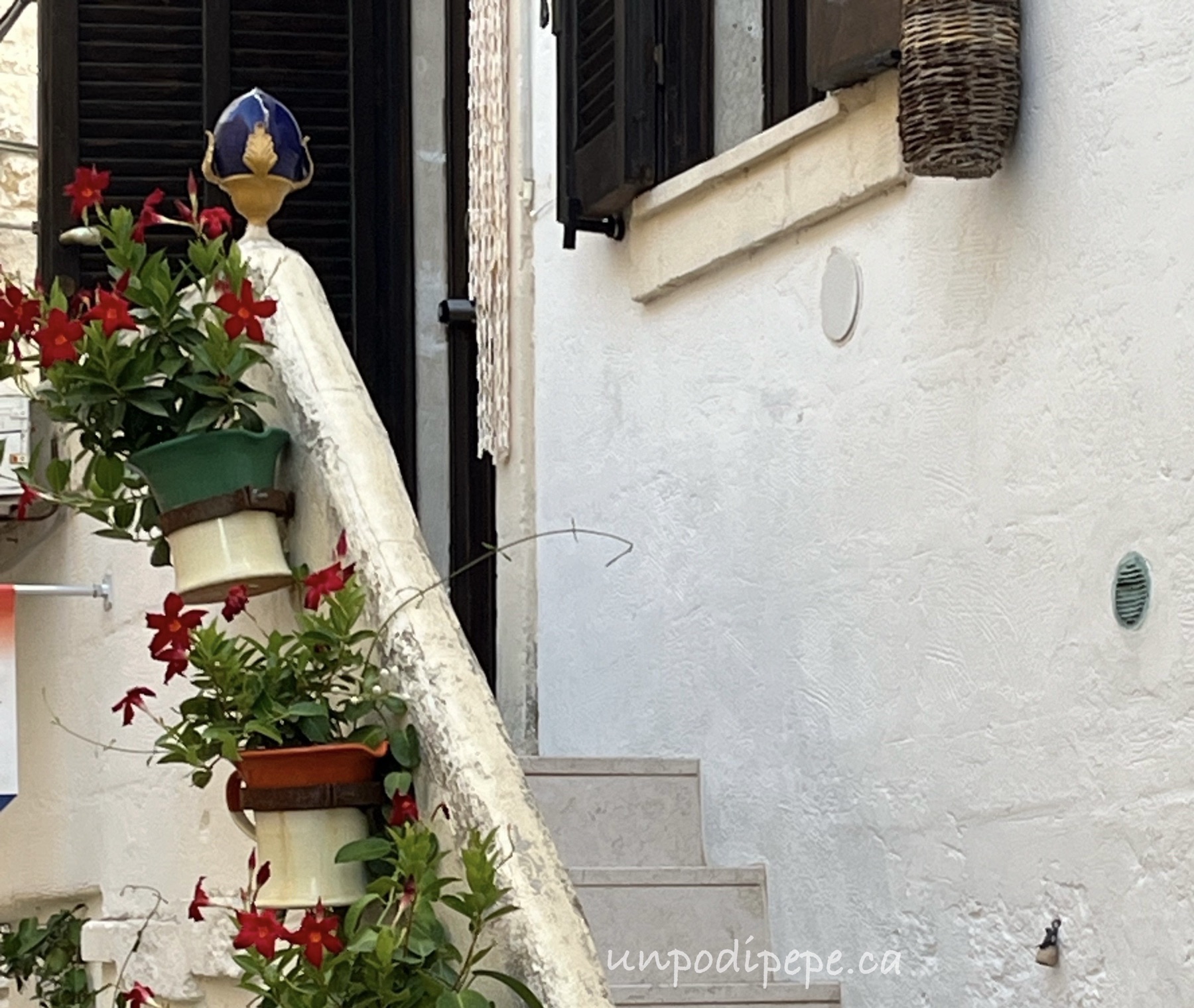
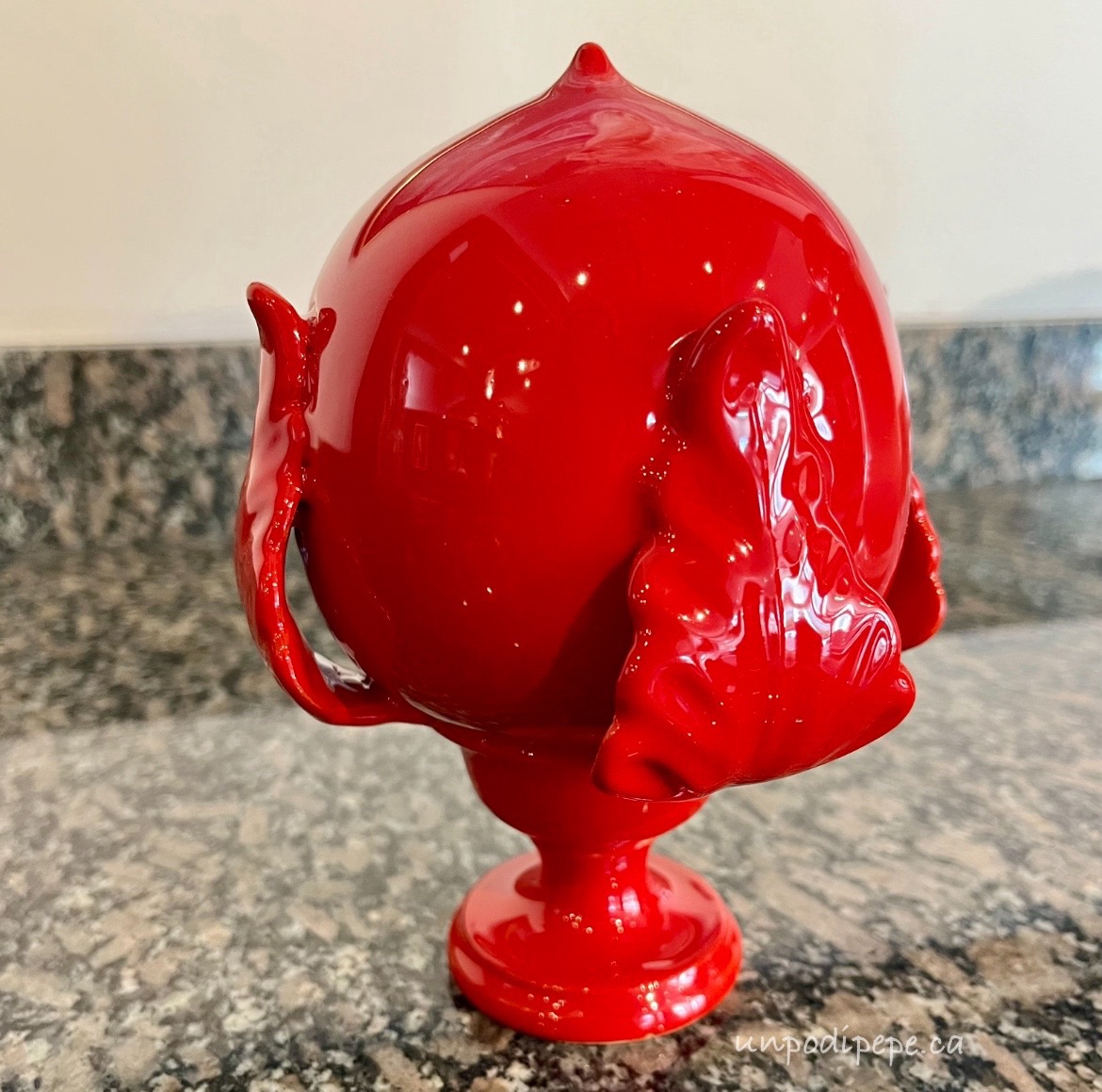 Today the pumo is an emblem of Puglia and is often used as a piece of jewellery, a bomboniera (wedding favour) or a souvenir from Puglia. Sometimes they are in the shape of a rose bud or pine cone and can even be room fragrance diffusers, decorative lamps, candleholders or bottles.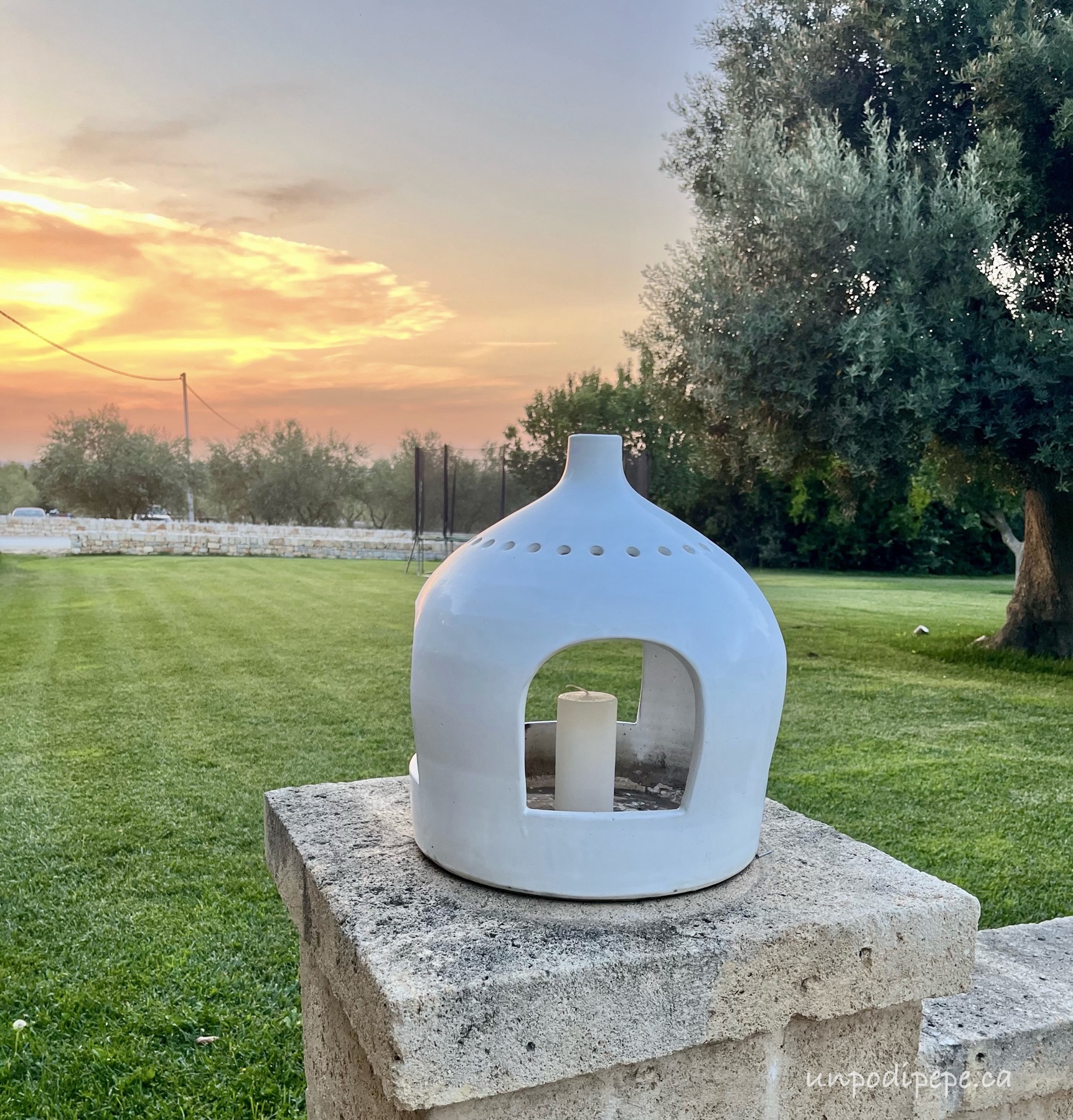

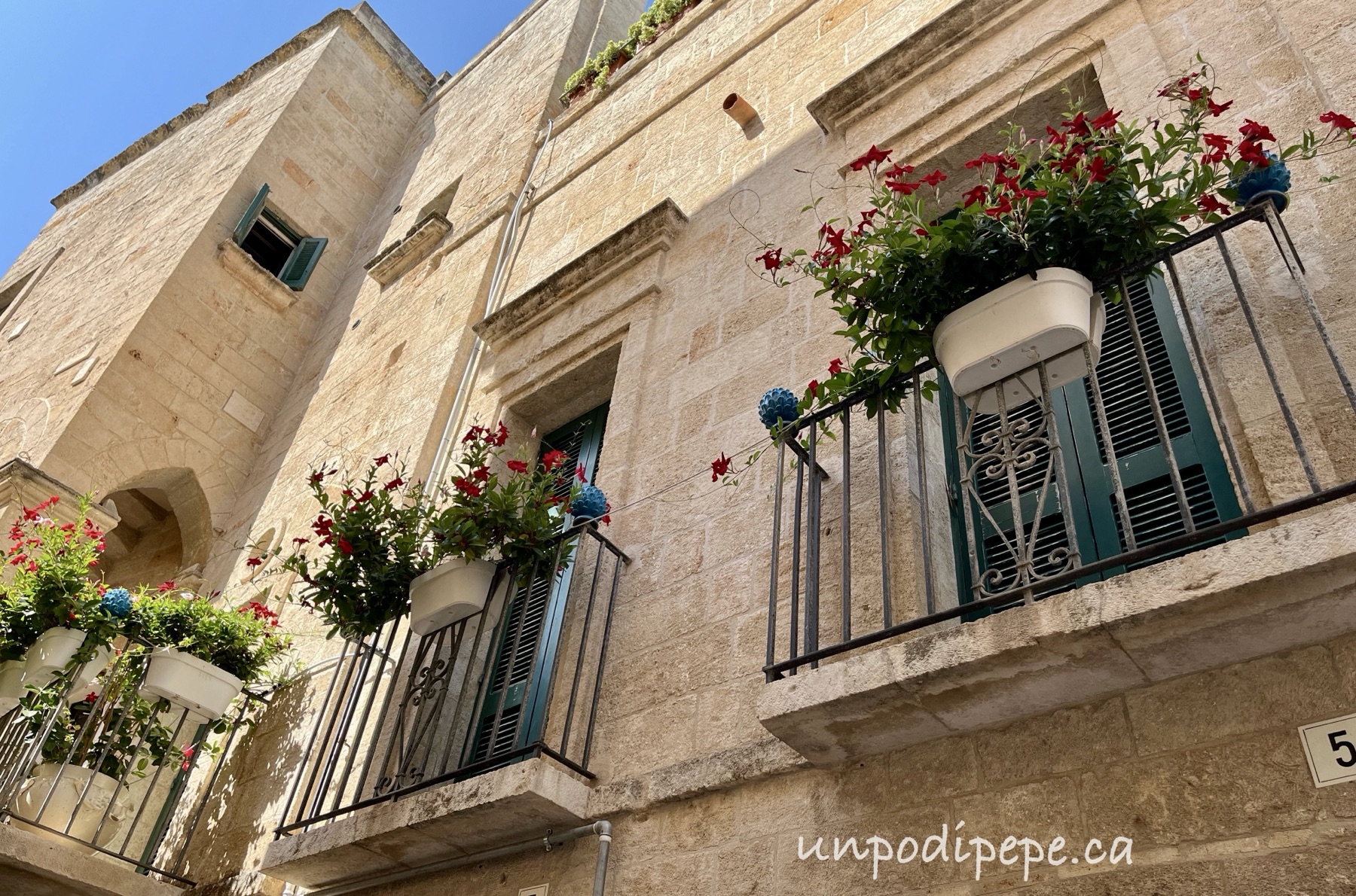
 Oggi il pumo è un emblema della Puglia e viene spesso utilizzato come gioiello, bomboniera o souvenir pugliese. A volte ha la forma di un bocciolo di rosa o di una pigna e può anche essere un diffusore di fragranze per ambienti, una lampada decorativa, un portacandele o una bottiglia.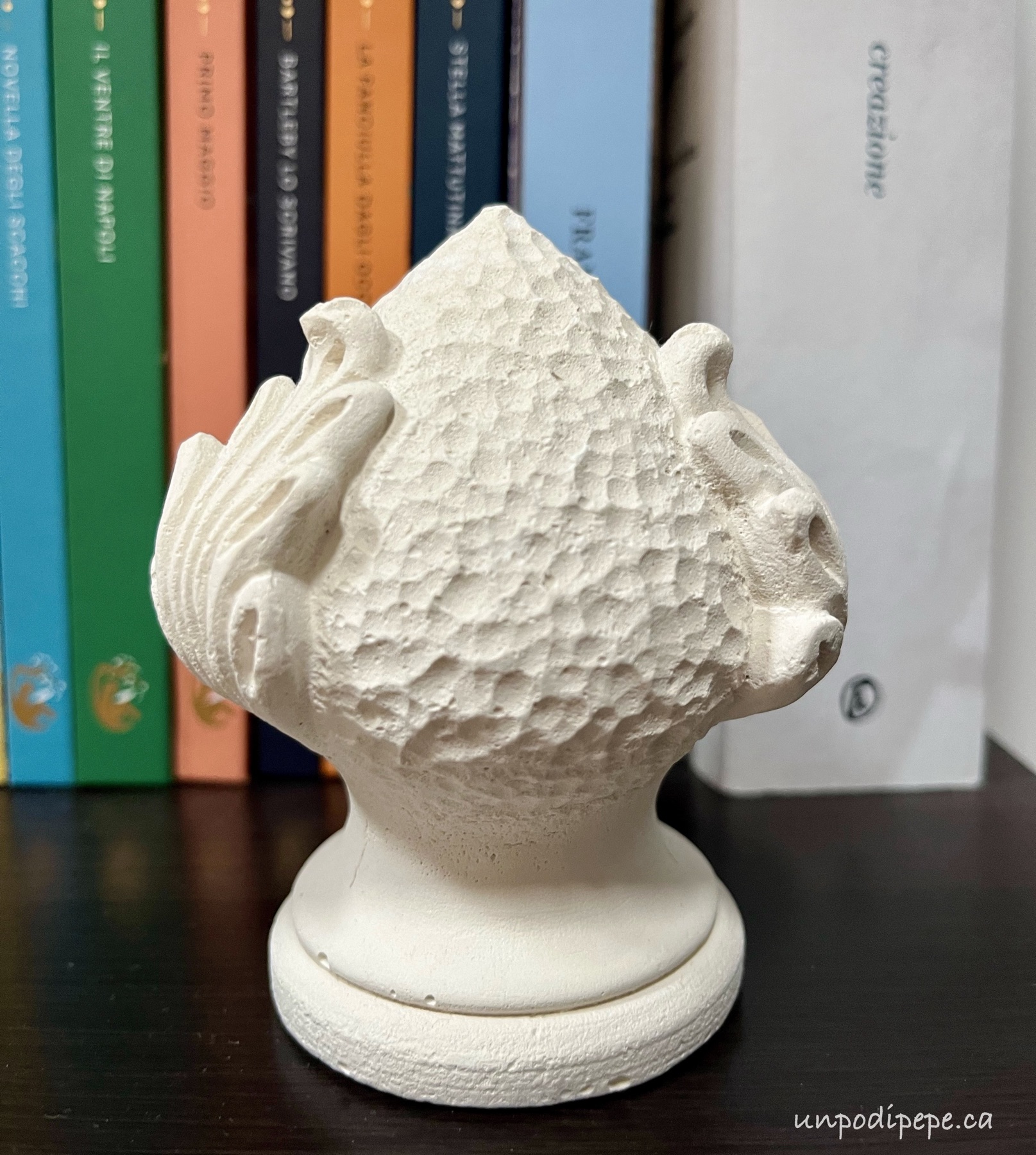


 ‘Culture Shock’ is this month’s topic for the Dolce Vita Bloggers group. I was born in Italia, grew up in an Italian family in an italian/multicultural neighbourhood and have been travelling to Italia my whole life. There isn’t much culture shock going on for me to write about.
 Colpo d’aria means literally a smack, strike or big hit of air. An example of this is going from outside on a hot day into a shopping mall blasted with air conditioning. Someone who has cold symptoms or a sore back, headache, earache or even indigestion might say ‘ho preso un colpo d’aria’. Italians are somewhat distrustful of air conditioning, using it only when really necessary- in sharp contrast to the North American obsession with it. Severe back spasm is often called ‘colpo della strega’- Strike of the witch.
  La cervicale is another classic condition related to colpo d’aria. This is a stiff neck cause by the neck being exposed to cold. And you thought everyone wore scarves just to be fashionable!




 Un po' di pepe