• Home
  • About me/Chi sono
  • Contact

Un po' di pepe

~ …… (oon∙poh∙dee∙PEH∙peh) Cristina writes about interesting stuff /Cristina scrive di cose interessanti

Un po' di pepe

Tag Archives: Italy travel tips

I Sassi di Matera

04 Sunday Oct 2015

Posted by Un po' di pepe in Italia, Photography, Travel

≈ 15 Comments

Tags

Basilicata, Carlo Levi, Chiese Rupestri, European Capital of Culture, I Sassi di Matera, Italian history, Italy travel tips, Luisa Levi, Matera, Sasso Barisano, Sasso Caveoso, Southern Italy, UNESCO World Heritage Sites

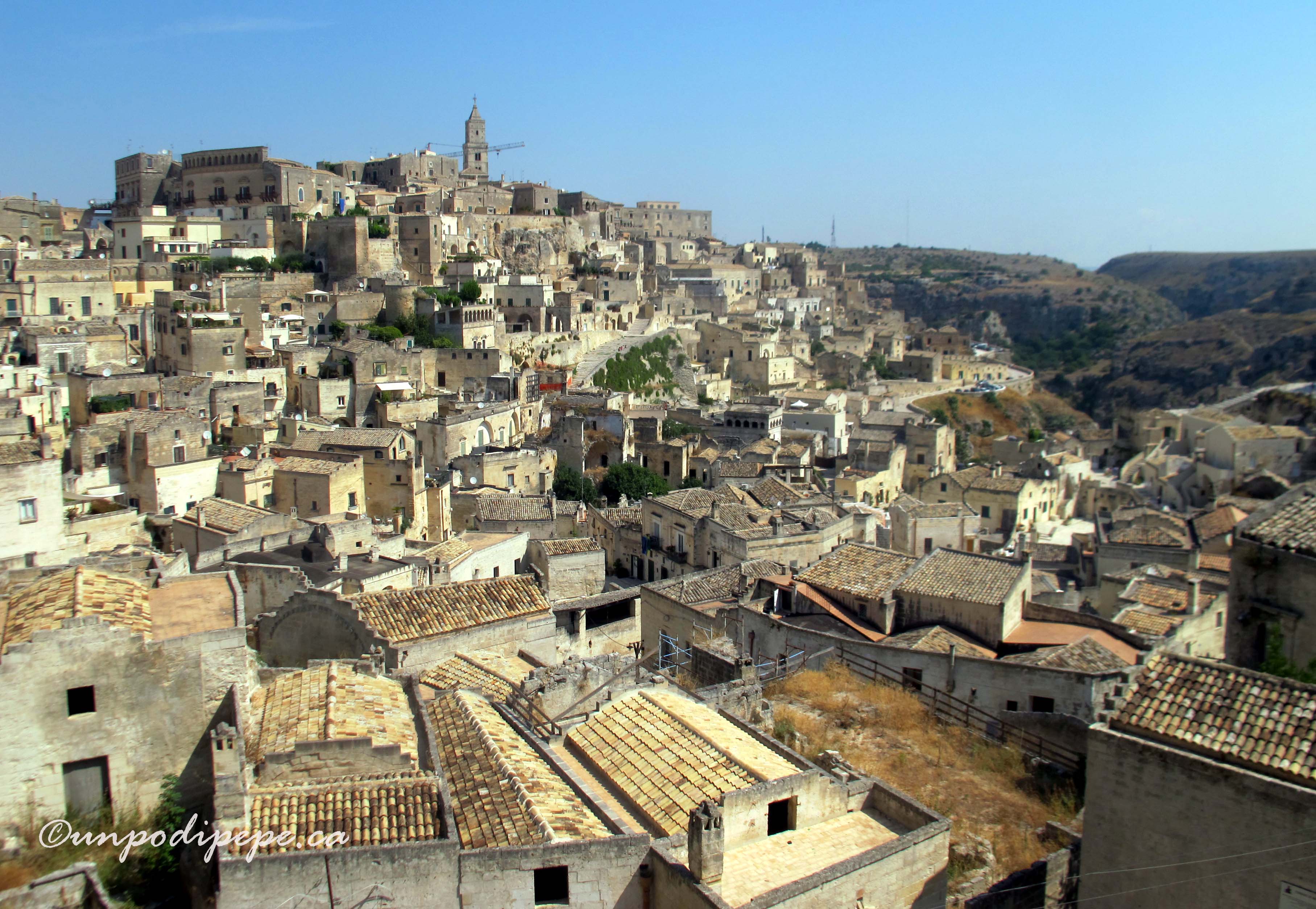
MateraMatera is a rock-cut settlement in Basilicata, the most isolated, least visited region of Italia. It is one of the world’s oldest living cities, continuously inhabited for over 9,000 years.  Clinging to a 300m gravina (ravine) carved out by the river below, Matera seems to rise straight up from the earth, built in 2 natural basins. These basins are the ‘Sassi’ districts, Sasso Caveoso and Sasso Barisano. Sassi means stones and refers to the rock cut cave dwellings. The higher ground in between the 2 Sassi districts is the Civita.  Above the Sassi, on the Piano (plain/plateau) modern Matera is barely visible. The Piano was originally used for agriculture and water collection.Materagravina

Across the canyon, the west side of the gravina is the Murgia Plateau and the Parco Archeologico Storico Naturale delle Chiese Rupestre Materano. The original stone-age settlement was on this side.  The Parco Archeologico is filled with grotte (caves), Chiese Rupestri (churches carved into the rock), Neolithic villages and tombs. From Matera, the grotte look like little mouseholes. With the invention of tools it was easier to dig into the softer tufo (calcareous rock) on the east side of the gravina and Matera was excavated from this rock.

Grotte (caves) across the ravine from Matera
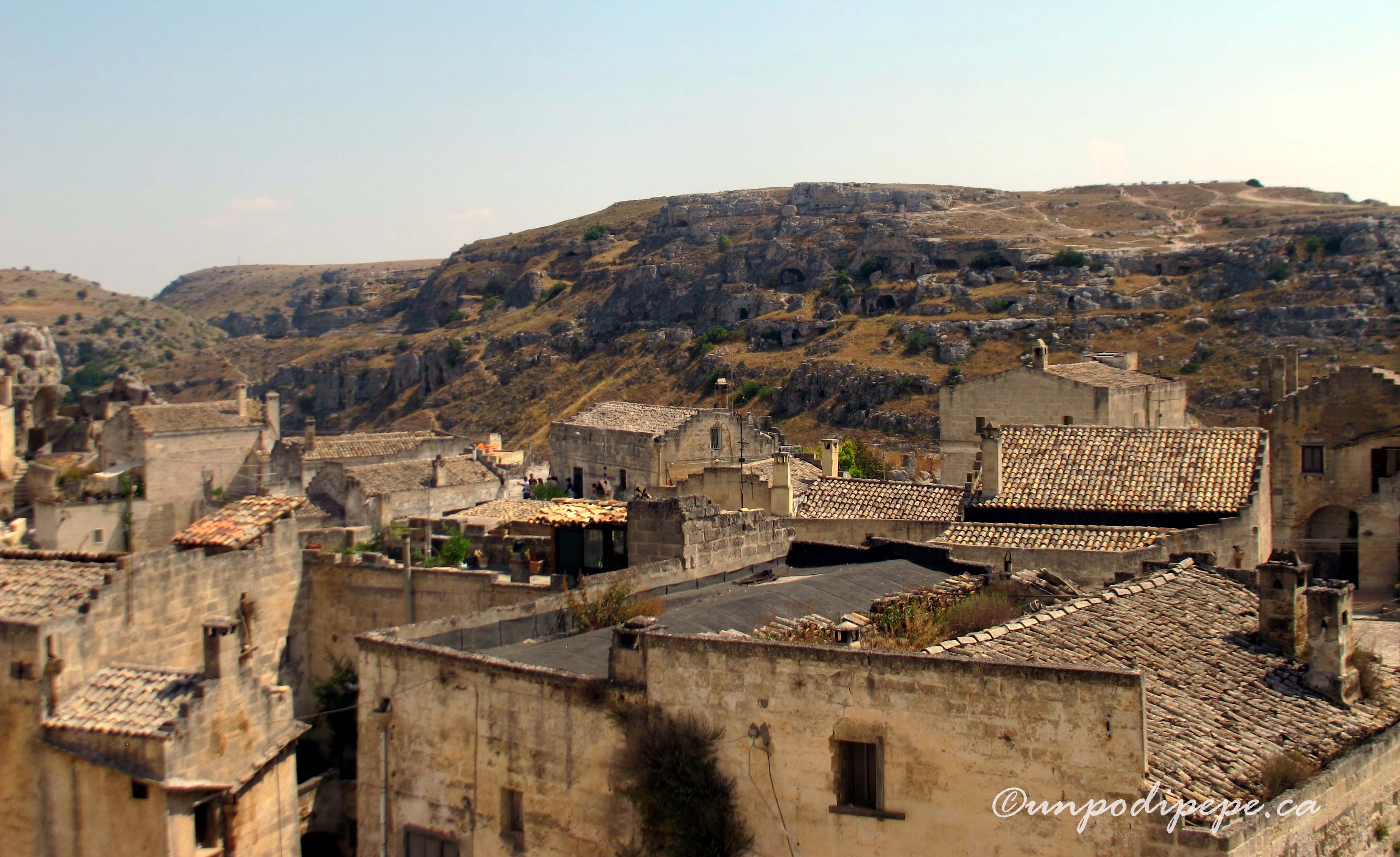
Grotte (caves) across the ravine from Matera

Materapanorama2The Sassi developed in layers over time, as Matera was home to every passing civilization. On the surface the Sassi look deceiving. House fronts are facades-built in front of, on top of and around caves! Incredible systems of underground cisterns and canals were built to collect and distribute rainwater.Materapanorama5
Matera’s isolated location made the area attractive to religious communities. Between the 8th and 13th centuries, Byzantine Basilian monks escaping religious persecution lived in the grotte. There are over 150 Chiese Rupestri with priceless Byzantine frescoes throughout Matera and the Parco delle Chiese Rupestri. By the 15th century, peasants and animals occupied the grotte left by the monks.

Things moved along for the next few centuries. When Matera was the provincial capital 1663-1806, increased activity caused a rise in population. In the 18th and 19th centuries, the wealthier Materani moved into the newer town on the Piano, leaving only contadini and artigiani (farmers and artisans) in the Sassi. By the early 20th century, the Sassi could not accommodate the increased population. Overcrowding plus development of the Piano also affected the water collection systems and led to poor sanitary conditions. With less farmland available, the poverty was unbelievable. Large families shared dark, crowded case grotte (cave homes) with sheep, pigs and goats. Some were only accessible by a trapdoor and ladder. There was no electricity, running water or sewage. It’s hard to imagine these kind of living conditions.

Matera’s situation continued on unnoticed- until the 1945 release of ‘Cristo si è Fermato a Eboli’ (Christ Stopped at Eboli), Carlo Levi’s memoir about his year as a political prisoner in Basilicata in 1935/36. Levi was a doctor, writer and artist from a wealthy family in Torino. He was exiled to a small town near Matera for his Anti-fascist views. Near the beginning of the book, his sister Luisa, also a doctor, needs a permission form stamped in Matera so she can visit him. She describes the Sassi as ‘a schoolboy’s idea of Dante’s Inferno’. She states ‘I felt, under the blinding sun as if I were in a city stricken by the plague. I have never in all my life seen such a picture of poverty. ..This is how 20,000 people live!’ There was a 50% infant mortality rate, malaria, dysentery and trachoma. Eboli is south of Napoli and the title is a local expression suggesting that Christ didn’t make it as far as Basilicata so they are beyond civilization and hope.Materasassibn

Carlo spends a few hours in Matera near the end of the book and says ‘I had time to see the town and then I understood my sister’s horror, although at the same time I was struck by it’s tragic beauty’. I’ve read this book twice and definitely recommend it. It is very philosophical and it is obvious from Levi’s writing and painting that this experience affected him profoundly. His paintings from Basilicata are on display in the Museo di Arte Medievale e Moderna in Palazzo Lanfranchi.

Levi’s book became internationally known and brought to light the living conditions in Basilicata. Matera became ‘La Vergogna Nazionale’ the National Shame. The Sassi were declared unsafe and unsanitary, although only 30% were actually unsafe. US experts on rural relocation were brought in as consultants. Instead of temporarily relocating the residents while the structurally unsafe areas were fixed, the government forcibly relocated almost everyone to poorly planned government housing. Starting in 1952, 16,000 people were removed from the Sassi to new apartments in the ‘modern town’ that were built facing away from the Sassi. The move isolated families and the community and made them feel ashamed for being poor. An unfortunate example of a patronizing, poorly conceived plan to help people without consulting them or addressing the real problem.Materasassocaveoso3

The Sassi became an archeological ghost town in the 1960’s,mostly abandoned except for a few families who had stayed or moved back in. In the 1970’s squatters, local hippies, artists and drug dealers lived in the Sassi. A group of young locals formed Circolo La Scaletta, an organization that lobbied for restoration of the Sassi and protection of the frescoes. One of their supporters was Carlo Levi, now an Italian senator. Yeah Carlo! In the 1980’s laws were passed protecting the Sassi and Chiese Rupestri.

In 1993 the Sassi finally went from shame to fame when UNESCO declared I Sassi di Matera e il Parco delle Chiese Rupestri a world heritage site. Calling it ‘the most outstanding intact example of a troglodyte (cave dweller) settlement in the Mediterranean region, perfectly adapted to its terrain and ecosystem’. Today about 3,000 people live in the Sassi. 50% are occupied and more continue to be restored. In Sasso Caveoso, some areas are still unsafe and blocked off. Now Matera has sassi hotels, bed and breakfasts, ristoranti, offices, artisan shops and galleries as well as homes.Materauccelli

Photogenic Matera has played ancient Jerusalem in several movies, including Pasolini’s ‘Il Vangelo Secondo San Matteo’ (1964), Mel Gibson’s ‘The Passion of the Christ’ (2004), and ‘Ben Hur’ (2016).

Matera was selected as the European Capital of Culture for 2019 and will host cultural events raising its visibility and profile internationally.  Luckily, Matera is not the easiest place to get to, which will prevent it from becoming an overcrowded tourist theme park like Capri!

Exploring Matera.  Photo by D Goodheart

Exploring Matera. Photo by D Goodheart

There is something very special about this hauntingly beautiful place.  As I wandered through the alleys and mazes of Matera, I was reminded once again of the amazing courage and resilience of our contadini ancestors.

Stay tuned for more posts about Matera!
Share this:

  • Click to share on Facebook (Opens in new window) Facebook
  • Click to share on Pinterest (Opens in new window) Pinterest
  • Click to share on X (Opens in new window) X
  • Click to email a link to a friend (Opens in new window) Email
  • Click to share on WhatsApp (Opens in new window) WhatsApp
Like Loading...

I Trulli di Alberobello

24 Wednesday Jun 2015

Posted by Un po' di pepe in Italia, Photography, Puglia, Travel

≈ 26 Comments

Tags

Alberobello, Architecture, Bandiera Arancione, Italian history, Italy travel tips, Puglia, Rione Aja Piccola, Rione Monti, Southern Italy, Trulli, UNESCO World Heritage Sites, Val d'Itria, Vernacular architecture, Zona dei Trulli

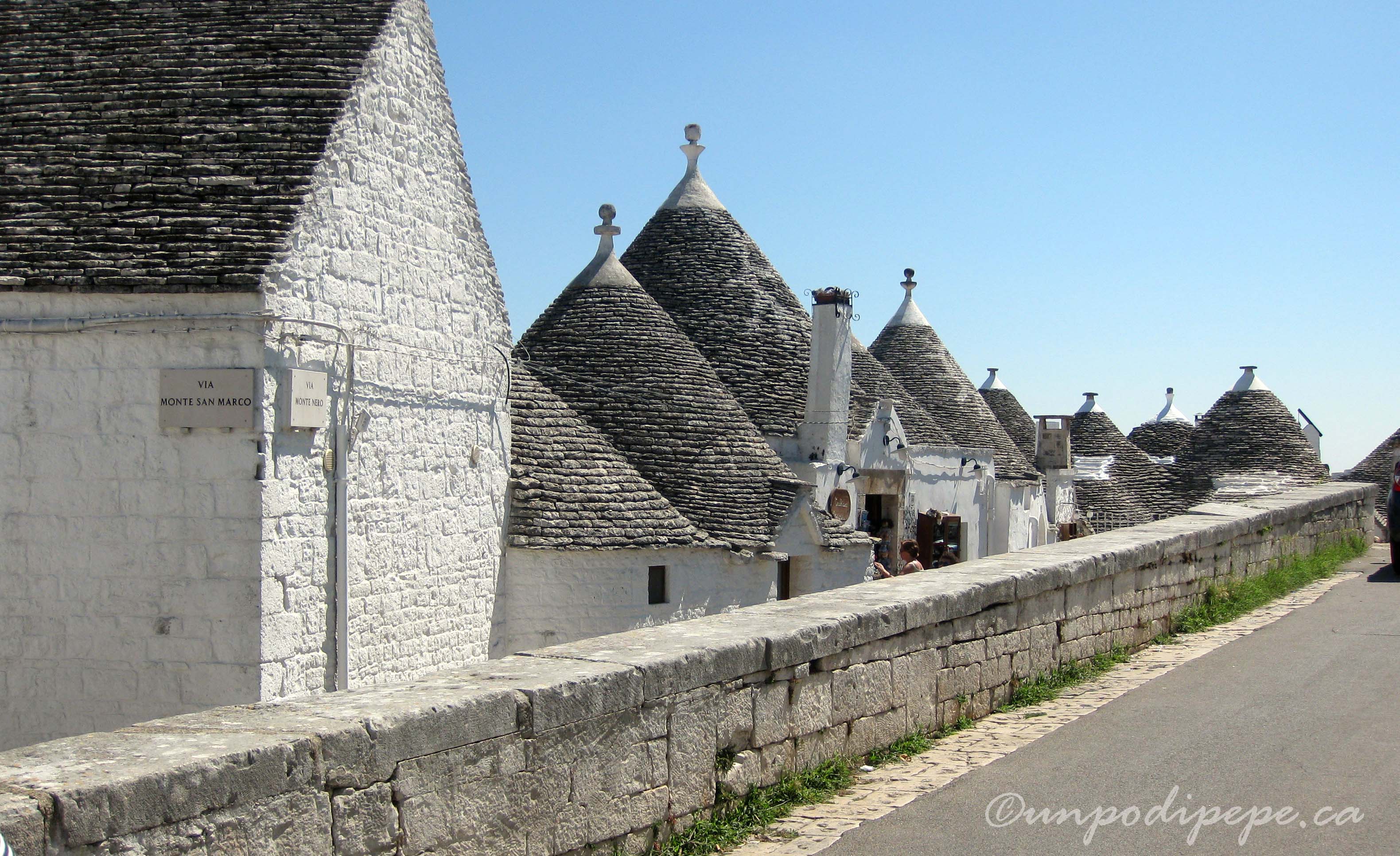
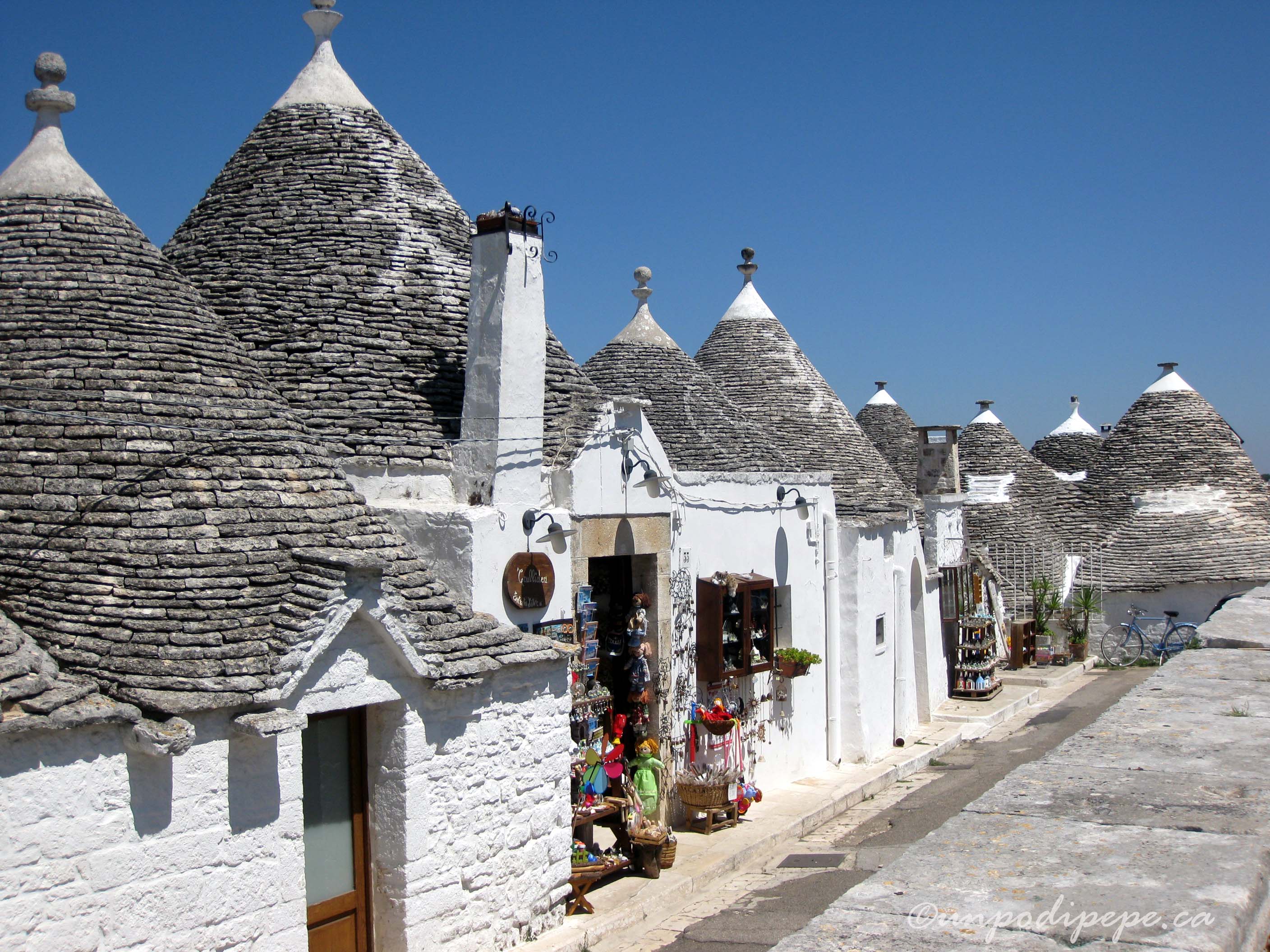
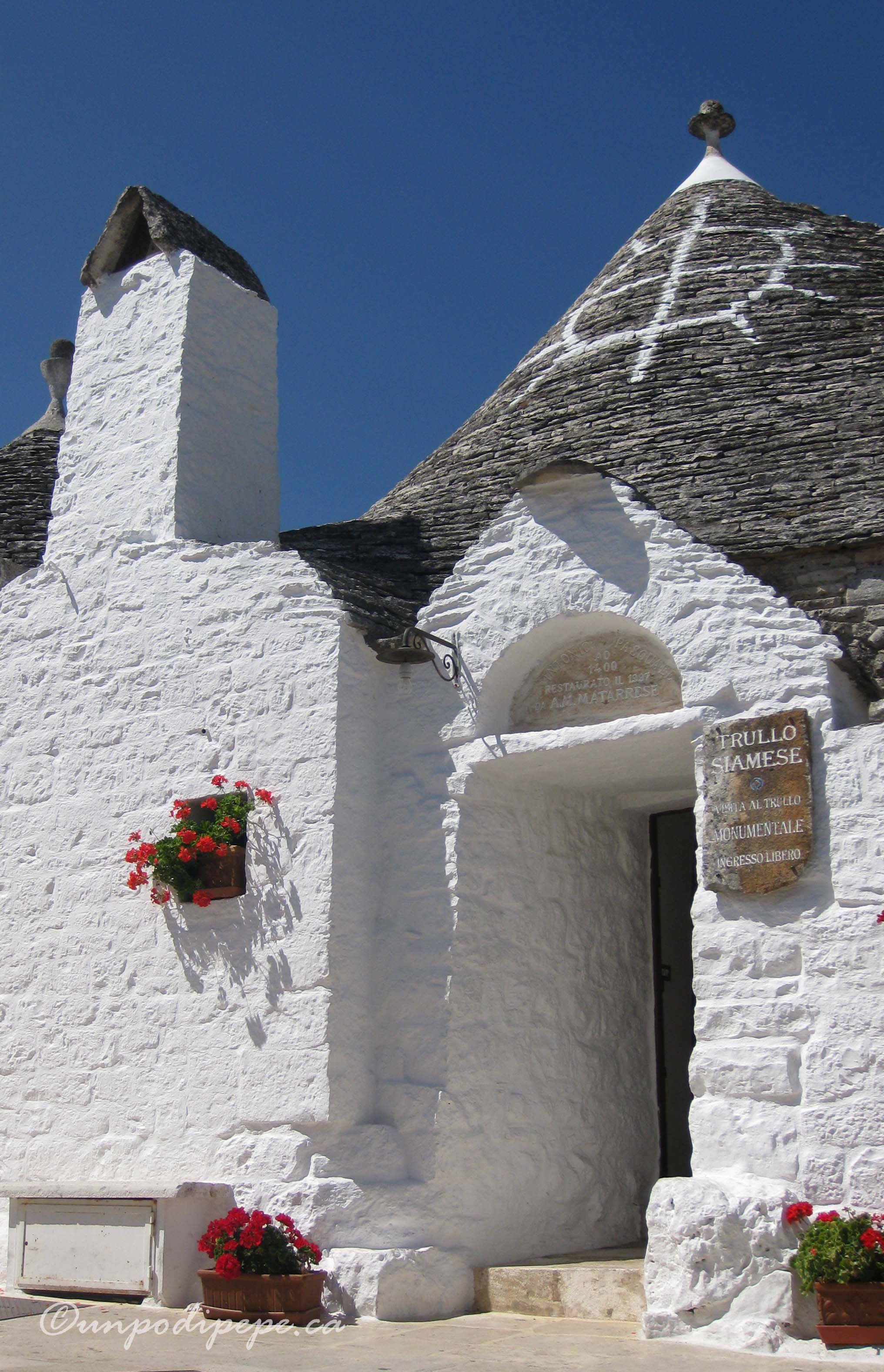
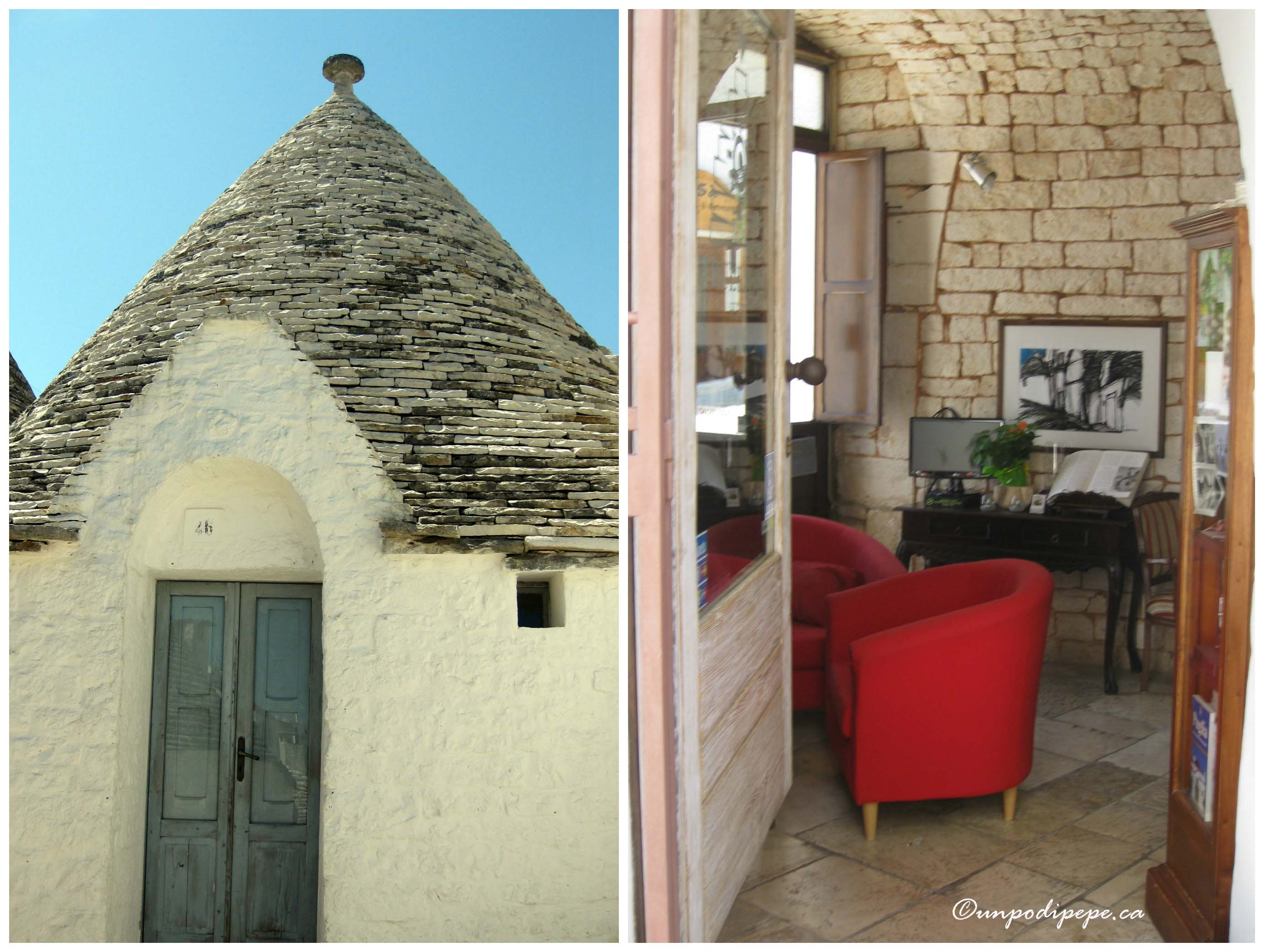
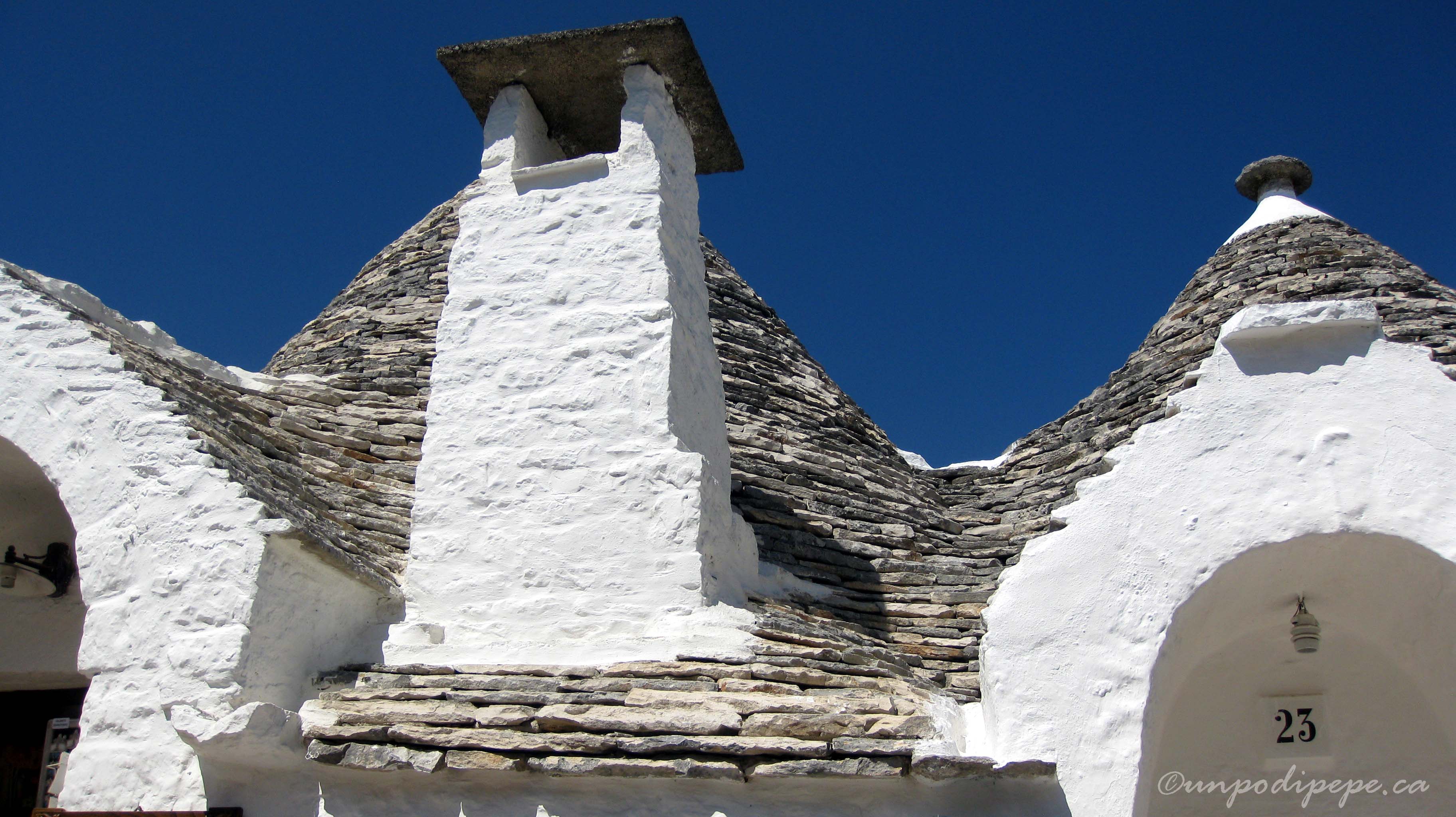
TrulliecielobluAs the car nears Alberobello, trulli (TROOL•lee) start to appear in the rural landscape and my imagination goes into overtime.  I hear the tune ‘La-la-la-la-la-la, la-la-la-la-la’ in my head and I expect i Puffi (the Smurfs) to start dancing around the whitewashed trulli! Too much midday Pugliese sun maybe?  Trulli are traditional limestone houses unique to the Val d’Itria in Southern Puglia.  They were built ‘a secco’, which means dry-without mortar.  Trulli have domed cone-shaped roofs built up of overlapping chiancharelle (kyan•ka•REL•leh)-grey limestone slabs.  On the capstone at the top is a decorative pinnacolo (pinnacle).  The shape of the pinnacolo is said to be a signature of the stonemason who built it.  Some roofs also have mythologic or religious symbols painted on them.

Alberobellostrada‘La Zona dei Trulli’ includes the areas around Locorotondo, Fasano, Cisternino, Martina Franca, Ceglie Massapica and the largest concentration of 1,620 trulli in Alberobello.  Alberobello and its trulli are aUNESCO World Heritage Site. UNESCO believes Alberobello is an exceptional example of the survival of prehistoric building techniques that are still in use. The fact that the buildings are so well-preserved and still occupied make the site unique.Alberobellobiancheria

The word trullo comes from tholos (τρούλος) a variation of the Greek word for cupola or dome. There were already scattered trulli settlements in the Val d’Itria around the year 1000.  These gradually grew into villages, later called Aja Piccola and Monti-the 2 trulli districts in Alberobello today. The oldest trulli we know of date back to about 1350 when the Counts Acquaviva of Conversano were given land for their service during the Crusades and colonized the area by moving people from their nearby areas.Alberobellostrada2

Tradition has it that building ‘a secco’ was imposed on the settlers so their houses could be dismantled quickly and easily. At first this was so the Count could easily dispossess villagers of their homes. Later it was a way to evade taxation imposed on each new construction by the King of Napoli. Trulli could be dismantled when the tax collector came by for an inspection, and then reconstructed just as quickly when he left. Trulli came to be known as temporary, unstable field shelters that were not worth taxing.

Trullo Siamese.  2 brothers in love with the same woman lived here.  They split it in half and the single brother installed a door into the lane.

Trullo Siamese. 2 brothers in love with the same woman lived here. They split it in half and the single brother installed a door into the lane.

In reality, trulli are anything but unstable or primitive. They are built directly on the underlying natural rock and their internal structure is very durable. The thick double walls keep the trullo warm in winter and cool in summer. There are systems for collecting rainwater using eaves projecting at the base of the roof diverting water through a channelled slab into a cistern underneath the trullo. Some trullo homes are made up of groups of 2- 5 trulli.  Most historians agree that the building technique for trulli came about due to the area’s geographical conditions and abundance of limestone. The quickie evictions and tax evasion scam came later.trulliombra

In the early 1600’s there was a group of about 40 trulli in Rione Monti (Monti District) then settlement and trullo construction really expanded with the addition of a bakery, mill, tavern and butcher shop.   In 1797 the feudal rule of the Acquaviva family ended when Ferdinand IV, King of Napoli proclaimed the community a ‘citta regia’, or royal town.  Alberobello took its name from silva arboris belli, the Latin name for the region.

Inner-city trulli?

Inner-city trulli?

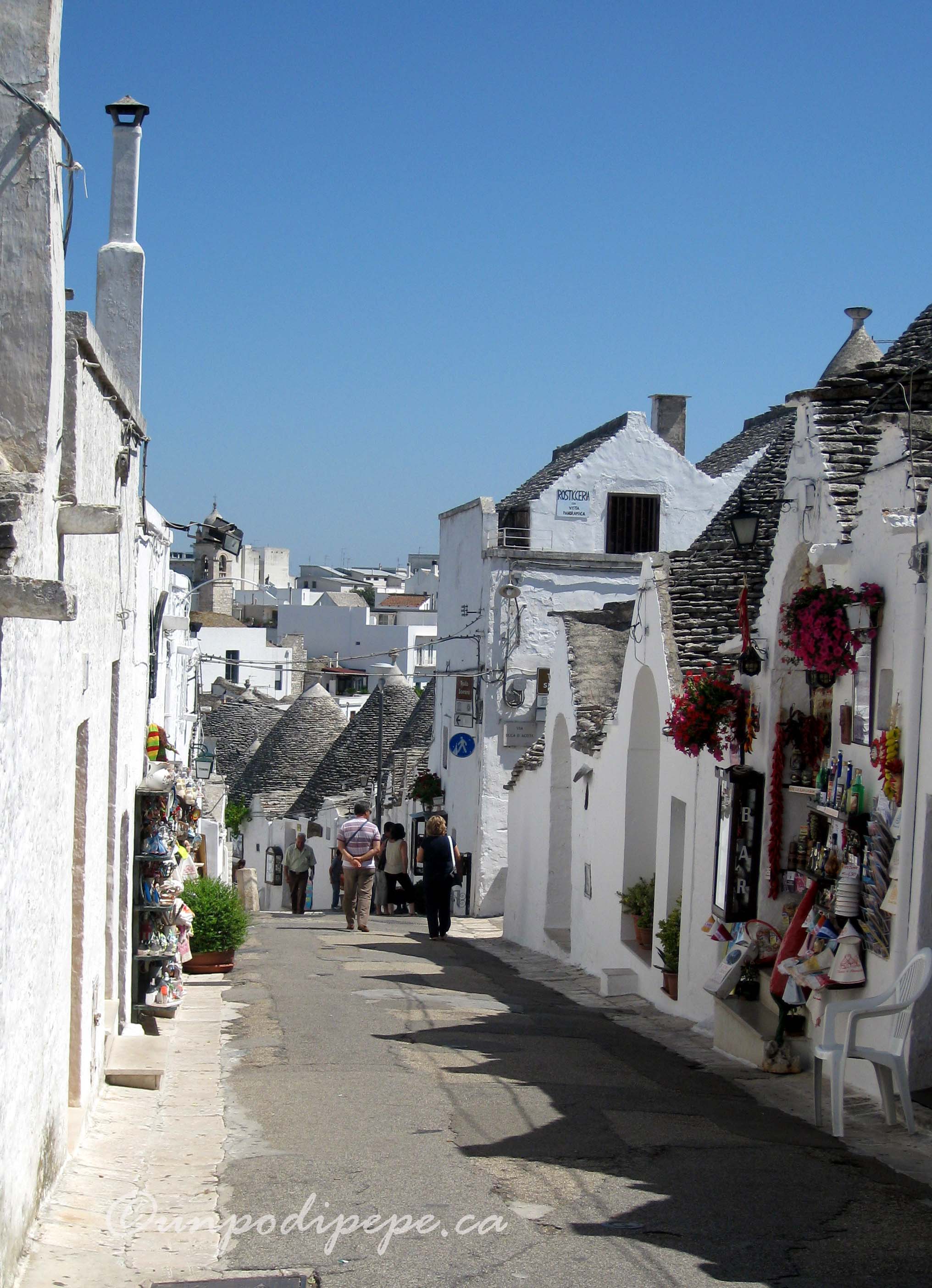
Today Rione Monti has 1,030 trulli and Rione Aja Piccola has 590 trulli, many of which are still inhabited as homes by some of Alberobello’s 11,000 residents.  You can also find the trullo church of Sant’Antonio di Padova, trullo souvenir shops and ristoranti, and a trullo hotel.  In the surrounding countryside there are many trullo masserie (farmhouses) that can be rented.

Exterior of a single trullo and interior of a trullo photo and art gallery

Exterior of a single trullo and interior of a trullo photo and art gallery

In 2010 along with Orsara di Puglia, Alberobello was distinguished with a Bandiera Arancione (orange flag) designation, a seal of quality from the Touring Club Italiano.  Alberobello can be accessed by train or bus from Bari. Although Alberobello is quite ‘touristy’, it still retains its charm and is definitely worth a visit.  If you can brave the mid-day sun in the summer, the cast shadows against whitewashed walls are an artist’s and photographer’s dream….but if you start dreaming about i Puffi, you had better go find some shade!

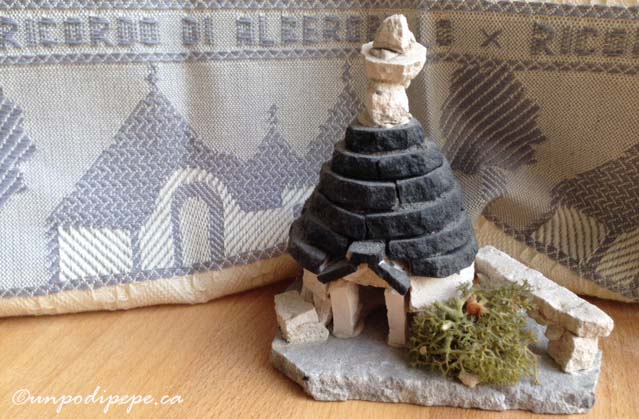
Alberobello souvenirs.  A linen towel and my very own very cute trullo.  I bought it the first time I visited Alberobello.  It's made of real limestone and chiancharelle.

Alberobello souvenirs. A linen towel and my very own very cute trullo. I bought it the first time I visited Alberobello. It’s made of real limestone and chiancharelle.

Not all of the buildings in Alberobello are trulli

Not all of the buildings in Alberobello are trulli

alberobelloombra

Ciao, Cristina

Share this:

  • Click to share on Facebook (Opens in new window) Facebook
  • Click to share on Pinterest (Opens in new window) Pinterest
  • Click to share on X (Opens in new window) X
  • Click to email a link to a friend (Opens in new window) Email
  • Click to share on WhatsApp (Opens in new window) WhatsApp
Like Loading...

The Miracle Players, Roma

15 Monday Jun 2015

Posted by Un po' di pepe in Culture, Italia, Roma, Travel tips

≈ 8 Comments

Tags

Foro Romano, Italian history, Italy travel tips, Roma, Roma english speaking theater, Roman Forum, The Miracle Players

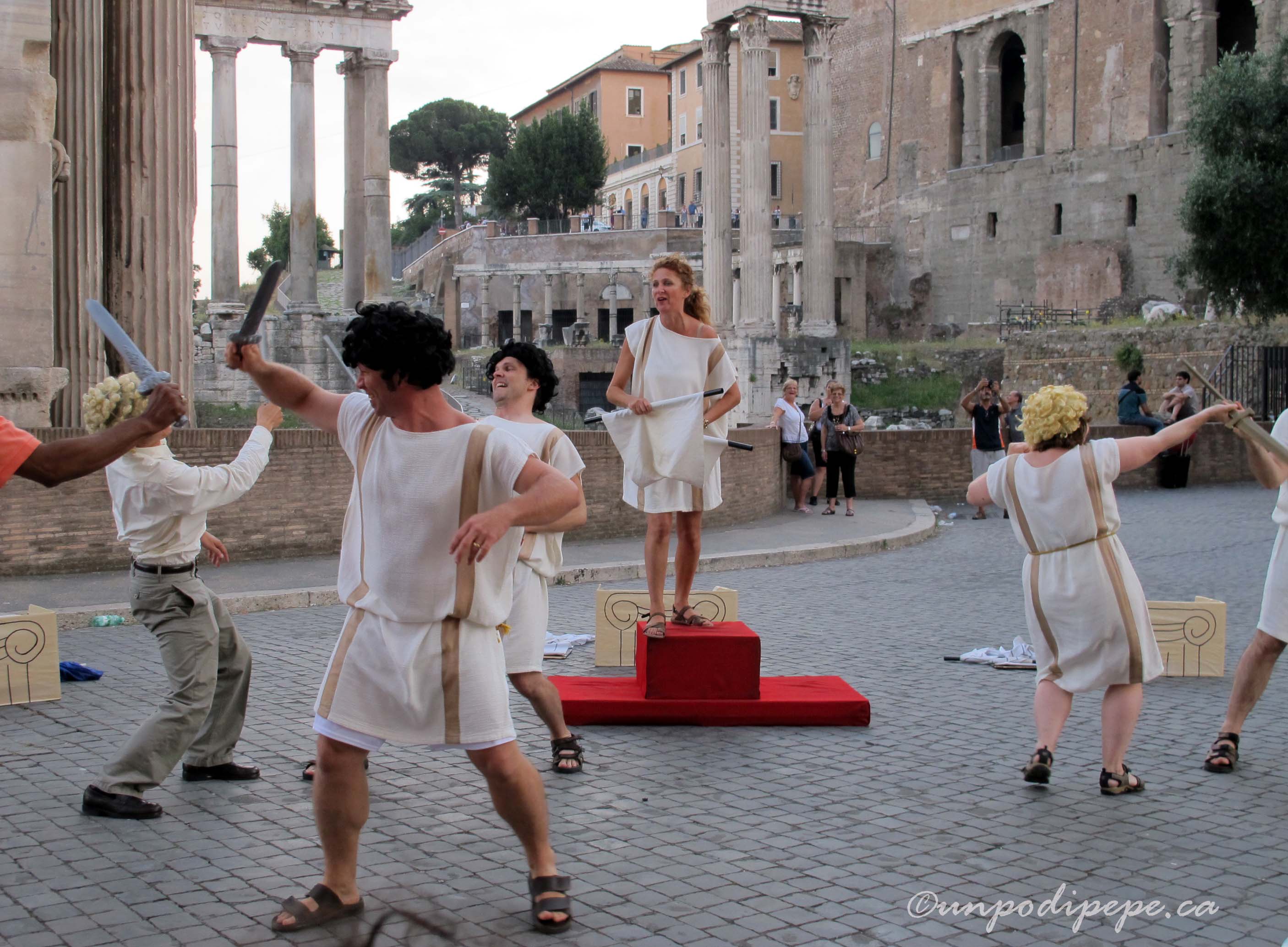
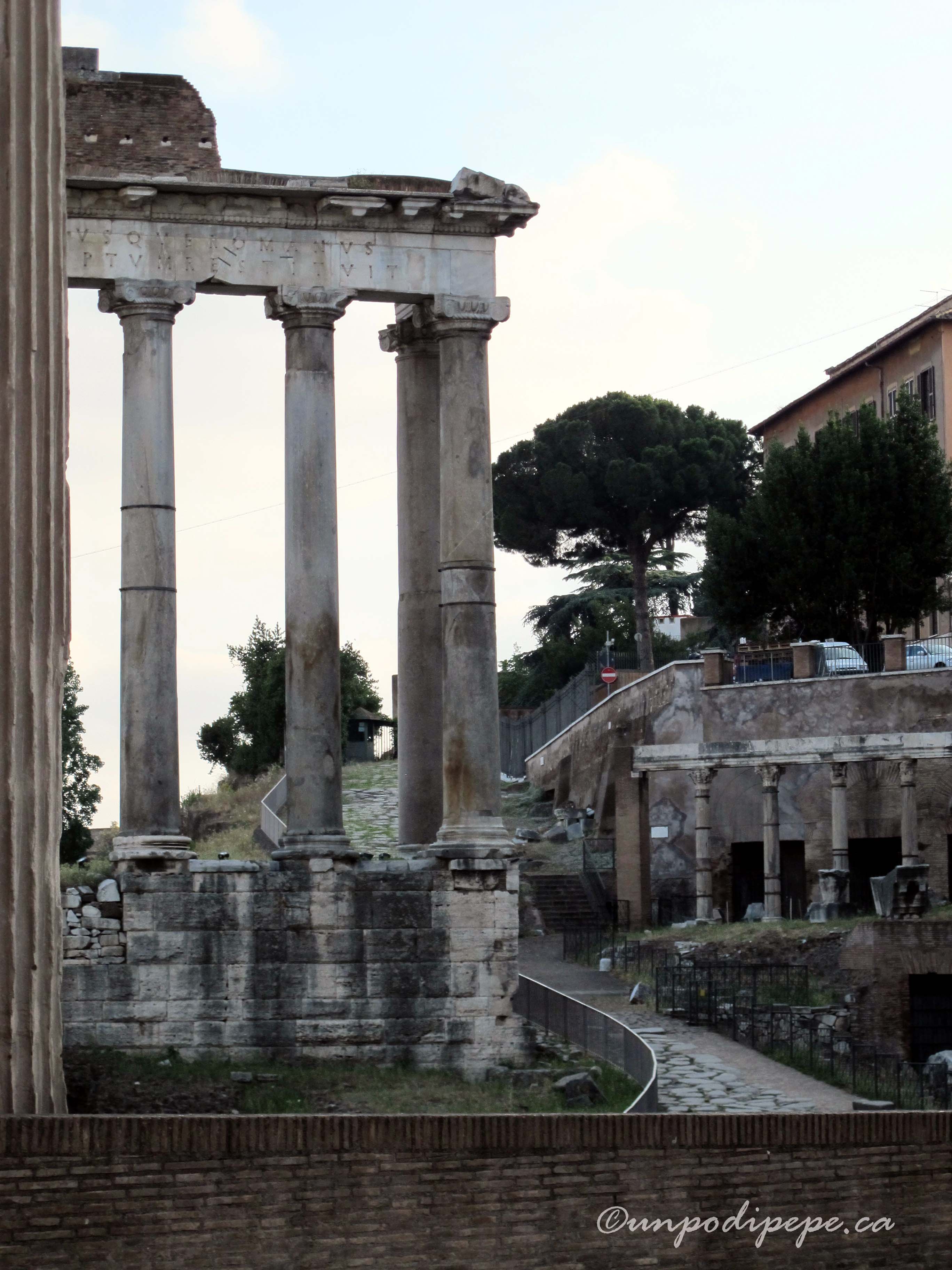
Miracle PlayersIf Monty Python meets the history of the Roman Empire sounds appealing, you will love the Miracle Players.  They are an English speaking theater group in Roma made up of expats from around the world.  They perform hysterically historical original comic works at the Foro Romano (Roman Forum) each summer.

Miracle Players2

Miracle Players performances feature volunteer swordfighters and high tech special effects!

Miracle Players performances feature volunteer swordfighters and high tech special effects!

I have been to 3 of their performances; ‘Caesar-More than just a Salad’, ‘The Life of Michelangelo’, and ‘The Seven Kings of Rome’.  This year they are performing the rhyming ‘Rome in a Nutshell’.

Miracle Players4

If you will be in Roma on a Friday between June 26 and July 31, check out the performance at 7:30pm sharp.  It is free and no reservation required. Get there early to sit on the stairs of the church facing the action-Chiesa dei Santi Luca e Martina. Bring something to sit on if your culetto doesn’t like hard stairs or pavement.

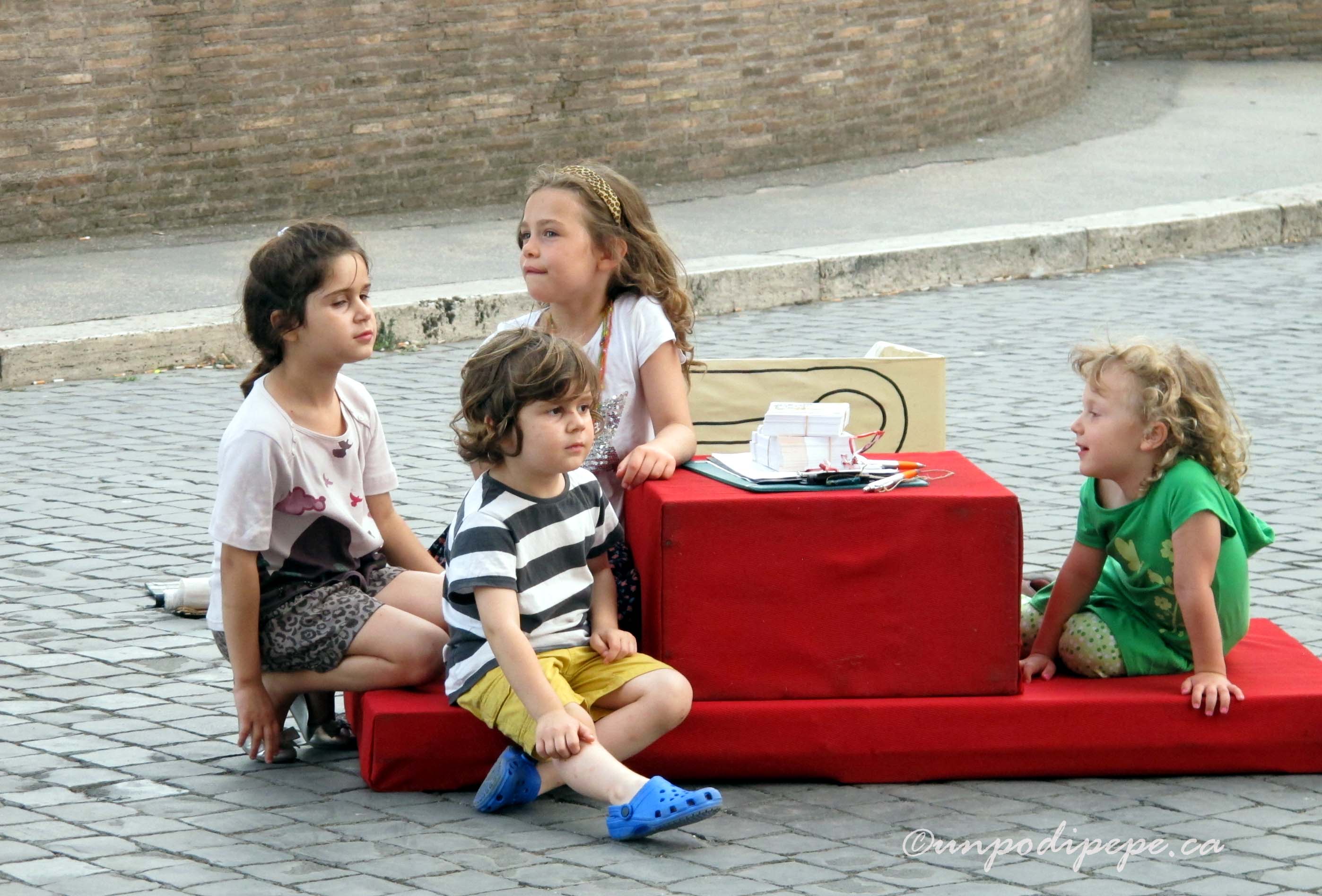
The production crew takes a break

The production crew takes a break

The performance is across from the Carcere Mamertino (Mamertine Prison) at the Roman Forum.  This is below the Campidoglio and behind Il Vittoriano.  The location is easy to get to.  Take the Metro B blue line to Colosseo and walk down Via dei Fori Imperiali.  There is a map on The Miracle Players website. The stage backdrop is the Roman Forum itself-how can you top that!  ForoRomano

Share this:

  • Click to share on Facebook (Opens in new window) Facebook
  • Click to share on Pinterest (Opens in new window) Pinterest
  • Click to share on X (Opens in new window) X
  • Click to email a link to a friend (Opens in new window) Email
  • Click to share on WhatsApp (Opens in new window) WhatsApp
Like Loading...

Val d’Orcia Daytrip

03 Sunday May 2015

Posted by Un po' di pepe in Firenze, Italia, Travel tips

≈ 14 Comments

Tags

Abbazia Sant'Antimo, Cappella della Madonna di Vitaleta, Castelnuovo dell'Abate, Daytrips from Firenze, Daytrips from Siena, Firenze, Fondazione Il Bisonte, Italy travel tips, Monteriggioni, Pienza, UNESCO World Heritage Sites, Val d'Orcia

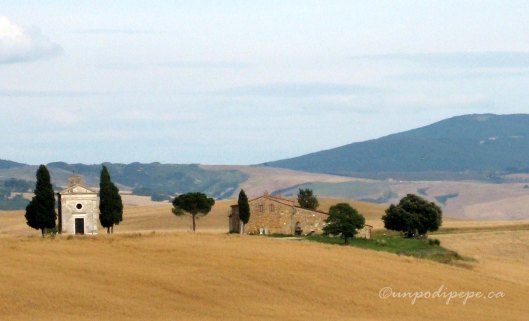
CappellaMadonnadiVitaleta

I wrote an email a while ago about my daytrip from Firenze to the Val d’Orcia with my amica Shannon.  I have sent that same email so many times to friends planning a visit to Toscana that I thought it would make a great blog post.

Shannon was studying printmaking at Il Bisonte in Firenze for a year and I went to visit her for a week . We decided to rent a car for a day and go exploring. Our start time was delayed and by the time we drove off it was almost mezzogiorno (noon). No plans were made regarding where to go, we just drove away from Firenze then headed south, towards Siena. We passed a sign for Monteriggioni, which neither of us had been to, so that was our first stop. Monteriggioni is a small 13th Century medieval walled village. Besides the intact 10m high walls and 14 square towers, Monteriggioni’s claim to fame is a mention from Dante in his Divina Commedia: Inferno, canto xxxi lines 41-42:

‘Come in su la cerchia tonda, Monteriggioni di torri si corona’

‘Like a circling round, Monteriggioni crowns itself with towers.’

Monteriggionicollage

Hunger set in, but we did not want to take time from our adventure to sit in a restaurant. At the Generi Alimentari (grocery/deli) we picked up some local goodies…prosciutto, finocchione (Tuscan fennel salame), pecorino di Pienza, fresh bread, and 2 glasses of Chianti—all for 11 €! They put it all in a cestino (basket) for us and we ate outside in the piazza. It was the best lunch ever.  See for yourself…..

Monteriggionilunch2

We got back in the car and headed towards the Val d’Orcia. When you see photos or postcards of the classic Toscana landscape with gentle rolling hills, vineyards and cipressi (cypress trees)…this is it!

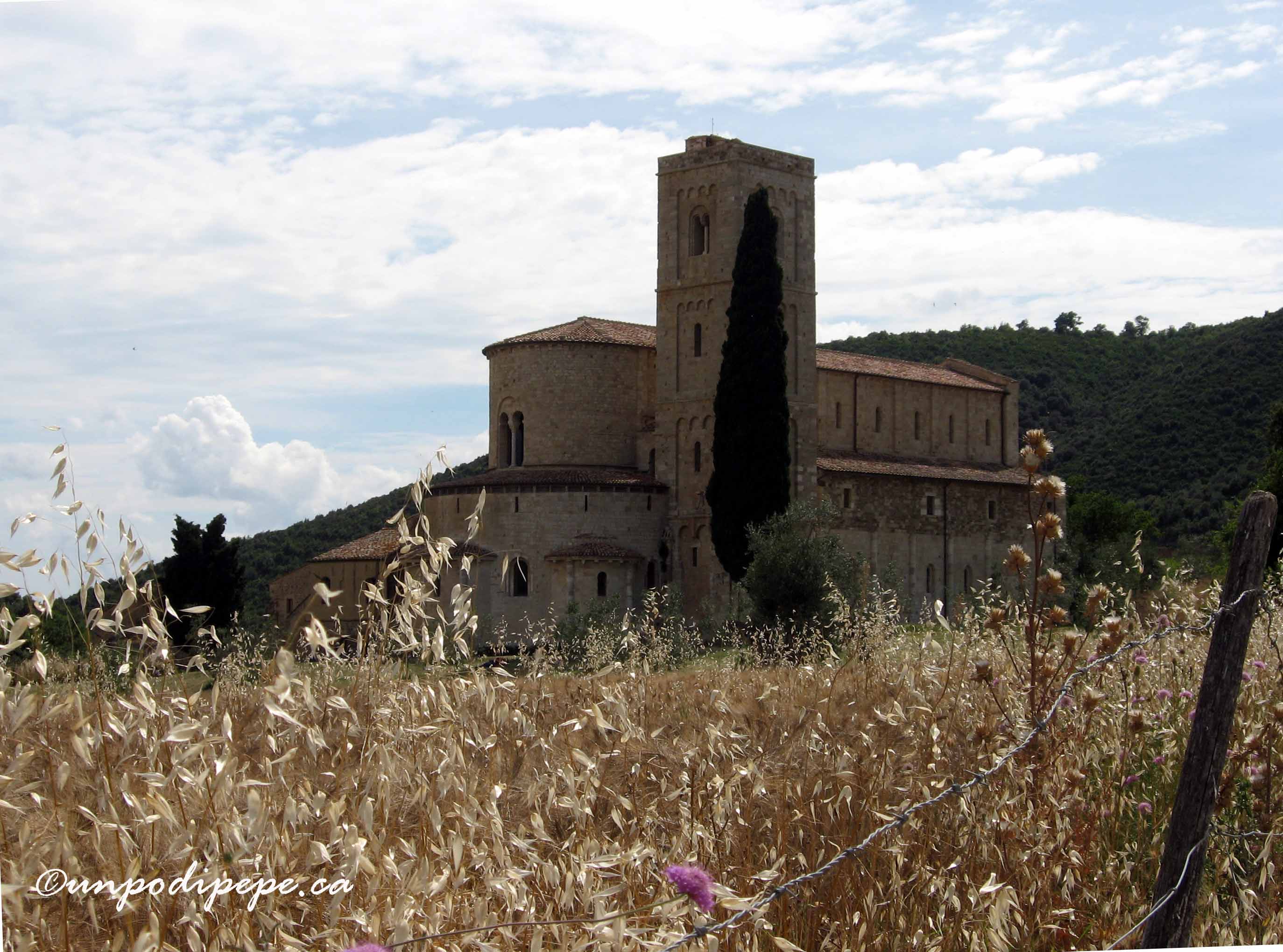
ToscanaThe entire Val d’Orcia is a UNESCO World Cultural Landscape.  When we stopped in Montalcino, there was a sign for the Abbazia Sant’Antimo. I had recently read about this beautiful Romanesque Abbey, so we drove to Castelnuovo dell’Abate, parked the car and walked down.

Sant'Antimo1Sant’Antimo is a heavenly place, in a valley surrounded by vineyards, olive trees and cypresses. Parallel to the bell tower stands a striking single cypress tree. A powerful monastery in the middle ages, Sant’Antimo was abandoned for a short period of about 500 years! Local contadini (farmers) apparently used the crypt as a wine cellar!

Sant'Antimo2Restoration work was done in the 1980’s and now it is home to a small Canonical order. 7 times a day there are vespers and Mass with Canto Gregoriano (Gregorian chanting). Sant’Antimo is worth going out of the way for. Next time I am there, I want  to walk the 10.5 km from Montalcino and take the bus back from Castelnuovo.

Castelnuovo dell' Abate

Castelnuovo dell’ Abate

Between San Quirico d’Orcia and Pienza the scenery was breathtaking, including one of the most photographed places in Italia, La Cappella della Madonna di Vitaleta. It is on private property so we weren’t able to visit, but we did lots of admiring from afar.

Cappella della Madonna di Vitaleta-unfinished mixed media painting

Cappella della Madonna di Vitaleta-unfinished mixed media painting

There were cipressi (chee•PRES•see) everywhere! I have a fascination with cipressi  and love to paint their ‘flame’ shapes and shadows. My nipotine have always called them ‘Zia’s trees’ and they love to paint them too. We came across some random sculpture among the cipressi with signs ‘Si prega di non appogiarsi alle sculture’ (Please don’t lean on the sculptures).

sculture

Pienza-formerly called Cortignano was the birth town of Pope Pio (Pius) II. In 1489, he rebuilt it to be an ‘ideal town’ according to Renaissance Humanist design concepts and renamed it after himself. He was a humble man! Because of this early vision of urban planning, the Centro Storico (historic center) of Pienza is a UNESCO World Heritage Site. I could have spent weeks sketching in Pienza!

Pienza Collage copy

After a brief visit to Montepulciano we had to start heading back towards Firenze. Our final stop was Castellina in Chianti to have pappardelle al lepere (thick ribbon pasta with wild rabbit sauce) which was so yummy! The ride to Castellina was spectacular.  We somehow ended up on a back road, the sun was setting and everything was sparkly and lavender! Just before mezzanotte (midnight) we arrived back in Firenze and dropped off the car. Our Val d’Orcia adventure lasted exactly 12 wonderfully unplanned hours.
Pienza

Pienza

Val d'Orcia daytrip

Val d’Orcia daytrip

Buon Viaggio! Cristina

Share this:

  • Click to share on Facebook (Opens in new window) Facebook
  • Click to share on Pinterest (Opens in new window) Pinterest
  • Click to share on X (Opens in new window) X
  • Click to email a link to a friend (Opens in new window) Email
  • Click to share on WhatsApp (Opens in new window) WhatsApp
Like Loading...

Over Lago Maggiore

22 Sunday Mar 2015

Posted by Un po' di pepe in Amici e Famiglia, Italia, Photography, Travel

≈ 8 Comments

Tags

Angera, Eremo Santa Caterina del Sasso, Isola Bella, Isola Pescatori, Isole Borromee, Italy travel tips, La Rocca d'Angera, Lago Maggiore, Lounge Bar La Noce, Milano daytrips, Palazzo Borromeo

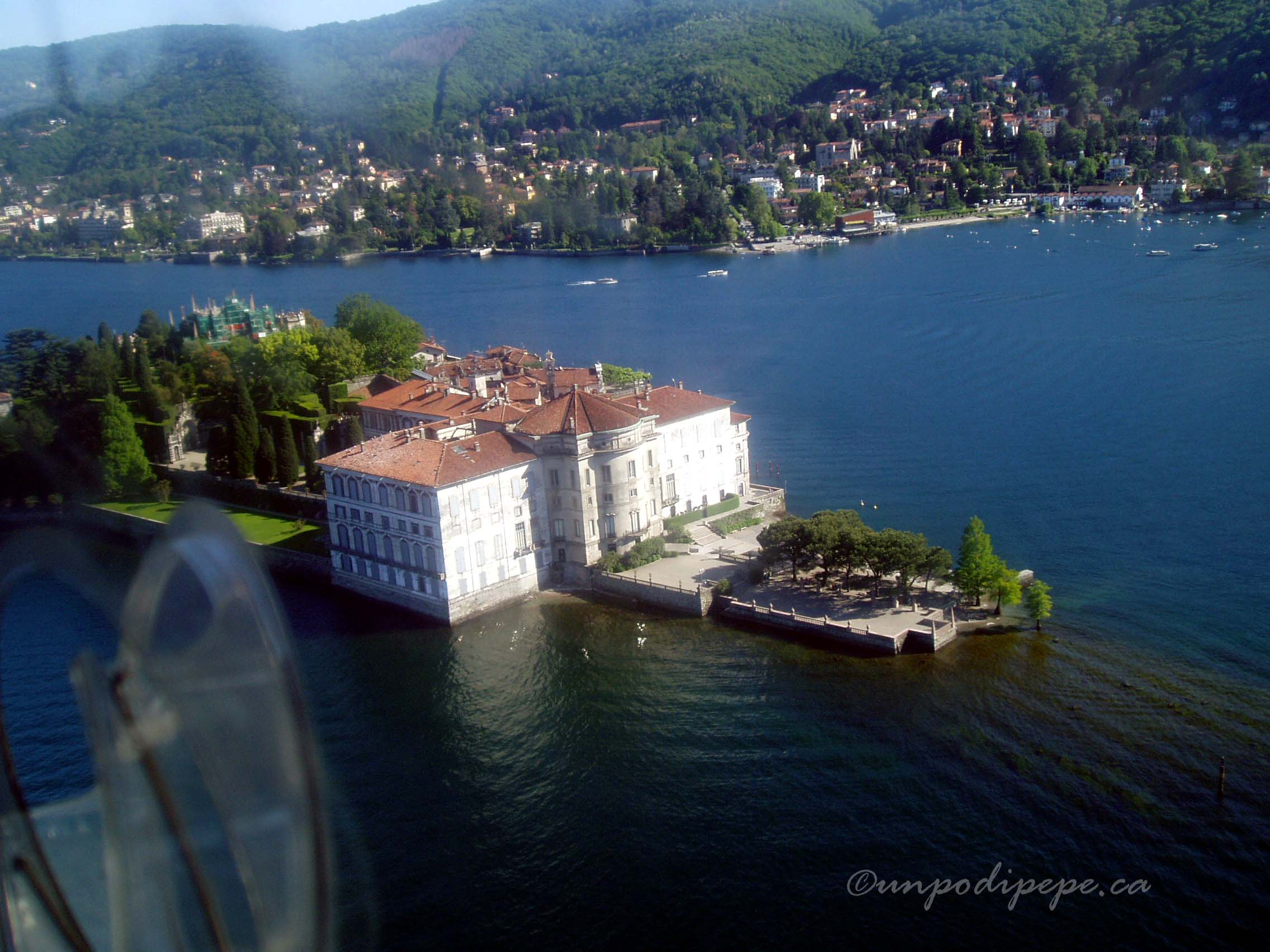
A few years ago I went to Angera on the eastern shore of Lago Maggiore to visit my cugini Rosa and Pasquale and their family.  They own Lounge Bar La Noce which is right on the lake. Pasquale took me up for a spin in his ultralight and I ended up with some ‘vista d’uccello’ (bird’s eye view) shots of l’Isole Borromee, 3 small islands in the Italian part of Lago Maggiore.

Isola Bella

Isola Bella is named for Contessa Isabella D’Adda, wife of Carlo Borromeo III.  It was once a big flat rock in the lake with a tiny fishing village.  Over a 40 year period in the 1600’s soil was brought in to build 10 terraces for the gardens and a summer palace.  Famous palace guests include Napoleon and Josephine.

Isola Madre

Isola Madre is the largest of the 3 islands.  The 16th Century Palazzo Borromeo was built by Count Lancillotto Borromeo -what an awesome name!  The English style Giardini Botanici dell’Isola Madre (Botanical Gardens) were built in the 18th Century on the site of a citrus grove.

Isola Pescatori

Isola Superiore dei Pescatori -usually just called Isola Pescatori, is named for the fisherman.  The village has about 50 permanent residents, and a few of them are actually still fishermen. Isola Pescatori was owned by the Borromeo family until the middle ages but is now part of Stresa. There are several hotels and restaurants on the island and taxi boat service from Stresa.

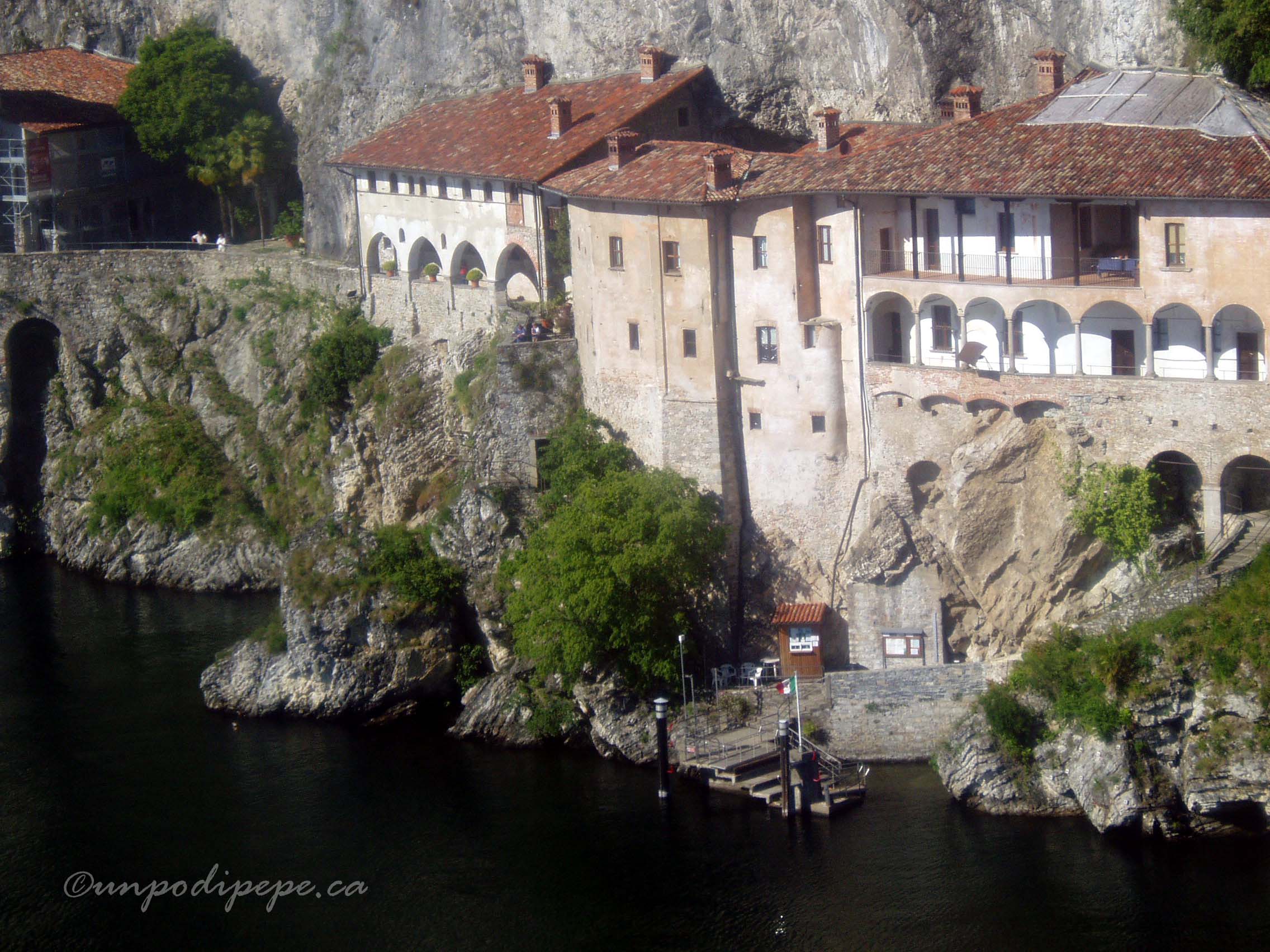
Eremo Santa Caterina del Sasso, a monastery founded by a man shipwrecked during a storm.  He swore that if he survived he would dedicate his life to building a monastery on the site.

Eremo Santa Caterina del Sasso, a monastery founded by a man shipwrecked during a storm. He swore that if he survived he would dedicate his life to building a monastery on the site.

La cabina di pilotaggio (cockpit) & i piloti!  I don't remember how we managed to take this blurry selfie in the cockpit?

La cabina di pilotaggio (cockpit) & i piloti! I don’t remember how we managed to take this blurry selfie in the cockpit?

La Rocca d'Angera on the hill with Lounge Bar La Noce below.  Photo Pasquale D'Ambrosio.

La Rocca d’Angera on the hill with Lounge Bar La Noce below. Photo Pasquale D’Ambrosio.

Angera (pop 5600) was an important lake point in Roman times, when it was called Angheria.  Today it is most famous for La Rocca d’Angera (Castello Borromeo) a fortress on top of a 200m hill overlooking Lago Maggiore.  The 1989 RAI miniseries ‘I Promessi Sposi’, based on the 1827 novel by Alessandro Manzoni was filmed here.  La Rocca is also home to Il Museo delle Bambole, a doll museum.  The Borromeo family still owns La Rocca d’Angera, Isola Bella and Isola Madre but they are accessible to the public. Boats to l’Isole Borromee (www.navigazionelaghi.it) are available from the lakefront towns of Stresa, Laverno, Pallanza and Intra.  Some hotels and restaurants also have their own private boat service.

Angera is a nice day trip from Milano.  There is no direct train but the closest route is the train to Sesto Calende then bus to Angera or the train to Arona and then a ferry across the lake to Angera. Buon Viaggio!

Cigne Angera

Share this:

  • Click to share on Facebook (Opens in new window) Facebook
  • Click to share on Pinterest (Opens in new window) Pinterest
  • Click to share on X (Opens in new window) X
  • Click to email a link to a friend (Opens in new window) Email
  • Click to share on WhatsApp (Opens in new window) WhatsApp
Like Loading...

Centrale Montemartini

15 Sunday Feb 2015

Posted by Un po' di pepe in Architecture, Art, Art history, Culture, Italia, Photography, Roma

≈ 13 Comments

Tags

Al Biondo Tevere, Art history, Art Nouveau, Basilica San Paolo Fuori le Mura, Capitoline Museum, Centrale Montemartini, Cleopatra, Industrial archeology, Italy travel tips, Roma, Stile Liberty, Temple of Apollo Sosiano, Via Ostiense

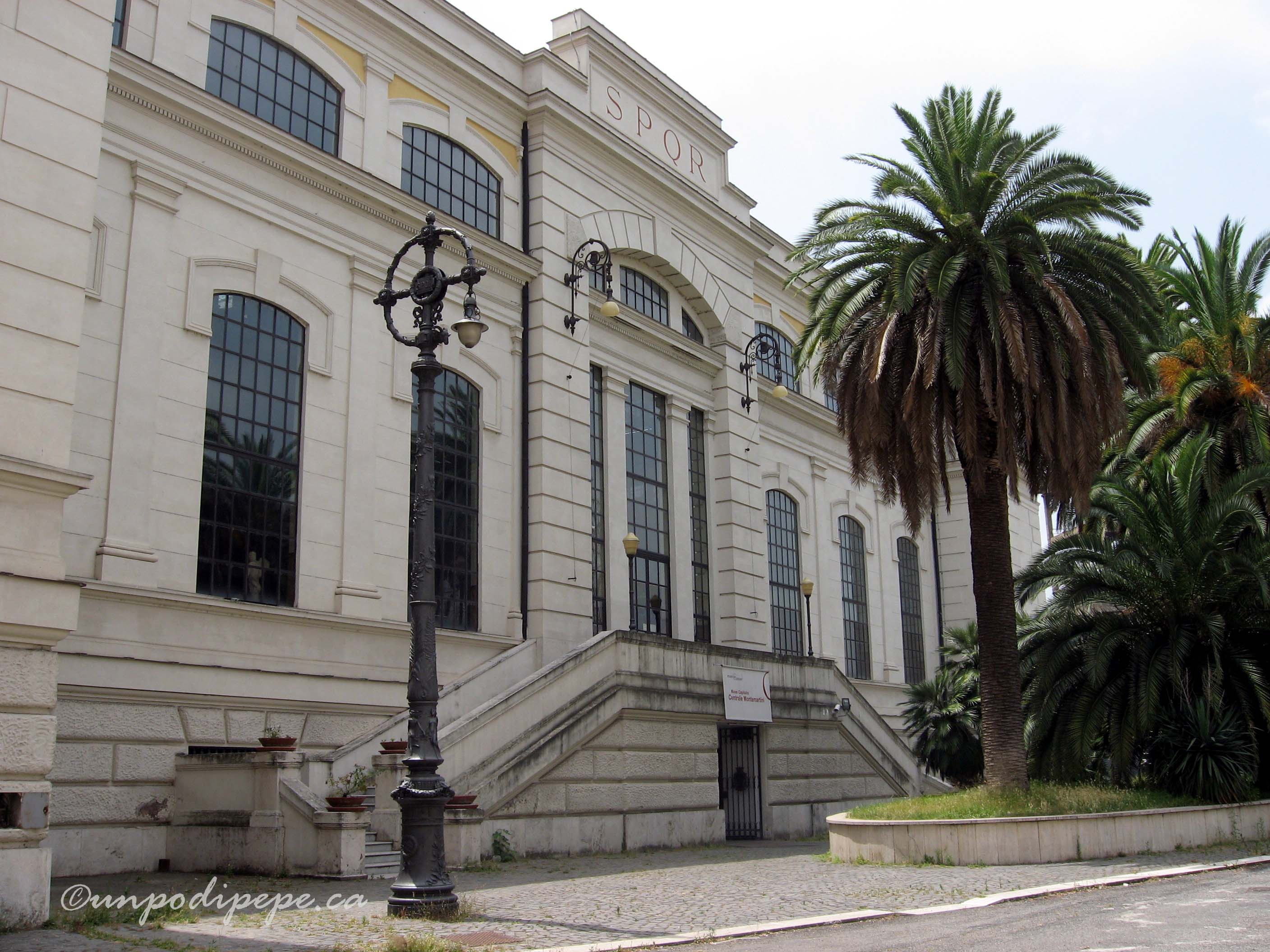
Centrale Montemartini is an amazingly awesome, undervisited museum and a stunning example of 20th Century industrial archeology.  Built in 1912 in Art Nouveau style (Stile Liberty), it was the first public electric plant in Roma, providing power for the surrounding area until it was abandoned in 1963.  Luckily the amazing architecture and historical importance saved it from demolition!

Amazon warrior in front of a diesel engine

Amazon warrior in front of a diesel engine

In 1997 during the Capitoline Museum renovation, Centrale Montemartini was used for a temporary exhibition ‘Le Macchine e gli Dei’ (The Machines and the Gods).  In 2005 it became a permanent space for part of the Capitoline collection, with all of the original thermoelectric equipment left in place.  Now you can visit a unique display of classical sculpture against an industrial  backdrop of steam boilers, diesel engines, catwalks twisting pipes and gauges.  It’s a blend of ‘vecchio e più vecchio’ (old and older), a stark contrast of ancient and industrial, art and science.  Antique white marble appears translucent against the blackness of the machinery.  The space is immense and silent, with high ceilings and tall windows providing natural light. The works of art are carefully chosen and placed so there is space to appreciate their beauty while you walk among them and contemplate the passage of time.Centrale Montemartini Sala Macchine3

The 400 pieces include ancient Roman sculptures, rare Greek originals brought to Roma, and Roman copies of Greek originals. They date from the 5th Century BC to the 4th Century AD and were found in the late 19th and early 20th Century. Most of the works are on the upper floor in 2 massive rooms.

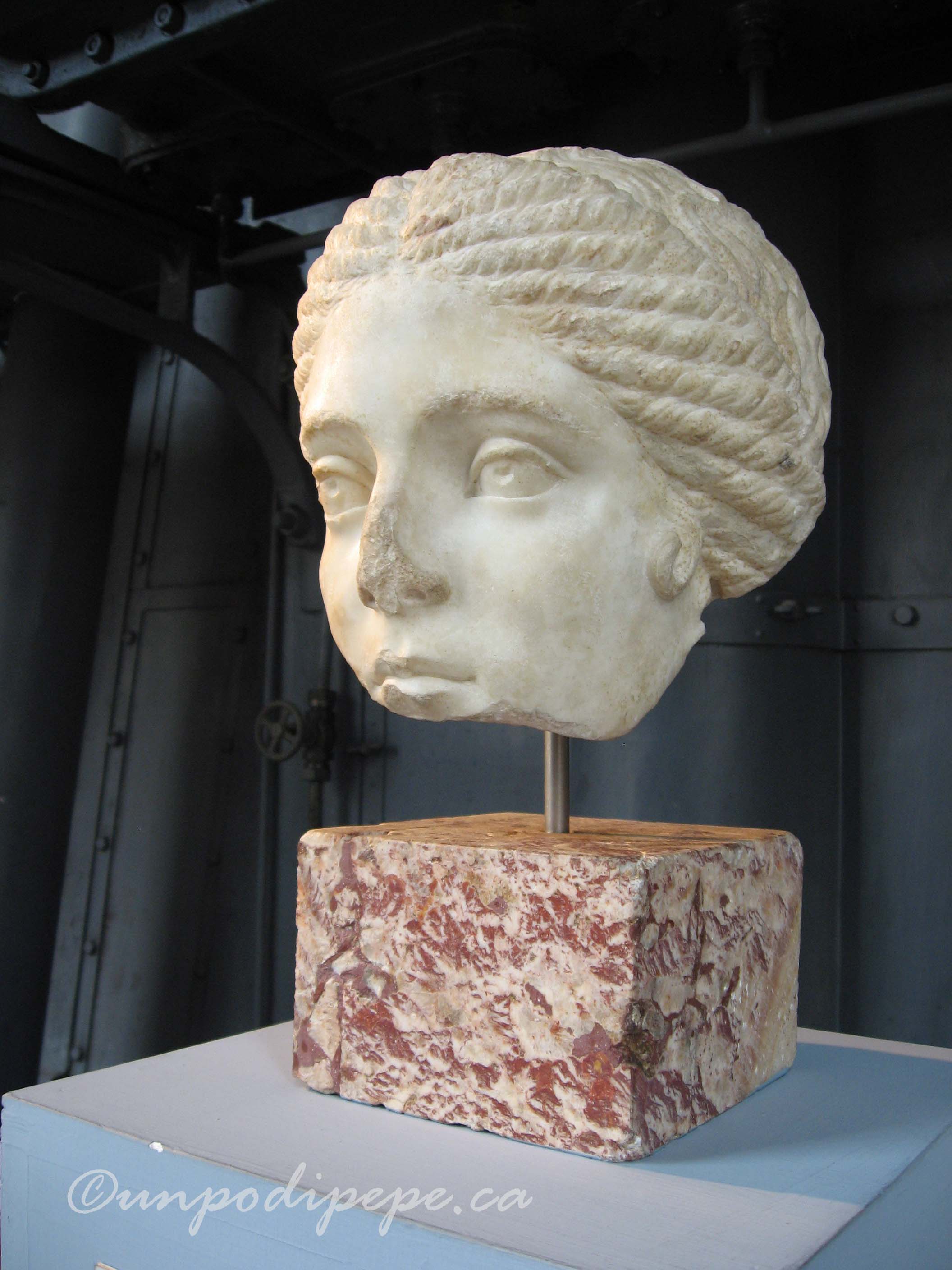
Partial female head, discovered in the garden of Villa Rivaldi in 1933 during construction of Via dei Fori Imperiali

Partial female head, discovered in the garden of Villa Rivaldi in 1933 during construction of Via dei Fori Imperiali

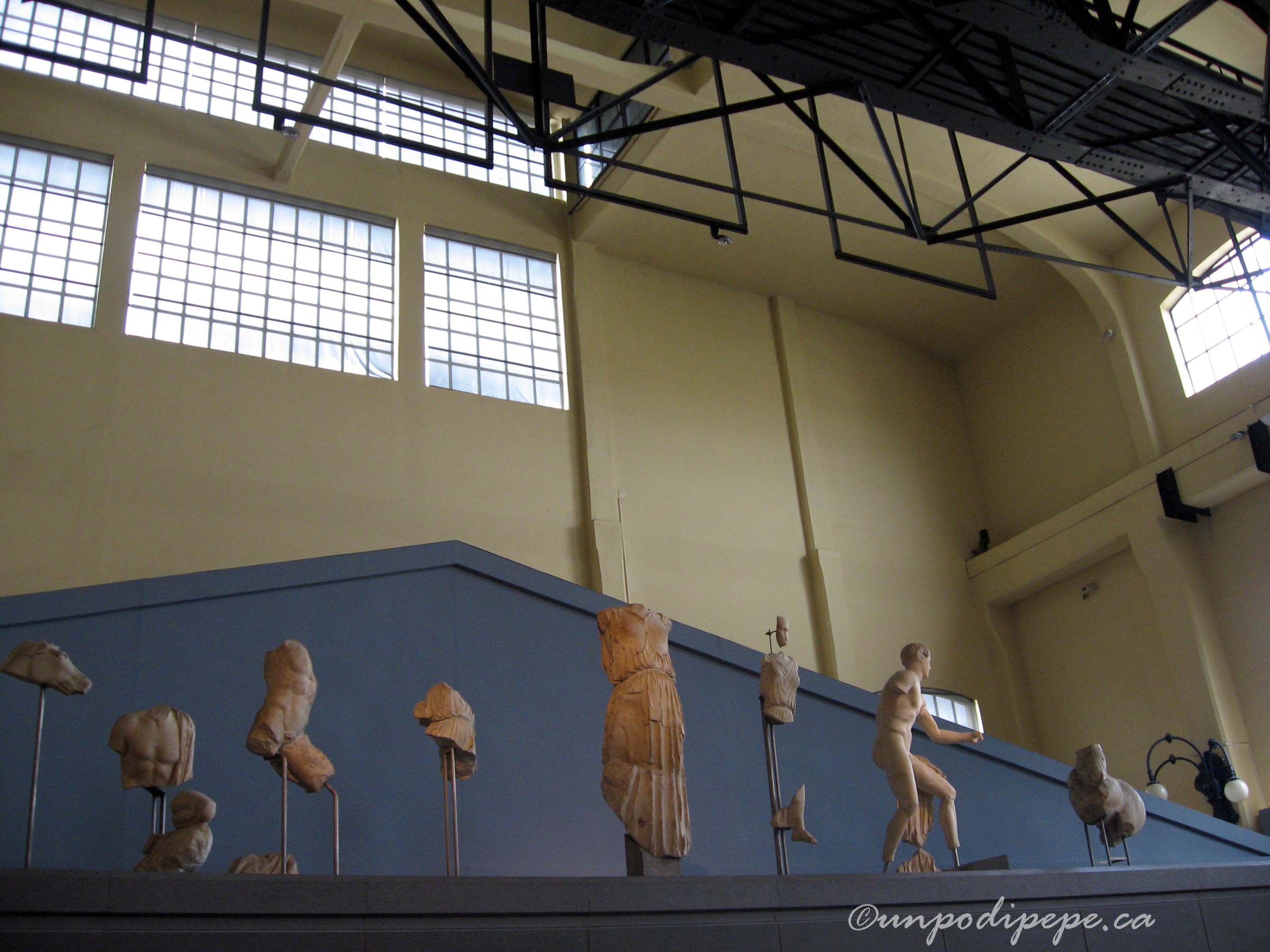
In Sala Macchine (Machine Room or Hall of the Machines) 2 hulking diesel engines are surrounded by Roman replicas of Greek statues.  At one end, a reconstruction of the pediment of the Temple of Apollo Sosiano depicts a battle between Greeks and Amazons.  These pieces are Greek originals found in the 1930’s near the Theater of Marcellus.  Above this installation hangs the old ‘carroponte‘ (Gantry crane).

Centrale Montemartini, Sala Macchine

Centrale Montemartini, Sala Macchine

Centrale Montemartini Apollo Sosiano

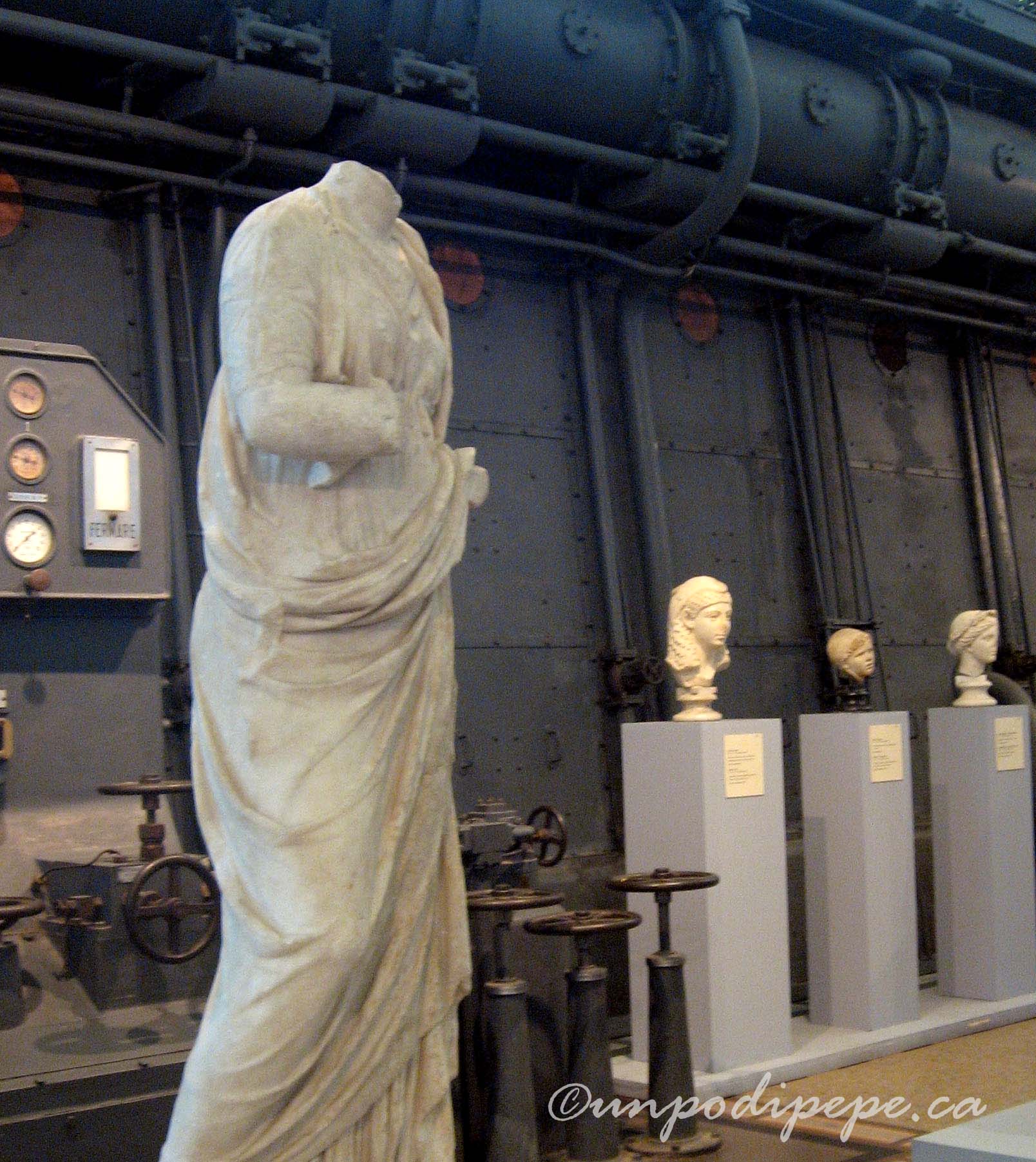
Other ‘meraviglie’ (wonders) include a bust of Cleopatra and the giant head, right arm and feet of an 8m high statue of the Goddess Fortuna found near Largo Argentina.  Her feet look very modern with their ‘infraditi’-thong style sandals!piedidifortuna

Sala Macchine. Bust of Cleopatra (to the right of the large statue)

Sala Macchine. Bust of Cleopatra (to the right of the large statue)

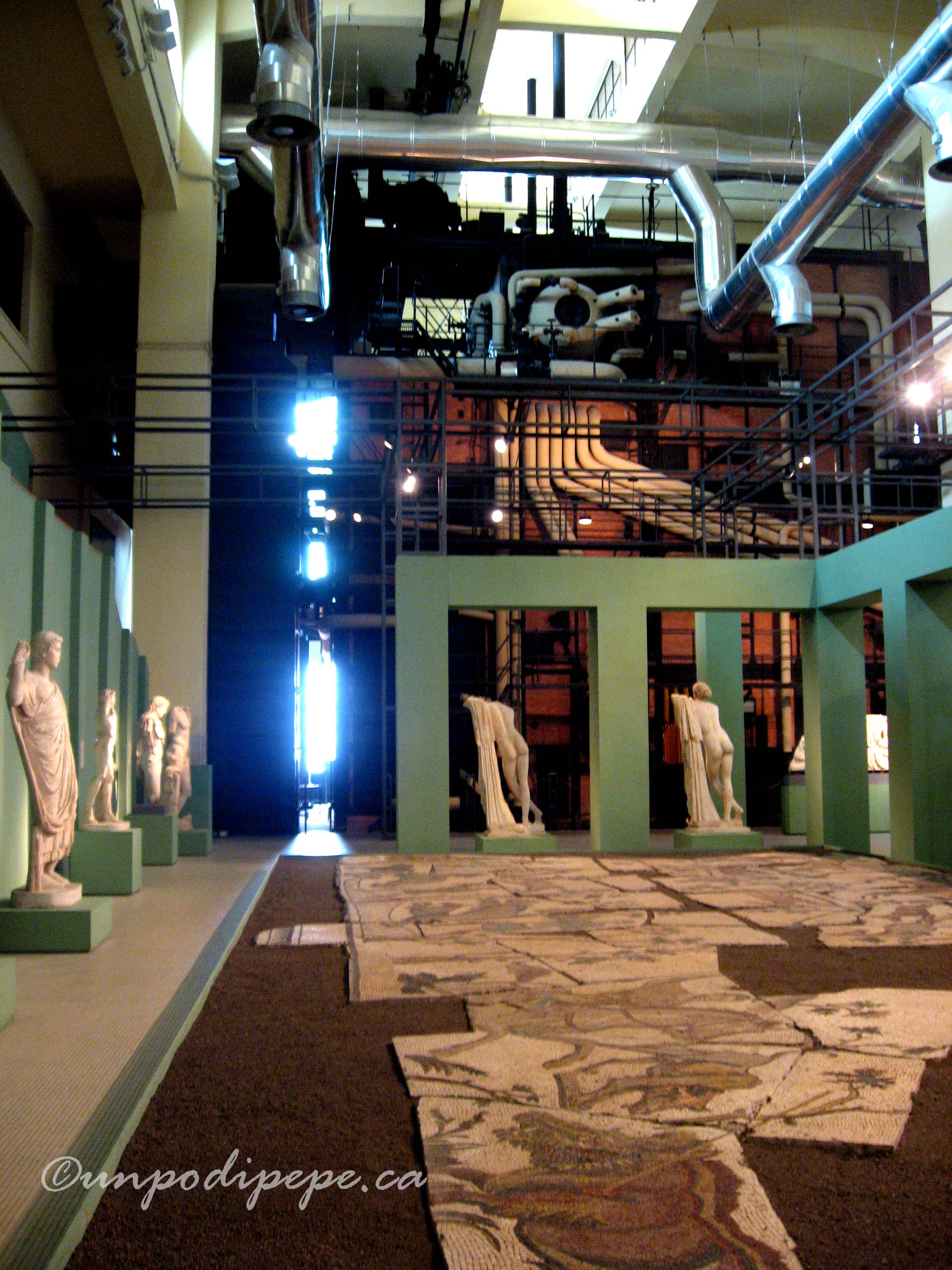
cleopatraSala Caldaie (Boiler Room) is named for its 15m steam boiler and features a large mosaic of a hunting scene found near Santa Bibiana.  The mosaic is surrounded by sculptures once adorning lavish Roman homes.Centrale Montemartini Sala Caldaie

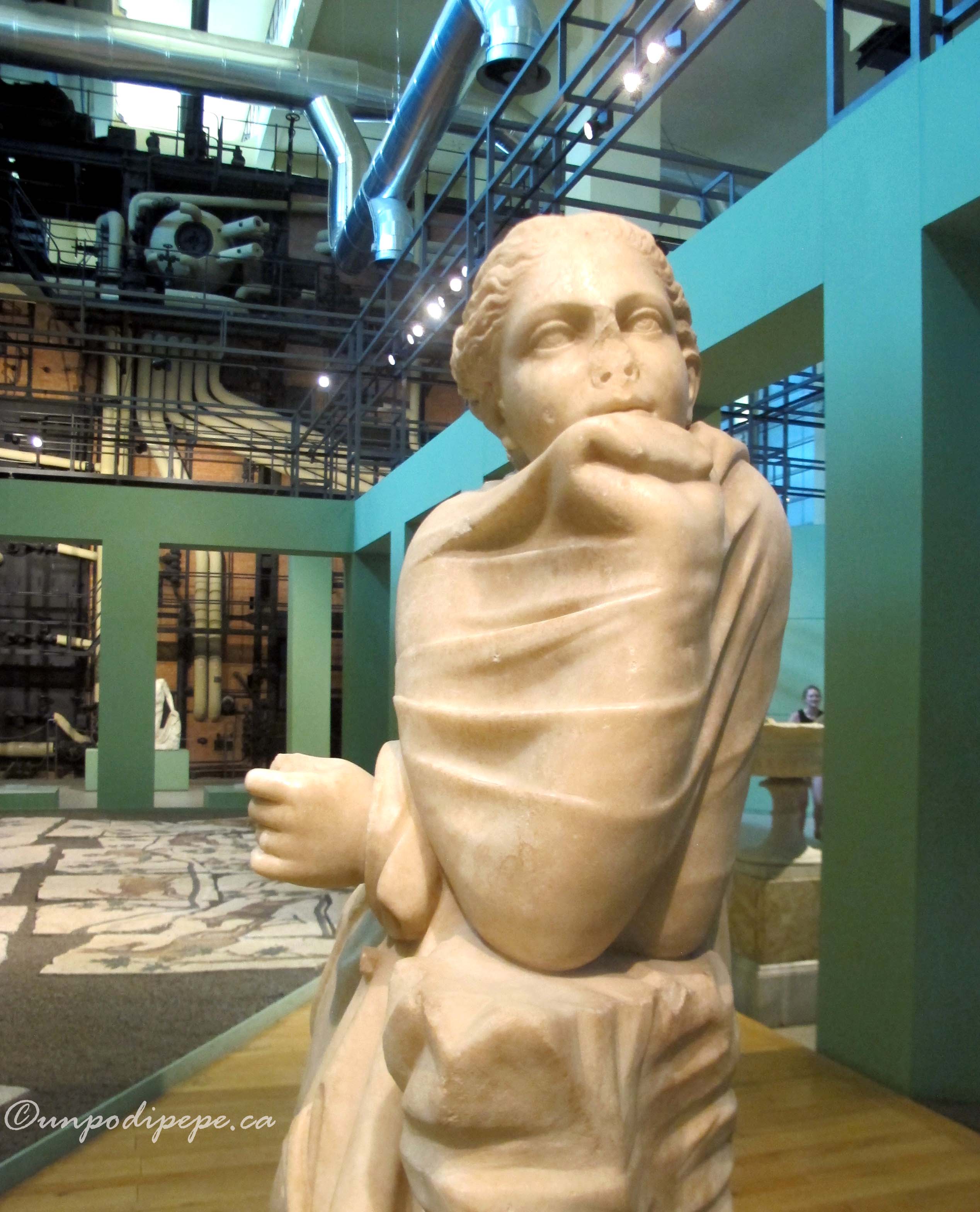
PolimniaI especially like the statue of Polimnia, muse of poetry and dance.  She has her elbows resting on a pillar and her shawl casually wrapped around her.  My other favourite in Sala Caldaie is the Sphinx Frieze, which seems to glow against the red brick wall.

Sala Caldaie. Sphinx Frieze with Acanthus Spirals. This was part of the Gardens of Sallust and likely represents the victory over Antony and Cleopatra.

Sala Caldaie. Sphinx Frieze with Acanthus Spirals. This was part of the Gardens of Sallust and likely represents the victory over Antony and Cleopatra.

There were only 4 or 5 other people in the museum both times I visited.  One of the staff told me that from October to May they have a lot of school groups visiting through their educational program, but June to September is not very busy.  This is opposite to most other museums!  I definitely recommend this amazing place, especially if you want to get away from crowds and lineups and see something truly unique. Even people who don’t like museums will appreciate this one-or at least find it oddly fascinating!Centrale Montemartini WarriorTorso

Centrale Montemartini is in the Ostiense area on the left bank of the Tevere.  It is south of Roma’s historic center but very accessible by Metro B line Garbatella stop.  When leaving the metro stop, you will cross a pedestrian bridge and then reach Via Ostiense.  Bus 23 goes along Via Ostiense and Stazione Ostiense is also nearby.

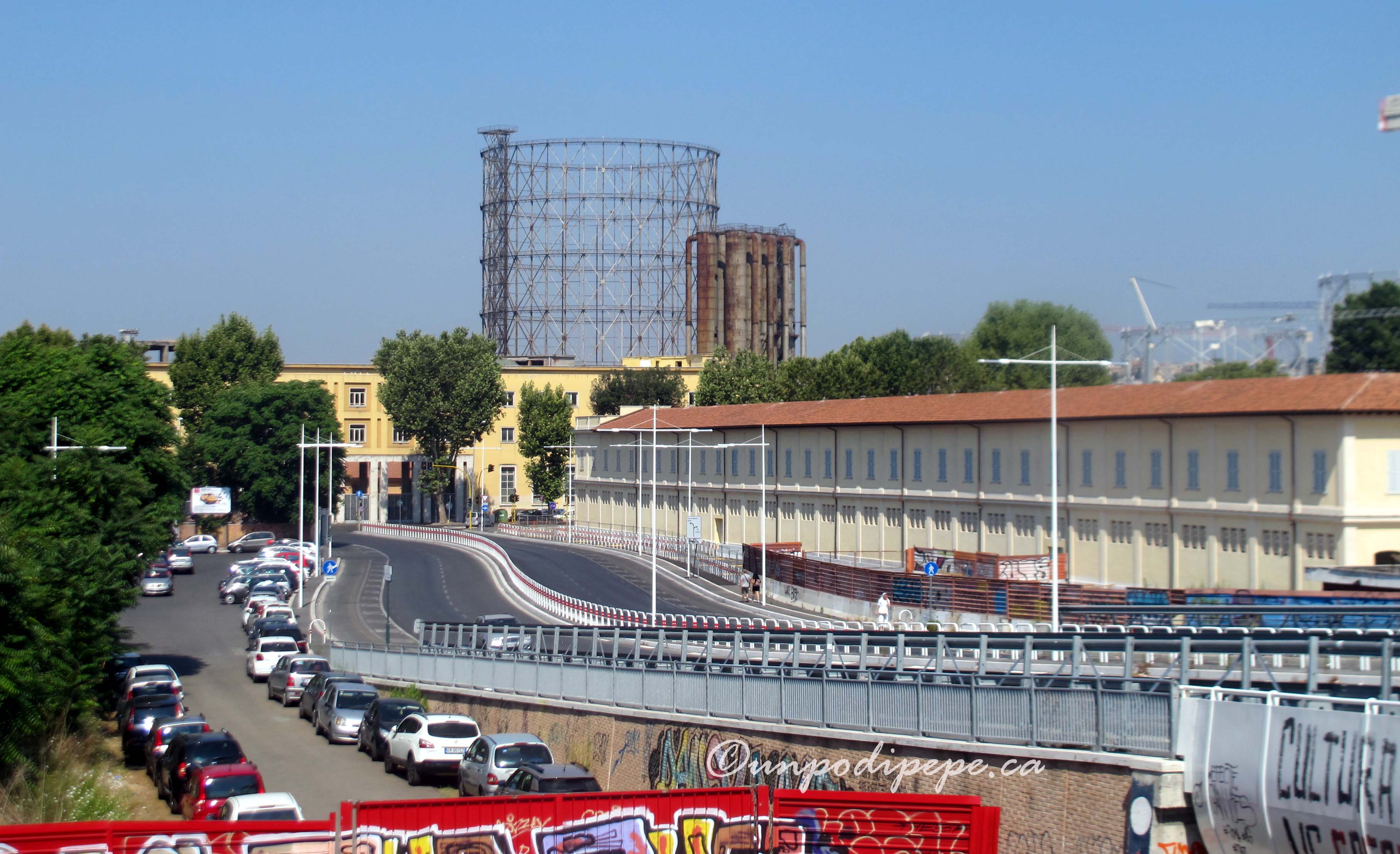
The view on exiting Garbatella Metro Stop.  Via Ostiense is in front, where the yellow building is.  Il Gasometro is behind it.  Centrale Montemartini is just to the left.

The view on exiting Garbatella Metro Stop. Via Ostiense is in front, where the yellow building is. Il Gasometro is behind it. Centrale Montemartini is just to the left.

The Basilica of San Paolo Fuori le Mura is walking distance, one metro stop away.  In between the Basilica and Centrale Montemartini is one of the oldest restaurants in Roma, Al Biondo Tevere at Via Ostiense 178 www.albiondotevere.it  serving Roman cuisine overlooking the Tevere.

Centrale Montemartini

Centrale Montemartini

www.centralemontemartini.org  Via Ostiense 106, open Tues-Sun from 09-19.  Admission is € 7.50 for adults or €16 for the Capitolini Card (valid 7 days).  The Romapass can also be used.  Don’t forget your sketchbook!

Ciao, Cristina

Share this:

  • Click to share on Facebook (Opens in new window) Facebook
  • Click to share on Pinterest (Opens in new window) Pinterest
  • Click to share on X (Opens in new window) X
  • Click to email a link to a friend (Opens in new window) Email
  • Click to share on WhatsApp (Opens in new window) WhatsApp
Like Loading...

Le Isole Tremiti

16 Wednesday Jul 2014

Posted by Un po' di pepe in Italia, Photography, Puglia, Travel

≈ 13 Comments

Tags

Alidaunia, Diomedes, Fellini, Il Gargano, Isole Tremiti, Italia, Italian history, Italy travel tips, Parco Nazionale del Gargano, photography, Puglia, Southern Italy

San Nicola and Cretaccio seen from above the helipad, San Domino

San Nicola and Cretaccio seen from above the helipad, San Domino

The Isole Tremiti (ee∙SOH∙leh treh∙MEE∙tee) are an archipelago of 3-5 islands-depending on what you consider an island-in the Adriatic Sea, 22 km off the coast of Italia. The Tremiti, considered ‘le perle dell’Adriatico’ (the pearls of the Adriatic), have been inhabited since at least the 4th century BC.  They are part of the Parco Nazionale del Gargano (Gargano National Park) http://www.parcogargano.it and have been a protected Marine Nature Reserve (Riserva Naturale Marina Isole Tremiti) since 1989. The clear waters make the islands a popular spot for snorkeling, scuba diving and even bird watching.

Isole Tremiti Satellite View

Isole Tremiti Satellite View

Flying into San Domino by helicopter

Flying into San Domino by helicopter

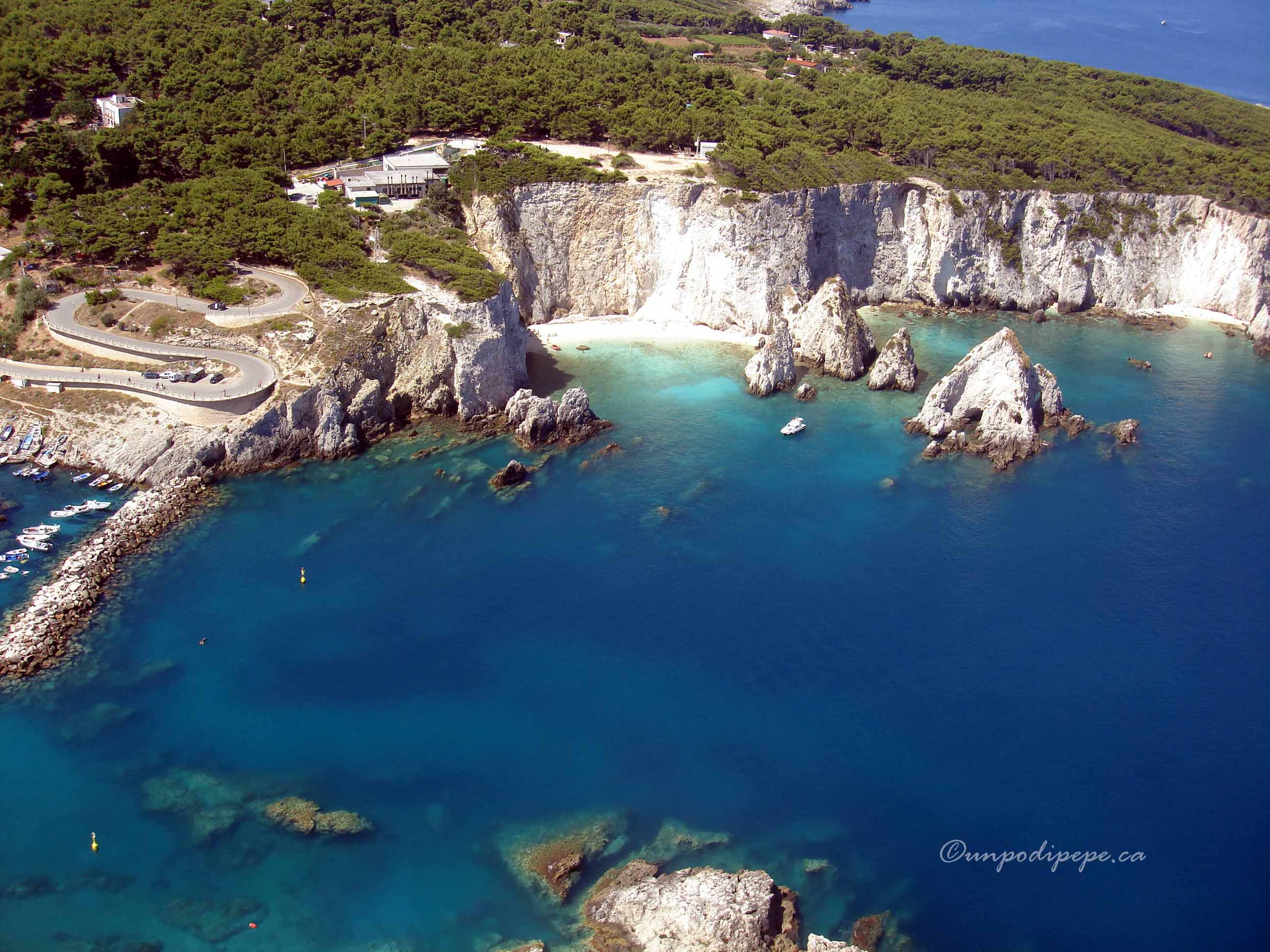
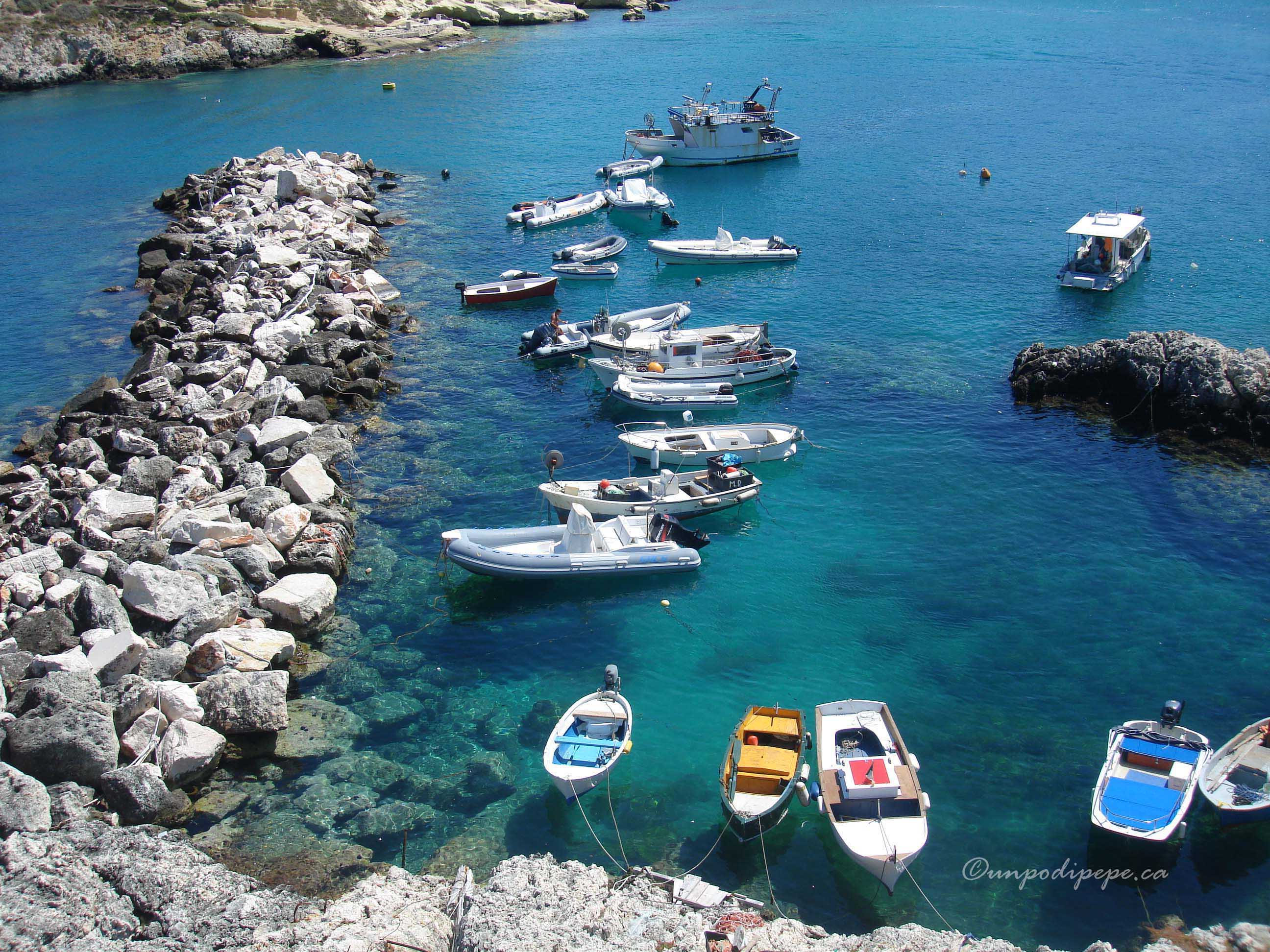
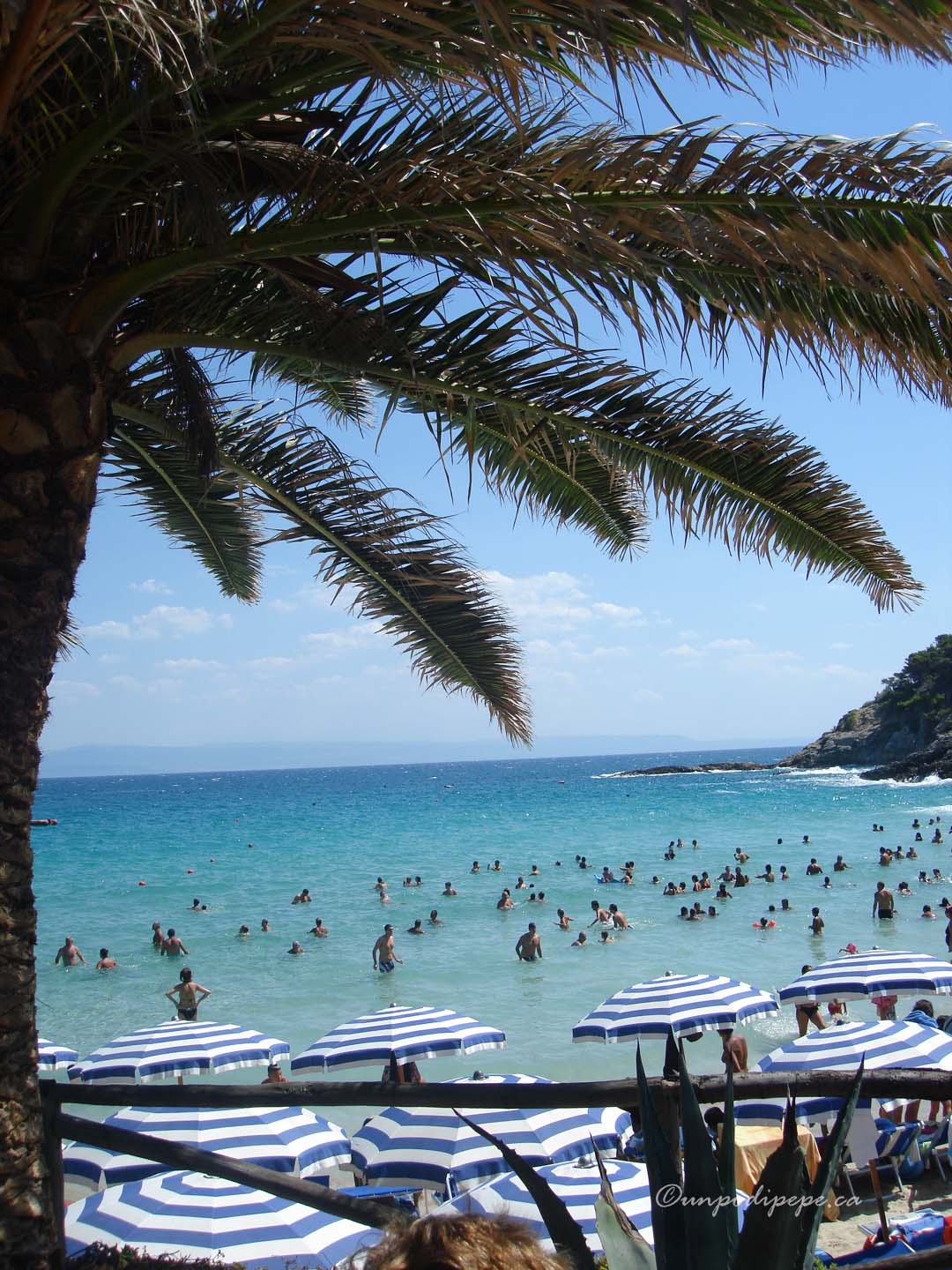
San Domino is the largest island and has most of the facilities such as hotels, restaurants, the Tremiti Diving Center, and the heliport. It is covered by lush Aleppo pine forest, capers and rosemary, and surrounded by small coves and sea caves. San Domino has the Tremiti’s only sandy beach –Cale delle Arene. The rocky coves are beautiful to explore and swim-but don’t go barefoot! My friend stepped on a riccio di mare (sea urchin) and it was not fun.  There is a 2 hour walk around part of the island and bicycles are available for rent.

The small port, San Domino

The small port, San Domino

Cale delle Arene, San Domino-the only sandy beach on the Isole Tremiti

Cale delle Arene, San Domino-the only sandy beach on the Isole Tremiti

Scoglio dell 'Elefante, San Domino, looks like a giant sitting elephant drinking from the sea

Scoglio dell ‘Elefante, San Domino, looks like a giant sitting elephant drinking from the sea

San Nicola is the administrative and historic center of the islands, and where most of the 400 or so permanent residents live. The 11th Century Benedictine abbey and church of Santa Maria del Mare seem to rise up out of the limestone cliffs, with fortified walls starting at the port. The church has a beautiful 11th century mosaic floor and a Byzantine painted wood crucifix that was likely brought here by monks fleeing from the Crusades.

San Nicola, seen from San Domino

San Nicola, seen from San Domino

San Nicola Porto

San Nicola Porto

Bagnetto anyone?

Bagnetto anyone?

Capraia (or Caprara) is rocky and uninhabited except for sea birds. It is named for the capers that grow there. There is no organized transport to Capraia, but local fishermen can be hired to take people over.

San Nicola and Capraia.  Yes those are solar panels down there!

San Nicola and Capraia. Yes those are solar panels down there!

Cretaccio is an uninhabited halfmoon shaped block of yellowish clay between San Domino and San Nicola.  Cretaccio literally means ‘big hunk of clay’.
Pianosa is 11 km away from the other islands and is the most northern point of Puglia.  It can be covered by waves during storms, as the elevation is only 15 m.  The waters surrounding Pianosa are in zone A of the Marine Reserve, so access is strictly prohibited except for approved marine research.

Cretaccio and San Domino, seen from Santa Maria al Mare, San Nicola

Cretaccio and San Domino, seen from Santa Maria al Mare, San Nicola

The islands are sometimes known by their former name ‘Le Diomedee’ or ‘I Sassi di Diomede’ and you see a lot of things in the Gargano area called ‘Diomede’. According to legend/mythology, after the Trojan War, the Greek hero Diomedes settled in the Daunia area (Province of Foggia) and created the islands with 3 rocks he threw into the Adriatic.  He was also shipwrecked on the islands with his crew and possibly died here.

La tomba di Diomede on San Nicola.

La tomba di Diomede on San Nicola.

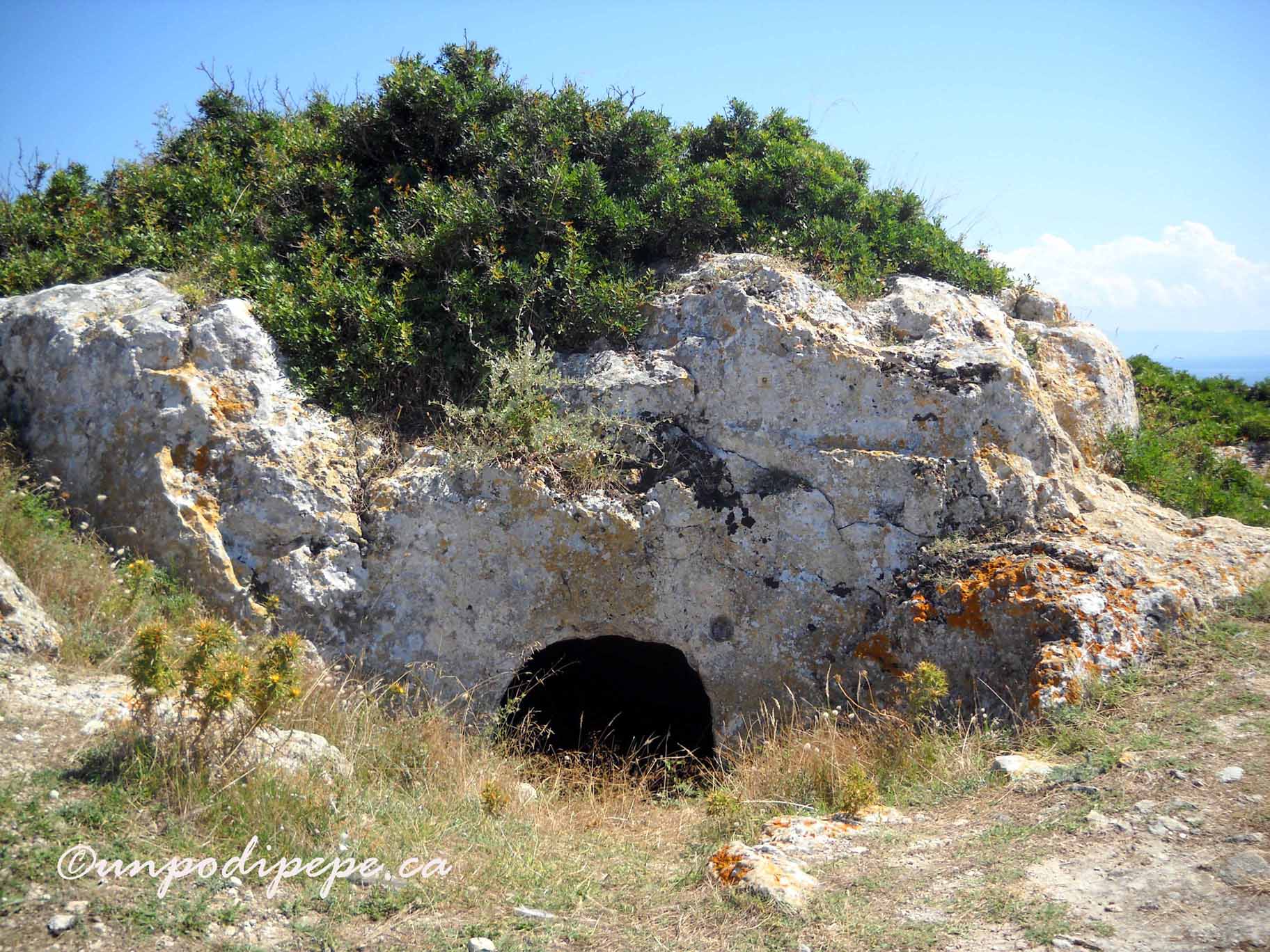
There is an unmarked Hellenic period tomb on San Nicola that is known as ‘la tomba di Diomede’. His crew was so upset at the loss of their captain that the Goddess Venus took pity on the grieving men and turned them into birds that continue to cry for their loss. The scientific name for the Great Albatross which is common in the area, is ‘Diomedea’.  These birds look a lot like seagulls and make a noise that can sound like a crying newborn.  In Fellini’s ‘Otto e mezzo’ (8½) there is a scene where a cardinal tells this story to Guido (Marcello Mastroianni).

A Diomedea, San Domino

A Diomedea, San Domino

The islands also have a long history as a place of exile. Emperor Octavius Augustus confined his granddaughter Giulia to San Nicola for adultery with a Roman senator. She remained there until her death 20 years later. One of the necropoli beneath the abbey could be her tomb.  Ferdinand, king of Napoli turned the abbey into a penal colony. A hundred years later, another Ferdinand tried to repopulate the islands with criminals and people moved in from the slums. For many years, the Fascists imprisoned those considered a danger to the public on the Isole Tremiti. One of the prisoners held there was Sandro Pertini, future president of the Italian Republic.

Alidaunia flies from Foggia to San Domino daily

Alidaunia flies from Foggia to San Domino daily

I have visited the islands several times by helicopter.  As you can see in the photos, the emerald water is so crystal clear you can see the bottom from the air!  The wonderful thing about visiting the Isole Tremiti is that there are no large hotels or resorts.  All of the hotels are small and surrounded by pine forest, so although this is a tourist destination, it doesn’t feel overrun with people. The Isole Tremiti are accessible by 1-2 hour ferry ride from Vieste, Peschici, Rodi Garganico, Manfredonia and Termoli, or by half hour helicopter ride from Foggia http://www.alidaunia.it .

Over San Nicola

Over San Nicola

Buon Viaggio!

Share this:

  • Click to share on Facebook (Opens in new window) Facebook
  • Click to share on Pinterest (Opens in new window) Pinterest
  • Click to share on X (Opens in new window) X
  • Click to email a link to a friend (Opens in new window) Email
  • Click to share on WhatsApp (Opens in new window) WhatsApp
Like Loading...
Newer posts →

Enter your email address to follow 'un po' di pepe' and receive notifications of new posts by email.

Join 511 other subscribers
Follow Un po' di pepe on WordPress.com

Popular Posts

  • Hairstyling in Ancient Roma
    Hairstyling in Ancient Roma
  • Espresso Cookies
    Espresso Cookies
  • Panforte di Siena
    Panforte di Siena
  • Il Pumo Pugliese
    Il Pumo Pugliese
  • Panettone Fatto in Casa
    Panettone Fatto in Casa
  • Internment of Italian Canadians
    Internment of Italian Canadians
  • San Nicola
    San Nicola

Recent Posts

  • Castel del Monte
  • ‘The Nuances of Love’
  • Hostaria Antica Roma~Eat like an Ancient Roman
  • Santa Maria in Aracoeli
  • Casino dell’Aurora~Villa Boncompagni Ludovisi
  • Nasoni di Roma
  • Bloghiversario #11
  • Fontana di Trevi
  • Acqua Vergine
  • Giubileo 2025
  • Sanremo 2025
  • In Vino there are Memories
  • A Literary Harvest
  • 2024~Un po’ di pepe Year in Review
  • Buon Natale 2024
  • Il Bicerin
  • Mercato Porta Palazzo
  • Torino
  • Catanzaro, Calabria
  • Il Pumo Pugliese
  • Artemisia Gentileschi
  • Cavalli di San Marco
  • Panzerotti
  • Torcello
  • 10 years of Un po’ di pepe!

Categories

Amici e Famiglia Architecture Art Art history Art projects Bilingual posts Blogging Canada Culture Feste Firenze Inspiration Italia Italian Folklore Italian language Italian life Italocanadesi Libri Mangiamo! Orsara di Puglia Parole piacevoli Photography Puglia Recipes Roma Travel Travel tips Uncategorized Vino

Archives

Un po’ di pepe on Facebook

Un po’ di pepe on Facebook

Start a Blog at WordPress.com.

  • Subscribe Subscribed
    • Un po' di pepe
    • Join 511 other subscribers
    • Already have a WordPress.com account? Log in now.
    • Un po' di pepe
    • Subscribe Subscribed
    • Sign up
    • Log in
    • Report this content
    • View site in Reader
    • Manage subscriptions
    • Collapse this bar
 

Loading Comments...
 

    %d