• Home
  • About me/Chi sono
  • Contact

Un po' di pepe

~ …… (oon∙poh∙dee∙PEH∙peh) Cristina writes about interesting stuff /Cristina scrive di cose interessanti

Un po' di pepe

Author Archives: Un po' di pepe

Fucacoste e Cocce Priatorje

01 Sunday Nov 2015

Posted by Un po' di pepe in Culture, Feste, Italian Folklore, Orsara di Puglia, Puglia

≈ 5 Comments

Tags

Falò e Teste del Purgatorio, Festa dei Morti, Italian Folklore, Italian history, Muscitaglia, November 1st, Orsara di Puglia, Puglia, Pugliese Traditions, Pumpkin carving, Southern Italy, Traditional Festivals in Puglia, Tutti i Santi Festa, Zucche

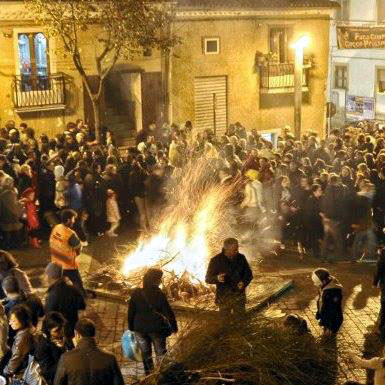
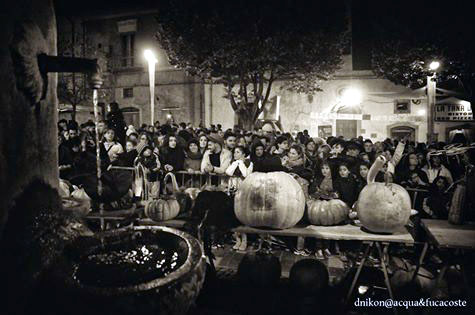
Piazza San Pietro. Photo courtesy of International Photo Correspondent Donato Narducci

Piazza San Pietro. Photo courtesy of International Photo Correspondent Donato Narducci

Tonight is a big festa in Orsara di Puglia, so I am reposting this from last year.

Fucacoste e cocce priatorje is dialetto Orsarese for ‘Falò e teste del Purgatorio’.  This translates to ‘Bonfires and heads from purgatory’. It is an ancient festival unique to Orsara di Puglia celebrated on November 1st, the night of ‘Tutti i Santi’ (All Saints Day).  All Saints Day was created in the 9th century when the Pope superimposed a Christian feast day onto existing rituals, so this festa has been around for a very long time.  It is a night where people have the opportunity to honour, reconnect and pay respect to the spirits of their loved ones.  Carabinieri estimate that the town of 3,000 had 40,000 visitors attend the festa tonight, with 9,000 cars parked up to 3 km away!

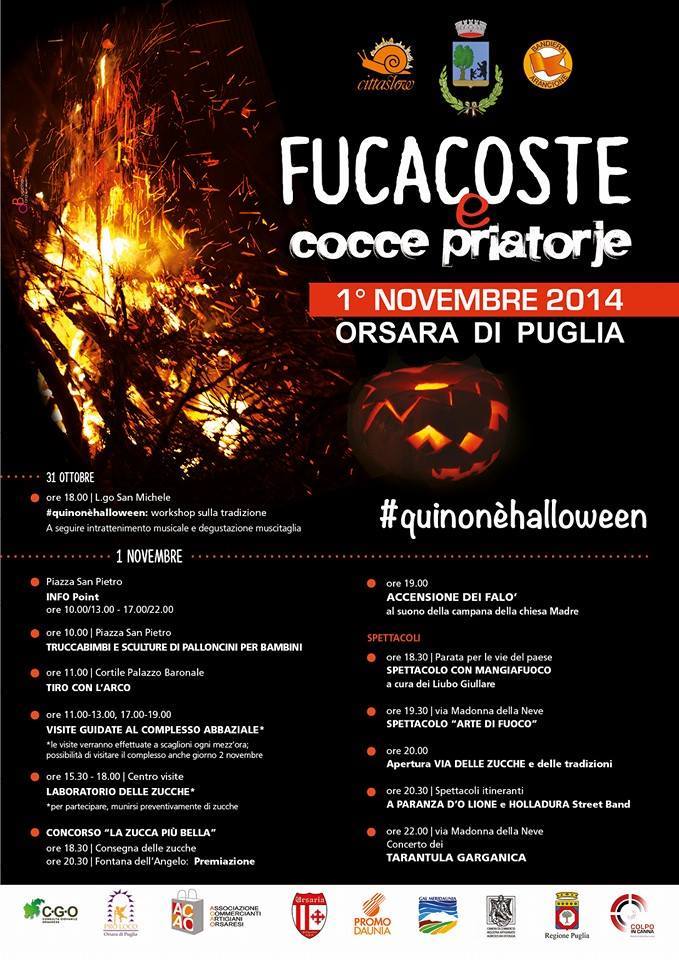
2014 poster for Fucacoste e cocce priatorje

2014 poster for Fucacoste e cocce priatorje

It is believed that the souls of the dead return among the living to visit their relatives and their former homes before moving on to Paradiso.  The bonfires are lit with wood and branches of ginestra (broom). The light of the fires and the crackling and sparks of the ginestra attract the spirits to reunite the living with those who continue to live only in their memories.  The souls of the dead loved ones collect ashes from the fires. The gleam of light inside ‘cocce priatorje’, pumpkins carved to look like heads-light their way to find their former home.

Preparation for the  festa involves gathering firewood and ginestra, preparing food and carving zucche (pumpkins).  There is even a BYOZ (bring your own zucca) pumpkin carving workshop.  Later in the evening zucche are exhibited and there is a contest for ‘la zucca più bella’-the best zucca.

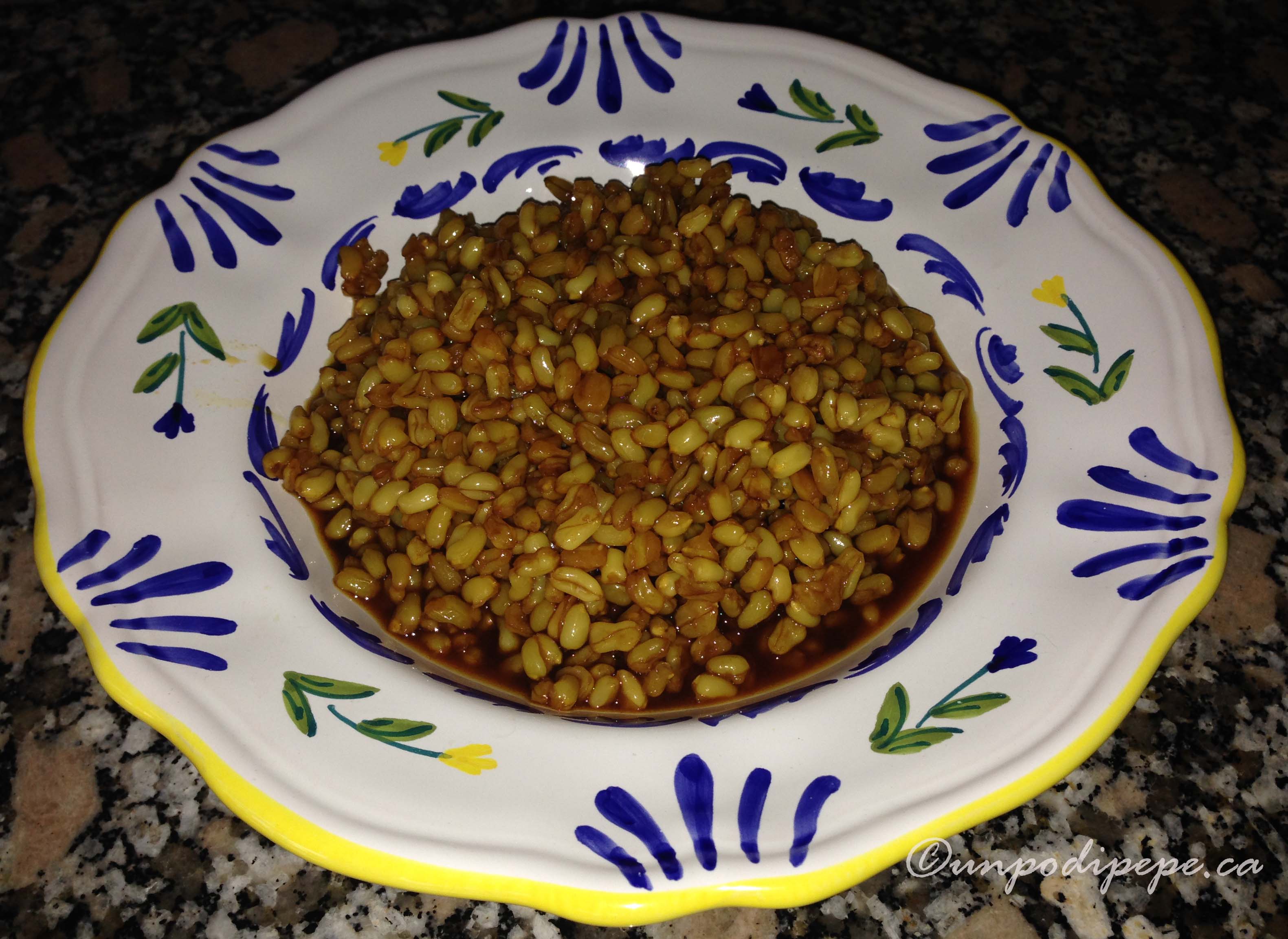
In honour of the dead, simple but symbolic foods are prepared.  These include potatoes, onions, salsicce (sausages) and castagne (chestnuts) cooked in open fire. Muscitaglia is a traditional dish served on November 1st which probably dates back from the ancient Greeks and Byzantines. Muscitaglia (moo•shee•tah•lyah) in both Greek and Latin is made up of the words mosto (wine must) and talia (grain). The ingredients include boiled grain and vino cotto (literally cooked wine-also called mosto cotto). Pomegranate seeds and walnut pieces are sometimes added. These ingredients are symbols of fertility and abundance, but also of honour and respect for the dead.

Muscitaglia

Muscitaglia

When the campanile (church bell tower) strikes 1900 hours (7 pm), Orsara di Puglia ‘catches fire’. Over 100 bonfires are simultaneously lit in every street and piazza and remain lit through the night.  The fires, pumpkin lanterns, music and people in the streets create a magical, enchanted atmosphere.

Fucacoste e Cocce Priatorje has often been confused with Hallowe’en, but it is a very different event.  Besides the fact that the date is different, dressing up in costume is not part of the custom, there is nothing scary about it and there are no evil spirits to chase away. It has more similarities with the Mexican Dia de los Muertos, Day of the Dead.  This is an event about being together in community to celebrate the bond between the living and those who we remember in our hearts, and to remind us that our time on earth is precious.

Watch the video ‘#quinonèhalloween’ featuring 94 year old Z’Gaetan talking about the festa and its significance  https://www.youtube.com/watch?v=9W5RD0-9H-A

Read about tonight’s festa (in Italiano) on the Comune di Orsara di Puglia website.  For more about Orsara di Puglia read the post ‘Benvenuti ad Orsara di Puglia’.  Ci vediamo alla festa!

Fucacoste e Cocce Priatorje, Fontana Sant'Angelo, Orsara di Puglia 2014. Photo courtesy of Donato Narducci

Fucacoste e Cocce Priatorje, Fontana Sant’Angelo, Orsara di Puglia 2014. Photo courtesy of Donato Narducci

Share this:

  • Share on Facebook (Opens in new window) Facebook
  • Share on Pinterest (Opens in new window) Pinterest
  • Share on X (Opens in new window) X
  • Email a link to a friend (Opens in new window) Email
  • Share on WhatsApp (Opens in new window) WhatsApp
Like Loading...

The Whitsundays~Giù di Sotto Part 2

29 Thursday Oct 2015

Posted by Un po' di pepe in Photography, Travel

≈ 9 Comments

Tags

Australia, Australia travel, Cockatoo, Grande Barriera Corallina, Great Barrier Reef, Hamilton Island, Hardy Reef, Queensland, Rainbow Lorikeet, Whitehaven Beach, Whitsunday Islands, Whitsundays

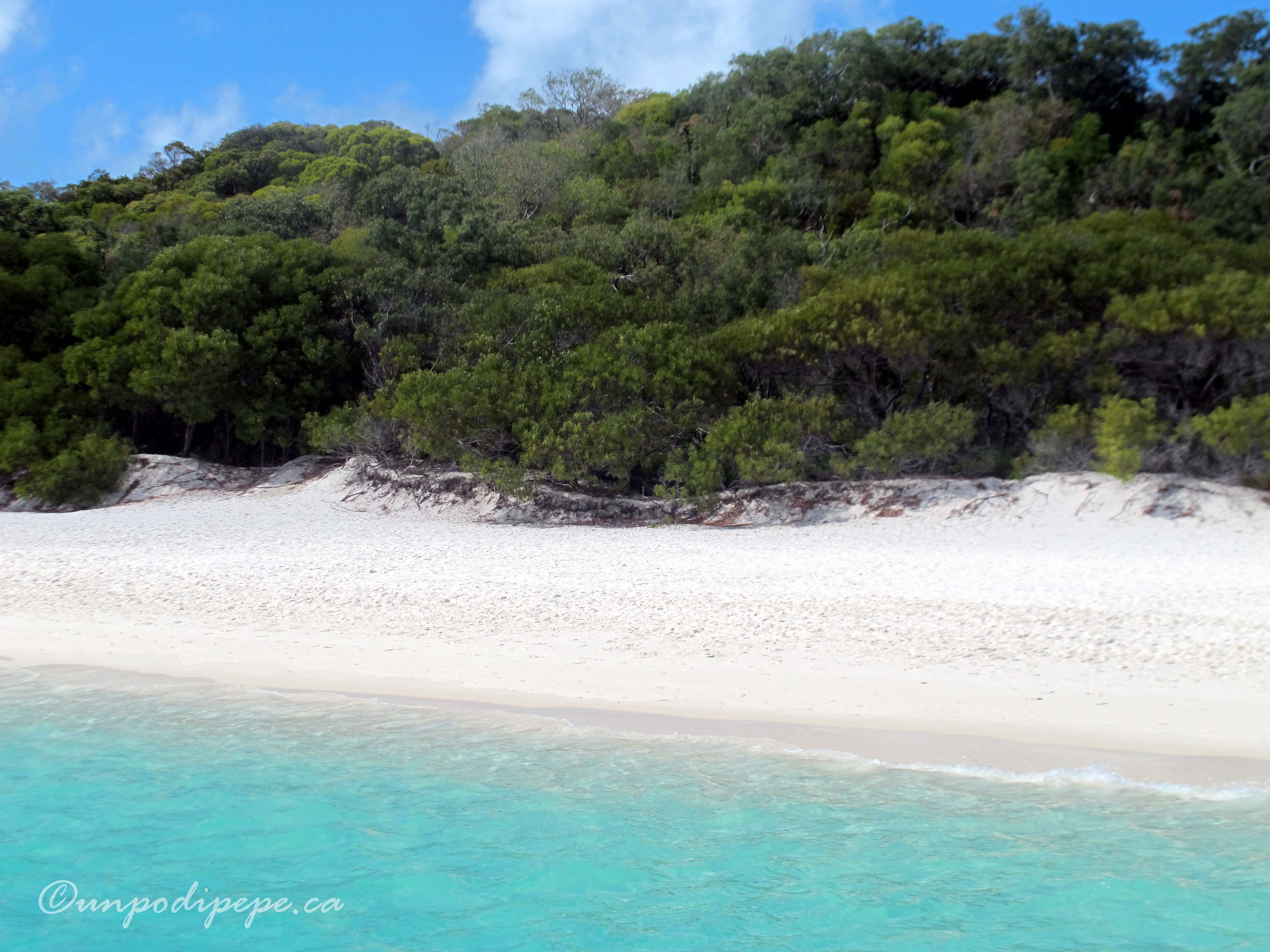
reefview2After attending a conference in Brisbane, I spent 5 days in the Whitsunday Islands.  If you read about my trip to Australia in Giù di Sotto, this is part 2. The Whitsundays are a group of 74 islands off the coast of Queensland, named incorrectly by Captain Cook.  He had crossed the International Date Line, so it was Monday! The islands are sheltered by La Grande Barriera Corallina-the Great Barrier Reef, making them a great place for boating. In 1988 I spent a few days sailing in the Whitsundays, and they are just as beautiful now.Catseyebeach

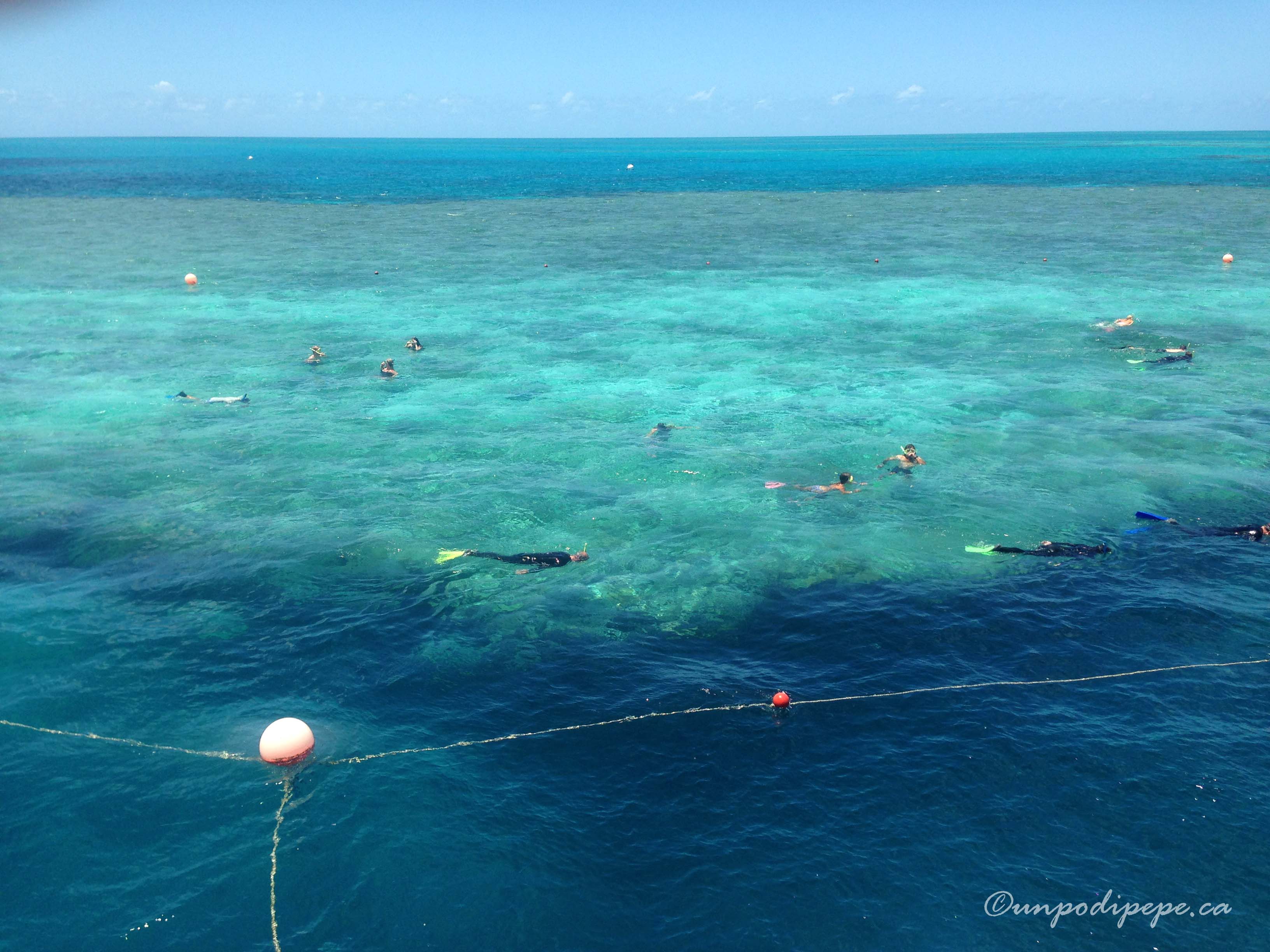
I took a daytrip to the Great Barrier Reef, a world heritage area which is the only living thing visible from space!  It took 2 hours to get to a large pontoon next to Hardy Reef where I spent 4 hours before heading back.  The pontoon had snorkel and scuba equipment, and a semi-submersible with glass sides.  I met someone on the pontoon who had done ‘Reefsleep’, spending the previous night on the deck.  He said ‘at 8 pm they turned off all the lights and God turned on the stars’.  Wow.Reefworld

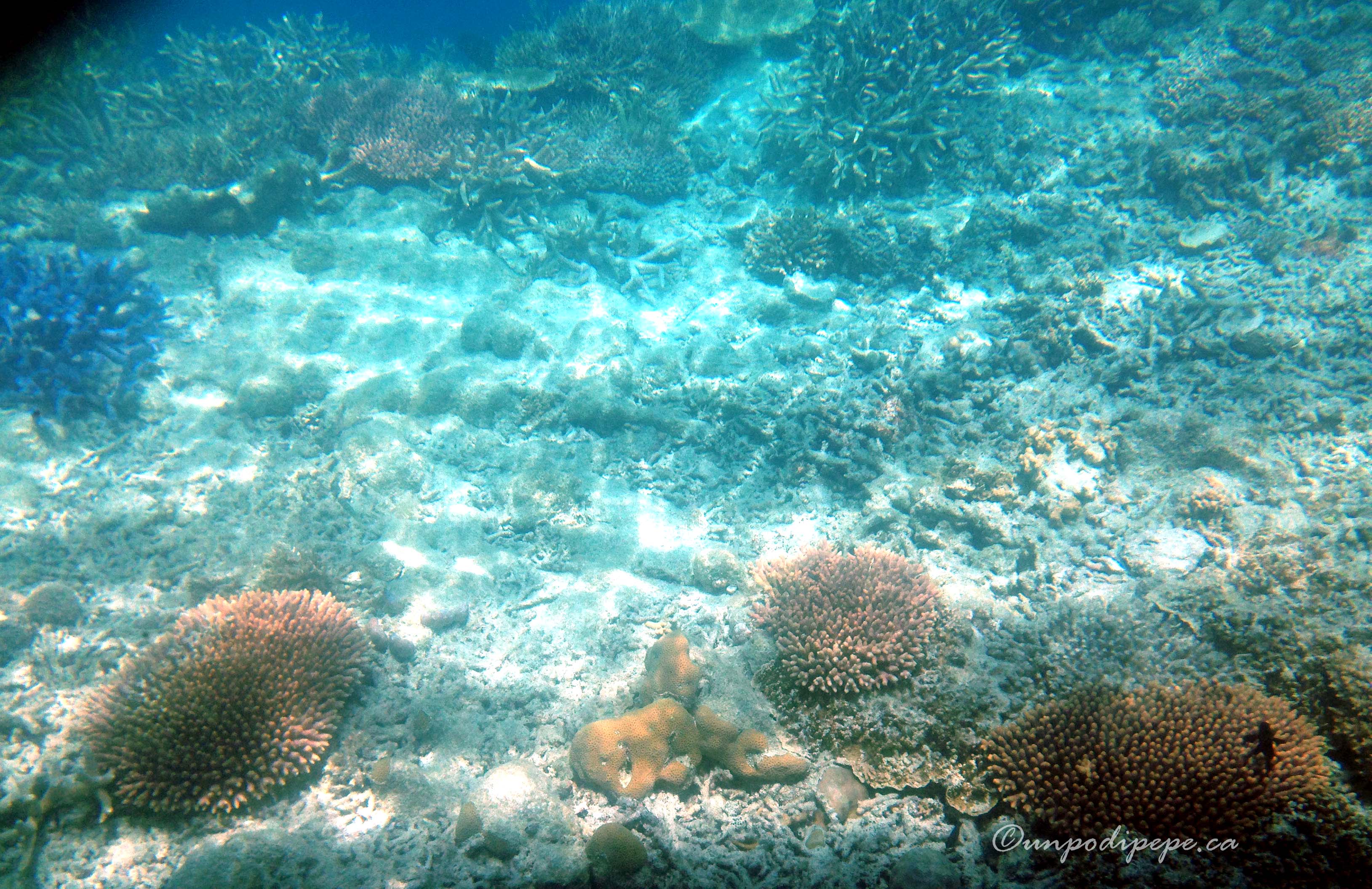
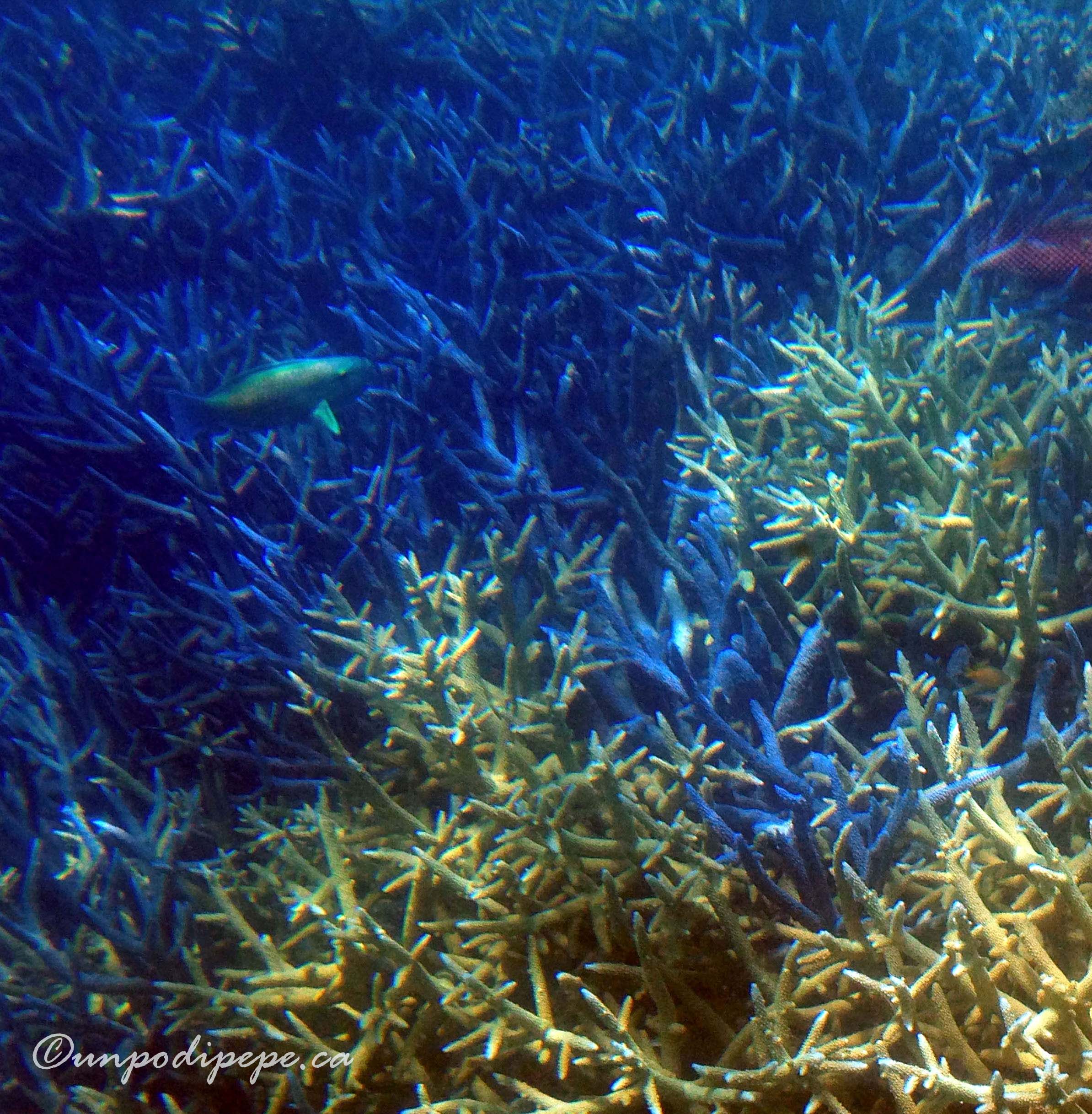
I went snorkeling and it was spectacular-although I must admit I was terrified.  I’m not a strong swimmer and don’t like to be in deep water.  They recommended we wear ‘stinger suits’ because in warm deep water there can be tiny jellyfish called Urukandji that are very dangerous.  They are found mostly in the Australian summer and farther north near Cairns, but everyone is extremely safety conscious.  Greatbarrierreef3I had trouble keeping the camera still, so my reef photos are a bit blurry.  The only time in my life I would have liked one of those ridiculous selfie sticks! Photos can’t capture the reef like being there.  I saw hundreds of little fishies, but did not end up finding Nemo. Greatbarrierereef1

Underwater sunshine!

Underwater sunshine!

ReeffishWhen I went for a ride in the semi-sub, I was so glad to be out of the water because I saw un squallo-a reef shark!  Eek!  I know, they are small, apparently ‘harmless’, eat small fish and are afraid of people, but I don’t think the words ‘harmless’ and ‘shark’ should ever be used in the same sentence. There was a scuba underwater marriage proposal.  Staff divers helped him roll out a big cloth that said ‘Will you marry me?’, and she said ‘yes’!

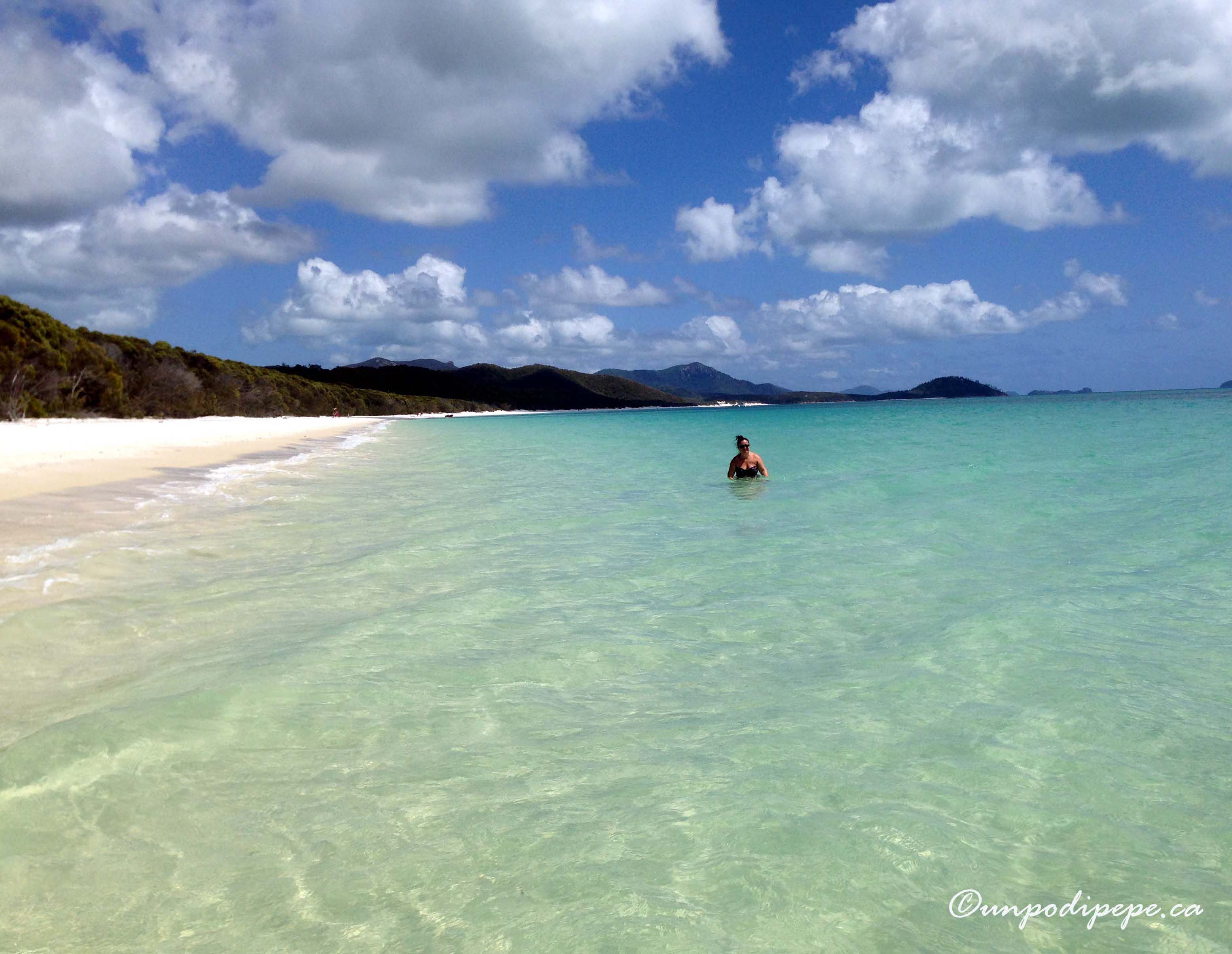
WhitehavenWhitehaven Beach, on Whitsunday Island really should be called ‘Whiteheaven Beach’.  It’s 7 km of pure white silica sand that doesn’t get hot no matter what the temperature is.  The island has been a protected National Park for 30 years and it looks just as stunning and unspoiled as it did in 1988.  Whitehaven is considered the most beautiful beach in Australia and among the top 10 in the world.whitehavenbeach

One evening I went kyacking to watch the sunset over Dent Island and Plum Pudding Island-yes there really is an island called Plum Pudding!  Along the way, a big slimy green head with droopy eyes came up out of the water beside my kyack, opened it’s mouth, took a giant breath then dove back in.  Then I saw it’s shell and realized it was not a sea monster, but a sea turtle.kyackingwhitsundays

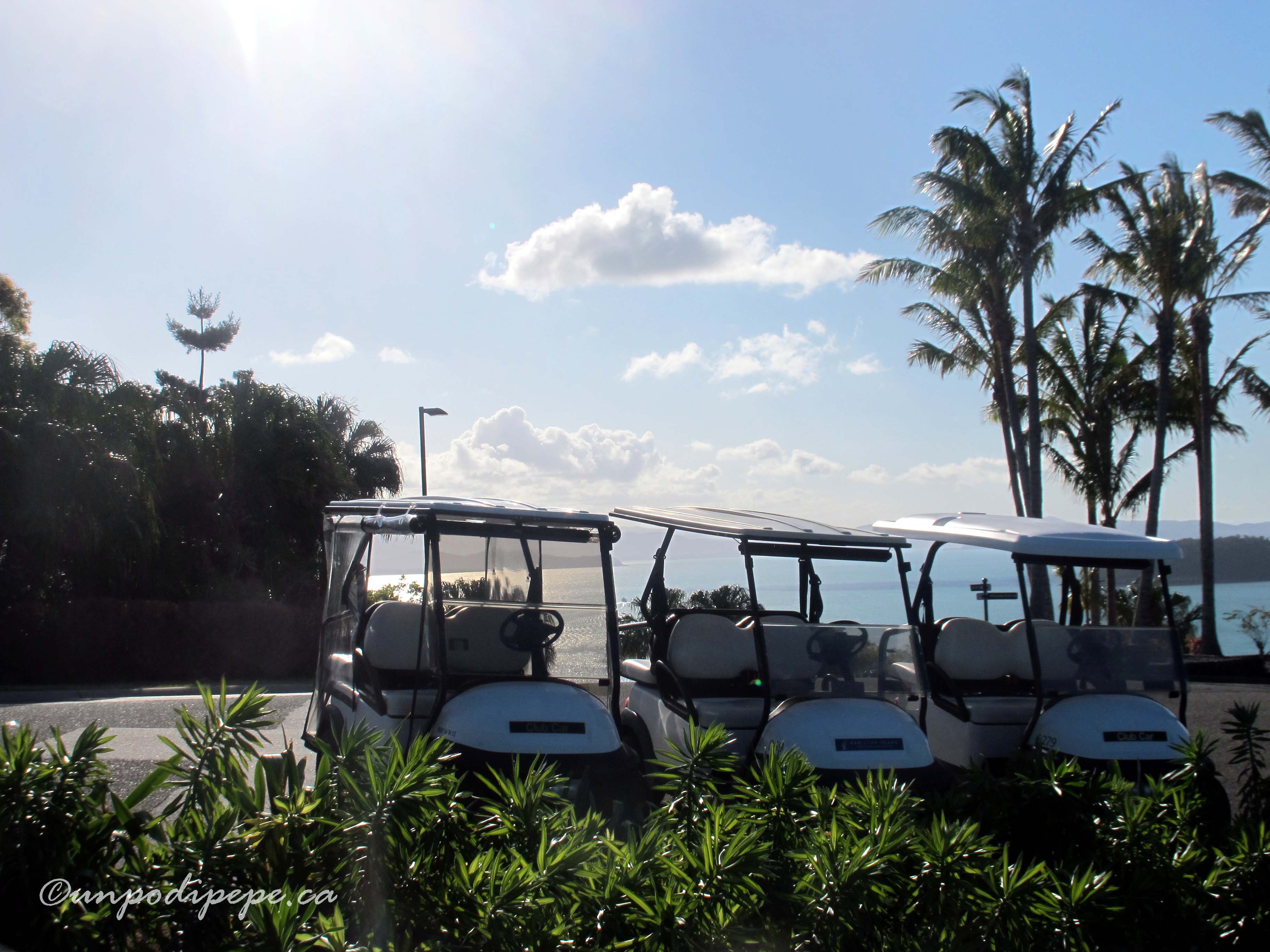
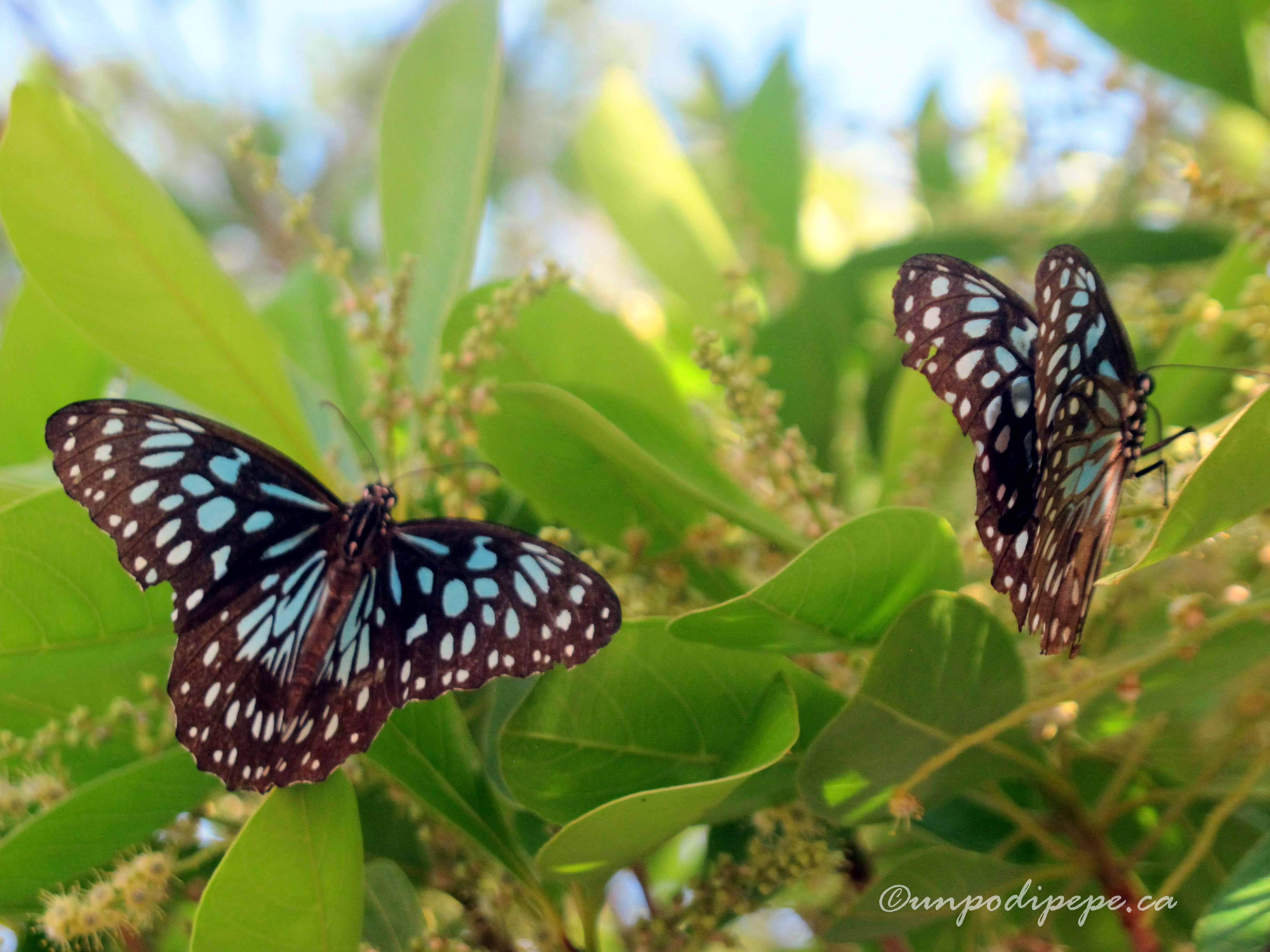
While kyacking, I was invited to Trivia Night at the Marina Tavern.  My team won and my prize was 24 hours of ‘buggy hire’.  The Whitsundays are car-free.  On Hamilton Island, you can get around on the free bus, or with a buggy-an electric golf cart.  BuggieshamiltonislandMy new friends from Argentina and I went cruising around and drove to the Church up the hill.  Since it was spring, there were farfalle (butterflies) everywhere.  Thousands of them!  They even flew through the open window while I was attempting to drive on the other side of the road.  Luckily I didn’t hit anything!ChurchhamiltonislandFarfallehamiltonisland

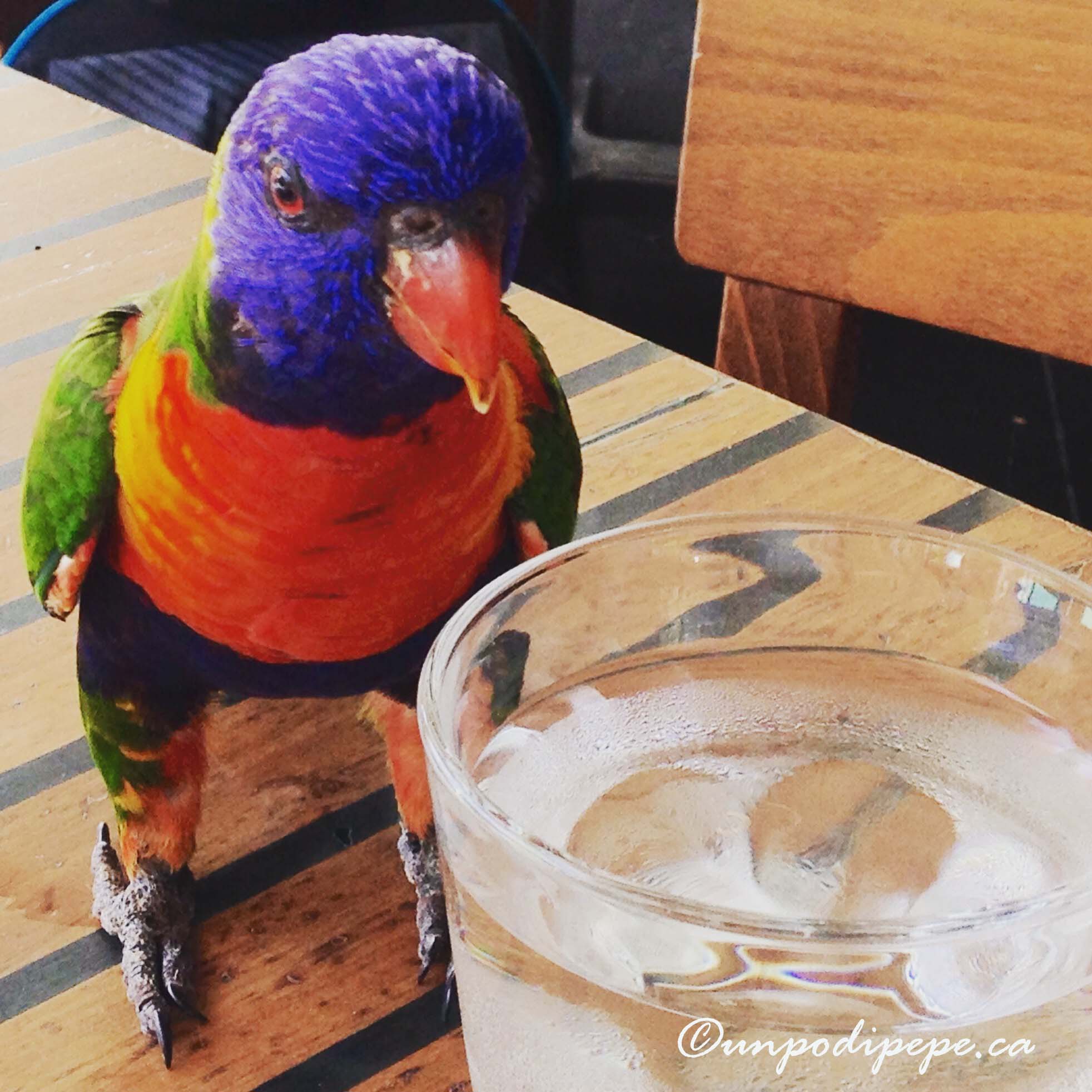
FarfalleThere was a lot of wildlife on Hamilton Island besides the farfalle.  One night I saw a wallaby as I walked back to the hotel, another night a possum.  Beautiful Rainbow Lorikeets flew all over, and became very friendly when they saw food!  Rainbowlorikeet2Lorenzo the cockatoo hung out on my balcony.  Why did I call him Lorenzo?  If you have seen paintings of Lorenzo de’ Medici’s naso (nose), you will understand!CockatooLorenzo  I hope you have enjoyed this photo journey to the Whitsundays!  Ciao, Cristina

Share this:

  • Share on Facebook (Opens in new window) Facebook
  • Share on Pinterest (Opens in new window) Pinterest
  • Share on X (Opens in new window) X
  • Email a link to a friend (Opens in new window) Email
  • Share on WhatsApp (Opens in new window) WhatsApp
Like Loading...

Giù di Sotto

21 Wednesday Oct 2015

Posted by Un po' di pepe in Photography, Travel

≈ 18 Comments

Tags

Australia, Australia travel, Brisbane, Lone Pine Koala Sanctuary, Manly, Manly Beach, Queensland, Redcliffe, Sydney, Whitsundays

Sydneyharbour‘Giù di Sotto’… is my attempt at ‘Down Under’ in Italiano. As some of you know, or figured out from my Instagram posts, I was in Australia for a few weeks. 8 days in Brisbane for a work-related course and conference, then a week of vacation. A week isn’t long, so I had to plan wisely. When I visited Australia in 1988, sailing in the Whitsundays was my most memorable place, so I decided to spend 5 days there and 2 days in Sydney before flying home. This is the first of 2 blog posts with a few scatti (shots) to highlight my quick but fabulous trip.

The Lone Pine Koala Sanctuary in Brisbane is the oldest and largest in Australia.  Koalas are molto cute.  I cuddled a koala named Cat right after she woke up from her nap and she smelled like eucalyptus. Koalas sleep 18-20 hours a day!  Their diet is only eucalyptus leaves, so their bodies have adapted to this very low energy diet.  So much for the theory that you can lose weight by eating very little!Koaladiptych

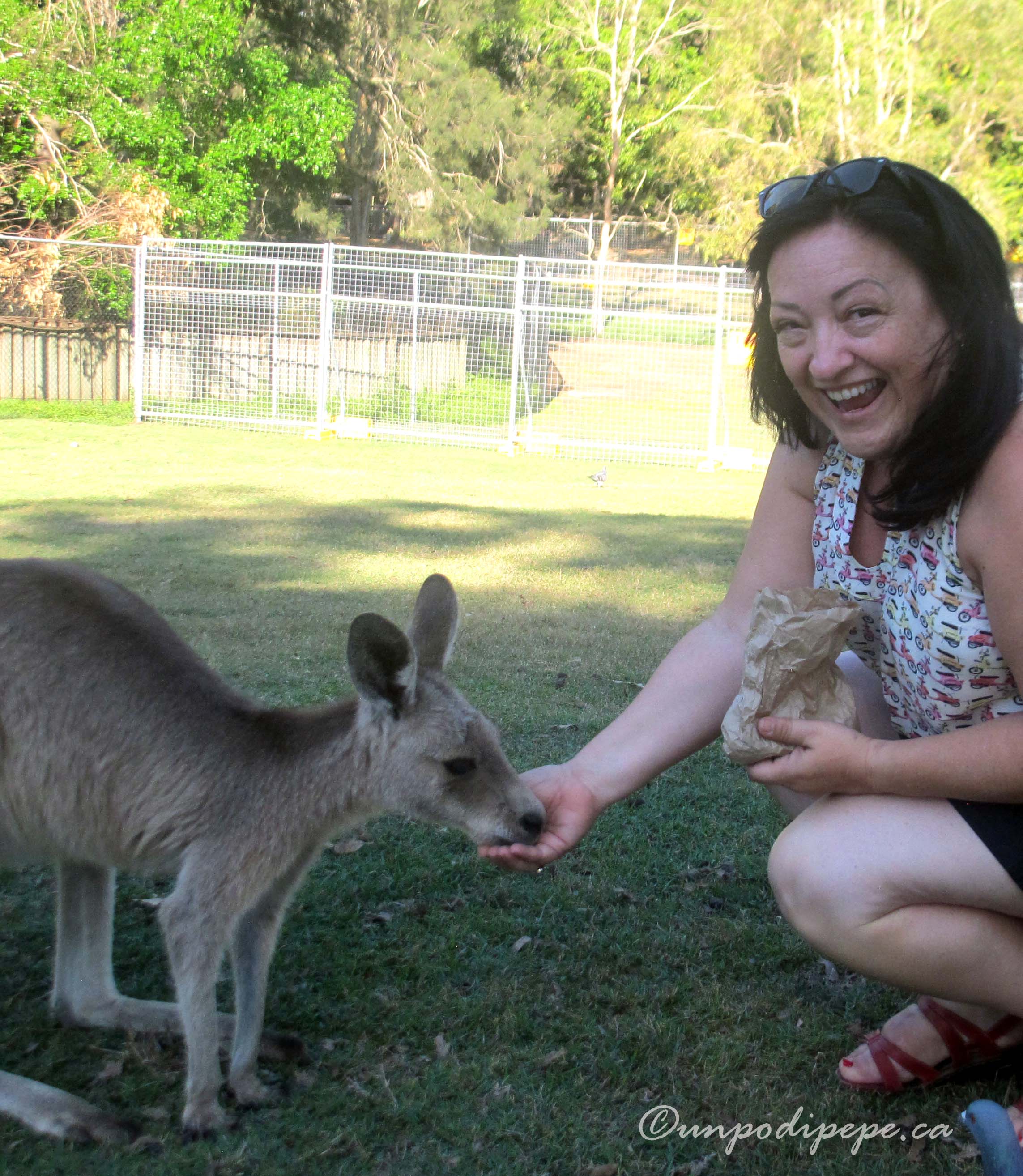
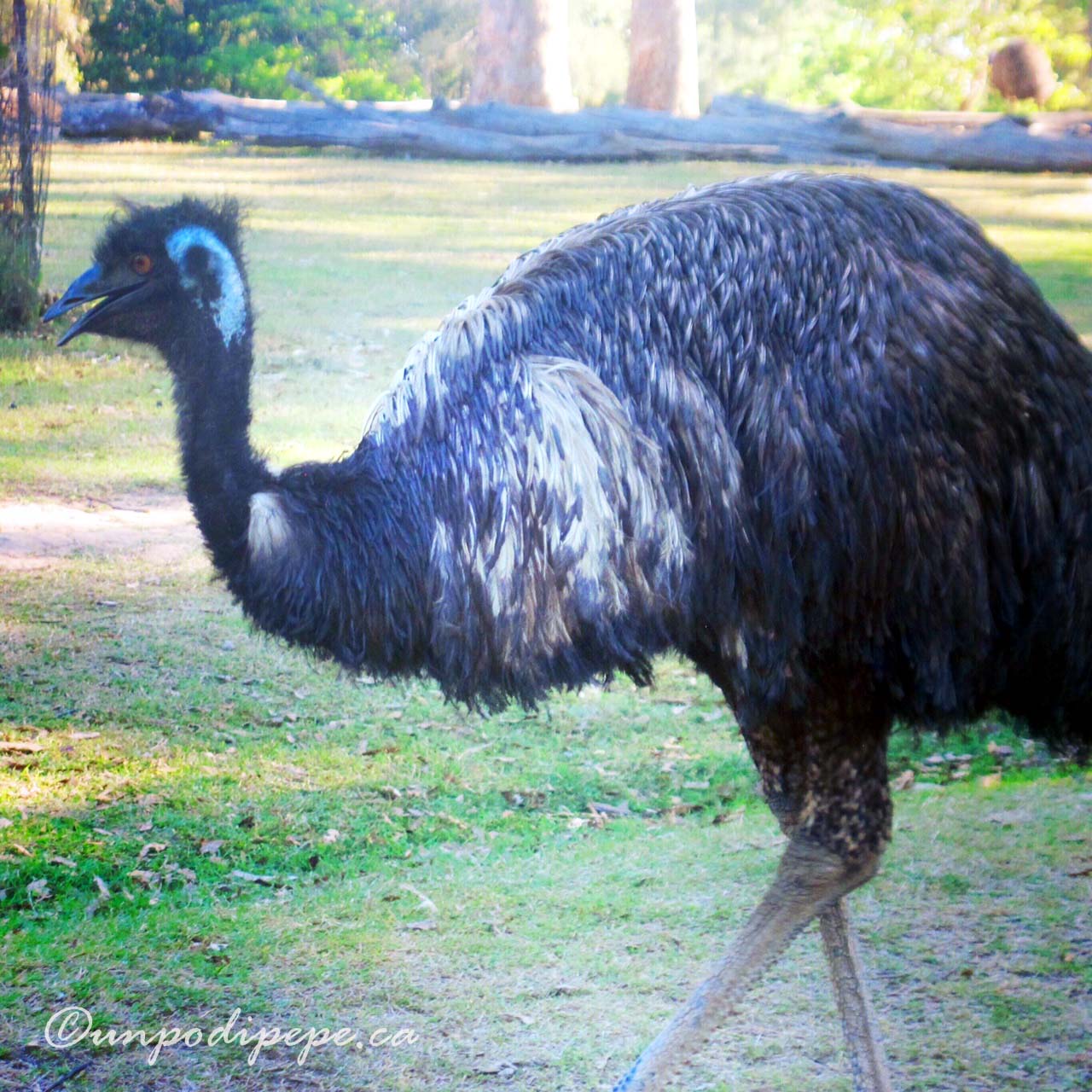
I also fed free-roaming canguri (kangaroos) while trying to keep an aggressive emu and Australian Bush Turkey from stealing my bag of kangaroo food.Canguro

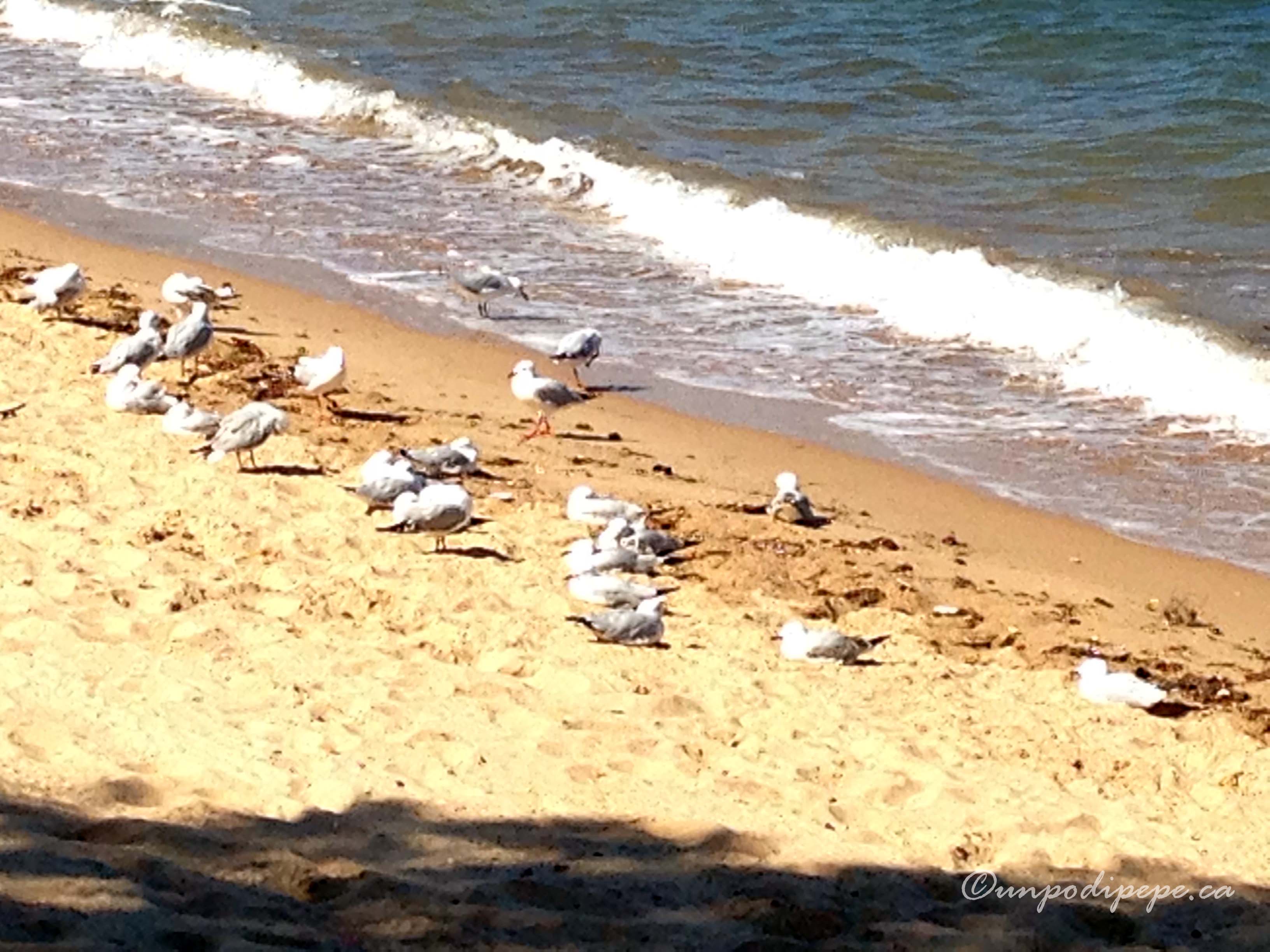
aggressiveemuI met up with Lyn and  Zoë, 2 virtual friends/fellow bloggers in Brisbane, which was molto cool. Lyn and I went to Redcliffe, where the Bee Gees are from.  The beach was nice, and we saw Australian gabbiani (seagulls).  They are so tiny!Redcliffegabbiani

One night while walking along Brisbane’s South Bank, I noticed people holding paper lanterns and I knew I should investigate.  I bought a lantern and joined the crowd.  It was the ‘Light the Night’ 3Km walk for leukemia, held all over Australia.Brisbanelightthenight

My last day and a half was in Sydney and I actually had to wear a jacket at night!   Sydney is a really large, spread out city of 4.8 million.  About 23 million people live in Australia, so that is 20% of the whole population! I spent a lot of time on ferries, which is a great way to see the city if you don’t have a lot of time.Sydneyoperahouse

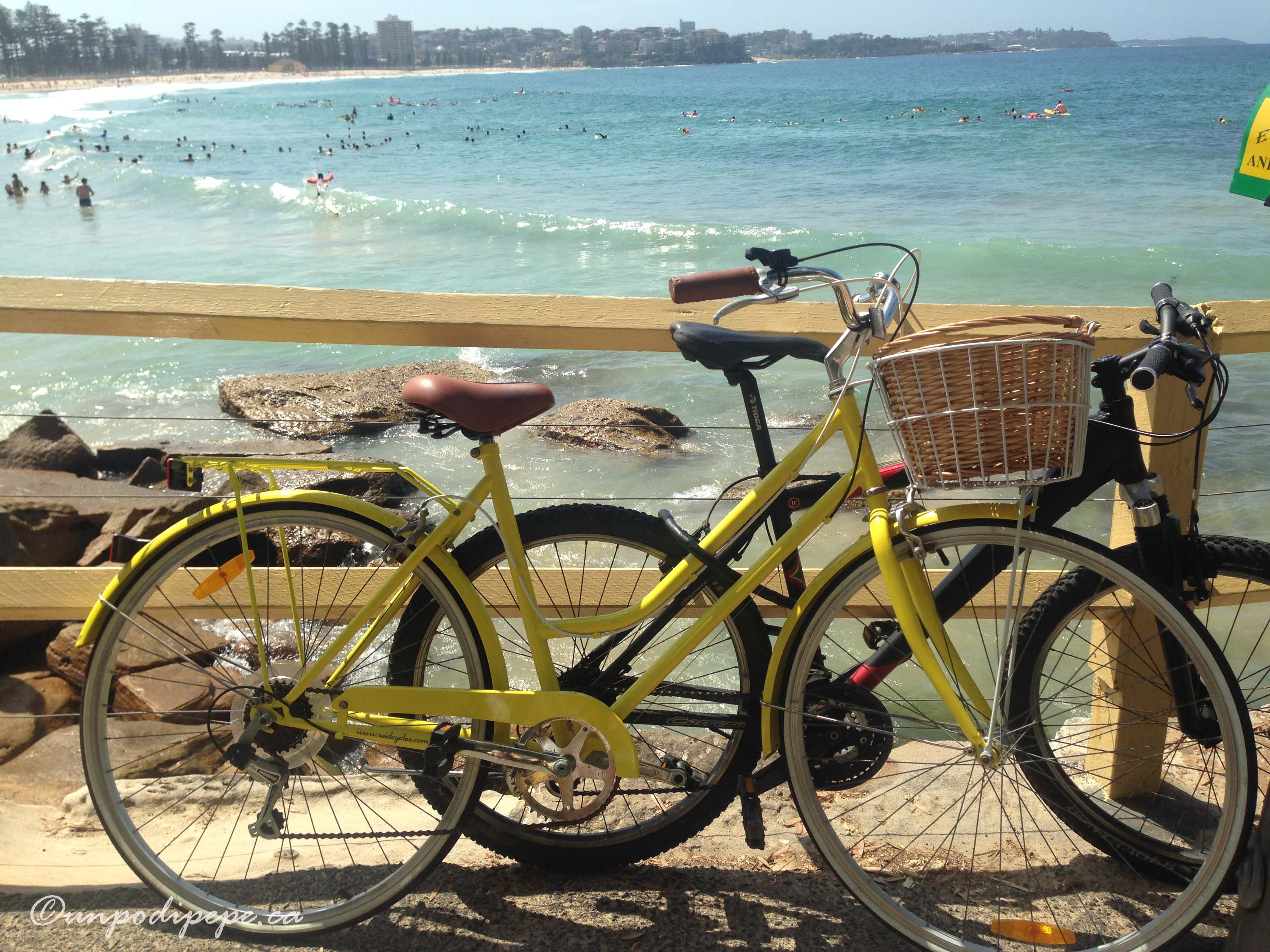
I took the ferry to Manly and met a friend.  Jelena and I had a wonderful day at the beach, walking and watching surfers ride the waves.Manlybicicletta

ManlysurfOn the ferry back to Sydney, the harbour was filled with sailboats.  SydneysailboatsChe peccato l’Australia è troppo lontano!  What a pity Australia is so far away!  I didn’t meet a single grumpy person the whole time I was there!  Hopefully it won’t be another 27 years before we meet again!  Check out some seriously beautiful Queensland scatti in ‘The Whitsundays~Giù di Sotto Part 2’.  Ciao, Cristina

Share this:

  • Share on Facebook (Opens in new window) Facebook
  • Share on Pinterest (Opens in new window) Pinterest
  • Share on X (Opens in new window) X
  • Email a link to a friend (Opens in new window) Email
  • Share on WhatsApp (Opens in new window) WhatsApp
Like Loading...

I Sassi di Matera

04 Sunday Oct 2015

Posted by Un po' di pepe in Italia, Photography, Travel

≈ 15 Comments

Tags

Basilicata, Carlo Levi, Chiese Rupestri, European Capital of Culture, I Sassi di Matera, Italian history, Italy travel tips, Luisa Levi, Matera, Sasso Barisano, Sasso Caveoso, Southern Italy, UNESCO World Heritage Sites

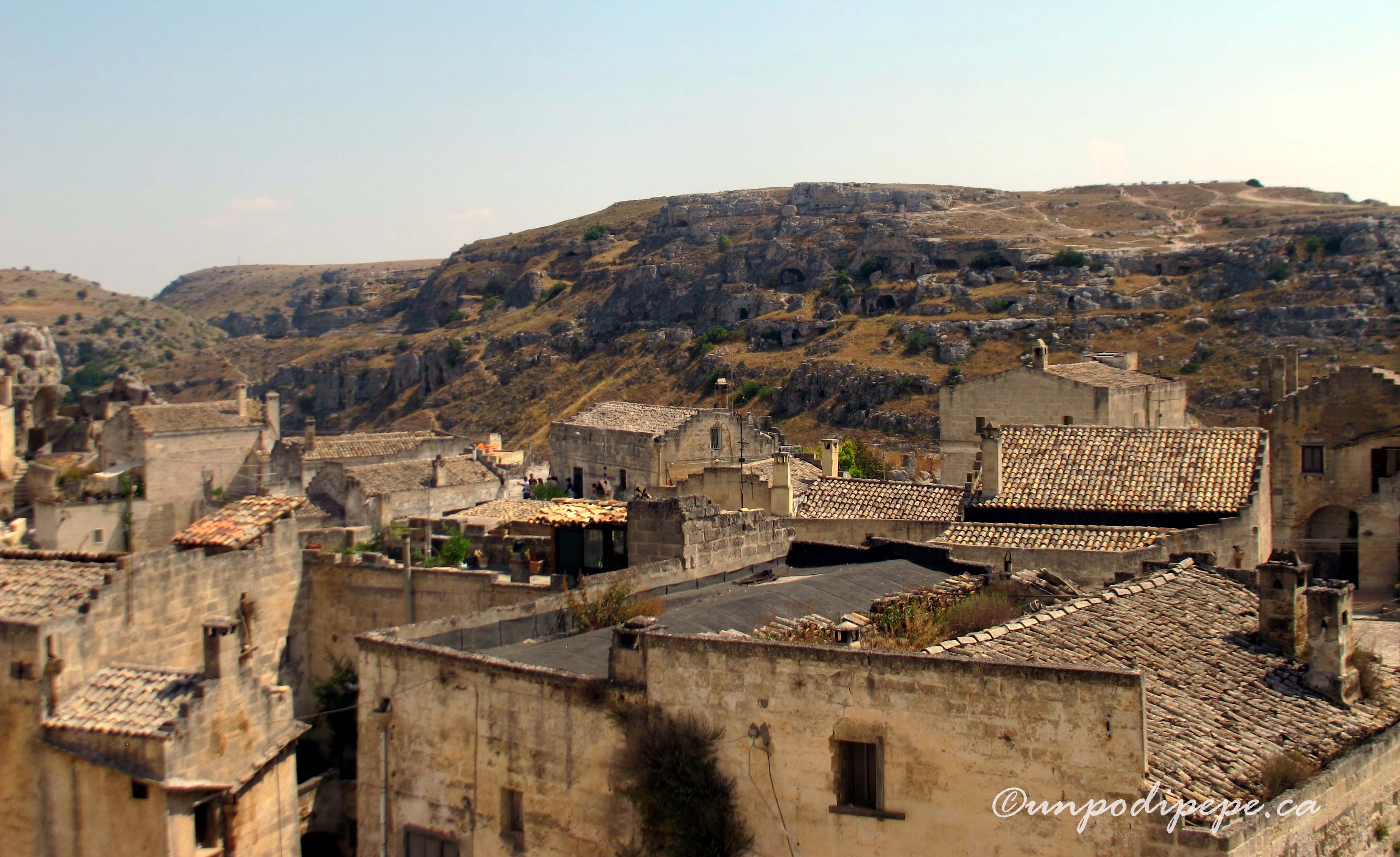
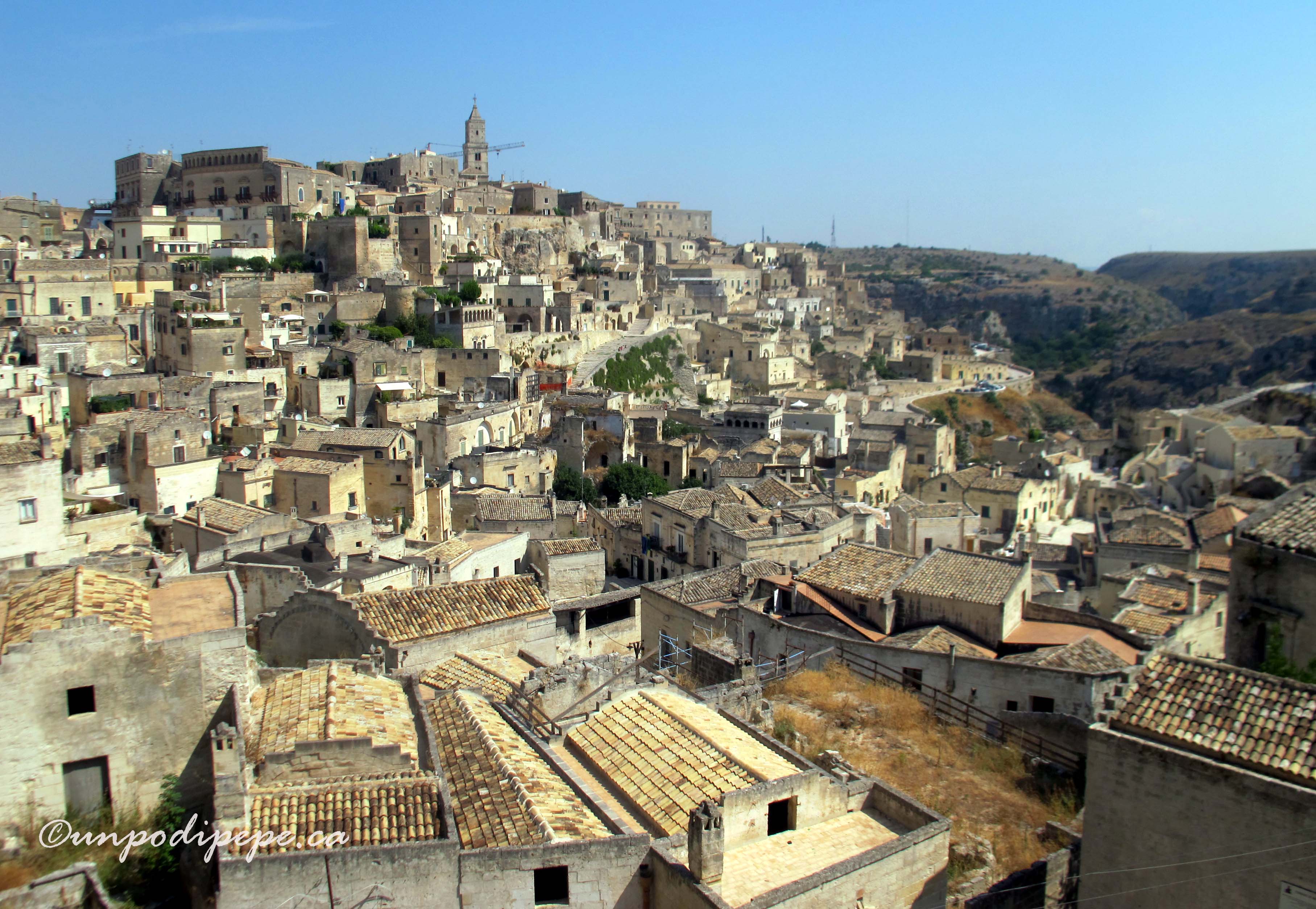
MateraMatera is a rock-cut settlement in Basilicata, the most isolated, least visited region of Italia. It is one of the world’s oldest living cities, continuously inhabited for over 9,000 years.  Clinging to a 300m gravina (ravine) carved out by the river below, Matera seems to rise straight up from the earth, built in 2 natural basins. These basins are the ‘Sassi’ districts, Sasso Caveoso and Sasso Barisano. Sassi means stones and refers to the rock cut cave dwellings. The higher ground in between the 2 Sassi districts is the Civita.  Above the Sassi, on the Piano (plain/plateau) modern Matera is barely visible. The Piano was originally used for agriculture and water collection.Materagravina
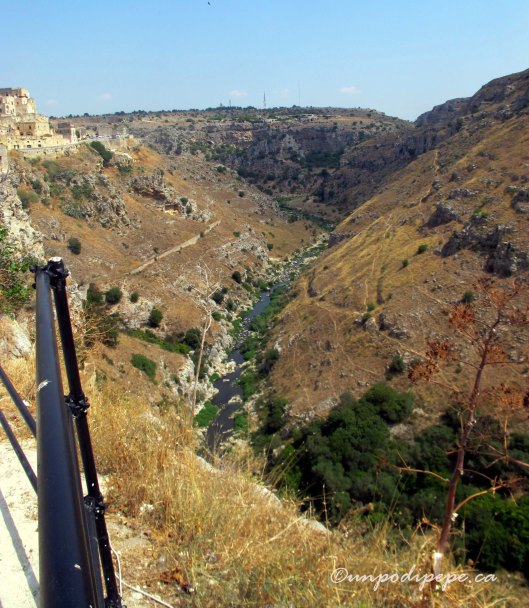
Across the canyon, the west side of the gravina is the Murgia Plateau and the Parco Archeologico Storico Naturale delle Chiese Rupestre Materano. The original stone-age settlement was on this side.  The Parco Archeologico is filled with grotte (caves), Chiese Rupestri (churches carved into the rock), Neolithic villages and tombs. From Matera, the grotte look like little mouseholes. With the invention of tools it was easier to dig into the softer tufo (calcareous rock) on the east side of the gravina and Matera was excavated from this rock.

Grotte (caves) across the ravine from Matera

Grotte (caves) across the ravine from Matera

Materapanorama2The Sassi developed in layers over time, as Matera was home to every passing civilization. On the surface the Sassi look deceiving. House fronts are facades-built in front of, on top of and around caves! Incredible systems of underground cisterns and canals were built to collect and distribute rainwater.Materapanorama5
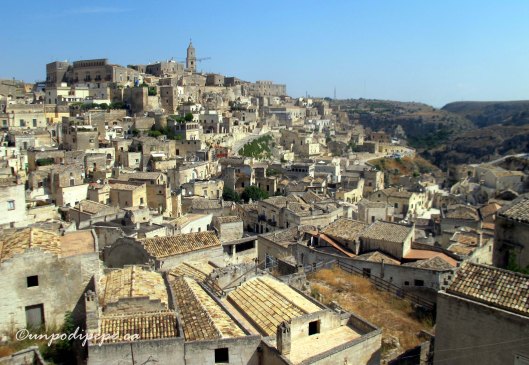
Matera’s isolated location made the area attractive to religious communities. Between the 8th and 13th centuries, Byzantine Basilian monks escaping religious persecution lived in the grotte. There are over 150 Chiese Rupestri with priceless Byzantine frescoes throughout Matera and the Parco delle Chiese Rupestri. By the 15th century, peasants and animals occupied the grotte left by the monks.

Things moved along for the next few centuries. When Matera was the provincial capital 1663-1806, increased activity caused a rise in population. In the 18th and 19th centuries, the wealthier Materani moved into the newer town on the Piano, leaving only contadini and artigiani (farmers and artisans) in the Sassi. By the early 20th century, the Sassi could not accommodate the increased population. Overcrowding plus development of the Piano also affected the water collection systems and led to poor sanitary conditions. With less farmland available, the poverty was unbelievable. Large families shared dark, crowded case grotte (cave homes) with sheep, pigs and goats. Some were only accessible by a trapdoor and ladder. There was no electricity, running water or sewage. It’s hard to imagine these kind of living conditions.

Matera’s situation continued on unnoticed- until the 1945 release of ‘Cristo si è Fermato a Eboli’ (Christ Stopped at Eboli), Carlo Levi’s memoir about his year as a political prisoner in Basilicata in 1935/36. Levi was a doctor, writer and artist from a wealthy family in Torino. He was exiled to a small town near Matera for his Anti-fascist views. Near the beginning of the book, his sister Luisa, also a doctor, needs a permission form stamped in Matera so she can visit him. She describes the Sassi as ‘a schoolboy’s idea of Dante’s Inferno’. She states ‘I felt, under the blinding sun as if I were in a city stricken by the plague. I have never in all my life seen such a picture of poverty. ..This is how 20,000 people live!’ There was a 50% infant mortality rate, malaria, dysentery and trachoma. Eboli is south of Napoli and the title is a local expression suggesting that Christ didn’t make it as far as Basilicata so they are beyond civilization and hope.Materasassibn
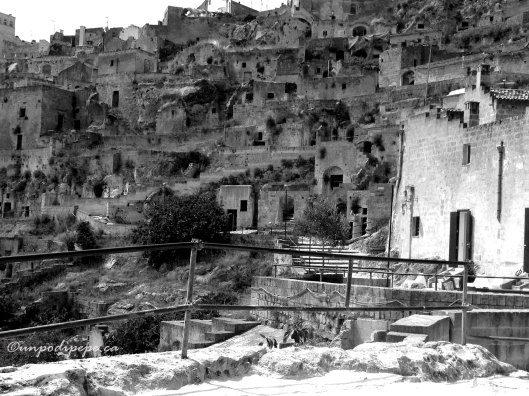
Carlo spends a few hours in Matera near the end of the book and says ‘I had time to see the town and then I understood my sister’s horror, although at the same time I was struck by it’s tragic beauty’. I’ve read this book twice and definitely recommend it. It is very philosophical and it is obvious from Levi’s writing and painting that this experience affected him profoundly. His paintings from Basilicata are on display in the Museo di Arte Medievale e Moderna in Palazzo Lanfranchi.

Levi’s book became internationally known and brought to light the living conditions in Basilicata. Matera became ‘La Vergogna Nazionale’ the National Shame. The Sassi were declared unsafe and unsanitary, although only 30% were actually unsafe. US experts on rural relocation were brought in as consultants. Instead of temporarily relocating the residents while the structurally unsafe areas were fixed, the government forcibly relocated almost everyone to poorly planned government housing. Starting in 1952, 16,000 people were removed from the Sassi to new apartments in the ‘modern town’ that were built facing away from the Sassi. The move isolated families and the community and made them feel ashamed for being poor. An unfortunate example of a patronizing, poorly conceived plan to help people without consulting them or addressing the real problem.Materasassocaveoso3

The Sassi became an archeological ghost town in the 1960’s,mostly abandoned except for a few families who had stayed or moved back in. In the 1970’s squatters, local hippies, artists and drug dealers lived in the Sassi. A group of young locals formed Circolo La Scaletta, an organization that lobbied for restoration of the Sassi and protection of the frescoes. One of their supporters was Carlo Levi, now an Italian senator. Yeah Carlo! In the 1980’s laws were passed protecting the Sassi and Chiese Rupestri.

In 1993 the Sassi finally went from shame to fame when UNESCO declared I Sassi di Matera e il Parco delle Chiese Rupestri a world heritage site. Calling it ‘the most outstanding intact example of a troglodyte (cave dweller) settlement in the Mediterranean region, perfectly adapted to its terrain and ecosystem’. Today about 3,000 people live in the Sassi. 50% are occupied and more continue to be restored. In Sasso Caveoso, some areas are still unsafe and blocked off. Now Matera has sassi hotels, bed and breakfasts, ristoranti, offices, artisan shops and galleries as well as homes.Materauccelli

Photogenic Matera has played ancient Jerusalem in several movies, including Pasolini’s ‘Il Vangelo Secondo San Matteo’ (1964), Mel Gibson’s ‘The Passion of the Christ’ (2004), and ‘Ben Hur’ (2016).

Matera was selected as the European Capital of Culture for 2019 and will host cultural events raising its visibility and profile internationally.  Luckily, Matera is not the easiest place to get to, which will prevent it from becoming an overcrowded tourist theme park like Capri!

Exploring Matera.  Photo by D Goodheart

Exploring Matera. Photo by D Goodheart

There is something very special about this hauntingly beautiful place.  As I wandered through the alleys and mazes of Matera, I was reminded once again of the amazing courage and resilience of our contadini ancestors.

Stay tuned for more posts about Matera!
Share this:

  • Share on Facebook (Opens in new window) Facebook
  • Share on Pinterest (Opens in new window) Pinterest
  • Share on X (Opens in new window) X
  • Email a link to a friend (Opens in new window) Email
  • Share on WhatsApp (Opens in new window) WhatsApp
Like Loading...

Pesto Genovese

18 Friday Sep 2015

Posted by Un po' di pepe in Mangiamo!, Recipes

≈ 24 Comments

Tags

Basilico, Italian food, Moretum, Mortar and pestle, Pesto, Pesto Genovese, Pesto recipe, Traditional recipes

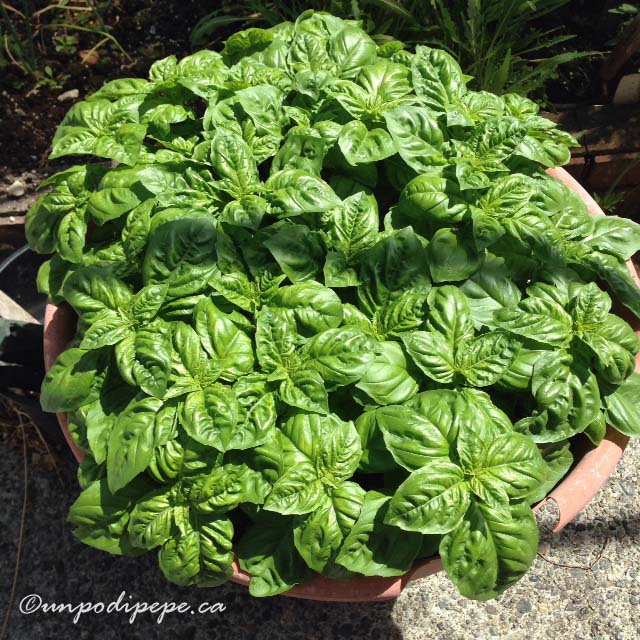
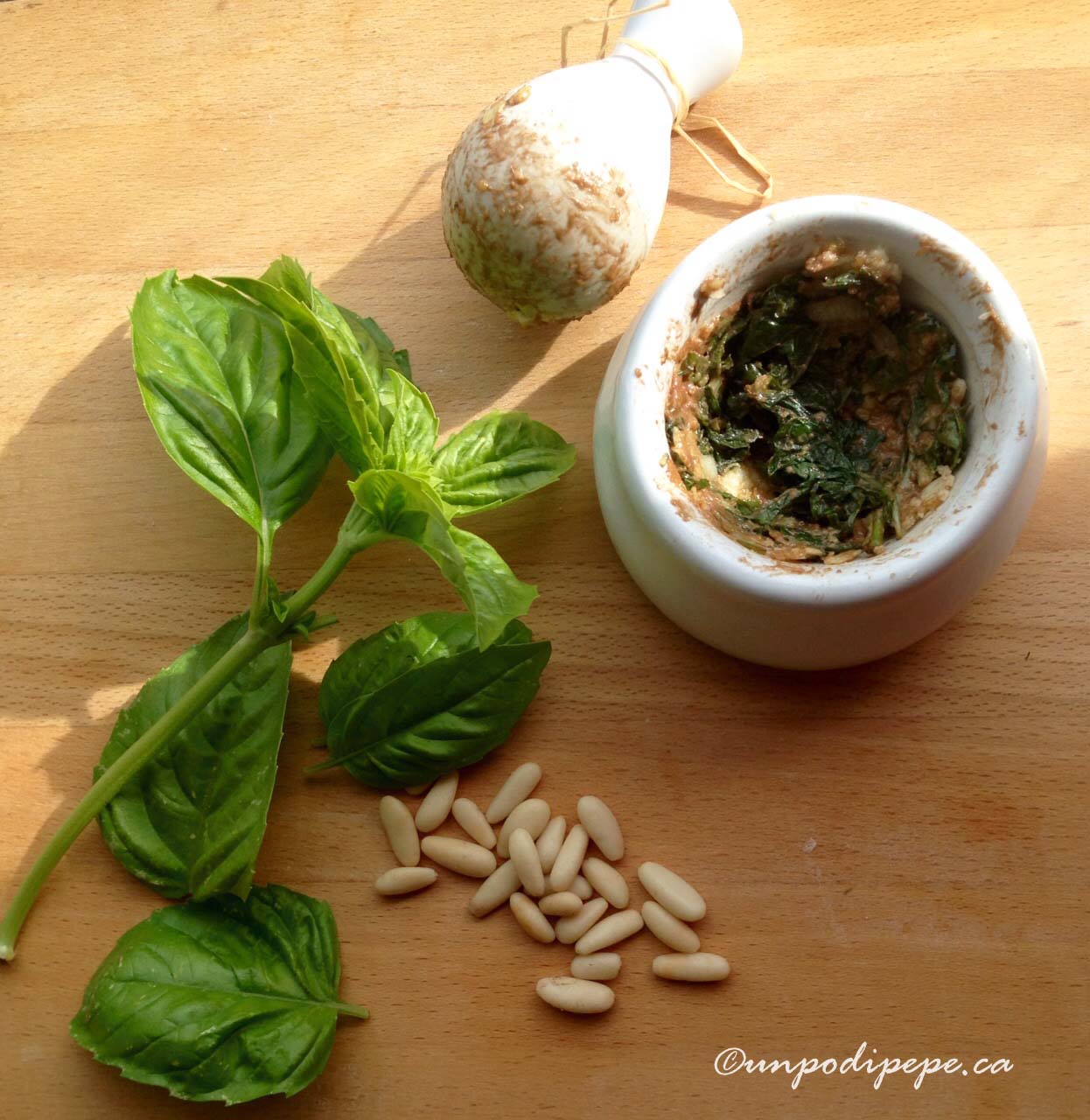
Pesto2This year, I grew basilico (basil) from seed again.  Thanks to the unusually warm summer, my plants were happy and grew nicely.  I love to shake the basilico plant a bit, stick my face in it and inhale the incredible aroma.  Some of my basilico was already used to make passata di pomodoro.  The rest will be used to make Pesto, before it starts to rain and the leaves turn brown.basilico

Pesto Genovese, usually just called Pesto, originated in Genoa, Liguria.  It is made with fresh basil leaves, garlic, pine nuts, extra virgin olive oil, Pecorino Sardo or Pecorino Romano, and Parmigiano Reggiano.

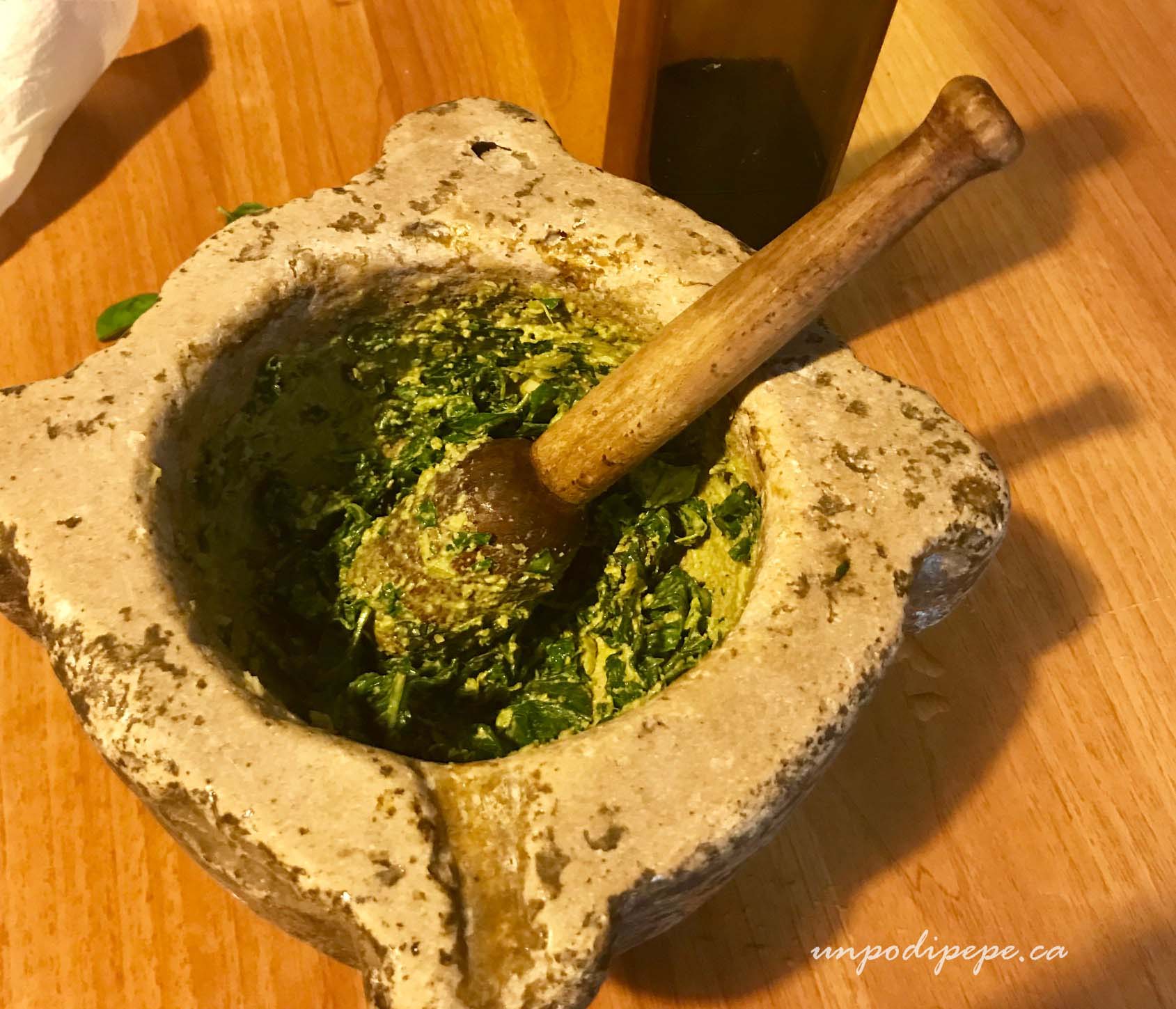
Before the age of food-processors, Pesto was made by grinding the ingredients in a marble or stone mortar with a wooden pestle.  The words ‘pesto’ and ‘pestle’ come from ‘pestare‘ which means to pound or crush.  The most flavourful pesto is actually made by hand with a mortar and pestle, but it is hard work! Pesto made with old stone mortar/mortaioLigurian basilico has very small leaves and is easier to grind.  My basilico tends to have very large leaves and is difficult to crush.  The biggest problem with the food processor is that it gets very hot.  I recommend putting the blades in the freezer for an hour before making pesto.  This prevents the food processor from overheating and the pesto is also less likely to turn brown.basilicobw

The ancient Romans made something similar called Moretum.  They named it after the mortar instead of the pestle!  Moretum was a spread made with fresh sheep milk cheese, herbs, salt, pine nuts and olive oil.

Basilico was likely brought to Italia from India, and the climate of Liguria was perfect for it.  The Genovese adapted the Romans’ recipe to include basilico, and Pesto Genovese was born! In Liguria, Pesto is usually served with trofie or linguine.  It is also used on pasta, potatoes and green beans, all cooked in the same pot of water. Yum!

When I make Pesto, I do not measure the ingredients, but I estimated them here for you. Good quality ingredients are necessary to make delicious Pesto.  No skimping!Pesto Genovese

Pesto Genovese

2 firmly packed cups (500 ml) large basil leaves

3 cloves of garlic

¼ cup (50 grams) European pine nuts

salt and pepper

½ cup (125 ml) good quality extra virgin olive oil

½ cup (45 grams) grated Pecorino Sardo or Pecorino Romano

½ cup (45 grams) grated Parmigiano Reggiano

  • Put the blades of the food processor in the freezer for an hour
  • Wash the basil and dry well.  Water on the leaves will turn them brown and the Pesto will go bad.  Yuck!
  • I like to toast the pine nuts as it brings out the flavour, but this is optional
  • Blend garlic and pine nuts in a food processor until fine
  • Add basil, pulsing a handful at a time until blended
  • Add salt and pepper.  Not too much salt, as the cheese is salty too
  • Pour in olive oil slowly while food processor is running
  • Pour it all into a bowl and add the Pecorino and Parmigiano
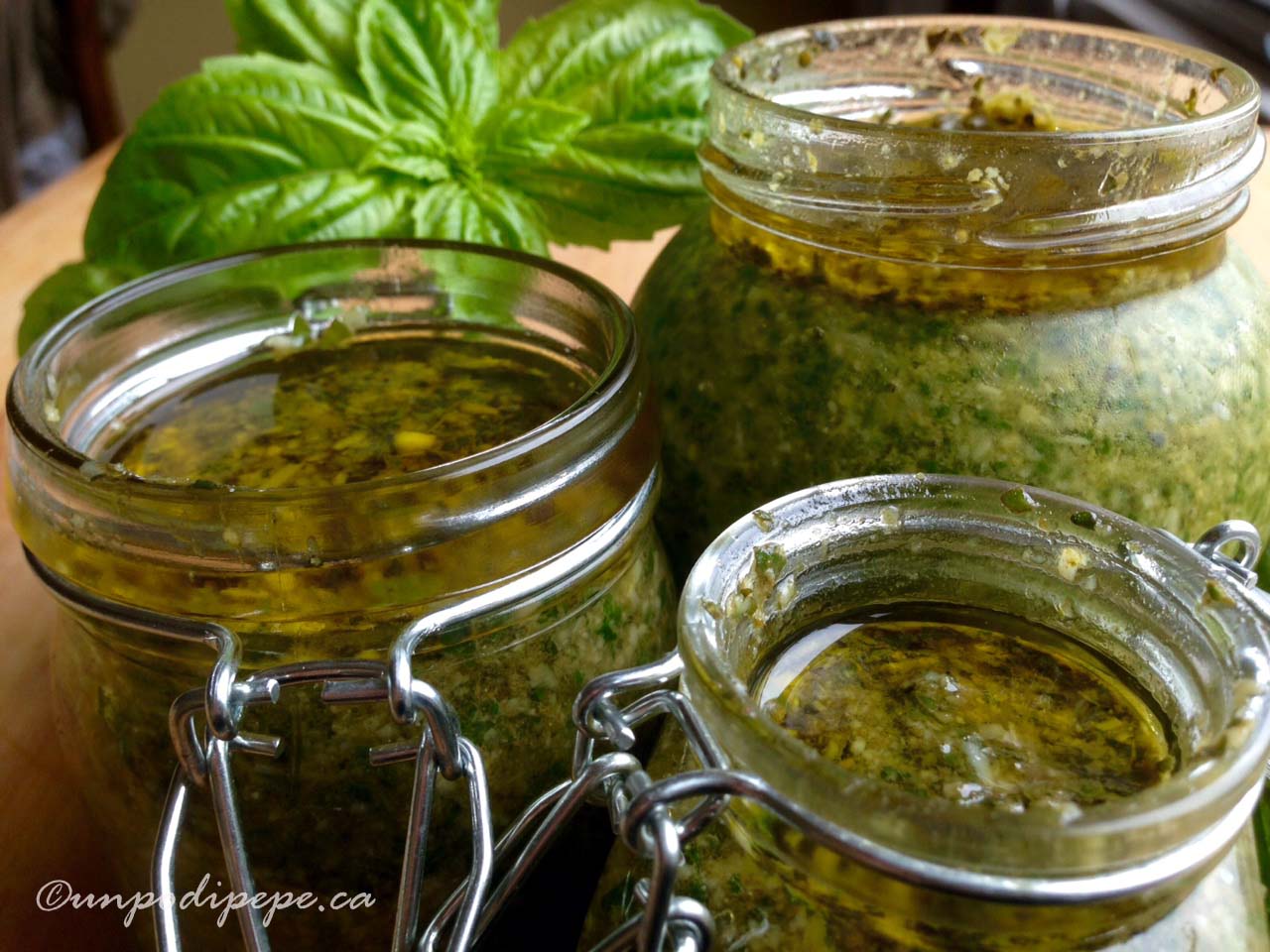
  • Spoon the Pesto into small jars with tight fitting lids
  • Seal the jar with a thin film of olive oil
  • Pesto keeps well in the fridge for 6-8 months.  If you use part of a jar, add another thin film of olive oil before putting it back in the fridge
  • To freeze the Pesto, leave out the 2 cheeses and add them when you are going to use itPesto1

Buon Appetito!

©2015 unpodipepe.ca

basilico4

Share this:

  • Share on Facebook (Opens in new window) Facebook
  • Share on Pinterest (Opens in new window) Pinterest
  • Share on X (Opens in new window) X
  • Email a link to a friend (Opens in new window) Email
  • Share on WhatsApp (Opens in new window) WhatsApp
Like Loading...

Il Pomodoro

07 Monday Sep 2015

Posted by Un po' di pepe in Italian life, Mangiamo!

≈ 24 Comments

Tags

Acqua sale, Antonio Latini, Conserva di pomodoro, Francesco Leonardi, History of the tomato, Italian food, Mediterranean diet, Passata di pomodoro, Pomodori, Tomato sauce, Traditional recipes

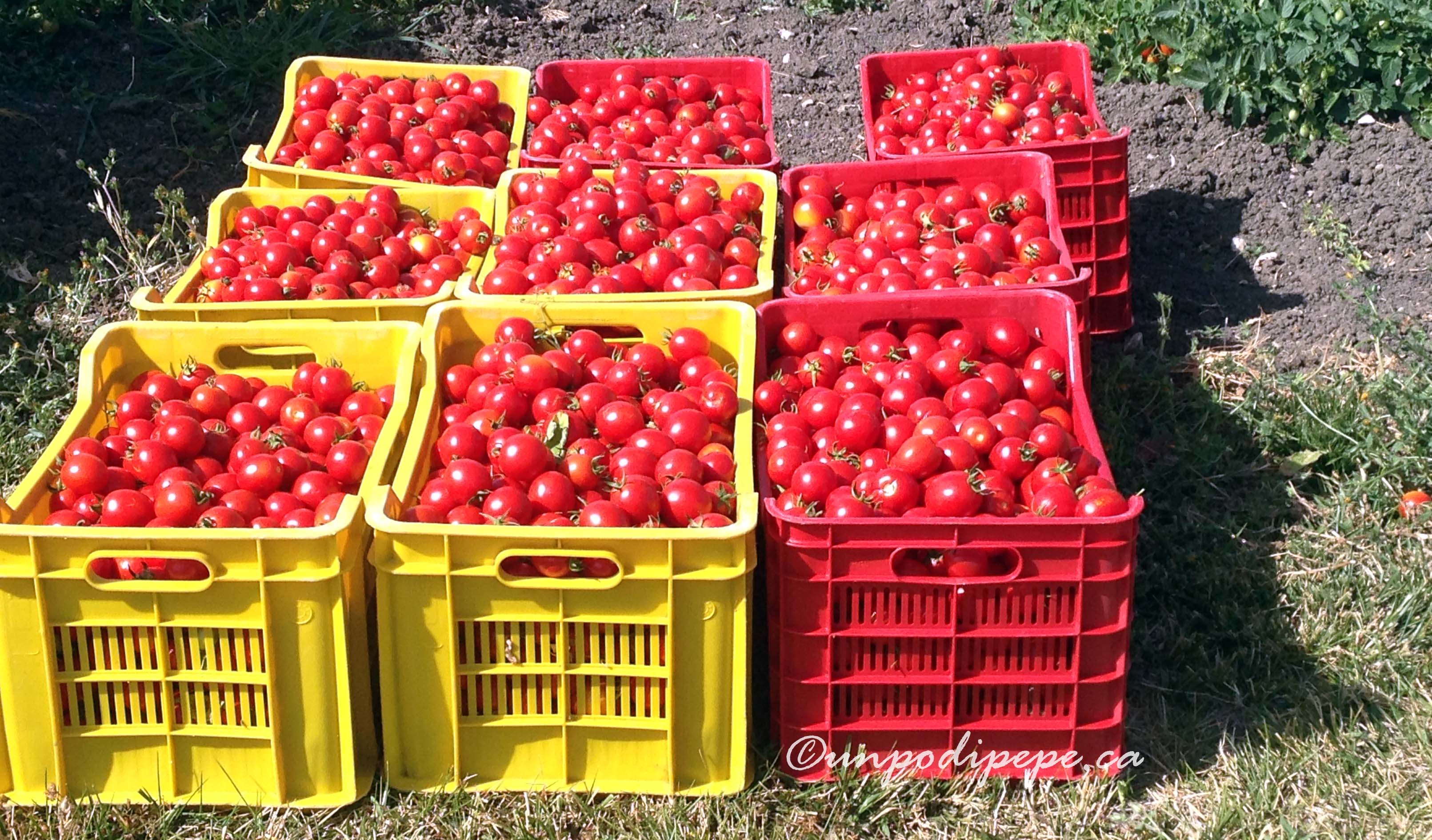
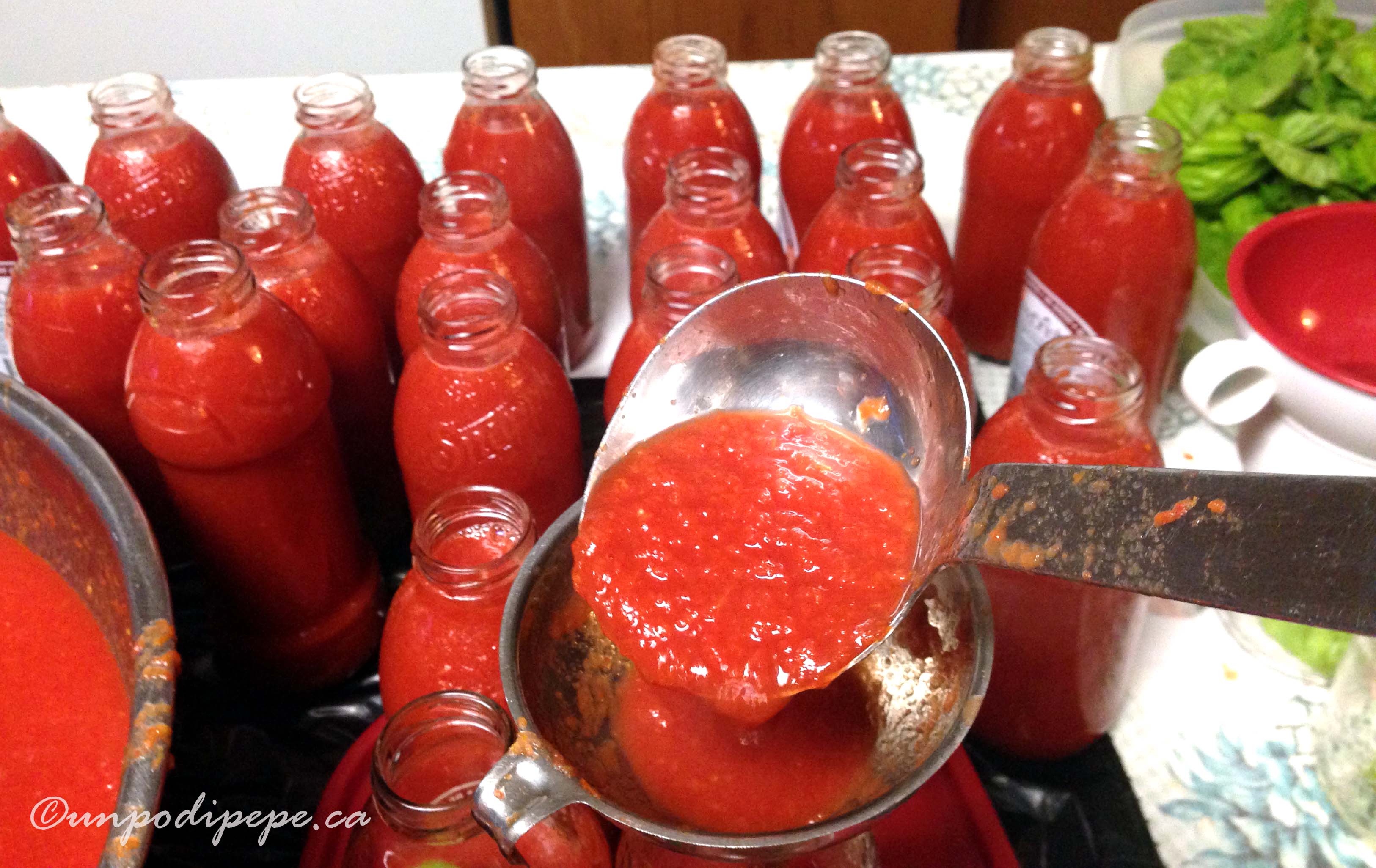
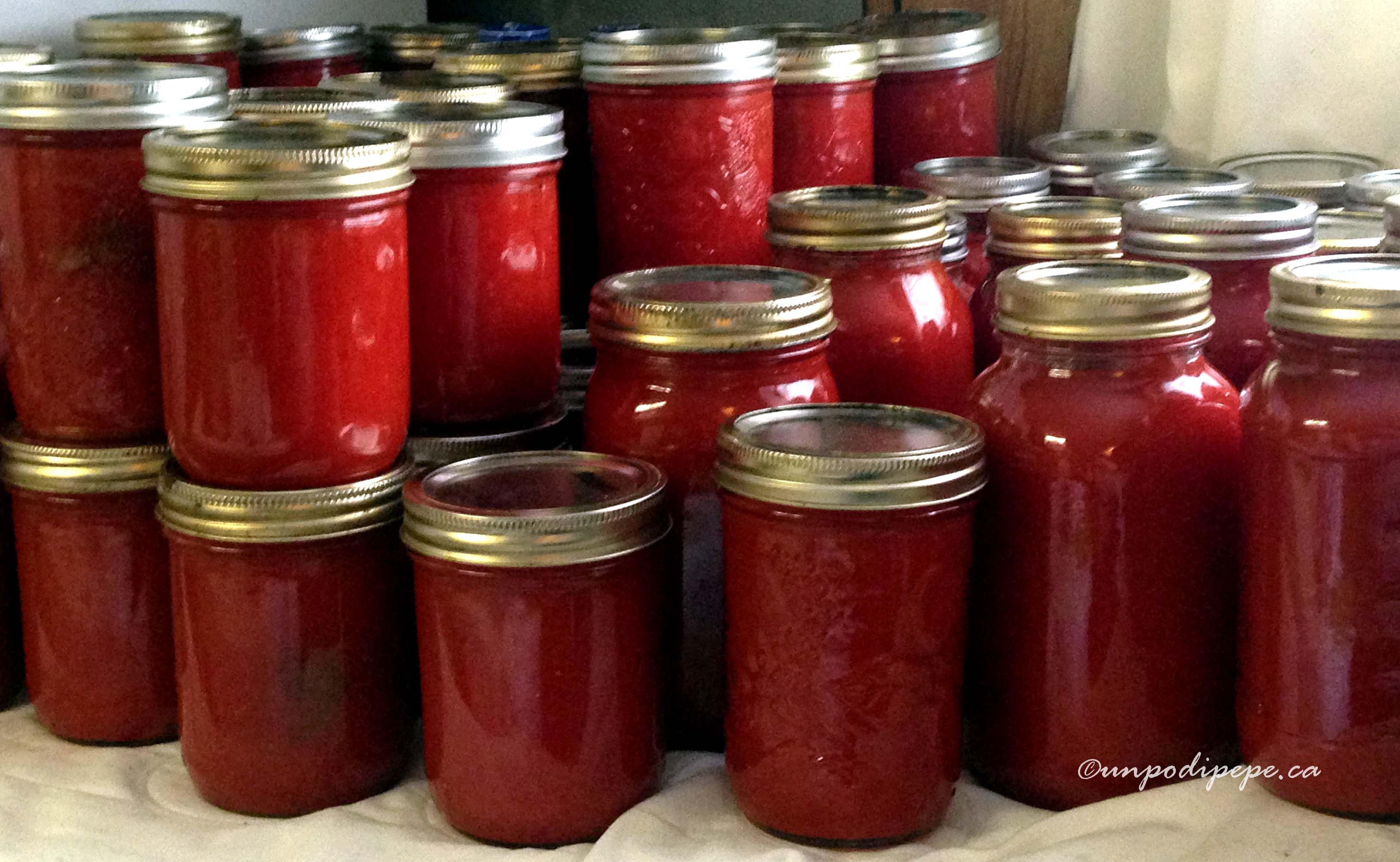
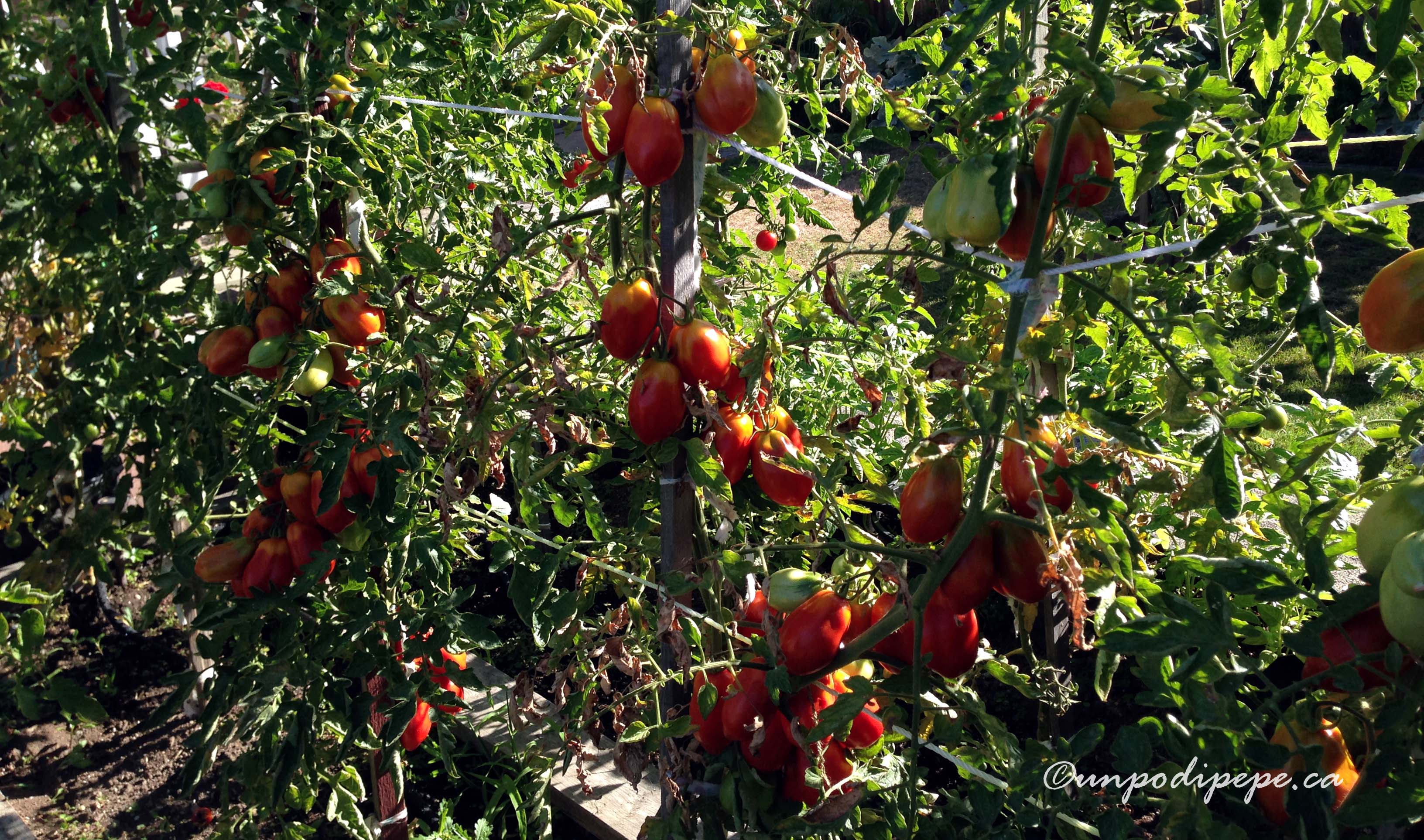
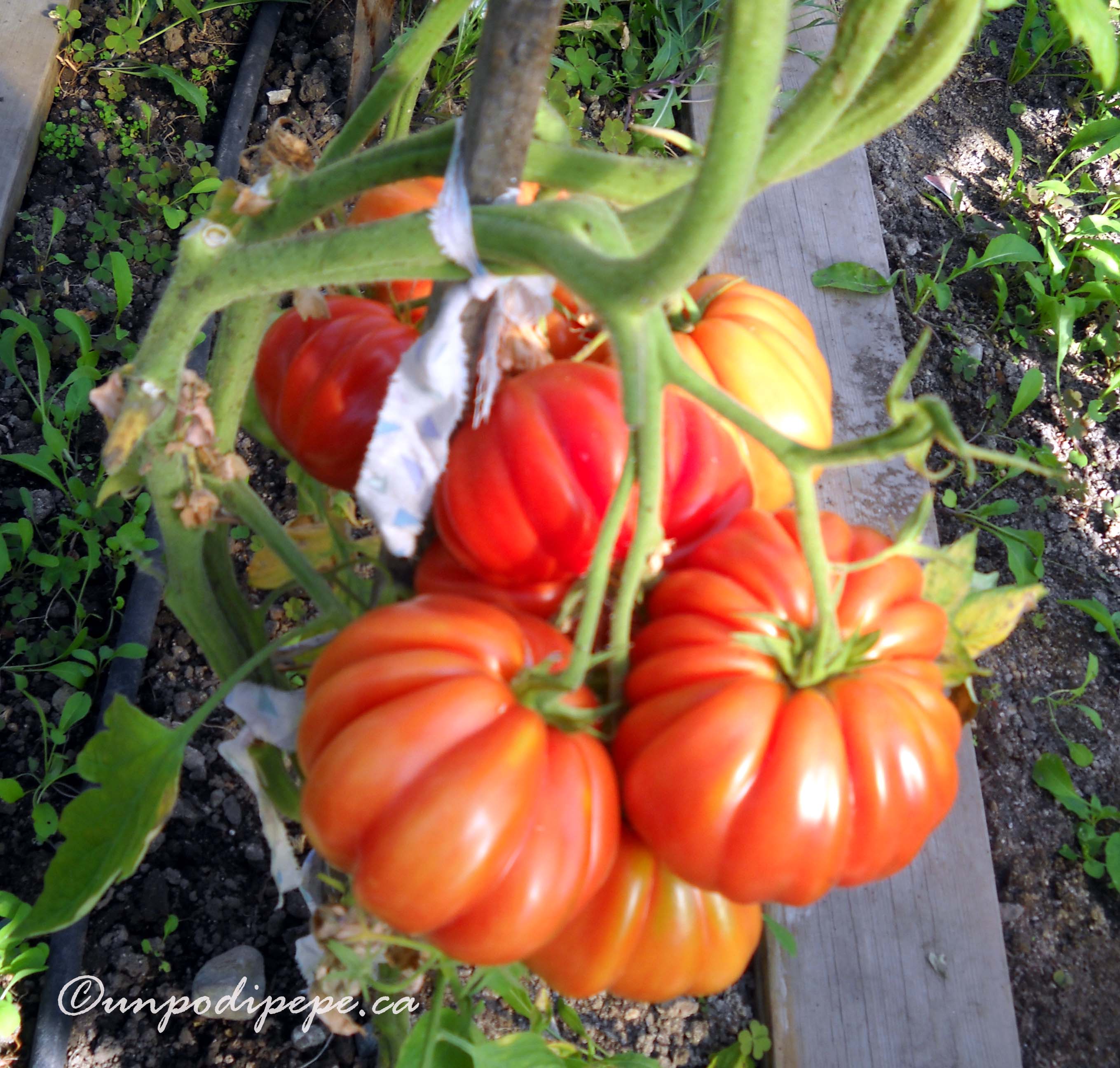
PomodorivillajameleLate August/early September is pomodoro season. Last weekend my family made passata di pomodoro and pomodori pelati in the garage. If you haven’t read last year’s post, check ‘Passata di Pomodoro’ out for a step by step commentary! Passata di pomodoro, or simply ‘salsa’ as we usually call it, is very versatile. It is used to make sugo (tomato sauce) or ragù (meat sauce) and pizza, or added to fagioli (beans) and lenticchie (lentils), minestrone and other zuppe (soups).Salsa2015

To make pomodori pelati, pomodori are cut into quarters, the seeds removed, and then tightly packed into vasetti (jars) with basilico and a spoonful of salt. The vasetti are sealed and cooked, then turned upside down to cool. Pelati are used for pizza al pomodoro and zuppe. They can also be used for making sauces, although I am not a fan of skins and seeds in my sugo!pomodoripelati2015Pelati2015

Canning or bottling pomodori is a yearly domestic ritual for many Italian and Italocanadese families. It’s a lot of work, but totally worth it. All year round you have the taste of summer in a jar!Vasetti2015

The pomodoro was not always such a staple in the Italian cucina. First grown by the Aztecs in Mexico, then also in the South American Andes, the pomodoro was brought to Europe by the Spanish in the 16th Century. The first documentation of pomodori in Italia is a 1548 note from Cosimo de’ Medici’s household to his secretary. The note states that ‘un cestino di pomodori’ (a basket of tomatoes) from one of the Medici estates had been received.  At this time, pomodori were not eaten or used in cooking. They were exotic but their taste was considered really gross, so they were mostly ornamental and sometimes used in potions as an aphrodisiac.  Hmmmm.pomodori2015b

Early pomodori did not taste anything like they do today, and some varieties were even toxic. Fortunately, the Mediterranean climate was ideal for growing the pomodoro.  It was able to mutate and create better tasting, sweeter versions of itself. It did take awhile for anyone to figure out what to do with the pomodoro. I’m really glad someone thought of adding olive oil, basilico, salt and of course, un po’ di pepe!

The earliest recorded recipe using pomodori was in Napoli, in Antonio Latini’s book ‘Il Scalco alla Moderna’.  This translates to something like ‘The Modern Butler’. The recipe was for ‘Salsa alla Spagnuola’, a Spanish condiment made with pomodoro, melanzane (eggplant) and cipolla (onion). Sounds a bit like ratatouille.  The first recipe using pomodori on pasta was in Roman chef Francesco Leonardi’s 1790 cookbook ‘L’Apicio Moderno’. By the mid 1800’s the pomodoro was a staple food of Italian contadini. The ‘Contadino diet’ was mostly raw or cooked pomodori and other vegetables, legumes, bread or pasta, salt and olive oil. Today they call this the ‘Mediterranean diet’.Pomodori2012

‘Acqua Sale’ is a classic Orsarese comfort food. Older bread slices are soaked in water and then pomodori are squished over it. A drizzle of olive oil, salt, and basilico or oregano and it’s an instant delicious meal, similar to Panzanella Toscana. This tastes even better on freshly baked bread-minus the soaking in water! We always ate ‘pan’ e pomodoro’ when the bread came out of the oven. Yum. So simple yet so delicious.

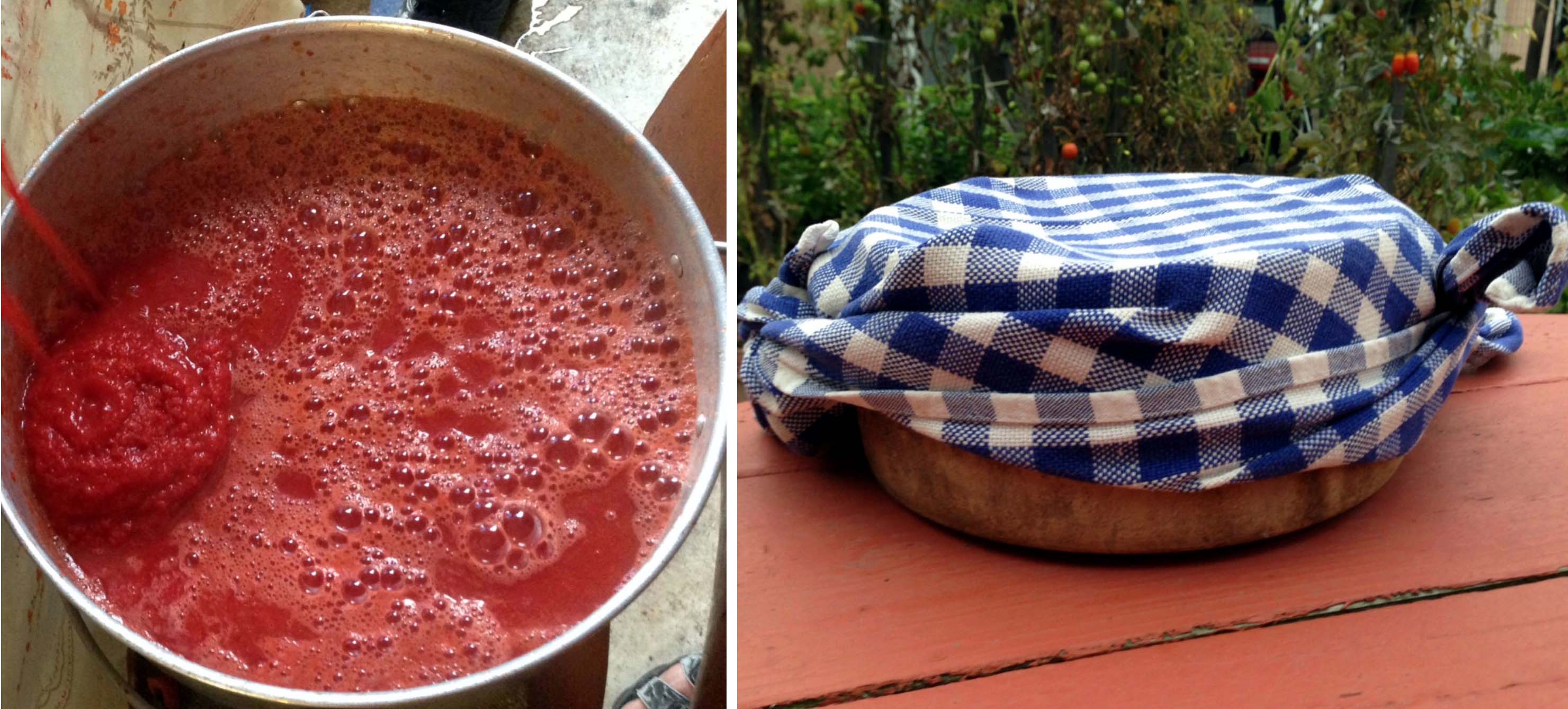
I asked Mamma what they did before glass vasetti and other modern canning conveniences were available. She said they made ‘la conserva’ which was like a tomato paste that could be stored. It was used in winter to make sugo for pasta or to add flavor to other foods. In August, pomodori were cooked with skins and seeds removed, similar to passata. This salsa was salted, placed in large earthenware dishes and left out in the sun for several days. Once it was dark and thick, la conserva was transferred to terracotta or glass containers and covered with a film of olive oil and fig leaves or basilico to seal it. The container was then covered and tied with un straccio (a dishrag). Quartered pomodori were also sundried to use in winter.

My recreation of 'la conserva'. The passata was dried in the sun, then the thickened stuff was placed in an earthenware bowl, covered with a film of olive oil and fig leaves, then covered with a dishrag

My recreation of ‘la conserva’. The passata was dried in the sun, then the thickened stuff was placed in an earthenware bowl, covered with a film of olive oil and fig leaves, then covered with a dishrag

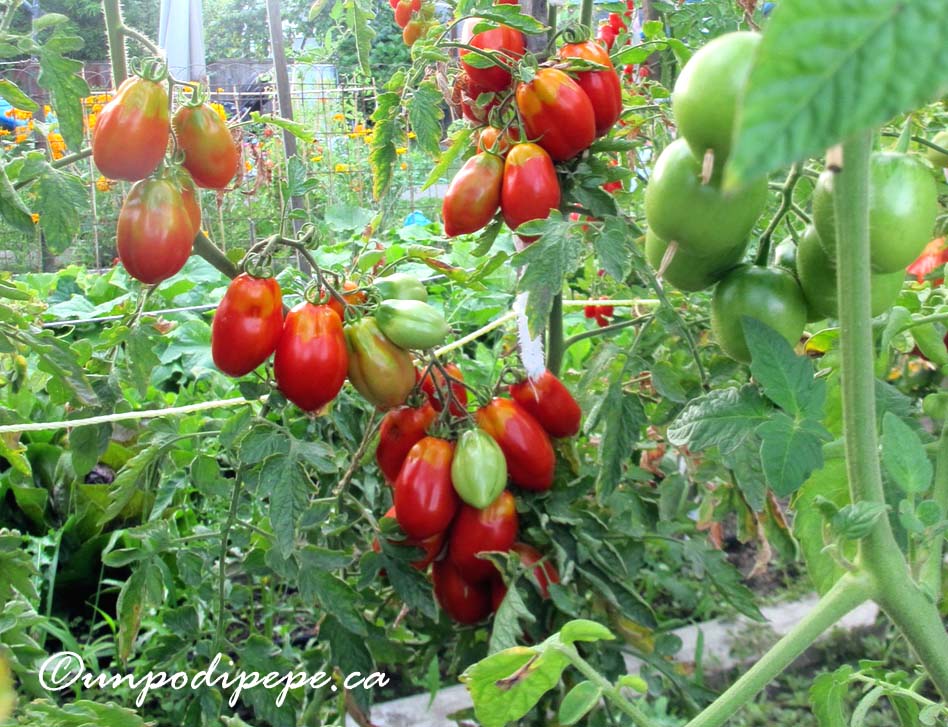
Talking about pomodori is making me hungry! I’ll go pick some in the garden and make some pan’ e pomodoro!pomodori2015a

Share this:

  • Share on Facebook (Opens in new window) Facebook
  • Share on Pinterest (Opens in new window) Pinterest
  • Share on X (Opens in new window) X
  • Email a link to a friend (Opens in new window) Email
  • Share on WhatsApp (Opens in new window) WhatsApp
Like Loading...

Museo Diocesano, Orsara di Puglia

29 Saturday Aug 2015

Posted by Un po' di pepe in Art history, Italia, Italian life, Orsara di Puglia, Photography, Puglia

≈ 7 Comments

Tags

Italian history, Museo Diocesano Orsara di Puglia, Orsara di Puglia, Palazzo Varo, Puglia, Southern Italy

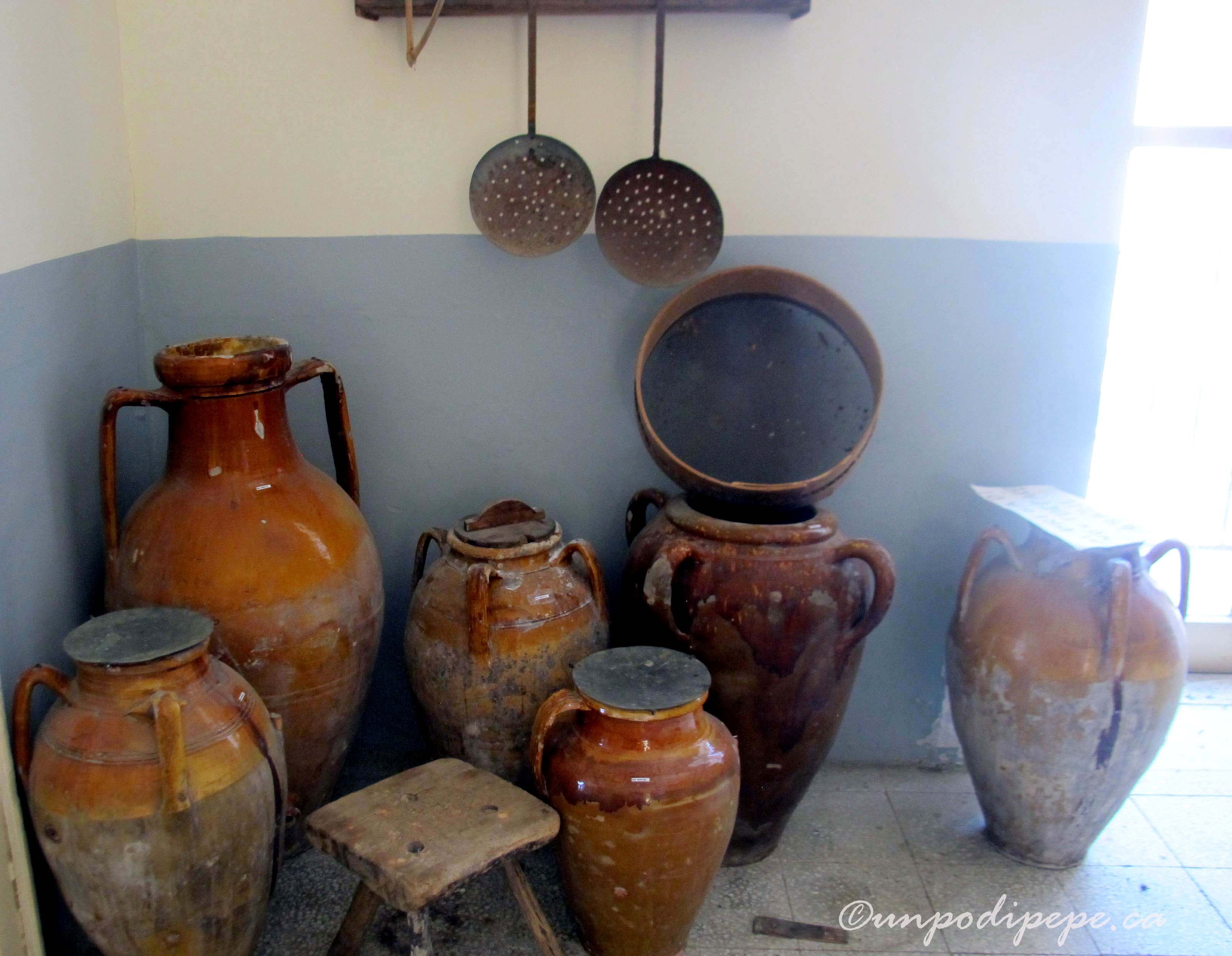
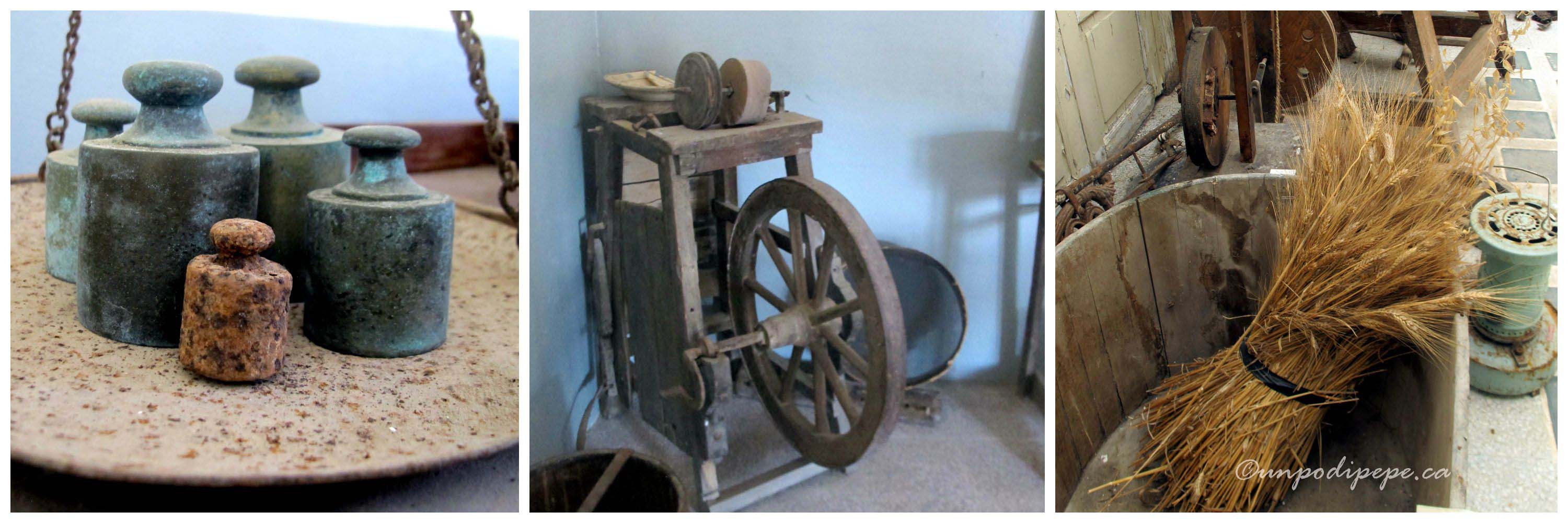
museodiocesanoorsaraThe last time I was in the Museo Diocesano di Orsara di Puglia was about 1980. It looks as if hardly anyone else has been there either! The Museo is right around the corner from my casa, and it is not usually open. To visit, you need to ask for the person who has the key.  Last week I was walking by and noticed it was open as there was a photo exhibit in one of the rooms. As I walked up the stone staircase it was like stepping through time.

My accidental selfie

My accidental selfie

The Museo occupies part of the upper floor of the Palazzo Varo, a 16th Century building that was part of the Abbazia dell’Angelo. The famiglia Varo sold the palazzo and it became a convent for the ‘Monache Bianche’ or white nuns. When the sisters moved in the 1960’s it became the Scuola Media until a new school was built. In the 1970’s, some of the rooms became a depository for archeological relics and museum items. The bottom floor was recently remodelled into a very nice meeting/conference area.  The upper floor has a separate entrance and is in an elegant state of decay, to match the artifacts it is housing.museodiocesanocollage2

The collection is actually really impressive and reflects the history of the area.   Most of the artifacts, except the sacred items formerly used in the parish, have been donated, collected and collated by volunteers. The Museo encompasses a time span from Neolithic to mid 20th Century. That’s a really long time! The bronze and selce (flint) tools and utensils, earthenware vessels, lamps, tomb decorations and even fragments of a 10th Century pavimento (mosaic pavement) were dug up by contadini (farmers/peasants) while plowing their fields.

Roman lucerne -oil lamps

Roman lucerne -oil lamps

Ascia e lancie in Bronzo (bronze hatchet and spears)

Ascia e lancie in Bronzo (bronze hatchet and spears)

There are also farm implements, tools, utensils and household items used by local contadini in daily life. The lack of formal organization and cataloguing of the items makes the place so much more interesting. The crumbling, aging plaster walls of the formerly grand Palazzo provide a beautiful, yet ironic backdrop for the crumbling rusted work and field implements used by contadini Orsarese.

Museodiocesanocollage3 copymuseodiocesanosellaThe Museo is definitely worth a visit-you need to ask at the Parish or Comune (Town Hall) for someone to let you in.  Let me know if you need more info on this, and read Benvenuti ad Orsara di Puglia!
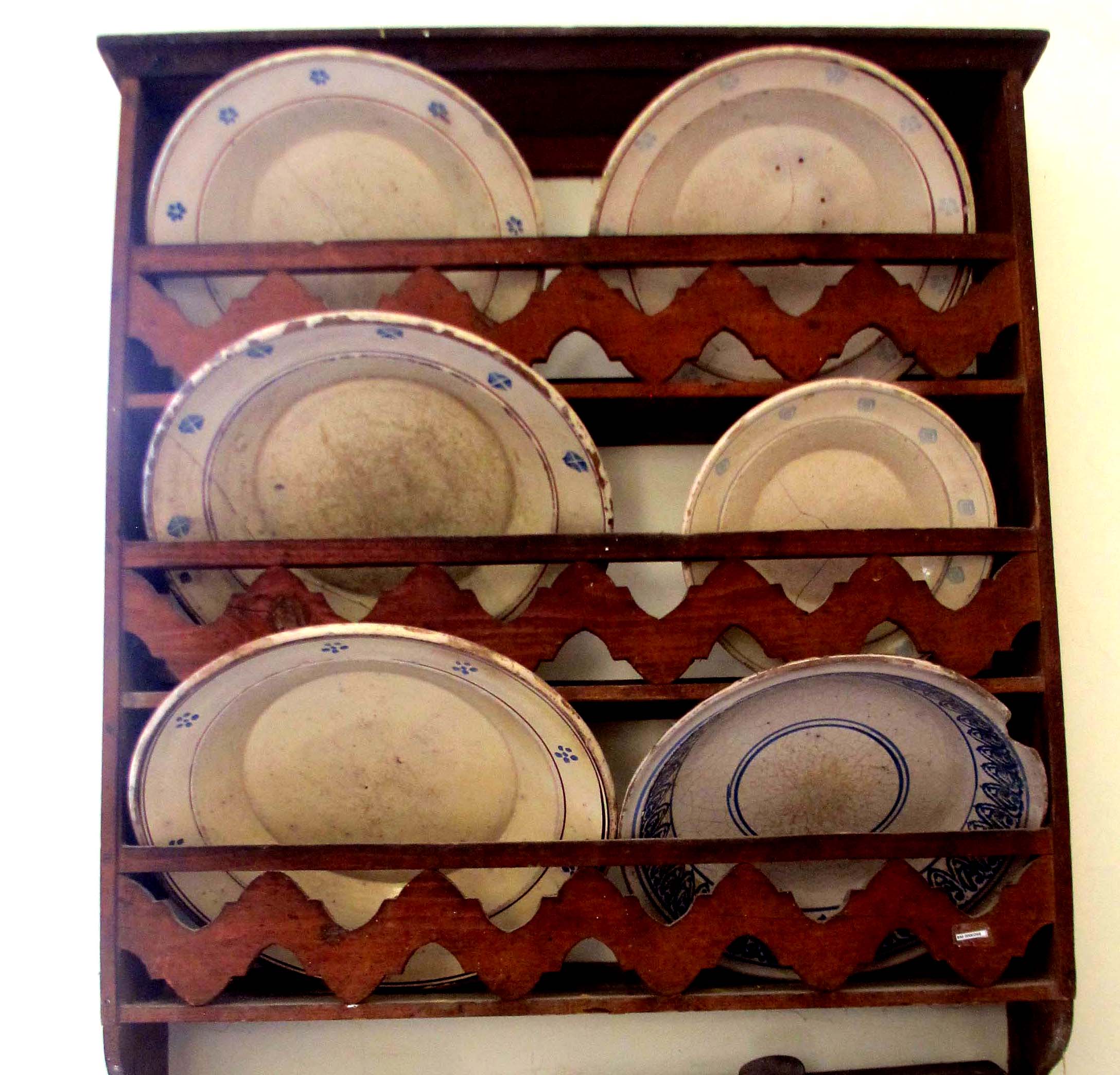
A piattaia, called a 'scudular' (scoo.doo.lahr) in Orsarese. I have one just like it, made by a friend of Papà's. My plates are quite a bit newer though!
A piattaia, called a ‘scudular’ (scoo.doo.lahr) in Orsarese. I have one just like it, made by a friend of Papà’s. My plates are quite a bit newer though!

museodiocesano3

Share this:

  • Share on Facebook (Opens in new window) Facebook
  • Share on Pinterest (Opens in new window) Pinterest
  • Share on X (Opens in new window) X
  • Email a link to a friend (Opens in new window) Email
  • Share on WhatsApp (Opens in new window) WhatsApp
Like Loading...

Senz’ acqua

03 Monday Aug 2015

Posted by Un po' di pepe in Inspiration, Italian life, Orsara di Puglia

≈ 17 Comments

This morning I woke up to find out the water was being shut off soon.  Luckily I live in the Centro Storico (historic center) of town, which is downhill, so had time to run around filling up the tub and all sorts of pots and bottles with water.  We will probably only be senz’ acqua (without water) until this evening, or let’s hope so anyways. I was reminded of something I wrote exactly 2 years ago tomorrow, when we senz’ acqua for almost 4 days:

senaacqua1

Senz’ acqua, Agosto 2013

On Friday a truck from the comune (co•MOO•neh) or city hall, went around announcing that at 5pm the water would be turned off.  They didn’t say for how long, but everyone filled up their pails, bottles, and bathtubs anyways, assuming the water would be back on by the next morning.

It turns out there was a ‘guasto’ (GWAH•stoh)-a water main break that was more serious than originally thought.  It was between Troia and Foggia, about 40 minutes away. Now it was starting to sound like we would be senz’ acqua for 2-3 days!

senzacqua2

The next day, the temperature was 38° C.  The population of Orsara was increased by about 1,000 because of families visiting, the Festa del Jazz, people living in Foggia coming for the weekend to escape the heat and the Festa della Madonna della Neve coming up.  I was taking bottles to fill up at one of the fontane (fountains) so we could wash dishes and flush the toilet, when I heard there was an autobotto (water truck) at Ponte Capò.  By the time I got there it had moved to La Benzina (the gas station) and was going to San Rocco.  I was out of breath when I finally managed to find the autobotto and fill up my 3L bottles.  I brought them home and then heard that Acquedotto Pugliese was giving out rations of 4L bags of water.  Mannaggia what a scene it was.  The vecchietta (old lady) in front of me said ‘ma vieni di nuova la Guerra!’, the war has come back again! The man behind me had 10 family members from France staying with him and was trying to get extra.  It started to get kind of ugly, but they ran out of water anyways. We carried out water bags home and arrived ‘in un bagno di acqua’-bathed in sweat.  It was stinking hot and 6L of water gets heavy when you have to carry it up a steep old stone stairway.

senzacqua3

This reminded me of when I used to come to Orsara di Puglia as a child/ teenager.  In an effort to conserve water in the hot summer months, it was only available from 8am until noon, then shut off until the next morning.   Laundry, showers and washing hair all had to be done before noon.  This was a common practice in Southern Italian towns in the 1980’s.  I’m not sure it actually saved any water because every household would fill up their tub and every imaginable jug and container with water before it was shut off.

At 5pm the TV went off, which seemed odd, so I tried the lights and they didn’t work.  I heard someone outside yell ‘Ma no!  Anche la corrente no!’-‘but no! Not the electricity too!’  Mamma and I ran around looking for the flashlight and candles for later. No running water and no power!  The neighbours packed up and went back to Foggia.  Luckily the power was only off for an hour so at least we were only lacking 1 utility.

Water in the tub or from the fountains is used for washing then toilet flushing.  Dishwashing water is also later used to flush the toilet.  Acquedotto Pugliese 4L bags are only for cooking and washing food.  Bottled water is for drinking. It’s amazing the simple things that we take for granted today.  Have you ever thought about how you would manage if you were ‘senz’ acqua’ for 3 days?  In many parts of the world, people still don’t have electricity and running water in their homes.  Take a few minutes and think about how you would survive this ‘medieval camping’ situation.

Share this:

  • Share on Facebook (Opens in new window) Facebook
  • Share on Pinterest (Opens in new window) Pinterest
  • Share on X (Opens in new window) X
  • Email a link to a friend (Opens in new window) Email
  • Share on WhatsApp (Opens in new window) WhatsApp
Like Loading...

Torta Caprese all’ Arancia

25 Saturday Jul 2015

Posted by Un po' di pepe in Mangiamo!, Recipes

≈ 28 Comments

Tags

Cannolo Award, Capri, Dolci, Gluten-free chocolate cake, Italian food, Southern Italy, Torta Caprese, Traditional recipes

Tortacaprese2In honour of my recent Cannolo Award, I thought this post should be food related.  What is a Cannolo Award?  Read about it here.  Although I love them, I will not be writing about cannoli, but rather about Torta Caprese.

The super cute-issimo cannolo logo

The super cute-issimo cannolo logo

Caprese (cah•PREH•seh) means ‘from Capri’ (CAP•ree) the beautiful island off the coast of Napoli.  I suppose caprese could also mean ‘goatlike’ since capra is goat?  We’ll stick with ‘from Capri’.

There are a few different stories about how Torta Caprese came to be.  The most likely is that it was invented by mistake in the 1920’s or 30’s by a kitchen worker who added ground almonds (mandorle tritate) instead of flour while trying to make something similar to an Austrian Sachertorte for visitors at an Austrian owned pensione on Capri.  It was a big hit, and went on to be served at all of the hotels and tea rooms on the island.

The basic recipe involves mixing melted butter and chocolate in a ‘bagno-maria’ with sugar and egg yolks, then adding whipped egg whites and ground almonds.  Liqueur, usually Strega, is added.  The cake has a hard thin shell and moist interior and the center tends to sink in a bit from the sides.

I recently tasted a yummy orange Torta Caprese, so I decided to try my own version.  After a bit of experimentation, and substituting Gran Marnier for Strega, I ended up with a very nice Torta Caprese all’ Arancia.  It is a 3 bowl recipe, so be prepared to wash lots of dishes!

Torta Caprese all’ Arancia

Ingredients:

  • 250g dark chocolate 70%
  • 175g (¾ cup) butter at room temperature
  • 110g (½ cup) sugar
  • 110g (½ cup) brown or golden sugar
  • grated peel of a large orange
  • 3 tablespoons Gran Marnier, Mandarino, or other orange liqueur
  • 6 eggs, separated
  • 150g (1½ cups) ground blanched almonds (also called almond flour or almond meal)
  • ½ a bustina (packet) Lievito Bertolini or Pane degli Angeli (substitute 2½ teaspoons baking powder if you can’t find these)
  • pinch of salt
  • Icing sugar for dusting

1.  Preheat oven to 180° C (350° F).

2.  Butter the sides of a round springform pan and line the bottom with parchment paper.

3.  Melt butter and chocolate in a double boiler or ‘bagno-maria’ (a stainless steel bowl in a pan of hot water) and let cool.  This can also be done with a glass bowl in the microwave but be careful-only heat in 30 second intervals and stir well.

4.  In another bowl, whisk the egg yolks and brown sugar, then add to the chocolate.  Stir in alcohol and grated orange peel.

PicMonkey Collage

5.  Whip egg whites with an electric mixer until stiff peaks form.  Add the white sugar.

Torta Caprese Collage4

6.  In another bowl, mix almond flour, lievito or baking powder and salt together with a fork.  Fold the chocolate mixture in with a rubber spatula, then fold in egg whites.

Torta Caprese Collage3

7.  Pour batter into pan and bake for 55 minutes to 1 hour, until center is firm.  The center sink in a bit.  Remove the sides of the pan and slide the cake onto a platter.

8.  Dust with icing sugar and serve with orange slices and whipped cream or gelato.  Store at room temperature for up to 3 days…if it lasts that long!

Torta Caprese

Buon Appetito!  Mille grazie to my amiche Anna and Shannon who were very motivated to help me photograph the finished cake.  I wouldn’t let them cut it and have a piece until the photos were done!

torta caprese tagliata

Torta Caprese pezzo

Here is me posing on my first visit to Capri when I was 16. Unfortunately I didn't know about Torta Caprese at the time.

Here is me posing on my first visit to Capri when I was 16. Unfortunately I didn’t know about Torta Caprese at the time.

Downloadable recipe and recipe in italiano will be added as soon as I am home from Italia.  Buon Appetito!

©2015unpodipepe.ca

Share this:

  • Share on Facebook (Opens in new window) Facebook
  • Share on Pinterest (Opens in new window) Pinterest
  • Share on X (Opens in new window) X
  • Email a link to a friend (Opens in new window) Email
  • Share on WhatsApp (Opens in new window) WhatsApp
Like Loading...

Melagrana

08 Wednesday Jul 2015

Posted by Un po' di pepe in Art projects, Italian language, Parole piacevoli

≈ 16 Comments

Tags

Drypoint etching, Granada, Italian language, Italian pronunciation guide, Melagrana, Monotipi, Monotypes, Pomegranate, Punta secca

melagrana2While I was looking for some book cloth in my paper drawers, I discovered that I have an infestation of unfinished melagrane.

Unfinished melagrane in my studio

Unfinished melagrane in my studio

Melagrana (meh•lah•GRA•nah) is una parola piacevole (pa•ROH•la pyah•cheh•VOH•leh), a really likeable word.  It is Italian for pomegranate, the luscious red fruit with tart little seeds full of vitamins and antioxidants.  Melagrane is plural and il melograno is the pomegranate tree. The tree is masculine and the fruit is feminine-this causes a lot of confusion.  Just remember ‘la melagrana e il frutto del melagrano’. This is consistent with other fruits and their trees, for example- pera/ pero, olive/ulivo.

Melagrani (pomegranate trees) and melagrane (pomegranate fruit) on the roof of Hotel Columbia in Roma

Melagrani (pomegranate trees) and melagrane (pomegranate fruit) on the roof of Hotel Columbia in Roma

Granata is another word for melagrana. Granata is also the luscious pomegranate red colour, garnet-as in the stone, and grenade-the not so nice kind that blows up.  A grenade does kind of look it is covered in ‘semi di melagrana’ (pomegranate seeds).  Granatina or grenadine is syrup made with pomegranate juice used to make a Tequila Sunrise.

Melagrana comes from the latin words Malum (mela=apple) and granatum (grainy/full of seeds).   The Spanish city of Granada is named for the fruit-Granada is melagrana in Spanish.  The official symbol of the city is the melagrana and it appears in its coat of arms and all over Granada. The French word for apple is pomme, so pomme granate resulted in the English word pomegranate (apple of Granada).  I love how all of these words are connected!

Melagrane-unfinished drypoint etching monotype with chine colle

Melagrane-unfinished drypoint etching monotype with chine colle

Mannaggia la melagrana!  I’d better find time to finish all of these monotipi (monotypes) and incisione punta secca (drypoint etchings). I might have to have a melagrana sale.

Ciao, Cristina

Share this:

  • Share on Facebook (Opens in new window) Facebook
  • Share on Pinterest (Opens in new window) Pinterest
  • Share on X (Opens in new window) X
  • Email a link to a friend (Opens in new window) Email
  • Share on WhatsApp (Opens in new window) WhatsApp
Like Loading...
← Older posts
Newer posts →

Enter your email address to follow 'un po' di pepe' and receive notifications of new posts by email.

Join 511 other subscribers
Follow Un po' di pepe on WordPress.com

Popular Posts

  • Hairstyling in Ancient Roma
    Hairstyling in Ancient Roma
  • Napoli Street Art
    Napoli Street Art
  • Cucina Italiana Patrimonio UNESCO
    Cucina Italiana Patrimonio UNESCO
  • Un altro giorno a Napoli
    Un altro giorno a Napoli
  • Gallerie d'Italia Napoli
    Gallerie d'Italia Napoli
  • Venezia~La Serenissima
    Venezia~La Serenissima
  • Caffè con Caravaggio a Roma
    Caffè con Caravaggio a Roma

Recent Posts

  • Cucina Italiana Patrimonio UNESCO
  • 2025~Un po’ di pepe Year in Review
  • Castel del Monte
  • ‘The Nuances of Love’
  • Hostaria Antica Roma~Eat like an Ancient Roman
  • Santa Maria in Aracoeli
  • Casino dell’Aurora~Villa Boncompagni Ludovisi
  • Nasoni di Roma
  • Bloghiversario #11
  • Fontana di Trevi
  • Acqua Vergine
  • Giubileo 2025
  • Sanremo 2025
  • In Vino there are Memories
  • A Literary Harvest
  • 2024~Un po’ di pepe Year in Review
  • Buon Natale 2024
  • Il Bicerin
  • Mercato Porta Palazzo
  • Torino
  • Catanzaro, Calabria
  • Il Pumo Pugliese
  • Artemisia Gentileschi
  • Cavalli di San Marco
  • Panzerotti

Categories

Amici e Famiglia Architecture Art Art history Art projects Bilingual posts Blogging Canada Culture Feste Firenze Inspiration Italia Italian Folklore Italian language Italian life Italocanadesi Libri Mangiamo! Orsara di Puglia Parole piacevoli Photography Puglia Recipes Roma Travel Travel tips Uncategorized Vino

Archives

Un po’ di pepe on Facebook

Un po’ di pepe on Facebook

Start a Blog at WordPress.com.

  • Subscribe Subscribed
    • Un po' di pepe
    • Join 511 other subscribers
    • Already have a WordPress.com account? Log in now.
    • Un po' di pepe
    • Subscribe Subscribed
    • Sign up
    • Log in
    • Report this content
    • View site in Reader
    • Manage subscriptions
    • Collapse this bar
 

Loading Comments...
 

    %d