• Home
  • About me/Chi sono
  • Contact

Un po' di pepe

~ …… (oon∙poh∙dee∙PEH∙peh) Cristina writes about interesting stuff /Cristina scrive di cose interessanti

Un po' di pepe

Category Archives: Architecture

Castel del Monte

22 Saturday Nov 2025

Posted by Un po' di pepe in Architecture, Puglia

≈ 9 Comments

Tags

Federico II, Italian history, Puglia, Romanica Pugliese, Southern Italy, UNESCO World Heritage Sites


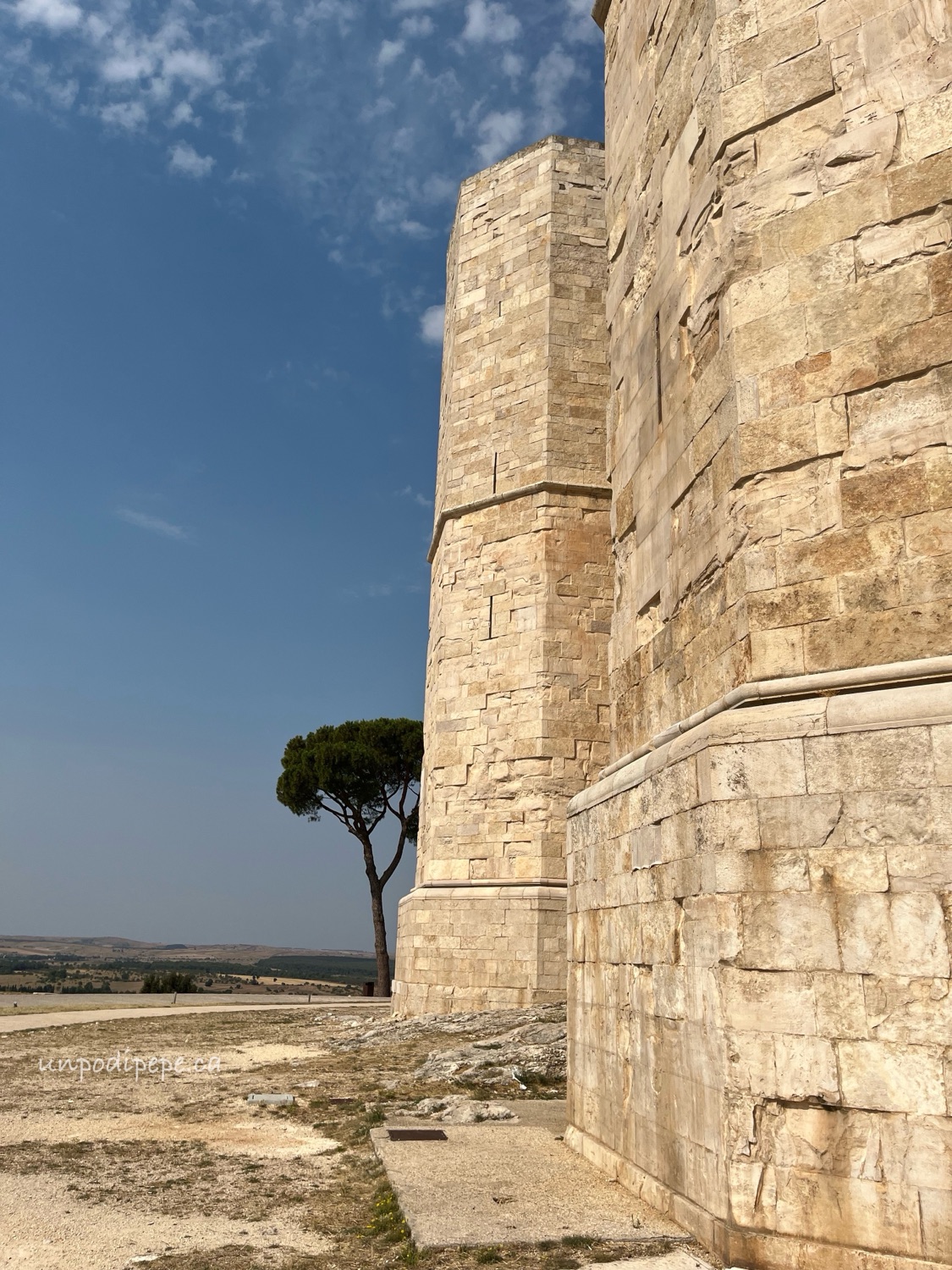
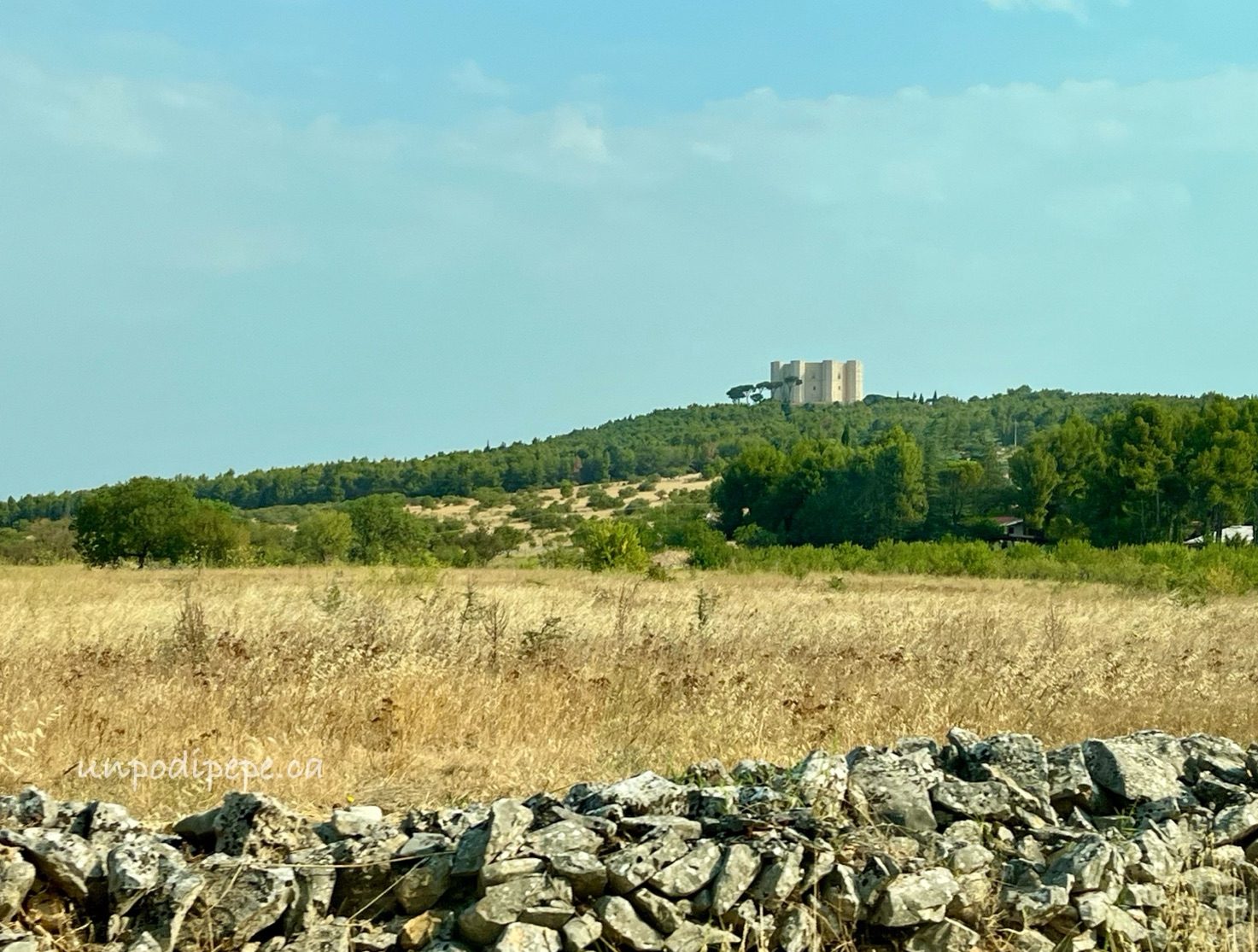
Castel del Monte overlooks the Murgia plateau near Andria, Puglia, rising like a massive, imposing stone crown. The flawless design is awe-inspiring, and it can even be seen from the sea. Castel del Monte ‘castle of the mountain’, is a mysterious place, that has intrigued scholars with speculation regarding its purpose and symbolism for almost 800 years.

Federico Secondo /Frederick II Hohenstaufen (1194-1250) Holy Roman Emperor and King of Sicily built Castel del Monte between 1240 -1250.  He was a visionary, considered an early Humanist-a lover of art, architecture, science and poetry, and also a skilled warrior, hunter and falconer.  He spoke 6 languages and wrote books, including a guide to falconry.  At his court in Palermo, he brought together Greek, Arab, Italian and Jewish scholars so that experts in science, theology, philosophy, and alchemy could exchange their Eastern and Western knowledge. A cultured, cosmopolitan ruler, and probably a megalomaniac, he was called ‘Stupor Mundi’ wonder of the world.

No one knows why he built Castel del Monte– the location at an altitude of 540m (1770 ft), has a great view, but is not strategic, and the building has no defensive measures, such as a moat or arrow slits, so was not built as a fort. Some think it was built as a fancy hunting lodge, but there is no sign of a kitchen or cooking facilities on site.  Federico died not long before it was completed, so he never actually stayed there.

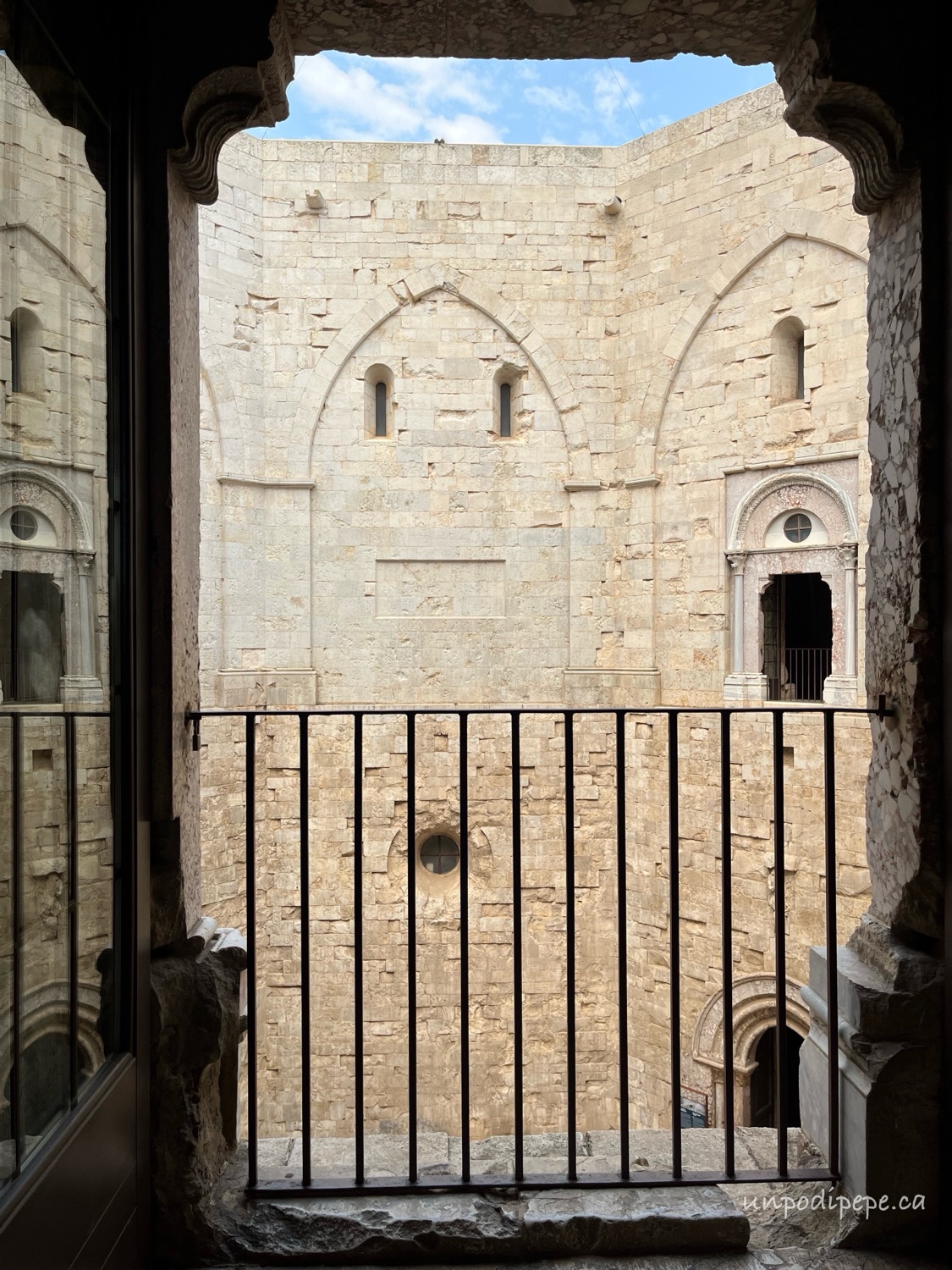
The octagonal design is unusual. According to medieval beliefs and mathematical symbolism, the octagon represented the union of the divine perfection of the circle and the natural perfection of the square into one shape. In many cultures and religions, the number 8 is associated with power, good judgement, efficiency, prosperity, strength and stability.  A sideways 8, the infinity sign is a symbol of continuous balance.  8 is repeated throughout the design of Castel del Monte-an octagonal shape with 8 interconnecting rooms on each floor, 8 octagonal towers, and an octagonal internal courtyard. Many details in the sculptures, bas-reliefs, marble columns and keystones have decorations with 8 elements.

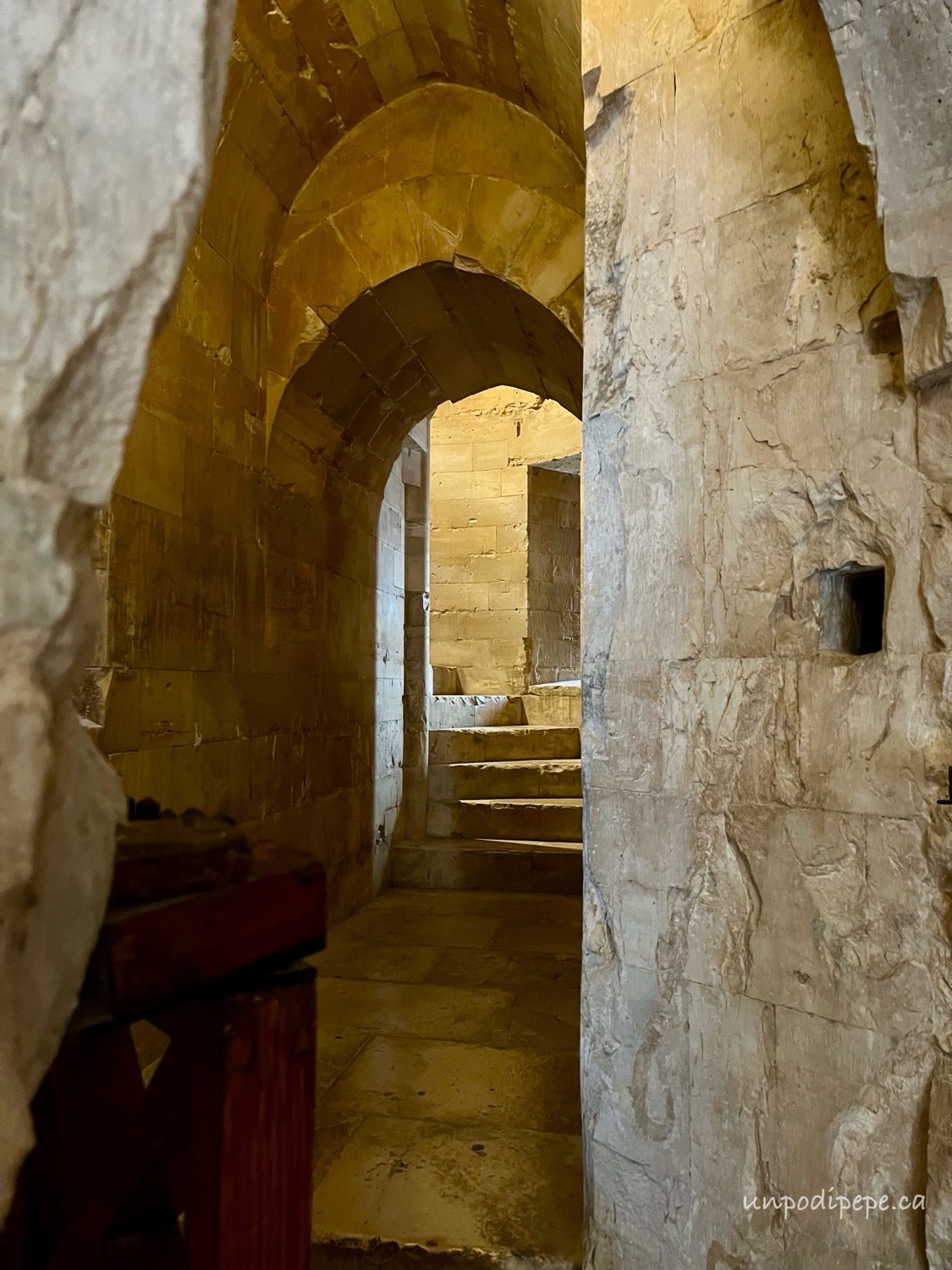
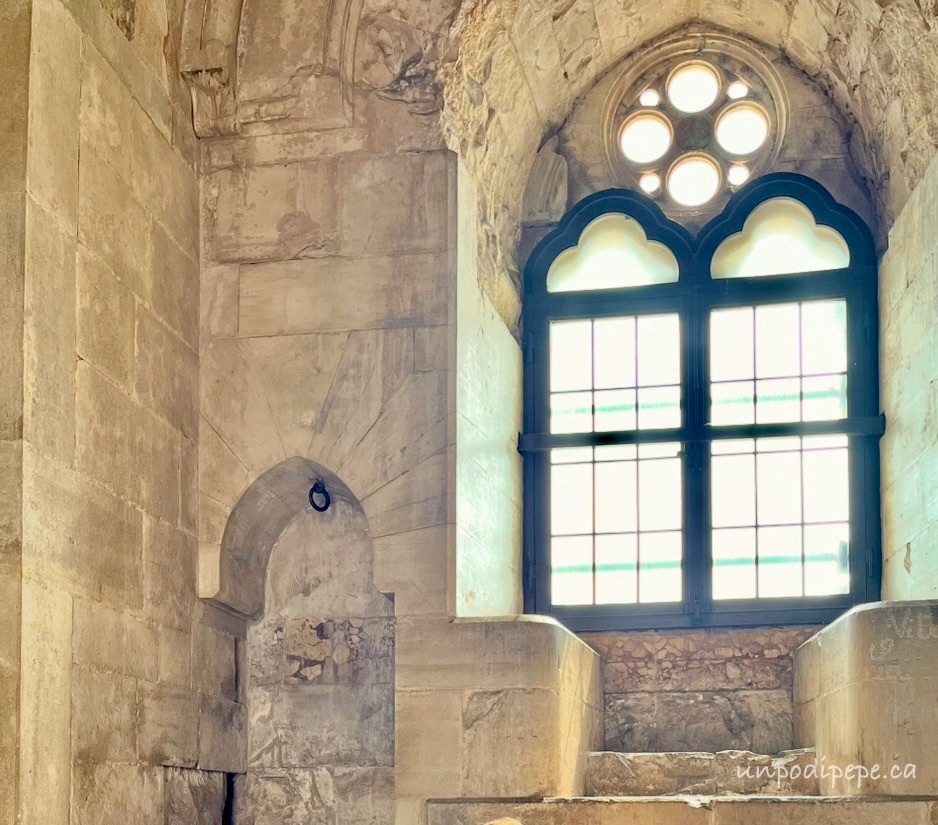
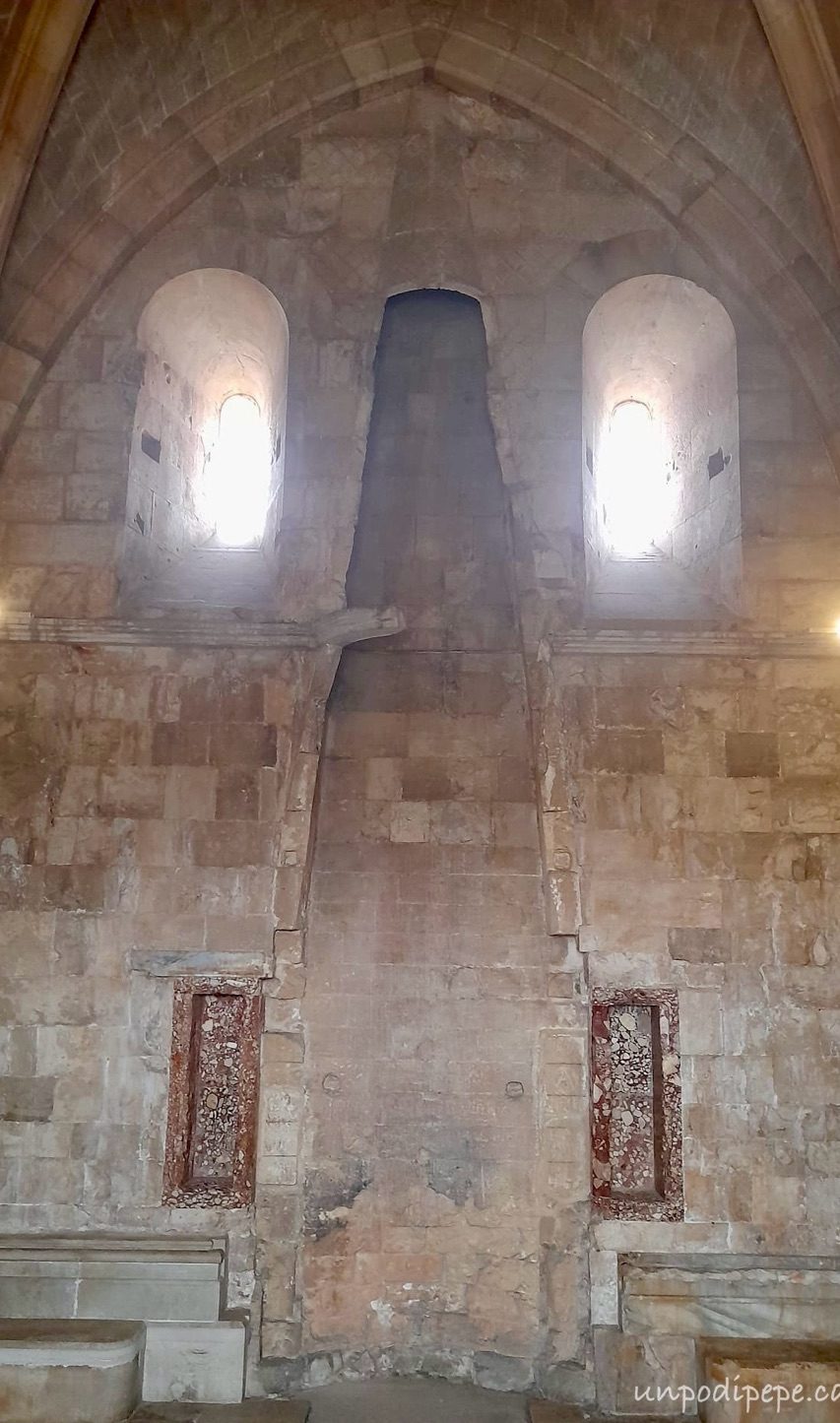
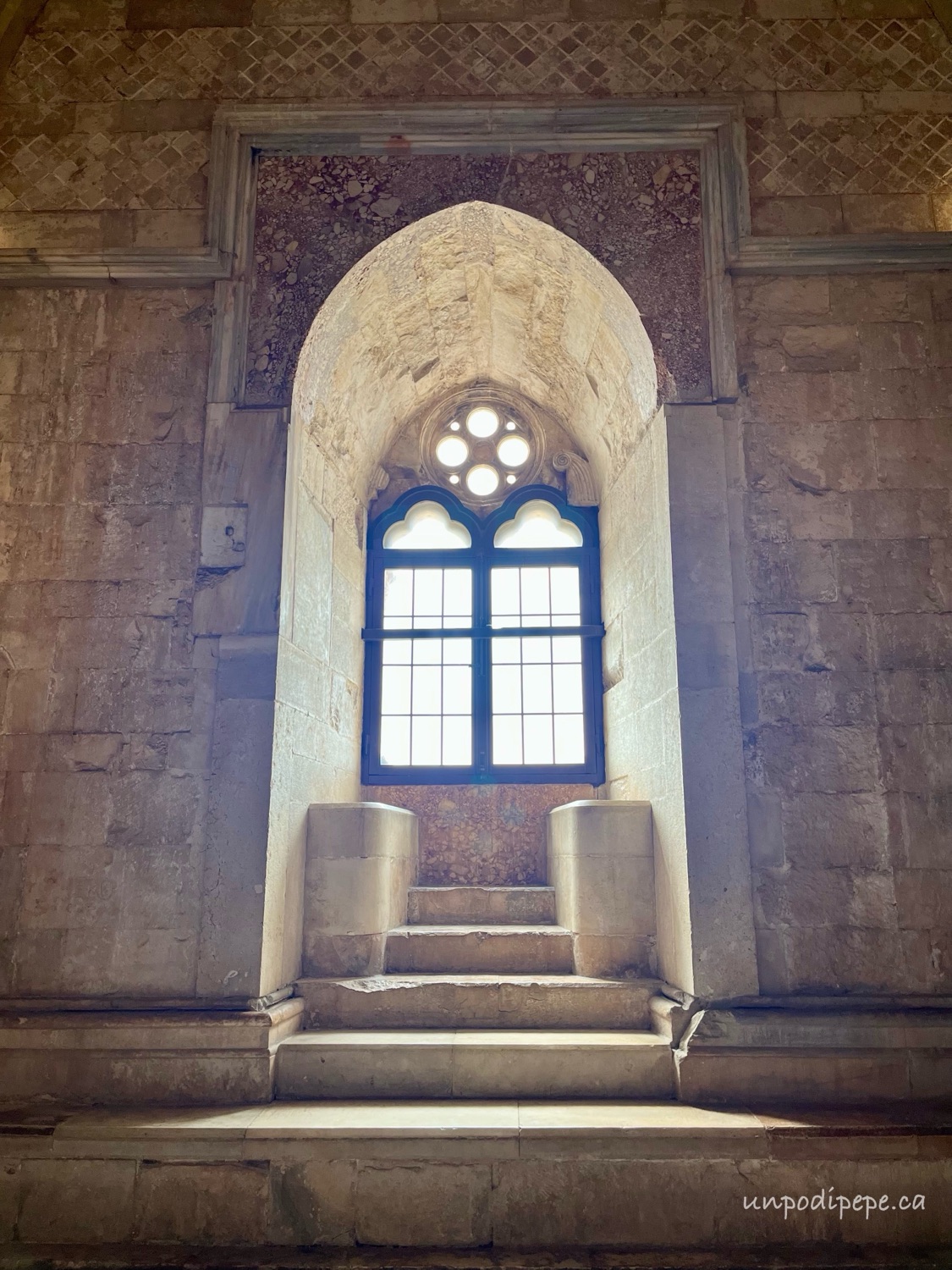
The upper rooms have decorative marble columns and 8 fireplaces, The doorways and Gothic windows are framed in corallite stone. 3 of the towers have stairs and at least one has a room with what may have been Europe’s first flushing toilets. Castel del Monte also had advanced hydraulic engineering with an air heating/cooling system (ancient HVAC?) in the walls and a rainwater collection and filtration system.  Water passed through the walls into cisterns in the foundation. In the alcoves beside some of the windows on the upper floor, you can see evidence of these systems.

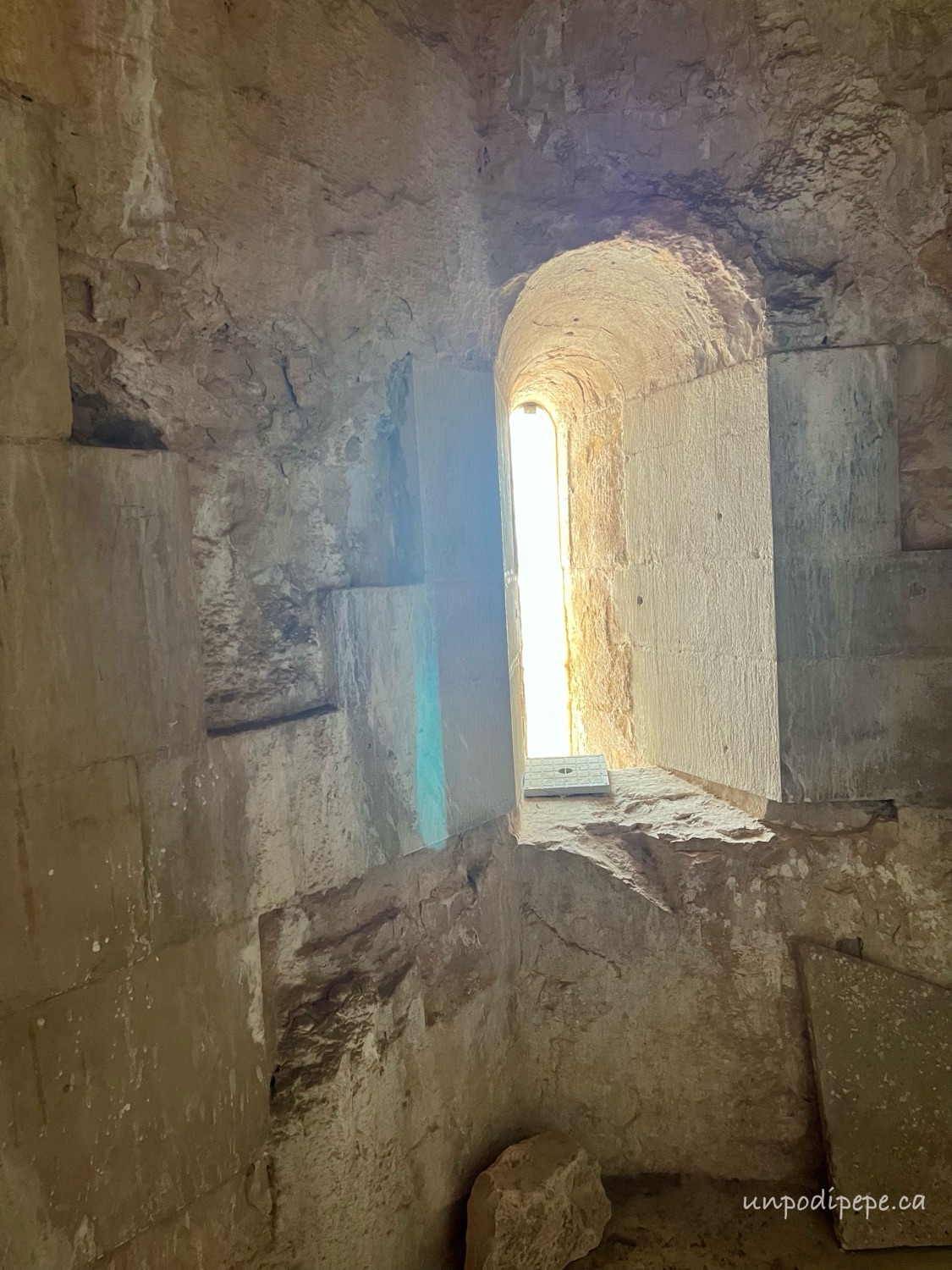
Similar to Federico’s cultural perspective, elements of diverse architectural styles and traditions from different times in history are effortlessly blended in Castel del Monte. These include classical antiquity, the Islamic Orient and north-European Gothic. To me it looks similar to Romanica Pugliese.  The layout and orientation are designed with advanced mathematical and astronomic precision. The positions of windows and light slits is designed to create specific light and shadow effects during the solstice and equinox. Secret messages perhaps? The light cast by the slits also serve as a clock/sundial.  I actually thought the light slits were ridiculously long arrow slits! Mathematician Leonardo Fibonacci was a guest of Federico’s in 1240, so he may have even been a consultant!

Castel del Monte was purchased by the Italian State in 1876 for 25,000 Lire, and is now protected under strict laws. It was declared a UNESCO World Heritage Site in 1996, as a unique and beautiful masterpiece of medieval military architecture and for its lack of structural alteration.  Castel del Monte is featured on the Italian one euro cent coin.

So what was the overall purpose of Castel del Monte if it was not built as a fort or hunting lodge?  Was it a celestial observatory, or a giant sundial?  Likely the primary purposes were to symbolize the power and personal genius of Federico II to reflect his cultural, pre-Humanist perspective, and to celebrate the relationship/balance between the spiritual and material world.

I have wanted to visit Castel del Monte for years. Since it is on a remote hilltop, 20 km from Andria, 35 km from Trani, getting to Castel del Monte without a car is not easy.  I got together with 6 of my friends from Orsara di Puglia and we hired a friend with an 8 passenger van to take us there.  We arrived early and then went to the Trulli di Alberobello in the afternoon. We had an amazing time! I was expecting Castel del Monte to be fascinating-but it surpassed my expectations!

To get there by train/bus:  From Bari, take the Ferrovia Bari-Nord train to Andria.  Then either take bus # 6 from Andria station to Castel del Monte (35 minutes, five buses daily, April to October only) or take a taxi or hired car from Andria.  Trani is 35 km away and would be my choice if I was planning to stay the night.  A small parking site down the hill charges €5 for a car, and sometimes there is a €1 shuttle up the short, steepish walk to Castel del Monte.  There are a few souvenir stalls close to the parking area, and a Bar is open at the same seasonal entry times.

Opening hours: April 1-Sept 30 1000 to 1845.  Oct 1-Mar 31 0900 to 1745 Closed Dec 25 and Jan 1st.

Adult admission is €10 Audio guides (€6) are also available to maximise visit. Skip the line tickets are available but not necessary, since there are only 250,000 visitors per year. There are likely to be more visitors during the summer or winter Solstice and the Federico II festival in April.

The inside visit takes about 1 hour, but allow more time to walk around the outside, enjoy the views and take photos.  In summer, try to go in the morning, as the afternoons are hot and there is little shade.Buon viaggio, Cristina

Share this:

  • Click to share on Facebook (Opens in new window) Facebook
  • Click to share on Pinterest (Opens in new window) Pinterest
  • Click to share on X (Opens in new window) X
  • Click to email a link to a friend (Opens in new window) Email
  • Click to share on WhatsApp (Opens in new window) WhatsApp
Like Loading...

Santa Maria in Aracoeli

12 Friday Sep 2025

Posted by Un po' di pepe in Amici e Famiglia, Architecture, Roma

≈ 2 Comments

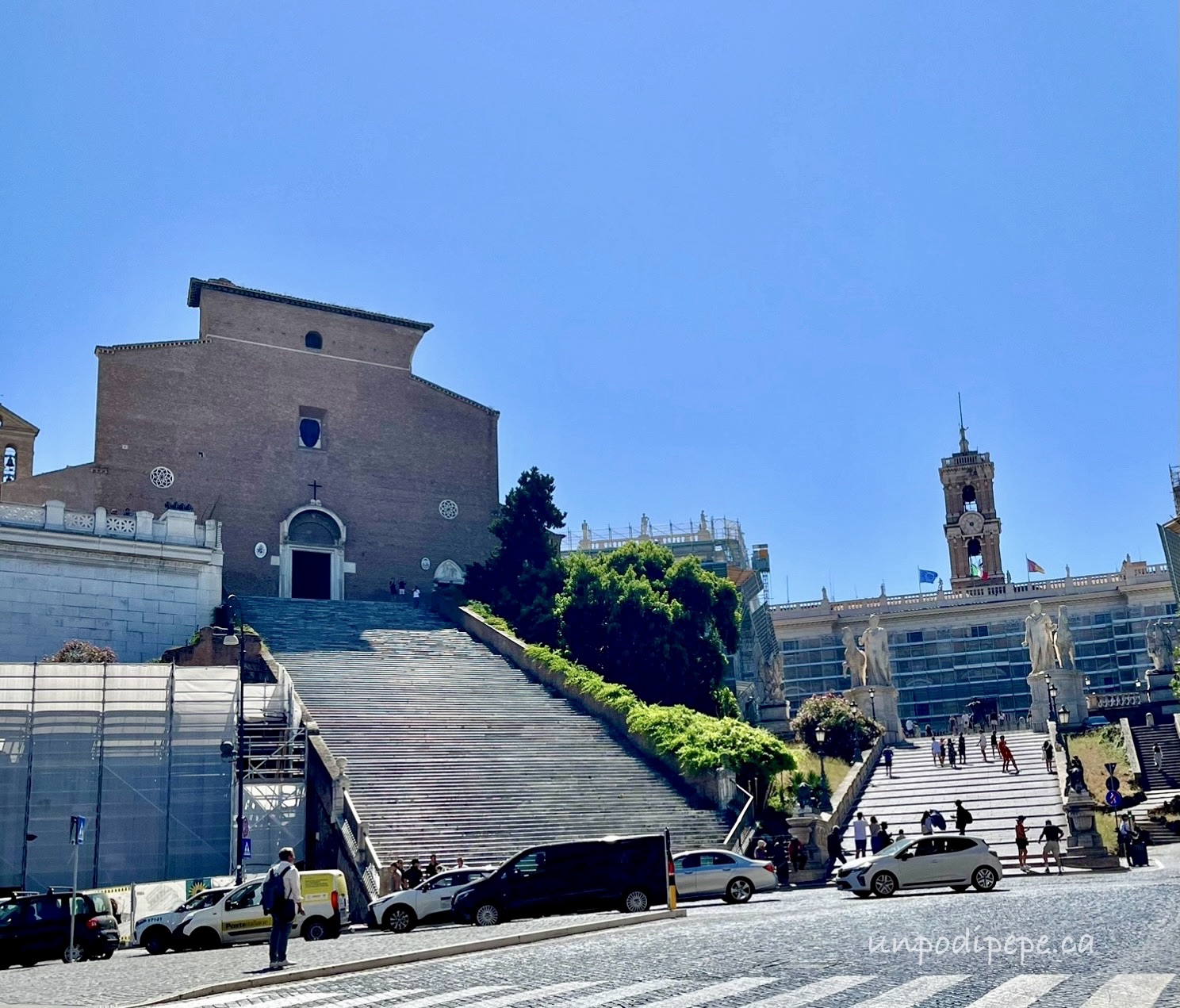
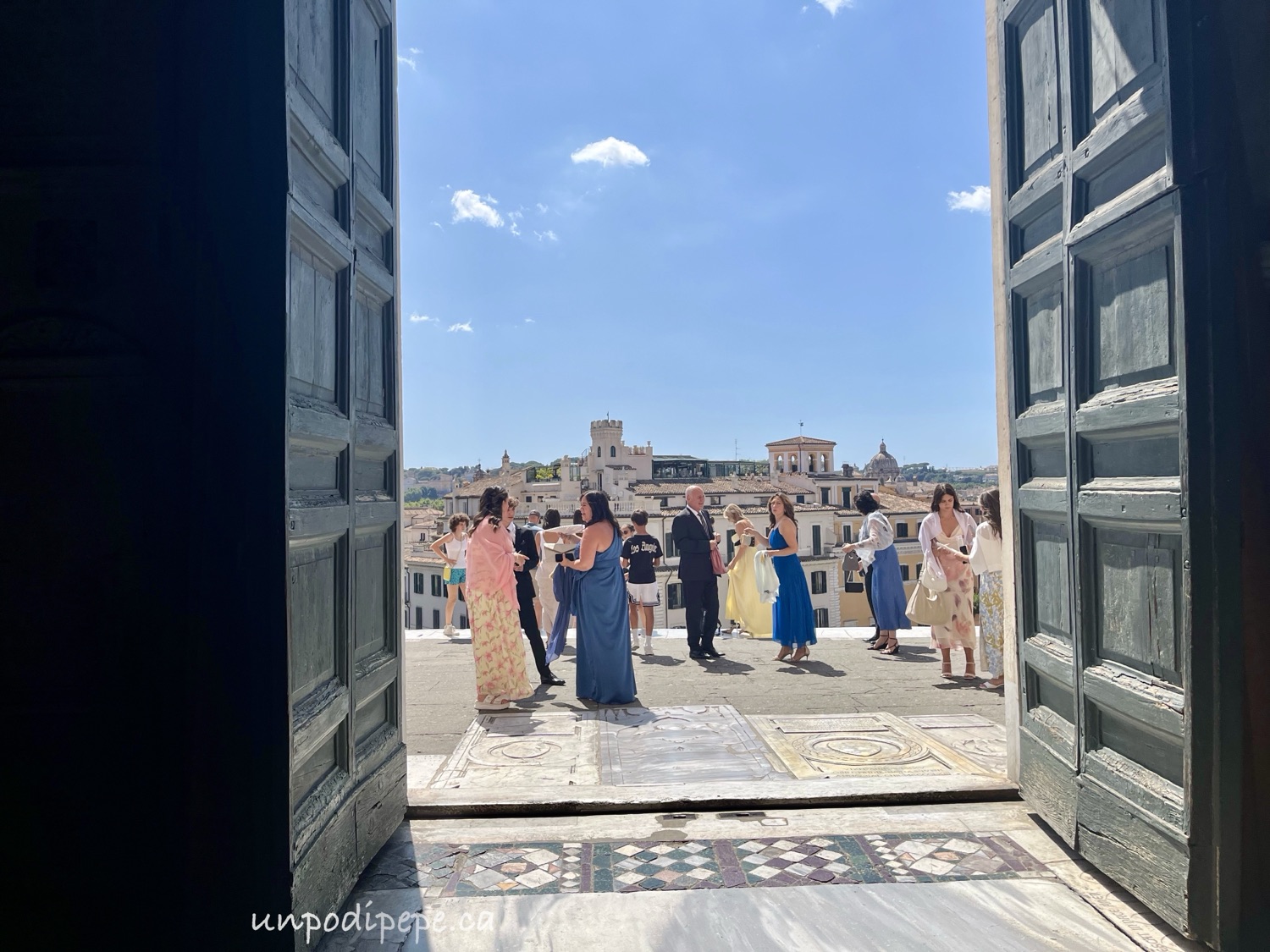
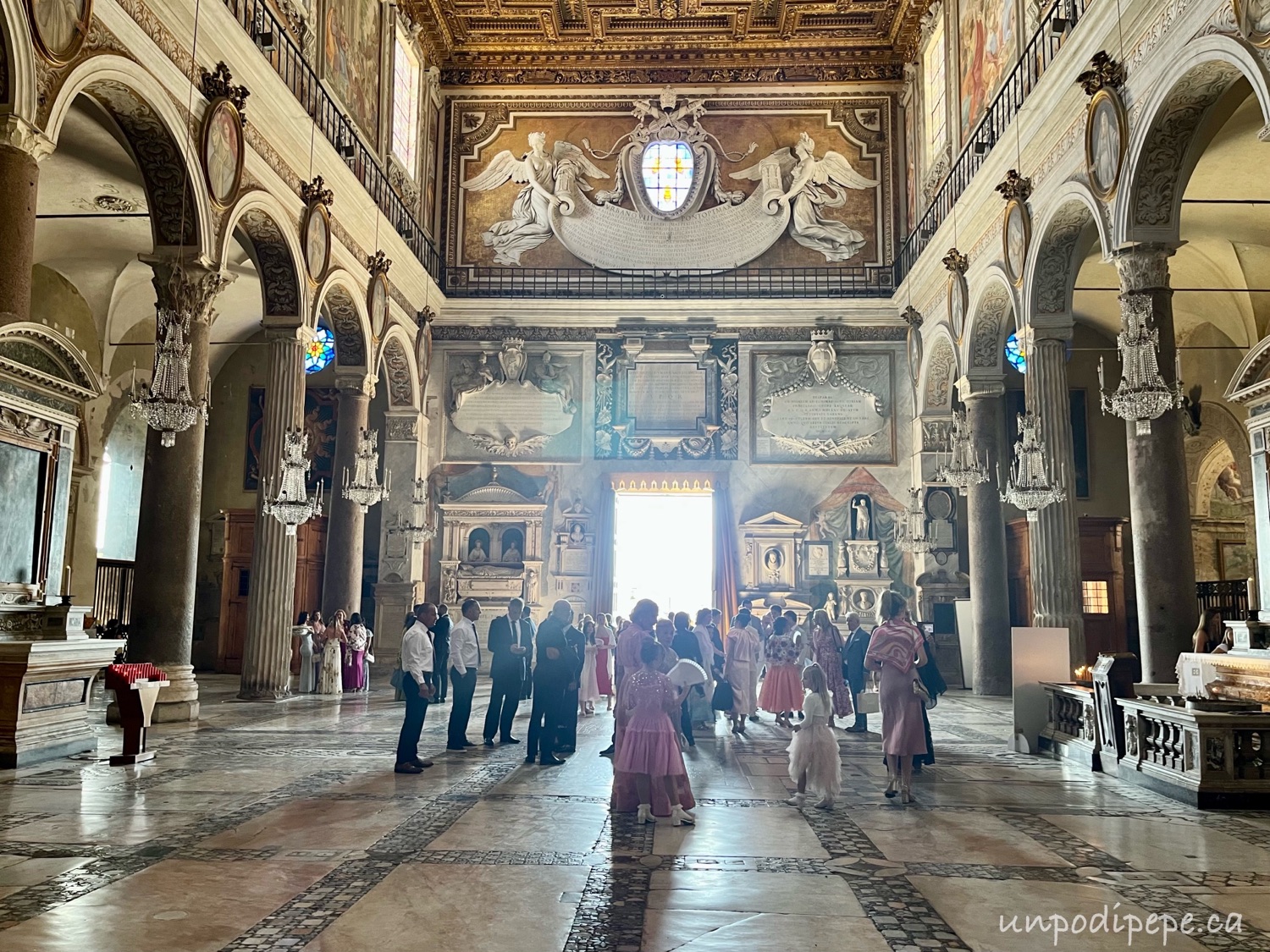
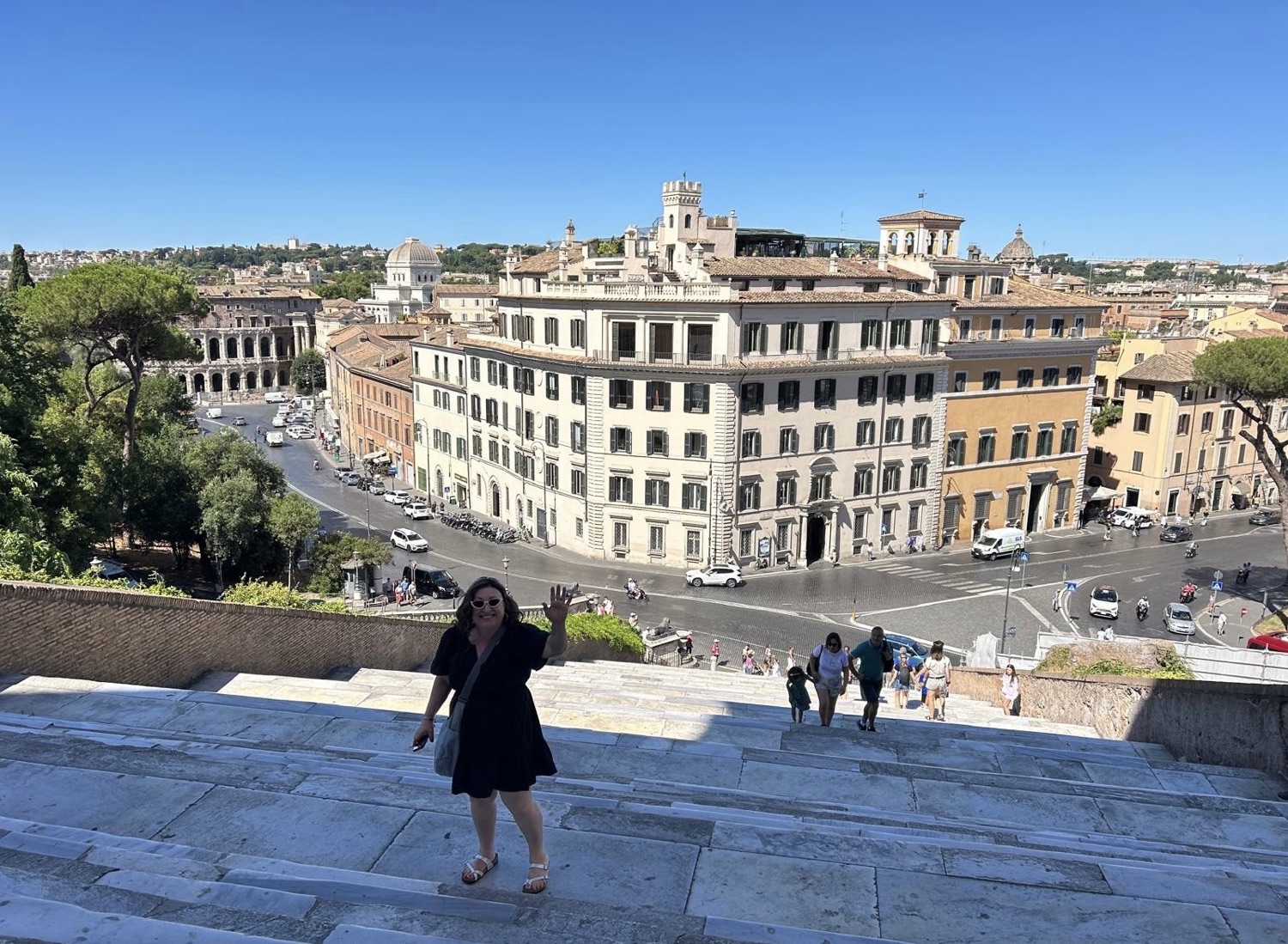
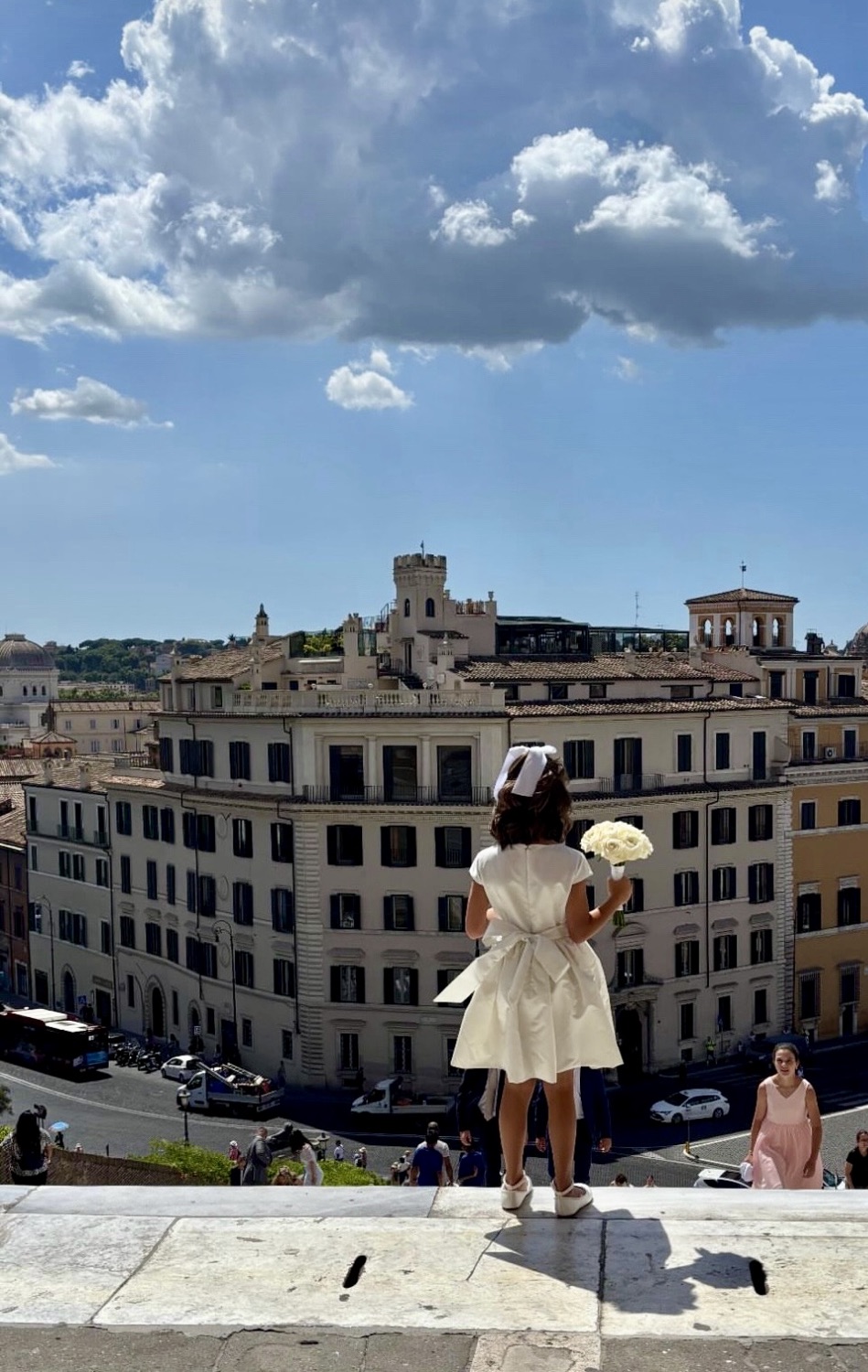
I recently attended a family wedding in one of the most beautiful churches in Roma, the Basilica Santa Maria in Aracoeli (pronounced Ah*rah*CHEH*lee). Because of its location on the highest point of the Capitoline Hill, sandwiched between Il Vittoriano and the staircase to Il Campidoglio, most visitors have seen it from the outside-but they have no idea what treasures the interior holds. Photos in this post are from the July rehearsal and wedding of Isabella and John.Translated from Latin, Santa Maria in Aracoeli means ‘Santa Maria of the altar in Heaven’. The Romanesque Gothic Basilica was built on the site of a Temple to Giunone (Juno) in the year 574.  Originally a Greek Byzantine church, it was taken over by the Benedictines in the 9th Century, then later the Franciscans in 1249.  Santa Maria in Aracoeli is one of the principal churches of Roma and the designated church of the city council and the Senate and people of Roma (SPQR). The Municipio, or City Hall of Roma is conveniently located behind the Basilica, on the Campidoglio.  During the French occupation of 1797, the Basilica was turned into a stable for the French cavalry!  It was almost demolished in the 1880’s during construction of its massive neighbour Il Vittoriano /L’Altare della Patria. In the photo above, the white monument is Il Vittoriano, the building behind it with the steep staircase is Santa Maria in Aracoeli and the staircase on the right leads to Piazza del Campidoglio, where the Capitoline Museum and Municipio are located.The interior is elaborately decorated, with a coffered and gilded wooden ceiling (1575).  The exquisite cream and pink marble floor is decorated with Cosmati, an inlay geometric style of Medieval stonework. The arches are supported on 22 columns scavenged and upcycled from diverse ancient ruins throughout the city. This is why no 2 of the columns are alike.  52 gorgeous Murano glass chandeliers hang in the nave and sanctuary. They were all lit during the wedding.

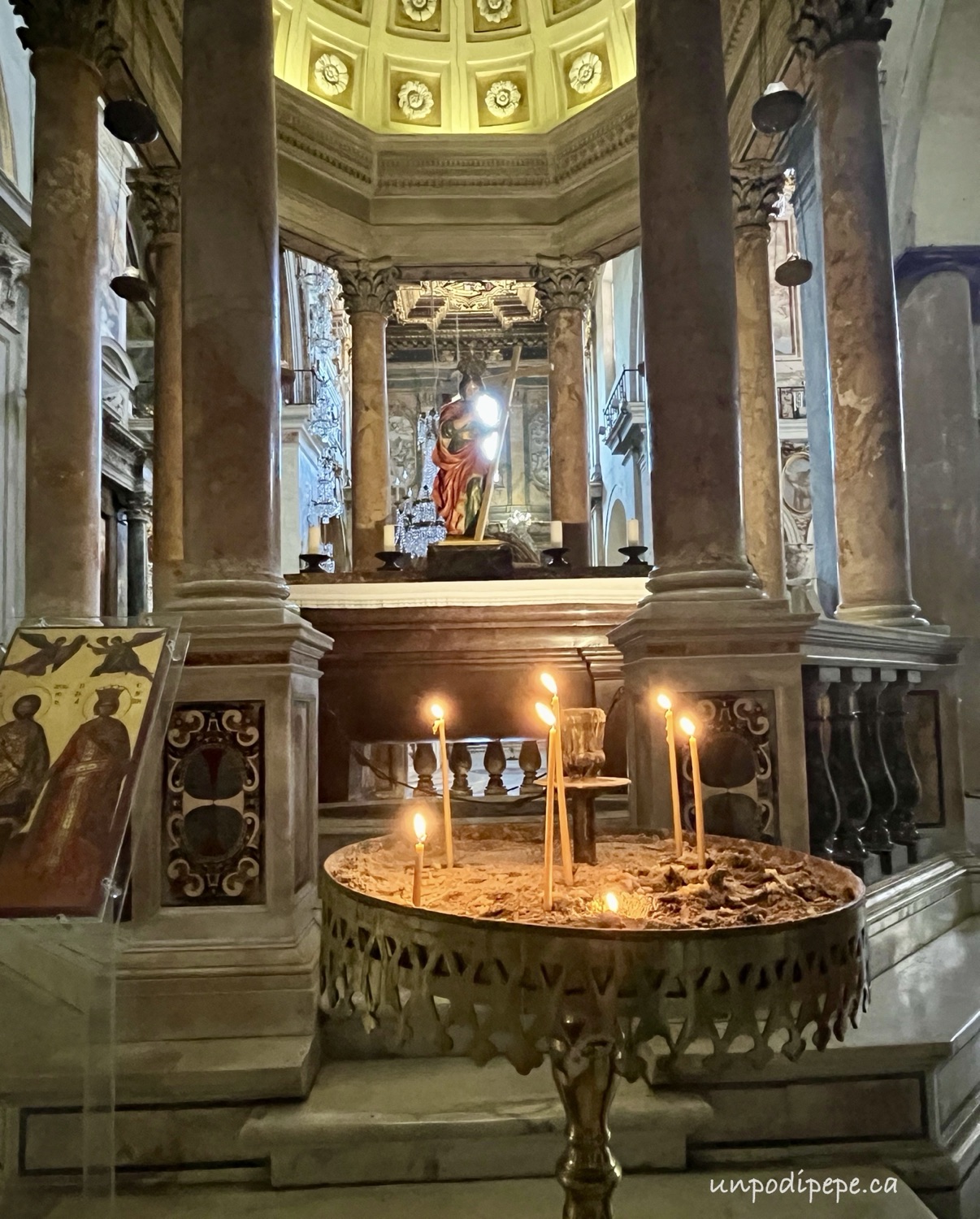
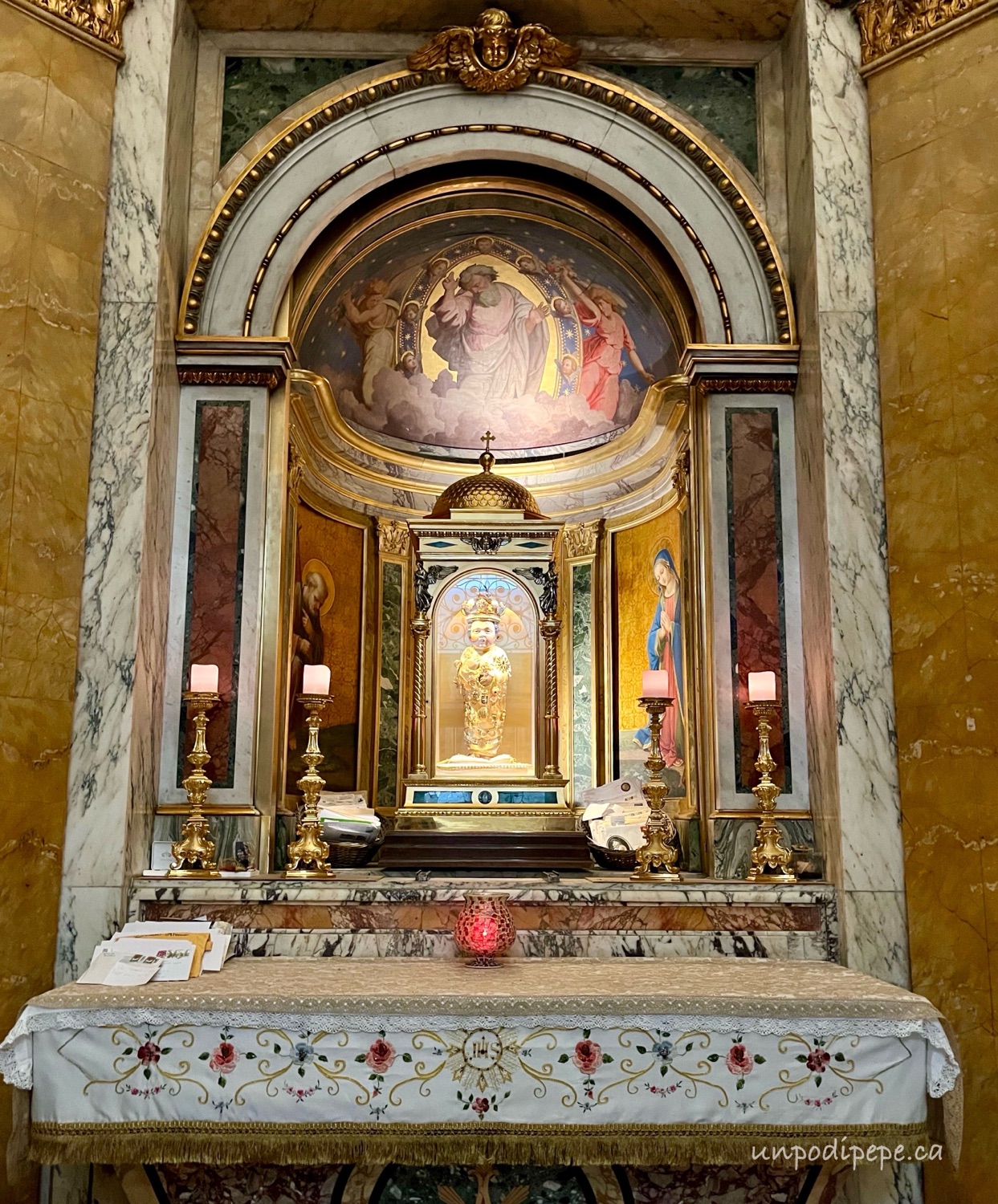
On the altar, is a 10th Century Byzantine icon painted on beech wood, la Madonna di Aracoeli. She is holding up her hand, which is painted in gold.  La Madonna di Aracoeli was carried through the streets of Roma during the Black Plague outbreak in 1348, and is credited with the shorter duration of the epidemic. To the left of the altar an octagonal tempietto or shrine contains the Byzantine relics of Sant’ Elena (St. Helena), the mother of Emperor Constantine. Cappella Bufalini, the first chapel on the right of the entrance, contains a series of 15th Century frescoes by Pinturicchio.  There are also frescoes by Pietro Cavallini and Arnolfo di Cambio, and countless other works of art.The most famous item in the church is the Santissimo Bambinello, a 15th Century bejewelled wooden sculpture of baby Jesus carved out of olive wood from the gardens of Gethsemane in Jerusalem, and baptised in the river Jordan.  It is believed to have healing powers. Unfortunately, he was stolen in 1994, and is still missing.  Today, the Bambinello in a private chapel by the small gift shop is a replica.

La Scala Santa, the staircase of 124 marble steps leading to the main entrance of the church, was designed in 1348 on the occasion of the end of the Black Death. The stairs are considered sacred, and people have been known to climb up on their knees, hoping for a miracle.  Luckily, none of the wedding guests chose to do this, but there were many wobbly stilettos climbing the stairs, and one extremely dirty wedding train!  Viva gli sposi!

Ciao, Cristina

Share this:

  • Click to share on Facebook (Opens in new window) Facebook
  • Click to share on Pinterest (Opens in new window) Pinterest
  • Click to share on X (Opens in new window) X
  • Click to email a link to a friend (Opens in new window) Email
  • Click to share on WhatsApp (Opens in new window) WhatsApp
Like Loading...

Fontana di Trevi

13 Sunday Apr 2025

Posted by Un po' di pepe in Architecture, Italia, Photography, Roma

≈ 13 Comments

Tags

Aqua Virgo, Fontana di Trevi, La Dolce Vita, Palazzo Poli, Roman Fountains, UNESCO World Heritage Sites

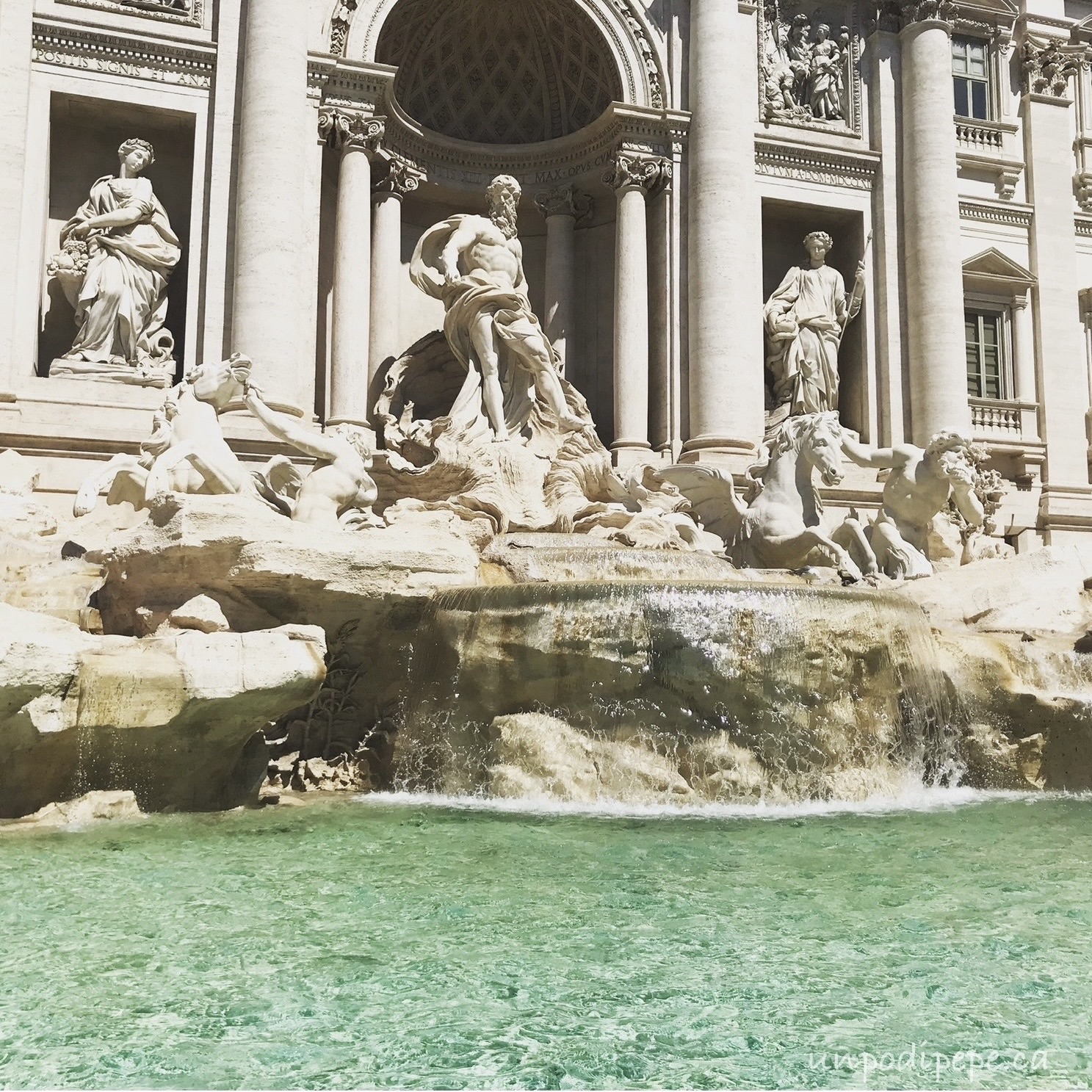
The Fontana di Trevi is one of the most iconic structures in Roma-a Baroque masterpiece with a direct link to the Ancient Roman Empire.  Every year, millions of tourists visit, trying to capture a perfect photo, tossing in a coin to ensure a return visit to Roma.  Sometimes it can feel like a mosh pit! The water comes from an ancient aqueduct, Aqua Virgo (Acqua Vergine in Italiano), 9 m below ground, built in 19 BC.  It still functions today and provides water to the fountains in Central Roma.  Find out more in the previous post Acqua Vergine.

The Fontana di Trevi is named for the piazza. Tre vie means 3 roads, refering to Via De’Crocicchi, Via Poli and Via delle Muratte that come together at Piazza Trevi. The Fontana di Trevi is the final destination of Acqua Vergine.

There was always a fountain to mark the end point of Acqua Vergine. The medieval fountain was a simple rectangular shape with 3 spouts pouring water into 3 basins.  In the Baroque era, when everything was over the top and extravagantly decorated, Pope Urban found the existing fountain too boring.  He commissioned the Master, Gian Lorenzo Bernini to sketch a design, but they both died before it got going.  The next Pope held a contest, and Nicola Salvi’s design was chosen.  Construction started in 1732, with many artists involved during the 30 years it took to complete. In a very modern fashion, construction of the Fontana di Trevi was financed with proceeds from the Roman lottery.

The symmetrically balanced theme ’Taming the Waters’ was built right onto the existing building. Palazzo Poli was given a new façade featuring a giant order of Corinthian columns. The main sculpture is Greek Titan Oceanus, not Neptune as is commonly thought.  He is in a large half-shell pulled by 2 seahorses and tritons (sea messengers) with a sea reef below them.  The façade and sea reef are made of Travertine from Tivoli, and the sculptures are Carrara marble. Above and on either side of Oceanus are 2 bas reliefs illustrating the origins of Acqua Vergine.  One depicts Marcus Agrippa ordering construction of the aqueduct and the other the vergine, a young girl leading Roman soldiers to the spring.  The Fontana di Trevi is 26 m (~85 ft) high and 49 m (~160 ft) wide. It spills 80,000 cu m (2, 825,000 cu ft) of water per day! Today the water is continually recycled.

Tossing a coin in the water with the right hand over the left shoulder while facing away from the fountain is thought to ensure a return to Roma. I never miss this opportunity-even during renovation in 2015 I found a way to toss one in! This tradition dates back to the Ancient Romans who tossed coins in water so the gods would protect them on their journey and ensure a safe return. Throw in a second coin to find true love and a third for wedding bells! I believe these last 2 are just from the 1954 movie ‘3 coins in the Fountain’, not the Ancient Romans!  According to another old tradition, drinking the water with your beloved will ensure eternal love and fidelity. Do not drink the water! 

Although the water comes straight from a spring via an ancient aqueduct, it is now continually recirculated. In 1998 when the Fontana was refurbished, recirculating pumps were installed. On the far right and up a few stairs is the Fontanella degli Innamorati (Little Lovers’ Fountain) a small rectangular basin with 2 crossing spouts. Take a drink from this instead-the water is also from Acqua Vergine!

All of those coins in the water can’t be hygienic either.  Approximately €3,500 per day is collected nightly and given to the charity Caritas. The money funds a program providing supermercato cards Roma’s needy.   There are regular attempts to steal the coins from the basin, which of course is illegal.  The water has been vandalized many times, painted red and most recently dyed black with charcoal by climate eco anarchists.

In 2014 Fendi sponsored a 1.5 year, €2.2 million restoration and cleaning, including installation of LED lights to improve night illumination. Most recently, in late 2024 a 3 month restoration also secured the lower basin to restrict access to only 400 visitors at a time. Crowds are expected to be bigger than usual during Giubileo 2025.  Early in the morning is usually a good time to visit.

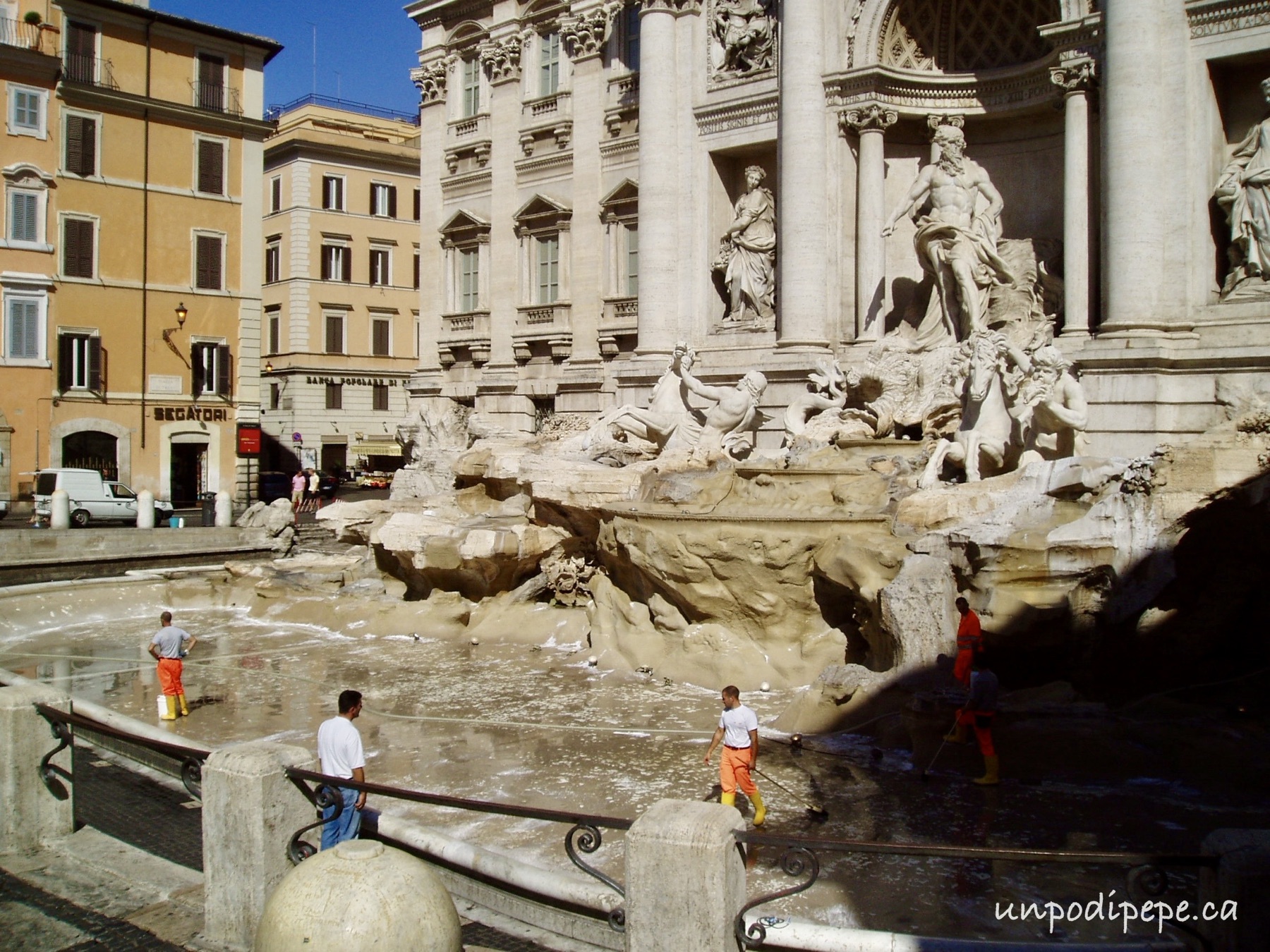
As an outdoor public monument, the Fontana di Trevi is free and always open, so unless it is under renovation, you can check it out at any time.  Access to the lower basin may be limited at some times, and cleaning takes place on certain Monday and Friday mornings. Since it is fed by an aqueduct and powered only by gravity, it never needs to be turned off.

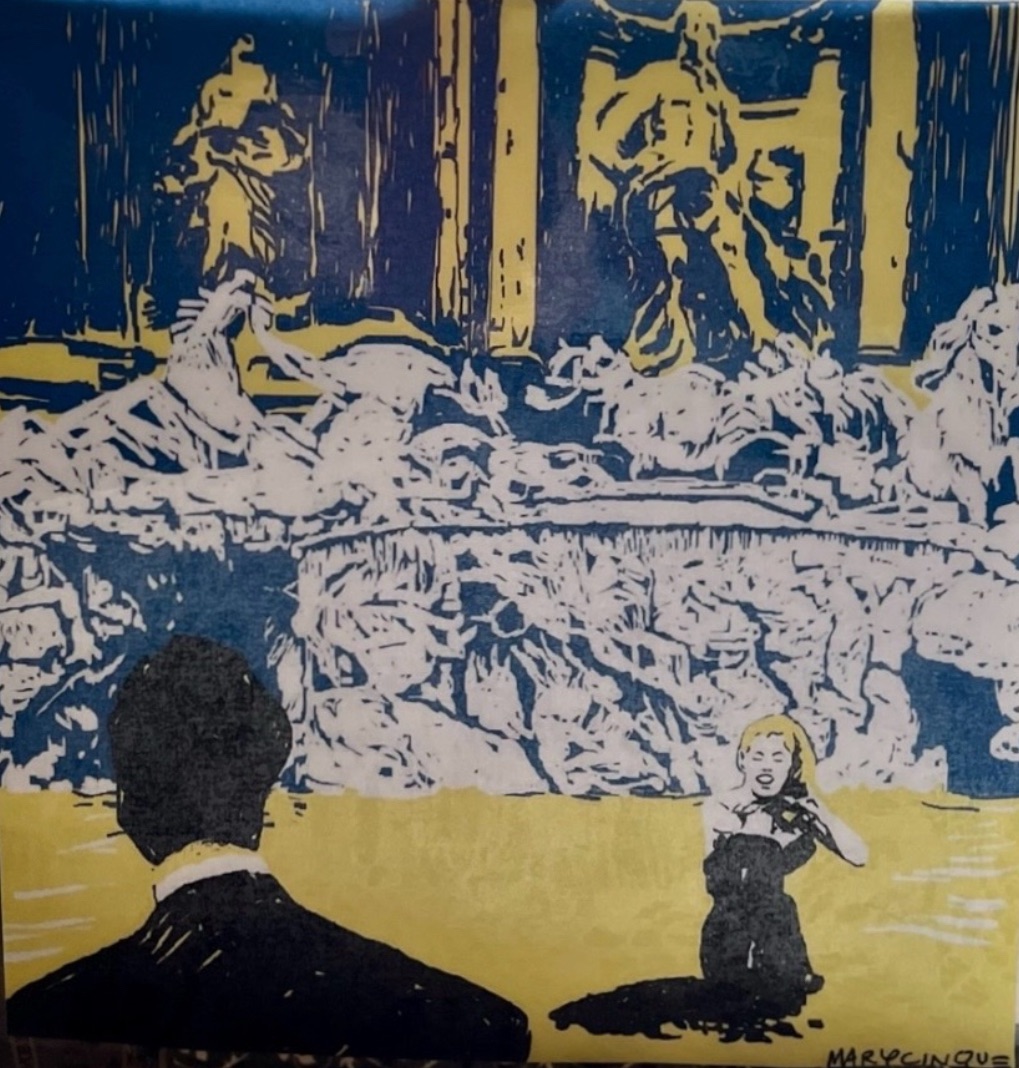
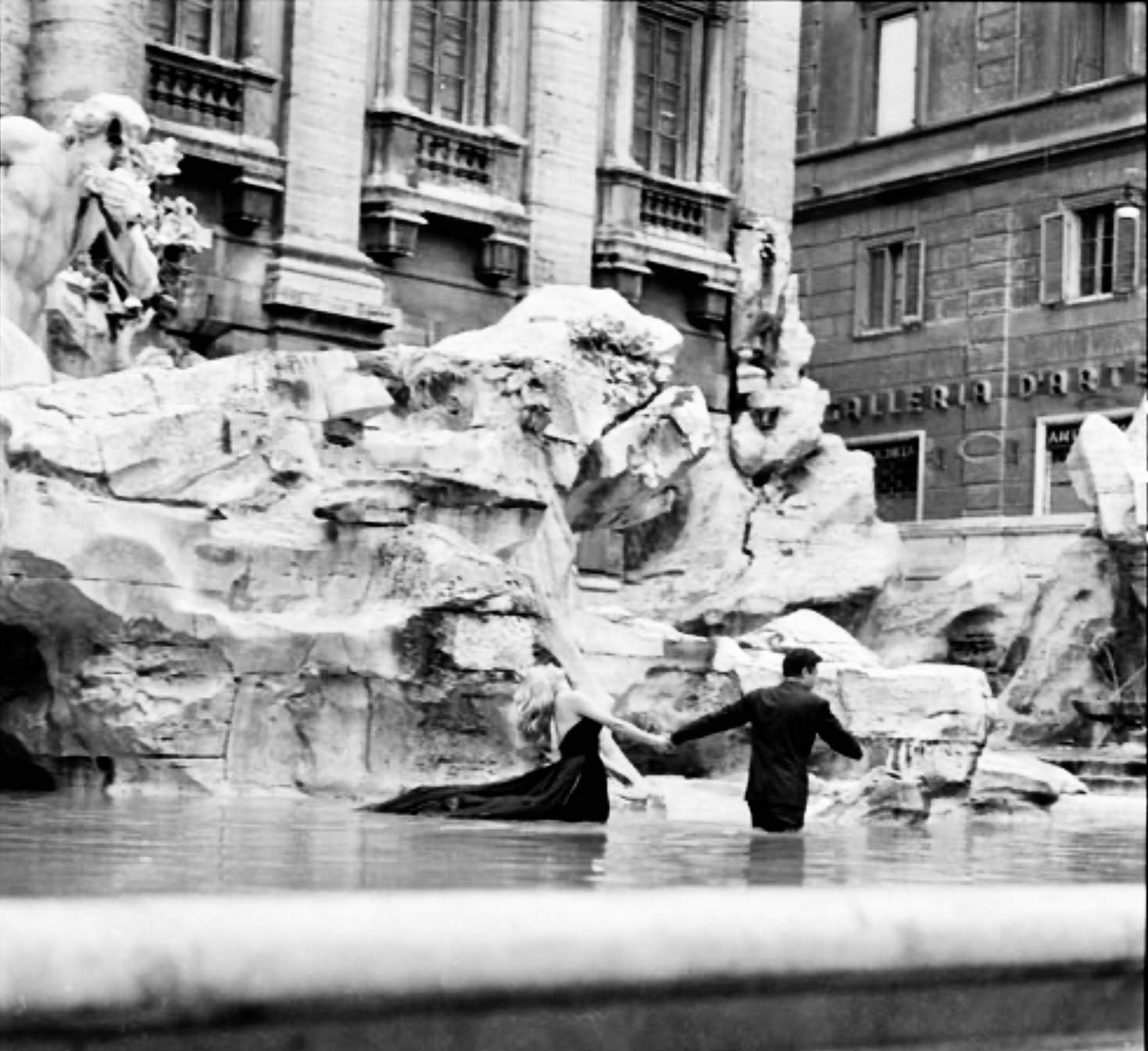
The Fontana was immortalized in film in 1960 when Anita Ekberg walked in with her clothes on in the Fellini classic La Dolce Vita.  Do not be like Anita-you will be immediately slapped with a €450 fine. When her costar Marcello Mastroianni died in 1996, the Fontana di Trevi was draped in black, the water and lights turned off in his honour. Below is part of a poster-note how dirty the stone was in 1960!  The spouts of Fontanella degli Innamorati can be seen on the far right.

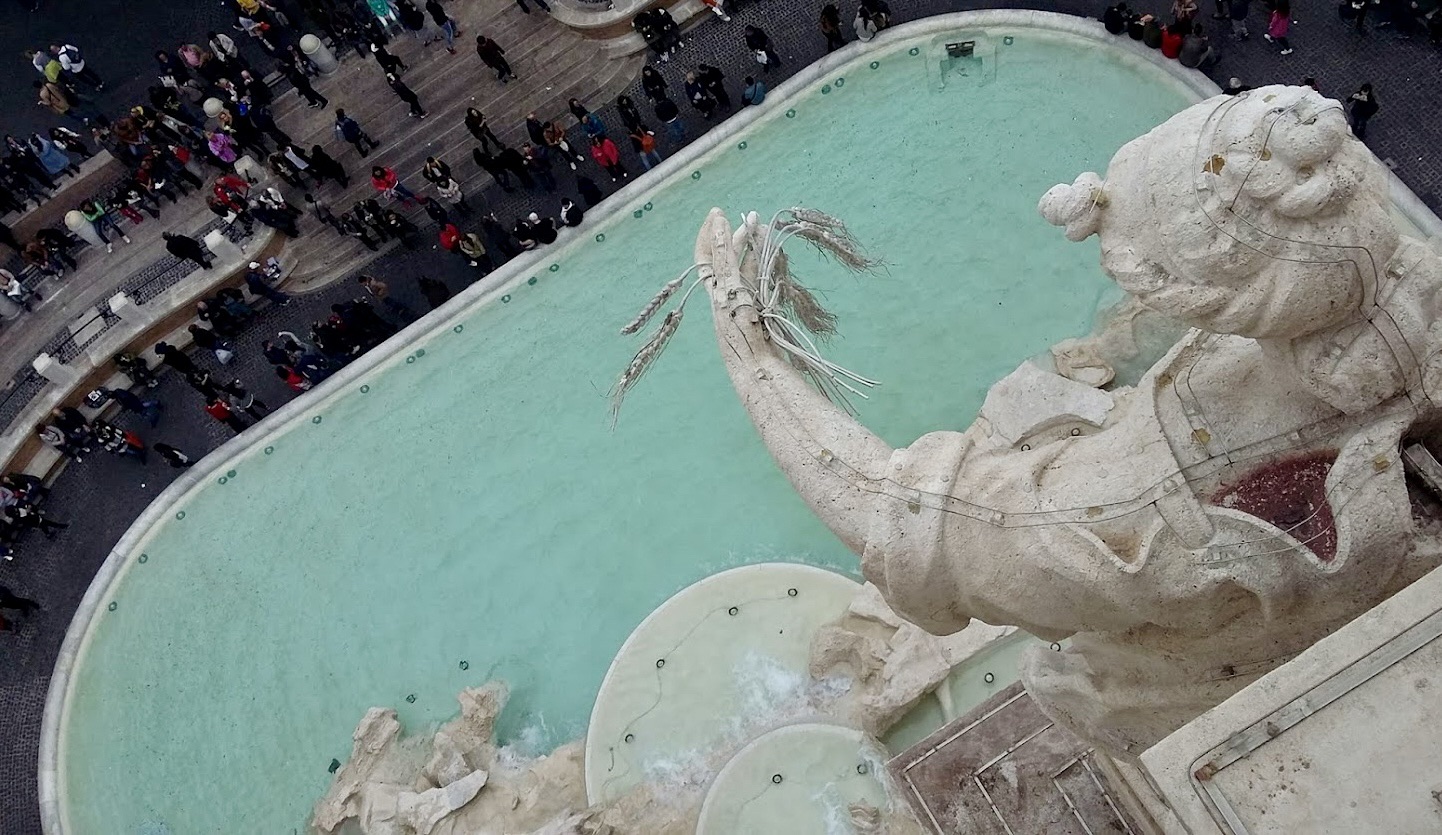
I have a cool Trevi memory.  In 2004, I attended a printmaking exhibit with a friend.  The entrance was at Via della Stamperia 6, 150 m from Piazza Trevi, down the side street past Fontanella degli Innamorati.  I remember climbing a lot of stairs and walking through corridors to get to the exhibit, which was amazing.  Then I wandered off to explore the gorgeous architectural details of the building, and heard the sound of running water as I walked past one of the tall, heavily curtained windows. Moving the curtain, I was right above the Fontana di Trevi!  It had not even occurred to me that there was a real building behind it.  Of course, this was before the time of cell phone cameras! This photo is from the Istituto’s website and was taken from farther up, possibly the roof.  Palazzo Poli was once a private residence, expropriated in 1885.  It is now theIstituto Centrale per la Grafica (Central institute for Graphics) a museum and exhibition space created to preserve and promote cultural heritage documenting graphic art.  Open Monday to Friday 09-17 and weekends 09-14.  Admission is free.  The room I wandered into is usually closed, unless you are attending a classical music performance.

9 m below the Fontana di Trevi, an archeological site was discovered during 2001 renovation of the former Trevi Cinema. Excavations uncovered a building complex from the Imperial Age (27 BC to 476 AD) and a fancy domus (Roman home), including canals still carrying clear water from Acqua Vergine to a holding tank for the domus. The site is called Vicus Caprarius, or “City of water” Vicolo del Puttarello 25.  Open Tuesday to Sunday 11-17 Reservations are recommended on weekdays, required weekends and holidays.  There are several underground tours, ranging from 30 minutes with audio guide to several hours long. I plan to see it in July!

The photos in this post were taken between 2004 and 2025.  Night view and bas reliefs taken by my sorella Lucia in Feb 2025.  ‘La Dolce Vita’ oil pastel on paper by the amazing Mary Cinque.

Ciao, Cristina

Share this:

  • Click to share on Facebook (Opens in new window) Facebook
  • Click to share on Pinterest (Opens in new window) Pinterest
  • Click to share on X (Opens in new window) X
  • Click to email a link to a friend (Opens in new window) Email
  • Click to share on WhatsApp (Opens in new window) WhatsApp
Like Loading...

Acqua Vergine

28 Friday Mar 2025

Posted by Un po' di pepe in Architecture, Roma

≈ 5 Comments

Tags

Ancient Roma, Ancient Roman engineering, Fontana di Trevi, La Barcaccia, Roman Fountains, UNESCO World Heritage Sites

The Ancient Romans were masters of engineering.  One of the greatest examples of this is their aqueducts.  These systems of waterways transported fresh water from springs and melting snow long distances via pipes and tunnels.  The ability to provide a fresh, safe supply of drinking water is one of the reasons the Roman Empire became so powerful. In Roma, 11 aqueducts were built over a period of ~500 years.  Aqueduct #6 out of 11, called Aqua Virgo (Acqua Vergine in Italiano) lives on today.  Not only is it still with us, but it is still functioning, providing water to the most important fountains in central Roma.  The pure, cold, fresh water is drinkable*, constantly flowing and powered by gravity.

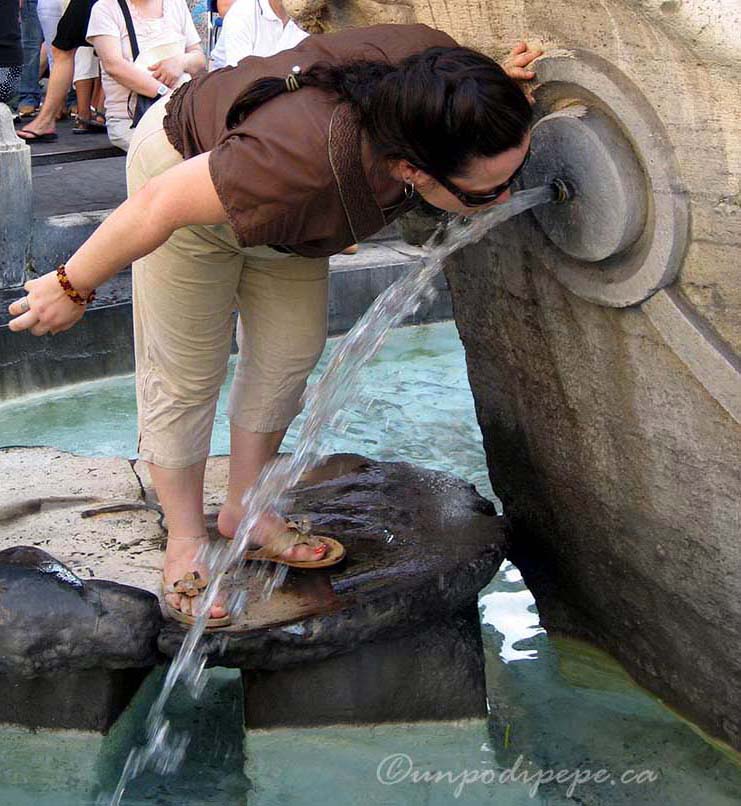
Mmmm! Acqua freddissima!

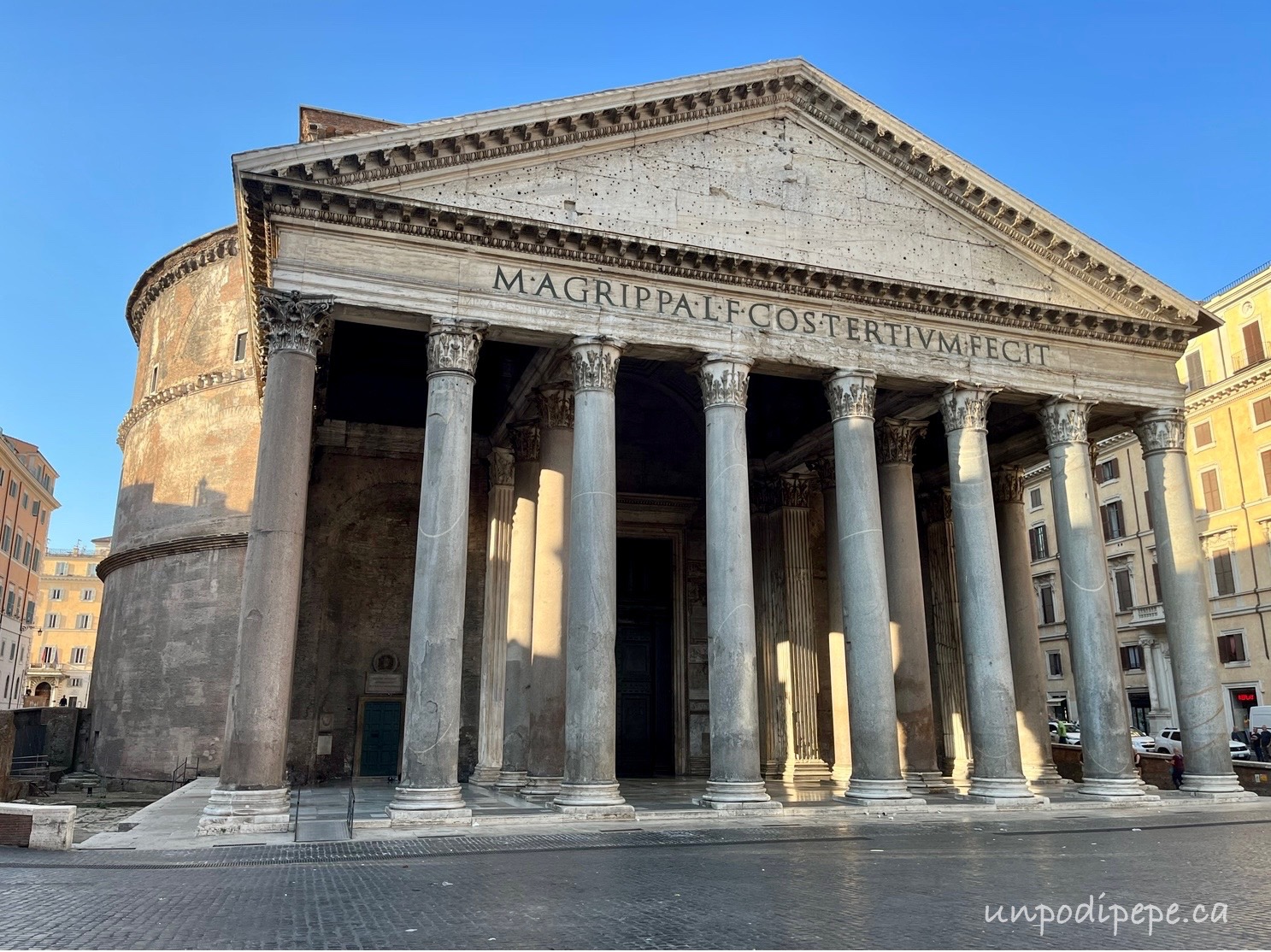
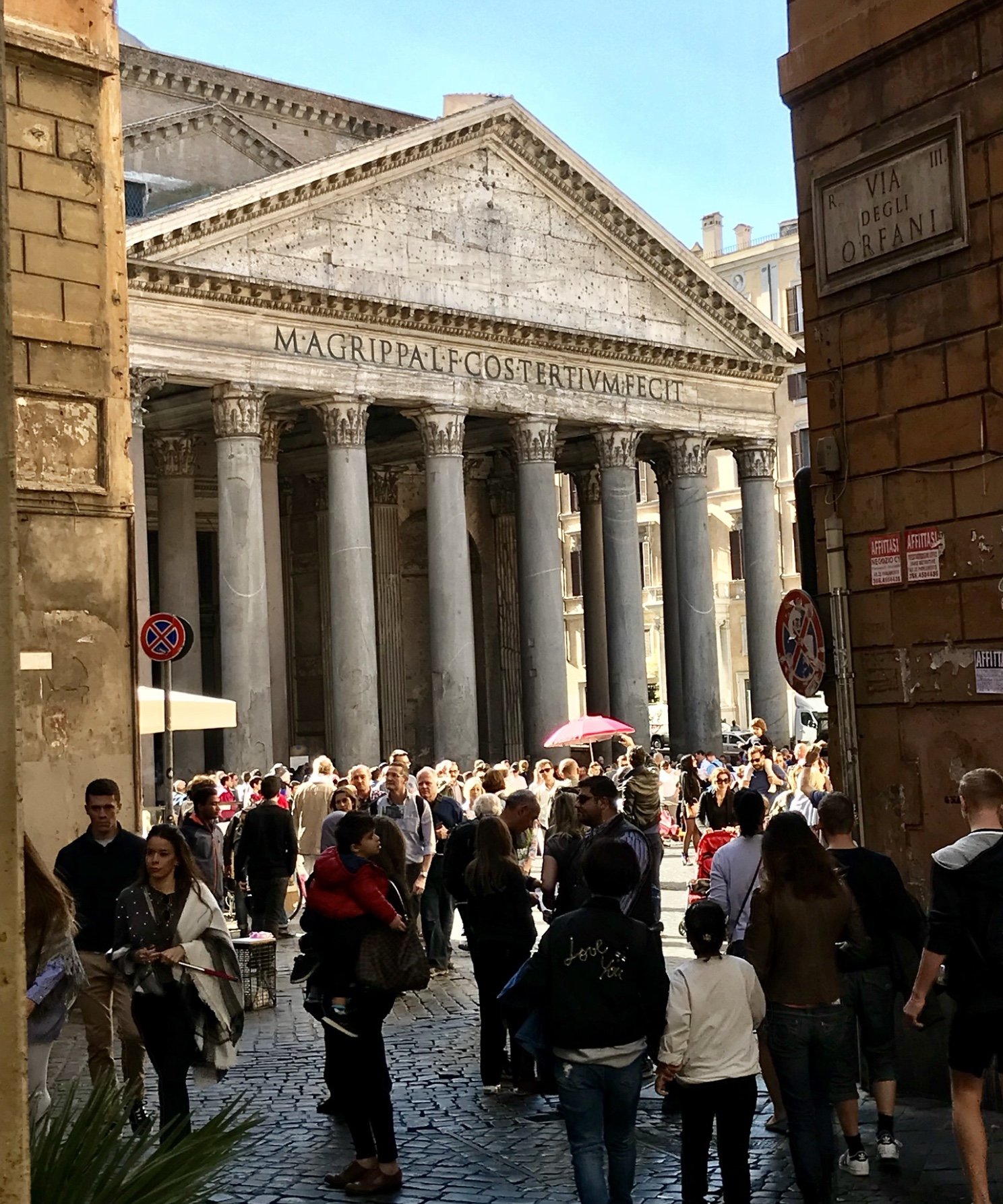
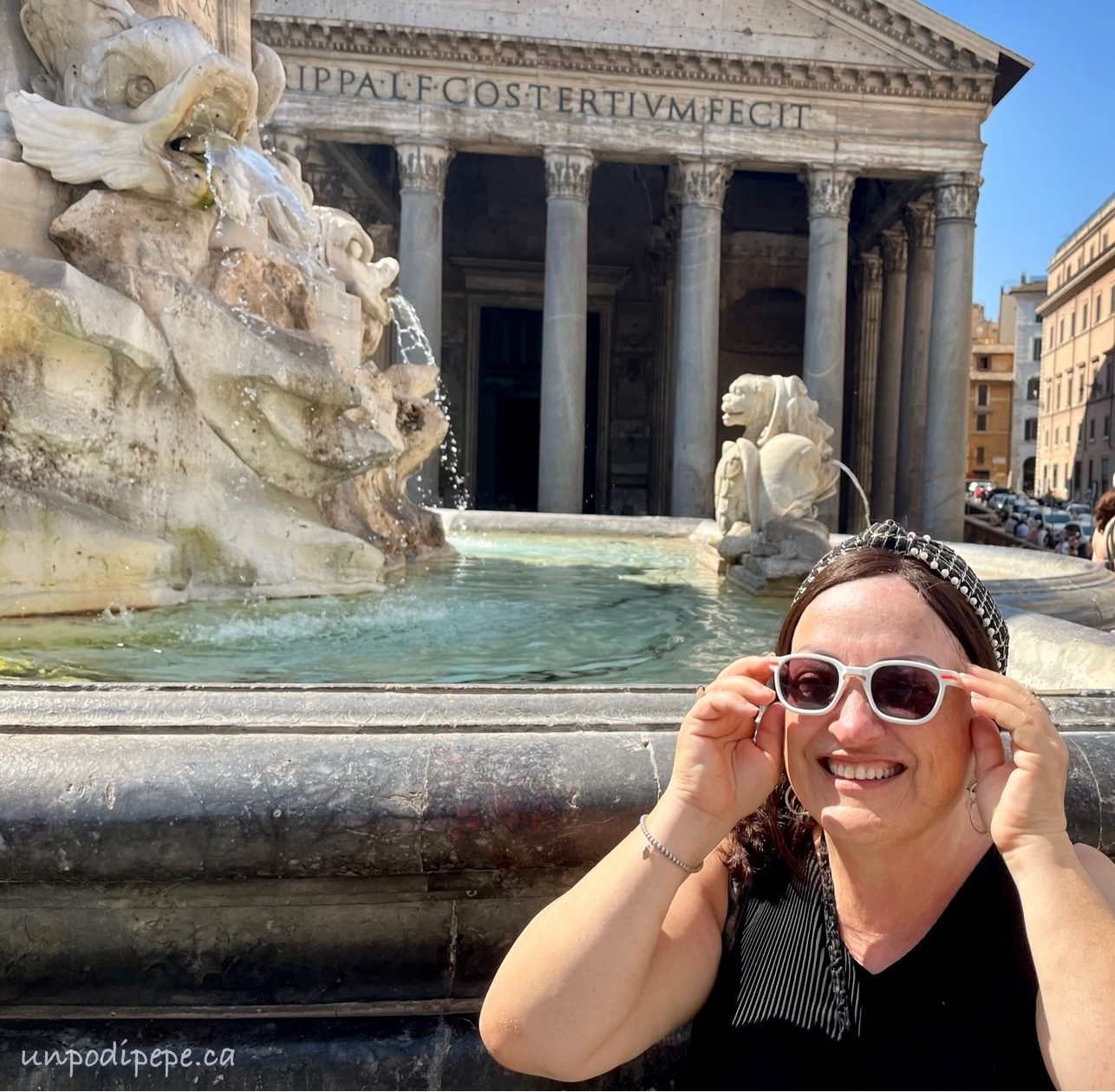
Aqua Virgo was constructed in 19 BC by Marcus Vipsamius Agrippa, son in law and general of Emperor Octavian Augustus.  Yes- the same Marcus Agrippa whose name is carved into the front of the Pantheon. He constructed the original Pantheon, before it burnt down.  Marcus had the aqueduct built to supply water for the thermal baths of Agrippa in the Campo Marzio area near the Pantheon.

Aqua Virgo/Acqua Vergine probably refers to the freshness and purity of the water, but according to legend, in 19 BC, a young girl led Roman soldiers to a spring -the source for the aqueduct.  The source is in the hills 13 km away, at Agro Lucellano between Via Tiburtina and the 8th milestone of Via Collatina (2 of the roads that led to Roma) near present day Salone.  The source is actually only 24m (79 ft) above sea level. Aqua Virgo is 21 km long via indirect route to Roma, making a wide arc.  This is to make use of gravity by shallow downward gradient. 19 km of Acqua Vergine are 9m below ground, with short stretches of brick arches above ground.

There were 1352 fountains in Roma in the 4th Century.  Aqua Virgo was damaged by the invasion of 537 and repaired. It remained in use through the Middle Ages with a few renovations during the Renaissance.  Early Renaissance Popes started to decorate the end point of restored aqueducts with large, ornate fountains.The Fontana di Trevi is the final destination of the original Acqua Vergine and Piazza del Popolo the end of an offshoot.  Carved above the statues next to Oceanus on the Fontana di Trevi, 2 bas reliefs illustrate Marcus Agrippa ordering construction of the aqueduct and the young girl leading Roman soldiers to the source.  They can both be seen in the photo below:

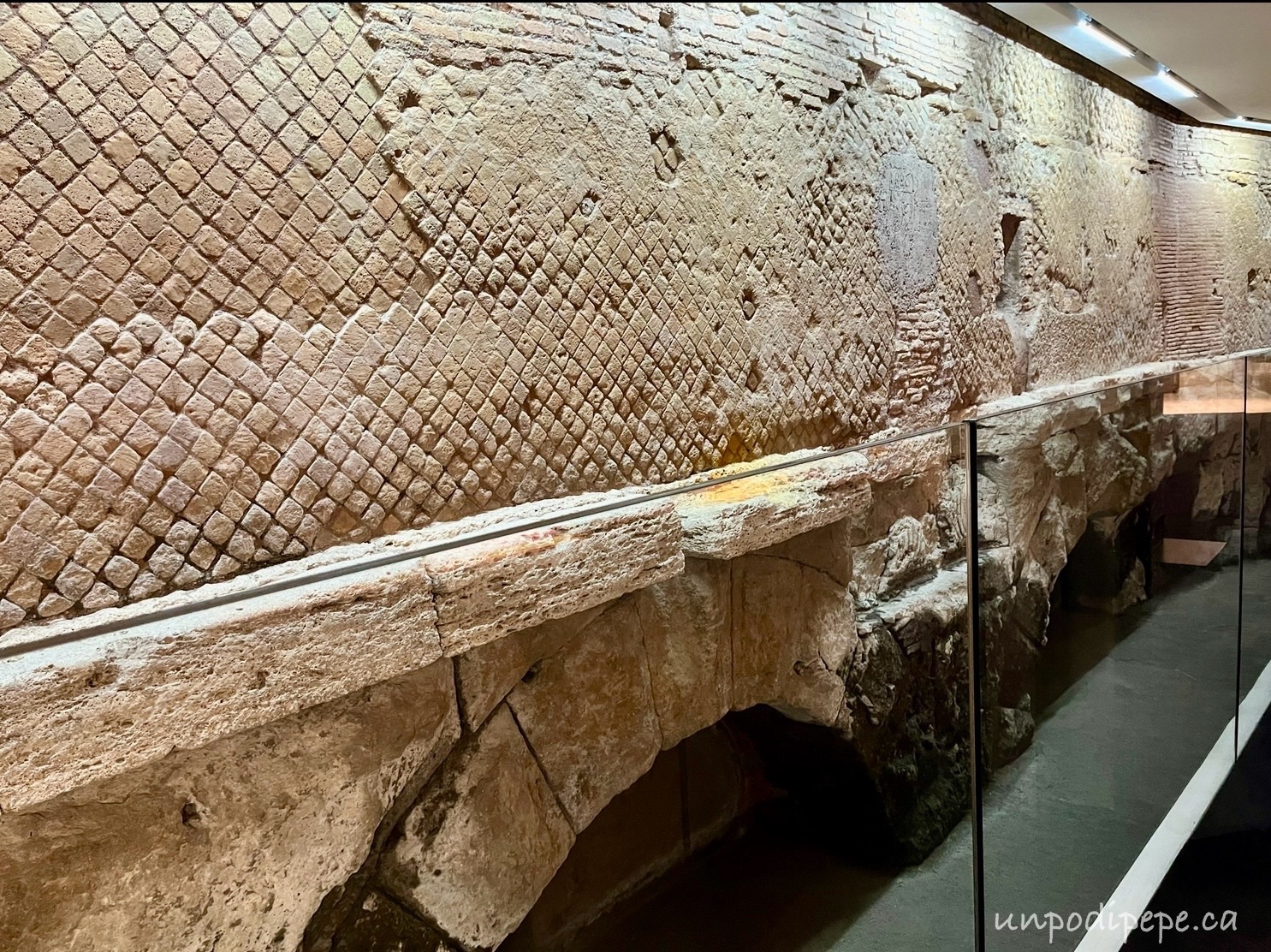
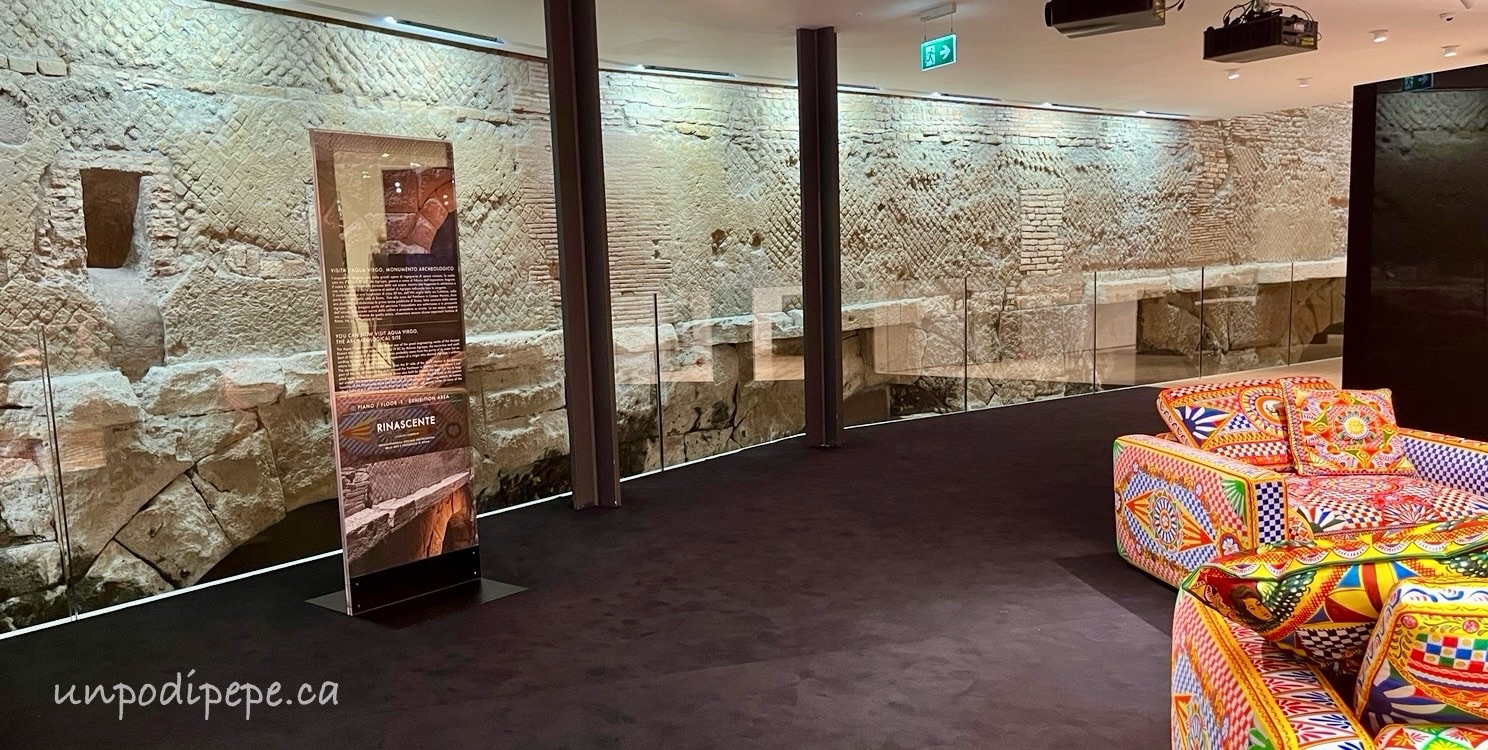
Acqua Vergine Antica runs under Villa Borghese and Villa Medici to Piazza di Spagna and Fontana di Trevi. In 1930 renovated Aqua Vergine Nuova goes behind Piazza di Spagna to Piazza through Giardini Borghese to Piazza Flaminio and Piazza del Popolo. Most of the aqueduct’s 21 km are 9m underground, except for the last stretch running partly on arches as it approached the Campo Marzio area, emerging from the hill by the present La Rinascente Department store. There is also an arch standing on Via del Nazareno, north of Trevi.  Part of Aqua Virgo was found during construction of the new La Rinascente department store location, delaying the opening by 2 years. In 2017 the new Flagship La Rinascente store on Via Tritone 61 opened, including a basement archeological site with a 60 m (197 ft) section of Aqua Virgo on display. Admission is free.  When I went, there was a Dolce and Gabbana furniture exhibit! Just take the escalator down to the bottom floor any time the store is open. Where else but Roma can you combine high end shopping and archeology?

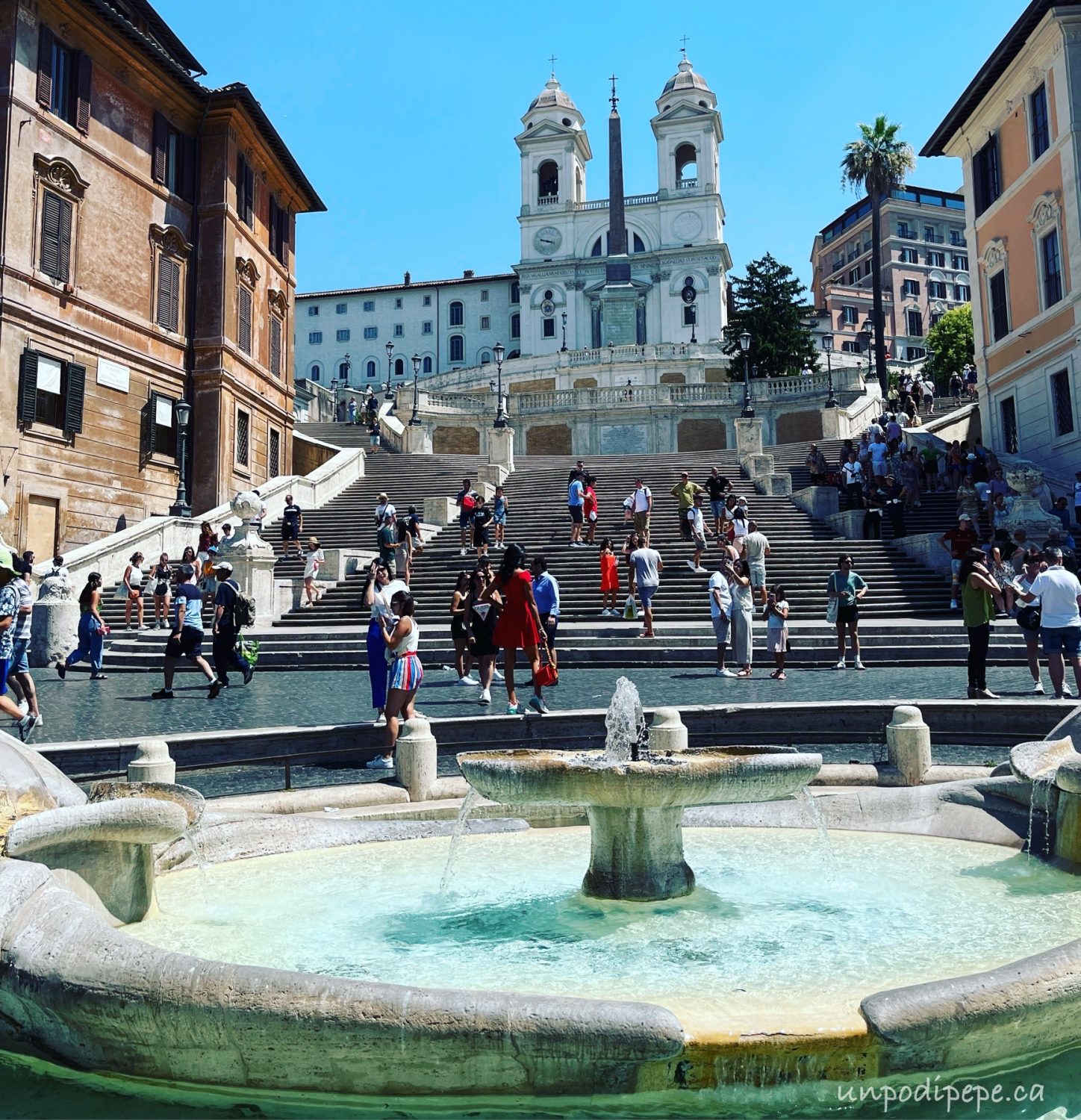
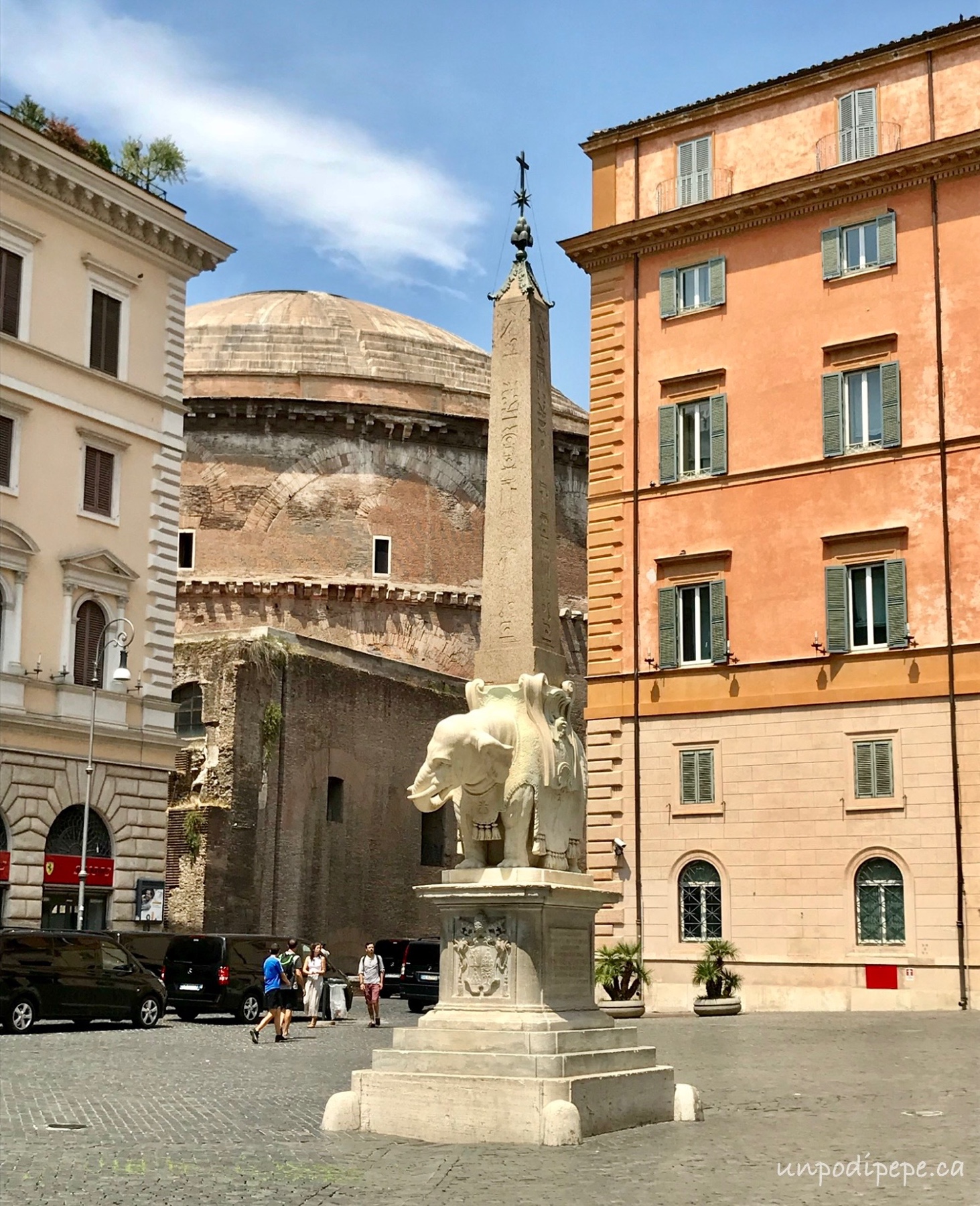
Today Acqua Vergine supplies water to the fountains in Piazza della Rotonda outside the Pantheon, Piazza Mattei (Fontana delle Tartarughe) Fontana del Babuino, Piazza Navona (the 2 outer ones, not the Fontana dei Quattro Fiumi), Campo dei Fiori, Piazza del Popolo (Fontana dei quattro leoni, Fontana di Nettuno and Fontana della Dea di Roma), Piazza Trevi, and my all-time favourite in Piazza di Spagna, La Barcaccia which resembles a sinking ship.  

Don’t forget to bring a water bottle to Roma!  Buon Viaggio, Cristina

*Since 1998, the water in the Fontana di Trevi is recycled, so no longer drinkable.  With €3000 of coins thrown in daily, it was hardly drinkable anyways! Read more about this in my next post!

Photo credits:  Drinking from La Barcaccia by Shannon Milar, Photo with bas reliefs by my sorella Lucia.

Share this:

  • Click to share on Facebook (Opens in new window) Facebook
  • Click to share on Pinterest (Opens in new window) Pinterest
  • Click to share on X (Opens in new window) X
  • Click to email a link to a friend (Opens in new window) Email
  • Click to share on WhatsApp (Opens in new window) WhatsApp
Like Loading...

Torino

13 Sunday Oct 2024

Posted by Un po' di pepe in Architecture, Italia, Photography, Travel tips

≈ 14 Comments

Tags

Bicerin, Italian history, Northern Italy, Piemonte, UNESCO World Heritage Sites

I had no expectations when I visited Torino.  I knew that many of my paesani had moved to the area in the 1970-80’s to look for work, but did not know much about the city itself.  Torino turned out to be a pleasant surprise-a truly underrated, overlooked city on the banks of the river Po, at the foothills of the Alps. With a population of almost 850,000, it is the fourth largest city in Italia but practically unknown to English speaking travellers. It is much less crowded, quieter and cheaper than most other major cities.

L’Universita’ di Torino

I arrived in Torino by highspeed train (TGV) from Paris, to attend an AICW conference at the Università di Torino.  Once the conference started, I only had the evenings to explore the city, so could not visit any buildings/museums.  This is why many of my photos were taken at night!  I need to return to Torino to visit the indoor things!

Named for the ancient Taurini people, the Roman Colony of Taurinorum was founded in 28 BC.  Via Garibaldi, the main shopping street traces the exact path of the ancient Roman street or Decumanus.

Torino was the capital of the Duchy of Savoia, the political center of the Risorgimento (birth of the nation) leading to unification of Italy, and the first capital of the Kingdom of Italy after unification in 1861. The capital moved to Roma in 1865.  Torino was also the center of anti-fascist movements and the Italian resistance movement during WW2.  A lot of history here!

Elegant and sophisticated, Torino has an old world feel, like Paris or Prague, but with an Italian accent.  There is a definite French influence from the Savoia family, even on the local dialetto. The stunning architecture in the centro includes Baroque, Rococo, Neoclassical, Romanesque and Art Nouveau. Most buildings were built between the 16-18th centuries.  In 1997, the historical Center of Torino and residences of the Royal House of Savoia became a UNESCO World Heritage Site.

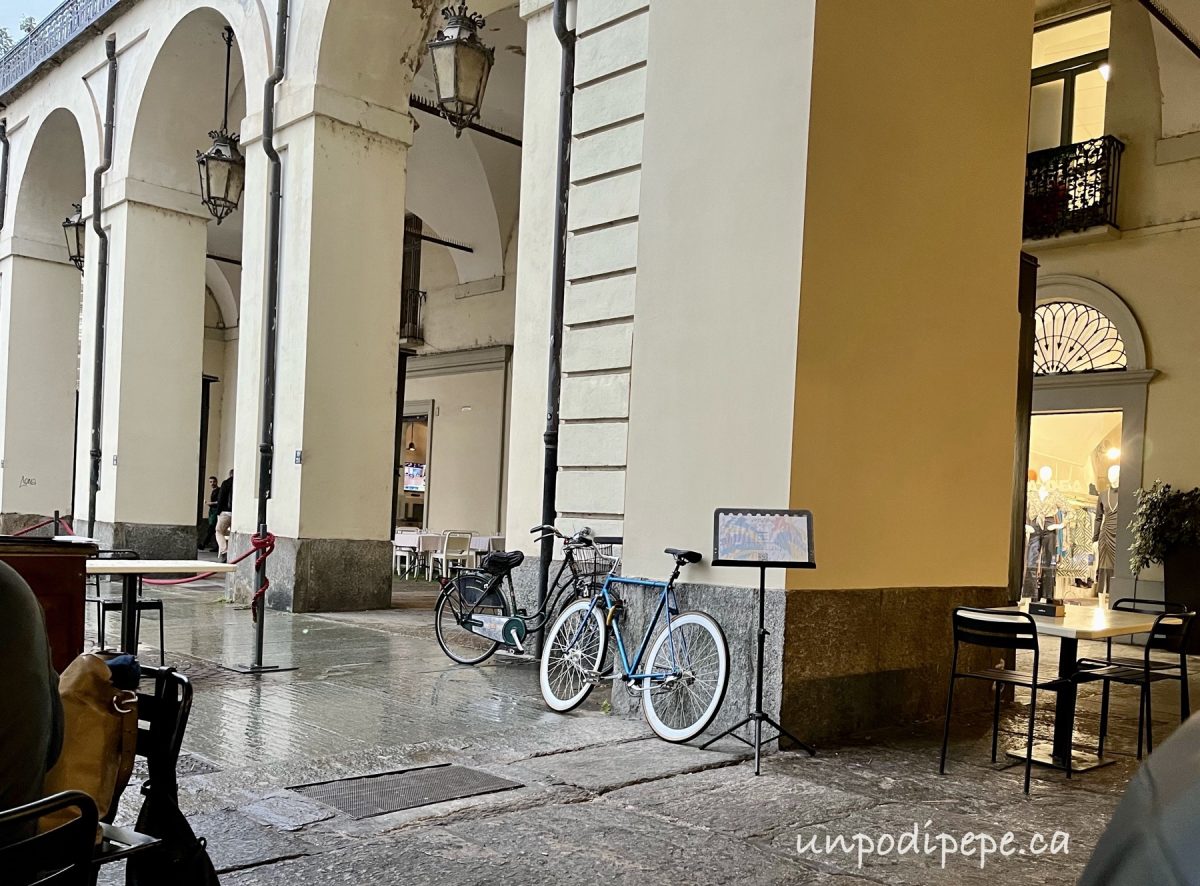
Torino’s centro, the largest pedestrian area in Europe, is easy to navigate. A defining characteristic of Torino’s architecture are the portici (porticoes). 18 km (7 miles) of portici provide shade in summer and shelter from rain, snow and wind.  12.4 km are continuous.  According to legend, King Vittorio Emanuele I wanted Torino to be elegant and also wanted to go on his daily walk to the river Po without getting wet.  So he had the portici built -and now everyone can window shop in all weather conditions.  A whole day can be devoted to walking the portici. Torinesi use them a lot!

Torino is known for, the Shroud of Turin, artisanal chocolate, museums, Royal Palazzi of Savoia, FIAT, Juventus, 2006 winter Olympics, Eurovision 2022, and home to the automotive industry with headquarters for Fiat, Lancia and Alfa Romeo. Torino is also the birthplace of Italian caffè culture, aperitivo, Nutella, Ferrero Rocher, gianduja, Lavazza, FIAT, Vermouth and the Slow food movement!

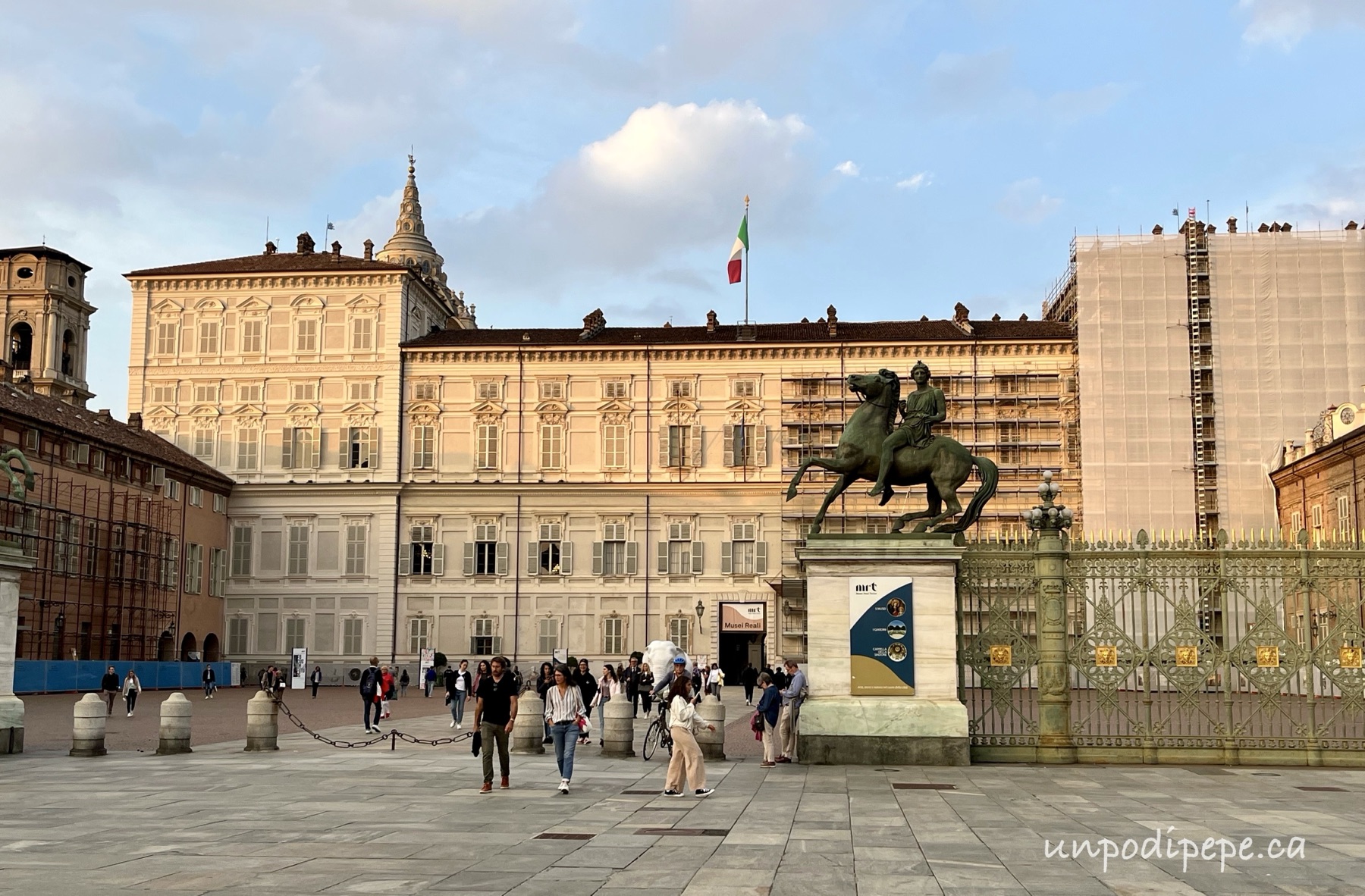
There are many large piazze, full of amazing architectural details, chocolate shops and places to have aperitivo.  Piazza Castello has the Royal Palaces, Palazzo Reale and Palazzo Madama.  Palazzo Madama was the residence of 2 Savoia queens, which explains the name.  It was also the 1st Senate of Italy.  Since 1934 it is a museum of ancient art-although mostly from middle-ages to 18th Century.  Palazzo Reale at the north end, with iron gates contains Armeria Reale, Galleria Sabauda and the Museo di Antichità. The Museo Nazionale del Risorgimento (unification museum) is in Palazzo Carignano.

I had the day before the conference free and met local expert Lucia Hannau from Turinepi for a morning walking tour.  We started in Il Quadrilatero, the oldest part of city, dating back to Roman times.  Piazza della Consolata is home to Caffè Al Bicerin since 1763. They make it in other historic bars, but this is the home of the original Bicerin- with the accompanying plate of local cookies. Bicerin is the iconic drink of Torino, with 3 layers, chocolate, caffè and frothed milk-no stirring!  Stay tuned for a future post! Santuario della Consolata, is across the piazza.  The Baroque exterior looks more like a neoclassical temple, the interior ornate and colourful, gilded and decorated with marble of different colours.

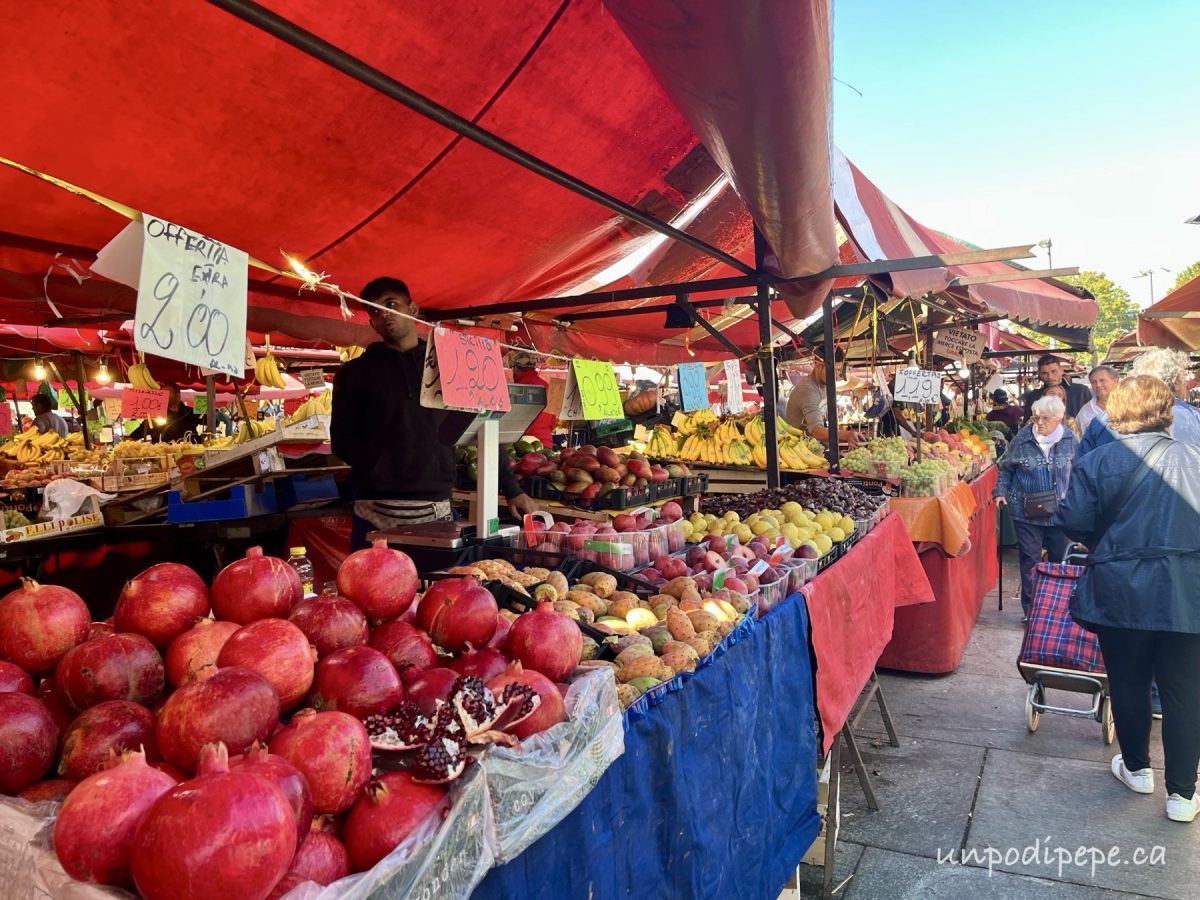
We ended at Mercato Porta Palazzo, Europe’s largest open-air market. My many photos will need a separate post. I had time for only 1 museum visit after my walk with Lucia, and it was Museo Egizio–the world’s oldest Egyptian museum and the largest collection of Egyptology outside of Cairo. Buy €14 tickets online as numbers entering at one time is limited.  If you go to Torino, do not miss this! Stay tuned for a future post.

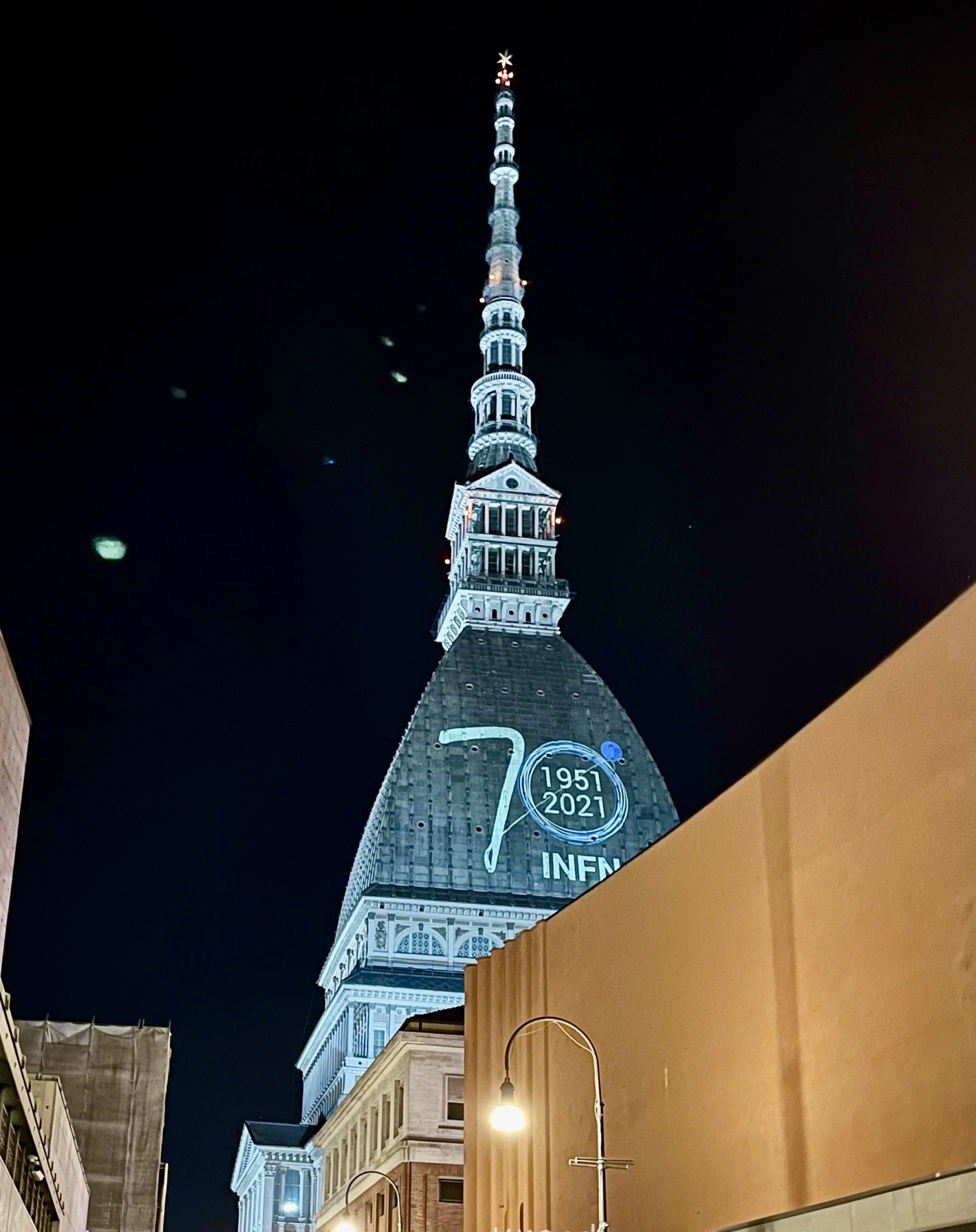
The 167 m (550 ft) tall Mole Antonelliana is featured on the back side of the 2 € coin. Mole means ‘big mound’ and Antonelli was the architect who kept making it taller.  Originally planned as a synagogue, it barely escaped bombing during WW2.  Since 2000 it houses the Museo Nazionale del Cinema, an interactive cinema museum and the tallest museum in the world. It is also the tallest unreinforced brick building in the world (without steel girder skeleton). The top has impressive views of Torino and the Alps.  

The Holy Shroud (Sindone di Torino) is a linen cloth said to have covered the body of Jesus.  An important icon for pilgrims, kept in the Cathedral of San Giovanni Battista, but only displayed for the Jubilee every 25 years.  It will be on display in 2025.

Autumn is a perfect time to visit Piemonte, especially for the seasonal food….zucca, porcini, castagne, tartufo bianco, salsiccia,tajarin and agnolotti del plin.

Tajarin integrale con porcini, salsicce e formaggio Piemontese

Torino has a chocolate festival in November and the Salone dei Libri in May. Milano is only 1 hour by train. Stay 3-4 days if you can, as there is a lot to see in Torino!  I definitely recommend a walking tour with Lucia, Bicerin and the train from Paris!

Buon Viaggio, Cristina

Share this:

  • Click to share on Facebook (Opens in new window) Facebook
  • Click to share on Pinterest (Opens in new window) Pinterest
  • Click to share on X (Opens in new window) X
  • Click to email a link to a friend (Opens in new window) Email
  • Click to share on WhatsApp (Opens in new window) WhatsApp
Like Loading...

Venezia~La Serenissima

25 Monday Mar 2024

Posted by Un po' di pepe in Architecture, Art history, Italia, Photography

≈ 12 Comments

Tags

Acqua alta, Grand Canal Venice, Italy travel tips, Overtourism, UNESCO World Heritage Sites, Veneto, Venice

La Serenissima turns 1603 today!  Venezia, a geographically unique engineering marvel, is built on a group of 118 tiny islands in the Venetian lagoon.  They are separated by open water and 170 canals, linked by over 400 footbridges.  Named after the ancient Veneti people of the 10th Century BC, Venezia was founded March 25, 421 by refugees from the Roman cities of Padua, Aquilea and Treviso, and the surrounding countryside fleeing Longobard and Hun invasions.  They first settled on the sandy islands of Torcello and Jesolo. The land of the islands in the lagoon was muddy, some of it barely above water, and not suitable to build on.  Millions of wooden poles or pilings were submerged into the mud and sand to reach the solid layer of earth underneath.  The pilings were covered with wooden boards to form the base that the city was built on.  Since there was no forest in the area, the wood came from Croatia, Slovenia and Montenegro.

Venezia was the capital of the Venetian Republic for almost a century, from 810 until 1797 when it was defeated by Napoleon.  In 1866, along with the rest of the Veneto region, it became part of the Kingdom of Italy.  The title ‘La Serenissima’ refers to its stability as a government compared to others at the time. Venezia was a wealthy city for most of its history, especially the 13th-17th centuries.  It was as an influential financial and maritime power and important center of art, commerce, and trade of silk, grain and spices between East and West.  This east/west connection is apparent in the art and architecture of the city. The Venetian Lagoon and historical parts of the city within the lagoon became a UNESCO World Heritage Site in 1987. The population of Venezia is now about 55,000 and the PATREVE (Padua, Treviso, Venezia) metro area has a population of 2.6 million.

I have been to Venezia 5 times and my most recent visit was following an unintentional 28 year absence!  I still remember stepping out of Stazione Santa Lucia the first time, and immediately being filled with wonder and awe at the view.  That part hasn’t changed a bit since 1980. This time I was there for 3 days in early October but the weather was like summer.  So were the crowds!  It was unbelievable how many people were in the streets and waiting in lines! Someone forgot to tell everyone it was not July! I also noted much more expensive it was than the rest of Italia.  When I saw the lineups for everything in Piazza San Marco-even for those with reservations, I decided to concentrate on exploring outside. I enjoyed the beautiful weather and only visited a few places that were new to me. I definitely want to see the incredible interior of Basilica San Marco and the 4 Cavalli again, but will wait for a rainy day!

Signore in piazza, Cannareggio

Venezia is shaped like a fish and there are 6 sestieri or neighbourhoods:

  • Santa Croce the west end ‘mouth’ of the fish is the transportation hub, with the bus and train stations, harbour of San Basilio, and parking garage in Piazzale Roma.
  • San Marco is the touristy center with Piazza San Marco and Rialto
  • Dorsoduro is the trendy Southeastern area across Canal Grande and includes Giudecca, Piazza and Ponte Accademia, Collezione Peggy Guggenheim and Santa Maria della Salute
  • San Polo across the Ponte Rialto, is the oldest sestiere and includes Rialto fruit and fish mercato
  • Cannareggio the most northern area is less crowded and touristy, more of the ‘real’ Venezia.  It includes the Jewish quarter.  It is picturesque and the best place to get lost among the calli (streets)
  • Castello the eastern ‘tail’ of the fish and largest sestiere is host to the Biennale in the Arsenale Naval base

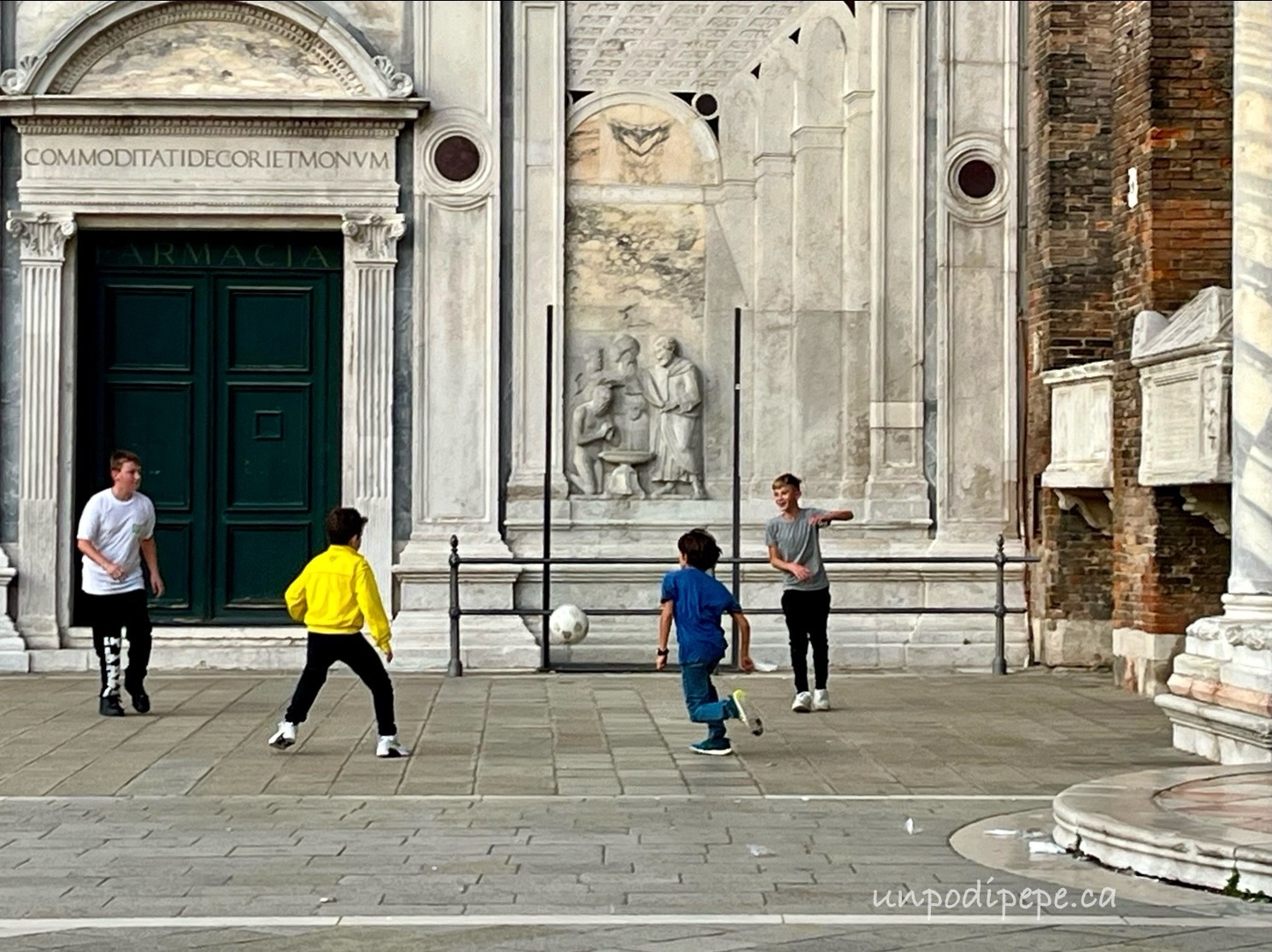
    Calcio in Castello

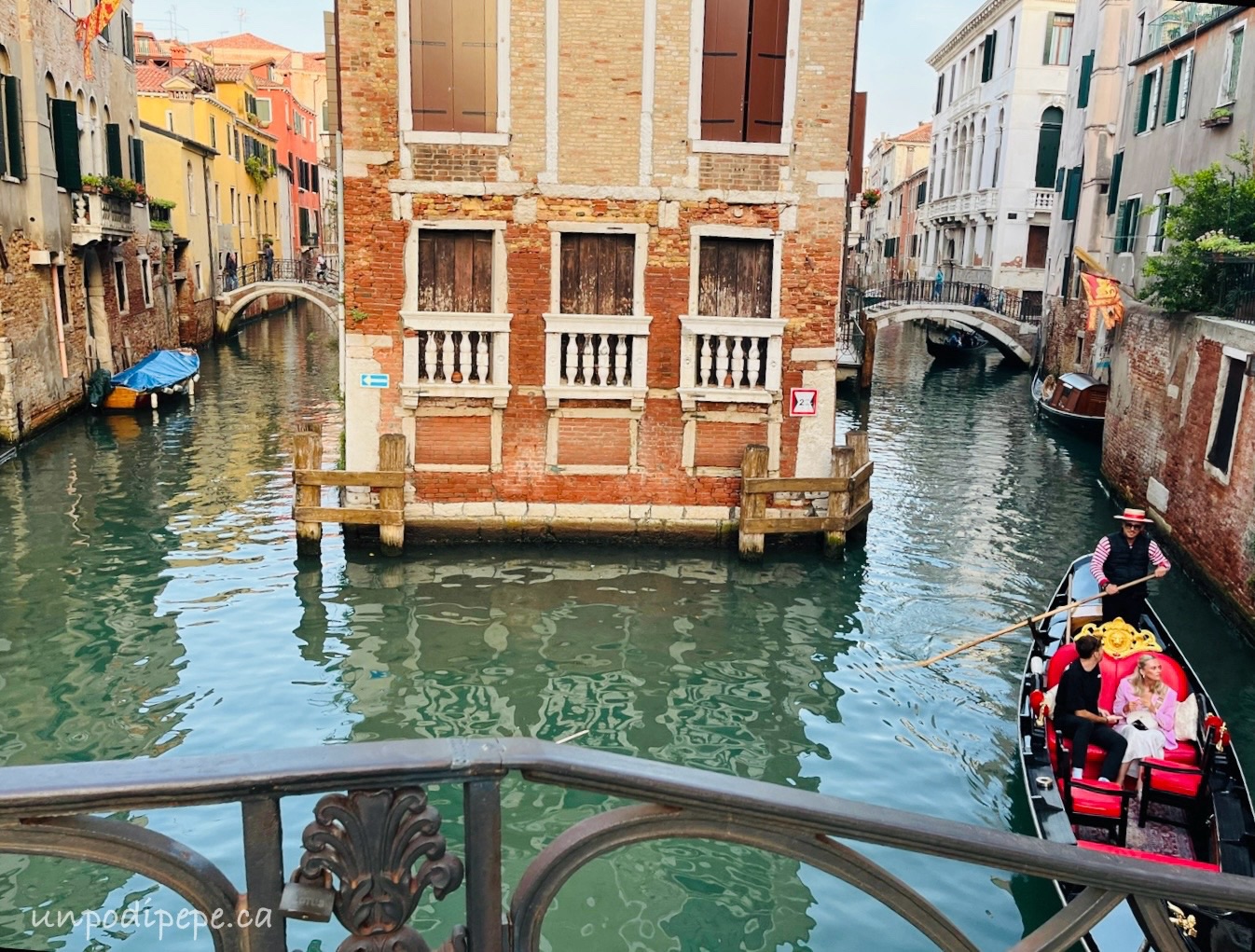
Main things to see and do:Wander aimlessly, get lost and explore! Venezia is a photographer’s paradise, a walkable city and many of the sights are clustered.  Walk from Piazzale Roma to Piazza San Marco (40 min-1 hour), explore the ponti (bridges) and narrow calle (streets) look for cisterne (rainwater collection wells), walk along Riva degli Schiavoni to see the gondole bobbing up and down in the water and stop for cicchetti (Venetian snacks).

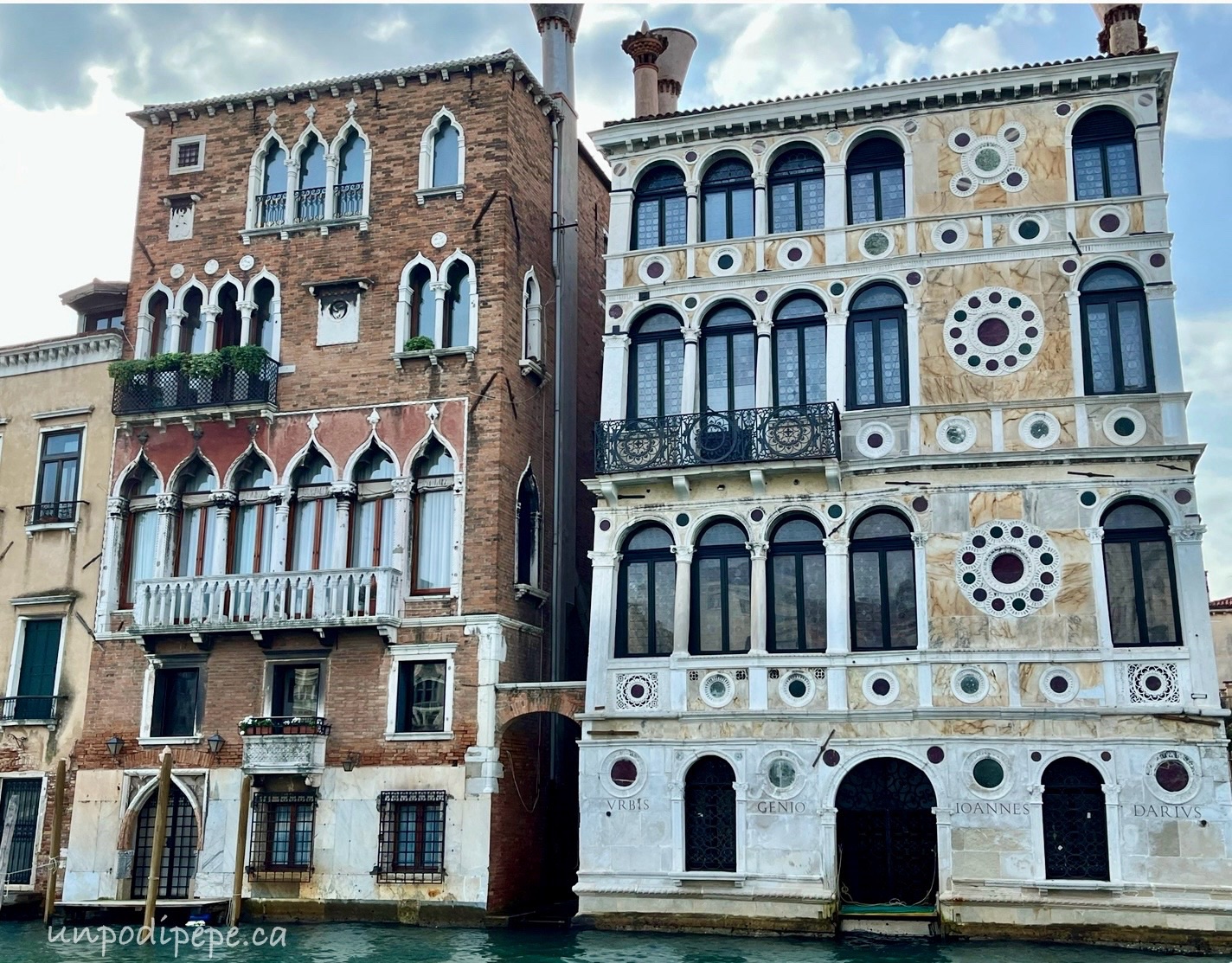
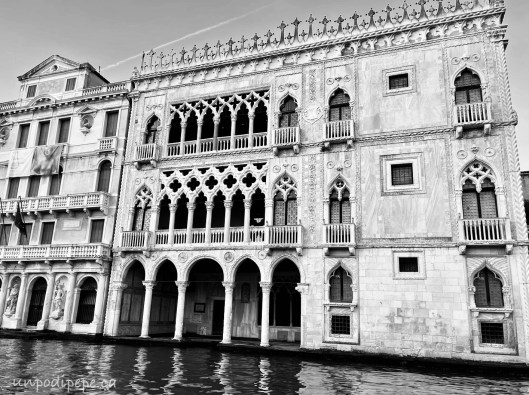
Cruise Canal Grande. Buy a Vaporetto pass and explore the Canal Grande from the water. Get on in front of Stazione Santa Lucia and cruise to San Marco or vice versa. Canal Grande is S shaped and lined with ~170 majestic palazzi, buildings from the 13-18th  Many of them are fondaco houses, meaning the ground floor was a warehouse and merchants lived on the upper floors with their families. 3 of my favourite palazzi are the Fondaco dei Turchi, the Venetian Gothic Ca’ d’Oro, and Palazzo Dario, which is funky because it started out Gothic but was renovated in Renaissance style. I love to spot interesting boats… the ambulance boat, the dry-cleaning delivery boat, etc.
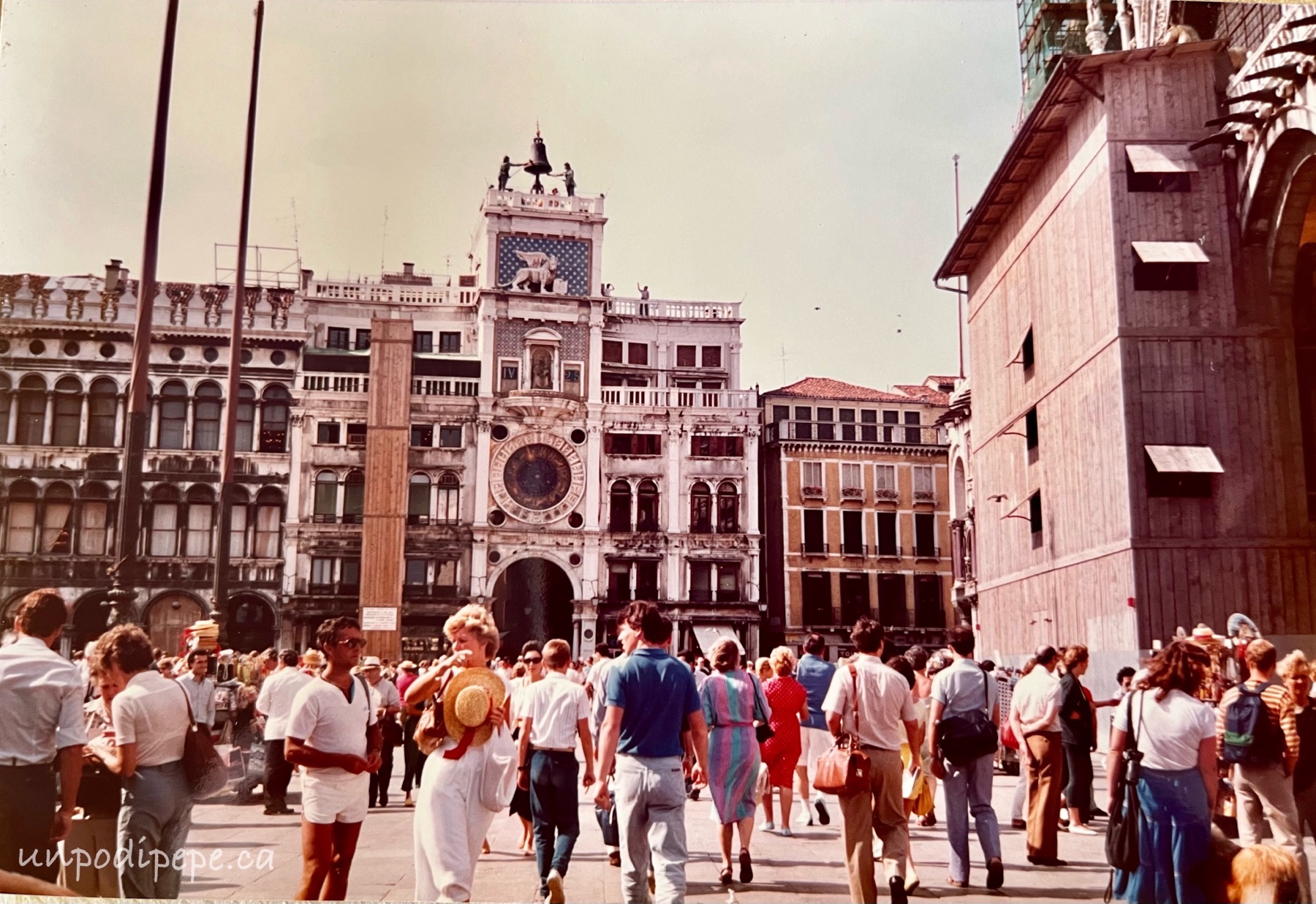
Piazza San Marco is the main piazza in Venezia and is full of things to see. The multi domed Basilica is at the east end, and the rest is lined with arcades.  These were once homes and offices, now shops and restaurants.  In the piazza is a 4.5m bronze winged lion, the symbol of San Marco and the Venetian Republic.  It is on top of Egyptian granite column brought here in the 12th  Napoleon moved it to Paris but it was returned in 1815.  Torre dell’Orologio, the clocktower dates back to the 15th Century.
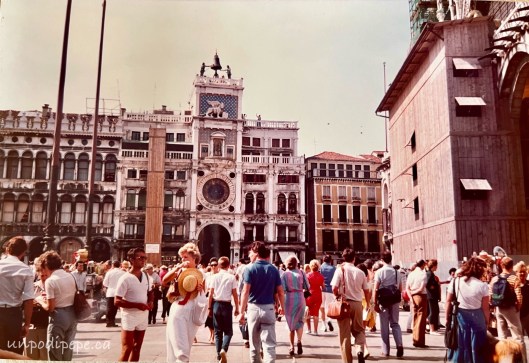
Torre dell’Orologio 1980

Visit Basilica San Marco, built in the 9th century and enlarged in 1063. Over 8 centuries, golden mosaics and other treasures were added.  The exterior is magnificent, with a combination of Byzantine, Romanesque and Gothic features. The Western side has mosaic archways while the Southern side has gothic adornments.  The Interior has 8000 m² of golden mosaics.  Gold leaf is sandwiched between 2 layers of glass tile, giving an illumination effect.  The evening tour is apparently spectacular as it is lit up. The Cavalli di San Marco, 4 magnificent ancient Greek bronze horses were brought from Constantinople in 1204.  Since 1974, replicas are on the terrace above the entrance, and the originals are inside.  They need their own blog post!  Admission €3 onsite, €6 online in advance.  Extra €5 to see Pala d’oro altar piece and Cavalli. Open 0930—1715, 1400-1715 Sundays.  Note….even if booked online, you still have to arrive early and wait in lineups for security.

Palazzo Ducale-Venetian Gothic style former residence of the Doges and Palazzo di Giustizia (courthouse) next to Basilica San Marco. It is now a museum.  Cross Ponte dei Sospiri (bridge of sighs) to see prisoners’ last view on their way to execution. Admission €25 Open 0900-1800 daily

Climb Campanile-Take the elevator to the top of the belltower for amazing views. Reservations are booked for a specific time slot €10 Euro, €12 online.  May be closed during maltempo-bad weather.

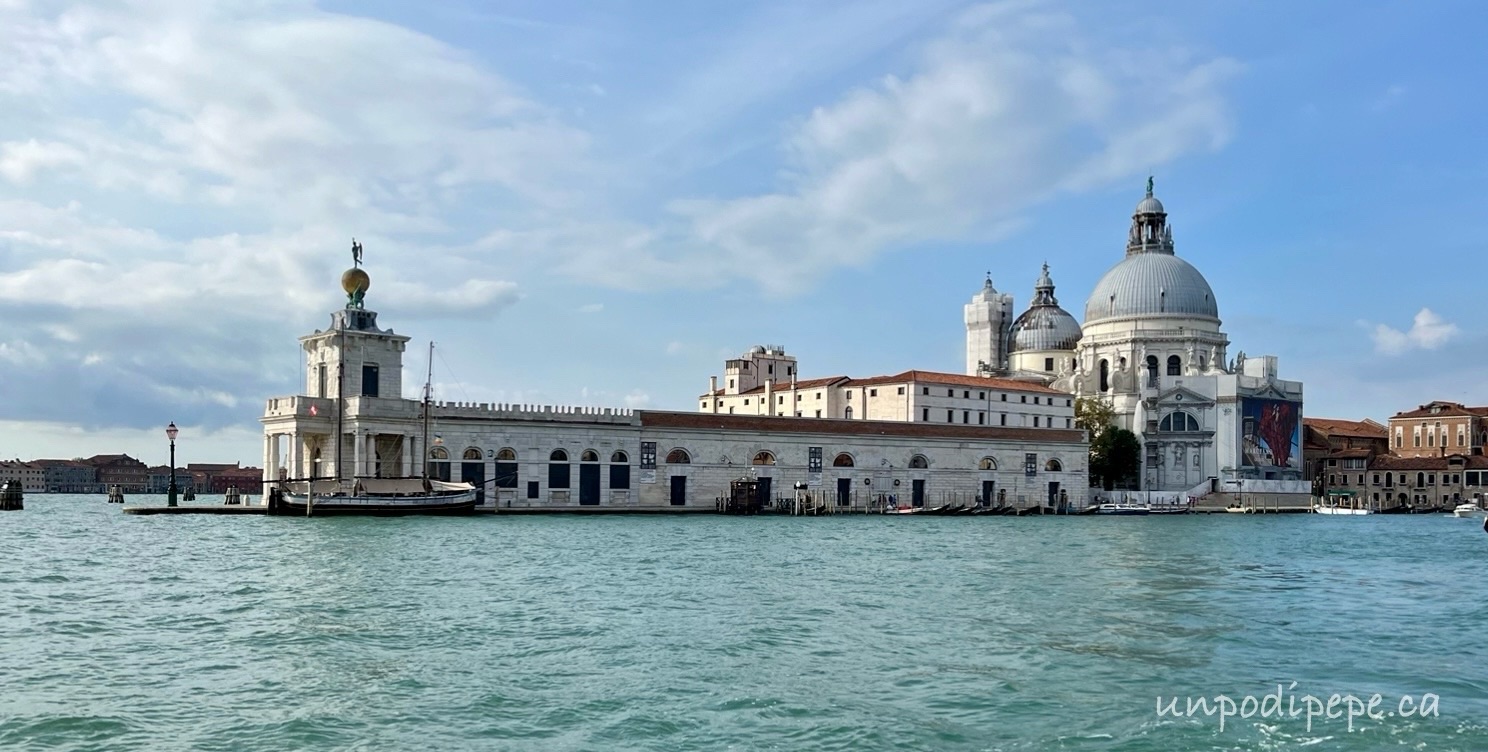
Collezione Peggy Guggenheim Former home of the heiress, now a museum of modern art in the Dorsoduro area. Take a €2 traghetto gondola ride across Canal Grande from San Marco or walk across Ponte dell’ Accademia.  Admission €16 open 1000-1800 Closed Tuesdays. Read my post here.Terrace Horse, Peggy Guggenheim Collection VeniceSanta Maria della Salute the Baroque church at the entrance to Canal Grande next to Punta della Dogana, has been immortalized by artists Canaletto, Sargent, Turner and Monet. The octagonal church made of Istrian stone has 2 domes and 2 bell towers in the back. Built in 1687 to celebrate the end of the plague (black death) that killed 1/3 of the population.  Santa Maria della Salute means ‘Our Lady of Good Health’.
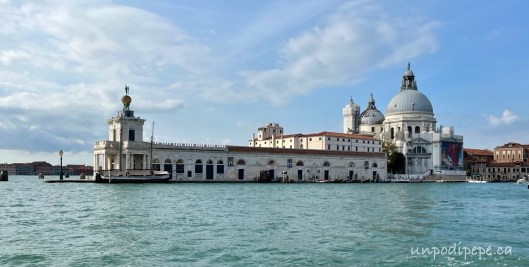
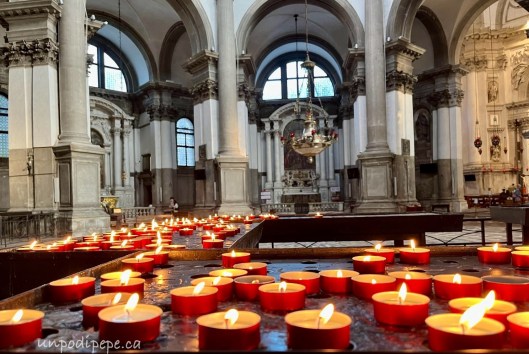
Entrance to the Basilica is free, climb steps to the cupola €4  Open 0900-1200 and 1500-1730.  Cupola closed Mondays. Take the ‘ferry gondola’ across from Piazza San Marco for €2. Nov 21 is the Festa della Salute featuring a parade from San Marco to La Salute over a pontoon bridge.
Ponte dell’ Accademia walk over the old wooden bridge for the best views of Canal Grande

Ponte Rialto a covered footbridge lined with shops has great views from both sides. It is the oldest of 4 bridges that span the Canal Grande.  The original was built in 1173 and it was rebuilt several times.  The present bridge was built in 1591.

Gondola ride Ponte Rialto 1995

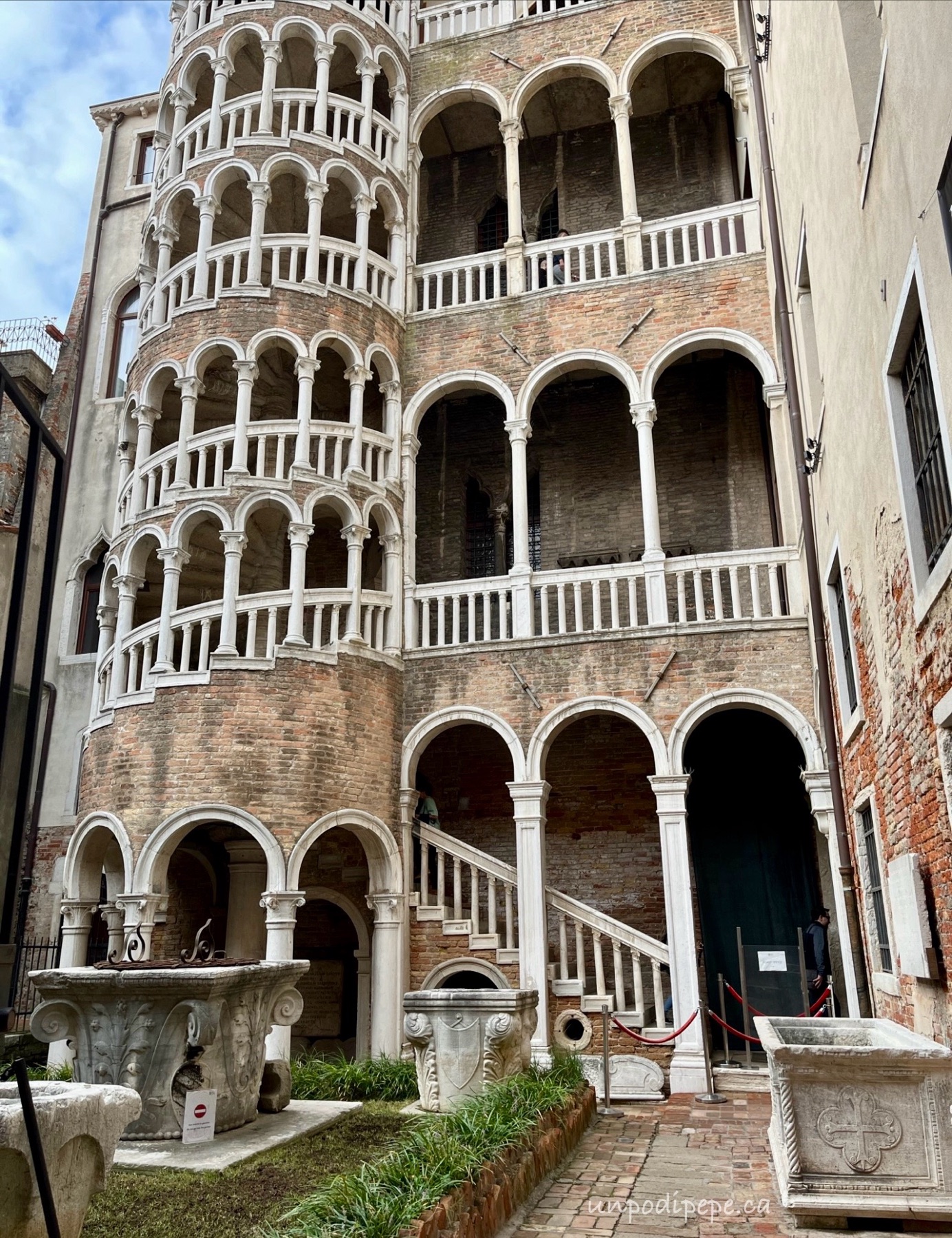
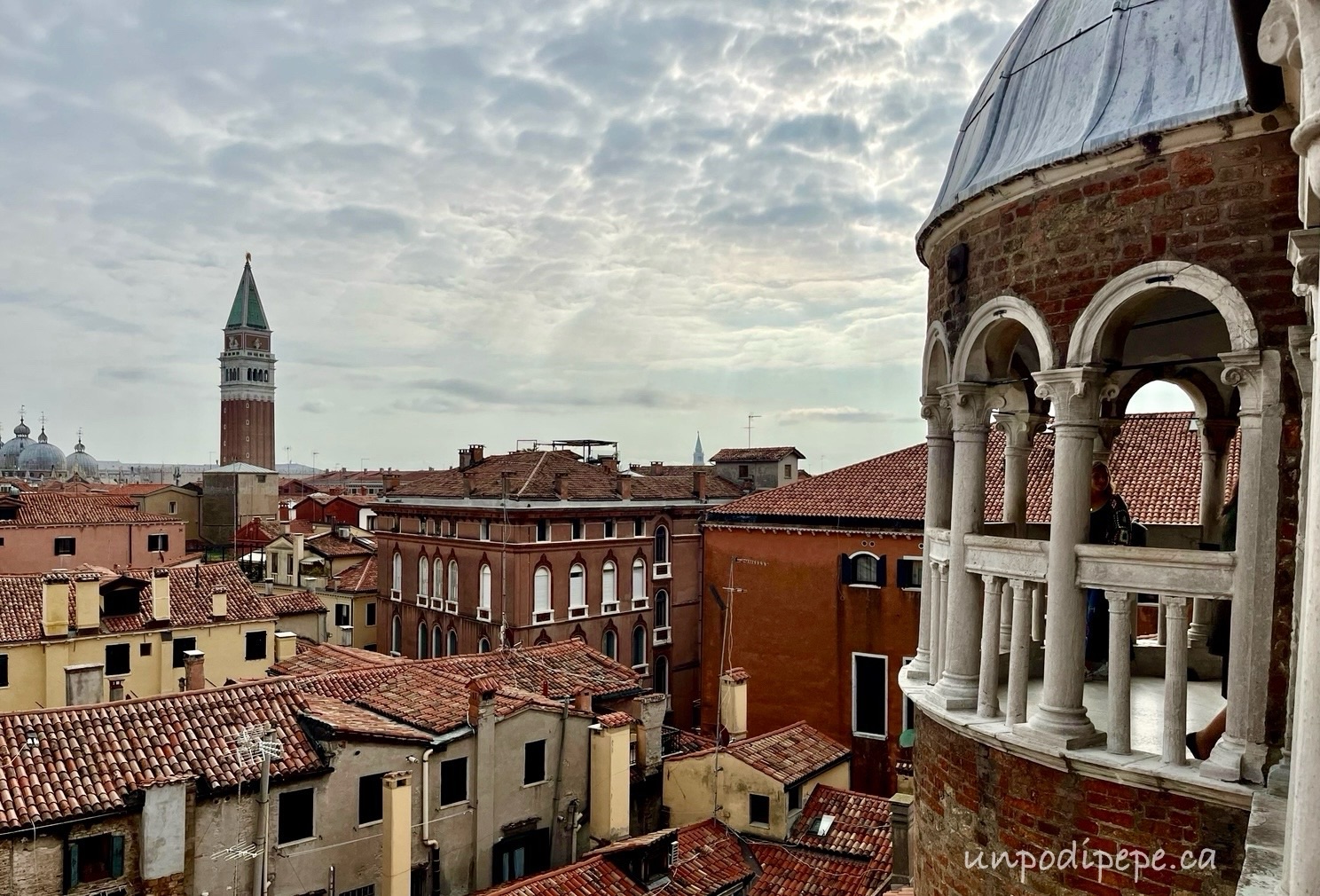
Ride in a gondola Gondolas are unique, symbolic of Venezia and have been a means of transport on waterways here for over 10 Centuries, so you really do need to do this! Gondola rides are usually €80 for a 30-40 minute ride and €100 in the evening. If this is not in your budget, or you are travelling solo like me, there are inexpensive traghetti, or gondola ferries you can take with others to cross to the other side of Canal Grande for € Best deal in town!  Look for the green ‘traghetti’ sign.  There is now a special dock at Piazzale Roma for those with mobility issues to safely get into a gondola.Scala Contarini del Bovolo Cool external 26 m multi arch spiral staircase near Piazza San Marco. It was added to the palazzo in 1499. View of rooftops, the Campanile, the cupole of San Marco and La Salute.  €8 admission Open 1000-1800 daily.

La Fenice The opera house was well named! Like the Phoenix it has risen from the ashes after being destroyed by fire 3 times, most recently in 1996. It was reopened in 2003. Admission €12 including audioguide tour.  Open 0900-1800

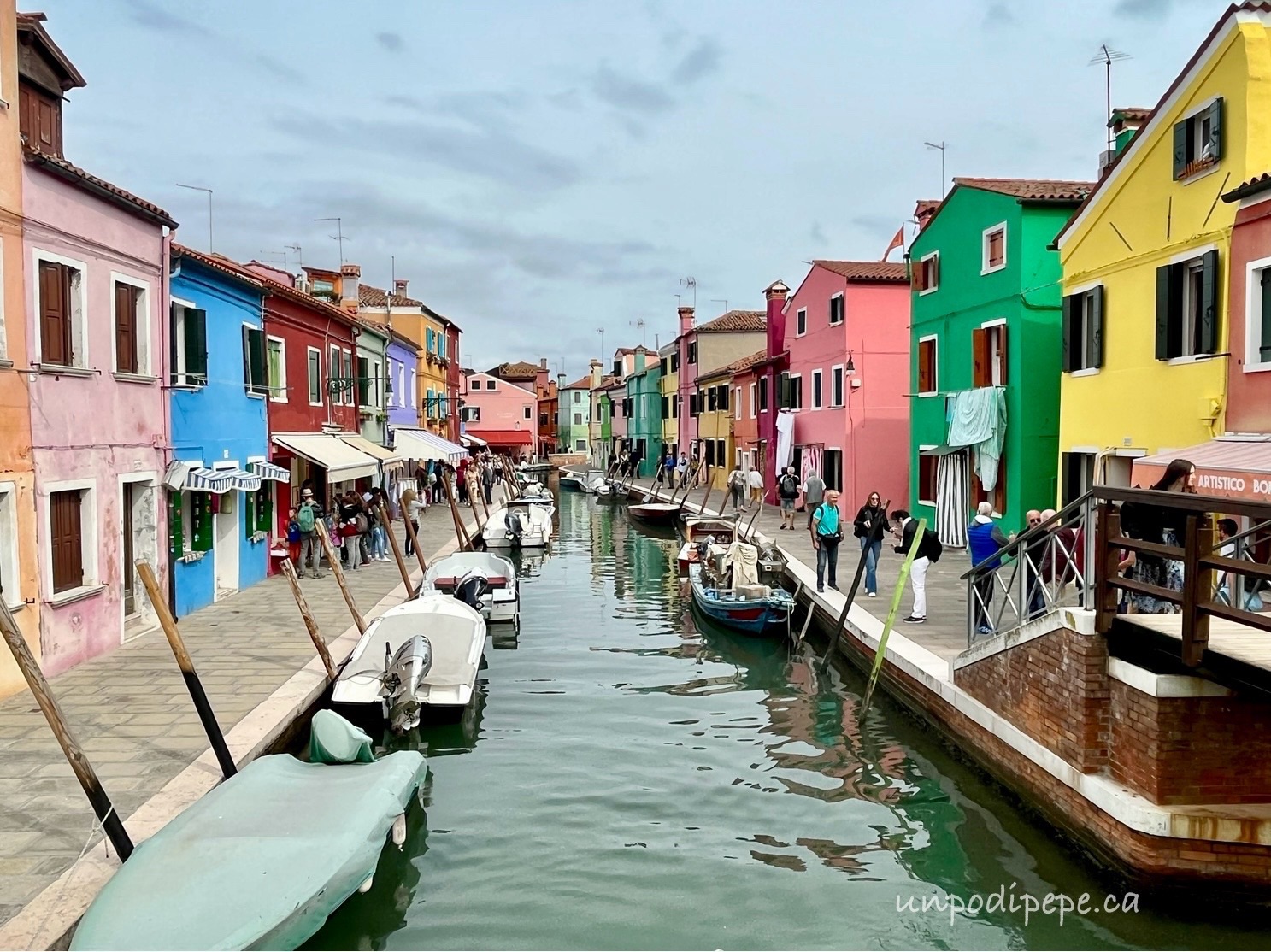
Visit the islands Take the vaporetto to Murano, Burano, Torcello, Lido and San Giorgio Maggiore.

Terrazza Fondaco dei Tedeschi (T Fondaco).  Tedeschi are Germans. This was the German merchants’ warehouse, then the post office, now a luxury department store. It is at the foot of Ponte Rialto, northwest end.  The rooftop terrace has panoramic views over Canal Grande. Open daily 1015-1800.  Entrance is free, reservations are required and the timeslot is only 15 minutes.  Reservations must be made on their website.

Feste: Venezia has feste all year round, most of them involve gondola races!

  • January 6th Regatta delle Befane-50 rowing club members dress up as La Befana and race from San Tomà to Ponte Rialto, where the finish line is a giant stocking hanging from the bridge!
  • February-Carnevale the 10 days before Ash Wednesday (22 Feb -4 Mar in 2025).
  • March 25th anniversary of Venezia and festa of the Annunciation
  • Biennale d’Arte held even years. 20 April-24 Nov, 2024
  • April 25 Festa di San Marco, patron Saint of Venezia
  • May-1st since the 11th Century, the Sunday after Ascension Day is Sensa, the marriage of Venezia with the sea
  • May-Vogalonga, a non-competitive 30Km rowing celebration between canals and the islands.  A peaceful protest against damage due to waves from motorboats.
  • July-the 3rd Sunday Redentore Fireworks July 20-21, 2024
  • Late August/early Sept Venice Film Festival on Lido di Venezia Aug 28-Sept7, 2024
  • September, 1st Sunday Regatta Storica
  • October Venice Marathon Oct 24, 2004 38th annual
  • November 21 Salute Celebration.  Feast of Santa Maria della Salute celebrating the end of the devastating Black plague that killed 1/3 of population
  • December 7th-lighting of tree in Piazzetta San Marco
  • December-Mercatino di Natale in Dorsoduro
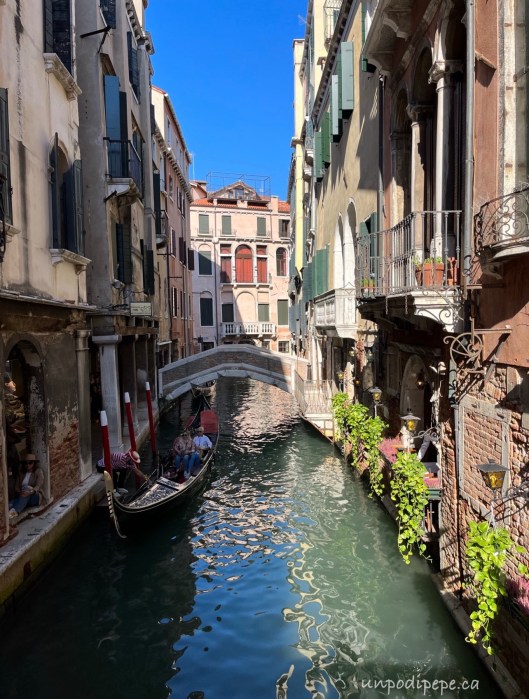
Getting there and around:The main airport Marco Polo is 10 km away.  Ryanair and some other budget airlines use Treviso airport 40 km away. An airport express bus takes you to Piazzale Roma in half an hour for €10.  Then walk or take vaporetto to hotel. Alilaguna waterbus is €15 and has several stops.  Shared watertaxi is €35 per person with several stops along the 1 hour route.  Private watertaxi is much more expensive.

Train-Stazione Santa Lucia in Santa Croce area.  Walk or take vaporetto to hotel.     Car parking garage ‘Tronchetto parking’ in Piazzale Roma has a capacity of 4500 cars

Actv Vaporetto is a waterbus and an affordable way to sightsee.  Also used by residents to get around and get to work.  Single ticket one way €9.50, daypass €25. Passes for 2, 3 and 7 days are also available.  It is not necessary to buy these in advance.  With my daypass, I cruised to San Marco, then took another vaporetto at San Zaccaria (in front of Hotel Danieli) to Burano and Torcello.

Venezia is a one of the most visited destinations in the world, with over 20 million tourists per year.  It is crowded, more expensive than anywhere else in Italia, and struggling with the effects of overtourism.   Acqua Alta, high water flooding happens in late autumn to early spring.  Usually predictable and lasts only a few hours.  Read my post on MOSE.

Cannareggio

I have talked about the crowds, the lines, the expense….but do not let that put you off.  There is nowhere else like Venezia with its intricate maze of waterways, art, and unique architecture.  Around every corner is another magical scene. The entire city is an extraordinary masterpiece, so I definitely recommend visiting.  It can be compared to Santorini, which is crowded and expensive, but incredibly unique and historically rich.  My recommendation is to stay 3-4 days. In 2022, only 3.2 million visitors out of 30 million stayed overnight.

As of June 1, 2024, in an effort to decrease the effects of mass tourism, regulate huge crowds and improve life for local residents, Venezia will be trialing a €5 entry charge.   Residents, commuters, students and children under 14 will be exempt, as well as anyone who has booked an overnight stay.  Personally, I think the entry fee is too low to be effective.  Constant maintenance to prevent more water damage is expensive.  Tour groups will also be limited to 25 people (=½ the capacity of a bus) and loudspeakers are banned(yeah!!!).  Cruise ships have been banned from the lagoon since 2021 after threats from UNESCO to put it on the endangered list. That is the UNESCO equivalent to ‘the naughty list’!

Hope you all make it to Venezia at some point!  Buon viaggio, Cristina

**Photo credits: 1995 Lucia and Donato on honeymoon taken by unknown gondolier.  All other photos by me!
Share this:

  • Click to share on Facebook (Opens in new window) Facebook
  • Click to share on Pinterest (Opens in new window) Pinterest
  • Click to share on X (Opens in new window) X
  • Click to email a link to a friend (Opens in new window) Email
  • Click to share on WhatsApp (Opens in new window) WhatsApp
Like Loading...

Pantheon update

28 Sunday May 2023

Posted by Un po' di pepe in Architecture, Photography, Roma, Travel

≈ 11 Comments

Tags

Ancient Roma, Italy travel tips, Lazio, Pantheon, Roma photography, Roma travel, Santa Maria ad Martyres, UNESCO World Heritage Sites

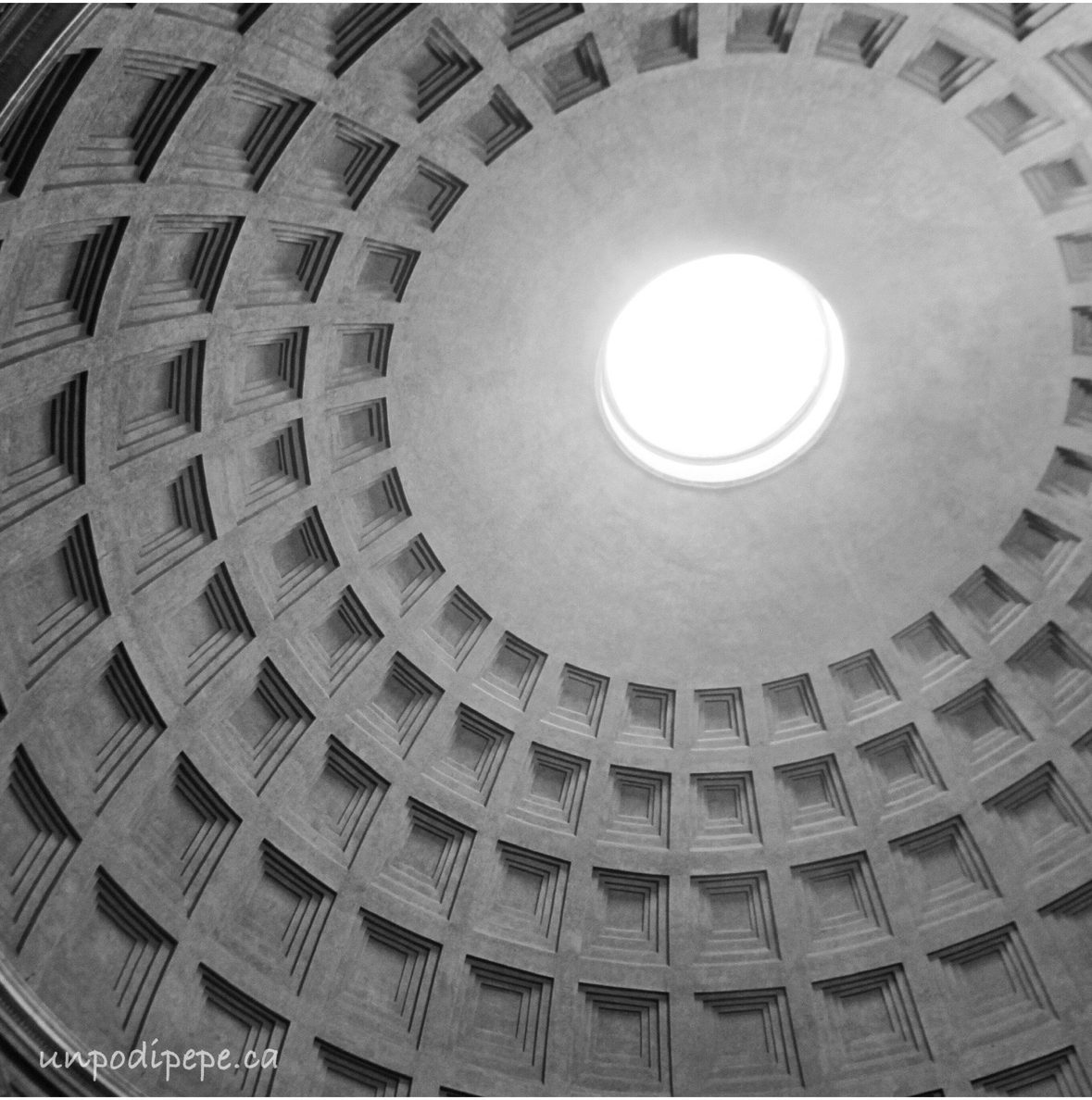
Roma is full of amazing buildings. The most amazing and best-preserved of all is the Pantheon.  Imagine Michelangelo entering the Pantheon 500 years ago, looking up and saying “this looks more like the work of angels than humans’-that is how amazing it is! The perfect mathematical proportions of the Pantheon have provided inspiration for architects for almost 2,000 years. Check out the post Il Pantheon for more details on the history and structure.Admission has always been free, and there has been talk of charging an entry fee for many years…in fact, it has been ‘announced’ several times.  Well….purtroppo, the time has come.  Starting July 1st 2023, there will be a €5 admission fee for entry for tourists/visitors.  Admission will still be free for residents of Roma, those under 18 years old and those attending Mass. Until then, admission remains free, with booking required at least 1 day in advance only on weekends and holidays.

The Pantheon is a classical masterpiece and a monument that requires expensive upkeep, so the need for a modest admission fee is understandable. Since the 7th century it also functions as the Church of Santa Maria ad Martyres.  In Roma entry into churches is free-so that is why there has been so much effort to not charge an admission fee.

Mass is at 5 pm Saturdays, 10:30 am Sundays and public holidays, and midnight on Christmas Eve.  Shoulders, midriff and knees need to be covered, although this is not as strictly enforced as the Vatican.

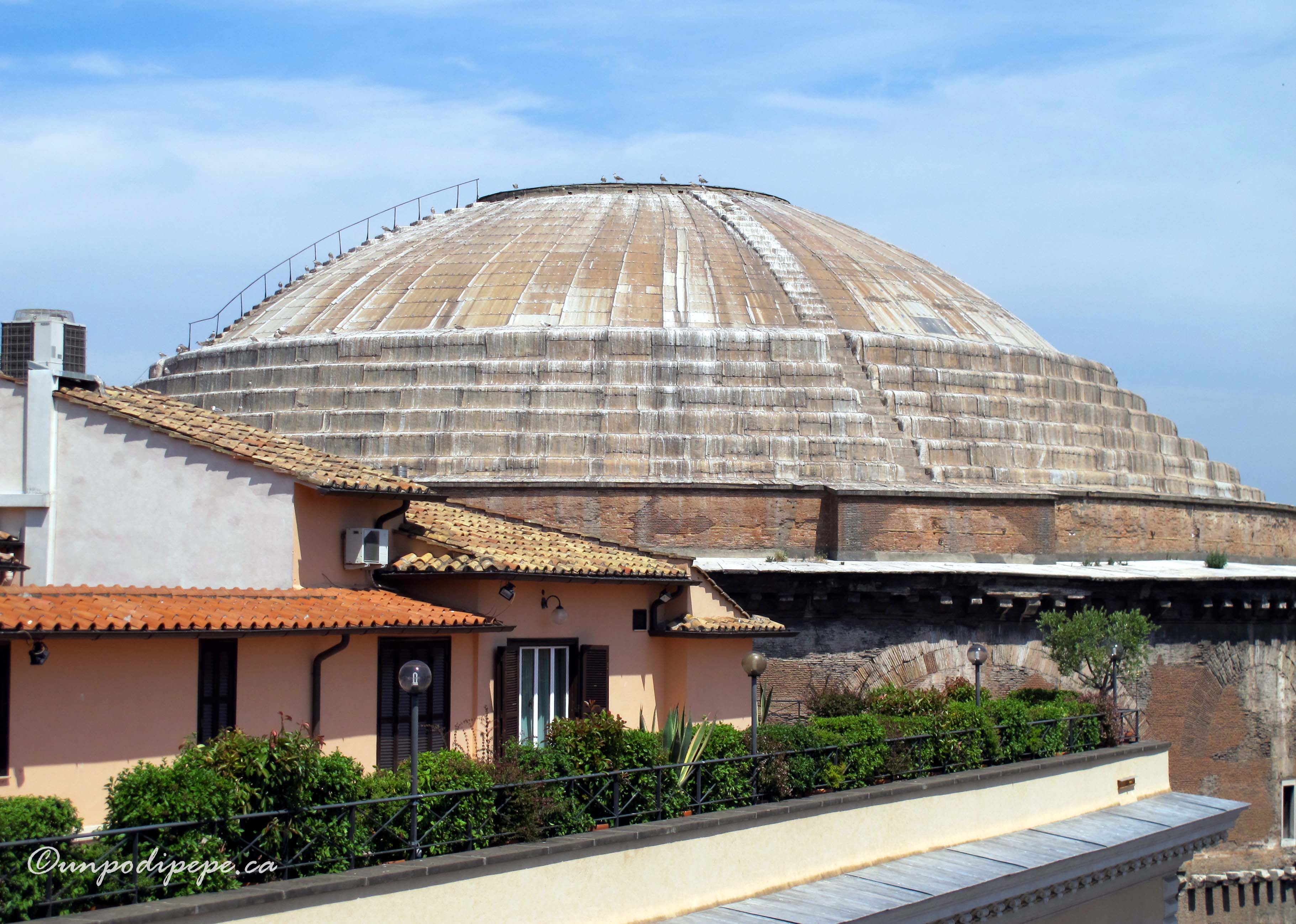
‘La Pioggia delle Rose al Pantheon’ (the rain of roses) is on my list of things to see in my lifetime. This takes place on Pentecost Sunday, 50 days after Easter.  At noon, right after Mass, Roma’s Vigili del Fuoco (fire fighters) climb to the top of the dome and drop thousands of rose petals through the oculus as choirs sing.  The rose petals symbolize the Holy Spirit coming down to earth.  Pentecost Sunday happens to be today! I saw a video of the event this morning, and even Michelangelo would be impressed! Tickets or advance booking are not available for this event.  Arriving by 7am for the 10:30 Mass is apparently necessary to get a spot inside! The ladder used by the vigili to get to the oculus is visible in the foto:

The dome and oculus, viewed from the roof of Grande Hotel de la Minerve

Visiting the Pantheon takes about 45 minutes. It is open daily 0900-1700 Sun 09-1800 with last entry at 18:30. The Pantheon is closed Jan 1, May 1, Aug 15 and Dec 25.  An audio guide with an App can be prebooked for ~€8.50, or a 45 minute guided tour for ~€20.

Details are not yet available on how to book admission, but they should be available soon on the website. Roma is a popular weekend destination for European and Italian travelers, so I imagine tickets will easier to book during the week.  There is really no ‘off season’ except for possibly the period from January 7 until the end of February.

The Pantheon is centrally located, in Piazza della Rotonda.  I walk slower than most people, but it is about a 20 minute walk to Piazza di Spagna, the closest Metro stop.  It is about a 20 minute walk to the Fontana di Trevi, 10 minutes to Piazza Navona and 40 minutes to Colosseo.

Read more about the Pantheon in Caffè con Caravaggio a Roma, Un Giorno a Roma  and Autunno in Italia.

Buon Viaggio, Cristina

Share this:

  • Click to share on Facebook (Opens in new window) Facebook
  • Click to share on Pinterest (Opens in new window) Pinterest
  • Click to share on X (Opens in new window) X
  • Click to email a link to a friend (Opens in new window) Email
  • Click to share on WhatsApp (Opens in new window) WhatsApp
Like Loading...

Museo Faggiano

22 Sunday Nov 2020

Posted by Un po' di pepe in Architecture, Puglia, Travel

≈ 19 Comments

Tags

Archeology, Lecce, Museo Faggiano, Southern Italy

Museo Faggiano is a family run, independent archeology museum in Lecce and also a working archeological site.  This is a small museum with big history! In 2001, Luciano Faggiano planned to open a restaurant with his 3 sons Marco, Andrea and Davide in a building he owned in Lecce’s Centro Storico.
The building had issues with dampness and sewage backup, likely caused by broken pipes.  Since a working toilet is kind of important, the Faggiano family planned all took 1 week off to work on the plumbing themselves.

Museo Faggiano archeologyThey started digging and found a false floor.  Beneath that, they uncovered 4 subterranean levels to other worlds.  They found Messapii tombs and an ossuary from the 5th Century BC.  The Messapii were from Crete and settled in Southern Italia.  They also uncovered a Roman granary, silo, cisterns a 10 m deep well and even an underground escape tunnel leading to the Roman anfiteatro a few blocks away.  From 1000-1200, the building was a House of the Knights Templar, who left their emblems on frescoes and wall etchings.  A Franciscan chapel and religious artifacts were found from the convent of Sisters of Santa Chiara, which the building was from 1200-1609.  Each of these populations left their traces in the unassuming little building.

Artifacts in Museo FaggianoAfter 7 years of excavation, the museum opened to the public in 2008.  All of the work was financed by Signor Faggiano, under the supervision of the Archeology superintendent of Taranto.  In Italia, anything found underground belongs to the government no matter who owns the property.  This was clearly a labour of love.

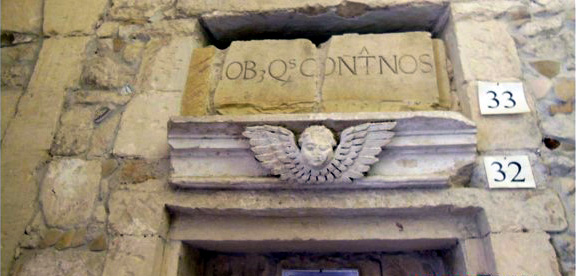
In addition to the architectural elements of the builing, treasures found include a gold and emerald Jesuit bishop’s ring, coins, lots of pottery fragments and a stone sculpture with the abbreviated Latin inscription ‘Si deus pro nobis quis contra nos’ -If God is with us, who can be against us?Sculpture found in Museo Faggiano

In 2015, Museo Faggiano was featured in a NY Times article.

Museo Faggiano is at Via Ascanio Grandi 58, a short walk from Piazza Sant’Oronzo.  It is open daily from 9:30am-8pm.  Admission is €5.  Often one of the family members is there to answer questions.  A numbered sheet with self-guided tour is available in many languages.

Imagine 2500 years of history in one small house!  If you are like me and have an inner Indiana Jones, and your palms sweat when surrounded by unique archeology, you will be fascinated by Museo Faggiano!

Luciano Faggiano finally did open his restaurant Quo Vadis, next door in June 2019. He is not planning to dig up the pavimento!

Share this:

  • Click to share on Facebook (Opens in new window) Facebook
  • Click to share on Pinterest (Opens in new window) Pinterest
  • Click to share on X (Opens in new window) X
  • Click to email a link to a friend (Opens in new window) Email
  • Click to share on WhatsApp (Opens in new window) WhatsApp
Like Loading...

Lecce

25 Friday Sep 2020

Posted by Un po' di pepe in Architecture, Italia, Photography, Travel

≈ 24 Comments

Tags

Barocco Leccese, Baroque art, Negroamaro, Puglia, Salento, Southern Italy, UNESCO World Heritage Sites

Santa Croce facade black and whiteLecce reminds me of a Caravaggio painting-Baroque, dramatic and opulent, with attention to detail.  It is unfortunate he did not live long enough to visit the city!  Lecce, in the Salento area of Southern Puglia is over 2000 years old and rich in tradition and local customs.  Originally called Syvar, it was founded by the Mesapii(Mesapians) from Crete.  There is a long history of Greek settlement here, in fact there is still a group of 9 towns called ‘Grecia Salentino’ where ‘Griko’ dialetto is spoken.

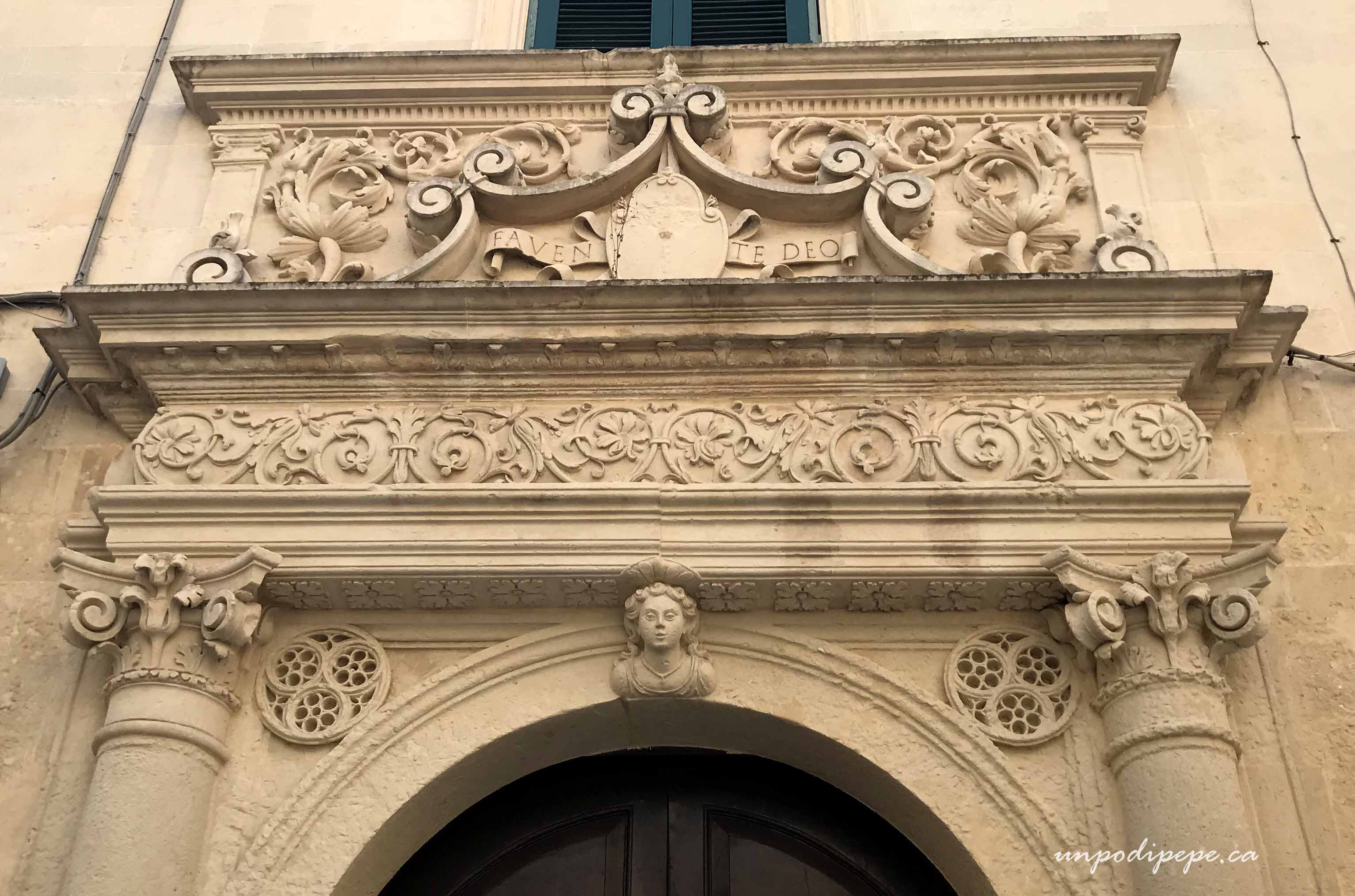
Conquered by the Romans in the 3rd Century BC, it was renamed Lupiae.  Hadrian moved the city 3 Km northeast in the 2nd Century AD and called it Licea. Then came the Byzantines in 549, followed by Orthodox monks.  Lecce and the Salento were an independent country from 1043 until 1463 when Emperor Carlo V conquered Puglia, and they became part of the Kingdom of Napoli until Italian unification in 1861.  Lecce was an important commercial city, with a building and cultural boom. Baroque doorway Lecce

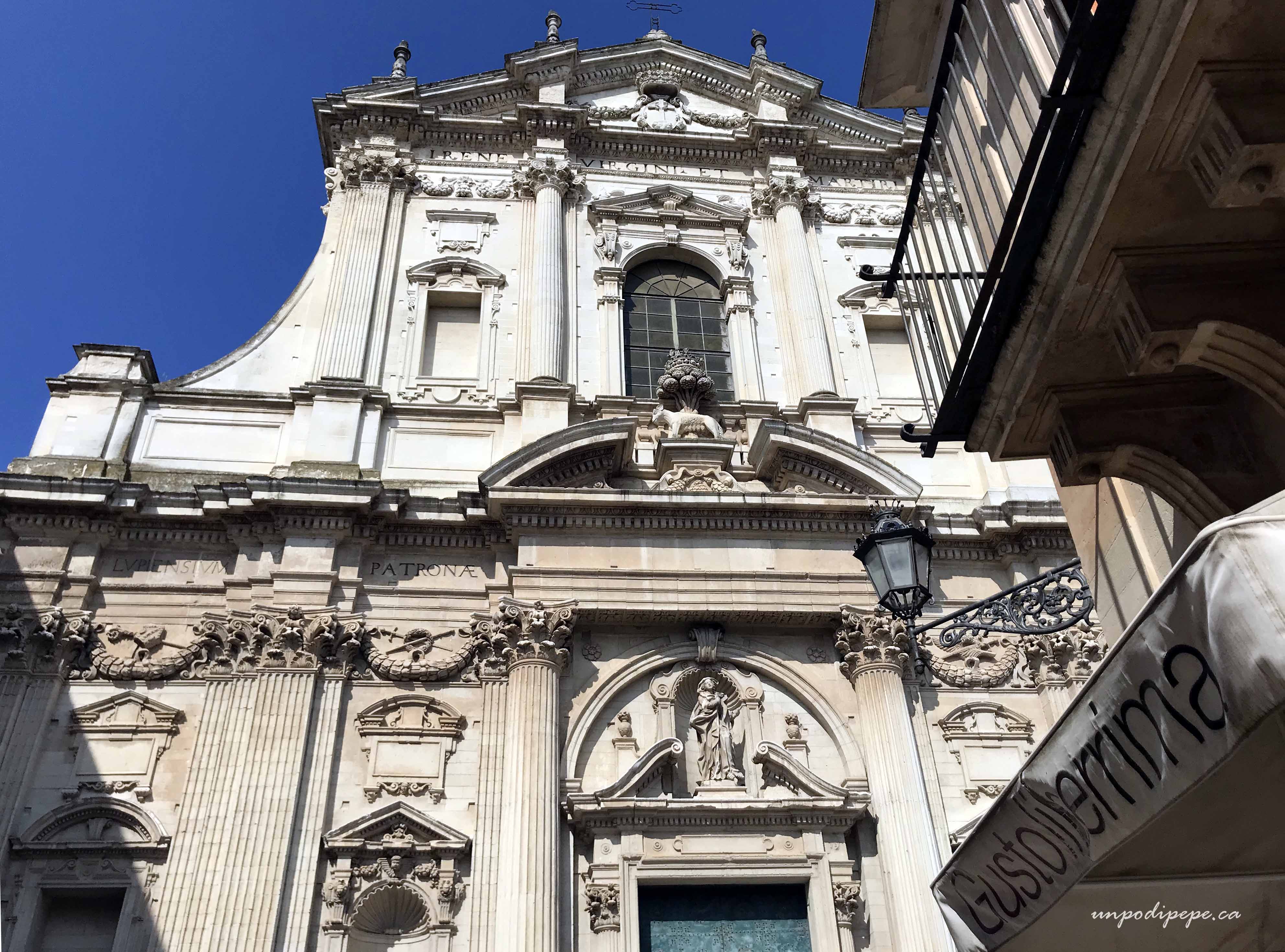
Lecce is best known for its dramatic Baroque architecture and ornamentation, which even has its own name-Barocco Leccese.  The style was around from the mid 1500’s to the early 1700’s, so even among buildings constructed at different times there is continuity of style.Sant'Irene Lecce Interior

The Baroque style features over the top details and intricate carvings that create a sense of movement.  Barocco Leccese is even more expressive and unique.  Windows, balconies and loggias are elaborately ornamented with twisting columns, scrolls and cornices.  They are carved with human figures, animals, wreaths, vines and gargoyles.  There is also a lot of marble, gilt and bronze involved.  Corbels supporting balconies are a common decorative element in Lecce.Duomo Lecce

‘Salento and the Barocco Leccese, including Lecce, Nardò, Gallipoli, Martina Franca, Ostuni, Francavilla, Galatina and Galatone’ are on the UNESCO World Heritage tentative list since 2006. This is the step before becoming a World Heritage Site.Vespa Lecce Puglia

Lecce’s buildings are made of Pietra Leccese, a local, honey coloured porous limestone.  It is soft and workable for sculpture, and was hardened and weatherproofed by soaking in a liquid solution made with whole milk.  Pietra Leccese is still one of the area’s main exports, mined in open quarries.Vicolo, Lecce

What to see in Lecce:

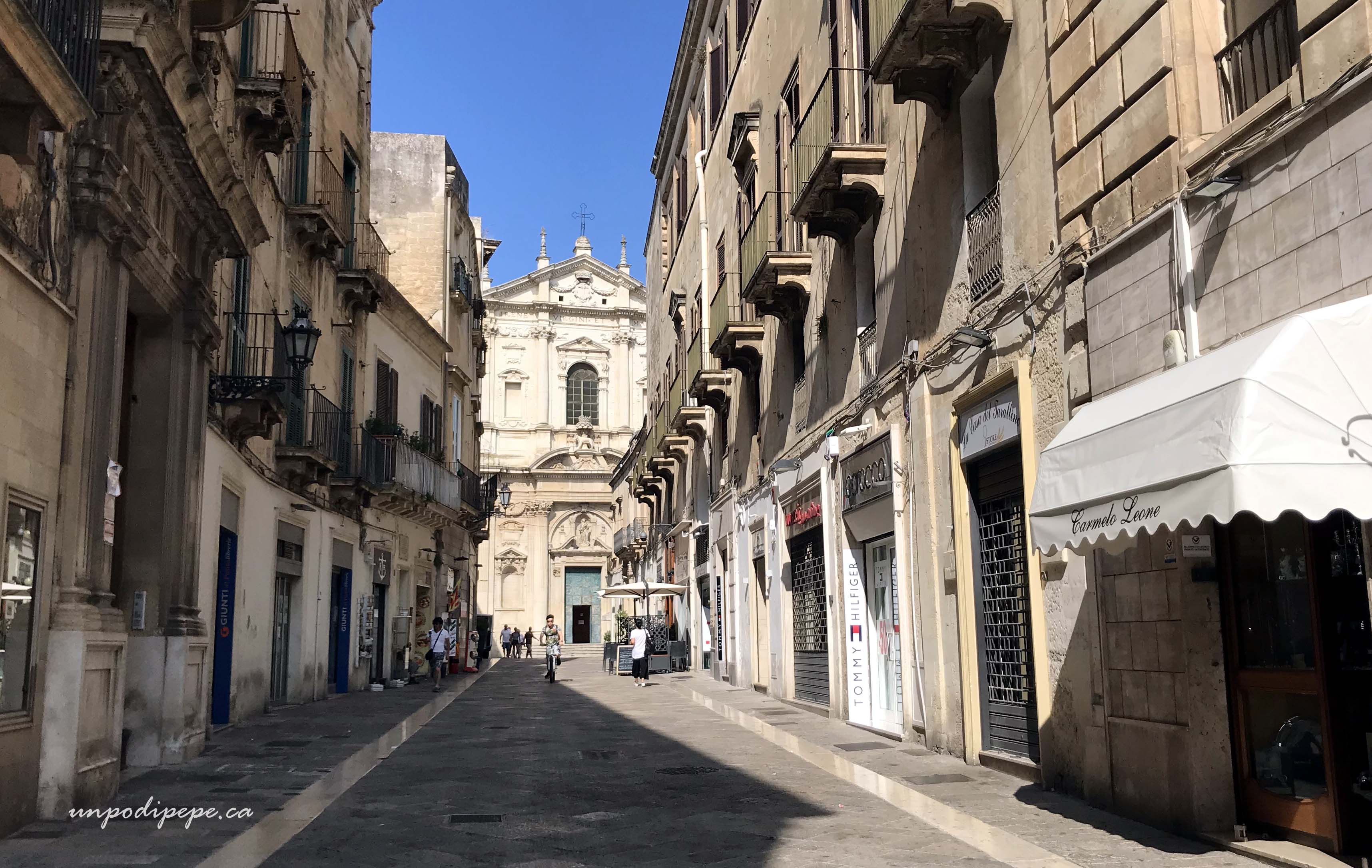
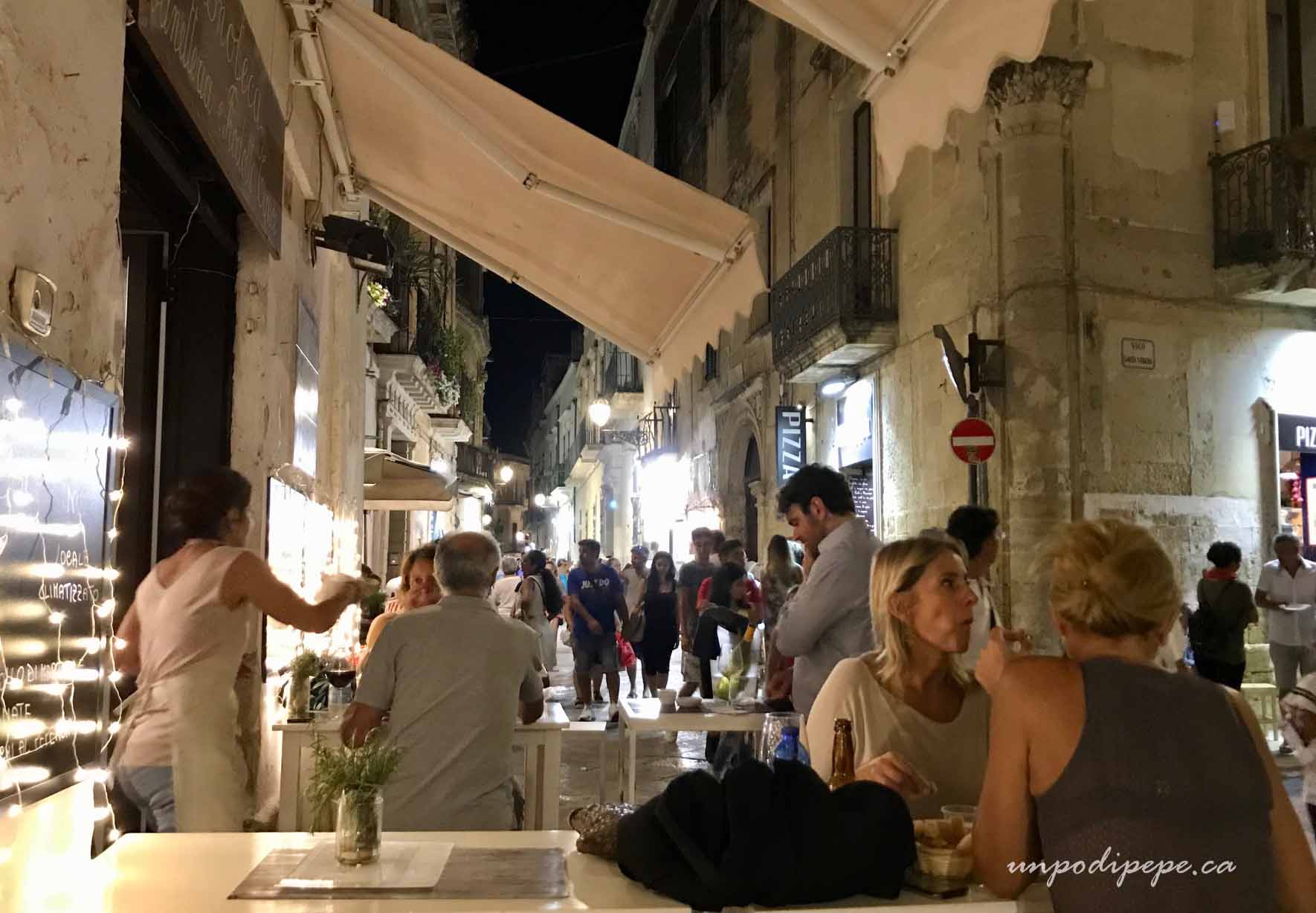
The Centro Storico of Lecce, with its narrow stone streets, 22 churches and unique architecture is a historically preserved walking museum.  It is mostly pedestrian only and very walkable.  Corso Vittorio Emanuele e Sant'Irene LecceAfter dark the streets are lined with outdoor seating for vino and aperitivo, and everyone is out for passeggiata.Lecce di notte

Lecce’s defensive walls are gone, but 3 gates remain: Porta Rudiae, Porta San Biagio and Porta Napoli, which marked the starting point of the road to Napoli.Piazza Duomo Lecce

The 2 main piazze are Piazza Duomo and Piazza Sant’Oronzo, which are connected by Corso Vittorio Emanuele.  Piazza Duomo is a large open space, but you can almost walk by and miss it!  There is only one entrance, and it is closed off on 3 sides.  The Duomo is unique as it has 2 facades.  This was done so that visitors to the piazza did not have to face a big blank side wall as they entered.  Campanile Piazza Duomo LecceThe Campanile is the tallest in Italia at 68 m.  Piazza Duomo also contains the Palazzo Vescovile and Seminario, which is used mainly for exhibitions.

Piazza Sant’Oronzo, named for the first Christian bishop and the patron saint of Lecce, was the site of the mercato.  The 2nd Century AD Roman anfiteatro was discovered in 1901 during construction of a new Banca d’Italia. Anfiteatro LecceThe 20,000 seat arena was originally built outside of the walls of Lecce and was still in use in the 12thCentury. More than half of it has not been excavated!

Looking down over the anfiteatro is Il Sedile, a 1590 Gothic structure which was the seat of the town hall.  It is now the Tourist information office.Anfiteatro and Il Sedile, Lecce, Puglia

The Colonna di S Oronzo, is a column topped with a bronze statue of Sant’Oronzo.  It was originally built in 110 AD-one of a pair of Turkish marble columns marking the end of the Via Appia from Roma to Brindisi.  This one toppled and broke in 1528 and its twin is still standing in Brindisi. In 1659, the broken remains were given to Lecce to thank Sant’Oronzo for saving Brindisi from the 1656 plague.  The Brindisini have wanted it back ever since!

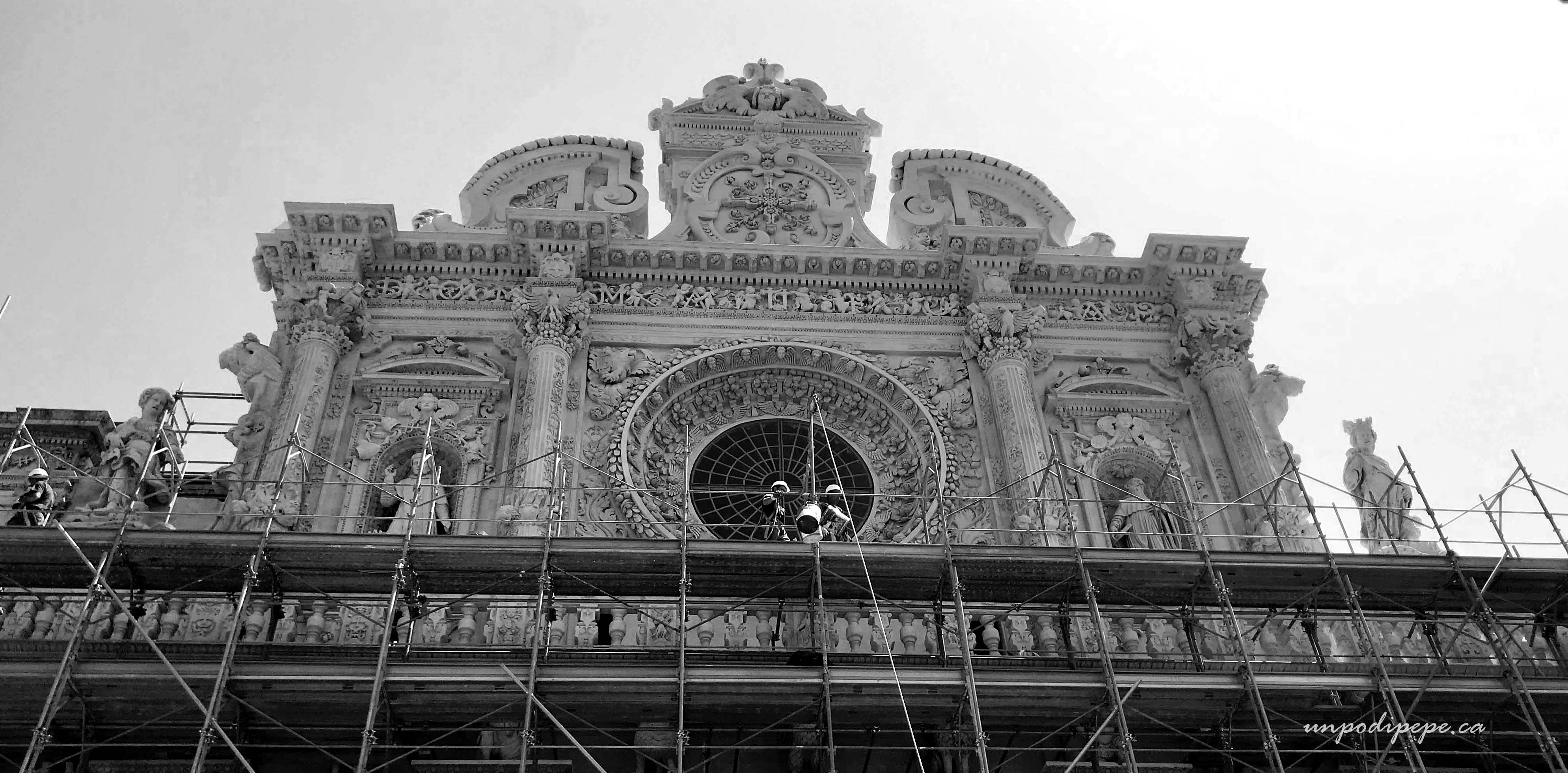
Not far from the piazza is Museo Faggiano- a unique museum, especially for archeology nerds like me!  Plumbing issues result in DIY renovations that uncover layers of history…..Blog post coming!Santa Croce lecce under renovation. Black and white

Santa Croce’s façade is the masterpiece of Barocco Leccese.  It took 200 years to build.  The exterior was recently cleaned and renovated.  The interior has a gilded coffered ceiling and 14 chapels with carved, twisting columns.Santa Croce interior Lecce

Sant’Irene is dedicated to the ancient protector of the city 1591-1639.  The interior is simple, but has twin Baroque side altars.  My amazing balcony at Palazzo Belli B&B looked out onto the side entrance.Sant'Irene Lecce

Santa Chiara built in 1687 has an unusual façade and an extravagant interior with a wooden ceiling. There are loads of other beautiful churches to see in Lecce, but i have only mentioned the main ones. Santa Chiara Lecce

Sometimes the scenery looks like an old movie set!  Walk down Via Palmieri, lined with grand palazzi, ending at Porta Napoli.  Via Palmieri Lecce Puglia

Things I did not have time to see include the Castello Carlo V and its carta pesta (papier maché) museum, the Teatro Romano and the Museo Provinciale.

Lecce is a great place to shop.  Specialties include colourful Pugliese ceramics, carta pesta, olive oil and vino.  Lecce observes the pausa pranzo which means shops are closed from 2-5pm.Lecce ceramic souvenirs

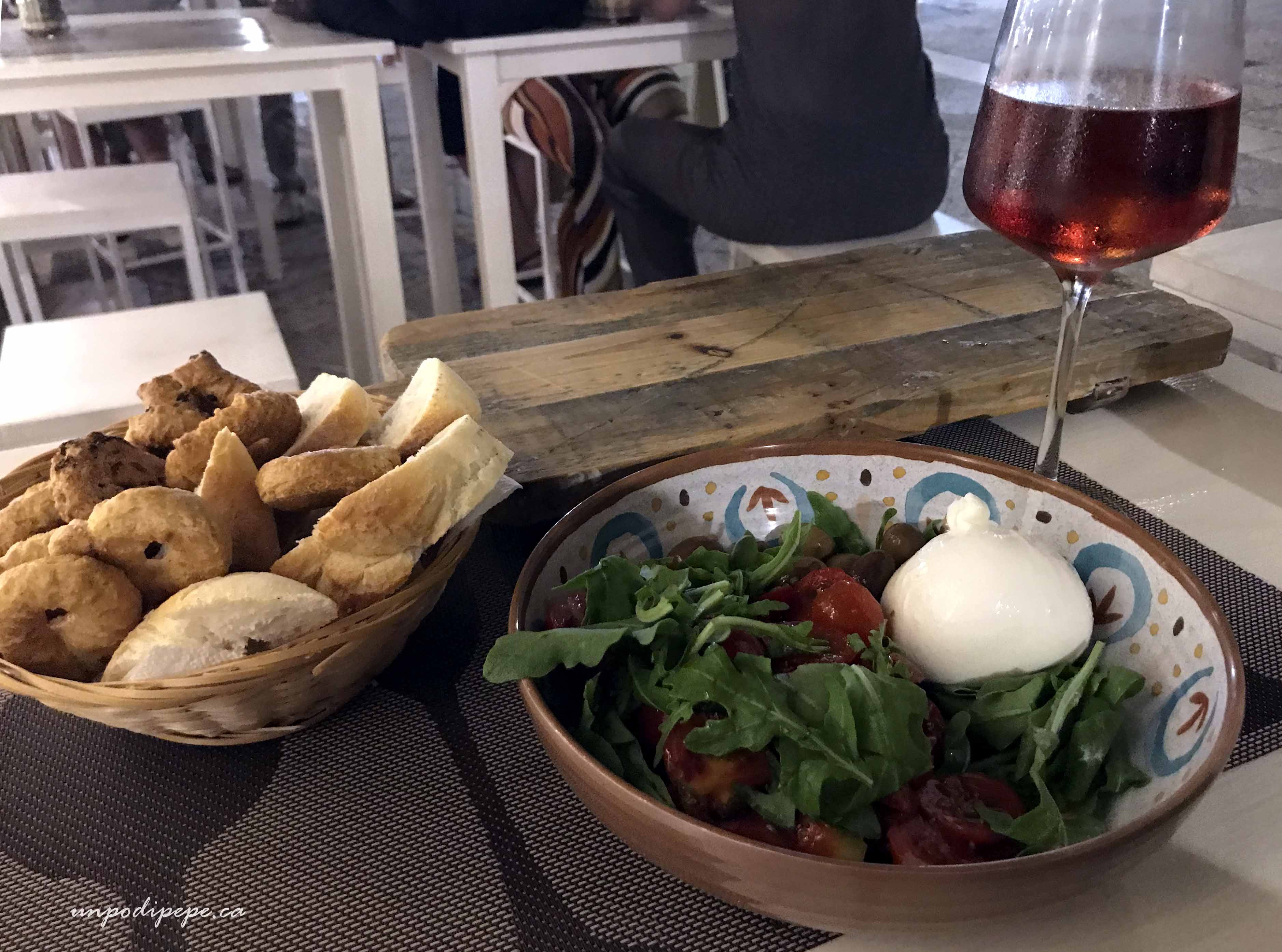
Make sure to try pasticciotto.  My favourite is the kind with crema and amarena. Yum! Colazione LecceSit outside to have Caffè Leccese –espresso on ice with almond milk and of course local vino, especially my favourite-Negroamaro.  Here is my cena with Negroamaro rosé.  Burratina, taralli e Negroamaro Rose,

Since the centro storico is car free, dealing with a car in Lecce can be a pain.  During high season, it is easier to get around by bus or local train.  During low season, a car will make it easier to visit places that are not on the main train line. Lecce is between 2 seas, the Adriatic is 11km away and the Ionian 23 km away.

Lecce (pop. 96,000) is on the Adriatico train route that starts in Bologna.  The Stazione is a flat walk, 1 km south of the Centro Storico.  Last year, I took the train from Foggia (3 hours) staying 3 days in Lecce and 1 in Nardò. It was late July/early August, and not crowded at all. I booked my train and accomodation 3 days in advance. Try to avoid making Lecce a daytrip, as you will miss the beautiful evenings and fun nightlife. I am looking forward to going back as soon as possible!Via Palmieri Lecce black and white

Buon viaggio, Cristina
Share this:

  • Click to share on Facebook (Opens in new window) Facebook
  • Click to share on Pinterest (Opens in new window) Pinterest
  • Click to share on X (Opens in new window) X
  • Click to email a link to a friend (Opens in new window) Email
  • Click to share on WhatsApp (Opens in new window) WhatsApp
Like Loading...

Troia 1019-2019

05 Saturday Oct 2019

Posted by Un po' di pepe in Architecture, Italia, Photography, Puglia

≈ 8 Comments

Tags

Diomedes, Italy travel tips, Romanico Pugliese, Southern Italy, UNESCO World Heritage Sites, Wines of Puglia

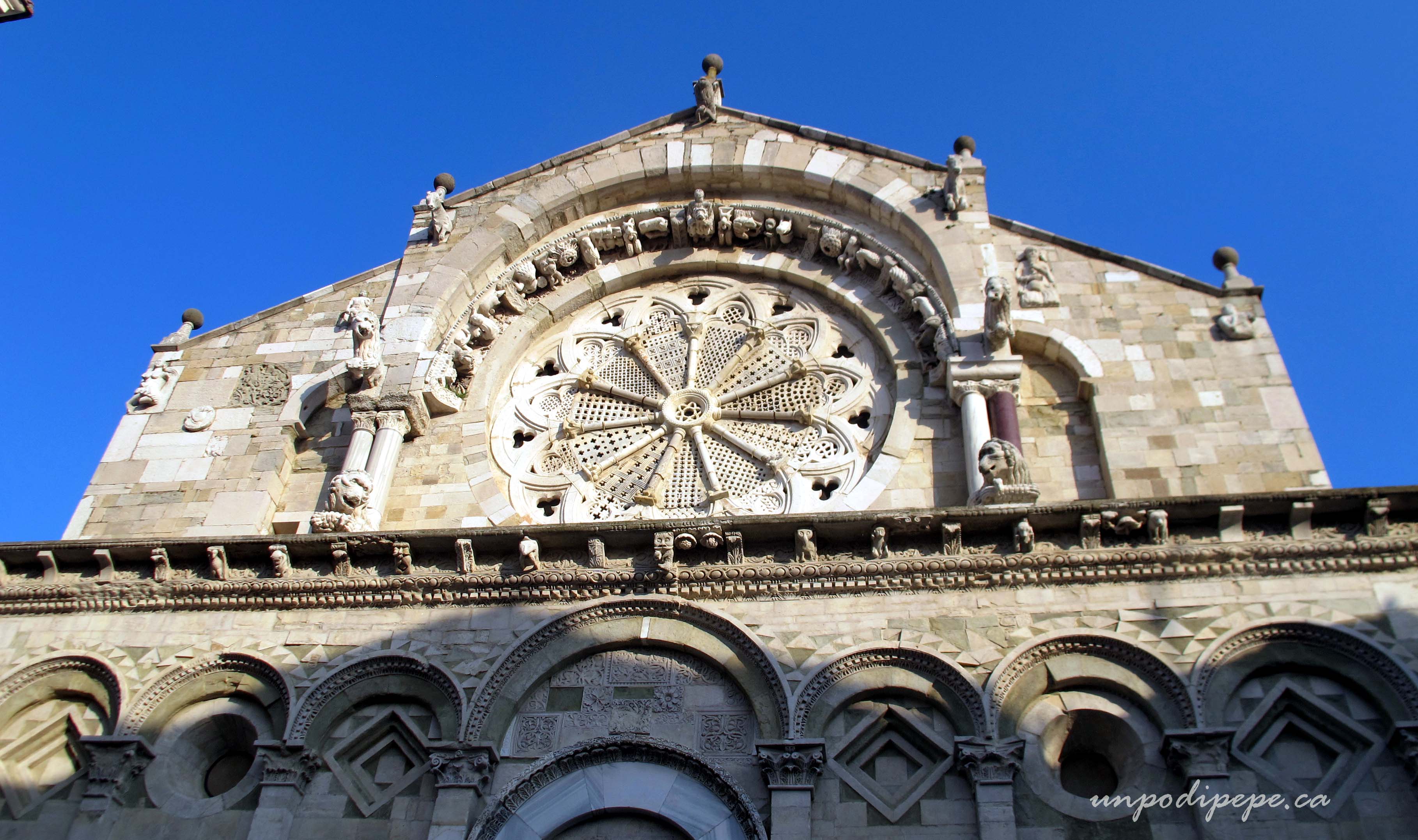
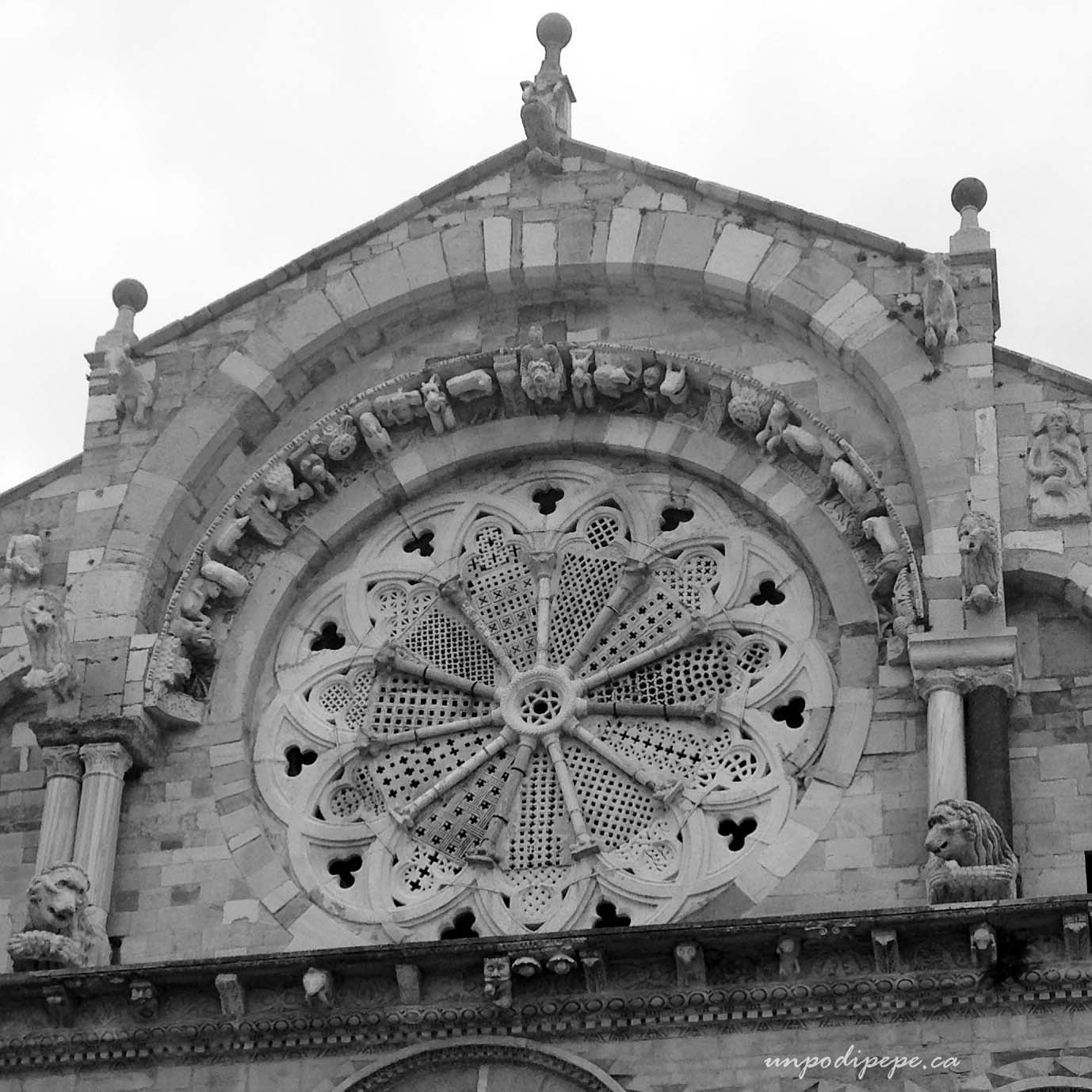
Rosone, Cattedrale di TroiaAccording to legend, Troia (TROH∙yah) was founded by the Trojan War hero Diomede (Diomedes) in the 10th century BC.  After the fall of Troy, he found out his wife was unfaithful.  Instead of going home to Argos, Diomede travelled around the Adriatic, settling in the Daunia area of Puglia.  Troia, also spelled Troja, was at the junction of the Via Traiana –the road from Benevento to Brindisi, and the road to Siponto (Sipontium).  The Romans called it Aecae.  In 1010, a medieval settlement was built on the ruins of the ancient city, and in 1017 a Byzantine fortress to protect against Saracen invaders.  Modern Troia was founded in 1019, making this year its millennia!!!  Auguri Troia!Troia Millenio 1019-2019

Troia was ruled by powerful bishops, and they built a magnificent cattedrale (cathedral), an exquisite example of Romanico Pugliese, a unique architectural mix of Pisan Romanesque, Arab and Byzantine inspired features.  It was an important connection between the Norman kingdoms of Southern Italia and the Pope. Completed in 1119, this architectural capolavoro or masterpiece is celebrating its 900th anniversary!Troia cattedrale Romanica Pugliese

The stunning rosone-rose window is made up of 11 thin columns, each with a delicate stone ‘screen’ finely carved with Islamic inspired geometric designs.  The 11 ‘petals’ or segments each have a different pattern.  They look like they are woven out of stone.  11 is an unusual number of sections for a rose window, or for anything, actually. There could be some interesting numerology related to this building.Cattedrale di Troia, Puglia 2011

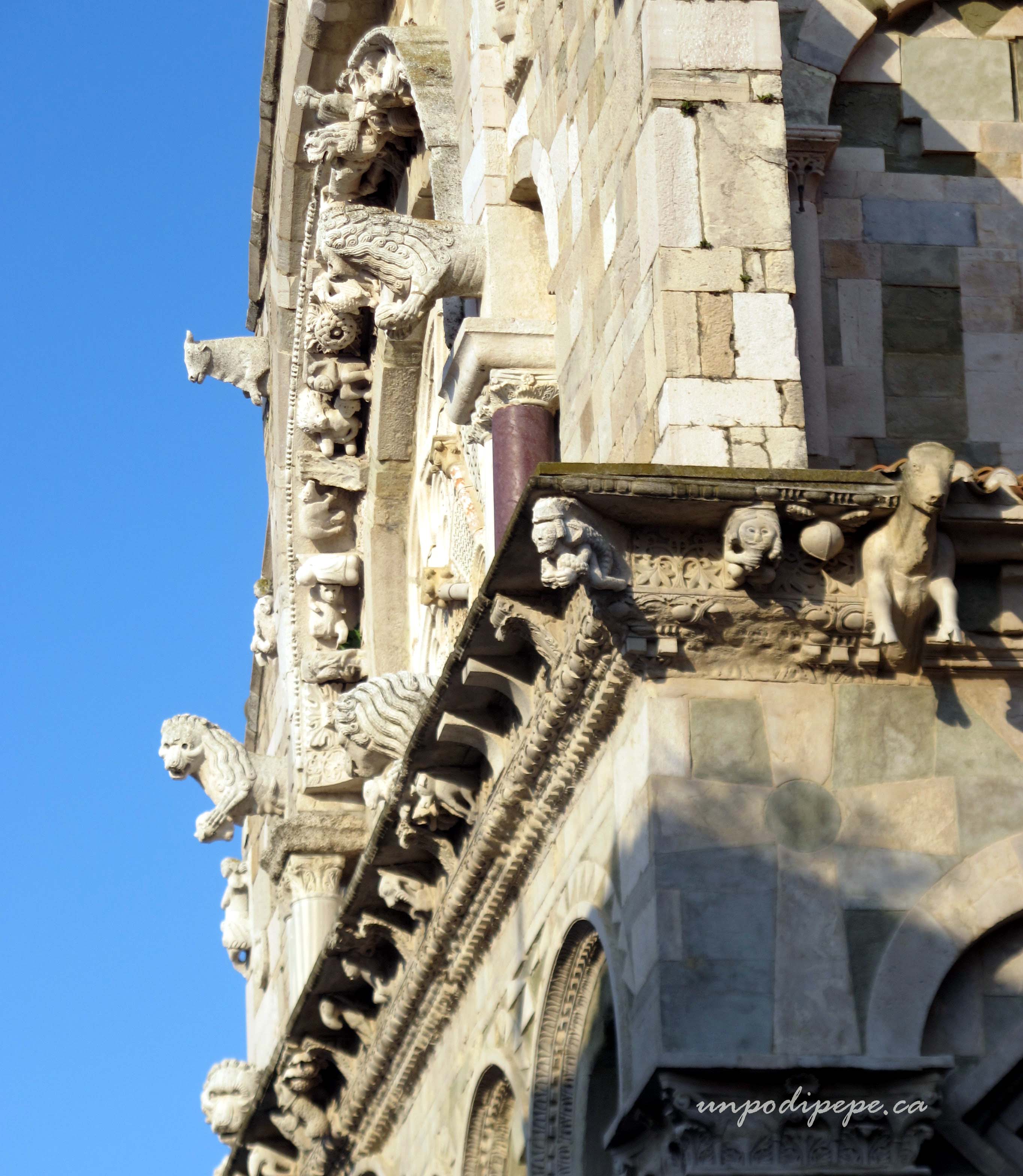
The upper façade is elaborate, with the rosone and gargoyles. The arches around the window are decorated with an odd but fascinating assortment of primitive looking animal and human sculptures and are held up on either side by Pugliese lions. Side view, Troia Cathedral, PugliaTroia Cathedral bronze doors

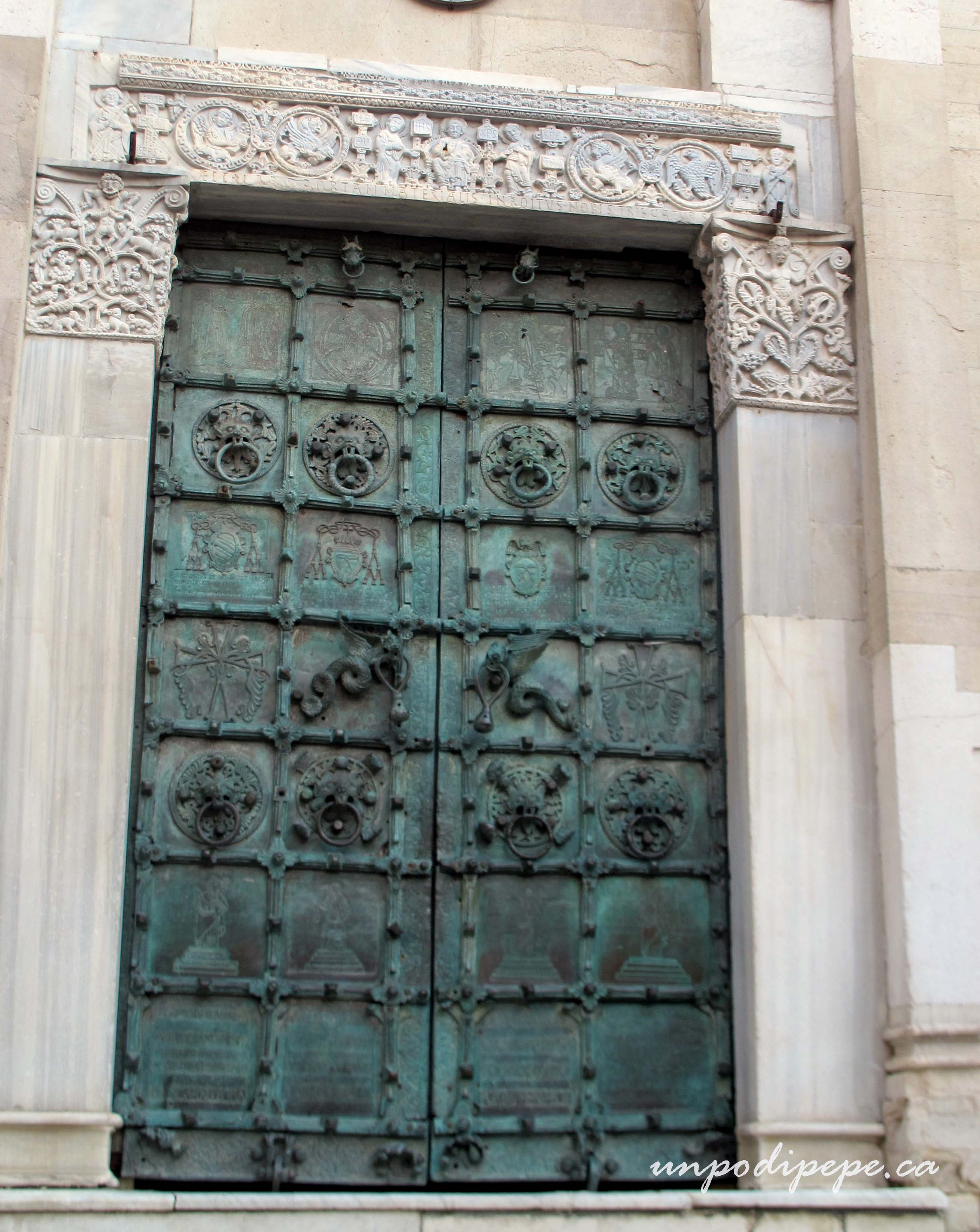
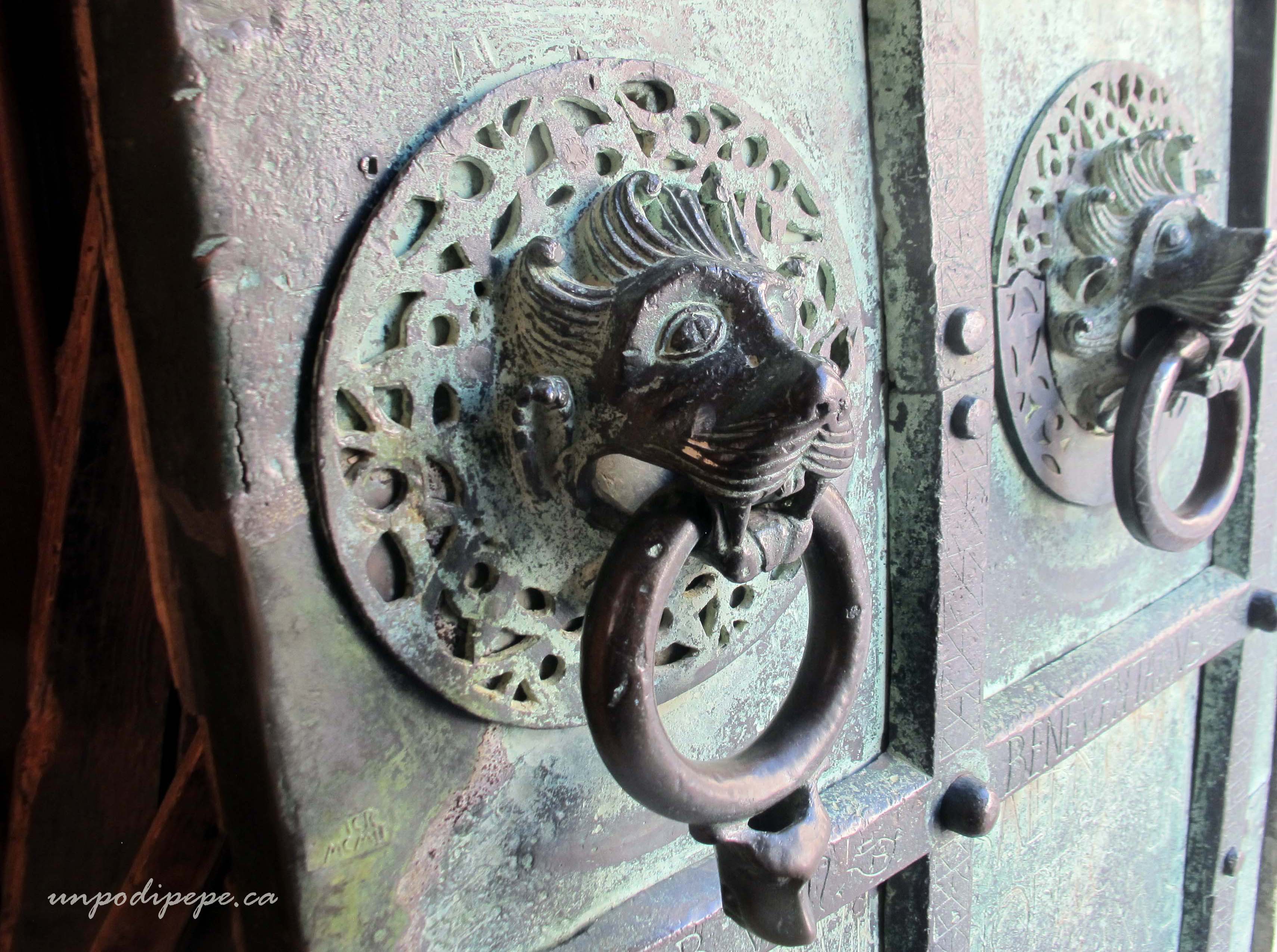
The lower front is a 7 arch façade-the center one being the main entrance through bronze doors with the most magnificent dragon handles. They look straight out of Trono di Spada (Game of Thrones)! The doors were built in 1127 by Oderisio da Benevento. Troia cathedral dragon door handles and lion knockers The doors are decorated with reliefs and inscriptions.  There are 10 knockers; 8 lions and 2 wyverns, which are small 2 legged dragons.  On each side of the door are 3 blind arches topped with geometric carvings and a round window on the middle arch.  The arches on the side of the building are topped with geometric sun and moon patterns in green stone. The main doors are closed and entry is only through the side door, another bronze by Oderisio da Benevento.  The church is usually open during the day, and of course during Masses.Troia Cathedral bronze door lion door knockers

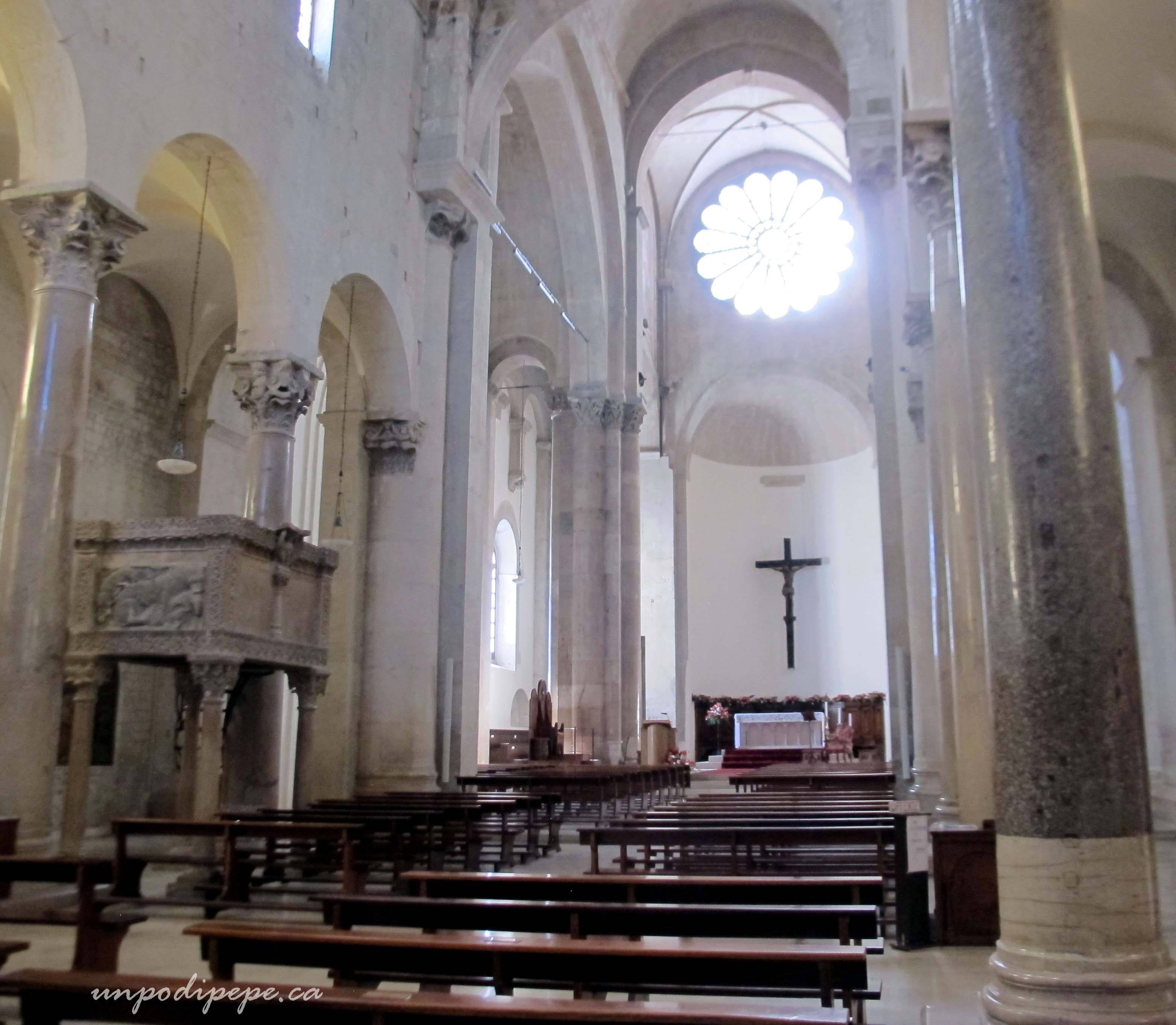
In contrast to the ornate exterior, the interior of the cattedrale is simple.  The design is a Latin cross plan with 3 aisles separated by 13 Corinthian columns, 2 rows of 6 and a 3rd row in the SW corner with only one column, as seen in the photo below.  These represent the 12 apostles and Christ. There is no ceiling, the beamed wood roof is exposed. The Cathedrals in the Romanico Pugliese style, including Troia’s, are on the tentative list for UNESCO World Heritage Sites.  This is the step before becoming a heritage site!Interior of the Cathedral of Troia, with a view of the 13th column

The 1169 pulpit dates to 1169 has an interesting relief carved on one side. It is a dog biting the back of a lion, who is biting the neck of a lamb and is visible in the photo below.  The dog symbolizes God, who is faithful and vigilant, preventing poor judgement and heresy (the lion) from devouring the church (the lamb). Troia Cathedral, relief sculpture on pulpit

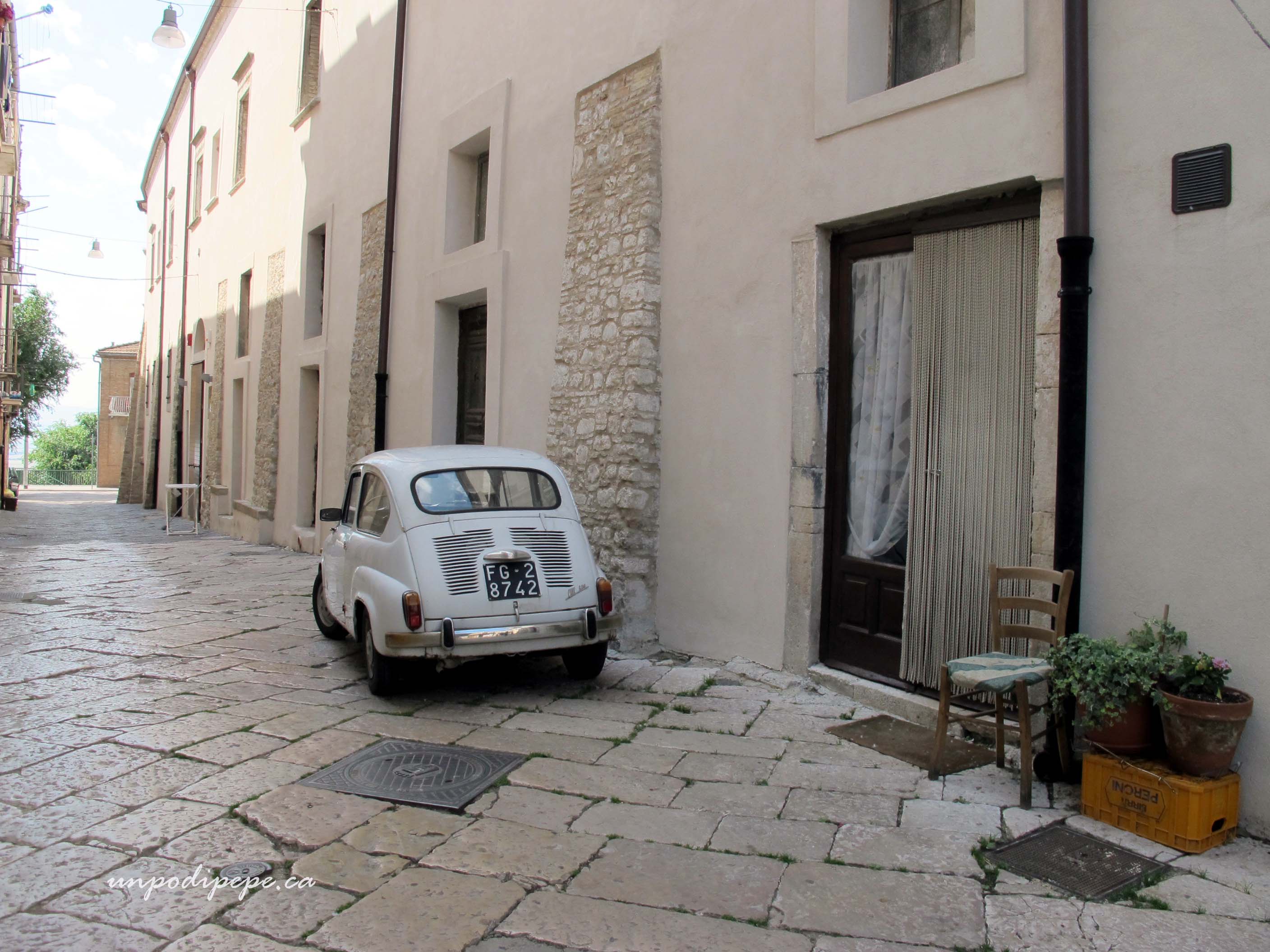
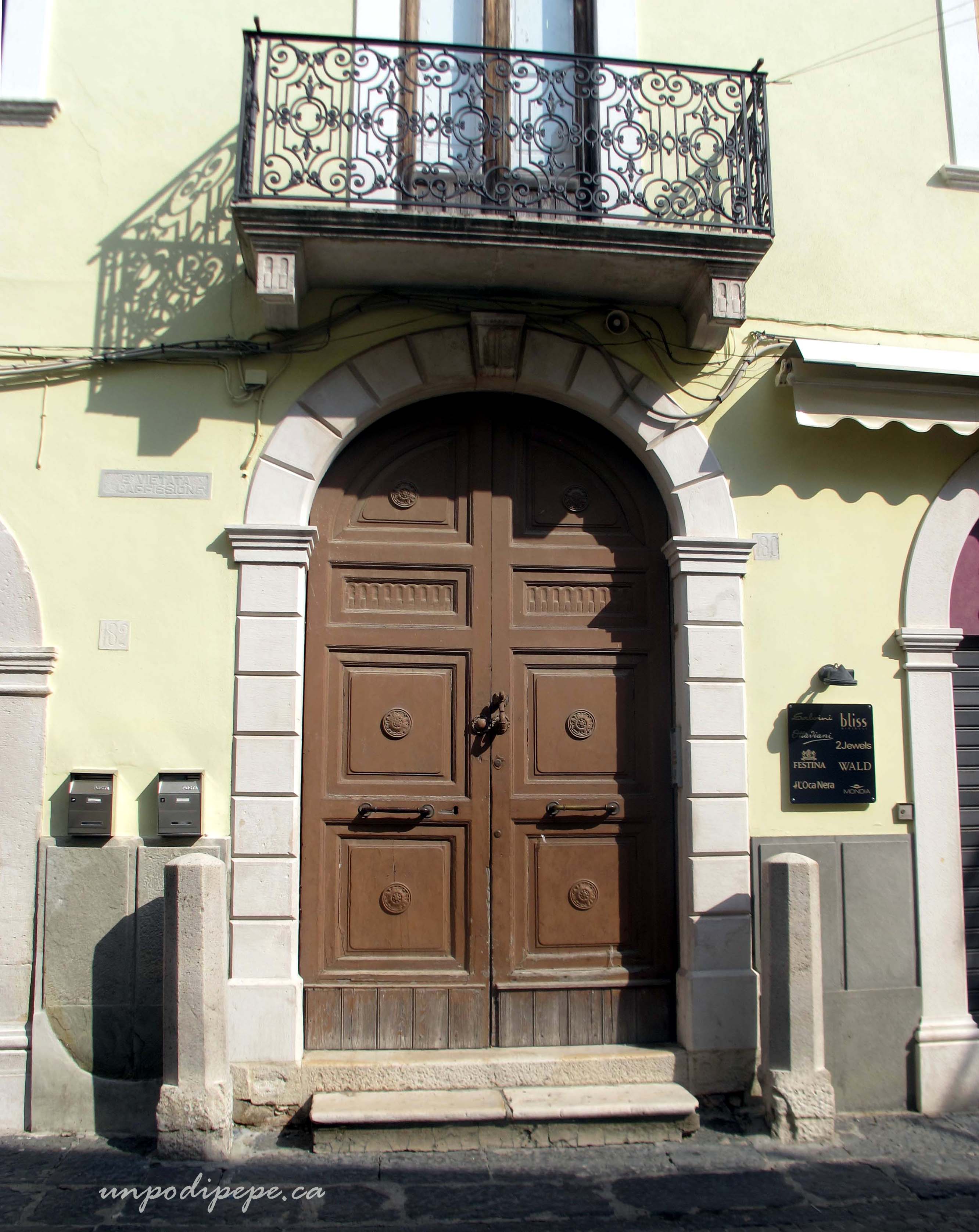
Il Museo del Tesoro della Cattedrale di Troia (the cathedral treasury) is worth a visit for rare 11th century parchments and other medieval sacred artifacts. There are only 32 illuminated Exultet codes (Easter scrolls) in the world, and 3 of them are here.  Also worth seeing is Il Capitello delle Quatre Razze (Column of the 4 Races).  This is a 13th Century column with 4 heads, one on each corner, depicting the 4 races of man known before 1492- European, African, Asian and Arab.  Admission is free, but it is only open Tuesday and Thursday 17:30-20 and Saturday 10-13.  Mondays are only open for school groups with appointments.  Call ahead, as they may open for groups 0881 97 00 20.Cattedrale di Troia, PugliaTroia is named for the ancient city, but unfortunately ‘troia’ is also Italian slang for ‘slut’.  My best guess is that the origin of this term is from Elena di Troia (Helen of Troy) who was an adultress.  Don’t let the name put you off though.  Troia is a charming town with a beautiful centro storico.  It is also way off the radar for most visitors to Puglia, so you will not find any crowds.Side street in Troia with Fiat Seicento (600) As an added bonus, you can find Nero di Troia vino everywhere!  Read more about this lovely vino in Vini di Puglia. My Zia lives in Troia, so I have been there a lot.  Here are some interesting Troia facts… #1-I had my confirmation at the Cattedrale di Troia when I was 15!  Interesting fact #2-Troia is the only municipality in Italia providing free public transportation! Via Regina Margherita doorway Troia, Puglia

Get off the bus from Foggia or park the car near La Villa Comunale and Bar Cluny.  Walk down Via Regina Margherita to explore the centro storico.  The Cattedrale is half way down this long, narrow street, which is lined with shops and interesting doorways.  Stop at the award-winning Pasticceria e Gelateria Artigianale Aquilino for a decadent treat. Visit the oldest church in Troia, the Byzantine San Basilio with ox heads around the altar.  It was originally a Greek Orthodox temple. The haunted Palazzo D’Avolos is now home to the Civic offices and Civic Museum. Wander into the narrow side streets and you may come across a Fiat 600 or some work by local artist Leon Marino.House in Troia, Puglia with Leon Marino angel mural

Troia has a population of  about 7000.  It is situated on a hill, 439 m above the Tavoliere plain, 22 km SW of Foggia, 15 km south of Lucera and 14 km east of Orsara di Puglia.  The surrounding landscape is a beautiful blanket of wheat fields, vineyards and olive groves- like the view from the abandoned Celle Sant’Antonio, just outside of Troia.  Celle Sant'Antonio, Troia Puglia

Ferrovie del Gargano buses arrive regularly from Foggia and Lucera. The ticket is €1.80.  If taking the train to Foggia, the bus station is conveniently next door. Troia has several B&B’s including Alba d’Oro, Stella and Svegliarsi nei Borghi.  There is even a car rental agency, Automottola, on the edge of town, towards Foggia.  For more information check out Troia’s website.Troia Cathedral and Via Regina MargheritaRead more about Troia and Diomede in Puglia-Mia Regione Preferita.  Have any of you readers who are not related to me been to Troia?

Ciao e buon viaggio, Cristina
Share this:

  • Click to share on Facebook (Opens in new window) Facebook
  • Click to share on Pinterest (Opens in new window) Pinterest
  • Click to share on X (Opens in new window) X
  • Click to email a link to a friend (Opens in new window) Email
  • Click to share on WhatsApp (Opens in new window) WhatsApp
Like Loading...
← Older posts

Enter your email address to follow 'un po' di pepe' and receive notifications of new posts by email.

Join 511 other subscribers
Follow Un po' di pepe on WordPress.com

Popular Posts

  • Hairstyling in Ancient Roma
    Hairstyling in Ancient Roma
  • Espresso Cookies
    Espresso Cookies
  • Il Pumo Pugliese
    Il Pumo Pugliese
  • Panforte di Siena
    Panforte di Siena
  • Internment of Italian Canadians
    Internment of Italian Canadians
  • San Nicola
    San Nicola
  • Panettone Fatto in Casa
    Panettone Fatto in Casa

Recent Posts

  • Castel del Monte
  • ‘The Nuances of Love’
  • Hostaria Antica Roma~Eat like an Ancient Roman
  • Santa Maria in Aracoeli
  • Casino dell’Aurora~Villa Boncompagni Ludovisi
  • Nasoni di Roma
  • Bloghiversario #11
  • Fontana di Trevi
  • Acqua Vergine
  • Giubileo 2025
  • Sanremo 2025
  • In Vino there are Memories
  • A Literary Harvest
  • 2024~Un po’ di pepe Year in Review
  • Buon Natale 2024
  • Il Bicerin
  • Mercato Porta Palazzo
  • Torino
  • Catanzaro, Calabria
  • Il Pumo Pugliese
  • Artemisia Gentileschi
  • Cavalli di San Marco
  • Panzerotti
  • Torcello
  • 10 years of Un po’ di pepe!

Categories

Amici e Famiglia Architecture Art Art history Art projects Bilingual posts Blogging Canada Culture Feste Firenze Inspiration Italia Italian Folklore Italian language Italian life Italocanadesi Libri Mangiamo! Orsara di Puglia Parole piacevoli Photography Puglia Recipes Roma Travel Travel tips Uncategorized Vino

Archives

Un po’ di pepe on Facebook

Un po’ di pepe on Facebook

Start a Blog at WordPress.com.

  • Subscribe Subscribed
    • Un po' di pepe
    • Join 511 other subscribers
    • Already have a WordPress.com account? Log in now.
    • Un po' di pepe
    • Subscribe Subscribed
    • Sign up
    • Log in
    • Report this content
    • View site in Reader
    • Manage subscriptions
    • Collapse this bar
 

Loading Comments...
 

    %d