• Home
  • About me/Chi sono
  • Contact

Un po' di pepe

~ …… (oon∙poh∙dee∙PEH∙peh) Cristina writes about interesting stuff /Cristina scrive di cose interessanti

Un po' di pepe

Category Archives: Italia

Hairstyling in Ancient Roma

31 Tuesday Jan 2017

Posted by Un po' di pepe in Art history, Italia, Roma

≈ 23 Comments

Tags

Ancient Roman hairdressing, Hadrianic Turban, Hercules Knot, Nodus, Orbis Comarum, Palazzo Massimo alle Terme, Roma

villa-of-the-mysteriesOn a recent visit to Palazzo Massimo alle Terme, I walked the corridors lined with ancient Roman busts and was struck by the variety and realism of sculpted hairstyles. Many of them are so detailed, the hair looks like it is moving. Roman women originally wore their hair in simple styles with a circular band around the head, a bun at the nape of the neck or on top of the head. In Imperial Roma (1st -3rd C AD), hairstyles were always changing. Archeologists are actually able to identify and date coins and busts based on the hairstyle, which was often worn by the empress of the time.vibiasabina3

During the reign of Emperor Augustus elaborate updos for married women became fashionable, and really got big and complex in the Flavian and Trajanic eras. Clothing styles for women were simple, and unlike men, whose status could be reflected in their clothes, there was no special dress code to distinguish status. Women could only display their status, wealth and age via their hairstyles and jewellery. A natural hairstyle was considered barbarian, and implied a lack of both wealth and taste.  For Roman noblewomen, complex, unnatural hairstyles requiring hours of daily attention showed wealth and culture to the max. It was the job of slave hairdressers called ornatrice and their assistants to put hair up and take it down. Scenes of hairdressing and mirror-gazing were popular subjects in portraiture and reliefs, such as the 50 BC fresco from the Villa of the Mysteries in Pompeii.

Reticula (hairnet) of finely woven gold, found on Via Tiburtina, Palazzo Massimo. In behind is the poet Sappho wearing a hairnet, from a Pompeiian fresco.

Reticula (hairnet) of finely woven gold, found on Via Tiburtina, Palazzo Massimo. In behind is the poet Sappho wearing a hairnet, from a Pompeiian fresco.

Ornatrice curled hair in ringlets by wrapping it around a tapered bronze rod called a Calamistrum, which was heated in hot ashes or open flame. Hair was twisted, braided, curled, teased, wrapped and tied with cords or ribbons to bind around the head. Carefully arranged styles, braids and buns were stitched up with blunt bone needle and wool thread, held with wire, painted bone, ivory or jeweled hairpins and combs, and hairnets called reticulae of finely woven gold wire. Beeswax pomade was the only styling product available-the closest thing to hairspray they had!

My similated 'Ornatrice Toolbox' containing blunt needle and wool thread. hair piece and hair bodkin, leaf spring scissors, camel bone comb, beeswax and a 'calamistrum' which is actually my ring mandrel, but it is the right shape!

My similated ‘Ornatrice Toolbox’ containing blunt needle and wool thread. hair piece and hair bodkin, leaf spring scissors, camel bone comb, beeswax and a ‘calamistrum’ which is actually my ring mandrel, but it is the right shape!
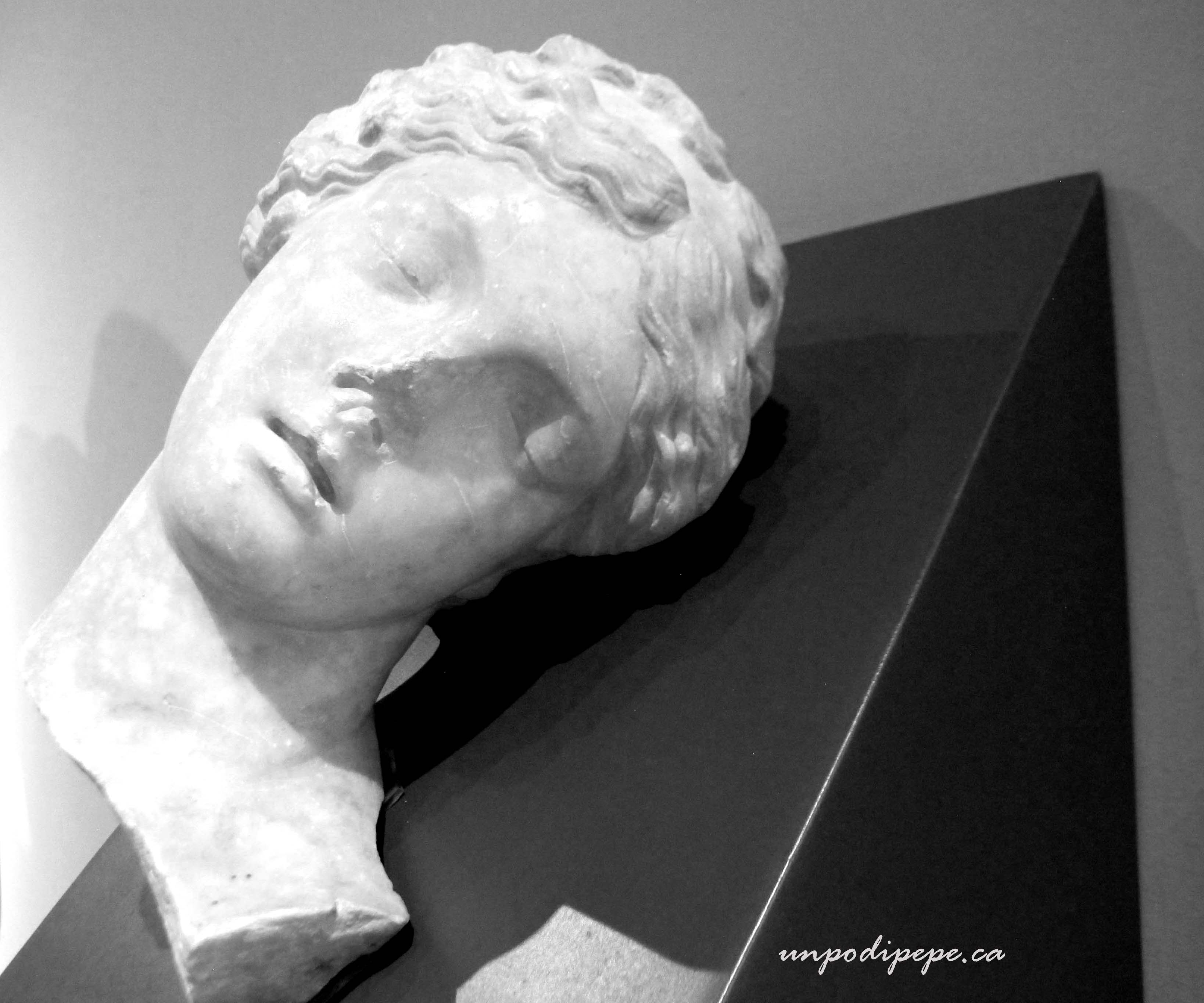
Fanciulla Dormiente, Palazzo Massimo

Fanciulla Dormiente, Palazzo Massimo

Romans dyed their hair with everything from herbs to yucky potions. Hair was lightened with lemons, chamomile, henna, saffron, turmeric, baking soda, ammonia, and even pigeon poop. Hair was reddened with henna from Egypt or animal fat mixed with wood ashes. According to Pliny the Elder, hair could be dyed black by applying leeches that had been rotting in red wine and vinegar for 40 days. Yuck! Hair was also darkened with lead oxide, copper filings, or burned walnut shells and leeks. A paste of herbs and crushed earthworms was applied at night to prevent gray. Che schifo!

Women kept their hair as long as it grew, so styles were done with very long hair. Over time, all of this pulling, pinning, colouring, and frequent curling at high temperature led to hair thinning and damage. The only ‘hair products’ available were olive oil, honey and eggs.  As they got older, women often had to use hairpieces, extensions and wool pads to make their hair look thicker or longer. These were braided into existing hair, pinned, or sewn in with wool thread, twine or wire and a blunt bone needle. In extreme cases, a capellamentum or full wig could be worn. Busts were sometimes even made with detachable marble hairpieces so the style could be updated without the expense of commissioning a new bust.

Lucilla wearing a palla, Palazzo Massimo

Lucilla wearing a palla, Palazzo Massimo

Most adult Roman women wore a palla when they left the house. This was a long cloth wrapped around the body and draped over the back of the head as a veil.  A woman wearing her hair uncovered and loose in the street could be mistaken for a prostitute!
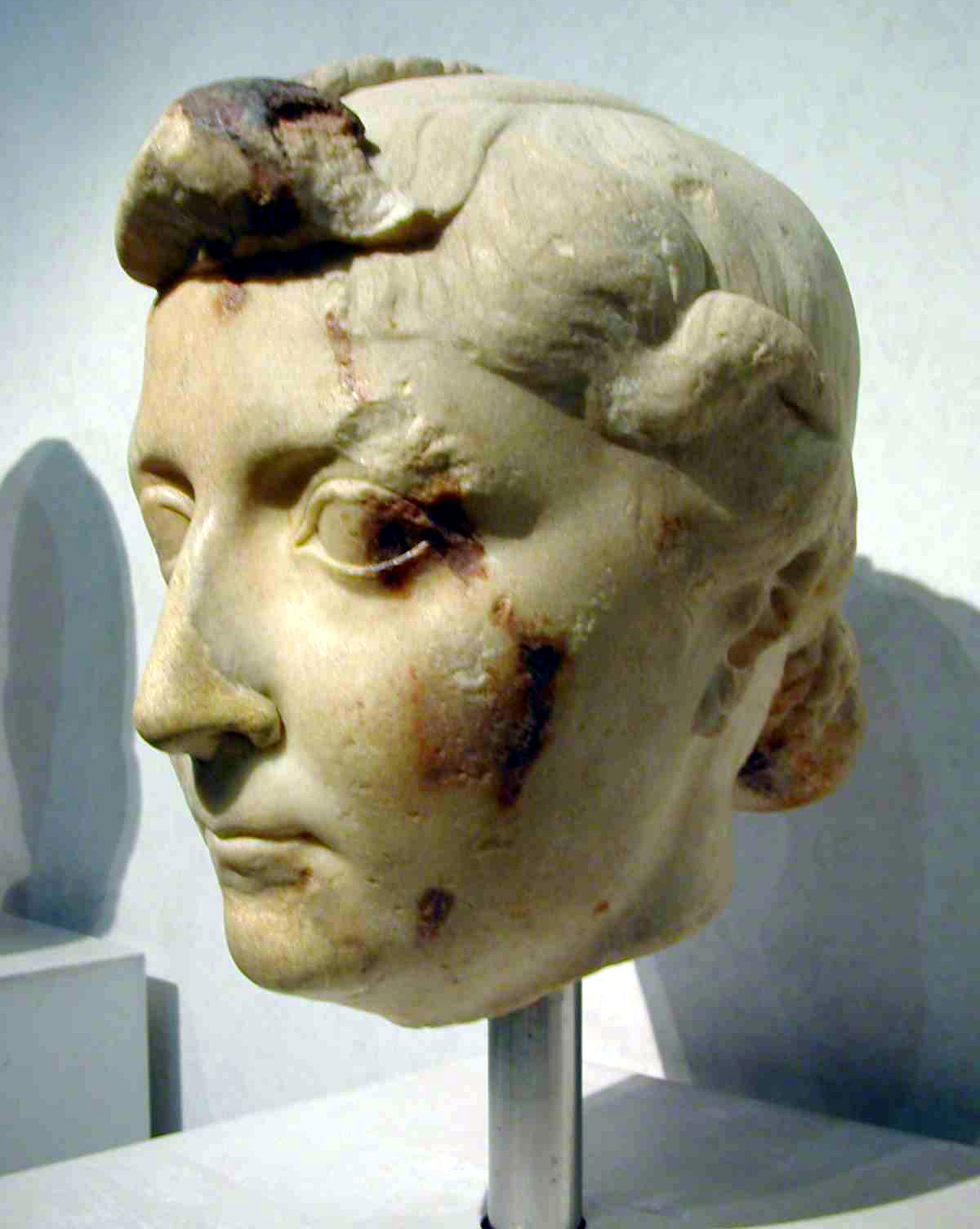
Bust of Livia, Palazzo Massimo

Bust of Livia, Palazzo Massimo

The ancient Nodus hairstyle was worn by Livia Drusilla, wife of Augustus and also his sister Octavia. The hair was parted in 3 sections. The side hair was tied into a bun at the back and the middle section looped back on itself like a pompadour and then braided to join the bun.
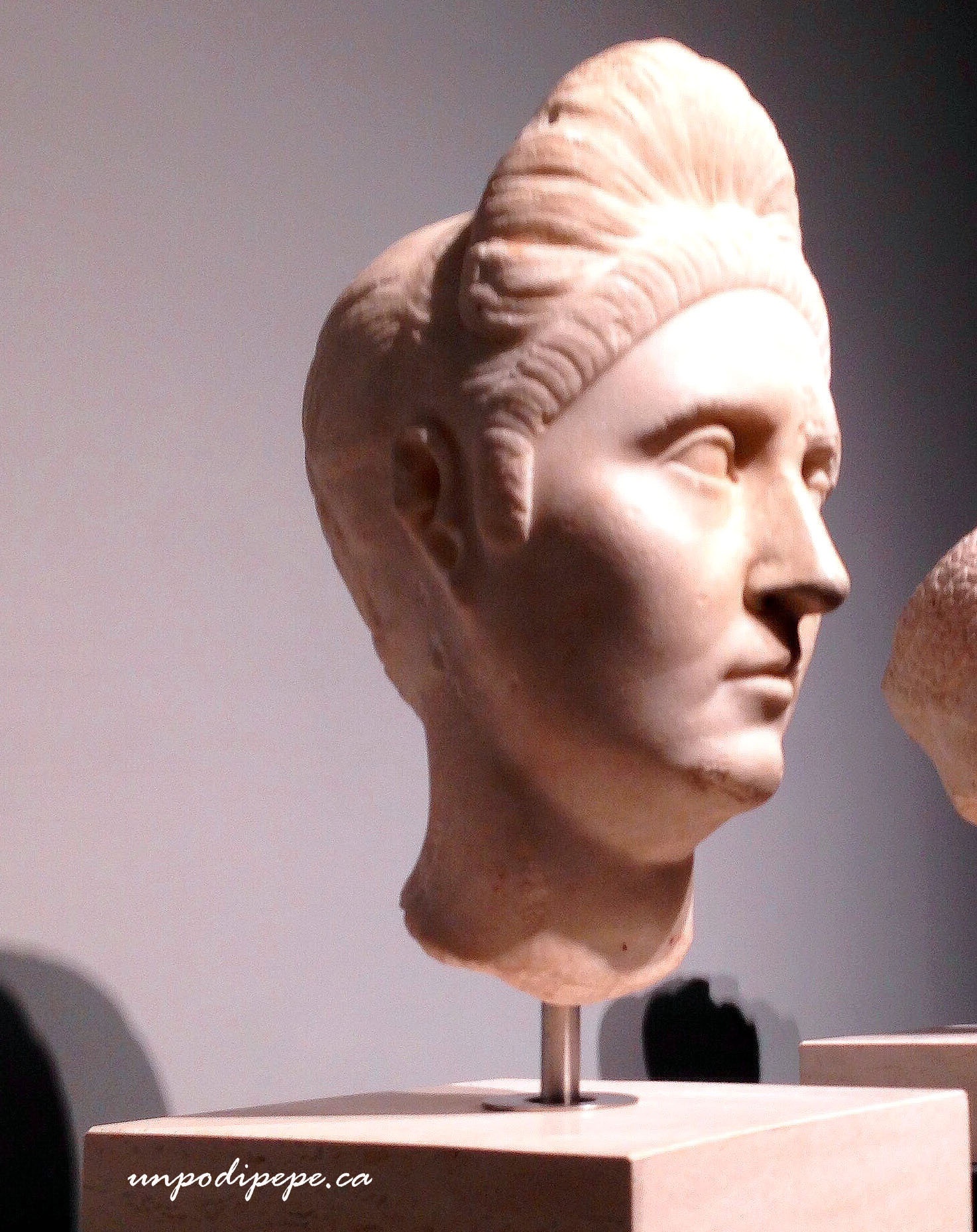
Plotina Pompeia, wife of Trajan, Palazzo Massimo. Her nodus is a high cascading ponytail.

Plotina Pompeia, wife of Trajan, Palazzo Massimo. Her nodus is a high cascading ponytail.

Fanciulla Romana, young woman with Hercules knot, Palazzo Massimo

Fanciulla Romana, young woman with Hercules knot, Palazzo Massimo

Roman women even tied their hair in knots.  Above  is a Hercules Knot, also called a reef knot or square knot.  Left over right, right over left!   Roman brides often wore a belt with a Hercules knot, which is where the phrase ‘to tie the knot’ comes from, but the hairstyle was not associated with marriage. Vibia Sabina also wore this style.

Agrippina Minor, Palazzo Massimo

Agrippina Minor, Palazzo Massimo

This partial bust of Agrippina Minor (15-59 AD), mother of Nero, found in Ostia has tightly curled short front hair with a diadem (tiara). We have to imagine the rest of the hairstyle, with a bun and ringlets in the back, coming over her shoulders.

Poppaea Sabina, Palazzo Massimo

Poppaea Sabina, Palazzo Massimo

Poppea Sabina (31-65 AD) the wife of Nero had a talented, hardworking ornatrice!  Her bust features two rows of interesting looped tight curls under the diadem and ringlets down the back.  Look at those fine little curlicues around her face.  They were probably held in place with beeswax pomade.hadrianicturban-copy

The Hadrianic Turban or tower hairstyle was like a turban of parallel braids that were sewn together on top of the head. This style was often worn by Vibia Sabina (88-137 AD) wife of Emperor Hadrian and can also be seen on the Egyptian Mummy portrait at the end of this post.

Vibia Sabina, wife of Hadrian, Vienna Kunsthistorisches Museum. Photo, Wikimedia commons

Vibia Sabina, wife of Hadrian, Vienna Kunsthistorisches Museum. Photo, Wikimedia commons

This back view of one of Vibia Sabina’s hairstyles is an absolute masterpiece- un capolavoro.  This sculptor wins the best stone hairdressing prize.  You can feel the weight of that massive coil of knotted braids on her head. The details are amazing, like the tendrils on the back of the neck, and that little curl beside the ear.

Faustina Maggiore, Musei Capitolini. Photo Wikimedia Commons

Faustina Maggiore, Musei Capitolini. Photo Wikimedia Commons

The hairstyle of Faustina Maggiore (the Elder) is another work of art.  It is like a French roll made with braids, then rolled into a coiled bun at the top of her head like a Jackie-O pillbox hat.

During the Flavian and Trajanic eras (late 1st, early 2nd C AD) the ‘orbis comarum’ or circle of hair with really big, tall front hair was in fashion.  A shorter fringe of tall tight curls or ringlets was piled high in the front, and braids wound into a big wreath bun in back. The big front hair was often curled, teased, and then sewn in place and supported by wires and padded with a wool pad or hairpiece.fonsecabust

The Fonseca Bust in the Musei Capitolini is a portrait of an unknown Flavian woman with the Orbis Comarum.  The front ringlets are sculpted using a hand drill.  Can you imagine making a mistake drilling one of those fine deep holes!  The back view of the bust looks like a straw hat on the head. That big front hair looks mega-teased.  It is amazing this was possible without hairspray! The side view is my favourite.  I love how you can see the origin of all the braids.

Fonseca bust, side and back view (the back view is of a plaster cast ) Photos Wikimedia Commons
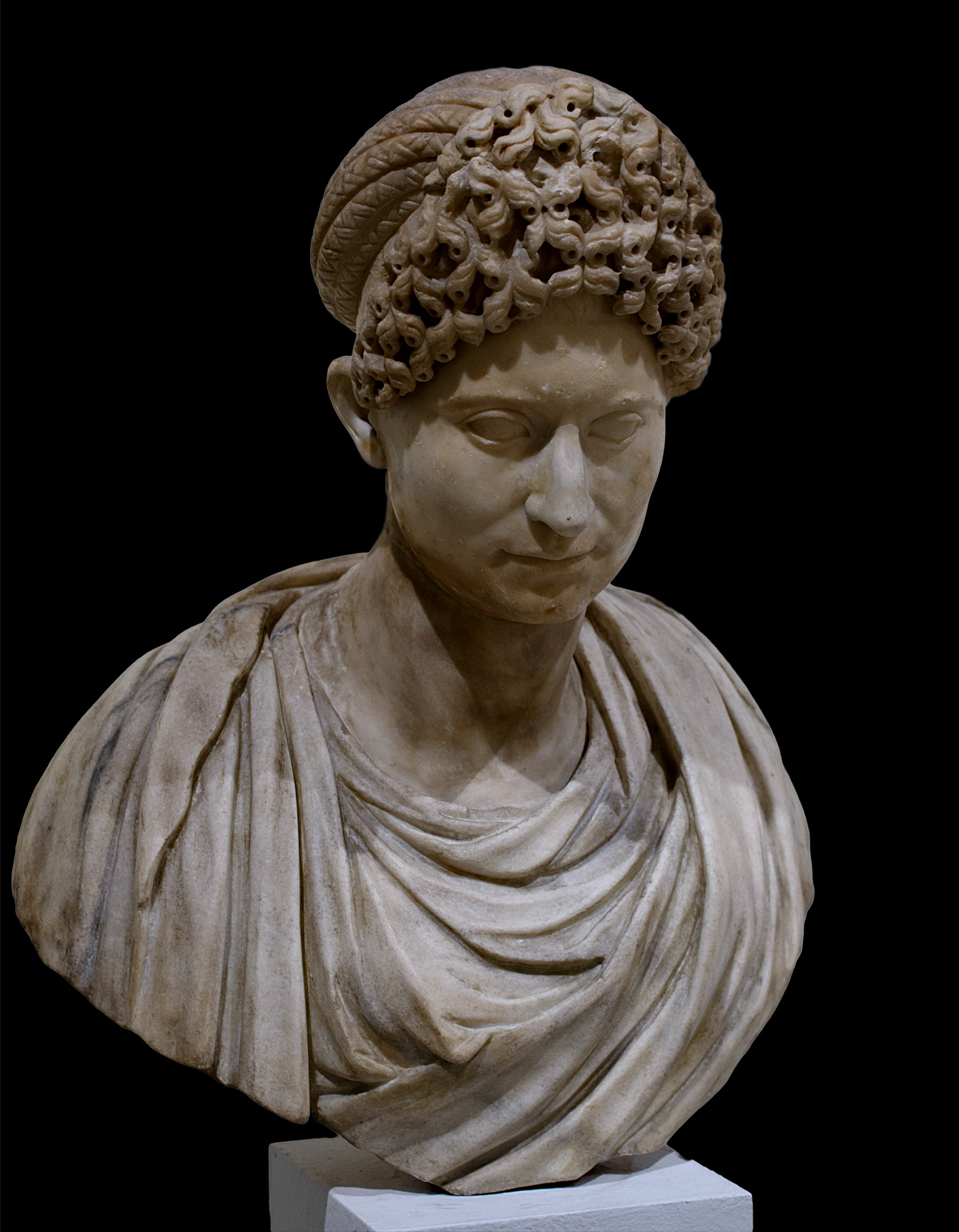
Fonseca bust, side and back view (the back view is of a plaster cast ) Photos Wikimedia Commons

Flavian Woman, Museo Nazionale Venezia. Photo Wikimedia Commons.

Flavian Woman, Museo Nazionale Venezia. Photo Wikimedia Commons.

On this bust of an unknown Flavian era woman (75-100 AD), the small tight ringlets are sculpted with a hand drill. They almost look like fusilli!  The big front hair looks like it is being propped up by the ropes of braids, wound high on her head.
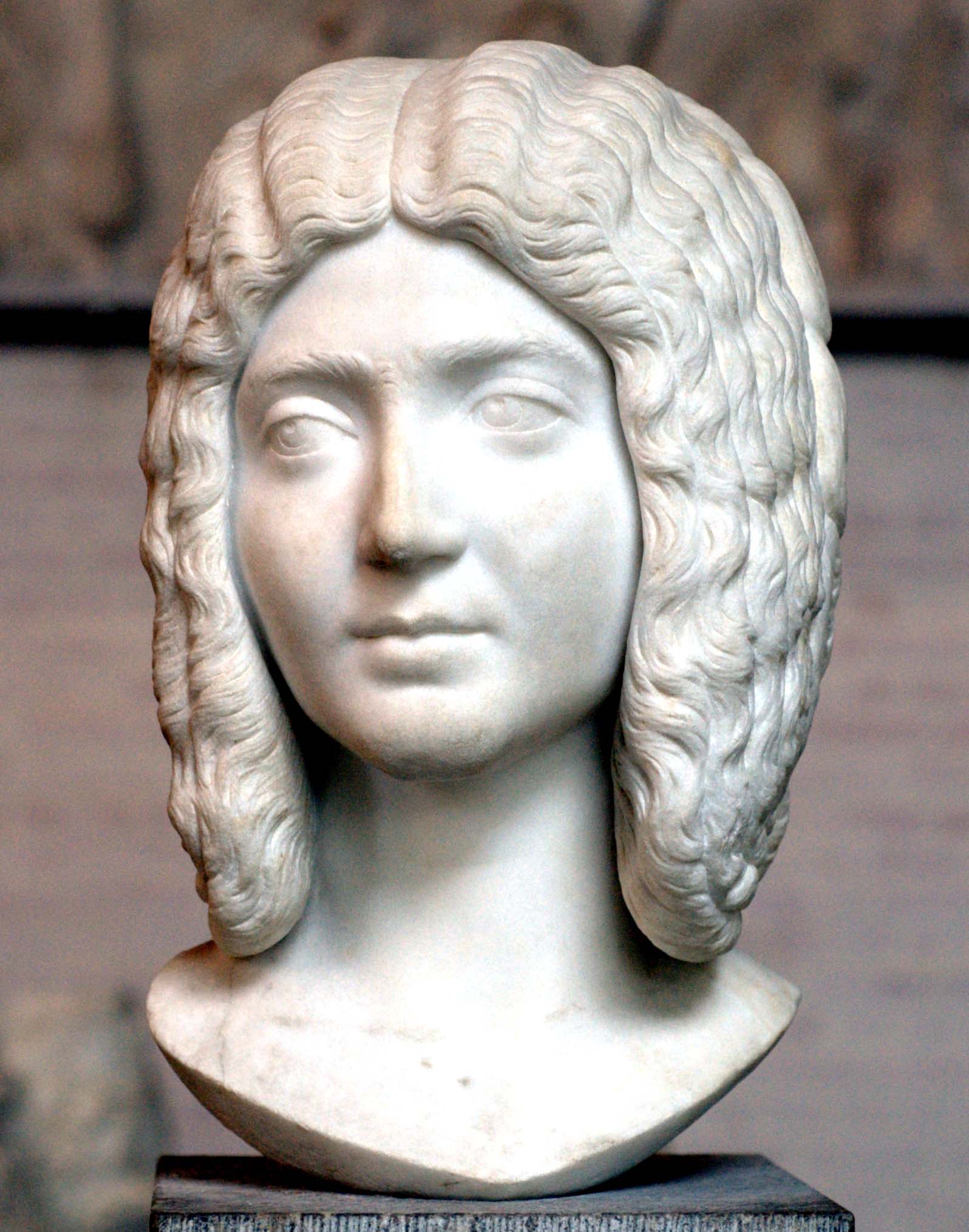
Giulia Domna, Glyptothek, Munich. Photo Wikimedia Commons

Giulia Domna, Glyptothek, Munich. Photo Wikimedia Commons

Giulia Domna (170-218 AD) the Syrian wife of Emperor Septimus Severus had a very distinctive hairstyle-and a nose similar to Lorenzo di Medici.  Great sculpted eyebrows too!  Her hair was twisted loosely in strands and draped around her face, then brought up the back of her head and sewn into a long, flat bun, which you can see in the side view.  I guess she didn’t have to move around much! juliadomna2

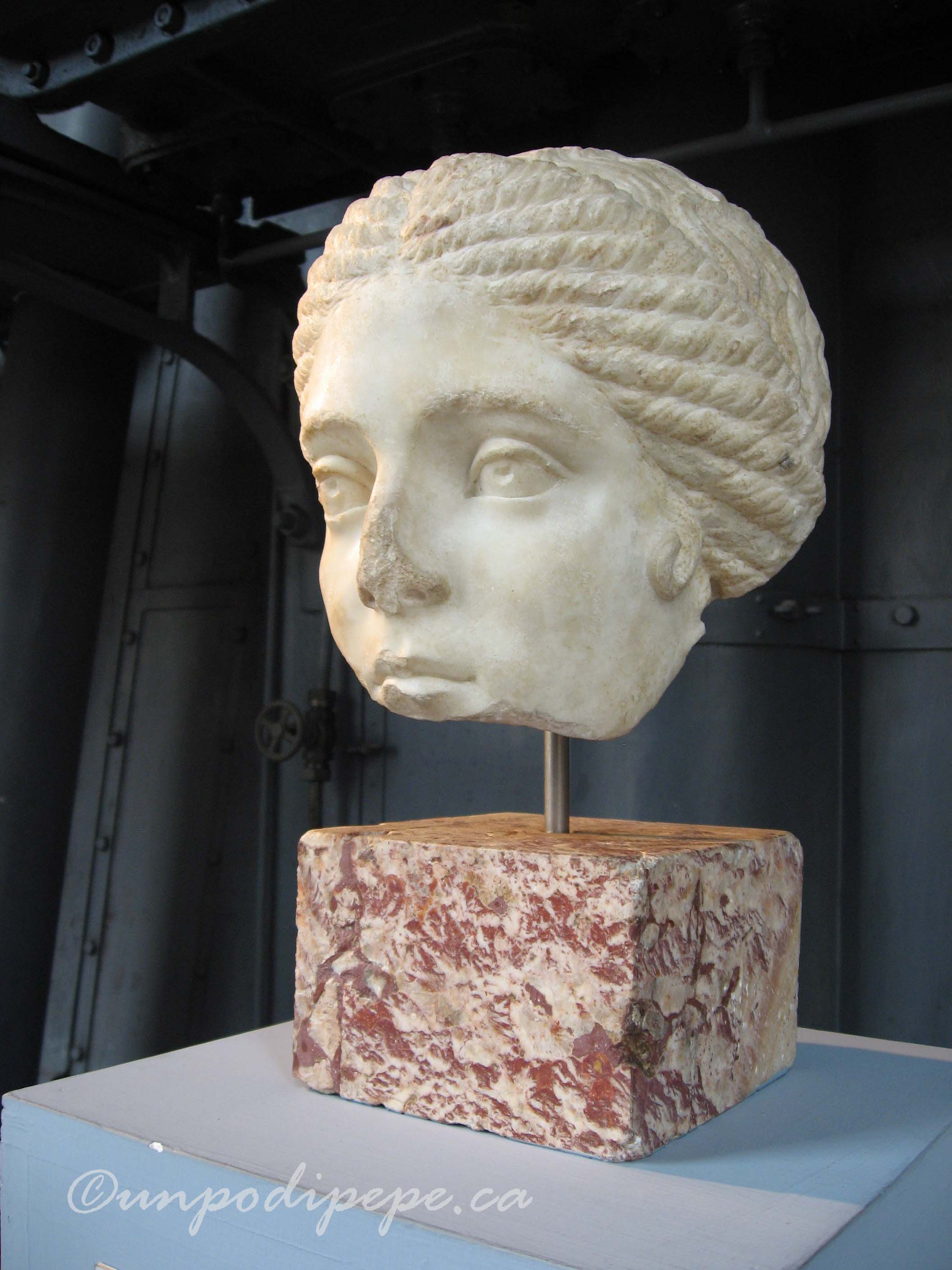
Female portrait, Centrale Montemartini

Female portrait, Centrale Montemartini

This lovely late 2nd C, early 3rd C AD partial Roman woman’s head was discovered in 1933, while Mussolini was constructing Via dei Fori Imperiali. Her front hair is twisted in small strands almost like Rastafarian corn rows to frame the face, and the back is twisted in a large, loose bun. She now sits in Centrale Montemartini in front of a caldaia -a giant boiler.

Exquisite mummy portrait in encaustic wax on wood panel, Hawara, Middle Egypt, 120 AD. Photo National Museum of Scotland

Exquisite mummy portrait in encaustic wax on wood panel, Hawara, Middle Egypt, 120 AD. Photo National Museum of Scotland

I hope you enjoyed this tour of Ancient Roman hair.  To see some of these styles recreated by a modern hairdresser, visit the youTube channel of Janet Stephens.  Ciao, Cristina

Share this:

  • Share on Facebook (Opens in new window) Facebook
  • Share on Pinterest (Opens in new window) Pinterest
  • Share on X (Opens in new window) X
  • Email a link to a friend (Opens in new window) Email
  • Share on WhatsApp (Opens in new window) WhatsApp
Like Loading...

Palazzo Massimo alle Terme, Roma

16 Monday Jan 2017

Posted by Un po' di pepe in Art, Culture, Italia, Roma, Travel

≈ 15 Comments

Tags

Augustan Villa of the Farnesina, Musei Nazionale Romano, Palazzo Massimo alle Terme, Roma, Villa Livia

giardinovillaliviaOne of the best museums in Roma is nascosto in piena vista. Hidden in plain sight near Stazione Termini, Palazzo Massimo alle Terme contains one of the most important collections of classical art.  It is right across the street from Stazione Termini, visible from the bus loop on the way to Piazza dei Cinquecento. The first time I visited Palazzo Massimo was in 2006 when my friend who lives in Roma recommended it. There were only about 10 other people in the building!palazzomassimo

When I was in Roma this summer, it was too hot to be out in the afternoon, so I decided to visit the museum. This turned out to be a great idea, since the top floor with the mosaics and detached frescos is downright cold!  Brrrr!  It was so refreshing! There were more than 10 people in the museum this time, but I still felt like I almost had the place to myself.

Built by Principe Massimiliano Massimo for the Jesuit Collegio Romano, the Palazzo became the first Liceo (high school) in Roma in 1871. Except for a brief period as a WWII military hospital,l the Liceo was open until 1960.  In the 1980’s, in a state of neglect, it was purchased for the Museo Nazionale Romano.  Renovations were completed in 1998.  Palazzo Massimo is now 4 stories of classical amazingness.  700 years (200 BC to 500 AD) of Ancient Roman history, myths, artistic culture and everyday life are on display in the form of sculpture, fresco, mosaic, jewellery and coins.

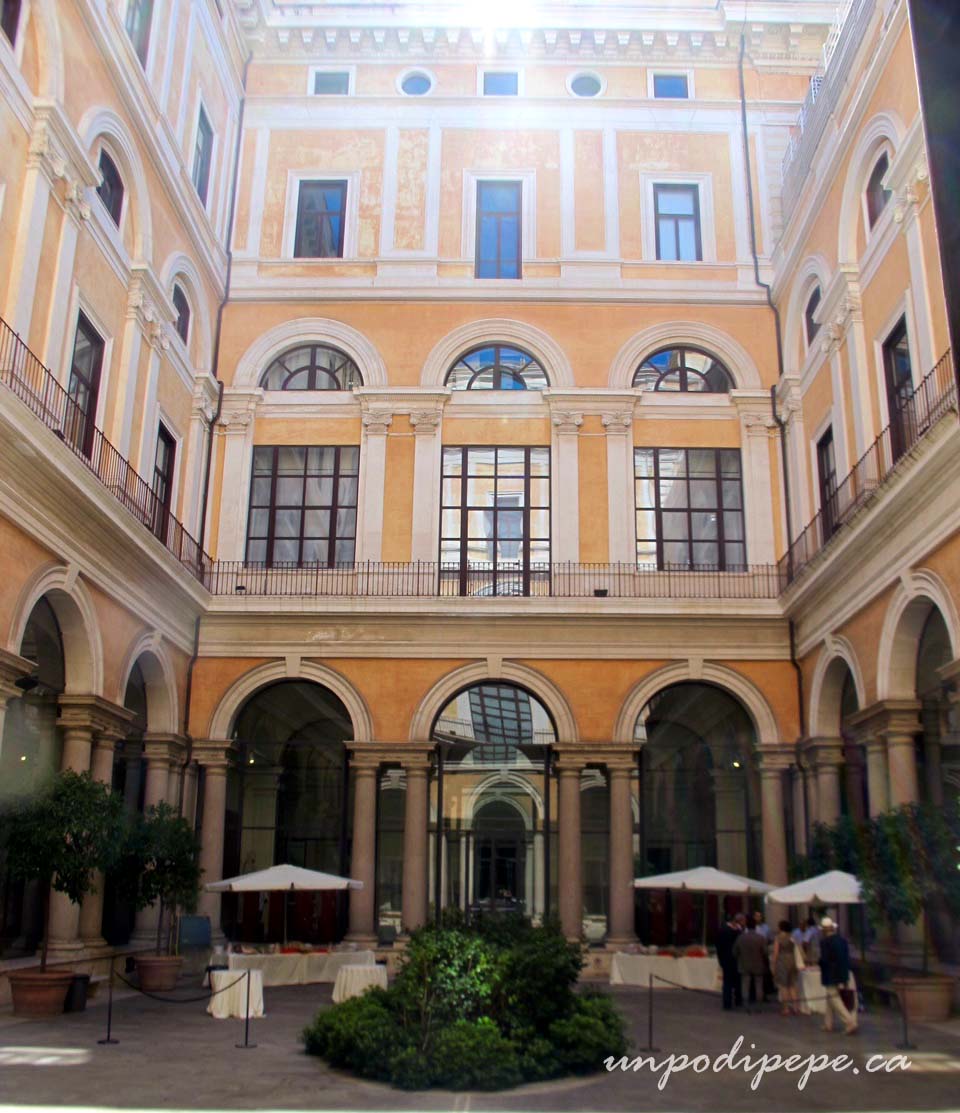
Central Courtyard, Palazzo Massimo

Central Courtyard, Palazzo Massimo

What is extra cool about the artifacts in Palazzo Massimo is how they got to be there. Previous to the museum opening, most of this priceless stuff was in storage in the Roma city works yard!  In a city as old as Roma, anywhere you break dirt, something will be found.  During construction of the Metro, new roads, or any municipal work involving digging, artifacts were found, tagged and stored. Every piece in the museum has a sign with a written description in Italian and English.  In between the two is stated (in Italiano only) precisely where and when it was found, and in some cases by whom.  For example ‘Roma, Piazza Venezia, Construction of National Monument to Vittorio Emanuele II’, or ‘Subiaco, recovered by the Guardia di Finanza (revenue or tax police, involved in recovery of stolen artifacts)’.  Reading these signs is exciting because you may have walked over that very spot the day before!  Ok, maybe you won’t be as excited as me, but I am a total archeology geek so I find this fascinating!

The ground floor of Palazzo Massimo displays Greek originals discovered in Roma, such as The Dying Niobid, and the magnificent Pugile in riposo, the 2nd Century BC bronze Boxer at Rest, wearing leather hand wraps.  He is so realistic with his broken nose, cuts and deformed ears, you can feel the emotion in his face.

'Pugile a Riposo' Found in 1885 on the Quirinale Hill, where the Baths of Constantine once were.

‘Pugile a Riposo’ Found in 1885 on the Quirinale Hill, where the Baths of Constantine once were.

This floor also has a Roman calendar, portraiture from the Republican and Imperial ages, and sarcophagi, such as the sarcophagus of Portonacci with battle scenes carved in relief.statuarypalazzomassimo

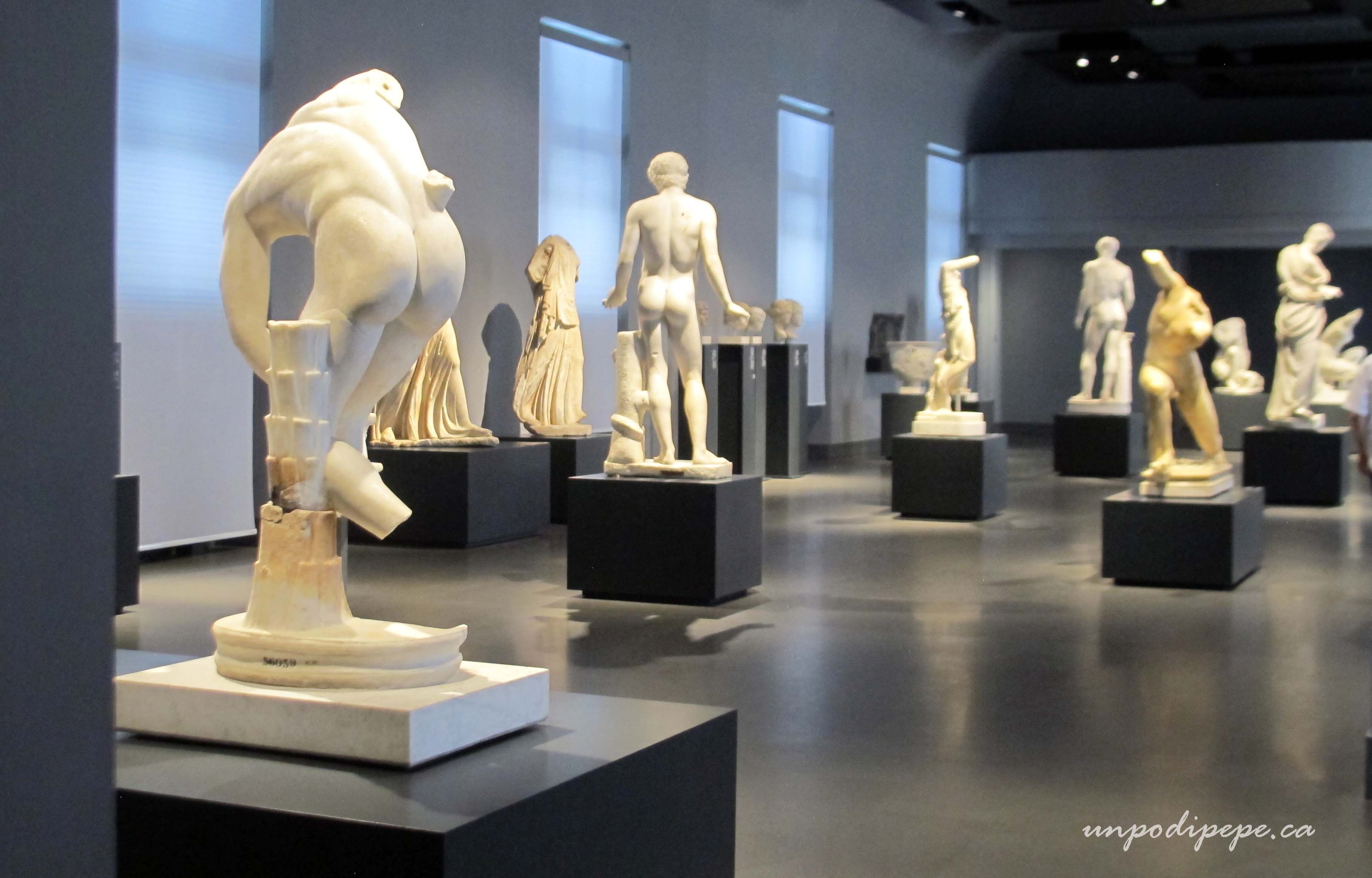
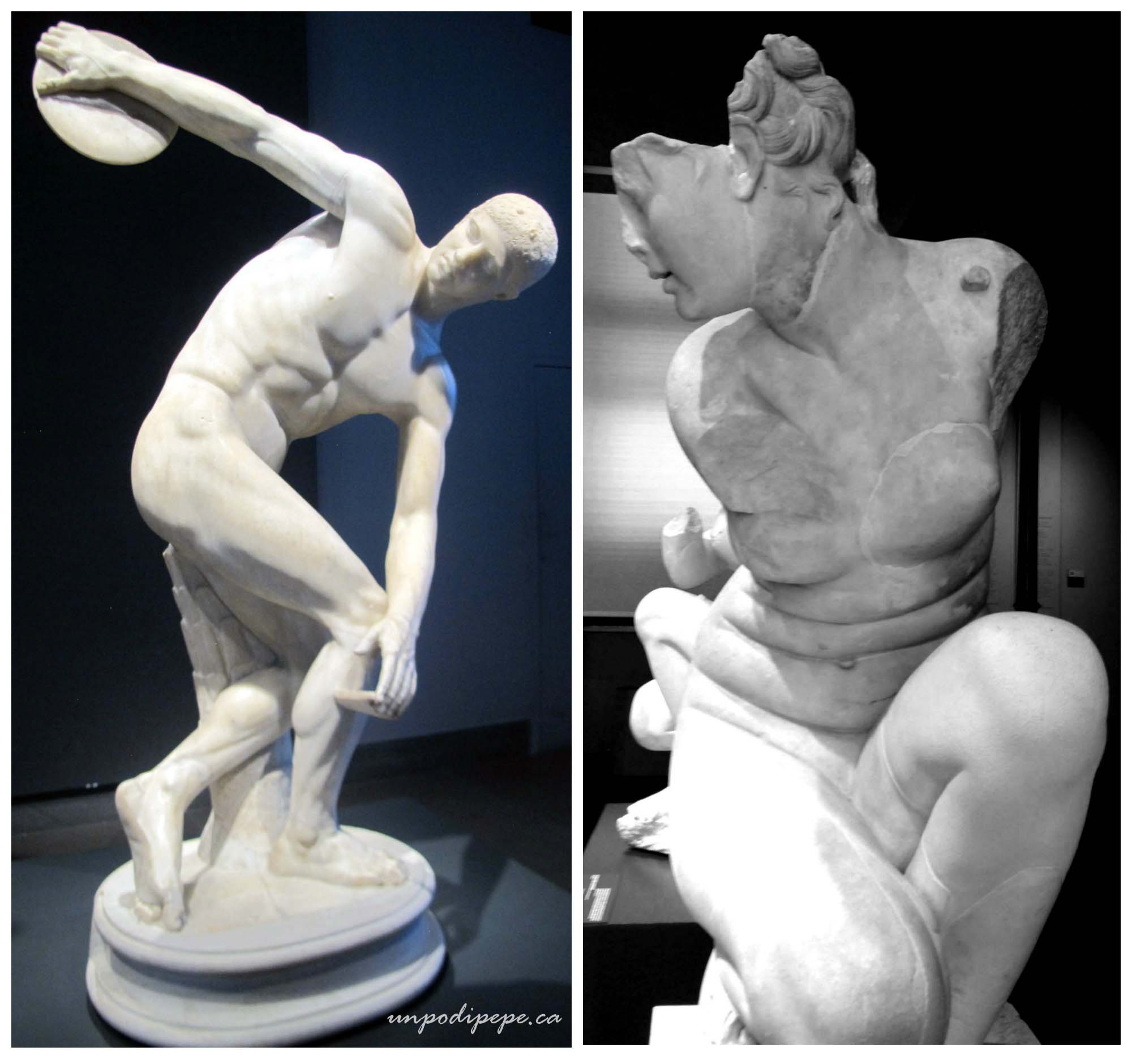
The first floor (2nd floor to North Americans) has masterpieces of statuary, including the Maiden of Antium, Il Discobolo, a Crouching Aphrodite after Diodalses found at Villa Adriana in Tivoli in 1920, and the Sleeping Hermaphrodite.  There are also all the surviving bronze sculptures, fittings and a head of Medusa that decorated Caligula’s floating palaces, the Nemi ships.  These vessels were recovered in the 1920’s by draining Lago di Nemi, only to be destroyed by enemy fire in 1944.

Il Discobolo and a Crouching Aphrodite from Villa Adriana in Tivoli. Both are Roman reproductions of Greek originals

Il Discobolo and a Crouching Aphrodite from Villa Adriana in Tivoli. Both are Roman reproductions of Greek originals

The top floor takes us on an intimate tour of the domestic decor inside Roman homes. An amazing discovery was made right across the street in 1947, during the renovations to Termini and construction of Metro line B. It was a complex from 130-140 AD built in a grid system of private homes, public baths, warehouses, and apartments with shops at street level.  There was pavement and a functioning drainage system. It was all destroyed to make way for quick construction of the new buildings! Aaaahhh!  Luckily the site was well-documented so that the 270 m² of wall frescos and pavement mosaics that were preserved could be reassembled. Part of it is displayed here where 3 rooms of a Domus (Roman house) have been reconstructed to their original size.  Ironically, these rooms face a window looking out at where they used to be.

The 1948 photo from Palazzo Massimo of the site across the street. You can see that the mosaic is the same one that is now in the museum

The 1948 photo from Palazzo Massimo of the site across the street. You can see that the mosaic is the same one that is now in the museum

The Augustan Villa of the Farnesina was discovered in Trastevere in 1879 during work along the river.  The site has since been destroyed, but the vibrantly coloured frescoes were detached and stored for 120 years before being installed in Palazzo Massimo, in accurately reconstructed rooms of their original dimensions.  There is a portico, dining room and 2 Vermillion coloured cubicola (bedrooms) with mythological and erotic paintings, and several hallways.  The rooms are reassembled how they were, so it is like walking through a Roman villa.  Decorating the walls of upper class houses with paintings of mythological or literary subjects was supposed to stimulate cultured conversation. In this villa, there are many references to the Egyptian world in the decorations, celebrating the conquest of Egypt. The owner is thought to have been General Marcus Vipsanius Agrippa, son-in-law of Augustus, who defeated Marc Anthony and Cleopatra at the Battle of Actium in 31 BC.villafarnesinacollage

The final treasure is the 1st Century BC frescoes from Villa Livia, discovered on Via Flaminia in 1863.  The villa belonged to Livia Drusilla, wife of Emperor Augustus.  The paintings of a lush green garden with birds, pomegranate and lemon trees, roses, irises and other plants decorated a vaulted room that was half underground. The large room is recreated here.  It was probably a cool triclinium, a living and dining room for  the summer. villaliviaThe basement has the history of the Roman Empire in coins. It has been converted into a vault for the Medagliere, the coin cabinet and jewellery.

Palazzo Massimo is one of 4 musei that make up the Museo Nazionale Romano. Tickets are €7 for adults, valid for 3 days for all 4 sites.  The other sites are:  Terme di Diocleziano, Palazzo Altemps and Crypta Balbi. Open Tues to Sunday 0900-1945. If you love antiquities, don’t miss it! Ciao, Cristina

Share this:

  • Share on Facebook (Opens in new window) Facebook
  • Share on Pinterest (Opens in new window) Pinterest
  • Share on X (Opens in new window) X
  • Email a link to a friend (Opens in new window) Email
  • Share on WhatsApp (Opens in new window) WhatsApp
Like Loading...

La Certosa di Padula

27 Sunday Nov 2016

Posted by Un po' di pepe in Architecture, Italia, Travel

≈ 14 Comments

Tags

AICW, Association of Italian Canadian Writers, Campania, La Certosa di Padula, Parco Nazionale del Cilento e Vallo di Diano, Scagliola, Southern Italy, UNESCO World Heritage Sites

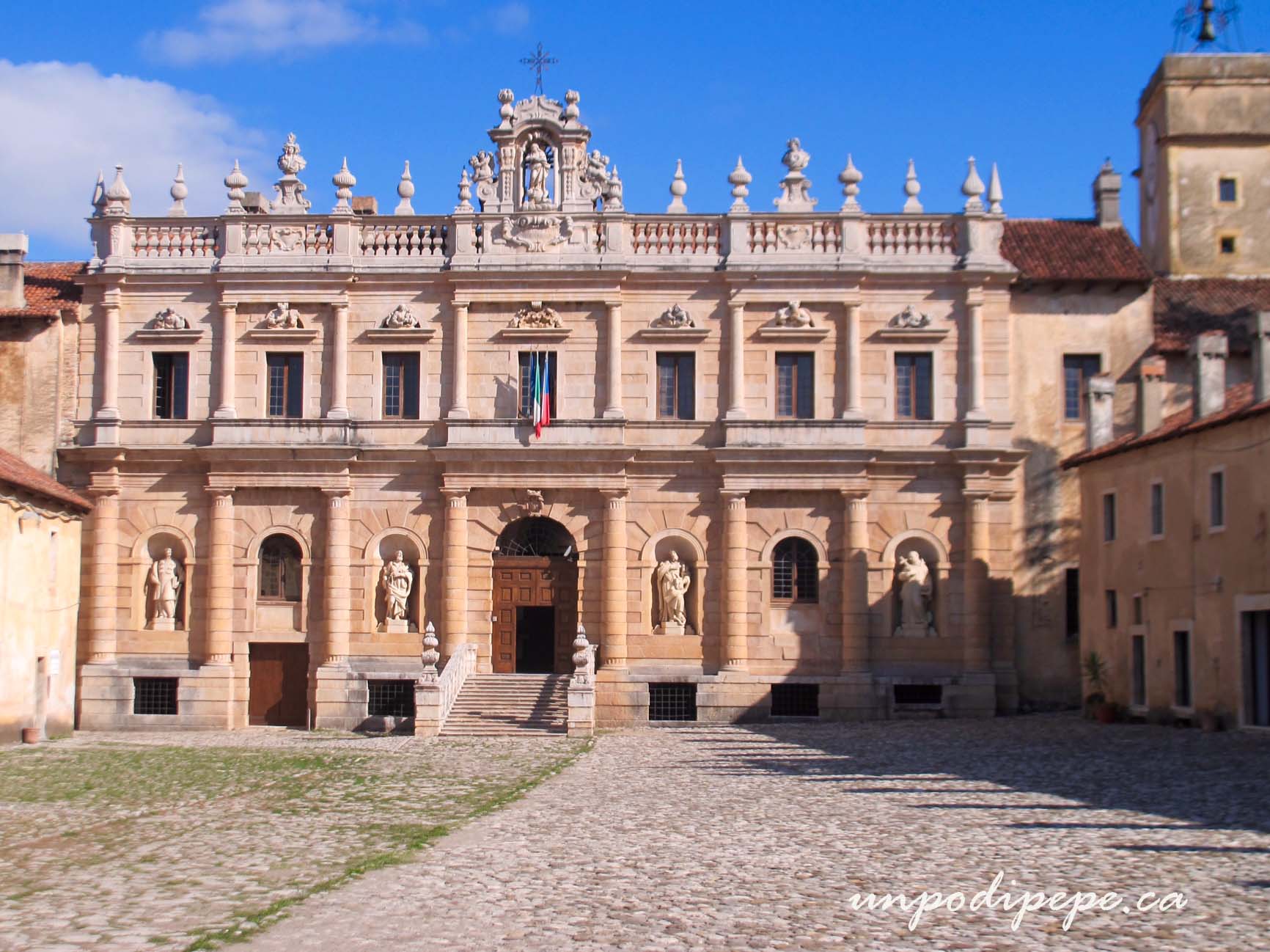
la-certosa-di-padula-facciataIn August, I attended the Association of Italian Canadian Writers (AICW) 16th biennial conference ‘Italian Canadian Literature: Departures, Journeys, Destinations’ where I read my first short story in public.  38 speakers, AICW members and friends came from across Canada, Italy, Germany, Spain, the United States and the United Kingdom.  The conference presentations were amazing and an anthology will be published next year.

View from Conference Room

View from Conference Room

The conference was held in Padula (Salerno, Campania) at La Certosa di Padula, a Carthusian Monastery built in 1306 and added onto over the next 450 years. Dedicated to San Lorenzo, the style is mostly Baroque and it is the largest monastery in Italia. Chiostro Grande is the largest cloister in the world, surrounded by 84 columns.  The place is huge with a total of 320 rooms! In 1998, it became a UNESCO World Heritage Site along with the Parco Nazionale del Cilento e Vallo di Diano and the archeological sites of Paestum and Velia.  I have now been to all of them except Velia.padulachiostro

The Certosa site is made up of spaces for contemplation -the cloisters, library and chapels, and spaces for work -the kitchen, cantina, laundry, stables and gardens.padulafrescocloister

While I was there, due to restoration work the upper floor was not accessible. This meant I was not able to see the monks’ cells or take the white marble scala elittico to the large biblioteca (library) which has a Maiolica tile floor from Vietri sul Mare and 2000 remaining manuscripts. I was also not able to see the last construction added to the site in 1799, the famous Scalone Elicoidale –an ornate double ramped, double helix shaped staircase in an octagonal tower with 8 large open windows overlooking a garden.  The Scalone spirals incorporating the Fibonacci sequence and the Golden Section, which I find fascinating.  It connects the upper floor to the Chiostro Grande and was used by the cloistered monaci for their passeggiata settimanale –weekly walk. Being a lover of staircases, books and libraries, the closure was disappointing, but luckily there was still a lot left to see. padulasanlorenzoMost of the chapels are Baroque and very ornate, with the largest collection of Scagliola work found anywhere. Scagliola (sca·LYOH·lah) is a technique for painting stucco columns, sculptures, and other architectural features to look like inlays in marble and semi-precious stones, such as madre di perla. Those monaci were frugal and talented!  Now I know what to call the areas of my house that I have painted to look like Carrara marble!padulacucina2

The Monastery kitchen, renovated in 1742, could have been the perfect setting for ‘Masterchef: Medieval edition’. It is brightened by yellow and green Maiolica tiles which look completely out of place.  The colours were chosen to keep the flies away- at least that is what the guard told me!  padulacucinaThe most striking feature in the cucina is an enormous cappa or hood, on a furnace with an antique boiler and a base covered in maiolica tiles.  The inside of the cappa is blackened from hundreds of years of use.  Stone work tables are in place and on the back wall is a large fresco, painted in 1650, obscured by time and smoke.  This part of the cucina with its barrel vaulted ceiling used to be a rectory before the 1742 reno. The cucina has its own cloister and small garden, with the cantina and laundries next to it.

Chi lava i piatti?

Chi lava i piatti?

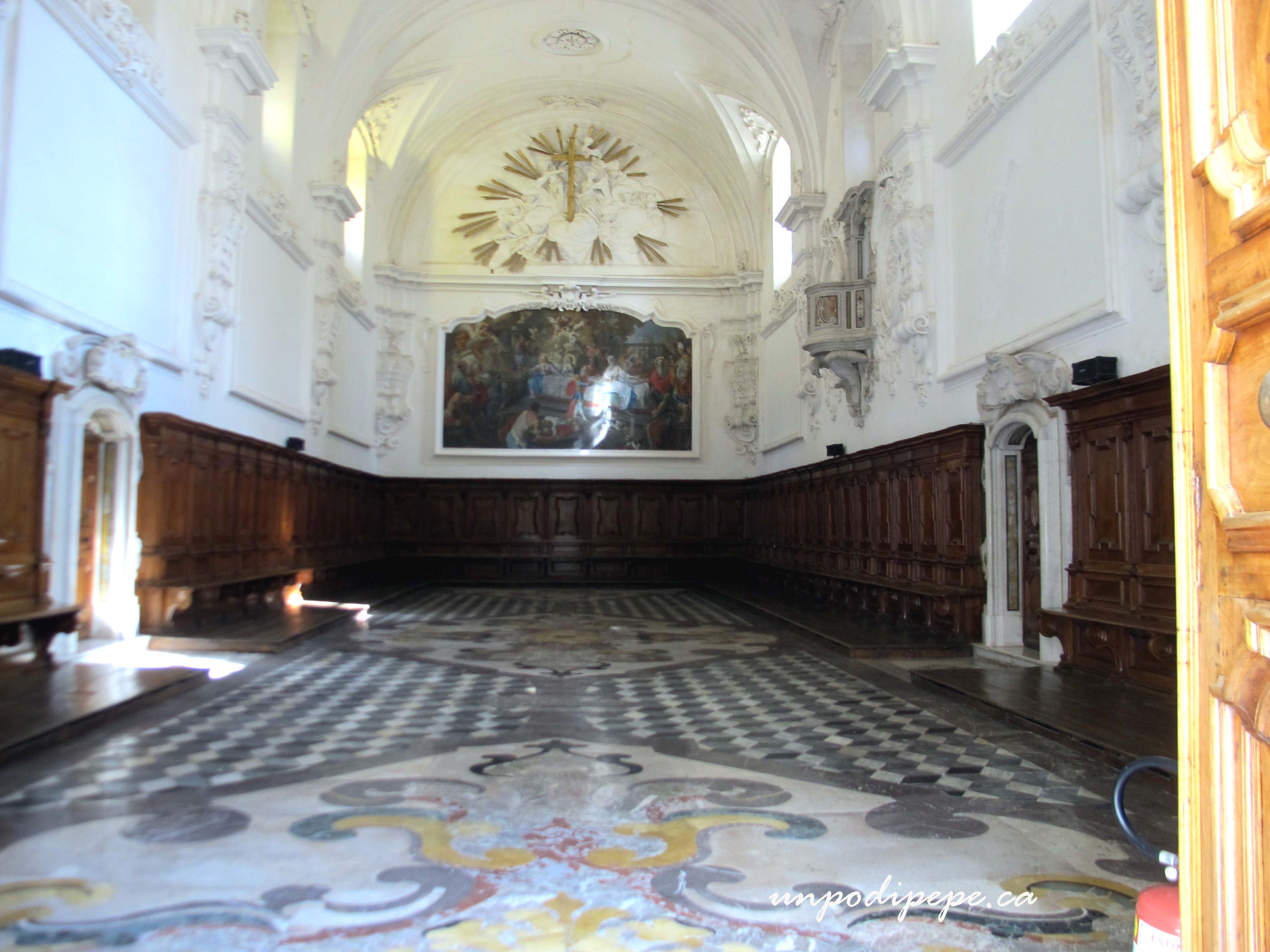
The monaci ate frugal, meatless meals in solitude in their cells, except during special occasions. The refettorio (rectory) hall with 61 stalls carved of walnut wood is where they sat at meal times on feast days and during Lent.  The 1749 fresco is of Le Nozze di Cana.  refettorioOccasionally the cucina was used to prepare rich meals for visits by important guests, most famously the one organized for Emperor Carlo V on his return from Tunisia in 1535.  The monaci prepared him a frittata with 1,000 eggs.  My first night in Padula, August 10th, was the annual Festa della Frittata di Mille Uova, recreating this event. The modern contraption used to make the frittata was made in 1996 and looks like a colossal pizzelle iron that flips over and rolls across a massive fire pit!  Unfortunately we don’t know what the monaci used to make their frittata.

Frittatta di mille uova making contraption!

Frittatta di mille uova making contraption!

In 1802, the monaci had to abandon La Certosa, and Napoleonic troops took away any treasures that were cartable. They returned a few years later, but abandoned La Certosa for the last time in 1866.  20 years later, it was declared a national monument. During the 2 World Wars the complex was mostly abandoned, being used briefly as a prison camp, and as a children’s holiday camp.  Padula received funds for restoration in 1982.view-from-hotel-certosa

Padula is a very nice town of 5,000. Getting there without your own car is extremely difficult.  Padula is on the A3 Salerno-Reggio Calabria road, exit Buonabitacolo.  The closest train station is Sapri on the Cilento coast. There are a couple of buses a day from Napoli, which make stops in every town along the way. Although very out of the way, Padula is worth the detour!  The drive there from Paestum was stunning.  Admission to La Certosa di Padula is €4 for adults. Make sure you have at least 4 hours to visit. There are 2 very nice, affordable hotels in Padula, Grand Hotel Certosa and Villa Cosilinum. padula

Buon Viaggio!

Share this:

  • Share on Facebook (Opens in new window) Facebook
  • Share on Pinterest (Opens in new window) Pinterest
  • Share on X (Opens in new window) X
  • Email a link to a friend (Opens in new window) Email
  • Share on WhatsApp (Opens in new window) WhatsApp
Like Loading...

L’Elefantino di Bernini

20 Sunday Nov 2016

Posted by Un po' di pepe in Art history, Italia, Roma

≈ 10 Comments

Tags

Bernini, L'Elefantino di Bernini, Piazza della Minerva, Pulcino della Minerva, Roma, Roma photography

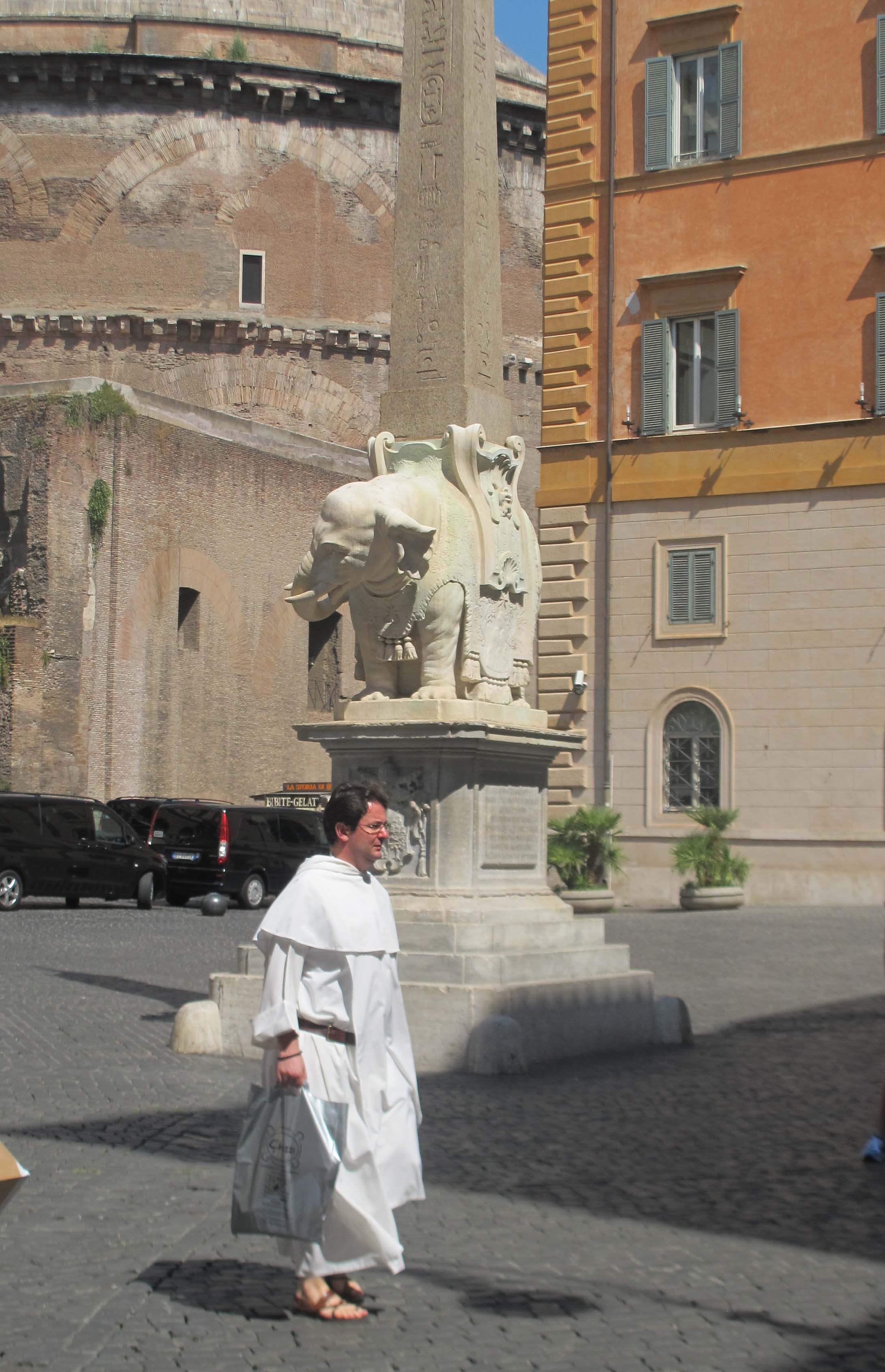
berninielefantinoLast week, one of my favourite monuments in Roma was vandalized.  Gianlorenzo Bernini’s Elefantino had one of his zanne (tusks) broken off by unidentified vandals.  I think I called them ‘stronzi maleducati’ in my instagram post.  I was being polite.  A Spanish couple found the broken piece and reported it to the authorities.  The ‘stone surgeons’ have reattached the zanna (ZAHN·nah) and reinforced it with wooden splints.  A nice €2000 bit of plastic surgery. The process is shown in this video.  Along with everyone in Roma, I’m so glad my favourite little pachyderm is on the mend that I had to write a post about him.Elefantino
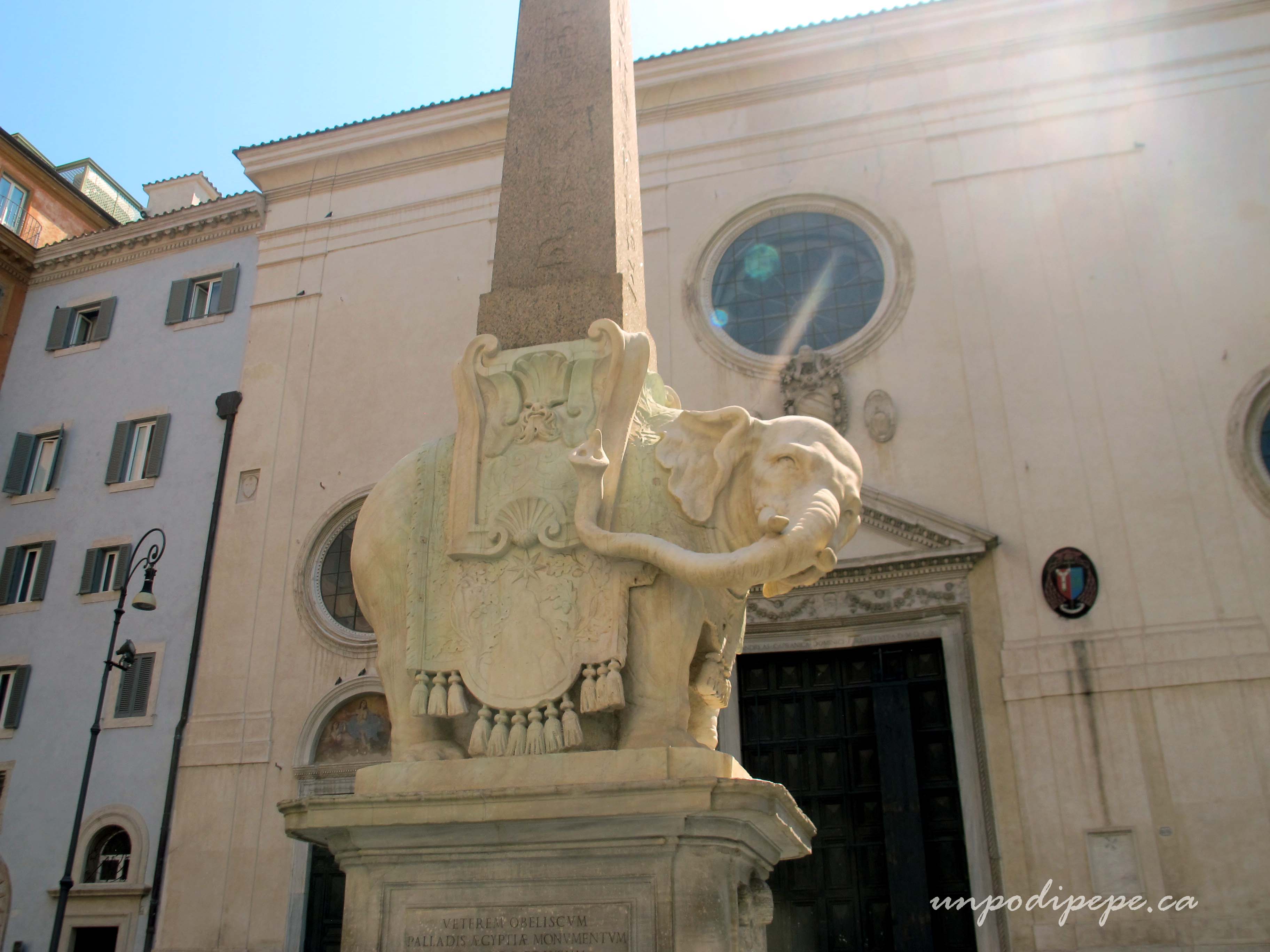
In 1665, the Dominican friars of Santa Maria Sopra Minerva found a 5.5 m Egyptian Obelisk while working in their garden.  It is one of 13 in Roma.  For some reason, Pope Alexander VII decided to install it in the Piazza outside the church, Piazza della Minerva. To design a base to support the obelisk, he had architects put in their proposals for the commission.  One of the Dominican friars, Domenico Paglia put in a horrendous proposal which involved mounting the obelisk on 6 small hills, with a dog at each corner.  The 6 hills are part of the Pope’s family coat of arms, and dogs the symbol of the Dominicans, referring to their fidelity.  The word Dominican comes from ‘Dominis canis’ meaning dogs of the Lord.piazzadellaminerva

Luckily, the Pope chose Bernini’s proposal to mount the obelisk on the back of an elephant, a symbol of strength.  Bernini was inspired by a woodcut in a 1499 book by Francesco Colonna.  Padre Paglia was very unhappy that his design was not chosen.  He convinced the Pope that Bernini’s design was flawed and would not be supportive unless a cube was sculpted under the elephant’s belly to support the obelisk.elefantino2

Bernini did not like this suggestion.  He wanted his elephant to stand on its four legs, but he had no choice in the matter.  He tried to hide the extra marble by adding an ornate, floor length gualdrappa or saddle blanket on the elephant’s back.  This had the effect of making him look pudgy and stout like a baby elephant rather than strong and fierce.  When the statue was installed in 1667, Romans referred to it as ‘Il Porcino della Minerva’ or ‘Minerva’s piglet’ because it had the dimensions of a maialetto more than an elephant.  This eventually morphed into ‘Pulcino’ or ‘Purcino’ which means chick in italiano and in dialetto Romano. Most monuments in Roma have a nickname.

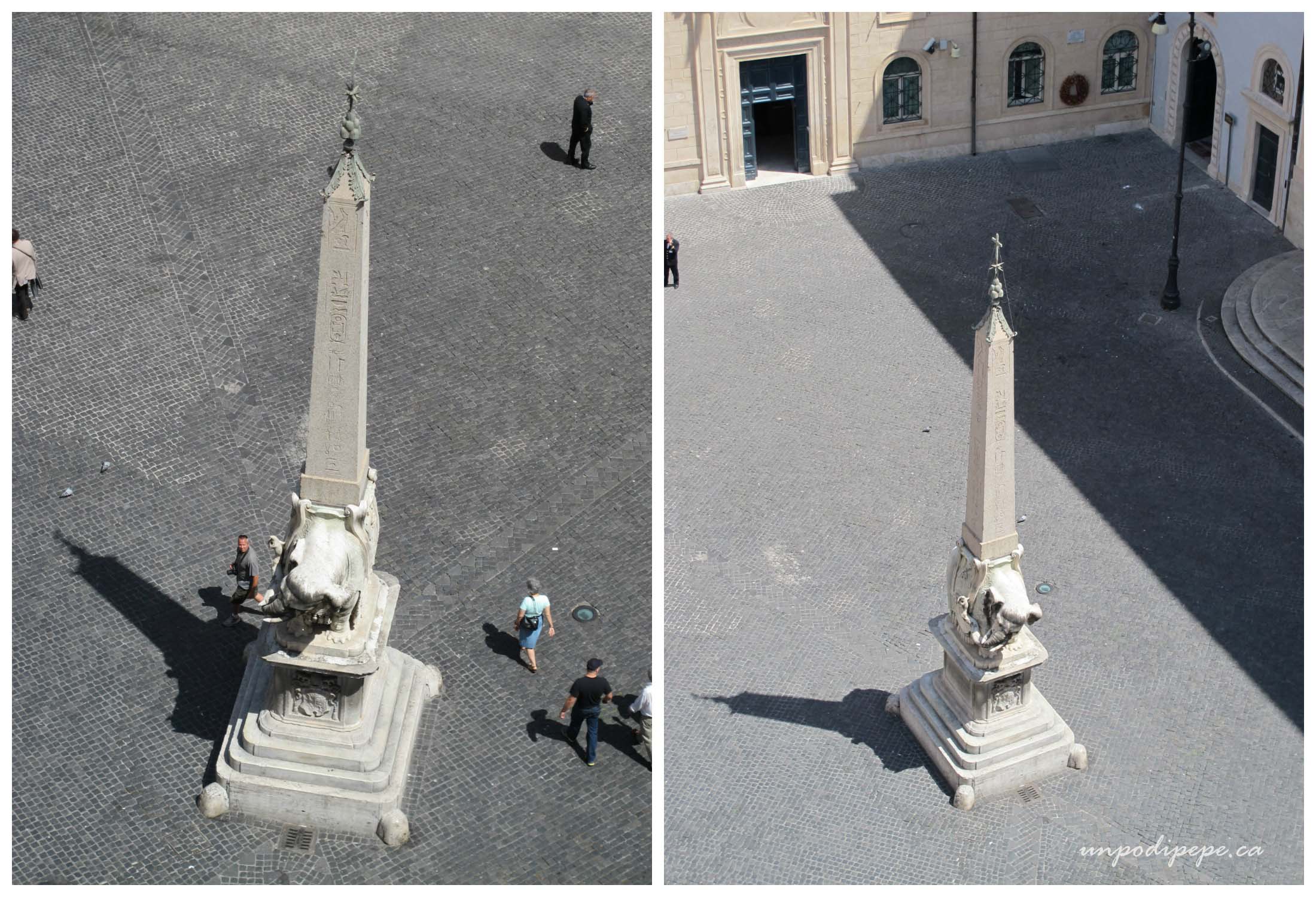
Bernini did get revenge on Padre Paglia.  There is a reason Elefantino’s head is turned away from the church with a cute mischievous grin.  Bernini had the statue placed with its rear facing the Dominican monastery.  His muscles seem tensed and his tail is shifted to the left, exposing his bum as if he is about to drop a load!  Bernini was also protesting the way Galileo was treated here, where he was interrogated by the Inquisition in 1633. I don’t know if the second point is true or just Leggenda Metropolitana dell’ 700 – 17th Century urban legend!

View from the roof of Grande Hotel de la Minerve across the street. The black open door is the Dominican Headquarters.

View from the roof of Grande Hotel de la Minerve across the street. The black open door is the Dominican Headquarters.

elefantino3Piazza della Minerva is right behind the Pantheon.  L’Elefantino was also included in my post ‘Un giorno a Roma’. Ciao, Cristina

Share this:

  • Share on Facebook (Opens in new window) Facebook
  • Share on Pinterest (Opens in new window) Pinterest
  • Share on X (Opens in new window) X
  • Email a link to a friend (Opens in new window) Email
  • Share on WhatsApp (Opens in new window) WhatsApp
Like Loading...

Polignano a Mare

27 Thursday Oct 2016

Posted by Un po' di pepe in Italia, Photography, Puglia

≈ 38 Comments

Tags

Domenico Modugno, Guido il Flâneur, Nel blu dipinto di blu, photography, Polignano a Mare, Ponte Lama Monachile, Southern Italy, Spiaggia Lama Monachile, Vicolo della Poesia

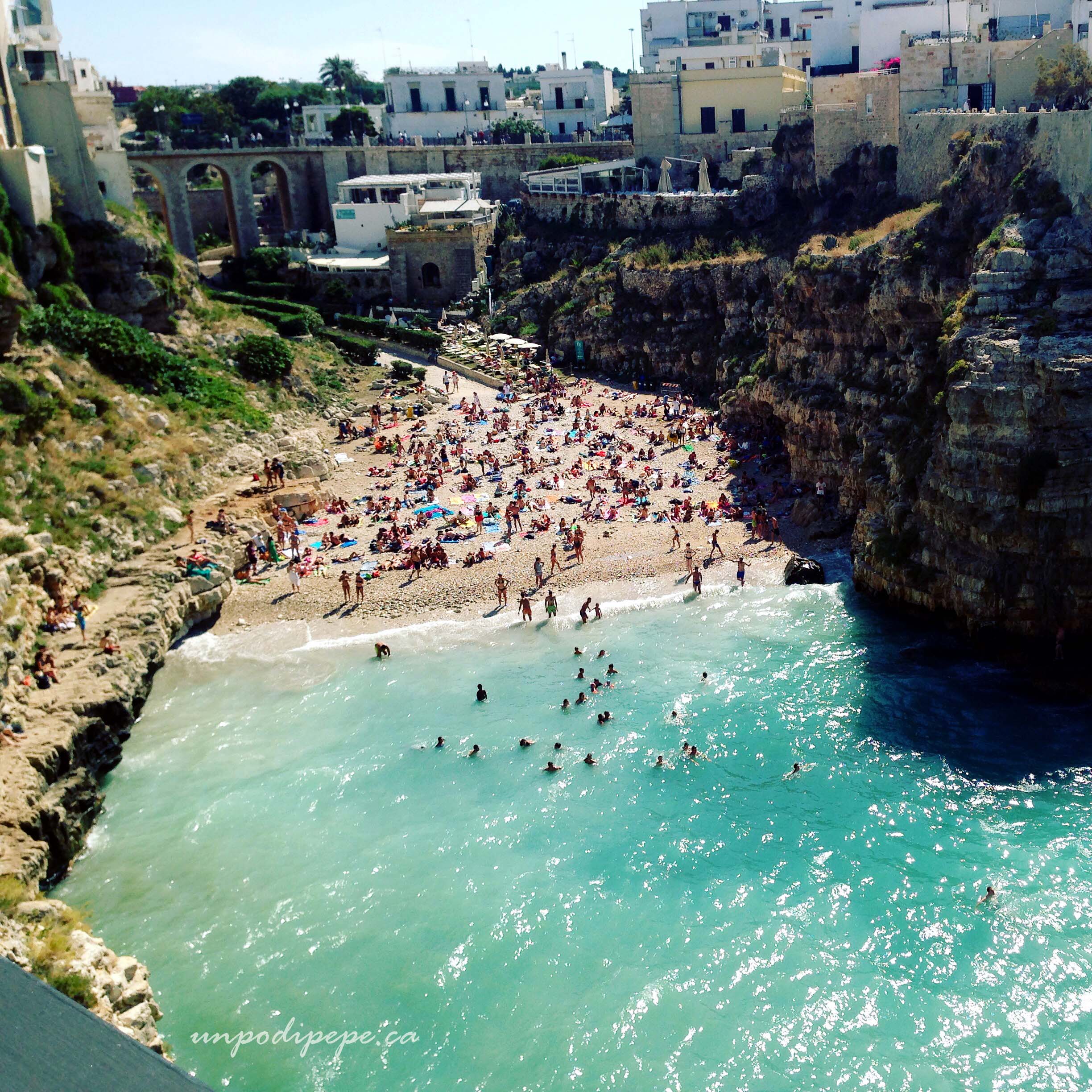
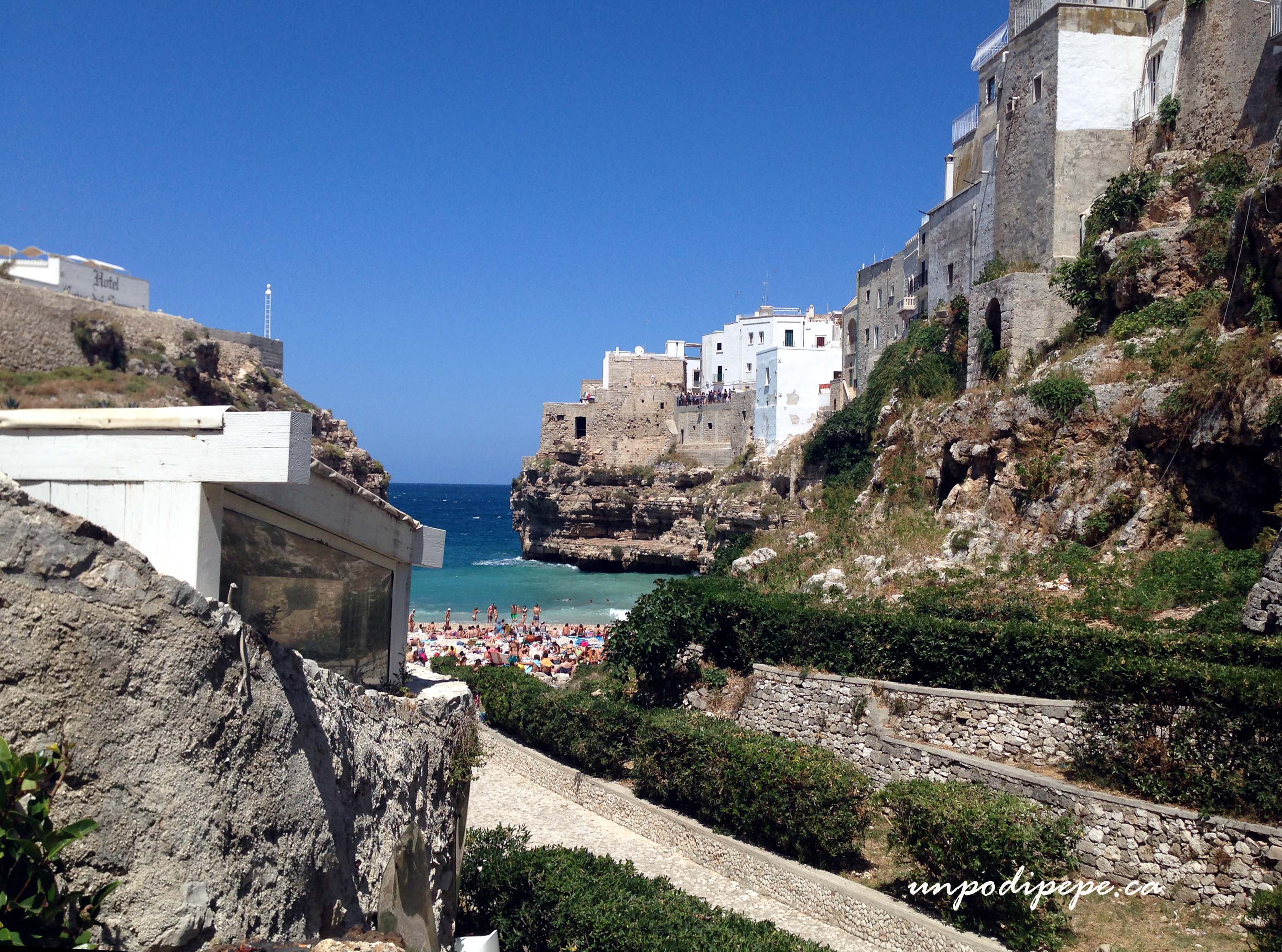
spiaggia-lama-monachile-polignanoPolignano a Mare sits atop limestone cliffs on the Adriatic coast just south of Bari.  From the white-washed Centro Storico with narrow, winding cobblestone streets, the crystal clear water, and 3 terrazze with views of the sea, everywhere you look, there are panorami mozzafiato (pah·noh·RAH·mee moz∙zah∙FYAH∙toh)-breathtaking views.  There is even a restaurant in a grotta, one of the caves overlooking the sea, the Grotta Palazzese.  Polignano was the ancient Greek city of Neapolis, founded in the 4th Century BC.  It was prosperous under the Romans too, because Ponte Lama Monachile, the Roman bridge, is right on the ancient Via Traiana.  This was an extension of Via Appia, going from Beneventum (Benevento) to Brundisium (Brindisi) by a shorter route. There was a monastery nearby and the name of the bridge literally means ‘monastic monk’.  Sounds a bit redundant, although better than the other possibility ‘monastic blade’.polignano-a-mare-ponte

polignano-a-mare-spiaggia2Beneath the bridge is Spiaggia Lama Monachile, a small ‘spiaggia libera’ or public beach, with blue-green crystalline water and small white pebbles called ciottoli (cheeot·TOH· lee). I climbed up on some rocks and could have just sat there all day feeling the wind in my hair and sun on my face. Near the water, I noticed a constant movement of people coming and going from a cave.  I was curious and walked over to try and see what was there.  It just looked dark.  A very nice older local gentleman saw me trying to peer in.  He came over and offered me his arm and said he would accompany me.  It was a ‘cave tunnel’ that had about 1 foot of water.  The other end was very windy and opened to the next cove.  We could see cliffs and the surf crashing onto the rocks, sending water over us.  It was incredibly beautiful, but of course I did not have my camera.  My escort told me that he lives in Polignano and comes to the spiaggia every day of the year!

The man in the white hat with his arm outstretched is the 'gentiluomo'.

The man in the white hat with his arm outstretched is the ‘gentiluomo’.

polignano-spiaggia-3When I took a dip  in the water, the waves were so big I was thrown into a seated position and lost one of my flip flops, known in Italia as infraditi (in·fra·DEE·tee). The spiaggia is too rocky to walk barefoot.  I retrieved my infradito and was immediately felled by another powerful wave, taking the other infradito off my foot.  This went on for a few more waves, and eventually my infradito was too far out.  Luckily a nice ragazzo retrieved it for me.  I returned to my heavenly place on the rocks, to find that my cugina had taken my camera and photographed of every stage of my ordeal with the infraditi!  Grazie Maria!polignano-a-mare-spiaggia

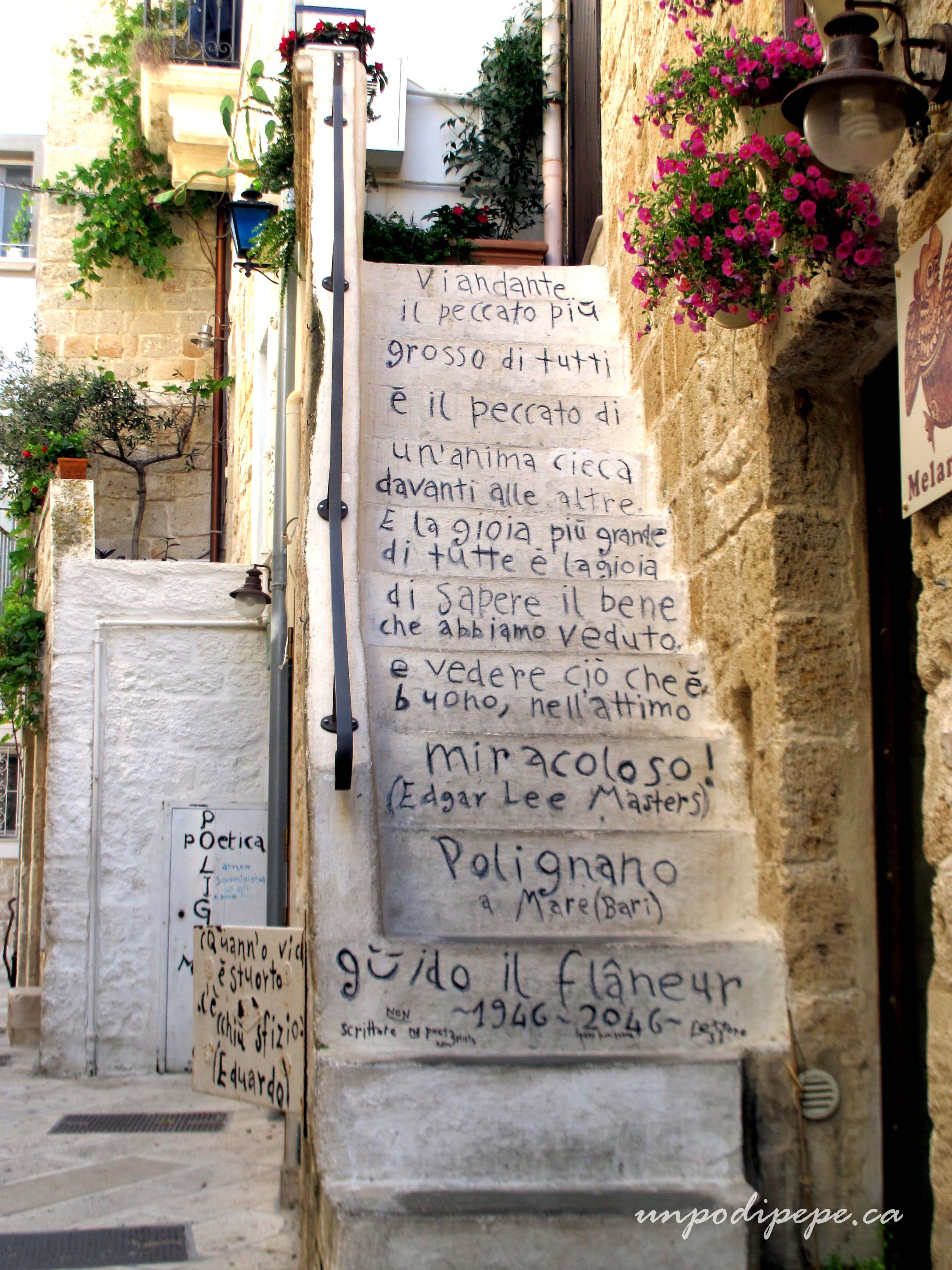
The town is a steep walk up the stairs beside Ponte Lama Monachile. The Centro Storico is entered via l’ Arco Marchesale, an old Roman gate. There is an interesting area called Vicolo della Poesia, with poetry written on staircases, walls and doorways. vicolo-della-poesia This ‘graffiti’ is signed ‘Guido Il Flâneur’. Guido is a poet, although the ‘graffiti’ is not his own poetry.  He left his job in Bari and moved to Polignano to pursue a writing career 32 years ago.  ‘Flâneur’ is an 18th Century term for french gentlemen who strolled the streets sharing their passion for literature. Apparently Guido goes for a swim every day, year round!  Hmmm, this sounds familiar.  I found a poor-quality foto of Guido online, and I think he may be the gentiluomo who escorted me through the cave tunnel!vicolo-della-poesia2

Polignano a Mare’s most famous citizen is Domenico Modugno, who shot to fame in 1958 when his song ‘Nel blu dipinto di blu’ (you probably know it as Volare) won the Festival di San Remo, then represented Italia in the Eurovision song contest.  In a piazza on the other side of the bridge is a statue of Modugno, with his arms stretched out like he is ready to take flight over Polignano. Our parking ran out before we could walk to the other side, so I’ll have to go back to visit Domenico.
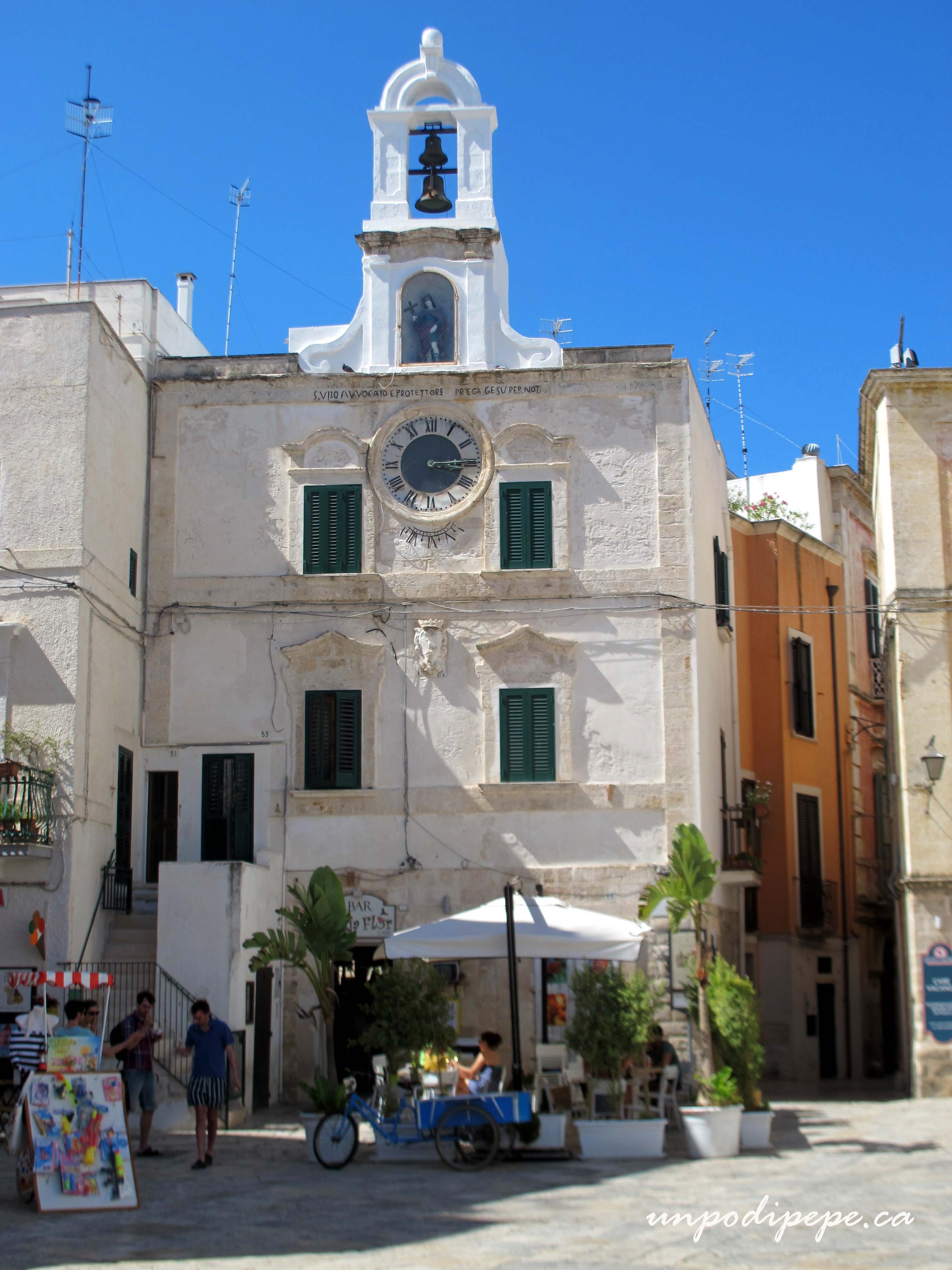
An interesting building-it looks like it was once a church, but now there is a bar on the ground level!

An interesting building-it looks like it was once a church, but now there is a bar on the ground level!

In the right third of the photois Grotta Palazzese, where you can see 3 white posts of the railing.

In the right third of the photois Grotta Palazzese, where you can see 3 white posts of the railing.

I really enjoyed the day in Polignano a Mare, and so did my camera! It was not as crowded as I expected on a weekday in early August and the spiaggia was just perfect. The only thing I found kind of annoying was the amount of English signage in the Centro Storico, which is not typical for a town in Puglia.polignano-a-mare-loggiapolignanomuro

Polignano a Mare is easy to get to, as it is on Strada Statale 16 (SS 16) the main coastal road. It is also very easy to get to without a car, since it is on the Adriatic train route from Bari to Lecce.  From Bari, Polignano is a 20 min train ride and from the train station the Centro Storico is a 10 min walk.ponte-lama-monachile

Buon Viaggio, Cristina

Share this:

  • Share on Facebook (Opens in new window) Facebook
  • Share on Pinterest (Opens in new window) Pinterest
  • Share on X (Opens in new window) X
  • Email a link to a friend (Opens in new window) Email
  • Share on WhatsApp (Opens in new window) WhatsApp
Like Loading...

Paestum

10 Monday Oct 2016

Posted by Un po' di pepe in Architecture, Italia, Travel

≈ 12 Comments

Tags

Campania, Doric temples, Magna Grecia, Paestum, photography, Poseidonia, Southern Italy, UNESCO World Heritage Sites

tempiodinettuno2The first time I saw Paestum I was 11 years old. Even then, I was an archeology and mythology nerd and was fascinated by the wonders of this place.  It took many years, but I finally went back to Paestum this year! It was every bit as enchanting as it was then-maybe even more!paestumforum

Paestum was founded around 600 BC by Greek colonists from Sybaris, a Greek colony in Calabria. They named it Poseidonia, after Poseidon, Greek God of the sea. Poseidonia became a prosperous trade center in Magna Grecia, the Greek colonies in Southern Italia. They even minted their own coins.  The Lucanians took over around 390 BC and called it Paistom.  In 273 BC, the Romans conquered, Latinized the name to Paestum, and constructed more buildings. Paestum was partially damaged by an earthquake after the eruption of Vesuvius in 79 AD.  In the 5th Century AD with Christianity came a Paleochristian church and a Bishop.  Deforestation and other factors led to conditions that brought malaria.  The malaria plus Saracen attacks caused the abandonment of Paestum by 877 AD.  The inhabitants retreated to higher ground at Capaccio, 6 km away.  Overgrown by forest and buried by swamps, Paestum remained hidden and forgotten for almost 900 years. In 1748, the temples were rediscovered by road builders, who apparently kept ploughing right through.la-basilica

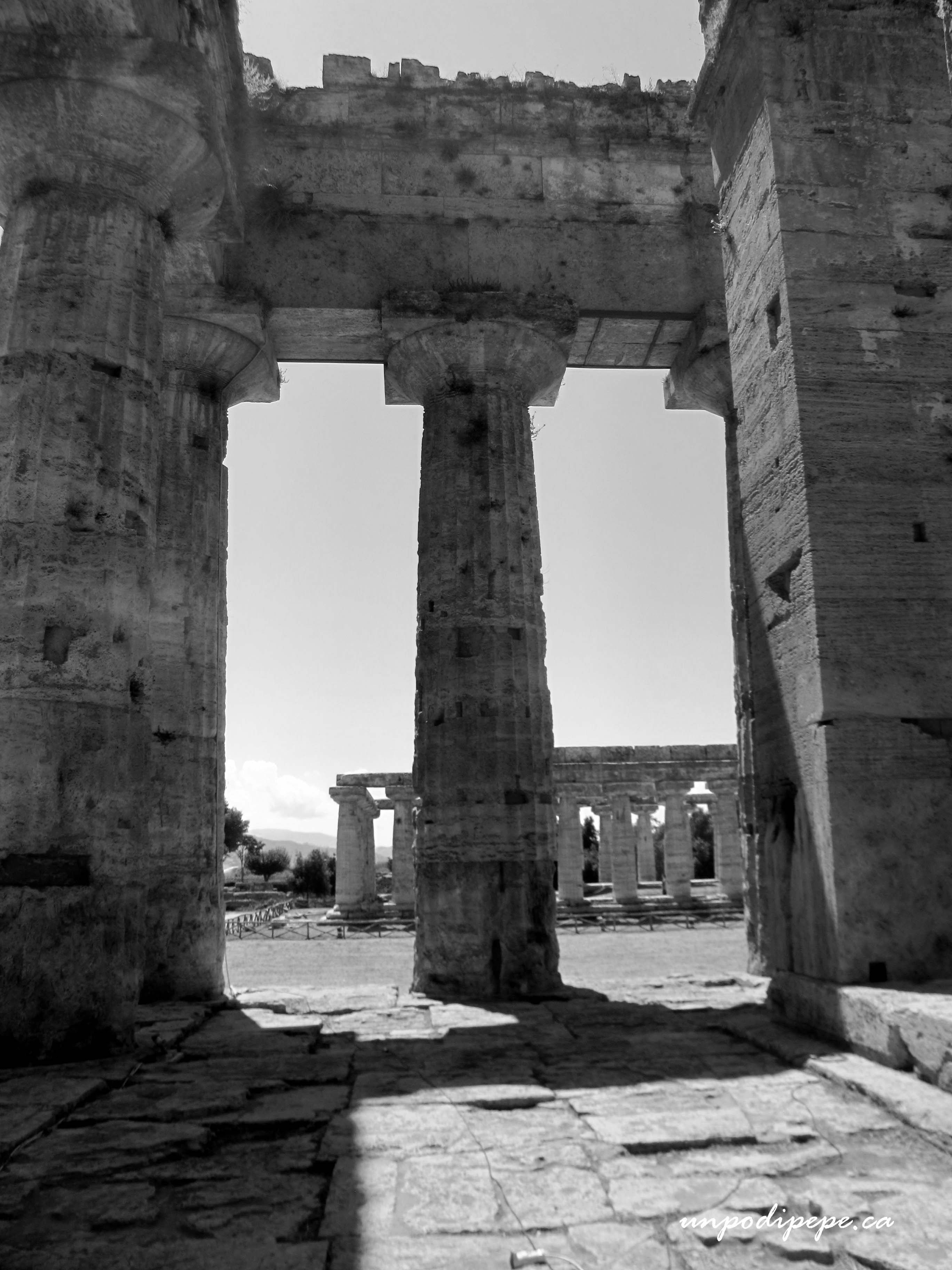
Paestum is in a quiet, idyllic setting in the countryside, surrounded by farmland. 3 well-preserved majestic Greek temples rise up out of the plain. La Basilica is the oldest of the temples, built in 550 BC and is actually a temple to Hera.  18th century archeologists mistakenly identified it as a Roman building used as a meeting place.

La Basilica

La Basilica

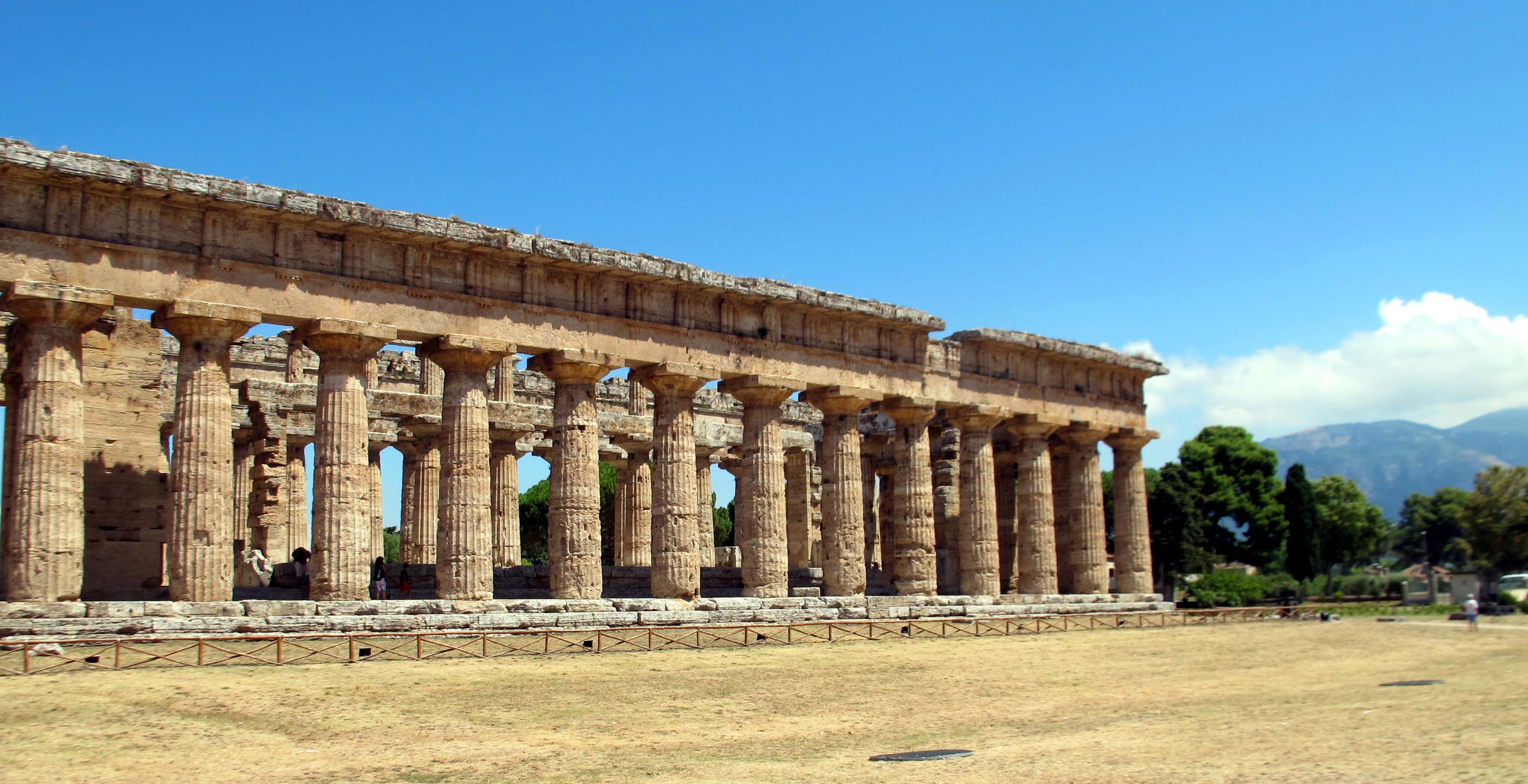
Right next to it, the Tempio di Nettuno (Neptune is the Roman equivalent of Poseidon) resembles the Parthenon.  It was built in 460 BC and is the best preserved Doric temple outside of Greece.  It is almost intact, with only the roof and a bit of the inside missing. You can actually walk inside both of these temples!

Tempio di Nettuno

Tempio di Nettuno

A bit farther away from the other 2 temples is the Tempio di Cerere (Temple of Ceres/ Demeter) which was actually a temple to Athena.  18th Century archeologists must have been very confused. It was built in 500 BC and the architecture is part Doric, part Ionic. At some point, it was used as a church and has 3 medieval tombs in the floor.  The inside of this temple is not accessible.

Tempio di Cerere

Tempio di Cerere

The remains of the ancient city also include a Roman Forum, paved streets, the foundations of public buildings and many residential Roman houses, an amphitheater, and a swimming pool/gymnasium. Walking through the overgrown areas provides some of the best views and glimpses of some mosaic floors.  paestumforum2The city walls, almost 5 km long, are mostly intact with 24 towers and 4 gates.  Only 20% of the site has been excavated.  80% of Paestum is still buried under agricultural land, most of it privately owned. A road cuts the site in 2 and has a few restaurants, bars, souvenir shops, a small piazza, the Paleochristian church, an information center, and the museum.  The amphitheater is only half exposed as the road was enlarged in the 1930’s and buried the east half of it!paestummatrimonio

The Museo Nazionale contains all of the items found in tombs in and around Paestum and the Metopes from a temple 9 km away. There are also Giovanni Piranesi’s etchings of the site, printed in 1778. The most amazing thing in the museum was on loan and I did not get to see it!  It is the 470 BC Tomba del Tuffatore, tomb of the diver, a fresco painted on the underside of a tomb which portrays a young man in mid-air diving off a cliff into water.  It is thought to portray the harmonious passage from life to death.paestumtempiodinettuno

The Archeological site of Paestum is a UNESCO World Heritage Site, along with the Cilento coast, Vallo di Diano National Park, the archeological site of Velia and the Certosa di Padula.   Today, Paestum is a Frazione or hamlet of Capaccio in the province of Salerno.  It is accessible by bus or local train from Salerno (30 minutes), but the best way to get there is by car.  The drive is spectacular and it is worth going out of the way for.  Even on a ‘busy’ summer day, the site is not crowded.  Staying the night is a great idea, as you can visit the ruins just before sunset.  A combination ticket to the site and museum is €9.

Buon Viaggio, Cristina

Share this:

  • Share on Facebook (Opens in new window) Facebook
  • Share on Pinterest (Opens in new window) Pinterest
  • Share on X (Opens in new window) X
  • Email a link to a friend (Opens in new window) Email
  • Share on WhatsApp (Opens in new window) WhatsApp
Like Loading...

Santa Maria di Siponto~ Art reconstructs time

21 Wednesday Sep 2016

Posted by Un po' di pepe in Architecture, Italia, Puglia

≈ 13 Comments

Tags

Edoardo Tresoldi, Il Gargano, Parco Archeologico Santa Maria di Siponto, Puglia, Santa Maria di Siponto, Southern Italy


santamariadisiponto1Santa Maria di Siponto is just off the SS 89 Garganica highway, 3km from Manfredonia. The church was built in 1117 over an existing early Christian structure.  The architectural style is Romanica Pugliese, Pugliese Romanesque with Byzantine and Islamic influences evident in its pure, simple lines and geometric patterns.  The building is unusual as it is square and there are 2 independent churches; the upper church and the crypt below, with an external staircase.santamariadisiponto5

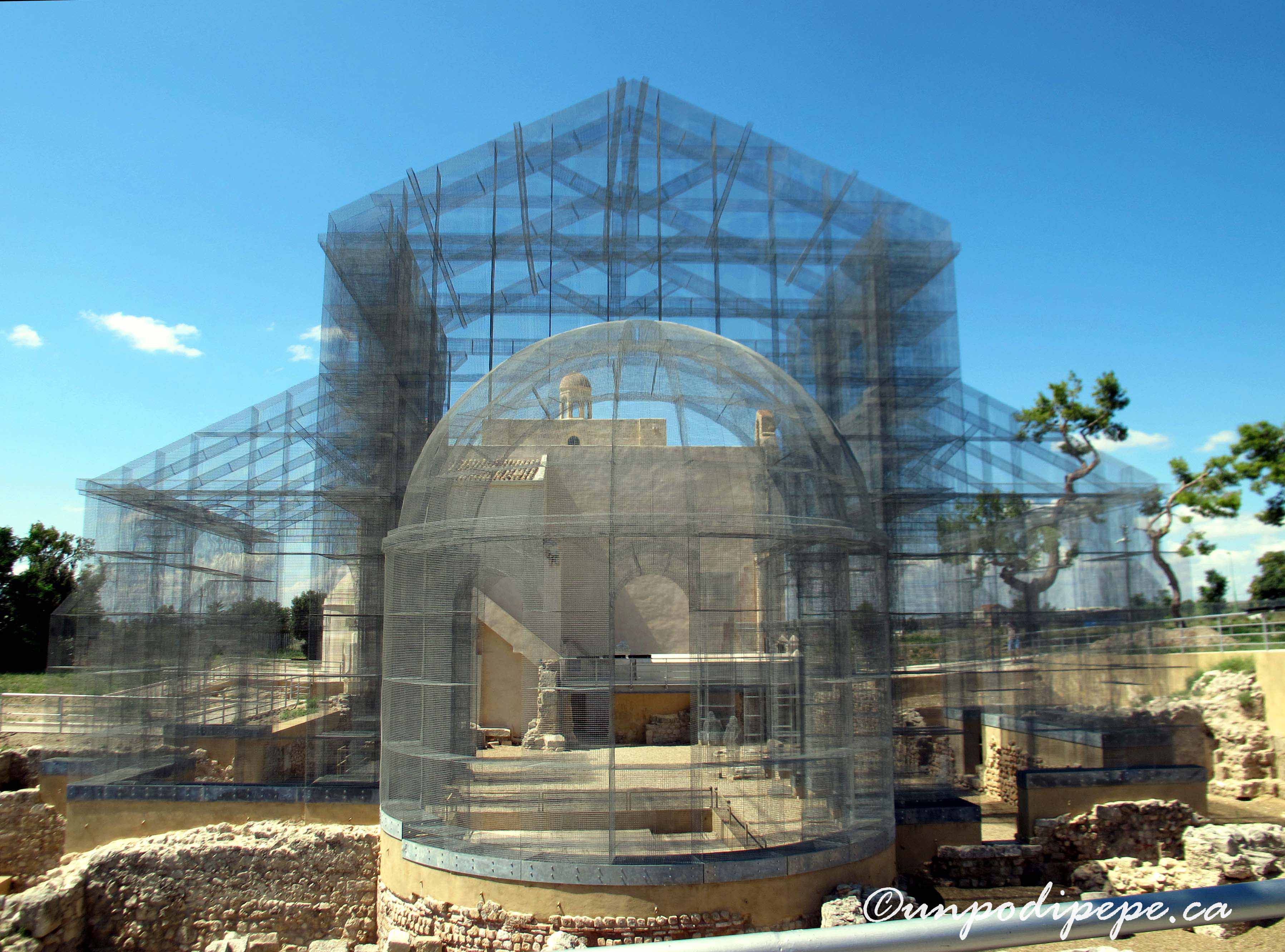
To the left of the church is the Parco Archeologico di Santa Maria di Siponto. Until March 2016, this consisted of the ruins of a Paleochristian basilica (250 AD) with a semi-circular apse and mosaic pavement, and the partially excavated remains of Ancient Roman Sipontium.  Now the space once occupied by the basilica has been transformed into a magnificent sculpture titled ‘Dove l’arte riconstruisce il tempo’ which means ‘Where art reconstructs time’. The permanent installation took 3 months to construct and is built right onto the foundations of the archeological remains.santamariadisiponto2

The installation/sculpture is made of layers of wire mesh that overlap and intersect, interpreting and reclaiming the space and volume once occupied by a structure that no longer exists. The lightness and transparency of the material makes it look like a hologram of the original church…it is there, but it is no longer there. The site is also illuminated at night, creating a ‘ghostly’ effect.  Contemporary art and archeology intersect to form a link with the past. 14 m high and weighing 6,000 kg, this is probably the largest structure in the world made entirely of wire mesh.santamariadisiponto6

I have been to Santa Maria di Siponto many times since I was a child. I am a total archeology nerd, and I was excited to see this construction breathing new life into this small archeological site, relatively unknown outside of Puglia. It feels like the basilica has been resurrected from the ruins.  I have not seen anything like this before and it is already a distinctive landmark, especially since it is visible from the highway. In 5 months it has already brought 100,000 visitors to the site and contributed to the local economy.

The artist, Edoardo Tresoldi, a 29 year old set designer and sculptor in Roma, is known for his monumental metallic wire mesh sculptures, integrating into their surroundings.  His website is still under construction.  He must be too busy making great art!santamariadisiponto4Santa Maria di Siponto is definitely worth a visit.  If you have plans to visit the Gargano area, especially Monte Sant’ Angelo, San Giovanni Rotondo, Manfredonia or Mattinata, it is fairly close by. It is definitely easiest to get there with your own vehicle, although it is possible to get to Foggia, then Manfredonia by train or bus and then taxi to the site. Buon Viaggio, Cristina

Share this:

  • Share on Facebook (Opens in new window) Facebook
  • Share on Pinterest (Opens in new window) Pinterest
  • Share on X (Opens in new window) X
  • Email a link to a friend (Opens in new window) Email
  • Share on WhatsApp (Opens in new window) WhatsApp
Like Loading...

Spaghetti all’Amatriciana

30 Tuesday Aug 2016

Posted by Un po' di pepe in Italia, Mangiamo!, Recipes, Roma

≈ 16 Comments

Tags

Amatrice, Croce Rossa Italiana, Cucina Romana, Earthquake relief Central Italy, Inspiration, Italian food, Pasta all'Amatriciana, Terremoto 2016, Traditional recipes

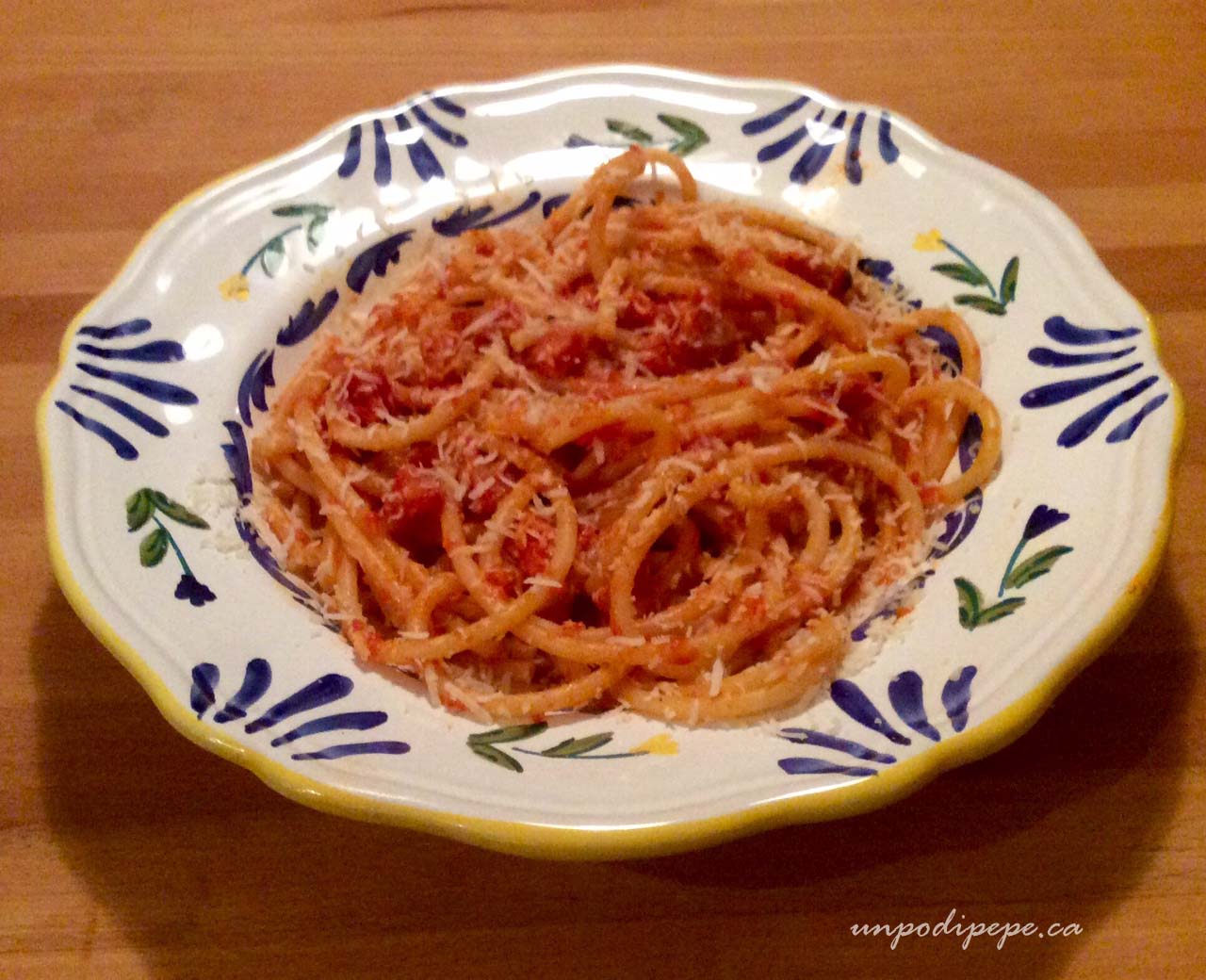
Pasta all'AmatricianaMy last post was about the terremoto in Italia and I listed ways you can help with earthquake relief.  One of these ways was to order Pasta all’Amatriciana at one of the many restaurants participating to raise money for the Croce Rossa Italiana.  I realized that not everyone will have a restaurant in their area participating, so I am posting a recipe, just in case anyone wants to host their own small fundraiser. August 27-28 would have been the Spaghetti all’Amatriciana festa in Amatrice.  Amatriciana

Pasta all’Amatriciana-also known as Pasta alla Matriciana in dialetto Romano, is made with guanciale (cured pork cheek), Pecorino Romano, and pomodoro (tomato).  Peperoncino is often added.  Pasta all’Amatriciana originated from Pasta alla Gricia, made with guanciale and Pecorino.  It is basically Pasta Carbonara with tomato instead of  eggs. Shepherds near Amatrice carried the simple ingredients with them into the fields.  The pomodoro had not been brought to Europe yet.  In Amatrice, they started making the Pasta alla Gricia with pomodoro, once it had been introduced.  When Amatriciani moved from the outlaying areas to Roma, the sauce became popular, and is now considered a staple of Cucina Romana.  In Roma, Amatriciana is made with bucatini, which are spaghetti with a hole down the middle, or rigatoni, but in Amatrice, it is only made with spaghetti! Making Amatriciana

Spaghetti all’Amatriciana

100g guanciale (pancetta can be used if guanciale not available)

350g passata di pomodoro, or pelati (peeled tomatoes)-about 1 500ml canning jar

75g Pecorino Romano, freshly grated

Black pepper, freshly grated

320g spaghetti or bucatini (80g per person)

Cut guanciale into strips or cubes. In a frying pan, cook guanciale until crispy.  When the white part becomes transparent, add tomatoes and pepper.  While this is simmering, cook spaghetti in a large pot of salted water.  Cook for 1 minute less than the time it says on the box! Drain well then add to the pan and toss in the sauce and add Pecorino.  Serve with extra Pecorino Romano on top.  Serves 4. Buon Appetito!Amatriciana

Share this:

  • Share on Facebook (Opens in new window) Facebook
  • Share on Pinterest (Opens in new window) Pinterest
  • Share on X (Opens in new window) X
  • Email a link to a friend (Opens in new window) Email
  • Share on WhatsApp (Opens in new window) WhatsApp
Like Loading...

Terremoto in Italia~How to help

26 Friday Aug 2016

Posted by Un po' di pepe in Italia

≈ 18 Comments

Tags

Croce Rossa Italiana, Earthquake relief Central Italy, La Piazza Dario Ristorante Vancouver, National Italian-American Foundation, Pasta all'Amatriciana, Terremoto 2016

Vigili del Fuoco in Amatrice-Winnipeg Free Press

Vigili del Fuoco in Amatrice-Winnipeg Free Press

Una preghiera per le vittime del terremoto.  A few days ago, a devastating terremoto-earthquake struck central Italia.  Today aftershocks continue to damage buildings and roads. The ancient villages of Amatrice, Accumuli, Pescara del Tronto and Arquata del Tronto now look like part of Dante’s Inferno.  Pescara del Tronto has been totally destroyed, with only 5 buildings left standing.  The death toll is 267 and rising, countless others are still missing, and thousands left displaced and homeless.  Since the Unification of Italia in 1861, there have been 35 major terremoti, and 86 smaller ones.

What can you do to help:

The Croce Rosse Italiana-Italian Red Cross has a page set up (in Italian) for the earthquake rescue efforts.  To donate in international currencies a fund has been set up by the International Federation of Red Cross and Red Crescent Societies (IFRC). I used this one myself and it was molto facile!

The National Italian American Foundation (NIAF) has a donation page set up for earthquake relief.

Save the Children has launched a response in Amatrice, setting up a child-friendly space, a safe and protected environment where children and young people can receive support from trained staff and participate in various activities. This will allow them to play, socialize, learn, and express themselves as they recover from trauma.

Order Pasta all’Amatriciana!  Italian ristoranti all over Italia and around the world are donating €2 per plate of pasta all’Amatriciana to the Italian Red Cross for relief in Amatrice.  This fund raising initiative started by Italian blogger Paolo Campana had 700 restaurants signed up within a few hours. For the month of September, La Piazza Dario Ristorante Italiano in Vancouver will be donating $5 per order of Spaghetti all’Amatriciana to the Croce Rossa Italiana.

Amatriciana

Pasta all’Amatriciana originated from shepherds in the area around Amatrice.

In Roma and across Italia, you can donate blood, and there are donation points set up to donate non-perishable food, blankets, clothing and flashlights.

Last, but definitely not least, pray for survivors! Ciao, Cristina

Please share other links in the comments.

Share this:

  • Share on Facebook (Opens in new window) Facebook
  • Share on Pinterest (Opens in new window) Pinterest
  • Share on X (Opens in new window) X
  • Email a link to a friend (Opens in new window) Email
  • Share on WhatsApp (Opens in new window) WhatsApp
Like Loading...

La Madonna della Neve

05 Friday Aug 2016

Posted by Un po' di pepe in Culture, Feste, Italia, Italian life, Orsara di Puglia, Puglia

≈ 13 Comments

Tags

August 5th, Italia, Madonna della Neve, Orsara di Puglia, Pugliese Traditions, Southern Italy

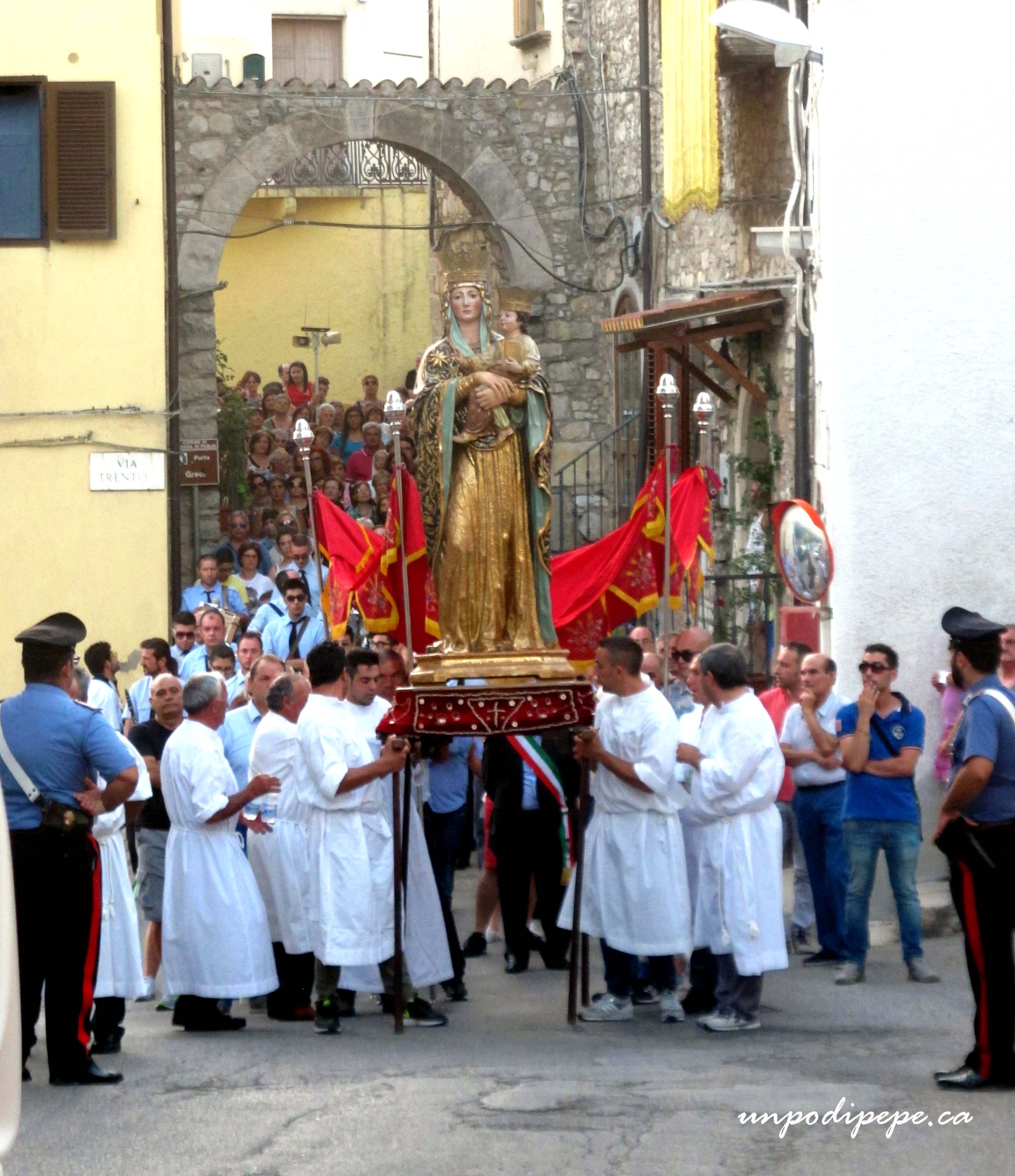
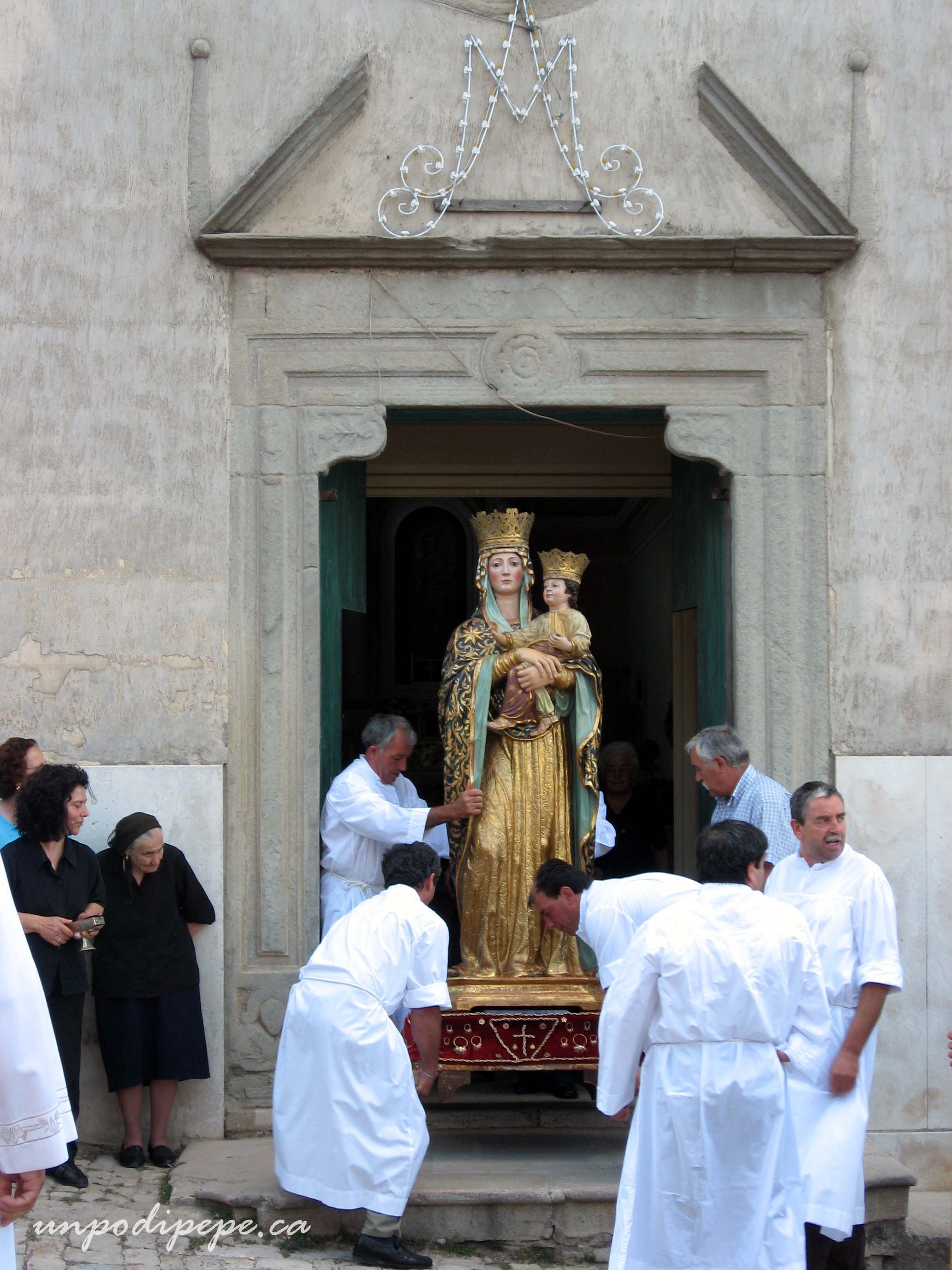
MadonnanevechiesaAugust 5th is the feast day of La Madonna della Neve (the Madonna of the Snow).  She is one of the Patron Saints of Orsara di Puglia and there is a big festa.  She is carried through Orsara in a procession and returned to her usual spot in the main church. In the evening there is a Mass, then music and fireworks in her honour.  La Madonna della Neve is the protectoress and Patron Saint of many paesi montani or mountain villages because, of course, it snows!

La Madonna della Neve is tied to the origins of the Basilica Santa Maria Maggiore in Roma.  According to legend, in the year 352, the night between August 4th and 5th, the Madonna appeared in a dream to a wealthy couple who wanted to build a church.  She asked them to build a church where snow had fallen during the night.  They went to tell Pope Liberio and it turns out he had the exact same dream during the night!

In the middle of a hot Roman summer, snow had fallen on L’Esquilino, the Esquiline Hill.  The perimeter of the snowed on area was where the church of Santa Maria ‘Ad Nives’ (of the snow) was built. The church is usually known as Santa Maria Maggiore.Madonnaneve06

Orsara’s Madonna della Neve statue was carved out of a single piece of quercia (oak) by Napoletano sculptor Aniello Stallato in 1624. I have been familiar with this beautiful sculpture since I was 11, but I had no idea she was almost 400 years old! Here are some photos of the processione!Madonnaneve10

Madonnaneve2MadonnanevestradadirittaMadonnanevearco

Ciao, Cristina

Share this:

  • Share on Facebook (Opens in new window) Facebook
  • Share on Pinterest (Opens in new window) Pinterest
  • Share on X (Opens in new window) X
  • Email a link to a friend (Opens in new window) Email
  • Share on WhatsApp (Opens in new window) WhatsApp
Like Loading...
← Older posts
Newer posts →

Enter your email address to follow 'un po' di pepe' and receive notifications of new posts by email.

Join 504 other subscribers
Follow Un po' di pepe on WordPress.com

Popular Posts

  • Hairstyling in Ancient Roma
    Hairstyling in Ancient Roma
  • Acqua Vergine
    Acqua Vergine
  • Santa Maria in Aracoeli
    Santa Maria in Aracoeli
  • Contact
    Contact
  • Hostaria Antica Roma~Eat like an Ancient Roman
    Hostaria Antica Roma~Eat like an Ancient Roman
  • Artemisia Gentileschi
    Artemisia Gentileschi
  • About me/Chi sono
    About me/Chi sono

Recent Posts

  • Pane e Salute
  • Sanremo 2026
  • Cucina Italiana Patrimonio UNESCO
  • 2025~Un po’ di pepe Year in Review
  • Castel del Monte
  • ‘The Nuances of Love’
  • Hostaria Antica Roma~Eat like an Ancient Roman
  • Santa Maria in Aracoeli
  • Casino dell’Aurora~Villa Boncompagni Ludovisi
  • Nasoni di Roma
  • Bloghiversario #11
  • Fontana di Trevi
  • Acqua Vergine
  • Giubileo 2025
  • Sanremo 2025
  • In Vino there are Memories
  • A Literary Harvest
  • 2024~Un po’ di pepe Year in Review
  • Buon Natale 2024
  • Il Bicerin
  • Mercato Porta Palazzo
  • Torino
  • Catanzaro, Calabria
  • Il Pumo Pugliese
  • Artemisia Gentileschi

Categories

Amici e Famiglia Architecture Art Art history Art projects Bilingual posts Blogging Canada Culture Feste Firenze Inspiration Italia Italian Folklore Italian language Italian life Italocanadesi Libri Mangiamo! Orsara di Puglia Parole piacevoli Photography Puglia Recipes Roma Travel Travel tips Uncategorized Vino

Archives

Un po’ di pepe on Facebook

Un po’ di pepe on Facebook

Start a Blog at WordPress.com.

  • Subscribe Subscribed
    • Un po' di pepe
    • Join 504 other subscribers
    • Already have a WordPress.com account? Log in now.
    • Un po' di pepe
    • Subscribe Subscribed
    • Sign up
    • Log in
    • Report this content
    • View site in Reader
    • Manage subscriptions
    • Collapse this bar
 

Loading Comments...
 

    %d