• Home
  • About me/Chi sono
  • Contact

Un po' di pepe

~ …… (oon∙poh∙dee∙PEH∙peh) Cristina writes about interesting stuff /Cristina scrive di cose interessanti

Un po' di pepe

Category Archives: Orsara di Puglia

Senz’ acqua

03 Monday Aug 2015

Posted by Un po' di pepe in Inspiration, Italian life, Orsara di Puglia

≈ 17 Comments

This morning I woke up to find out the water was being shut off soon.  Luckily I live in the Centro Storico (historic center) of town, which is downhill, so had time to run around filling up the tub and all sorts of pots and bottles with water.  We will probably only be senz’ acqua (without water) until this evening, or let’s hope so anyways. I was reminded of something I wrote exactly 2 years ago tomorrow, when we senz’ acqua for almost 4 days:

senaacqua1

Senz’ acqua, Agosto 2013

On Friday a truck from the comune (co•MOO•neh) or city hall, went around announcing that at 5pm the water would be turned off.  They didn’t say for how long, but everyone filled up their pails, bottles, and bathtubs anyways, assuming the water would be back on by the next morning.

It turns out there was a ‘guasto’ (GWAH•stoh)-a water main break that was more serious than originally thought.  It was between Troia and Foggia, about 40 minutes away. Now it was starting to sound like we would be senz’ acqua for 2-3 days!

senzacqua2

The next day, the temperature was 38° C.  The population of Orsara was increased by about 1,000 because of families visiting, the Festa del Jazz, people living in Foggia coming for the weekend to escape the heat and the Festa della Madonna della Neve coming up.  I was taking bottles to fill up at one of the fontane (fountains) so we could wash dishes and flush the toilet, when I heard there was an autobotto (water truck) at Ponte Capò.  By the time I got there it had moved to La Benzina (the gas station) and was going to San Rocco.  I was out of breath when I finally managed to find the autobotto and fill up my 3L bottles.  I brought them home and then heard that Acquedotto Pugliese was giving out rations of 4L bags of water.  Mannaggia what a scene it was.  The vecchietta (old lady) in front of me said ‘ma vieni di nuova la Guerra!’, the war has come back again! The man behind me had 10 family members from France staying with him and was trying to get extra.  It started to get kind of ugly, but they ran out of water anyways. We carried out water bags home and arrived ‘in un bagno di acqua’-bathed in sweat.  It was stinking hot and 6L of water gets heavy when you have to carry it up a steep old stone stairway.

senzacqua3

This reminded me of when I used to come to Orsara di Puglia as a child/ teenager.  In an effort to conserve water in the hot summer months, it was only available from 8am until noon, then shut off until the next morning.   Laundry, showers and washing hair all had to be done before noon.  This was a common practice in Southern Italian towns in the 1980’s.  I’m not sure it actually saved any water because every household would fill up their tub and every imaginable jug and container with water before it was shut off.

At 5pm the TV went off, which seemed odd, so I tried the lights and they didn’t work.  I heard someone outside yell ‘Ma no!  Anche la corrente no!’-‘but no! Not the electricity too!’  Mamma and I ran around looking for the flashlight and candles for later. No running water and no power!  The neighbours packed up and went back to Foggia.  Luckily the power was only off for an hour so at least we were only lacking 1 utility.

Water in the tub or from the fountains is used for washing then toilet flushing.  Dishwashing water is also later used to flush the toilet.  Acquedotto Pugliese 4L bags are only for cooking and washing food.  Bottled water is for drinking. It’s amazing the simple things that we take for granted today.  Have you ever thought about how you would manage if you were ‘senz’ acqua’ for 3 days?  In many parts of the world, people still don’t have electricity and running water in their homes.  Take a few minutes and think about how you would survive this ‘medieval camping’ situation.
Share this:

  • Share on Facebook (Opens in new window) Facebook
  • Share on Pinterest (Opens in new window) Pinterest
  • Share on X (Opens in new window) X
  • Email a link to a friend (Opens in new window) Email
  • Share on WhatsApp (Opens in new window) WhatsApp
Like Loading...

La Montagna Spaccata

17 Sunday May 2015

Posted by Un po' di pepe in Italia, Orsara di Puglia, Photography, Puglia

≈ 18 Comments

Tags

Montagna Spaccata, Montaguto, Orsara di Puglia, Parco Eolico di Montaguto, Puglia, Southern Italy

Montagna Spaccata1

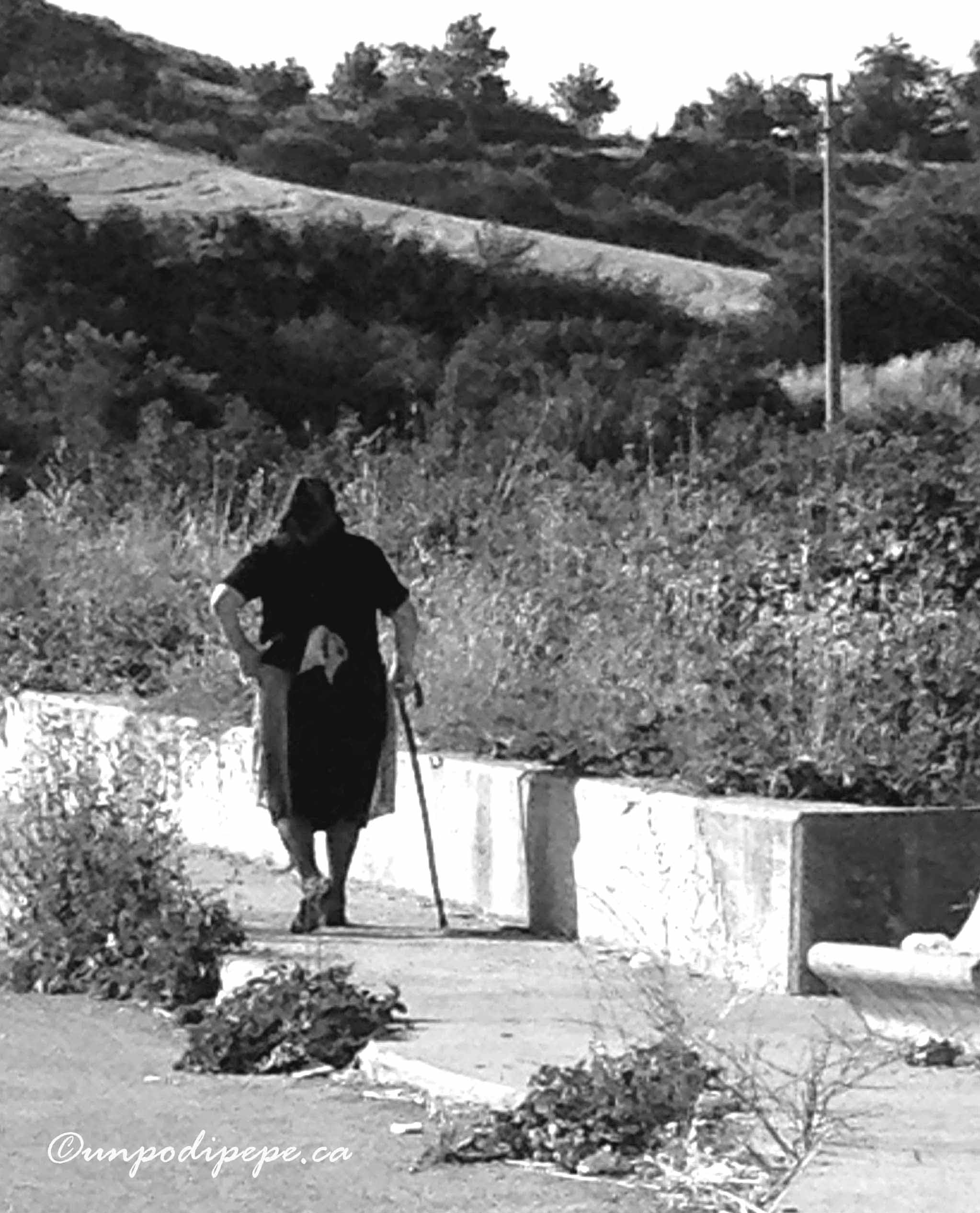
When I am in Orsara di Puglia, I go for a long passeggiata (walk) up the mountain almost every morning. When you spend weeks eating lots of yummy food, this is necessary. Orsara is already at 650-700 m elevation (2300 ft) and my walk is uphill a lot of the way so there is some good altitude there. I leave Orsara via Via Castagneto and take the Via Nuova, go past the Cimitero (cemetary) and then take the uphill zigzags to ‘La Montagna Spaccata’. At one time this was a steep windy dirt road, but now it is paved. I like to call it ‘la palestra di Madre Natura’ or ‘Mother Nature’s gym’.  In the early to mid morning and early evening many Orsaresi of all ages are out walking.

ViaNuova2

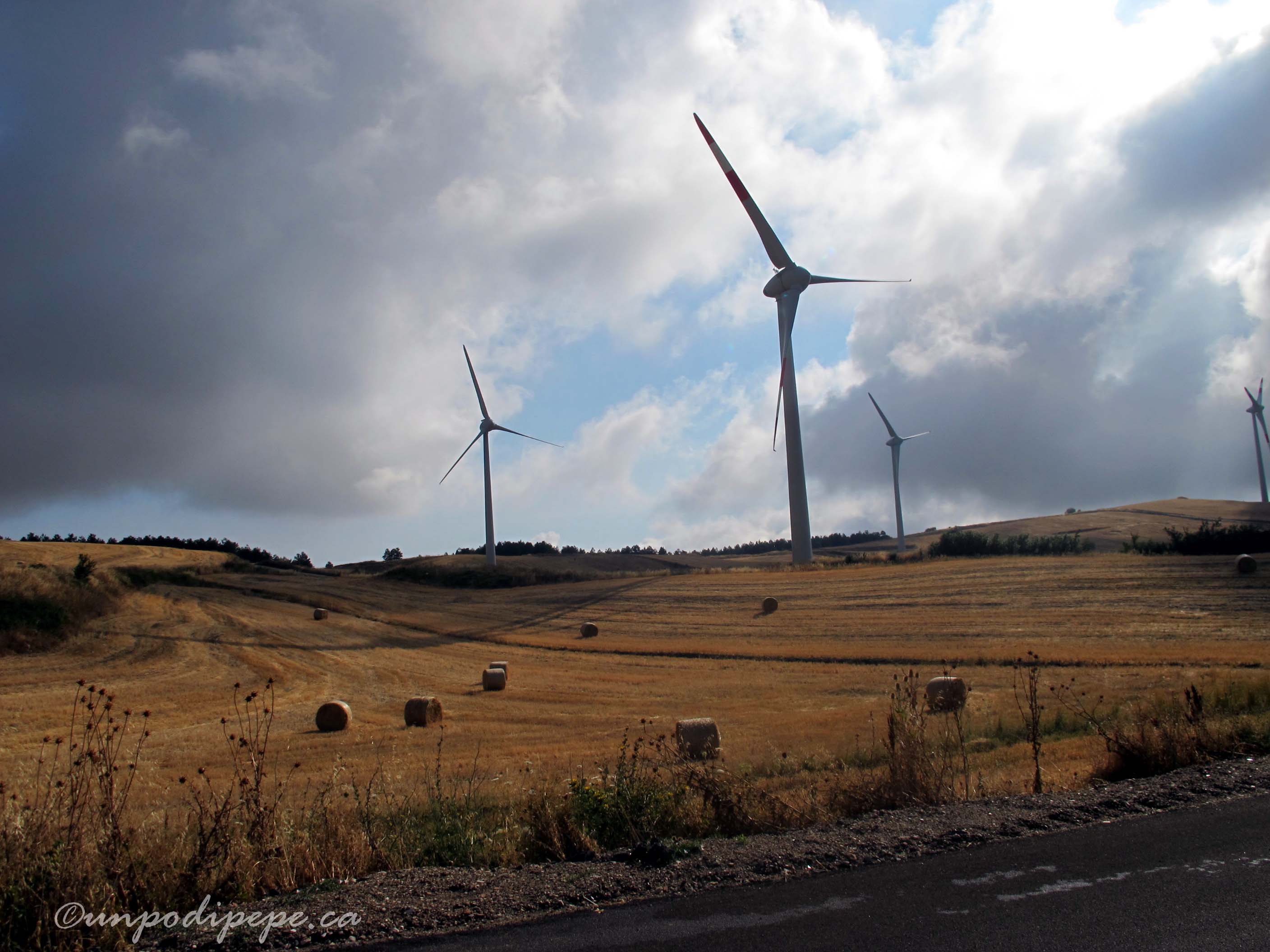
‘Spaccata’ means cracked or split, as in split into 2.  The reason for the name is that part of the mountain is in Puglia and part in Campania.  In fact, Montaguto, the closest village to Orsara, is in Campania, in the province of Avellino. Arriving at the ‘frontiera’ (border), you can see the difference in the asphalt where one regione has stopped paving and the other has started. Just beyond the border is the Parco Eolico di Montaguto (wind farm) and the road also flattens out a lot. I usually walk to this ‘frontiera’ and then walk back down.  Sometimes I go father, and a few times I have even walked all the way to Montaguto which is 6 km away.

Montaguto (AV) seen from a distance

Montaguto (AV) seen from a distance

I always thought Montagna Spaccata was just a ‘local’ name and that it had a real name.  I tried to find out, but no one seemed to know for sure.  I did some heavy duty research, consulting wikipedia….oops, I mean my amico Donato, who asked his amico Leonardo who consulted the official IGMI (Istituto Geografico Militare Italiano) military map …..and what do you know, Montagna Spaccata is the actual name!

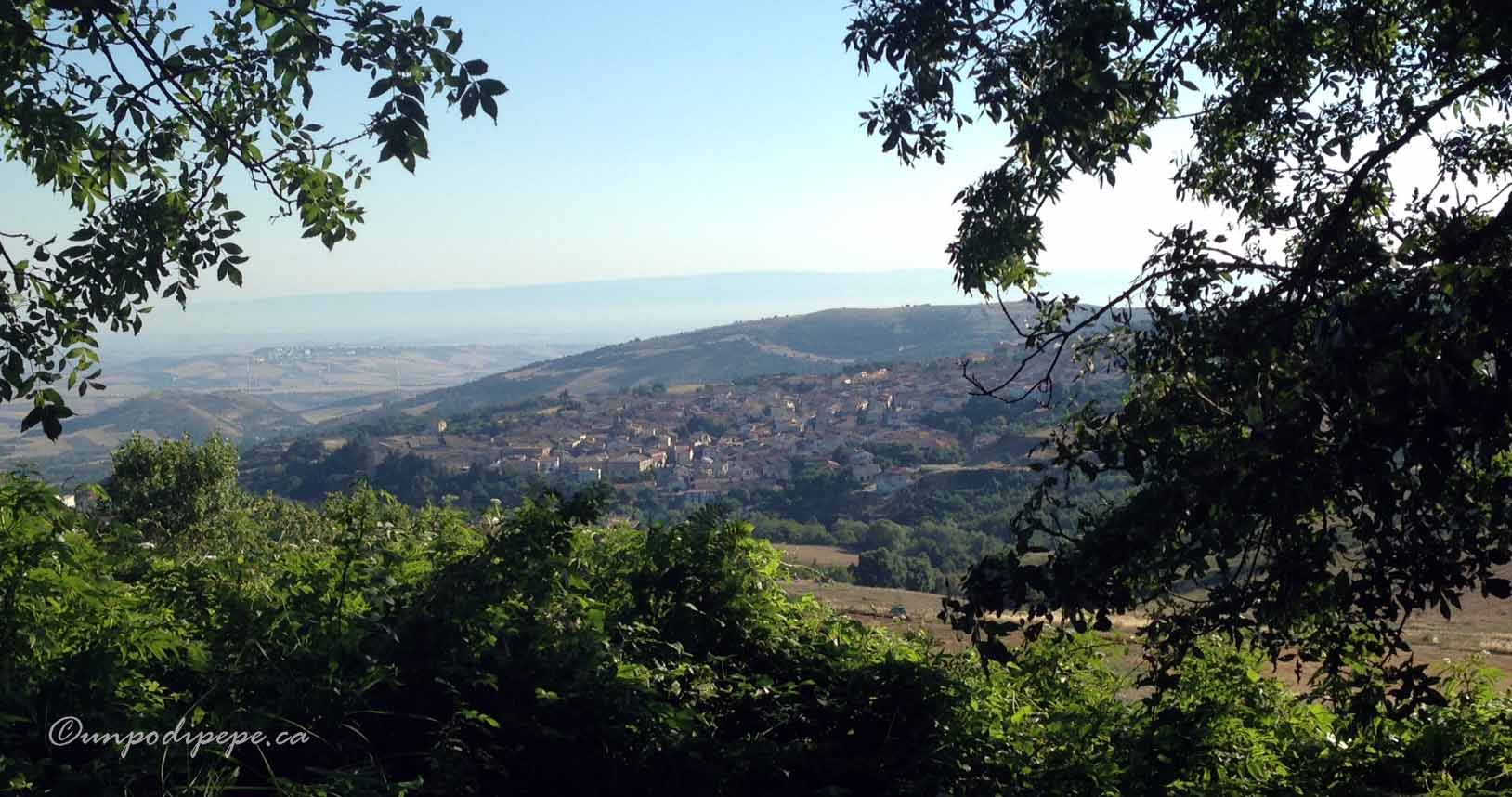
View of Orsara di Puglia

View of Orsara di Puglia

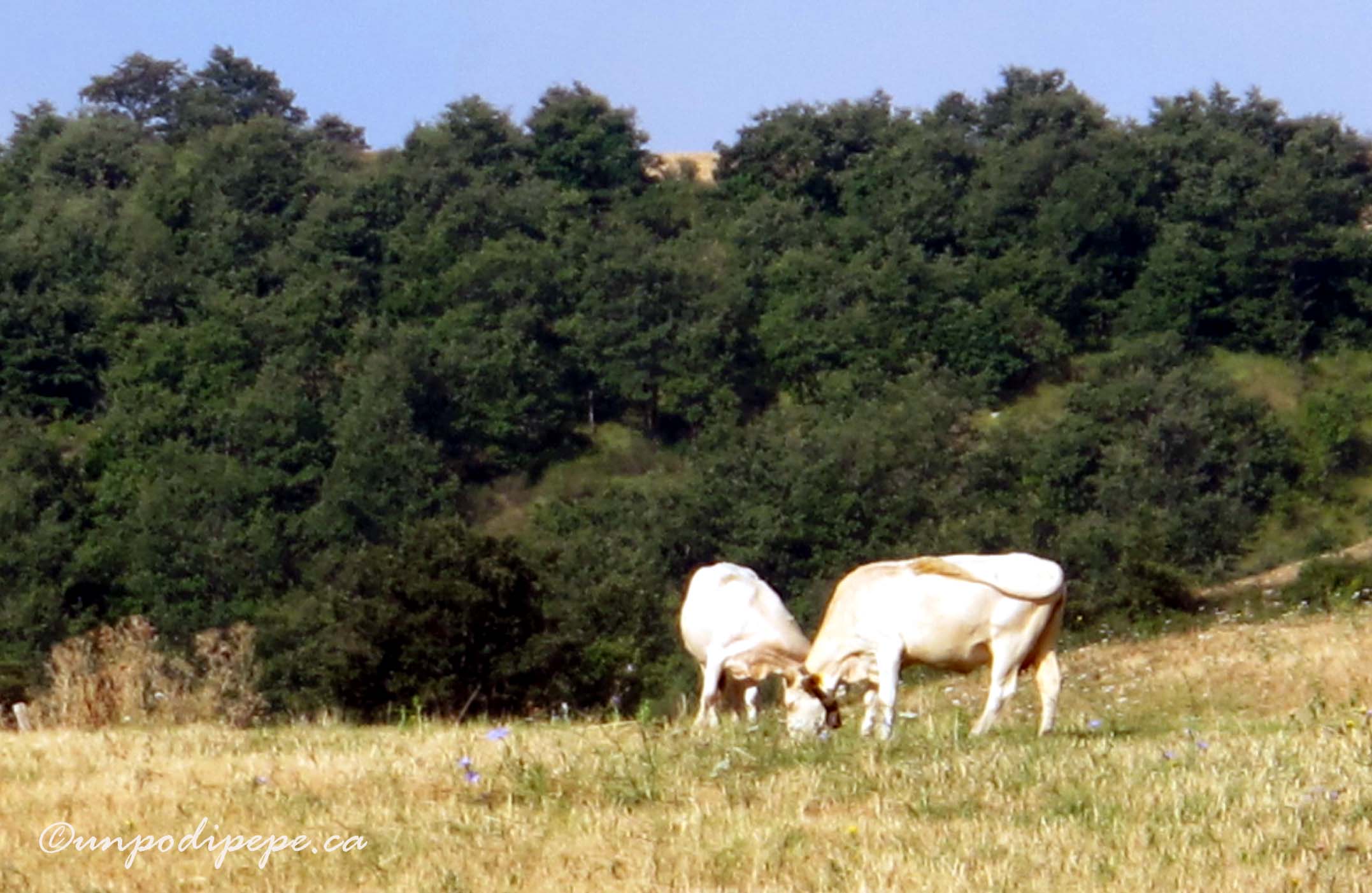
I love my morning passeggiata.  I can breathe in fresh aria di montagna (mountain air) and get some exercise-aka an excuse to eat more! I also enjoy and photograph some breathtaking scenery and views of Orsara di Puglia and even meet friends along the way.  See for yourself…..

Montagna Spaccata copy1

Orsaradipugliavista2

Pale eoliche (wind turbines) near Montaguto

Pale eoliche (wind turbines) near Montaguto

MuccheMontaguto

Share this:

  • Share on Facebook (Opens in new window) Facebook
  • Share on Pinterest (Opens in new window) Pinterest
  • Share on X (Opens in new window) X
  • Email a link to a friend (Opens in new window) Email
  • Share on WhatsApp (Opens in new window) WhatsApp
Like Loading...

Cauzuncill’

19 Friday Dec 2014

Posted by Un po' di pepe in Italian life, Mangiamo!, Orsara di Puglia

≈ 3 Comments

Tags

Calzoncini di ceci, Dolci di Natale, Italian food, Natale, Orsara di Puglia, Pugliese Traditions, vino cotto

cauzuncillI know Natale (Christmas) is around the corner when we make cauzuncill’  (cow•zoon•cheel).  Cauzuncill’ is Orsarese for calzoncini, which means piccoli calzoni or ‘little pants’.

Cauzuncill’ are ‘a forma di mezzaluna’ (half moon shaped) turnovers traditionally filled with mashed ceci (chick peas), vino cotto, mandarin orange and lemon zest, grated chocolate, sugar and of course alcohol. We also made some with ground almonds instead of ceci.  Castagne (chestnuts) are sometimes mixed in with the ceci filling.

Cauzuncill'collage copy

Cauzuncill' Collage3 copyCauzuncill’ are fried and then served drizzled with vino cotto.  Don’t know what vino cotto is?  When making wine, some of the freshly pressed grape juice (mosto) is slowly cooked all day until it is reduced and caramelized.  It’s like a thick wine syrup that is used for desserts, muscitaglia on November 1st, and even drizzled on snow!

Cauzuncill' (cow-zoon-cheel) with almond and vino cotto filling, drizzled with vino cotto

Cauzuncill’ (cow-zoon-cheel) with almond and vino cotto filling, drizzled with vino cotto

Dolci di Natale similar to cauzuncill’ are made in Basilicata and Molise, but the name, fillings and even the pastry change depending on the region.  What kind of dolci di Natale does your family make?


Share this:

  • Share on Facebook (Opens in new window) Facebook
  • Share on Pinterest (Opens in new window) Pinterest
  • Share on X (Opens in new window) X
  • Email a link to a friend (Opens in new window) Email
  • Share on WhatsApp (Opens in new window) WhatsApp
Like Loading...

Fucacoste e Cocce Priatorje

01 Saturday Nov 2014

Posted by Un po' di pepe in Culture, Feste, Italian Folklore, Orsara di Puglia, Puglia

≈ 7 Comments

Tags

Falò e Teste del Purgatorio, Italian history, Muscitaglia, November 1st, Orsara di Puglia, Puglia, Pugliese Traditions, Pumpkin carving, Southern Italy, Traditional Festivals in Puglia, Tutti i Santi Festa

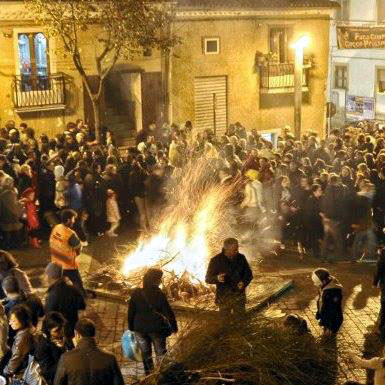
Piazza San Pietro. Photo courtesy of International Photo Correspondent Donato Narducci Piazza San Pietro. Photo courtesy of International Photo Correspondent Donato Narducci

Fucacoste e cocce priatorje is dialetto Orsarese for ‘Falò e teste del Purgatorio’.  This translates to ‘Bonfires and heads from purgatory’. It is an ancient festival unique to Orsara di Puglia celebrated on November 1st, the night of ‘Tutti i Santi’ (All Saints Day).  All Saints Day was created in the 9th century when the Pope superimposed a Christian feast day onto existing rituals, so this festa has been around for a very long time.  It is a night where people have the opportunity to honour, reconnect and pay respect to the spirits of their loved ones.  Carabinieri estimate that Orsara (pop 3,000) had 40,000 visitors attend the festa tonight, with 9,000 cars parked up to 3 km away!

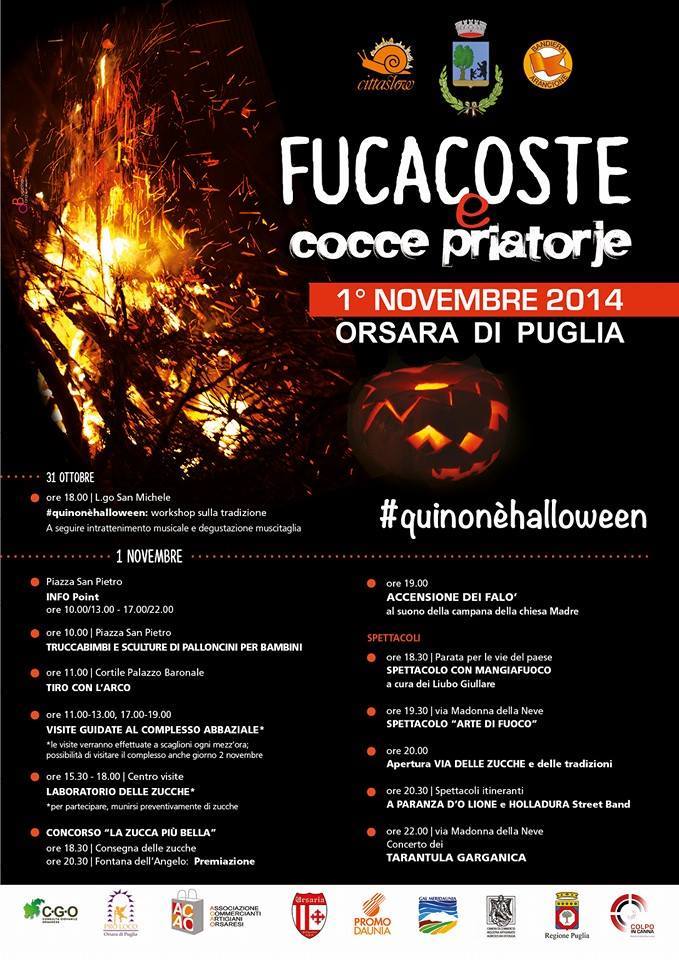
2014 poster for Fucacoste e cocce priatorje 2014 poster for Fucacoste e cocce priatorje

It is believed that the souls of the dead return among the living to visit their relatives and their former homes before moving on to Paradiso.  The bonfires are lit with wood and branches of ginestra (broom). The light of the fires and the crackling and sparks of the ginestra attract the spirits to reunite the living with those who continue to live only in their memories.  The souls of the dead loved ones collect ashes from the fires. The gleam of light inside ‘cocce priatorje’, pumpkins carved to look like heads-light their way to find their former home.

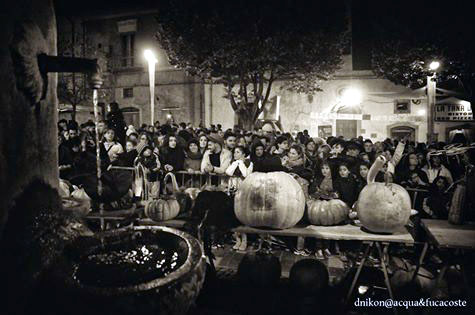
Preparation for the  festa involves gathering firewood and ginestra, preparing food and carving zucche (pumpkins).  There is even a BYOZ (bring your own zucca) pumpkin carving workshop.  Later in the evening zucche are exhibited and there is a contest for ‘la zucca più bella’-the best zucca.

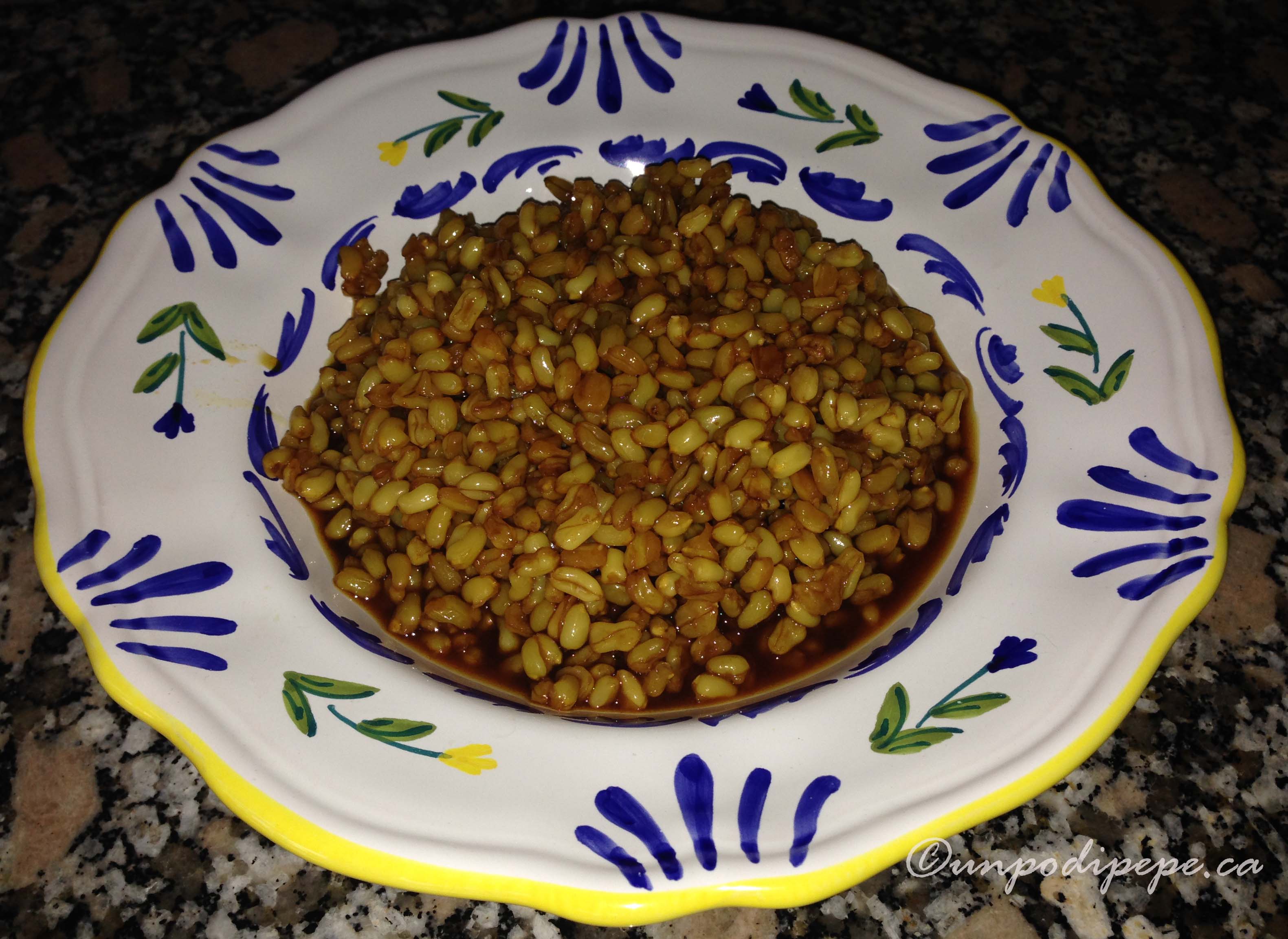
In honour of the dead, simple but symbolic foods are prepared.  These include potatoes, onions, salsicce (sausages) and castagne (chestnuts) cooked in open fire. Muscitaglia is a traditional dish served on November 1st which probably dates back from the ancient Greeks and Byzantines. Muscitaglia (moo•shee•tah•lyah) in both Greek and Latin is made up of the words mosto (wine must) and talia (grain). The ingredients include boiled grain and vino cotto (literally cooked wine-also called mosto cotto). Pomegranate seeds and walnut pieces are sometimes added. These ingredients are symbols of fertility and abundance, but also of honour and respect for the dead.

Muscitaglia Muscitaglia

When the campanile (church tower bell) strikes 1900 hours (7 pm), Orsara di Puglia ‘catches fire’. Over 100 bonfires are simultaneously lit in every street and piazza and remain lit through the night.  The fires, pumpkin lanterns, music and people in the streets create a magical, enchanted atmosphere. In 2017 I attended the festa and took photos.  They are in the post Tutti i Santi.

Fucacoste e Cocce Priatorje has often been confused with Hallowe’en, but it is a very different event.  Besides the fact that the date is different, dressing up in costume is not part of the custom, there is nothing scary about it and there are no evil spirits to chase away. It has more similarities with the Mexican Dia de los Muertos/Day of the Dead.  This is an event about being together in community to celebrate the bond between the living and those who we remember in our hearts, and to remind us that our time on earth is precious.

Watch the video ‘#quinonèhalloween’ featuring 94 year old Z’Gaetan talking about the festa and its significance  https://www.youtube.com/watch?v=9W5RD0-9H-A

Read about tonight’s festa (in Italiano) on the Comune di Orsara di Puglia website.  For more about Orsara di Puglia read the post ‘Benvenuti ad Orsara di Puglia’.  Ci vediamo alla festa!

Fucacoste e Cocce Priatorje, Fontana Sant'Angelo, Orsara di Puglia 2014. Photo courtesy of Donato Narducci Fucacoste e Cocce Priatorje, Fontana Sant’Angelo, Orsara di Puglia 2014. Photo courtesy of Donato Narducci

Share this:

  • Share on Facebook (Opens in new window) Facebook
  • Share on Pinterest (Opens in new window) Pinterest
  • Share on X (Opens in new window) X
  • Email a link to a friend (Opens in new window) Email
  • Share on WhatsApp (Opens in new window) WhatsApp
Like Loading...

Bambini, Soccer and World Peace

23 Saturday Aug 2014

Posted by Un po' di pepe in Culture, Inspiration, Italia, Italian life, Orsara di Puglia

≈ 4 Comments

Tags

Calcio, Inspiration, Orsara di Puglia, Soccer

orsaracampetto
Bambini are amazing. My 9 year old nipotino (nephew) Vito loves soccer (aka calico/football/futbol) and all things associated. He had predicted Germany would win the World Cup before it even started. Vito came to Orsara di Puglia this year, and really wanted to play, so our Zia called a friend whose son played and arranged to have them meet ‘sotto la sveglia’ (under the clock) at Porta San Pietro at 9pm. When we went to meet him, I also saw my friends’ son and asked him if he liked to play. Within minutes, all of the 10-11 year old boys in the area had gathered and enthusiastically arranged to meet the next morning at ‘il campetto’ (the small soccer field) for a game, then they all went for a passeggiata. It was the cutest thing ever and could have been a TV advertisement for the next world cup!
The next morning, they all showed up and there were enough boys for 2 teams. They played for 2 hours and Vito was excited that they all played as enthusiastically as he did. He understands Italian quite well, and even with all the loud ‘friendly arguing’ in dialetto and hand gestures, they had no problems communicating.  They were adorable, and got together to play 2 more times while Vito was there.  They even played in the afternoons in the narrow streets, and went out for pizza Margherita or a passeggiata in the evenings. I think that if bambini were in charge….. maybe there would be hope for world peace?

Share this:

  • Share on Facebook (Opens in new window) Facebook
  • Share on Pinterest (Opens in new window) Pinterest
  • Share on X (Opens in new window) X
  • Email a link to a friend (Opens in new window) Email
  • Share on WhatsApp (Opens in new window) WhatsApp
Like Loading...

Benvenuti ad Orsara di Puglia

25 Sunday May 2014

Posted by Un po' di pepe in Italia, Orsara di Puglia, Puglia

≈ 63 Comments

Tags

Bandiera Arancione, Cittaslow, Culture, Italia, Italian history, Orsara di Puglia, Puglia, San Michele, Southern Italy

View of Orsara di Puglia

View of Orsara di Puglia

Orsara di Puglia is ‘un borgo medioevale incantevole’ (an enchanting medieval village) on the slopes of Monte San Marco in the Dauno Subappenino area at an elevation of 650 m (~2100 ft). It is surrounded by forests, rolling hills, vineyards, wheat fields and olive groves. Until 1927, it was in the province of Avellino (Campania) which is why it is called Orsara di Puglia. In 1951, before mass emigration, the population was over 7,000. Today the permanent population is just under 3,000. I spent the first 27 months of my life here, and I return every year for some ‘aria di montagna’ (fresh mountain air). This post is an introduction…the first of many Orsarese posts!

Orsara di Puglia-NASA Satellite view

Orsara di Puglia-NASA Satellite view

Orsara is built on a site with natural caves, which made it favourable for settlement. There is evidence of settlement in the area in the 11th Century BC, and Greek colonization as early as the 8th Century BC. There are many legends about the origins of Orsara, but my favourite-definitely the coolest-is that it was founded by the Greek hero Diomedes, who came to Puglia after the Trojan War. Legend also has it that a bear and her cubs had a lair in one of the caves Orsara was built on. The name comes from the Latin Ursus (bear) and aria= Ursaria meaning a place of bears.

The oldest part of Orsara, the Centro Storico or historic town center, is built around the Complesso Abbaziale dell’Angelo.  This complex consists of the pre-7th Century cave church Grotta di San Michele Archangelo with a connecting 1527 church, the exquisite Romanesque Chiesa dell’ Annunziata, and Palazzo Baronale.  The last 2 were the former Abbazia di Sant’Angelo (Abbey of the Holy Angel), a monastery built in the 11th-13th Century.  The Abbazia included a hostel for pilgrims and was home to several orders of monks, incuding the Spanish Cavalieri di Calatrava (Knights of Calatrava) who arrived in 1224. The Calatrava expanded the abbazia, including a hospital, and were an important part of Orsara’s history.  Palazzo Baronale is now private homes except for the basement which is an archeological museum.  The Complesso Abbaziale has seasonal opening hours, and can also be visited by appointment.

Complesso Abbaziale dell'Angelo, seen from Piano Paradiso. The tall, tower-like building is the Chiesa dell'Annunziata.

Complesso Abbaziale dell’Angelo, seen from Piano Paradiso. The tall, tower-like building is the Chiesa dell’Annunziata.

Orsara di Puglia is a member of the Slow Food movement Cittaslow. A gastronomic paradise, Orsara has 8 restaurants, 4 pizzerie, an enoteca, a pub and a cooking school http://www.peppezullo.it. Orsara even has its own designated DOC cheese-cacioricotta, and 3 IGT designated wines. Thanks to the maze of steep, windy cobblestone streets and my morning walk to La Montagna Spaccata, I can eat lots yummy food and still fit into my clothes.

Caciocavallo, pecorino, capicollo & cacioricotta

Caciocavallo, pecorino, capicollo & cacioricotta

In 2010, along with Alberobello, Orsara became one of only 6 towns in Puglia to be distinguished with a Bandiera Arancione (orange flag), a seal of quality from the Touring Club Italiano. The Club certifies small inland towns that are welcoming to visitors and have historic, cultural and environmental significance. For more information http://www.paesiarancioni.net (in Italiano) and http://www.bestsmalltownsitaly.com/town/orsara-di-puglia-apulia-south-islands/ (in English). There are now 13 paesi Pugliesi with a Bandiera Arancione designation.

Via Vittorio Emanuele

Via Vittorio Emanuele

Via Buonarroti

Via Buonarroti

Since 1988, Orsara hosts a Festa del Vino the last weekend in June. The Orsara Musica Jazz Festival and Orsara International Jazz Workshop are held the last week in July. Orsara has 2 patron saints and protectors; Aug 5th is the Festa della Madonna della Neve, and Sept 29th the Festa di San Michele Arcangelo. The night between Nov 1st and Nov 2nd is the Festa dei Fucacoste e Cocce Priatorije, an ancient tradition to honour the dead. For more information on events, check Orsara di Puglia’s official website and blog.

Via Principe Amedeo

Via Principe Amedeo

Ci vediamo ad Orsara!  Buon Viaggio, Cristina

Share this:

  • Share on Facebook (Opens in new window) Facebook
  • Share on Pinterest (Opens in new window) Pinterest
  • Share on X (Opens in new window) X
  • Email a link to a friend (Opens in new window) Email
  • Share on WhatsApp (Opens in new window) WhatsApp
Like Loading...

Sbandieratori~Accenti Magazine Photo Contest

04 Sunday May 2014

Posted by Un po' di pepe in Culture, Italia, Orsara di Puglia, Photography, Puglia

≈ 6 Comments

Tags

Accenti magazine, Accenti photo contest, Culture, History, Italia, Orsara di Puglia, photography, Puglia

Sbandieratori

The 7th annual Accenti Magazine ‘Capture an Italian Moment’ Photo Competition results were just released at the Accenti Magazine Awards during the Blue Metropolis Montreal International Literary Festival. My photo, ‘Sbandieratori’ came in second place!

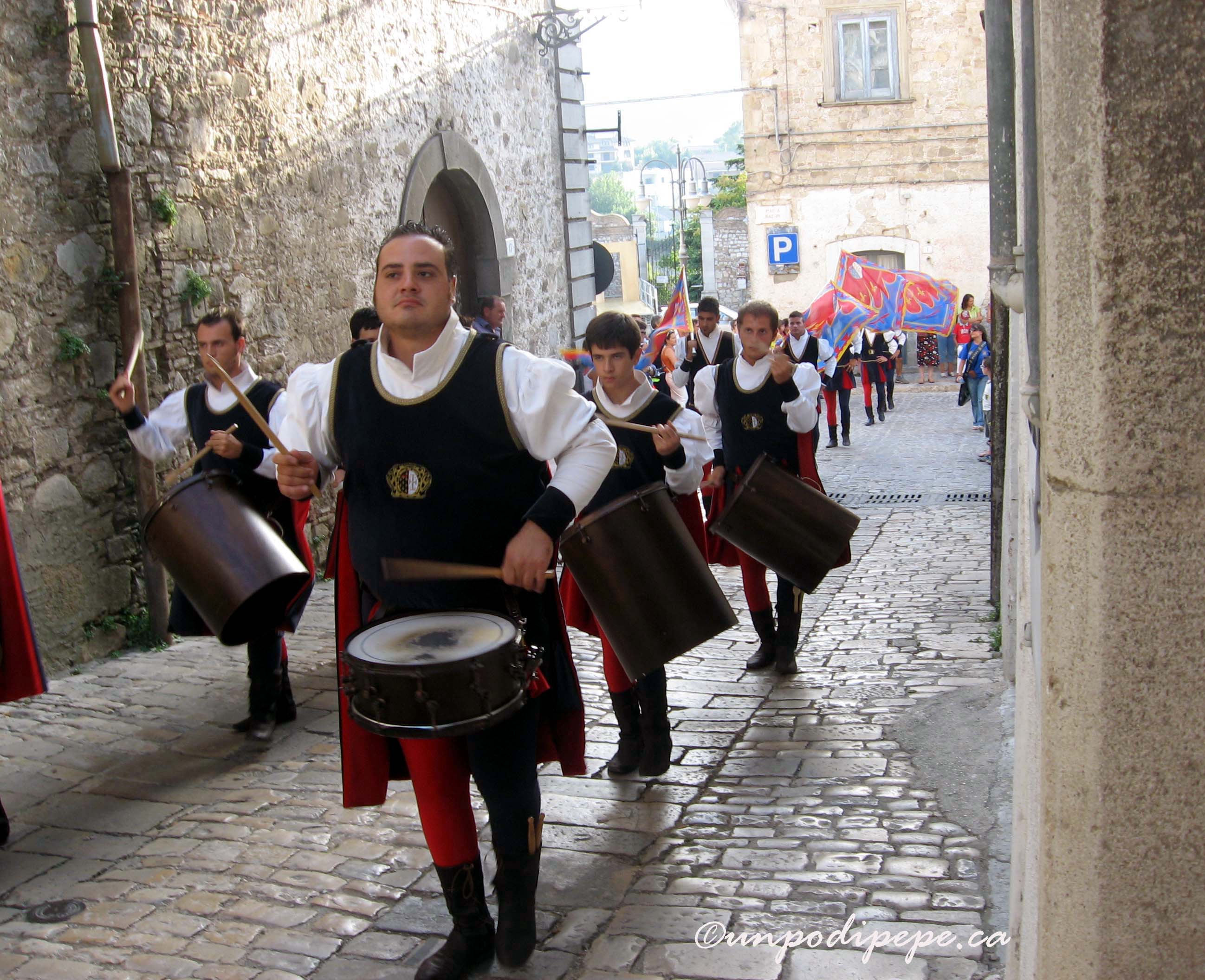
This photo was taken in Orsara di Puglia during the ‘Corteo Storico’, a parade in period costume, reenacting the history of the village. These sbandieratori (flag throwers) came from nearby Lucera to perform. Here, they are in between performances, engaged in casual conversation. What struck me about this image were the bold colours and composition of the costumes and flags. I was also curious to know what their conversation was about….was it early Renaissance gossip, or the latest cell phone app?

In Italiano:

Questa foto è stata scattata ad Orsara di Puglia durante il ‘corteo storico’, una sfilata in costume medioevale, che racconta la storia del paese.  Questi sbandieratori sono venuti da Lucera.  Qui li vediamo in attesa di sfilare, impegnati in una conversazione.  Quello che mi ha colpito sono stati I colori vibranti e la composizione che si è create tra I costume e le bandiere.  Ero anche curiosa di sapere di cosa parlavono…..chiacchiere medioevale o dell’uscita di una nuova app per il telefono?

The mission of Accenti, “the magazine with an Italian accent,” and Accenti Online http://www.accenti.ca is to bring together readers and writers around the idea of shared cultural experience, encourage creative expression, and act as a bridge between cultures. The 2015 photo and writing competition is now accepting submissions. If you are interested in finding out more, go to http://www.accenti.ca/photo-contest or http://www.accenti.ca/writing-contest.

The word Sbandieratori is related to the word bandiera (flag) and is pronounced zban∙ dee∙ ear ∙a∙ tow∙ ree. Say it a few times….now say it faster.

Here are a few more photos from the ‘Corteo Storico’ in Orsara di Puglia:

Sbandieratori, corteo storico, Orsara di Puglia

Sbandieratori, corteo storico, Orsara di Puglia

Corteo Storico, Orsara di Puglia

Corteo Storico, Orsara di Puglia

Share this:

  • Share on Facebook (Opens in new window) Facebook
  • Share on Pinterest (Opens in new window) Pinterest
  • Share on X (Opens in new window) X
  • Email a link to a friend (Opens in new window) Email
  • Share on WhatsApp (Opens in new window) WhatsApp
Like Loading...
Newer posts →

Enter your email address to follow 'un po' di pepe' and receive notifications of new posts by email.

Join 511 other subscribers
Follow Un po' di pepe on WordPress.com

Popular Posts

  • Hairstyling in Ancient Roma
    Hairstyling in Ancient Roma
  • Grano Arso
    Grano Arso
  • Cucina Italiana Patrimonio UNESCO
    Cucina Italiana Patrimonio UNESCO
  • Napoli Street Art
    Napoli Street Art
  • Italiano per Ristoranti~How to pronounce your restaurant menu
    Italiano per Ristoranti~How to pronounce your restaurant menu
  • Hostaria Antica Roma~Eat like an Ancient Roman
    Hostaria Antica Roma~Eat like an Ancient Roman
  • Puglia~Mia Regione Preferita
    Puglia~Mia Regione Preferita

Recent Posts

  • Cucina Italiana Patrimonio UNESCO
  • 2025~Un po’ di pepe Year in Review
  • Castel del Monte
  • ‘The Nuances of Love’
  • Hostaria Antica Roma~Eat like an Ancient Roman
  • Santa Maria in Aracoeli
  • Casino dell’Aurora~Villa Boncompagni Ludovisi
  • Nasoni di Roma
  • Bloghiversario #11
  • Fontana di Trevi
  • Acqua Vergine
  • Giubileo 2025
  • Sanremo 2025
  • In Vino there are Memories
  • A Literary Harvest
  • 2024~Un po’ di pepe Year in Review
  • Buon Natale 2024
  • Il Bicerin
  • Mercato Porta Palazzo
  • Torino
  • Catanzaro, Calabria
  • Il Pumo Pugliese
  • Artemisia Gentileschi
  • Cavalli di San Marco
  • Panzerotti

Categories

Amici e Famiglia Architecture Art Art history Art projects Bilingual posts Blogging Canada Culture Feste Firenze Inspiration Italia Italian Folklore Italian language Italian life Italocanadesi Libri Mangiamo! Orsara di Puglia Parole piacevoli Photography Puglia Recipes Roma Travel Travel tips Uncategorized Vino

Archives

Un po’ di pepe on Facebook

Un po’ di pepe on Facebook

Start a Blog at WordPress.com.

  • Subscribe Subscribed
    • Un po' di pepe
    • Join 511 other subscribers
    • Already have a WordPress.com account? Log in now.
    • Un po' di pepe
    • Subscribe Subscribed
    • Sign up
    • Log in
    • Report this content
    • View site in Reader
    • Manage subscriptions
    • Collapse this bar
 

Loading Comments...
 

    %d