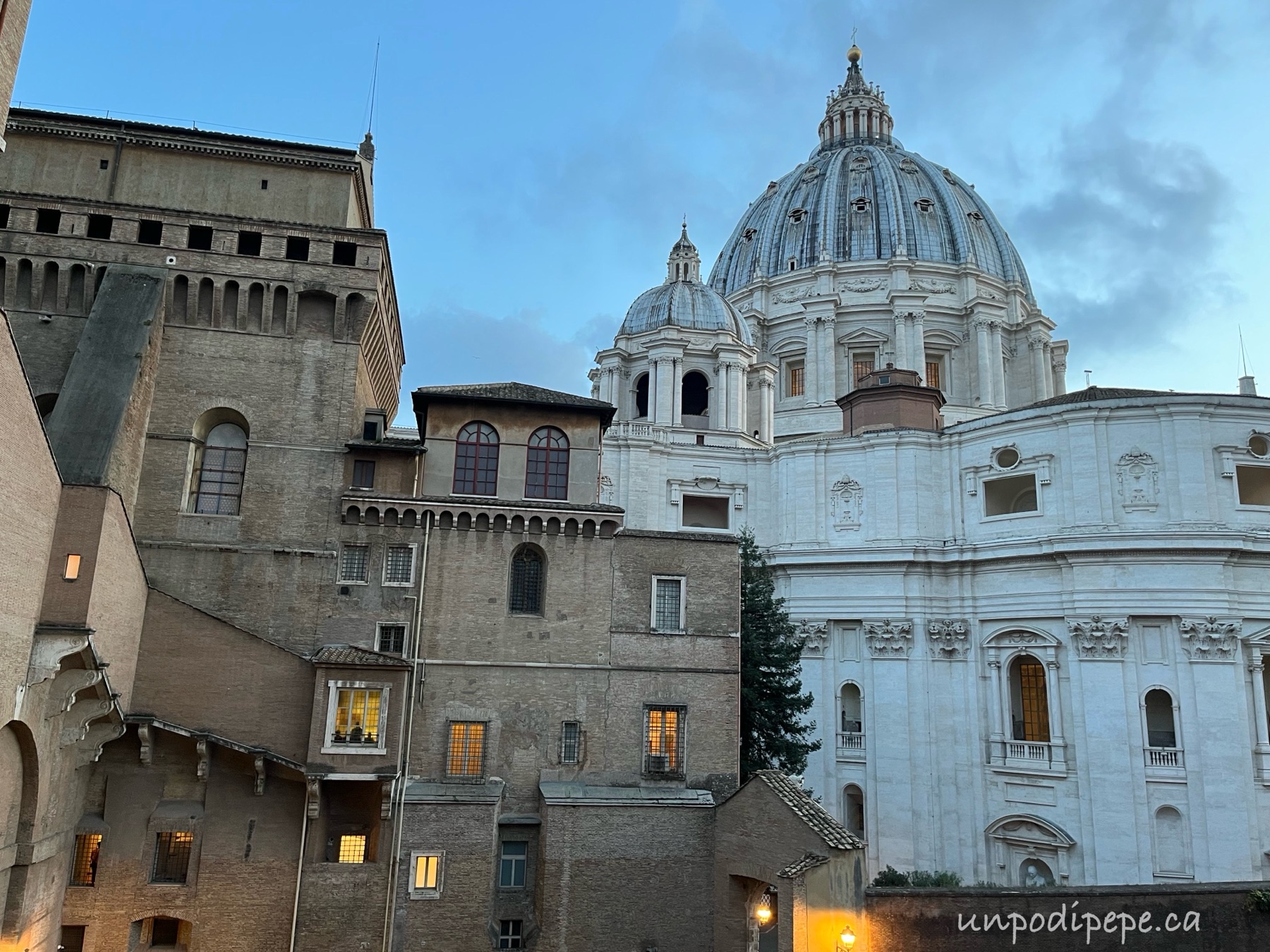
In Vino there are Memories

Tags

, , , , ,

To celebrate my birthday, today I am posting my story from the recently published anthology ‘A Literary Harvest: Canadian Writing about Wine and other Libations’.  I hope you enjoy it as much as I enjoyed writing it.  It is followed by an Italian translation.  Per l’italiano, leggi sotto.  Salute!….

When I look into a glass of wine, I see more than a delicious beverage to sip and enjoy. I see tradition and family, and a piece of my cultural heritage. I think of my Nonno’s vineyard in Puglia and I imagine my ancestors tilling the soil. I also imagine the journey the grapes made, coming from Greece and the Balkans millennia ago, then again across the Atlantic to North America. Immigrant journeys, similar to ours.

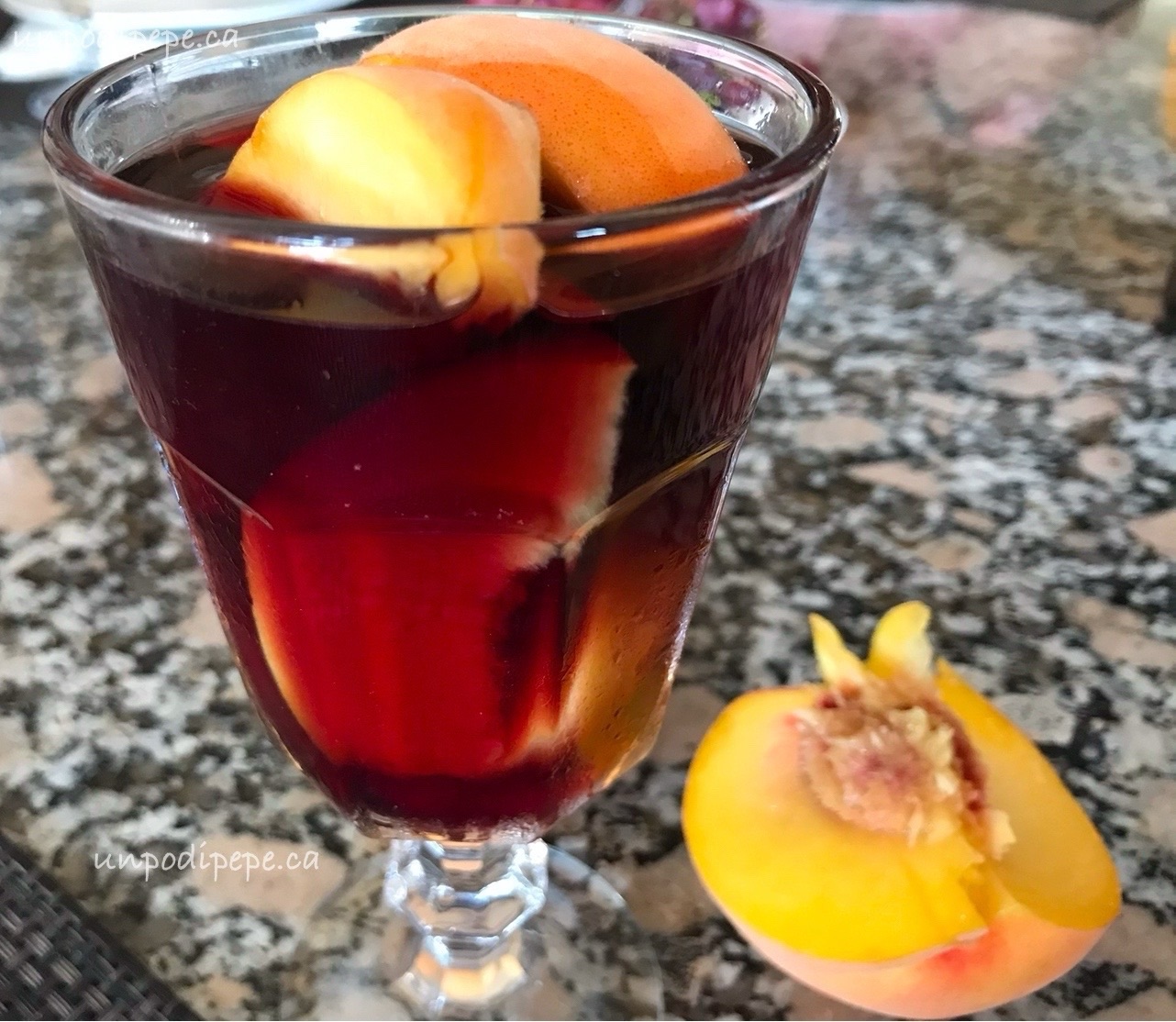
Wine is an integral part of growing up in an italocanadese family and is a staple of every family function. Everyone was allowed to have a bit of vino with dinner – it was exciting and made us feel grown up. Even when we were little … at first with 7-Up, Sprite or Ginger Ale, and eventually straight vino. In the summer, everyone looks forward to la pesca in vino. This involves cutting up a fresh peach, placing the slices in a glass, then filling it with vino. After the wine is consumed, lovely, sweet, wine-saturated peach slices await you for dessert. The peach slices take up most of the space in the glass, so the amount of wine to drink is really very little.

Wine making season is mid- to late-September, right after the pomodori are canned and stored in the cantina. The grapes grown in the back-yard garden are mostly for eating, so wine grapes are purchased from the Okanagan Valley. This is an area with summer weather similar to southern Italia … hot and dry during the day and colder at night. This combination produces the sweetest grapes.

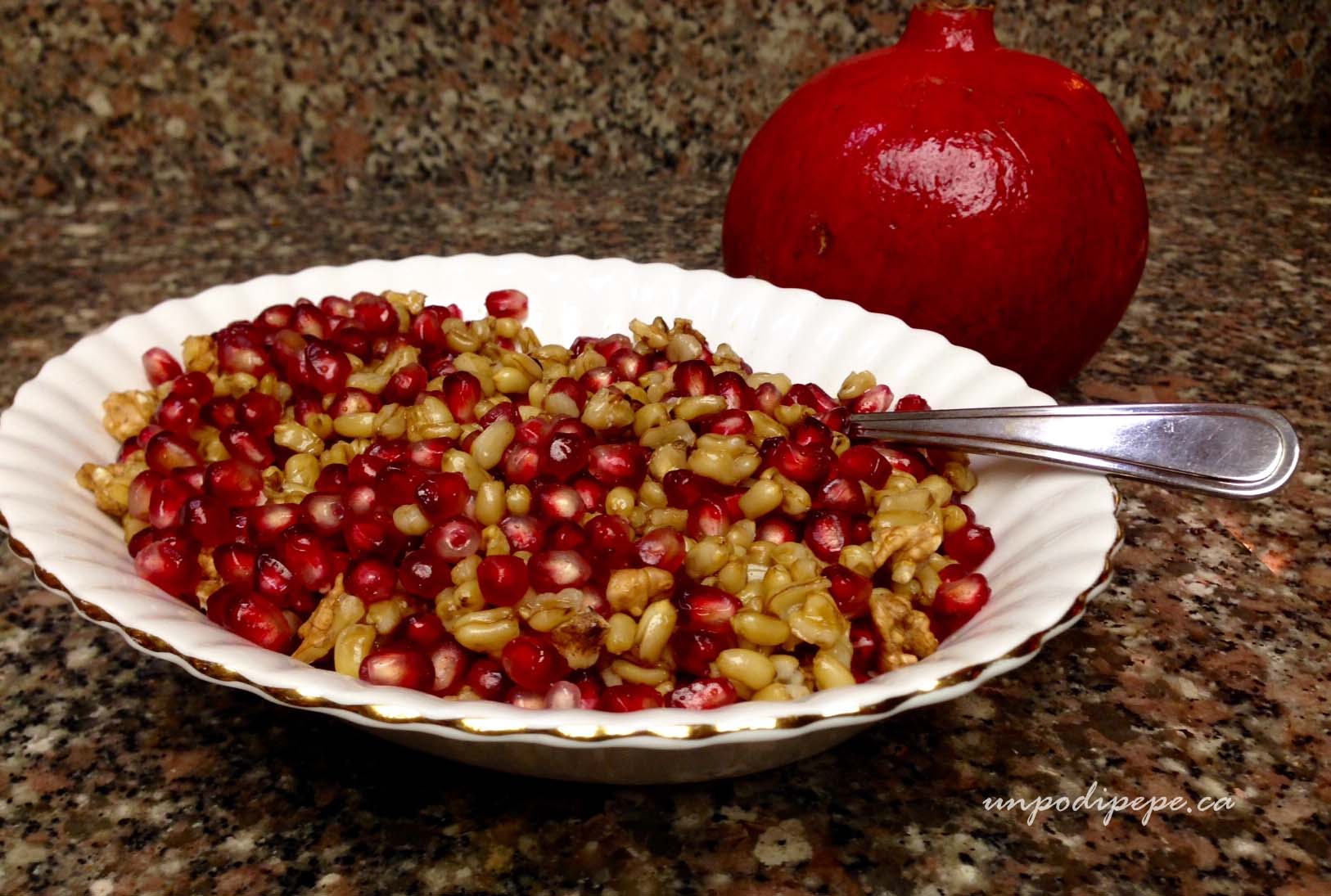
Making vino is a real family affair. When the grapes arrive, everyone who is free lends a hand, even the little ones, the nipotini. We help cart the boxes of grapes from the truck and empty them straight into the hand cranked grape crusher on top of a barrel.  Everything goes in;  skins, seeds and stems. Then we break apart the boxes, or else the wasps soon descend- Vespe know a good thing when they smell it! All month the aroma of fermenting grapes fills the garage!Mamma takes some of the mosto, the wine must, and boils it down like molasses to make vino cotto.  It really should be called mosto cotto, but we have always called it vino cotto. The thick, sweet liquid is poured over boiled wheat berries on November 1st to celebrate Tutti i Santi, All Saints’ Day. This traditional dish, in the local dialect, is called muscitaglia, from the words in Greek and Latin mosto and talia (grain). Walnut pieces and pomegranate seeds are added when available. Vino cotto is also drizzled on cartellate, a traditional Pugliese Christmas treat, and even on snow, like a vino cotto slushie!

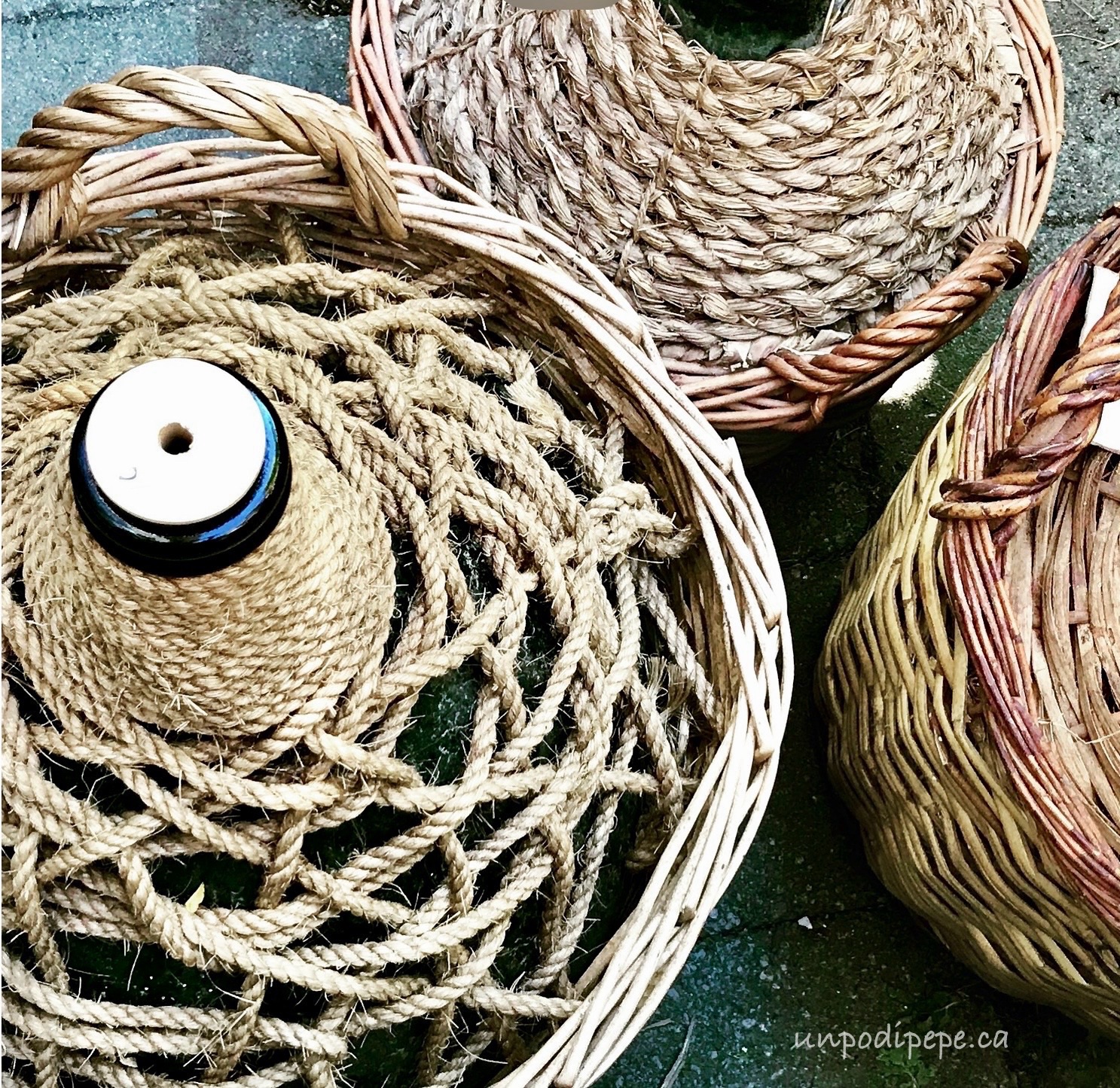
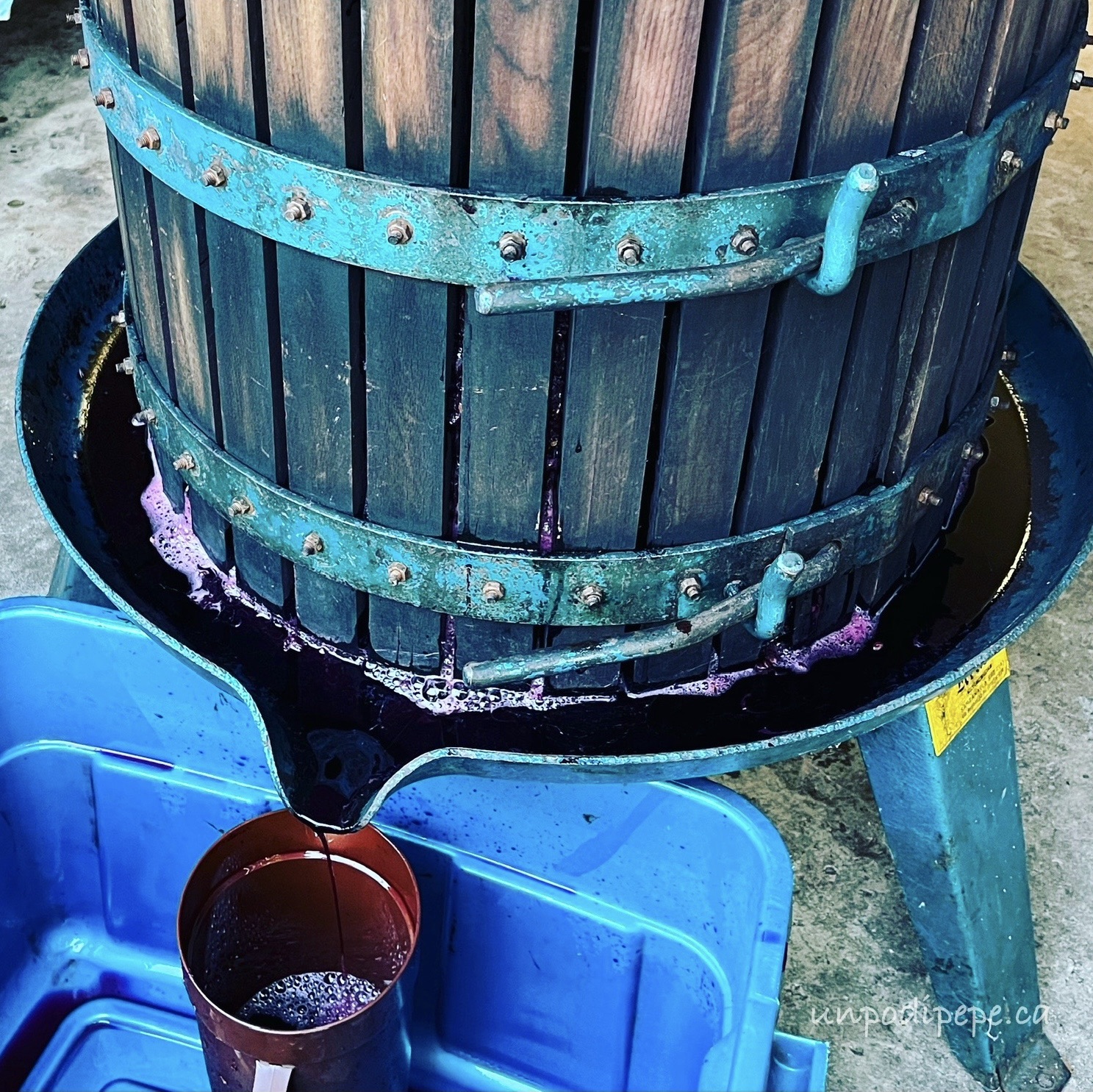
When ready, the fermented grapes are transferred to the old wooden torchio, for pressing. Since there are no preservatives added, our vino is stored in large, bell-shaped, wicker-covered glass damigiane, and siphoned into bottles only as needed. The wine needs to be tramutato a few times. This involves transferring it from one damigiana to another, to remove sediment. Like everything else Papà does, this is done according to the phases of the moon. Vino is tramutato during la luna calante, the waning moon, although the damigiane are still left open to air. On November 11th, the feast day of Saint Martin, the new vino is tasted and then the damigiane are closed until bottling. The old proverbs say “A San Martino, ogni mosto diventa vino” which means “On St Martin’s Day, every must turns into wine”, and ‘A San Martino, si lascia l’acqua e si beve vino’, ‘On Saint Martin’s Day, one abandons water and drinks wine’.

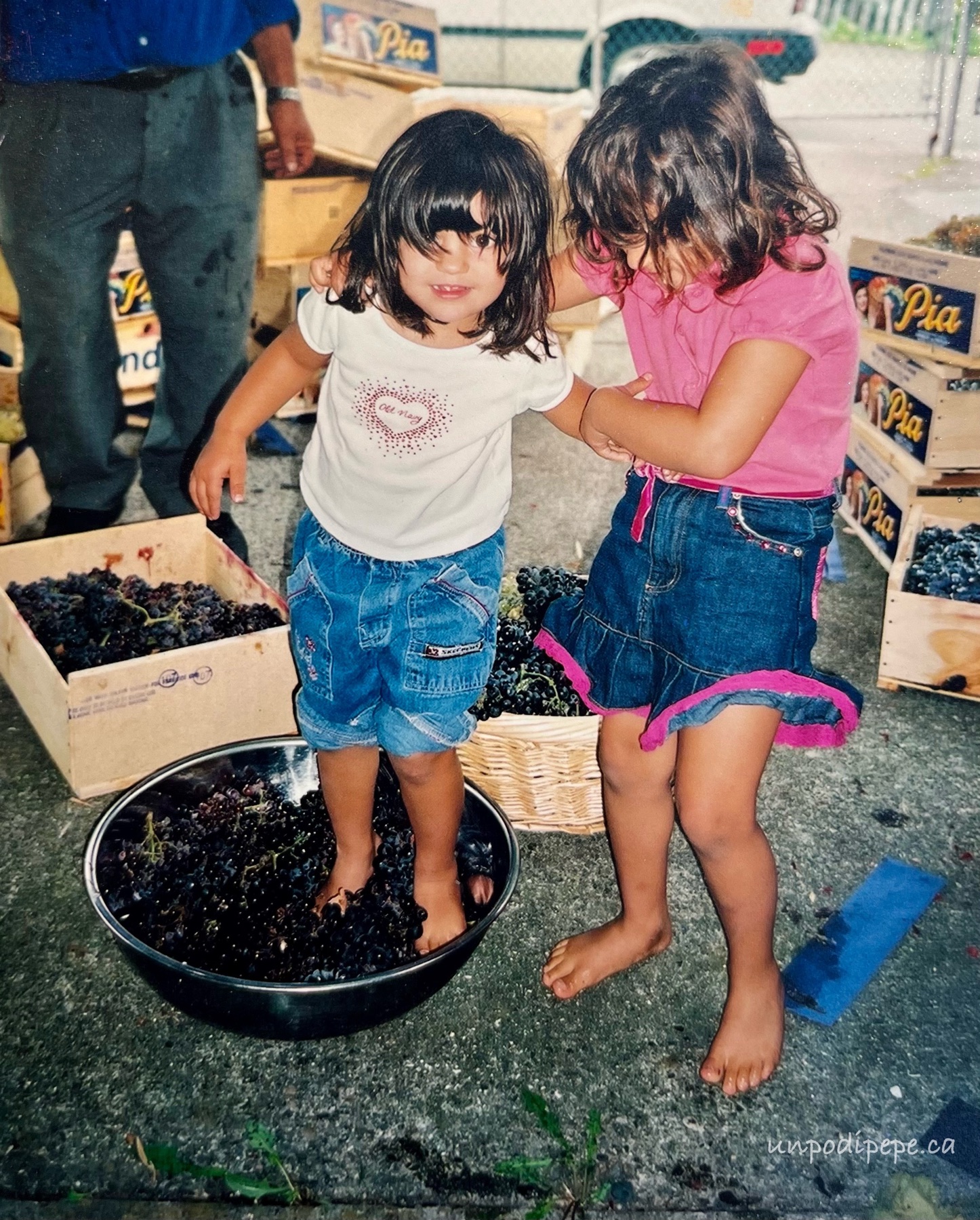
Papà makes the best vino. No sulfites or preservatives, just pure fermented grape juice. It has a full, robust flavour and does not leave you with a headache. Whenever anyone (anyone non-Italian, that is), asks him how he makes such good vino, he always has the same answer. “Ok … I tell you” … then he gets all dramatic… “for 2 weeks … I no wash the feet…” You can see where this is going. It is amazing how many people sit there open-mouthed for a few minutes and actually believe him! That is, until they see the mischievous smirk on his face. Just for fun, all of my nipotini have had photos taken à la “I Love Lucy,” crushing grapes in a half barrel or tub with their bare feet. These grapes are not added to il torchio, even though they did wash their feet. Salute!

         Published in ‘A Literary Harvest:  Canadian Writing about Wine and Other Libations. Editors Licia Canton, Giulia De Gasperi & Decio Cusmano.  Longbridge Books, 2025, p 94-96.

In Italiano:

Nel Vino ci sono Ricordi

Quando guardo dentro un bicchiere di vino, vedo più di una bevanda deliziosa da sorseggiare e gustare. Vedo tradizione e famiglia, e un pezzo del mio patrimonio culturale. Penso al vigneto di mio nonno in Puglia e immagino i miei antenati che coltivano la terra. Immagino anche il viaggio che hanno fatto le uve, provenienti dalla Grecia e dai Balcani millenni fa, poi di nuovo attraverso l’Atlantico fino al Nord America. Viaggi di immigrazione, simili ai nostri.

Il vino è parte integrante della crescita in una famiglia italocanadese ed è un elemento fondamentale di ogni festa familiare. A tutti era permesso bere un po’ di vino a cena: era emozionante e ci faceva sentire grandi. Anche quando eravamo piccoli… all’inizio con 7-Up, Sprite o Ginger Ale, e alla fine vino puro. In estate, tutti aspettano con ansia la pesca in vino. Ciò comporta tagliare una pesca fresca, mettere le fette in un bicchiere, quindi riempirlo di vino. Dopo aver consumato il vino, deliziose, dolci, fette di pesca sature di vino ti aspettano. Le fette di pesca occupano la maggior parte dello spazio nel bicchiere, quindi la quantità di vino da bere è davvero molto ridotta.

La stagione della vinificazione va da metà a fine settembre, subito dopo che i pomodori sono stati inscatolati e conservati in cantina. L’uva coltivata nel orto sul retro è destinata al consumo umano, quindi l’uva da vino viene acquistata nella Okanagan Valley. Questa è una zona con un clima estivo simile a quello dell’Italia meridionale… caldo e secco durante il giorno e più freddo di notte. Questa combinazione produce l’uva più dolce.

La produzione del vino è una vera e propria faccenda di famiglia. Quando arriva l’uva, tutti quelli che sono liberi danno una mano, anche i più piccoli, i nipotini. Aiutiamo a trasportare le casse di uva dal camion e le svuotiamo direttamente nella pigiatrice a manovella in cima a una botte. Ci mettiamo dentro tutto: bucce, semi e raspi. Poi rompiamo le casse, altrimenti le vespe scenderanno presto: le vespe sanno riconoscere una cosa buona quando la sentono! Per tutto il mese l’aroma dell’uva in fermentazione riempie il garage!

Mamma prende un po’ di mosto di vino, e lo fa bollire come la melassa per fare il vino cotto. Dovrebbe chiamarsi mosto cotto, ma noi lo abbiamo sempre chiamato vino cotto. Il liquido denso e dolce viene versato sui chicchi di grano bolliti il ​​1° novembre per celebrare la festa di Tutti i Santi, il giorno di Ognissanti. Questo piatto tradizionale, nel dialetto locale, è chiamato muscitaglia, dalle parole in greco e latino mosto e talia (grano). Pezzi di noce e semi di melograno vengono aggiunti quando disponibili. Il vino cotto viene anche versato sulle cartellate, un dolce natalizio tradizionale pugliese, e anche sulla neve, come un granita di vino cotto!

Quando è pronto, l’uva fermentata viene trasferita nel vecchio torchio di legno, per la pressatura. Poiché non vengono aggiunti conservanti, il nostro vino viene conservato in grandi damigiane di vetro a forma di campana, ricoperte di vimini, e travasato nelle bottiglie solo quando necessario. Il vino deve essere travasato un paio di volte. Ciò comporta il trasferimento da una damigiana all’altra, per rimuovere i sedimenti. Come ogni altra cosa che fa Papà, questo viene fatto in base alle fasi lunari. Il vino viene travasato durante la luna calante, anche se le damigiane vengono comunque lasciate all’aria aperta. L’11 novembre, giorno della festa di San Martino, si assaggia il vino nuovo e poi le damigiane vengono chiuse fino all’imbottigliamento. I vecchi proverbi dicono “A San Martino, ogni mosto diventa vino” e “A San Martino, si lascia l’acqua e si beve vino”.

Papà fa il miglior vino. Niente solfiti o conservanti, solo puro succo d’uva fermentato. Ha un sapore pieno e robusto e non ti lascia il mal di testa. Ogni volta che qualcuno (chiunque non sia italiano, ovviamente) gli chiede come fa a fare un vino così buono, lui ha sempre la stessa risposta. “Ok… ti dico”… poi diventa tutto drammatico… “per due settimane… non si lavano i piedi…” Puoi capire dove vogliamo arrivare. È incredibile quante persone se ne stanno lì a bocca aperta per qualche minuto e ci credono davvero! Cioè, finché non vedono il sorrisetto malizioso sul suo viso. Solo per divertimento, tutti i miei nipotini si sono fatti fotografare alla “I Love Lucy”, mentre schiacciavano l’uva in una mezza botte a piedi nudi. Quest’uva non si aggiunge al torchio, anche se si lavano i piedi. Salute!

Pubblicato in ‘A Literary Harvest: Canadian Writing about Wine and Other Libations. editors Licia Canton, Giulia De Gasperi & Decio Cusmano. Longbridge Books, 2025, p 94-96.

A Literary Harvest

Tags

, , , ,

It is finally here!  Today I received ‘A LITERARY HARVEST: Canadian Writing about Wine and other Libations’ (previously known as The Canadian Wine Anthology). When a book with your writing arrives in the mail, it is so exciting!  I am one of the 42 writers in this anthology.

A LITERARY HARVEST:  Canadian Writing about Wine and Other Libations, Eds. Licia Canton, Giulia De Gasperi and Decio Cusmano.  From the blurb ‘The writings presented in A Literary Harvest give us new understanding and diverse perspectives in making and drinking wine and other libations.  This volume introduces or re introduces the writing of 42 authors.  Their text and unique drinking voices form a potable Canadian Literature’.

Contributors:  Nic Battigelli Carolyn Bennett, Licia Canton, Glenn Carley, George Elliott Clarke, Renée Cohen, V.A. Colucci, Joan Crate, Sheldon Currie, Domenic Cusmano, Victoria Dickenson, Francesca Favaro, Terri Favro, Amanda Feder, Anna Fornari, Anna Foschi Ciampolini, Keith Foster, Veena Gokhale, Jacob Hogeterp, Karen Klassen, Alexandra Korey, Penelope Laurence, CarolL. Mackay, Antonio Mauriello, Aislinn McDougall, Adam McDowell, Heather McGuire, Rosanna Micelotta Battigelli, Carmelo Militano, Earl Murphy, Mariam S. Pal, Cristina Pepe, Damiano Pietrapaolo, Giovanna Riccio, Peppino Ruggeri, Laura Sanchini, Jeremy R. Saunders, Christopher Sisca, Christine Sigismondo, Glen Sorestad, Carmine Starnino and Carolyne Van Der Meer

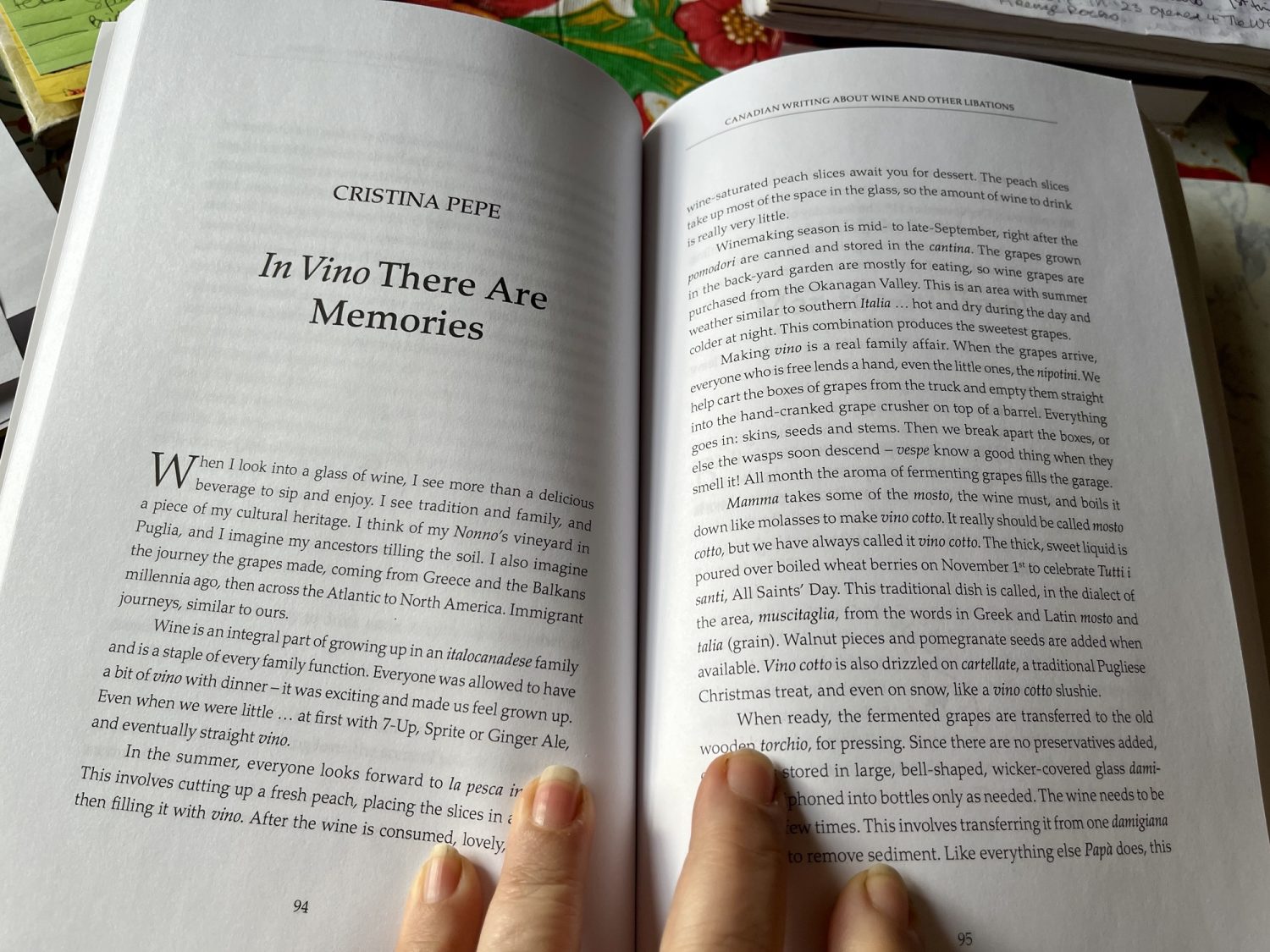
My contribution is titled ‘In Vino there are Memories‘ and it is about my family’s wine and winemaking traditions. It may be featured it in a blog post soon, but for now, if you have great vision, try and read a few paragraphs here:

To order a copy for yourself or for all of the wine enthusiasts in your life, order on the Accenti magazine site here or email info@longbridgebooks.com.  Publication date January 2025, ISBN:  978-1-928065-27-2, 310 pages, $34.95.  Free delivery in Canada/US for orders of $60 or more. The gorgeous cover will go well with any wine collection. Grazie mille to the editors for all of their hard work!

Salute, Cristina

2024~Un po’ di pepe Year in Review

Tags

, , ,

As we prepare to ring in 2025, here is a look back at 2024 on Un po’ di pepe. Same amount of posts were published as last year, but with a lot more views. I am still hoping to write more post-there are many partially written ones in progress!

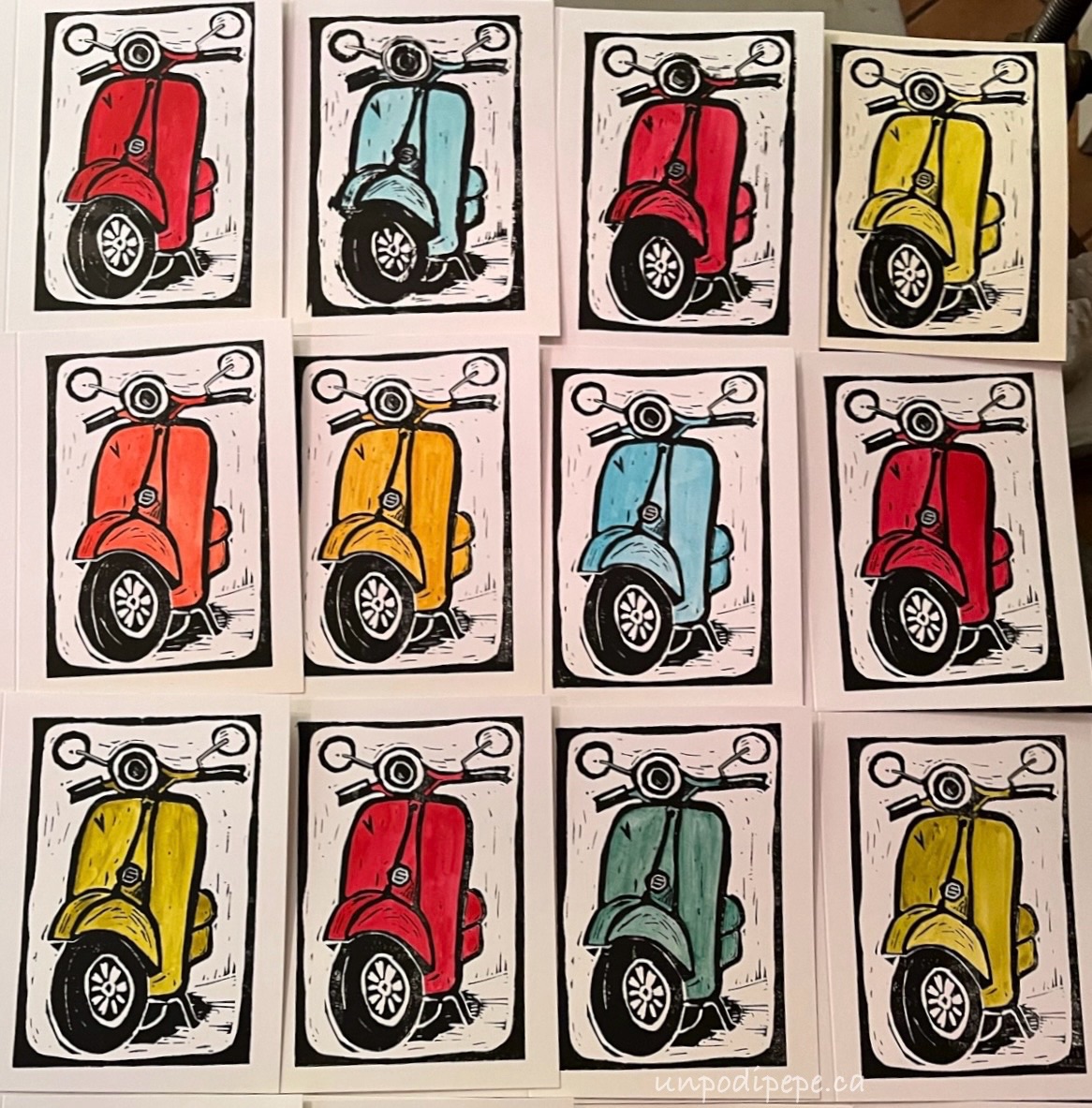
In April Un po’ di pepe celebrated 10 years of blogging, and I had a ‘Vespa’ hand printed linocut card giveaway for 10 readers. I still have to find 2 of you-Frank and Kathryn!

During my annual trips to Italia, I always try to visit 1 or 2 new places.  In 2024 I went to Calabria for the first time-definitely not the last time. Read about it in the post Catanzaro, Calabria.

In September I attended the AICW Biennial Conference in Toronto, reading a humorous, updated version of Aria Pericolosa.

WordPress sends me end of year stats which I love to share because they are so interesting.* In 2024, Un po’ di pepe had a huge increase in viewers-over 21,500 views from 131 different countries!  I know you are wondering, so I looked it up and there are 195 countries in the world! There were also over 12,000 google searches.

The top 10 posts (11 actually because of a tie) of 2024 are listed below, with links included in red, in case you missed any of them.  7 of the top posts of the year appear on the first page of a google search.  This is fantastic!  Most are not commonly searched topics but I am still impressed. 

Based on the number of views, the top posts of 2024 are:

#10 Che Cavolo-Non Rompere le Scatole! To celebrate Week of the Italian language in the World 2023, I published a post to liven up your language skills, using euphemisms to swear ‘politely’. Why is there a photo of flying genitalia?  Read the post to find out!

Flying cazzi amulet mobile at the Napoli Airport gift shop


#9 Artemisia Gentileschi
 I have wanted to write this 2024 post on one of my favourite artists since starting the blog, so I am thrilled it got some love. Art history rocks!

Self-portrait as the Allegory of Painting 1638-39 Royal Collection, Windsor Castle

#8 Espresso Cookies  My 2016 espresso cookie recipe is consistently viewed, but it has only appeared in the top 10 once before this year.

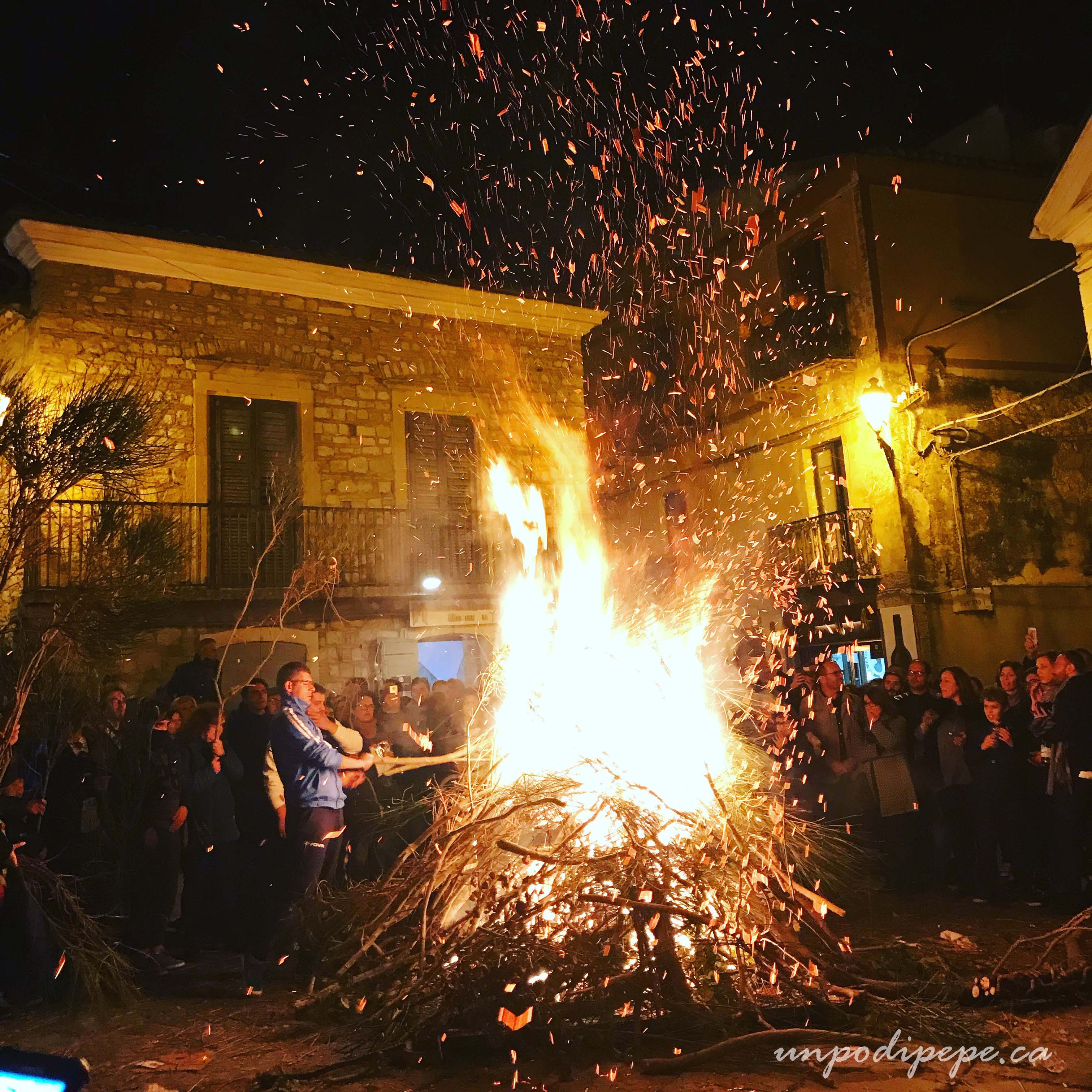
#7 Tutti i Santi This 2018 post was written after I attended the annual November 1 festa in Orsara di Puglia to honour the departed with bonfires and carved pumpkins. I previously wrote about this event in another post Fucacoste e Cocce Priatorje, but at the time had not attended in person yet.

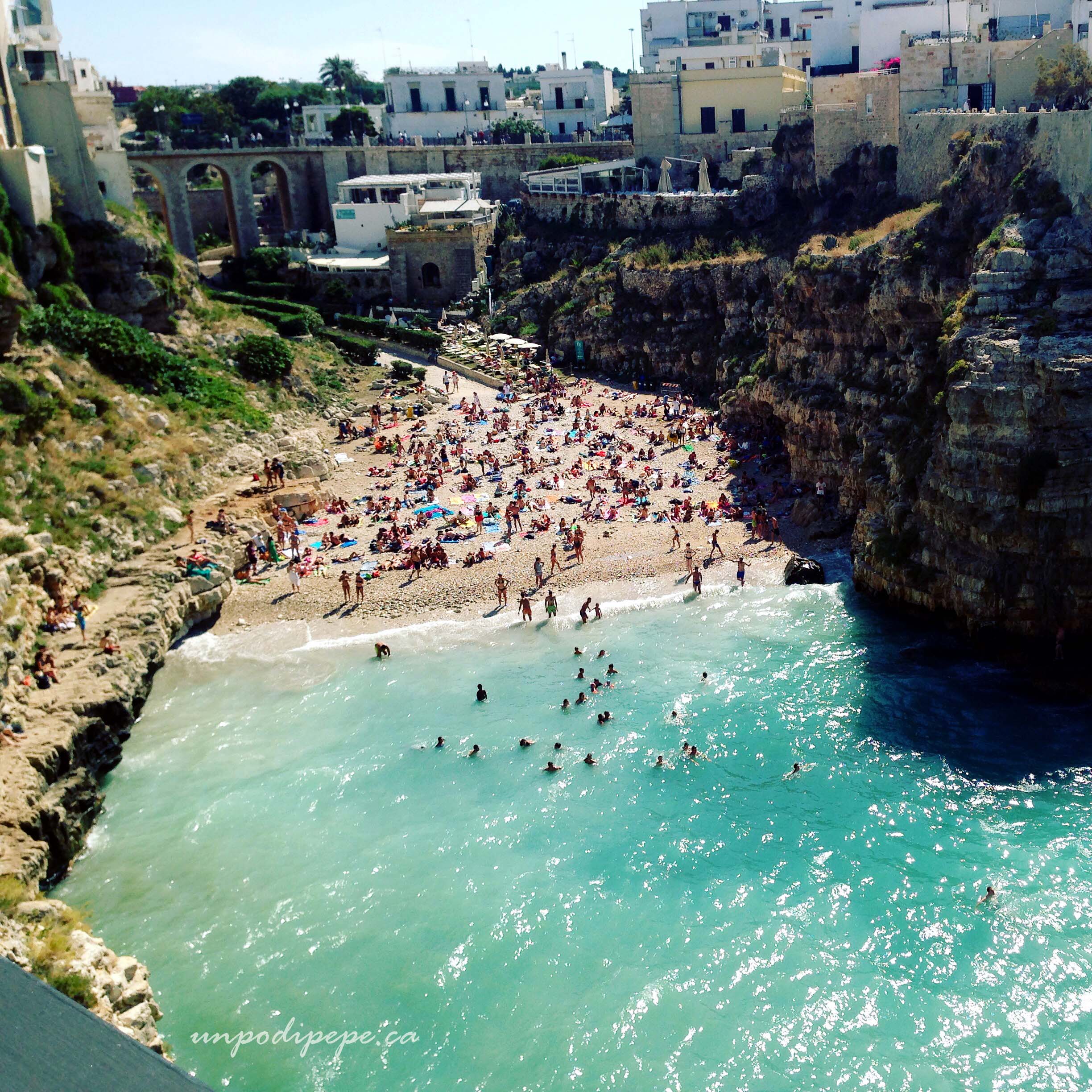
#6  Polignano a Mare In this 2016 post about the stunning clifftop town on the coast of Puglia, read about my probable encounter with the mysterious ‘stair poet’  and learn what infraditi are. I was in Polignano again this year, so need to write a Polignano a Mare 2.0 post.

#5b La Madonna della Neve  August 5th is the feast day of la Madonna della Neve, one of Orsara di Puglia‘s patron saints.  This is the first time this 2016 post has been in the top 10, and it is fitting, because in 2024, the statue celebrated its 400th anniversary. Orsara’s beloved Madonna della Neve statue was carved out of a single piece of quercia (oak) by Napoletano sculptor Aniello Stallato in 1624. #5a Internment of Italian Canadians  This 2021 post was written on the 81st anniversary of the internment if Italian Canadians during World War 2, to coincide with a formal apology from the Canadian government.  It always amazes me how little is known about this subject.  This is the first time this post appears in the top 10 list.

#4 Italiano per Ristoranti-How to Pronounce your Restaurant Menu, this 2014 handy Italian menu pronunciation guide was #1 for many years, and has always been in the top 4.  In a google search for ‘Italian menu pronunciation’ it comes out as the top suggestion! Molto cool! A 6 page downloadable PDF is available via a link at the end of the post. It was downloaded 94 times in 2024! I would like to expand and turn it into an ebook someday. Speriamo! If any of you have experience or advice on this, let me know! Ravioli di ricotta e spinaci

#3 Napoli Street Art I absolutely love Napoli, a perfect place for self-expression since only the last few thousand years. Join me on a graffiti/street art tour in the Centro Storico. This 2020 post comes up 3rd in a Google search .I have  been to Napoli several times since writing this, and have enough new street art photos for a 2.0 version.volto di Sophia Loren Napoli street art#2 Sanremo 2024 For the third year in a row, I wrote a handy viewing guide to the 5 day Festival di Sanremo Italian song contest held in February, and it was well received, so I plan to keep doing it every year. In 2025 the festival is February 11-15.

#1 Hairstyling in Ancient Roma This 2017 post was on the top 10 list last year for the second time, and I am sooooo thrilled to see it is in first place again this year-by a landslide!  I am not sure why? I know some views have been referred via Pinterest and it now ranks 2nd in Google search, after Wikipedia. Another art history post of mine that suddenly had lots of views was because it was being used for a class by a college in California. Join me as I study ancient hairstyling practices by looking at Classical sculptures and paintings. Most of the research was done at Palazzo Massimo.  Yeah for archeology nerds!

For 2025 my goals are simple and the same as usual….less stress, more exercise, more art, travel and writing! 

I was just recently published in an Anthology along with 41 other writers.  You will be hearing about A Literary Harvest soon!

In July I will be attending a family wedding in Roma! Yipee!!!

To find out what I am up to, check out the Un po’ di pepe Facebook page and Instagram (@unpodipepe).  I know many of you read new posts only when they are posted on Facebook, but with the new algorithms, you are likely to miss them most of the time.  To get notified of new posts, it is best to sign up with your email in the top right hand corner of the home page. You will only receive an email when I publish a new post.

I would love to hear which post you liked best, and what you would like to read more about in 2025 on Un po’ di pepe?  Let me know in the comments.  Looking forward to writing more cose interresanti /interesting stuff in 2025. 

Buon Anno a tutti i lettori di ‘Un po’ di pepe’, vicini e lontani!  Spero che 2025 porta buona salute e gioia a voi e ai vostri cari.  Happy New Year readers of  ‘Un po’ di pepe’, near and far.  I hope 2025 brings good health and joy to you and your loved ones!

Vi auguro un 2025 piena di gioia e buona salute!  Ciao, Cristina

Check out Italian Christmas Vocabulary for help understanding my seasonal greetings,

*Note…WordPress’ method of collecting stats is odd.  The newest post counts as a ‘Home page’ view until the next one is published and this definitely does affect the results, especially for those of us that do not post often.

Buon Natale 2024

Tags

,

Cari amici di ‘Un po’ di pepe’, auguro un buonissimo Natale e un meraviglioso nuovo anno piena di gioia e salute a voi e alle vostre famiglie!

Dear friends of ‘Un po’ di pepe’, wishing you and your families an incredibly Merry Christmas and a marvelous new year filled with joy and good health.

I love addobbi di Natale-Christmas ornaments and decorations.  They help me make it through the blah winter weather!  Here are some photos taken in and around my house to spread the cheer, starting with my corona dell’Avvento /Advent wreath.

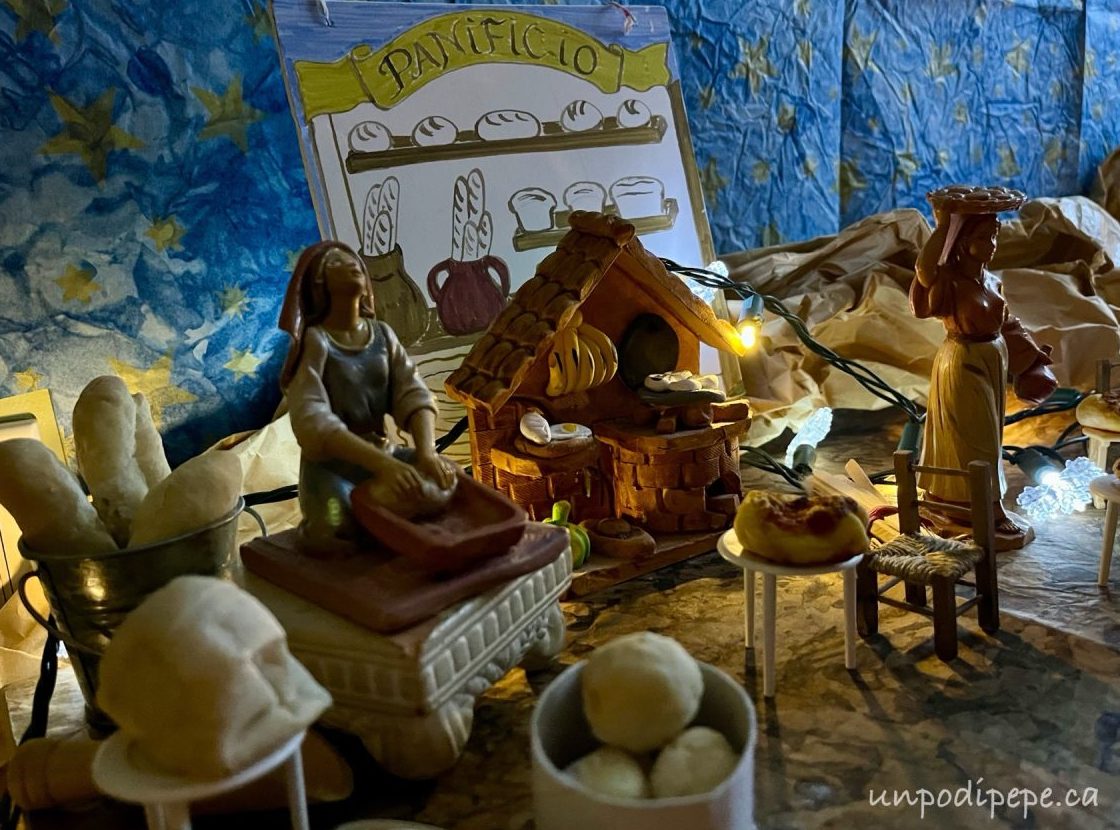
My newest addobbo/ornament was a gift from Roma in July. I love how it sparkles in the tree.The title photo is of my presepio.  I may have to find a bigger space for it next year.  Below is the panificio corner of Mamma’s presepio.  Notice how she bakes tiny bread loaves and baguettes-even focaccia Pugliese!Next is Mamma’s vicolo dei lavandai/ washerwomen’s alley.  I love the attention to detail, especially the washboards and clothesline.  The lavandaia on the left with the red scarf is from Via San Gregorio Armeni in Napoli.

This beautiful outdoor presepio in my neighbourhood looks like it was handpainted.

On the same street, Santa’s sleigh is pulled by weiner dogs!These classic old homes look beautiful all lit up-minus the inflatable Santa and Frosty.
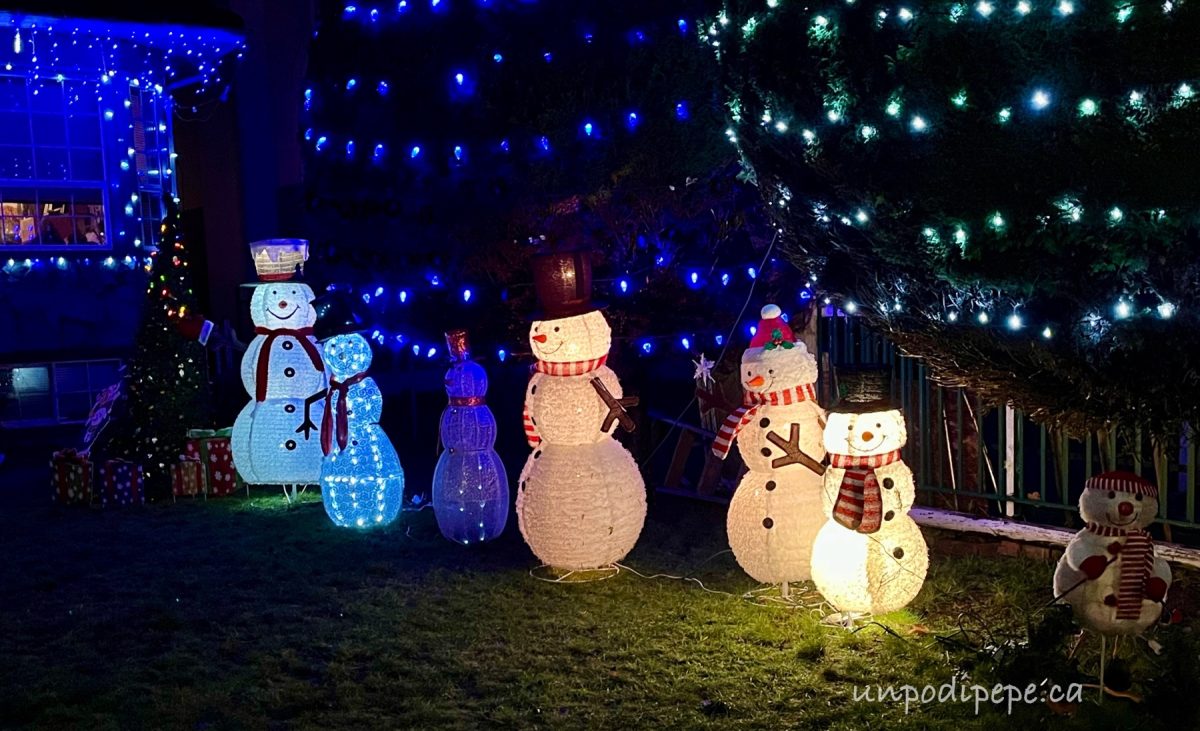
And finally, the snowman family is adorable!Un abbraccio, Cristina

Il Bicerin

Tags

, , ,

November weather is dark and dreary, and has me craving a nice warm Bicerin. Bicerin (bee • SHEH • reen) is the official, historic drink of Torino.  The Bicerin was invented in 1763, at the newly opened Caffè Confetteria Al Bicerin in Piazza della Consolata.

Al Bicerin’s strategic location opposite the Santuario della Consolata, where the King and Royal Family attended Mass on Sundays, made it a popular spot and the beverage became well-known.

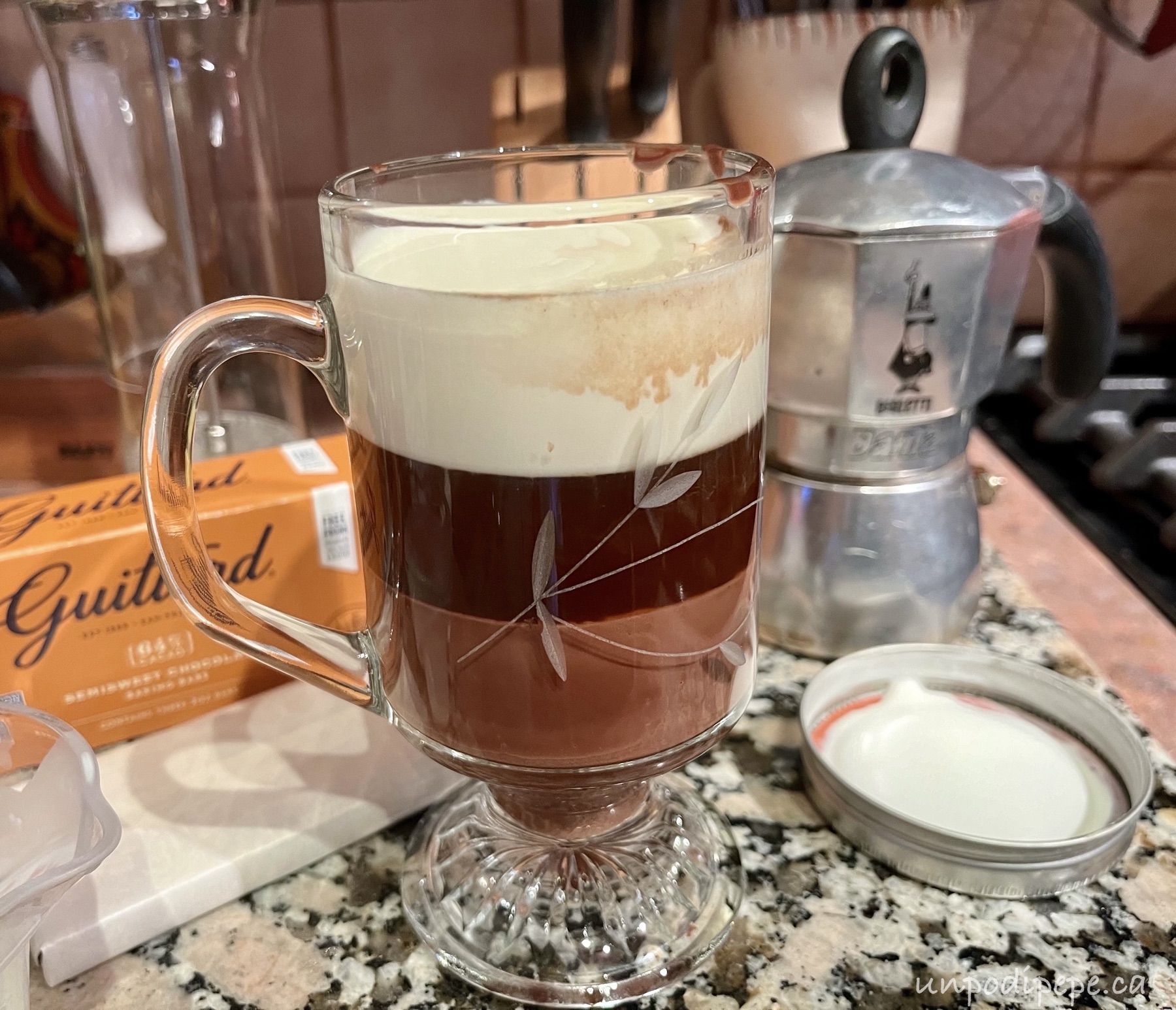
The secret recipe is made with local dark chocolate, espresso and frothed fior di latte, and served in a small stemmed glass.  The drink is actually named after the glass, Bicerin being local dialetto for bicchierino, meaning small glass. The glass is clear so that all 3 layers are visible.  A Bicerin is not supposed to be stirred, so that the temperature and texture of each layer can be tasted separately and blend on the palate.

The facade of Al Bicerin is still original and stepping inside is like travelling back in time. The counter, the cabinet filled with glass jars of Confetti and the woodwork is from the 19th Century.

I went to Al Bicerin twice while I was in Torino.  Since the weather was nice, I sat outside both times, but the inside is inviting and cozy.  Perfect for a cold, wet November day. The photo below was taken just before closing.

Count Camillo Cavour, the first Italian Prime Minister always sat in the same corner on his daily visit to Al Bicerin. Now there is a photo of him in his angolo. Other famous patrons include Picasso, Puccini, Nietzsche, Alexandre Dumas, Umberto Eco, and Ernest Hemingway, who apparently called the Bicerin one of the 100 things in the world worth saving!

A fun fact about Caffè Confetteria Al Bicerin is that since 1763, it has always been managed by women!

In 2001, the Bicerin was finally recognized by the region of Piemonte as a traditional Piemontese beverage. Order with a plate of local cookies, which can include canestrelli, torcetti, krumiri, savoiardi and baci di dama.

Bicerin is now served in all of the historic caffè places in Torino but it will be slightly different than the original recipe at Caffè Confetteria Al Bicerin, located at Piazza della Consolata 5 in the Quadrilatero area.

Other historic places to have Bicerin in Torino include:

Baratti e Milano- Piazza Castello 29

Caffè Torino- Piazza San Carlo 29

Caffè Fiorio- Via Po 8/C

Farmacia del Cambio- Piazza Carignano 2

Pepino Piazza Carignano- 8

Pfatish Via Paolo Scacchi- 42

I did some experimenting at home to try and reproduce a Bicerin.  My final product did not taste or look exactly the same, but it was delicious, and the taste-testing ‘research’ was fun.  It takes a bit of juggling to have all 3 layers ready to assemble at once, so do not get discouraged if the first attempt does not look pretty.

Cristina’s attempt at Bicerin

Ingredients:

  • 60 ml (2 oz) light cream*
  • 60 ml (2 oz) chopped 70% dark chocolate, ideally Venchi or other quality brand**
  • 60 ml (2 oz) freshly made espresso doppio/double shot
  • 60 ml (2 oz) frothed whole milk or light cream (must be cold)*

A 300-360 ml (10-12 oz) clear, heat-proof stemmed glass

Instructions:

  • Prepare heat-proof glass by warming with hot water
  • Prepare caffettiera for espresso
  • Pour light cream* and chopped chocolate into a small pan over low heat and whisk until thick.  Meanwhile, make espresso
  • Shake milk/cream in a small jar for 2-3 minutes

Assemble the Bicerin:

  • Pour hot chocolate into warm glass
  • Using the back of a spoon, carefully pour espresso towards the side of glass
  • Carefully add shaken milk/cream
  • Do not stir!

*Consistency wise, there is no North American equivalent to Italian fior di latte (milk cream) or panna (cream).  I experimented using combinations of whipping cream and milk.  My best results were using a mixture of half whipping cream and half whole milk (3%).  This is what I recommend using for both the hot chocolate and the topping. 1 part whipping cream and 2 parts whole milk also works.

**A Torino produced chocolate such as Venchi is best to use.  I used Guillard as it was the best good quality chocolate I had available.

Espresso cookies go perfectly with Bicerin.  Buon appetito, Cristina

Mercato Porta Palazzo

Tags

, , ,

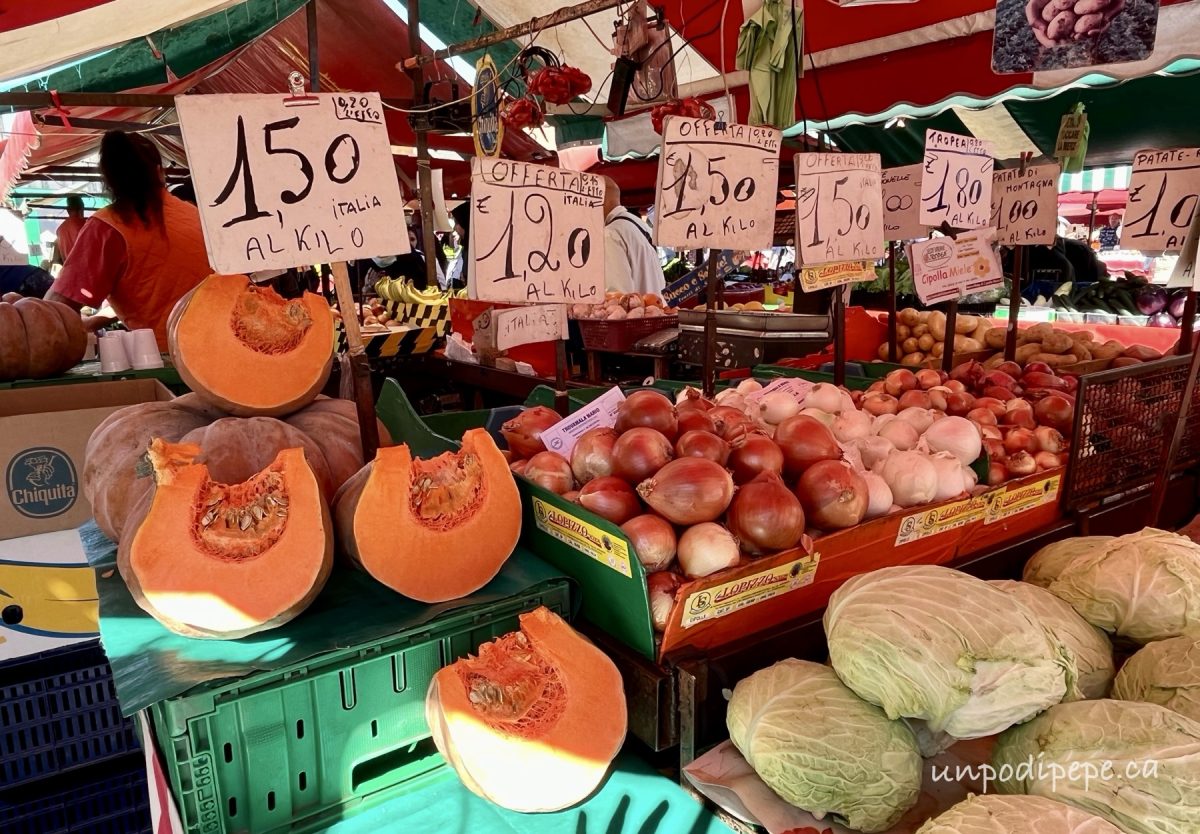
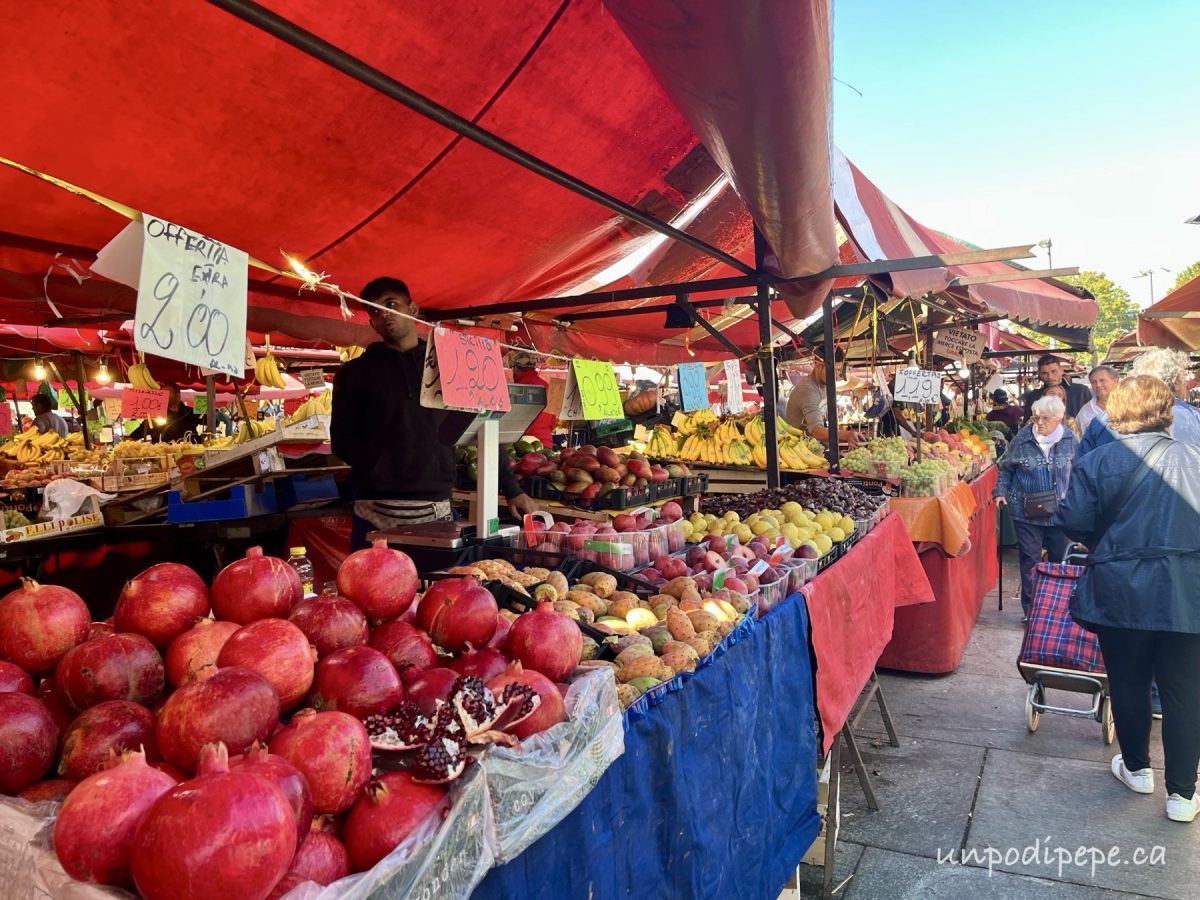
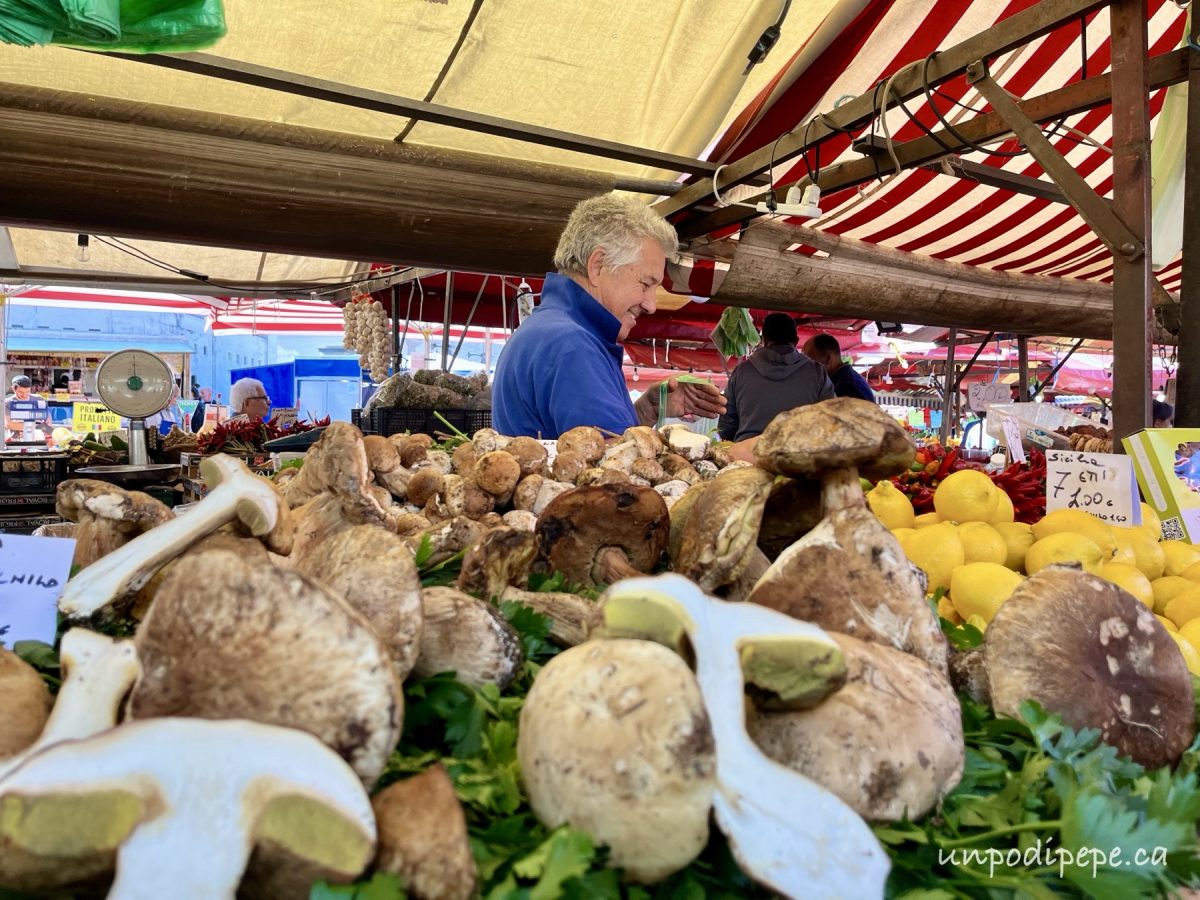
Torino’s Mercato Porta Palazzo in Piazza della Repubblica is the largest open-air market in Europe. My first morning in Torino, I took a walk through the mercato with Lucia from turinepi.  While we walked, I took so many photos of the produce and the bancarelle -the market stalls, that I had to dedicate an entire post to them. Established in 1835, Porta Palazzo is a collection of outdoor and covered market spaces. The bancarelle host vendors from all over, selling products from food and wine to flowers, clothing, shoes and housewares.

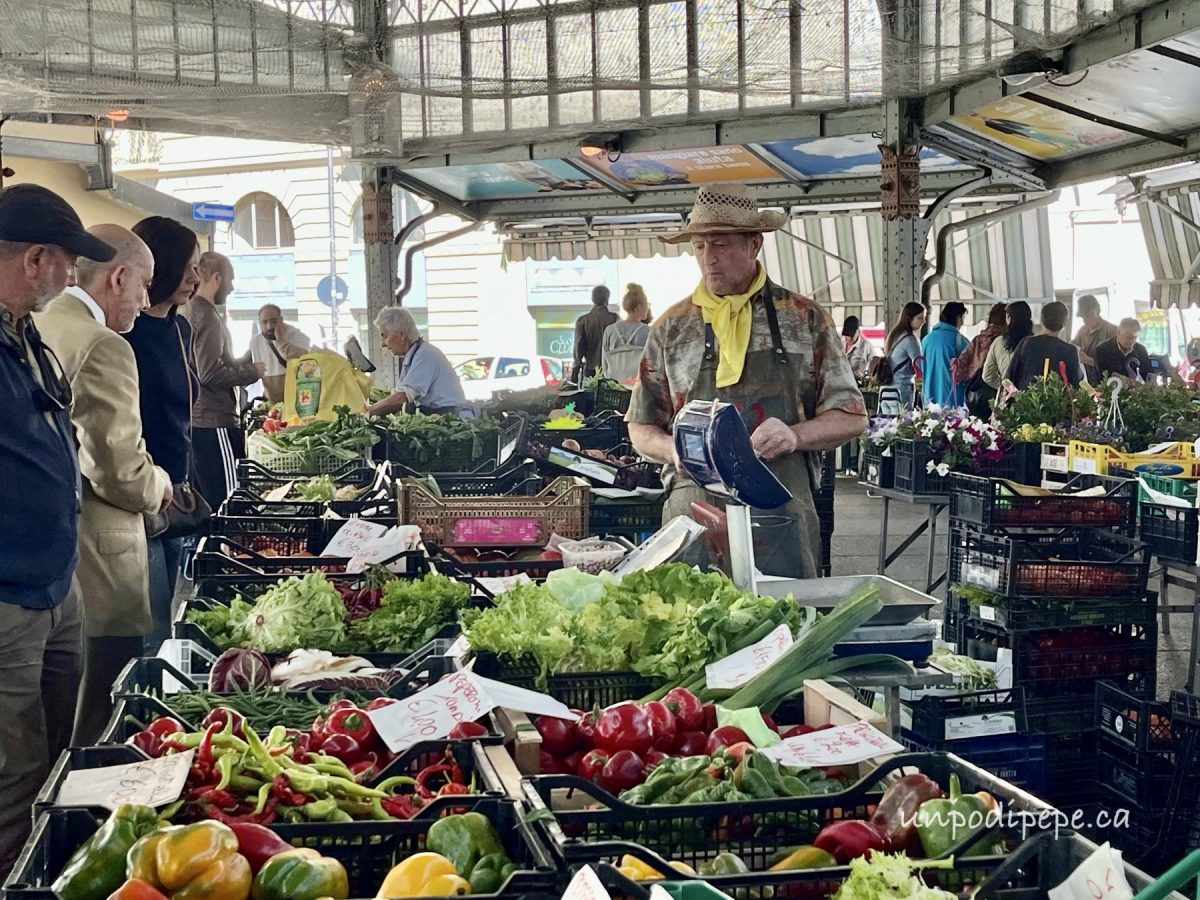
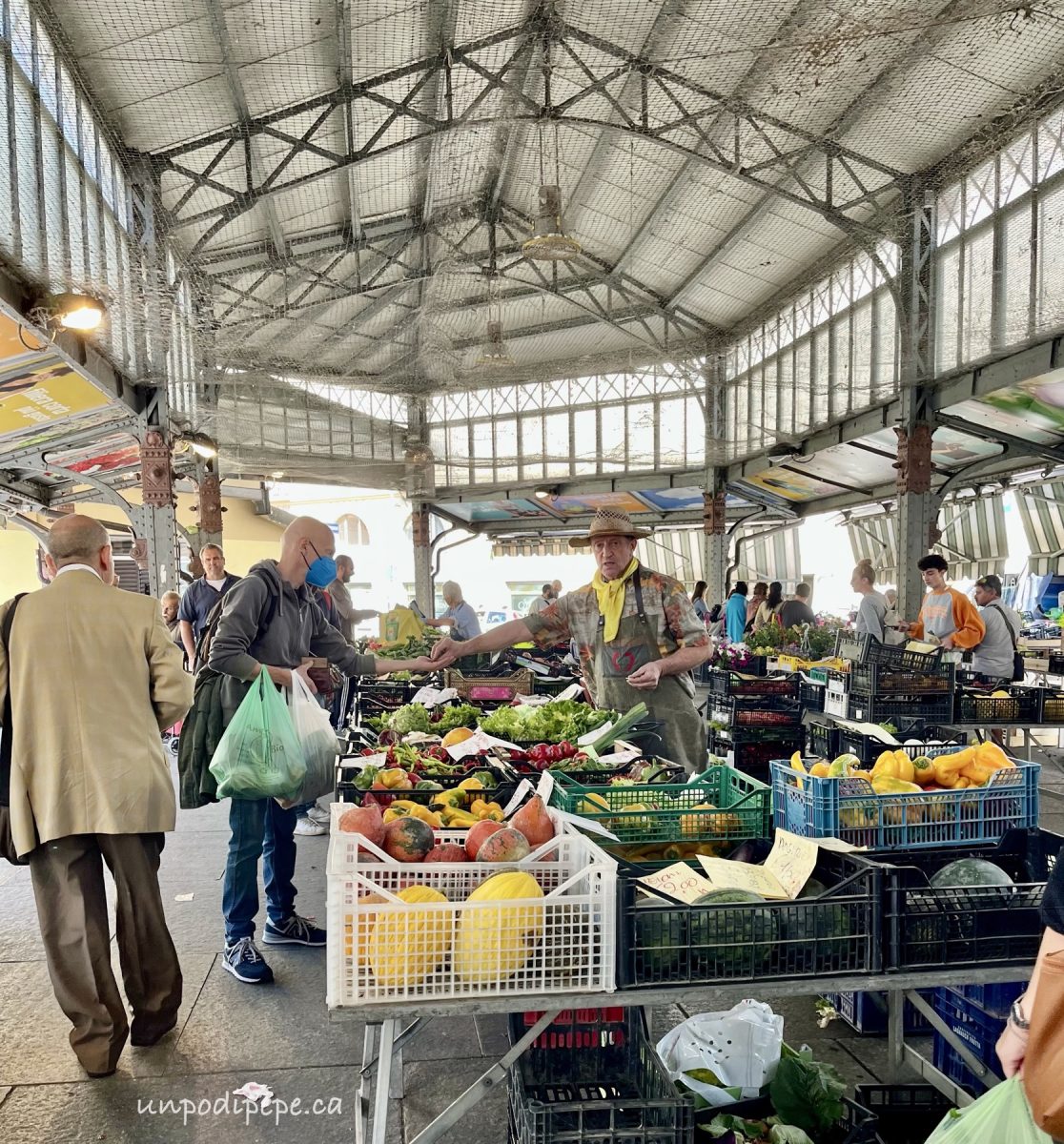
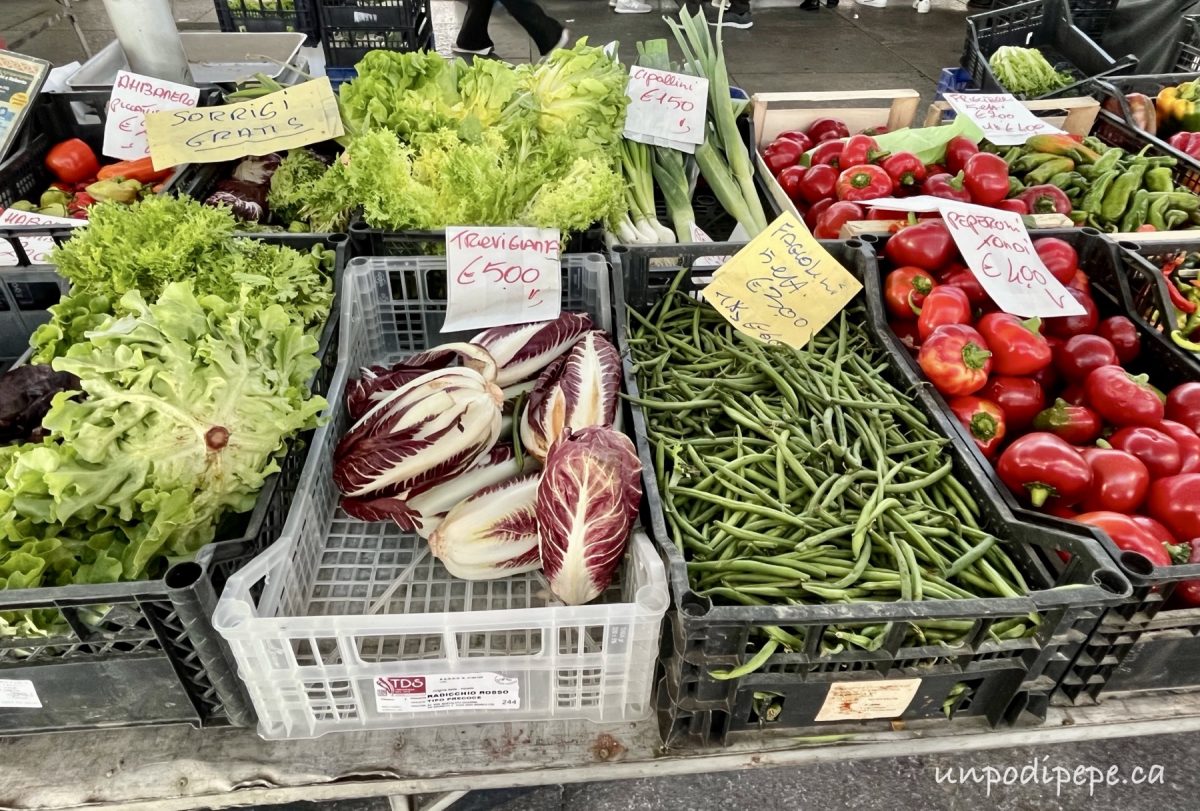
The covered glass pavilion is the local farmers market.  Look at the gorgeous radicchio.  This vendor with the hat is Lucia’s favourite.The produce is surprisingly well-priced.  Porta Palazzo is a clean and lively space.  The Torinesi call it Porta Pila, and do much of their shopping here. The space is huge, so there can be thousands, of people, especially on Saturdays, when many shoppers even drive in from France!A good place to snack, or to taste and see local food, as well as other ethnic specialties. Porta Palazzo is an explosion of colour and a feast for all of the senses-flavours, aromas, colours, sounds and languages.
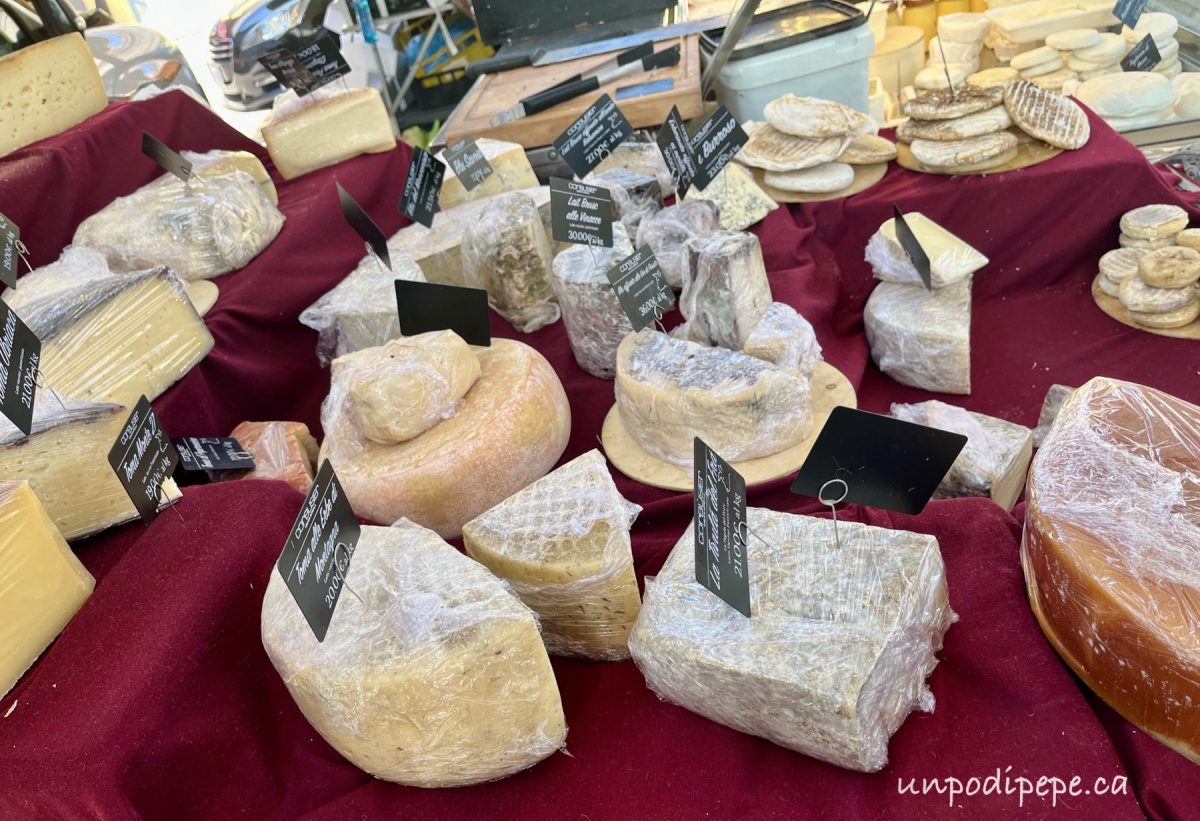
Formaggi can be found from Piemonte and every region of Italia

Besides the bancarelle and pavilion, there are also 4 structures on the site: Mercato Ittico e Alimentare, built in 1826, L’antica Tettoia dell’Orologio, a 1916 metal art deco building, Mercato dell’abbigliamento-the clothing market, and Mercato Centrale di Torino, built in 2011.  A food lover’s Heaven! Also, more formaggi!

Mercato Porta Palazzo is a 5 minute walk from Piazza Castello.  From Piazza Castello, take Via Garibaldi, turn right onto Via Milano, then walk straight until you reach Piazza della Repubblica and the mercato.

Mercato Porta Palazzo is open from 8:00-12:00 Tuesday to Friday, and 7:00-19:30 Saturday. The mercato is closed Sunday and Monday.

More info on Mercato Porta Palazzo can be found on their website.

Buon viaggio, Cristina

Torino

Tags

, , , ,

I had no expectations when I visited Torino.  I knew that many of my paesani had moved to the area in the 1970-80’s to look for work, but did not know much about the city itself.  Torino turned out to be a pleasant surprise-a truly underrated, overlooked city on the banks of the river Po, at the foothills of the Alps. With a population of almost 850,000, it is the fourth largest city in Italia but practically unknown to English speaking travellers. It is much less crowded, quieter and cheaper than most other major cities.

L’Universita’ di Torino

I arrived in Torino by highspeed train (TGV) from Paris, to attend an AICW conference at the Università di Torino.  Once the conference started, I only had the evenings to explore the city, so could not visit any buildings/museums.  This is why many of my photos were taken at night!  I need to return to Torino to visit the indoor things!

Named for the ancient Taurini people, the Roman Colony of Taurinorum was founded in 28 BC.  Via Garibaldi, the main shopping street traces the exact path of the ancient Roman street or Decumanus.

Torino was the capital of the Duchy of Savoia, the political center of the Risorgimento (birth of the nation) leading to unification of Italy, and the first capital of the Kingdom of Italy after unification in 1861. The capital moved to Roma in 1865.  Torino was also the center of anti-fascist movements and the Italian resistance movement during WW2.  A lot of history here!

Elegant and sophisticated, Torino has an old world feel, like Paris or Prague, but with an Italian accent.  There is a definite French influence from the Savoia family, even on the local dialetto. The stunning architecture in the centro includes Baroque, Rococo, Neoclassical, Romanesque and Art Nouveau. Most buildings were built between the 16-18th centuries.  In 1997, the historical Center of Torino and residences of the Royal House of Savoia became a UNESCO World Heritage Site.

Torino’s centro, the largest pedestrian area in Europe, is easy to navigate. A defining characteristic of Torino’s architecture are the portici (porticoes). 18 km (7 miles) of portici provide shade in summer and shelter from rain, snow and wind.  12.4 km are continuous.  According to legend, King Vittorio Emanuele I wanted Torino to be elegant and also wanted to go on his daily walk to the river Po without getting wet.  So he had the portici built -and now everyone can window shop in all weather conditions.  A whole day can be devoted to walking the portici. Torinesi use them a lot!

Torino is known for, the Shroud of Turin, artisanal chocolate, museums, Royal Palazzi of Savoia, FIAT, Juventus, 2006 winter Olympics, Eurovision 2022, and home to the automotive industry with headquarters for Fiat, Lancia and Alfa Romeo. Torino is also the birthplace of Italian caffè culture, aperitivo, Nutella, Ferrero Rocher, gianduja, Lavazza, FIAT, Vermouth and the Slow food movement!

There are many large piazze, full of amazing architectural details, chocolate shops and places to have aperitivo.  Piazza Castello has the Royal Palaces, Palazzo Reale and Palazzo Madama.  Palazzo Madama was the residence of 2 Savoia queens, which explains the name.  It was also the 1st Senate of Italy.  Since 1934 it is a museum of ancient art-although mostly from middle-ages to 18th Century.  Palazzo Reale at the north end, with iron gates contains Armeria Reale, Galleria Sabauda and the Museo di Antichità. The Museo Nazionale del Risorgimento (unification museum) is in Palazzo Carignano.

I had the day before the conference free and met local expert Lucia Hannau from Turinepi for a morning walking tour.  We started in Il Quadrilatero, the oldest part of city, dating back to Roman times.  Piazza della Consolata is home to Caffè Al Bicerin since 1763. They make it in other historic bars, but this is the home of the original Bicerin- with the accompanying plate of local cookies. Bicerin is the iconic drink of Torino, with 3 layers, chocolate, caffè and frothed milk-no stirring!  Stay tuned for a future post! Santuario della Consolata, is across the piazza.  The Baroque exterior looks more like a neoclassical temple, the interior ornate and colourful, gilded and decorated with marble of different colours.

We ended at Mercato Porta Palazzo, Europe’s largest open-air market. My many photos will need a separate post. I had time for only 1 museum visit after my walk with Lucia, and it was Museo Egizio–the world’s oldest Egyptian museum and the largest collection of Egyptology outside of Cairo. Buy €14 tickets online as numbers entering at one time is limited.  If you go to Torino, do not miss this! Stay tuned for a future post.

The 167 m (550 ft) tall Mole Antonelliana is featured on the back side of the 2 € coin. Mole means ‘big mound’ and Antonelli was the architect who kept making it taller.  Originally planned as a synagogue, it barely escaped bombing during WW2.  Since 2000 it houses the Museo Nazionale del Cinema, an interactive cinema museum and the tallest museum in the world. It is also the tallest unreinforced brick building in the world (without steel girder skeleton). The top has impressive views of Torino and the Alps.  

The Holy Shroud (Sindone di Torino) is a linen cloth said to have covered the body of Jesus.  An important icon for pilgrims, kept in the Cathedral of San Giovanni Battista, but only displayed for the Jubilee every 25 years.  It will be on display in 2025.

Autumn is a perfect time to visit Piemonte, especially for the seasonal food….zucca, porcini, castagne, tartufo bianco, salsiccia,tajarin and agnolotti del plin.

Tajarin integrale con porcini, salsicce e formaggio Piemontese

Torino has a chocolate festival in November and the Salone dei Libri in May. Milano is only 1 hour by train. Stay 3-4 days if you can, as there is a lot to see in Torino!  I definitely recommend a walking tour with Lucia, Bicerin and the train from Paris!

Buon Viaggio, Cristina

Catanzaro, Calabria

Tags

, , , , ,

Calabria for beginners-I finally made it to Calabria!  Just a little slice of it, as an unexpected detour!  I have been wanting to see Calabria for years, but it never seemed to work out.  My amica Rosetta, lives in Northern Italia but spends the summers in Calabria.  She saw on a Facebook post that I was in Puglia and wrote me a comment ‘Vienici a trovare in Calabria’.  Of course, I said ‘si!’ and even managed to find a ride from one of my paesani who lives in Catanzaro Lido. Sometimes the stars just align.

Calabria, the ‘toe’ and ‘foot’ of the Italian boot, is one of the lesser travelled areas of the country, and also one of the least expensive to visit.  I was there during the last week of July and it was not crowded where I was.  Calabria is known for rocky coastlines, crystal clear water, beautiful beaches, ancient mountain villages, castles and archeological sites.  I saw all of the above.I only went to a small area of Calabria on the Ionian Sea (east coast) around the Golfo di Squillace, in the province of Catanzaro. This is the narrowest part of Calabria, so it is possible to drive to the west coast, to Tropea, in an hour and a half.  My friends are in Squillace Lido, and as soon as I arrived, we went to Catanzaro Lido for the Festa della Madonna di Porto Salvo.  The highlight of the festa was a sea procession.  The Madonna was in the large red-hulled boat and all the other boats followed.

Rosetta’s back yard was heavenly, with an olive tree and a view of the Ionian Sea.  She decided we had to wake up at 0543 to watch l’alba, the sunrise.  I am not a morning person, but it was totally worth getting up for, as you can see.

Every morning, we went to the beach -to Squillace Lido, and everyone I met-both on the beach, under an ombrellone, or in the water-was a cousin of Rosetta or her husband Enrico!  Some of these cugini lived in the area and some had moved to other parts of Italia, returning for the summer.  What an amazing thing!  It was so hot, I stayed in the water most of the time.  The sand was coarse, and my feet had a nice daily exfoliation.Even on the beach in Calabria, my Cinquecento radar was on high alert!

Squillace (skwee•LAH•cheh) population ~3500, was originally the Greek colony of Scylletium and then the Roman town of Scolacium.  I visited the Parco Archeologico Scolacium, which was formerly a large olive farm and orchard by the sea.  The site has Roman, Byzantine and Norman ruins.  It was discovered in the 1800’s by farmers, but not excavated until 1965. The residence of the former owner, Baron Mazza, is now the museum and you can also walk through the old olive mill.  The statues in the museum are covered in scrapes made by farm implements!  Ouch! Please read my friend Karen in Calabria’s post about Scolacium, she took better photos than mine.

Only a small part of the site has been excavated and it is still ongoing.  There are extensive mosaics that get worked on, then covered again until there is time and $ to excavate some more. Surrounding this magnificent olive tree, you can see stones ready to be excavated.Called ‘the pearl of the Ionian Sea’, Soverato was recently named the 3rd most beautiful beach in Calabria.  Soverato, population ~9000, is known for its beaches, boardwalk and nightlife.  I visited for an evening stroll along the boardwalk.  The beach looked almost otherworldly before sunset!

This night shot was taken from Baia dell’Est where we had pizza. Caminia is right below, then Pietragrande, and Soverato in the far distance. Below is the daytime version of this view.

What did I bring back from Calabria?  Peperoncini, also known as ‘Viagra Calabrese‘, Bergamotto-the citrus fruit used to flavour Earl Grey tea, and the famous cipolla rossa di Tropea -Tropea red onions.  This is where I bought my goodies.  Behind the Lanzellotti bancarella is a pepper tree-growing pepe rosso-red peppercorns!  Un po’di pepe!

Getting back to Orsara di Puglia was not so easy.  My options were to go to Lamezia Terme, take the train to Napoli and then take the bus to Foggia and another bus to Orsara, or take a 7.5 hour overnight bus from Catanzaro Lido to Foggia.  I chose the overnight bus so I could have an extra day at the beach!  At 7am my cugina met me for colazione in Foggia, then I took the bus to Orsara.  As mamma would say ‘una sfacchinata’!

Calabria seems to be even more badly connected with transportation than Puglia! Mannaggia! This makes it harder to get around without renting a car, but it is also one of the reasons these areas are less crowded and less pricey.  Tropea was apparently extremely crowded this year, as it has been getting a lot of attention since 2021. Despite the lack of convenient transportation, I will definitely be going back to see more of Calabria some time in the future!

Grazie to Rosetta and Enrico for inviting me to visit their little corner of paradise in Calabria!  Ciao, Cristina

Il Pumo Pugliese

Tags

, , , , ,

The Pumo is an artisanal decorative ceramic object in the form of a bud just about to flower, enclosed by acanthus leaves. It symbolizes the capacity to regenerate and form new life.  The acanthus leaves, the same ones found on ancient Greek and Roman Corinthian columns, symbolize long life and immortality.  For these reasons the pumo is a traditional Pugliese good luck charm, providing protection and bringing prosperity, happiness, good fortune and fertility.

The name pumo comes from the latin words pomum (fruit) and pumum (pine cone) and is tied to the cult of the goddess Pomona, protector of fruit.

Centuries ago, noble Pugliese families used pumi (plural) as ornaments on building facades, staircases, balconies, and at the foot of the bed of newly married couples. They were also frequently given as wedding gifts.  Pumi were originally only available to wealthy families, since they were the only ones who could afford decorative ceramics.  Today the pumo is an emblem of Puglia and is often used as a piece of jewellery, a bomboniera (wedding favour) or a souvenir from Puglia.   Sometimes they are in the shape of a rose bud or pine cone and can even be room fragrance diffusers, decorative lamps, candleholders or bottles.

In Italiano

Il Pumo è un oggetto decorativo artigianale in ceramica a forma di un bocciolo in procinto di sbocciare, chiuso tra foglie di acanto. Simboleggia la capacità di rigenerarsi e formare nuova vita. Le foglie di acanto, le stesse che si trovano sulle antiche colonne corinzie greche e romane, simboleggiano lunga vita e immortalità. Per queste ragioni il pumo è un portafortuna tradizionale pugliese, che fornisce protezione e porta prosperità, felicità, buona fortuna e fertilità.

Il nome pumo deriva dalle parole latine pomum (frutto) e pumum (pigna) ed è legato al culto della dea Pomona, protettrice della frutta.

Secoli fa, le famiglie nobili pugliesi utilizzavano i pumi come ornamenti sulle facciate degli palazzi, sulle scale, sui angoli delle ringhiere dei balconi e ai piedi del letto delle coppie di novelli sposi. Venivano anche spesso offerti come regali di nozze. I pumi erano originariamente disponibili solo per le famiglie ricche, poiché erano le uniche che potevano permettersi ceramiche decorative.Oggi il pumo è un emblema della Puglia e viene spesso utilizzato come gioiello, bomboniera o souvenir pugliese.  A volte ha la forma di un bocciolo di rosa o di una pigna e può anche essere un diffusore di fragranze per ambienti, una lampada decorativa, un portacandele o una bottiglia.

Buona fortuna, Cristina

Artemisia Gentileschi

Tags

, , , ,

Artemisia Gentileschi was born July 8, 1593, 431 years ago today.  One of the greatest artists of the Baroque period, she is best known for using her paintbrush to create empowered female subjects, portraying them from a female perspective, in ways male artists rarely had. Rather than sitting passively, Artemisia’s women are active participants, strong, capable and defiant.

Introduced to art and trained by her father Orazio Gentileschi, an early follower of the dramatic style of Caravaggio, Artemisia worked along with her 3 younger brothers.  She was the only one to show talent and interest, producing her own work by age 15. In 1610, at age 17, she painted her earliest surviving work ‘Susanna and the Elders’ which for years was incorrectly attributed to Orazio. Unlike other painters’ versions, her Susanna is distraught and shields herself from the oglers, as an early depiction of sexual harassment. Artemisia painted this subject 7 times.
Susanna and the Elders (1610)

In 1611 Orazio decorated a palazzo in Rome with painter Agostino Tassi.  He hired Tassi to tutor 17-year-old Artemisia to help refine her painting skills.  During one of their sessions, he raped her.  They started a relationship, since she believed they were going to be married, as societal norms of the time required.  When it became apparent that Tassi was not going to marry Artemisia, Orazio took the unusual route of pressing charges against him for rape.  The trial went on for 7 months, revealing scandalous details -that Tassi had an affair with his sister-in-law and allegedly hired bandits to murder his missing wife.  Artemisia was subjected to a gynecological exam, and tortured with thumbscrews to verify the truthfulness of her testimony!  Luckily there was no permanent damage to her fingers and this did not affect her ability to paint. Tassi was convicted, and sentenced to 2 years in prison.  He was also exiled from Roma, but this was never enforced.

Judith Slaying Holofernes 1620 Galleria degli Uffizi, Firenze

After this ordeal, many of Artemisia’s paintings feature women being attacked or in positions of power, seeking revenge. In 1612 she painted her first of 6 versions of Judith Slaying Holofernes, which is in Museo Capodimonte, Napoli.  The 1620 version in the Galleria degli Uffizi, Firenze is ‘bloodier’ than the first one. I like to imagine Artemisia having a scientific discussion with Galileo about realistic blood spatter patterns!  Below is Caravaggio’s 1598-99 version of the scene, which is a masterpiece, but Judith looks like the 90 pound weakling who is worried about breaking a nail or getting blood on her dress, and her servant just stands there.  In Artemisia’s version, both women mean business, practically sitting on Holofernes to get the job done. 

Judith Beheading Holofernes Caravaggio 1598-99 Palazzo Barberini

After the trial, Orazio arranged for Artemisia to marry artist Pierantonio Stiattesi and they moved to his home city Firenze, where she had a successful career as an artist and an impressive clientele.  She had the support of Cosimo II de Medici and was friends with Galileo.

Allegory of Inclination (1615) Casa Buonarroti

At age 21, Artemisia was the first woman accepted into the prestigious Firenze Accademia delle Arte del Disegno.  This was a major accomplishment!  She was now able to sign her own contracts and purchase art materials without permission from her husband!  In 1615, she was commissioned to paint one of the ceiling frescoes at Casa Buonarroti, former home of Michelangelo, being turned into a museum by his great-nephew. Artemisia was paid more than the male artists working on the frescoes were! ‘Allegory of Inclination’, like many of her paintings, was likely a self-portrait.  Why self-portraits?  The model is free and always available!

Self-portrait, Galleria Barberini 1630-35

In 1618 Artemisia had a daughter named Prudentia, the only one of her 5 children to survive infancy.  She trained Prudentia as an artist, although none of her work survives that we know of.  Artemisia had an affair with Florentine nobleman Francesco Maria di Niccolo Maringhi, which is documented in a series of 36 letters, discovered in 2011.  Her husband also corresponded with Maringhi, who helped support them financially.  Fed up with her husband’s financial and legal issues, she returned to Roma with her daughter in 1621-1626.  Artemisia continued to be influenced by Caravaggio as she worked with some of his followers, Carravagisti, including Simon Vonet.  She also spent 3 years in Venezia working on commissions.

Sansone e Dalila/Samson and Delilah 1630-38 Galleria d’Italia, Napoli

Artemisia relocated to Napoli in 1630 and worked with many well-known artists such as Massimo Stanzione. In 1638, she was invited to the court of Charles I of England in London, where Orazio had been court painter for 12 years. He was the only Italian painter in London and the first to introduce the style of Caravaggio there.  Orazio and Artemisia had not seen each other for 17 yrs.  She worked alongside Orazio on an allegorical fresco for Greenwich, residence of the Queen. Orazio was 75 and needed her help to complete the work before he died suddenly in 1639.  Artemisia painted some of her most famous works while in England, including Self Portrait as Allegory of Painting (1639), which she likely painted with 2 mirrors, one on either side of her. In 2017 I had the opportunity to see this painting at the Vancouver Art Gallery exhibit from the Royal Collection.

Self-portrait as the Allegory of Painting 1638-39 Royal Collection, Windsor Castle

Once she finished her commissions, Artemisia left England before 1642, returning to Napoli.  The last letter from her agent was dated 1650, which implies she was still painting.  There is additional evidence to suggest she was still working in Napoli in 1654 and likely died during the plague in 1656.

Artemisia’s legacy is complex and full of controversy.  She defied the odds and was well respected as an artist during her own lifetime.  She thrived in a time when women had few opportunities to pursue artistic training, let alone actually work as professional artists.  After her death, Artemisia Gentileschi was almost omitted from the history of art.  The fact that her style was much like her father’s and some of her works were incorrectly attributed to Orazio and even Caravaggio may have something to do with that.  More likely, those documenting art history did not think a woman was worth mentioning.

In the early 1900’s, her work was rediscovered and championed by Caravaggio scholar Roberto Longhi.  In all accounts of her life, Artemisia’s talent and achievements are overshadowed by the story of her rape and trial.  This is partly due to a 1947 over-sexualized fictional novel by Longhi’s wife Anna Banti.  1970’s and 80’s feminist art historians began to reassess Artemisia and her reputation, focusing on her significant artistic achievements and influence on the course of art history rather than events that happened in her life.

A 1976 exhibition ‘Women artists 1550-1950’ proposed that Artemisia was the first female in the history of Western art to make a significant and important contribution to the art of her time.  Following centuries of near obscurity, today Artemisia’s paintings are again celebrated around the world.  An ornate plate rests in her honour at the table of contemporary feminist art as part of Judy Chicago’s iconic 1979 work ‘The Dinner Party’.

Artemisia has left us with 60 paintings, not including collaborations with Orazio.  40 of them feature females from the Bible or mythology. Only 19 of her paintings are signed and 13 are in Private collections!  Can you imagine owning your own Artemisia??? Famous quotes from Artemisia include ‘My illustrious lordship, I’ll show you what a female can do’ and ‘As long as I live, I will have control of my being’.

Enjoy the Monologue ‘Becoming Artemisia'(May 2024) directed by Antonio D’Alfonso, text by Mary Melfi (17 min).

Google doodle of Artemisia GentileschiBuon Compleanno Artemisia!

Photo credits: Susanna and the Elders and Allegory of Inclination, Wikipedia

Google Doodle by Hélène Leroux, July 8, 2020

All other photos taken by Cristina