• Home
  • About me/Chi sono
  • Contact

Un po' di pepe

~ …… (oon∙poh∙dee∙PEH∙peh) Cristina writes about interesting stuff /Cristina scrive di cose interessanti

Un po' di pepe

Tag Archives: Ancient Roma

Hostaria Antica Roma~Eat like an Ancient Roman

26 Friday Sep 2025

Posted by Un po' di pepe in Mangiamo!, Roma

≈ 8 Comments

Tags

Ancient Roma, Apicius, Cetara, Colatura di alici, De re Coquinaria, Garum, Gastronomic history, Moretum, Paolo Magnanimi, Traditional recipes, Via Appia Antica

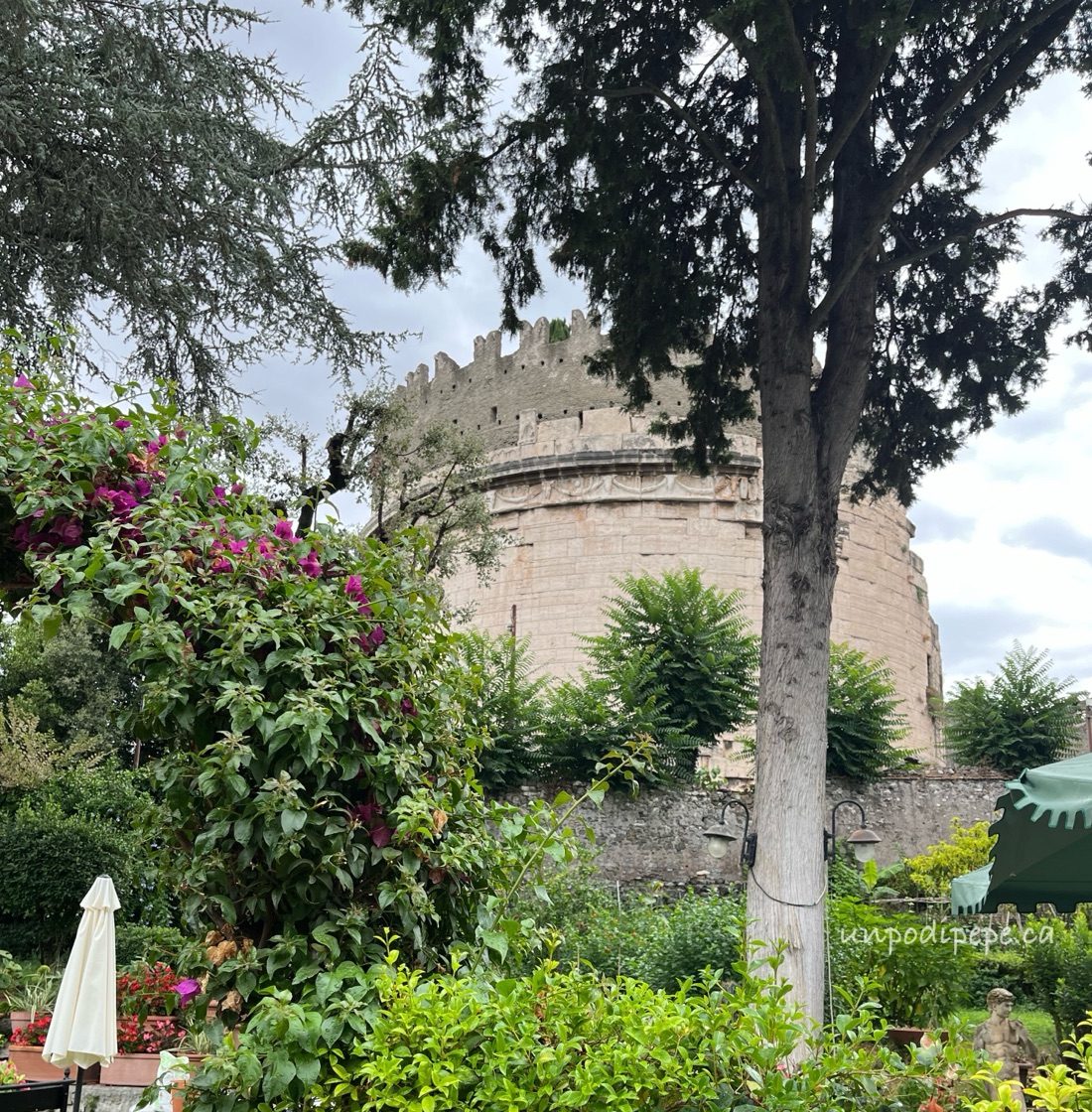
What do you do when a planned daytrip from Roma is cancelled because of pouring rain?  Go and have a meal like the ancient Romans! My friend and I went to Via Appia Antica-the Ancient Appian Way, a road from Roma to Brindisi. Close to the Catacombs of Domitilla, and almost right below the cylindrical Tomba di Cecilia Metella is Hostaria Antica Roma. Here, at his family’s ristorante, Paolo Magnanimi, an amateur gastronomic archeologist, has researched and is reviving 2,000 year old ancient Roman recipes. We enjoyed a delicious meal, enriched by explanation and commentary from Paolo.  It was an educational culinary journey into the past.
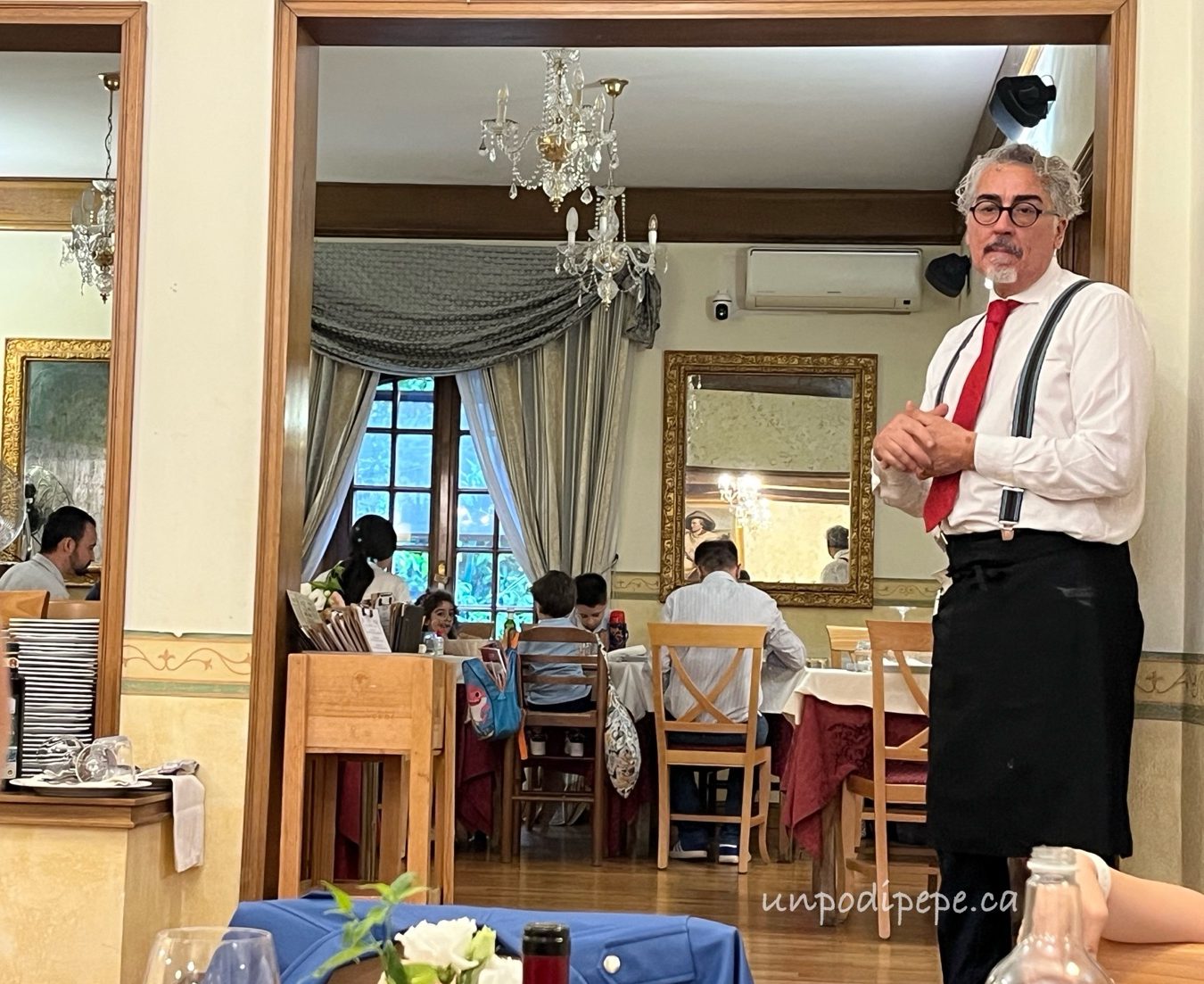
The restaurant serves traditional ‘modern’ Roman cuisine, but also a tasting menu called ‘A Tavola con Apicio’ (At the table with Apicius) closely based on the recipes in the 1st Century AD ‘De Re Coquinaria’ /On the subject of Cooking’, the only surviving cookbook from Ancient Roma. It is thought to have been compiled by Apicio -Marcus Gavius Apicius, a wealthy epicure/food lover. He was described by Pliny the Elder as ‘the most gluttonous gorger of all spendthrifts’.  Ouch! Just like Nonna’s, the ancient recipes only include ingredients, not quantities, proportions or instructions.  Paolo recreates the dishes using -as much as possible-only ingredients available at the time.  Ingredients inclucing sugar, chocolate, basil and tomato were not available in the 1stCentury.
We started off with ‘Gustum’ an antipasto platter consisting of a selection of everyday ancient snacks made with local products.  I believe this menu item usually needs to be ordered in advance.  Fortunately for us, a table had reserved for 6 people, but only 5 were there, so we were able to take the extra one!  Clockwise from the top of the photo:

Libum di Catone a bread described by Cato as a sacred symbol of devotion.  It was made with wheat flour, sheep milk ricotta, eggs and honey, and baked on a layer of bay laurel leaves. Now I know what I will do with my extra bay leaves!

Moretum was described by the poet Virgil as an everyday dish of the ancient Romans. This is the ancestor of Pesto, but named after the mortar instead of the pestle.  Moretum is made with pecorino-fresh sheep milk cheese, garlic, herbs such as coriander and celery seed, salt, nuts and olive oil. It can be eaten on its own or spread onto libum.  Paolo grinds together his ingredients with the mortar and pestle, just as described by Virgil.

Prosciutto cotto (ham) with honey and fresh pecorino

Epityrium a spread, similar to a tapenade, of olives and herbs, including cumin, fennel, coriander and sometimes mint. It was served on bread

For our primo or first course, we had the ancestor of modern lasagne, Patina Cotidiana, which is Latin for ‘daily dish’.  The pasta sheets are called laganum.  If any of you believe Marco Polo brought pasta to Italy from China in the 13th Century, that is ‘leggenda metropolitana’, an urban myth.  Boiled laganum are layered with ground beef, fennel and pecorino.  It is ‘in bianco’, meaning no tomato, since the tomato did not arrive in Europe until the 1500’s, and was not even an edible product at that time. Click on Il Pomodoro for the history of the modern tomato.
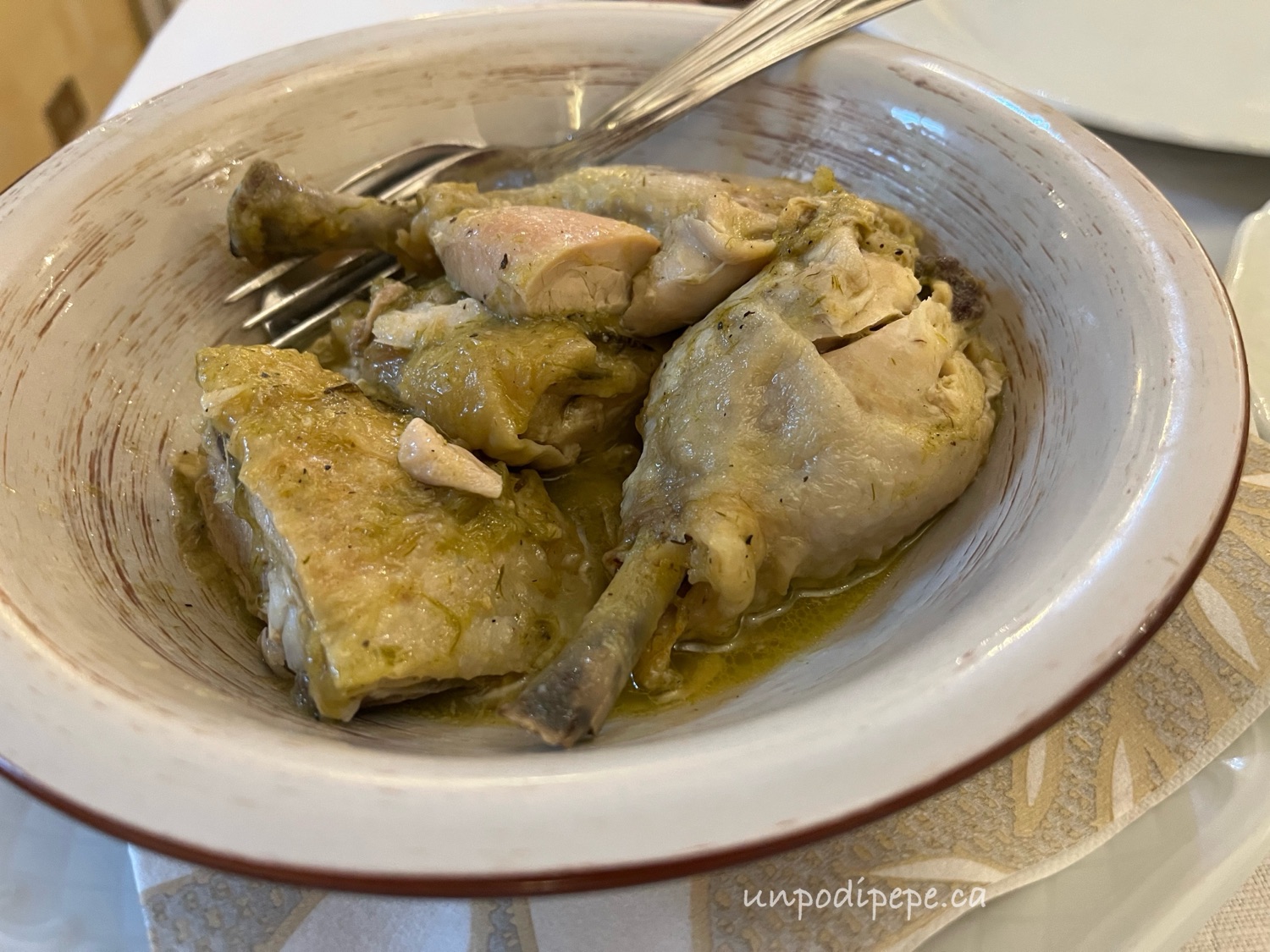
Our secondo or second course was Pollum Oxizomum, chicken cooked with pieces of leek, olive oil, vinegar and garum.  Garum was a fermented fish sauce that was a staple condiment in the ancient Roman kitchen.  75% of the recipes in De re Coquinaria include garum!  At the archeological site of Ostia Antica, one of the market stalls with fish mosaics likely sold the intensely flavoured Garum!  Today, colatura di alici di Cetara is the best substitute for garum.  Colatura di alici means anchovy drippings and this can be considered the ‘Italian version’ of an Asian fish sauce.

In the small Amalfi Coast fishing village of Cetara, they have been making colatura di alici the same way for centuries.  Anchovy fillets and sea salt are layered in small chestnut wood barrels called terzigni with a heavy weight on top. The anchovies are left to ferment for a long time-up to 3 years!  This process produces a clear amber liquid with an intense flavour that floats to the top.  A hole is made in the bottom of the barrel to collect the colatura after it passes through the layers of anchovies.  Online, a 50 ml bottle is about $25 (USD).  Surprisingly, our pollo did not taste fishy or overly salty.  It was delicious!

Finally, for dessert /dolce we had Tiropatina a predecessor of custard or crème caramel.  It was made with whole milk, eggs and honey, with a drizzle of honey and a sprinkling of freshly ground black pepper on top.  The ancient Romans believed pepper to be an aphrodisiac.

A few other items on the ancient menu that we did not try include: Pulsa con copadia, rustic polenta with an aromatic beef stew, Isicia Omentata, pork polpette (meatballs) in grape sauce and La Cassata di Oplontis, a dessert made with almond flour, sheep milk ricotta, honey, dried and candied fruit.

I absolutely recommend a visit to Hostaria Antica Roma, especially if you are fascinated by the history of ancient Roma and gastronomic history.  The fact that everything was delicious does not hurt either!  The week after our visit in July, Paolo was being interviewed by the BBC.

De Re Coquinaria 2021 edition, translated by Terra Nectare corrects previously incorrect translations

Hostaria Antica Roma, Via Appia Antica 176Open Tuesday-Saturday 12:30-1500 and 19:30-22:30, Sun 12-3, Monday closed.

Grazie to to my amica Anna for joining me.  Buon appetito!
 

Share this:

  • Click to share on Facebook (Opens in new window) Facebook
  • Click to share on Pinterest (Opens in new window) Pinterest
  • Click to share on X (Opens in new window) X
  • Click to email a link to a friend (Opens in new window) Email
  • Click to share on WhatsApp (Opens in new window) WhatsApp
Like Loading...

Acqua Vergine

28 Friday Mar 2025

Posted by Un po' di pepe in Architecture, Roma

≈ 5 Comments

Tags

Ancient Roma, Ancient Roman engineering, Fontana di Trevi, La Barcaccia, Roman Fountains, UNESCO World Heritage Sites

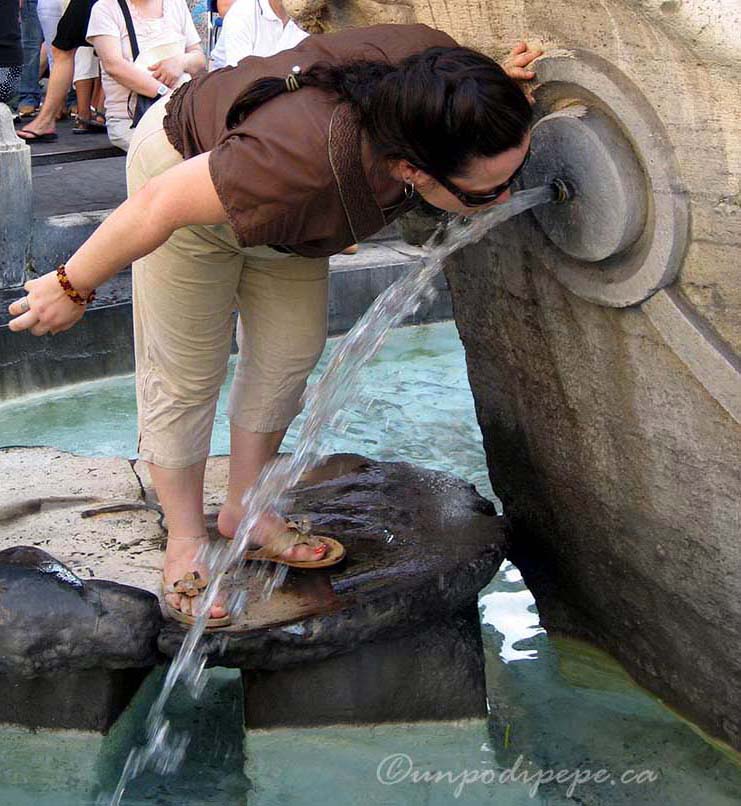
The Ancient Romans were masters of engineering.  One of the greatest examples of this is their aqueducts.  These systems of waterways transported fresh water from springs and melting snow long distances via pipes and tunnels.  The ability to provide a fresh, safe supply of drinking water is one of the reasons the Roman Empire became so powerful. In Roma, 11 aqueducts were built over a period of ~500 years.  Aqueduct #6 out of 11, called Aqua Virgo (Acqua Vergine in Italiano) lives on today.  Not only is it still with us, but it is still functioning, providing water to the most important fountains in central Roma.  The pure, cold, fresh water is drinkable*, constantly flowing and powered by gravity.

Mmmm! Acqua freddissima!

Aqua Virgo was constructed in 19 BC by Marcus Vipsamius Agrippa, son in law and general of Emperor Octavian Augustus.  Yes- the same Marcus Agrippa whose name is carved into the front of the Pantheon. He constructed the original Pantheon, before it burnt down.  Marcus had the aqueduct built to supply water for the thermal baths of Agrippa in the Campo Marzio area near the Pantheon.

Aqua Virgo/Acqua Vergine probably refers to the freshness and purity of the water, but according to legend, in 19 BC, a young girl led Roman soldiers to a spring -the source for the aqueduct.  The source is in the hills 13 km away, at Agro Lucellano between Via Tiburtina and the 8th milestone of Via Collatina (2 of the roads that led to Roma) near present day Salone.  The source is actually only 24m (79 ft) above sea level. Aqua Virgo is 21 km long via indirect route to Roma, making a wide arc.  This is to make use of gravity by shallow downward gradient. 19 km of Acqua Vergine are 9m below ground, with short stretches of brick arches above ground.

There were 1352 fountains in Roma in the 4th Century.  Aqua Virgo was damaged by the invasion of 537 and repaired. It remained in use through the Middle Ages with a few renovations during the Renaissance.  Early Renaissance Popes started to decorate the end point of restored aqueducts with large, ornate fountains.The Fontana di Trevi is the final destination of the original Acqua Vergine and Piazza del Popolo the end of an offshoot.  Carved above the statues next to Oceanus on the Fontana di Trevi, 2 bas reliefs illustrate Marcus Agrippa ordering construction of the aqueduct and the young girl leading Roman soldiers to the source.  They can both be seen in the photo below:

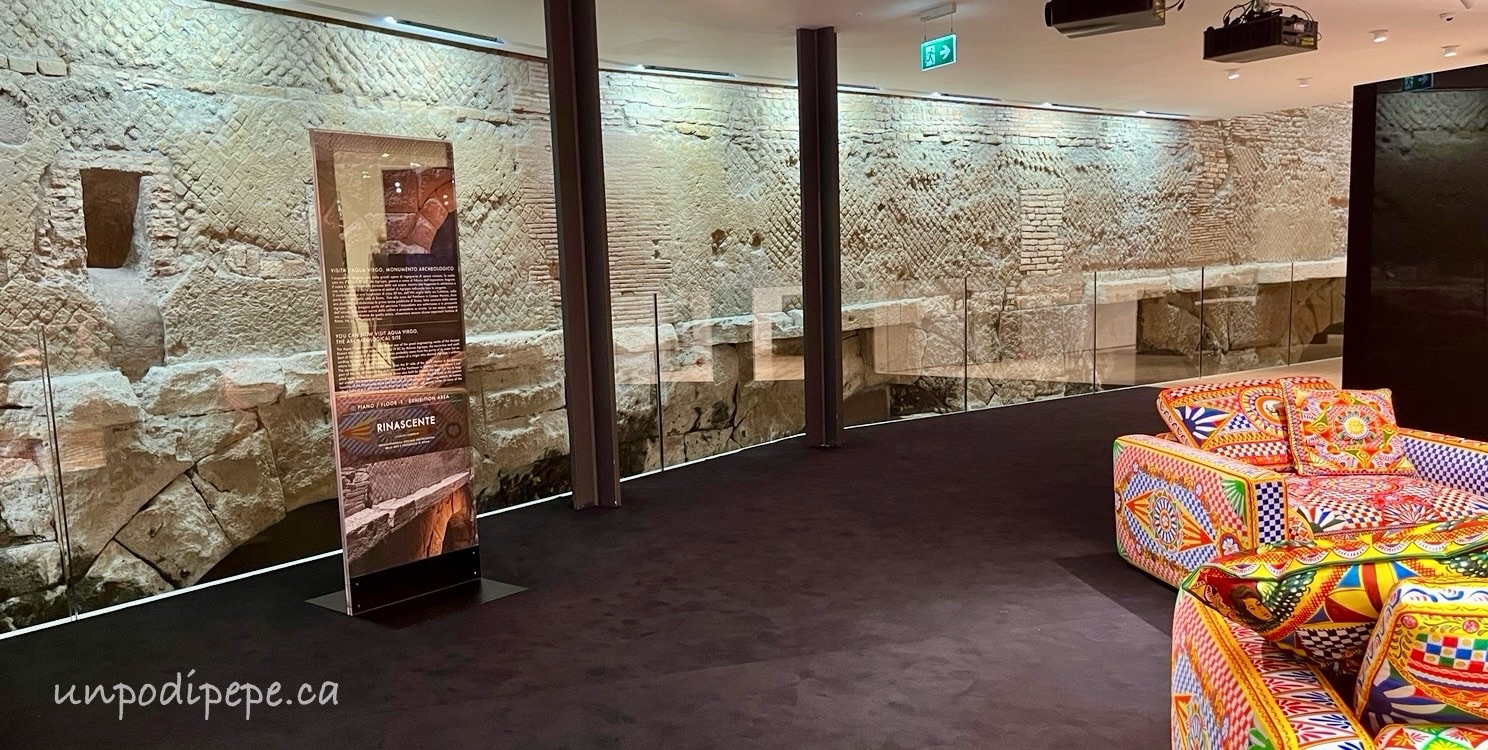
Acqua Vergine Antica runs under Villa Borghese and Villa Medici to Piazza di Spagna and Fontana di Trevi. In 1930 renovated Aqua Vergine Nuova goes behind Piazza di Spagna to Piazza through Giardini Borghese to Piazza Flaminio and Piazza del Popolo. Most of the aqueduct’s 21 km are 9m underground, except for the last stretch running partly on arches as it approached the Campo Marzio area, emerging from the hill by the present La Rinascente Department store. There is also an arch standing on Via del Nazareno, north of Trevi.  Part of Aqua Virgo was found during construction of the new La Rinascente department store location, delaying the opening by 2 years. In 2017 the new Flagship La Rinascente store on Via Tritone 61 opened, including a basement archeological site with a 60 m (197 ft) section of Aqua Virgo on display. Admission is free.  When I went, there was a Dolce and Gabbana furniture exhibit! Just take the escalator down to the bottom floor any time the store is open. Where else but Roma can you combine high end shopping and archeology?

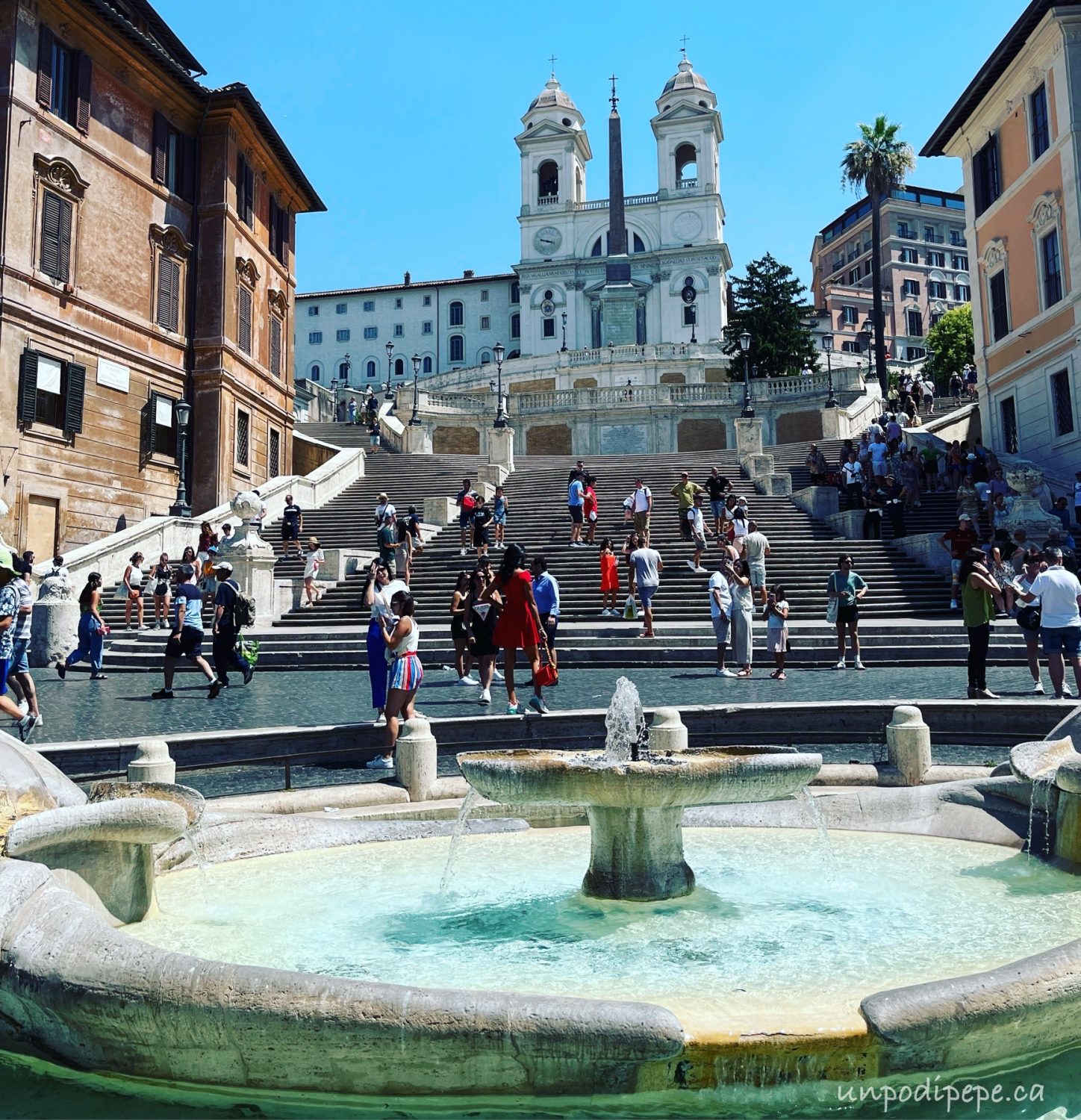
Today Acqua Vergine supplies water to the fountains in Piazza della Rotonda outside the Pantheon, Piazza Mattei (Fontana delle Tartarughe) Fontana del Babuino, Piazza Navona (the 2 outer ones, not the Fontana dei Quattro Fiumi), Campo dei Fiori, Piazza del Popolo (Fontana dei quattro leoni, Fontana di Nettuno and Fontana della Dea di Roma), Piazza Trevi, and my all-time favourite in Piazza di Spagna, La Barcaccia which resembles a sinking ship.  

Don’t forget to bring a water bottle to Roma!  Buon Viaggio, Cristina

*Since 1998, the water in the Fontana di Trevi is recycled, so no longer drinkable.  With €3000 of coins thrown in daily, it was hardly drinkable anyways! Read more about this in my next post!

Photo credits:  Drinking from La Barcaccia by Shannon Milar, Photo with bas reliefs by my sorella Lucia.

Share this:

  • Click to share on Facebook (Opens in new window) Facebook
  • Click to share on Pinterest (Opens in new window) Pinterest
  • Click to share on X (Opens in new window) X
  • Click to email a link to a friend (Opens in new window) Email
  • Click to share on WhatsApp (Opens in new window) WhatsApp
Like Loading...

Ostia Antica

27 Tuesday Feb 2024

Posted by Un po' di pepe in Art history, Italia, Roma, Travel

≈ 9 Comments

Tags

Ancient Roma, Archeology, Daytrips from Roma, Italian history, Lazio, Roma, Roman walks

Ostia Antica, 30 km southwest of Rome was once a thriving town and commercially important seaport. It is now a well-preserved archeological site and at 150 hectares, one of the largest archeological parks in Europe. Founded in 620 BC to harvest sea salt at the ‘ostium’ or mouth of the Tevere (Tiber River), Ostia Antica was Rome’s first colony, a naval base and main ancient seaport.  With a population of 60,000 in the 2nd and 3rdcenturies AD, it was the hub for import of grain, olive oil, wine, marble, cloth and other goods destined for Rome.

Originally located on the coast, Ostia Antica is now 3 km inland. After the fall of Rome and barbarian raids, the port was neglected and the harbour eventually silted up. It was completely abandoned in the 9th century AD.  Sand dunes and mud covered the city, helping to preserve the ruins and mosaics for us like a time capsule from Ancient Rome.

Ostia Antica was a working class port city, as opposed to Pompeii, which was a resort getaway and playground for the rich and famous.  The ruins provide insight into regular, daily life in Ancient Rome and give us a sense of urban planning for the time.  There are well preserved cobbled streets, magnificent mosaics, temples, shops, apartment buildings, warehouses, private homes, public baths, warehouses, taverns, inns, a public laundry, theater and even a firefighting service.  The earliest identified synagogue in Western Europe (41-54 AD) was discovered in 1961.

Excavation started in the early 19th Century, but most of it was done from 1938-1942. Only 40% of the site has been excavated! There is a lot to see in Ostia Antica.  Here are some of the highlights:

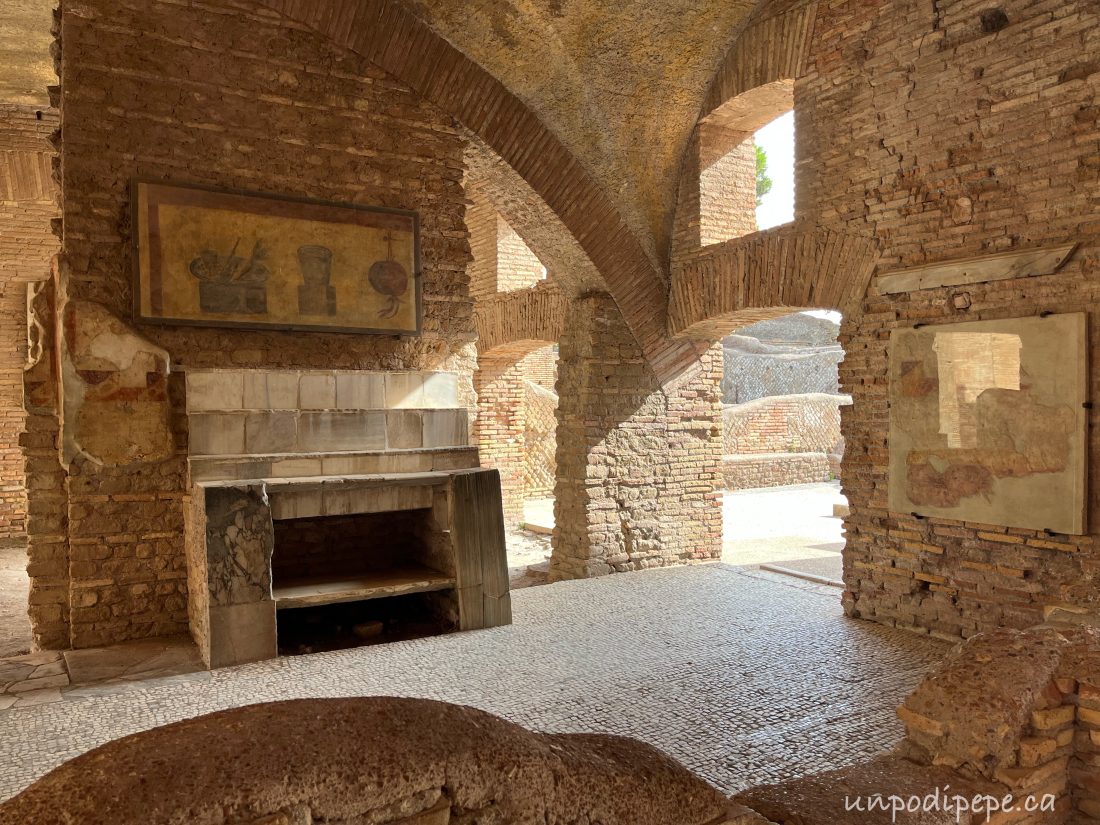
Thermopolium di Via di Diana Thermopolium is Greek for ‘place where hot food is sold’.  A 3rd C ancient fast-food joint and wine bar with windows that open out onto the street and a marble take-out counter, long table to serve hot food, shelves and a courtyard with a fountain for outdoor dining. Amphorae with cheap wine were stored under the counter.  A large fresco ‘menu’ on one wall shows a plate with carrots and beans, a glass of wine, a jar of olives and large onions or pomegranates.
Customers likely topped their food with an ancient condiment called Garum.  It was a pungent rotten fish sauce and makes ketchup sound appetizing.  On the side of the Thermopolium is a single gated public toilet!

Mulino di Silvano A multiroom bakery built in 120 AD. One room has 3 intact lava millstones for grinding the grain into flour, one for kneading the flour into dough and another still has the ovens for baking the loaves.  The bread was sold on site and also transported to sell in Rome.

Teatro Ostia’s semicircular theater survives in excellent condition.  Built in the first century BC and expanded later, it is one of the oldest masonry theaters in the world.  It can seat 4,000 spectators and is still used for summer concerts.

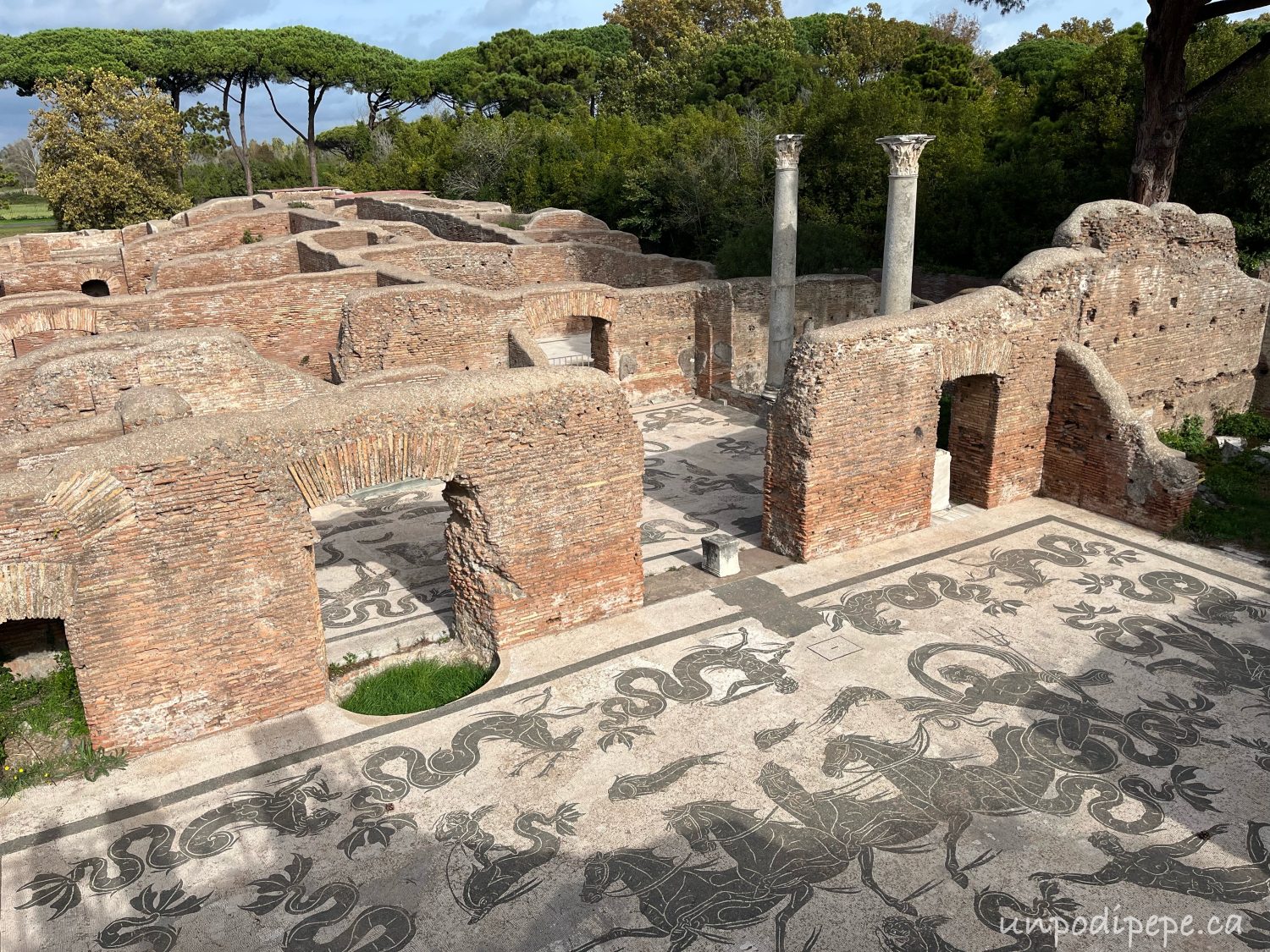
Public Baths  There are several public baths in Ostia.   The Baths of Neptune have incredibly preserved mosaic floors of Neptune and sea creatures.  We can thank the mud that covered them for centuries!  These are often covered up in the winter to protect from the harsh weather.

Public toilets A fine example of Roman plumbing. The toilets consist of a communal marble bench along 3 walls with 20 seats. Each seat had a hole leading down towards a single drain channel fed with running water to flush away waste. Since toilet paper was not a thing yet, a sea sponge attached to a stick was kept in a bucket of saltwater or vinegar for patrons of the toilets to wipe themselves. Yuck!

Piazzale delle Corporazioni (Piazza of the Corporations/Guilds) Located behind the theater, the piazza is a large open air market square with stalls along all 4 sides. Merchants and craftsmen from all over the Mediterranean sold their goods.A small metal model of the piazzale has descriptions written in Braille and Italian.The beautiful black and white mosaics in front of the stalls advertised the goods or services being sold. Stalls included shipbuilders, ropemakers, leather tanners, sailmakers, grain and wine importers, as well as fish and food products.  One of the stalls with fish mosaics likely sold the pungent Garum fish gut sauce!

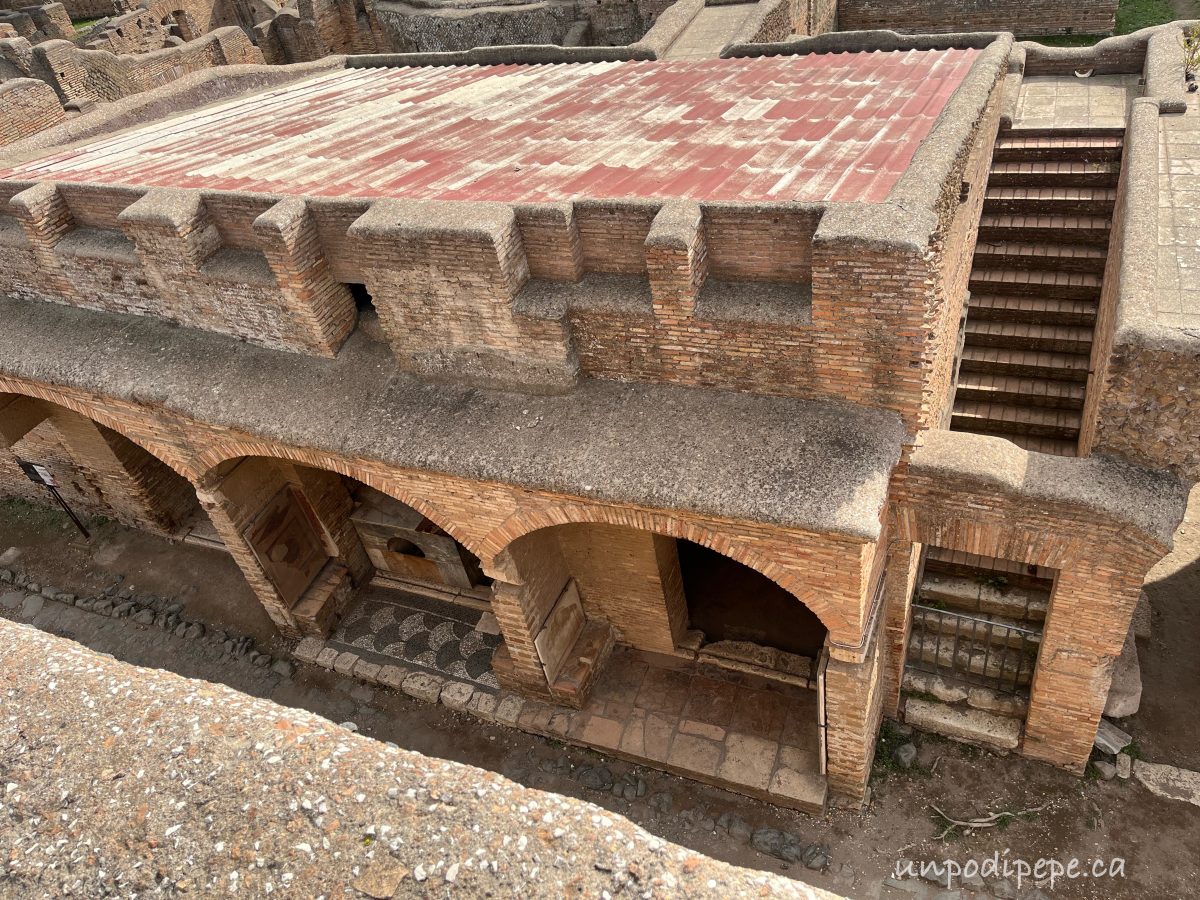
Casa di Diana A complex multifunction residential building -urban planning centuries ahead of its time.  Called an insula, this multilevel apartment has ground floor shops, accommodation for the shopkeepers on the 1stfloor and more modest accommodation on the upper floors.  A 150 AD painting of Diana was found inside.  It is possible to climb the stairs of other insulae to get to the upper floors.

A visit to Ostia Antica is a nice, half day trip from Roma, although it can be a whole day excursion if you explore more of the huge site and have lunch at one of the restaurants nearby.  Ostia Antica is grossly under visited, so it is never crowded! Bring water, a hat, sunscreen and good walking shoes.

Open Tues to Sat 8:30-4:30 in winter 8:30- 7 pm in summer. Admission fee is €18. Free admission the first Sunday of the month.  Tickets can be booked online on the official website .  A PDF guide can also be downloaded from the website.  The museum is worth seeing, but is closed at present.

Getting there by public transportation is easy and cheap: Take Metro line B (Blue line) to San Paolo (or Piramide*) metro station and take the ‘Lido’ commuter train to Ostia. Get off at ‘Ostia Antica’. The ride is 23 minutes. (Do not get off at Ostia Lido Nord or Ostia Lido Centro unless you are going to the beach!)

Use the footbridge to cross the road and walk 5-10 minutes to the main entrance of the Parco Archeologico Ostia Antica. Trains leave every 20 minutes and use the regular metro/bus tickets €1.50.

*If getting there from Piramide, walk out of the metro station and go to Porta San Paolo train station next door to find the Lido commuter train.

Buon viaggio!

Share this:

  • Click to share on Facebook (Opens in new window) Facebook
  • Click to share on Pinterest (Opens in new window) Pinterest
  • Click to share on X (Opens in new window) X
  • Click to email a link to a friend (Opens in new window) Email
  • Click to share on WhatsApp (Opens in new window) WhatsApp
Like Loading...

Pantheon update

28 Sunday May 2023

Posted by Un po' di pepe in Architecture, Photography, Roma, Travel

≈ 11 Comments

Tags

Ancient Roma, Italy travel tips, Lazio, Pantheon, Roma photography, Roma travel, Santa Maria ad Martyres, UNESCO World Heritage Sites

Roma is full of amazing buildings. The most amazing and best-preserved of all is the Pantheon.  Imagine Michelangelo entering the Pantheon 500 years ago, looking up and saying “this looks more like the work of angels than humans’-that is how amazing it is! The perfect mathematical proportions of the Pantheon have provided inspiration for architects for almost 2,000 years. Check out the post Il Pantheon for more details on the history and structure.Admission has always been free, and there has been talk of charging an entry fee for many years…in fact, it has been ‘announced’ several times.  Well….purtroppo, the time has come.  Starting July 1st 2023, there will be a €5 admission fee for entry for tourists/visitors.  Admission will still be free for residents of Roma, those under 18 years old and those attending Mass. Until then, admission remains free, with booking required at least 1 day in advance only on weekends and holidays.

The Pantheon is a classical masterpiece and a monument that requires expensive upkeep, so the need for a modest admission fee is understandable. Since the 7th century it also functions as the Church of Santa Maria ad Martyres.  In Roma entry into churches is free-so that is why there has been so much effort to not charge an admission fee.

Mass is at 5 pm Saturdays, 10:30 am Sundays and public holidays, and midnight on Christmas Eve.  Shoulders, midriff and knees need to be covered, although this is not as strictly enforced as the Vatican.

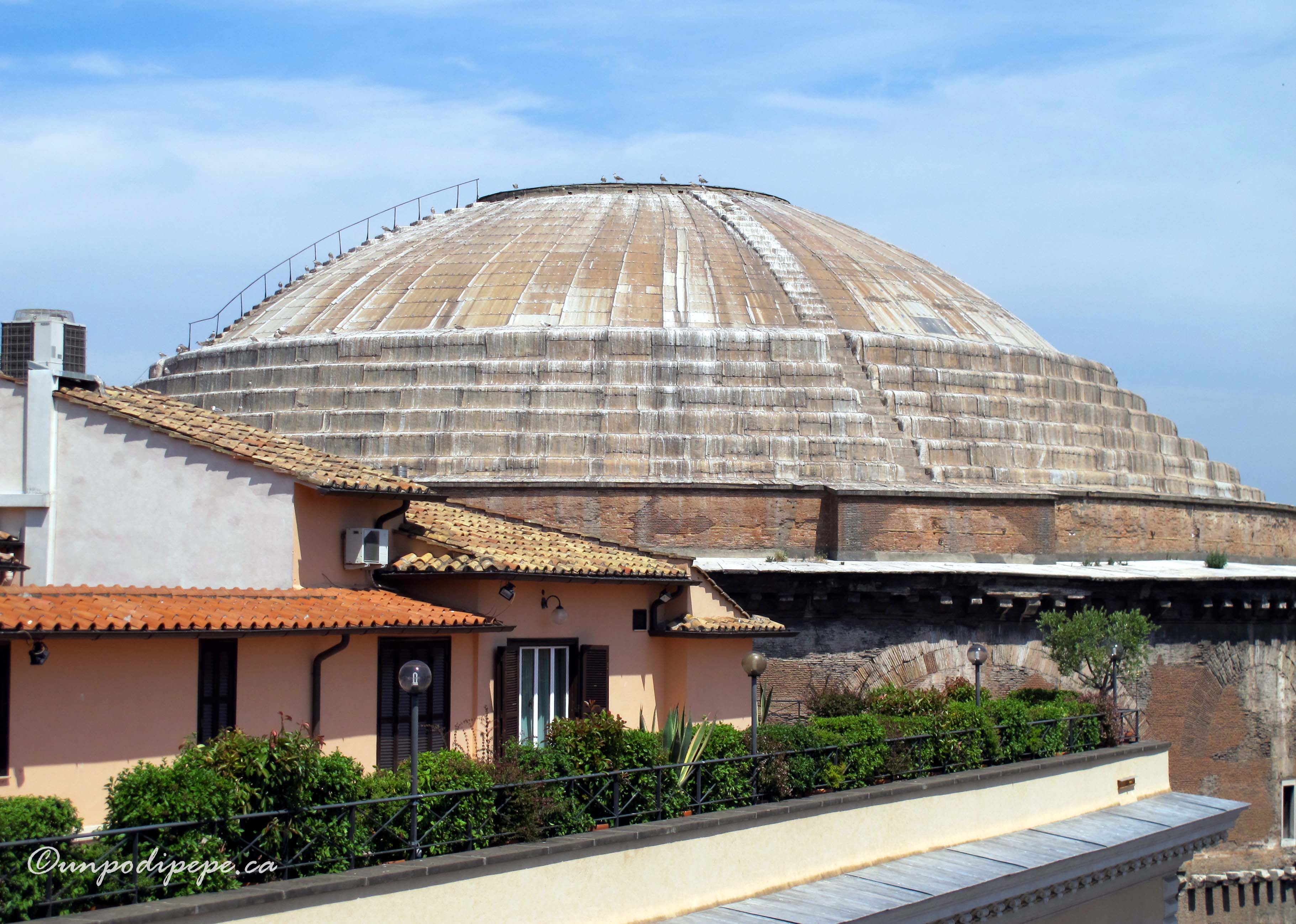
‘La Pioggia delle Rose al Pantheon’ (the rain of roses) is on my list of things to see in my lifetime. This takes place on Pentecost Sunday, 50 days after Easter.  At noon, right after Mass, Roma’s Vigili del Fuoco (fire fighters) climb to the top of the dome and drop thousands of rose petals through the oculus as choirs sing.  The rose petals symbolize the Holy Spirit coming down to earth.  Pentecost Sunday happens to be today! I saw a video of the event this morning, and even Michelangelo would be impressed! Tickets or advance booking are not available for this event.  Arriving by 7am for the 10:30 Mass is apparently necessary to get a spot inside! The ladder used by the vigili to get to the oculus is visible in the foto:

The dome and oculus, viewed from the roof of Grande Hotel de la Minerve

Visiting the Pantheon takes about 45 minutes. It is open daily 0900-1700 Sun 09-1800 with last entry at 18:30. The Pantheon is closed Jan 1, May 1, Aug 15 and Dec 25.  An audio guide with an App can be prebooked for ~€8.50, or a 45 minute guided tour for ~€20.

Details are not yet available on how to book admission, but they should be available soon on the website. Roma is a popular weekend destination for European and Italian travelers, so I imagine tickets will easier to book during the week.  There is really no ‘off season’ except for possibly the period from January 7 until the end of February.

The Pantheon is centrally located, in Piazza della Rotonda.  I walk slower than most people, but it is about a 20 minute walk to Piazza di Spagna, the closest Metro stop.  It is about a 20 minute walk to the Fontana di Trevi, 10 minutes to Piazza Navona and 40 minutes to Colosseo.

Read more about the Pantheon in Caffè con Caravaggio a Roma, Un Giorno a Roma  and Autunno in Italia.

Buon Viaggio, Cristina

Share this:

  • Click to share on Facebook (Opens in new window) Facebook
  • Click to share on Pinterest (Opens in new window) Pinterest
  • Click to share on X (Opens in new window) X
  • Click to email a link to a friend (Opens in new window) Email
  • Click to share on WhatsApp (Opens in new window) WhatsApp
Like Loading...

Buon Compleanno Roma!

21 Friday Apr 2017

Posted by Un po' di pepe in Italia, Roma

≈ 2 Comments

Tags

Ancient Roma, April 21 753 BC, La Lupa Capitolina, Natale di Roma, Roma, Romolo & Remo

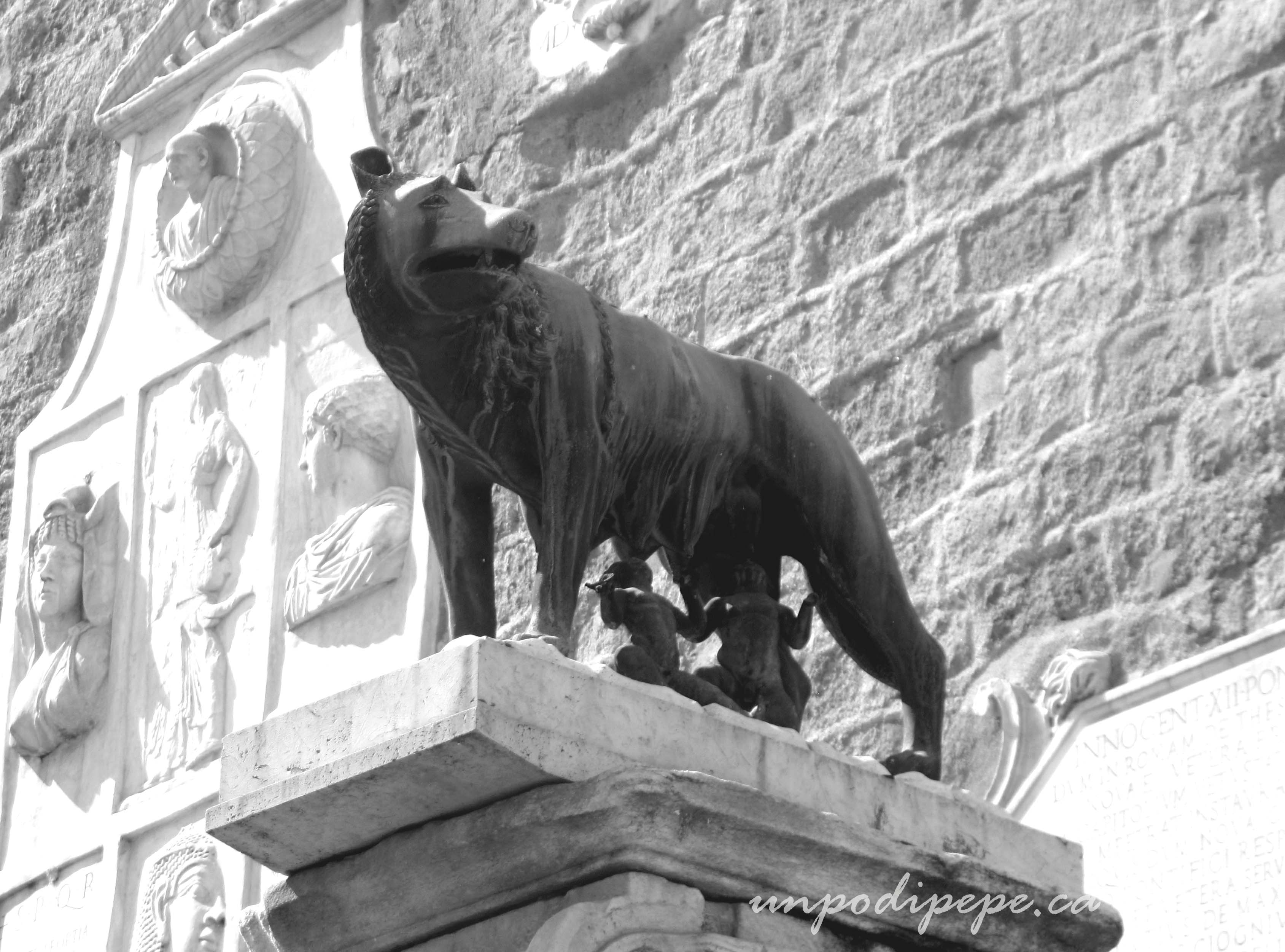
Roma’s turns 2770 years old today!  Auguri Roma.  The day of Roma’s foundation is called ‘Natale di Roma’.  You may be thinking… Christmas of Roma?  Huh? Christmas is called Natale in Italiano, but the word natale, with a lower case ‘n’, actually means birth-so today is the celebration of the birth of Roma. The exact date, April 21, 753 BC, was determined by Marcus Terentius Varro, a 1st Century BC Roman scholar.

According to legend, on this date Roma was founded by orphaned twins Romolo and Remo (Romulus and Remus in Latin).  Their dramatic story shares plotlines with those of Hamlet, Moses and Cain and Abel!  They were children of Mercury, God of War, and Rea Silvia, the daughter of Numitore, ex King of Alba Longa, which was 19 km southeast of Roma. Rea Silvia’s family were descendants of Aeneas, the Greek Trojan war refugee. Aeneas’ son Ascanio was the founder and first king of Alba Longa. Numitore’s brother Amulio ousted him.  To insure Numitor would have no heirs, Amulio killed his son, and forced Rea Silvia to become a Vestal Virgin. When the gemelli were born in 771 BC, Amulio ordered them to be drowned in the Tevere.

The servants who were to drown the babies set them afloat in a basket on the river instead.  They washed up near the Palatino (Palatine Hill) and were found and nurtured by a lupa (she-wolf) who had lost her newborn cubs. *Interesting note- at the time, the word ‘lupa‘ could also mean prostitute! Romolo and Remo were found by a shepherd, Faustilo. He and his wife Larentia took them in and raised them.

Romolo and Remo grew up to be leaders of a group of shepherd warriors.  When they found out that they were the true heirs to Alba Longa, they attacked, killed Amulio and restored their Nonno Numitore as king. Fresh from their revenge and still full of adrenaline, Romolo and Remo decided they would build a city of their own near where they were found by the lupa.  Romolo wanted to build on the Palatine Hill (where the Forum is) and Remo wanted to build on the Aventine.  They disagreed and fought, with Romolo accidentally killing his brother in the process.  And so began the long, bloody, politically charged history of Ancient Roma.  Romolo built the city on the Palatino and named her Roma after himself.

Gruppo Storico Romano organizes many festivities in Roma today, including a live reenactment of Il Natale di Roma at Circo Massimo.

Ciao e buon 2770mo compleanno Roma, Cristina

Share this:

  • Click to share on Facebook (Opens in new window) Facebook
  • Click to share on Pinterest (Opens in new window) Pinterest
  • Click to share on X (Opens in new window) X
  • Click to email a link to a friend (Opens in new window) Email
  • Click to share on WhatsApp (Opens in new window) WhatsApp
Like Loading...

Il Pantheon

08 Monday Feb 2016

Posted by Un po' di pepe in Architecture, Art history, Italia, Photography, Roma

≈ 15 Comments

Tags

Ancient Roma, Pantheon, Piazza della Rotonda

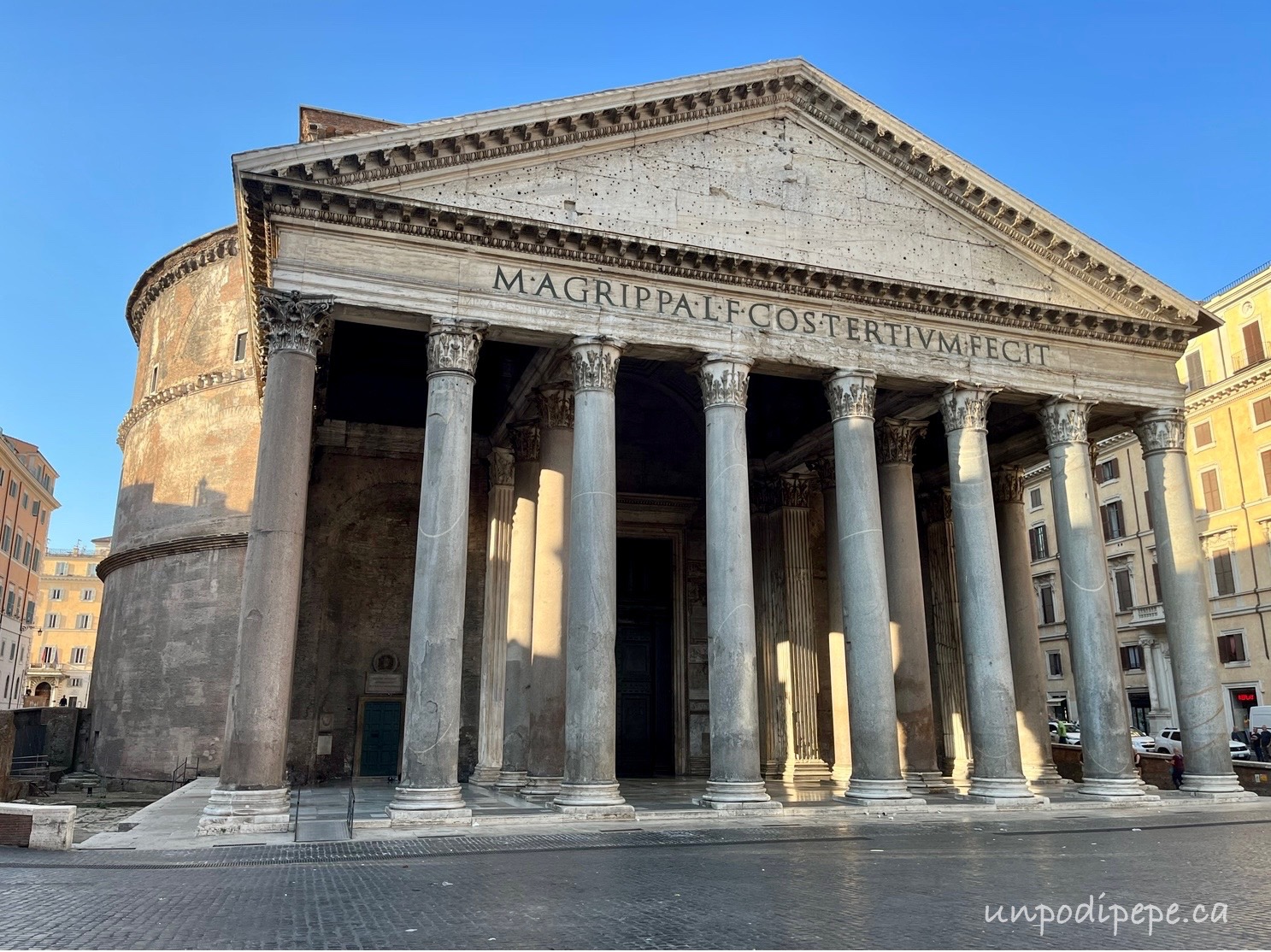
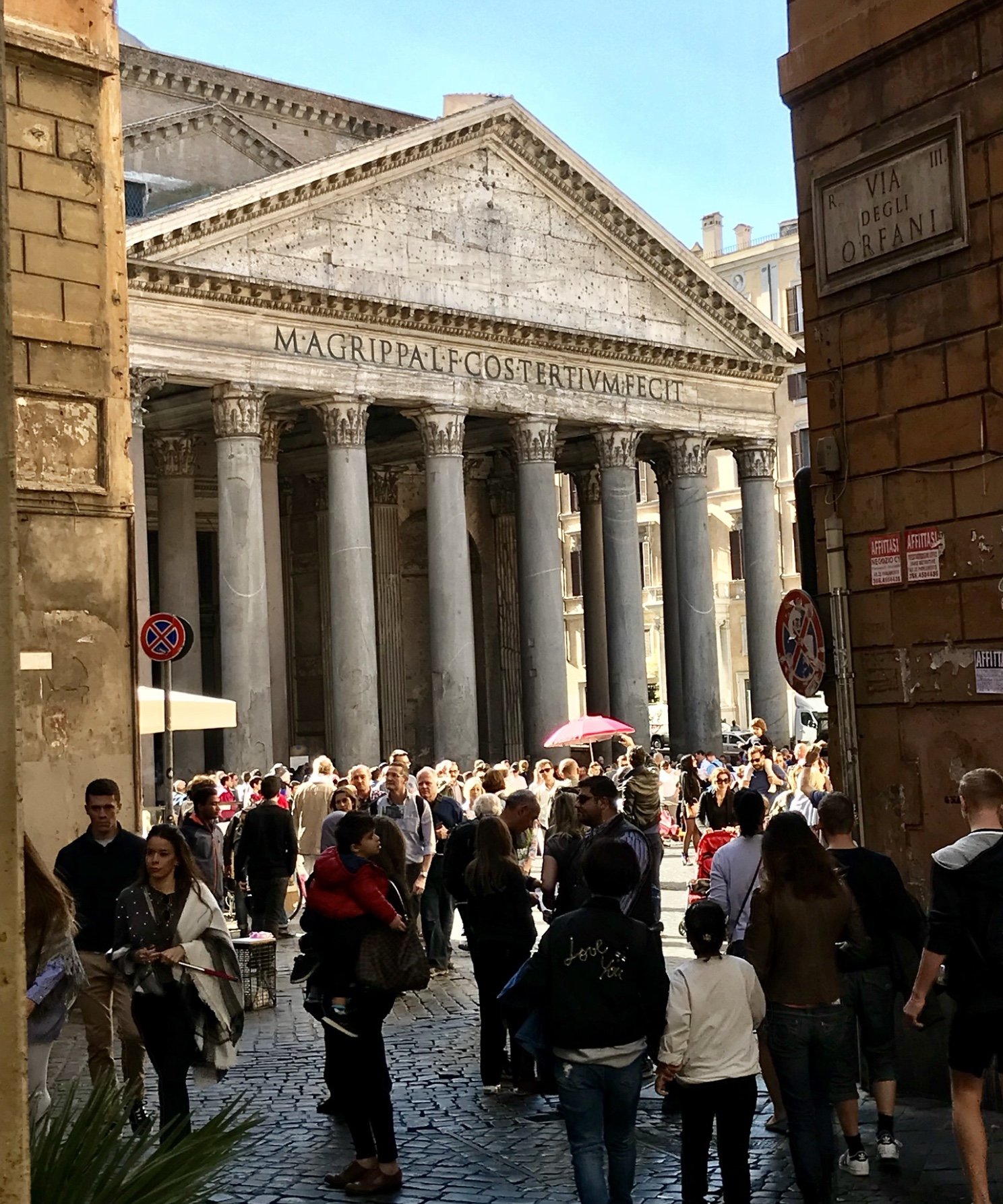
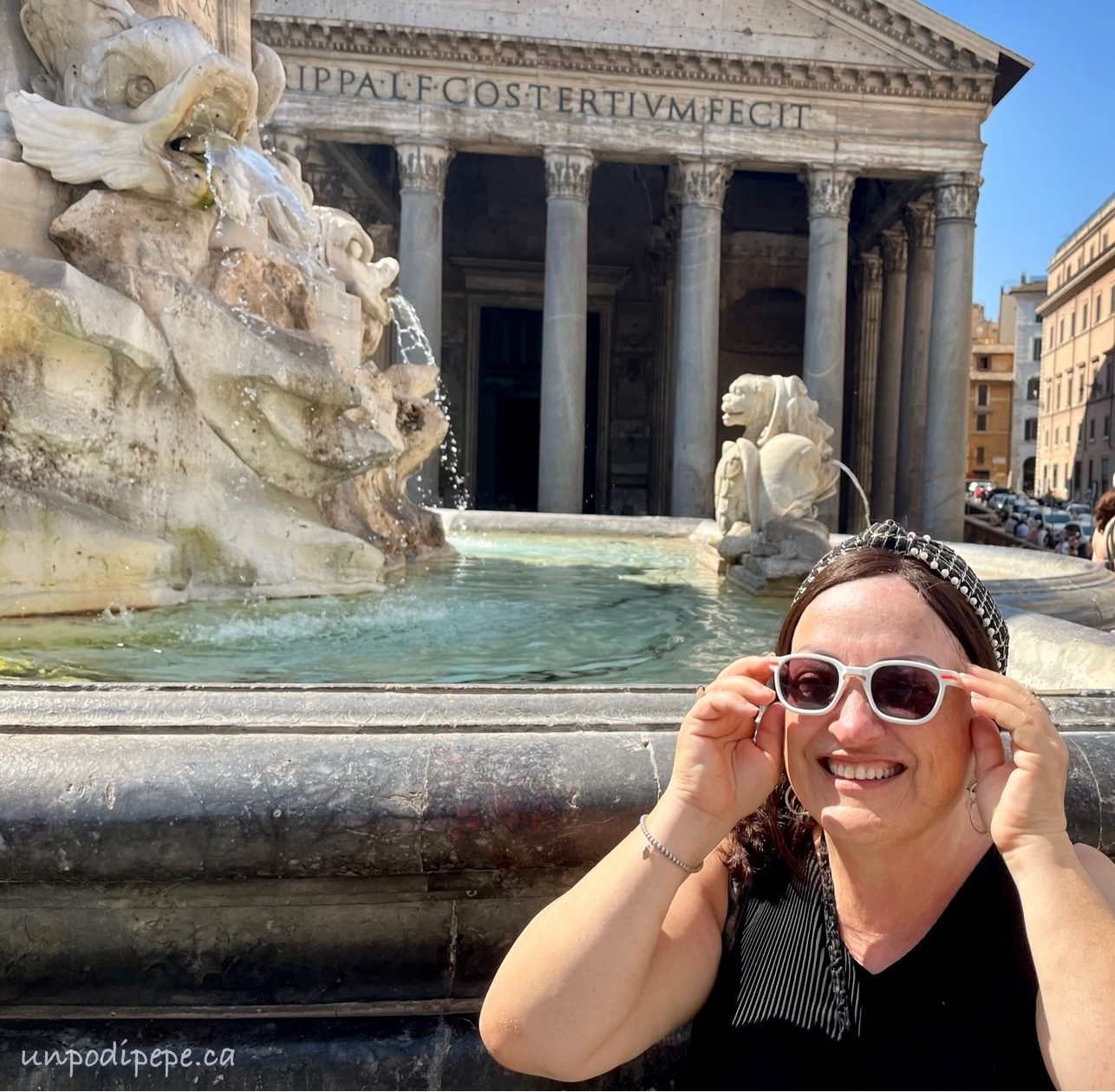
Piazzadellarotonda500 years ago, Michelangelo entered the Pantheon and stated that it looked more like the work of angels than humans. The Pantheon is an architectural masterpiece and the most well-preserved building from Ancient Rome.  This is probably because it has been in continuous use since it was built.  The original use of the Pantheon is not known.  Many think it was a temple to all the gods, since ‘Pan-theos’ is Greek for ‘all gods’, although Ancient Roman temples were dedicated to single gods.  ‘Pan-theos’ might also refer to the heavens, the territory of the gods.  According to legend the site is where Romulus, the founder of Roma ascended to the heavens.  IlPantheonMarcus Agrippa, Augustus’ commander in chief built the original Pantheon on his own land, so it may have been a private building.  This building burned down in 80 AD and then was struck by lightning and burned again in 110 AD! The Pantheon standing today was completed around 126 AD by Emperor Hadrian.  He kept the original inscription under the pediment ‘M.Agrippa.L.F.Costertium.Fecit’ (Made by Marcus Agrippa, son of Lucius in his third time as Consul) which caused confusion about the construction date.  The Pantheon was given to the Pope in 609, and it has been the Church of Santa Maria dei Martiri ever since, but it is usually still called the Pantheon.Pantheonfontana

From the outside, the Pantheon looks like a Greek temple. It is actually a round building (rotunda) with a portico of eight 12m (39 ft) high granite Corinthian columns up front and 8 more in behind. These columns are each a single 60 ton piece of stone quarried in Egypt.  Imagine the journey these huge stones made to get here….they were dragged through the desert, barged down the Nile to Alexandria, shipped across the Mediterranean to the port of Ostia, barged down the Tevere to Roma and then hauled overland to the site of the Pantheon!Pantheon oculus

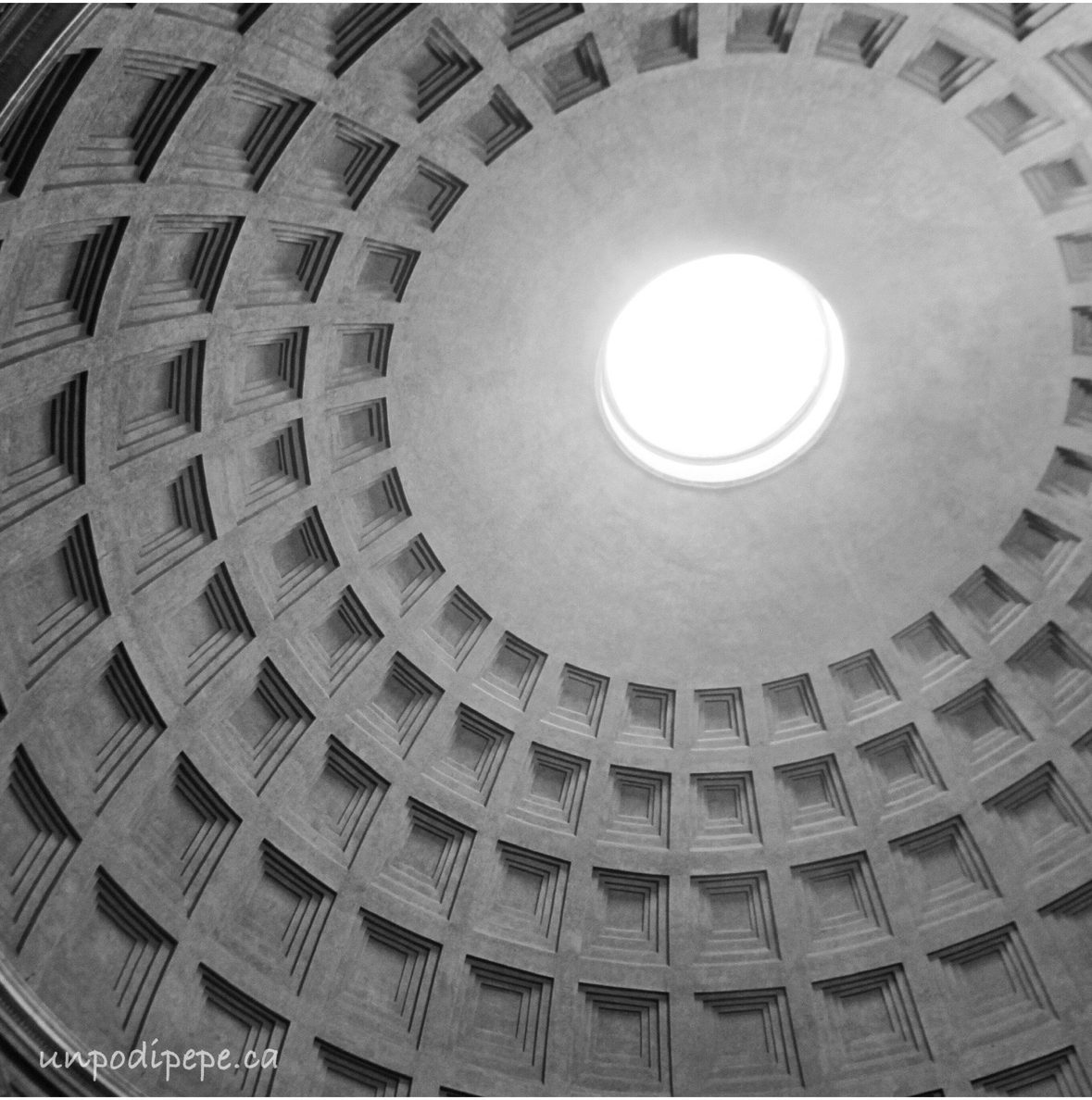
Enter into the Pantheon and it is immediately clear what Michelangelo meant. Overhead is the largest unreinforced concrete dome in the world-still after almost 2,000 years! The Romans invented concrete, using a mixture of volcanic ash and soil from Pozzuoli, lime and rocks, but they did not have rebar, so this is amazing! The 8 m wide hole in the roof is the oculus and the shaft of light coming in from the sun moves slowly throughout the day like a sun-dial.  When looking up, the dome feels like it could rotate. The oculus and front door are the Pantheon’s only sources of natural light.  Concrete walls 6m (20 ft) thick support the dome, which is 6m thick at its base but narrows to 1.2m (3.9 ft) around the oculus.  Lighter materials, such as tufa, pumice and even broken terra cotta pots were used towards the top to further lighten the load.  The oculus also lightens the load at the very top, acting as a compression ring where the roof would be its weakest. Rainwater coming in through the oculus is drained off through holes and a drainage system under the slanted marble floor.

Is it a mask for Carnevale? No, these are drainage holes in the floor right below the oculus!

Is it a mask for Carnevale? No, these are drainage holes in the floor right below the oculus!

The height of the oculus is 43.3m (150 Roman feet) and the diameter of the building is also 43.3m. A perfect 43.3m sphere would fit inside the building. For another visual, if the dome was flipped upside down, it would fit perfectly inside the rotunda.

The perfect mathematical proportions of the Pantheon invoke harmony and symbolize the earth and the heavens. The Pantheon has provided inspiration to architects including Brunelleschi and Michelangelo for almost 2,000 years.  Public buildings throughout the world are modelled on the Pantheon’s ‘portico and dome’ design.Pantheonchapel

In the 17 the Century, the Barberini Pope Urbano VII removed the bronze ceiling from the portico and melted it down to make cannons for Castel Sant’Angelo. The outrage prompted the saying ‘Quello che non hanno fatto i barberi hanno fatto i Barberini’ (What the barbarians didn’t do, the Barberini did), implying that the Pantheon had survived numerous barbarian invasions, only to be looted by the Barberini family. In addition to functioning as a Classical Masterpiece and a Church, many notable Italiani are buried in the Pantheon.  Some of these include Vittorio Emanuele II, Umberto II and his wife Margherita di Savoia, Rafaelle Sanzio da Urbino (Raphael) and his fiancée Maria Bibbiena.

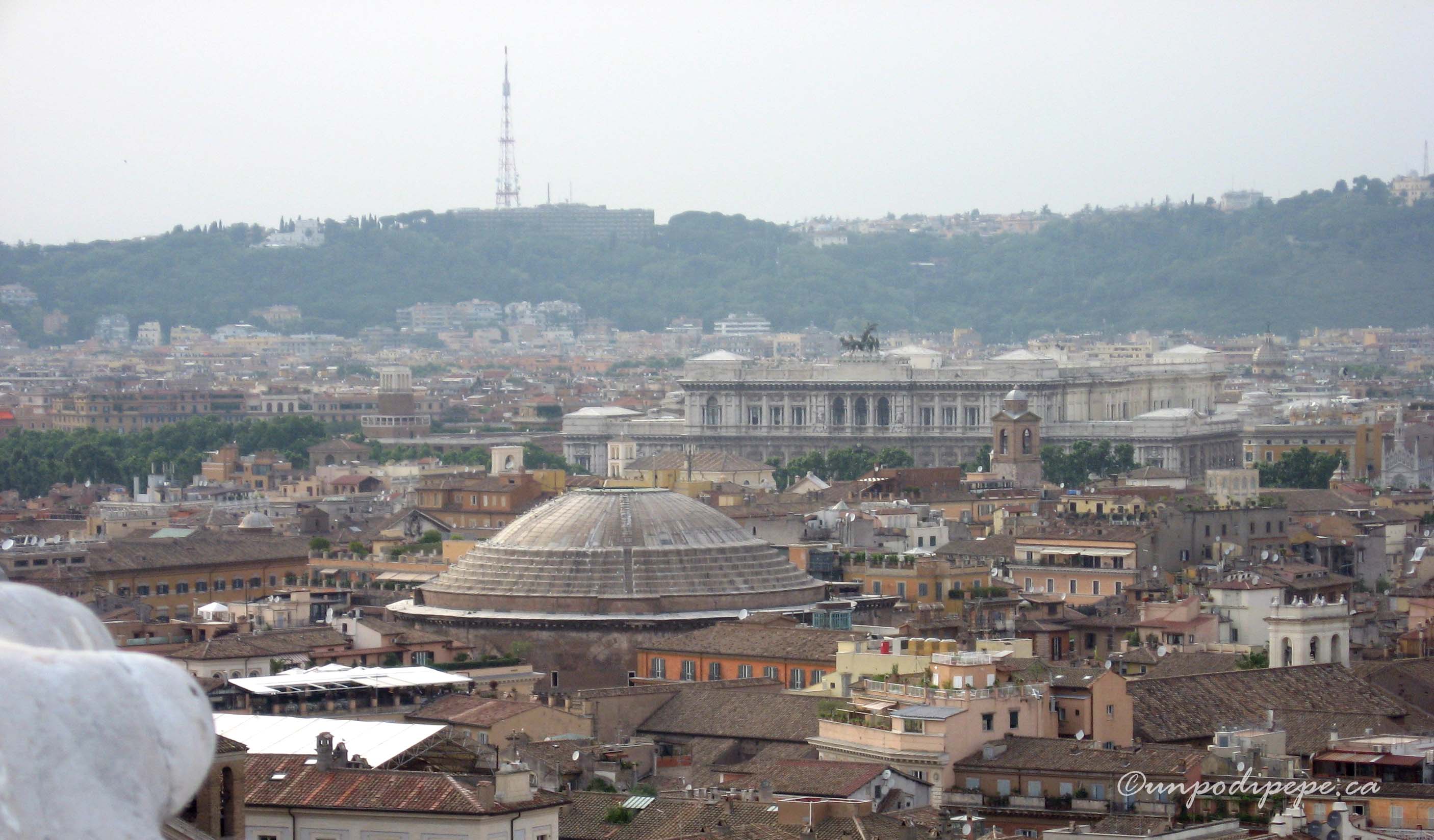
Il Pantheon from Il Vittoriano

Il Pantheon from Il Vittoriano

‘La Pioggia delle Rose al Pantheon’ (the rain of roses) is on my list of things to see. This takes place on Pentecost Sunday, 50 days after Easter.  At noon, right after Mass, Roma’s Vigili del Fuoco (fire fighters) climb to the top of the dome and drop thousands of rose petals through the oculus as choirs sing.  The rose petals symbolize the Holy Spirit coming down to earth.  Even Michelangelo would be impressed!

The dome and oculus, viewed from the roof of Grande Hotel de la Minerve

The dome and oculus, viewed from the roof of Grande Hotel de la Minerve

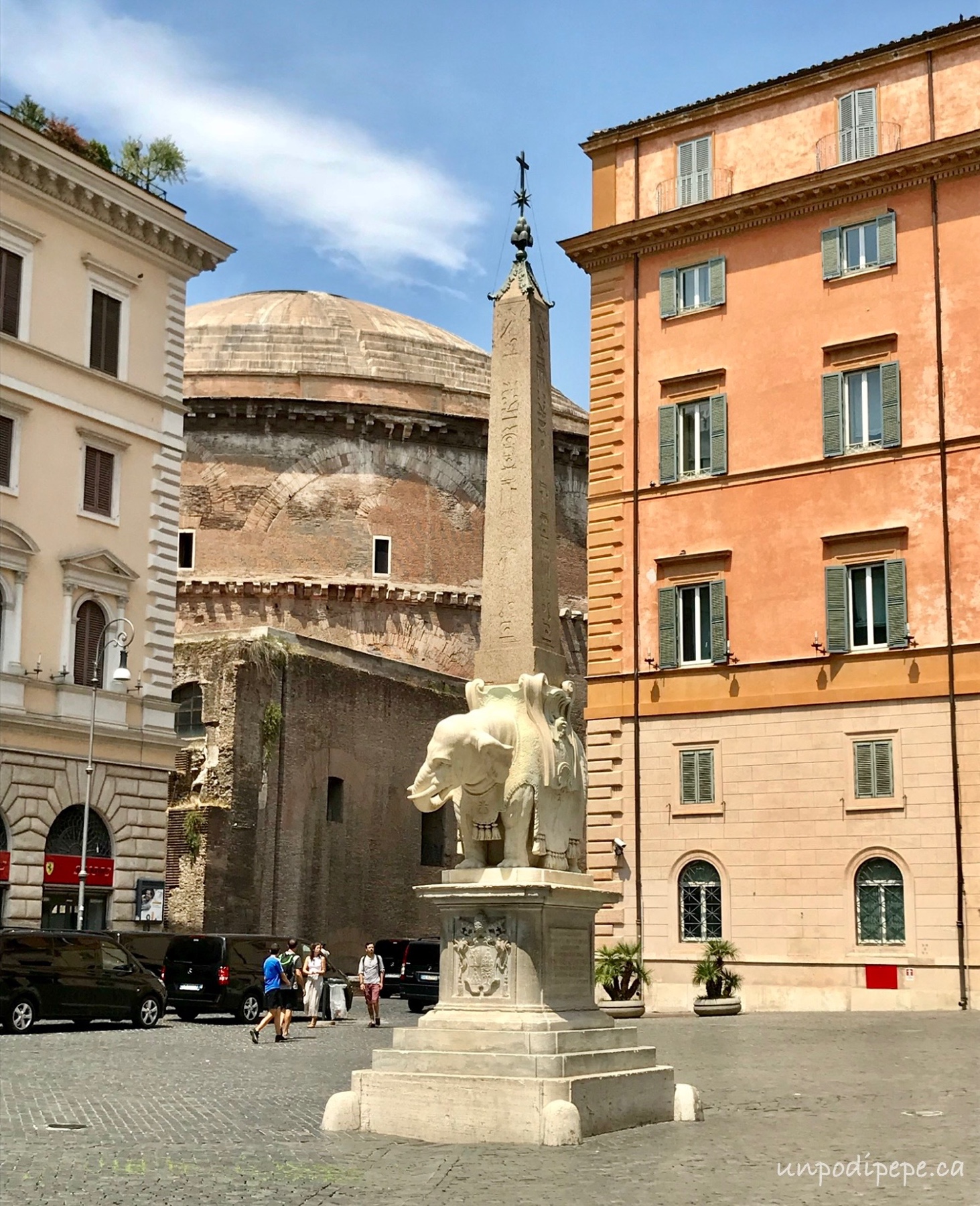
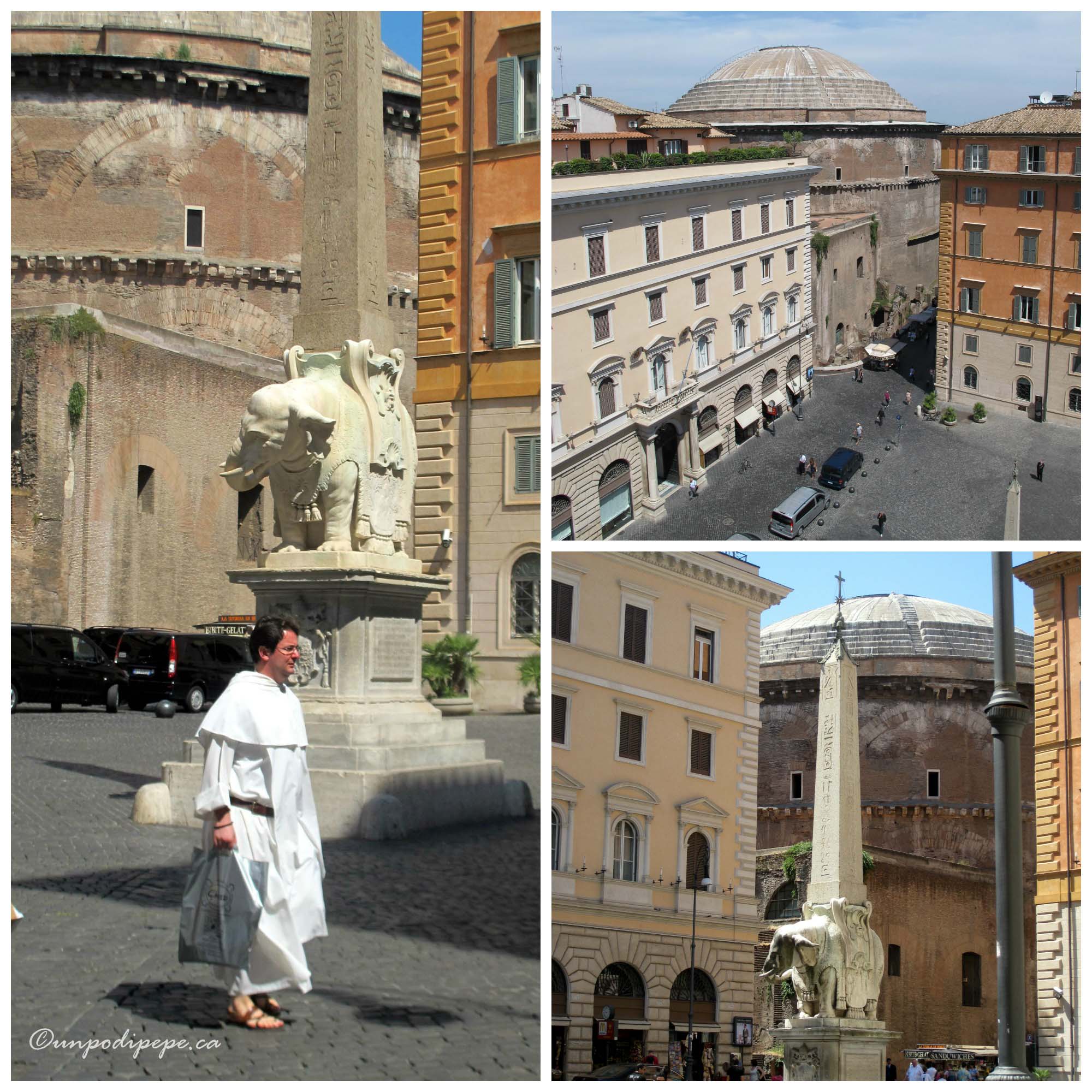
Il Pantheon from Piazza de la Minerva

Il Pantheon from Piazza de la Minerva

Il Pantheon is also featured in my post ‘Un Giorno a Roma’.

©2016 http://www.unpodipepe.ca


Share this:

  • Click to share on Facebook (Opens in new window) Facebook
  • Click to share on Pinterest (Opens in new window) Pinterest
  • Click to share on X (Opens in new window) X
  • Click to email a link to a friend (Opens in new window) Email
  • Click to share on WhatsApp (Opens in new window) WhatsApp
Like Loading...

Enter your email address to follow 'un po' di pepe' and receive notifications of new posts by email.

Join 511 other subscribers
Follow Un po' di pepe on WordPress.com

Popular Posts

  • Hairstyling in Ancient Roma
    Hairstyling in Ancient Roma
  • Panforte di Siena
    Panforte di Siena
  • Espresso Cookies
    Espresso Cookies
  • Il Pumo Pugliese
    Il Pumo Pugliese
  • Panettone Fatto in Casa
    Panettone Fatto in Casa
  • Dolci di Natale
    Dolci di Natale
  • Internment of Italian Canadians
    Internment of Italian Canadians

Recent Posts

  • Castel del Monte
  • ‘The Nuances of Love’
  • Hostaria Antica Roma~Eat like an Ancient Roman
  • Santa Maria in Aracoeli
  • Casino dell’Aurora~Villa Boncompagni Ludovisi
  • Nasoni di Roma
  • Bloghiversario #11
  • Fontana di Trevi
  • Acqua Vergine
  • Giubileo 2025
  • Sanremo 2025
  • In Vino there are Memories
  • A Literary Harvest
  • 2024~Un po’ di pepe Year in Review
  • Buon Natale 2024
  • Il Bicerin
  • Mercato Porta Palazzo
  • Torino
  • Catanzaro, Calabria
  • Il Pumo Pugliese
  • Artemisia Gentileschi
  • Cavalli di San Marco
  • Panzerotti
  • Torcello
  • 10 years of Un po’ di pepe!

Categories

Amici e Famiglia Architecture Art Art history Art projects Bilingual posts Blogging Canada Culture Feste Firenze Inspiration Italia Italian Folklore Italian language Italian life Italocanadesi Libri Mangiamo! Orsara di Puglia Parole piacevoli Photography Puglia Recipes Roma Travel Travel tips Uncategorized Vino

Archives

Un po’ di pepe on Facebook

Un po’ di pepe on Facebook

Start a Blog at WordPress.com.

  • Subscribe Subscribed
    • Un po' di pepe
    • Join 511 other subscribers
    • Already have a WordPress.com account? Log in now.
    • Un po' di pepe
    • Subscribe Subscribed
    • Sign up
    • Log in
    • Report this content
    • View site in Reader
    • Manage subscriptions
    • Collapse this bar
 

Loading Comments...
 

    %d