• Home
  • About me/Chi sono
  • Contact

Un po' di pepe

~ …… (oon∙poh∙dee∙PEH∙peh) Cristina writes about interesting stuff /Cristina scrive di cose interessanti

Un po' di pepe

Tag Archives: Italian history

Castel del Monte

22 Saturday Nov 2025

Posted by Un po' di pepe in Architecture, Puglia

≈ 9 Comments

Tags

Federico II, Italian history, Puglia, Romanica Pugliese, Southern Italy, UNESCO World Heritage Sites


Castel del Monte overlooks the Murgia plateau near Andria, Puglia, rising like a massive, imposing stone crown. The flawless design is awe-inspiring, and it can even be seen from the sea. Castel del Monte ‘castle of the mountain’, is a mysterious place, that has intrigued scholars with speculation regarding its purpose and symbolism for almost 800 years.

Federico Secondo /Frederick II Hohenstaufen (1194-1250) Holy Roman Emperor and King of Sicily built Castel del Monte between 1240 -1250.  He was a visionary, considered an early Humanist-a lover of art, architecture, science and poetry, and also a skilled warrior, hunter and falconer.  He spoke 6 languages and wrote books, including a guide to falconry.  At his court in Palermo, he brought together Greek, Arab, Italian and Jewish scholars so that experts in science, theology, philosophy, and alchemy could exchange their Eastern and Western knowledge. A cultured, cosmopolitan ruler, and probably a megalomaniac, he was called ‘Stupor Mundi’ wonder of the world.
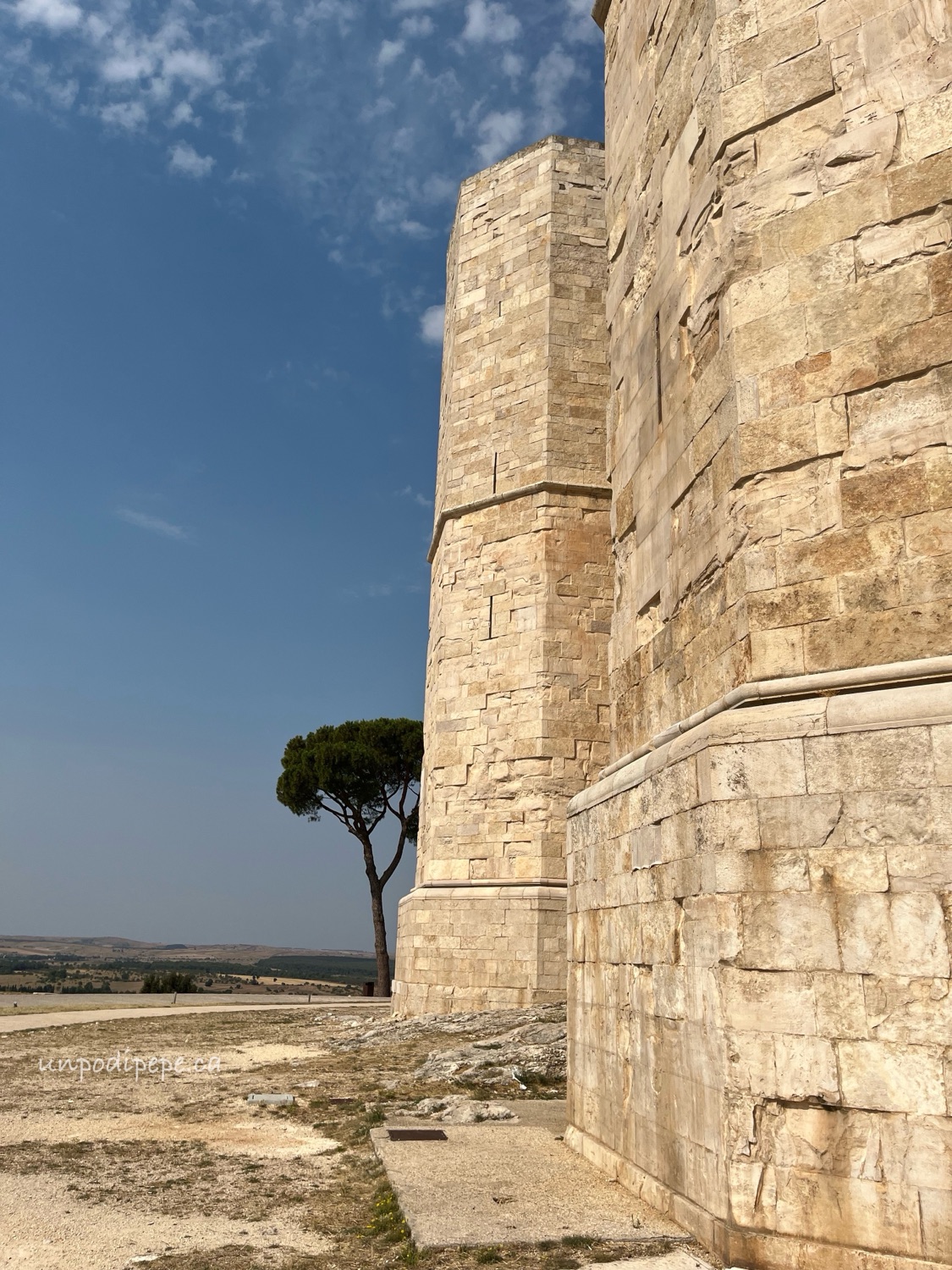
No one knows why he built Castel del Monte– the location at an altitude of 540m (1770 ft), has a great view, but is not strategic, and the building has no defensive measures, such as a moat or arrow slits, so was not built as a fort. Some think it was built as a fancy hunting lodge, but there is no sign of a kitchen or cooking facilities on site.  Federico died not long before it was completed, so he never actually stayed there.

The octagonal design is unusual. According to medieval beliefs and mathematical symbolism, the octagon represented the union of the divine perfection of the circle and the natural perfection of the square into one shape. In many cultures and religions, the number 8 is associated with power, good judgement, efficiency, prosperity, strength and stability.  A sideways 8, the infinity sign is a symbol of continuous balance.  8 is repeated throughout the design of Castel del Monte-an octagonal shape with 8 interconnecting rooms on each floor, 8 octagonal towers, and an octagonal internal courtyard. Many details in the sculptures, bas-reliefs, marble columns and keystones have decorations with 8 elements.
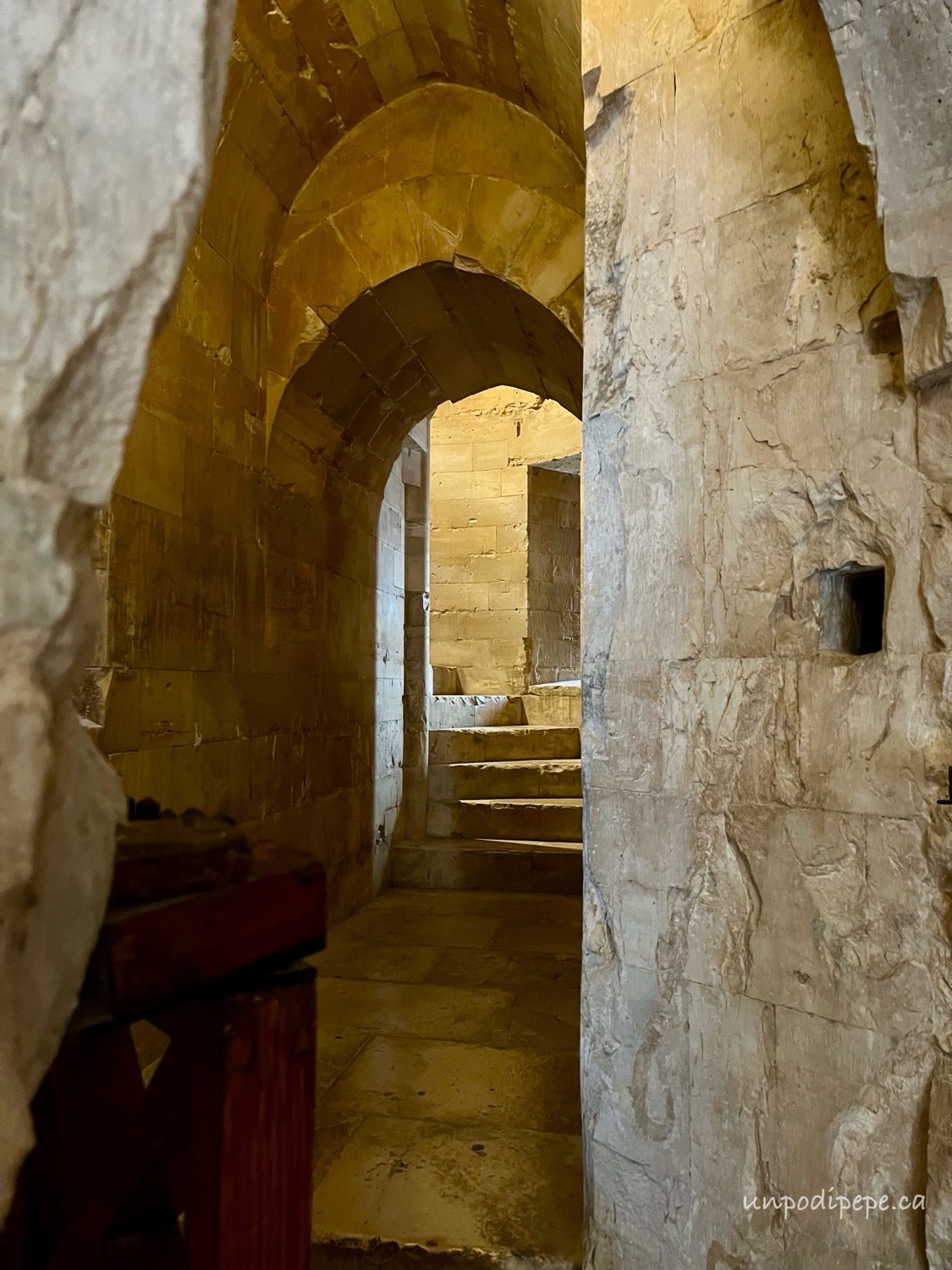
The upper rooms have decorative marble columns and 8 fireplaces, The doorways and Gothic windows are framed in corallite stone. 3 of the towers have stairs and at least one has a room with what may have been Europe’s first flushing toilets. Castel del Monte also had advanced hydraulic engineering with an air heating/cooling system (ancient HVAC?) in the walls and a rainwater collection and filtration system.  Water passed through the walls into cisterns in the foundation. In the alcoves beside some of the windows on the upper floor, you can see evidence of these systems.
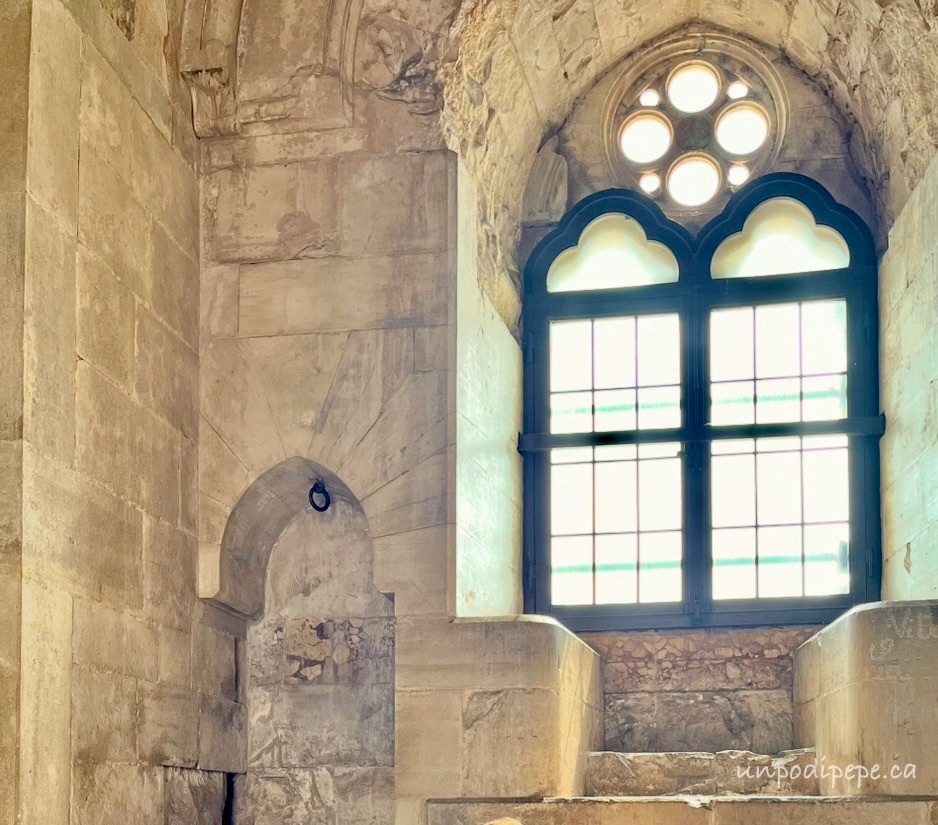
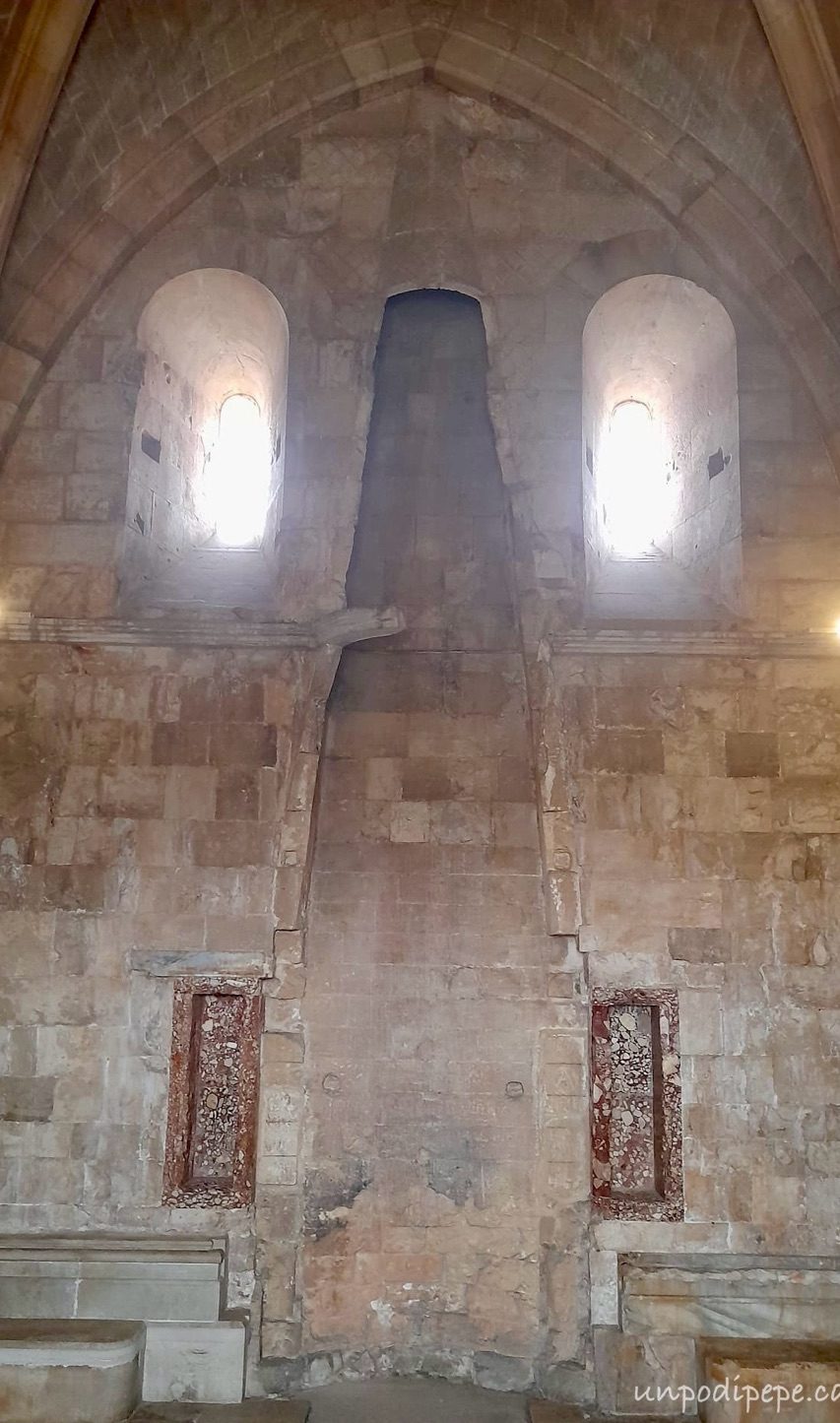
Similar to Federico’s cultural perspective, elements of diverse architectural styles and traditions from different times in history are effortlessly blended in Castel del Monte. These include classical antiquity, the Islamic Orient and north-European Gothic. To me it looks similar to Romanica Pugliese.  The layout and orientation are designed with advanced mathematical and astronomic precision. The positions of windows and light slits is designed to create specific light and shadow effects during the solstice and equinox. Secret messages perhaps? The light cast by the slits also serve as a clock/sundial.  I actually thought the light slits were ridiculously long arrow slits! Mathematician Leonardo Fibonacci was a guest of Federico’s in 1240, so he may have even been a consultant!
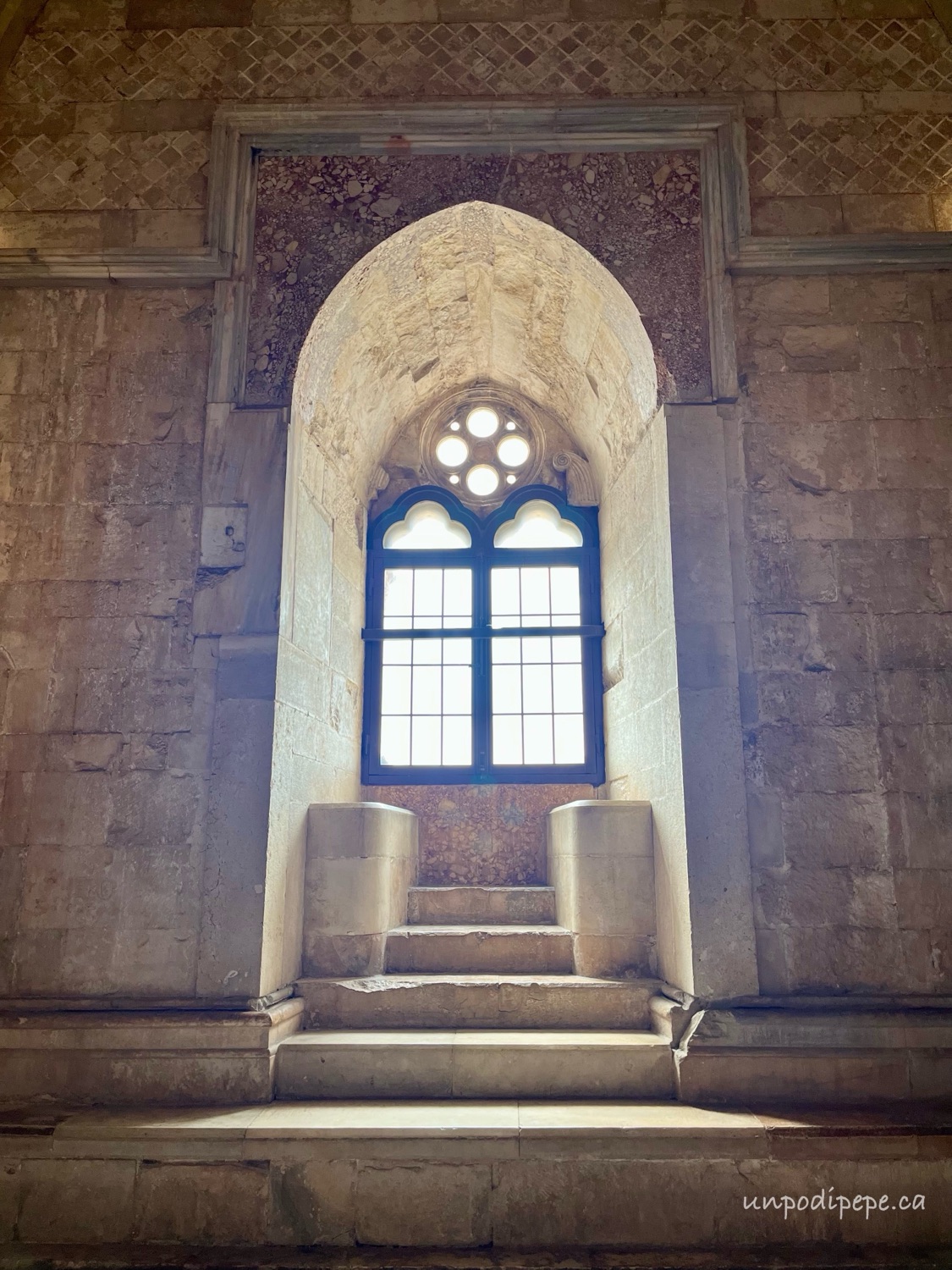
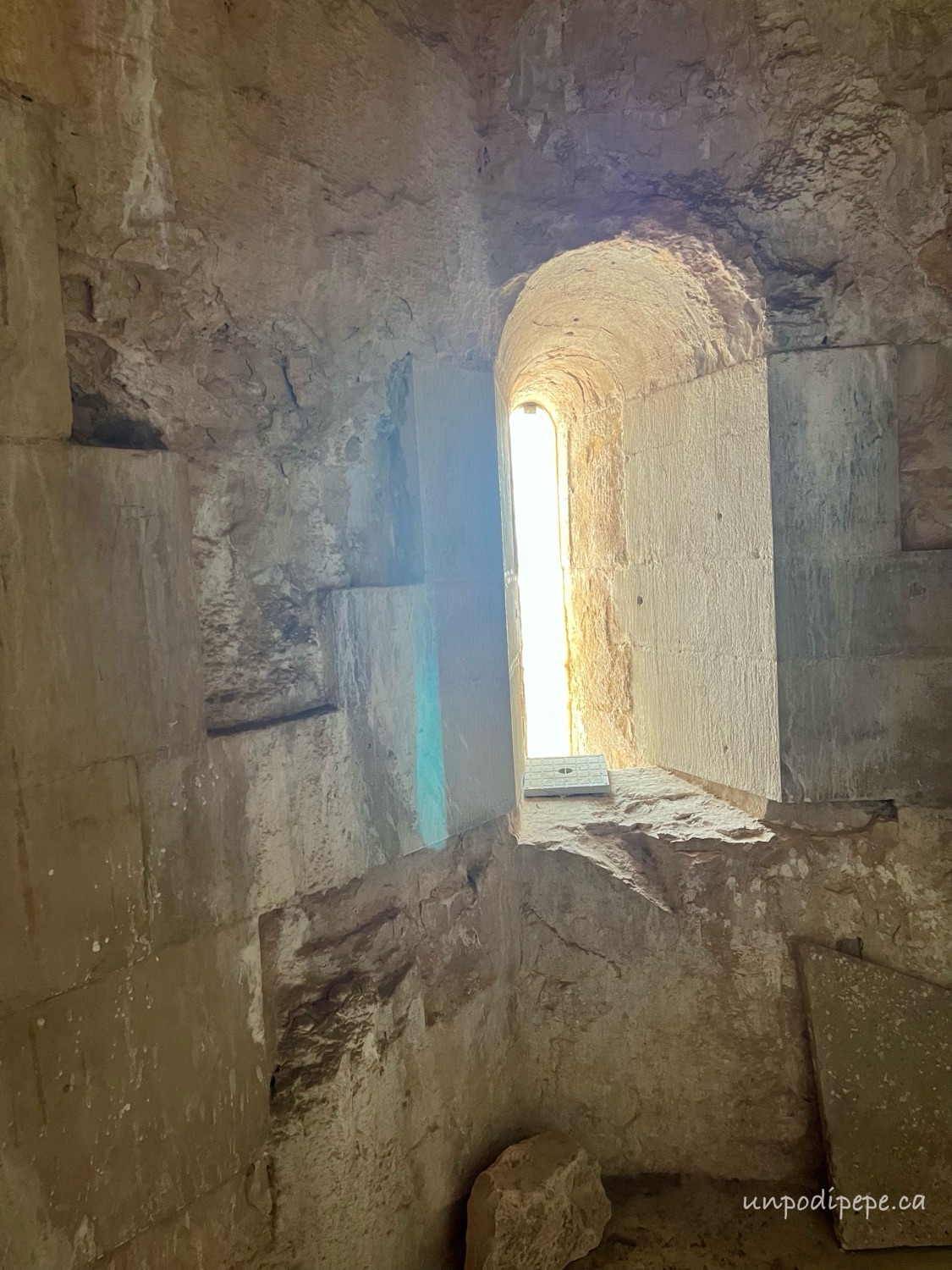
Castel del Monte was purchased by the Italian State in 1876 for 25,000 Lire, and is now protected under strict laws. It was declared a UNESCO World Heritage Site in 1996, as a unique and beautiful masterpiece of medieval military architecture and for its lack of structural alteration.  Castel del Monte is featured on the Italian one euro cent coin.
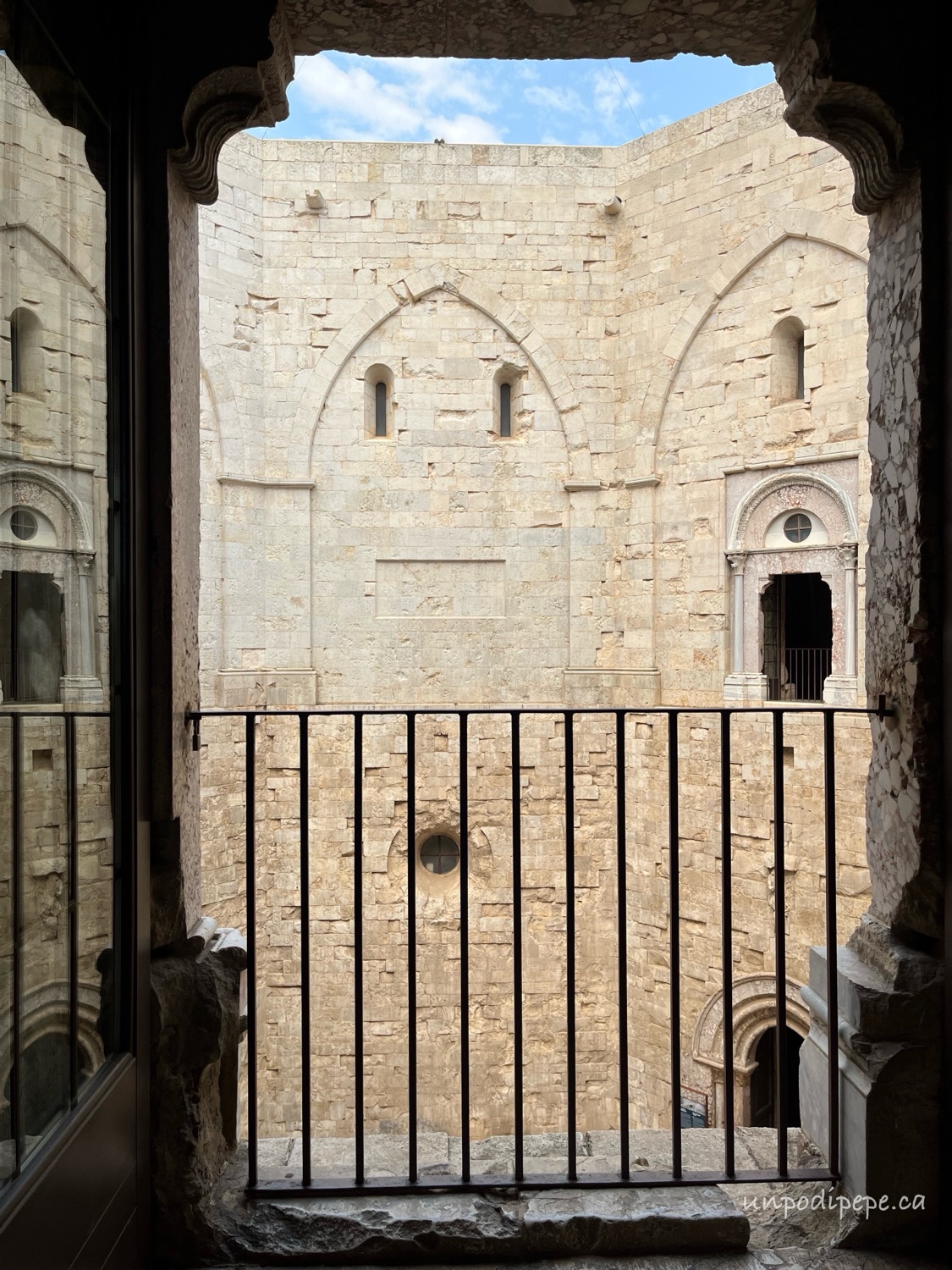
So what was the overall purpose of Castel del Monte if it was not built as a fort or hunting lodge?  Was it a celestial observatory, or a giant sundial?  Likely the primary purposes were to symbolize the power and personal genius of Federico II to reflect his cultural, pre-Humanist perspective, and to celebrate the relationship/balance between the spiritual and material world.

I have wanted to visit Castel del Monte for years. Since it is on a remote hilltop, 20 km from Andria, 35 km from Trani, getting to Castel del Monte without a car is not easy.  I got together with 6 of my friends from Orsara di Puglia and we hired a friend with an 8 passenger van to take us there.  We arrived early and then went to the Trulli di Alberobello in the afternoon. We had an amazing time! I was expecting Castel del Monte to be fascinating-but it surpassed my expectations!
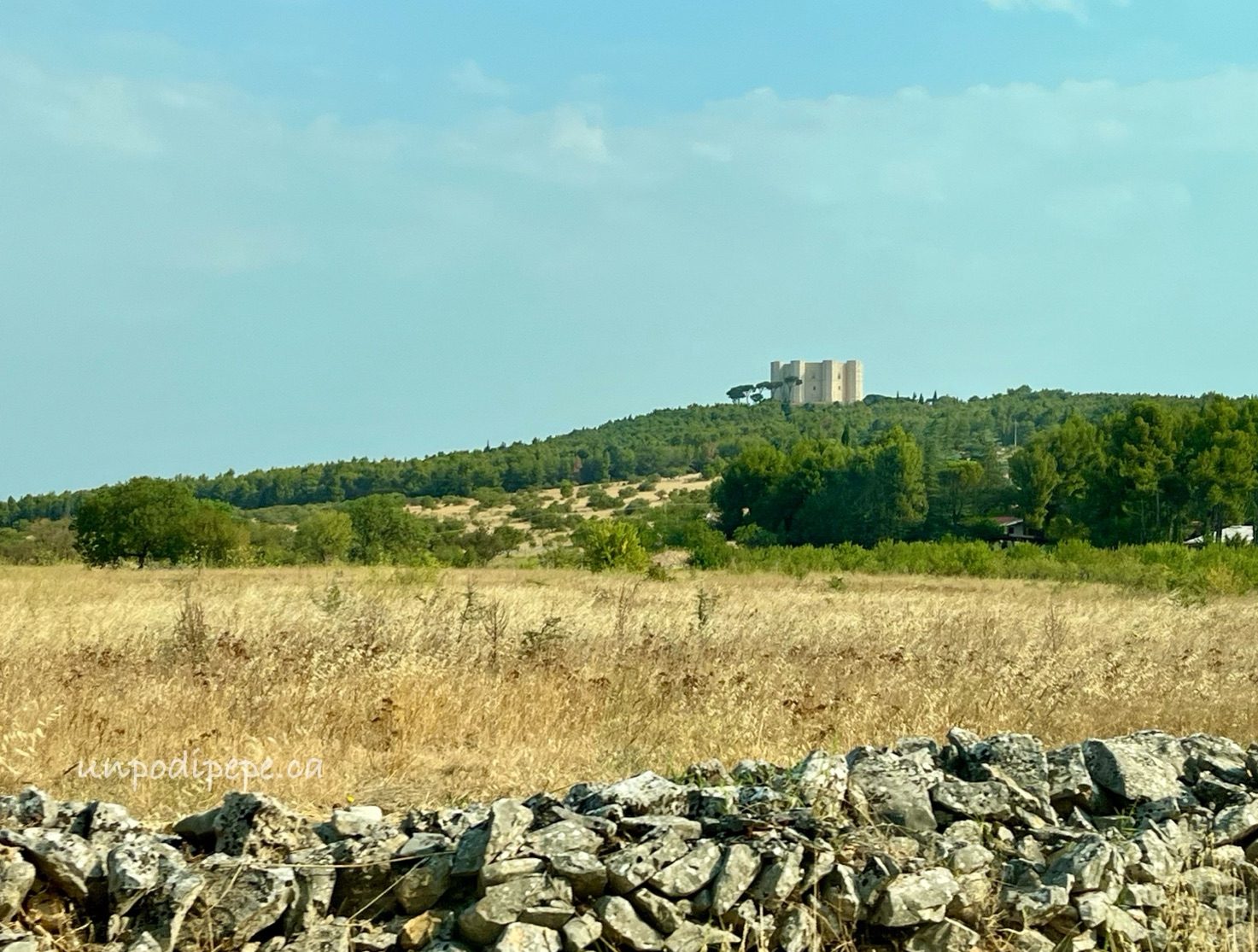
To get there by train/bus:  From Bari, take the Ferrovia Bari-Nord train to Andria.  Then either take bus # 6 from Andria station to Castel del Monte (35 minutes, five buses daily, April to October only) or take a taxi or hired car from Andria.  Trani is 35 km away and would be my choice if I was planning to stay the night.  A small parking site down the hill charges €5 for a car, and sometimes there is a €1 shuttle up the short, steepish walk to Castel del Monte.  There are a few souvenir stalls close to the parking area, and a Bar is open at the same seasonal entry times.

Opening hours: April 1-Sept 30 1000 to 1845.  Oct 1-Mar 31 0900 to 1745 Closed Dec 25 and Jan 1st.

Adult admission is €10 Audio guides (€6) are also available to maximise visit. Skip the line tickets are available but not necessary, since there are only 250,000 visitors per year. There are likely to be more visitors during the summer or winter Solstice and the Federico II festival in April.

The inside visit takes about 1 hour, but allow more time to walk around the outside, enjoy the views and take photos.  In summer, try to go in the morning, as the afternoons are hot and there is little shade.Buon viaggio, Cristina

Share this:

  • Click to share on Facebook (Opens in new window) Facebook
  • Click to share on Pinterest (Opens in new window) Pinterest
  • Click to share on X (Opens in new window) X
  • Click to email a link to a friend (Opens in new window) Email
  • Click to share on WhatsApp (Opens in new window) WhatsApp
Like Loading...

Torino

13 Sunday Oct 2024

Posted by Un po' di pepe in Architecture, Italia, Photography, Travel tips

≈ 14 Comments

Tags

Bicerin, Italian history, Northern Italy, Piemonte, UNESCO World Heritage Sites

I had no expectations when I visited Torino.  I knew that many of my paesani had moved to the area in the 1970-80’s to look for work, but did not know much about the city itself.  Torino turned out to be a pleasant surprise-a truly underrated, overlooked city on the banks of the river Po, at the foothills of the Alps. With a population of almost 850,000, it is the fourth largest city in Italia but practically unknown to English speaking travellers. It is much less crowded, quieter and cheaper than most other major cities.

L’Universita’ di Torino

I arrived in Torino by highspeed train (TGV) from Paris, to attend an AICW conference at the Università di Torino.  Once the conference started, I only had the evenings to explore the city, so could not visit any buildings/museums.  This is why many of my photos were taken at night!  I need to return to Torino to visit the indoor things!

Named for the ancient Taurini people, the Roman Colony of Taurinorum was founded in 28 BC.  Via Garibaldi, the main shopping street traces the exact path of the ancient Roman street or Decumanus.

Torino was the capital of the Duchy of Savoia, the political center of the Risorgimento (birth of the nation) leading to unification of Italy, and the first capital of the Kingdom of Italy after unification in 1861. The capital moved to Roma in 1865.  Torino was also the center of anti-fascist movements and the Italian resistance movement during WW2.  A lot of history here!

Elegant and sophisticated, Torino has an old world feel, like Paris or Prague, but with an Italian accent.  There is a definite French influence from the Savoia family, even on the local dialetto. The stunning architecture in the centro includes Baroque, Rococo, Neoclassical, Romanesque and Art Nouveau. Most buildings were built between the 16-18th centuries.  In 1997, the historical Center of Torino and residences of the Royal House of Savoia became a UNESCO World Heritage Site.

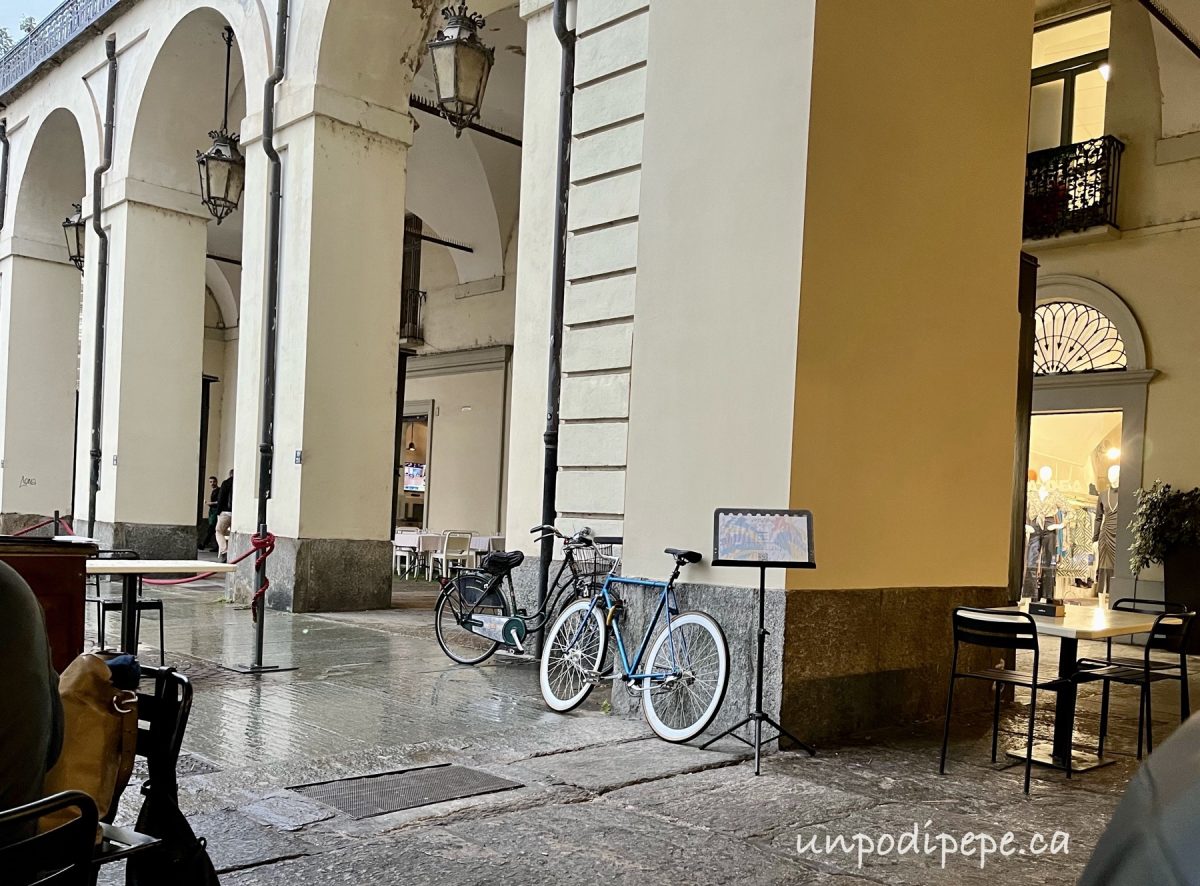
Torino’s centro, the largest pedestrian area in Europe, is easy to navigate. A defining characteristic of Torino’s architecture are the portici (porticoes). 18 km (7 miles) of portici provide shade in summer and shelter from rain, snow and wind.  12.4 km are continuous.  According to legend, King Vittorio Emanuele I wanted Torino to be elegant and also wanted to go on his daily walk to the river Po without getting wet.  So he had the portici built -and now everyone can window shop in all weather conditions.  A whole day can be devoted to walking the portici. Torinesi use them a lot!

Torino is known for, the Shroud of Turin, artisanal chocolate, museums, Royal Palazzi of Savoia, FIAT, Juventus, 2006 winter Olympics, Eurovision 2022, and home to the automotive industry with headquarters for Fiat, Lancia and Alfa Romeo. Torino is also the birthplace of Italian caffè culture, aperitivo, Nutella, Ferrero Rocher, gianduja, Lavazza, FIAT, Vermouth and the Slow food movement!

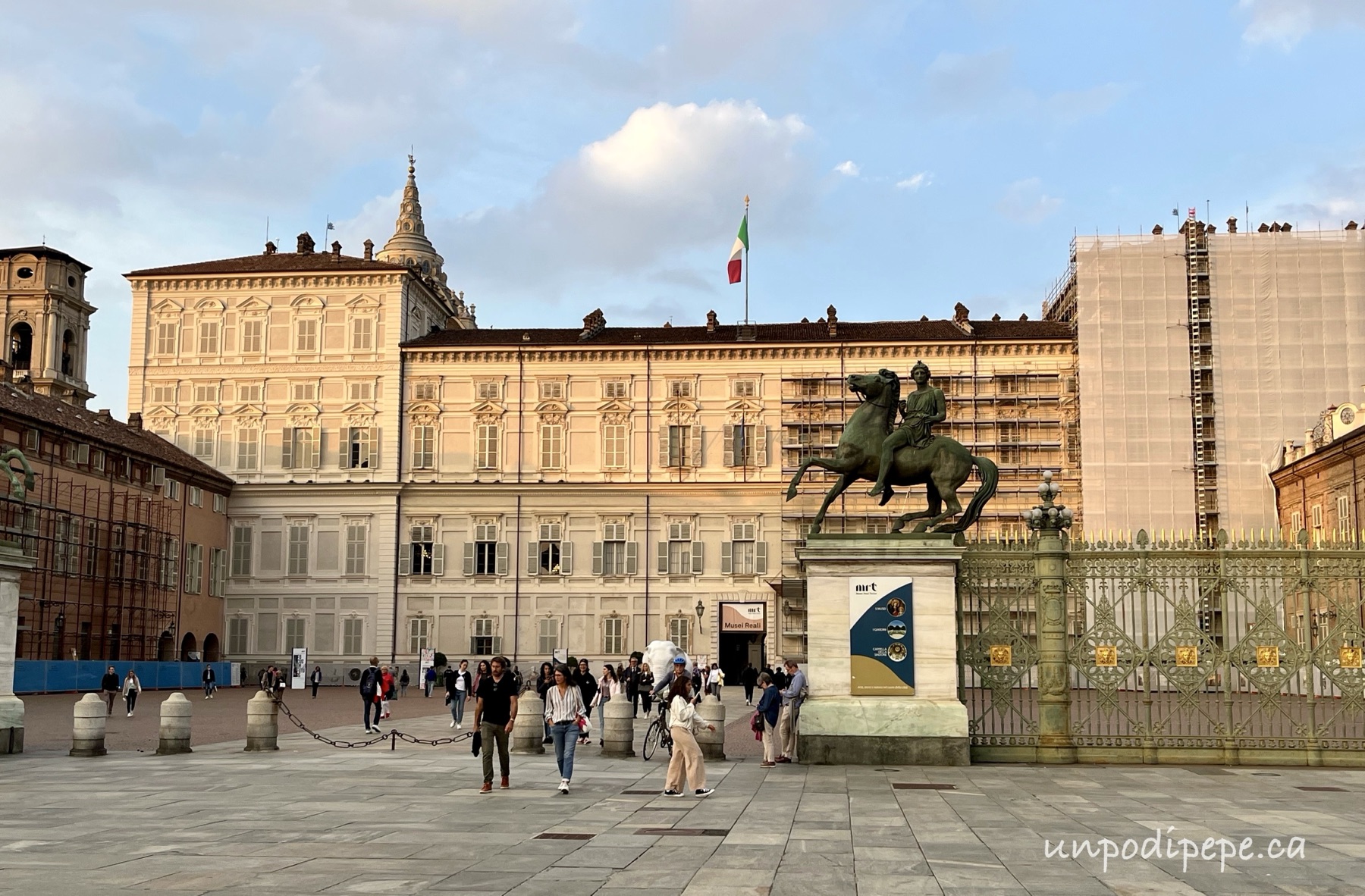
There are many large piazze, full of amazing architectural details, chocolate shops and places to have aperitivo.  Piazza Castello has the Royal Palaces, Palazzo Reale and Palazzo Madama.  Palazzo Madama was the residence of 2 Savoia queens, which explains the name.  It was also the 1st Senate of Italy.  Since 1934 it is a museum of ancient art-although mostly from middle-ages to 18th Century.  Palazzo Reale at the north end, with iron gates contains Armeria Reale, Galleria Sabauda and the Museo di Antichità. The Museo Nazionale del Risorgimento (unification museum) is in Palazzo Carignano.

I had the day before the conference free and met local expert Lucia Hannau from Turinepi for a morning walking tour.  We started in Il Quadrilatero, the oldest part of city, dating back to Roman times.  Piazza della Consolata is home to Caffè Al Bicerin since 1763. They make it in other historic bars, but this is the home of the original Bicerin- with the accompanying plate of local cookies. Bicerin is the iconic drink of Torino, with 3 layers, chocolate, caffè and frothed milk-no stirring!  Stay tuned for a future post! Santuario della Consolata, is across the piazza.  The Baroque exterior looks more like a neoclassical temple, the interior ornate and colourful, gilded and decorated with marble of different colours.

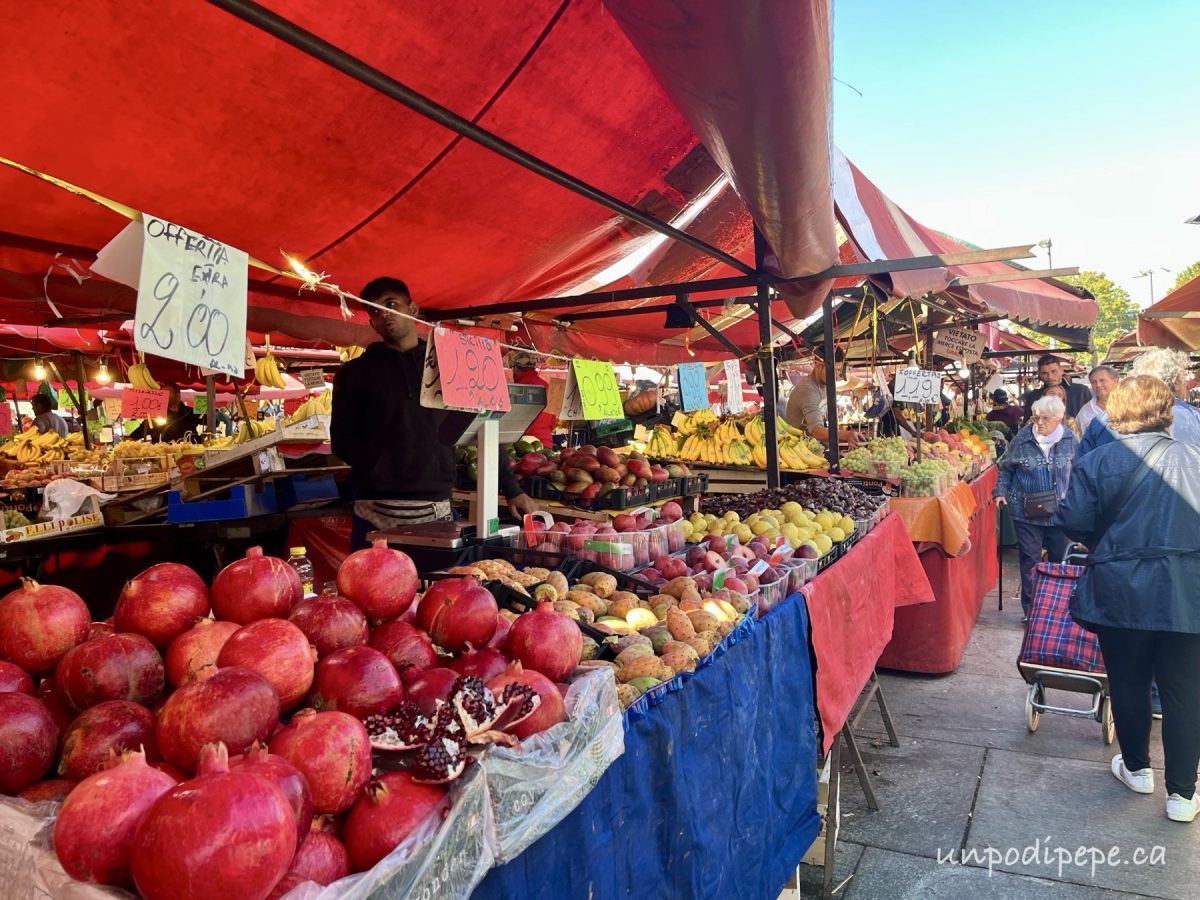
We ended at Mercato Porta Palazzo, Europe’s largest open-air market. My many photos will need a separate post. I had time for only 1 museum visit after my walk with Lucia, and it was Museo Egizio–the world’s oldest Egyptian museum and the largest collection of Egyptology outside of Cairo. Buy €14 tickets online as numbers entering at one time is limited.  If you go to Torino, do not miss this! Stay tuned for a future post.

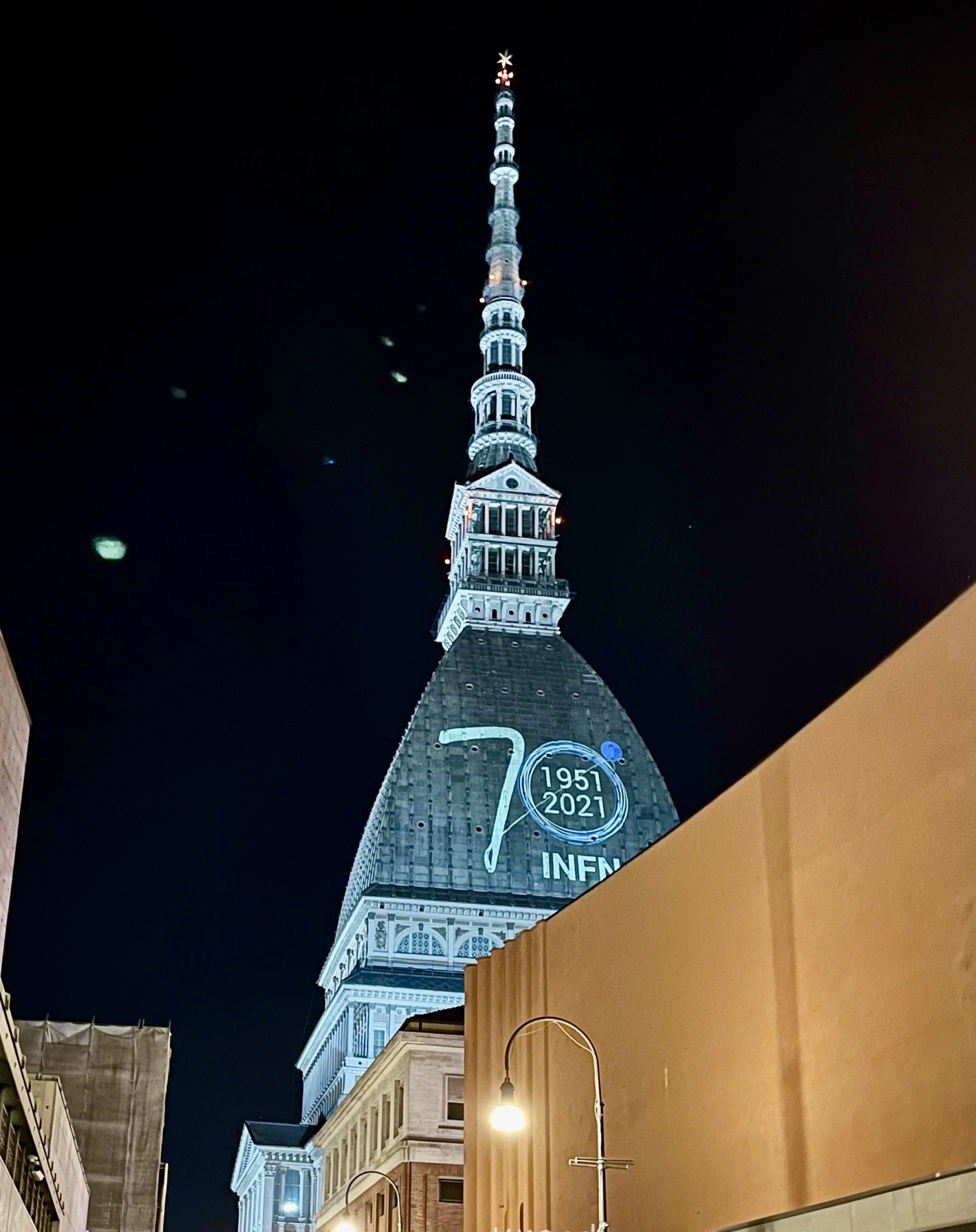
The 167 m (550 ft) tall Mole Antonelliana is featured on the back side of the 2 € coin. Mole means ‘big mound’ and Antonelli was the architect who kept making it taller.  Originally planned as a synagogue, it barely escaped bombing during WW2.  Since 2000 it houses the Museo Nazionale del Cinema, an interactive cinema museum and the tallest museum in the world. It is also the tallest unreinforced brick building in the world (without steel girder skeleton). The top has impressive views of Torino and the Alps.  

The Holy Shroud (Sindone di Torino) is a linen cloth said to have covered the body of Jesus.  An important icon for pilgrims, kept in the Cathedral of San Giovanni Battista, but only displayed for the Jubilee every 25 years.  It will be on display in 2025.

Autumn is a perfect time to visit Piemonte, especially for the seasonal food….zucca, porcini, castagne, tartufo bianco, salsiccia,tajarin and agnolotti del plin.

Tajarin integrale con porcini, salsicce e formaggio Piemontese

Torino has a chocolate festival in November and the Salone dei Libri in May. Milano is only 1 hour by train. Stay 3-4 days if you can, as there is a lot to see in Torino!  I definitely recommend a walking tour with Lucia, Bicerin and the train from Paris!

Buon Viaggio, Cristina

Share this:

  • Click to share on Facebook (Opens in new window) Facebook
  • Click to share on Pinterest (Opens in new window) Pinterest
  • Click to share on X (Opens in new window) X
  • Click to email a link to a friend (Opens in new window) Email
  • Click to share on WhatsApp (Opens in new window) WhatsApp
Like Loading...

Ostia Antica

27 Tuesday Feb 2024

Posted by Un po' di pepe in Art history, Italia, Roma, Travel

≈ 9 Comments

Tags

Ancient Roma, Archeology, Daytrips from Roma, Italian history, Lazio, Roma, Roman walks

Ostia Antica, 30 km southwest of Rome was once a thriving town and commercially important seaport. It is now a well-preserved archeological site and at 150 hectares, one of the largest archeological parks in Europe. Founded in 620 BC to harvest sea salt at the ‘ostium’ or mouth of the Tevere (Tiber River), Ostia Antica was Rome’s first colony, a naval base and main ancient seaport.  With a population of 60,000 in the 2nd and 3rdcenturies AD, it was the hub for import of grain, olive oil, wine, marble, cloth and other goods destined for Rome.

Originally located on the coast, Ostia Antica is now 3 km inland. After the fall of Rome and barbarian raids, the port was neglected and the harbour eventually silted up. It was completely abandoned in the 9th century AD.  Sand dunes and mud covered the city, helping to preserve the ruins and mosaics for us like a time capsule from Ancient Rome.

Ostia Antica was a working class port city, as opposed to Pompeii, which was a resort getaway and playground for the rich and famous.  The ruins provide insight into regular, daily life in Ancient Rome and give us a sense of urban planning for the time.  There are well preserved cobbled streets, magnificent mosaics, temples, shops, apartment buildings, warehouses, private homes, public baths, warehouses, taverns, inns, a public laundry, theater and even a firefighting service.  The earliest identified synagogue in Western Europe (41-54 AD) was discovered in 1961.

Excavation started in the early 19th Century, but most of it was done from 1938-1942. Only 40% of the site has been excavated! There is a lot to see in Ostia Antica.  Here are some of the highlights:

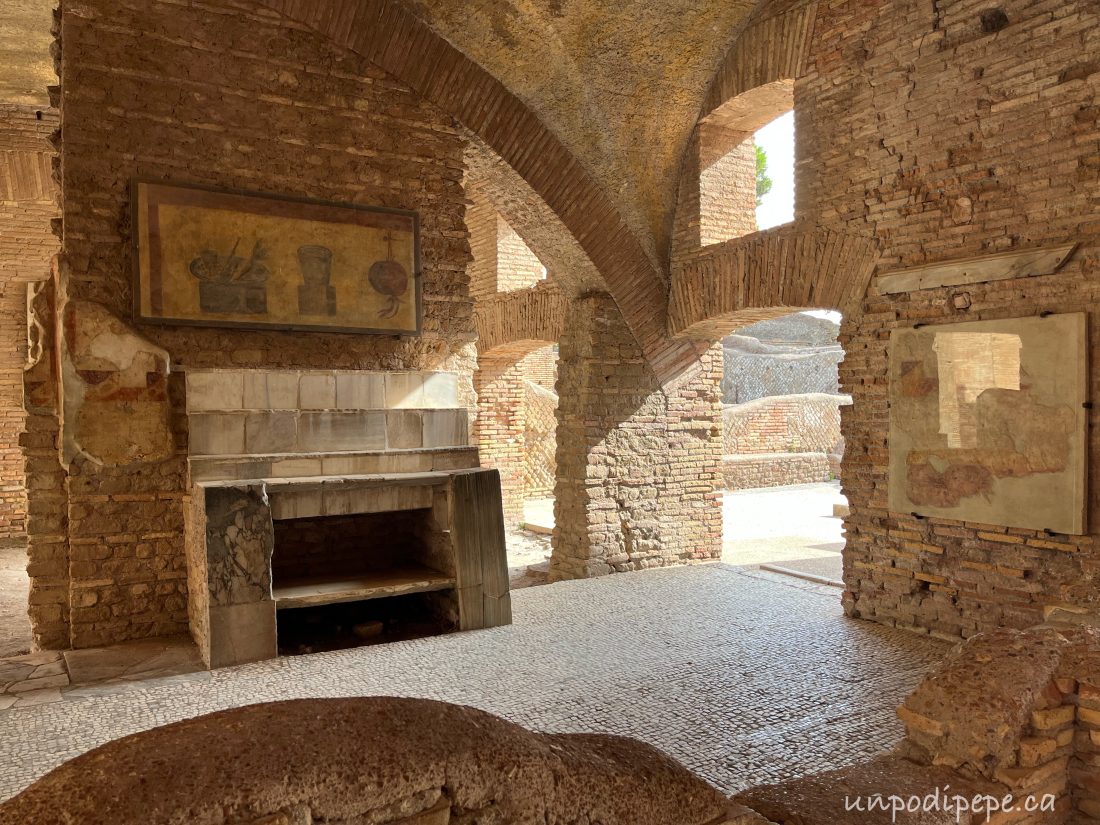
Thermopolium di Via di Diana Thermopolium is Greek for ‘place where hot food is sold’.  A 3rd C ancient fast-food joint and wine bar with windows that open out onto the street and a marble take-out counter, long table to serve hot food, shelves and a courtyard with a fountain for outdoor dining. Amphorae with cheap wine were stored under the counter.  A large fresco ‘menu’ on one wall shows a plate with carrots and beans, a glass of wine, a jar of olives and large onions or pomegranates.
Customers likely topped their food with an ancient condiment called Garum.  It was a pungent rotten fish sauce and makes ketchup sound appetizing.  On the side of the Thermopolium is a single gated public toilet!

Mulino di Silvano A multiroom bakery built in 120 AD. One room has 3 intact lava millstones for grinding the grain into flour, one for kneading the flour into dough and another still has the ovens for baking the loaves.  The bread was sold on site and also transported to sell in Rome.

Teatro Ostia’s semicircular theater survives in excellent condition.  Built in the first century BC and expanded later, it is one of the oldest masonry theaters in the world.  It can seat 4,000 spectators and is still used for summer concerts.

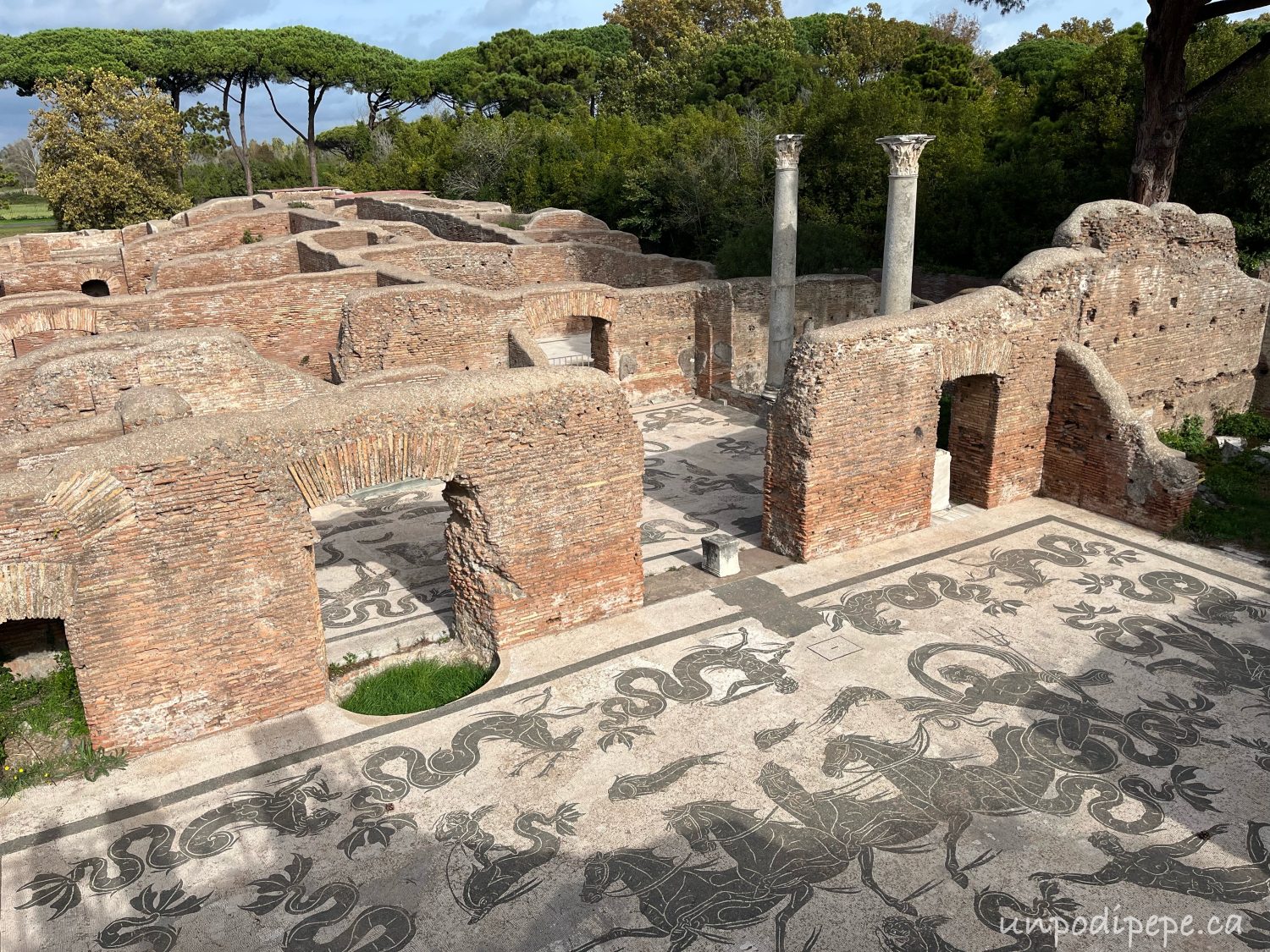
Public Baths  There are several public baths in Ostia.   The Baths of Neptune have incredibly preserved mosaic floors of Neptune and sea creatures.  We can thank the mud that covered them for centuries!  These are often covered up in the winter to protect from the harsh weather.

Public toilets A fine example of Roman plumbing. The toilets consist of a communal marble bench along 3 walls with 20 seats. Each seat had a hole leading down towards a single drain channel fed with running water to flush away waste. Since toilet paper was not a thing yet, a sea sponge attached to a stick was kept in a bucket of saltwater or vinegar for patrons of the toilets to wipe themselves. Yuck!

Piazzale delle Corporazioni (Piazza of the Corporations/Guilds) Located behind the theater, the piazza is a large open air market square with stalls along all 4 sides. Merchants and craftsmen from all over the Mediterranean sold their goods.A small metal model of the piazzale has descriptions written in Braille and Italian.The beautiful black and white mosaics in front of the stalls advertised the goods or services being sold. Stalls included shipbuilders, ropemakers, leather tanners, sailmakers, grain and wine importers, as well as fish and food products.  One of the stalls with fish mosaics likely sold the pungent Garum fish gut sauce!

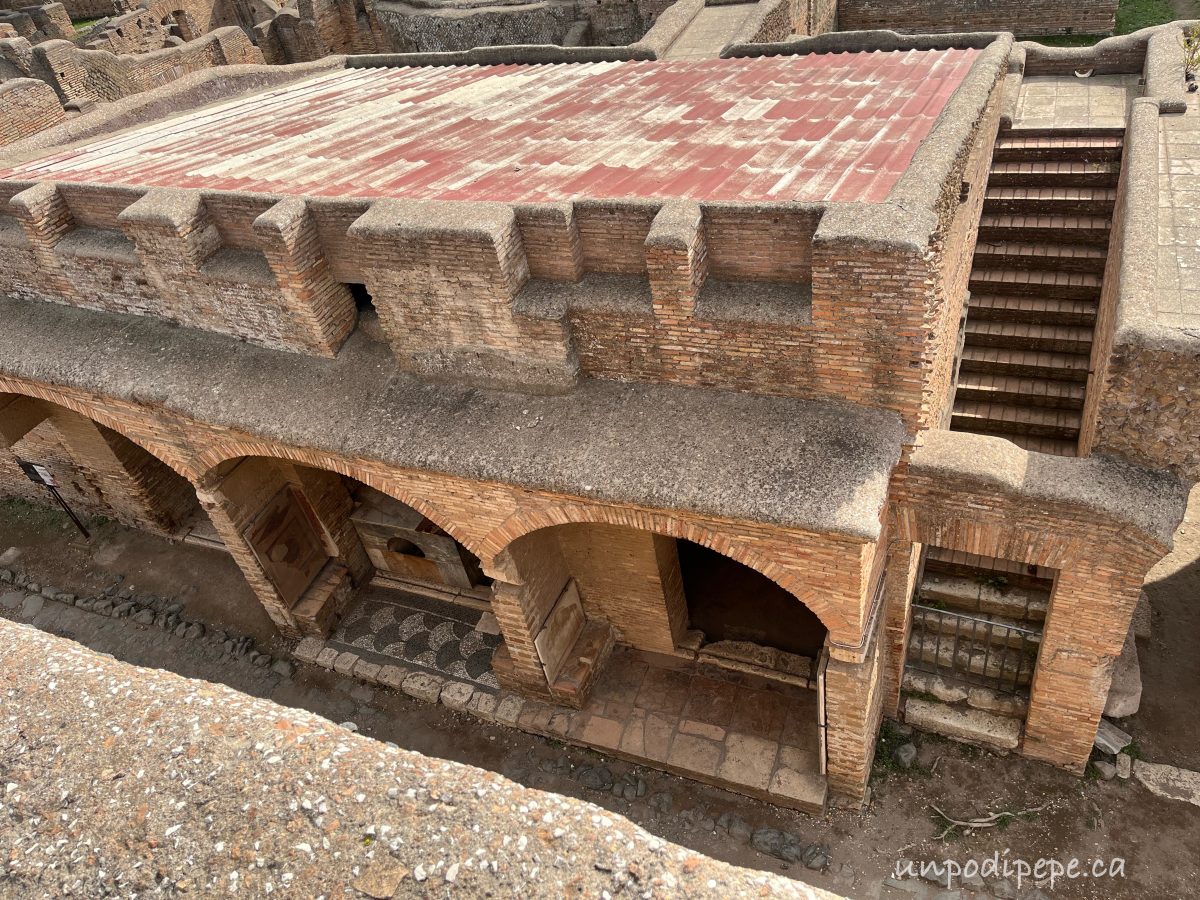
Casa di Diana A complex multifunction residential building -urban planning centuries ahead of its time.  Called an insula, this multilevel apartment has ground floor shops, accommodation for the shopkeepers on the 1stfloor and more modest accommodation on the upper floors.  A 150 AD painting of Diana was found inside.  It is possible to climb the stairs of other insulae to get to the upper floors.

A visit to Ostia Antica is a nice, half day trip from Roma, although it can be a whole day excursion if you explore more of the huge site and have lunch at one of the restaurants nearby.  Ostia Antica is grossly under visited, so it is never crowded! Bring water, a hat, sunscreen and good walking shoes.

Open Tues to Sat 8:30-4:30 in winter 8:30- 7 pm in summer. Admission fee is €18. Free admission the first Sunday of the month.  Tickets can be booked online on the official website .  A PDF guide can also be downloaded from the website.  The museum is worth seeing, but is closed at present.

Getting there by public transportation is easy and cheap: Take Metro line B (Blue line) to San Paolo (or Piramide*) metro station and take the ‘Lido’ commuter train to Ostia. Get off at ‘Ostia Antica’. The ride is 23 minutes. (Do not get off at Ostia Lido Nord or Ostia Lido Centro unless you are going to the beach!)

Use the footbridge to cross the road and walk 5-10 minutes to the main entrance of the Parco Archeologico Ostia Antica. Trains leave every 20 minutes and use the regular metro/bus tickets €1.50.

*If getting there from Piramide, walk out of the metro station and go to Porta San Paolo train station next door to find the Lido commuter train.

Buon viaggio!

Share this:

  • Click to share on Facebook (Opens in new window) Facebook
  • Click to share on Pinterest (Opens in new window) Pinterest
  • Click to share on X (Opens in new window) X
  • Click to email a link to a friend (Opens in new window) Email
  • Click to share on WhatsApp (Opens in new window) WhatsApp
Like Loading...

700 Years of Dante

28 Thursday Jan 2021

Posted by Un po' di pepe in Firenze, Italia, Italian language

≈ 13 Comments

Tags

Accademia della Crusca, Dante, Dante Alighieri, Firenze, Italian history, Italian language, Italian literature, La Divina Commedia

Dante Alighieri profile2021 is the 700th anniversary of the death of Dante Alighieri.  Dante is known as the ‘Father of the Italian Language’.  His most famous work La Divina Commedia (The Divine Comedy) is considered a masterpiece, the first and still the greatest work of literature in the Italian language and a precursor to modern fiction.  In the late medieval period, Latin was the only language for education, literature and religion.  La Divina Commediawas the first major work written in a language of ordinary speech or vulgare, the way people actually spoke at home. Dante combined Tuscan and other dialects, including Sicilian and Latin, establishing the modern Italian language.  Even though La Divina Commedia was written in 1308-20 the language is understandable today.Dante Divina Commedia

La Divina Commedia is a 3 part epic poem written in the first person, emphasizing the importance of salvation and Divine love in the redemption of humanity. It explores Dante’s imaginary trip to Paradiso (Heaven), passing through L’Inferno (Hell) and Purgatorio (Purgatory).  It is also a critique of famous figures of his time. The work is filled with historical, mythological and biblical references and discusses politics, religion, science, ethics and love. La Divina Commedia does not contain jokes nor is it funny.  The reason it is termed a commedia is because it is not a tragedia (trajedy) and it has a happy ending.

Dante was born in Firenze in 1265.  He studied philosophy, poetry, and was also an apothecary-a medieval pharmacist.  This is not as strange as it sounds, since nobles in public office had to belong to one of the city guilds and books were sold by apothecaries at the time. He married Gemma Donati in 1285 and they had 3 children.  Dante’s family was involved in the Guelfi/Ghibellini (Guelph/Ghibelline) power struggles.  The Guelfi supported the Papacy and the Ghibellini supported the Holy Roman Emperor -even though there was not one at the time. 

The Guelfi split into 2 groups because the Pope kept interfering with internal matters in Firenze.  Guelfi Bianchi (White Guelphs) did not want the Pope involved in city politics and Guelfi Neri (Black Guelphs) supported complete Pope authority. Dante’s family were Guelfi Bianchi.  In 1302, while Dante was in Roma as an ambassador, Firenze was occupied by the Guelfi Neri.  The Guelfi Bianchi, including Dante and his sons, were exiled. A few years later, other Guelfi Bianchi in exile were pardoned- but not Dante.  He was quite the badass in exile and burnt his bridges by writing many nasty letters.  Dante was offered amnesty in 1315, but it came with conditions and a heavy fine, which he was not able to pay.

Dante wrote La Divina Commedia while in exile and ruthlessly sends everyone responsible for his banishment to eternal damnation in L’Inferno.  He put a lot of effort and imagination into coming up with the horrible details! If Dante were alive today, he would probably be writing political satire.

Dante never did return to his beloved Firenze.  He stayed in Roma, then moved to Ravenna, where he completed Paradiso in 1320 and died of malaria Sept 14th 1321.  He is buried in the church of San Francesco. Jacopo Alighieri (1289-1348), also a poet, regained possession of his father’s confiscated property in 1343.

Firenze regretted Dante’s exile, and repeatedly asked Ravenna for his remains. A tomb was even built in 1829 in Santa Croce but all requests were refused and the tomb is empty. In June 2008, Firenze finally passed a motion rescinding his sentence and exile.  As my Mamma says ‘meglio tardi che mai’-Better late than never!

700th anniversary celebrations are happening throughout 2021, although most of them will depend on ever changing COVID 19 restrictions.  There is a website for all of the 700 Dante Firenze festivities. A few examples:

Museo di Casa di Dante has a new multimedia display and a virtual tour.
 
L’Accademia della Crusca, Italia’s fun ‘language police’ was established in Firenze in the 16th Century to safeguard the study of the Italian language.  Their website includes ‘Parola di Dante fresca di giornata’ a Dante word of the day for each day of 2021!

La Divina Commedia is as relevant today as it was in 1320.  I will leave you with an encouraging message of hope from the final phrase of l’Inferno…

             ‘e quindi uscimmo a riveder le stelle’– ‘hence we came forth to see the stars again’

Ciao, Cristina


Statue of Dante in Piazza Santa Croce, Firenze

Share this:

  • Click to share on Facebook (Opens in new window) Facebook
  • Click to share on Pinterest (Opens in new window) Pinterest
  • Click to share on X (Opens in new window) X
  • Click to email a link to a friend (Opens in new window) Email
  • Click to share on WhatsApp (Opens in new window) WhatsApp
Like Loading...

Lucca

15 Monday Jun 2020

Posted by Un po' di pepe in Italia, Photography, Travel

≈ 31 Comments

Tags

Daytrips from Firenze, Daytrips from Siena, Italian history, Lucca, Torre Guinigi, Toscana, UNESCO World Heritage Sites

Lucca Torre GuinigiLucca is one of my favourite smaller cities in Italia.  While writing my last post, I realized that I have not yet dedicated a whole post to Lucca!   Founded by the Etruscans as Luk, meaning marsh, Lucca became a Roman colony in 180 BC.  In the 12th-13th centuries, the silk trade and banking were responsible for economic development and population increase.  Lucca was an independent republic for 500 years, until Italian unification. Today the population is 88,000 and Lucca has been a UNESCO World Heritage Site since 2006.Porta Santa Maria Lucca

Lucca does not have 1 or 2 monumental sites-the city itself is the attraction!  Lucca is best known for the well preserved, intact Renaissance walls encircling it.  The complex defense network is still mostly intact, 12 m high and 30 m wide, with 6 porte – entrance gates and 10 ramparts.  The only thing missing is the moat, which was filled in the 1800’s.Lucca medieval walls

On top of the walls is Via delle Mura Urbane, a wide 4.2 km tree lined pathway that is popular for walking, cycling and running.  When entering Lucca, the 16th C walls from can be seen from below. Bike rentals are available near most of the entry gates.Lucca

Lucca has a real ‘lived in’ feel to it.  Walking through one of the gate tunnels is like stepping back in time.  Lucca is flat, with a random street layout.  Most of the centro storico is pedestrian only and full of biciclette to photograph.  Lucca bicicletta rossaThe streets are narrow and flanked by tall, narrow buildings.  The many towers and other landmarks are often not visible from below, so it is easy and fun to get lost among the historic architecture and cobblestone streets.Lucca

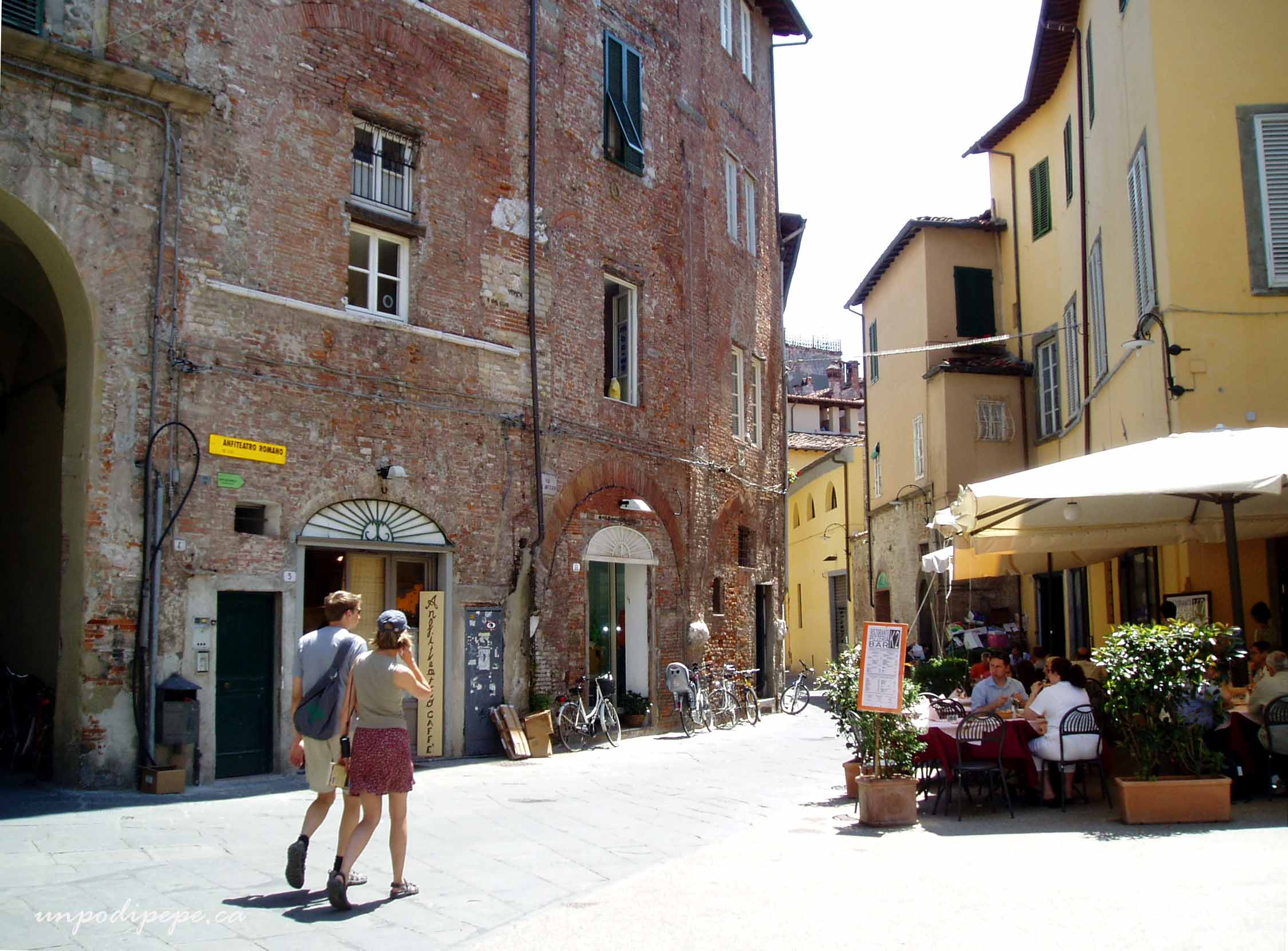
The main street, Via Fillungo has beautiful storefronts and buildings.  It connects Piazza Anfiteatro and Piazza San Michele.  Piazza Anfiteatro’s oval shape is the ‘ghost’ of the 10,000 seat Roman amphitheater that once stood there.  Entrance to the piazza is through brick tunnels.The stones were looted to build other structures, but the tall buildings in shades of yellow and cream with green shutters were built following the shape of the former amphitheater.Piazza AnfiteatroPiazza Anfiteatro Lucca

As in San Gimignano, defense towers were a status symbol for Lucca’s wealthy families in the 1300’s. Lucca’s skyline has several towers, the most famous being the 45 m Romanesque Gothic red brick Torre Guinigi.  Built in 1384 by the Guinigi family of silk merchants, the tower is 45 m tall with 7 Holm Oak trees growing on top, symbolizing rebirth.  Torre Guinigi, LuccaThe rooftop was originally used for dining, with the kitchen on the floor below.  Imagine carrying dishes the 232 steps to the top!  Admission is €5 single/ €8 family. A 2 day combination ticket can also be purchased that includes Torre delle Ore and Orto BotanicoView from the top of Torre Guinigi Lucca

At 50m Torre delle Ore is the tallest tower in Lucca.  It started as a personal defensive tower, and when defense was no longer needed, it was turned into a clock in 1390.  The present clock mechanism is from the 1700’s.  It even has its own resident ghost legend-in 1623, a Lucchese woman who had sold her soul to the devil ran up to the top to try to stop time, but she didn’t make it.  Climb the top to see rooftop Lucca and the best views of Torre Guinigi. In the photo below you can see Torre delle Ore and the campanile of San Martino.View from Torre Guinigi

Lucca has over 70 churches.  The Gothic/Pisan Romanesque church of San Martino was started in 1070.  It has a mismatched 14th C campanile-the top is white like the church, but the lower half is red quartz stone.  The church façade has 3 levels of open arches and each of the 37 columns are different.  There was a contest for the design of the columns and each artist submitted one.  Instead of awarding a winner, all of the columns were used without paying the artists.  Che furbi!  San Martino is home to the famous relic, a cedar crucifix known as  il Volto Santo di Lucca (the holy face) and works of art by Jacopo della Quercia, Ghirlandaio and Tintoretto.

Like much of Lucca, the church of San Michele in Foro was built on a much earlier structure.  Piazza San Michele was formerly the Roman Forum.  The façade has 4 rows of ornate arches and columns, similar to San Martino.  I do not think artists contributed these columns for free! San Michele has works by Tuscan superstars Luca della Robbia and Filippino Lippi.San Michele in Foro, Lucca

The oldest church in Lucca, 6th C San Frediano has a beautiful golden  mosaic façade.  Lucca San Frediano

Lucca is the birthplace of Giacomo Puccini, and the house where he was born is now Museo Puccini.  Admission is €7. If you are in Lucca in the evening, it is common to hear music coming from churches, piazze and the opera house Teatro del Giglio.Lucca San Giusto

Lucca is beautiful to visit any time of the year……except for the first week of November!  Unless you are attending, avoid visiting during Lucca Comics and Games.  Lucca is NW of Firenze, closer to Pisa.  The train station is right across the street from Porta San Pietro, one of the entry gates, making Lucca an easy day trip -90min from Firenze and 30 min from Pisa.  Lucca really deserves a few days of its own though, and also makes a great base to see the rest of Toscana.Lucca, bicicletta

The photos in this post were taken on 4 separate visits over a 15 year period, which explains the dramatic weather fluctuations!

Lucca is also mentioned in the posts Viaggio con Isabella and Autunno in Italia

Photos of San Martino and San Frediano from wikimedia commons.

Buon viaggio, Cristina

Share this:

  • Click to share on Facebook (Opens in new window) Facebook
  • Click to share on Pinterest (Opens in new window) Pinterest
  • Click to share on X (Opens in new window) X
  • Click to email a link to a friend (Opens in new window) Email
  • Click to share on WhatsApp (Opens in new window) WhatsApp
Like Loading...

La Brigantessa~Book Review

07 Monday Jan 2019

Posted by Un po' di pepe in Libri

≈ 13 Comments

Tags

AICW, Association of Italian Canadian Writers, Calabria, Italian Canadian Literature, Italian history, Italocanadesi, Rosanna Micelotta Battigelli

La Brigantessa coverLa Brigantessa is a novel of historical fiction which takes place following the Unification of Italy (1860’s), during a decade of turmoil.  It was a time when law enforcement was often worse than the criminals and the law only protected the wealthy.

The main character, Gabriella Falcone, is a young peasant girl whose family work for the parish priest in a small village in Calabria.  Her inamorato, Tonino has volunteered to fight alongside Giuseppe Garibaldi. When Gabriella stabs a nobleman in self defense, she is forced to flee with the priest, knowing that her version of what happened will not be believed. La Brigantessa has everything a great read needs…love, honour, class struggles, jealousy, betrayal, bravery, suspense, and even a ‘modern’ Calabrese Robin Hood.

The story is told from the point of view of many characters, yet they are all so well-developed there is no confusion.  Each character is given a detailed, credible backstory, revealing their individual struggles and motivations.  I was emotionally invested in these characters, even the nasty ones!  The attention to detail regarding life and customs in 19th Century Calabria transported me there.

I have been waiting 2 years for this book to come out, since I listened to the author read excerpts from it at 2 conferences-and it did not disappoint. This is not one of those book reviews that gives away the whole book, so that is all I am going to say!  Pour yourself a glass of vino-red, of course, sit back and enjoy.  I can’t wait for the sequel and/or movie.

I give La Brigantessa 5 peperoncini out of 5 ! 🌶 🌶🌶🌶🌶

La Brigantessa is published by Inanna Publications, a Canadian Publisher based in Toronto, focusing on women’s writing.  The book is available from the publisher or from Amazon or Chapters.  Viva la Brigantessa!

Buona lettura, Cristina

Share this:

  • Click to share on Facebook (Opens in new window) Facebook
  • Click to share on Pinterest (Opens in new window) Pinterest
  • Click to share on X (Opens in new window) X
  • Click to email a link to a friend (Opens in new window) Email
  • Click to share on WhatsApp (Opens in new window) WhatsApp
Like Loading...

San Gimignano

15 Friday Apr 2016

Posted by Un po' di pepe in Firenze, Italia, Photography, Travel

≈ 6 Comments

Tags

Dante Alighieri, Firenze, Italian history, Italy travel tips, San Gimignano, Siena, Torre Grossa, Toscana, UNESCO World Heritage Sites, Vernaccia di San Gimignano

Torri di San GimignanoSan Gimignano’s skyline looks like a Medieval Metropolis, complete with early grattacieli (grat•tah•chee•EH•lee = skyscrapers). It was known as San Gimignano delle belle Torri -San Gimignano of the beautiful towers. The site was an Etruscan settlement, then a castello called Silvia with a walled village built around it.  Silvia was renamed San Gimignano in 450 after the Bishop of Modena, who spared it from Attila the Hun’s troops.San Gimignano Torre

San Gimignano became an independent town in 1199. It was prosperous, being a stopping point on La Via Francigena, the medieval pilgrimage route from Canterbury to Roma, via France.  San Gimignano also traded in local zafferano (zaf•fer•RAN•noh = saffron) and wine from the white Vernaccia grape. The earliest mention of Vernaccia di San Gimignano is in the archives of 1276! In 1966, 690 years later, it was the first Italian vino bianco to receive DOC recognition.

The 13 and 14th Centuries saw San Gimignano caught in the Guelph/Ghibelline conflicts.  Read about this in Dante’s post. Wealthy San Gimignanesi built tower houses as symbols of power and wealth, as well as for protection.  The height of these torri kept increasing, up to 70m high, to keep up with the neighbors. There were originally 72 torri and 14 still stand today.

Waves of plague and famine hit San Gimignano in the mid 1300’s. The ‘black death’ claimed almost half the population, and San Gimignano was now under the rule of Firenze.  Fiorentino control prevented any urban development that happened in other towns.  As a result, San Gimignano was preserved in a medieval ‘time warp’, retaining its original atmosphere and appearance.  Little changed until the 19th century when it became a tourism destination. Today the population is 7800 and it does have 1 traffic light! To protect San Gimignano from the effects of mass tourism, strict rules prevent modification to the appearance or intended use of buildings.

Bancomat Medievale/Medieval Bank Machine!

Bancomat Medievale/Medieval Bank Machine!

In 1990, the Historic Center of San Gimignano became a UNESCO World Heritage Site for its outstanding examples of medieval architecture and original urban layout.Piazza della Cisterna

The Cattedrale know as La Collegiata, has Masterpieces of 14th and 15th Century art.  Inside the front façade is the Fresco of Last Judgement, Heaven and Hell by Taddeo di Bartolo (1393). The Cappella di Santa Fina with frescoes by Domenico Ghirlandaio (1475) was featured in the 1990 Franco Zeffirelli film ‘Tea with Mussolini’.

In the Palazzo Comunale is the Sala di Dante where Dante Alighieri spoke as an ambassador for the Guelphs in May 1300. The Pinacoteca has treasures by Filippino Lippi, among others.  Climb the 218 steps of the adjacent 54m Torre Grossa for views of San Gimignano and the Val d’Elsa.  Admission is €6.View from Torre Grossa

Piazza della Cisterna is triangular with a well on an octagonal pedestal in the center, surrounded by medieval buildings. It is named for the underground cistern built in 1287 which was the main source of water for the San Gimignanesi.  Piazza della Cisterna is the meeting point of the Via Francigena and the road from Pisa to Siena, so it was a happening place in medieval times.

Piazza della Cisterna, seen from Torre Grossa

Piazza della Cisterna, seen from Torre Grossa

San Gimignano is an easy daytrip on the bus from Firenze, Siena or Poggibonsi. There is no direct train. The train route is to change trains at Empoli to Poggibonsi and then bus from there. It’s also nice to be there in the evening or overnight when all of the daytrippers have left.

Like Alberobello, no matter how many hordes of tourists it is overrun with, San Gimignano is incantevole (een•can•teh•VOH•leh = enchanting) and definitely worth a visit. I need to go back to do ‘research’, since I have a drawer full of unfinished sketches, monotypes and etchings!

Buon Viaggio, Cristina

Share this:

  • Click to share on Facebook (Opens in new window) Facebook
  • Click to share on Pinterest (Opens in new window) Pinterest
  • Click to share on X (Opens in new window) X
  • Click to email a link to a friend (Opens in new window) Email
  • Click to share on WhatsApp (Opens in new window) WhatsApp
Like Loading...

Margherita di Savoia

20 Wednesday Jan 2016

Posted by Un po' di pepe in Italian language, Mangiamo!

≈ 16 Comments

Tags

Capanna Regina Margherita, Grand Hotel Terme, Italian food, Italian history, Margherita di Savoia, Pizza Margherita, Puglia, Savoiardi

Queen_Margharitha_di_SavoiaA few nights ago I was at my favourite pizzeria having a pizza Margherita. This made me think about Margherita di Savoia, and all the random connections to her name.  Margherita di Savoia (Mar·gehr∙EE∙tah dee Sah∙VOH∙yah) lived from 1851-1926.  She became the first Queen of Italia when her husband, Umberto I di Savoia became King.  They had one son born in 1870, and he became King Vittorio Emanuele III in 1900 after the assassination of Umberto by an anarchist.

Regina Margherita was a great supporter of the arts and ‘opere di beneficenza’ – charitable works. She encouraged artists and writers and was involved with the Red Cross. During the war, she turned her house in Roma into a hospital. Margherita loved hiking and driving.  The Royal garage was filled with cars named after birds.  After her death, the cars were auctioned off for charity. In 1893, she climbed the peak of Monte Rosa in the Alps for the opening of Capanna Regina Margherita, the highest mountain hut in Europe.

Margherita was extremely popular with the public. On her visit to Napoli in 1889, she took off her gloves to eat a chicken leg with her hands, which is the origin of the saying ‘Anche la regina Margherita mangia il pollo con le dita/ Even Regina Margherita eats chicken with her fingers’.  Unfortunately Margherita’s political views leaned towards fascism in her later years, but fortunately that isn’t one of my random connections!

My list of random connections to Margherita di Savoia:

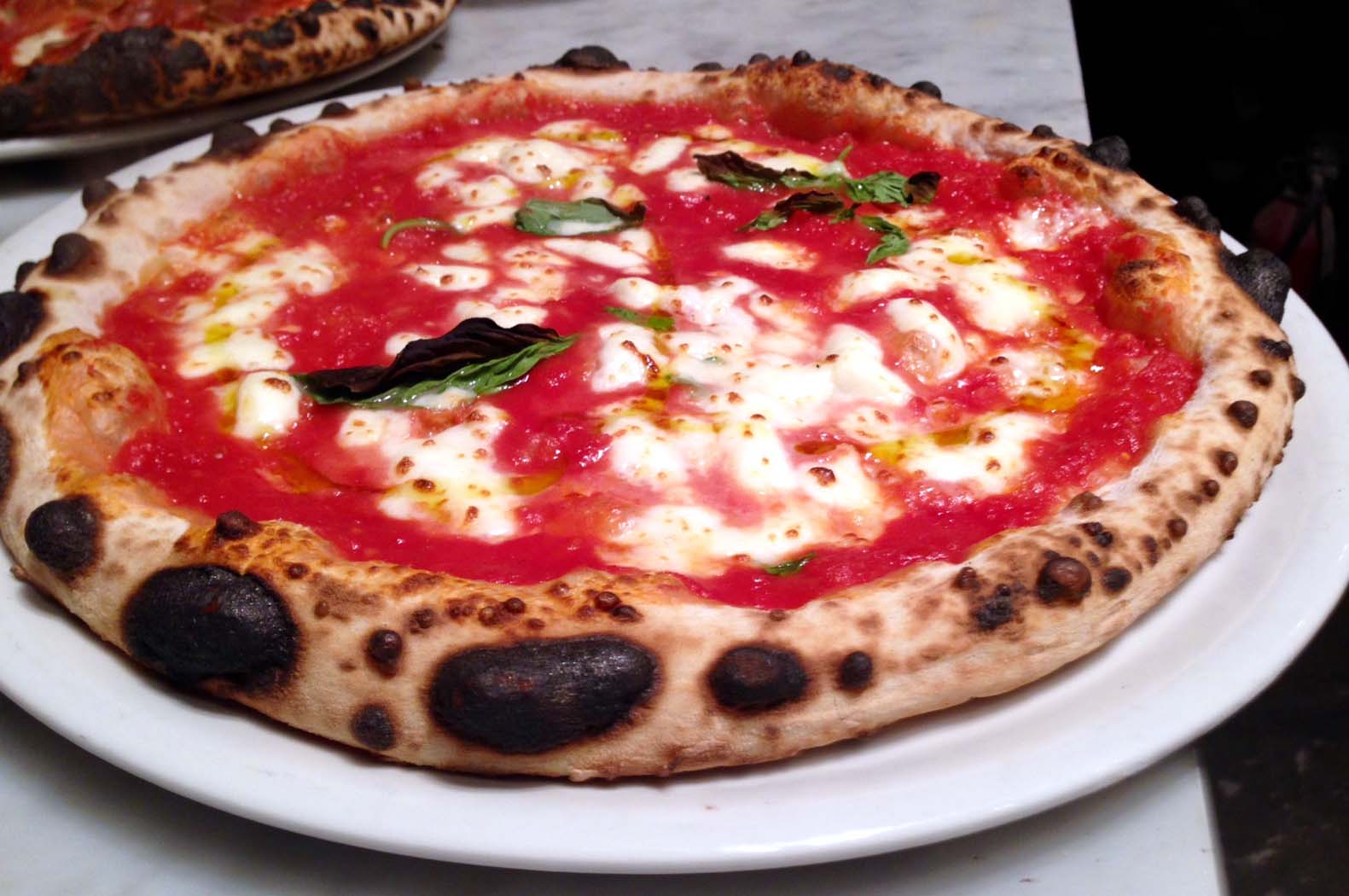
1-Pizza Margherita. In 1889, in honour of the royal visit to Napoli, Raffaele Esposito of Pizzeria Brandi ‘created’ pizza Margherita topped with pomodoro, mozzarella and basilico (tomato, mozzarella and basil) to represent the colours of the Italian flag.  In reality these pizza toppings were already being used in Napoli, so it was the name created by pizzaiolo Raffaele. I remember having a delicious calzone a long time ago in Montaguto called ‘Le Mutande della Regina’.  It was filled with Margherita toppings, and the calzone was left a bit open on the 2 sides, with sausage meat spilling out so they looked like frilly underwear!margherita

2-Margherita di Savoia, Puglia.  In the summer, there is a direct bus from Orsara di Puglia to Margherita di Savoia, a seaside thermal spa town in the province of Barletta 2 hours away. Before 1879, it was called Saline di Barletta because of the saltworks.  Salt has been collected here since the Roman times.  Approaching Margherita, the salt looks like snowy mountains by the beach.  The water is very salty and therapeutic, and the Grand Hotel Terme di Margherita is known for ‘fanghi’ salty mud treatments.Margheritadisavoia2015margheritasale

Margheritadisavoiaspiaggia3-The Pantheon.  Regina Margherita is buried with her husband Umberto in my favourite architectural masterpiece, the Pantheon.tombadimargherita

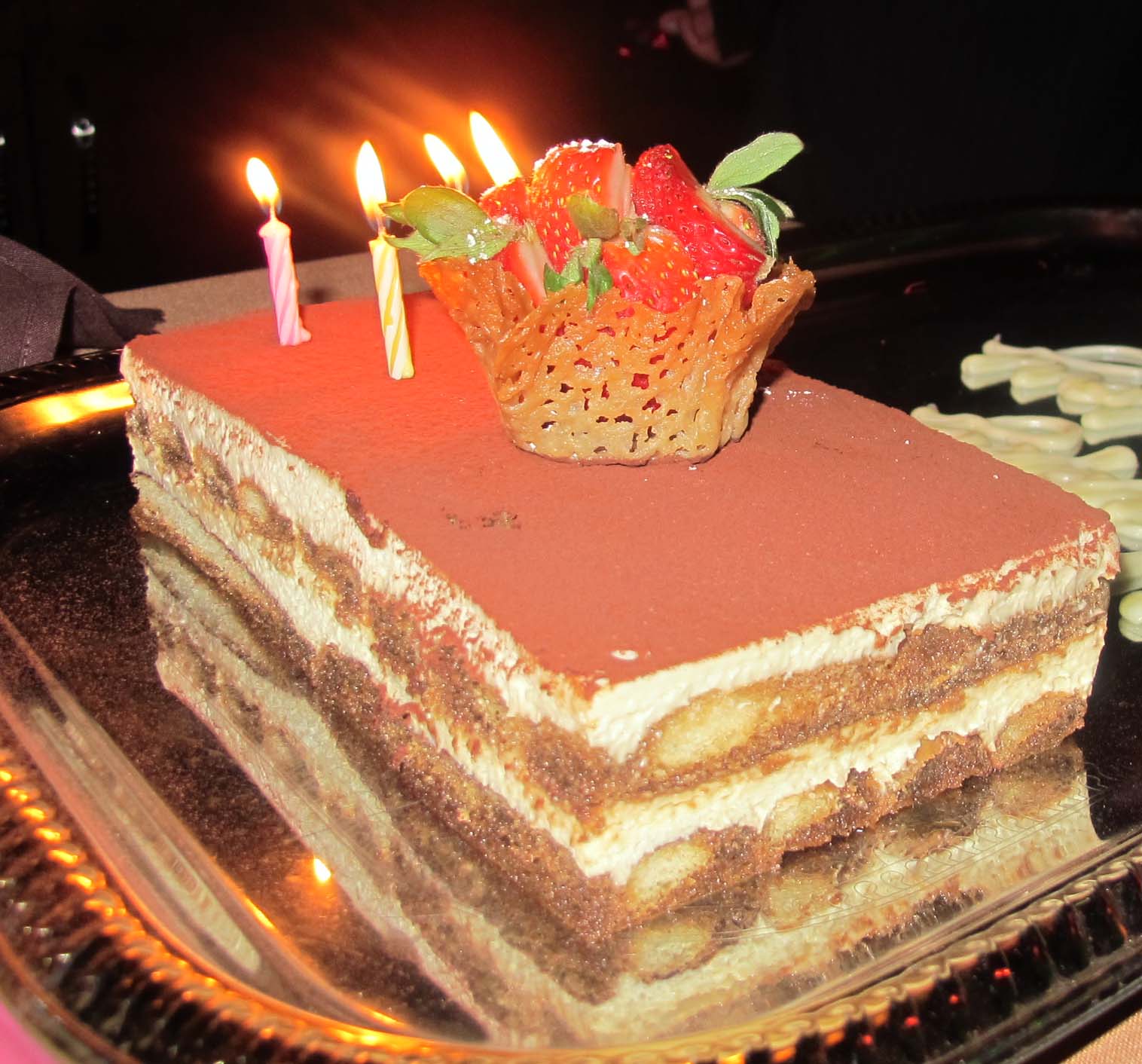
4-Tiramisù. Savoiardi are named after the Savoia family. They were the 15th Century official court biscuit of the House of Savoia, created in honour of a visit from the King of France.  Without savoiardi, there would be no tiramisù.Tiramisu

5-Forza Azzurri! The Italian National Team wear azzurro, the colour of the House of Savoia.

Forza Azzurri! Forza Azzurri!

6-My address! In Orsara di Puglia, I live on Via Regina Margherita.vrmargherita

viarmargheritaThe last one is my favourite Margherita! The word ‘margherita‘ means daisy, as in the flower.  Can you think of other random Margherita connections?

*Portrait of Margherita di Savoia 1881 from Wikimedia Commons

©2016www.unpodipepe.ca


Share this:

  • Click to share on Facebook (Opens in new window) Facebook
  • Click to share on Pinterest (Opens in new window) Pinterest
  • Click to share on X (Opens in new window) X
  • Click to email a link to a friend (Opens in new window) Email
  • Click to share on WhatsApp (Opens in new window) WhatsApp
Like Loading...

Fucacoste e Cocce Priatorje

01 Sunday Nov 2015

Posted by Un po' di pepe in Culture, Feste, Italian Folklore, Orsara di Puglia, Puglia

≈ 5 Comments

Tags

Falò e Teste del Purgatorio, Festa dei Morti, Italian Folklore, Italian history, Muscitaglia, November 1st, Orsara di Puglia, Puglia, Pugliese Traditions, Pumpkin carving, Southern Italy, Traditional Festivals in Puglia, Tutti i Santi Festa, Zucche

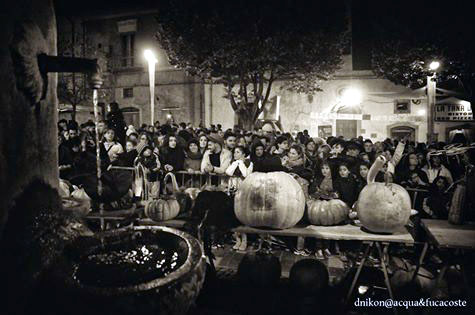
Piazza San Pietro. Photo courtesy of International Photo Correspondent Donato Narducci

Piazza San Pietro. Photo courtesy of International Photo Correspondent Donato Narducci

Tonight is a big festa in Orsara di Puglia, so I am reposting this from last year.

Fucacoste e cocce priatorje is dialetto Orsarese for ‘Falò e teste del Purgatorio’.  This translates to ‘Bonfires and heads from purgatory’. It is an ancient festival unique to Orsara di Puglia celebrated on November 1st, the night of ‘Tutti i Santi’ (All Saints Day).  All Saints Day was created in the 9th century when the Pope superimposed a Christian feast day onto existing rituals, so this festa has been around for a very long time.  It is a night where people have the opportunity to honour, reconnect and pay respect to the spirits of their loved ones.  Carabinieri estimate that the town of 3,000 had 40,000 visitors attend the festa tonight, with 9,000 cars parked up to 3 km away!

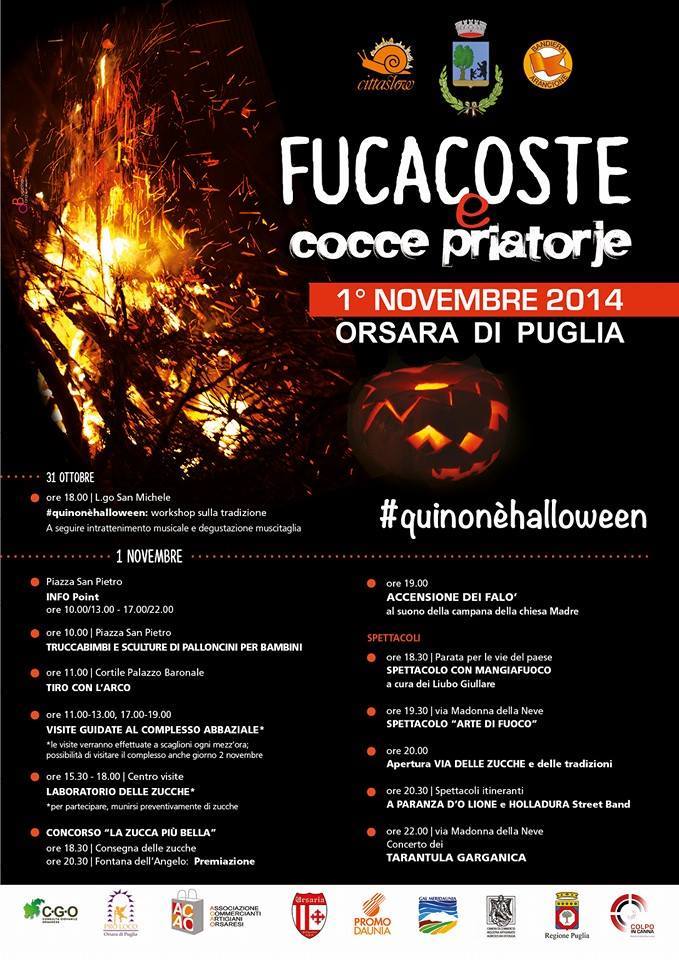
2014 poster for Fucacoste e cocce priatorje

2014 poster for Fucacoste e cocce priatorje

It is believed that the souls of the dead return among the living to visit their relatives and their former homes before moving on to Paradiso.  The bonfires are lit with wood and branches of ginestra (broom). The light of the fires and the crackling and sparks of the ginestra attract the spirits to reunite the living with those who continue to live only in their memories.  The souls of the dead loved ones collect ashes from the fires. The gleam of light inside ‘cocce priatorje’, pumpkins carved to look like heads-light their way to find their former home.

Preparation for the  festa involves gathering firewood and ginestra, preparing food and carving zucche (pumpkins).  There is even a BYOZ (bring your own zucca) pumpkin carving workshop.  Later in the evening zucche are exhibited and there is a contest for ‘la zucca più bella’-the best zucca.

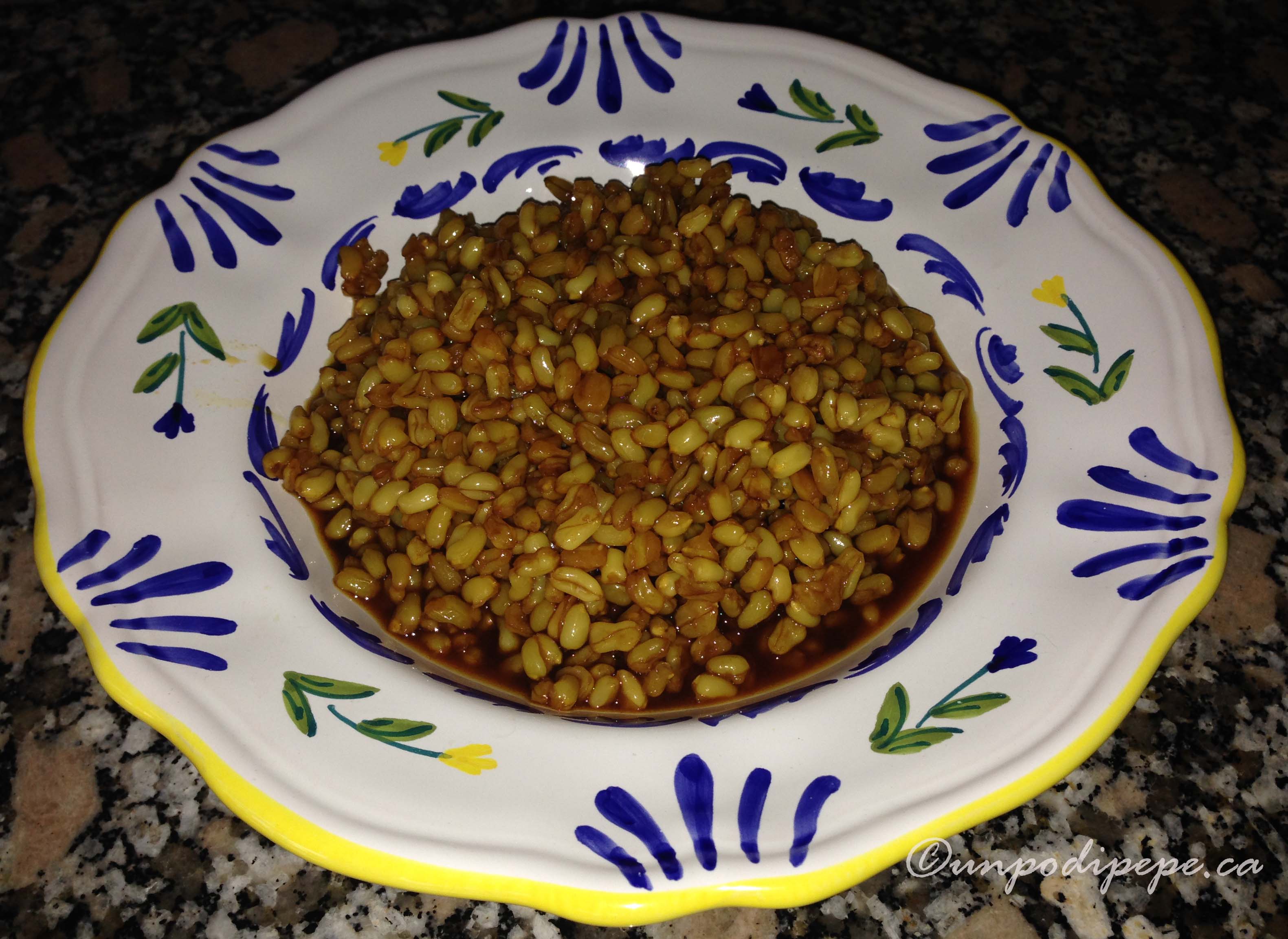
In honour of the dead, simple but symbolic foods are prepared.  These include potatoes, onions, salsicce (sausages) and castagne (chestnuts) cooked in open fire. Muscitaglia is a traditional dish served on November 1st which probably dates back from the ancient Greeks and Byzantines. Muscitaglia (moo•shee•tah•lyah) in both Greek and Latin is made up of the words mosto (wine must) and talia (grain). The ingredients include boiled grain and vino cotto (literally cooked wine-also called mosto cotto). Pomegranate seeds and walnut pieces are sometimes added. These ingredients are symbols of fertility and abundance, but also of honour and respect for the dead.

Muscitaglia

Muscitaglia

When the campanile (church bell tower) strikes 1900 hours (7 pm), Orsara di Puglia ‘catches fire’. Over 100 bonfires are simultaneously lit in every street and piazza and remain lit through the night.  The fires, pumpkin lanterns, music and people in the streets create a magical, enchanted atmosphere.

Fucacoste e Cocce Priatorje has often been confused with Hallowe’en, but it is a very different event.  Besides the fact that the date is different, dressing up in costume is not part of the custom, there is nothing scary about it and there are no evil spirits to chase away. It has more similarities with the Mexican Dia de los Muertos, Day of the Dead.  This is an event about being together in community to celebrate the bond between the living and those who we remember in our hearts, and to remind us that our time on earth is precious.

Watch the video ‘#quinonèhalloween’ featuring 94 year old Z’Gaetan talking about the festa and its significance  https://www.youtube.com/watch?v=9W5RD0-9H-A

Read about tonight’s festa (in Italiano) on the Comune di Orsara di Puglia website.  For more about Orsara di Puglia read the post ‘Benvenuti ad Orsara di Puglia’.  Ci vediamo alla festa!

Fucacoste e Cocce Priatorje, Fontana Sant'Angelo, Orsara di Puglia 2014. Photo courtesy of Donato Narducci

Fucacoste e Cocce Priatorje, Fontana Sant’Angelo, Orsara di Puglia 2014. Photo courtesy of Donato Narducci

Share this:

  • Click to share on Facebook (Opens in new window) Facebook
  • Click to share on Pinterest (Opens in new window) Pinterest
  • Click to share on X (Opens in new window) X
  • Click to email a link to a friend (Opens in new window) Email
  • Click to share on WhatsApp (Opens in new window) WhatsApp
Like Loading...

I Sassi di Matera

04 Sunday Oct 2015

Posted by Un po' di pepe in Italia, Photography, Travel

≈ 15 Comments

Tags

Basilicata, Carlo Levi, Chiese Rupestri, European Capital of Culture, I Sassi di Matera, Italian history, Italy travel tips, Luisa Levi, Matera, Sasso Barisano, Sasso Caveoso, Southern Italy, UNESCO World Heritage Sites

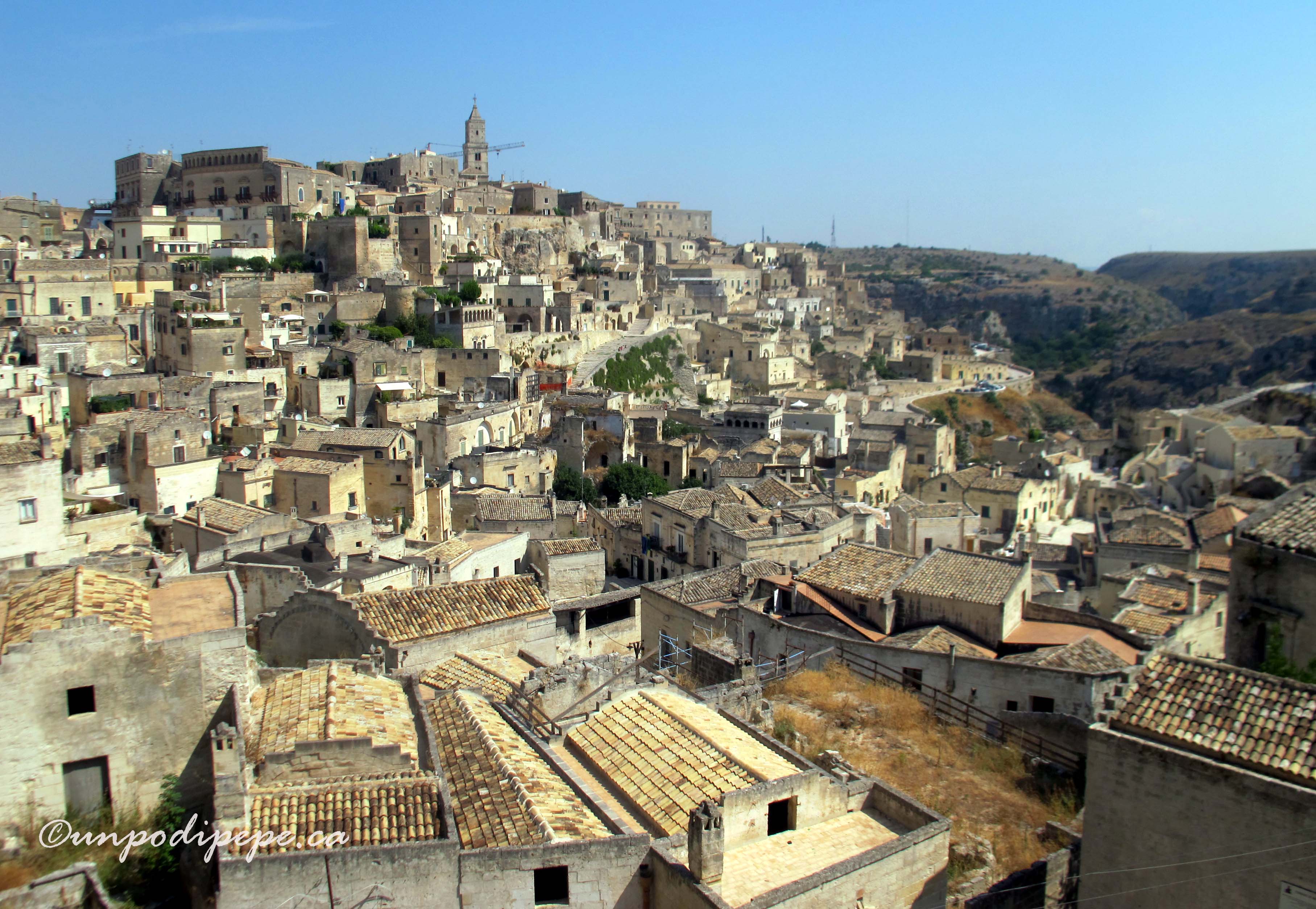
MateraMatera is a rock-cut settlement in Basilicata, the most isolated, least visited region of Italia. It is one of the world’s oldest living cities, continuously inhabited for over 9,000 years.  Clinging to a 300m gravina (ravine) carved out by the river below, Matera seems to rise straight up from the earth, built in 2 natural basins. These basins are the ‘Sassi’ districts, Sasso Caveoso and Sasso Barisano. Sassi means stones and refers to the rock cut cave dwellings. The higher ground in between the 2 Sassi districts is the Civita.  Above the Sassi, on the Piano (plain/plateau) modern Matera is barely visible. The Piano was originally used for agriculture and water collection.Materagravina

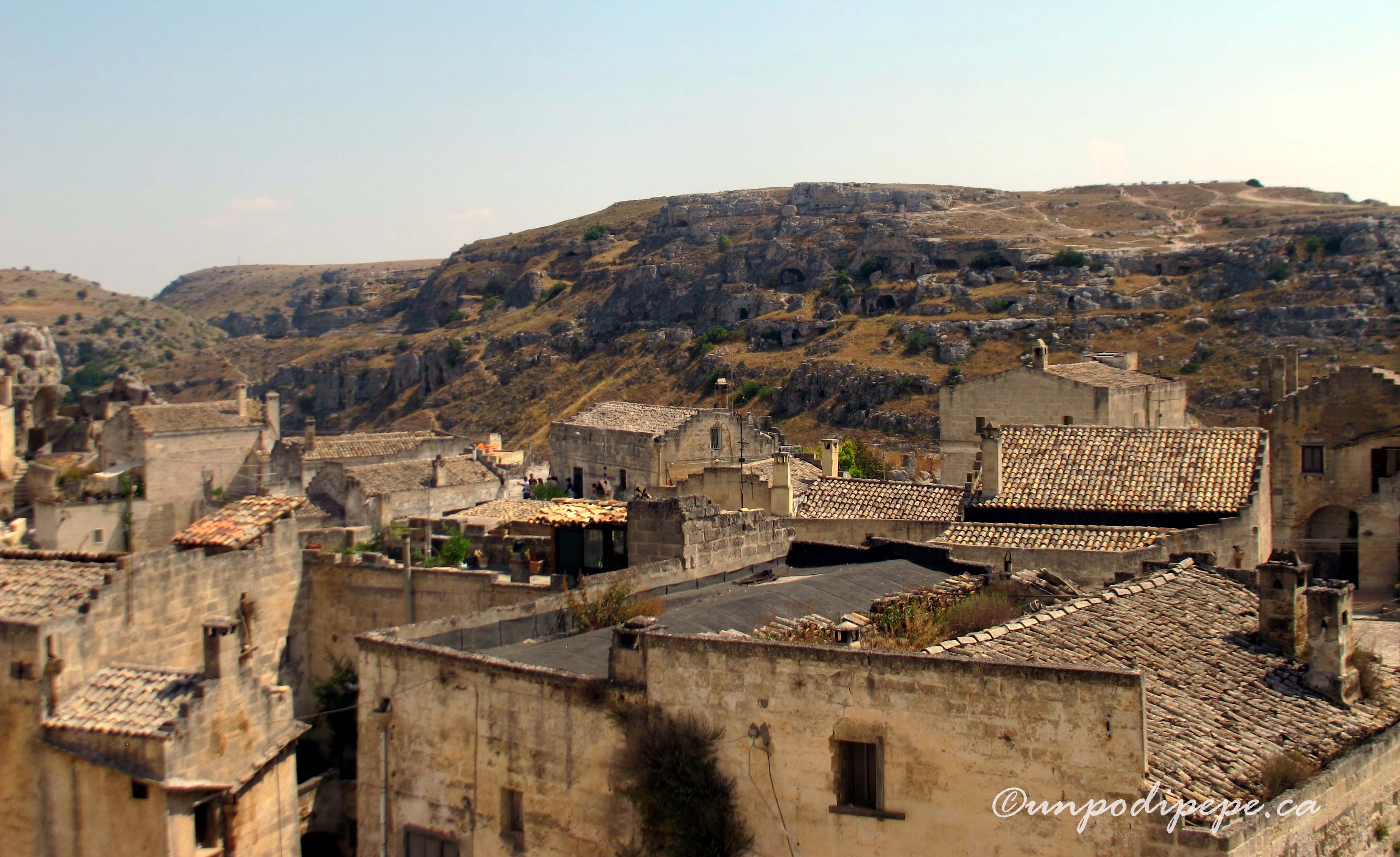
Across the canyon, the west side of the gravina is the Murgia Plateau and the Parco Archeologico Storico Naturale delle Chiese Rupestre Materano. The original stone-age settlement was on this side.  The Parco Archeologico is filled with grotte (caves), Chiese Rupestri (churches carved into the rock), Neolithic villages and tombs. From Matera, the grotte look like little mouseholes. With the invention of tools it was easier to dig into the softer tufo (calcareous rock) on the east side of the gravina and Matera was excavated from this rock.

Grotte (caves) across the ravine from Matera

Grotte (caves) across the ravine from Matera

Materapanorama2The Sassi developed in layers over time, as Matera was home to every passing civilization. On the surface the Sassi look deceiving. House fronts are facades-built in front of, on top of and around caves! Incredible systems of underground cisterns and canals were built to collect and distribute rainwater.Materapanorama5

Matera’s isolated location made the area attractive to religious communities. Between the 8th and 13th centuries, Byzantine Basilian monks escaping religious persecution lived in the grotte. There are over 150 Chiese Rupestri with priceless Byzantine frescoes throughout Matera and the Parco delle Chiese Rupestri. By the 15th century, peasants and animals occupied the grotte left by the monks.

Things moved along for the next few centuries. When Matera was the provincial capital 1663-1806, increased activity caused a rise in population. In the 18th and 19th centuries, the wealthier Materani moved into the newer town on the Piano, leaving only contadini and artigiani (farmers and artisans) in the Sassi. By the early 20th century, the Sassi could not accommodate the increased population. Overcrowding plus development of the Piano also affected the water collection systems and led to poor sanitary conditions. With less farmland available, the poverty was unbelievable. Large families shared dark, crowded case grotte (cave homes) with sheep, pigs and goats. Some were only accessible by a trapdoor and ladder. There was no electricity, running water or sewage. It’s hard to imagine these kind of living conditions.

Matera’s situation continued on unnoticed- until the 1945 release of ‘Cristo si è Fermato a Eboli’ (Christ Stopped at Eboli), Carlo Levi’s memoir about his year as a political prisoner in Basilicata in 1935/36. Levi was a doctor, writer and artist from a wealthy family in Torino. He was exiled to a small town near Matera for his Anti-fascist views. Near the beginning of the book, his sister Luisa, also a doctor, needs a permission form stamped in Matera so she can visit him. She describes the Sassi as ‘a schoolboy’s idea of Dante’s Inferno’. She states ‘I felt, under the blinding sun as if I were in a city stricken by the plague. I have never in all my life seen such a picture of poverty. ..This is how 20,000 people live!’ There was a 50% infant mortality rate, malaria, dysentery and trachoma. Eboli is south of Napoli and the title is a local expression suggesting that Christ didn’t make it as far as Basilicata so they are beyond civilization and hope.Materasassibn

Carlo spends a few hours in Matera near the end of the book and says ‘I had time to see the town and then I understood my sister’s horror, although at the same time I was struck by it’s tragic beauty’. I’ve read this book twice and definitely recommend it. It is very philosophical and it is obvious from Levi’s writing and painting that this experience affected him profoundly. His paintings from Basilicata are on display in the Museo di Arte Medievale e Moderna in Palazzo Lanfranchi.

Levi’s book became internationally known and brought to light the living conditions in Basilicata. Matera became ‘La Vergogna Nazionale’ the National Shame. The Sassi were declared unsafe and unsanitary, although only 30% were actually unsafe. US experts on rural relocation were brought in as consultants. Instead of temporarily relocating the residents while the structurally unsafe areas were fixed, the government forcibly relocated almost everyone to poorly planned government housing. Starting in 1952, 16,000 people were removed from the Sassi to new apartments in the ‘modern town’ that were built facing away from the Sassi. The move isolated families and the community and made them feel ashamed for being poor. An unfortunate example of a patronizing, poorly conceived plan to help people without consulting them or addressing the real problem.Materasassocaveoso3

The Sassi became an archeological ghost town in the 1960’s,mostly abandoned except for a few families who had stayed or moved back in. In the 1970’s squatters, local hippies, artists and drug dealers lived in the Sassi. A group of young locals formed Circolo La Scaletta, an organization that lobbied for restoration of the Sassi and protection of the frescoes. One of their supporters was Carlo Levi, now an Italian senator. Yeah Carlo! In the 1980’s laws were passed protecting the Sassi and Chiese Rupestri.

In 1993 the Sassi finally went from shame to fame when UNESCO declared I Sassi di Matera e il Parco delle Chiese Rupestri a world heritage site. Calling it ‘the most outstanding intact example of a troglodyte (cave dweller) settlement in the Mediterranean region, perfectly adapted to its terrain and ecosystem’. Today about 3,000 people live in the Sassi. 50% are occupied and more continue to be restored. In Sasso Caveoso, some areas are still unsafe and blocked off. Now Matera has sassi hotels, bed and breakfasts, ristoranti, offices, artisan shops and galleries as well as homes.Materauccelli

Photogenic Matera has played ancient Jerusalem in several movies, including Pasolini’s ‘Il Vangelo Secondo San Matteo’ (1964), Mel Gibson’s ‘The Passion of the Christ’ (2004), and ‘Ben Hur’ (2016).

Matera was selected as the European Capital of Culture for 2019 and will host cultural events raising its visibility and profile internationally.  Luckily, Matera is not the easiest place to get to, which will prevent it from becoming an overcrowded tourist theme park like Capri!

Exploring Matera.  Photo by D Goodheart

Exploring Matera. Photo by D Goodheart

There is something very special about this hauntingly beautiful place.  As I wandered through the alleys and mazes of Matera, I was reminded once again of the amazing courage and resilience of our contadini ancestors.

Stay tuned for more posts about Matera!

Share this:

  • Click to share on Facebook (Opens in new window) Facebook
  • Click to share on Pinterest (Opens in new window) Pinterest
  • Click to share on X (Opens in new window) X
  • Click to email a link to a friend (Opens in new window) Email
  • Click to share on WhatsApp (Opens in new window) WhatsApp
Like Loading...
← Older posts

Enter your email address to follow 'un po' di pepe' and receive notifications of new posts by email.

Join 511 other subscribers
Follow Un po' di pepe on WordPress.com

Popular Posts

  • Hairstyling in Ancient Roma
    Hairstyling in Ancient Roma
  • Espresso Cookies
    Espresso Cookies
  • Il Pumo Pugliese
    Il Pumo Pugliese
  • Panforte di Siena
    Panforte di Siena
  • Internment of Italian Canadians
    Internment of Italian Canadians
  • San Nicola
    San Nicola
  • Panettone Fatto in Casa
    Panettone Fatto in Casa

Recent Posts

  • Castel del Monte
  • ‘The Nuances of Love’
  • Hostaria Antica Roma~Eat like an Ancient Roman
  • Santa Maria in Aracoeli
  • Casino dell’Aurora~Villa Boncompagni Ludovisi
  • Nasoni di Roma
  • Bloghiversario #11
  • Fontana di Trevi
  • Acqua Vergine
  • Giubileo 2025
  • Sanremo 2025
  • In Vino there are Memories
  • A Literary Harvest
  • 2024~Un po’ di pepe Year in Review
  • Buon Natale 2024
  • Il Bicerin
  • Mercato Porta Palazzo
  • Torino
  • Catanzaro, Calabria
  • Il Pumo Pugliese
  • Artemisia Gentileschi
  • Cavalli di San Marco
  • Panzerotti
  • Torcello
  • 10 years of Un po’ di pepe!

Categories

Amici e Famiglia Architecture Art Art history Art projects Bilingual posts Blogging Canada Culture Feste Firenze Inspiration Italia Italian Folklore Italian language Italian life Italocanadesi Libri Mangiamo! Orsara di Puglia Parole piacevoli Photography Puglia Recipes Roma Travel Travel tips Uncategorized Vino

Archives

Un po’ di pepe on Facebook

Un po’ di pepe on Facebook

Start a Blog at WordPress.com.

  • Subscribe Subscribed
    • Un po' di pepe
    • Join 511 other subscribers
    • Already have a WordPress.com account? Log in now.
    • Un po' di pepe
    • Subscribe Subscribed
    • Sign up
    • Log in
    • Report this content
    • View site in Reader
    • Manage subscriptions
    • Collapse this bar
 

Loading Comments...
 

    %d