• Home
  • About me/Chi sono
  • Contact

Un po' di pepe

~ …… (oon∙poh∙dee∙PEH∙peh) Cristina writes about interesting stuff /Cristina scrive di cose interessanti

Un po' di pepe

Author Archives: Un po' di pepe

Fiori di Zucca

12 Sunday Oct 2014

Posted by Un po' di pepe in Mangiamo!, Recipes

≈ 14 Comments

Tags

Fiori di zucca, Fritelle di zucca, Italian cooking, Pastella, Peppe Zullo, Traditional recipes

Fioridizucca

È davvero finita l’estate! Summer is really over.  I just picked the last fiori di zucca in my garden and I’ll have to wait a long time to taste them again.  Fiori di zucca are a real delicacy and one of my favourite foods.  They are ‘i fiori maschili della zucchina’ the male flowers of the zucchina plant.  The flowers growing off of long, thin stems are male.  The ones growing off the end of a future zucchina are female (femminile).  The female flowers are edible too, but if you pick them there will be no crop of zucchine!  If you pick too many of the male flowers, you will also have no zucchine!

Fiori di zucca maschile e femminile-male flowers grow off of long thin stems and female flowers grow off the end of future zucchine.

Fiori di zucca maschile e femminile-male flowers grow off of long thin stems and female flowers grow off the end of future zucchine.

To clarify, zucca is Italiano for squash or pumpkin. ‘Zucchina’ (given a sex change and called zucchini in North America) means little squash.  The flowers of all 3 can be called fiori di zucca, but it is usually the flowers of zucchine (zucchina is singular and zucchine is plural) that are used in cooking.  Squash and pumpkin flowers can also be used, but they can have a bittery taste.

Fiori di zucca are extremely delicate and will only last a few days after picking. They are even too delicate to freeze.  In Italia it isn’t hard to find fiori di zucca in season.  I recently bought a ‘bouquet’ of them at a market in Foggia for 1 Euro.  Sometimes you can even buy small zucchine with the flowers still attached. I’ve only seen fiori di zucca for sale once in North America, several years ago at a farmer’s market in Seattle.  I won’t even mention how much they cost!  So, if you want to eat fiori di zucca you really need to grow your own-or find a friend who grows them and doesn’t know how good they taste!

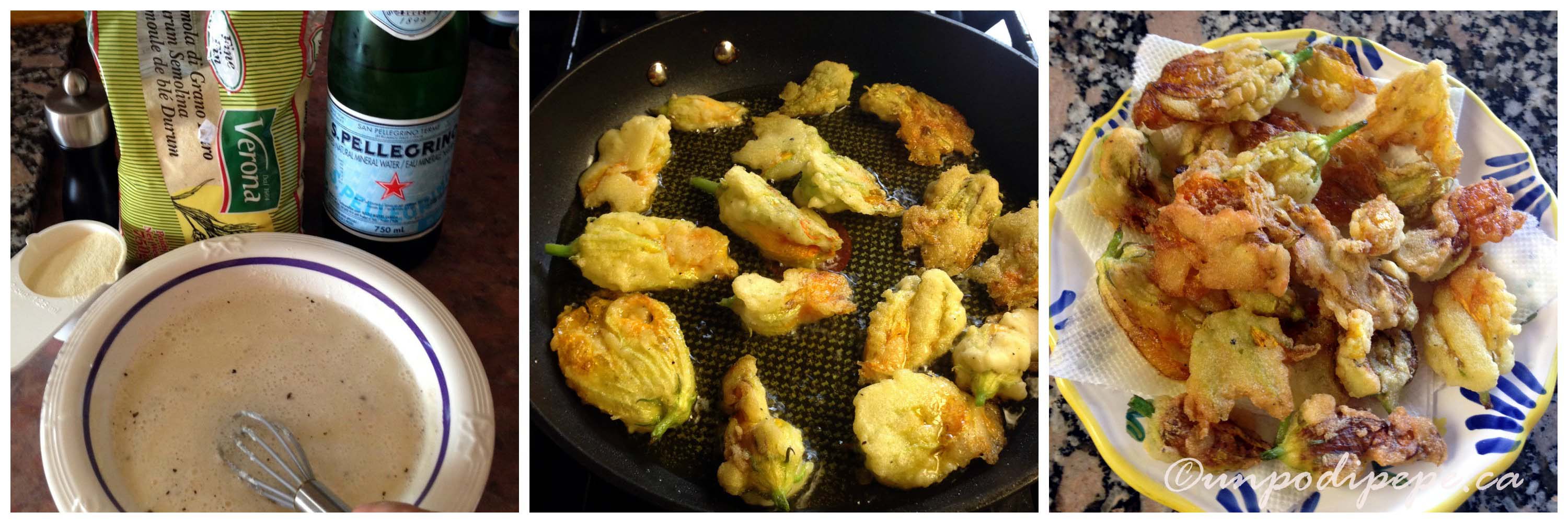
Fiori di zucca have a beautiful, delicate taste. I like to cook them a few different ways, but my favourite is in a simple ‘pastella’.  I whisk cold fizzy mineral water (acqua frizzante) with flour or semolino (durum wheat semolina) a drop of olive oil and pepper until it is not too thick or thin-like the consistency of pancake batter.  If it is too thin, it won’t stick, but if it’s too thick, the fiori can be damaged.  Gently clean fiori and remove the sepals-those green leaves at the base near the stem.  Some people remove the stamens inside, but I usually leave them. Dip them in pastella (batter) and fry in hot oil. I usually use grapeseed oil. When they are done, place on a plate with‘carta assorbente’ (paper towel) and add salt.  The bubbles in the mineral water make this pastella light and crispy. The batter doesn’t overpower delicate taste of the fiori like a heavy egg and flour batter would.

Pastellafioridizuccacollage

Fiori can also be stuffed with ricotta before frying (remember the ricotta fatta in casa post) or ‘farciti con mozzarella e prosciutto’-stuffed with mozzarella and prosciutto. Gnam, gnam, gnam (English translation…yum, yum, yum).

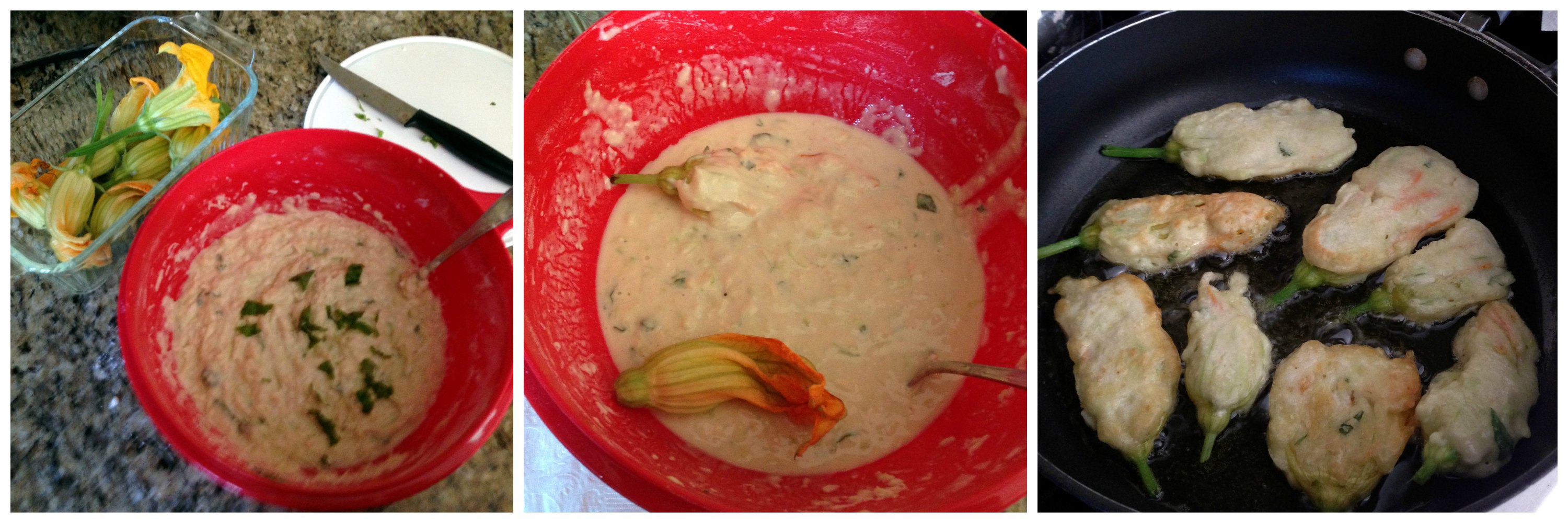
Lately I have also been making my fiori di zucca into frittelle (little fritters). This is a good way to stretch out your fiori and use broken and torn ones or include some larger pumpkin flowers.  Measurements are not too important here.  I mix some 00 flour and baking powder, then mix in 1 peeled, grated zucchina until it is coated with flour.  Add some fresh torn basil leaves if you have them and some freshly grated parmigiano or asiago and 1 large or 2 small eggs.  Once this is all mixed, add enough water to give it the consistency of pancake batter.  You will need more water than you think!

Fritellecollage

Gently dip the intact fiori in batter and fry in hot oil. When they are finished, chop up the broken ones and add to the rest of the batter.  Drop about 1 tablespoon of batter at a time into the oil to make ‘frittelle.  Place on paper towel and add salt.  They are delicious hot or cold.  For those of you who absolutely, positively can’t manage without measurements….here is a link to a recipe that is fairly similar.

Fritelle

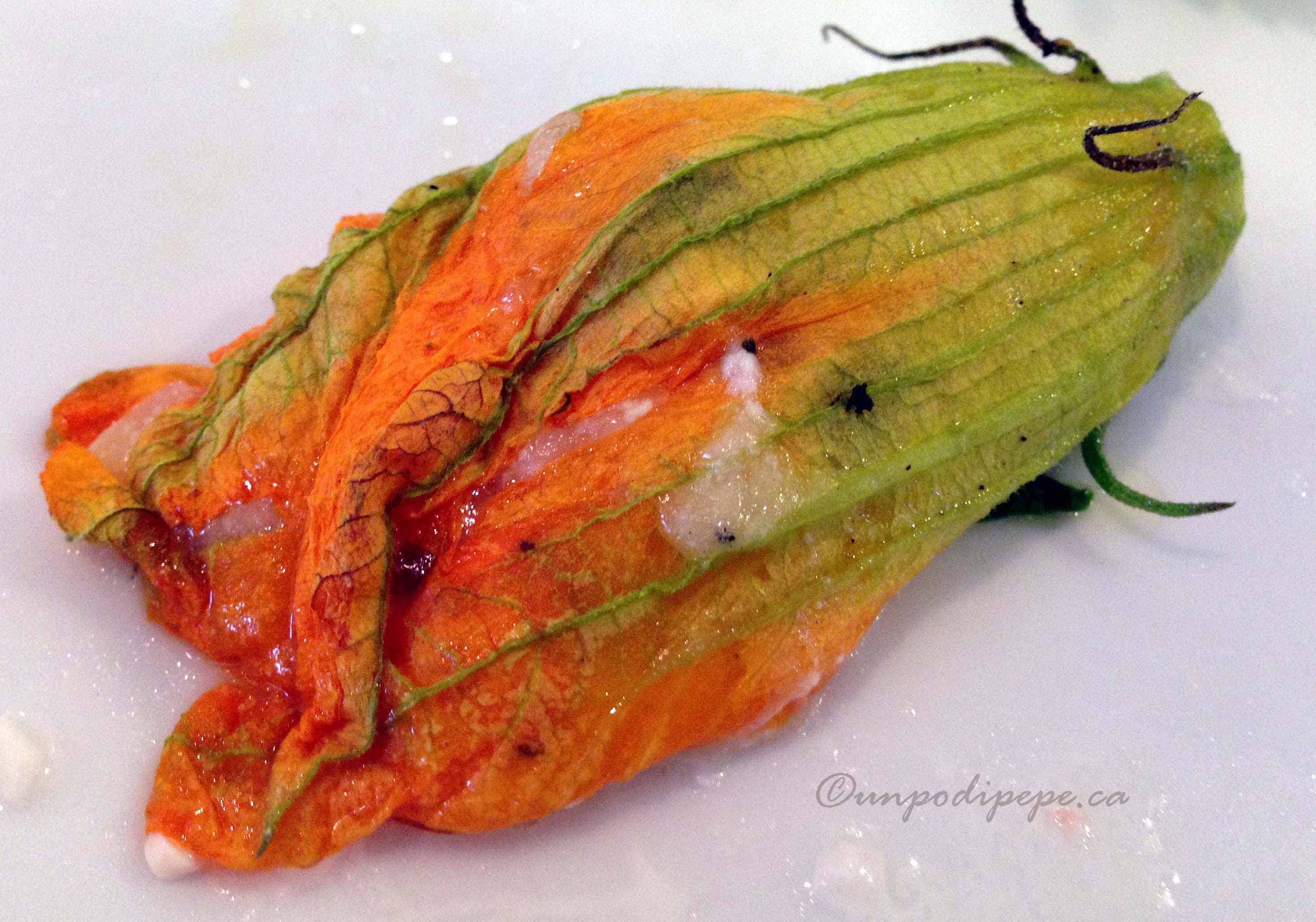
My friend Peppe Zullo in Orsara di Puglia, il ‘cuoco contadino’ www.peppezullo.it picks hundreds of fiori a day in his orto (vegetable garden) when they are in season.  His ristorante serves ‘fiori di zucca al forno, ripiene con caciocavallo’ (baked and stuffed with caciocavallo). Gnam, gnam, gnam!!!

fioreconcaciocavallo

Looking forward to summer when I can enjoy fiori di zucca again! A l’anno prossimo!


Share this:

  • Share on Facebook (Opens in new window) Facebook
  • Share on Pinterest (Opens in new window) Pinterest
  • Share on X (Opens in new window) X
  • Email a link to a friend (Opens in new window) Email
  • Share on WhatsApp (Opens in new window) WhatsApp
Like Loading...

Un Giorno a Roma

15 Monday Sep 2014

Posted by Un po' di pepe in Italia, Roma, Travel, Travel tips

≈ 11 Comments

Tags

Bernini, Caravaggio, Colosseo, Elefantino, Fontana di Trevi, Il Vittoriano, Italia, La Barcaccia, Pantheon, Roma, Roma photography, Roma walking tour, Roman Forum, San Luigi dei Francesi, Tazza d'oro

TreviRoma truly is ‘la Città Eterna‘-the eternal city! I usually fly in and out of Roma then take the train to Foggia on my way to Orsara di Puglia. I often have one full day in the city at the beginning or end of my trip. When i’m in Roma for just 1 day, I have a usual ‘itinerary’. I do not actually recommend anyone go to Roma for just one day, especially for the first time. 5 days will do but more is better.  One day only gives you enough time to visit a few sites, so it is mostly an entire day of exploring the city on foot. The sites I choose to visit change a bit each time, but the route is basically the same.

I stay with a friend in the Basilica San Paolo area so I take the Metro blue line to the Colosseo stop, exit the station and take a few minutes to absorb the view across the street, which never fails to impress.

The view across the street from the 'Colosseo' metro stop!

The view across the street from the ‘Colosseo’ metro stop!

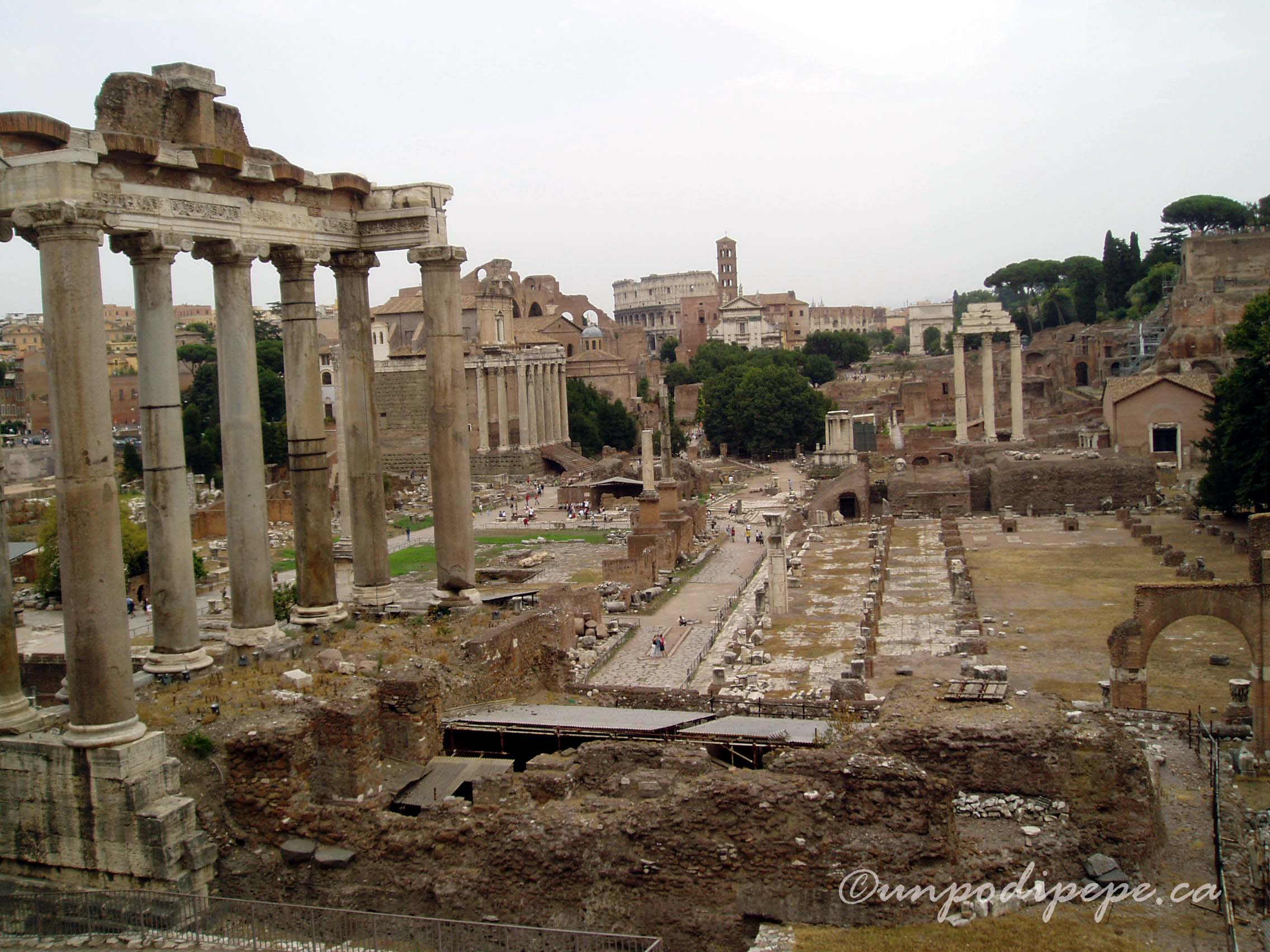
Then I turn right and walk along Via dei Fori Imperiali.  If you visit Il Colosseo, the ticket includes entry to the Forum, so you can walk through there.  Visiting these 2 awesome sites will take all morning, so they are not usually part of my ‘1 day’ itinerary.

View of the Roman Forum (Foro Romano)

View of the Roman Forum (Foro Romano)

Old meets new at the Foro Romano

Old meets new at the Foro Romano

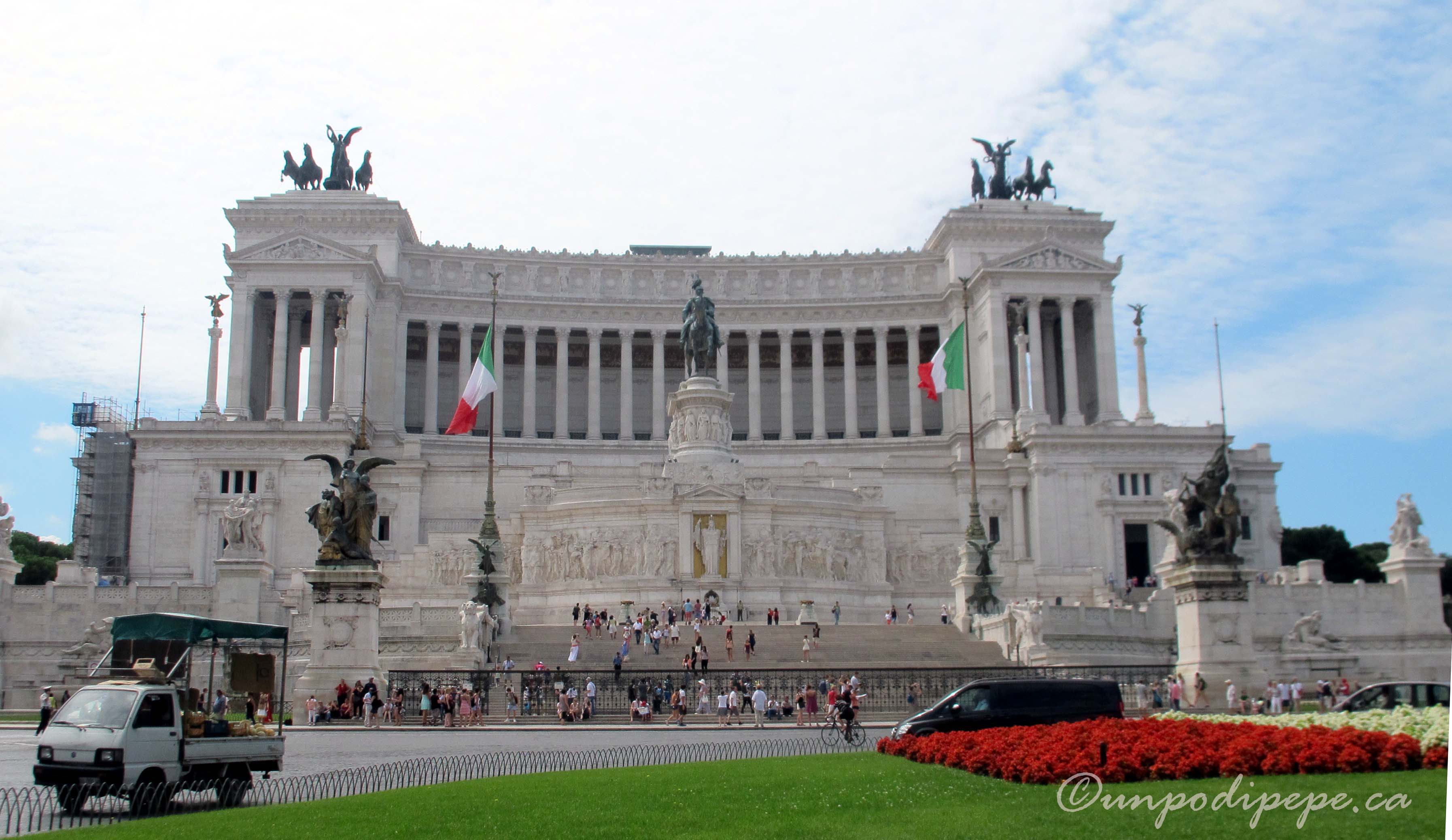
I walk along Via dei Fori Imperiali all the way to Piazza Venezia and Il Vittoriano, which is the neo-classical monument that looks like a giant wedding cake .

Il Vittoriano

Il Vittoriano

If you want some great views of Roma and are not afraid of heights, take the glass elevator to the rooftop terrace.

'Roma dal cielo' view from the roof of Il Vittoriano

‘Roma dal cielo’ view from the roof of Il Vittoriano

Then I turn right again and cross Piazza Venezia, which can be a bit of a challenge, and walk along Via del Corso. Via del Corso is lined with shops and goes all the way to Piazza del Popolo.

Crossing the street can be challenging! Photo taken by Vito!

Crossing the street can be challenging! Photo taken by Vito!

I turn into one of the side streets on the left and walk to the Pantheon-the domed architectural masterpiece that is absolutely not to be missed! The 2000 year old roof is the largest unreinforced concrete dome in the world. IlPantheonAcross the street I have an incredible granita di caffè at Tazza d’Oro.

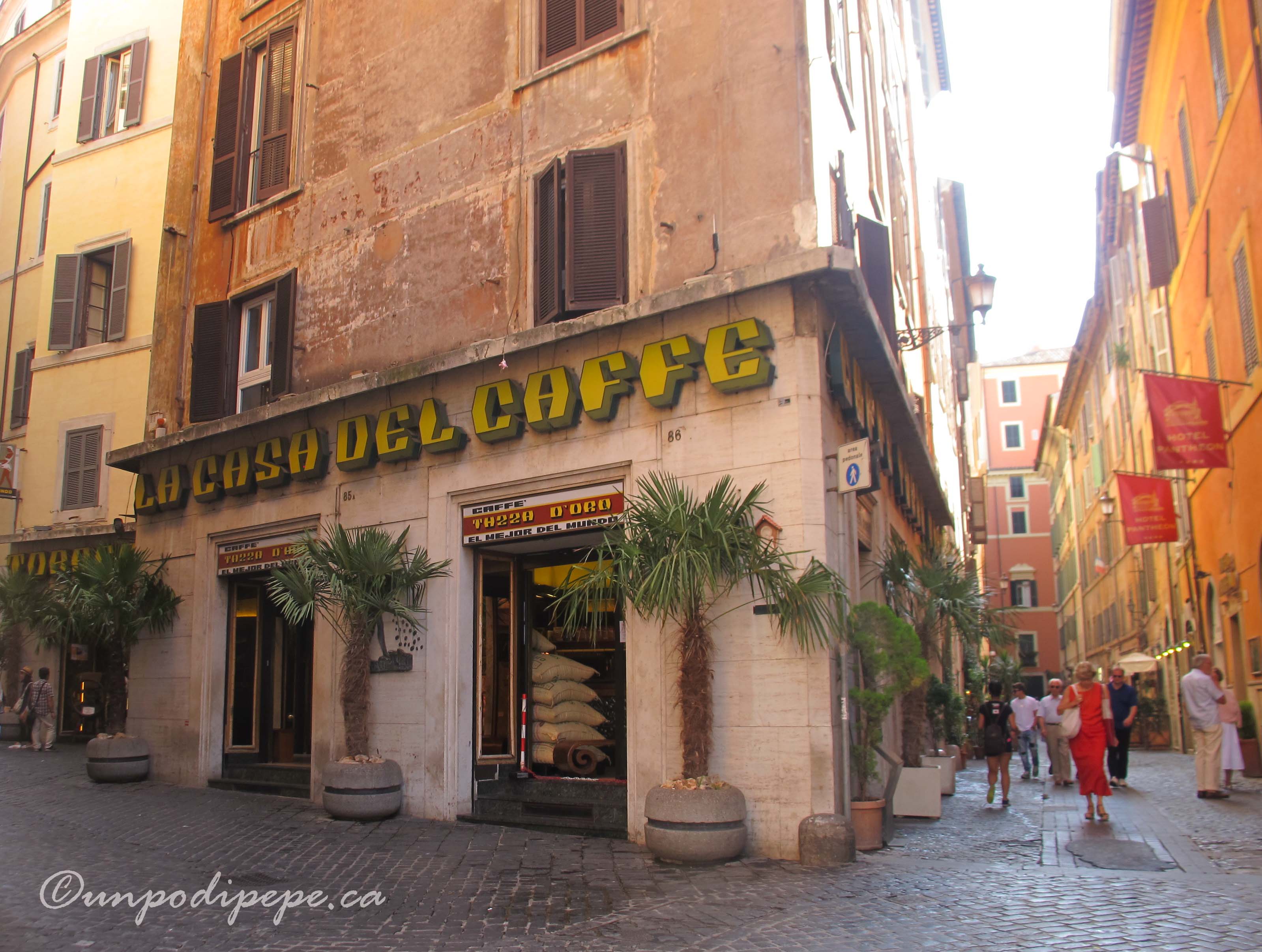
Tazza d'Oro, Via degli Orfani 84

Tazza d’Oro, Via degli Orfani 84

Granita di caffe

Granita di caffe

Behind the Pantheon is Santa Maria Sopra Minerva with Bernini’s adorable ‘elefantino’ sculpture in the piazza.  I sometimes like to sit and sketch the pudgy little elephant carrying a 5m Egyptian obelisk on its back.

Bernini's elefantino in Piazza Minerva. Behind the obelisk, you can see the domed roof of the Pantheon.

Bernini’s elefantino in Piazza Minerva. Behind the obelisk, you can see the domed roof of the Pantheon.

The molto fancy ‘Grande Hotel de la Minerve’ across from the church has a roof bar with incredible views. Down a side street – Via del Gesù- is Poggi art supplies www.poggi1825.it , so of course I have to stop there and drool at all the stuff I can’t carry home. I also pop into the little Baroque gem San Luigi dei Francesi, which is the National church of France in Roma. It has 3 incredible Caravaggio paintings-the ‘San Matteo’ cycle, in the Capella Contarelli which you can see for free! No lineups, no online bookings!  I always put a coin in the box and light a candle when I visit a church. If you have more time, go on my Caffè con Caravaggio walking tour.

I walk down some side streets and get back onto Via del Corso going left.  A few blocks down I cross the street and walk to the Fontana di Trevi to toss in my coin. I am very superstitious about this, so I have to do the coin toss or I’m afraid I might not return to Roma!  That would be awful! Fontanaditrevi

Fontana di Trevi

Fontana di Trevi

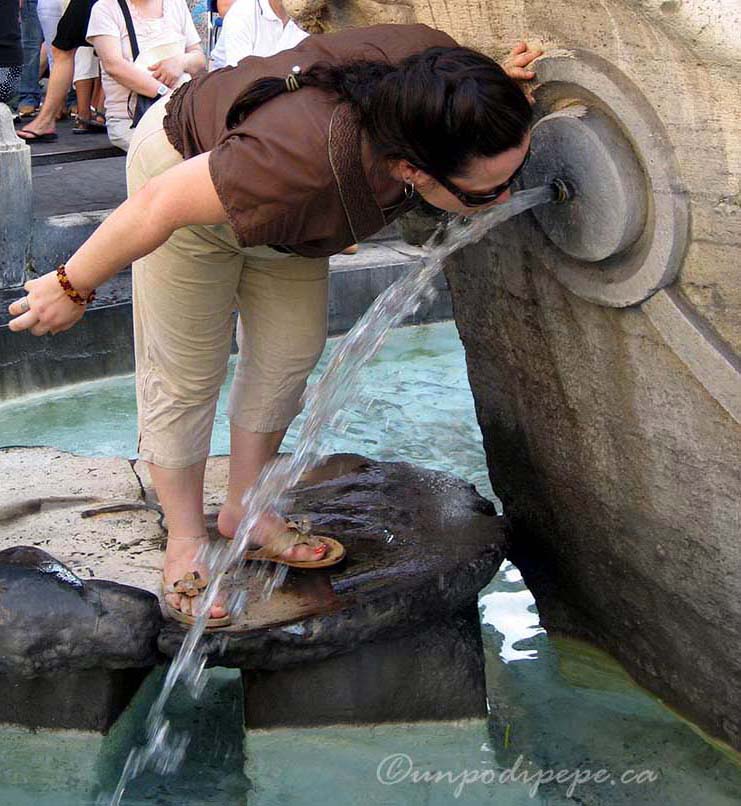
I look at all the tourists then head to my last stop- Piazza di Spagna. I never miss drinking from the Fontana della Barcaccia.  This is the Baroque fountain at the bottom of the steps that looks like a sinking ship. It was sculpted by both Bernini, Pietro and Gianlorenzo (father and son).  La Barcaccia has the best water ever, especially on a hot day –it comes straight from an ancient acqueduct Acqua Vergine and is always ice cold and refreshing.

La Barcaccia, Piazza di Spagna

La Barcaccia, Piazza di Spagna

Mmmm! Acqua freddissima!

Mmmm! Acqua freddissima!

From here I usually walk all the way back to the Colosseo metro stop to take the metro back home to San Paolo and pick up take-out suppli on the way. If I am too tired or have evening plans, I take the metro at Piazza di Spagna (red line) to Stazione Termini then change to the blue line for San Paolo.

Ci vediamo a Roma! Buon viaggio, Cristina

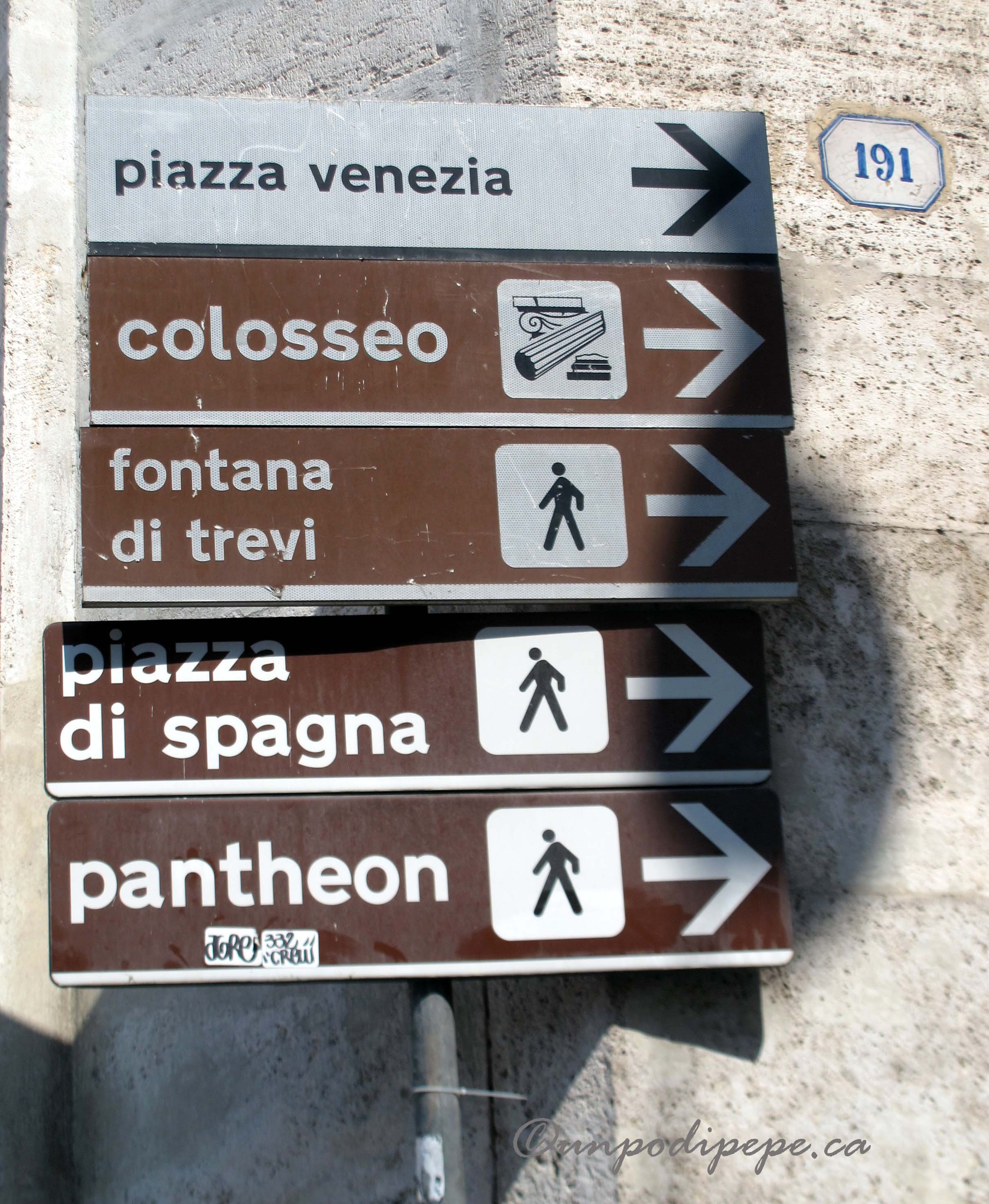
Handy signs at Piazza del Popolo

Handy signs at Piazza del Popolo

PS Stay tuned for future posts on things I like to do if I have more than one day in Roma:

  • Spend the day at the Vatican
  • Trastevere at night
  • Centrale Montemartini
  • Palazzo Massimo
  • Sketching at Piazza Navona
  • Visit more Caravaggio paintings for free at Santa Maria del Popolo
  • Go to Mass sung by cloistered nuns at Santa Brigida near Piazza Farnese

©2014 unpodipepe.ca

Piccoli gladiatori! Beware of fierce gladiators in training!

Piccoli gladiatori! Beware of fierce gladiators in training!

Share this:

  • Share on Facebook (Opens in new window) Facebook
  • Share on Pinterest (Opens in new window) Pinterest
  • Share on X (Opens in new window) X
  • Email a link to a friend (Opens in new window) Email
  • Share on WhatsApp (Opens in new window) WhatsApp
Like Loading...

Passata di Pomodoro

01 Monday Sep 2014

Posted by Un po' di pepe in Italian life, Mangiamo!

≈ 24 Comments

Tags

Italian food, Passata di pomodoro, Tomato sauce, Traditional recipes

Passata di pomodoro
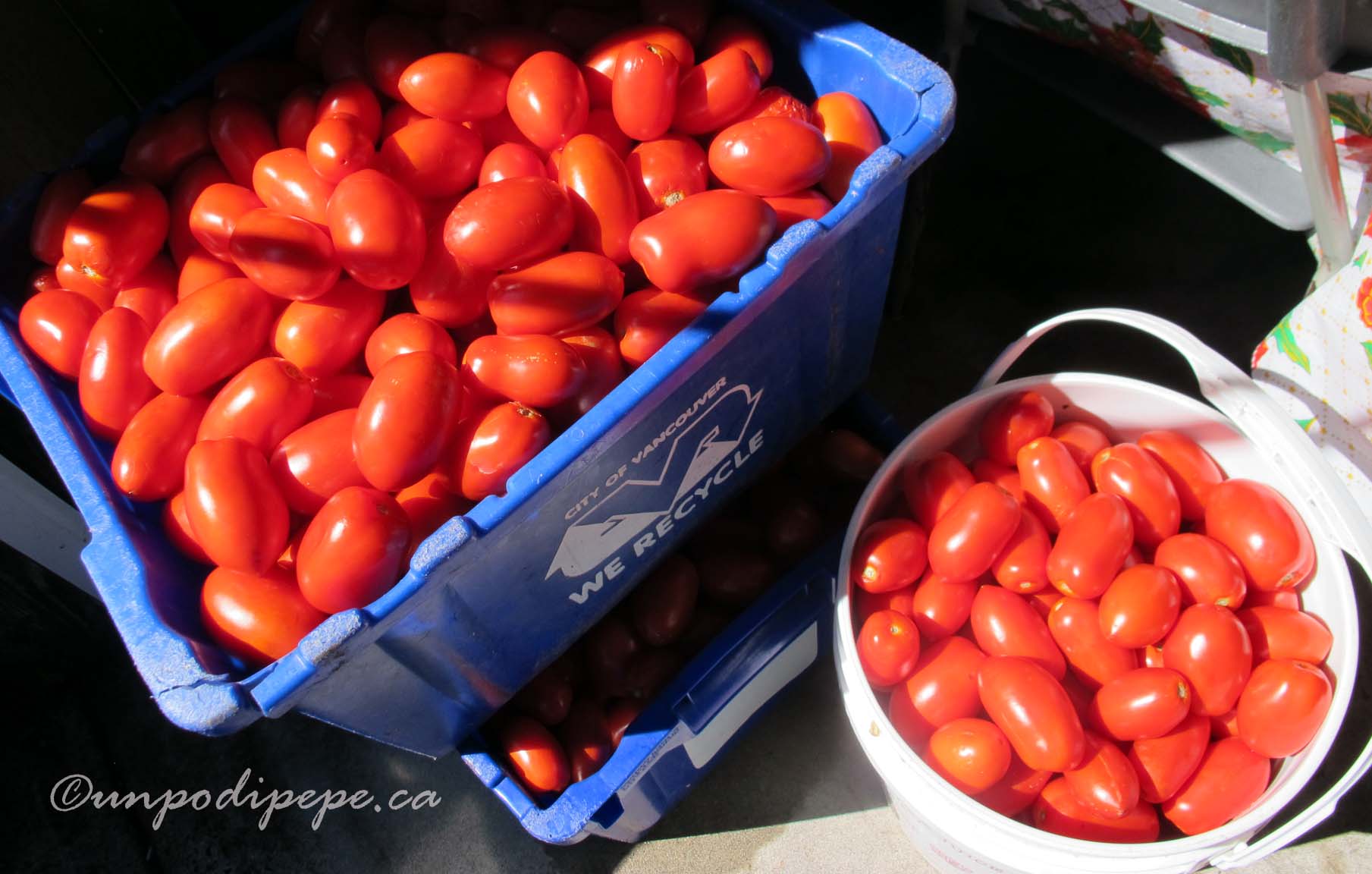
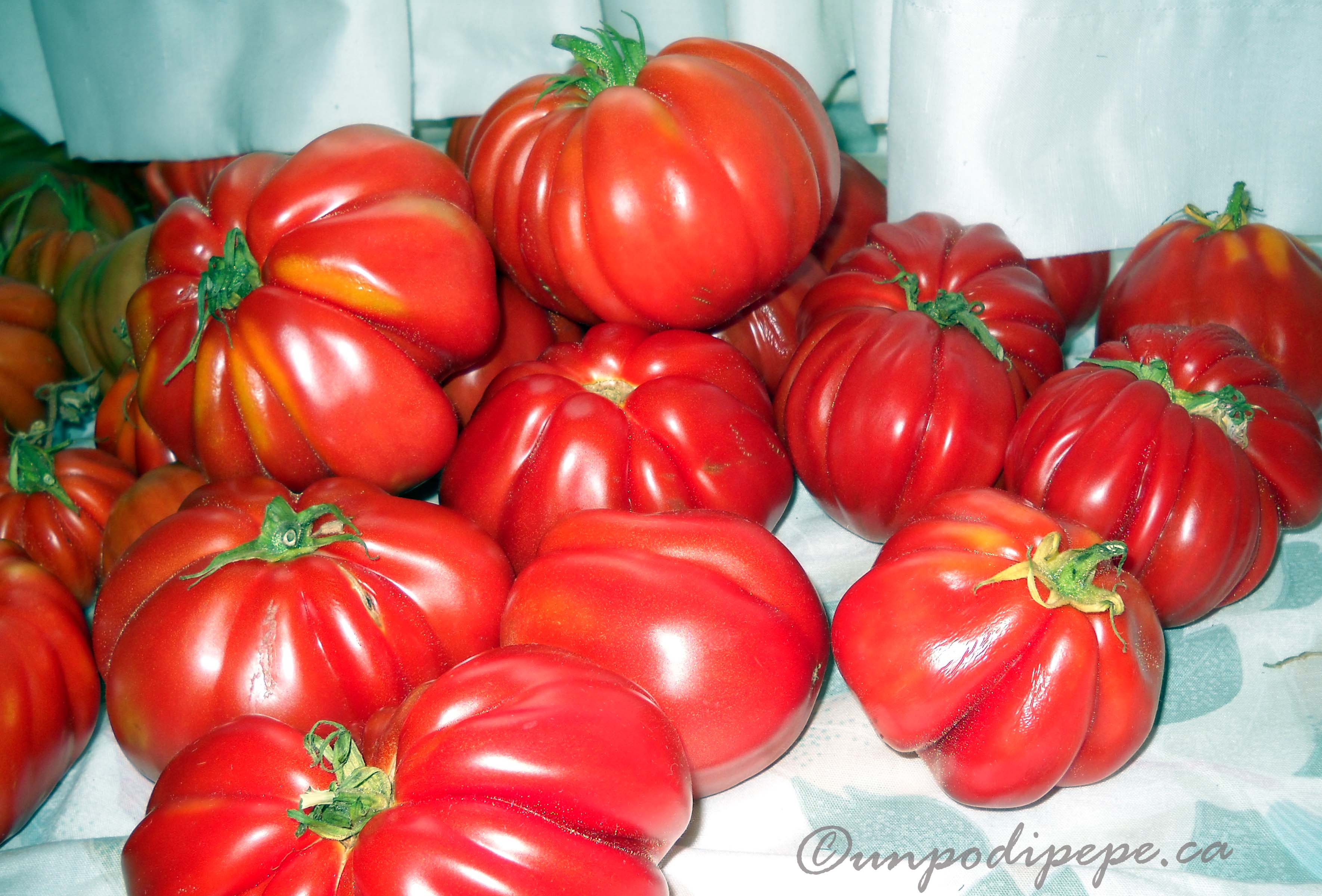
Every year my family gets together to make ‘la salsa’, or passata di pomodoro. Everyone participates, even the nipotini. It is a 2 day event and we are all tired today, as we made about 180 litres of salsa/passata! Some of the tomatoes came from our gardens, but most of them were purchased.

Pomodori ready to be washed

Pomodori ready to be washed

Pomodori from the garden

Pomodori from the garden

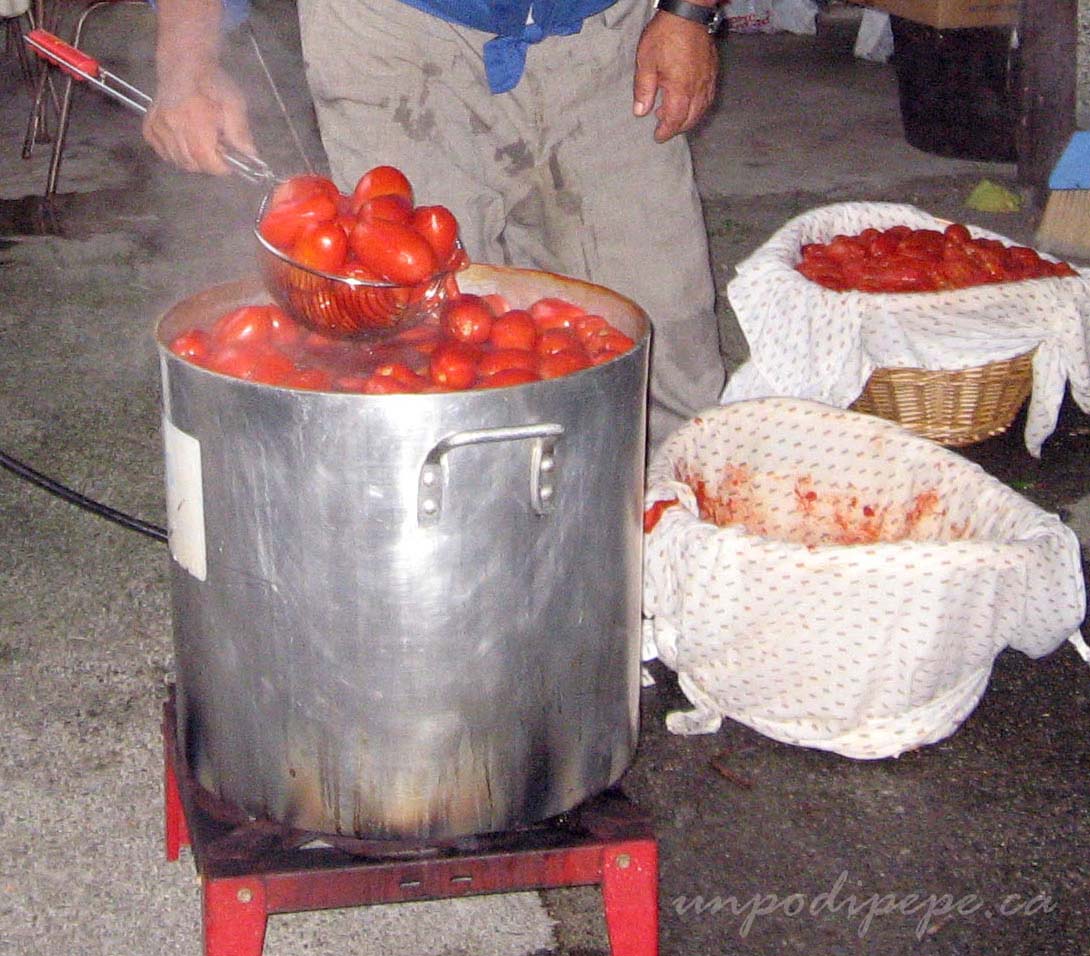
La pentola per i pomodori-a really big pot to cook the tomatoes!

La pentola per i pomodori-a really big pot to cook the tomatoes!

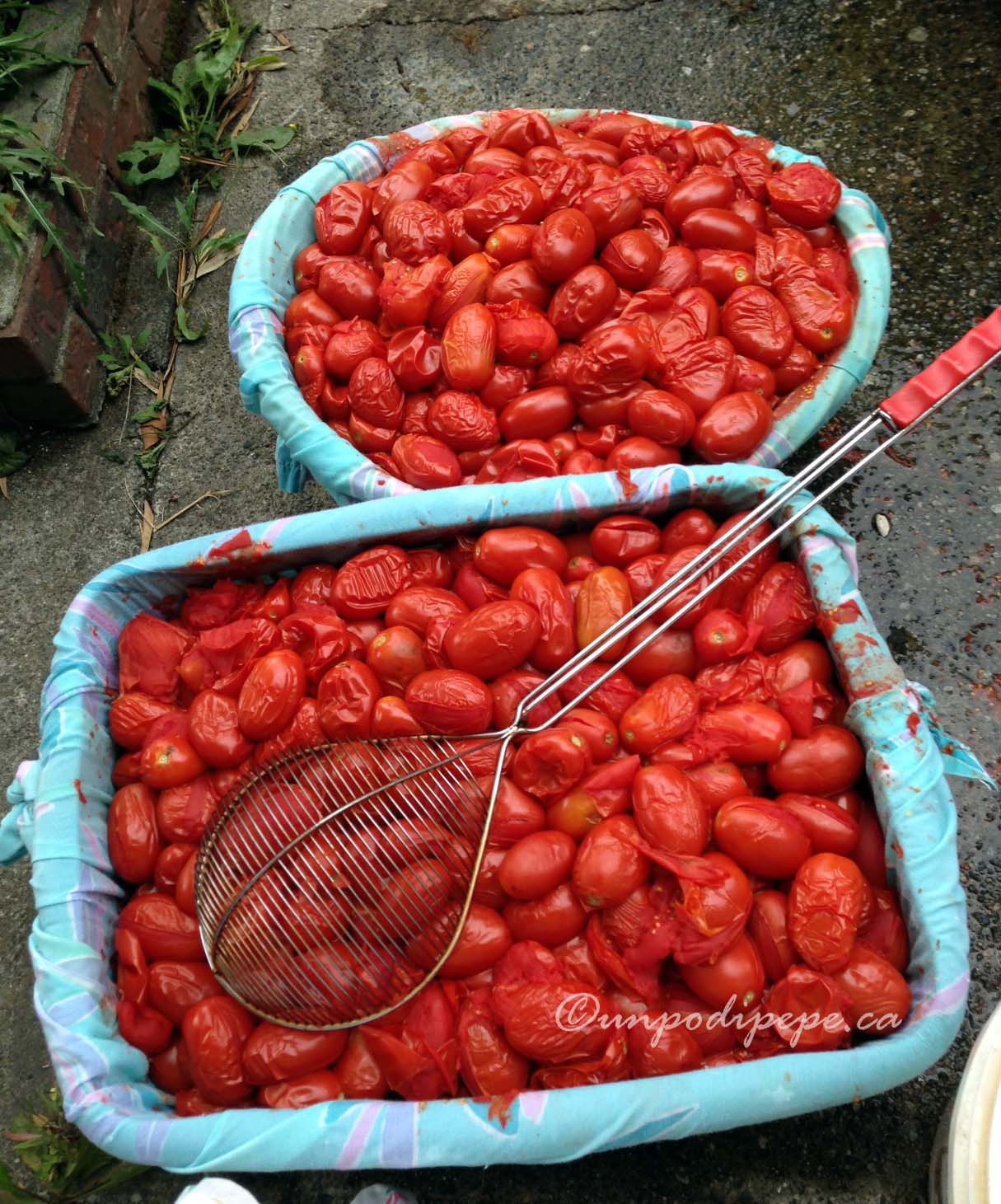
The ripe pomodori are washed, then cooked in a really big pot until soft. Then they are drained in baskets lined with cloth. If they aren’t drained well, then the passata will be too watery.  To make ‘pomodori pelati’ (peeled tomatoes) instead of passata, the skin is removed by hand and the whole pomodori are put in jars.

Cooked pomodori drained in baskets lined with cloth

Cooked pomodori drained in baskets lined with cloth

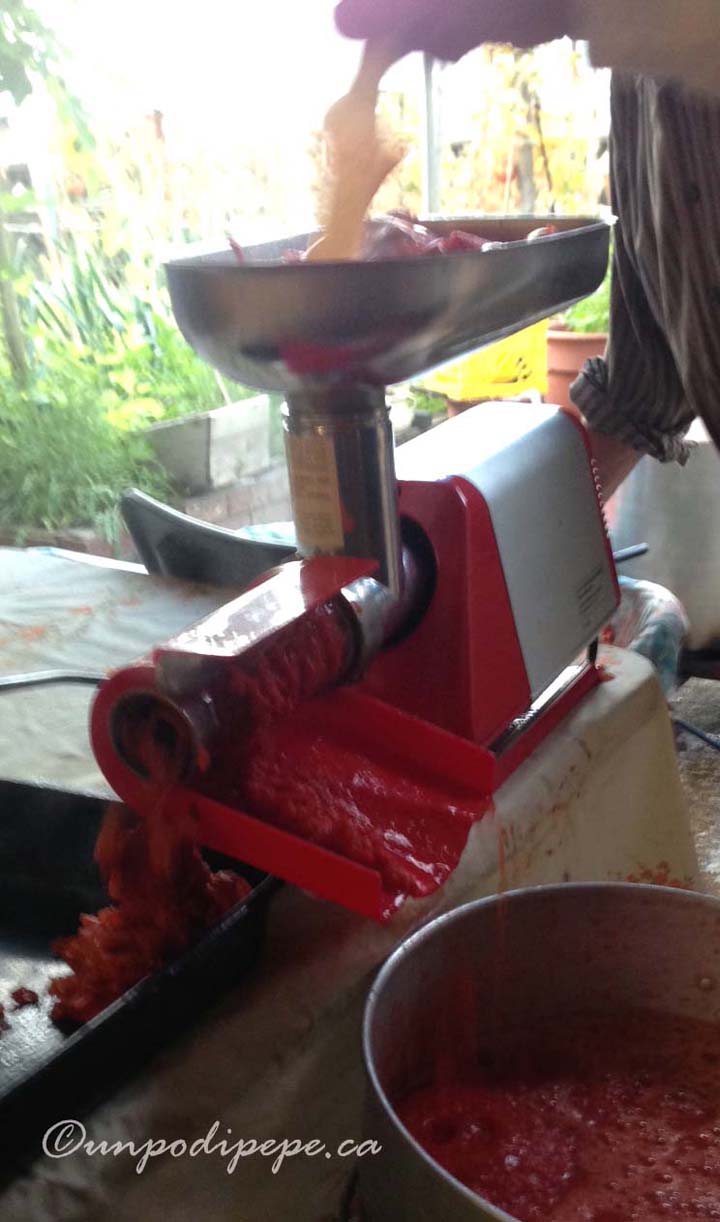
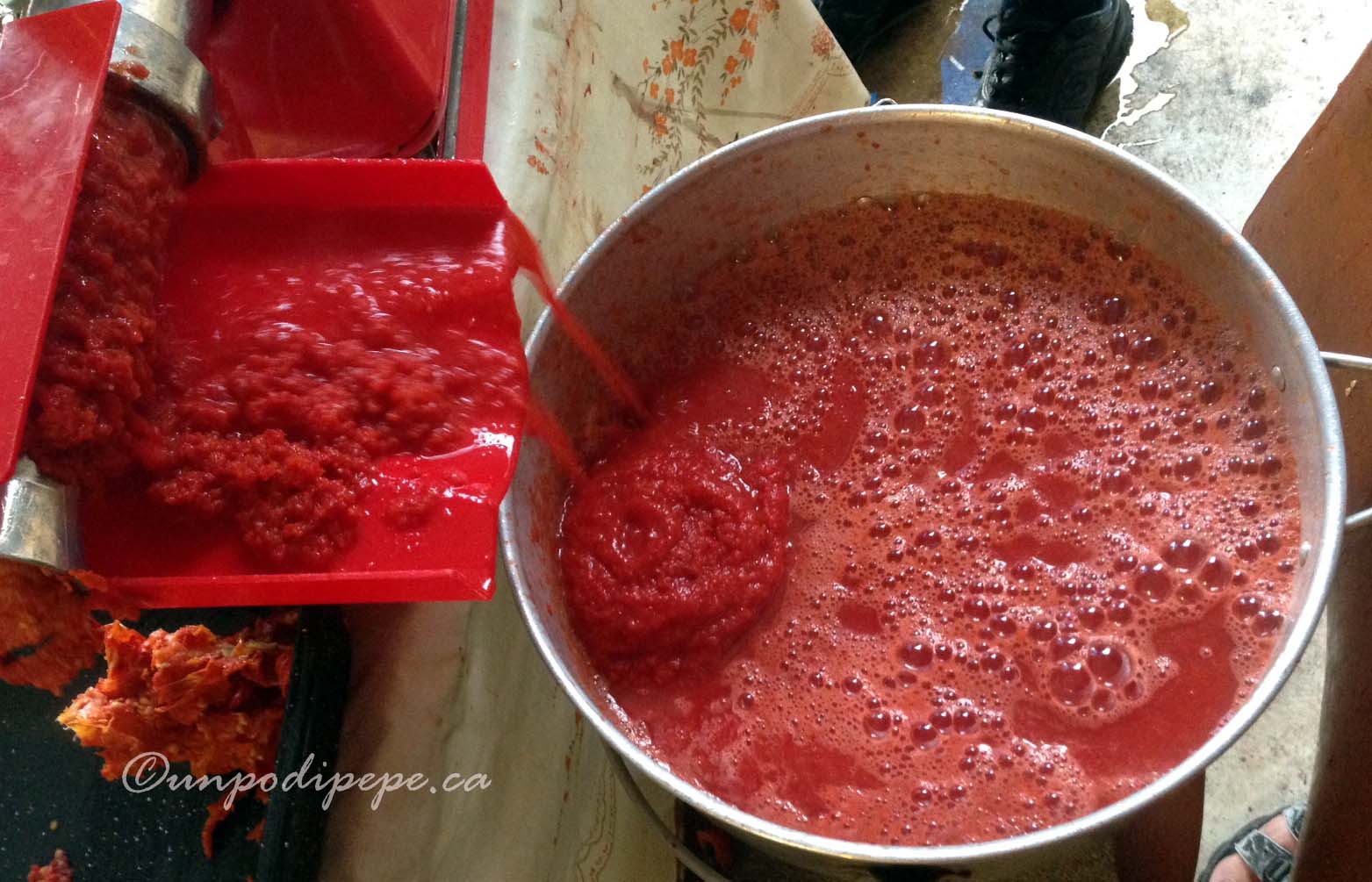
Passata refers to ‘passed’ through a sieve, a passapomodoro, or an electric machine to extract the juice and pulp and remove the skin and seeds. Our machine is called a ‘spremipomodori‘(tomato squeezer!). We thought it bit the dust last year, and bought a new one which didn’t work.  So we had to dig out the old one and give it a try.  This thing just keeps on ticking!

Our 'spremipomodoro' hard at work. The salsa/passata comes out the front and the skins and seeds come out the side.

Our ‘spremipomodoro’ hard at work. The salsa/passata comes out the front and the skins and seeds come out the side.

Passata di pomodoro

Passata di pomodoro

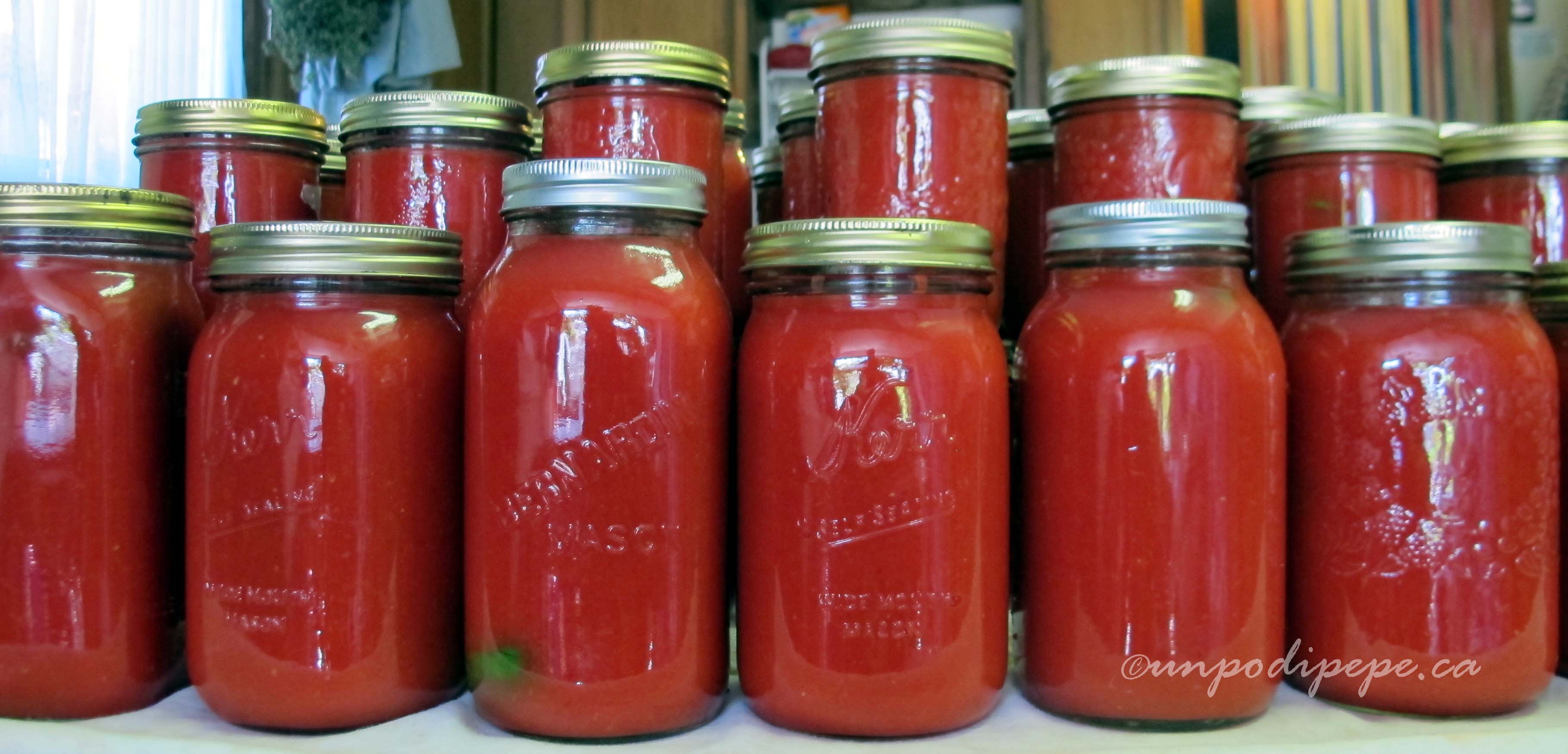
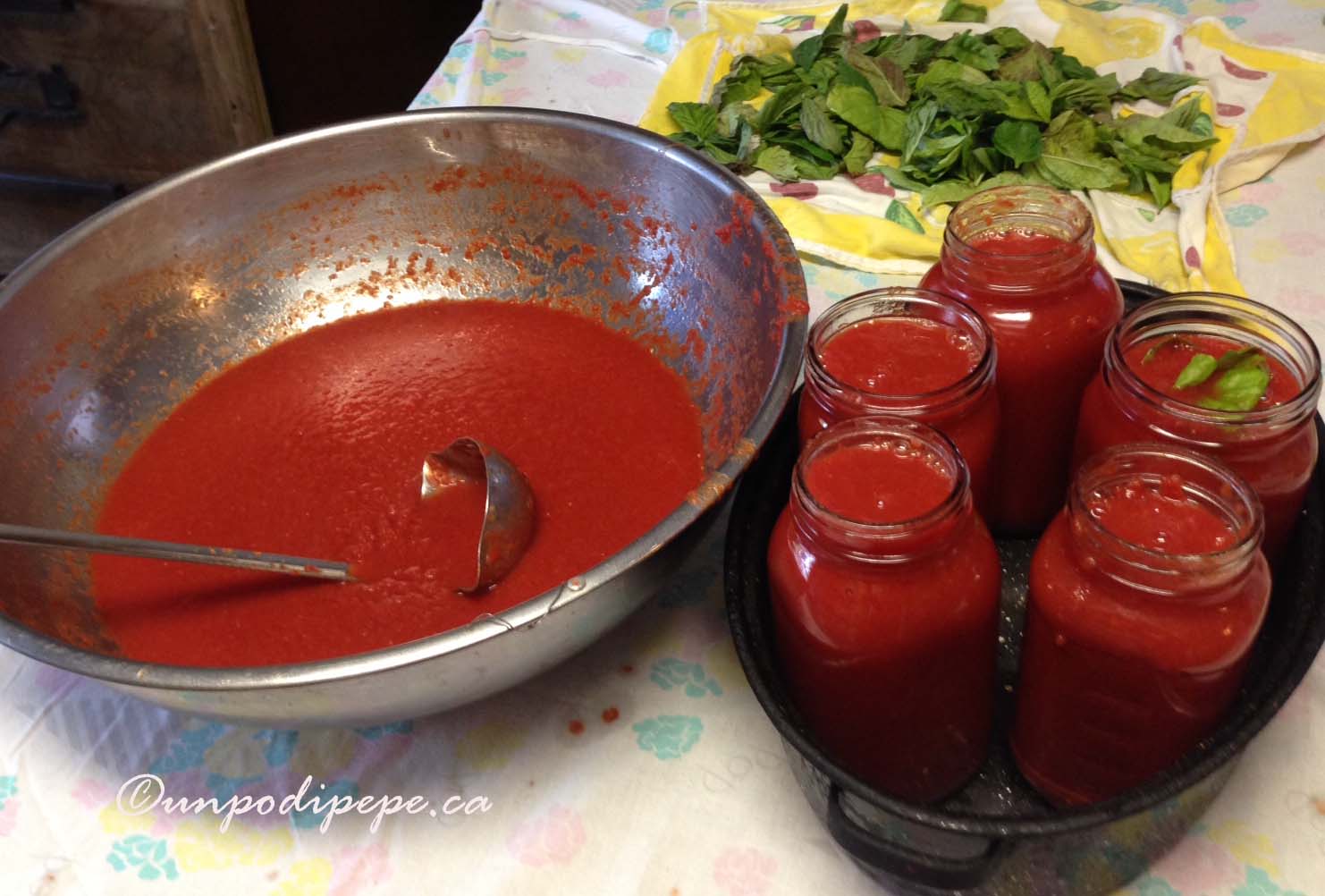
Salt is added to the passata/salsa as a preservative and it is ladled into jars with fresh basilico (basil). We use canning jars and juice bottles.  My relatives in Italia used to ladle their salsa into big amber beer bottles!
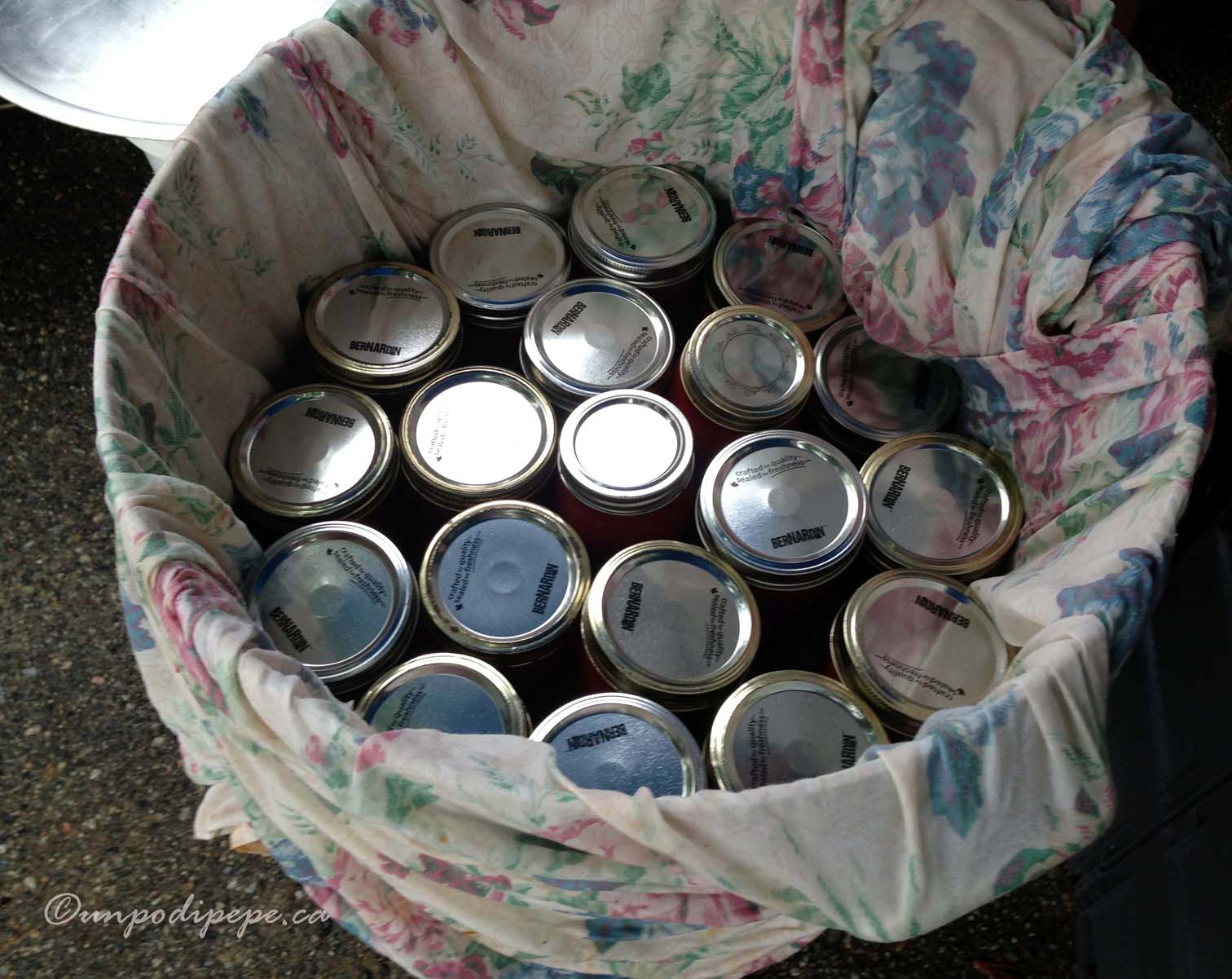
Passatadipomodoro3Sterilized lids are screwed on tightly, and the jars are place back in the large pot, which is lined with cloth so they don’t clang together. The pot is brought to a soft boil for about half an hour.

Vasetti (jars) of passata in a huge cloth lined pot

Vasetti (jars) of passata in a huge cloth lined pot

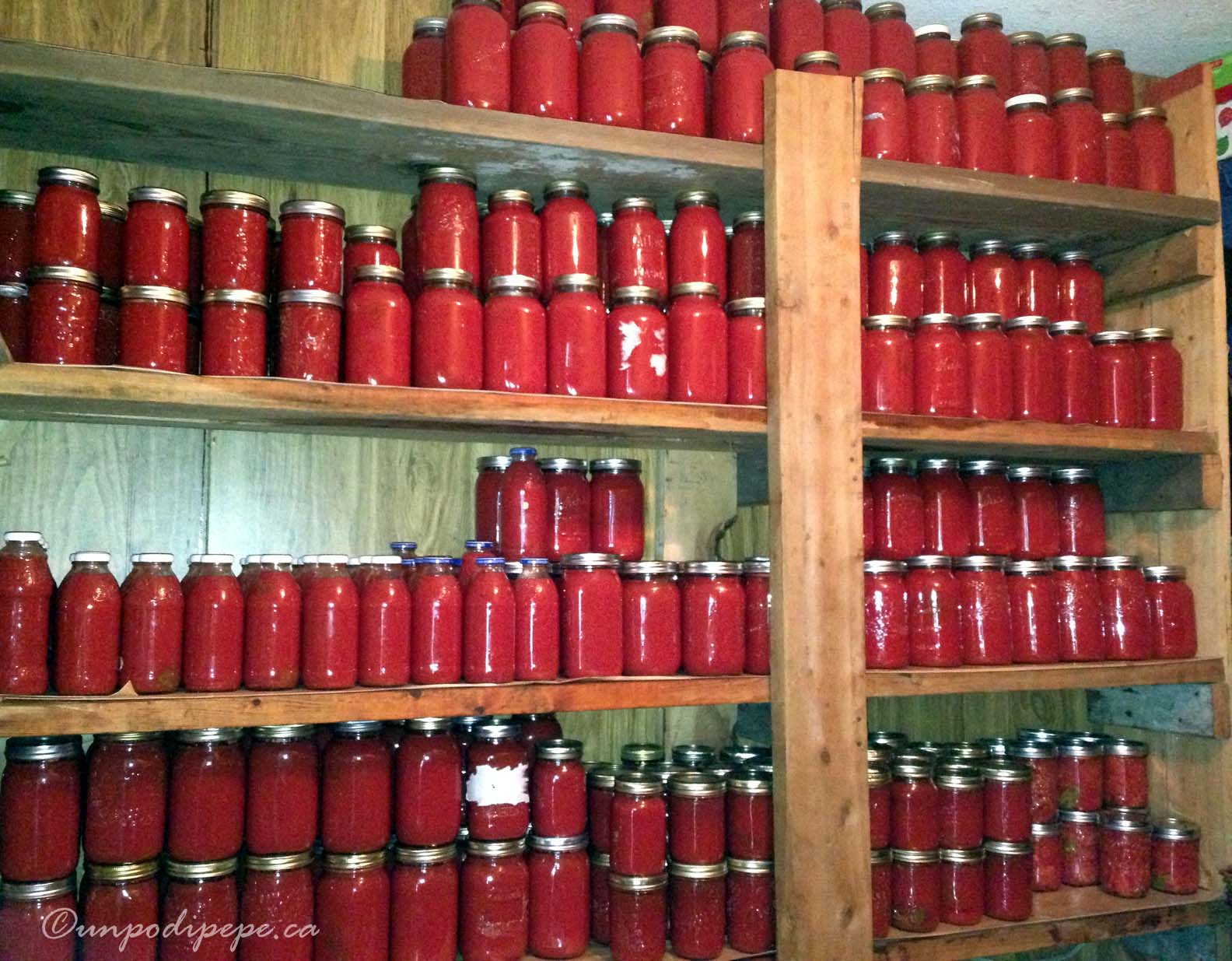
The warm jars are placed upside down and covered in blankets until the next day when they have cooled. Then they are stored in the cantina!

La cantina! The bottom shelf is from last year.

La cantina! The bottom shelf is from last year.

I hope you enjoyed your passata di pomodoro tour! Now I’m in the mood for orecchiette con sugo! Ciao, Cristina


Share this:

  • Share on Facebook (Opens in new window) Facebook
  • Share on Pinterest (Opens in new window) Pinterest
  • Share on X (Opens in new window) X
  • Email a link to a friend (Opens in new window) Email
  • Share on WhatsApp (Opens in new window) WhatsApp
Like Loading...

Bambini, Soccer and World Peace

23 Saturday Aug 2014

Posted by Un po' di pepe in Culture, Inspiration, Italia, Italian life, Orsara di Puglia

≈ 4 Comments

Tags

Calcio, Inspiration, Orsara di Puglia, Soccer

orsaracampetto
Bambini are amazing. My 9 year old nipotino (nephew) Vito loves soccer (aka calico/football/futbol) and all things associated. He had predicted Germany would win the World Cup before it even started. Vito came to Orsara di Puglia this year, and really wanted to play, so our Zia called a friend whose son played and arranged to have them meet ‘sotto la sveglia’ (under the clock) at Porta San Pietro at 9pm. When we went to meet him, I also saw my friends’ son and asked him if he liked to play. Within minutes, all of the 10-11 year old boys in the area had gathered and enthusiastically arranged to meet the next morning at ‘il campetto’ (the small soccer field) for a game, then they all went for a passeggiata. It was the cutest thing ever and could have been a TV advertisement for the next world cup!
The next morning, they all showed up and there were enough boys for 2 teams. They played for 2 hours and Vito was excited that they all played as enthusiastically as he did. He understands Italian quite well, and even with all the loud ‘friendly arguing’ in dialetto and hand gestures, they had no problems communicating.  They were adorable, and got together to play 2 more times while Vito was there.  They even played in the afternoons in the narrow streets, and went out for pizza Margherita or a passeggiata in the evenings. I think that if bambini were in charge….. maybe there would be hope for world peace?

Share this:

  • Share on Facebook (Opens in new window) Facebook
  • Share on Pinterest (Opens in new window) Pinterest
  • Share on X (Opens in new window) X
  • Email a link to a friend (Opens in new window) Email
  • Share on WhatsApp (Opens in new window) WhatsApp
Like Loading...

Le Isole Tremiti

16 Wednesday Jul 2014

Posted by Un po' di pepe in Italia, Photography, Puglia, Travel

≈ 13 Comments

Tags

Alidaunia, Diomedes, Fellini, Il Gargano, Isole Tremiti, Italia, Italian history, Italy travel tips, Parco Nazionale del Gargano, photography, Puglia, Southern Italy

San Nicola and Cretaccio seen from above the helipad, San Domino

San Nicola and Cretaccio seen from above the helipad, San Domino

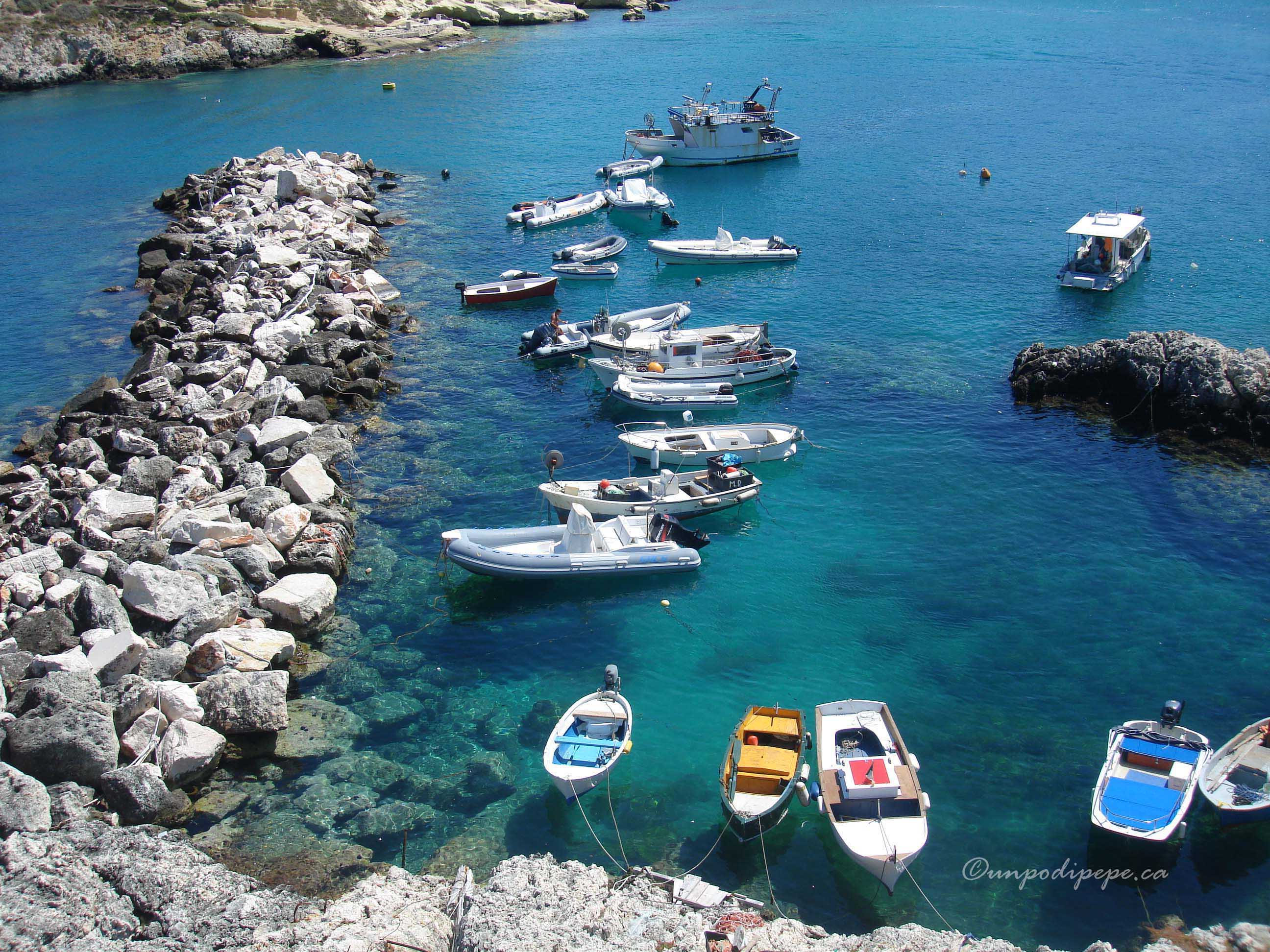
The Isole Tremiti (ee∙SOH∙leh treh∙MEE∙tee) are an archipelago of 3-5 islands-depending on what you consider an island-in the Adriatic Sea, 22 km off the coast of Italia. The Tremiti, considered ‘le perle dell’Adriatico’ (the pearls of the Adriatic), have been inhabited since at least the 4th century BC.  They are part of the Parco Nazionale del Gargano (Gargano National Park) http://www.parcogargano.it and have been a protected Marine Nature Reserve (Riserva Naturale Marina Isole Tremiti) since 1989. The clear waters make the islands a popular spot for snorkeling, scuba diving and even bird watching.

Isole Tremiti Satellite View

Isole Tremiti Satellite View

Flying into San Domino by helicopter

Flying into San Domino by helicopter

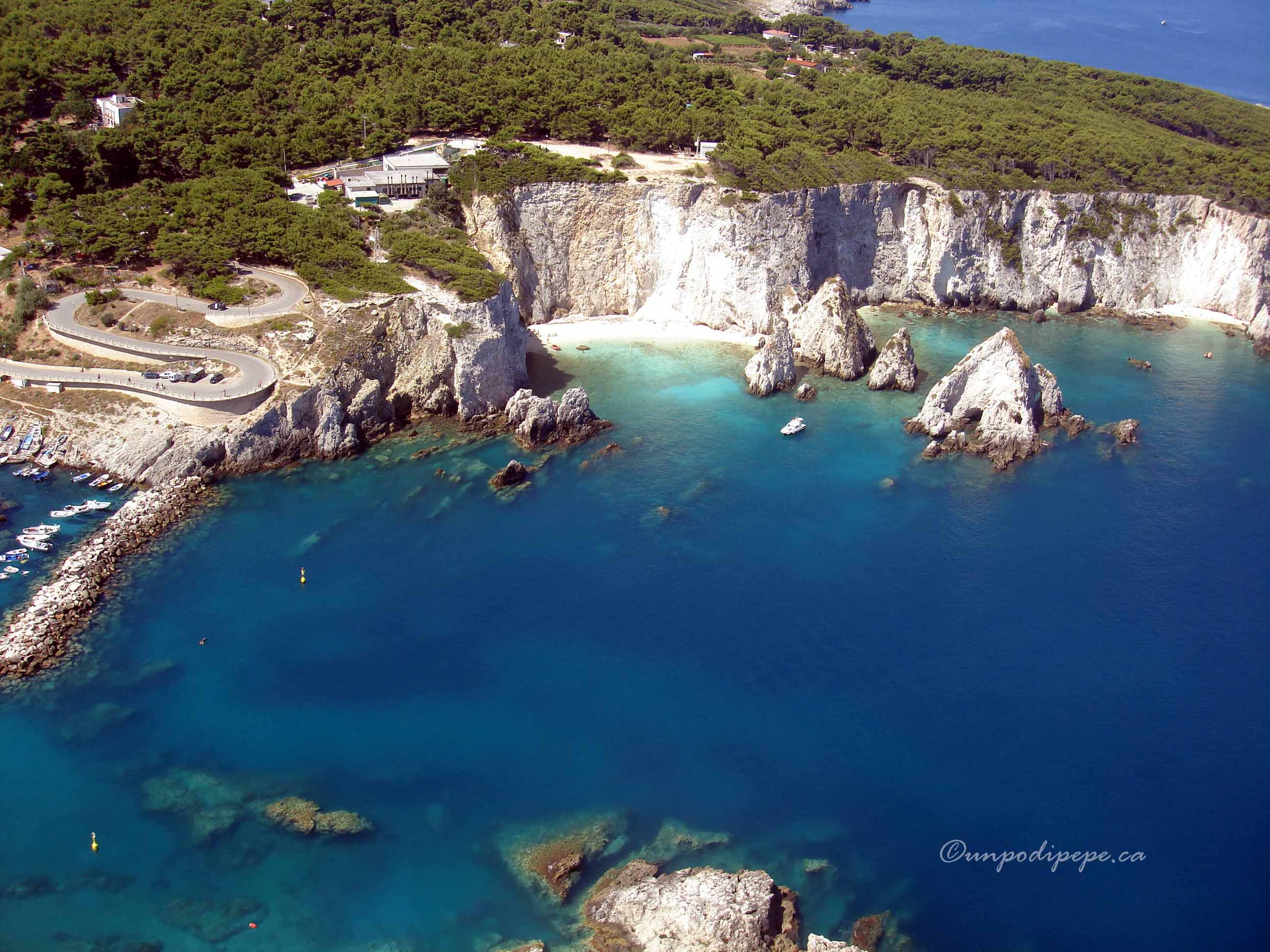
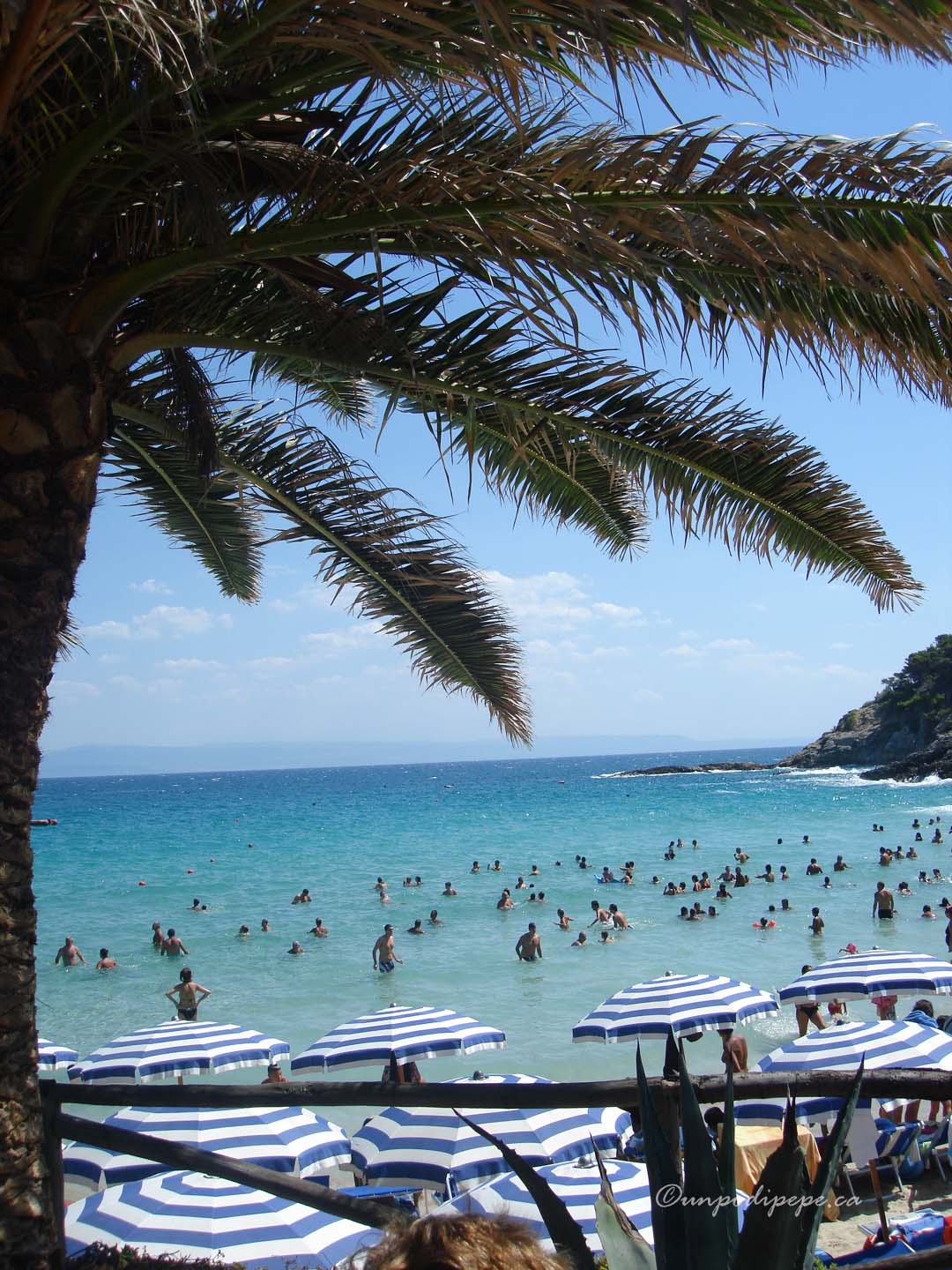
San Domino is the largest island and has most of the facilities such as hotels, restaurants, the Tremiti Diving Center, and the heliport. It is covered by lush Aleppo pine forest, capers and rosemary, and surrounded by small coves and sea caves. San Domino has the Tremiti’s only sandy beach –Cale delle Arene. The rocky coves are beautiful to explore and swim-but don’t go barefoot! My friend stepped on a riccio di mare (sea urchin) and it was not fun.  There is a 2 hour walk around part of the island and bicycles are available for rent.

The small port, San Domino

The small port, San Domino

Cale delle Arene, San Domino-the only sandy beach on the Isole Tremiti

Cale delle Arene, San Domino-the only sandy beach on the Isole Tremiti

Scoglio dell 'Elefante, San Domino, looks like a giant sitting elephant drinking from the sea

Scoglio dell ‘Elefante, San Domino, looks like a giant sitting elephant drinking from the sea

San Nicola is the administrative and historic center of the islands, and where most of the 400 or so permanent residents live. The 11th Century Benedictine abbey and church of Santa Maria del Mare seem to rise up out of the limestone cliffs, with fortified walls starting at the port. The church has a beautiful 11th century mosaic floor and a Byzantine painted wood crucifix that was likely brought here by monks fleeing from the Crusades.

San Nicola, seen from San Domino

San Nicola, seen from San Domino

San Nicola Porto

San Nicola Porto

Bagnetto anyone?

Bagnetto anyone?

Capraia (or Caprara) is rocky and uninhabited except for sea birds. It is named for the capers that grow there. There is no organized transport to Capraia, but local fishermen can be hired to take people over.

San Nicola and Capraia.  Yes those are solar panels down there!

San Nicola and Capraia. Yes those are solar panels down there!

Cretaccio is an uninhabited halfmoon shaped block of yellowish clay between San Domino and San Nicola.  Cretaccio literally means ‘big hunk of clay’.
Pianosa is 11 km away from the other islands and is the most northern point of Puglia.  It can be covered by waves during storms, as the elevation is only 15 m.  The waters surrounding Pianosa are in zone A of the Marine Reserve, so access is strictly prohibited except for approved marine research.

Cretaccio and San Domino, seen from Santa Maria al Mare, San Nicola

Cretaccio and San Domino, seen from Santa Maria al Mare, San Nicola

The islands are sometimes known by their former name ‘Le Diomedee’ or ‘I Sassi di Diomede’ and you see a lot of things in the Gargano area called ‘Diomede’. According to legend/mythology, after the Trojan War, the Greek hero Diomedes settled in the Daunia area (Province of Foggia) and created the islands with 3 rocks he threw into the Adriatic.  He was also shipwrecked on the islands with his crew and possibly died here.

La tomba di Diomede on San Nicola.

La tomba di Diomede on San Nicola.

There is an unmarked Hellenic period tomb on San Nicola that is known as ‘la tomba di Diomede’. His crew was so upset at the loss of their captain that the Goddess Venus took pity on the grieving men and turned them into birds that continue to cry for their loss. The scientific name for the Great Albatross which is common in the area, is ‘Diomedea’.  These birds look a lot like seagulls and make a noise that can sound like a crying newborn.  In Fellini’s ‘Otto e mezzo’ (8½) there is a scene where a cardinal tells this story to Guido (Marcello Mastroianni).

A Diomedea, San Domino

A Diomedea, San Domino

The islands also have a long history as a place of exile. Emperor Octavius Augustus confined his granddaughter Giulia to San Nicola for adultery with a Roman senator. She remained there until her death 20 years later. One of the necropoli beneath the abbey could be her tomb.  Ferdinand, king of Napoli turned the abbey into a penal colony. A hundred years later, another Ferdinand tried to repopulate the islands with criminals and people moved in from the slums. For many years, the Fascists imprisoned those considered a danger to the public on the Isole Tremiti. One of the prisoners held there was Sandro Pertini, future president of the Italian Republic.

Alidaunia flies from Foggia to San Domino daily

Alidaunia flies from Foggia to San Domino daily

I have visited the islands several times by helicopter.  As you can see in the photos, the emerald water is so crystal clear you can see the bottom from the air!  The wonderful thing about visiting the Isole Tremiti is that there are no large hotels or resorts.  All of the hotels are small and surrounded by pine forest, so although this is a tourist destination, it doesn’t feel overrun with people. The Isole Tremiti are accessible by 1-2 hour ferry ride from Vieste, Peschici, Rodi Garganico, Manfredonia and Termoli, or by half hour helicopter ride from Foggia http://www.alidaunia.it .

Over San Nicola

Over San Nicola

Buon Viaggio!

Share this:

  • Share on Facebook (Opens in new window) Facebook
  • Share on Pinterest (Opens in new window) Pinterest
  • Share on X (Opens in new window) X
  • Email a link to a friend (Opens in new window) Email
  • Share on WhatsApp (Opens in new window) WhatsApp
Like Loading...

Italiano per Ristoranti~How to pronounce your restaurant menu

20 Friday Jun 2014

Posted by Un po' di pepe in Italian language, Travel tips

≈ 41 Comments

Tags

Downloadable pronunciation guide, Italian language, Italian menu, Italian pronunciation guide, Italiano per ristoranti, Restaurant Italian

Bruschetta (broo.SKET.tah)

Bruschetta (broo.SKET.tah)

When I’m at a restaurant and I hear BROO∙sheda, FOKA∙sia, pra∙skew∙do, spug∙eddy, la∙TAY, EX∙preso or worst of all, GA∙noh∙chee.…I have to cover my ears. This post is my small effort to encourage everyone to get to know the beauty of the Italian language. Whether you are planning a trip to Italia, or to your local Trattoria, learning how to pronounce the words on the menu is worth the effort!

Italian pronunciation is very different from English. Pronouncing Italian words is easier than it looks, because every letter has a purpose. Words are pronounced phonetically-the way they are spelled.  There are no silent letters as in English, except h at the beginning of a word.  My name ‘Cristina’ has no h because there is no reason for it. In Italian, you won’t find crazy words like ‘enough’ that don’t sound at all like they are written (?inaf).  If you know the sounds made by certain letters and combinations, you can pronounce all of those big long words with lots and lots of vowels.  Pronouncing Italian correctly will also help with reading.

Note…. It isn’t easy to ‘speak’ with writing, and no written material can replace listening to and speaking Italian on site! This is a basic, practical introduction….just the facts! I’ve written the approximate pronunciations so that someone who speaks English can understand them.

2 important things to know:

  • There are only 21 letters in the Italian alphabet. There is no j, k, w, x or y, except in foreign words. J is used in some dialetti (regional dialects) including Orsarese, and is pronounced like a y
  • Emphasis is usually on the next to last syllable. If the emphasis is on the last syllable, the vowel at the end of the word has an accent. For example, tiramisù (teera∙ mee∙ SOO), ragù (ra ∙GOO) menù (meh∙NOO), supplì (soop∙PLEE), bignè (bee∙NYEH), tè (TEH), or caffè (caf∙FEH).  This is very important to remember, as it is what gives the Italian language its musicality. If you pronounce everything the same, then the words will sound monotonous.

Accents/accenti are used:

  • When emphasis is on the last syllable of a word as described above
  • 1 syllable words with 2 vowels, as in può, più
  • 1 syllable words that can have 2 meanings, as in te (you) or tè (tea), e (and) or è (is)

Unlike other languages, in Italian the accent is almost always l’accento grave (GRAH∙veh) sloping down towards the right as in à,è,ì,ò,ù. L’accento acuto, as in é and ó is not used often. We can safely say that 99% of the time, l’accento acuto is only used for sé, né and words ending in ché (perché, finché, giaché, etc). In all other cases, use the accento grave.

Pronouncing vowels

  • • A is pronounced ah as in Mamma or amore (ah∙ MOH∙ reh)
    • I is like the ee sound in green, as in piselli (pee∙ SEL∙ lee). Followed by a vowel, i can also sound like the y in yoga, as in ieri (YEH∙ree)
    • U is like the u in June or the oo in food. Musica is moo∙SEE∙ca, nutella is noo∙TEL∙lah
  • E has 2 slightly different pronunciations that are hard to express in writing, and also vary from region to region. For the purpose of pronouncing food, we will just say that e is pronounced eh like the e in egg.  My favourite example is pepe (PEH∙peh).  Many pronunciation guides make the mistake of stating that e makes the sound ‘ay’.  This is not correct.  Do not pronounce e this way unless you want to sound like Tony Soprano!
    • O is oh like the o in no – calzone (cal∙ZOH∙neh) or the o in hot- cotto (COT∙toh). You may not know which sound the o makes unless you have heard the word spoken correctly, and there is also regional variation

Italian words are full of vowels and most words end in a vowel. If there are 2 or more vowels in a row, each one is pronounced. They may be in the same syllable, as in ciao (CHEEAH∙oh) and ieri (YEH∙ree). An awesome word with 4 vowels in a row is gioia (GEEOH∙yah)! Try saying that with a grumpy face!

Pronouncing consonants
C and G
• C and g are ‘duro’ or hard (as in corso or grande) – except if followed by an e or an i
• C or g followed by an e or i are ‘dolce’ or soft, like the ch in church and the g in gem
• If c or g are followed by an h and then an e or i, the pronunciation is hard once again

Ci = chee                        chi = kee
Ce = cheh                       che = ke (as in keg)
Gi = gee                         ghi = ghee
Ge = jeh (as in jelly)        ghe =as in ghetto

Pesce (PEH∙sheh) = fish…pesca (PES∙kah) = peach…pesche (PES∙keh) = peaches. If you want succo di pesca/pesche (peach juice or nectar) but ask for succo di pesce, you are asking for fish juice. Yuk! Don’t make my Bellini with that!

H (acca/AK∙kah)
• H is muta (MOO∙tah=silent).
• H is used to change the pronunciation of c and g (see above), or to distinguish 2 words that sound the same (anno/hanno, o/ho, a/ha)
• H is only used with c or g if followed by i or e, not if followed by u, a or o. Remember this handy rhyme: ‘cu ca co, acca no/gu ga go, acca no’
Gn/Gl
• Gn is ‘nyuh’ like the n and y in ‘can you’ if you say it quickly and nasally – try bagno (BAH∙nyo) and gnocchi (NYOK∙Kee). Gn sounds similar to the Spanish letter ñ as in señor and piñata. It should not sound like a hard g
• Gl is ‘lyah’ like the l and y in ‘will you’ said quickly. Gl is followed by ia or io as in foglia (FO∙lyah) or aglio (AHL∙yoh)

S combinations
• Sce is sheh like the ‘she’ sound in shelter… pesce = PEH∙sheh
• Sci is shee as in prosciutto (pro∙SHEEOOT∙toh)
• Sb is zb as in sbottonata (zbot∙toh∙NAH∙tah) = unbuttoned, sbriciolata (zbree∙cheeoh∙LA∙tah) = crumbled
R’s are rrrolled.  T’s sound like T, not like D.

Double consonants are both pronounced.  You need to hold the sound for an extra fraction of a second.  Take cappuccino for example.  You pronounce 2 p’s and 2 c’s.  It’s cap∙ pooch ∙CHEE ∙no, not cap∙a∙chee∙no.

Double r’s are rrreally rrrolled as in burrata (boor∙RAT∙ah)

Pronouncing double consonants as single can change the meaning of the word and can even lead to embarassing situations.  For example, if you want to order penne (PEN∙neh) al pomodoro, but you ask for pene (PE∙neh) al pomodoro, you have just ordered penis in tomato sauce!

Plurals

Unlike English and Spanish, adding an s to the end of an Italian word doesn’t make it plural.  In Italian, everything has a gender.

  • Masculine things usually end in an o and are plural with an i
  • Feminine things usually end in a and are plural with an e

Biscotto (bee∙SCOT∙toh) is singular, biscotti (bee∙SCOT∙tee) is plural.  Do not ask for a biscotti. You ask for 1 biscotto or 2 biscotti.

The plural of birra (beer) is birre, so it’s una birra (BEE∙rah) or due birre (BEE∙reh)

Panino is singular, panini is plural.  Since panini is already plural, ‘paninis’ is ‘sandwicheses’!  It sounds just as silly in Italian!

Some foods have been given a sex change in North America. Remember that zucchine, fettucine and linguine are all female and do not end in i

  • Things ending in e, whether masculine or feminine, are plural with an i. For example, a glass is un bicchiere, 2 glasses are due bicchieri (beek∙KYEH∙ree), un salame, due salami
  • Things ending in io become plural with i. Kiss is bacio (BAH∙cheeoh), many kisses are baci (BAH∙chee)

Some words don’t change when plural:

  • Words that are abbreviations like auto and euro (eeoo∙roh)
  • Imported words like computer and taxi. These are usually masculine
  • one syllable words
  • Words that end in a consonant or an accented vowel (il caffè/i caffè)

There are exceptions to these. For example egg-l’uovo (oo∙oh∙voh) is masculine, but the plural is the feminine le uova (oo∙oh∙vah)-not ‘uovi’. Il dentista, il programma and il problema are masculine, but end in a because they come from the Greek, ending in ‘ma’ or ‘ta’.   Sometimes the exception is simply because it sounds awkward.

Using the wrong vowel at the end can completely change the meaning of a word. For example, if you want to order agnello alla menta (lamb cooked with mint) but you ask for agnello al mento (lamb with chin) I’m not sure which body part will be brought to your table!

Now you are ready to read the menu at Trattoria ‘Un po’ di pepe’……. Buon appetito!

This post is available as a downloadable PDF at the end of the menu. Ebook coming soon!

ilmenu

Il menù Trattoria Un po’ di pepe:

Focaccia Genovese (foh∙KACH∙cheeah  Jen∙oh∙VEH∙seh)•Genoa style focaccia

Mozzarella di bufala Campana (motz∙za∙REL∙la dee BOO∙fa∙lah Cam·PAH·nah)•Fresh mozzarella from the region of Campania, made with milk from water buffalo

Prosciutto e melone (pro∙sheeoot∙toh e meh∙LOH∙neh)•Prosciutto wrapped around slices of canteloupe

Gnocchi al pomodoro (NYOK∙kee ahl poh∙moh∙DOH∙roh)•Gnocchi in a tomato sauce

Tagliatelle al cinghiale (ta∙lyah∙TEL∙leh ahl ceen∙ghee∙AH∙leh)•tagliatelle (ribbon-like egg pasta) with wild boar sauce

Penne all’arrabbiata (PEN∙neh ahl ar∙rab∙BYAT∙tah)•Penne in an ‘angry’ spicy sauce

Orecchiette con cime di rapa (oh∙rek∙KYET∙the con CHEE∙meh dee RAH∙pah)•Orecchiette (Pugliese pasta shaped like little ears) with rapini

Spaghetti aglio, olio e peperoncino (spah∙GET∙tee AHL∙yoh ohl∙yo eh peh∙peh∙ron∙CHEE∙noh)•Spaghetti with garlic, olive oil and chili pepper

Risotto ai frutti di mare (ree∙SOT∙toh ahee frut∙tee dee MAH∙reh)•Seafood risotto

Pesce spada con salsa di acciughe (peh∙sheh spa∙da con sal∙sa dee ach∙chee∙OO∙geh)•Swordfish with anchovy sauce

Polpette della nonna (pohl∙PET∙teh  del∙la NON∙nah)•Nonna’s meatballs

Coniglio arrosto con patate  (coh∙NEE∙lyoh ar∙ROS∙toh con pah∙TAH∙teh)•Roast rabbit with potatoes

Melanzane ripiene al forno (meh∙lan∙ZAH∙neh ree∙PYEH∙neh)•Baked stuffed eggplant

Crostata con Nutella, mascarpone e pere (cro∙STA∙tah con noo∙TEL∙la, mas∙car∙POH∙neh e PEH∙reh)•Nutella, mascarpone and pear tart

Panettone con mandorle (pah∙net∙TOH∙neh con man∙DOR∙leh)•Panettone (sweet bread) with almonds

Zabaglione (zah∙bah∙LYOH∙neh)•A custard type of dessert made with egg yolks, sugar and marsala

Italiano per Ristoranti Downloadable PDF ©2016 unpodipepe.ca

BUON APPETITO!
Share this:

  • Share on Facebook (Opens in new window) Facebook
  • Share on Pinterest (Opens in new window) Pinterest
  • Share on X (Opens in new window) X
  • Email a link to a friend (Opens in new window) Email
  • Share on WhatsApp (Opens in new window) WhatsApp
Like Loading...

Ricotta fatta in casa~ Homemade ricotta

02 Monday Jun 2014

Posted by Un po' di pepe in Italian language, Mangiamo!, Recipes

≈ 9 Comments

Tags

cheese making, Food, Homemade ricotta, Italian language, Recipes, Traditional recipes

Ricotta (ree∙COT∙tah) means cooked again. Ricotta is made when the left over liquid from cheese making (whey) is cooked a second time. Vinegar or lemon juice is added to coagulate or curdle the whey and these curds make ricotta. Making ricotta at home from whey isn’t practical, since you need so much of it to make a small amount of ricotta. The do-it-yourself alternative is to use whole milk and the result is every bit as yummy. It will keep in the fridge for up to 5 days, but it won’t last that long!
Freshly made ricotta drizzled with olive oil, ready to spread onto bread

Freshly made ricotta drizzled with olive oil, ready to spread onto bread

You will need:
2 L (8 cups) whole milk (3.25% MF). Organic milk is best. Do not use skim or low-fat milk! I have used lactose-free milk, but it has to be whole milk
1 tsp sea salt
45 ml (3 tablespoons) lemon juice or 60 ml (4 tablespoons) white wine vinegar or clear apple cider vinegar
If using cow’s milk, you can also add up to 250 ml (1 cup) cream depending on how creamy you like it

Directions:
1. In a large pot, stir milk, cream and salt
2. Keep stirring over medium heat until the temperature reaches 80⁰ C (180⁰ F)
3. Add lemon juice or vinegar and stir briefly and gently. Be careful not to stir too much!
4. Keep on low flame for 5 minutes
ricottapentola2014
5. If you start to see bubbles, add a small amount of cold water to keep the milk from reaching boiling temperature
6. Remove from heat and scoop ricotta out with a slotted spoon. Pour through a cheesecloth lined colander or a sieve

ricottacolapasta2
7. Let the liquid drain out, then turn it over onto a plate and ecco-la ricotta!
ricottadicapra

I like to use goat milk, which is naturally creamier. I have had the best results using lemon juice to curdle the milk, but any of the coagulants listed will work well. Do not use the cloudy kind of apple cider vinegar-it gives the ricotta a funny taste. After I made my ricotta, I used the whey to make about 3 tablespoons of ‘real’ ricotta and I added it to the ricotta draining in the colander. I did not notice a taste difference.
Do not throw out the whey! It is rich in vitamins and protein. I used mine to water my olive tree and peperoncini! You can also keep it for adding to soup or risotto, for making bread, or as a substitute for milk in cakes or other recipes.

Links to my other posts featuring ricotta:

Fiori di Zucca

Limoncello Ricotta Cookies

Tortelloni di Ricotta

Buon appetito!

Click here for help with Italian pronunciation.

Vocabolario
Inglese:
                         Italiano:
Whey                              siero
Curds                              caglia
Goat milk                       latte di capra
Cow’s milk                     latte di mucca
Apple cider vinegar        aceto di mele
Whole milk                    latte intero
Lactose-free milk           latte senza lattosio
Skim milk                      latte scremato
Organic                          biologico
Colander                        colapasta
Do-it-yourself (DIY)       fai-da-te
Butterfingers                 Avere le mane di ricotta

Buon appetito, Cristina

Share this:

  • Share on Facebook (Opens in new window) Facebook
  • Share on Pinterest (Opens in new window) Pinterest
  • Share on X (Opens in new window) X
  • Email a link to a friend (Opens in new window) Email
  • Share on WhatsApp (Opens in new window) WhatsApp
Like Loading...

Benvenuti ad Orsara di Puglia

25 Sunday May 2014

Posted by Un po' di pepe in Italia, Orsara di Puglia, Puglia

≈ 63 Comments

Tags

Bandiera Arancione, Cittaslow, Culture, Italia, Italian history, Orsara di Puglia, Puglia, San Michele, Southern Italy

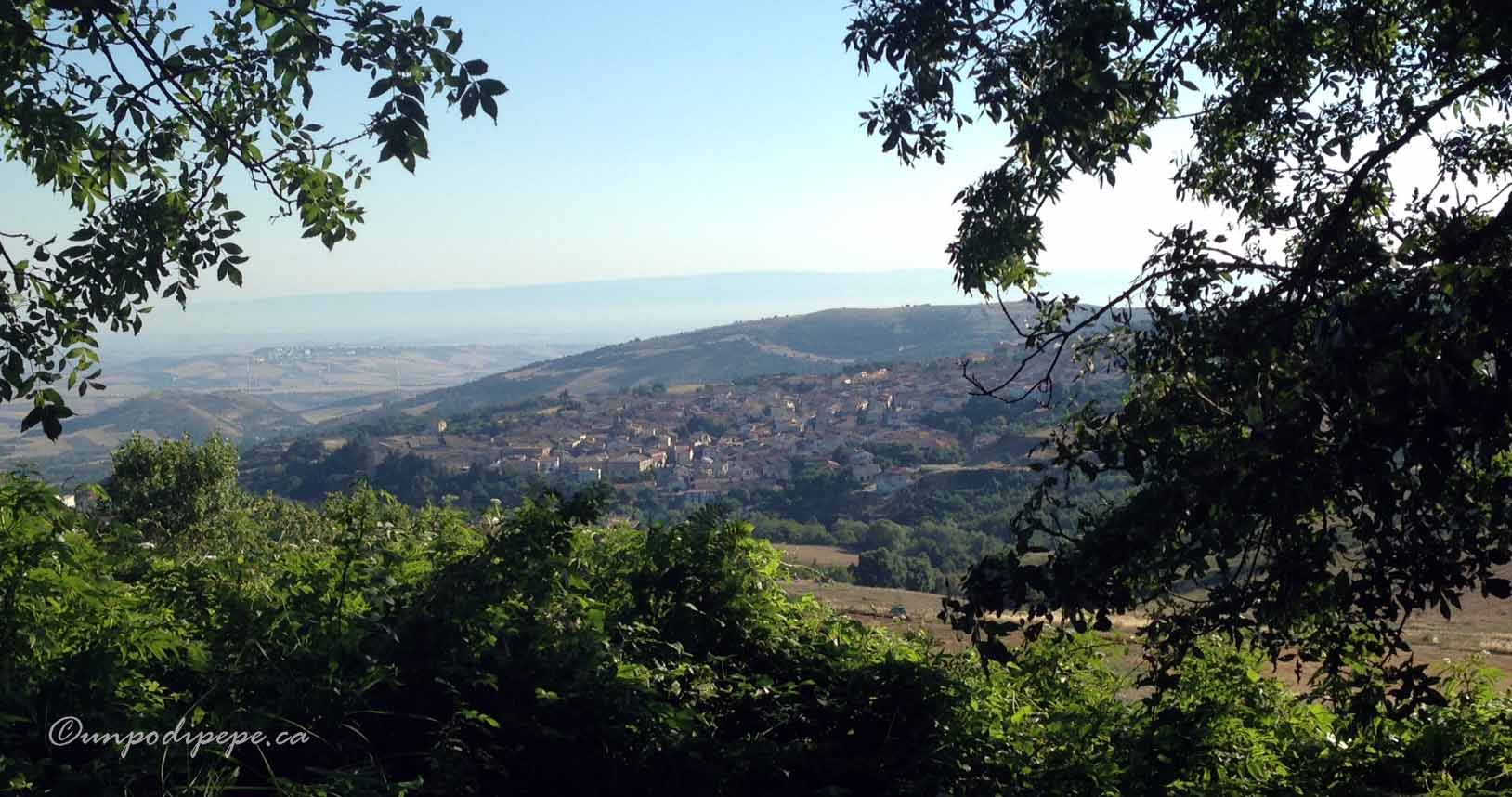
View of Orsara di Puglia

View of Orsara di Puglia

Orsara di Puglia is ‘un borgo medioevale incantevole’ (an enchanting medieval village) on the slopes of Monte San Marco in the Dauno Subappenino area at an elevation of 650 m (~2100 ft). It is surrounded by forests, rolling hills, vineyards, wheat fields and olive groves. Until 1927, it was in the province of Avellino (Campania) which is why it is called Orsara di Puglia. In 1951, before mass emigration, the population was over 7,000. Today the permanent population is just under 3,000. I spent the first 27 months of my life here, and I return every year for some ‘aria di montagna’ (fresh mountain air). This post is an introduction…the first of many Orsarese posts!

Orsara di Puglia-NASA Satellite view

Orsara di Puglia-NASA Satellite view

Orsara is built on a site with natural caves, which made it favourable for settlement. There is evidence of settlement in the area in the 11th Century BC, and Greek colonization as early as the 8th Century BC. There are many legends about the origins of Orsara, but my favourite-definitely the coolest-is that it was founded by the Greek hero Diomedes, who came to Puglia after the Trojan War. Legend also has it that a bear and her cubs had a lair in one of the caves Orsara was built on. The name comes from the Latin Ursus (bear) and aria= Ursaria meaning a place of bears.

The oldest part of Orsara, the Centro Storico or historic town center, is built around the Complesso Abbaziale dell’Angelo.  This complex consists of the pre-7th Century cave church Grotta di San Michele Archangelo with a connecting 1527 church, the exquisite Romanesque Chiesa dell’ Annunziata, and Palazzo Baronale.  The last 2 were the former Abbazia di Sant’Angelo (Abbey of the Holy Angel), a monastery built in the 11th-13th Century.  The Abbazia included a hostel for pilgrims and was home to several orders of monks, incuding the Spanish Cavalieri di Calatrava (Knights of Calatrava) who arrived in 1224. The Calatrava expanded the abbazia, including a hospital, and were an important part of Orsara’s history.  Palazzo Baronale is now private homes except for the basement which is an archeological museum.  The Complesso Abbaziale has seasonal opening hours, and can also be visited by appointment.

Complesso Abbaziale dell'Angelo, seen from Piano Paradiso. The tall, tower-like building is the Chiesa dell'Annunziata.

Complesso Abbaziale dell’Angelo, seen from Piano Paradiso. The tall, tower-like building is the Chiesa dell’Annunziata.

Orsara di Puglia is a member of the Slow Food movement Cittaslow. A gastronomic paradise, Orsara has 8 restaurants, 4 pizzerie, an enoteca, a pub and a cooking school http://www.peppezullo.it. Orsara even has its own designated DOC cheese-cacioricotta, and 3 IGT designated wines. Thanks to the maze of steep, windy cobblestone streets and my morning walk to La Montagna Spaccata, I can eat lots yummy food and still fit into my clothes.

Caciocavallo, pecorino, capicollo & cacioricotta

Caciocavallo, pecorino, capicollo & cacioricotta

In 2010, along with Alberobello, Orsara became one of only 6 towns in Puglia to be distinguished with a Bandiera Arancione (orange flag), a seal of quality from the Touring Club Italiano. The Club certifies small inland towns that are welcoming to visitors and have historic, cultural and environmental significance. For more information http://www.paesiarancioni.net (in Italiano) and http://www.bestsmalltownsitaly.com/town/orsara-di-puglia-apulia-south-islands/ (in English). There are now 13 paesi Pugliesi with a Bandiera Arancione designation.

Via Vittorio Emanuele

Via Vittorio Emanuele

Via Buonarroti

Via Buonarroti

Since 1988, Orsara hosts a Festa del Vino the last weekend in June. The Orsara Musica Jazz Festival and Orsara International Jazz Workshop are held the last week in July. Orsara has 2 patron saints and protectors; Aug 5th is the Festa della Madonna della Neve, and Sept 29th the Festa di San Michele Arcangelo. The night between Nov 1st and Nov 2nd is the Festa dei Fucacoste e Cocce Priatorije, an ancient tradition to honour the dead. For more information on events, check Orsara di Puglia’s official website and blog.

Via Principe Amedeo

Via Principe Amedeo

Ci vediamo ad Orsara!  Buon Viaggio, Cristina

Share this:

  • Share on Facebook (Opens in new window) Facebook
  • Share on Pinterest (Opens in new window) Pinterest
  • Share on X (Opens in new window) X
  • Email a link to a friend (Opens in new window) Email
  • Share on WhatsApp (Opens in new window) WhatsApp
Like Loading...

La Festa della Mamma~Mother’s Day

11 Sunday May 2014

Posted by Un po' di pepe in Feste, Photography

≈ 1 Comment

Auguri a tutte le Mamme per la festa della Mamma!/ Best wishes to all Mothers for Mother's Day!

Auguri a tutte le Mamme per la festa della Mamma!/ Best wishes to all Mothers for Mother’s Day!

Share this:

  • Share on Facebook (Opens in new window) Facebook
  • Share on Pinterest (Opens in new window) Pinterest
  • Share on X (Opens in new window) X
  • Email a link to a friend (Opens in new window) Email
  • Share on WhatsApp (Opens in new window) WhatsApp
Like Loading...

Sbandieratori~Accenti Magazine Photo Contest

04 Sunday May 2014

Posted by Un po' di pepe in Culture, Italia, Orsara di Puglia, Photography, Puglia

≈ 6 Comments

Tags

Accenti magazine, Accenti photo contest, Culture, History, Italia, Orsara di Puglia, photography, Puglia

Sbandieratori

The 7th annual Accenti Magazine ‘Capture an Italian Moment’ Photo Competition results were just released at the Accenti Magazine Awards during the Blue Metropolis Montreal International Literary Festival. My photo, ‘Sbandieratori’ came in second place!

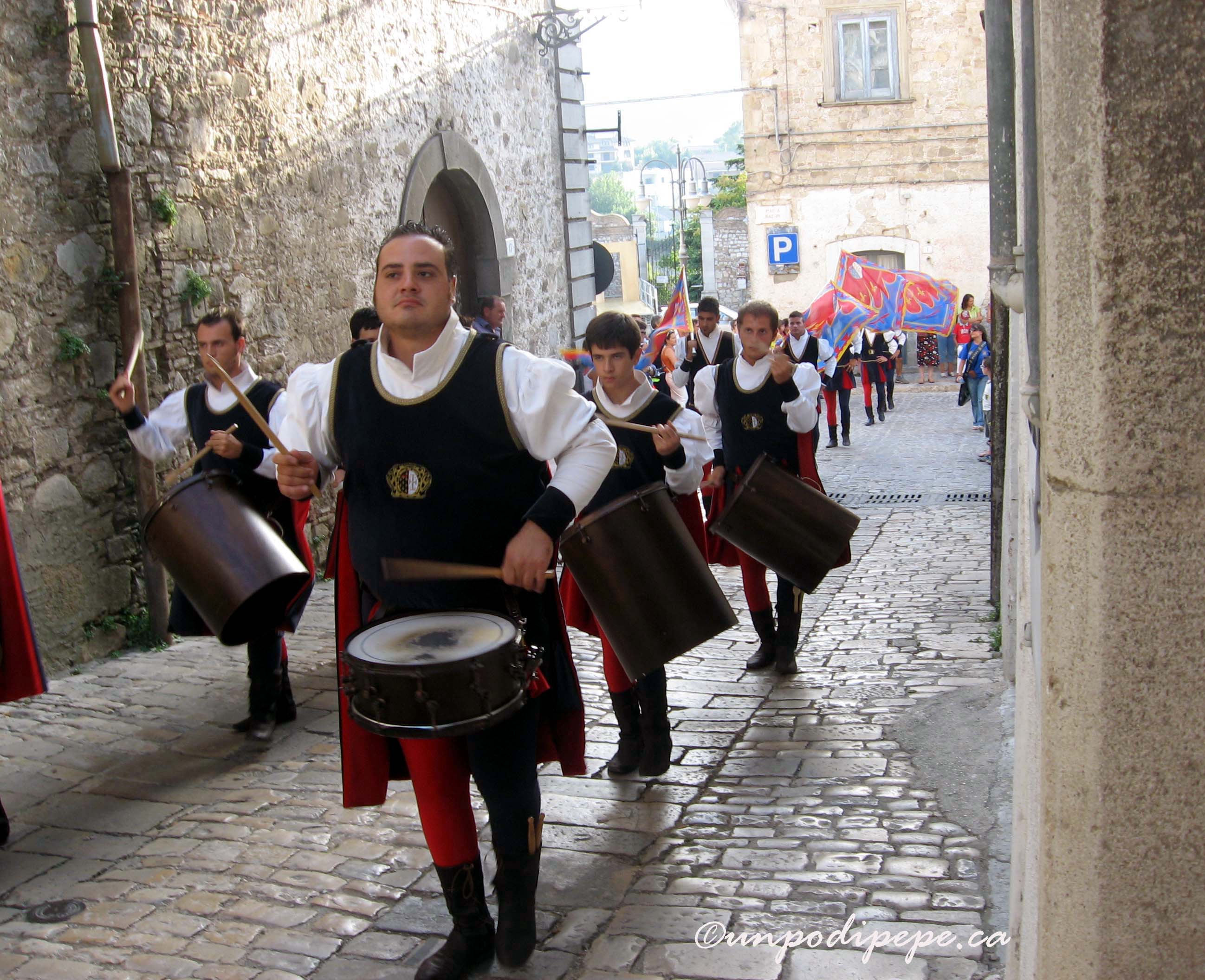
This photo was taken in Orsara di Puglia during the ‘Corteo Storico’, a parade in period costume, reenacting the history of the village. These sbandieratori (flag throwers) came from nearby Lucera to perform. Here, they are in between performances, engaged in casual conversation. What struck me about this image were the bold colours and composition of the costumes and flags. I was also curious to know what their conversation was about….was it early Renaissance gossip, or the latest cell phone app?

In Italiano:

Questa foto è stata scattata ad Orsara di Puglia durante il ‘corteo storico’, una sfilata in costume medioevale, che racconta la storia del paese.  Questi sbandieratori sono venuti da Lucera.  Qui li vediamo in attesa di sfilare, impegnati in una conversazione.  Quello che mi ha colpito sono stati I colori vibranti e la composizione che si è create tra I costume e le bandiere.  Ero anche curiosa di sapere di cosa parlavono…..chiacchiere medioevale o dell’uscita di una nuova app per il telefono?

The mission of Accenti, “the magazine with an Italian accent,” and Accenti Online http://www.accenti.ca is to bring together readers and writers around the idea of shared cultural experience, encourage creative expression, and act as a bridge between cultures. The 2015 photo and writing competition is now accepting submissions. If you are interested in finding out more, go to http://www.accenti.ca/photo-contest or http://www.accenti.ca/writing-contest.

The word Sbandieratori is related to the word bandiera (flag) and is pronounced zban∙ dee∙ ear ∙a∙ tow∙ ree. Say it a few times….now say it faster.

Here are a few more photos from the ‘Corteo Storico’ in Orsara di Puglia:

Sbandieratori, corteo storico, Orsara di Puglia

Sbandieratori, corteo storico, Orsara di Puglia

Corteo Storico, Orsara di Puglia

Corteo Storico, Orsara di Puglia

Share this:

  • Share on Facebook (Opens in new window) Facebook
  • Share on Pinterest (Opens in new window) Pinterest
  • Share on X (Opens in new window) X
  • Email a link to a friend (Opens in new window) Email
  • Share on WhatsApp (Opens in new window) WhatsApp
Like Loading...
← Older posts
Newer posts →

Enter your email address to follow 'un po' di pepe' and receive notifications of new posts by email.

Join 511 other subscribers
Follow Un po' di pepe on WordPress.com

Popular Posts

  • Hairstyling in Ancient Roma
    Hairstyling in Ancient Roma
  • Cucina Italiana Patrimonio UNESCO
    Cucina Italiana Patrimonio UNESCO
  • Napoli Street Art
    Napoli Street Art
  • Un altro giorno a Napoli
    Un altro giorno a Napoli
  • Gallerie d'Italia Napoli
    Gallerie d'Italia Napoli
  • Venezia~La Serenissima
    Venezia~La Serenissima
  • Caffè con Caravaggio a Roma
    Caffè con Caravaggio a Roma

Recent Posts

  • Cucina Italiana Patrimonio UNESCO
  • 2025~Un po’ di pepe Year in Review
  • Castel del Monte
  • ‘The Nuances of Love’
  • Hostaria Antica Roma~Eat like an Ancient Roman
  • Santa Maria in Aracoeli
  • Casino dell’Aurora~Villa Boncompagni Ludovisi
  • Nasoni di Roma
  • Bloghiversario #11
  • Fontana di Trevi
  • Acqua Vergine
  • Giubileo 2025
  • Sanremo 2025
  • In Vino there are Memories
  • A Literary Harvest
  • 2024~Un po’ di pepe Year in Review
  • Buon Natale 2024
  • Il Bicerin
  • Mercato Porta Palazzo
  • Torino
  • Catanzaro, Calabria
  • Il Pumo Pugliese
  • Artemisia Gentileschi
  • Cavalli di San Marco
  • Panzerotti

Categories

Amici e Famiglia Architecture Art Art history Art projects Bilingual posts Blogging Canada Culture Feste Firenze Inspiration Italia Italian Folklore Italian language Italian life Italocanadesi Libri Mangiamo! Orsara di Puglia Parole piacevoli Photography Puglia Recipes Roma Travel Travel tips Uncategorized Vino

Archives

Un po’ di pepe on Facebook

Un po’ di pepe on Facebook

Start a Blog at WordPress.com.

  • Subscribe Subscribed
    • Un po' di pepe
    • Join 511 other subscribers
    • Already have a WordPress.com account? Log in now.
    • Un po' di pepe
    • Subscribe Subscribed
    • Sign up
    • Log in
    • Report this content
    • View site in Reader
    • Manage subscriptions
    • Collapse this bar
 

Loading Comments...
 

    %d