• Home
  • About me/Chi sono
  • Contact

Un po' di pepe

~ …… (oon∙poh∙dee∙PEH∙peh) Cristina writes about interesting stuff /Cristina scrive di cose interessanti

Un po' di pepe

Tag Archives: Traditional recipes

Hostaria Antica Roma~Eat like an Ancient Roman

26 Friday Sep 2025

Posted by Un po' di pepe in Mangiamo!, Roma

≈ 8 Comments

Tags

Ancient Roma, Apicius, Cetara, Colatura di alici, De re Coquinaria, Garum, Gastronomic history, Moretum, Paolo Magnanimi, Traditional recipes, Via Appia Antica

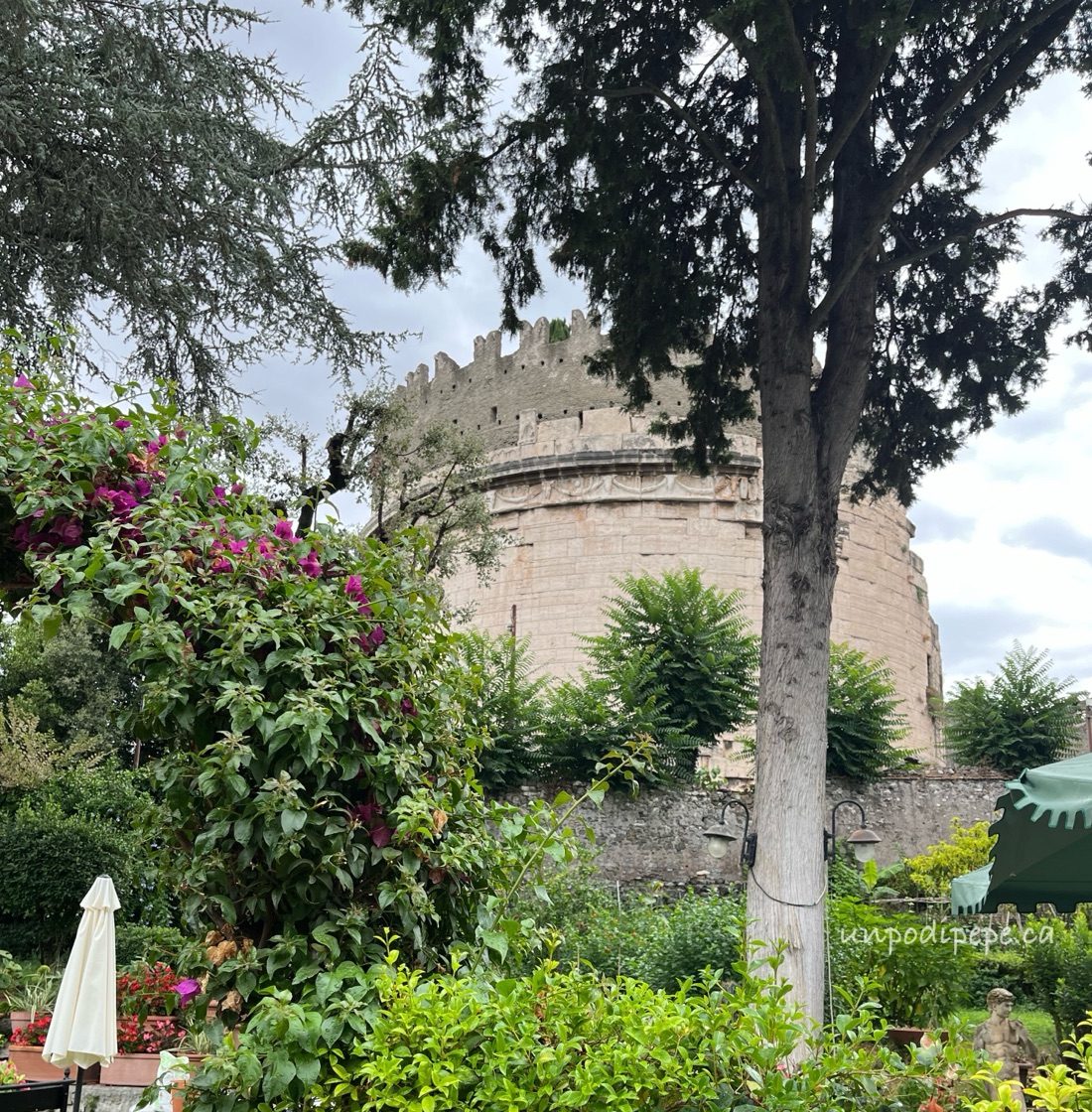
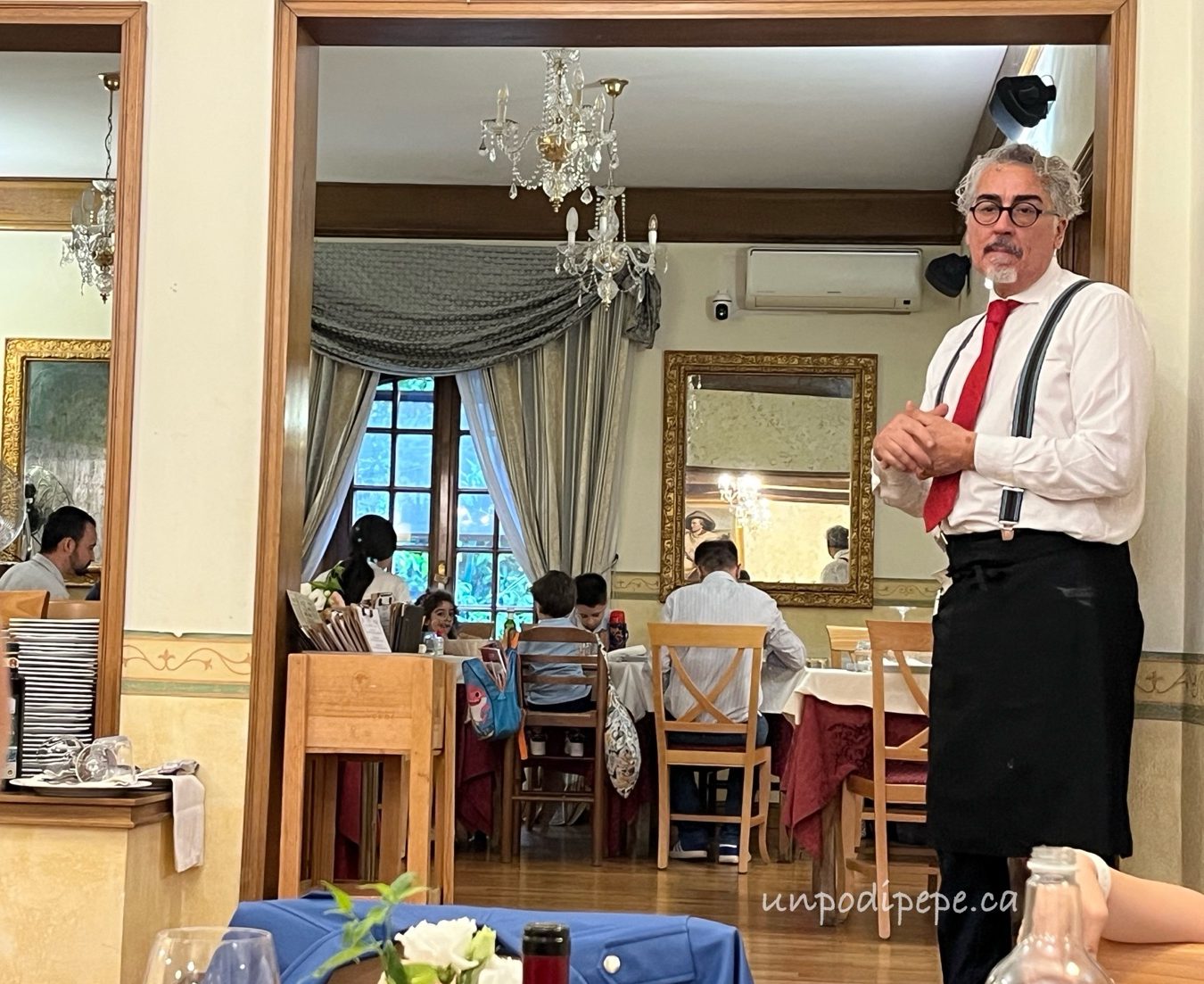
What do you do when a planned daytrip from Roma is cancelled because of pouring rain?  Go and have a meal like the ancient Romans! My friend and I went to Via Appia Antica-the Ancient Appian Way, a road from Roma to Brindisi. Close to the Catacombs of Domitilla, and almost right below the cylindrical Tomba di Cecilia Metella is Hostaria Antica Roma. Here, at his family’s ristorante, Paolo Magnanimi, an amateur gastronomic archeologist, has researched and is reviving 2,000 year old ancient Roman recipes. We enjoyed a delicious meal, enriched by explanation and commentary from Paolo.  It was an educational culinary journey into the past.

The restaurant serves traditional ‘modern’ Roman cuisine, but also a tasting menu called ‘A Tavola con Apicio’ (At the table with Apicius) closely based on the recipes in the 1st Century AD ‘De Re Coquinaria’ /On the subject of Cooking’, the only surviving cookbook from Ancient Roma. It is thought to have been compiled by Apicio -Marcus Gavius Apicius, a wealthy epicure/food lover. He was described by Pliny the Elder as ‘the most gluttonous gorger of all spendthrifts’.  Ouch! Just like Nonna’s, the ancient recipes only include ingredients, not quantities, proportions or instructions.  Paolo recreates the dishes using -as much as possible-only ingredients available at the time.  Ingredients inclucing sugar, chocolate, basil and tomato were not available in the 1stCentury.

We started off with ‘Gustum’ an antipasto platter consisting of a selection of everyday ancient snacks made with local products.  I believe this menu item usually needs to be ordered in advance.  Fortunately for us, a table had reserved for 6 people, but only 5 were there, so we were able to take the extra one!  Clockwise from the top of the photo:

Libum di Catone a bread described by Cato as a sacred symbol of devotion.  It was made with wheat flour, sheep milk ricotta, eggs and honey, and baked on a layer of bay laurel leaves. Now I know what I will do with my extra bay leaves!

Moretum was described by the poet Virgil as an everyday dish of the ancient Romans. This is the ancestor of Pesto, but named after the mortar instead of the pestle.  Moretum is made with pecorino-fresh sheep milk cheese, garlic, herbs such as coriander and celery seed, salt, nuts and olive oil. It can be eaten on its own or spread onto libum.  Paolo grinds together his ingredients with the mortar and pestle, just as described by Virgil.

Prosciutto cotto (ham) with honey and fresh pecorino

Epityrium a spread, similar to a tapenade, of olives and herbs, including cumin, fennel, coriander and sometimes mint. It was served on bread

For our primo or first course, we had the ancestor of modern lasagne, Patina Cotidiana, which is Latin for ‘daily dish’.  The pasta sheets are called laganum.  If any of you believe Marco Polo brought pasta to Italy from China in the 13th Century, that is ‘leggenda metropolitana’, an urban myth.  Boiled laganum are layered with ground beef, fennel and pecorino.  It is ‘in bianco’, meaning no tomato, since the tomato did not arrive in Europe until the 1500’s, and was not even an edible product at that time. Click on Il Pomodoro for the history of the modern tomato.

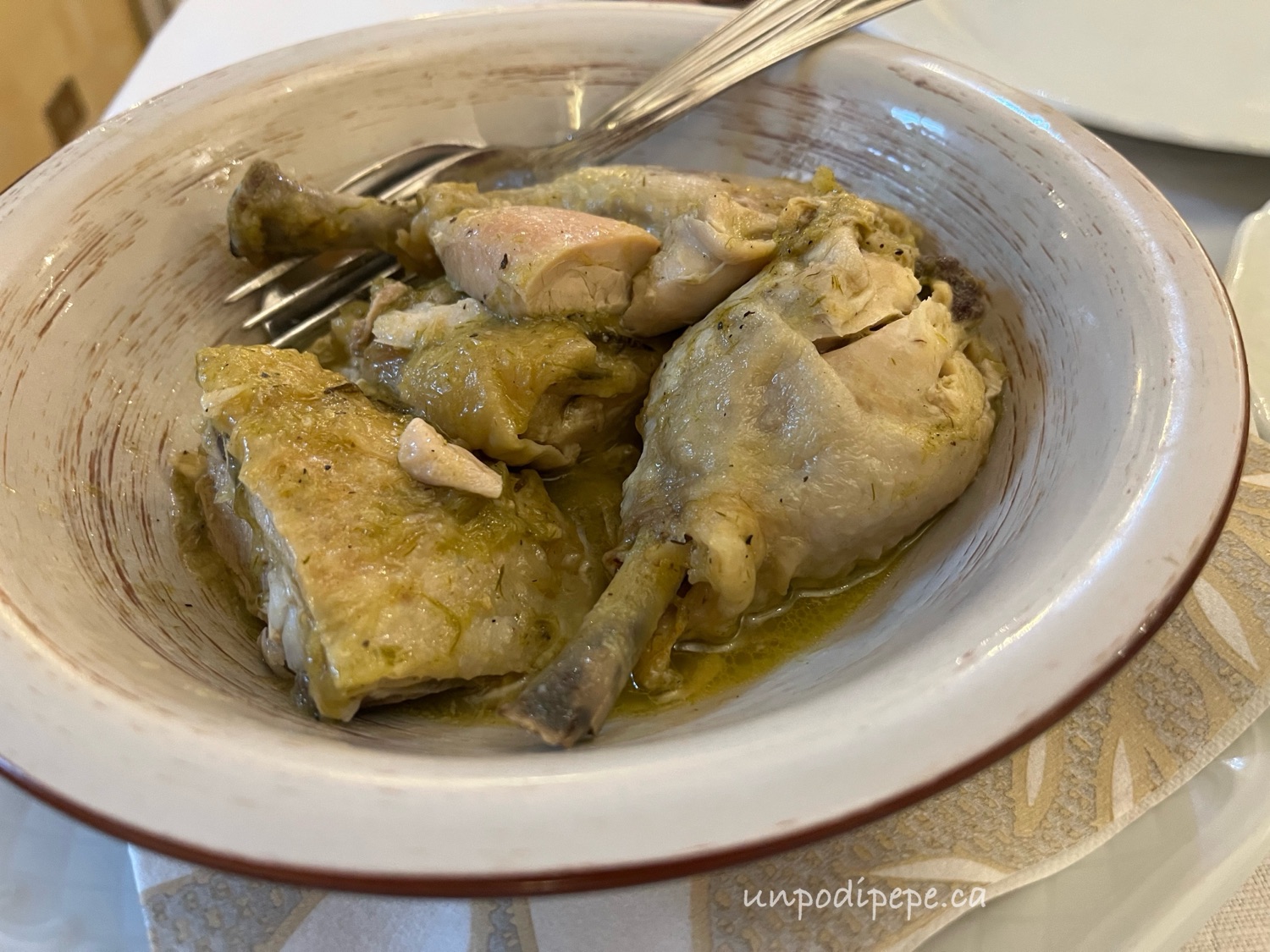
Our secondo or second course was Pollum Oxizomum, chicken cooked with pieces of leek, olive oil, vinegar and garum.  Garum was a fermented fish sauce that was a staple condiment in the ancient Roman kitchen.  75% of the recipes in De re Coquinaria include garum!  At the archeological site of Ostia Antica, one of the market stalls with fish mosaics likely sold the intensely flavoured Garum!  Today, colatura di alici di Cetara is the best substitute for garum.  Colatura di alici means anchovy drippings and this can be considered the ‘Italian version’ of an Asian fish sauce.

In the small Amalfi Coast fishing village of Cetara, they have been making colatura di alici the same way for centuries.  Anchovy fillets and sea salt are layered in small chestnut wood barrels called terzigni with a heavy weight on top. The anchovies are left to ferment for a long time-up to 3 years!  This process produces a clear amber liquid with an intense flavour that floats to the top.  A hole is made in the bottom of the barrel to collect the colatura after it passes through the layers of anchovies.  Online, a 50 ml bottle is about $25 (USD).  Surprisingly, our pollo did not taste fishy or overly salty.  It was delicious!

Finally, for dessert /dolce we had Tiropatina a predecessor of custard or crème caramel.  It was made with whole milk, eggs and honey, with a drizzle of honey and a sprinkling of freshly ground black pepper on top.  The ancient Romans believed pepper to be an aphrodisiac.

A few other items on the ancient menu that we did not try include: Pulsa con copadia, rustic polenta with an aromatic beef stew, Isicia Omentata, pork polpette (meatballs) in grape sauce and La Cassata di Oplontis, a dessert made with almond flour, sheep milk ricotta, honey, dried and candied fruit.

I absolutely recommend a visit to Hostaria Antica Roma, especially if you are fascinated by the history of ancient Roma and gastronomic history.  The fact that everything was delicious does not hurt either!  The week after our visit in July, Paolo was being interviewed by the BBC.

De Re Coquinaria 2021 edition, translated by Terra Nectare corrects previously incorrect translations

Hostaria Antica Roma, Via Appia Antica 176Open Tuesday-Saturday 12:30-1500 and 19:30-22:30, Sun 12-3, Monday closed.

Grazie to to my amica Anna for joining me.  Buon appetito!


Share this:

  • Click to share on Facebook (Opens in new window) Facebook
  • Click to share on Pinterest (Opens in new window) Pinterest
  • Click to share on X (Opens in new window) X
  • Click to email a link to a friend (Opens in new window) Email
  • Click to share on WhatsApp (Opens in new window) WhatsApp
Like Loading...

Il Bicerin

23 Saturday Nov 2024

Posted by Un po' di pepe in Italia, Mangiamo!, Recipes

≈ 20 Comments

Tags

Northern Italy, Piemonte, Torino, Traditional recipes

November weather is dark and dreary, and has me craving a nice warm Bicerin. Bicerin (bee • SHEH • reen) is the official, historic drink of Torino.  The Bicerin was invented in 1763, at the newly opened Caffè Confetteria Al Bicerin in Piazza della Consolata.

Al Bicerin’s strategic location opposite the Santuario della Consolata, where the King and Royal Family attended Mass on Sundays, made it a popular spot and the beverage became well-known.

The secret recipe is made with local dark chocolate, espresso and frothed fior di latte, and served in a small stemmed glass.  The drink is actually named after the glass, Bicerin being local dialetto for bicchierino, meaning small glass. The glass is clear so that all 3 layers are visible.  A Bicerin is not supposed to be stirred, so that the temperature and texture of each layer can be tasted separately and blend on the palate.

The facade of Al Bicerin is still original and stepping inside is like travelling back in time. The counter, the cabinet filled with glass jars of Confetti and the woodwork is from the 19th Century.

I went to Al Bicerin twice while I was in Torino.  Since the weather was nice, I sat outside both times, but the inside is inviting and cozy.  Perfect for a cold, wet November day. The photo below was taken just before closing.

Count Camillo Cavour, the first Italian Prime Minister always sat in the same corner on his daily visit to Al Bicerin. Now there is a photo of him in his angolo. Other famous patrons include Picasso, Puccini, Nietzsche, Alexandre Dumas, Umberto Eco, and Ernest Hemingway, who apparently called the Bicerin one of the 100 things in the world worth saving!

A fun fact about Caffè Confetteria Al Bicerin is that since 1763, it has always been managed by women!

In 2001, the Bicerin was finally recognized by the region of Piemonte as a traditional Piemontese beverage. Order with a plate of local cookies, which can include canestrelli, torcetti, krumiri, savoiardi and baci di dama.

Bicerin is now served in all of the historic caffè places in Torino but it will be slightly different than the original recipe at Caffè Confetteria Al Bicerin, located at Piazza della Consolata 5 in the Quadrilatero area.

Other historic places to have Bicerin in Torino include:

Baratti e Milano- Piazza Castello 29

Caffè Torino- Piazza San Carlo 29

Caffè Fiorio- Via Po 8/C

Farmacia del Cambio- Piazza Carignano 2

Pepino Piazza Carignano- 8

Pfatish Via Paolo Scacchi- 42

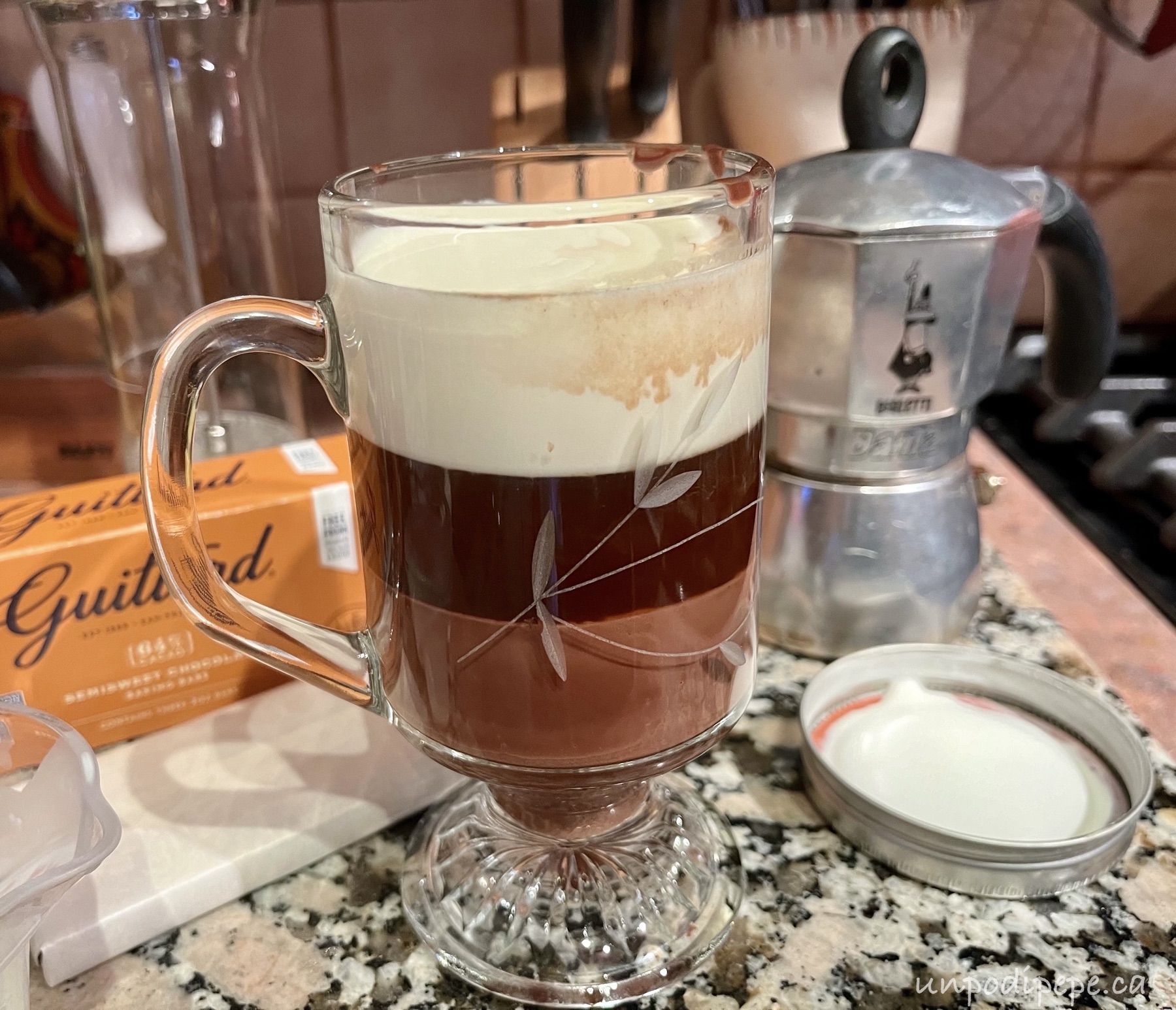
I did some experimenting at home to try and reproduce a Bicerin.  My final product did not taste or look exactly the same, but it was delicious, and the taste-testing ‘research’ was fun.  It takes a bit of juggling to have all 3 layers ready to assemble at once, so do not get discouraged if the first attempt does not look pretty.

Cristina’s attempt at Bicerin

Ingredients:

  • 60 ml (2 oz) light cream*
  • 60 ml (2 oz) chopped 70% dark chocolate, ideally Venchi or other quality brand**
  • 60 ml (2 oz) freshly made espresso doppio/double shot
  • 60 ml (2 oz) frothed whole milk or light cream (must be cold)*

A 300-360 ml (10-12 oz) clear, heat-proof stemmed glass

Instructions:

  • Prepare heat-proof glass by warming with hot water
  • Prepare caffettiera for espresso
  • Pour light cream* and chopped chocolate into a small pan over low heat and whisk until thick.  Meanwhile, make espresso
  • Shake milk/cream in a small jar for 2-3 minutes

Assemble the Bicerin:

  • Pour hot chocolate into warm glass
  • Using the back of a spoon, carefully pour espresso towards the side of glass
  • Carefully add shaken milk/cream
  • Do not stir!

*Consistency wise, there is no North American equivalent to Italian fior di latte (milk cream) or panna (cream).  I experimented using combinations of whipping cream and milk.  My best results were using a mixture of half whipping cream and half whole milk (3%).  This is what I recommend using for both the hot chocolate and the topping. 1 part whipping cream and 2 parts whole milk also works.

**A Torino produced chocolate such as Venchi is best to use.  I used Guillard as it was the best good quality chocolate I had available.

Espresso cookies go perfectly with Bicerin.  Buon appetito, Cristina

Share this:

  • Click to share on Facebook (Opens in new window) Facebook
  • Click to share on Pinterest (Opens in new window) Pinterest
  • Click to share on X (Opens in new window) X
  • Click to email a link to a friend (Opens in new window) Email
  • Click to share on WhatsApp (Opens in new window) WhatsApp
Like Loading...

Polpo e patate

20 Tuesday Jun 2023

Posted by Un po' di pepe in Italia, Mangiamo!, Photography, Puglia, Recipes, Travel

≈ 6 Comments

Tags

Cooking octopus, Imerovigli, Mattinata, Octopus and potato salad, Polpo, Santorini, Southern Italy, Traditional recipes

Polpo is one of the joys of visiting the Adriatic in summer.  Polpo or polipo is octopus, from the ancient Greek polypous, meaning ‘many footed.’  In Italiano, polpo and polipo are both correct terms for octopus! It is one of my favourite foods…I love it grilled, or in a summer salad, especially polpo e patate, a cold potato and octopus salad.  Last year, between camping on the beach in Mattinata, a family wedding, a side trip to Santorini, and mamma’s kitchen, there was a lot of polpo in my life.  In this post, I will share some of my polpo photos, instructions for cooking, and how to make polpo e patate.

I had polpo each of the 5 days I was in Santorini.  There it is called Octapodi χταπόδι, meaning ‘eight footed’. The view from the landing outside my hotel room in Thira was the perfect place to sketch.  When I finished sketching, it was too nice to leave.  Instead of going out to dinner, I walked to a restaurant and got takeout octapodi with couscous.  I brought my feast back and ate it at my sketching spot while watching the sunset.  Yiasou!

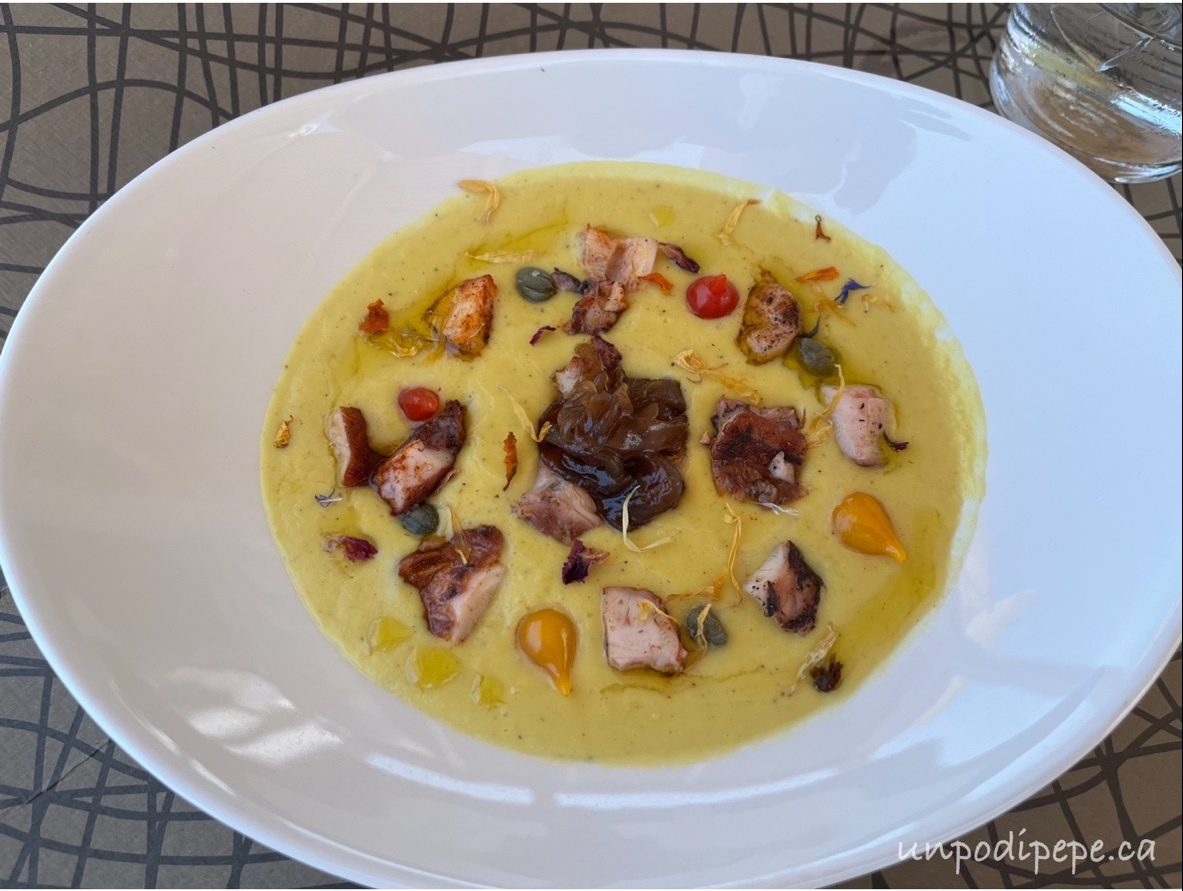
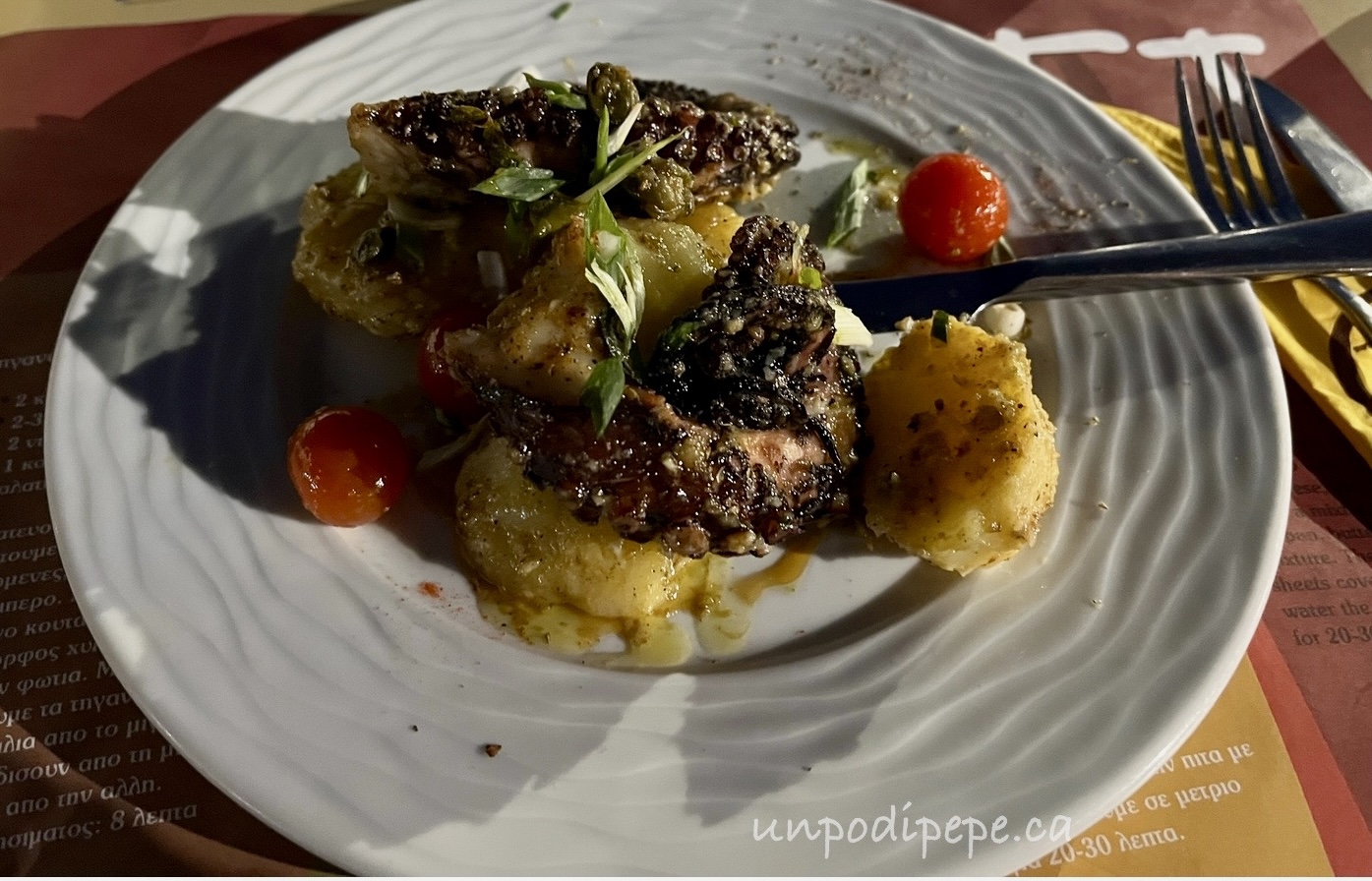
In Imerovigli, I had this orgasmic fava bean puree with grilled polpo, caramelized onions and capers. I have to try making this some time. Also in Imerovigli, I had a late night dinner of grilled octopodi on potatoes.

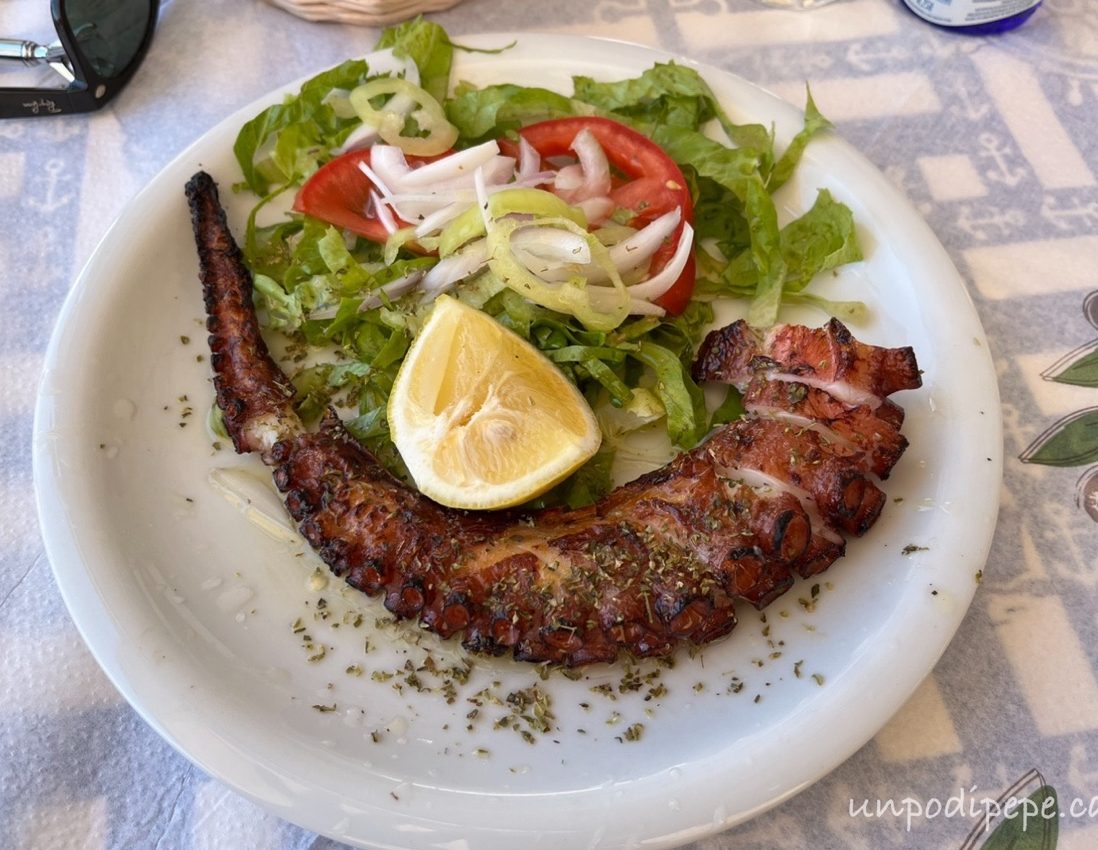
Santorini’s small port has a few seafood restaurants, where I had this very Greek grilled octopodi with oregano.

This photo was taken at the outlet mall in Molfetta.  Yes, polpo is mall food in Puglia!

The day after the matrimonio in Puglia we had a long table dinner in an olive grove by the beach in Mattinata.  This is the gorgeous polpo e patate!  #cookinggoals!

When camping on the beach with my cugini, we often grill polpo and then make a salad with it. The mobile fishmonger il pescivendolo  (pesh·ee·ven·DOH·loh) drives around to the different campsites selling fresh seafood. More about this in Campeggio sul Gargano.  We also have polpo on the grill when we go to my nonno’s olive grove for a grigliata.

This photo of mamma washing polpo in our tiny kitchen in Orsara di Puglia was popular on Instagram.  She made a salad, without potatoes but still yummy! The second one was cooked in a tomato sauce the following day.washing octopus

Octopus saladPeople apparently do all sorts of crazy things to tenderize polpo.  It does not need to be beaten against rocks, bashed with a meat tenderizer, or hung on the clothesline!  It just needs to cook in water long enough to tenderize the tough chewy collagen, which is about 1 hour per kg.  Once cooked, it can be eaten, grilled, pan seared in olive oil or saved to use later.  Freezing also helps tenderize, so previously frozen polpo does not need to cook for as long.

Polpo is hard to find in Canada!  I bought a pack of 4 legs/tentacles from Spain, but then had to freeze it as I could not use it right away.  Here is my ‘measurements optional’, flexible recipe for polpo e patate.  It is made with the legs only, as I am not as adventurous as mamma!

Ingredients:      1 kg (2.2 lbs) polpo

                         500 g (1.1 lb) potatoes

                         Good quality extra virgin olive oil

                         10 ml (2 tsp) lemon juice, freshly squeezed

                         10 ml (2 tsp) chopped prezzemolo-Italian parsley

                         2-3 cherry tomatoes

                         1 bay leaf

                         Splash of vinegar

                         100g chopped celery and/or carrots

                         15 ml (1 tsp) capers

                         1 garlic clove, finely chopped (optional)

                         Peperoncino (optional)

                         sale, black pepper

Instructions:

  • Wash and rinse the polpo. I had already done this before freezing it.
  • In a pan, add salt, bay leaf, cherry tomatoes, lemon slices and a splash of vinegar. Cover with water
  • Bring to boil, then lower heat and cook 1 hour. It should be tender enough so that a knife can pierce the polpo with little resistance.
  • Turn off heat and let sit in the cooking water to cool
  • Pick up and immerse 3 times in the hot water if you want the tentacles to curl.
  • When cooled, polpo can either be grilled, pan seared, made into a salad, or stored in the fridge for up to 3 days
  • While cooling, cook potatoes in boiling salted water. Peel and cut into pieces
  • Cut cooled polpo into rounds or pieces. Add to a bowl with potatoes, olive oil, pepper, lemon juice and prezzemolo. You can also add finely chopped garlic and capers, or peperoncino for a little spice.  Add celery, carrots and cherry tomatoes and mix. Add extra prezzemolo and lemon slices for garnish

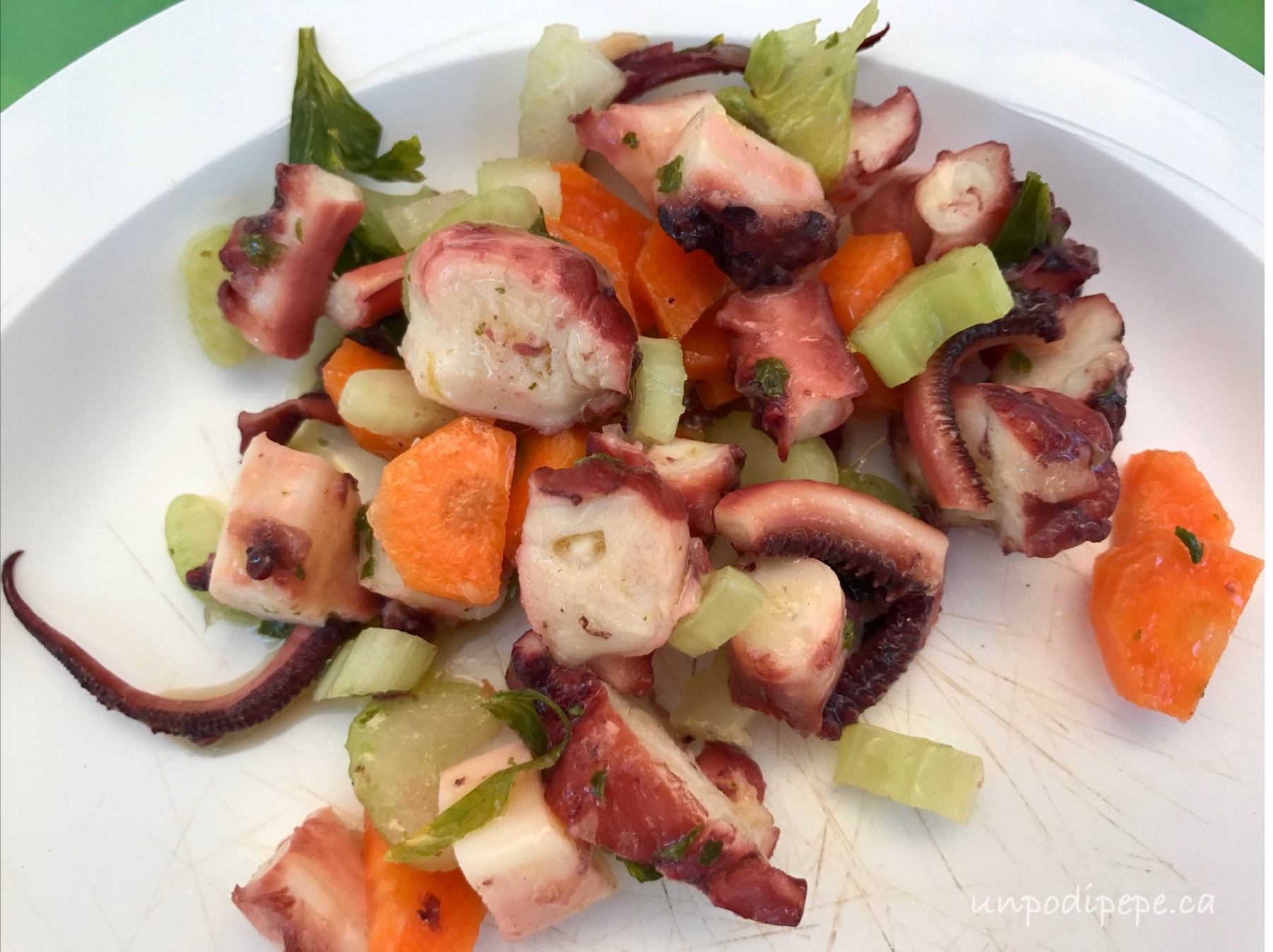
I didn’t have any celery and was out of capers.  Use whichever of these ingredients you have at the time.  The photos weren’t taken in the best light, but it was delicious! My next one will look like the one I had in Mattinata!

Are you a polpo fan too?  Have you ever cooked it yourself? Let me know in the comments.  Buon appetito, Cristina

Share this:

  • Click to share on Facebook (Opens in new window) Facebook
  • Click to share on Pinterest (Opens in new window) Pinterest
  • Click to share on X (Opens in new window) X
  • Click to email a link to a friend (Opens in new window) Email
  • Click to share on WhatsApp (Opens in new window) WhatsApp
Like Loading...

Your Favourite Recipe

09 Sunday Sep 2018

Posted by Un po' di pepe in Mangiamo!, Recipes

≈ 25 Comments

Tags

Cannolo Award, Capri, Dolcevitabloggers, Dolci, Gluten-free baking, Gluten-free chocolate cake, Southern Italy, Torta Caprese, Traditional recipes

For the second time in 3 months, I wrote about the wrong topic for the monthly #dolcevitabloggers linkup!  I was frantically trying to finish a detailed review of my favourite book, only to find that other posts were on the topic of ‘favourite Italian recipe’. Mannaggia!  I had taken a screenshot of the list of topics, but a few of them were switched.

So…. my favourite recipe?  Hmmm.  That is almost like asking a mamma which one is her favourite child!  I love food and have too many faves to pick just one.  I think it is better if I write about your favourite recipe!  I had a look through the recipe category of my blog.  There are 14 recipe posts-half are desserts.  My favourite ingredients seem to be ricotta, limoncello, orange and olive oil! The most popular recipe post, by a massively huge margin, is Torta Caprese all’Arancia. I posted this recipe in honour of my 2015 Cannolo Award. 

Caprese (cah•PREH•seh) means ‘from Capri’ (CAP•ree) the beautiful island off the coast of Napoli.  I suppose caprese could also mean ‘goatlike’ since capra is goat?  We’ll stick with ‘from Capri’.

There are a few different stories about how Torta Caprese came to be.  The most likely is that it was invented by mistake in the 1920’s by a kitchen worker at an Austrian owned pensione on Capri.  He added mandorle tritate –ground almonds, instead of flour while trying to make something similar to an Austrian Sachertorte.  It was a big hit, and went on to be served at all of the hotels and tea rooms on Capri.

The basic recipe involves mixing melted butter and chocolate in a ‘bagno-maria’ with sugar and egg yolks, then adding whipped egg whites and ground almonds.  Liqueur, usually Strega, is added.  The cake has a hard thin shell and moist interior and the center tends to sink in a bit from the sides.

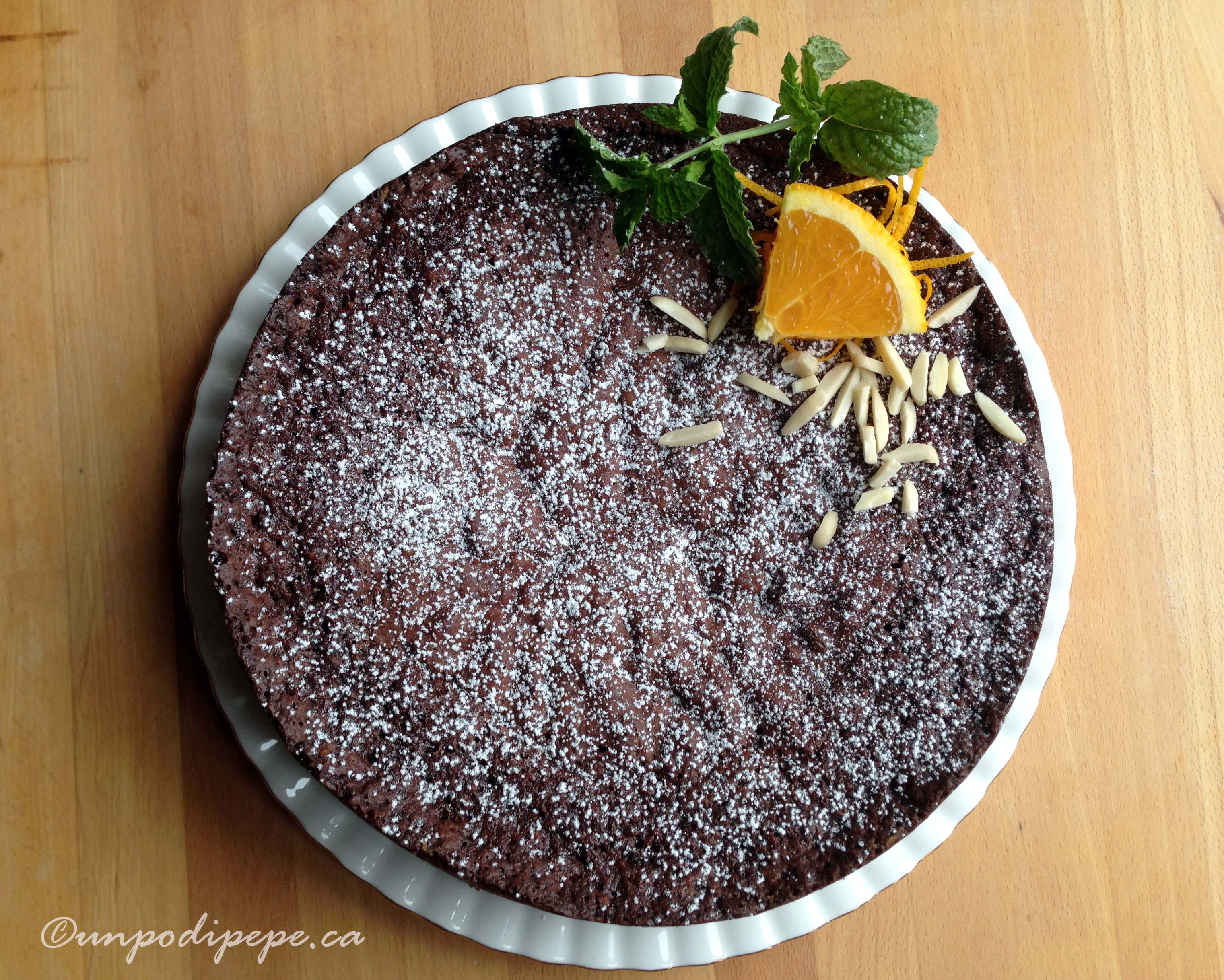
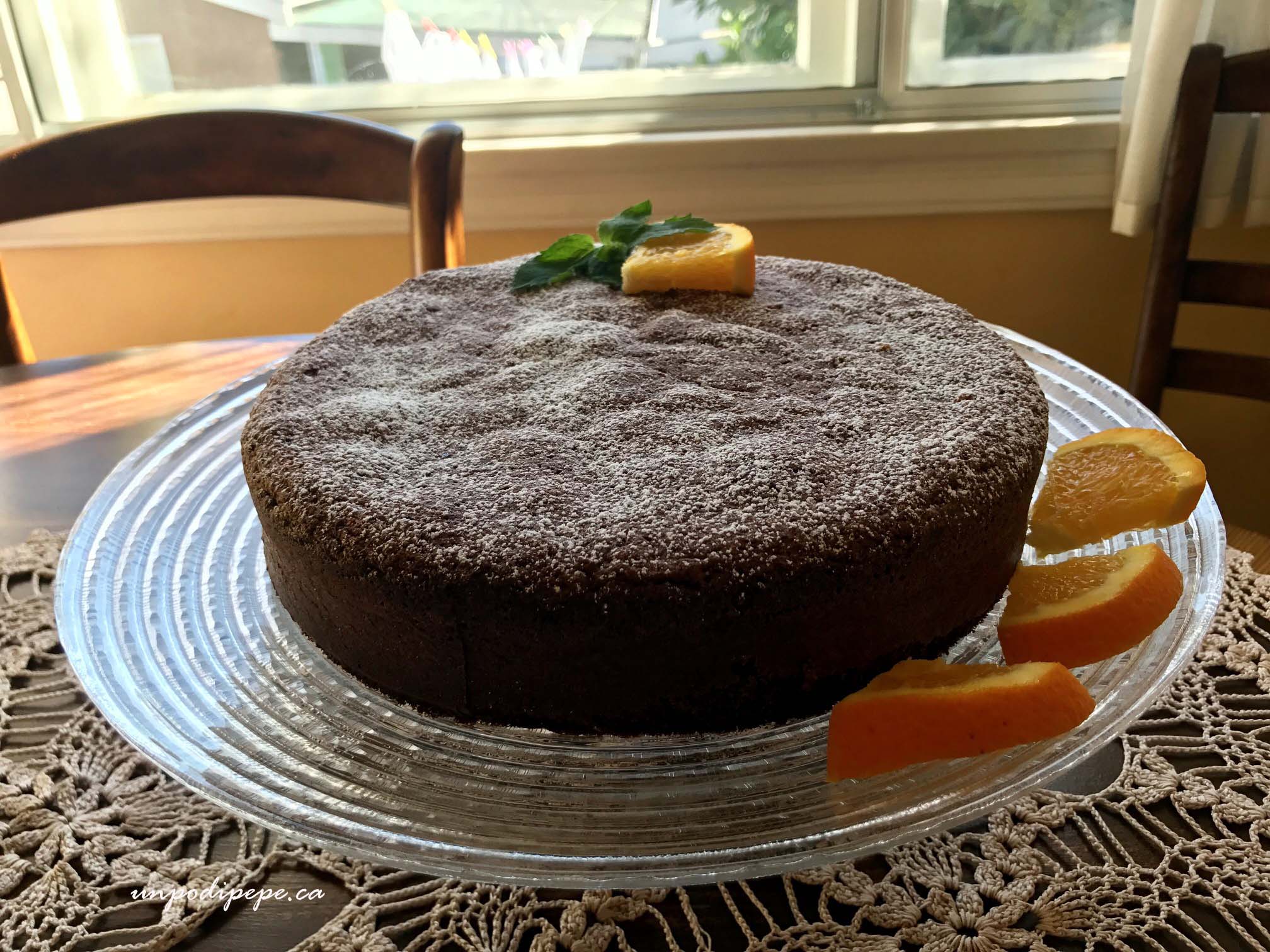
I recently tasted a yummy orange Torta Caprese, so I decided to try my own version.  After a bit of experimentation, and substituting Gran Marnier for Strega, I ended up with a very nice Torta Caprese all’ Arancia.  It is a 3 bowl recipe, so be prepared to wash them!

Read the rest of the original post Torta Caprese all’ Arancia to find the step-by-step recipe and find out what the Cannolo Award is all about.

This post is written as part of the monthly #dolcevitabloggers linkup, hosted by Jasmine of Questa Dolce Vita, Kelly of Italian at Heart and Kristie of Mamma Prada, the 7th -14th of every month. Hopefully next time I will prepare the correct topic!  You will have to wait until November to read about my favourite Italian book!

Here is me posing on my first visit to Capri when I was 16. Unfortunately I didn’t know about Torta Caprese at the time.

Ciao, Cristina

Share this:

  • Click to share on Facebook (Opens in new window) Facebook
  • Click to share on Pinterest (Opens in new window) Pinterest
  • Click to share on X (Opens in new window) X
  • Click to email a link to a friend (Opens in new window) Email
  • Click to share on WhatsApp (Opens in new window) WhatsApp
Like Loading...

Limoncello Ricotta Cookies

19 Thursday Jul 2018

Posted by Un po' di pepe in Mangiamo!, Recipes

≈ 15 Comments

Tags

Italian food, Limoncello, Limoncello ricotta cookies, Traditional recipes

Last week I had a bancarella at the Italian summer outdoor market. I like to bring dolci for friends who come to visit, or anyone who stops by to chat. Buy a card… get a cookie. It was an unusually hot day, and my espresso cookies would melt and make a mess all over the place, so I made refreshing, sweet and tangy limoncello ricotta cookies.  Limoncello and ricotta are 2 of my favourite ingredients.

When I was growing up, our Abruzzesi neighbours often made these soft cakey cookies-minus the limoncello. They used Anice (ah·Nee·cheh), a liqueur similar to Sambuca, and topped them with multi-coloured sprinkles.  The ricotta makes them soft, moist and chewy. If fresh is not available***, make your own ricotta!

Limoncello Ricotta Cookies:

350g flour (2½ cups)

5 g salt (1 tsp)

8g Pane degli Angeli (½ bustina/envelope, 2 teaspoons) *

100 g olive oil (½ cup) **

400 g sugar (2 cups)

2 eggs

450 g fresh ricotta (1 lb)

30g limoncello (30 ml, 2 tablespoons)

15 g freshly squeezed lemon juice (15 ml, 1 tablespoon)

Grated peel of 1 lemon

Glaze: same as for Casa Berti Olive Oil Limoncello Cake

200 g (1½ cups) powdered sugar/icing sugar

30g limoncello (30ml, 2 tablespoons)

15g freshly squeezed lemon juice (15 ml, 1 tablespoon)

Grated peel of 1 organic lemon

Preheat oven to 190°C (375°F)

Mix the 3 dry ingredients together. In another bowl, mix sugar and grated lemon peel together with the back of a spoon until the sugar becomes fragrant.  Add eggs, 1 at a time.  Add oil, then ricotta and limoncello. Stir in dry ingredients.

The dough is quite sticky. Use 2 tablespoons or a small cookie scoop to measure the dough onto a cookie sheet.  The dough may be easier to work with if it is left in the fridge for 30-60 minutes.  Bake for 15 minutes, being careful not to burn the edges.  Let cool.

To make glaze, mix the all ingredients except lemon peel in a small bowl until smooth.  If it is too thick and sticky, add more limoncello or lemon juice.  Add lemon peel last.  Use a teaspoon to spread glaze onto each cookie.  Leave glaze to harden and set for 1-2 hours.

Makes 40-60 cookies, depending on the size.  Store in a covered container.

* If Pane degli Angeli is not available, substitute 2 tsp baking powder and a tiny splash of vanilla extract

**if you prefer to use 125g unsalted butter (½ cup), mix the sugar and butter together first with a mixer, then add eggs one at a time, followed by the other ingredients

  ***Cottage cheese is NOT an appropriate substitute for ricotta!

Friends and customers often tell me I should be selling the cookies. I am not sure how to take that.  Are they trying to tell me my baking is more appealing than my artwork?  Hmmmm, I had better not overthink this one!

If you love limoncello and ricotta as much as I do, check out some of my other posts: Make your own Limoncello, Limoncello Cheesecake, Casa Berti Olive Oil Limoncello Cake, Ricotta fatta in casa, Tortelloni di Ricotta.

Read more about the mercato here.

Buon appetito, Cristina
Share this:

  • Click to share on Facebook (Opens in new window) Facebook
  • Click to share on Pinterest (Opens in new window) Pinterest
  • Click to share on X (Opens in new window) X
  • Click to email a link to a friend (Opens in new window) Email
  • Click to share on WhatsApp (Opens in new window) WhatsApp
Like Loading...

Insalata Purtuall’

18 Sunday Mar 2018

Posted by Un po' di pepe in Italian language, Mangiamo!, Recipes

≈ 28 Comments

Tags

Arancia, Gastronomic history, History of oranges, Insalata Purtuall', Italian language, Orange, Orange and fennel salad, Portokali, Traditional recipes

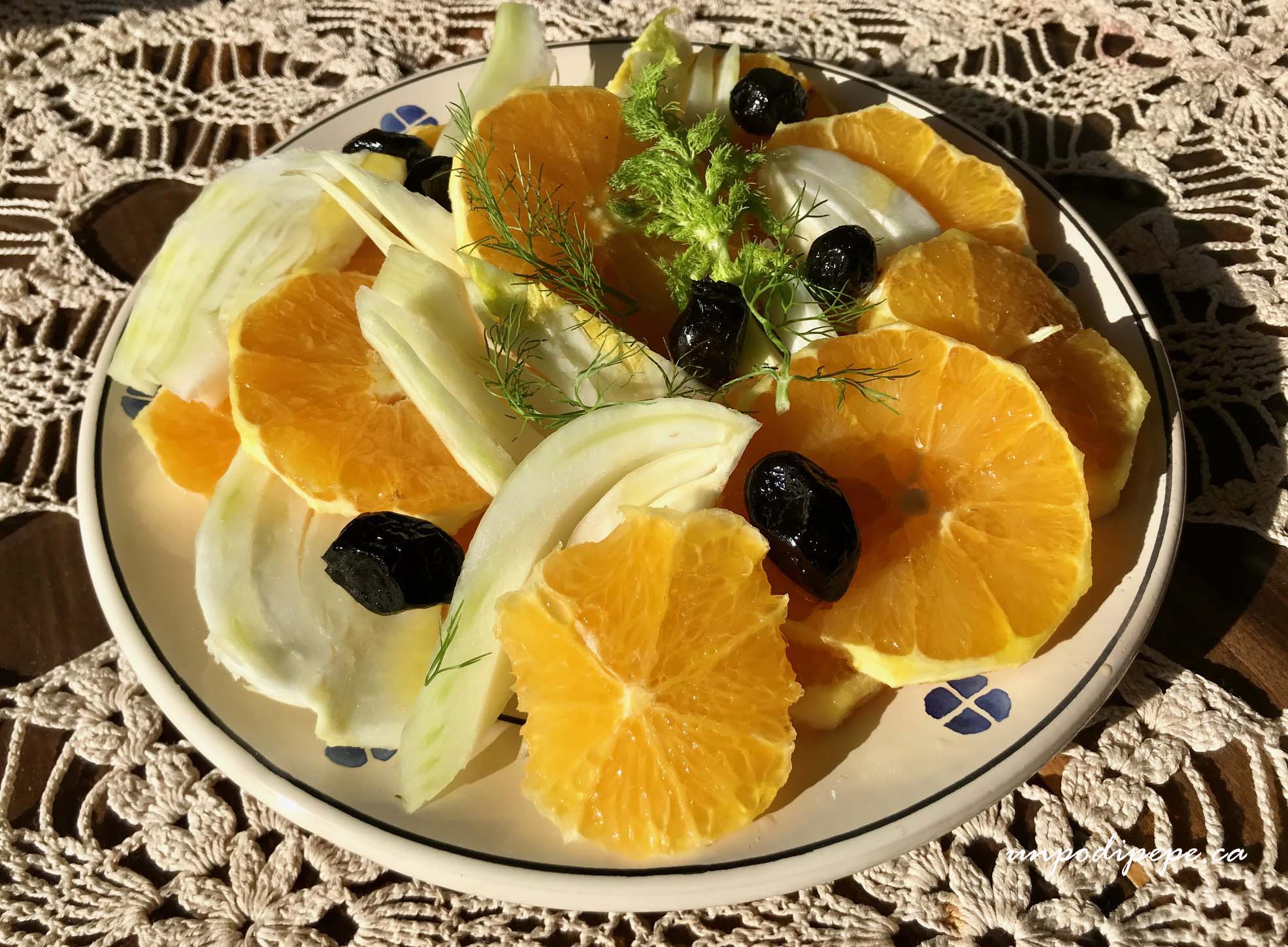
Insalata di arancia e finocchio-orange and fennel salad always brings back memories of my grade 1 lunchroom. My delicious lunches included home made crusty bread stuffed with melanzane and roasted peppers, prosciutto, capicollo or cotoletto di vitello, frittata, pizza or ‘chocolate sandwiches’ made with Nutella. Papà would often make me Insalata Purtuall’, with oranges cut crosswise in rounds, fennel and black olives, drizzled with olive oil and a bit of salt.  A true flavour explosion for 6 year old me.  I did not know why everyone at school thought my lunches were so weird.  The ‘Anglo’ kids made fun of them, and even the teachers eyed my food suspiciously.  Today all of these foods are available and trendy, so who is laughing now?  Ha! I do not remember being too bothered by the teasing.  I actually felt sorry for my classmates.  Their lunches were gross, usually consisting of ‘plastic’ cheese on bright white squishy bread that was sliced like cake! Poveretti. I will have to write more about my early gastronomic experiences in another post….

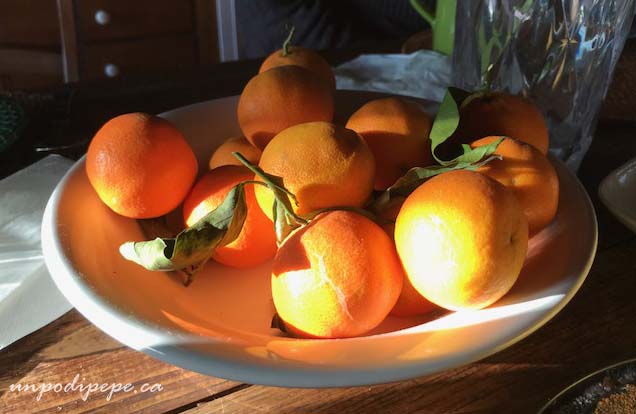
A while back, Frank from Memorie di Angelina wrote about orange and fennel salad, and I commented that we called it ‘Portugal’ salad, but did not know why. I asked Papà why we called it ‘Insalata Purtuall’. Purtuall’ is dialetto for Portogallo which is Portugal in italiano. His answer surprised me. He said it was not a Portuguese salad, but purtuall’ is what the orange were called. Hmmm.  Soon after this, I was at a writers’ conference and one of the presenters displayed a map showing the word for orange across Europe in various languages. Aha! I saw that the Greek word for orange is ‘portokali’. This was getting interesting!

Arancia amara, bitter orange, was known to the Romans. Sweet oranges were only introduced to Europe and the Mediterranean in the 14th century. Portuguese ships were the first to circumnavigate Africa and brought sweet oranges back from the Far East. In many countries, oranges were named after Portugal-the country that they seemed to be coming from! In Greek oranges are portokali, in North Africa and most Middle East countries burtuqall, in Iran purtuqol, in Turkey portakal and in Hungary and Romania portokal. In most of Western Europe, the Mediterranean and Britain, the word for orange comes from ‘narangas’, Sanskrit for orange tree. For example, in italiano arancia, in spanish naranja, portuguese laranja, and of course english orange. There are a few places in Italia where the dialetto still uses the ‘portuguese’ term. In Campania, Puglia, Basilicata and Abruzzo, purtuallo or portajalli, in Sicilian partualli (or aranciù), and in Piemonte portugaj. In modern Greek, bitter oranges are called ‘nerantzi’ while sweet oranges are called ‘portokali’. Who knew that the yummy salad I used to bring for lunch in elementary school reflects thousands of years of history, trade voyages and etymology between East and West!

A ‘recipe’ is not really needed for Insalata Purtuall’. Just peel a few oranges and remove as much of the pith as possible, then slice them crosswise and lay them on a plate. Cut half a fennel bulb and slice in either small or larger pieces. Add ‘un filo d’olio’, a drizzle of olive oil and salt, then a few black olives and garnish with fennel fronds. I sometimes like to throw in some pomegranate seeds or rucola. It is hard to mess up this healthy, refreshing winter insalata! I recently found out that Insalata Purtuall’ was served at my parents’ wedding in Orsara di Puglia in the 1960’s, so now it tastes even better!

Buon appetito, Cristina

Share this:

  • Click to share on Facebook (Opens in new window) Facebook
  • Click to share on Pinterest (Opens in new window) Pinterest
  • Click to share on X (Opens in new window) X
  • Click to email a link to a friend (Opens in new window) Email
  • Click to share on WhatsApp (Opens in new window) WhatsApp
Like Loading...

Spaghetti all’Amatriciana

30 Tuesday Aug 2016

Posted by Un po' di pepe in Italia, Mangiamo!, Recipes, Roma

≈ 16 Comments

Tags

Amatrice, Croce Rossa Italiana, Cucina Romana, Earthquake relief Central Italy, Inspiration, Italian food, Pasta all'Amatriciana, Terremoto 2016, Traditional recipes
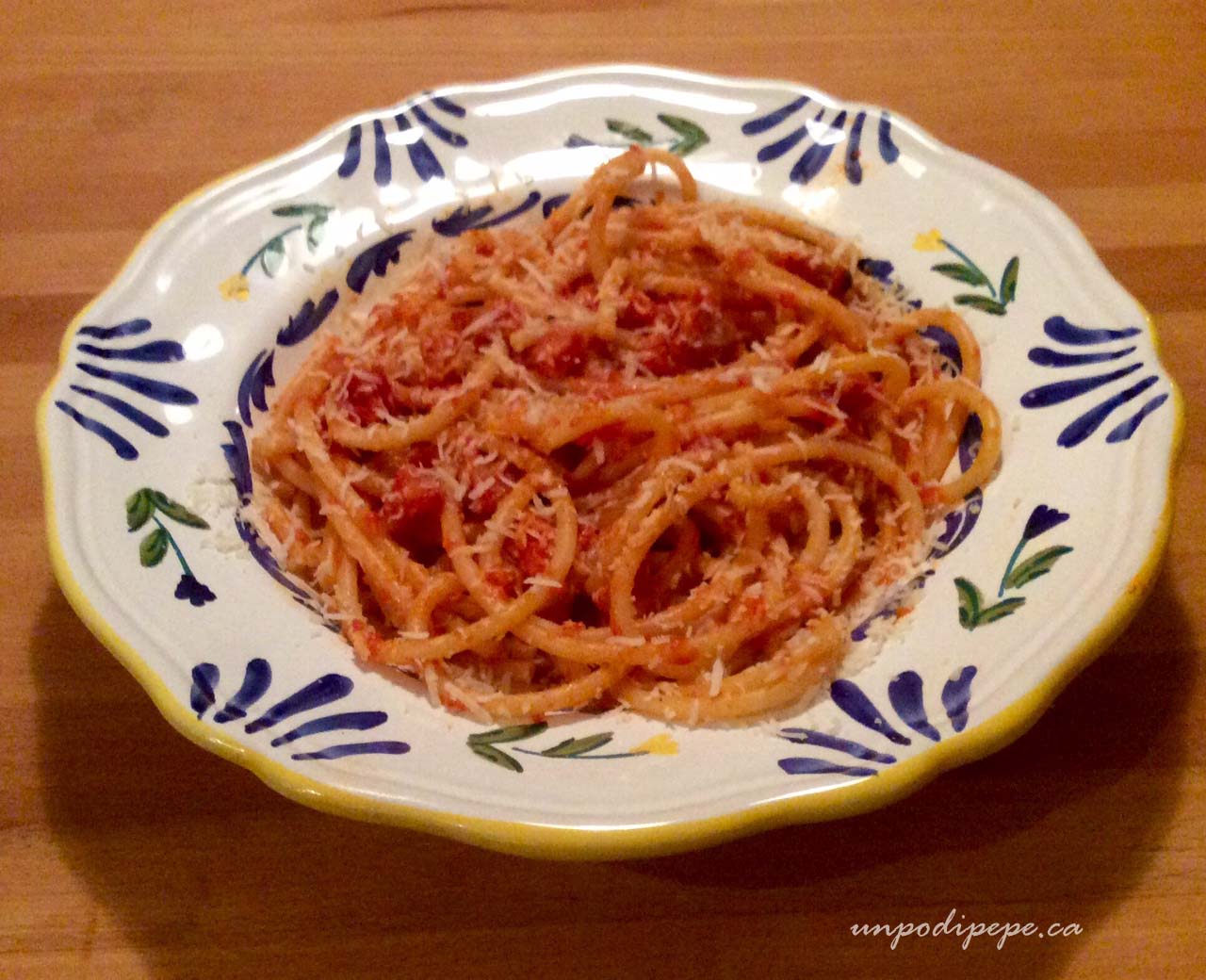
Pasta all'AmatricianaMy last post was about the terremoto in Italia and I listed ways you can help with earthquake relief.  One of these ways was to order Pasta all’Amatriciana at one of the many restaurants participating to raise money for the Croce Rossa Italiana.  I realized that not everyone will have a restaurant in their area participating, so I am posting a recipe, just in case anyone wants to host their own small fundraiser. August 27-28 would have been the Spaghetti all’Amatriciana festa in Amatrice.  Amatriciana
Pasta all’Amatriciana-also known as Pasta alla Matriciana in dialetto Romano, is made with guanciale (cured pork cheek), Pecorino Romano, and pomodoro (tomato).  Peperoncino is often added.  Pasta all’Amatriciana originated from Pasta alla Gricia, made with guanciale and Pecorino.  It is basically Pasta Carbonara with tomato instead of  eggs. Shepherds near Amatrice carried the simple ingredients with them into the fields.  The pomodoro had not been brought to Europe yet.  In Amatrice, they started making the Pasta alla Gricia with pomodoro, once it had been introduced.  When Amatriciani moved from the outlaying areas to Roma, the sauce became popular, and is now considered a staple of Cucina Romana.  In Roma, Amatriciana is made with bucatini, which are spaghetti with a hole down the middle, or rigatoni, but in Amatrice, it is only made with spaghetti! Making Amatriciana

Spaghetti all’Amatriciana

100g guanciale (pancetta can be used if guanciale not available)

350g passata di pomodoro, or pelati (peeled tomatoes)-about 1 500ml canning jar

75g Pecorino Romano, freshly grated

Black pepper, freshly grated

320g spaghetti or bucatini (80g per person)

Cut guanciale into strips or cubes. In a frying pan, cook guanciale until crispy.  When the white part becomes transparent, add tomatoes and pepper.  While this is simmering, cook spaghetti in a large pot of salted water.  Cook for 1 minute less than the time it says on the box! Drain well then add to the pan and toss in the sauce and add Pecorino.  Serve with extra Pecorino Romano on top.  Serves 4. Buon Appetito!Amatriciana

Share this:

  • Click to share on Facebook (Opens in new window) Facebook
  • Click to share on Pinterest (Opens in new window) Pinterest
  • Click to share on X (Opens in new window) X
  • Click to email a link to a friend (Opens in new window) Email
  • Click to share on WhatsApp (Opens in new window) WhatsApp
Like Loading...

Gnocchi di Zucca

15 Sunday Nov 2015

Posted by Un po' di pepe in Mangiamo!, Recipes

≈ 15 Comments

Tags

Gnocchi, Gnocchi di zucca, Italian food, Pumpkin carving, Pumpkin gnocchi recipe, Traditional recipes

GnocchidizuccaOne of my favourite things about fall is zucca (ZOOK•kah).  Zucca can mean pumpkin or squash and I love them both. Risotto di zucca, zuppa di zucca, roasted zucca…..yum! It always makes me sad to throw out my carved hallowe’en pumpkin, so this year, I used a small battery operated candle and ‘recycled’ my zucca into another one of my favourite things- gnocchi! Hallowe'enzuccaGnocchi (NYOK•kee) are usually made with potatoes, but they can also be made with ricotta, zucca, or a combination.  I made mine with no potato- just zucca as they are lighter and have a more intense zucca flavour.  A large hallowe’en zucca makes a lot of gnocchi, but you don’t have to use all of the polpa di zucca (pumpkin flesh) at once.  It can keep in the fridge for 3 days until you have time to make more gnocchi.  All of the measurements in this recipe are very approximate, as it depends on the water content of the zucca.Gnocchidizucca4

Gnocchi di Zucca

500-600 grams mashed roasted zucca (pumpkin) with excess water removed (2 cups)

1 small egg, beaten

160g 00 flour (about 1¼ cup) + extra for dusting

60g (¼cup) grated Pecorino Romano (or Parmigiano if you don’t have Pecorino)

Pinch of freshly grated nutmeg (optional)

Pinch of salt

  • Cut zucca into pieces, wrap in aluminum foil and bake at 180⁰C (350⁰F) for 50 minutes
  • Scoop out the flesh and mash by hand with a potato masher or a fork, or use a potato ricer.   Unless you plan to make zuppa di zucca (pumpkin soup) do NOT use a food processor or immersion blender!
  • Remove as much water as possible, or the gnocchi will absorb too much flour and become dense and rubbery. Do this by straining the mashed zucca through a tea towel. A lot of water will come out! If this is too messy for you, return the mashed zucca to the oven, uncovered for half an hour to remove moisture. The tea towel method works better.
  • Stir in the egg and mix well, then salt, nutmeg and Pecorino.
  • Add half of the flour and mix well
  • Add more flour as needed-only a little at a time. Use as little flour as possible-only enough to make the dough hold together
  • On a floured surface, cut off sections of dough and hand roll into 1.5 cm (½ inch) ropes
  • Cut rope into 2-2.5 cm (1 inch) lengths and roll each gnocco with your thumb against the the back tines of a forchetta (fork) or over a rigagnocchi. Rigagnocchi literally means ‘gnocchi line-maker’. It is a small wooden paddle with lines carved into it, as seen in the photos. I used a forchetta to roll my gnocco over the rigagnocchi.
  • Place finished gnocchi on a floured tray or surface and sprinkle with more flour to prevent sticking. To freeze the gnocchi, place on a floured tea towel on a tray or baking sheet and freeze for half an hour, then put the frozen gnocchi into zip-loc® bags or containers and refreeze.
  • To cook gnocchi, drop them into a large pot of boiling, salted water. They only need about 3 minutes to cook, then lift them out with a slotted spoon. If cooking frozen gnocchi, do not thaw them. Take them directly from the freezer into the boiling water. Frozen gnocchi hold their shape well, but not if they have been defrosted. They will take about 4 minutes to cook.
  • Gnocchi di zucca should be served with a simple sauce, so as not to overpower the delicate taste. I like to heat some extra virgin olive oil and add finely chopped garlic and whole sage leaves, then toss this over my gnocchi. I sprinkled on freshly grated cacioricotta from Orsara di Puglia. If you aren’t lucky enough to have cacioricotta, use freshly grated Pecorino or Parmigiano.Gnocchidizucca6Buon Appetito!

Share this:

  • Click to share on Facebook (Opens in new window) Facebook
  • Click to share on Pinterest (Opens in new window) Pinterest
  • Click to share on X (Opens in new window) X
  • Click to email a link to a friend (Opens in new window) Email
  • Click to share on WhatsApp (Opens in new window) WhatsApp
Like Loading...

Pesto Genovese

18 Friday Sep 2015

Posted by Un po' di pepe in Mangiamo!, Recipes

≈ 24 Comments

Tags

Basilico, Italian food, Moretum, Mortar and pestle, Pesto, Pesto Genovese, Pesto recipe, Traditional recipes

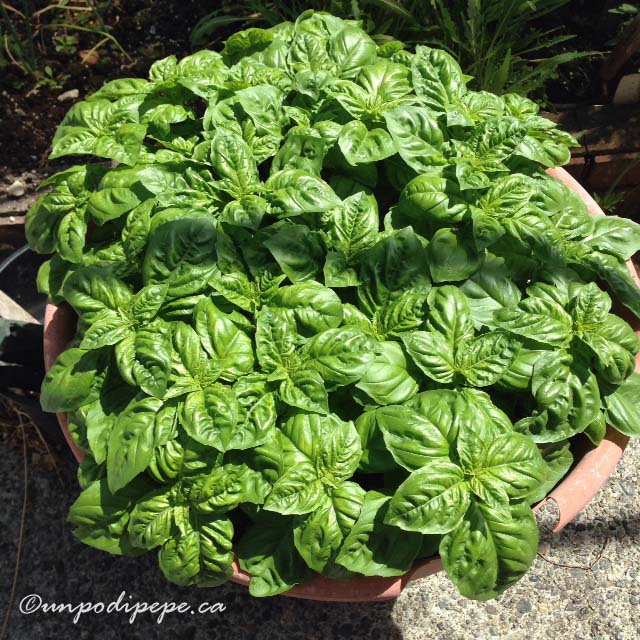
Pesto2This year, I grew basilico (basil) from seed again.  Thanks to the unusually warm summer, my plants were happy and grew nicely.  I love to shake the basilico plant a bit, stick my face in it and inhale the incredible aroma.  Some of my basilico was already used to make passata di pomodoro.  The rest will be used to make Pesto, before it starts to rain and the leaves turn brown.basilico

Pesto Genovese, usually just called Pesto, originated in Genoa, Liguria.  It is made with fresh basil leaves, garlic, pine nuts, extra virgin olive oil, Pecorino Sardo or Pecorino Romano, and Parmigiano Reggiano.

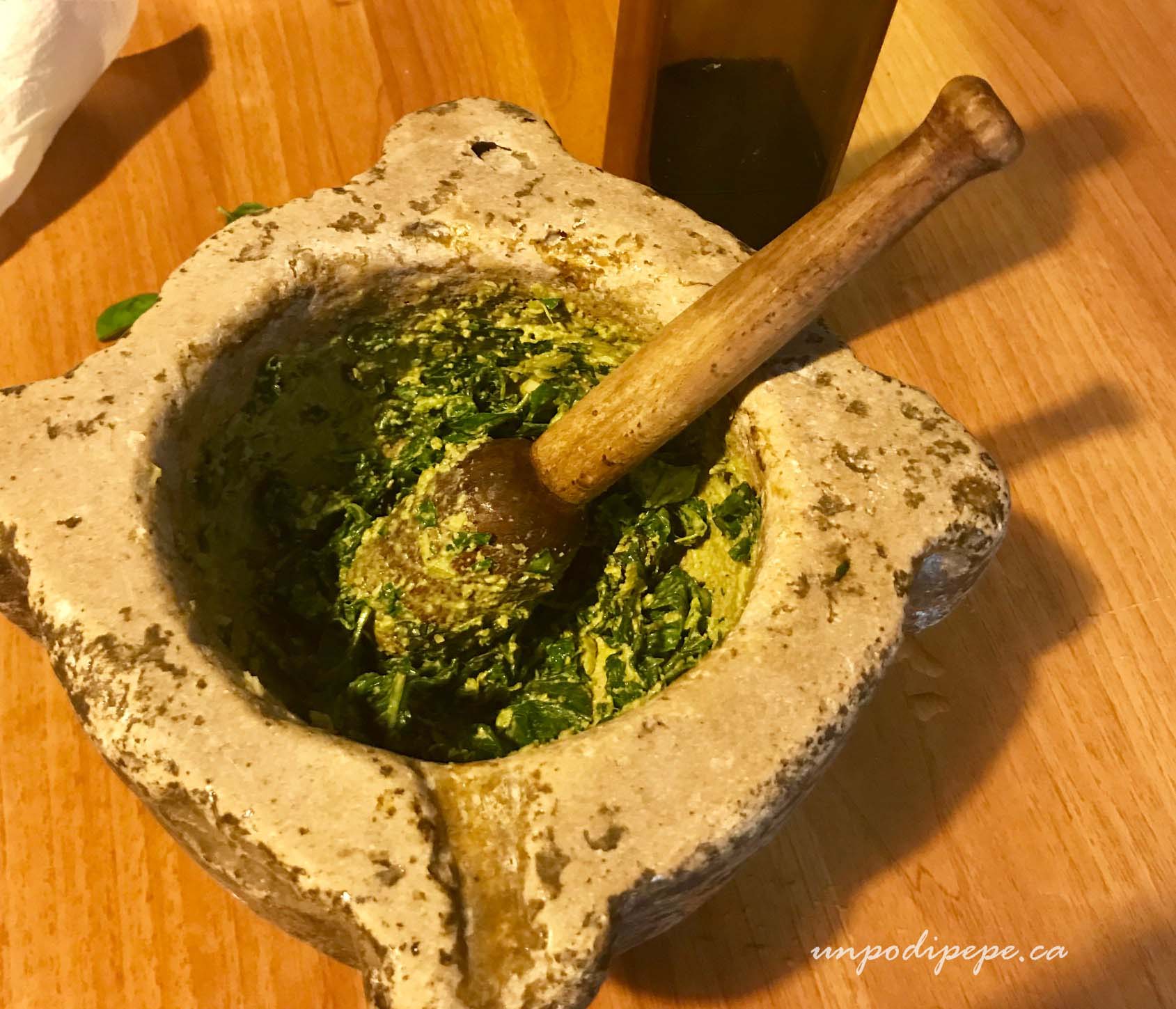
Before the age of food-processors, Pesto was made by grinding the ingredients in a marble or stone mortar with a wooden pestle.  The words ‘pesto’ and ‘pestle’ come from ‘pestare‘ which means to pound or crush.  The most flavourful pesto is actually made by hand with a mortar and pestle, but it is hard work! Pesto made with old stone mortar/mortaioLigurian basilico has very small leaves and is easier to grind.  My basilico tends to have very large leaves and is difficult to crush.  The biggest problem with the food processor is that it gets very hot.  I recommend putting the blades in the freezer for an hour before making pesto.  This prevents the food processor from overheating and the pesto is also less likely to turn brown.basilicobw

The ancient Romans made something similar called Moretum.  They named it after the mortar instead of the pestle!  Moretum was a spread made with fresh sheep milk cheese, herbs, salt, pine nuts and olive oil.

Basilico was likely brought to Italia from India, and the climate of Liguria was perfect for it.  The Genovese adapted the Romans’ recipe to include basilico, and Pesto Genovese was born! In Liguria, Pesto is usually served with trofie or linguine.  It is also used on pasta, potatoes and green beans, all cooked in the same pot of water. Yum!

When I make Pesto, I do not measure the ingredients, but I estimated them here for you. Good quality ingredients are necessary to make delicious Pesto.  No skimping!Pesto Genovese

Pesto Genovese

2 firmly packed cups (500 ml) large basil leaves

3 cloves of garlic

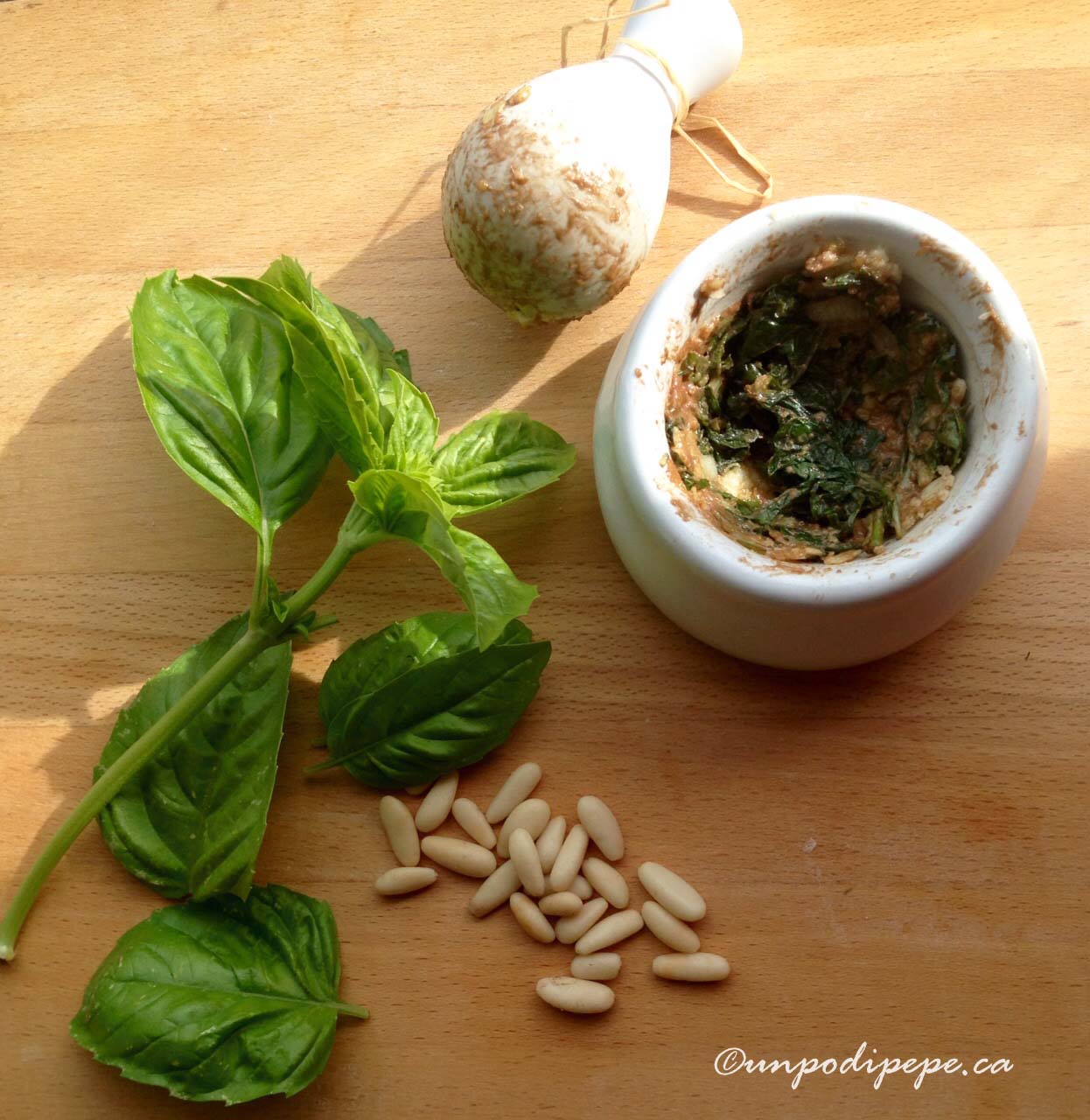
¼ cup (50 grams) European pine nuts

salt and pepper

½ cup (125 ml) good quality extra virgin olive oil

½ cup (45 grams) grated Pecorino Sardo or Pecorino Romano

½ cup (45 grams) grated Parmigiano Reggiano

  • Put the blades of the food processor in the freezer for an hour
  • Wash the basil and dry well.  Water on the leaves will turn them brown and the Pesto will go bad.  Yuck!
  • I like to toast the pine nuts as it brings out the flavour, but this is optional
  • Blend garlic and pine nuts in a food processor until fine
  • Add basil, pulsing a handful at a time until blended
  • Add salt and pepper.  Not too much salt, as the cheese is salty too
  • Pour in olive oil slowly while food processor is running
  • Pour it all into a bowl and add the Pecorino and Parmigiano
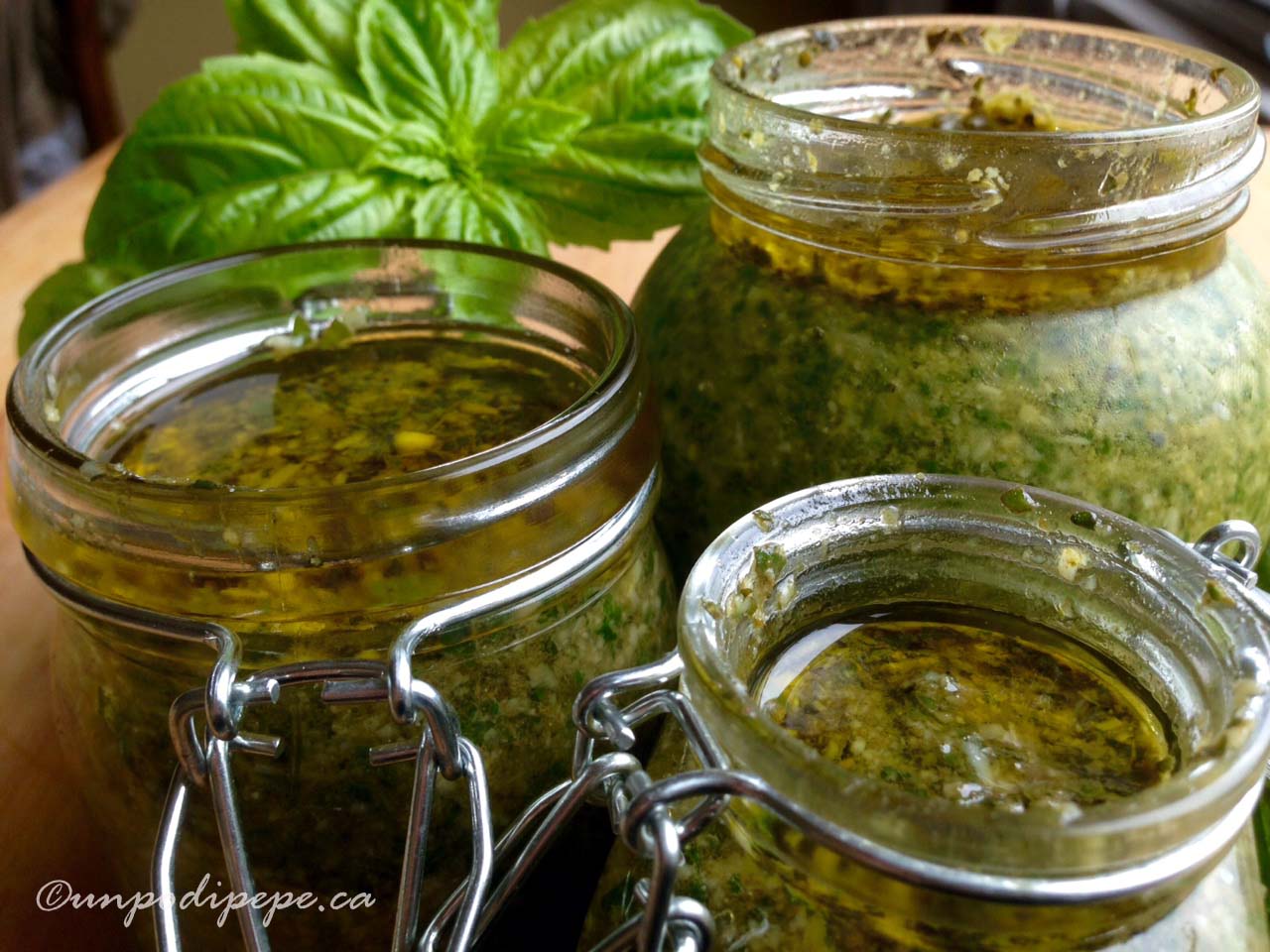
  • Spoon the Pesto into small jars with tight fitting lids
  • Seal the jar with a thin film of olive oil
  • Pesto keeps well in the fridge for 6-8 months.  If you use part of a jar, add another thin film of olive oil before putting it back in the fridge
  • To freeze the Pesto, leave out the 2 cheeses and add them when you are going to use itPesto1

Buon Appetito!

©2015 unpodipepe.ca

basilico4

Share this:

  • Click to share on Facebook (Opens in new window) Facebook
  • Click to share on Pinterest (Opens in new window) Pinterest
  • Click to share on X (Opens in new window) X
  • Click to email a link to a friend (Opens in new window) Email
  • Click to share on WhatsApp (Opens in new window) WhatsApp
Like Loading...

Il Pomodoro

07 Monday Sep 2015

Posted by Un po' di pepe in Italian life, Mangiamo!

≈ 24 Comments

Tags

Acqua sale, Antonio Latini, Conserva di pomodoro, Francesco Leonardi, History of the tomato, Italian food, Mediterranean diet, Passata di pomodoro, Pomodori, Tomato sauce, Traditional recipes

PomodorivillajameleLate August/early September is pomodoro season. Last weekend my family made passata di pomodoro and pomodori pelati in the garage. If you haven’t read last year’s post, check ‘Passata di Pomodoro’ out for a step by step commentary! Passata di pomodoro, or simply ‘salsa’ as we usually call it, is very versatile. It is used to make sugo (tomato sauce) or ragù (meat sauce) and pizza, or added to fagioli (beans) and lenticchie (lentils), minestrone and other zuppe (soups).Salsa2015

To make pomodori pelati, pomodori are cut into quarters, the seeds removed, and then tightly packed into vasetti (jars) with basilico and a spoonful of salt. The vasetti are sealed and cooked, then turned upside down to cool. Pelati are used for pizza al pomodoro and zuppe. They can also be used for making sauces, although I am not a fan of skins and seeds in my sugo!pomodoripelati2015Pelati2015

Canning or bottling pomodori is a yearly domestic ritual for many Italian and Italocanadese families. It’s a lot of work, but totally worth it. All year round you have the taste of summer in a jar!Vasetti2015

The pomodoro was not always such a staple in the Italian cucina. First grown by the Aztecs in Mexico, then also in the South American Andes, the pomodoro was brought to Europe by the Spanish in the 16th Century. The first documentation of pomodori in Italia is a 1548 note from Cosimo de’ Medici’s household to his secretary. The note states that ‘un cestino di pomodori’ (a basket of tomatoes) from one of the Medici estates had been received.  At this time, pomodori were not eaten or used in cooking. They were exotic but their taste was considered really gross, so they were mostly ornamental and sometimes used in potions as an aphrodisiac.  Hmmmm.pomodori2015b

Early pomodori did not taste anything like they do today, and some varieties were even toxic. Fortunately, the Mediterranean climate was ideal for growing the pomodoro.  It was able to mutate and create better tasting, sweeter versions of itself. It did take awhile for anyone to figure out what to do with the pomodoro. I’m really glad someone thought of adding olive oil, basilico, salt and of course, un po’ di pepe!

The earliest recorded recipe using pomodori was in Napoli, in Antonio Latini’s book ‘Il Scalco alla Moderna’.  This translates to something like ‘The Modern Butler’. The recipe was for ‘Salsa alla Spagnuola’, a Spanish condiment made with pomodoro, melanzane (eggplant) and cipolla (onion). Sounds a bit like ratatouille.  The first recipe using pomodori on pasta was in Roman chef Francesco Leonardi’s 1790 cookbook ‘L’Apicio Moderno’. By the mid 1800’s the pomodoro was a staple food of Italian contadini. The ‘Contadino diet’ was mostly raw or cooked pomodori and other vegetables, legumes, bread or pasta, salt and olive oil. Today they call this the ‘Mediterranean diet’.Pomodori2012

‘Acqua Sale’ is a classic Orsarese comfort food. Older bread slices are soaked in water and then pomodori are squished over it. A drizzle of olive oil, salt, and basilico or oregano and it’s an instant delicious meal, similar to Panzanella Toscana. This tastes even better on freshly baked bread-minus the soaking in water! We always ate ‘pan’ e pomodoro’ when the bread came out of the oven. Yum. So simple yet so delicious.

I asked Mamma what they did before glass vasetti and other modern canning conveniences were available. She said they made ‘la conserva’ which was like a tomato paste that could be stored. It was used in winter to make sugo for pasta or to add flavor to other foods. In August, pomodori were cooked with skins and seeds removed, similar to passata. This salsa was salted, placed in large earthenware dishes and left out in the sun for several days. Once it was dark and thick, la conserva was transferred to terracotta or glass containers and covered with a film of olive oil and fig leaves or basilico to seal it. The container was then covered and tied with un straccio (a dishrag). Quartered pomodori were also sundried to use in winter.

My recreation of 'la conserva'. The passata was dried in the sun, then the thickened stuff was placed in an earthenware bowl, covered with a film of olive oil and fig leaves, then covered with a dishrag

My recreation of ‘la conserva’. The passata was dried in the sun, then the thickened stuff was placed in an earthenware bowl, covered with a film of olive oil and fig leaves, then covered with a dishrag

Talking about pomodori is making me hungry! I’ll go pick some in the garden and make some pan’ e pomodoro!pomodori2015a

Share this:

  • Click to share on Facebook (Opens in new window) Facebook
  • Click to share on Pinterest (Opens in new window) Pinterest
  • Click to share on X (Opens in new window) X
  • Click to email a link to a friend (Opens in new window) Email
  • Click to share on WhatsApp (Opens in new window) WhatsApp
Like Loading...
← Older posts

Enter your email address to follow 'un po' di pepe' and receive notifications of new posts by email.

Join 511 other subscribers
Follow Un po' di pepe on WordPress.com

Popular Posts

  • Hairstyling in Ancient Roma
    Hairstyling in Ancient Roma
  • Espresso Cookies
    Espresso Cookies
  • Il Pumo Pugliese
    Il Pumo Pugliese
  • Panforte di Siena
    Panforte di Siena
  • Internment of Italian Canadians
    Internment of Italian Canadians
  • San Nicola
    San Nicola
  • Panettone Fatto in Casa
    Panettone Fatto in Casa

Recent Posts

  • Castel del Monte
  • ‘The Nuances of Love’
  • Hostaria Antica Roma~Eat like an Ancient Roman
  • Santa Maria in Aracoeli
  • Casino dell’Aurora~Villa Boncompagni Ludovisi
  • Nasoni di Roma
  • Bloghiversario #11
  • Fontana di Trevi
  • Acqua Vergine
  • Giubileo 2025
  • Sanremo 2025
  • In Vino there are Memories
  • A Literary Harvest
  • 2024~Un po’ di pepe Year in Review
  • Buon Natale 2024
  • Il Bicerin
  • Mercato Porta Palazzo
  • Torino
  • Catanzaro, Calabria
  • Il Pumo Pugliese
  • Artemisia Gentileschi
  • Cavalli di San Marco
  • Panzerotti
  • Torcello
  • 10 years of Un po’ di pepe!

Categories

Amici e Famiglia Architecture Art Art history Art projects Bilingual posts Blogging Canada Culture Feste Firenze Inspiration Italia Italian Folklore Italian language Italian life Italocanadesi Libri Mangiamo! Orsara di Puglia Parole piacevoli Photography Puglia Recipes Roma Travel Travel tips Uncategorized Vino

Archives

Un po’ di pepe on Facebook

Un po’ di pepe on Facebook

Start a Blog at WordPress.com.

  • Subscribe Subscribed
    • Un po' di pepe
    • Join 511 other subscribers
    • Already have a WordPress.com account? Log in now.
    • Un po' di pepe
    • Subscribe Subscribed
    • Sign up
    • Log in
    • Report this content
    • View site in Reader
    • Manage subscriptions
    • Collapse this bar
 

Loading Comments...
 

    %d