• Home
  • About me/Chi sono
  • Contact

Un po' di pepe

~ …… (oon∙poh∙dee∙PEH∙peh) Cristina writes about interesting stuff /Cristina scrive di cose interessanti

Un po' di pepe

Category Archives: Photography

Centrale Montemartini

15 Sunday Feb 2015

Posted by Un po' di pepe in Architecture, Art, Art history, Culture, Italia, Photography, Roma

≈ 13 Comments

Tags

Al Biondo Tevere, Art history, Art Nouveau, Basilica San Paolo Fuori le Mura, Capitoline Museum, Centrale Montemartini, Cleopatra, Industrial archeology, Italy travel tips, Roma, Stile Liberty, Temple of Apollo Sosiano, Via Ostiense

Centrale Montemartini is an amazingly awesome, undervisited museum and a stunning example of 20th Century industrial archeology.  Built in 1912 in Art Nouveau style (Stile Liberty), it was the first public electric plant in Roma, providing power for the surrounding area until it was abandoned in 1963.  Luckily the amazing architecture and historical importance saved it from demolition!

Amazon warrior in front of a diesel engine

Amazon warrior in front of a diesel engine

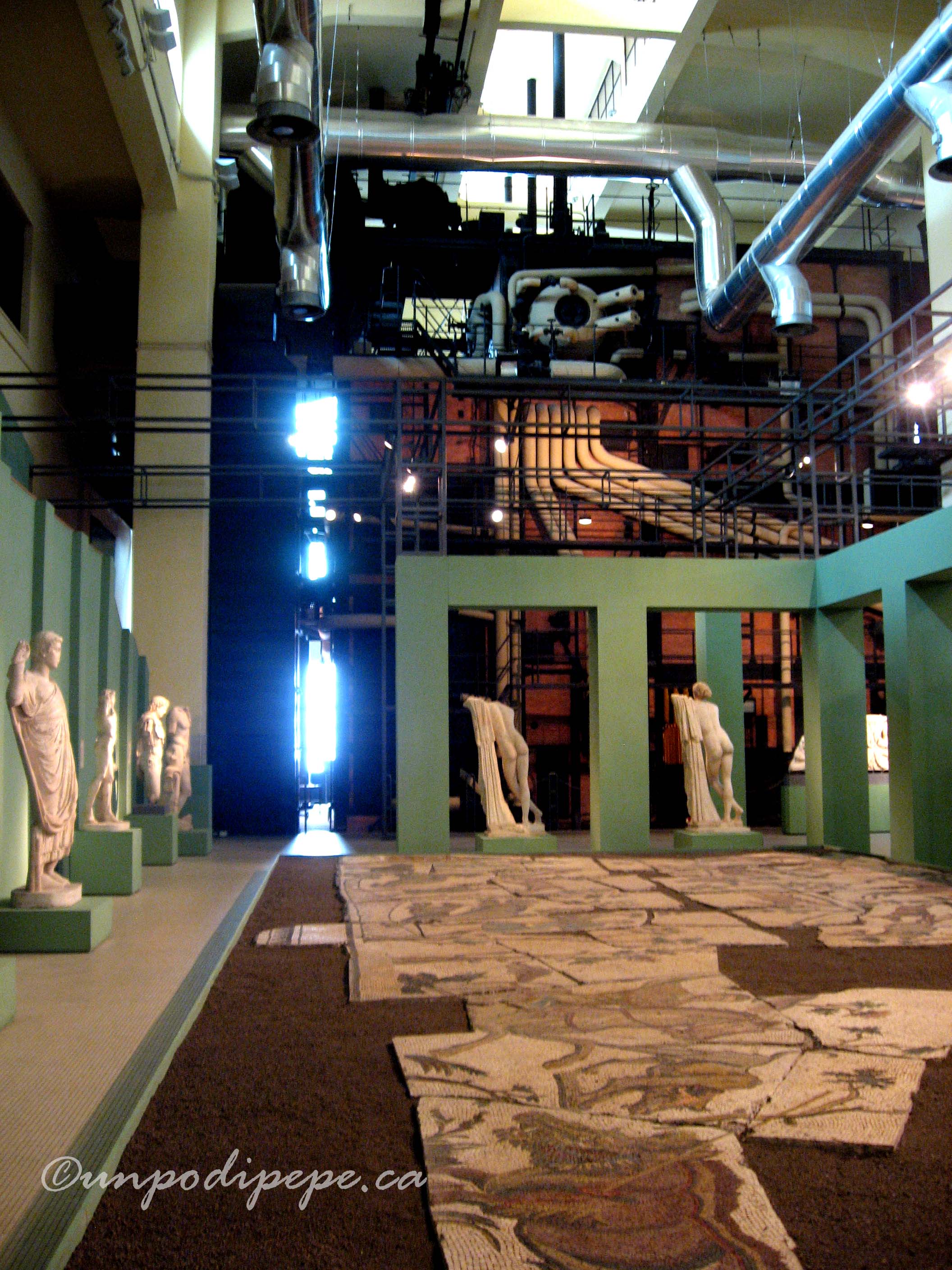
In 1997 during the Capitoline Museum renovation, Centrale Montemartini was used for a temporary exhibition ‘Le Macchine e gli Dei’ (The Machines and the Gods).  In 2005 it became a permanent space for part of the Capitoline collection, with all of the original thermoelectric equipment left in place.  Now you can visit a unique display of classical sculpture against an industrial  backdrop of steam boilers, diesel engines, catwalks twisting pipes and gauges.  It’s a blend of ‘vecchio e più vecchio’ (old and older), a stark contrast of ancient and industrial, art and science.  Antique white marble appears translucent against the blackness of the machinery.  The space is immense and silent, with high ceilings and tall windows providing natural light. The works of art are carefully chosen and placed so there is space to appreciate their beauty while you walk among them and contemplate the passage of time.Centrale Montemartini Sala Macchine3

The 400 pieces include ancient Roman sculptures, rare Greek originals brought to Roma, and Roman copies of Greek originals. They date from the 5th Century BC to the 4th Century AD and were found in the late 19th and early 20th Century. Most of the works are on the upper floor in 2 massive rooms.
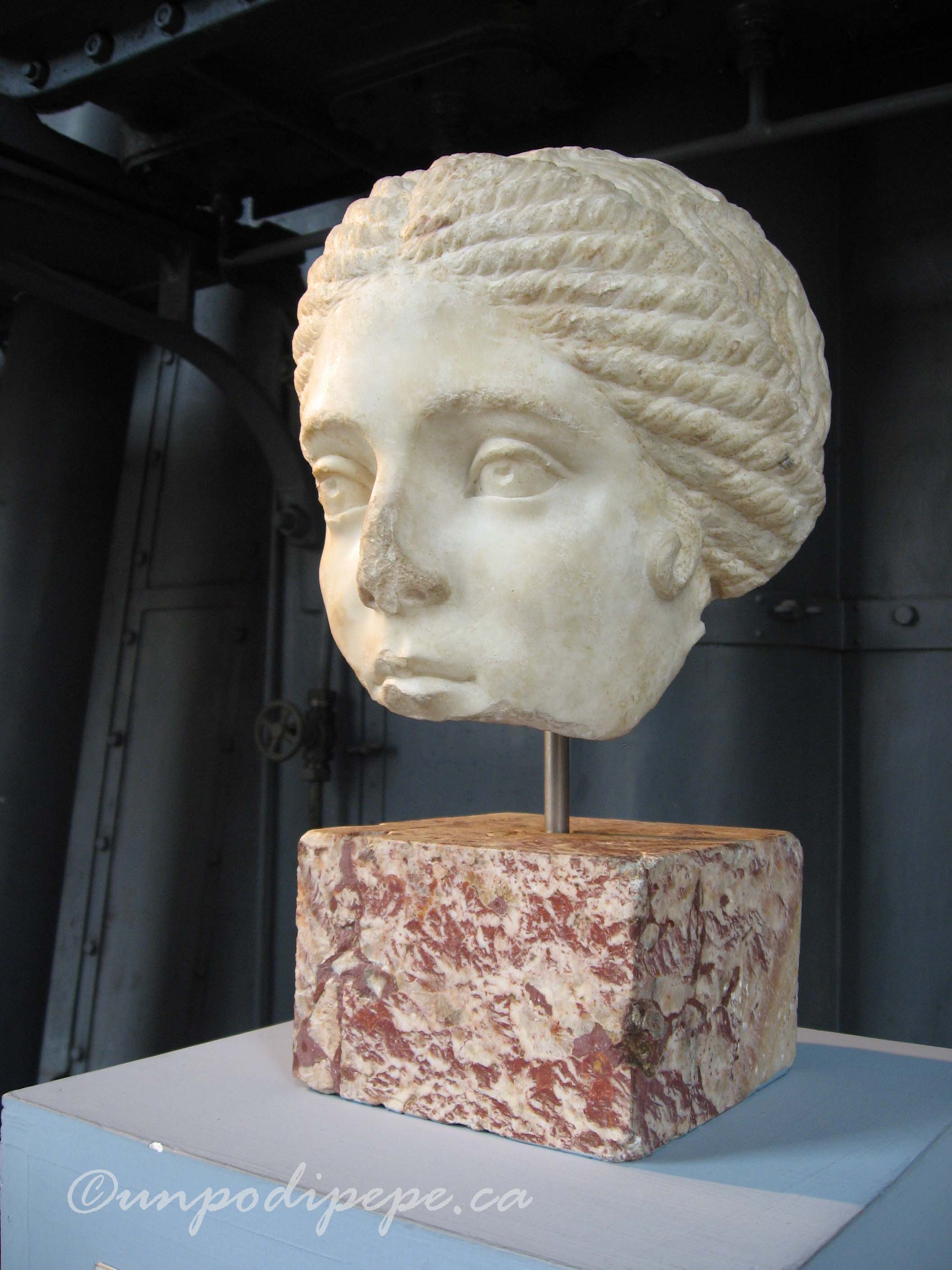
Partial female head, discovered in the garden of Villa Rivaldi in 1933 during construction of Via dei Fori Imperiali

Partial female head, discovered in the garden of Villa Rivaldi in 1933 during construction of Via dei Fori Imperiali

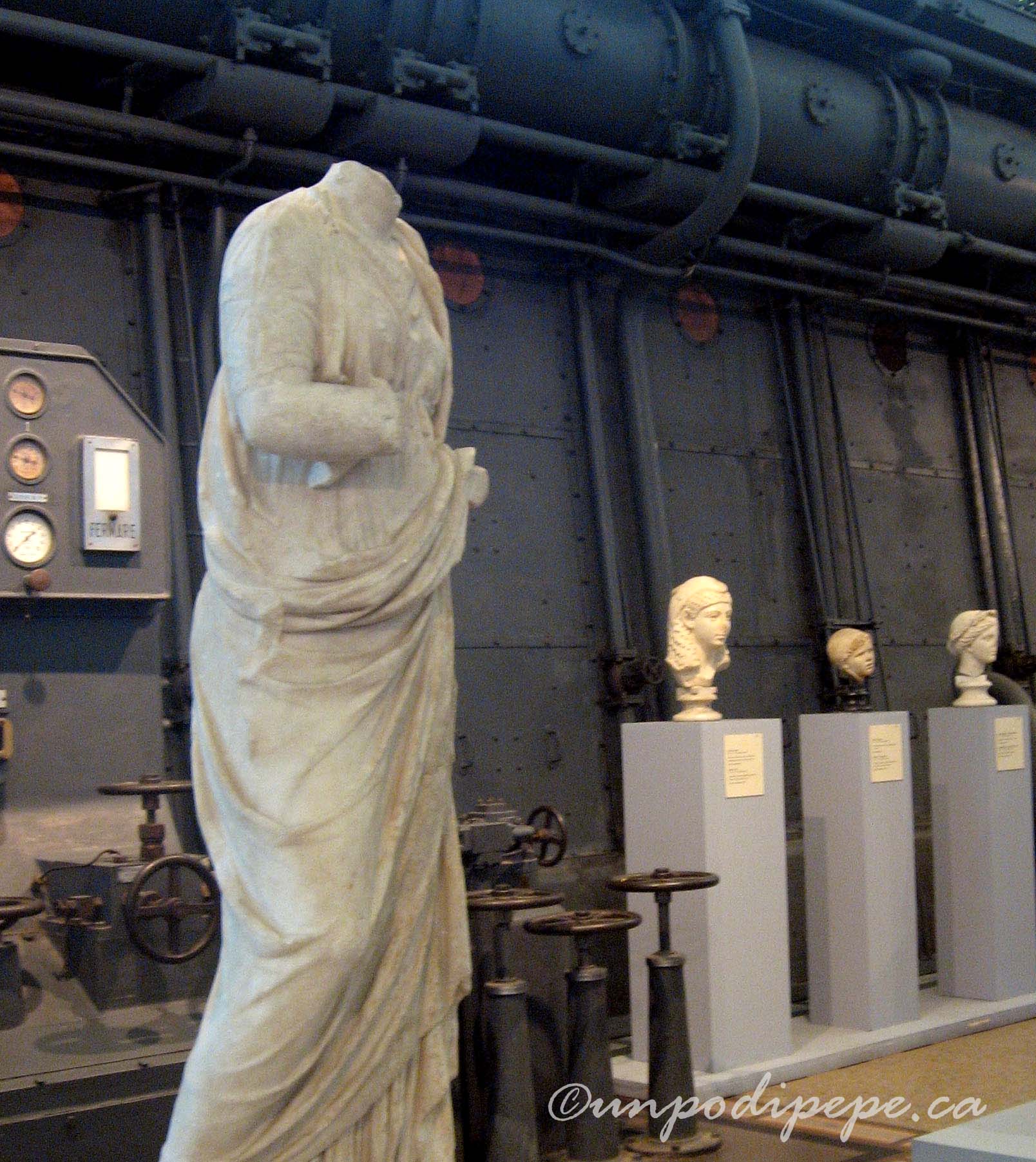
In Sala Macchine (Machine Room or Hall of the Machines) 2 hulking diesel engines are surrounded by Roman replicas of Greek statues.  At one end, a reconstruction of the pediment of the Temple of Apollo Sosiano depicts a battle between Greeks and Amazons.  These pieces are Greek originals found in the 1930’s near the Theater of Marcellus.  Above this installation hangs the old ‘carroponte‘ (Gantry crane).

Centrale Montemartini, Sala Macchine
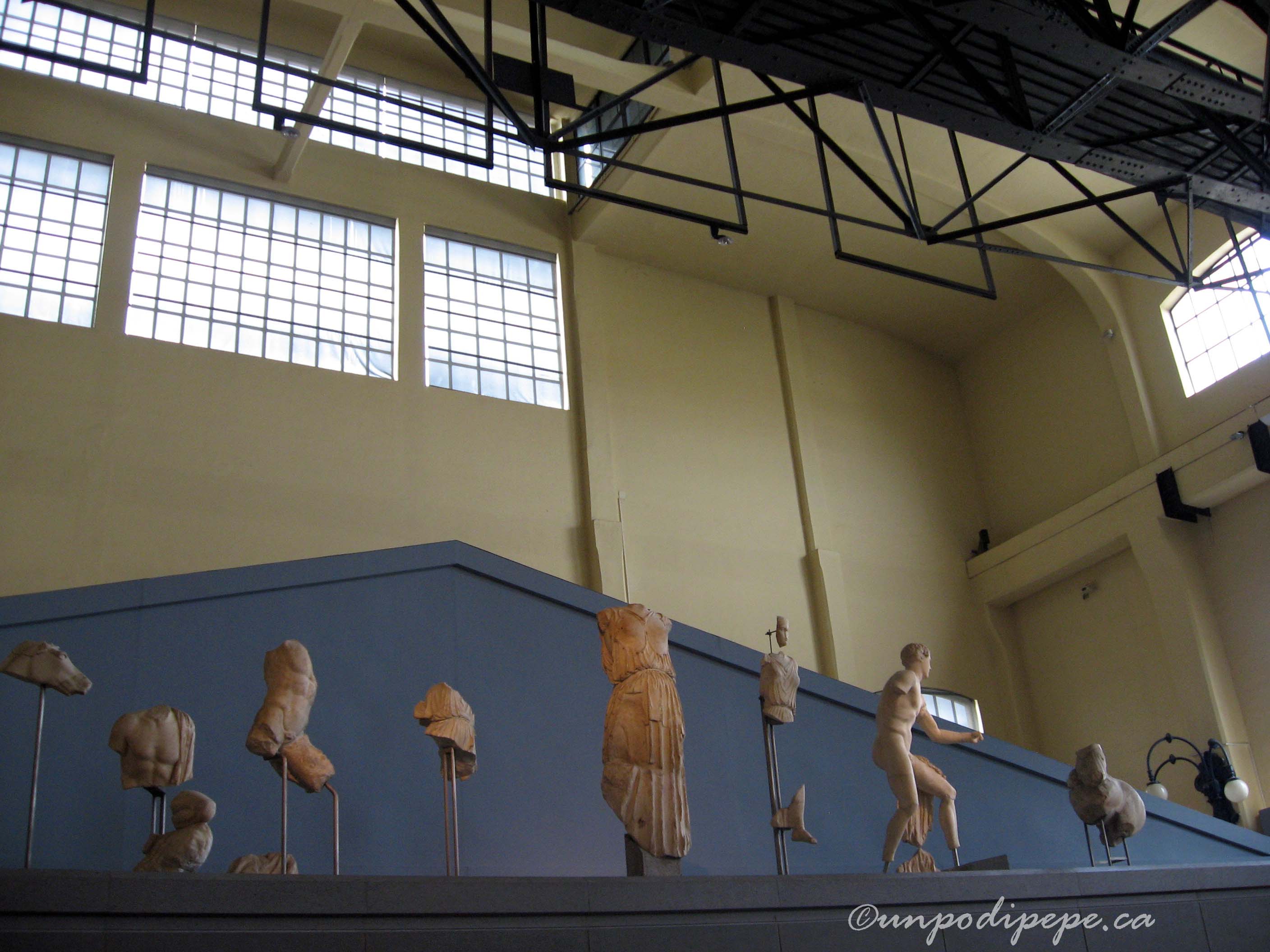
Centrale Montemartini, Sala Macchine

Centrale Montemartini Apollo Sosiano

Other ‘meraviglie’ (wonders) include a bust of Cleopatra and the giant head, right arm and feet of an 8m high statue of the Goddess Fortuna found near Largo Argentina.  Her feet look very modern with their ‘infraditi’-thong style sandals!piedidifortuna

Sala Macchine. Bust of Cleopatra (to the right of the large statue)

Sala Macchine. Bust of Cleopatra (to the right of the large statue)

cleopatraSala Caldaie (Boiler Room) is named for its 15m steam boiler and features a large mosaic of a hunting scene found near Santa Bibiana.  The mosaic is surrounded by sculptures once adorning lavish Roman homes.Centrale Montemartini Sala Caldaie

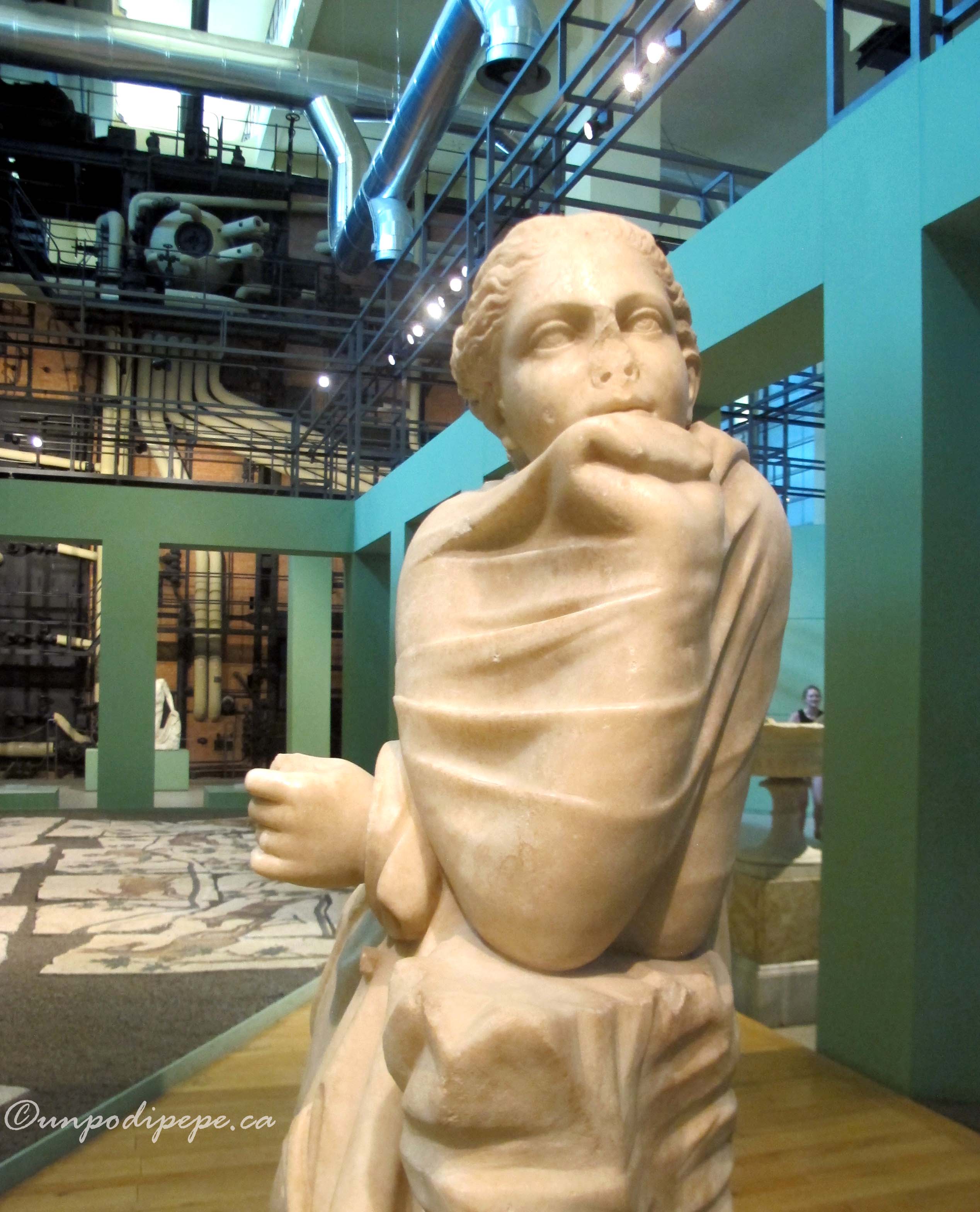
PolimniaI especially like the statue of Polimnia, muse of poetry and dance.  She has her elbows resting on a pillar and her shawl casually wrapped around her.  My other favourite in Sala Caldaie is the Sphinx Frieze, which seems to glow against the red brick wall.

Sala Caldaie. Sphinx Frieze with Acanthus Spirals. This was part of the Gardens of Sallust and likely represents the victory over Antony and Cleopatra.

Sala Caldaie. Sphinx Frieze with Acanthus Spirals. This was part of the Gardens of Sallust and likely represents the victory over Antony and Cleopatra.

There were only 4 or 5 other people in the museum both times I visited.  One of the staff told me that from October to May they have a lot of school groups visiting through their educational program, but June to September is not very busy.  This is opposite to most other museums!  I definitely recommend this amazing place, especially if you want to get away from crowds and lineups and see something truly unique. Even people who don’t like museums will appreciate this one-or at least find it oddly fascinating!Centrale Montemartini WarriorTorso

Centrale Montemartini is in the Ostiense area on the left bank of the Tevere.  It is south of Roma’s historic center but very accessible by Metro B line Garbatella stop.  When leaving the metro stop, you will cross a pedestrian bridge and then reach Via Ostiense.  Bus 23 goes along Via Ostiense and Stazione Ostiense is also nearby.
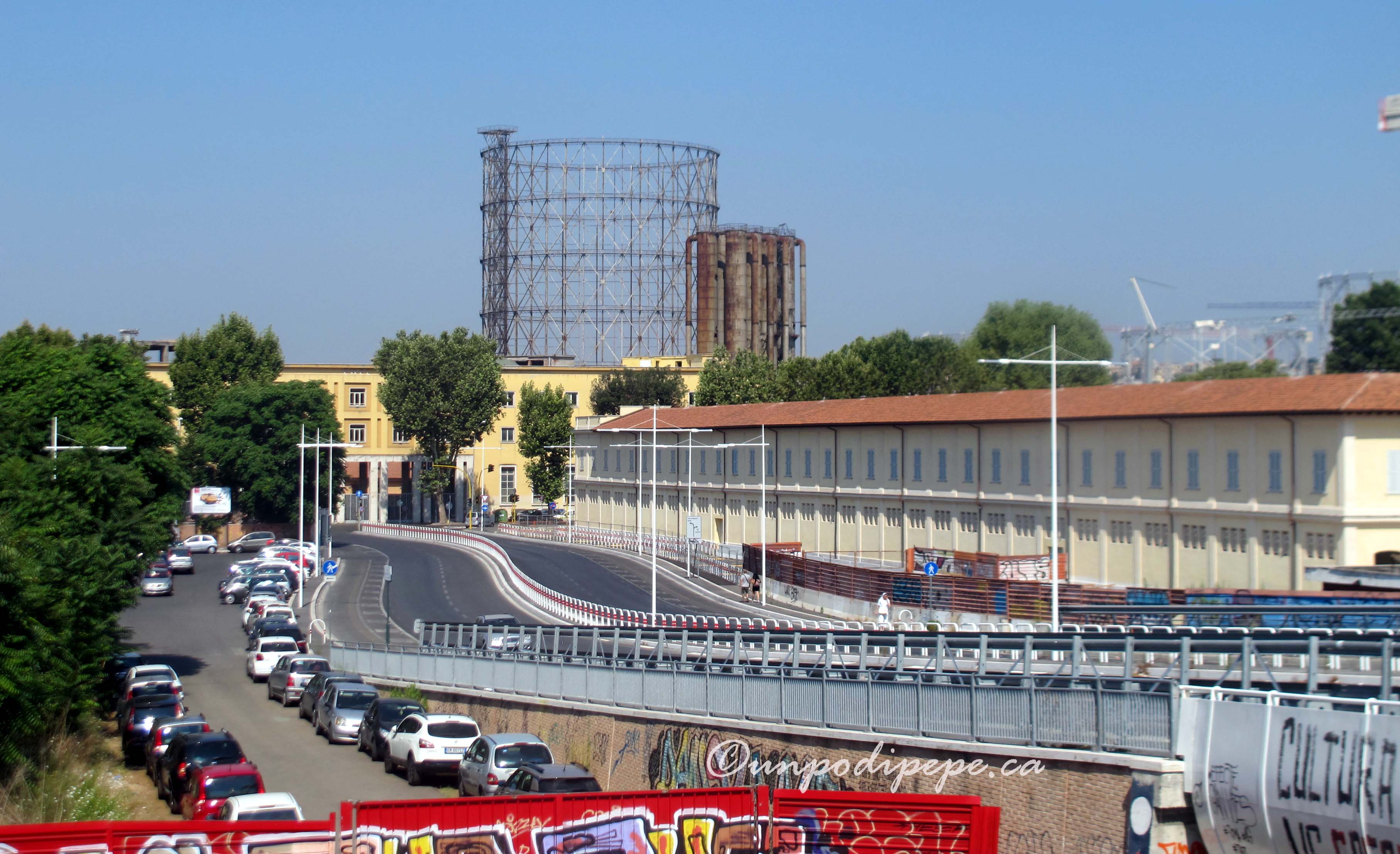
The view on exiting Garbatella Metro Stop.  Via Ostiense is in front, where the yellow building is.  Il Gasometro is behind it.  Centrale Montemartini is just to the left.

The view on exiting Garbatella Metro Stop. Via Ostiense is in front, where the yellow building is. Il Gasometro is behind it. Centrale Montemartini is just to the left.

The Basilica of San Paolo Fuori le Mura is walking distance, one metro stop away.  In between the Basilica and Centrale Montemartini is one of the oldest restaurants in Roma, Al Biondo Tevere at Via Ostiense 178 www.albiondotevere.it  serving Roman cuisine overlooking the Tevere.
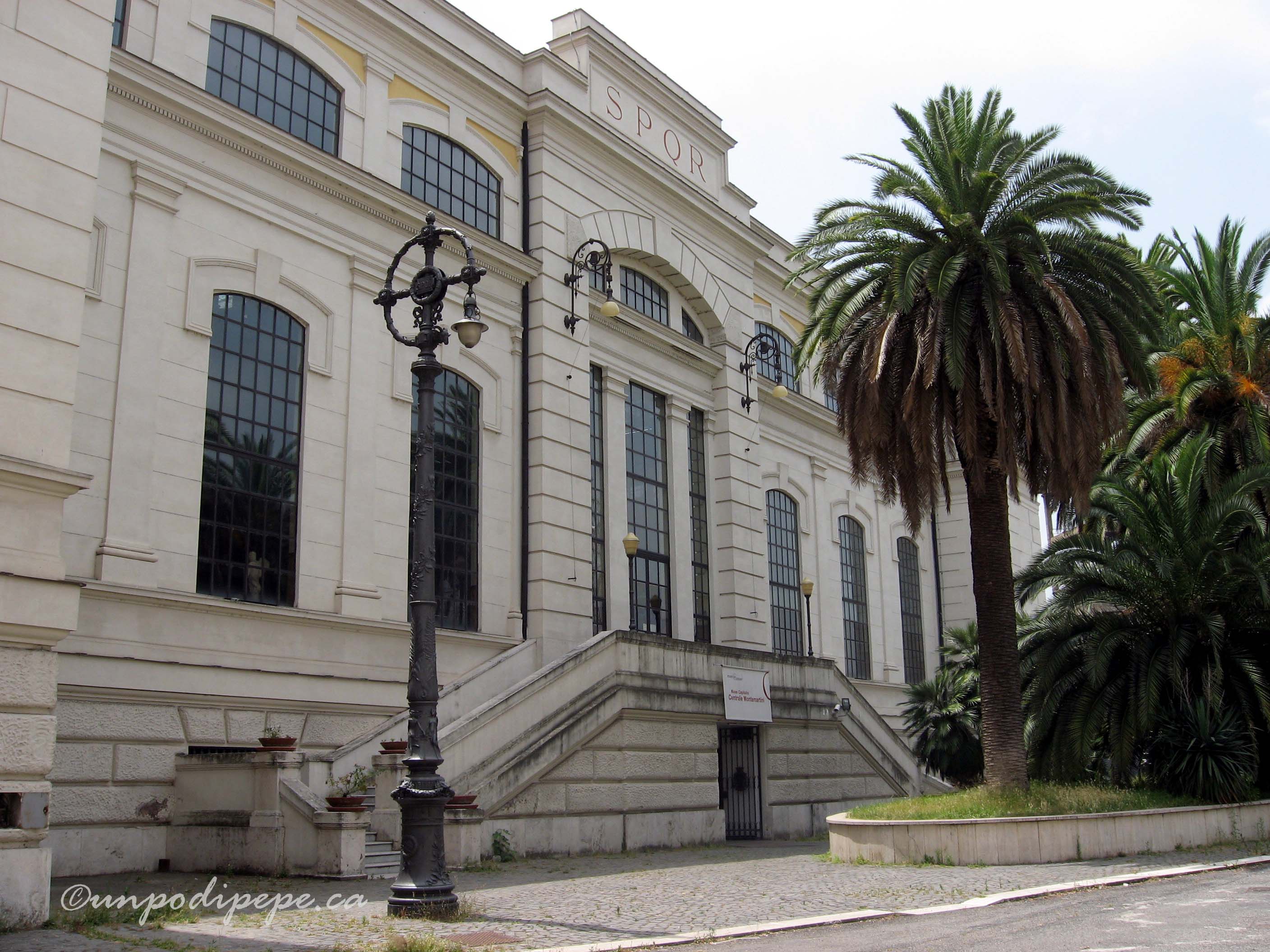
Centrale Montemartini

Centrale Montemartini

www.centralemontemartini.org  Via Ostiense 106, open Tues-Sun from 09-19.  Admission is € 7.50 for adults or €16 for the Capitolini Card (valid 7 days).  The Romapass can also be used.  Don’t forget your sketchbook!

Ciao, Cristina

Share this:

  • Share on Facebook (Opens in new window) Facebook
  • Share on Pinterest (Opens in new window) Pinterest
  • Share on X (Opens in new window) X
  • Email a link to a friend (Opens in new window) Email
  • Share on WhatsApp (Opens in new window) WhatsApp
Like Loading...

Le Isole Tremiti

16 Wednesday Jul 2014

Posted by Un po' di pepe in Italia, Photography, Puglia, Travel

≈ 13 Comments

Tags

Alidaunia, Diomedes, Fellini, Il Gargano, Isole Tremiti, Italia, Italian history, Italy travel tips, Parco Nazionale del Gargano, photography, Puglia, Southern Italy

San Nicola and Cretaccio seen from above the helipad, San Domino

San Nicola and Cretaccio seen from above the helipad, San Domino

The Isole Tremiti (ee∙SOH∙leh treh∙MEE∙tee) are an archipelago of 3-5 islands-depending on what you consider an island-in the Adriatic Sea, 22 km off the coast of Italia. The Tremiti, considered ‘le perle dell’Adriatico’ (the pearls of the Adriatic), have been inhabited since at least the 4th century BC.  They are part of the Parco Nazionale del Gargano (Gargano National Park) http://www.parcogargano.it and have been a protected Marine Nature Reserve (Riserva Naturale Marina Isole Tremiti) since 1989. The clear waters make the islands a popular spot for snorkeling, scuba diving and even bird watching.

Isole Tremiti Satellite View

Isole Tremiti Satellite View

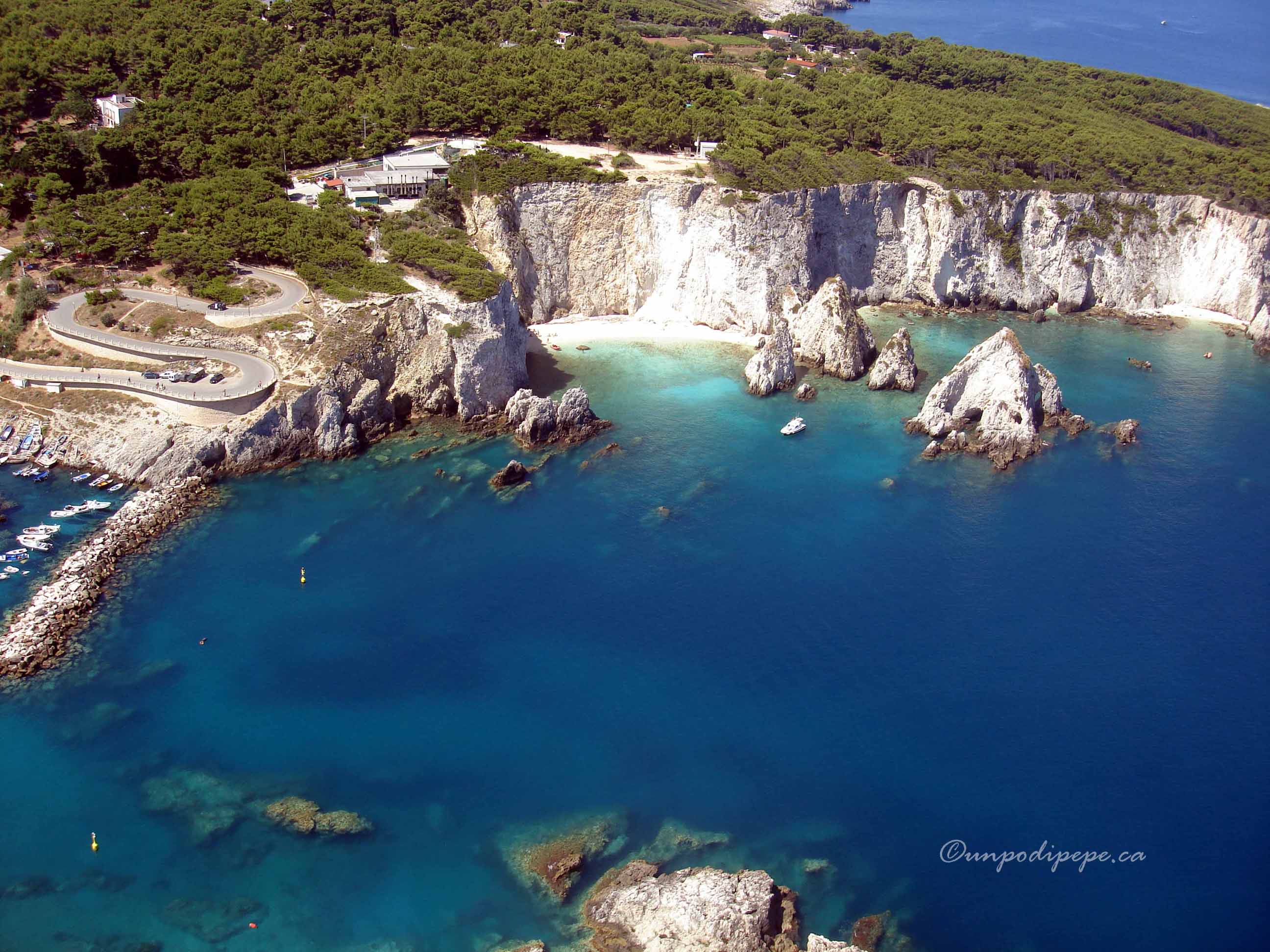
Flying into San Domino by helicopter

Flying into San Domino by helicopter

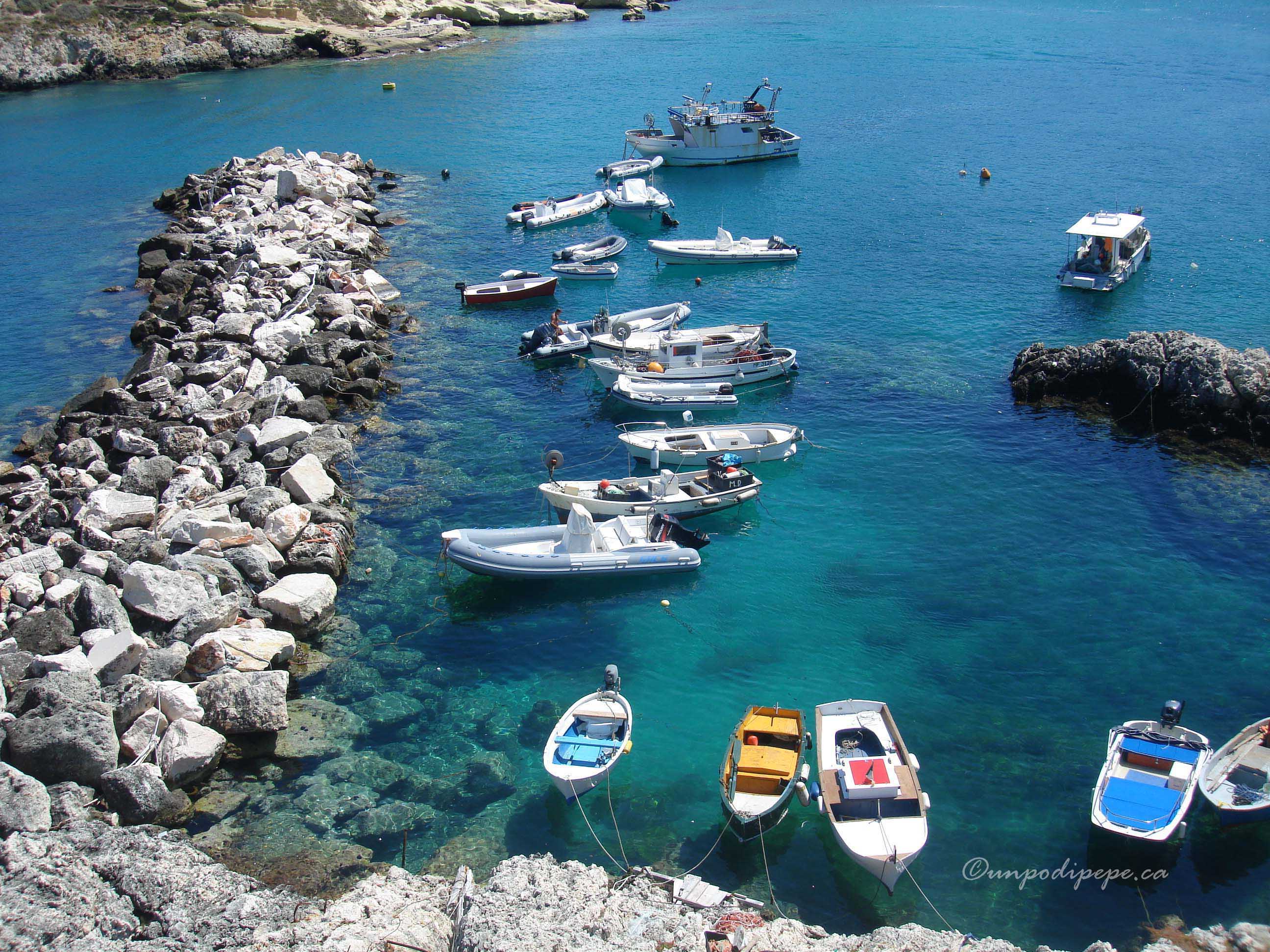
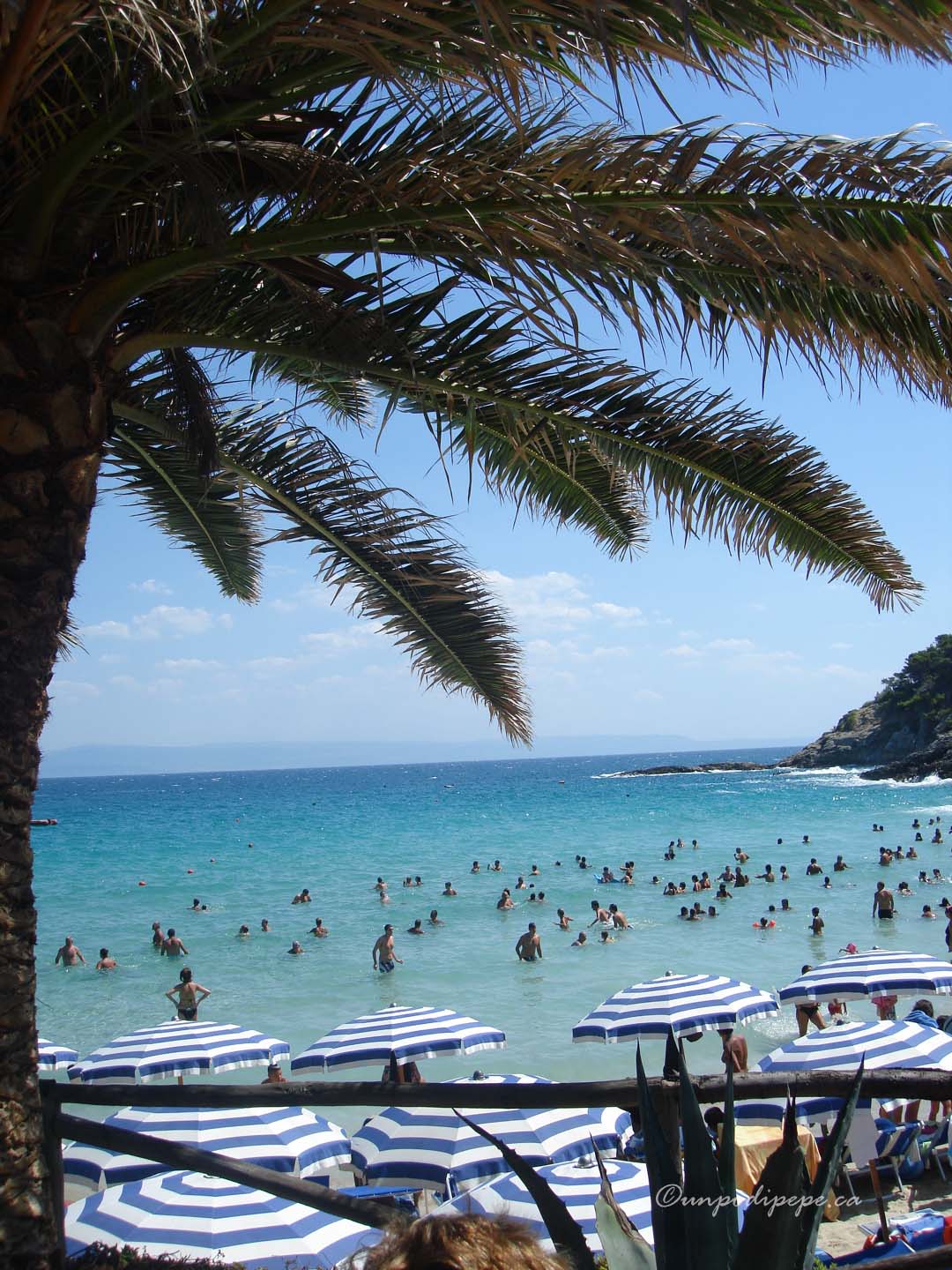
San Domino is the largest island and has most of the facilities such as hotels, restaurants, the Tremiti Diving Center, and the heliport. It is covered by lush Aleppo pine forest, capers and rosemary, and surrounded by small coves and sea caves. San Domino has the Tremiti’s only sandy beach –Cale delle Arene. The rocky coves are beautiful to explore and swim-but don’t go barefoot! My friend stepped on a riccio di mare (sea urchin) and it was not fun.  There is a 2 hour walk around part of the island and bicycles are available for rent.

The small port, San Domino

The small port, San Domino

Cale delle Arene, San Domino-the only sandy beach on the Isole Tremiti

Cale delle Arene, San Domino-the only sandy beach on the Isole Tremiti

Scoglio dell 'Elefante, San Domino, looks like a giant sitting elephant drinking from the sea

Scoglio dell ‘Elefante, San Domino, looks like a giant sitting elephant drinking from the sea

San Nicola is the administrative and historic center of the islands, and where most of the 400 or so permanent residents live. The 11th Century Benedictine abbey and church of Santa Maria del Mare seem to rise up out of the limestone cliffs, with fortified walls starting at the port. The church has a beautiful 11th century mosaic floor and a Byzantine painted wood crucifix that was likely brought here by monks fleeing from the Crusades.

San Nicola, seen from San Domino

San Nicola, seen from San Domino

San Nicola Porto

San Nicola Porto

Bagnetto anyone?

Bagnetto anyone?

Capraia (or Caprara) is rocky and uninhabited except for sea birds. It is named for the capers that grow there. There is no organized transport to Capraia, but local fishermen can be hired to take people over.

San Nicola and Capraia.  Yes those are solar panels down there!

San Nicola and Capraia. Yes those are solar panels down there!

Cretaccio is an uninhabited halfmoon shaped block of yellowish clay between San Domino and San Nicola.  Cretaccio literally means ‘big hunk of clay’.
Pianosa is 11 km away from the other islands and is the most northern point of Puglia.  It can be covered by waves during storms, as the elevation is only 15 m.  The waters surrounding Pianosa are in zone A of the Marine Reserve, so access is strictly prohibited except for approved marine research.

Cretaccio and San Domino, seen from Santa Maria al Mare, San Nicola

Cretaccio and San Domino, seen from Santa Maria al Mare, San Nicola

The islands are sometimes known by their former name ‘Le Diomedee’ or ‘I Sassi di Diomede’ and you see a lot of things in the Gargano area called ‘Diomede’. According to legend/mythology, after the Trojan War, the Greek hero Diomedes settled in the Daunia area (Province of Foggia) and created the islands with 3 rocks he threw into the Adriatic.  He was also shipwrecked on the islands with his crew and possibly died here.

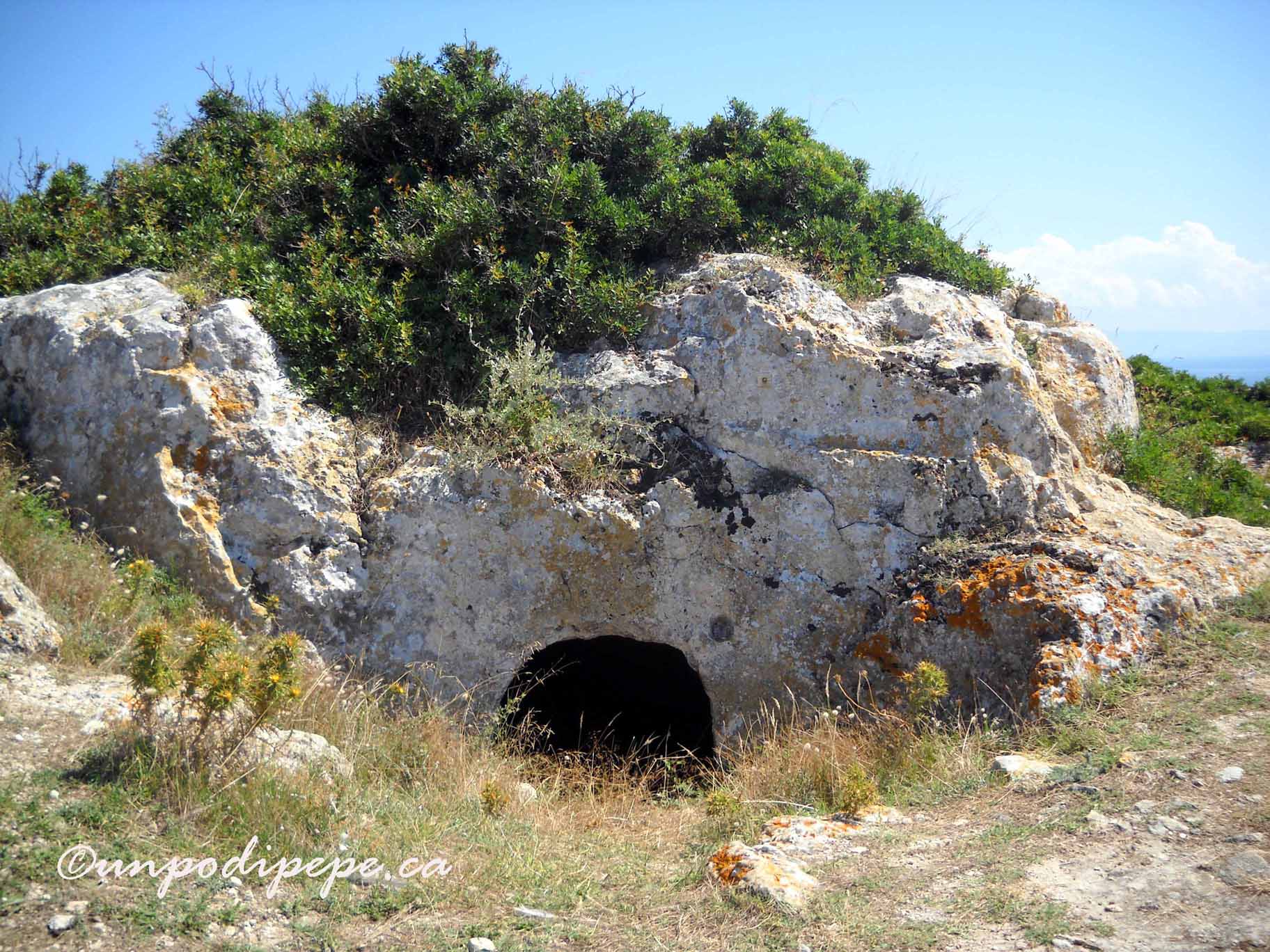
La tomba di Diomede on San Nicola.

La tomba di Diomede on San Nicola.

There is an unmarked Hellenic period tomb on San Nicola that is known as ‘la tomba di Diomede’. His crew was so upset at the loss of their captain that the Goddess Venus took pity on the grieving men and turned them into birds that continue to cry for their loss. The scientific name for the Great Albatross which is common in the area, is ‘Diomedea’.  These birds look a lot like seagulls and make a noise that can sound like a crying newborn.  In Fellini’s ‘Otto e mezzo’ (8½) there is a scene where a cardinal tells this story to Guido (Marcello Mastroianni).

A Diomedea, San Domino

A Diomedea, San Domino

The islands also have a long history as a place of exile. Emperor Octavius Augustus confined his granddaughter Giulia to San Nicola for adultery with a Roman senator. She remained there until her death 20 years later. One of the necropoli beneath the abbey could be her tomb.  Ferdinand, king of Napoli turned the abbey into a penal colony. A hundred years later, another Ferdinand tried to repopulate the islands with criminals and people moved in from the slums. For many years, the Fascists imprisoned those considered a danger to the public on the Isole Tremiti. One of the prisoners held there was Sandro Pertini, future president of the Italian Republic.

Alidaunia flies from Foggia to San Domino daily

Alidaunia flies from Foggia to San Domino daily

I have visited the islands several times by helicopter.  As you can see in the photos, the emerald water is so crystal clear you can see the bottom from the air!  The wonderful thing about visiting the Isole Tremiti is that there are no large hotels or resorts.  All of the hotels are small and surrounded by pine forest, so although this is a tourist destination, it doesn’t feel overrun with people. The Isole Tremiti are accessible by 1-2 hour ferry ride from Vieste, Peschici, Rodi Garganico, Manfredonia and Termoli, or by half hour helicopter ride from Foggia http://www.alidaunia.it .

Over San Nicola

Over San Nicola

Buon Viaggio!

Share this:

  • Share on Facebook (Opens in new window) Facebook
  • Share on Pinterest (Opens in new window) Pinterest
  • Share on X (Opens in new window) X
  • Email a link to a friend (Opens in new window) Email
  • Share on WhatsApp (Opens in new window) WhatsApp
Like Loading...

La Festa della Mamma~Mother’s Day

11 Sunday May 2014

Posted by Un po' di pepe in Feste, Photography

≈ 1 Comment

Auguri a tutte le Mamme per la festa della Mamma!/ Best wishes to all Mothers for Mother's Day!

Auguri a tutte le Mamme per la festa della Mamma!/ Best wishes to all Mothers for Mother’s Day!

Share this:

  • Share on Facebook (Opens in new window) Facebook
  • Share on Pinterest (Opens in new window) Pinterest
  • Share on X (Opens in new window) X
  • Email a link to a friend (Opens in new window) Email
  • Share on WhatsApp (Opens in new window) WhatsApp
Like Loading...

Sbandieratori~Accenti Magazine Photo Contest

04 Sunday May 2014

Posted by Un po' di pepe in Culture, Italia, Orsara di Puglia, Photography, Puglia

≈ 6 Comments

Tags

Accenti magazine, Accenti photo contest, Culture, History, Italia, Orsara di Puglia, photography, Puglia

Sbandieratori

The 7th annual Accenti Magazine ‘Capture an Italian Moment’ Photo Competition results were just released at the Accenti Magazine Awards during the Blue Metropolis Montreal International Literary Festival. My photo, ‘Sbandieratori’ came in second place!

This photo was taken in Orsara di Puglia during the ‘Corteo Storico’, a parade in period costume, reenacting the history of the village. These sbandieratori (flag throwers) came from nearby Lucera to perform. Here, they are in between performances, engaged in casual conversation. What struck me about this image were the bold colours and composition of the costumes and flags. I was also curious to know what their conversation was about….was it early Renaissance gossip, or the latest cell phone app?

In Italiano:

Questa foto è stata scattata ad Orsara di Puglia durante il ‘corteo storico’, una sfilata in costume medioevale, che racconta la storia del paese.  Questi sbandieratori sono venuti da Lucera.  Qui li vediamo in attesa di sfilare, impegnati in una conversazione.  Quello che mi ha colpito sono stati I colori vibranti e la composizione che si è create tra I costume e le bandiere.  Ero anche curiosa di sapere di cosa parlavono…..chiacchiere medioevale o dell’uscita di una nuova app per il telefono?

The mission of Accenti, “the magazine with an Italian accent,” and Accenti Online http://www.accenti.ca is to bring together readers and writers around the idea of shared cultural experience, encourage creative expression, and act as a bridge between cultures. The 2015 photo and writing competition is now accepting submissions. If you are interested in finding out more, go to http://www.accenti.ca/photo-contest or http://www.accenti.ca/writing-contest.

The word Sbandieratori is related to the word bandiera (flag) and is pronounced zban∙ dee∙ ear ∙a∙ tow∙ ree. Say it a few times….now say it faster.

Here are a few more photos from the ‘Corteo Storico’ in Orsara di Puglia:

Sbandieratori, corteo storico, Orsara di Puglia

Sbandieratori, corteo storico, Orsara di Puglia

Corteo Storico, Orsara di Puglia

Corteo Storico, Orsara di Puglia

Share this:

  • Share on Facebook (Opens in new window) Facebook
  • Share on Pinterest (Opens in new window) Pinterest
  • Share on X (Opens in new window) X
  • Email a link to a friend (Opens in new window) Email
  • Share on WhatsApp (Opens in new window) WhatsApp
Like Loading...
Newer posts →

Enter your email address to follow 'un po' di pepe' and receive notifications of new posts by email.

Join 504 other subscribers
Follow Un po' di pepe on WordPress.com

Popular Posts

  • Hairstyling in Ancient Roma
    Hairstyling in Ancient Roma
  • Cristo si è Fermato a Eboli
    Cristo si è Fermato a Eboli
  • Il Pumo Pugliese
    Il Pumo Pugliese
  • Internment of Italian Canadians
    Internment of Italian Canadians
  • Benvenuti ad Orsara di Puglia
    Benvenuti ad Orsara di Puglia
  • Ricotta fatta in casa~ Homemade ricotta
    Ricotta fatta in casa~ Homemade ricotta
  • Ravioli Rossi
    Ravioli Rossi

Recent Posts

  • Ostuni ‘La citta’ bianca’
  • 50 years of U2!
  • Polignano a Mare 2.0
  • Via dell’ Amore~Riomaggiore
  • AICW Conference, Viterbo
  • Bloghiversario #12
  • Pane e Salute
  • Sanremo 2026
  • Cucina Italiana Patrimonio UNESCO
  • 2025~Un po’ di pepe Year in Review
  • Castel del Monte
  • ‘The Nuances of Love’
  • Hostaria Antica Roma~Eat like an Ancient Roman
  • Santa Maria in Aracoeli
  • Casino dell’Aurora~Villa Boncompagni Ludovisi
  • Nasoni di Roma
  • Bloghiversario #11
  • Fontana di Trevi
  • Acqua Vergine
  • Giubileo 2025
  • Sanremo 2025
  • In Vino there are Memories
  • A Literary Harvest
  • 2024~Un po’ di pepe Year in Review
  • Buon Natale 2024

Categories

Amici e Famiglia Architecture Art Art history Art projects Bilingual posts Blogging Canada Culture Feste Firenze Inspiration Italia Italian Folklore Italian language Italian life Italocanadesi Libri Mangiamo! Orsara di Puglia Parole piacevoli Photography Puglia Recipes Roma Travel Travel tips Uncategorized Vino

Archives

Un po’ di pepe on Facebook

Un po’ di pepe on Facebook

Start a Blog at WordPress.com.

  • Subscribe Subscribed
    Un po' di pepe
    Join 504 other subscribers

    Have a WordPress.com account? Log in now.

  • Un po' di pepe
    View site in Reader
    Manage subscriptionsSign upLog in
    Report this content
    Collapse this bar
Loading Comments...
%d