• Home
  • About me/Chi sono
  • Contact

Un po' di pepe

~ …… (oon∙poh∙dee∙PEH∙peh) Cristina writes about interesting stuff /Cristina scrive di cose interessanti

Un po' di pepe

Category Archives: Puglia

Museo Faggiano

22 Sunday Nov 2020

Posted by Un po' di pepe in Architecture, Puglia, Travel

≈ 19 Comments

Tags

Archeology, Lecce, Museo Faggiano, Southern Italy

Museo Faggiano is a family run, independent archeology museum in Lecce and also a working archeological site.  This is a small museum with big history! In 2001, Luciano Faggiano planned to open a restaurant with his 3 sons Marco, Andrea and Davide in a building he owned in Lecce’s Centro Storico.
The building had issues with dampness and sewage backup, likely caused by broken pipes.  Since a working toilet is kind of important, the Faggiano family planned all took 1 week off to work on the plumbing themselves.

Museo Faggiano archeologyThey started digging and found a false floor.  Beneath that, they uncovered 4 subterranean levels to other worlds.  They found Messapii tombs and an ossuary from the 5th Century BC.  The Messapii were from Crete and settled in Southern Italia.  They also uncovered a Roman granary, silo, cisterns a 10 m deep well and even an underground escape tunnel leading to the Roman anfiteatro a few blocks away.  From 1000-1200, the building was a House of the Knights Templar, who left their emblems on frescoes and wall etchings.  A Franciscan chapel and religious artifacts were found from the convent of Sisters of Santa Chiara, which the building was from 1200-1609.  Each of these populations left their traces in the unassuming little building.

Artifacts in Museo FaggianoAfter 7 years of excavation, the museum opened to the public in 2008.  All of the work was financed by Signor Faggiano, under the supervision of the Archeology superintendent of Taranto.  In Italia, anything found underground belongs to the government no matter who owns the property.  This was clearly a labour of love.

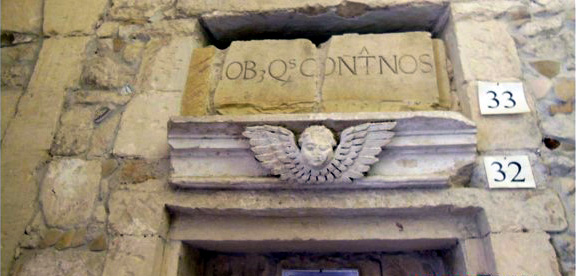
In addition to the architectural elements of the builing, treasures found include a gold and emerald Jesuit bishop’s ring, coins, lots of pottery fragments and a stone sculpture with the abbreviated Latin inscription ‘Si deus pro nobis quis contra nos’ -If God is with us, who can be against us?Sculpture found in Museo Faggiano

In 2015, Museo Faggiano was featured in a NY Times article.

Museo Faggiano is at Via Ascanio Grandi 58, a short walk from Piazza Sant’Oronzo.  It is open daily from 9:30am-8pm.  Admission is €5.  Often one of the family members is there to answer questions.  A numbered sheet with self-guided tour is available in many languages.

Imagine 2500 years of history in one small house!  If you are like me and have an inner Indiana Jones, and your palms sweat when surrounded by unique archeology, you will be fascinated by Museo Faggiano!

Luciano Faggiano finally did open his restaurant Quo Vadis, next door in June 2019. He is not planning to dig up the pavimento!

Share this:

  • Click to share on Facebook (Opens in new window) Facebook
  • Click to share on Pinterest (Opens in new window) Pinterest
  • Click to share on X (Opens in new window) X
  • Click to email a link to a friend (Opens in new window) Email
  • Click to share on WhatsApp (Opens in new window) WhatsApp
Like Loading...

Troia 1019-2019

05 Saturday Oct 2019

Posted by Un po' di pepe in Architecture, Italia, Photography, Puglia

≈ 8 Comments

Tags

Diomedes, Italy travel tips, Romanico Pugliese, Southern Italy, UNESCO World Heritage Sites, Wines of Puglia

Rosone, Cattedrale di TroiaAccording to legend, Troia (TROH∙yah) was founded by the Trojan War hero Diomede (Diomedes) in the 10th century BC.  After the fall of Troy, he found out his wife was unfaithful.  Instead of going home to Argos, Diomede travelled around the Adriatic, settling in the Daunia area of Puglia.  Troia, also spelled Troja, was at the junction of the Via Traiana –the road from Benevento to Brindisi, and the road to Siponto (Sipontium).  The Romans called it Aecae.  In 1010, a medieval settlement was built on the ruins of the ancient city, and in 1017 a Byzantine fortress to protect against Saracen invaders.  Modern Troia was founded in 1019, making this year its millennia!!!  Auguri Troia!Troia Millenio 1019-2019

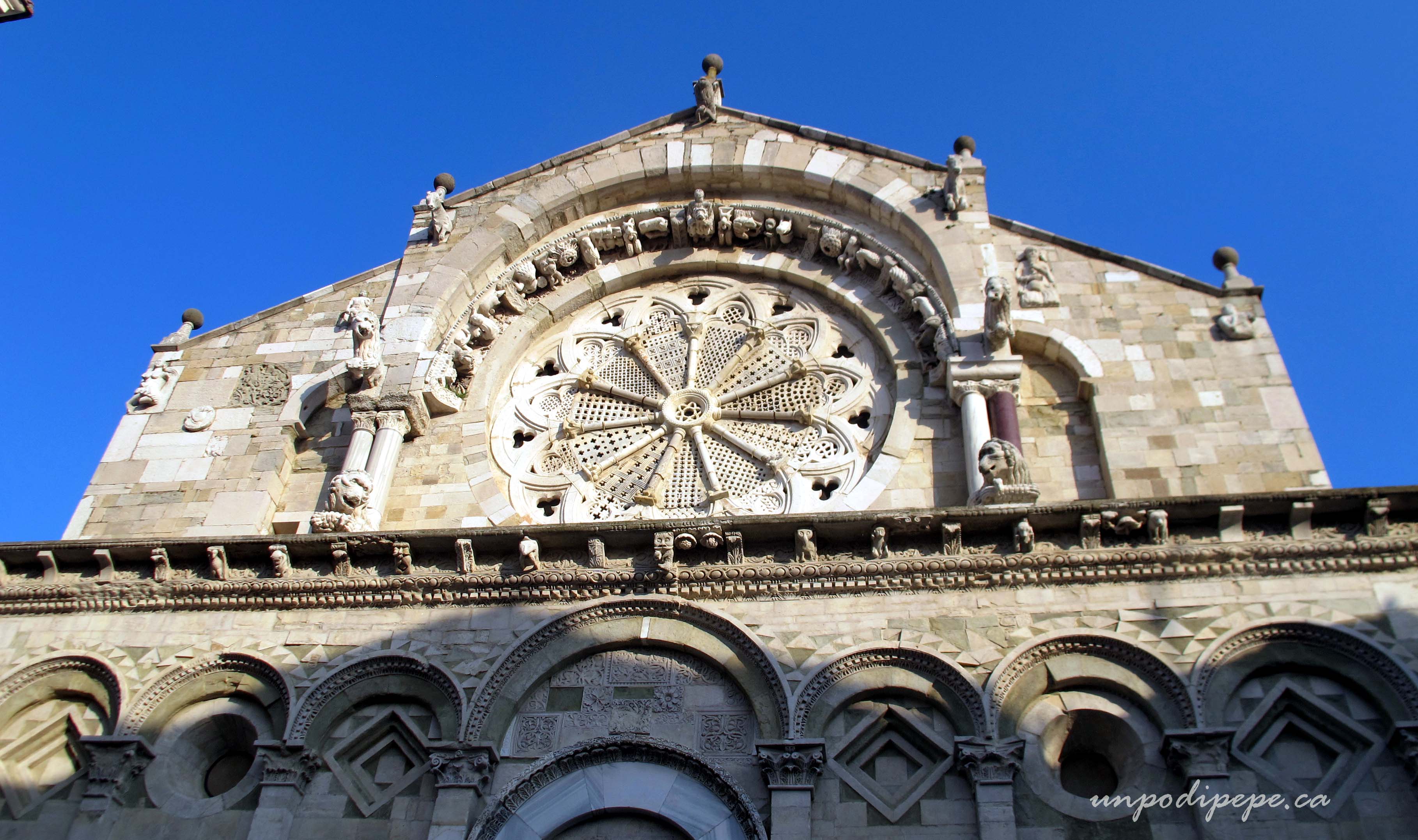
Troia was ruled by powerful bishops, and they built a magnificent cattedrale (cathedral), an exquisite example of Romanico Pugliese, a unique architectural mix of Pisan Romanesque, Arab and Byzantine inspired features.  It was an important connection between the Norman kingdoms of Southern Italia and the Pope. Completed in 1119, this architectural capolavoro or masterpiece is celebrating its 900th anniversary!Troia cattedrale Romanica Pugliese

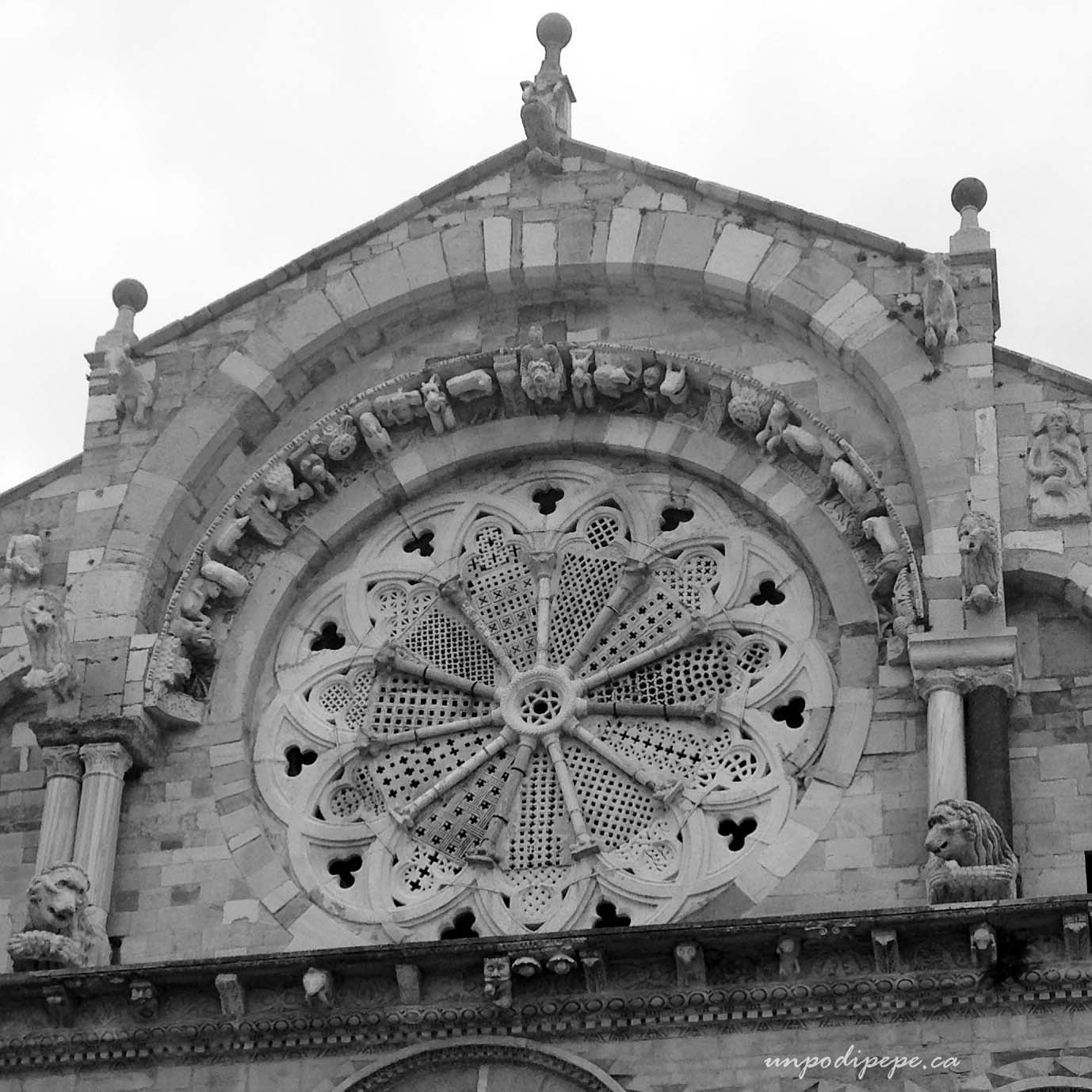
The stunning rosone-rose window is made up of 11 thin columns, each with a delicate stone ‘screen’ finely carved with Islamic inspired geometric designs.  The 11 ‘petals’ or segments each have a different pattern.  They look like they are woven out of stone.  11 is an unusual number of sections for a rose window, or for anything, actually. There could be some interesting numerology related to this building.Cattedrale di Troia, Puglia 2011

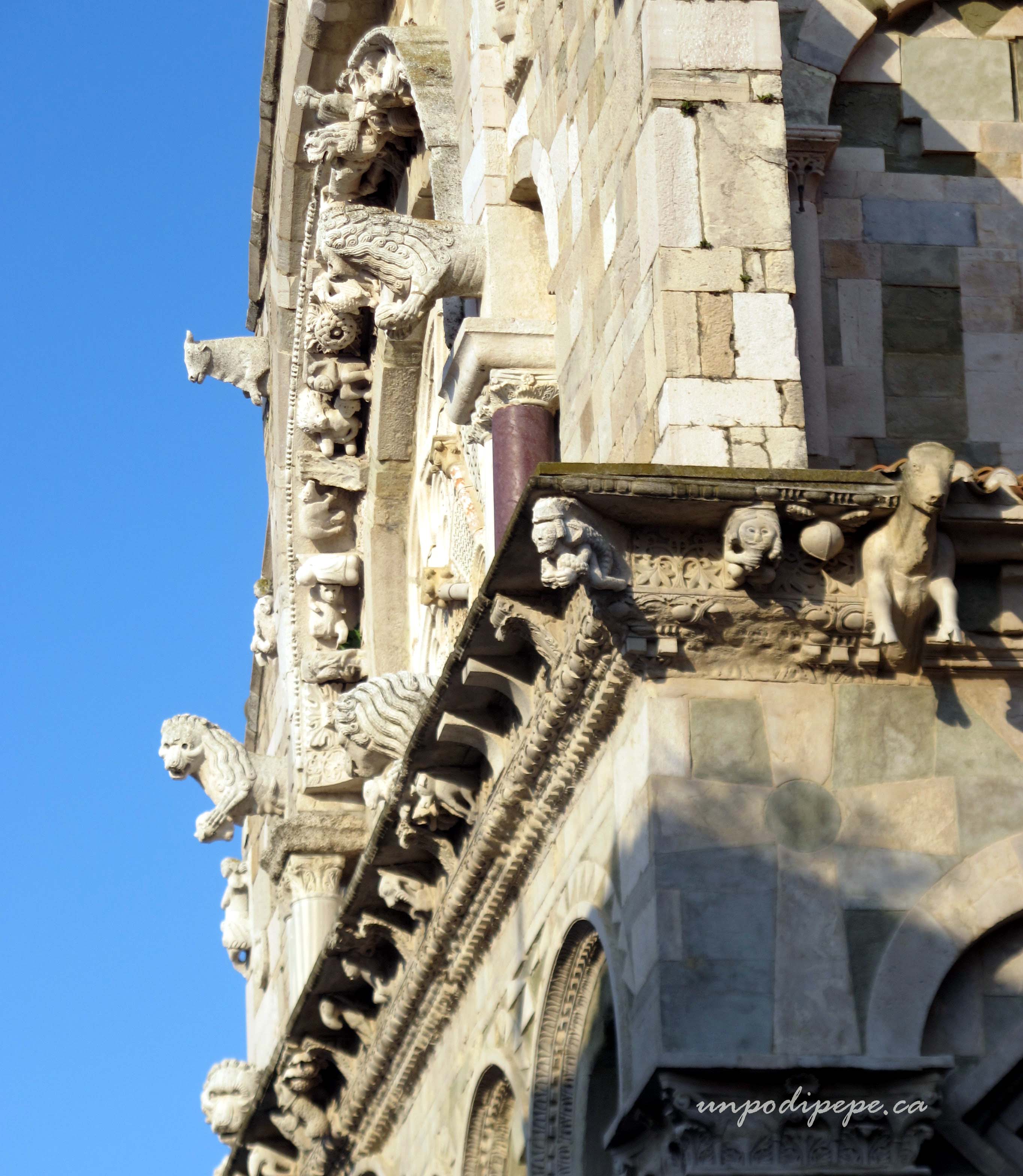
The upper façade is elaborate, with the rosone and gargoyles. The arches around the window are decorated with an odd but fascinating assortment of primitive looking animal and human sculptures and are held up on either side by Pugliese lions. Side view, Troia Cathedral, PugliaTroia Cathedral bronze doors

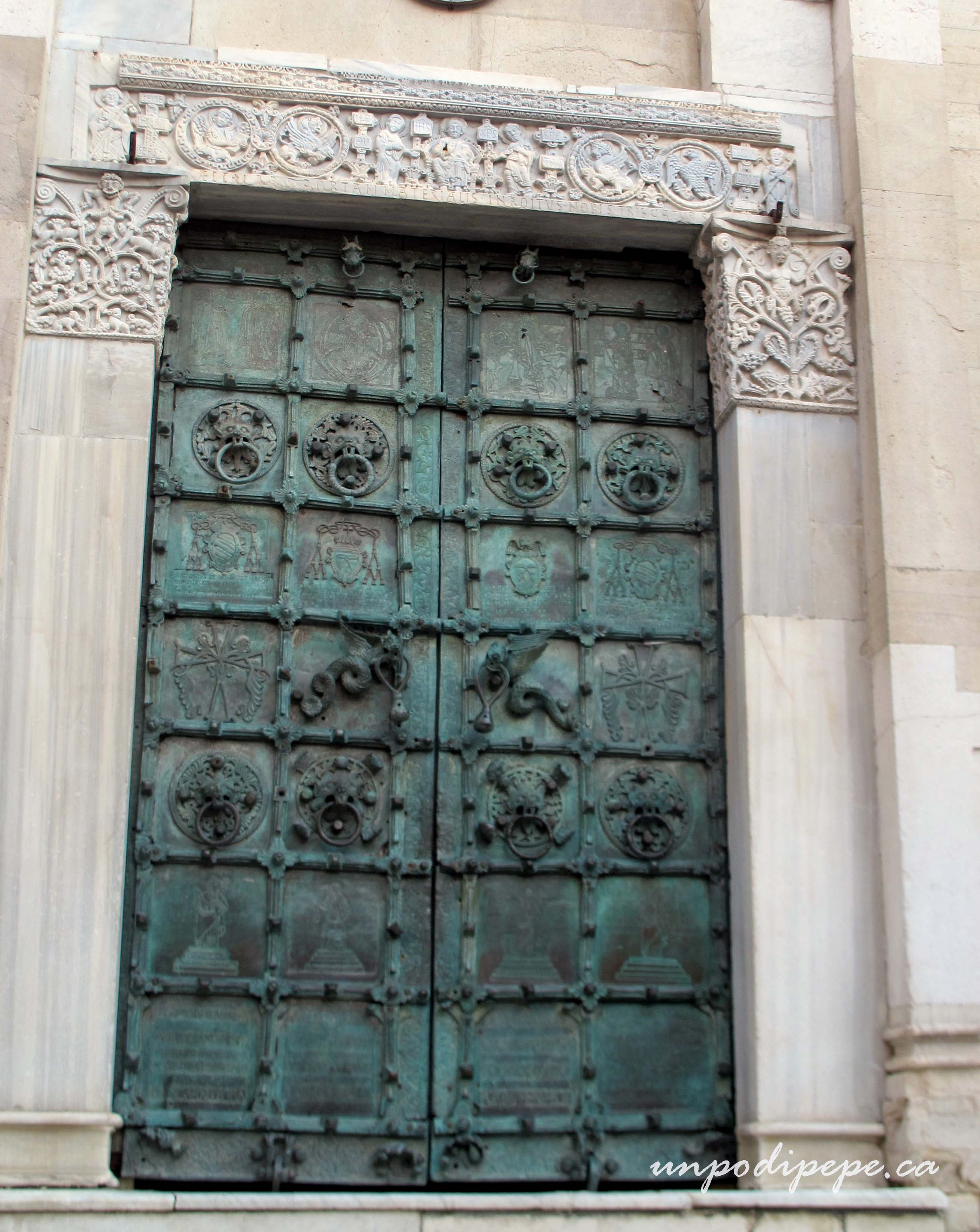
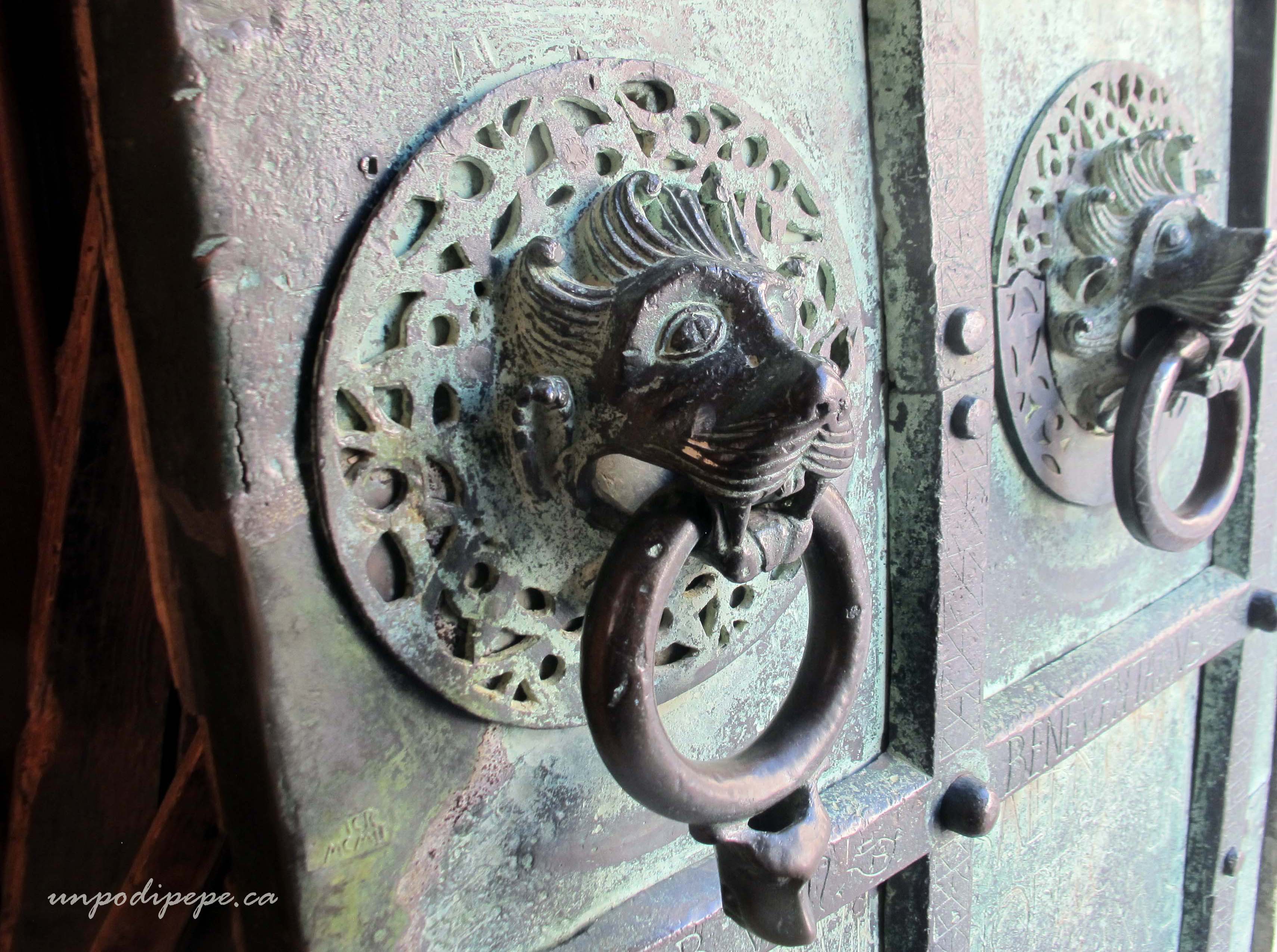
The lower front is a 7 arch façade-the center one being the main entrance through bronze doors with the most magnificent dragon handles. They look straight out of Trono di Spada (Game of Thrones)! The doors were built in 1127 by Oderisio da Benevento. Troia cathedral dragon door handles and lion knockers The doors are decorated with reliefs and inscriptions.  There are 10 knockers; 8 lions and 2 wyverns, which are small 2 legged dragons.  On each side of the door are 3 blind arches topped with geometric carvings and a round window on the middle arch.  The arches on the side of the building are topped with geometric sun and moon patterns in green stone. The main doors are closed and entry is only through the side door, another bronze by Oderisio da Benevento.  The church is usually open during the day, and of course during Masses.Troia Cathedral bronze door lion door knockers

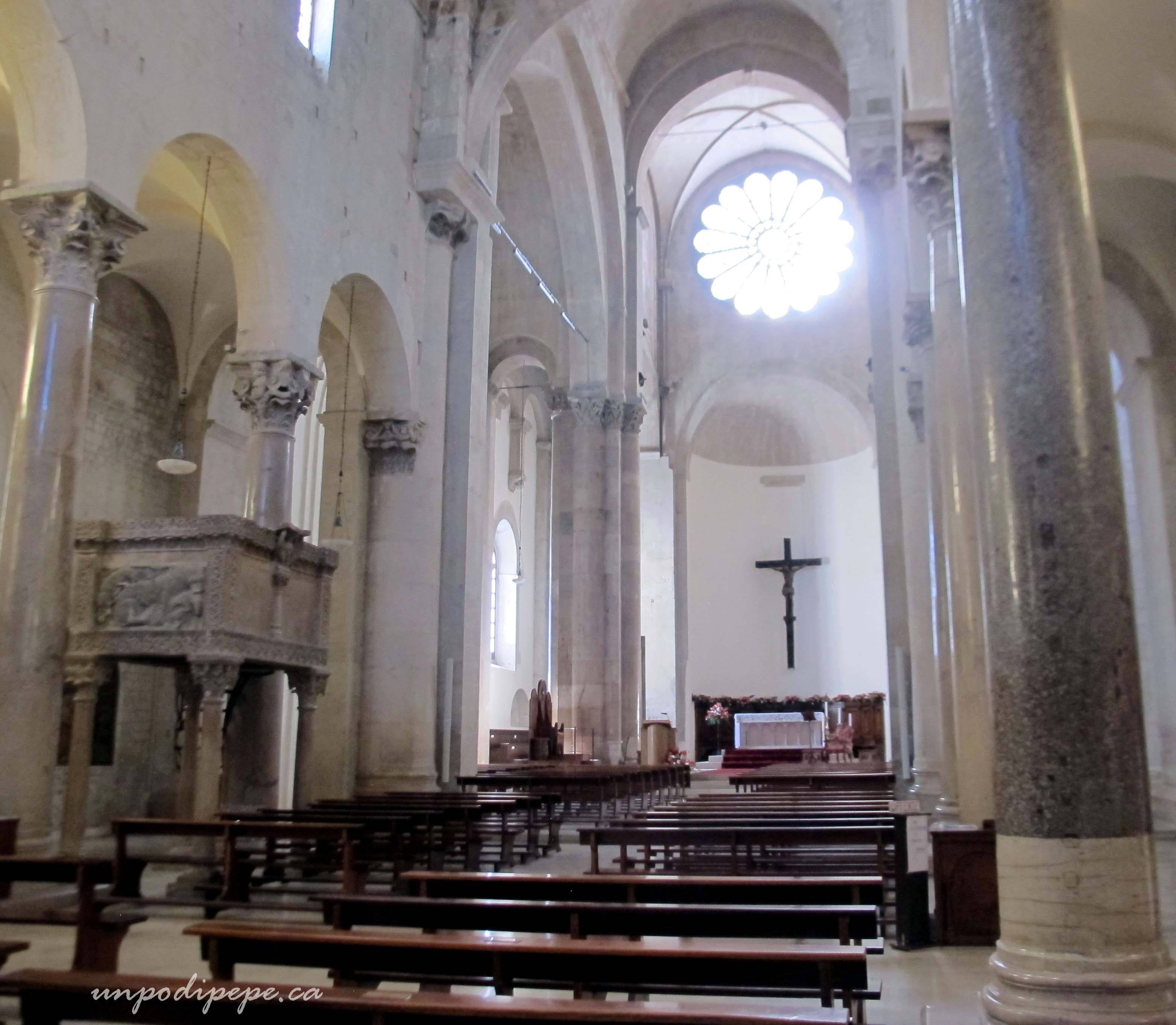
In contrast to the ornate exterior, the interior of the cattedrale is simple.  The design is a Latin cross plan with 3 aisles separated by 13 Corinthian columns, 2 rows of 6 and a 3rd row in the SW corner with only one column, as seen in the photo below.  These represent the 12 apostles and Christ. There is no ceiling, the beamed wood roof is exposed. The Cathedrals in the Romanico Pugliese style, including Troia’s, are on the tentative list for UNESCO World Heritage Sites.  This is the step before becoming a heritage site!Interior of the Cathedral of Troia, with a view of the 13th column

The 1169 pulpit dates to 1169 has an interesting relief carved on one side. It is a dog biting the back of a lion, who is biting the neck of a lamb and is visible in the photo below.  The dog symbolizes God, who is faithful and vigilant, preventing poor judgement and heresy (the lion) from devouring the church (the lamb). Troia Cathedral, relief sculpture on pulpit

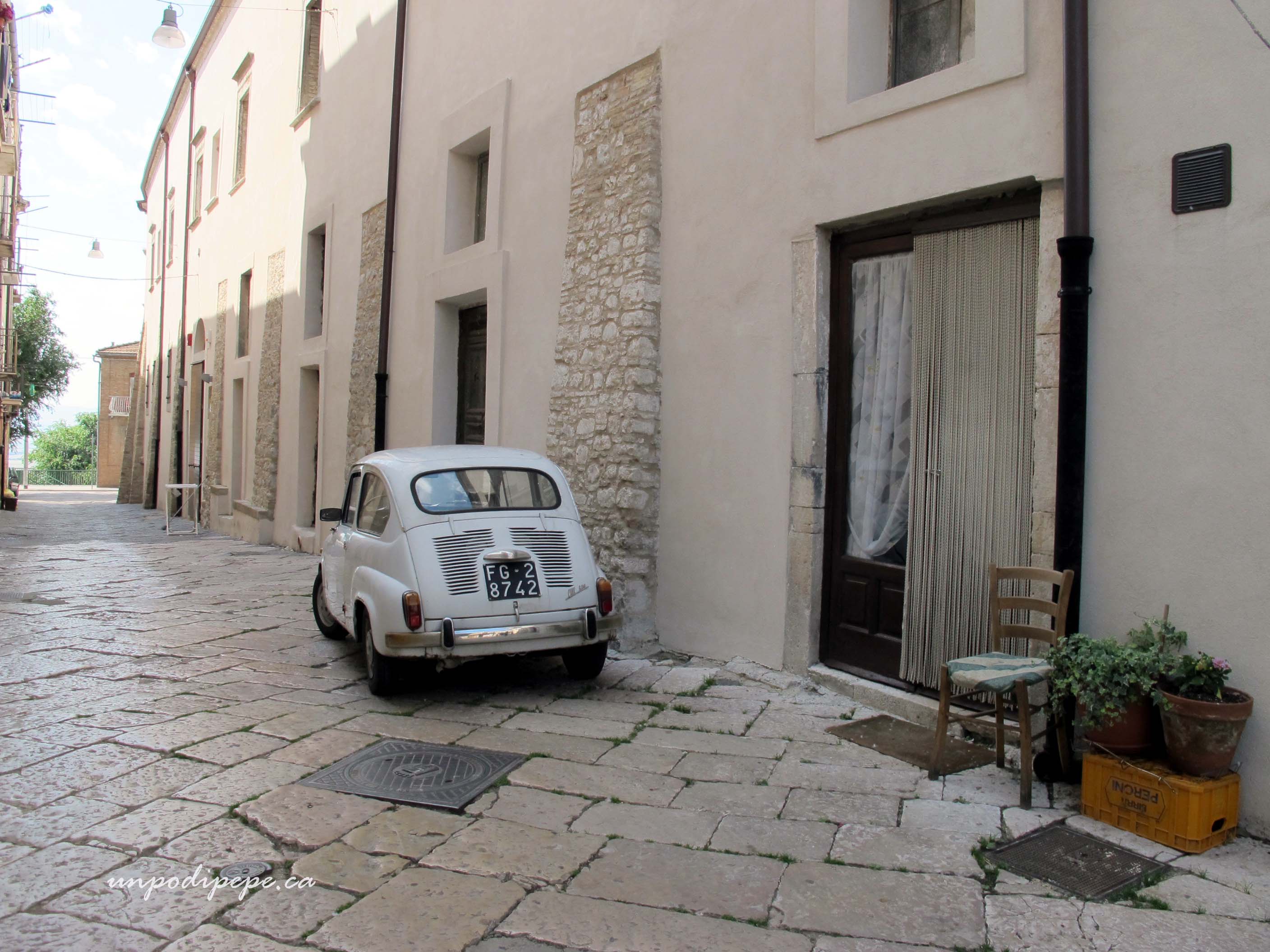
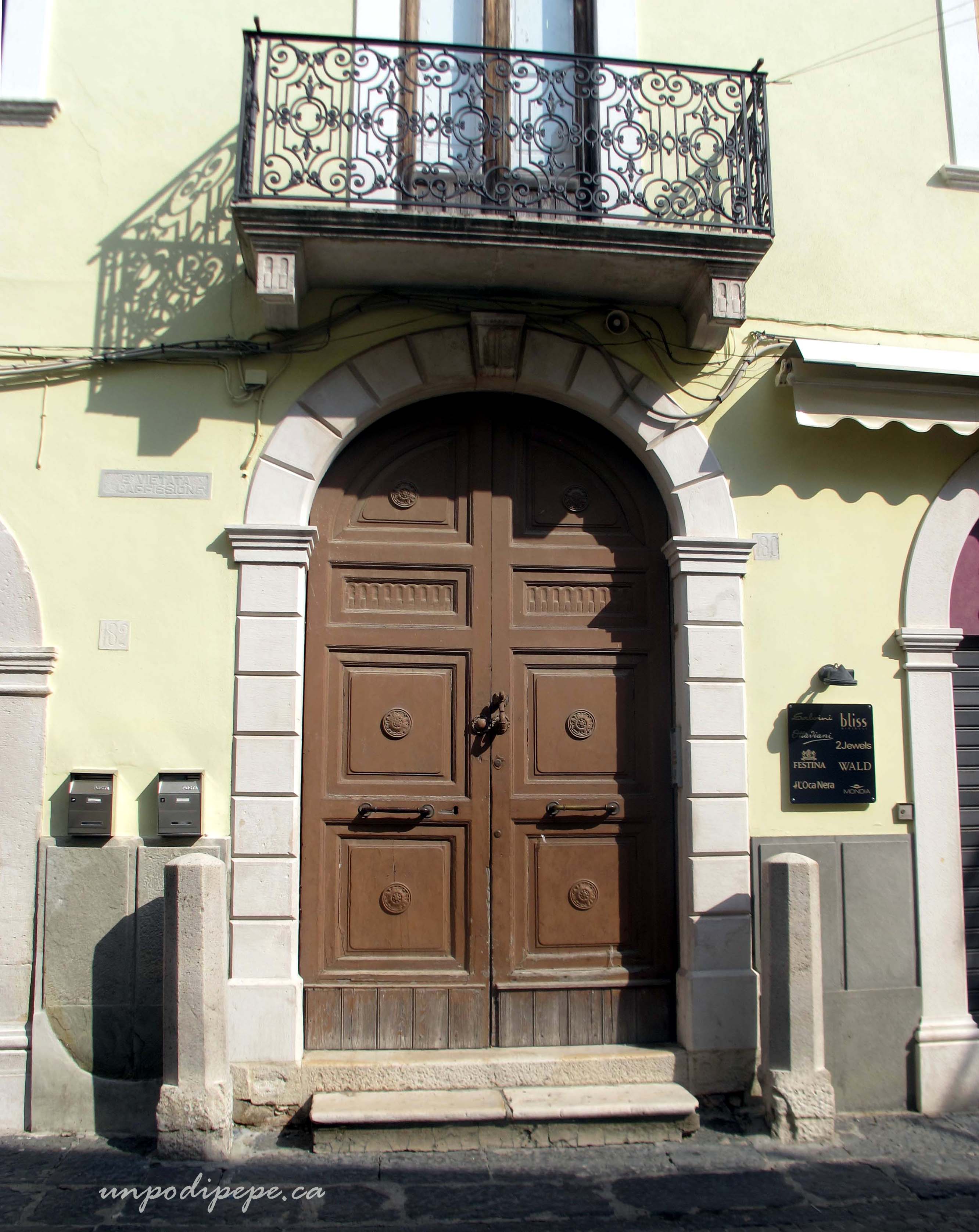
Il Museo del Tesoro della Cattedrale di Troia (the cathedral treasury) is worth a visit for rare 11th century parchments and other medieval sacred artifacts. There are only 32 illuminated Exultet codes (Easter scrolls) in the world, and 3 of them are here.  Also worth seeing is Il Capitello delle Quatre Razze (Column of the 4 Races).  This is a 13th Century column with 4 heads, one on each corner, depicting the 4 races of man known before 1492- European, African, Asian and Arab.  Admission is free, but it is only open Tuesday and Thursday 17:30-20 and Saturday 10-13.  Mondays are only open for school groups with appointments.  Call ahead, as they may open for groups 0881 97 00 20.Cattedrale di Troia, PugliaTroia is named for the ancient city, but unfortunately ‘troia’ is also Italian slang for ‘slut’.  My best guess is that the origin of this term is from Elena di Troia (Helen of Troy) who was an adultress.  Don’t let the name put you off though.  Troia is a charming town with a beautiful centro storico.  It is also way off the radar for most visitors to Puglia, so you will not find any crowds.Side street in Troia with Fiat Seicento (600) As an added bonus, you can find Nero di Troia vino everywhere!  Read more about this lovely vino in Vini di Puglia. My Zia lives in Troia, so I have been there a lot.  Here are some interesting Troia facts… #1-I had my confirmation at the Cattedrale di Troia when I was 15!  Interesting fact #2-Troia is the only municipality in Italia providing free public transportation! Via Regina Margherita doorway Troia, Puglia

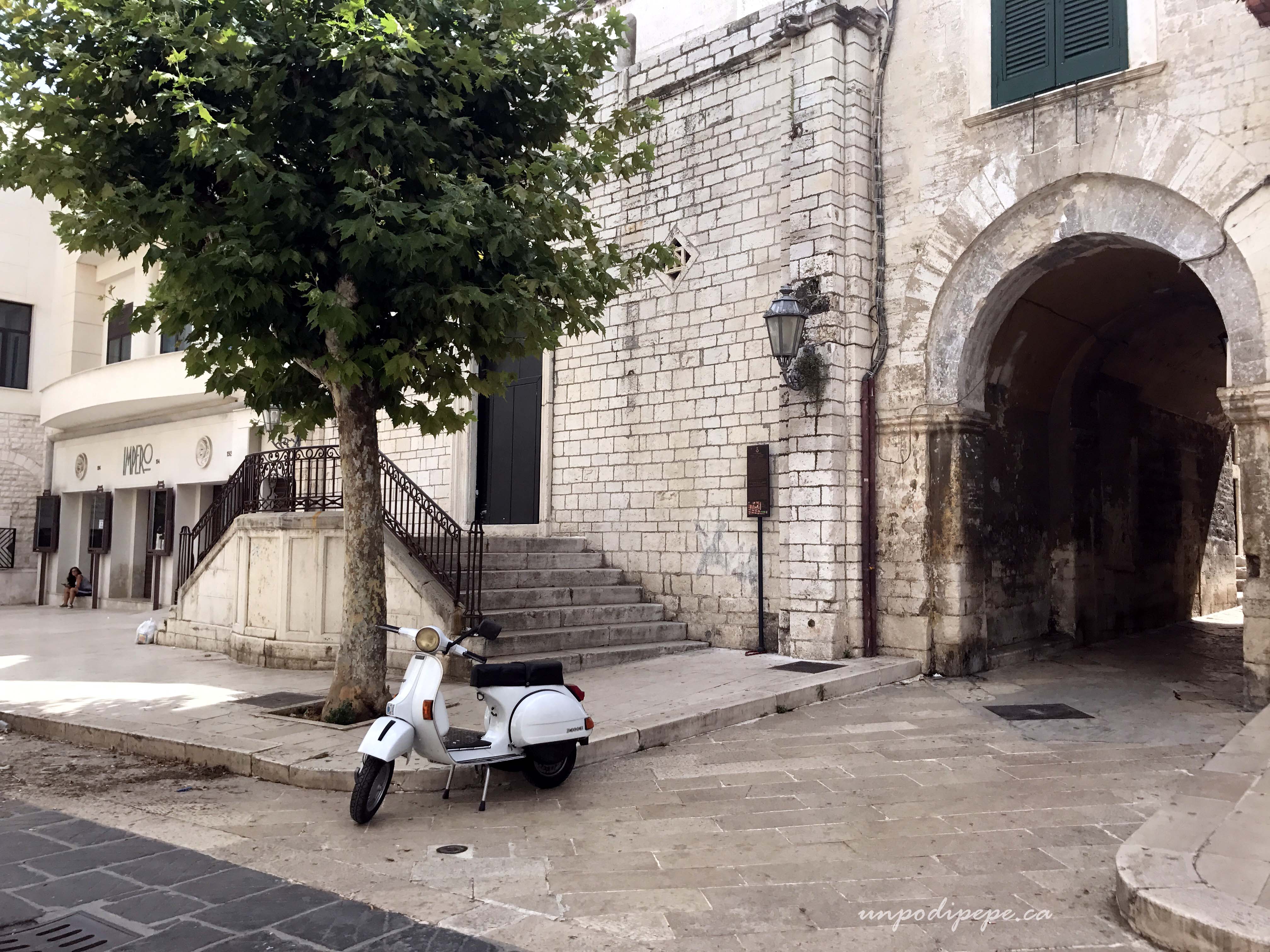
Get off the bus from Foggia or park the car near La Villa Comunale and Bar Cluny.  Walk down Via Regina Margherita to explore the centro storico.  The Cattedrale is half way down this long, narrow street, which is lined with shops and interesting doorways.  Stop at the award-winning Pasticceria e Gelateria Artigianale Aquilino for a decadent treat. Visit the oldest church in Troia, the Byzantine San Basilio with ox heads around the altar.  It was originally a Greek Orthodox temple. The haunted Palazzo D’Avolos is now home to the Civic offices and Civic Museum. Wander into the narrow side streets and you may come across a Fiat 600 or some work by local artist Leon Marino.House in Troia, Puglia with Leon Marino angel mural

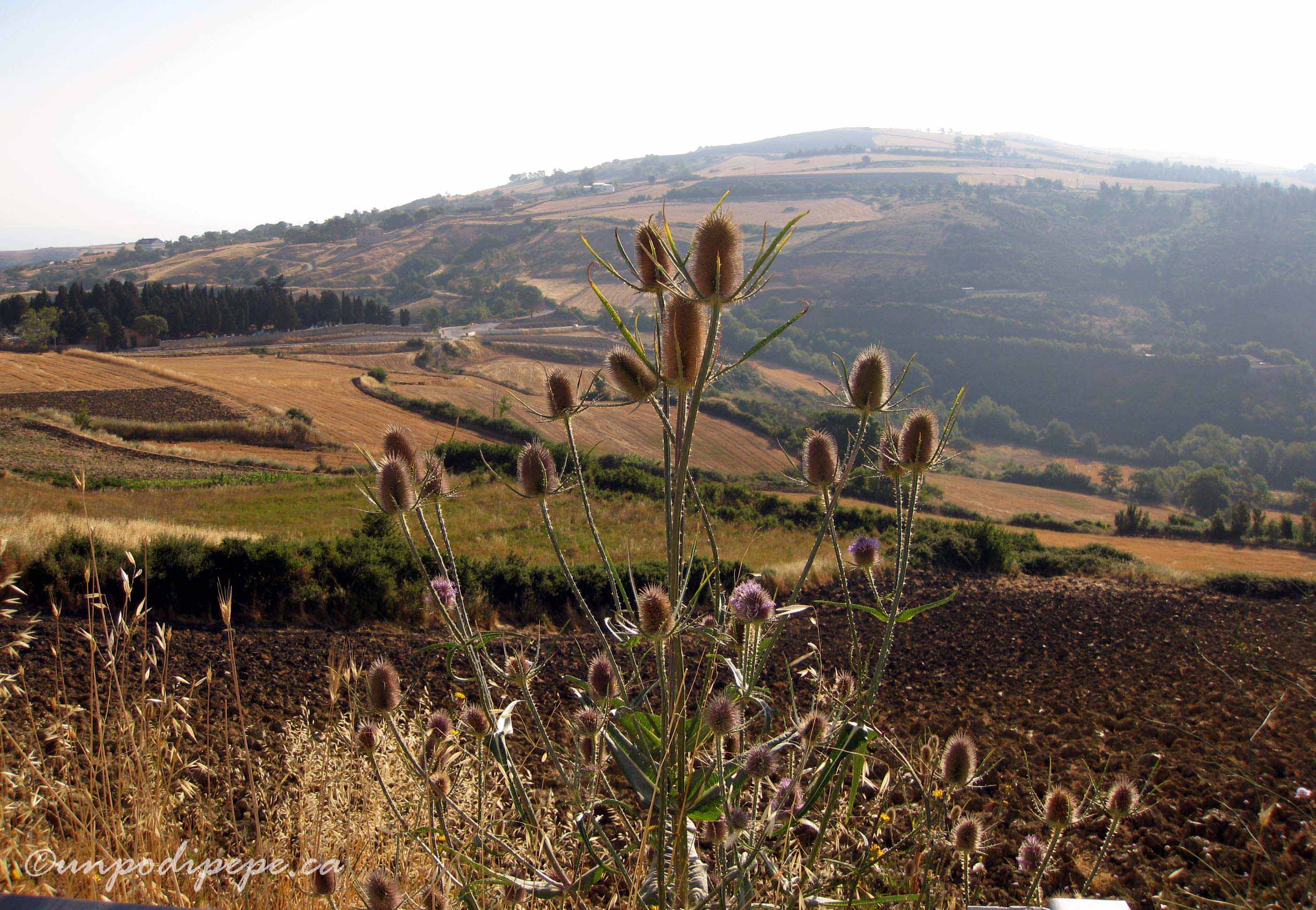
Troia has a population of  about 7000.  It is situated on a hill, 439 m above the Tavoliere plain, 22 km SW of Foggia, 15 km south of Lucera and 14 km east of Orsara di Puglia.  The surrounding landscape is a beautiful blanket of wheat fields, vineyards and olive groves- like the view from the abandoned Celle Sant’Antonio, just outside of Troia.  Celle Sant'Antonio, Troia Puglia

Ferrovie del Gargano buses arrive regularly from Foggia and Lucera. The ticket is €1.80.  If taking the train to Foggia, the bus station is conveniently next door. Troia has several B&B’s including Alba d’Oro, Stella and Svegliarsi nei Borghi.  There is even a car rental agency, Automottola, on the edge of town, towards Foggia.  For more information check out Troia’s website.Troia Cathedral and Via Regina MargheritaRead more about Troia and Diomede in Puglia-Mia Regione Preferita.  Have any of you readers who are not related to me been to Troia?

Ciao e buon viaggio, Cristina

Share this:

  • Click to share on Facebook (Opens in new window) Facebook
  • Click to share on Pinterest (Opens in new window) Pinterest
  • Click to share on X (Opens in new window) X
  • Click to email a link to a friend (Opens in new window) Email
  • Click to share on WhatsApp (Opens in new window) WhatsApp
Like Loading...

In my Kitchen in Puglia, 2019

07 Saturday Sep 2019

Posted by Un po' di pepe in Italian life, Mangiamo!, Orsara di Puglia, Puglia

≈ 36 Comments

Tags

Cavatelli, Fiori di zucca, In my kitchen, Nero di Troia, Orecchiette, Pancotto e patate, Pesto Genovese

August is always a busy month.  I am usually in Orsara di Puglia for at least half of it, and there is a lot of activity in my kitchen.  Here are just a few of the things my family and I were up to in our tiny but functional summer kitchen in Puglia.

Starting with the space itself, the whole casa is 40m² (about 450 square feet) including a bedroom and bathroom.  The room with the cucina is also the living room, guest room (aka my room) and art studio. The highlight of the room is the barrel vaulted stone ceiling. It is hard to get a photo of the whole thing, but this one gives you an idea what it looks like. Amazing, isn’t it?

August 5th is a feast day in Orsara.  It is la festa della Madonna della Neve which you can read about here.  My parents and I invited 7 family members over for pranzo, the 1pm meal.  Luckily we have a total of 10 chairs!

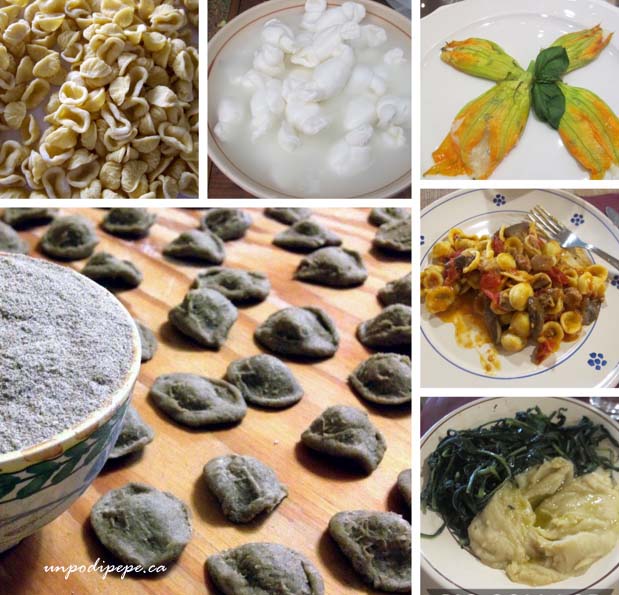
I had recently bought a spianatoia, although I only knew what is was called in dialetto.  It is a pasta rolling board with a lip on one end so it stays put on the table.  This one also has a handy carrying handle.  Cavatelli www.unpodipepe.caMamma and I decided to make orecchiette and cavatelli, even though both of us were out of practice. These are the most typical pasta shapes found in Puglia.Orecchiette www.unpodipepe.ca  Sugo con braciole They was served with sugo made with braciole which are thin cuts of meat rolled with prosciutto, parmigiano, parsley and garlic. Orecchiette con sugo

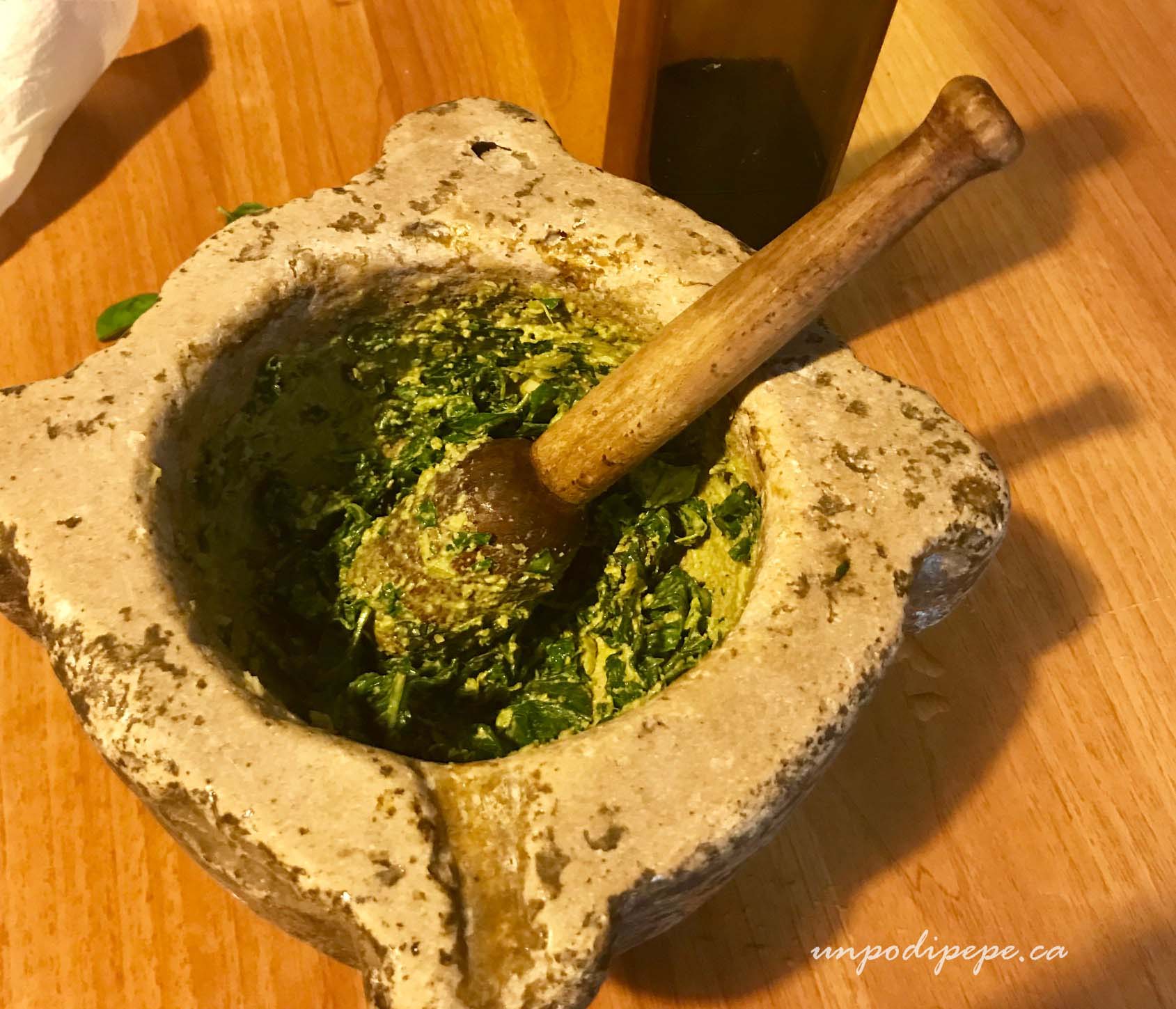
There are no fancy appliances in this kitchen.  I was given a bouquet of basilico and garlic from a friend’s garden and we made pesto ‘old school’ with her ancient and very heavy stone mortaio-mortar.Pesto made with old stone mortar/mortaio

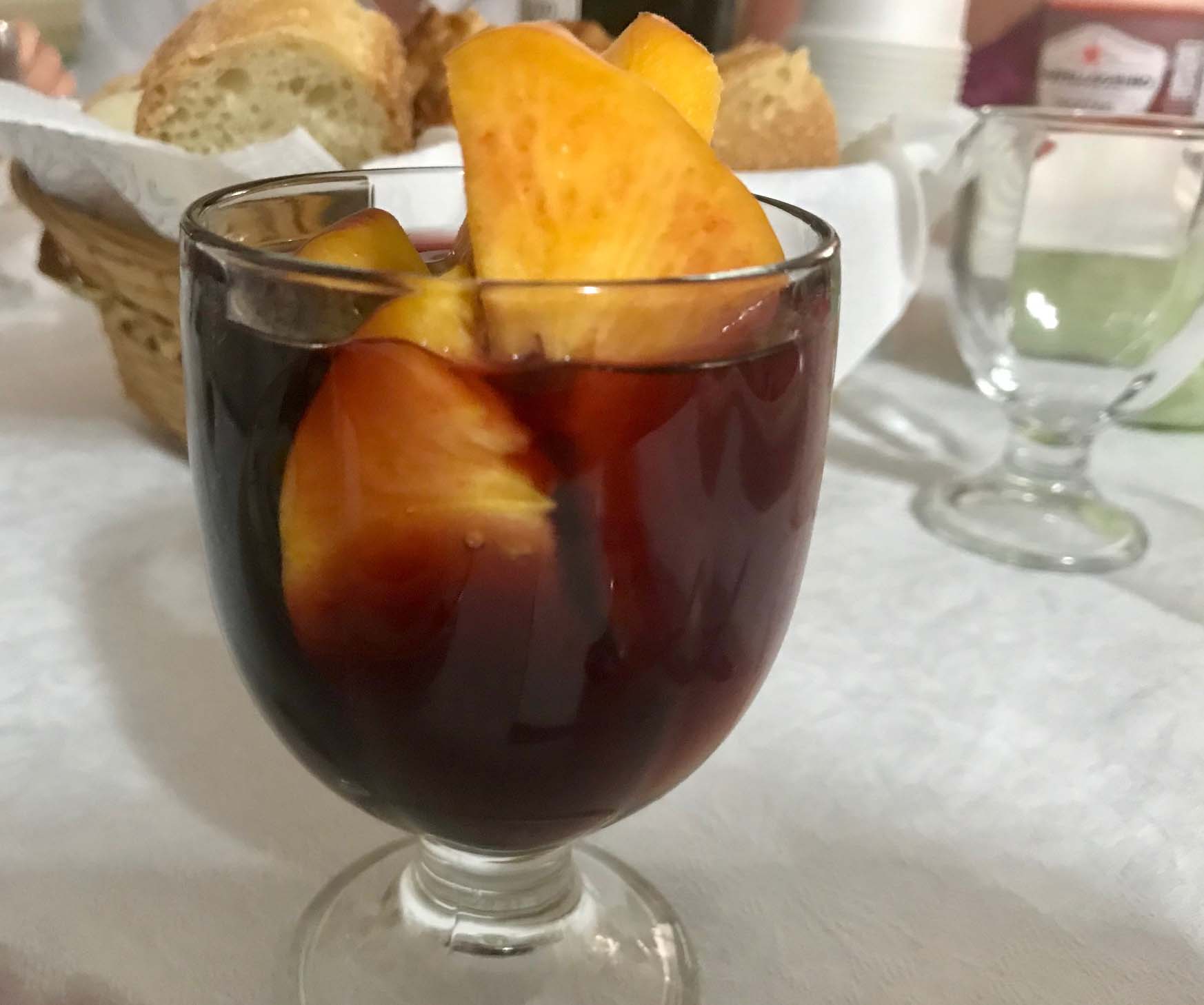
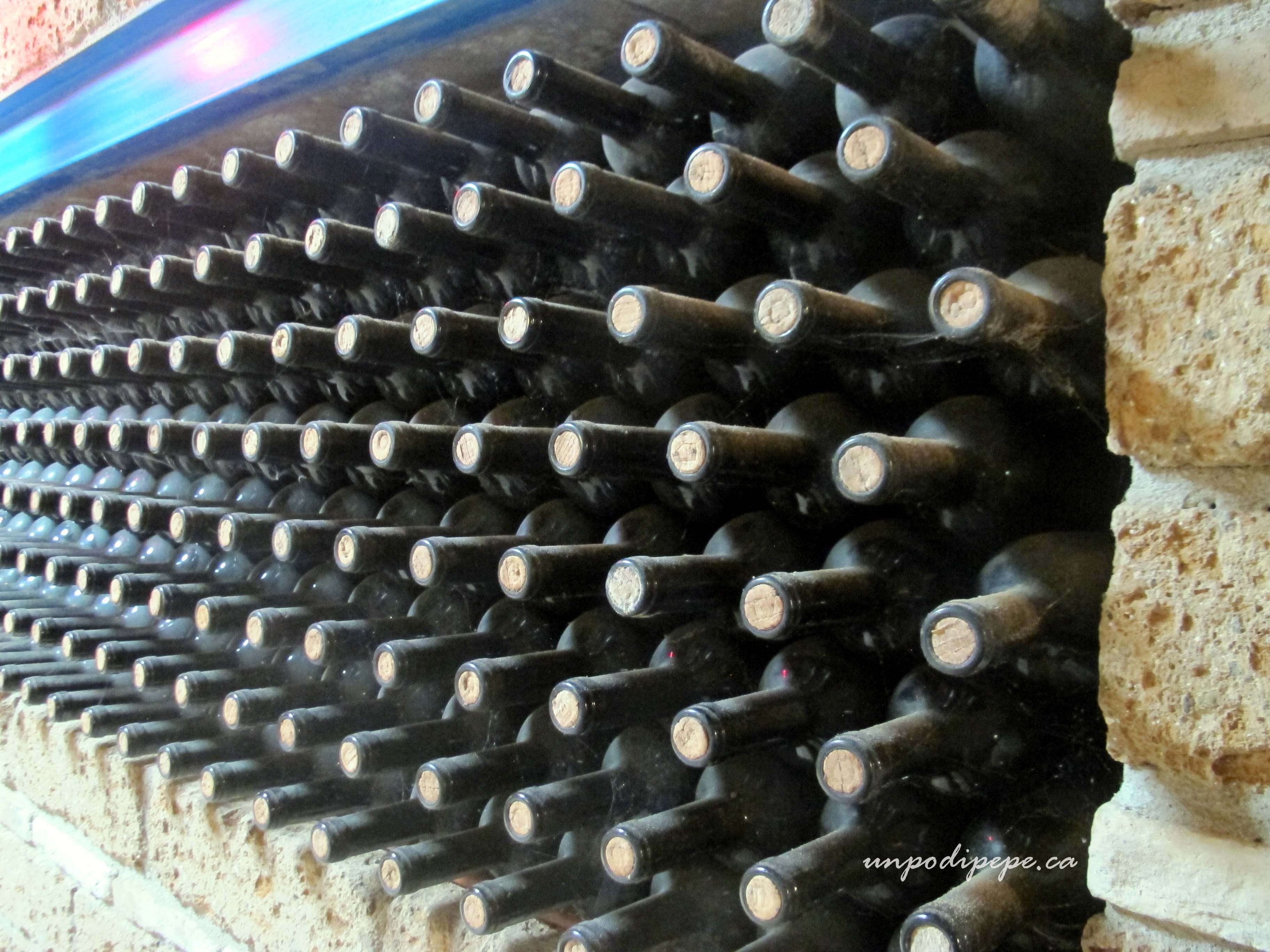
Vino is plentiful in Puglia.  Nero di Troia is a nice, full-bodied local wine.  Read more about it in Vini di Puglia, the first of a 3 part blog series.  It is available at the grocery store in a 3L plastic container for less than €6!  It is very good!  We bring it home and Papà transfers it to 4 750ml glass bottles.  Sure, you can spend more money, but even the inexpensive vino is good.  I love to drink pesche in vino -peaches in wine with pranzo.  Yum! In summer red wine is often served chilled.

The cheese products in Puglia and Campania are drool-worthy!  Orsara has its own DOP cheese called cacioricotta, a goat cheese, but it never stays around long enough to be photographed!  Here is a lovely white on white trio of burrata, ricotta and mozzarella di bufala.Burrata, ricotta e mozzarella di bufala

Fiori di zucca are one of my favourite summer foods.  Luckily they are readily available here.  These ones were grown by a friend.  They are stuffed with caciocavallo and basilico, ready to be baked or grilled.  More recipe and harvesting tips can be found in the post Fiori di zucca.  I grow them in my garden in Vancouver as well, but they are not that plentiful. Fiori di zucca

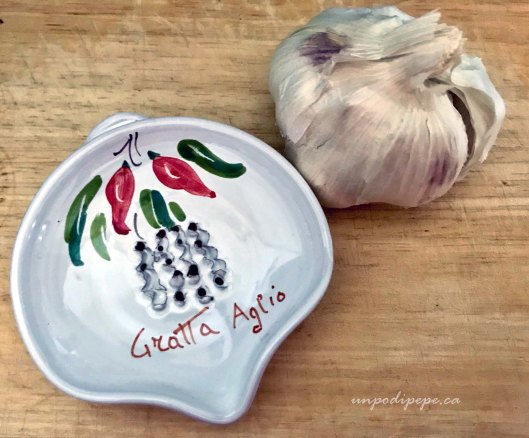
Cucina povera, literally ‘food of the poor’, is what you will find in Puglia.  Simple foods made with fresh local ingredients.  My favourite comfort food, very typical of Orsara di Puglia is pancotto e patate.  It is made with stale bread, boiled potatoes, oil and garlic.  Beans and rucola or other greens can also be added.  I will have to write a post on how to make it!Pancotto, patate e rucolaI took the train down to Lecce and Nardò for a few days and found this cute ceramic gratta aglio, a garlic grater.  Of course the peperoncini attracted me! Gratta aglioI hope this post has made you either hungry and drooling or wishing you could visit Puglia yourself.  Maybe it has done both? Buon appetito e buon viaggio, CristinaThanks Sherry from Australia for hosting the monthly food blogging event, In My Kitchen (IMK). Read about other world kitchens by clicking the link to Sherry’s Pickings . Buon appetito, Cristina

Share this:

  • Click to share on Facebook (Opens in new window) Facebook
  • Click to share on Pinterest (Opens in new window) Pinterest
  • Click to share on X (Opens in new window) X
  • Click to email a link to a friend (Opens in new window) Email
  • Click to share on WhatsApp (Opens in new window) WhatsApp
Like Loading...

Puglia~Mia Regione Preferita

26 Sunday May 2019

Posted by Un po' di pepe in Italia, Photography, Puglia, Travel, Vino

≈ 26 Comments

Tags

Cucina povera, Cucina Pugliese, Diomedes, Dolcevitabloggers, Parco Nazionale del Gargano, Romanico Pugliese, Southern Italy, Top 10 reasons to love Puglia, Trabucchi del Gargano, UNESCO World Heritage Sites, Vini di Puglia

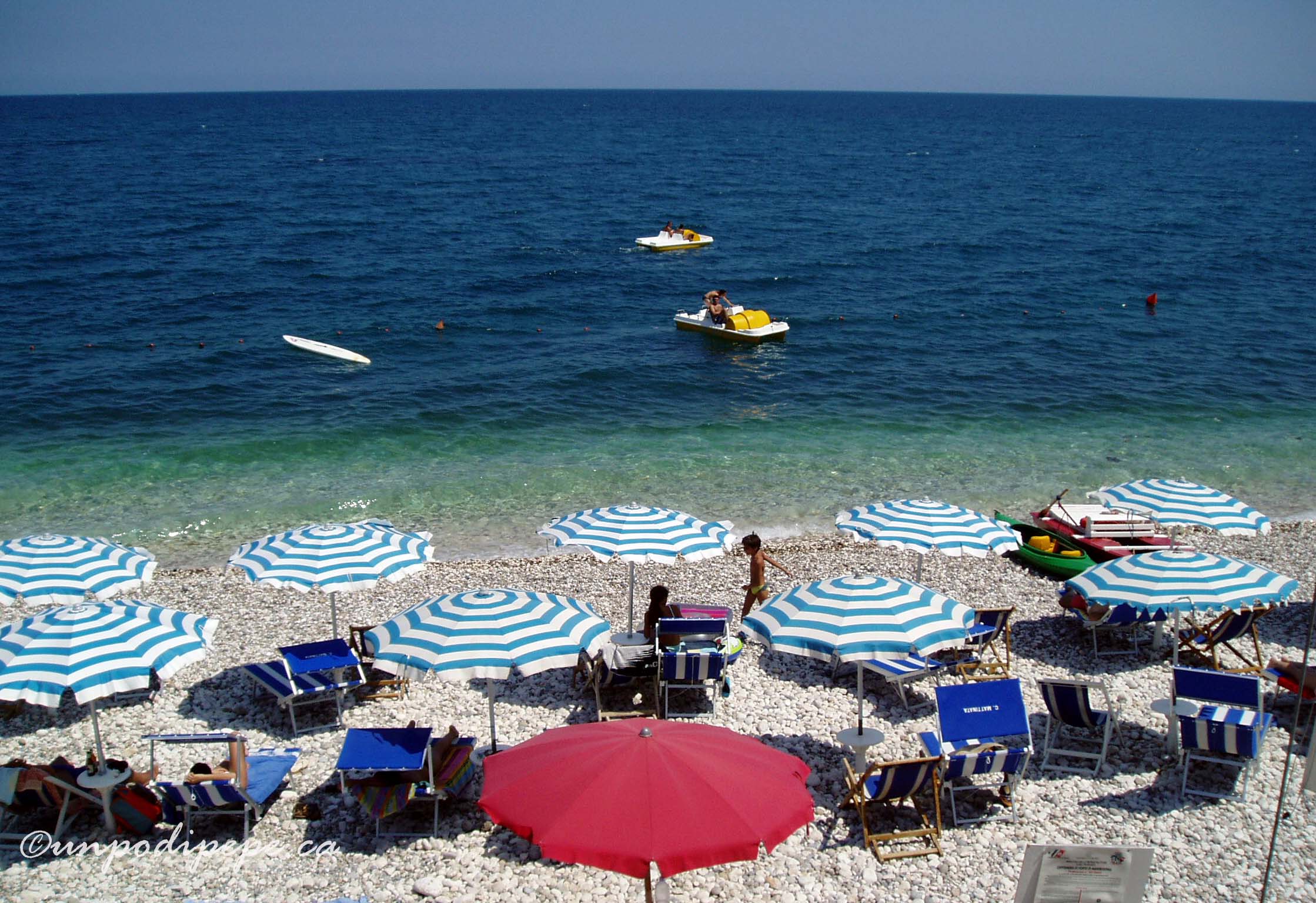
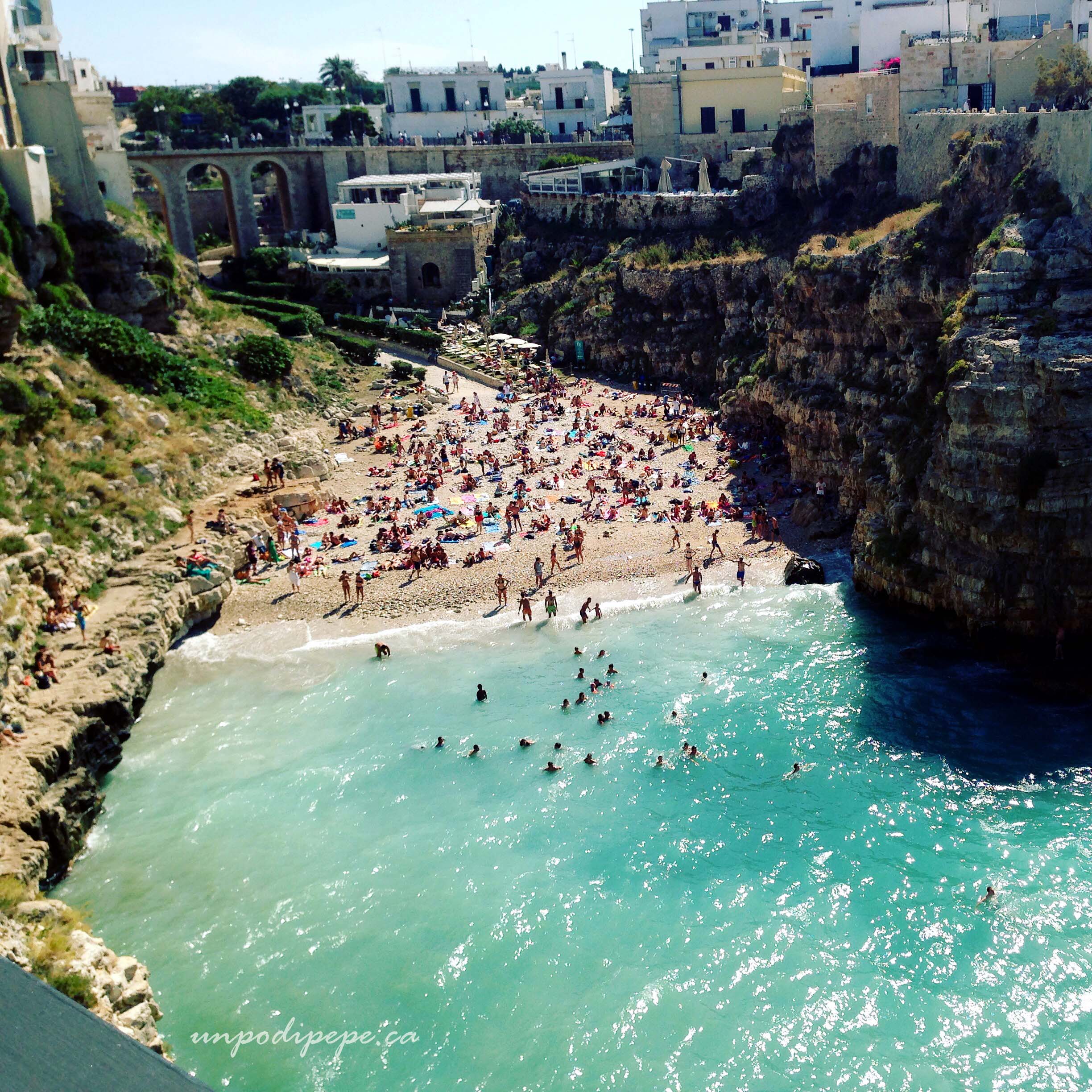
Italia has 20 regioni /regions. So far, I have been to 14 of them.  I love them all, but my absolute favourite is Puglia.  Why?  Well, aside from the obvious reason that it is home, there are countless others.  I have narrowed this post down to my top 10 reasons to love Puglia-in no particular order.  There are a lot of links to previous posts included here.  Please check them out!  Many of my Puglia posts were written when this blog only had about 27 readers, 80% of them related to me.  These posts need some new love!1) 840 km of coastline-That is a lot of beach!  The transparent turquoise colour of the water is real.Earlier this month, 13 Pugliese beaches received the environmental designation Bandiera Blu, including Polignano a Mare, Margherita di Savoia and Peschici.
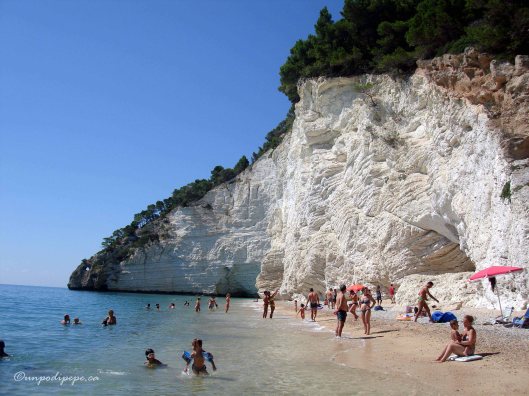
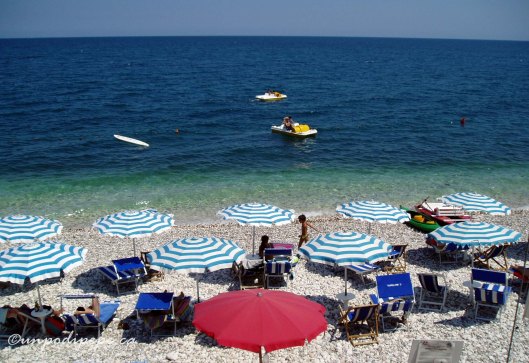
2) Cucina Pugliese is rustic cucina povera or peasant food, focusing on the freshness and simplicity of the ingredients that are in season.   Orecchiette con sugo

Pugliese specialties include orecchiette al sugo, orecchiette con cime di rape, grano arso, fave e cicorie, burrata, pancotto e patate, panzerotti, polpo, pesce, focaccia Pugliese, taralli, cartellate, pasticciotto, and pizza con la ricotta.  Everything is drizzled with Pugliese ‘liquid gold’, extra virgin olive oil.Cucina Pugliese 1

Cucina PuglieseI hope I have made you hungry.  Buon appetito!

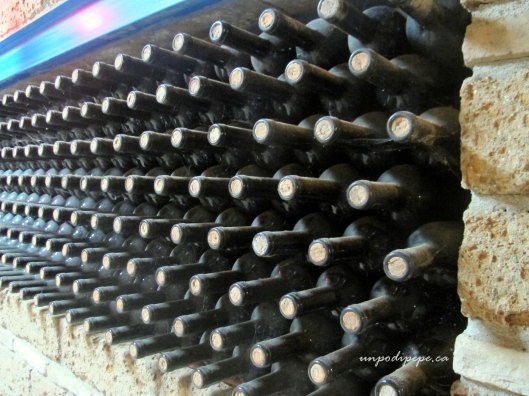
3) Vino- Oenotria ‘Land of Wine’ is the name the ancient Greeks gave Puglia. 425 km long, Puglia has a diverse agricultural landscape with mountains, plains, the Mediterranean sun, coastal sea breezes and fertile soil.  The climate is hot and dry, especially during the summer.  The name Puglia comes from the Latin ‘a pluvia’ meaning without rain. These environmental features, plus the presence of vitigni autoctoni (Native or Indigenous species of grapes) create an ideal environment for growing grapes and producing vino.
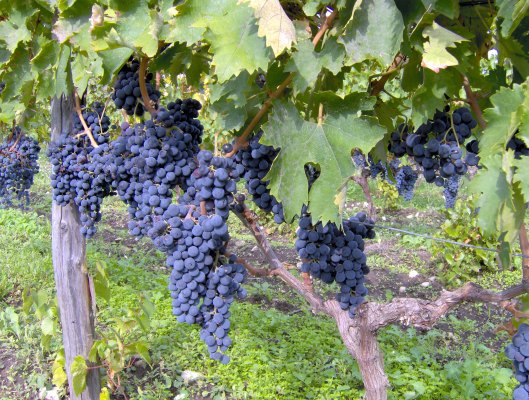
Vino is my favourite topic of research.  A few years ago, I published a Vini di Puglia trilogy-a series of 3 blog posts on the wines of Puglia!  Vini di Puglia is about the ‘big 3’ Negroamaro, Nero di Troia and Primitivo.  Part 2 Aglianico to Zibibbo is about all the other grapes of Puglia plus a glossary of viniculture terms in Italiano.  Il Tuccanese a grape native to Orsara di Puglia is the last post in the trilogy. Salute!
4) Architettura. Puglia has it’s own architectural style-Romanico Pugliese (Pugliese Romanesque).  Puglia was at the crossroads between Europe and the Crusades in the 11th-13th Century.  Many cattedrale were built in this style,  including those in Troia, Trani, Bari, Otranto, Molfetta, Bitonto, Siponto and Ruvo di Puglia.  Romanico Pugliese is a unique architectural style distinguished by elements of both Eastern and Western elements. These include vaulted ceilings, Byzantine semicircular cupolas, porticoes held up by marble lions, and intricate decorations with classical Byzantine and Arab features. The Romanesque Cathedrals in Puglia are on the UNESCO heritage sites tentative list, which is the step before heritage designation.  Troia cattedrale Romanica Pugliese

The 11 sectioned rosone pictured here of the Cattedrale di Troia built in 1145 AD looks like it is woven in stone.  Other architectural styles specific to Puglia are the Barrocco Leccese found in Lecce and the mysterious Castel del Monte near Andria built by Federico II, which is its own unique entity.

5) Promontorio del Gargano One of the most beautiful areas on earth, Il Promontorio del Gargano (gar·GAH·noh) is the promontory sticking out above ‘il tacco’, the heel of Italia.  You can also think of it as la caviglia-the ankle spur of Italia.  Surrounded by the Adriatico on 3 sides, the area is more like an island; biodiverse with unique flora and fauna. Most of the promontorio is a protected area and marine reserve, Il Parco Nazionale del Gargano, which includes le Isole Tremiti and the ancient Foresta Umbra. Fortunately, this has prevented development by large multinational hotels and resorts.San Domino Isole Tremiti, Puglia

Il Gargano is famous for picchi (woodpeckers) and other birds, 300 varieties of orchids, almonds and olives.  There are endless ancient hillside olive groves, pine forests, sea grotte, limestone cliffs, rocky shores, crystalline water and fresh seafood.

Baia delle Zagare, Puglia

Baia delle Zagare

The winding road around the Gargano, SS 89 from Foggia, has sharp turns and viste mozzafiato (VIS·teh moz·zah·FYAH·toh)-breathtaking views. One of my favourite viewpoints is La Baia delle Zagare, where the battle scene between the Amazons and Germans in the movie Wonder Woman were filmed!

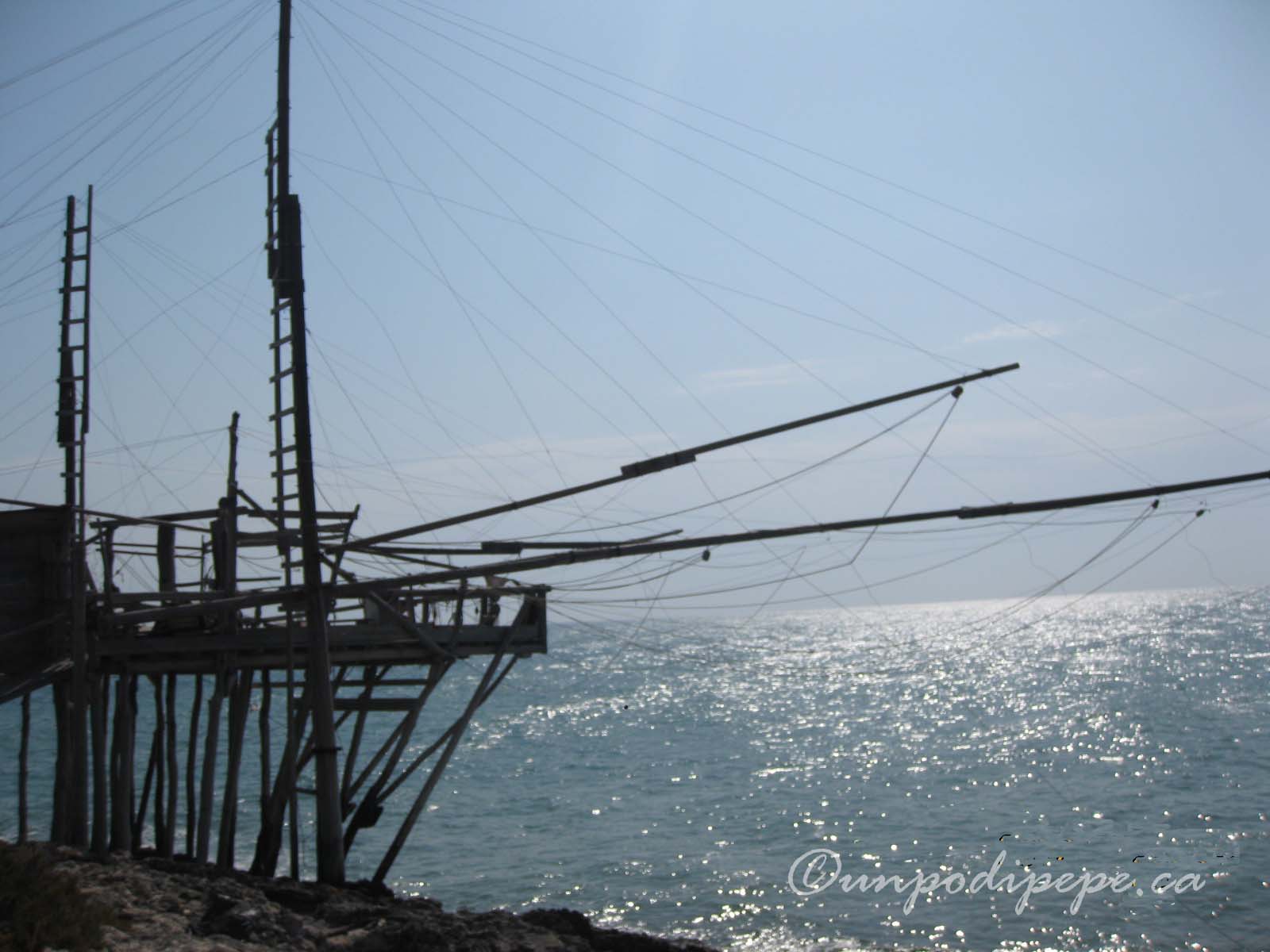
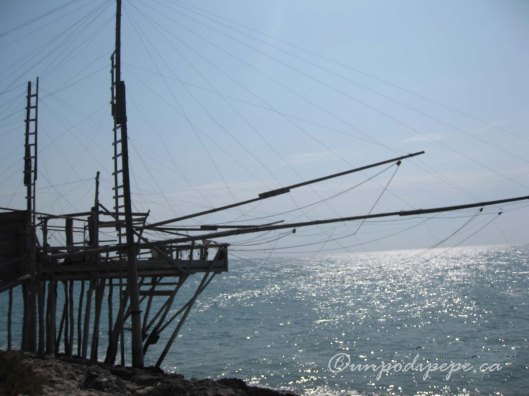
6)Trabucchi  Trabucchi (tra∙BOO∙kkee) are old fishing contraptions found on the Adriatic coast of Abruzzo, Molise and Puglia. The design probably dates back to the ancient Phoenicians.  Trabucchi have fascinated me since I was a child, taking l’Adriatico, the night train from Bologna to Foggia on a stormy night.  They looked like giant alien octopi coming out of the sea!  There are 13 functioning trabucchi on the coast of the Promontorio del Gargano between Peschici and Vieste, the oldest dating back to the 18th century.  They are protected as National cultural heritage sites within the Parco Nazionale del Gargano. Read more in I Trabucchi del Gargano.
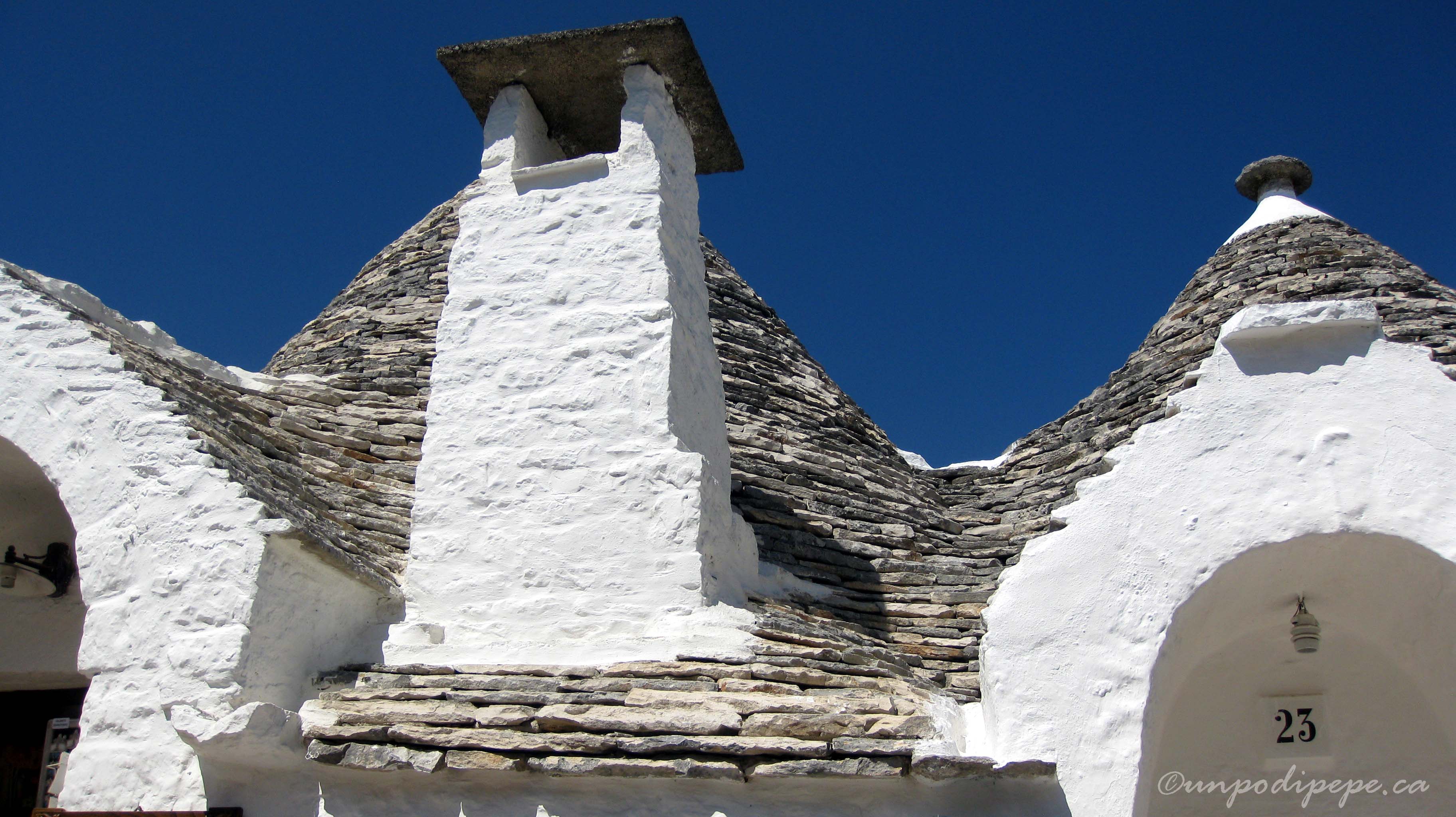
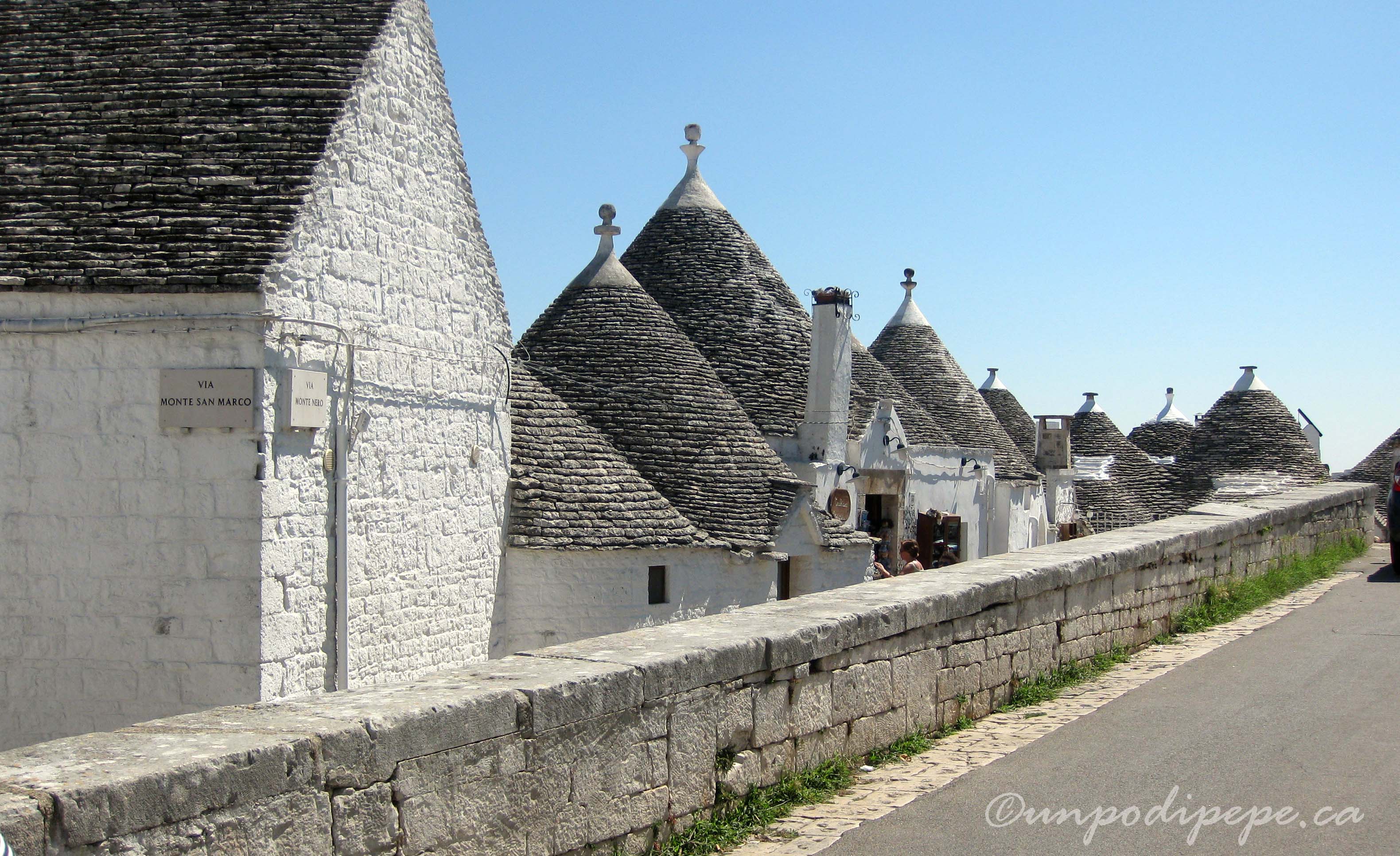
7) Trulli-These traditional limestone houses are unique to the Val d’Itria in Southern Puglia.  They were built ‘a secco’, which means dry-without mortar.  Trulli have domed cone-shaped roofs built up of overlapping grey limestone slabs called chiancharelle (kyan•ka•REL•leh). 

‘La Zona dei Trulli’ includes the areas around Locorotondo, Fasano, Cisternino, Martina Franca, Ceglie Massapica and the largest concentration of 1,620 trulli in Alberobello.  Alberobello and its trulli are a UNESCO World Heritage Site.  Read more about trulli in I Trulli di Alberobello.   Trulli Alberobello8) History/Connection to the Iliad  Can any other region say it was founded by a Trojan War hero?  According to legend, after the fall of Troy the mythical hero Diomede (Diomedes) found out his wife had been unfaithful.  Instead of returning home to Argos, he sailed the Adriatic, created the Isole Tremiti, and then was invited by Daunus, King of the Daunia (modern Provincia di Foggia) to settle there.  Diomede allegedly planted the first grape vines in Puglia, brought with him from Greece. He also founded many other towns in Puglia.  Diomede was allegedly shipwrecked and died near the Isole Tremiti.
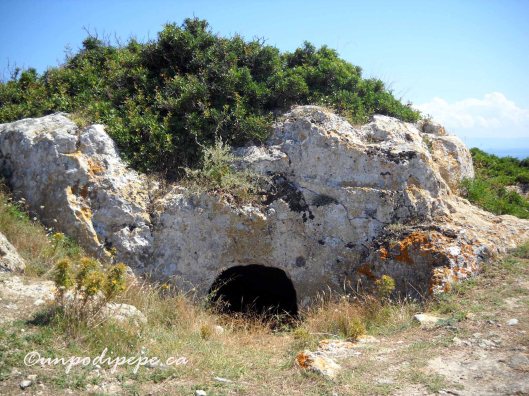
tomba di Diomede Isole Tremiti

La tomba di Diomede on San Nicola.

An unmarked Hellenic period tomb on San Nicola is known as ‘la tomba di Diomede’. According to legend, his crew was so upset that the Goddess Venus took pity on the grieving men and turned them into birds that continue to cry for their loss. The scientific name for the Great Albatross common in the area is ‘Diomedea’.  These birds look like seagulls and sounds like a crying newborn.  There is a scene in Fellini’s fim ‘Otto e mezzo’ (8½), where a cardinal tells this story to Guido (Marcello Mastroianni).

A Diomedea, San Domino

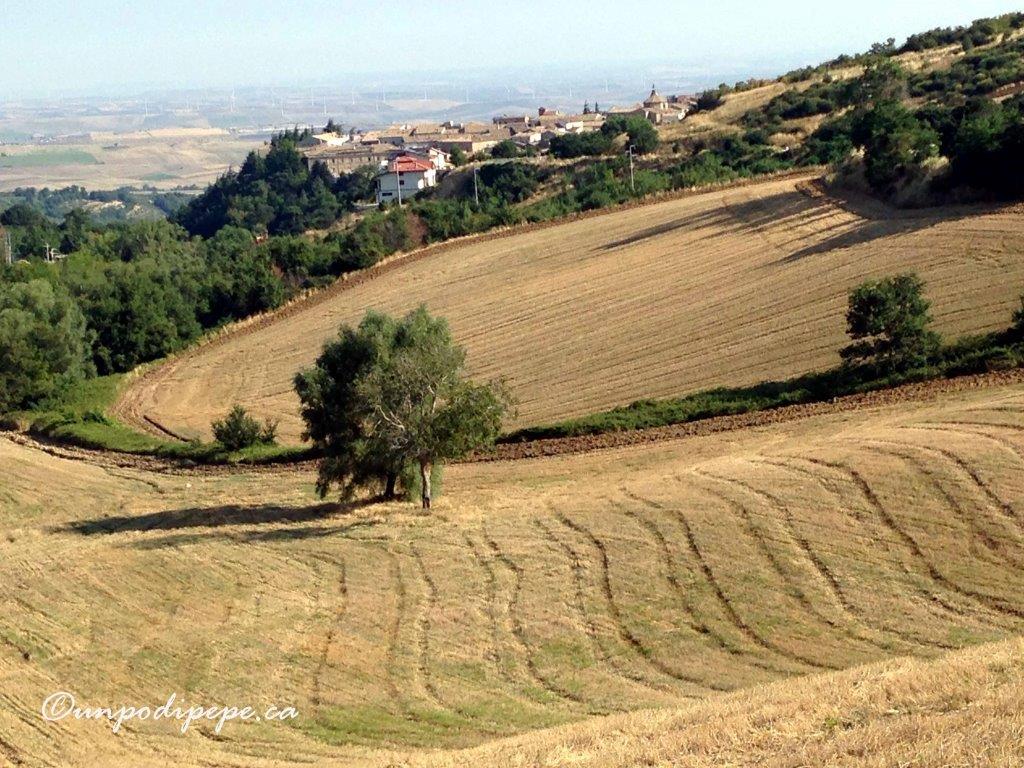
Orsara di Puglia landscape9)Paesaggi- The landscape of Puglia is varied and beautiful, made up of wheat fields, olive groves, vineyards and rocky coastline.  The region has 60 million olive trees,  including ulivi secolari-centuries old trees with knotted, gnarled trunks that have been twisted by time and wind.  Puglia’s trees produce 40% of the olive oil in Italia.

10) Slower pace Most of Puglia is still very much ‘real italia’, less commercialized and touristy, with great places to visit.  I am often told my photos look like they are from old movie sets.  Even though Puglia is often on the ‘places to see this year’ lists, it is uncrowded.  This is partly because it is poorly served by public transportation, and also because most foreigners visiting Puglia only go to the Salento and Alberobello! Italians from other regions travel to Puglia a lot, making it a great place to practice speaking italiano! Check out the posts A Perfect day in Italia and Il Sole di Metà Pomeriggio for more paese scenes.Fiat 500K Giardiniera AutobianchiHave you been to Puglia, mia regione preferita?  Let me know in the comments.

This post is written as part of the #dolcevitabloggers monthly blogging linkup, hosted by Jasmine, Kelly and Kristie the 3rd Sunday of the month.  Click the link to check out what the rest of the Dolce Vita bloggers have written on this month’s topic.Porto, San Domino, Isole Tremiti, Puglia

Ciao, Cristina

Share this:

  • Click to share on Facebook (Opens in new window) Facebook
  • Click to share on Pinterest (Opens in new window) Pinterest
  • Click to share on X (Opens in new window) X
  • Click to email a link to a friend (Opens in new window) Email
  • Click to share on WhatsApp (Opens in new window) WhatsApp
Like Loading...

Tutti i Santi

01 Thursday Nov 2018

Posted by Un po' di pepe in Feste, Italia, Italian Folklore, Orsara di Puglia, Photography, Puglia

≈ 12 Comments

Tags

#quinonehalloween, All Saints' Day, Falò e Teste del Purgatorio, Fucacoste e Cocce Priatorje, Muscitaglia, November 1st, Pugliese Traditions, Pumpkin carving, Southern Italy, Tutti i Santi Festa

November 1st is Tutti i Santi-All Saints’ Day and is a national holiday in Italia.  It was created in the 9th century when the Pope superimposed a Christian feast day onto existing rituals, so this festa has been around for a very long time. Tonight is also an ancient festa celebrated in Orsara di Puglia called Fucacoste e Cocce Priatorje which is dialetto Orsarese for ‘Falò e teste del Purgatorio’.  This translates to ‘Bonfires and heads from purgatory’ the ‘heads’ being zucche lanterne-carved pumpkin lanterns. For simplicity, it is also called ‘Tutti i Santi’ or ‘La Festa dei Morti’.

The night between November 1stand 2nd provides the opportunity to honour, reconnect and pay respect to the spirits of loved ones.  I wrote about the festa in a 2014 post Fucacoste e Cocce Priatorje, but at that time I had not attended.  I had only heard about it from my parents, family and friends.  Last year I had the opportunity to attend. It was cold but the night was clear and an absolutely amazing, magical, spriritual experience-for me and at least 20,000 others. Orsaresi who live in other parts of Italia and Europe come home for the festa, and visitors come from all over Puglia. Since it is a holiday, many families are able to take an extra long weekend known as il Ponte dei morti.

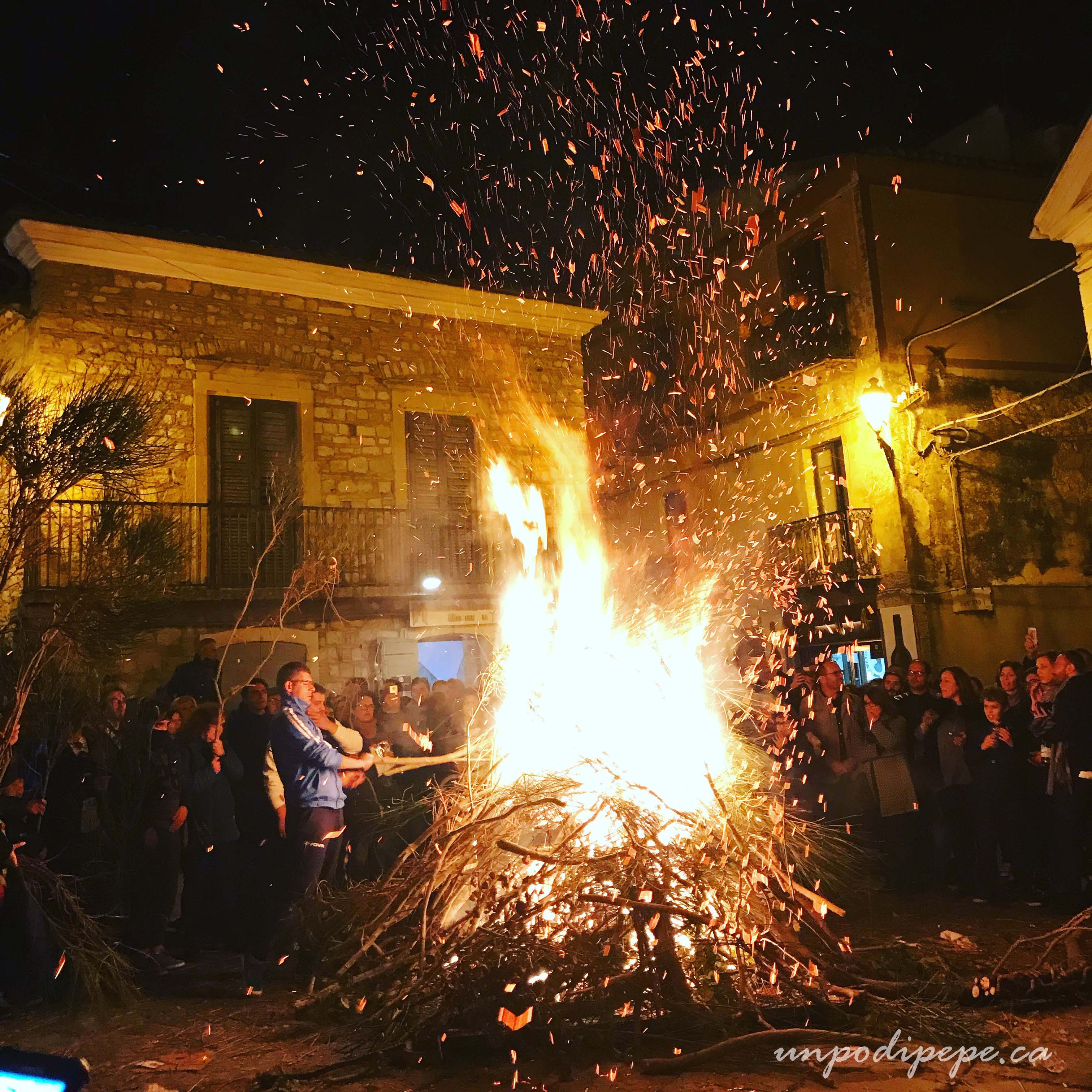
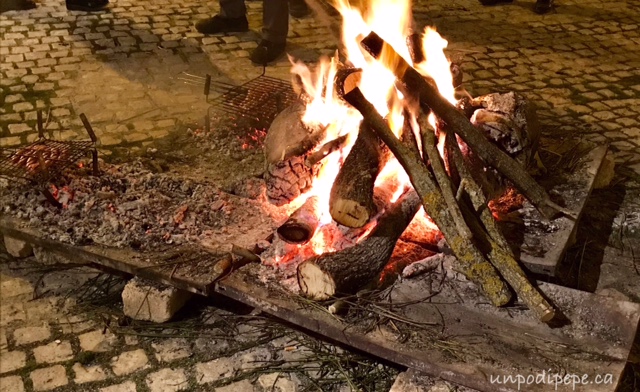
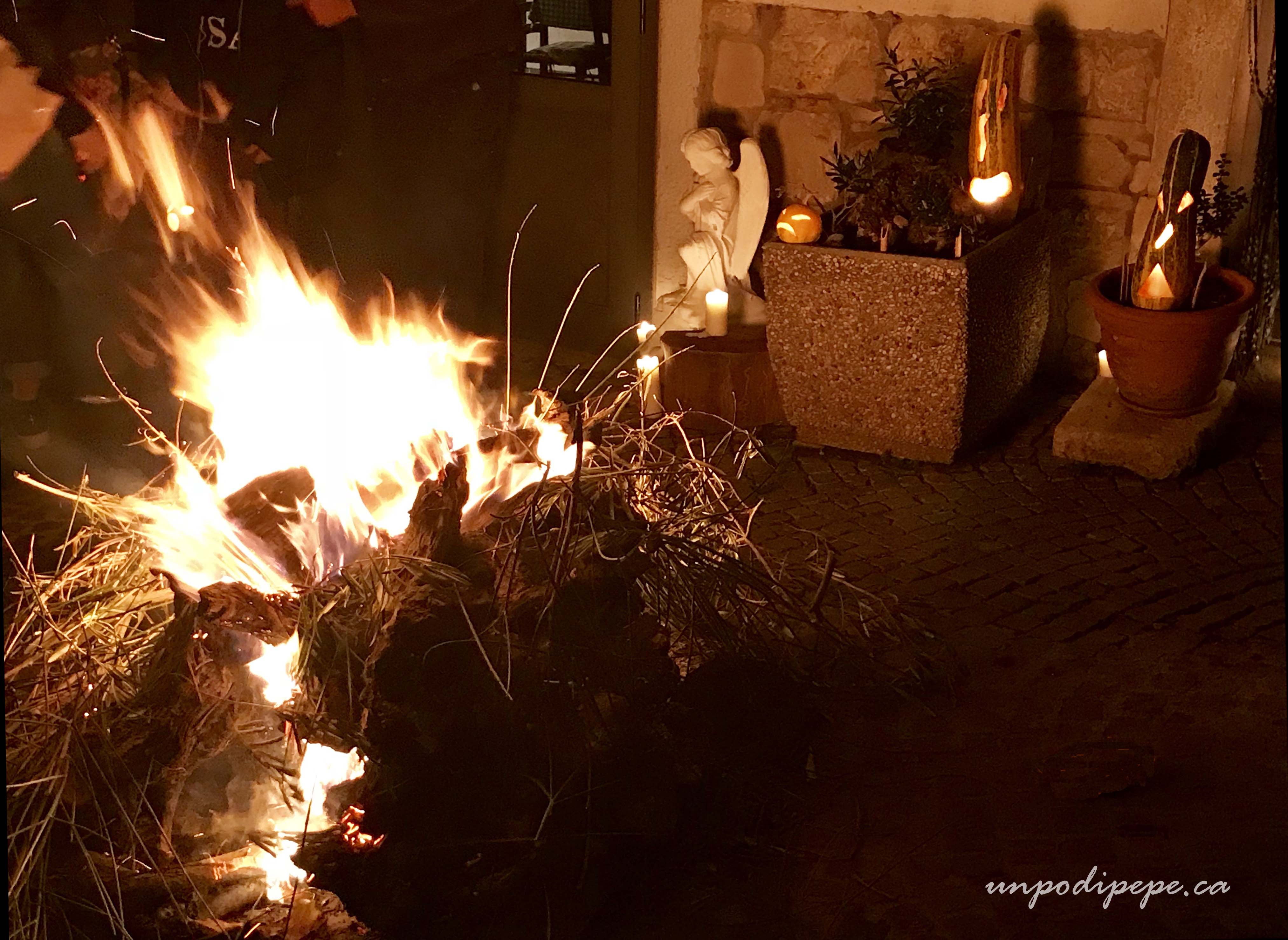
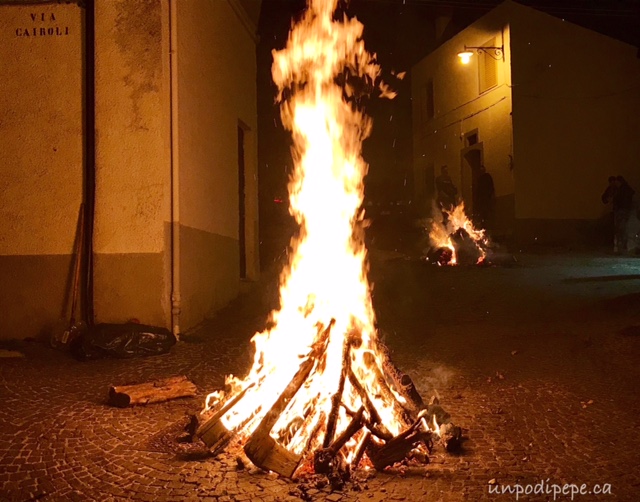
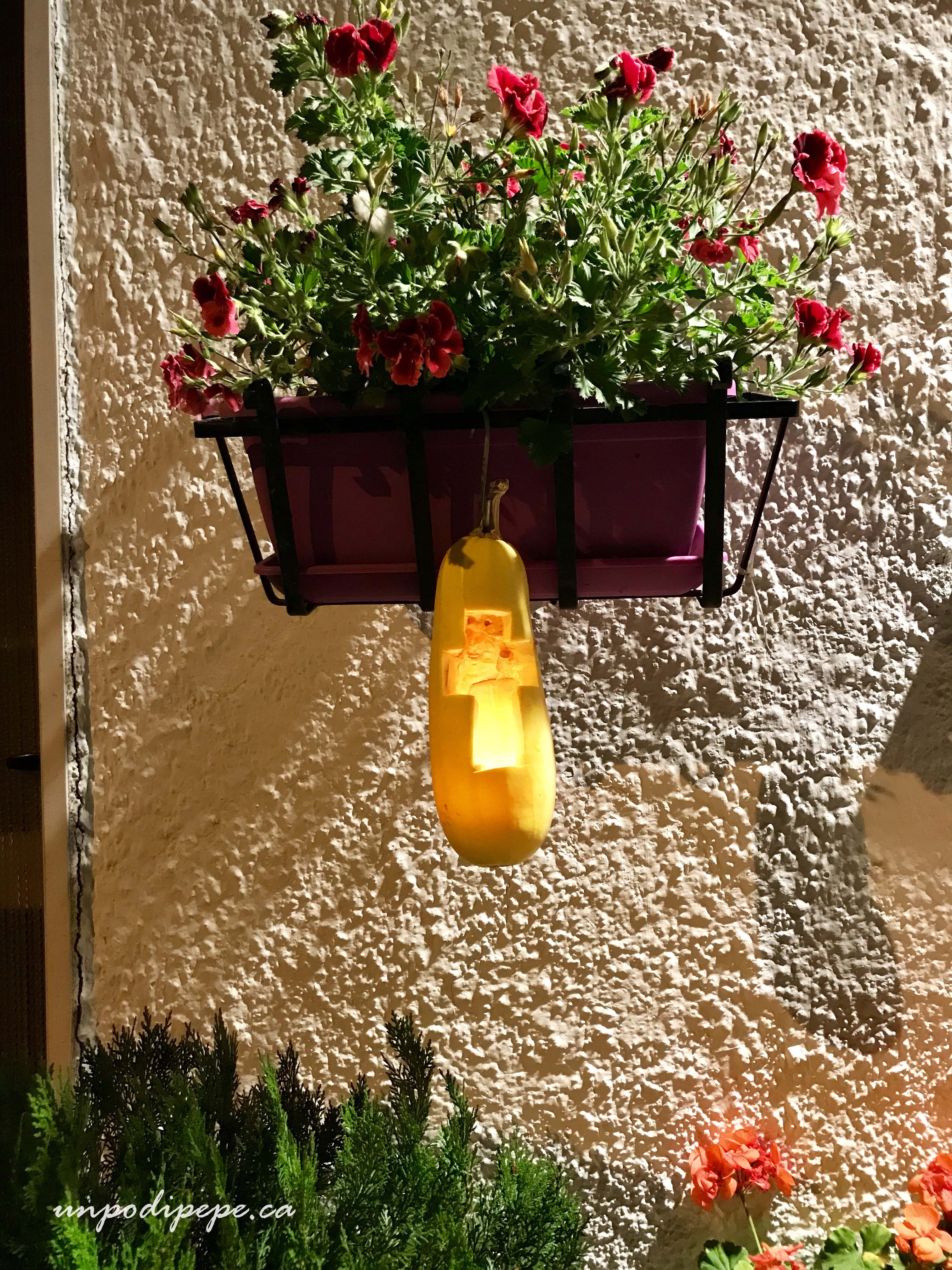
It is believed that this night between Nov 1 and 2, the souls of the recently dead return among the living to visit their relatives and their former homes before moving on to Paradiso.  Bonfires are lit with wood and branches of ginestra (broom). The light of the fires and the crackling and sparks of the ginestra reaching for the sky attract the spirits, to reunite the living with those who continue to live only in our memories. Fucacoste e Cocce Priatorje www.unpodipepe.caThe light inside ‘cocce priatorje’, pumpkin lanterns carved to look like heads or carved with crosses-light their way to find their former home.

My paesani are busy preparing for the festa for days.  Preparation involves gathering firewood and ginestra, preparing food for family and friends and picking hundreds of locally grown zucche which are carved and placed all over Orsara.  Restaurants and bars prepare for one of their busiest nights of the year.  There is even a laboratorio di intaglio delle zucche– a pumpkin carving workshop.  My street, balcony and front door were decorated with zucche.  In the evening zucche are exhibited and there is a contest for ‘la zucca più bella’.

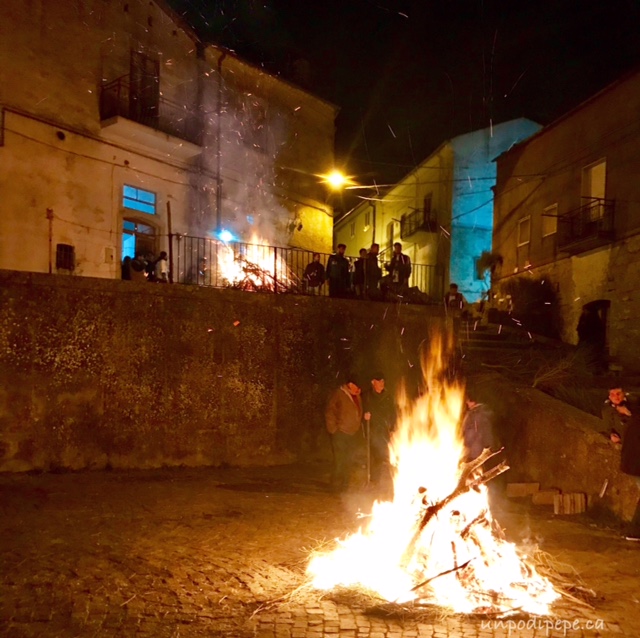
When the campanile, the church bell tower, strikes 1900 hours, Orsara di Puglia ‘catches fire’.  Bonfires are simultaneously lit in every street and piazza and remain lit through the night.  The fires, illuminated zucche, music and people in the streets create a magical, enchanted atmosphere. There are 3 large municipal falò, and every quartiere – neighbourhood, and many families also light their own.

I made a point of getting off of the main Corso to visit some of the smaller personal falò. In honour of the dead, simple but symbolic seasonal foods are cooked on the open fires and also served as cibo di strada-street food.  These include patate -potatoes, cipolle-onions, salsicce-sausages, castagne-chestnuts and pane cotto-bread cooked with garlic, potatoes and greens.

Salsicce e pancetta nel fuoco

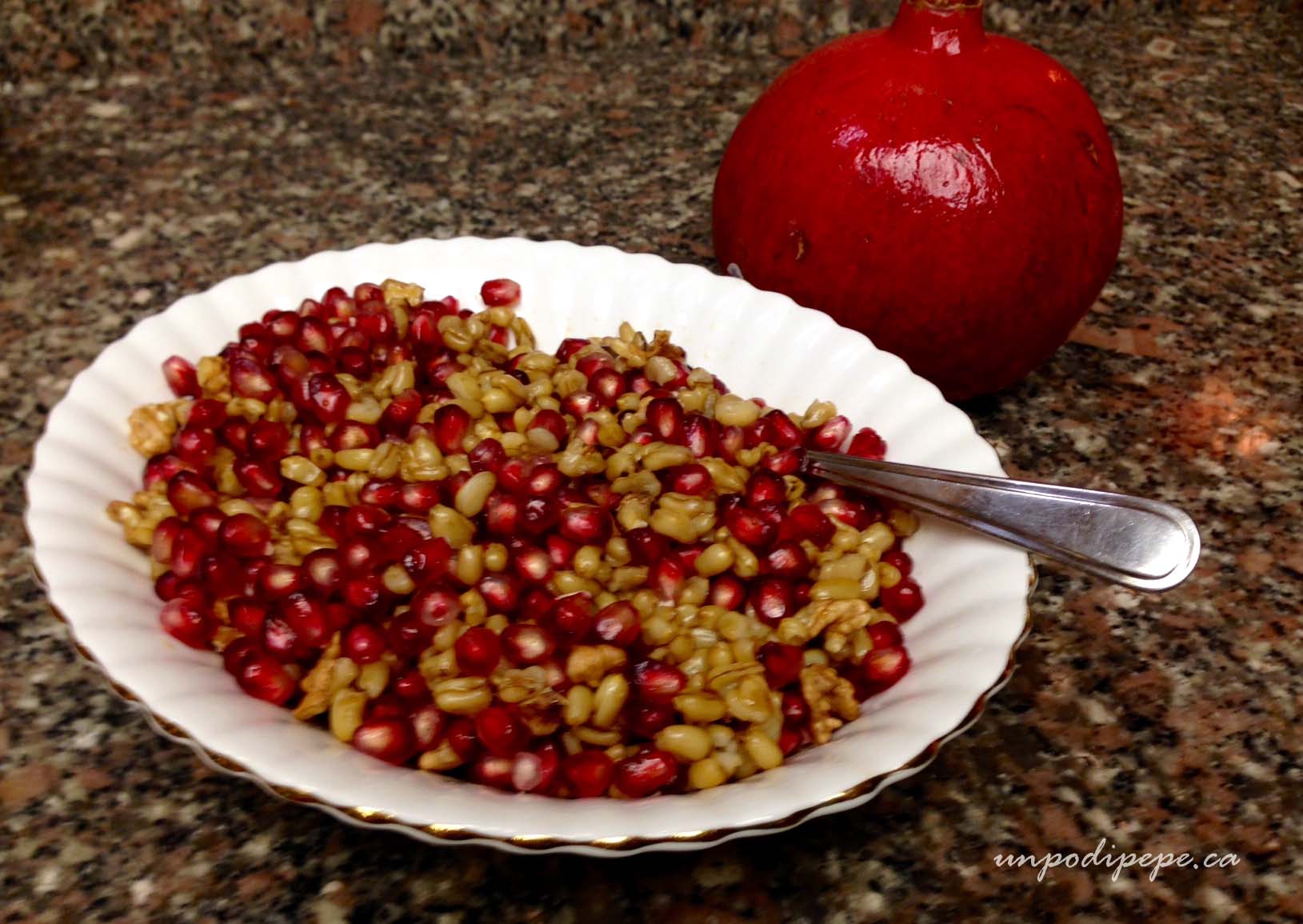
Muscitaglia (moo•shee•tah•lyah) is a traditional dish served November 1st likely dating back from the ancient Greeks and Byazantines. Muscitaglia is made up of the Greek and Latin words mosto (wine must) and talia (grain). The ingredients include boiled grain and vino cotto. Semi di melagrana e pezzi di noci -pomegranate seeds and walnut pieces are often added.  These ingredients are symbols of fertility and abundance, but also of honour and respect for the dead.

Il fuoco e le zucche di Antonella e Domenico

Fucacoste e Cocce Priatorje has often been confused by visitors with the Anglosaxon Hallowe’en, but it is an entirely different event.  Besides the obvious fact that the date is different, dressing up in costume is not part of the custom and there is nothing scary or evil about it.  This is the reason for the hashtag #quinonèhalloween. There are more similarities with Mexico’s Dia de los Muertos/Day of the Dead.  This event is about being together in community to celebrate the bond between the living and those who we remember in our hearts.  It is also to remind us that our time on earth is precious. The following day, November 2nd is l’Anime dei Morti-All Soul’s Day, and it is customary to go to the cemetery to pay respects at the resting place of loved ones.

The 9 minute video below features 94 year old Z’Gaetan talking about the festa and its significance.

This lively 48 second video from 2016 featuring the music of Tarantula Garganica will make you all wish you were there tonight:

If you did not watch the video….watch it now!  I did not make it there this year, but am looking forward to my next trip to Fucacoste e Cocce Priatorje!  Now I am off to my Mamma’s to have muscitaglia! Ciao, Cristina

Share this:

  • Click to share on Facebook (Opens in new window) Facebook
  • Click to share on Pinterest (Opens in new window) Pinterest
  • Click to share on X (Opens in new window) X
  • Click to email a link to a friend (Opens in new window) Email
  • Click to share on WhatsApp (Opens in new window) WhatsApp
Like Loading...

Baia di Campi

08 Friday Jun 2018

Posted by Un po' di pepe in Italia, Puglia, Travel

≈ 17 Comments

Tags

Baia di Campi, Dolcevitabloggers, Gargano campsites, Il Gargano, Parco Nazionale del Gargano, Vieste

One of the most beautiful areas on earth, Il Promontorio del Gargano (gar·GAH·noh) is the promontory sticking out above ‘il tacco’, the heel of Italia.  You can also think of it as la caviglia-the ankle spur of Italia.  Surrounded by the Adriatico on 3 sides, the area is more like an island; biodiverse with unique flora and fauna. Most of the promontorio is a protected area and marine reserve, Il Parco Nazionale del Gargano, which includes le Isole Tremiti and the ancient Foresta Umbra. Fortunately, this has prevented overdevelopment by large multinational hotels and resorts.

Il Gargano is full of campsites, inexpensive, rustic accommodation and B & B’s.  The campeggi e villaggi turistici -campsites and tourist villages, are ben attrezzati-well equipped. Go with a camper and all the gear, or just a vehicle and a tent.  There are villette-little cabins for rent, but you need to bring your own sheets and towels, so these are mostly used by locals. This website (in Italiano) lists Gargano campsites. I have spent many weekends at different sites in the Gargano  with my cugini and their camper.  In July, we stayed at Campeggio Baia di Campi, near Vieste. Here is a video of the private beach during my windy morning walk:

Baia di Campi

Baia di Campi

Nothing like having a spiaggia all to myself! We were going to paddle by canoa-kayak to la Grotta dei due occhi, a sea cave 10 minutes away.  Unfortunately, it became too windy to go, so I will hopefully have the opportunity to go again. The campsite had a shuttle bus to whitewashed Vieste, 20 minutes away. Read about other campsites I have stayed at in Campeggio sul Gargano.

View of Vieste from the SS89

The winding road around the Gargano, SS 89 from Foggia, has sharp turns and viste mozzafiato (VIS·teh moz·zah·FYAH·toh)-breathtaking views.  You will not see any dehydrated (yuk!) camping food in Puglia.  Most campsites have a little market selling fresh fruit, giant watermelon, mozzarelle and other necessities.  Fresh fish is never far away, so I get to enjoy Mauro’s insalata di polpo ubriaco-drunken octopus salad!Most of the tourists visiting the Gargano area are Italian, especially in the summer.  Many Germans drive their campers down too, but you will not meet many North Americans here.  Il Gargano is the place to visit to improve your Italiano!  This post is written as part of the monthly #dolcevitabloggers linkup, hosted by Jasmine of Questa Dolce Vita, Kelly of Italian at Heart and Kristie of Mamma Prada the 7th -14th of every month. This month’s topic is ‘Hidden gems’.  Il Gargano is not so much ‘hidden’, as remote, unknown and not easily accessible without either a car or a lot of time.  I hope you all make it here one day!  As the Gargano website says, visit il Gargano ‘per una vacanza tra natura, mare e cultura’…for a holiday among nature, sea and culture!

More Il Gargano posts by Cristina: Isole Tremiti, I Trabucchi del Gargano, Campeggio sul Gargano, Santa Maria di Siponto.

Ciao e buon viaggio, Cristina
Share this:

  • Click to share on Facebook (Opens in new window) Facebook
  • Click to share on Pinterest (Opens in new window) Pinterest
  • Click to share on X (Opens in new window) X
  • Click to email a link to a friend (Opens in new window) Email
  • Click to share on WhatsApp (Opens in new window) WhatsApp
Like Loading...

Il Sole di Metà Pomeriggio

23 Wednesday May 2018

Posted by Un po' di pepe in Italia, Orsara di Puglia, Photography, Puglia

≈ 16 Comments

Tags

Italy photography, La luce del sole, Orsara di Puglia, Southern Italy

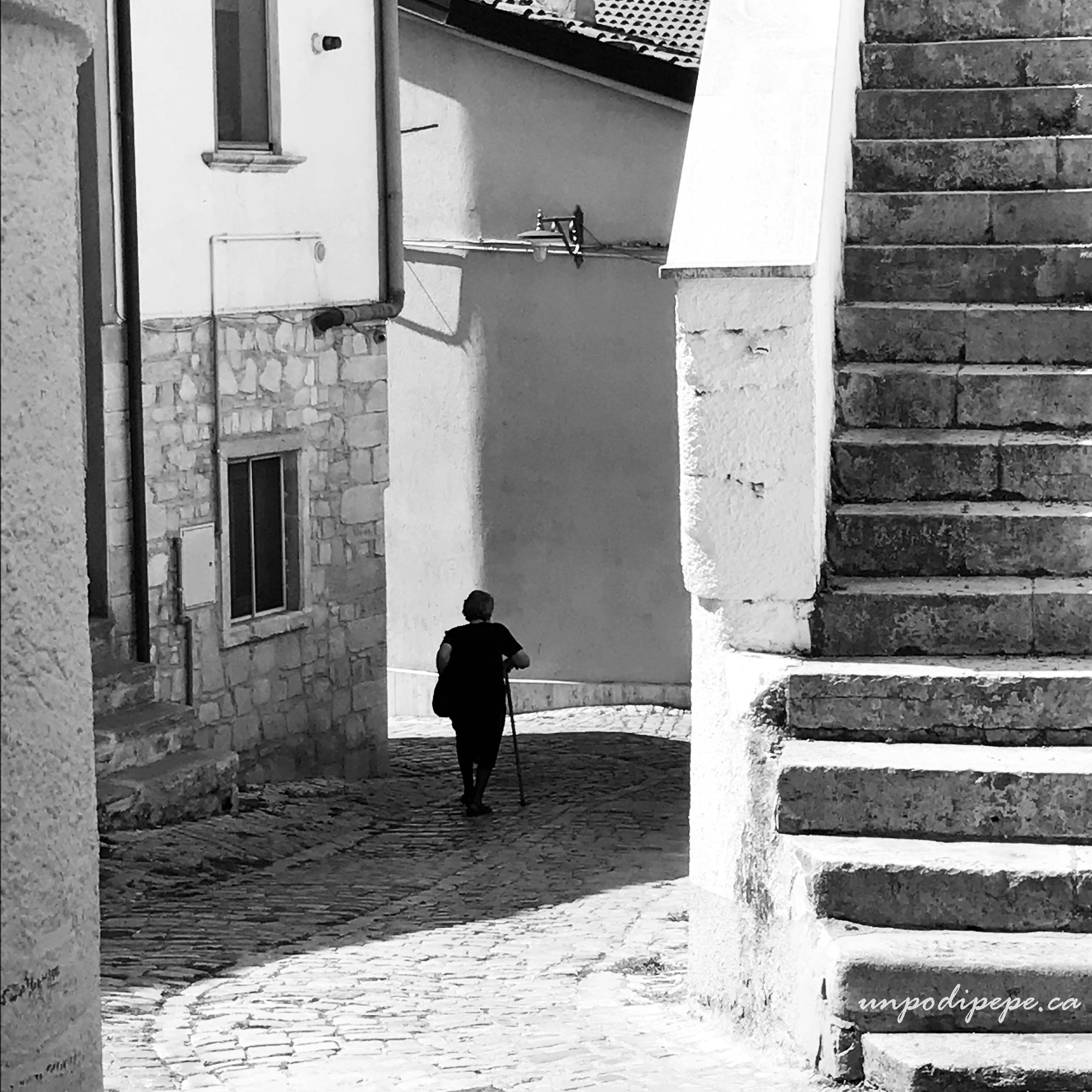
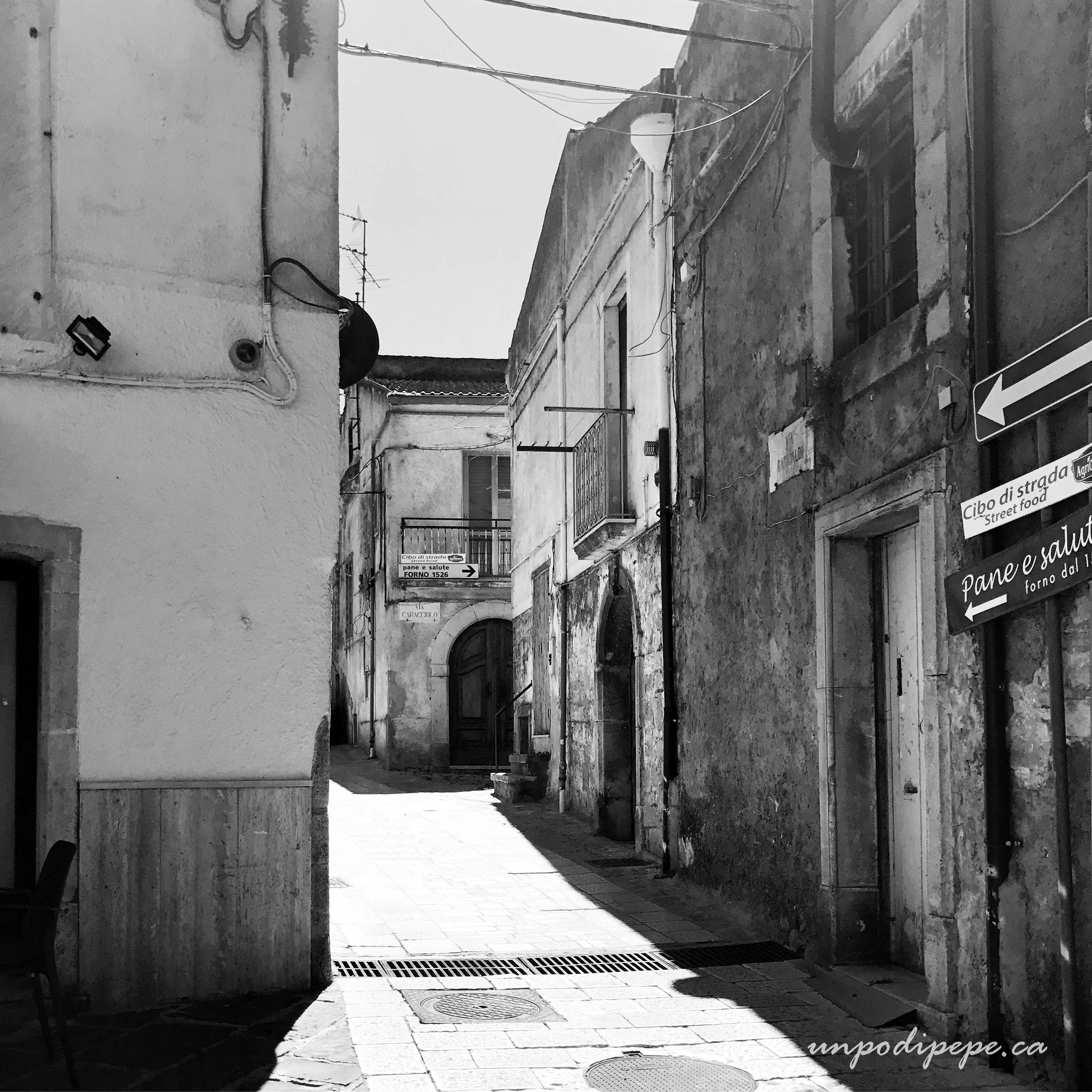
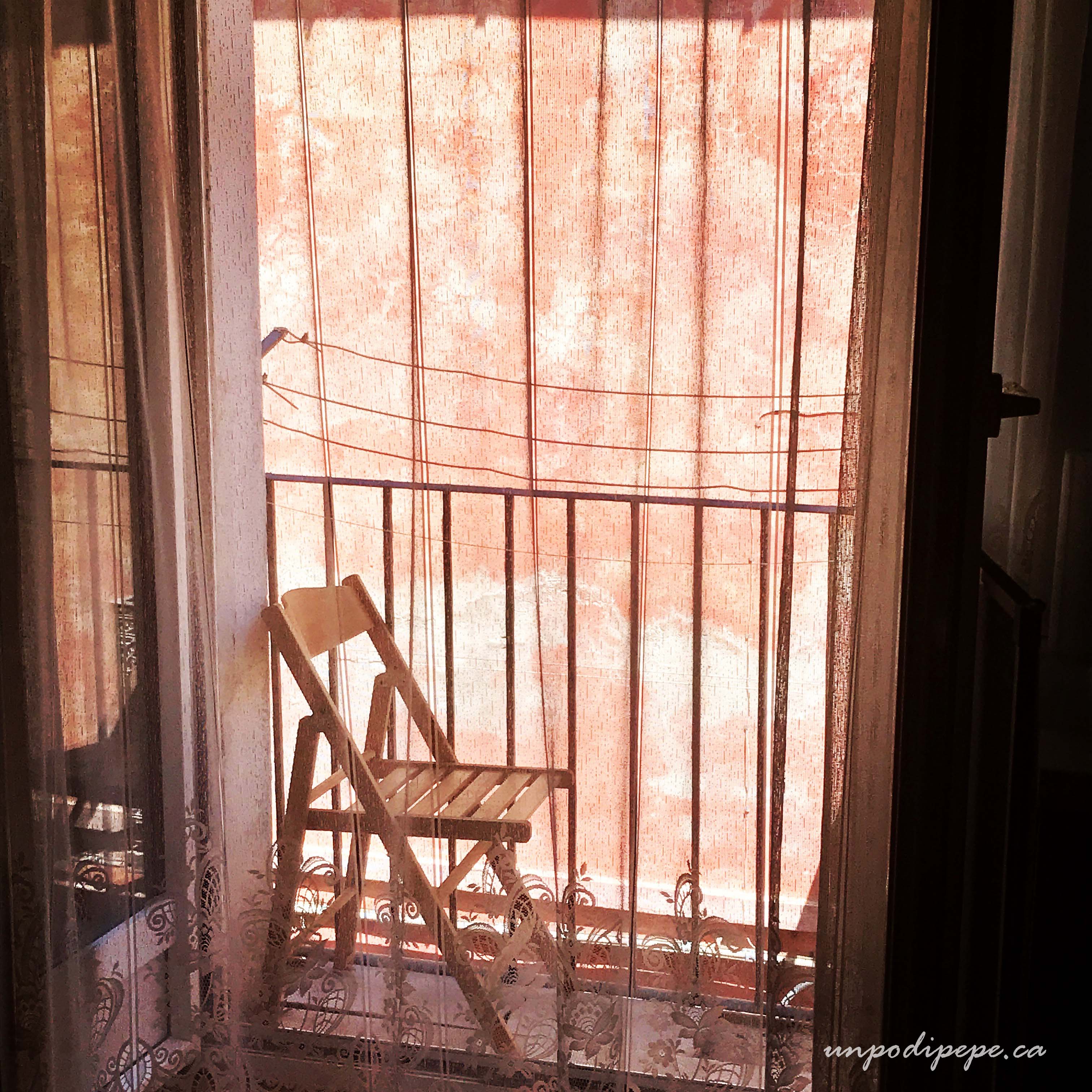
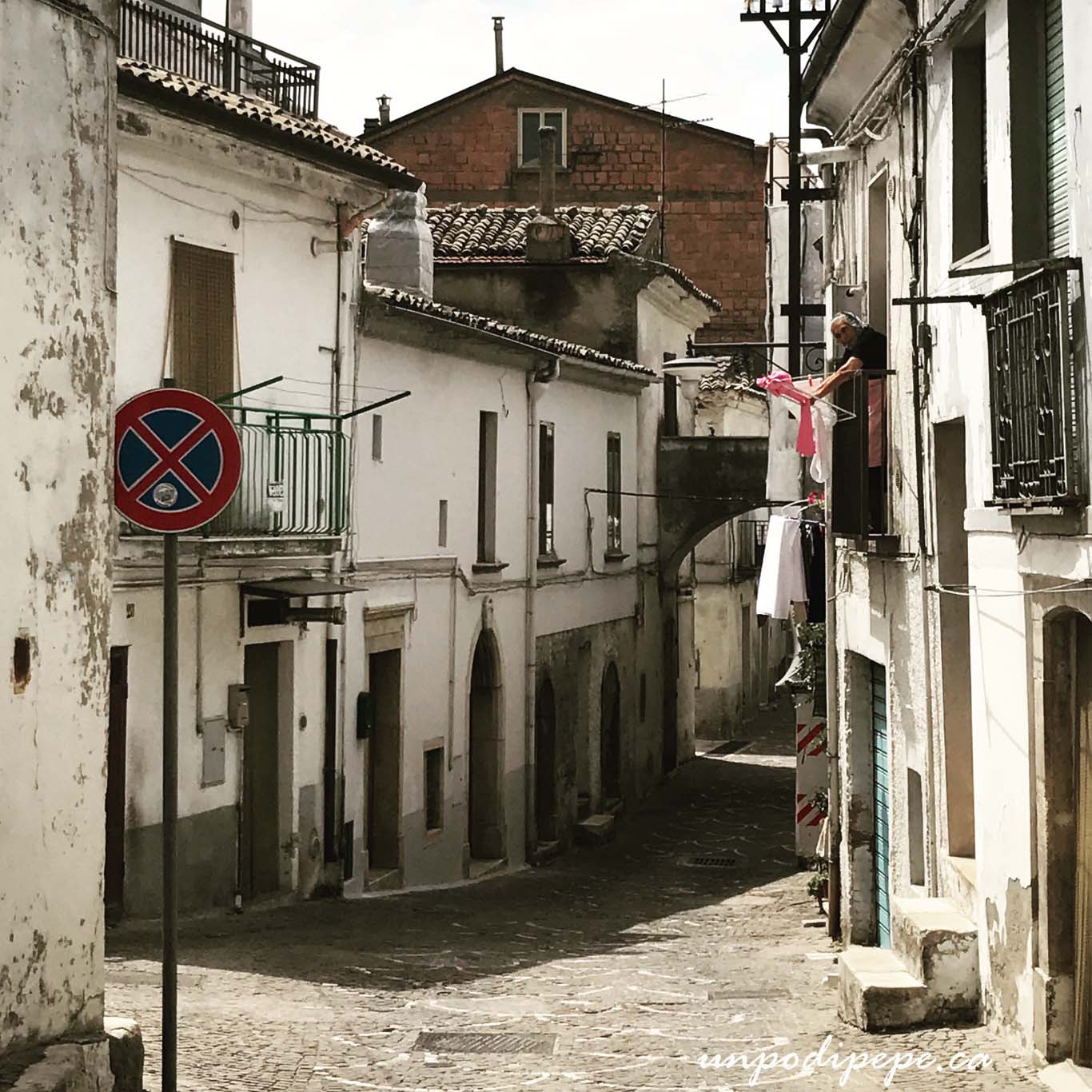
La luce del sole di metà pomeriggio- the light of the mid-afternoon Mediterranean sun is absolutely stunning.  In the backdrop of a medieval hilltop village, cast shadows create abstract shapes among the stone walls, staircases and winding cobblestone streets.

Last summer was exceptionally hot, even at an altitude of 750m like Orsara di Puglia.  Both of the negozi elettrodomestici, the appliance stores, repeatedly ran out of portable electric fans.  Most people remained indoors after pranzo, until at least 4pm.  While everyone else was resting in the cool enclaves of their stone houses,  I often ventured out to try and capture the light with my camera.Here are some of my results….mostly monochromatic, mostly square, abstract shapes cast by the magnificent light of the mid-afternoon sun.Even my tiny balcony on narrow Via Regina Margherita is flooded with la luce del sole!

Imagine the smell of orecchiette con sugo wafting down empty Via XX Settembre just before pranzo. Yum!

Laundry dries in no time with the heat of the afternoon sun, and the shadows make interesting shapes on the old stone walls. This Nonna on Via Cavour wonders what I am doing out in this heat!My Cinquecento radar spots a visiting specimen in town.  The light makes interesting reflections and cast shadows on the street.

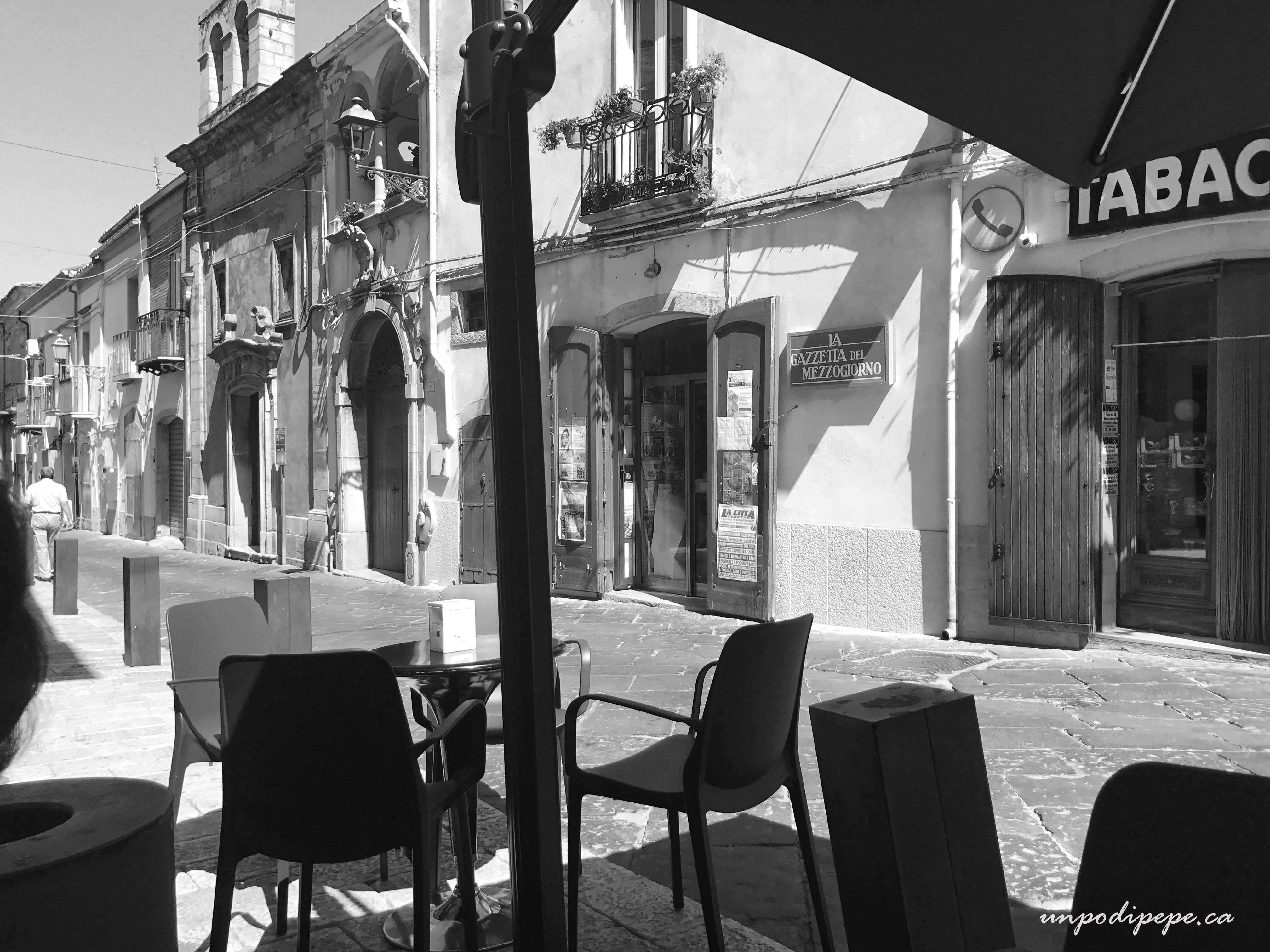
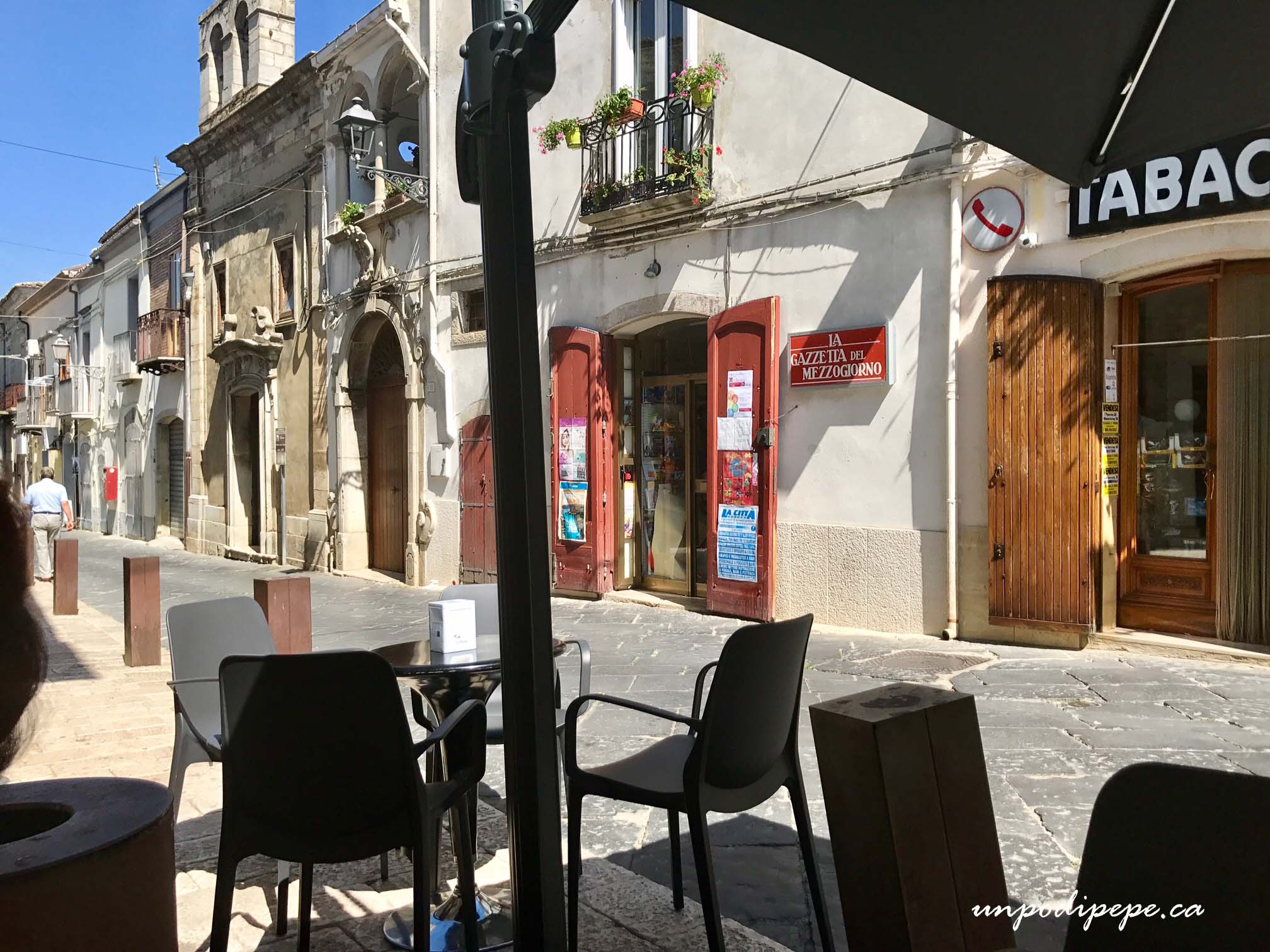
Shade under the ombrellone at the local bar.          I hope you enjoyed my attempt to capture ‘la luce’ in these photos!    Ciao, Cristina

Share this:

  • Click to share on Facebook (Opens in new window) Facebook
  • Click to share on Pinterest (Opens in new window) Pinterest
  • Click to share on X (Opens in new window) X
  • Click to email a link to a friend (Opens in new window) Email
  • Click to share on WhatsApp (Opens in new window) WhatsApp
Like Loading...

A Perfect Day in Italia

10 Tuesday Apr 2018

Posted by Un po' di pepe in Italia, Italian life, Orsara di Puglia, Puglia

≈ 41 Comments

Tags

Dolcevitabloggers, Orsara di Puglia, Pugliese Traditions, Southern Italy

The Dolce Vita Bloggers link-up theme this month is ‘a perfect day in Italy’. What a topic!  There are so many possibilities.  I have written about many wonderfully perfect days, in Roma, Matera, Alberobello, the Val d’Orcia, Polignano a Mare….  How do I narrow down what to write about? With too much material to choose from, I decided to write about a typical day ‘at home’ in Orsara di Puglia, where most days are laid back, spontaneous and pretty darn perfetto!

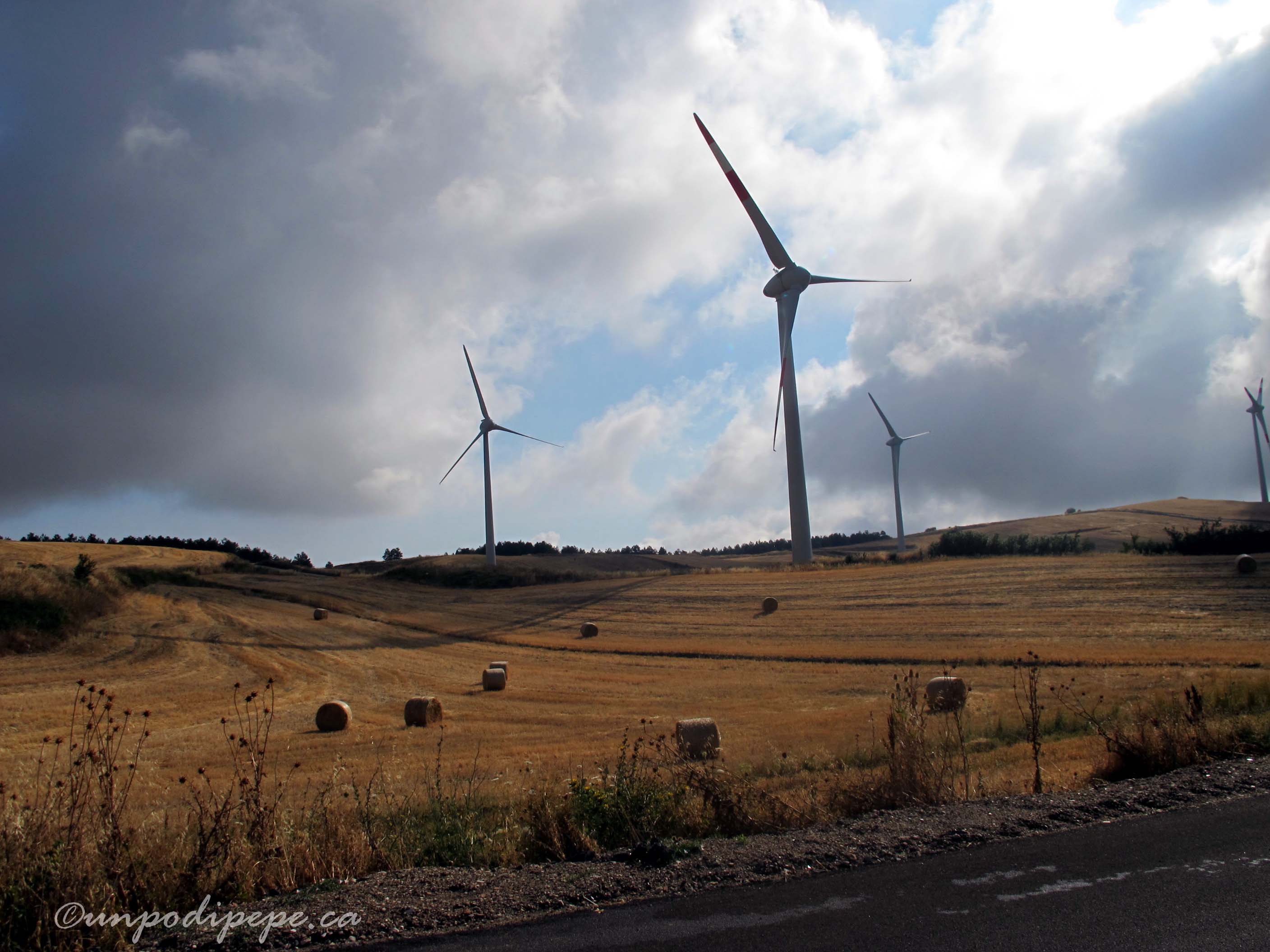
My day usually starts out with a long, early morning passeggiata to la Montagna Spaccata.  I call it ‘la Palestra di Madre Natura’ or ‘mother nature’s gym’, an uphill zig-zag walk up the mountain towards Campania with fresh aria di montagna, breathtaking views and encounters with fellow walkers.  I usually walk to the border with Campania, when I reach the pale eoliche (PAH•leh Eh•oh•LEH•keh).

Pale eoliche (wind turbines) near Montaguto

I have also walked all the way to Montaguto, in Campania 6 km away . I am not a ‘morning person’, but in the summer, the walk must be early, otherwise it gets too hot to walk on the way back. Long walks are necessary when you spend weeks eating lots yummy food and still want to fit into your clothes!

When I am back from my walk, cleaned up and changed, I often stop at the bar for an espressino, known as caffè marocchino in the rest of italia.  I also sneak in a few minutes of wifi.  Sometimes I walk to Piano Paradiso and have caffè with Peppe Zullo in the morning or afternoon.  Then I usually do servizi-errands, including shopping for food. Refrigerators are small, and most people shop at least every other day for fresh local ingredients.  Fresh bread and taralli are purchased at il forno.  Generi Alimentari are delis and also carry general grocery items.  My favourite items to purchase are fresh mozzarelle and the local specialty, cacioricotta.  Once a week, mozzarelle di bufala arrive and I am first in line! Fruit and vegetables are from the fruttivendolo-unless the neighbours give you produce from their orto.  There are also travelling fruttivendoli, selling out of small trucks.

Il fruttivendolo barely fits in Via Regina Margherita!

I celebrate when fiori di zucca are available!  Another local specialty is Tuccanese, vino made from a local native grape. As in most non-touristy towns in Italia, shops close at 1pm for la pausa pranzo and reopen at 5pm, until 8pm.

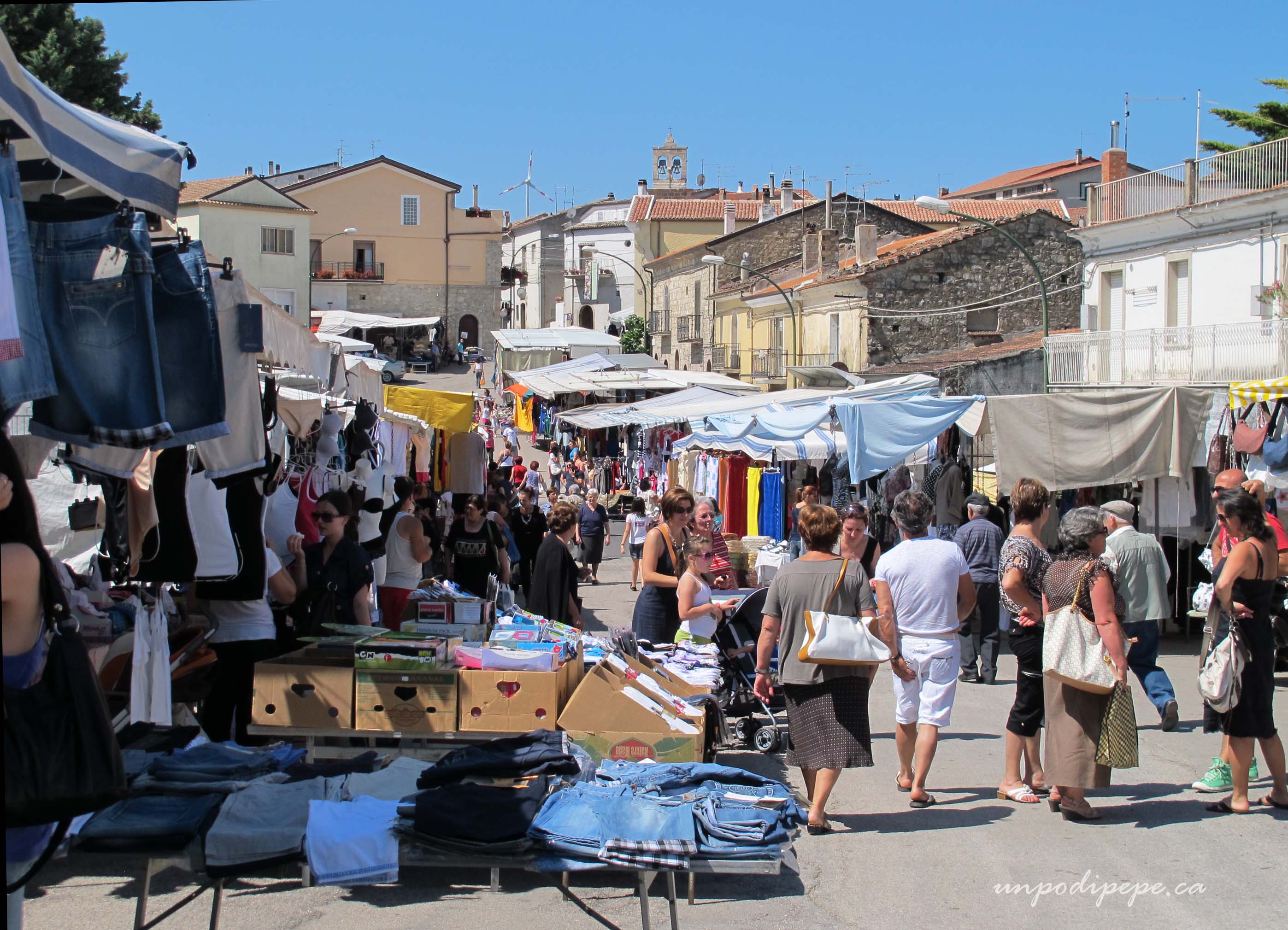
Giovedi mattina-Thursday morning is the mercato in Orsara.  The street is lined with bancarelle selling everything from fresh formaggi to produce, linens, shoes and household stuff.  A great spot to run into everyone in town, including visitors. Il postino likes giovedi, as he can hand everyone their mail on their way to the mercato.

The rest of the morning is usually spent helping to prepare pranzo, the main meal of the day, at 1pm.  In the summer, my parents are also in Orsara, sometimes my sister and her family too, so there is lots of food preparation going on, using ultra fresh local ingredients.

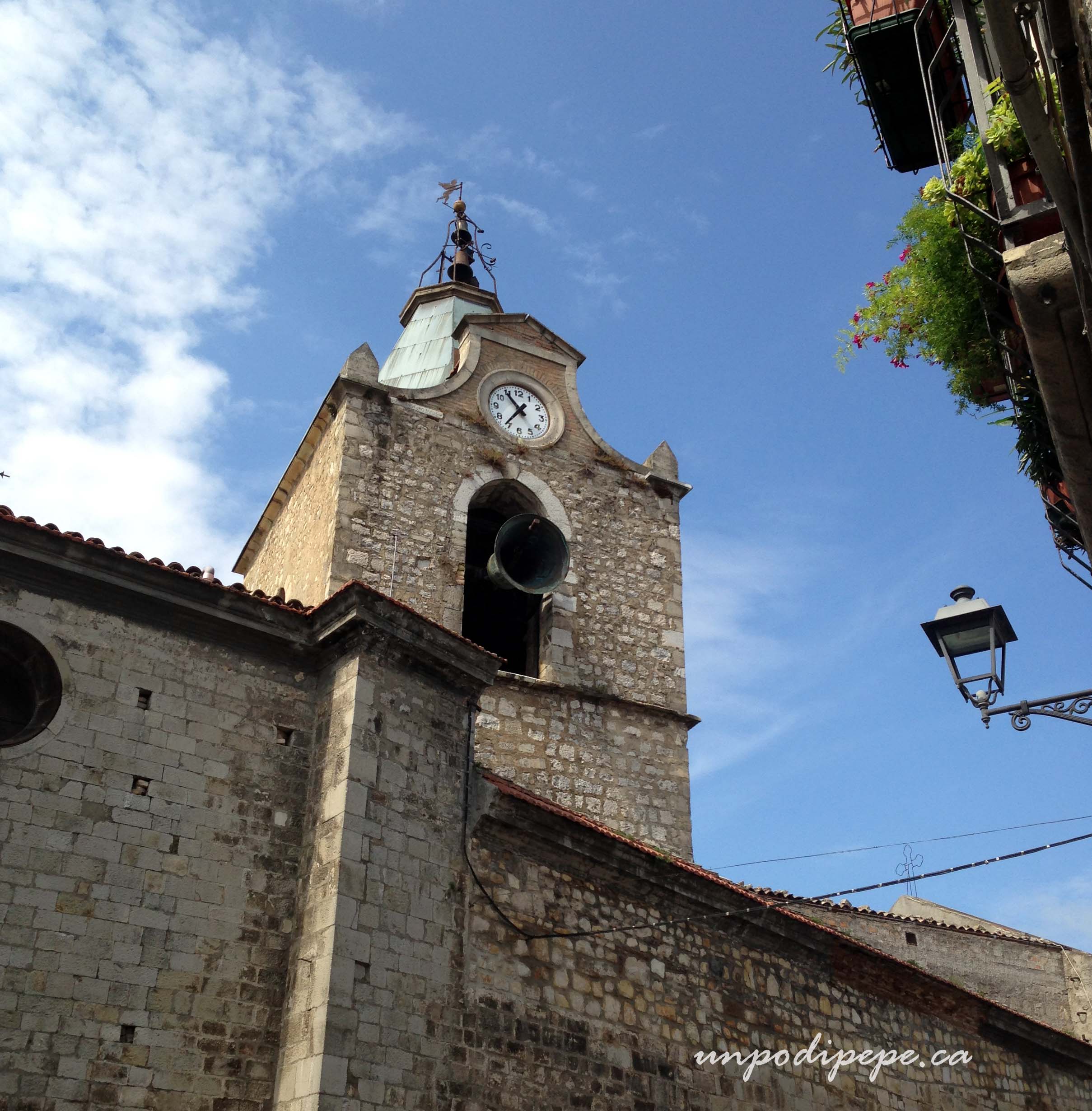
There is no need for a watch. My casa is right near the main church and the campanile– bell tower.  La campana rings every 15 minutes.  On the hour, there is one ‘ding’ for each hour, and every 15 minutes there is a higher pitched ‘ding’.  For example, at 12:45 la campana rings 12 times, followed by 3 higher pitched rings.  Back in the day when no one had a watch, contadini working in the fields would know the time. You might think this would get annoying, but la campana was broken for a year, and it was really missed! Once the dishes are done, it is orario di riposo-quiet time, as it is too hot to do much else.  Most people do not nap every afternoon, but they at least stay home and have a riposo, a rest. A short pisolino is quite civilized if you are up very early and plan to stay out late! The afternoon rest is not called a siesta in italiano- riposo or la pausa. I often read or do clean up stuff around the house, like hang laundry to dry. There are no dryers here as electricity is ridiculously expensive and sunlight is free. I may brave the mid afternoon sun to go out and take photos. The maze of steep, windy, cobblestone streets and alleys are empty and I am alone with the light and the incredible shadows.  To quote myself…

’ la luce … la gloriosa e magnifica luce del sole di metà pomeriggio è incredibile. Vorrei dipingere quella luce! / the light….the glorious and magnificent light of the mid-afternoon sun is incredible.  I want to paint that light!’ (Cristina, October 2017).

At 5pm shops and bars reopen and the streets come to life again.  I visit friends and relatives, meet for gelato, shop, or find somewhere to sit with my sketchbook. I also love to walk to La Cupa, the olive grove that used to belong to my Nonno to pick plums, figs and pears. I usually need to stop at one of the bars to use wifi, although as I explained in Chiuso per Ferie in August, this can end up seeming quite antisocial.

Sundays, I sleep in, unless going on a daytrip.  I love to have cappuccino and a cornetto crema di pistacchio before 11:00 Mass in the ancient Grotta di San Michele Arcangelo. At least one Sunday, I look forward to a barbecue at La Cupa with my extended family.

‘un po’ di relax’ under the olive trees

After 9pm, it is time for the evening passeggiata, walking up and down ‘il Corso’ and socializing. There are pizzerie and bars with outdoor seating along il Corso. On summer evenings, there are often concerts or special events.My favourite part of the passeggiata is walking all the way to the top of the Corso, past where the houses stop, then the streetlights stop.  It is buio (BOO•yoh) -dark, you can hear grille (GREEL•leh)-crickets, and see the stars.  On clear, windless nights, lucciole (looch•CHEEOH•leh)-fireflies make the night absolutely magical. There is usually a stop for a drink at an outdoor table before ending up back at home…never before midnight though! Buonanotte, Cristina.

Click on these links to read previous posts about wonderfully perfect days spent in… Alberobello, the Isole Tremiti, Matera, Polignano a Mare, Paestum, Roma, Trani and the Val d’Orcia.

This post is written as part of the monthly #dolcevitabloggers linkup, hosted by Jasmine of Questa Dolce Vita, Kelly of Italian at Heart and Kristie of Mamma Prada the 7th -14th of every month.

Share this:

  • Click to share on Facebook (Opens in new window) Facebook
  • Click to share on Pinterest (Opens in new window) Pinterest
  • Click to share on X (Opens in new window) X
  • Click to email a link to a friend (Opens in new window) Email
  • Click to share on WhatsApp (Opens in new window) WhatsApp
Like Loading...

Ruote di Trani

09 Monday Oct 2017

Posted by Un po' di pepe in Italia, Photography, Puglia, Travel

≈ 13 Comments

Tags

Fiat 126, Fiat 500 Giardiniera, Fiat Cinquecento, Piaggio Ape, Renault 4, Southern Italy, Trani

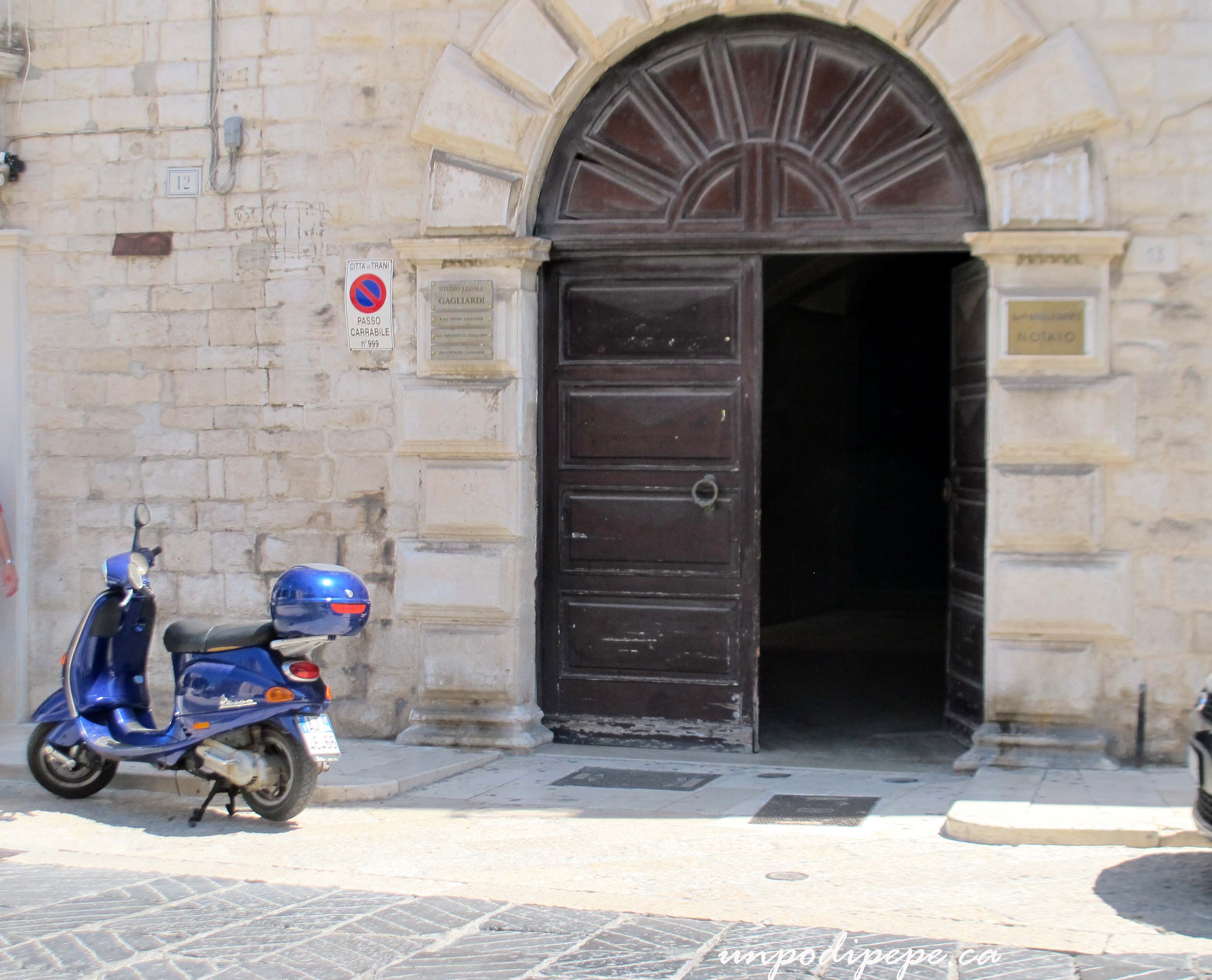
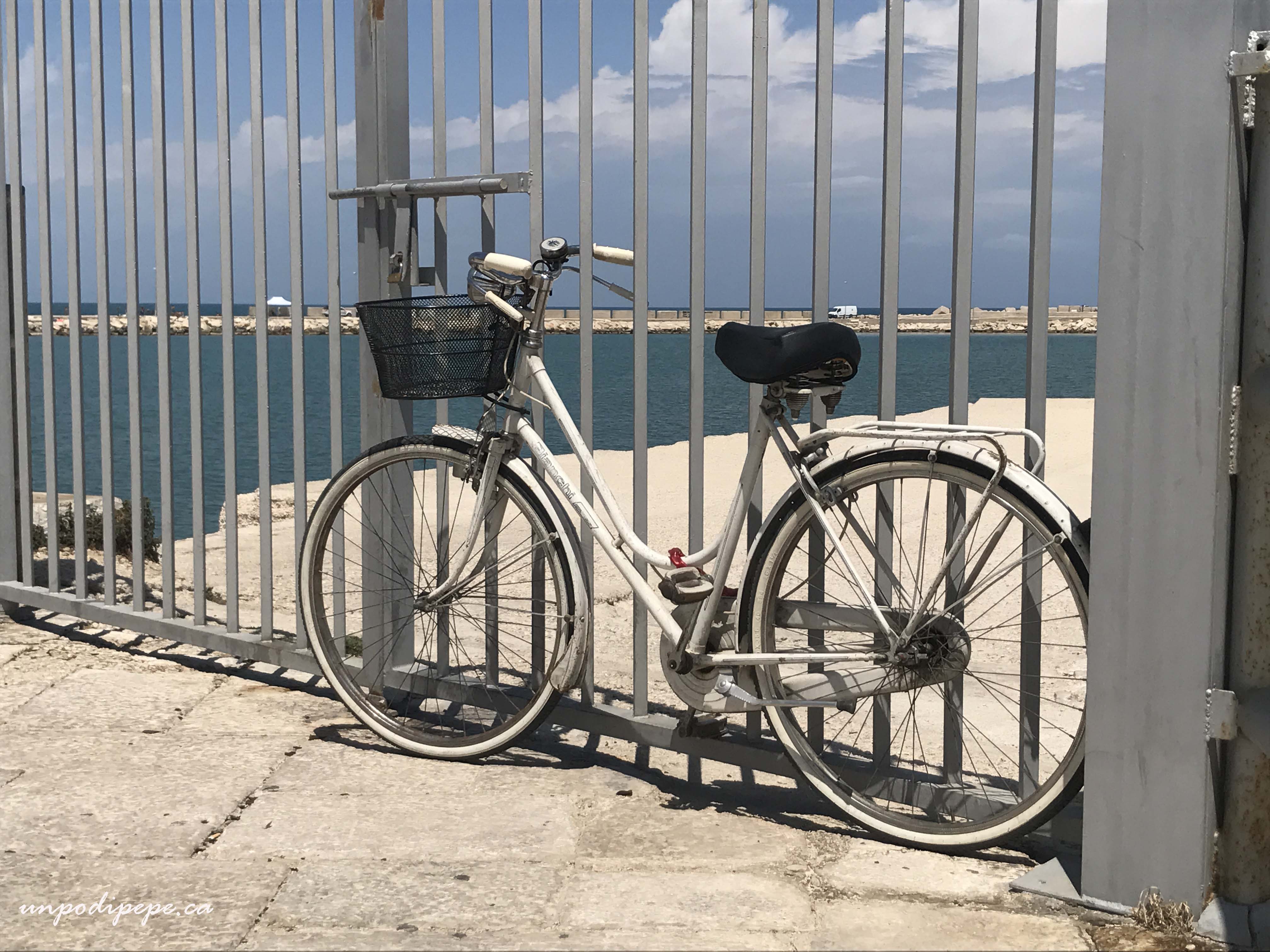
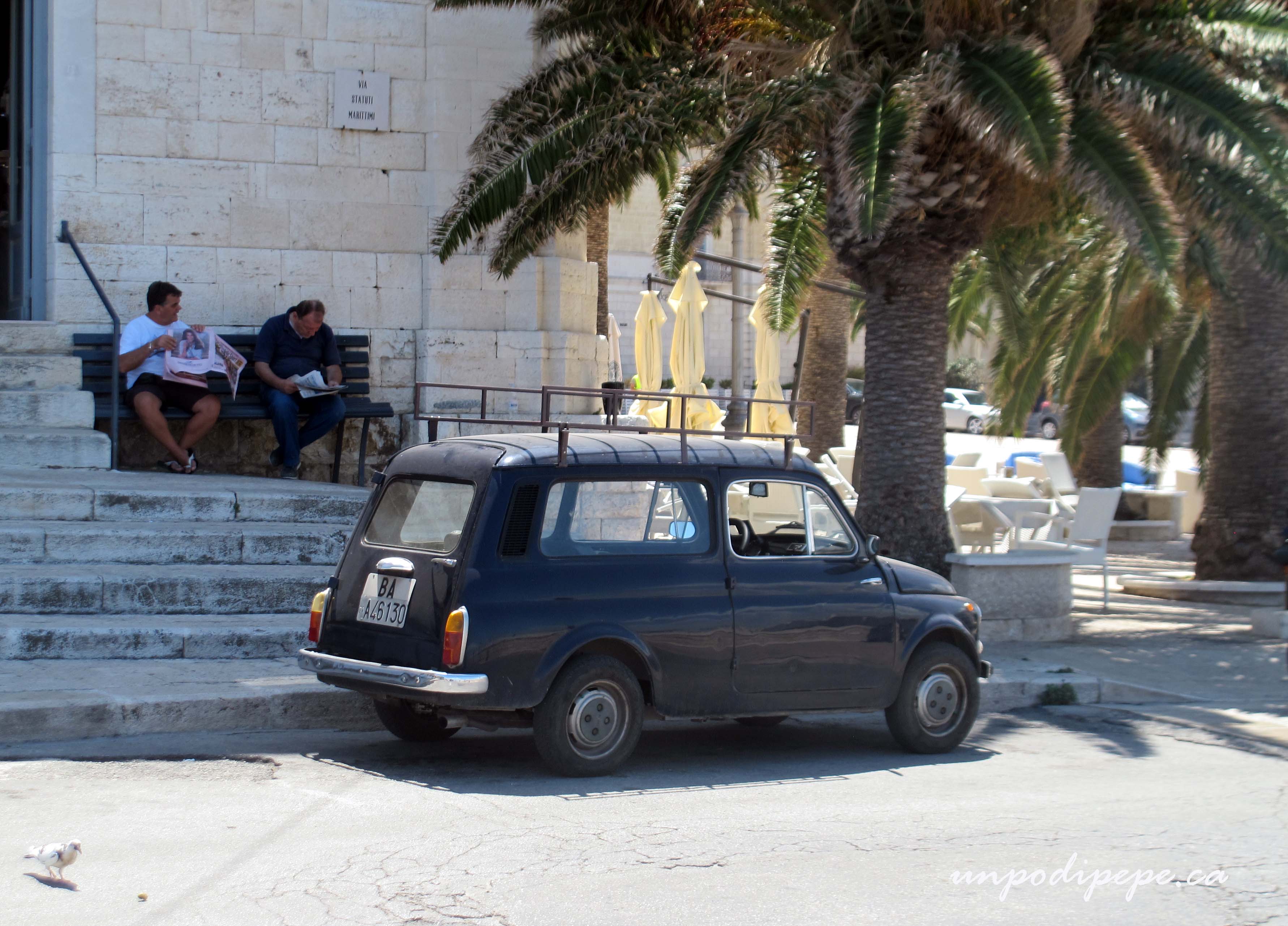
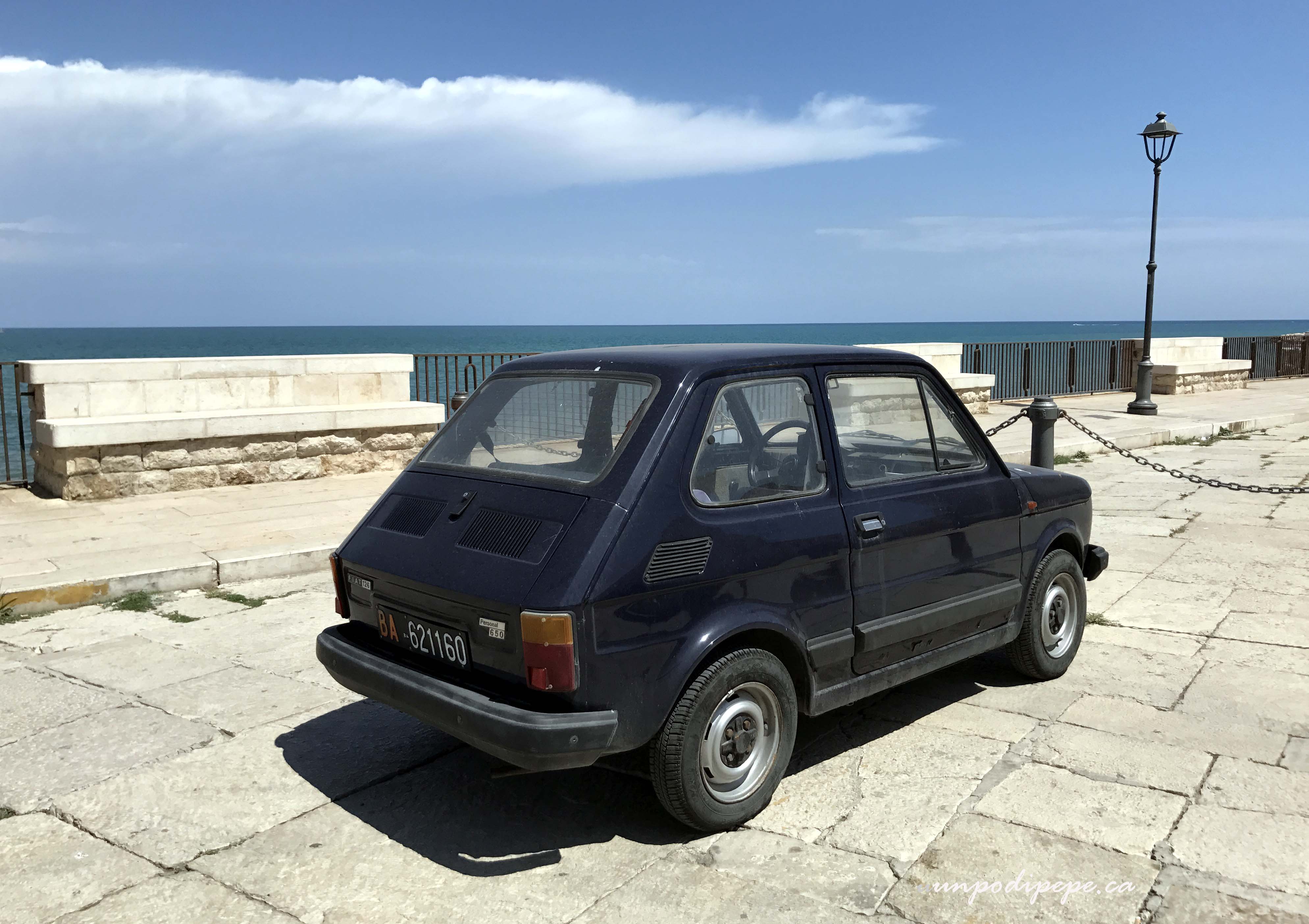
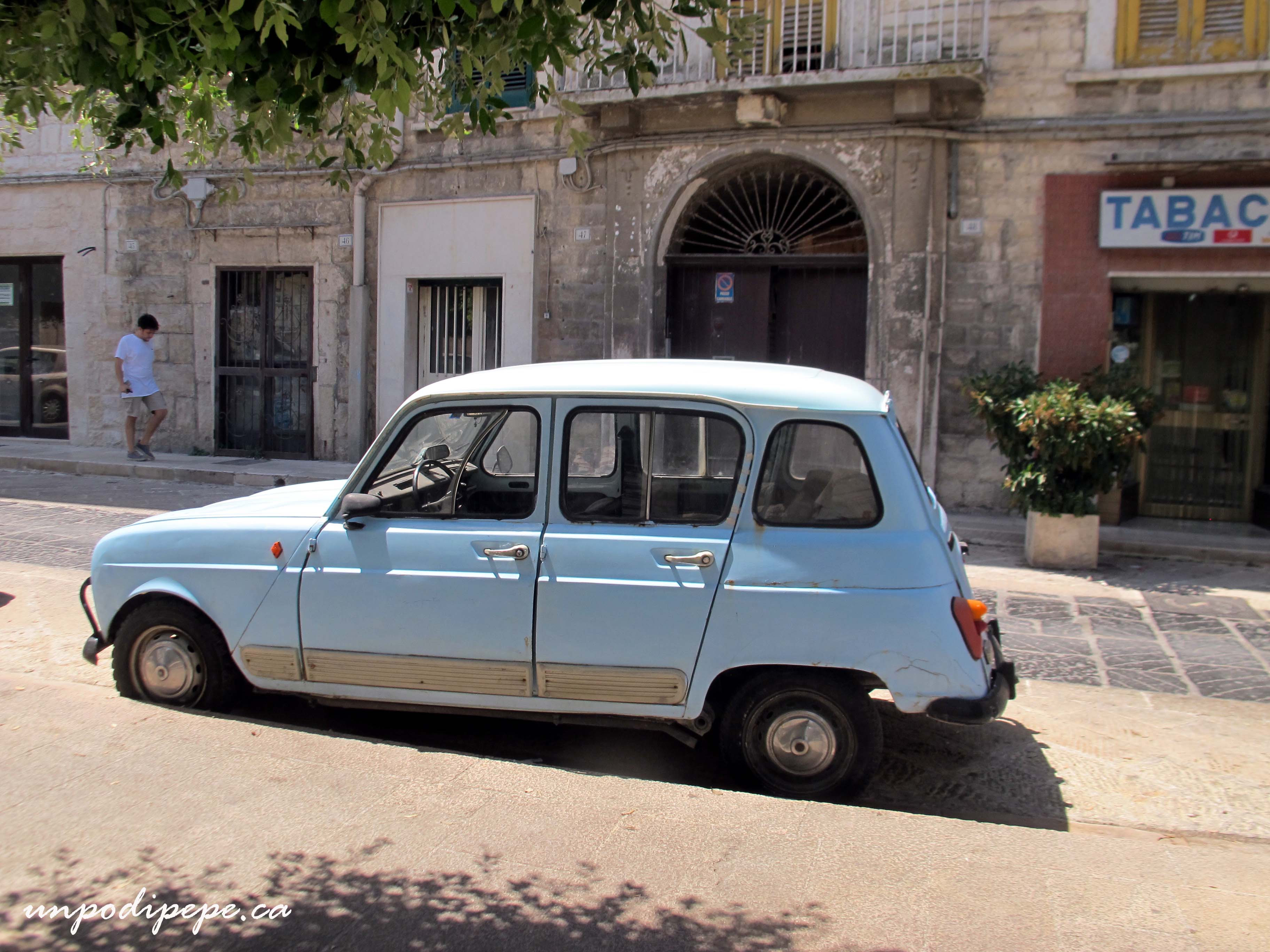
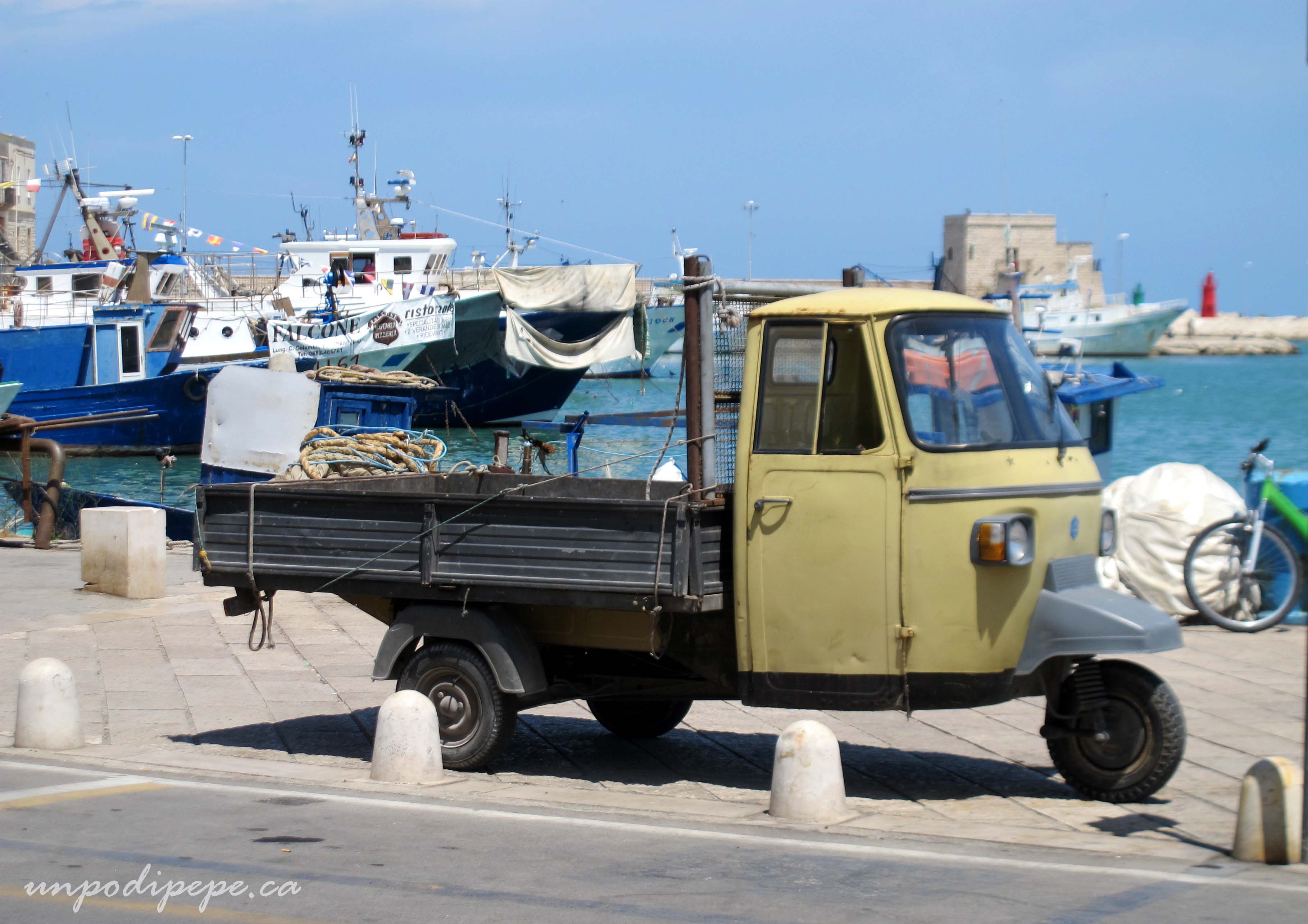
In August I took a lovely daytrip to Trani, a quiet, sun drenched fishing port on the Adriatic.  While walking through town and the port in the late morning/early afternoon there were times I felt like I was walking through a movie set! One of the reasons is because of all the macchine d’epoca or vintage cars that I saw, as well as motorini and biciclette. I have compiled a few photos of these vehicles in this post and, for lack of a better title, I am calling it Ruote di Trani or Wheels of Trani.

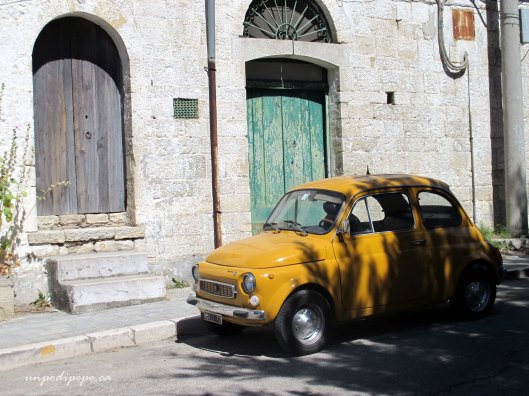
I was disappointed because I did not take any photos of my favourite macchina, as every time I saw a Cinquecento, a Fiat 500, it was speeding past me too quick to snap a photo! I have a bit of an obsession with them-but only the old ones.  It turns out I actually did photograph one though! 

This is a Fiat Cinquecento Giardiniera, also known as the 500K or the Autobianchi Giardiniera.  It is basically a Cinquecento station wagon, made from 1960-1977.  If you think I am joking, cover the back half of the car, and you will see that the front half is totally 500ish!  In 1970, production was transferred to Autobianchi, a Fiat subsidiary in Monza.  Later models were branded as Autobianchi rather than Fiat. Notice this one has porte di suicidio or suicide doors, which are hinged at the rear instead of the front.  They make it easier to get in and out of the car, but are a safety hazard at higher speeds.  I wrote about porte di suicidio here. Notice the bird photobomb in the corner!

The Centoventisei or Fiat 126 was a more modern model to replace the Cinquecento in 1973.  The 126 never became as popular.  My Zio used to have one that was a Robin’s egg blue.  It were very popular in the former eastern bloc countries because of its fuel efficiency.  Later models were made in Poland as the Polski 126p.

This ‘vintage’ photo of a white Fiat 126 was taken by me on my previous visit to Trani, in 1994.  My Zio had one just like this.  I think it even had the same dented front.  Thankfully, not much has changed to the look of Trani since 1994!

This photo of a late 1960’s/early 1970’s Renault 4 GTL on the street in front of old buildings looks like it was taken 50 years ago rather than just 2 months ago!

I spotted this Piaggio Ape (AH·peh) 3 wheeled vehicle at the port.  Piaggio also makes the Vespa motorino.  An Ape is basically a Vespa with 2 wheels at the back supporting a flatbed.  Piaggio started making the Ape in 1948 to fill the post-war need for inexpensive light commercial transport.  Ape means bee.  I thought it was named for the cute buzzing sound it makes while driving, but it could also be referring to the work ethic of this ‘worker bee’ hardworking vehicle.  Api make great delivery vehicles for narrow cobblestone streets and alleyways.

I hope you enjoyed your phototour of Trani’s ruote. Grazie mille to Franco for helping me identify them! Ciao, Cristina

Share this:

  • Click to share on Facebook (Opens in new window) Facebook
  • Click to share on Pinterest (Opens in new window) Pinterest
  • Click to share on X (Opens in new window) X
  • Click to email a link to a friend (Opens in new window) Email
  • Click to share on WhatsApp (Opens in new window) WhatsApp
Like Loading...

Trani

30 Saturday Sep 2017

Posted by Un po' di pepe in Architecture, Italia, Photography, Puglia, Travel

≈ 24 Comments

Tags

Diomedes, Italy travel tips, Puglia, Romanico Pugliese, San Nicola Pellegrino, Southern Italy, Trani, UNESCO World Heritage Sites

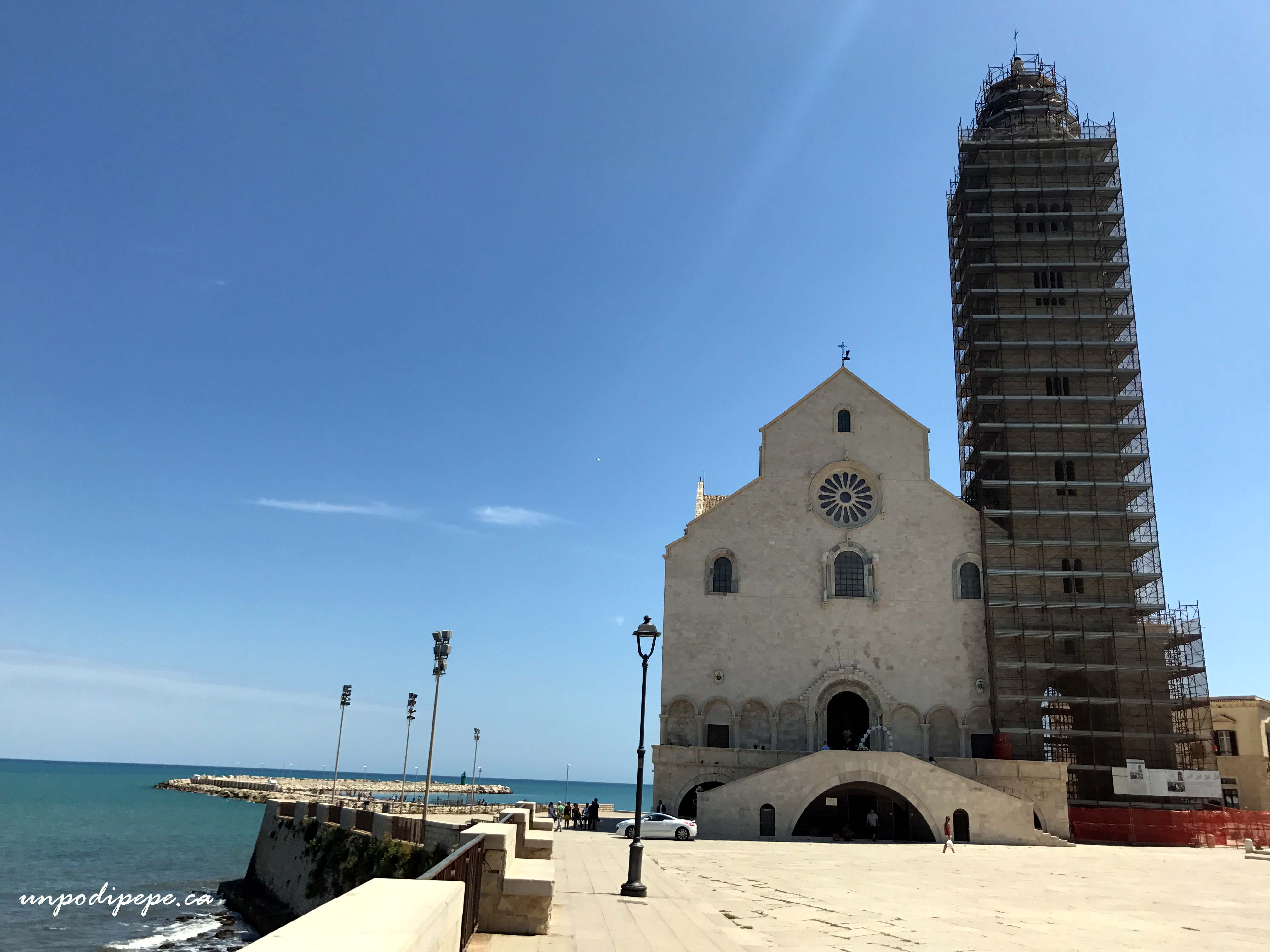
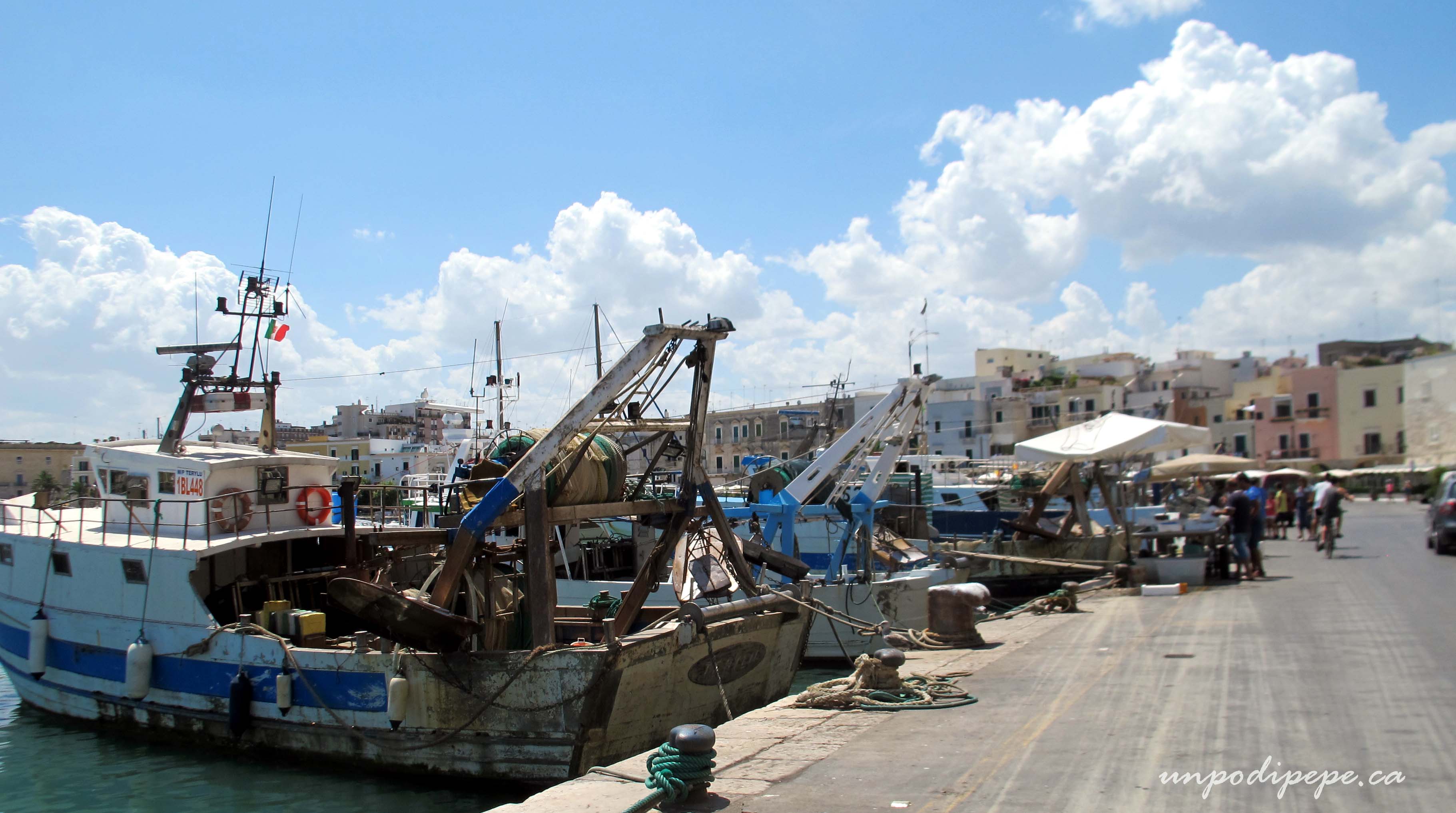
A crescent shaped port, fishermen selling their catch on the waterfront, a timeless, picturesque centro storico that looks like it could be a movie set, a castle, and a stunning limestone Romanesque cathedral right at the water’s edge where you expect to find a lighthouse.  These are some of the reasons why Trani is one of my favourite day trips.  It is a beautiful, peaceful, uncrowded fishing port on the Adriatic, between Barletta and Bari.  Trani is on the main ‘Adriatico’ railway line so it is easily accessible without a car.

Trani is ancient Tirenum, allegedly founded by Tirenus, son of Diomede.  Trani is famous for issuing the ‘Ordinamenta et consultudo Maris’ in 1063.  This is the oldest surviving maritime law code in the west. The street along the harbor is called ‘Via Statuti Marittimi’.  Trani is also known for Moscato di Trani, figs, almonds and olive oil.

During the rule of Federico Secondo (aka Holy Roman Emperor Frederick II) in the early 13th Century, Trani became an important political center and trading port with the Orient.  Since Trani was on the pilgrimage route to the Holy Land it grew and prospered.  Trani also had a close diplomatic and trading relationship with Venezia.When I got off the train in Trani, I walked about half an hour, straight to the cathedral.  I am a big fan of Romanico Pugliese (Pugliese Romanesque), an 11th-13th Century architectural style unique to Puglia.  Romanico Pugliese includes classic Romanesque features such as tall facades, campanili and rose windows, blended with Byzantine and Islamic architectural details.  In fact, since 2006, the Romanico Pugliese churches in Puglia are on the the UNESCO World Heritage Sites tentative list.  This is the step before becoming a World Heritage Site.The Trani cathedral was built in 1099 out of local tufo, a creamy coloured limestone that almost seems to glow in the sun.  One of the oldest and largest cathedrals in Puglia, it was used as a model for the ones built later. It was named for San Nicola Pellegrino (the Pilgrim), a 19 year old Greek shepherd who died while on pilgrimage in Trani in 1094.  His bones are in the crypt.  Note….this is not the same San Nicola who is buried in Bari and is the inspiration for Santa Claus.  Trani’s cathedral was constructed on layers of history.  It was built over the foundations of a 5th Century Byzantine church, Santa Maria della Scala, which was built over the Roman crypt of San Leucio.  Both of these ‘layers’ are accessible. The beautiful bronze doors are a copy.  The original doors are on display inside.  The 32 panels were sculpted by Barisano di Trani who also did work on the cathedrals in Ravenna and Monreale. The 60m high campanile built in 1239 has square corners and an octagonal spire.  The number of windows increase with each floor. The campanile was being renovated when I was there, so I have included a photo I took in 1994 without the scaffolding.

Trani 1994

Right on the harbour is the Chiesa di Ognissanti, built in the 12th Century by the Knights Templar in the courtyard of their hospital.  Trani was on the route to the Holy Land and the knights had a hospital here for those wounded in the crusades.  It is not open to the public.At the far end of the harbour, the Villa Comunale is a park with benches and a seaside walk.  The breakwater near the Cathedral is a nice place to sit and soak up the sun or go for a swim.

Federico II built the Castello Svevo in 1249.  It has square towers at each corner.  The sea water moat was filled in.  From the 1800’s-1974 the castello was used as a prison. Now it is open to visitors and hosts cultural events.  Admission is €3.

Trani once had southern Italia’s largest Giudecca community or Jewish neighborhood.  It was not a ghetto, as it was not closed off.  There were once 4 synagogues.  The Scolanova Synagogue spent centuries as a church, but in 2006 it was rededicated as a synagogue.

Trani is small enough that you can walk everywhere.  From the Stazione, walk straight out and turn left at Piazza della Repubblica.  There is an info point here.  It is about a half hour walk along quiet streets with beautiful palazzi to the cathedral and port.  Just ask a local for ‘Il Porto’ if you need directions.  Shops are closed from 1-5 pm.

For seafood lovers, the port has many excellent restaurants.  My cousins had given me 3 restaurant recommendations.  It was such a beautiful sunny day I just wanted to sit near the breakwater and enjoy the sea.  I had a mad craving for polipo-octopus.  I ended up getting a take away insalata di polipo and a glass of Falanghina.  It was perfect!

Trani is a great base to stay for exploring several UNESCO World Heritage Sites.  Castel del Monte, Alberobello and Matera are all about 1 hour away.

Ciao e buon viaggio, Cristina
Share this:

  • Click to share on Facebook (Opens in new window) Facebook
  • Click to share on Pinterest (Opens in new window) Pinterest
  • Click to share on X (Opens in new window) X
  • Click to email a link to a friend (Opens in new window) Email
  • Click to share on WhatsApp (Opens in new window) WhatsApp
Like Loading...
← Older posts
Newer posts →

Enter your email address to follow 'un po' di pepe' and receive notifications of new posts by email.

Join 511 other subscribers
Follow Un po' di pepe on WordPress.com

Popular Posts

  • Panforte di Siena
    Panforte di Siena
  • Hairstyling in Ancient Roma
    Hairstyling in Ancient Roma
  • Panettone Fatto in Casa
    Panettone Fatto in Casa
  • Polpo e patate
    Polpo e patate
  • Dolci di Natale
    Dolci di Natale
  • Acqua Vergine
    Acqua Vergine
  • Espresso Cookies
    Espresso Cookies

Recent Posts

  • Castel del Monte
  • ‘The Nuances of Love’
  • Hostaria Antica Roma~Eat like an Ancient Roman
  • Santa Maria in Aracoeli
  • Casino dell’Aurora~Villa Boncompagni Ludovisi
  • Nasoni di Roma
  • Bloghiversario #11
  • Fontana di Trevi
  • Acqua Vergine
  • Giubileo 2025
  • Sanremo 2025
  • In Vino there are Memories
  • A Literary Harvest
  • 2024~Un po’ di pepe Year in Review
  • Buon Natale 2024
  • Il Bicerin
  • Mercato Porta Palazzo
  • Torino
  • Catanzaro, Calabria
  • Il Pumo Pugliese
  • Artemisia Gentileschi
  • Cavalli di San Marco
  • Panzerotti
  • Torcello
  • 10 years of Un po’ di pepe!

Categories

Amici e Famiglia Architecture Art Art history Art projects Bilingual posts Blogging Canada Culture Feste Firenze Inspiration Italia Italian Folklore Italian language Italian life Italocanadesi Libri Mangiamo! Orsara di Puglia Parole piacevoli Photography Puglia Recipes Roma Travel Travel tips Uncategorized Vino

Archives

Un po’ di pepe on Facebook

Un po’ di pepe on Facebook

Start a Blog at WordPress.com.

  • Subscribe Subscribed
    • Un po' di pepe
    • Join 511 other subscribers
    • Already have a WordPress.com account? Log in now.
    • Un po' di pepe
    • Subscribe Subscribed
    • Sign up
    • Log in
    • Report this content
    • View site in Reader
    • Manage subscriptions
    • Collapse this bar
 

Loading Comments...
 

    %d