I Trabucchi del Gargano

Tags

, , , , , , ,

Il Trabucco Punta Lunga Mattina

Trabucchi (tra∙BOO∙kkee) are fascinating old fishing contraptions found on the Adriatic coast of Abruzzo, Molise and Puglia. When I was young, I remember taking ‘L’Adriatico’-the night train from Bologna to Foggia- on a stormy night. With the sound of the wind and the waves the crowded train was not a place I was going to get any sleep.  Once the train reached the coast, I spent most of the trip looking out the window watching the waves crashing onto these strange giant spidery things in the water.  To my wild imagination, they seemed like giant wooden aliens or octopi that would come to life at any moment with their tentacles thrashing in the surf.

Trabucco Torre Porticella

Trabucco Torre Porticella

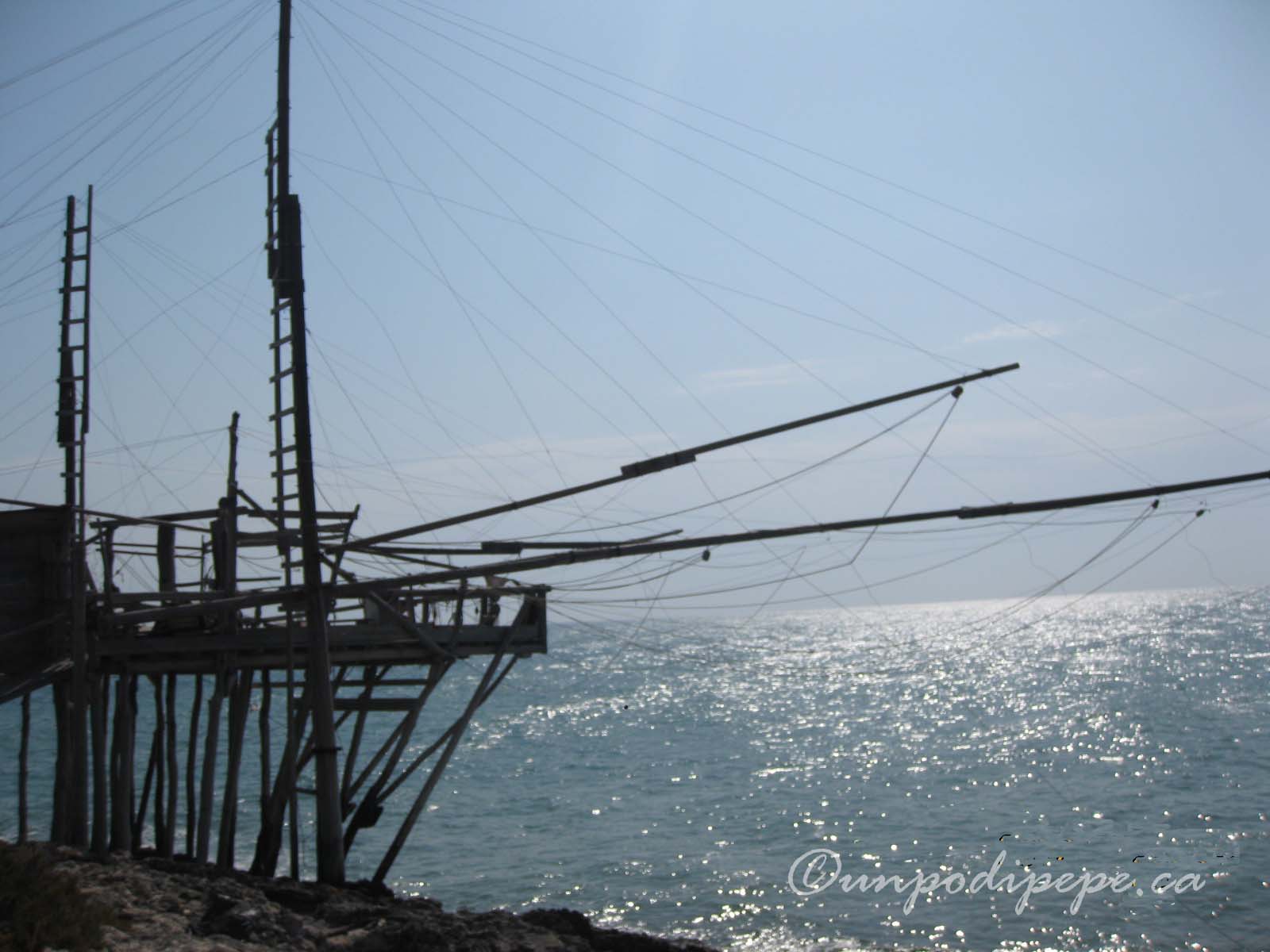
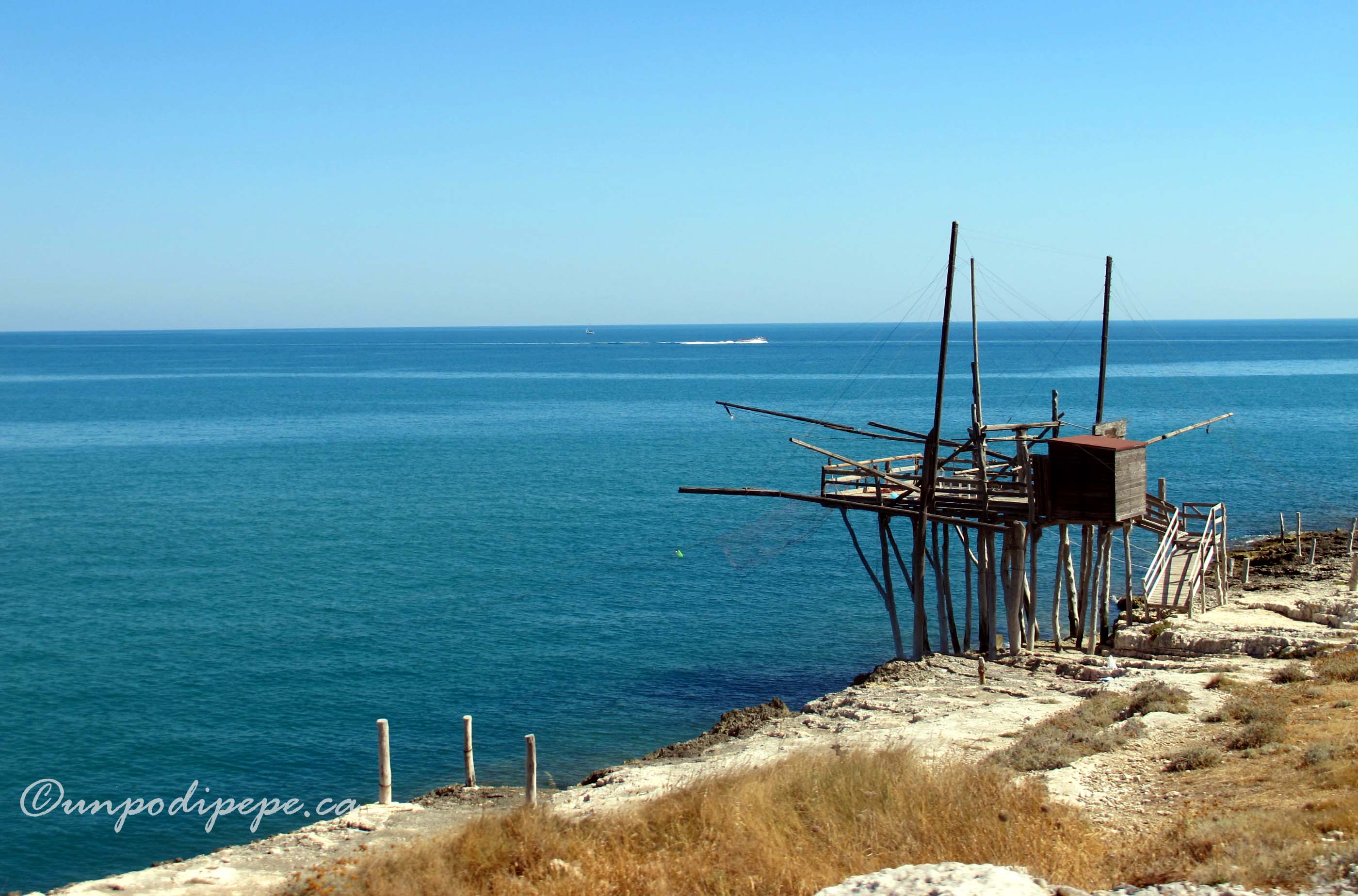
A trabucco is made up of a wooden platform on poles anchored to a rocky cliff or promontory, with several long wooden arms jutting out over the sea.  The arms have a system of ropes and winches suspending a giant narrow-mesh net called a trabocchettoTrabucchi are made of Aleppo pine which is abundant in the area and is resistant to salt and weather conditions.

Trabucco San Lorenzo

Along the coast of the Promontorio del Gargano (Gargano Promontory) there are 13 working trabucchi between Peschici and Vieste.  The oldest dates from the 18th century.   They are protected as National cultural heritage sites within the Parco Nazionale del Gargano.  Here is a link to a Trabucchi del Gargano map.

Trabucco Punta Lunga

Trabucco Punta Lunga

Although there is no documentation, Pugliese historians believe the trabucco design is imported from the ancient Phoenicians. They really are an ingenious way of fishing to take advantage of the rocky coastline and crystal clear waters of the Gargano. Trabucchi are built facing SE or NW and where the water is at least 5 m deep, to take maximum advantage of the marine currents.

Trabucco Molinella

A trabucco requires 3-4 operators or ‘trabuccolanti’.  1 or 2 trabuccolanti look out for schools of fish swimming along coastal currents.  They give word, then the other 2 operate winches to drop the trabocchetto (net) and quickly hoist it back up full of fish.  Gargano fisherman of old really created an extension of the land-with a trabucco they were able to fish from the rocky cliffs and did not have to ‘get their feet wet’ or take boats out in dangerous agitated seas.

The view below Trabucco Punta Lunga

The view below Trabucco Punta Lunga

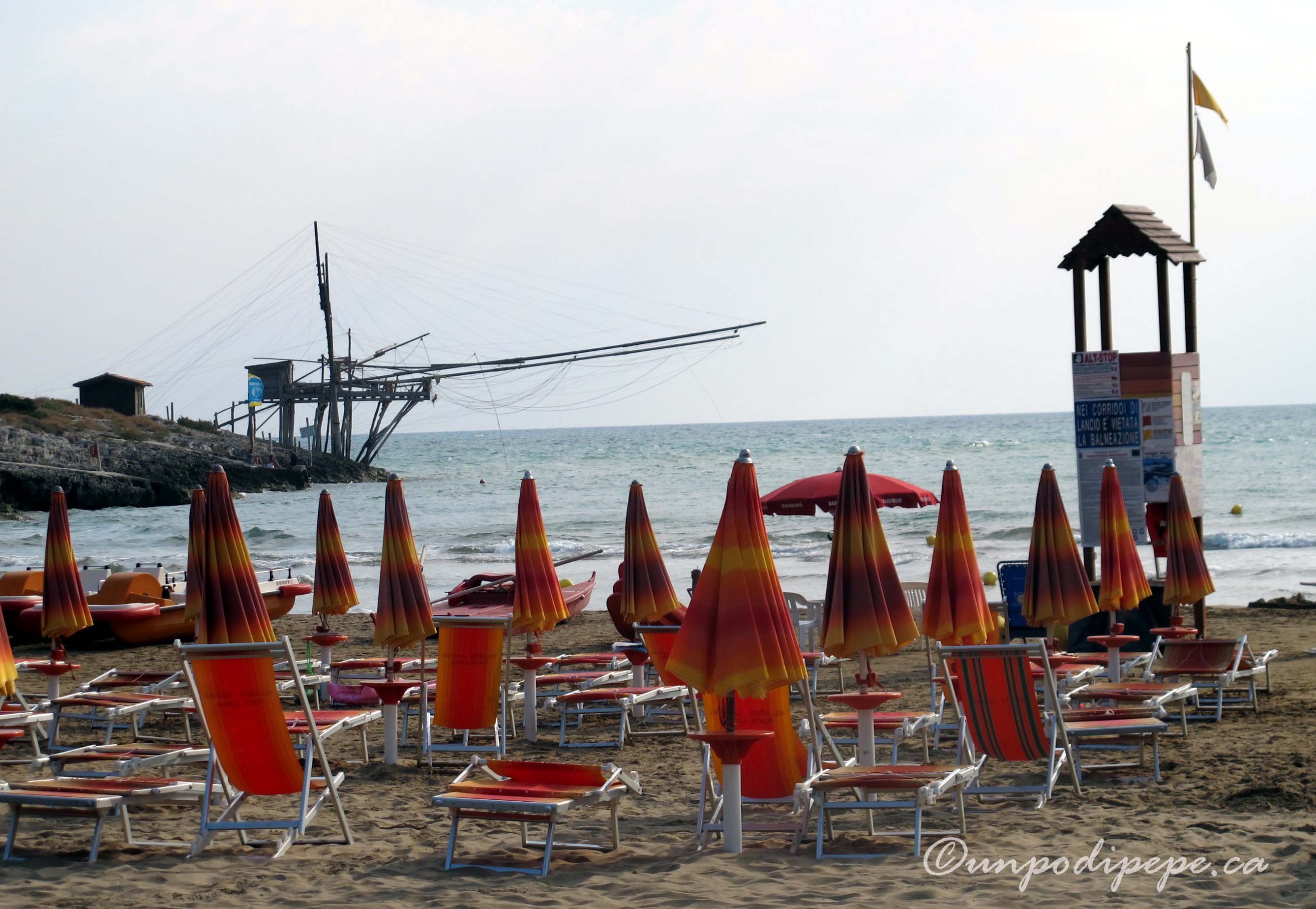
Trabucchi have become symbols of ancient maritime culture. I’ve been on several weekend camping trips in the Gargano with my cugini, and have been able to visit several trabucchi.  Imagine my excitement 2 years ago when the beach by our campsite at Punta Lunga, 2km north of Vieste had it’s very own trabucco!

Spiaggia Punta Lunga

Centrale Montemartini

Tags

, , , , , , , , , , , ,

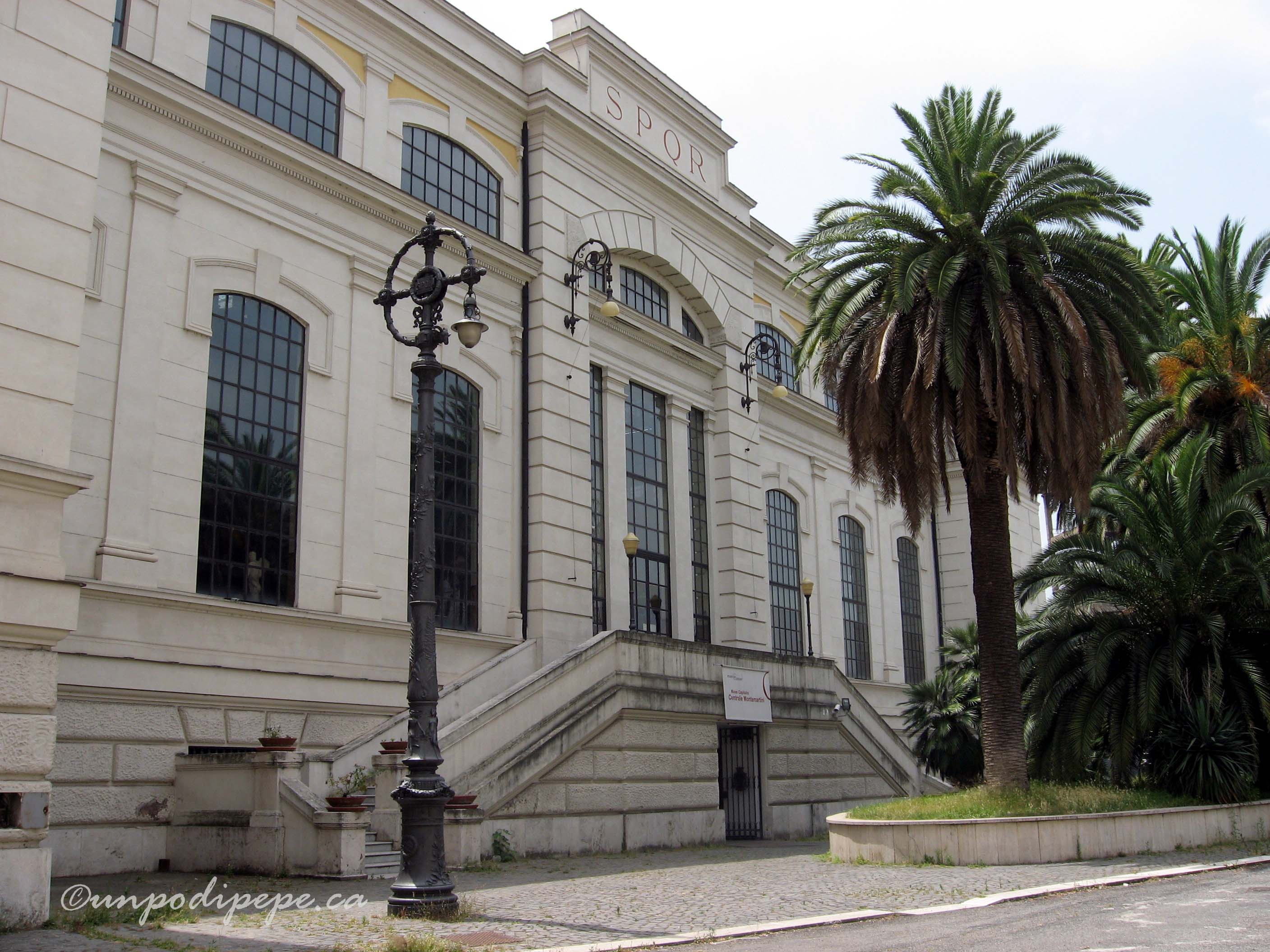
Centrale Montemartini is an amazingly awesome, undervisited museum and a stunning example of 20th Century industrial archeology.  Built in 1912 in Art Nouveau style (Stile Liberty), it was the first public electric plant in Roma, providing power for the surrounding area until it was abandoned in 1963.  Luckily the amazing architecture and historical importance saved it from demolition!

Amazon warrior in front of a diesel engine

Amazon warrior in front of a diesel engine

In 1997 during the Capitoline Museum renovation, Centrale Montemartini was used for a temporary exhibition ‘Le Macchine e gli Dei’ (The Machines and the Gods).  In 2005 it became a permanent space for part of the Capitoline collection, with all of the original thermoelectric equipment left in place.  Now you can visit a unique display of classical sculpture against an industrial  backdrop of steam boilers, diesel engines, catwalks twisting pipes and gauges.  It’s a blend of ‘vecchio e più vecchio’ (old and older), a stark contrast of ancient and industrial, art and science.  Antique white marble appears translucent against the blackness of the machinery.  The space is immense and silent, with high ceilings and tall windows providing natural light. The works of art are carefully chosen and placed so there is space to appreciate their beauty while you walk among them and contemplate the passage of time.Centrale Montemartini Sala Macchine3

The 400 pieces include ancient Roman sculptures, rare Greek originals brought to Roma, and Roman copies of Greek originals. They date from the 5th Century BC to the 4th Century AD and were found in the late 19th and early 20th Century. Most of the works are on the upper floor in 2 massive rooms.

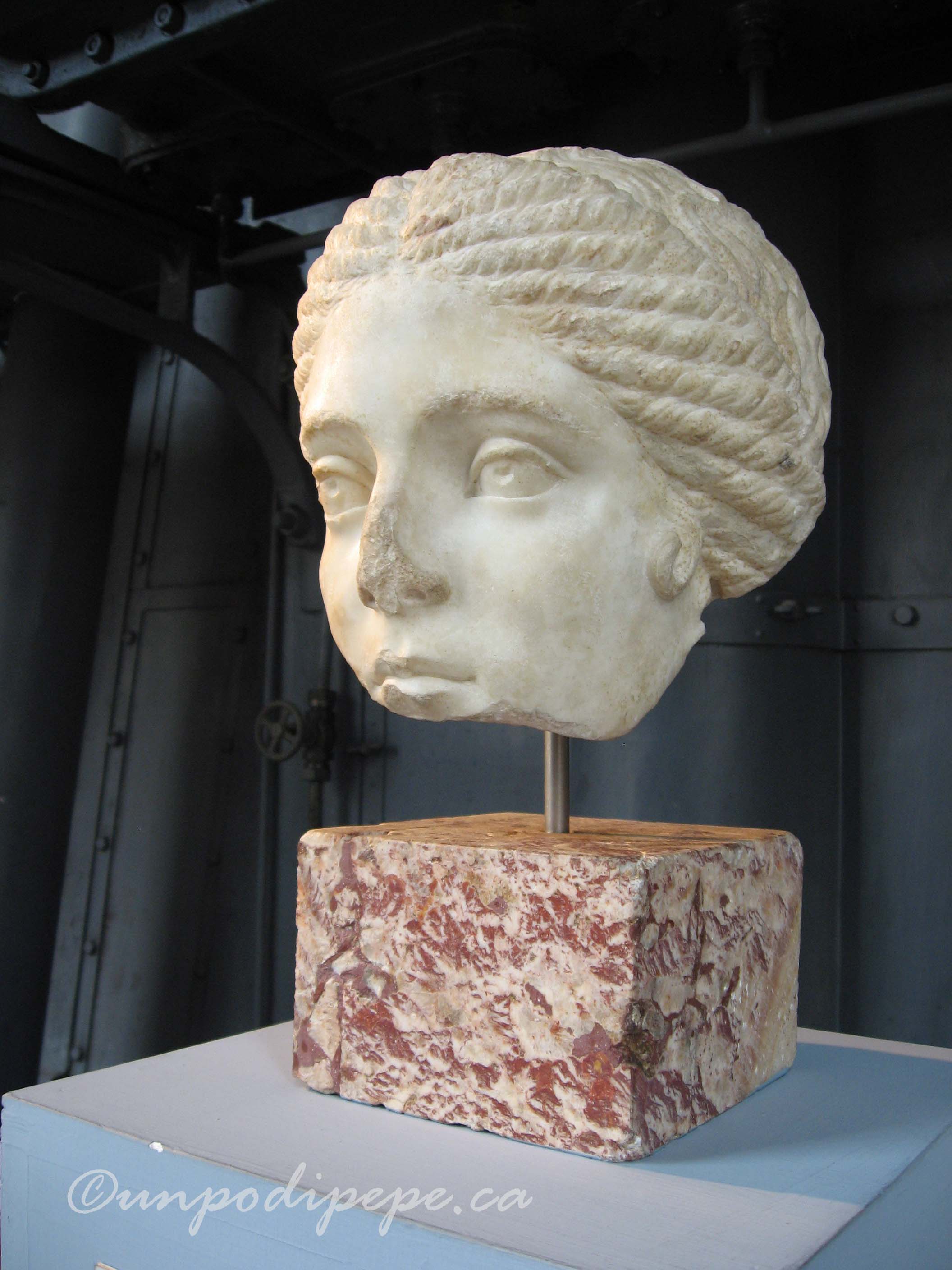
Partial female head, discovered in the garden of Villa Rivaldi in 1933 during construction of Via dei Fori Imperiali

Partial female head, discovered in the garden of Villa Rivaldi in 1933 during construction of Via dei Fori Imperiali

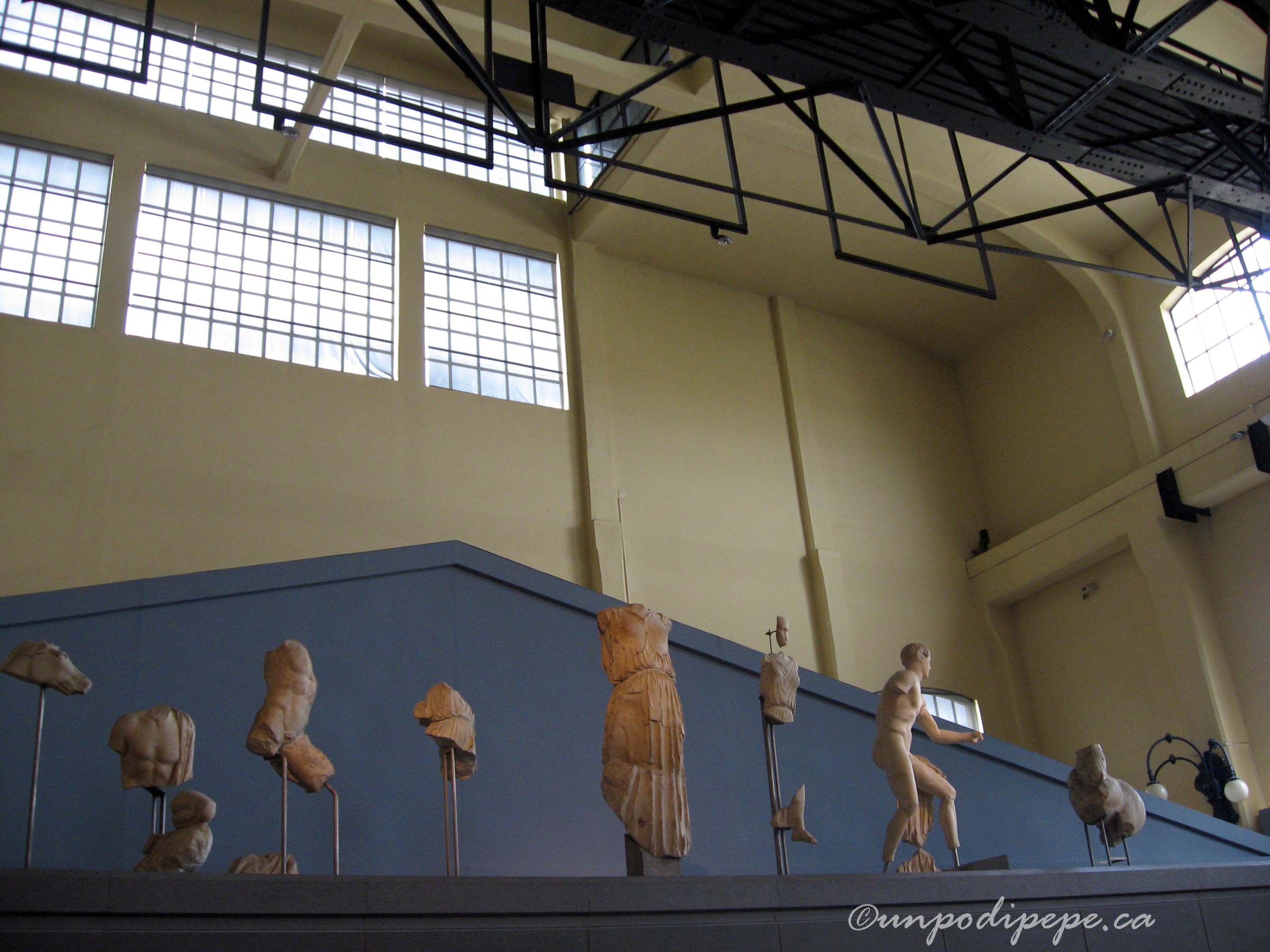
In Sala Macchine (Machine Room or Hall of the Machines) 2 hulking diesel engines are surrounded by Roman replicas of Greek statues.  At one end, a reconstruction of the pediment of the Temple of Apollo Sosiano depicts a battle between Greeks and Amazons.  These pieces are Greek originals found in the 1930’s near the Theater of Marcellus.  Above this installation hangs the old ‘carroponte‘ (Gantry crane).

Centrale Montemartini, Sala Macchine

Centrale Montemartini, Sala Macchine

Centrale Montemartini Apollo Sosiano

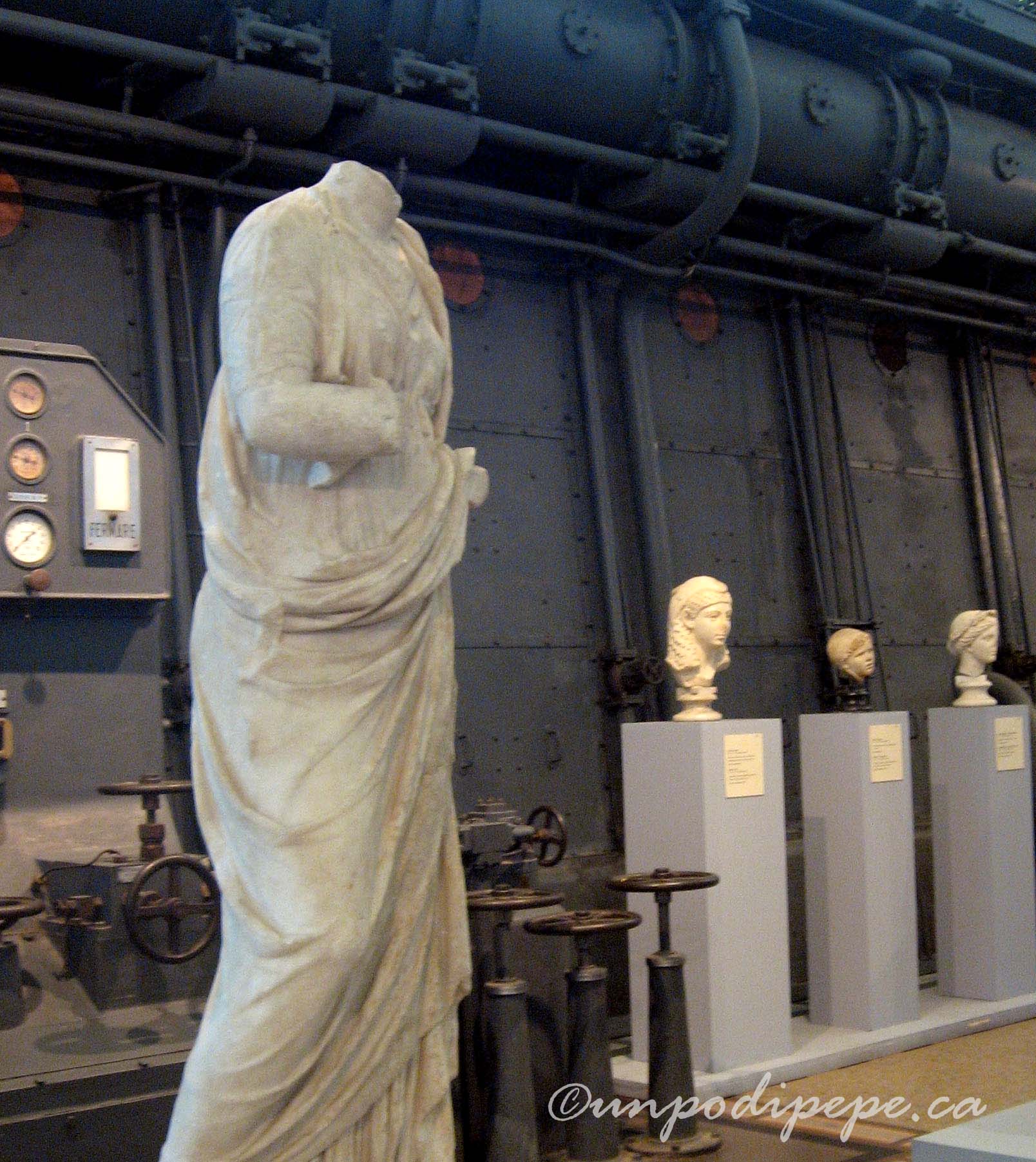
Other ‘meraviglie’ (wonders) include a bust of Cleopatra and the giant head, right arm and feet of an 8m high statue of the Goddess Fortuna found near Largo Argentina.  Her feet look very modern with their ‘infraditi’-thong style sandals!piedidifortuna

Sala Macchine. Bust of Cleopatra (to the right of the large statue)

Sala Macchine. Bust of Cleopatra (to the right of the large statue)

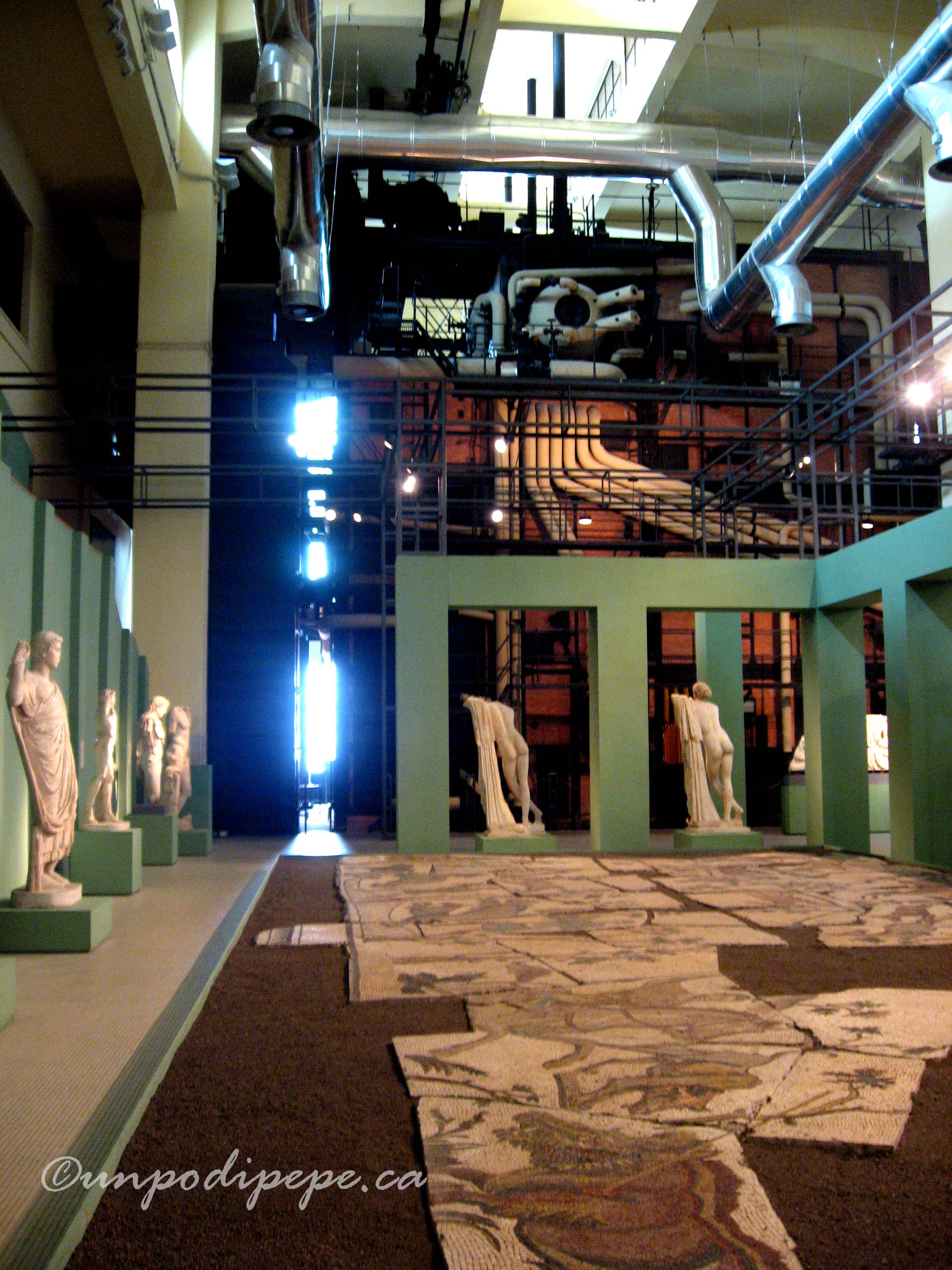
cleopatraSala Caldaie (Boiler Room) is named for its 15m steam boiler and features a large mosaic of a hunting scene found near Santa Bibiana.  The mosaic is surrounded by sculptures once adorning lavish Roman homes.Centrale Montemartini Sala Caldaie

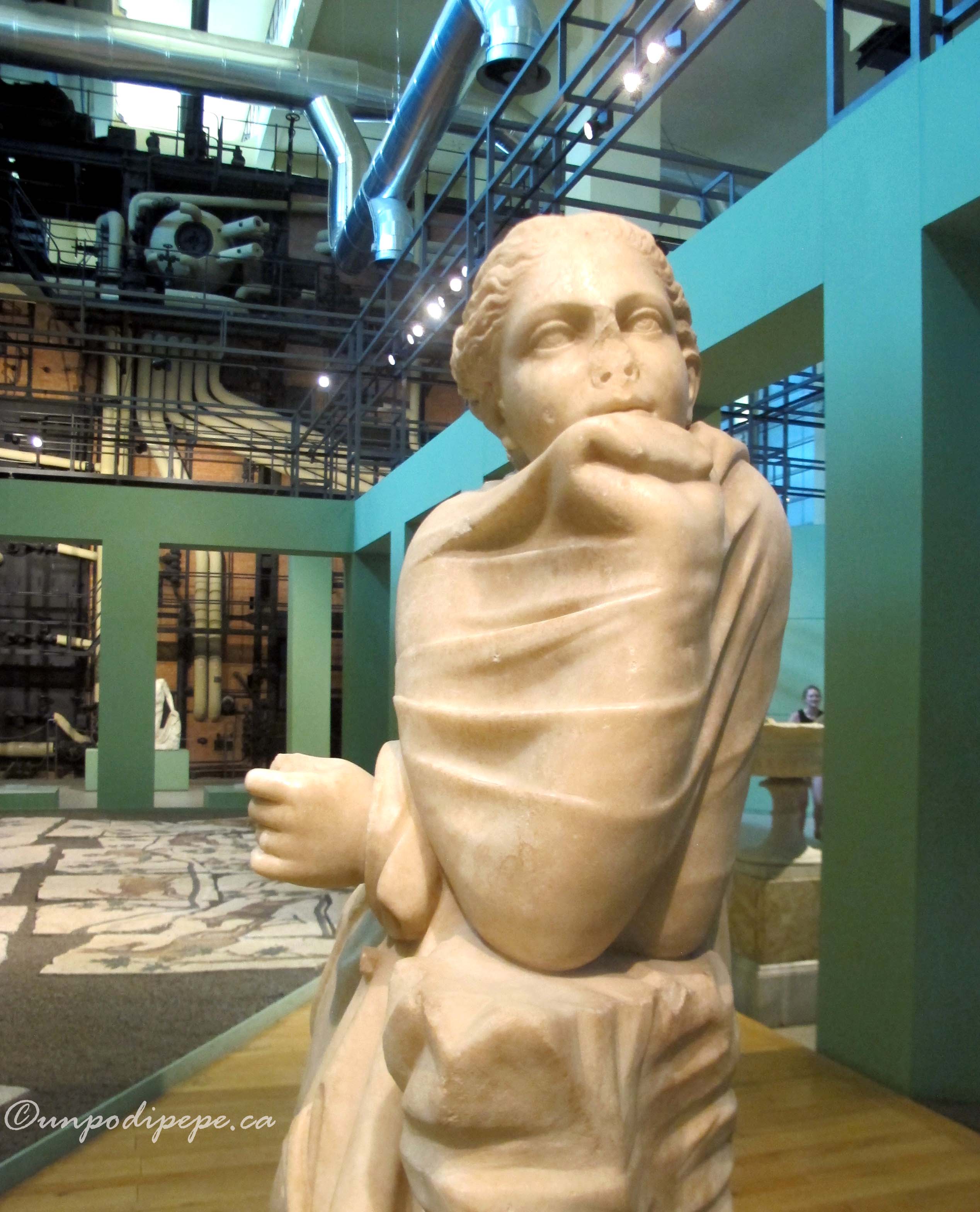
PolimniaI especially like the statue of Polimnia, muse of poetry and dance.  She has her elbows resting on a pillar and her shawl casually wrapped around her.  My other favourite in Sala Caldaie is the Sphinx Frieze, which seems to glow against the red brick wall.

Sala Caldaie. Sphinx Frieze with Acanthus Spirals. This was part of the Gardens of Sallust and likely represents the victory over Antony and Cleopatra.

Sala Caldaie. Sphinx Frieze with Acanthus Spirals. This was part of the Gardens of Sallust and likely represents the victory over Antony and Cleopatra.

There were only 4 or 5 other people in the museum both times I visited.  One of the staff told me that from October to May they have a lot of school groups visiting through their educational program, but June to September is not very busy.  This is opposite to most other museums!  I definitely recommend this amazing place, especially if you want to get away from crowds and lineups and see something truly unique. Even people who don’t like museums will appreciate this one-or at least find it oddly fascinating!Centrale Montemartini WarriorTorso

Centrale Montemartini is in the Ostiense area on the left bank of the Tevere.  It is south of Roma’s historic center but very accessible by Metro B line Garbatella stop.  When leaving the metro stop, you will cross a pedestrian bridge and then reach Via Ostiense.  Bus 23 goes along Via Ostiense and Stazione Ostiense is also nearby.

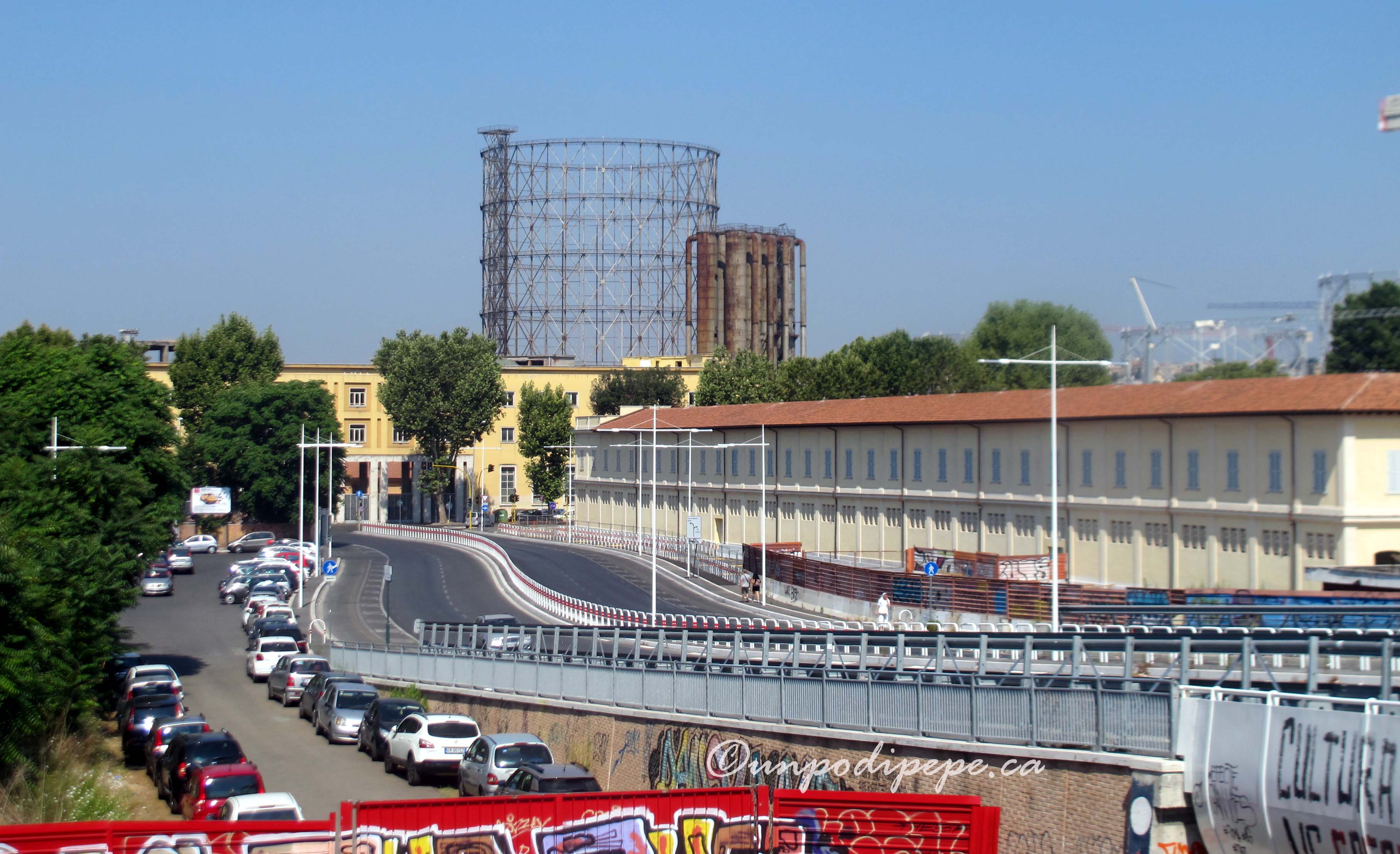
The view on exiting Garbatella Metro Stop.  Via Ostiense is in front, where the yellow building is.  Il Gasometro is behind it.  Centrale Montemartini is just to the left.

The view on exiting Garbatella Metro Stop. Via Ostiense is in front, where the yellow building is. Il Gasometro is behind it. Centrale Montemartini is just to the left.

The Basilica of San Paolo Fuori le Mura is walking distance, one metro stop away.  In between the Basilica and Centrale Montemartini is one of the oldest restaurants in Roma, Al Biondo Tevere at Via Ostiense 178 www.albiondotevere.it  serving Roman cuisine overlooking the Tevere.

Centrale Montemartini

Centrale Montemartini

www.centralemontemartini.org  Via Ostiense 106, open Tues-Sun from 09-19.  Admission is € 7.50 for adults or €16 for the Capitolini Card (valid 7 days).  The Romapass can also be used.  Don’t forget your sketchbook!

Ciao, Cristina

Chiacchiere

Tags

, , , , , ,

Chiacchierare (kee•ak•kee•eh•RAH•reh) is what I like to call a ‘parola piacevole’ (pa•ROH•la pyah•cheh•VOH•leh)-a likeable word. I love how it sounds.  If you need to review Italian pronunciation go back to this post.  The verb chiacchierare means to chat or talk.  It can also mean to gossip or make small talk. ‘Facciamo due chiacchiere’ literally means ‘Let’s have a few chats’.  Chiacchiere is also one of the many names for fried pastry for Carnevale.

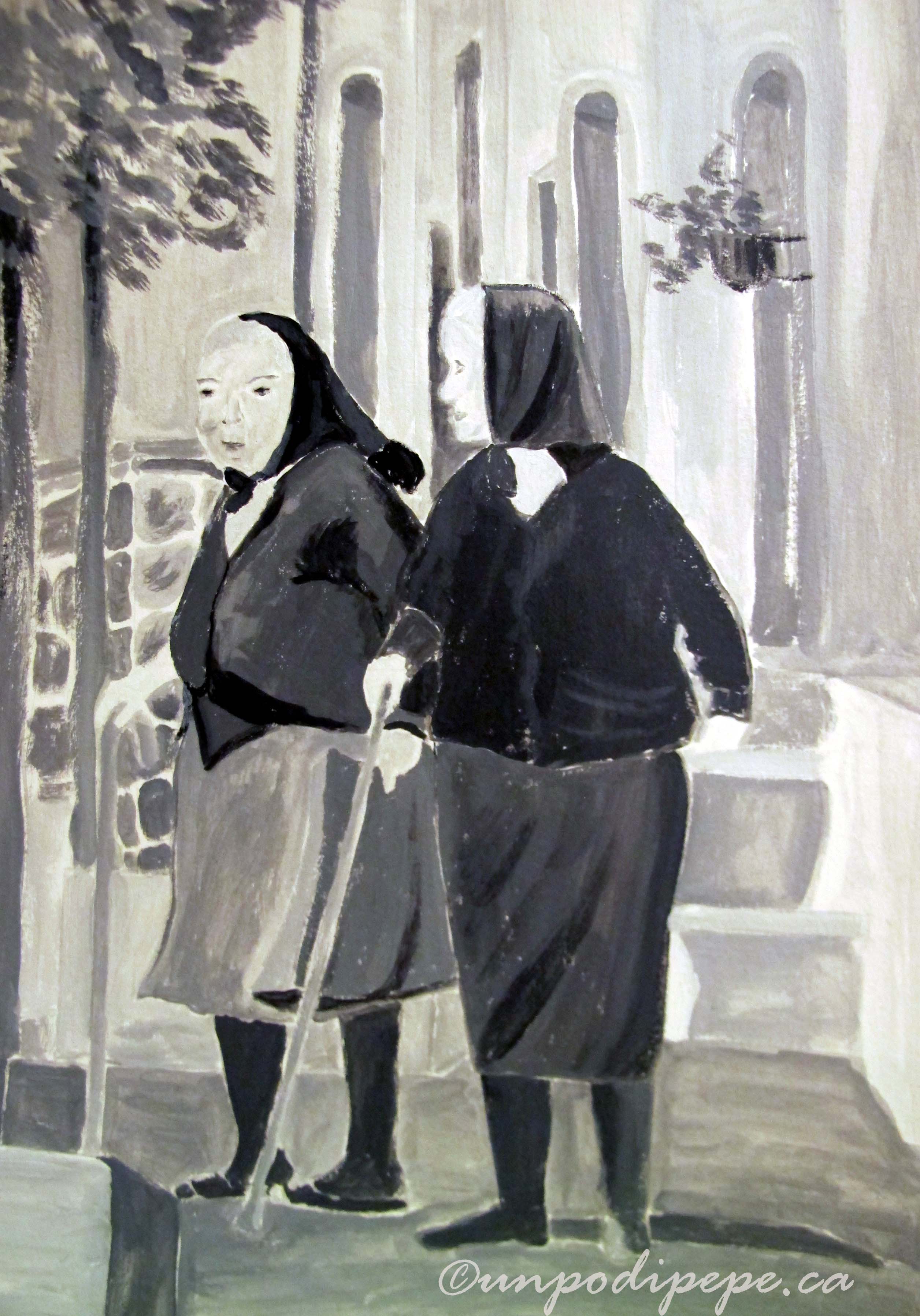
Chiacchiere, 2014

Chiacchiere, 2014

I titled my quick monochromatic acrylic sketch on paper ‘Chiacchiere’ because as soon as I finished it that is the word that came to me.  I wonder what these two vecchiette (vek•KYET•teh =little old ladies) are talking about today? I might turn them into a real painting or some note cards…so I can write down my chiacchiere and send them to you!

‘Ratto delle Sabine’

Tags

, , , , , , ,

OLYMPUS DIGITAL CAMERAOne of my favourite works of art is moving!  After 432 years in the Loggia dei Lanzi in Piazza della Signoria Firenze, Giambologna’s ‘Ratto delle Sabine’  (Abduction of the Sabine Women) is being moved to the Galleria degli Uffizi.  In November 2014 the Ministero dei beni e delle attività culturali e turismo (Ministry of cultural works and tourism) announced that the sculpture would be moving once a reproduction is made for the Loggia and funds are secured for the move.  If needs to be moved indoors to protect it from damage caused by pollution, rain, wind and even snow.

The sculpture was carved from a single block of flawed marble.  Does that sound familiar?  Remember the ‘Il Gigante-Michelangelo’s David’ post?.  It features 3 figures intertwined in a ‘figura serpentina’- a serpentine composition.  A man is lifting a woman into the air while another man crouches, and what they are doing is not really clear.  There is no dominant viewpoint or ‘good side’ to this sculpture. It has multiple viewpoints and makes the viewer want to move around and observe it from every angle.  This was probably the first work of art with more than one point of view.

There are 2 interesting things to note about the sculpture’s misleading title.  First of all, it is usually incorrectly translated into English as ‘Rape of the Sabine Women’.  ‘Ratto’ comes from the latin ‘raptio’ meaning abduction.  The second thing is that the subject matter was entirely made up-it was not the artist who gave this work its title!  Giambologna had no subject in mind when he sculpted this piece.  This was very unusual, but he was trying to demonstrate his ability to create a perfect upward spiralling vortex.  He was the official sculptor of the Medici family and you could say he was showing off.  When the work was completed in 1583, Francesco I de’Medici decided to put it on public display at the Loggia dei Lanzi.  The Loggia is like a large covered porch in the Piazza della Signoria, with 2 walls and 2 open sides.  Some guy named Vincenzo Borghini suggested the title and apparently no one could come up with a better one.  Am I the only one who finds this annoying?

I’ve had the opportunity to view this masterpiece many times and have even sketched it from different viewpoints.  I’m sure a lot of people don’t realize this is still the original sculpture and not a copy! I can totally understand that it needs to be protected from the elements, but once it is moved, you will have to book tickets online, wait in lineups……and you won’t be able to admire it for free on a midnight walk in the Piazza. If you have not seen ‘Ratto delle Sabine’ in the Loggia dei Lanzi yet, there is still time to get to Firenze before ‘il trasloco’-moving day!

La Befana

Tags

, , , , , ,

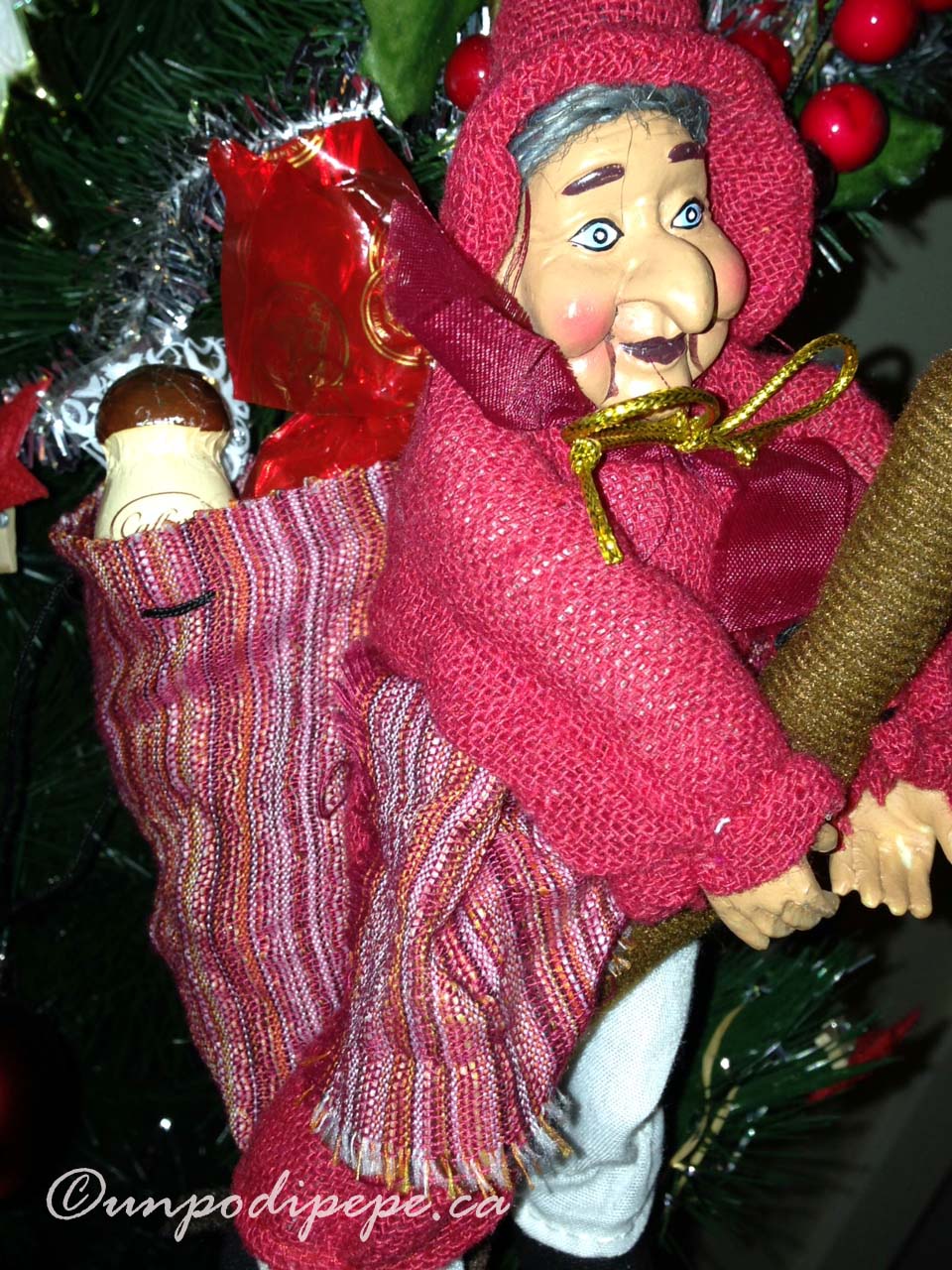
La Befana di Anna La Befana di Anna

Today is la Festa dell’Epifania in Italia, celebrating the arrival of i Re Magi (the 3 Wise Men) Gasparre, Melchiorre & Baldassarre with their gifts of oro, incenso e mirra (gold, frankincense and myrrh) for newborn Bambino Gesù (baby Jesus).

The night between January 5th and 6th is also the 12th night between Christmas and the Epiphany, and marks the end of the Christmas holiday season.  As the proverb says, ‘L’Epifania tutte le feste porta via’.  What does this have to do with La Befana, the ‘Buona Strega’?

La Befana is the traditional ‘gift-bringer’ in Italian folklore. According to legend, which varies from region to region, she is an old woman who prides herself on being a good housekeeper. While she was sweeping, the 3 Wise Men stopped at her house to ask for directions to Bethlehem. She didn’t know the way but they invited her to join them to greet the newborn king and bring him gifts. She was quite abrupt and told them she had housecleaning to do and could not possibly join them.

Once they had left, she realized she had made a very big mistake not going with them.  Befana quickly gathered food and gifts for the newborn King into a sack and uno scialle (a shawl) in case she was cold and set off to join the Wise Men. She even brought her scopa (broom) so she could sweep the floor for Bambino Gesù. Befana searched and searched but could not catch up to the 3 kings. She did not know they had taken a different route home.

To make up for the opportunity she missed, every year on the eve of l’Epifania, Befana flies on her broom delivering small gifts to children, in the hope that one of them is Bambino Gesù. Traditionally she fills calze (socks) with ‘caramelle o carbone’ (candies or coal).  She leaves dolcetti (sweets), fichi secchi, noci, mandarini, cioccolatine (dried figs, nuts, mandarine oranges, little chocolates) and torrone for children who have been nice and leaves carbone (coal), cenere (ashes), cipolle e aglio (onions and garlic) for cattivoni (naughty children). Christmas markets in Italia sell black candy that looks like lumps of coal! A glass of vino and mandarini or biscotti are left on the kitchen table for La Befana and she sweeps the floor before she leaves.  La Befana and her broom also symbolize the old year that is ‘swept away’ after the Christmas festivities.

Her name comes from Epifania which turned into Befania in dialetto and eventually Befana.  ‘Una Befana’ can also mean an ugly old hag. If someone calls you a Befana it is not a compliment-unless they are referring to your gift-giving generosity!

LaBefana

‘La Befana vien di notte

Con le scarpe tutte rotte

S’è scucito la sottana

Viva viva la Befana!

Porta cenere e carboni

Ai bambini cattivoni

Ai bambini belli e buoni

Porta chichi e tanti doni!’

 In Italiano

Oggi è la festa dell’Epifania in Italia. Si ricorda la visita dei tre Re Magi a Betlemme con regali di oro, incenso e mirra per il neonato Bambino Gesù. La notte tra il 5 e il 6 gennaio è anche la dodicesima notte dopo il Natale e la fine delle feste Natalizie. Il proverbio dice ‘L’Epifania tutte le feste porta via’. Ma questo che c’entra con La Befana, la buona strega?

Si dice che La Befana era una vecchietta molto preoccupata con il lavoro di casa. Mentre scopava fuori, i Re Magi hanno chiesto se lei conosceva la strada per andare a Betlemme perchè là era nato il nuovo Re.  La Befana non conosceva la strada.  I Re Magi l’hanno invitata ad andare con loro a portare dei regali al Bambino, ma lei ha detto che aveva troppo lavoro da fare e non era possibile. Dopo che  se n’erano andati, La Befana ha capito che aveva sbagliato e ha deciso di raggiungere i 3 Re per andare a trovare il Bambino Gesù.  Con uno scialle e un sacco con dolcetti e regali sulle spalle se n’è andata.  Ha portata anche la scopa, per pulire il pavimento per il Bambino Gesù.  La Befana ha cercato dappertutto ma i Re Magi erano già troppo lontani.  Allora, ogni anno, nella notte tra il 5 e 6 di gennaio, volando cavalcando la scopa, La Befana porta regali ai bambini nella speranza che uno di loro sia il Bambino Gesù.  Lei reimpie le calze dei bambini con ‘caramelle o carbone’.  Dolcetti per i bambini bravi e cenere e carbone per i cattivoni.  Si lascia un bicchiere di vino e un mandarino o biscotti sul tavolo per La Befana e lei scopa il pavimento prima di andare via.

Buona Befana a tutti! Cristina

Buon Natale

Tags

Gloria

Cari amici di ‘un po’ di pepe’,

Auguro un Buon Natale a voi e alle vostre famiglie! Baci, Cristina

Dear friends of ‘un po’ di pepe’,

I wish you and your families a very Merry Christmas! Baci, Cristina

presepio2014

Cauzuncill’

Tags

, , , , , ,

cauzuncillI know Natale (Christmas) is around the corner when we make cauzuncill’  (cow•zoon•cheel).  Cauzuncill’ is Orsarese for calzoncini, which means piccoli calzoni or ‘little pants’.

Cauzuncill’ are ‘a forma di mezzaluna’ (half moon shaped) turnovers traditionally filled with mashed ceci (chick peas), vino cotto, mandarin orange and lemon zest, grated chocolate, sugar and of course alcohol. We also made some with ground almonds instead of ceci.  Castagne (chestnuts) are sometimes mixed in with the ceci filling.

Cauzuncill'collage copy

Cauzuncill' Collage3 copyCauzuncill’ are fried and then served drizzled with vino cotto.  Don’t know what vino cotto is?  When making wine, some of the freshly pressed grape juice (mosto) is slowly cooked all day until it is reduced and caramelized.  It’s like a thick wine syrup that is used for desserts, muscitaglia on November 1st, and even drizzled on snow!

Cauzuncill' (cow-zoon-cheel) with almond and vino cotto filling, drizzled with vino cotto

Cauzuncill’ (cow-zoon-cheel) with almond and vino cotto filling, drizzled with vino cotto

Dolci di Natale similar to cauzuncill’ are made in Basilicata and Molise, but the name, fillings and even the pastry change depending on the region.  What kind of dolci di Natale does your family make?


Cachi

Tags

, , ,

CachiCollageOne of the few good things about November are cachi (kah•kee) or persimmons.  Papà picked them all a few weeks ago, before it got too cold and they fell off the tree.  The cachi have been ripening in the garage.  I took home a plateful and today they looked irresistably juicy and sketchable.  Yes…. a few of my models didn’t make the photo shoot-I couldn’t resist!

Nel Blu Dipinto di Azzurro-A History of the Colour Blue

Tags

, , , , , , , , , ,

PoggipoggiazzurroThis post is not about Domenico Modugno’s 1958 hit song or the Azzurri, the Italian national team.  It is about the long and fascinating history of blue pigment.  Although the colour blue is all around us-in the sky, the sea and the mountains, blue pigment is rare in nature.  Unlike earth colours, which could be made by going outside and mixing dirt with oil or sap, blue pigment was made with ground minerals which were not easily obtained. This made blue a rare and valuable colour.

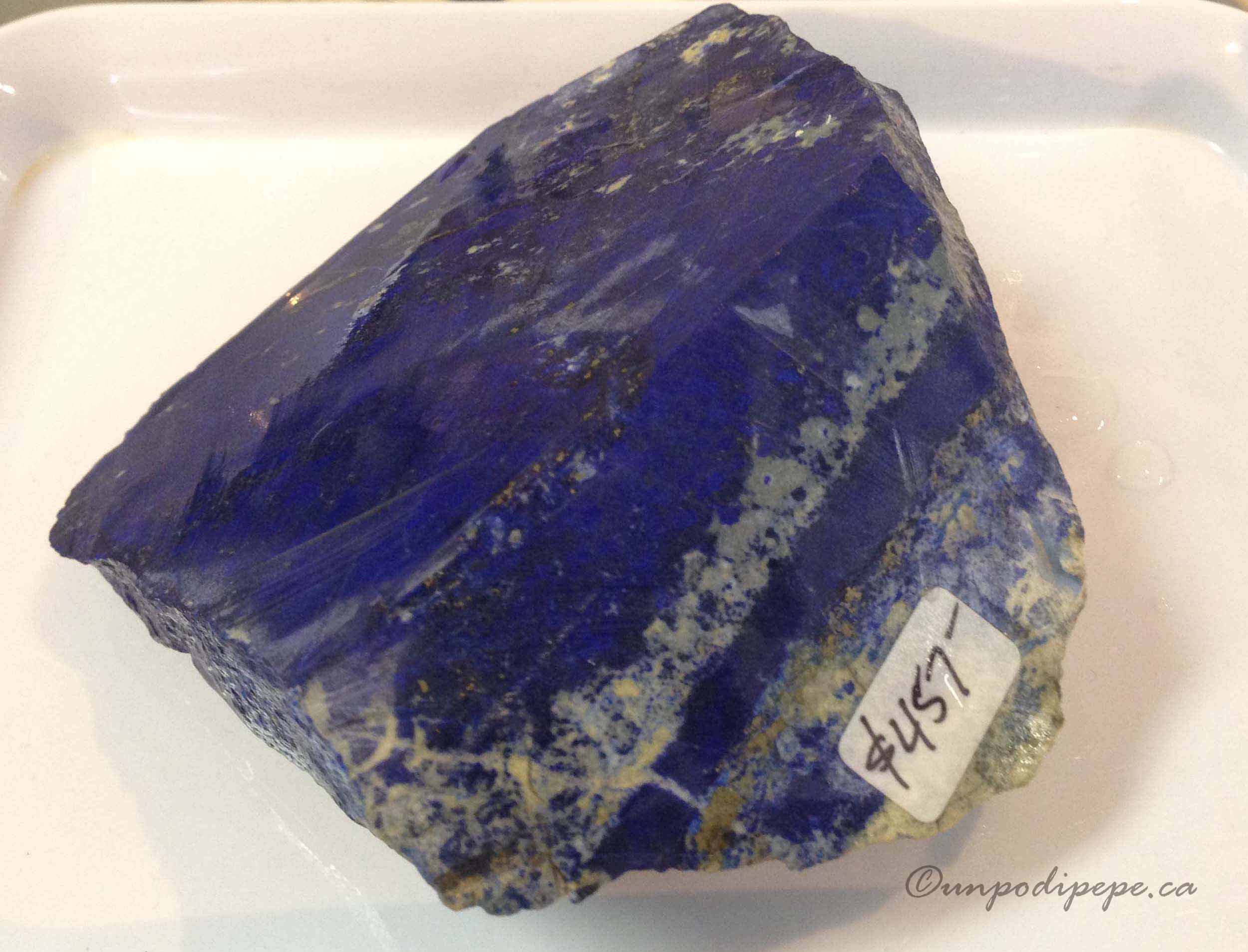
The Ancient Egyptians made a pigment called blue frit from blue glass ground into powder, but the complicated process of how to make it was lost. Historically, the most prized blue was ultramarine, a warm blue with a brilliant tone, leaning towards violet on the colour wheel.  Genuine ultramarine blue was made from ground lapis lazuli stone which has tiny specs of iron pyrite in it that make it glitter like gold.  Lapis lazuli comes mainly from one set of mines in the remote Badakhshan area of Northern Afghanistan (formerly Persia).  The Sar-i-Sang (Place of the Stones) mines have been in operation continuously for over 6,000 years!  Marco Polo explored the area in the 13th Century and wrote ‘there is a mountain in that region where the finest azure (lapis lazuli) in the world is found.  It appears in veins like silver streaks’.  The name ultramarine does not refer to the colour of the sea. ‘Azzurro oltre mare’ or ‘azzurro oltremarino’ means ‘blue from across the seas’.  No one knew exactly where it came from or how it was made, giving it an exotic and mysterious aura.
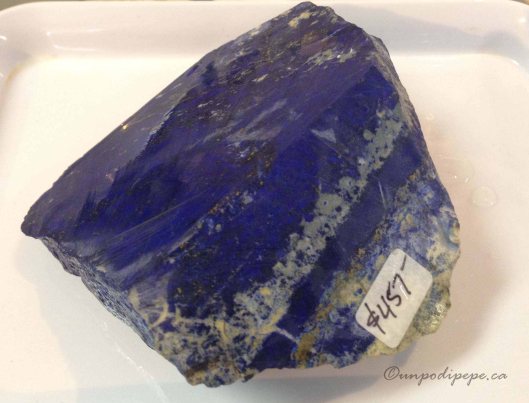
Lapis lazuli from the Sar-i-Sang mines in Afghanistan, courtesy of Mountain Gems, Burnaby BC.

Lapis lazuli from the Sar-i-Sang mines in Afghanistan, courtesy of Mountain Gems, Burnaby BC.

Lapis lazuli was exported to all parts of the ancient world and used for jewellery and adornment.  It is mentioned in one of the oldest known works of literature, the Mesopotamian poem ‘The Epic of Gilgamesh’ (17-18 C BC).  The irises on the Louvre’s 2400 BC alabaster statue of Ebih-II from ancient Mari (modern Syria) are made of lapis lazuli as are the eyebrows of the funeral mask of King Tutankhamun (1341-1323 BC).  Cleopatra may have even used very finely powdered lapis lazuli for eyeshadow.  Try finding that at Sephora!

The process for making a permanent, non-toxic pigment by extracting colour from the lapis lazuli stone was developed in 12th century Persia.  Trade of ultramarine to Europe via Venezia started soon after Marco Polo’s time.  It was used for manuscript illuminations and painting.  In his early 15th century bestseller, ‘Il Libro dell’Arte’ Cennino Cennini writes about how to make the pigment.  Powdered lapis lazuli stone was sifted and mixed with pine resin, gum mastic and wax or linseed oil.  It was wrapped in cloth, soaked and kneaded with a dilute lye solution until the blue colour was extracted.  Cennini wrote ‘ultramarine blue is a color illustrious, beautiful, the most perfect, beyond all other colours; one could not say anything about it, or do anything with it, that its quality would not still surpass’.

Extracting colour from lapis lazuli with lye can be compared to pressing olive oil. The process is done 3 times.  The first ‘press’, like extra virgin olive oil produces the highest quality colour.  The second press, although still good, is a lower quality colour, and the final press would be the equivalent of pomace olive oil.  In the 2009 Australian/French documentary ‘Cracking the Colour Code’ Massimo Zecchi can be seen preparing genuine ultramarine pigment for the restoration of a Renaissance altarpiece.

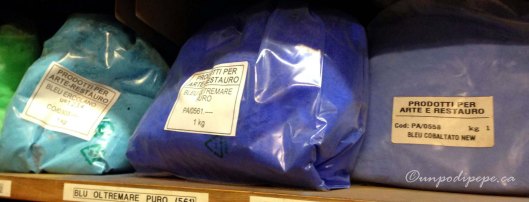
During the Renaissance, ultramarine became associated with the divine and heavenly, giving works of art both a sense of spirituality and luxury.  Since it was worth more than the same weight in gold, it was used sparingly by Renaissance painters.  It was reserved for the most important parts of the painting-usually the robes of the Virgin Mary and baby Jesus.  Artists would sign contracts with their patrons stating the quality and price to be paid for the pigment.  Zecchi Colori e Belle Arti in Firenze has been making artist pigments for over 300 years. On their website 100g of ‘Azzurro oltremarino di lapis lazuli Afgano’ sells for 510 Euro, 10g is €58  2nd quality is €290 for 100g or €38 for 10g.

Artists often economized for the underpainting by using blue made with azurite, a mineral mined in France.  Then they would add thin layers of ultramarine over top.  Azurite makes a paler, greenish blue.  It was used for painting skies but would turn dark over time.  In one of my favourite paintings, Sandro Botticelli’s 1470  ‘La Madonna dell’ Eucaristia’ (the Madonna of the Eucharist), the difference between the grayed greenish blue of the sky and the brilliant ultramarine of the Madonna’s robe is clearly visible. If you are in Boston, be sure to visit this masterpiece at the Isabella Stewart Gardner Museum because photographs do not do it justice.
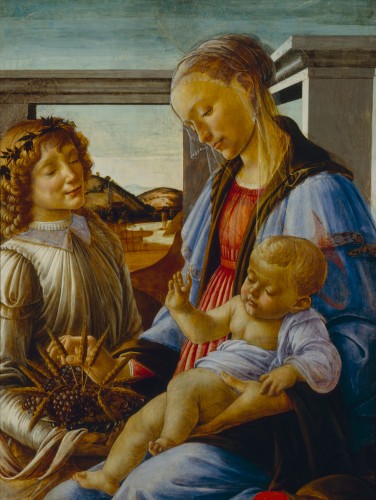
La Madonna dell' Eucaristia (1470) by Sandro Botticelli

La Madonna dell’ Eucaristia (1470) by Sandro Botticelli

Ultramarine was not used in fresco painting, as the colour bleaches out in reaction to the acidic wet lime plaster.  This meant an enormous amount of the expensive pigment would be needed.  Azurite was used for fresco painting.  It had a course texture, making it hard to stick to the plaster.  Several layers of azurite were needed, giving the fresco a crusty or chalky look. Ultramarine pigment was mixed with a binder-usually egg yolk, and applied to the fresco ‘secco’, after the plaster had dried. This is how Giotto painted the magnificent Cappella degli Scrovegni in Padova in 1305.

A small section of Giotto's Cappella degli Scrovegni

A small section of Giotto’s Cappella degli Scrovegni

The turban of Johannes Vermeer’s mesmerizing 1665 ‘Girl with a Pearl Earring’ is painted with a mixture of ultramarine and lead white, with many thin glazes of pure ultramarine painstakingly painted over it. Vermeer went into debt buying the pigment!
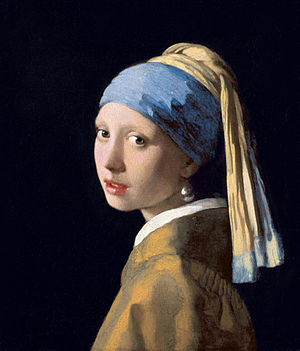
Girl with a Pearl Earring (1665) by Johannes Vermeer

Girl with a Pearl Earring (1665) by Johannes Vermeer

In the 18th Century, oxides from cobalt were used to make a blue similar to the Ancient Egyptian blue frit. Several other blue pigments were also developed, but none could compare to ultramarine.  In 1826, the French government offered a prize to produce a synthetic version of ultramarine. Many attempts failed. The final product was named ‘french ultramarine’.  Large quantities could be produced at a much lower price. This is the ultramarine blue pigment we use today.  It is one of the most important colour discoveries in the history of artist pigments.   The next time you crack open a tube of ultramarine blue, squeeze it onto your palette and load it on your brush….you can recall the long and fascinating history that led to the manufacture of your paint!

The Italian word for blue is azzurro (ahz·ZOOR·roh), from the Persian word lazhward which morphed into lazulo then became azzurro.  The same word is the root of English azure, French azur, Polish lazur, Romanian azuriu, Spanish and Portuguese azul, and Hungarian azúr.  Lapis is Latin for stone, thus lapis lazuli means blue stone.
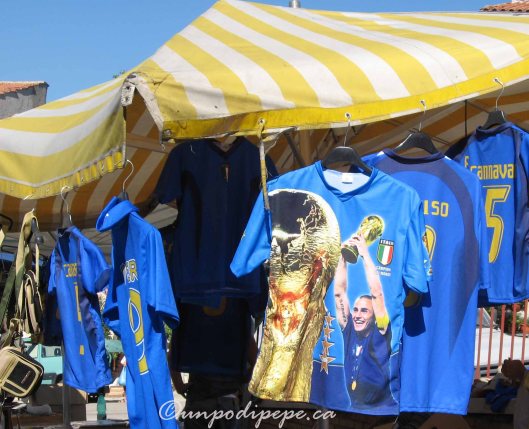
Forza Azzurri!

Forza Azzurri!

©2014 http://www.unpodipepe.ca
Fucacoste e Cocce Priatorje

Tags

, , , , , , , , , ,

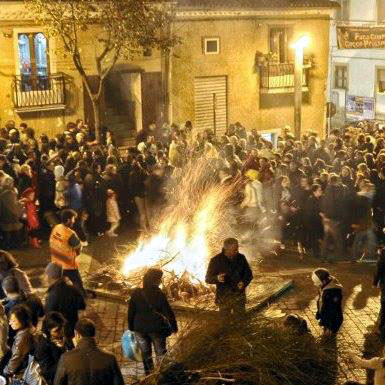
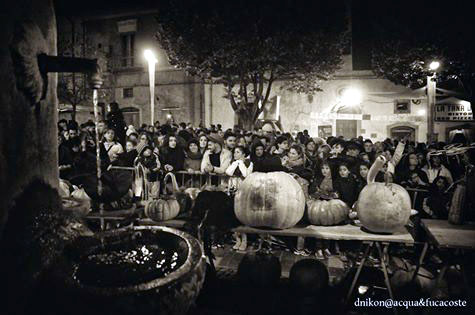
Piazza San Pietro. Photo courtesy of International Photo Correspondent Donato Narducci Piazza San Pietro. Photo courtesy of International Photo Correspondent Donato Narducci

Fucacoste e cocce priatorje is dialetto Orsarese for ‘Falò e teste del Purgatorio’.  This translates to ‘Bonfires and heads from purgatory’. It is an ancient festival unique to Orsara di Puglia celebrated on November 1st, the night of ‘Tutti i Santi’ (All Saints Day).  All Saints Day was created in the 9th century when the Pope superimposed a Christian feast day onto existing rituals, so this festa has been around for a very long time.  It is a night where people have the opportunity to honour, reconnect and pay respect to the spirits of their loved ones.  Carabinieri estimate that Orsara (pop 3,000) had 40,000 visitors attend the festa tonight, with 9,000 cars parked up to 3 km away!

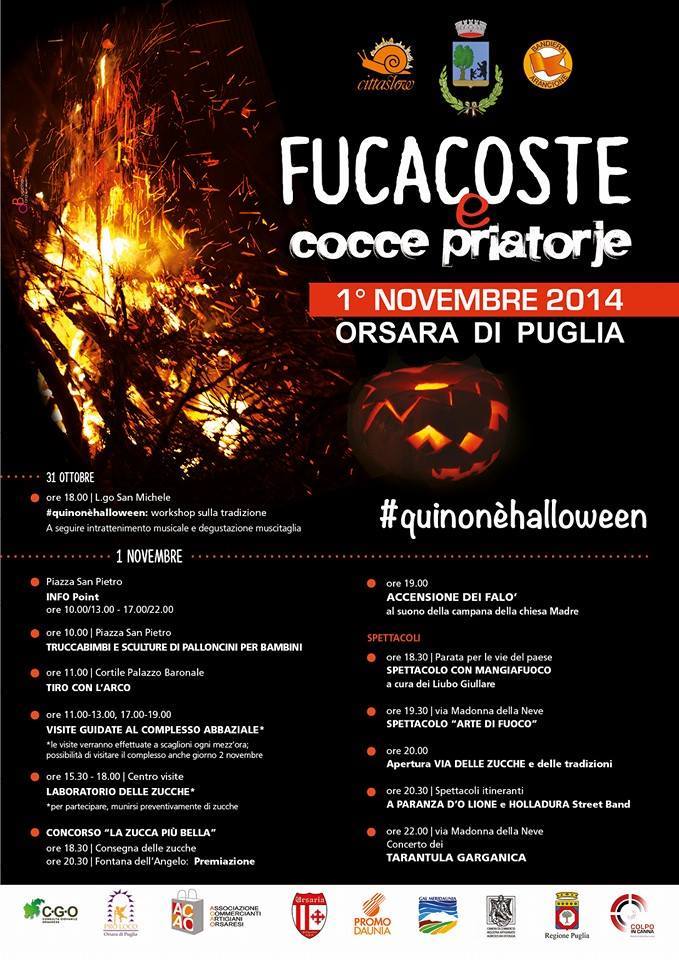
2014 poster for Fucacoste e cocce priatorje 2014 poster for Fucacoste e cocce priatorje

It is believed that the souls of the dead return among the living to visit their relatives and their former homes before moving on to Paradiso.  The bonfires are lit with wood and branches of ginestra (broom). The light of the fires and the crackling and sparks of the ginestra attract the spirits to reunite the living with those who continue to live only in their memories.  The souls of the dead loved ones collect ashes from the fires. The gleam of light inside ‘cocce priatorje’, pumpkins carved to look like heads-light their way to find their former home.

Preparation for the  festa involves gathering firewood and ginestra, preparing food and carving zucche (pumpkins).  There is even a BYOZ (bring your own zucca) pumpkin carving workshop.  Later in the evening zucche are exhibited and there is a contest for ‘la zucca più bella’-the best zucca.

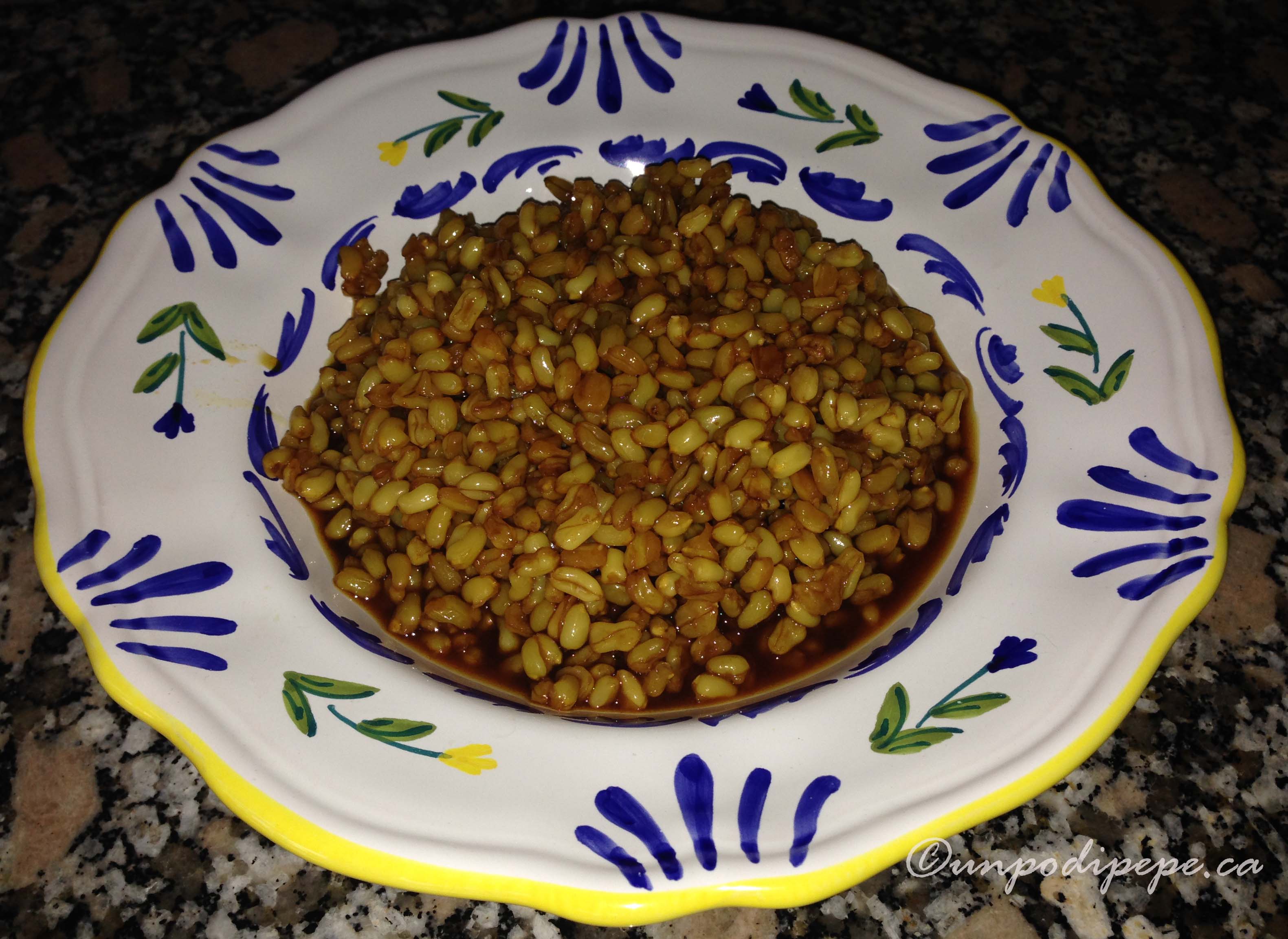
In honour of the dead, simple but symbolic foods are prepared.  These include potatoes, onions, salsicce (sausages) and castagne (chestnuts) cooked in open fire. Muscitaglia is a traditional dish served on November 1st which probably dates back from the ancient Greeks and Byzantines. Muscitaglia (moo•shee•tah•lyah) in both Greek and Latin is made up of the words mosto (wine must) and talia (grain). The ingredients include boiled grain and vino cotto (literally cooked wine-also called mosto cotto). Pomegranate seeds and walnut pieces are sometimes added. These ingredients are symbols of fertility and abundance, but also of honour and respect for the dead.
Muscitaglia Muscitaglia

When the campanile (church tower bell) strikes 1900 hours (7 pm), Orsara di Puglia ‘catches fire’. Over 100 bonfires are simultaneously lit in every street and piazza and remain lit through the night.  The fires, pumpkin lanterns, music and people in the streets create a magical, enchanted atmosphere. In 2017 I attended the festa and took photos.  They are in the post Tutti i Santi.

Fucacoste e Cocce Priatorje has often been confused with Hallowe’en, but it is a very different event.  Besides the fact that the date is different, dressing up in costume is not part of the custom, there is nothing scary about it and there are no evil spirits to chase away. It has more similarities with the Mexican Dia de los Muertos/Day of the Dead.  This is an event about being together in community to celebrate the bond between the living and those who we remember in our hearts, and to remind us that our time on earth is precious.

Watch the video ‘#quinonèhalloween’ featuring 94 year old Z’Gaetan talking about the festa and its significance  https://www.youtube.com/watch?v=9W5RD0-9H-A

Read about tonight’s festa (in Italiano) on the Comune di Orsara di Puglia website.  For more about Orsara di Puglia read the post ‘Benvenuti ad Orsara di Puglia’.  Ci vediamo alla festa!

Fucacoste e Cocce Priatorje, Fontana Sant'Angelo, Orsara di Puglia 2014. Photo courtesy of Donato Narducci Fucacoste e Cocce Priatorje, Fontana Sant’Angelo, Orsara di Puglia 2014. Photo courtesy of Donato Narducci