Buon Natale 2023
24 Sunday Dec 2023
Posted in Feste
24 Sunday Dec 2023
Posted in Feste
08 Friday Dec 2023
Posted in Feste, Italocanadesi
December 8th is a national holiday in Italia and the official start of le feste Natalizie-the Christmas season. It is also the day most Italiani put up and decorate their Christmas tree, l’ albero di Natale.
The most well-known albero di Natale is probably the one in Rockefeller Plaza in New York. It is known around the world and visited by 125 million people each year. Usually, the tree is a giant Norway Spruce from upstate NY, sometimes it is even from Canada. The tree goes up on the Wednesday evening after American Thanksgiving* and is lit from 5 am to midnight until after the epiphany.
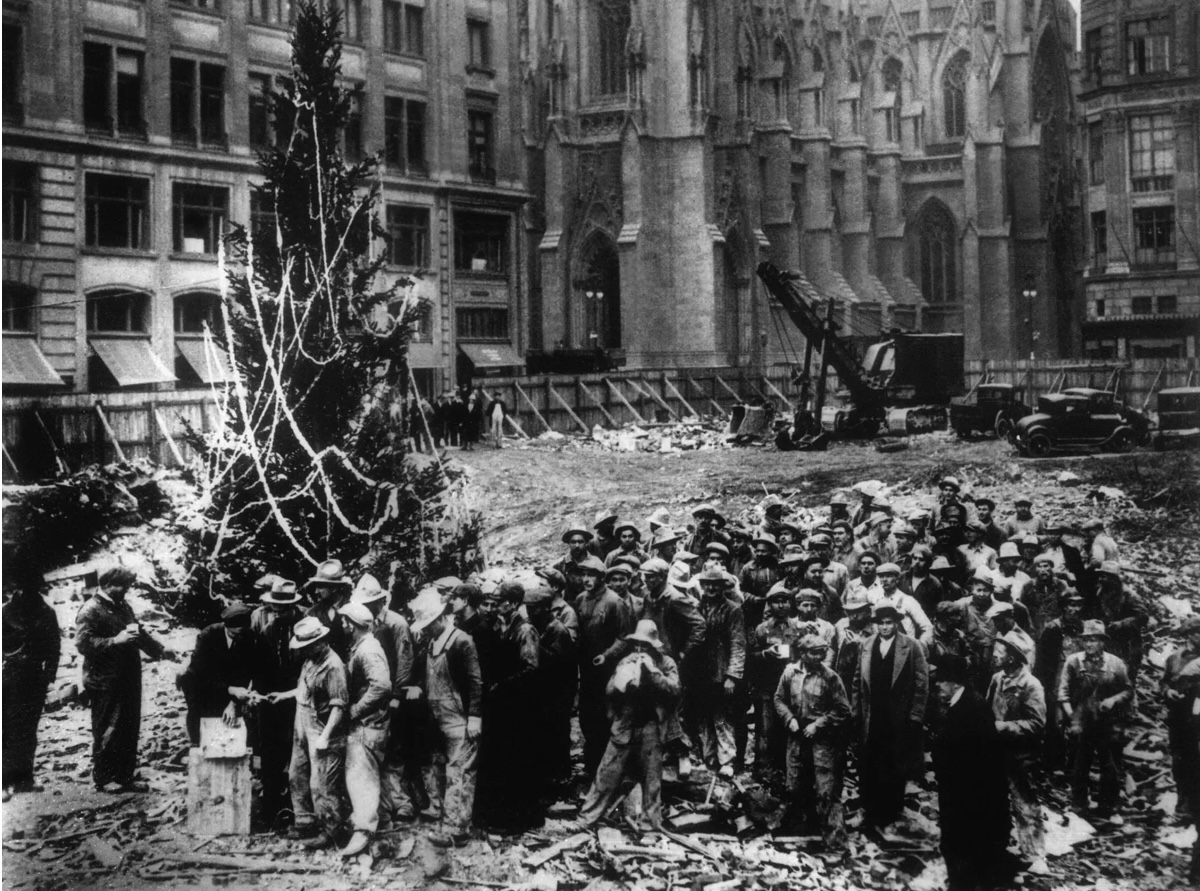
The tree may not go up on December 8th, but I recently found out that this famous tree tradition was started by Italian immigrant excavation workers. On December 24th 1931 work had just begun on the future site of Rockefeller Center. The first tree, a ‘small’ 6.1 m (20 ft) Balsam fir was brought to the site by Cesidio Perruzza. Originally from Frosinone, he was one of a group of Italian excavation workers who built a lot of Manhattan. They pooled their money to buy the tree, wanting to bring Christmas cheer and to be thankful for being employed during economic depression. The tree was decorated with paper garlands made by their families, gum wrappers, and the foil wrappers from blasting caps-since their job was blowing things up!
The photo from the Rockefeller Centre’s website shows workers lining up to collect their wages on Christmas Eve 1931 beside the tree.
By Christmas 1933, the job was completed and 30 Rockefeller Plaza opened. The first ‘official’ tree was lit in the plaza and it was made an annual tradition. It was a 15 m (50 ft) tree and according the Rockefeller Centre’s website, was intended as ‘a holiday beacon for New Yorkers and visitors alike’. The skating rink was added below the tree in 1936. This is how a group of Italian excavation workers with hope and Christmas spirit started a beloved tradition.
Perhaps this is common knowledge for Italian Americans? Did any of you know about this? Let me know in the comments.
*I specify American Thanksgiving because in Canada Thanksgiving is in October, the same time as American Columbus Day
Photos of 2023 Rockefeller Center Christmas tree taken last week by my cuginetto, paparazzo Luciano Pepe
Photos of Dec 24, 1931 from Rockefeller Center website
Buon Natale, Cristina
22 Sunday Oct 2023
Posted in Italian language, Parole piacevoli
Tags
Conversational Italian, Euphemisms, How to swear politely in Italian, Italian language, Italian language in the world, Italian slang, Rompere le scatole
What the Cabbage and don’t break the boxes? WTF? Yes, that is exactly what this post is about! Since it is ‘Settimana della lingua italiana nel Mondo/Week of the Italian language in the World’ this is an Italian language related post about my 2 favourite eufemismi- euphemisms. A euphemism is a word substitution where a more polite, less vulgar word or expression is used in place of one that may be offensive. We can subtitle this ‘How to swear politely in Italian’. Take your conversational Italian to the next level and learn how to swear politely-well, sort of.
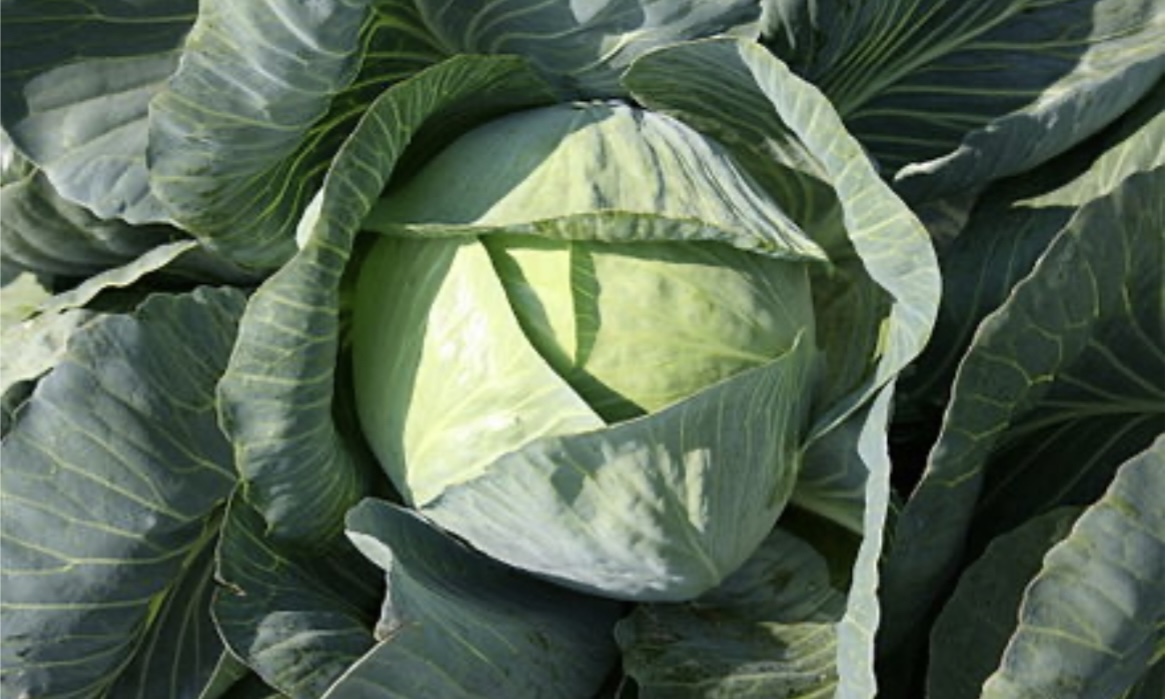
Cavolo means cabbage, and is often used as a euphemism for cazzo -the vulgar term for the male reproductive organ. Why cabbage? Is it because cabbage can be wilted and limp? Ha ha! The reason is probably just because the words sound so similar. It is like how, in English ‘fudge’ is used to replace ‘f*ck’. Cavolo can be used anywhere as a replacement-and it is used often in everyday Italian. ‘Che cazzo’ translates to WTF. This is not the literal translation of this expression, which would be ‘what the dick,’ but it is the Italian equivalent to the English WTF. For those of you who do not speak text, WTF means ‘what the f*ck’). Che cavolo!
Cavolo! Followed by an exclamation mark, cavolo is an expression of surprise or frustration. This is equivalent in English to saying ‘Damn!’ or a long, drawn out fuuuuuu*k! Example: Cavolo! Mi sono dimenticato le chiave!
Fare col cavolo means to do something with cabbage. This expression is used to say that something will never happen or is unlikely to be successful. Example: Elio lavoro col cavolo.
Non me ne importa un cavolo literally means ‘I don’t give a cabbage’ and is equivalent to IDGAF (I don’t give a f*ck). Example: Ho vista tua ex fidanzata con un altro /I saw your ex girlfriend with someone else. ‘Non me ne importo un cavolo!’
Non vale un cavolo means ‘not worth the cabbage’. This expression is used to declare something a waste of time.
Fatti i cavoli tuoi means ‘make your own cabbages’ and is equivalent to MYOB -mind your own business. Sono cavoli miei, literally ‘they are my cabbages’ means ‘it’s my business’. Example: ‘Fatti i cavoli tuoi, ma questi sono cavoli miei!’
Non ho fatto un cavolo means ‘I didn’t do a cabbage’-I didn’t do anything. Example: Domenica non ho fatto un cavolo/ On Sunday, I didn’t do a darn thing.
Fare una Cavolata-‘making a mess of cabbages’, means to do something stupid. Example: Lorenzo ha fatto una cavolata con la prenotazione /Lorenzo f**ked up the reservation.
Incazzata is the vulgar form of arrabbiata, meaning angry. When you use incazzata, you are really angry! Using the cavolo euphemism, we get Incavolata. Example; Ieri quando ho visto la casa in disordine, mi sono incavolata! /Yesterday when I saw the mess in the house, I got angry!
Substituting with cavolo definitely makes the statement less intense, so if you really want to emphazize how you feel, keep the cazzo!
Scatole means boxes, and is a euphemism for palle or coglioni which are balls or testicles. Rompere le scatole, meaning ‘breaking the boxes’ is the polite way of saying ‘breaking balls’. Mi hai rotto le scatole=you have broken my boxes. This expression is usually used when someone is annoying and getting on your nerves.
Non rompere le scatole-Don’t break the boxes /Don’t break my balls can be shortened simply to the no nonsense ‘non rompere’! Example: ‘Basta, mi hai rotto le scatole!’ = Enough! You have broken my boxes/balls!
Lui e un rompiscatolo means ‘he is a ball breaker’. This usually refers to someone who is a PITA -a pain in the ass.
There is a new book on my ‘to read’ list called ‘Lo Zen e l’arte di non rompere le scatole’/Zen and the art of not breaking balls! by Enzo Braschi and Danilo Sacco.
These expressions are widely used in everyday Italiano. Interestingly, although both cavolo and scatole are euphemisms for male genitalia, they are gender neutral and used equally as often by and about women.

‘It is said Live and let live because mind your own F***ing business and don’t break the balls didn’t appear too polite’
Do you ever use these Italian eufemismi? Or do you prefer to just say what you really mean? For other language posts, check out Italiese, Uffa, allora, purtroppo, magari, ….mannaggia, and Italian Christmas Vocabulary or search the category ‘parole piacevoli’.
Ciao, e non rompere! Cristina
30 Saturday Sep 2023
Posted in Art, Art history, Italia
Tags
20th Century art, Art history, Grand Canal, Grand Canal Venice, Modern art, Palazzo Venier dei Leoni, Venezia
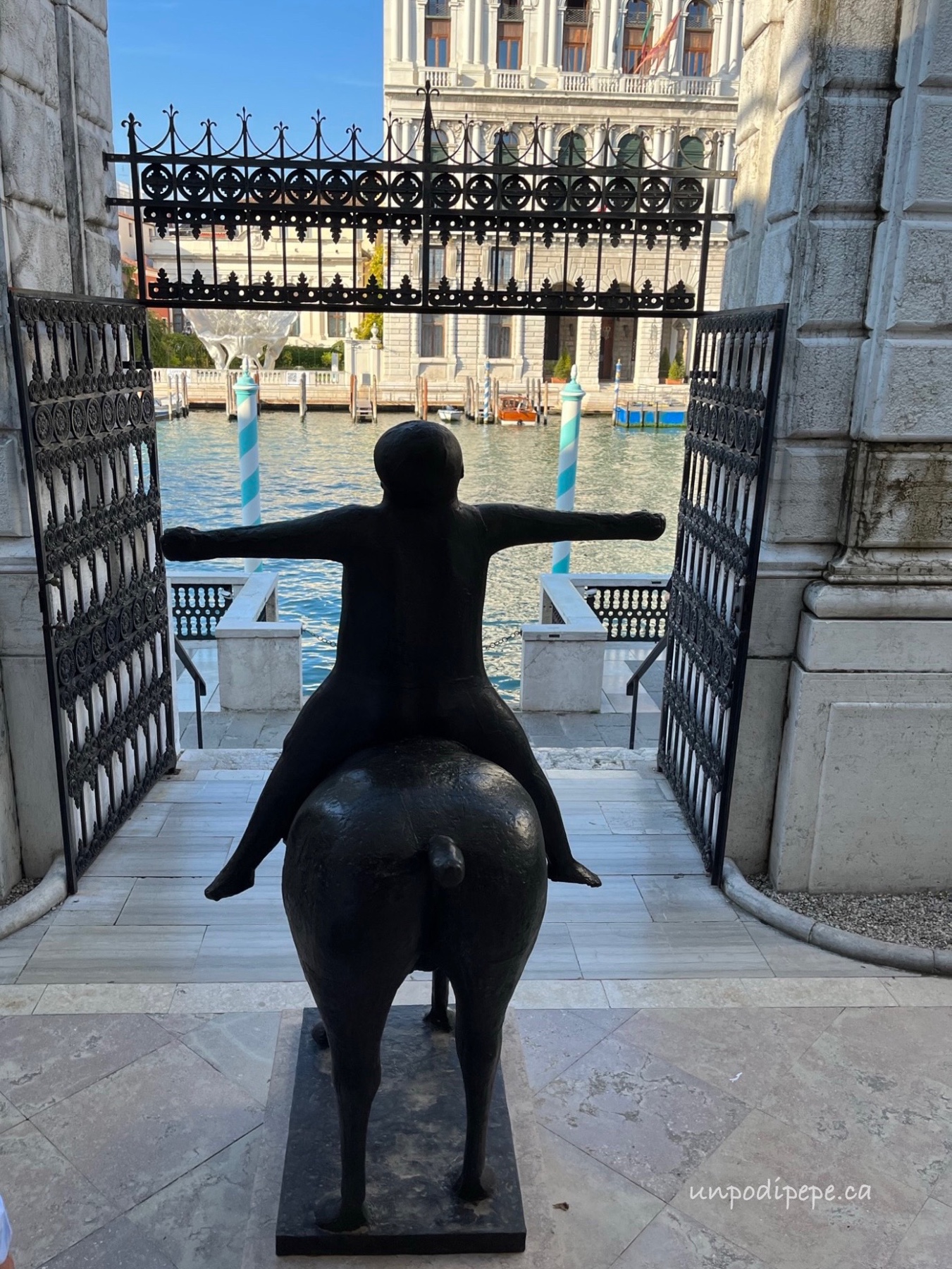
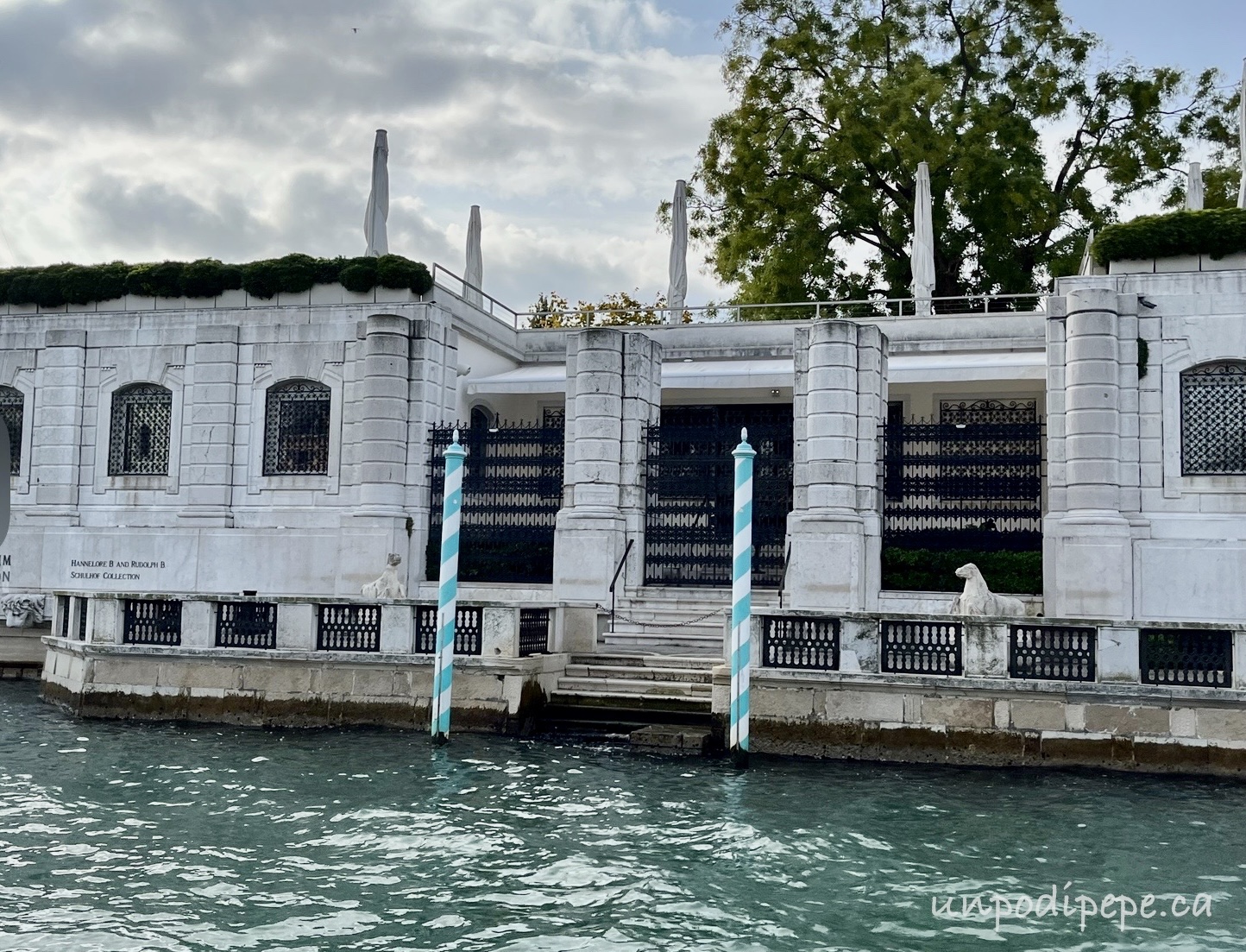
The Peggy Guggenheim Collection is one of the most important collections of European and North American 20th Century art. This was on my ‘must see’ list for years. An unintentional 24 year absence from Venezia got in the way, but I finally made it!
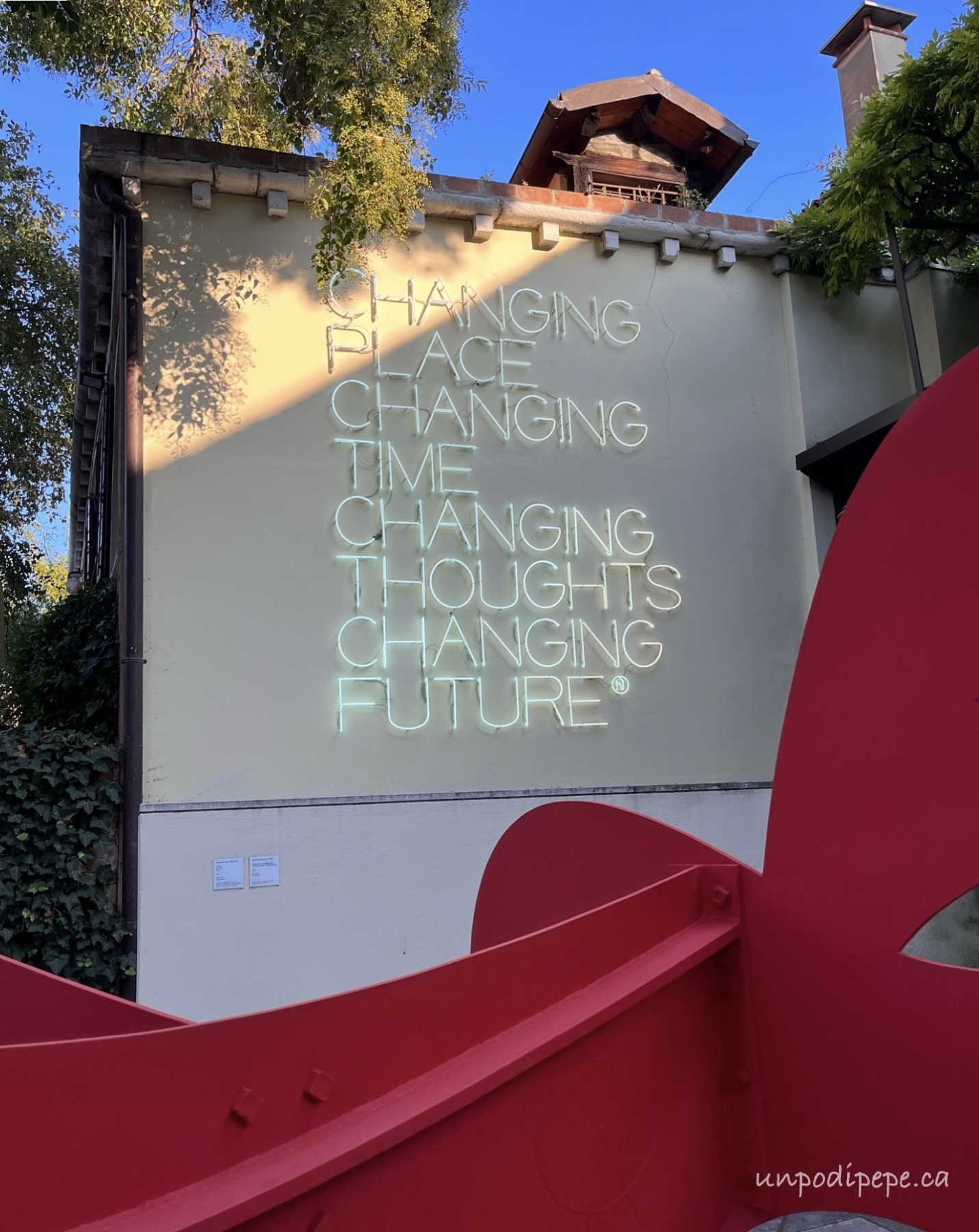
Located in her former home, the unfinished Palazzo Venier dei Leoni on the Grand Canal, the museum includes Peggy Guggenheim’s personal collection and a sculpture garden. Since 1980, it is part of the Solomon Guggenheim Foundation, which includes Guggenheim museums in New York, Bilbao Spain and soon Abu Dhabi.
Peggy Guggenheim was born in New York in 1898. Her father, Benjamin Guggenheim, one of 7 brothers who made a fortune in mining, died heroically on the SS Titanic in 1912. He and his valet helped women and children into lifeboats, then changed into their best clothes to ‘prepare to go down like gentlemen’. They were last seen on deck chairs by the grand staircase sipping brandy and smoking cigars.
Peggy came into her inheritance in 1919 and devoted her time and fortune to collecting and promoting modern art. She married Dadaist Laurence Vail and they had 2 children. The family travelled to Europe in 1921, embracing the Parisian Bohemian and American expat scene, then moved to London in the 1930’s fleeing Nazi occupation.
A self-proclaimed ‘art addict’ and a rebel, Peggy wanted to distinguish herself from her business focused family. In 1938, she began a career which would affect the course of postwar art. In London, she opened an art gallery called ‘Guggenheim Jeune’, focusing on contemporary art. The gallery lost a lot of money and was closed after a year, then Peggy moved back to France.
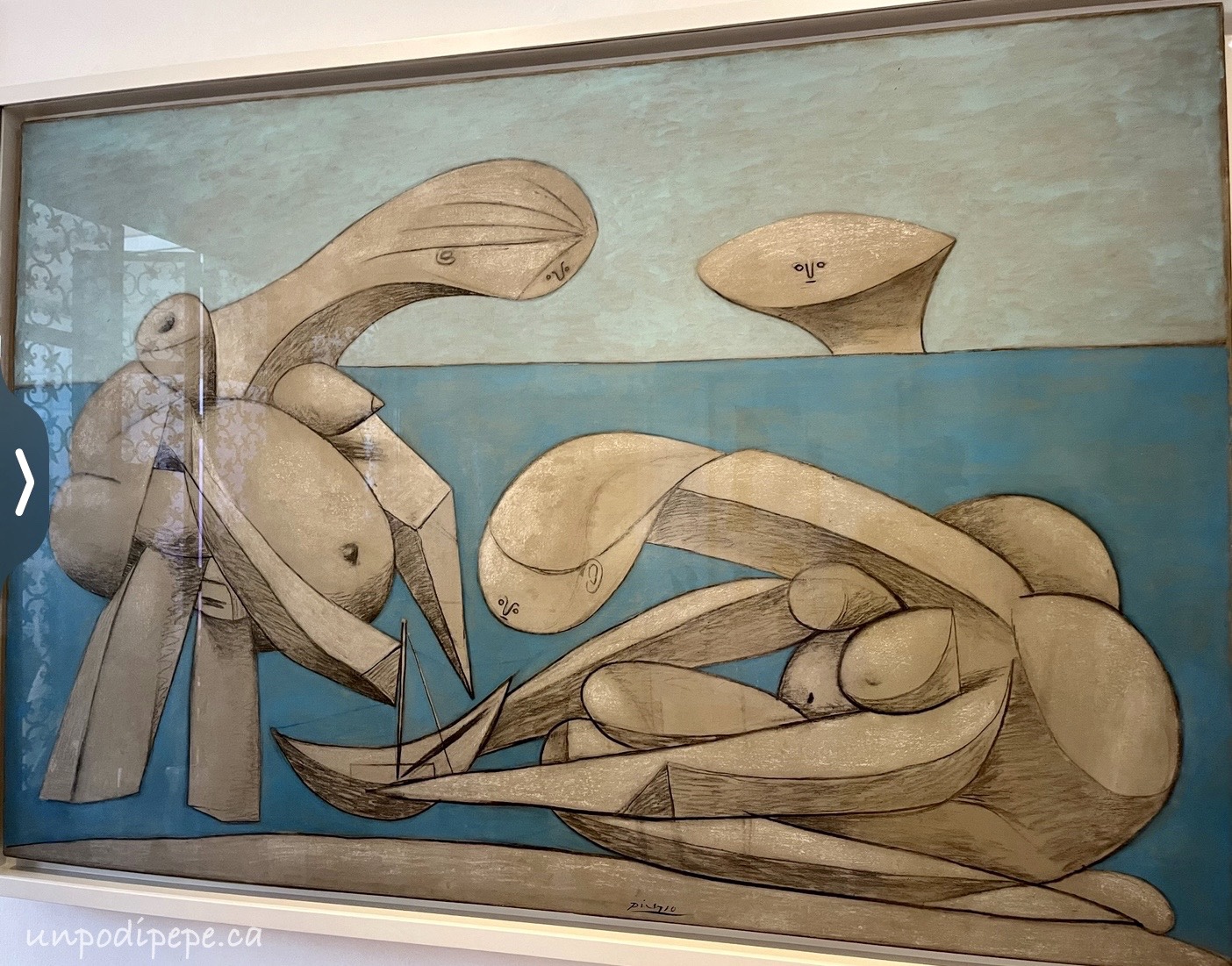
From 1939-40, with the motto ‘buy a picture a day’, she started buying art in Paris and London like a madwoman. She purchased Cubist and Surrealist works of art when they were not yet popular or held in high regard. Purchases included masterpieces by Brancusi, Braque, Dali, Ernst, Picasso, Mondrian and others. The Germans approached Paris just as Peggy was preparing to open a museum for her collection. In 1941 Peggy fled Nazi occupied France for New York with her ex-husband, their children and her future husband, Surrealist Max Ernst.
The Collection followed them to New York. The Louvre was asked to shelter Peggy’s collection from the war, but the request was denied. The now priceless artwork was crated up with ‘household goods’ written on the customs declaration, and a non-Jewish name replacing Guggenheim, then shipped across the Atlantic. Miraculously, everything arrived safely. Peggy’s actions protected the collection, and also supported artists who were in exile and among those branded ‘degenerates’ by Hitler.
‘Art of this Century’ was the Manhattan gallery Peggy opened in 1942 to exhibit her growing collection of Cubist, Abstract and Surrealist art. She also exhibited the work of a new generation of young American artists including Robert Mapplethorpe, Jackson Pollock, Mark Rothko and Robert De Niro Sr. In 1943 the exhibit ’31 Women’ was the first documented all female exhibit in the US
Peggy closed the gallery in 1947 and decided Venezia would be her permanent home. She was invited to exhibit her collection at the 1948 Biennale di Venezia. The Palazzo Venier dei Leoni was purchased in 1949, and Peggy lived there for 30 years. Her art collection moved in with her, and the beautiful setting is as much a work of art as the works inside.
The Venier family was one of the noblest Venetian families. In 1749 they ran out of money and had family issues which prevented completion of the palazzo. Only the 1st of 5 planned stories was completed. Lion heads decorating the façade at water level give the palazzo its name. Made of Istrian stone, it is often mistaken for a modern building because of its low, wide façade. In the late 19th century, the abandoned construction site and garden were purchased by the Levi family and began to take on their present look. There were various other owners and renters until 1949.
From 1951 until her death in 1979, Peggy opened her home and collection to the public for free 3 afternoons a week from March to November. The Peggy Guggenheim Collection opened in 1980, managed by the Guggenheim Foundation as stipulated in her will. In 2017, Peggy’s granddaughter Karole Vail was appointed Director of the Collection.
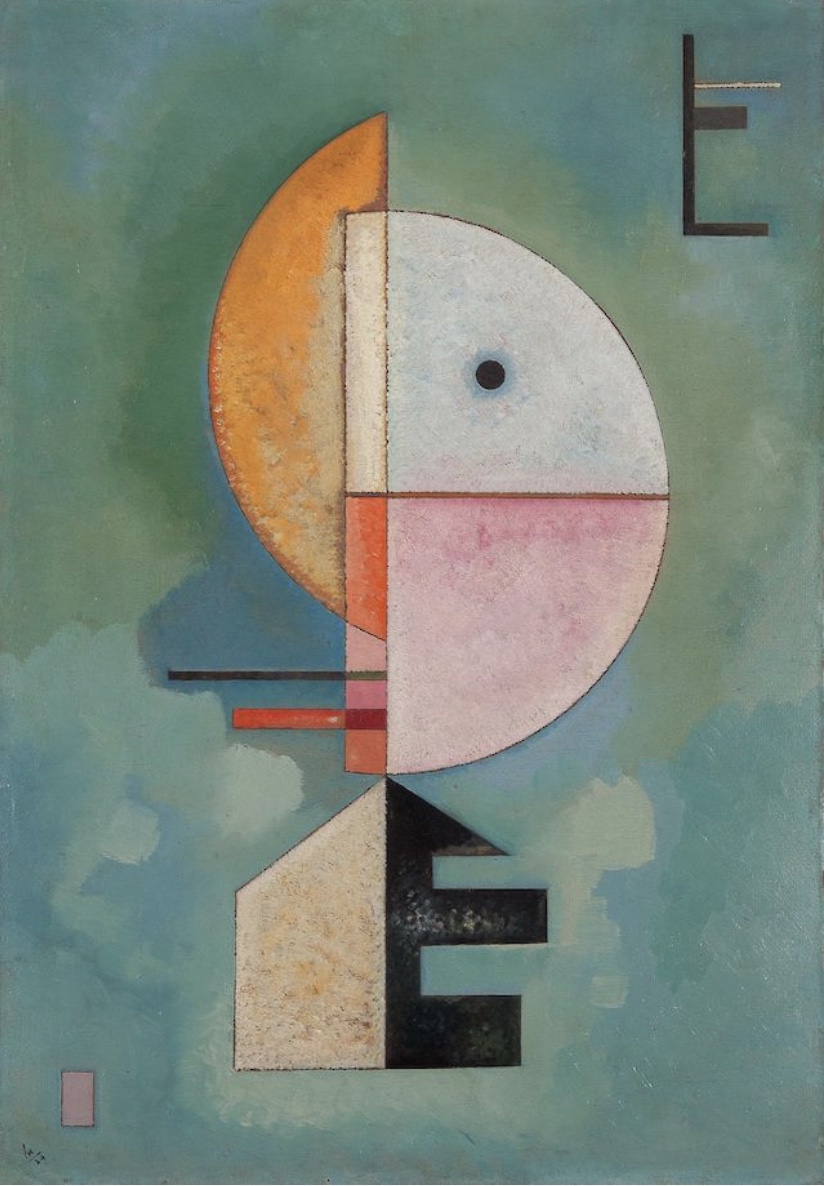
The Collection has 400,000 visitors per year and includes 326 paintings and sculptures. These include masterpieces of Cubism, Surrealism and Abstract expressionism as well as the works of prominent Italian Futurists and American modernists. Artists represented include Giorgio de Chirico, Gino Severini, Georges Braque, Marcel Duchamp, Joan Miró, Salvador Dali, Pablo Picasso, Constantin Brancusi, Alberto Giacometti, Arshile Gorky, Vasily Kandinsky, Paul Klee, Rene Magritte, Piet Mondrian, Max Ernst, Marino Marini, Jackson Pollock and others. It is a 20th Century art history textbook come to life.
Peggy Guggenheim Collection is located in the Dorsoduro area, across the Grand Canal from Piazza San Marco. It is between the Basilica di Santa Maria della Salute and Ponte dell’Accademia. To get there take a ‘group gondola’ across to Santa Maria della Salute for €2 then head right or cross the Ponte Rialto and head left. Admission is €16 for adults. Hours 10-18 Closed Tuesdays and December 25th.
Ciao, Cristina
12 Tuesday Sep 2023
Posted in Amici e Famiglia, Italian life, Mangiamo!, Orsara di Puglia, Puglia
Tags
Barrel vaulted ceiling, Cucina Pugliese, Fiori di zucca, In my kitchen, Mozzarella di bufala, Orsarosa, Parmigiana di melanzane, Pugliese Traditions, Ravioli
I recently returned from 6 weeks at our little casa in Orsara di Puglia. As usual, there was a lot of activity in the kitchen. Cucina povera, literally ‘food of the poor’, is what you will mostly find in Puglia. Simple foods made with fresh local ingredients. Here are just a few of the things my family and I were up to in our tiny but functional summer kitchen in Orsara di Puglia. Since I have so much material to write about, I have kept it to gifts of food received from amici, parenti e vicini di casa -friends, relatives and neighbours.
About the space, the whole place is only 40m² (about 450 square feet) including a bedroom and bathroom. That is about the size of a double garage. The room with the cucina is also the living room, guest room (aka my room) and art studio. The highlight of the room is the amazing barrel vaulted stone ceiling, which is hard to fit in a photo. There is even the face of a Madonnina on one of the stones.
We had a lot of visitors, many who came bearing gifts. This lovely cestino, filled with locally grown vegetables was dropped off by one of our neighbours. 
The melanzane (eggplant, or aubergine for the Brits) were stuffed and baked. The pulp was fried up with a bit of ground beef and pork, garlic, breadcrumbs and parmigiano, then stuffed and topped with tomato sauce and mozzarella. They were soooo yummy, but we only made them once, as it was so hot that having the oven on was painful!
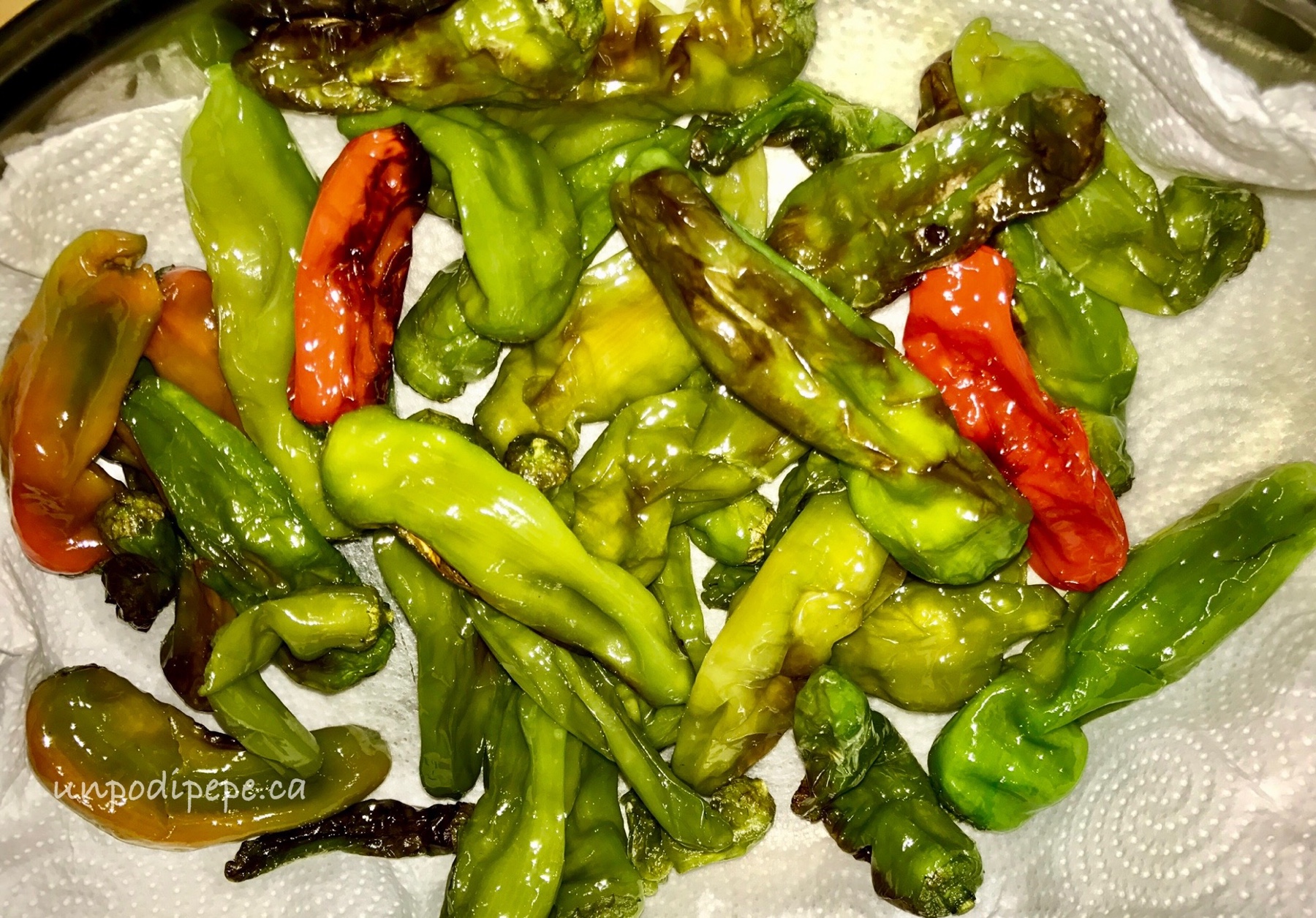
The long green and red peperoni or peppers in the cestino are called friarill’. They are sweet tasting, and as the name implies, are usually fried. Friarill’ on fresh bread taste heavenly!
The gift of fresh eggs is amazing. I used half of them to make fresh egg pasta for ravioli di ricotta e spinaci. I froze them for the festa della Madonna della Neve Aug 5th. Freezing them was hard, as the freezer is so tiny. I make these often in Vancouver, and they are good-but the goat milk ricotta here is so incredibly good that they taste better.
I was happy to use my spianatoia one more time. That is the wooden pasta rolling board. It has a lip on one end so it stays put on the table and a handy carrying handle, just like the chair.
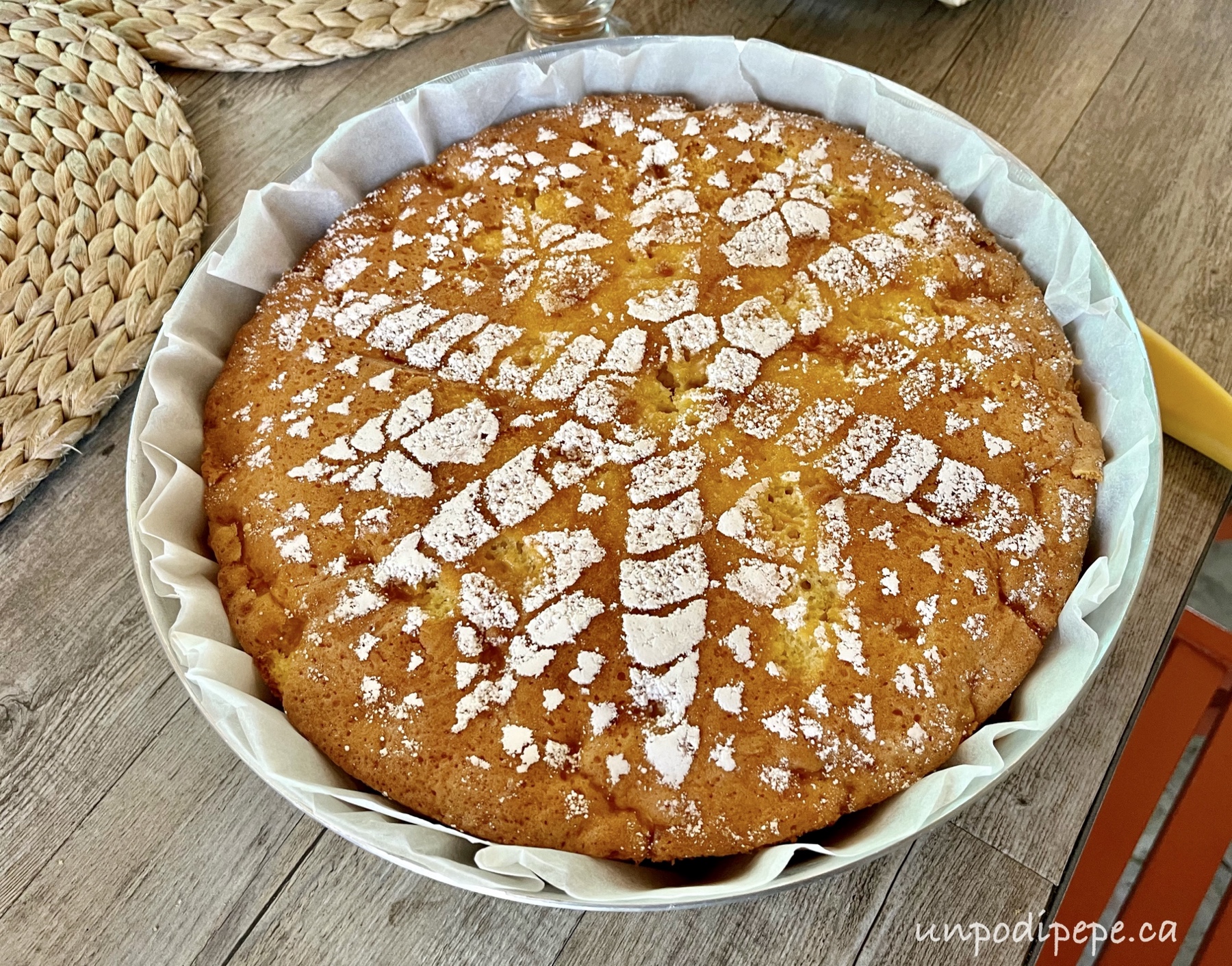
Mamma and I used the rest of the eggs to make Torta di mela, an apple cake. We made it to bring to our family grigliata -BBQ- at the olive grove that was my Nonno’s. It had to be baked at 1 am as it was just too painful to turn the oven on during the day.
La torta looked a bit plain, so I placed a clean crochet doily over the top and sprinkled icing sugar all over. The fancy shmancy design was left on the cake. I often have to do this to my Torta Caprese because the top always collapses a bit.
Fiori di zucca are one of my favourite summer foods-and my favourite bouquet of flowers. My Zio brought over a LOT of them one day, an hour before we were going to be eating. I stuffed some of them with what I had available. There were a few trecce-fresh, braided mozzarella, in the fridge and basilico growing out on the tiny terrazza. Once they were stuffed, I battered them in flour and mineral water with a few bonus ingredients like parmigiano and basilico, and then fried them. 
They were crunchy and delicious, but I only had time to use up less than half of my precious fiori.
Fiori di zucca are extremely delicate. They only last a day 2 and do not freeze well. Not wanting to waste them, once I finished the dishes, I drizzled olive oil on a baking pan, borrowed some caciocavallo from my neighbour, and stuffed a bunch more. The stuffed fiori were placed in the pan, which went straight into the freezer to use a 4 days later. Great idea, no? Well-yes and no. They had to be baked, since attempting to fry these beauties after freezing would turn them into mush. Baking them at 1am was not an option. We had to endure the heat but they were worth the sweat!
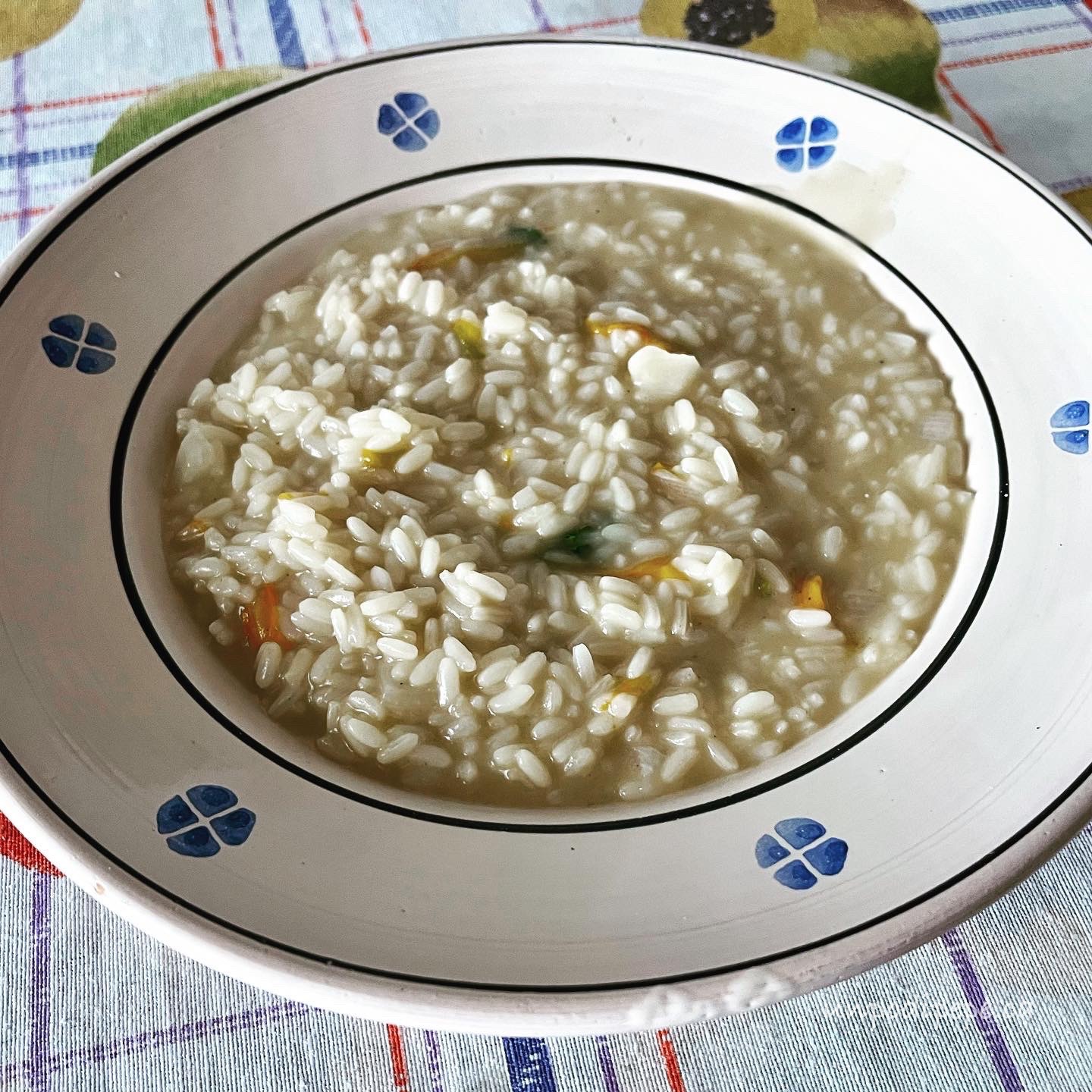
A few fiori were saved to make risotto the next day. This was a new thing for me, as I have never had so many fiori that I could make risotto. More recipe ideas and harvesting tips can be found in the post Fiori di zucca.
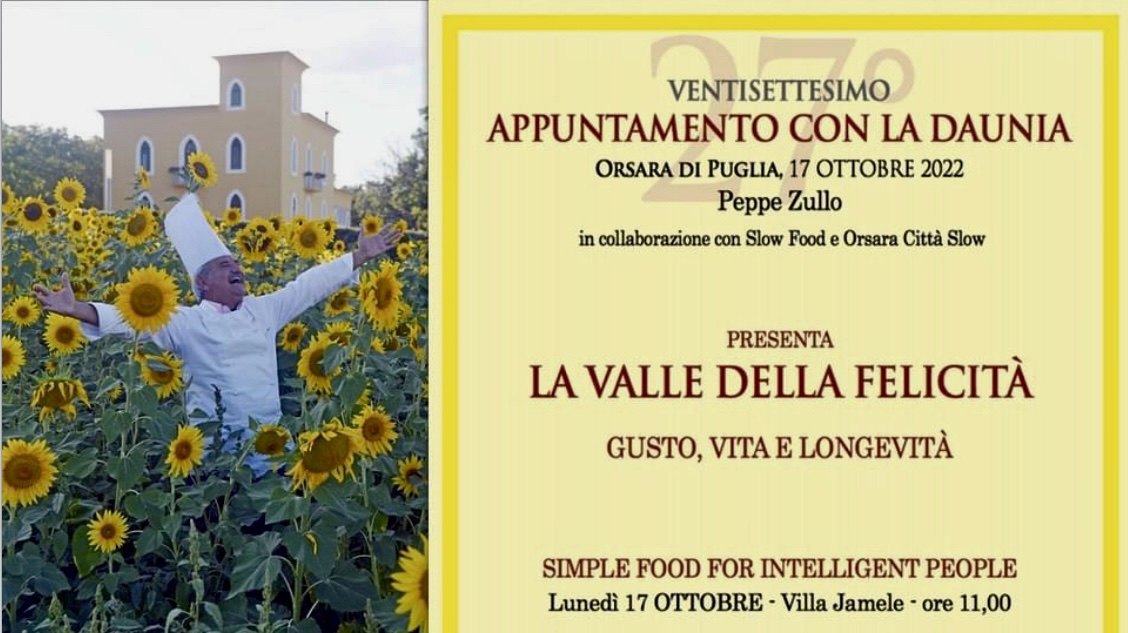
My amico Peppe Zullo gave me a few bottles of his vino rosato Amarosa. Apparently the name Amarosa has been trademarked by someone else, so the vino is getting a name change. It will now be named after Orsara’s women’s soccer (or football for the Brits) team….Orsarosa!
Mercoledi/Wednesday is mozzarella di bufala day. I came home from Procida on a Thursday and a friend had left me these melt in your mouth ones. They are from Masseria Li Gatti near Torremaggiore, SanSevero (FG).
The mozzarella are in the new Pugliese serving bowls my sister brought from Polignano a Mare. The piattaia is full so I will need to find somewhere to display them.
I hope this post has made you either hungry and drooling or wishing you could visit Puglia yourself. Perhaps it has done both? Perché no? I am already planning my next visit! Buon appetito e buon viaggio, Cristina
Thanks Sherry from Australia for hosting the monthly food blogging event, In My Kitchen (IMK). Click the link to Sherry’s Pickings to read about other world kitchens this month. Buon appetito, Cristina
31 Thursday Aug 2023
Posted in Italia, Photography, Travel
Tags
Campania, Chiaiolella, Ischia, Italian Capital of Culture, Italian islands, Marina di Corricella, Napoli, Slow travel, Southern Italy
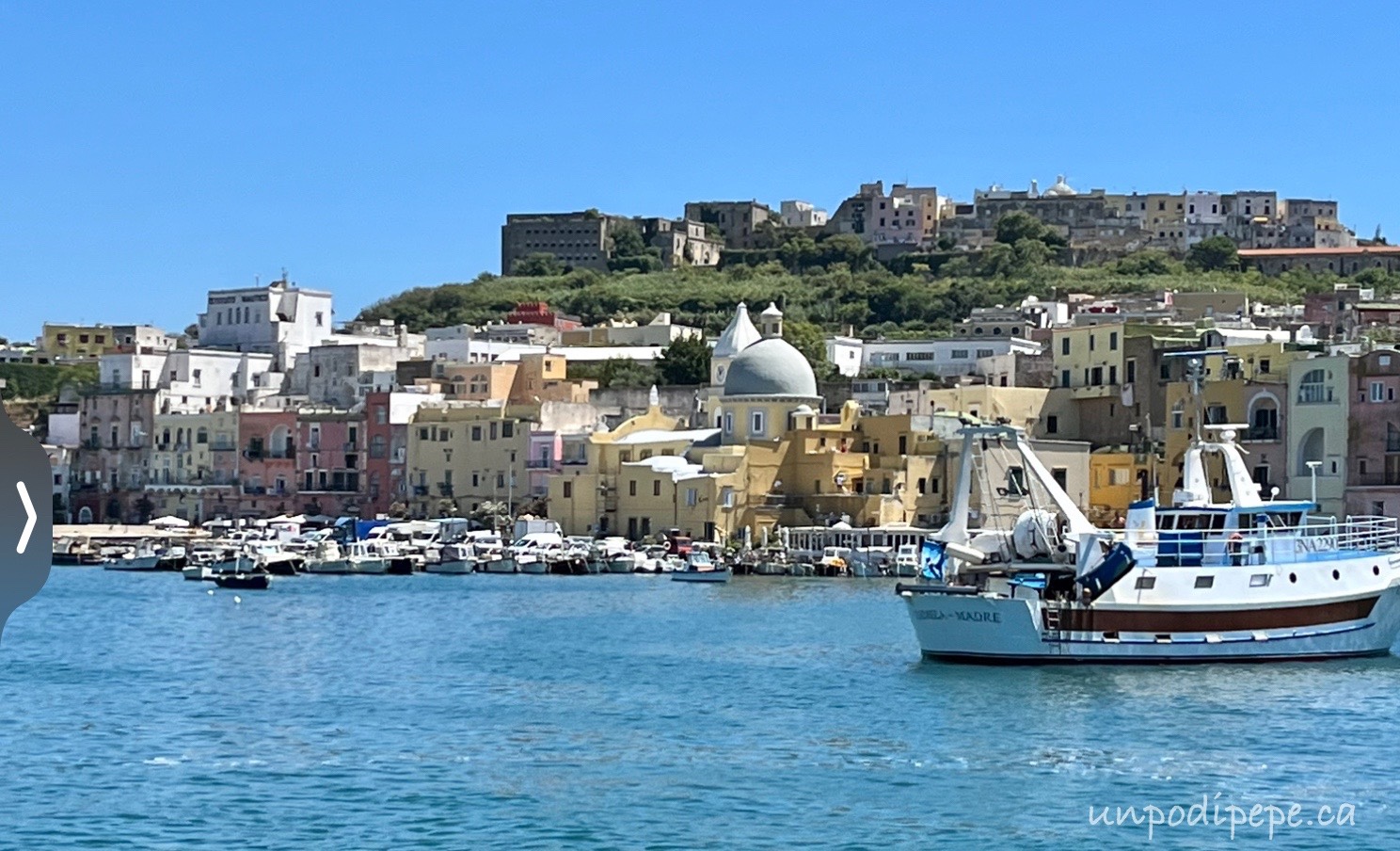
When I mentioned to anyone that i was going to Procida, the response was ‘Where is that?’ It was the 2022 Italian Capital of Culture, but still not well known outside of Italia. Procida (pronounced PRO·cheedah) is one of the Flegrean Islands off the coast of Napoli and is part of the city of Napoli. It was created by the eruption of 4 volcanoes, which are now submerged and dormant. Overshadowed by its sexier neighbours Capri and Ischia, Procida is the least visited of the 3 islands. It has a tiny area of 4.1 km², but with a population of 11,000, Procida is one of the most populated Italian islands. It is still mainly a fisherman’s island, a living, working place where real people live. The main industries on the island are the port and fishing. Tourism is #3.
Procida has a laid-back, slow travel vibe-even in the most popular areas. You will not find any resorts, fancy spas or tour groups and the shops cater more to locals, closing for ‘la pausa pranzo’ from 1-5 pm. Even finding somewhere to buy a few souvenirs was hard! In the summer and on weekends, many of the visitors to Procida are Napoletani going to the beach.
Procida has been featured in movies, most notably the beautiful, multi award winning 1994 film Il Postino and the 1999 psychological thriller The Talented Mr Ripley. Both films were set in the 1950’s-60’s. In the 1963 Elizabeth Taylor/Richard Burton film Cleopatra, Procida -with the baroque duomo clearly in the background-was briefly featured as the ancient city of Tarsus where Cleo’s barge arrived to meet Marc Antony. There are signs posted at various filming locations on the island.
Marina Grande is the main port where ferries (traghetti) and hydrofoils (aliscafi) arrive. Here you will find sorbetto coloured buildings, the main bus stop and ferry terminal, several restaurants and bars, a gluten free bakery Il Piccolo Forno Senza Glutine, and ONE gift/souvenir shop.
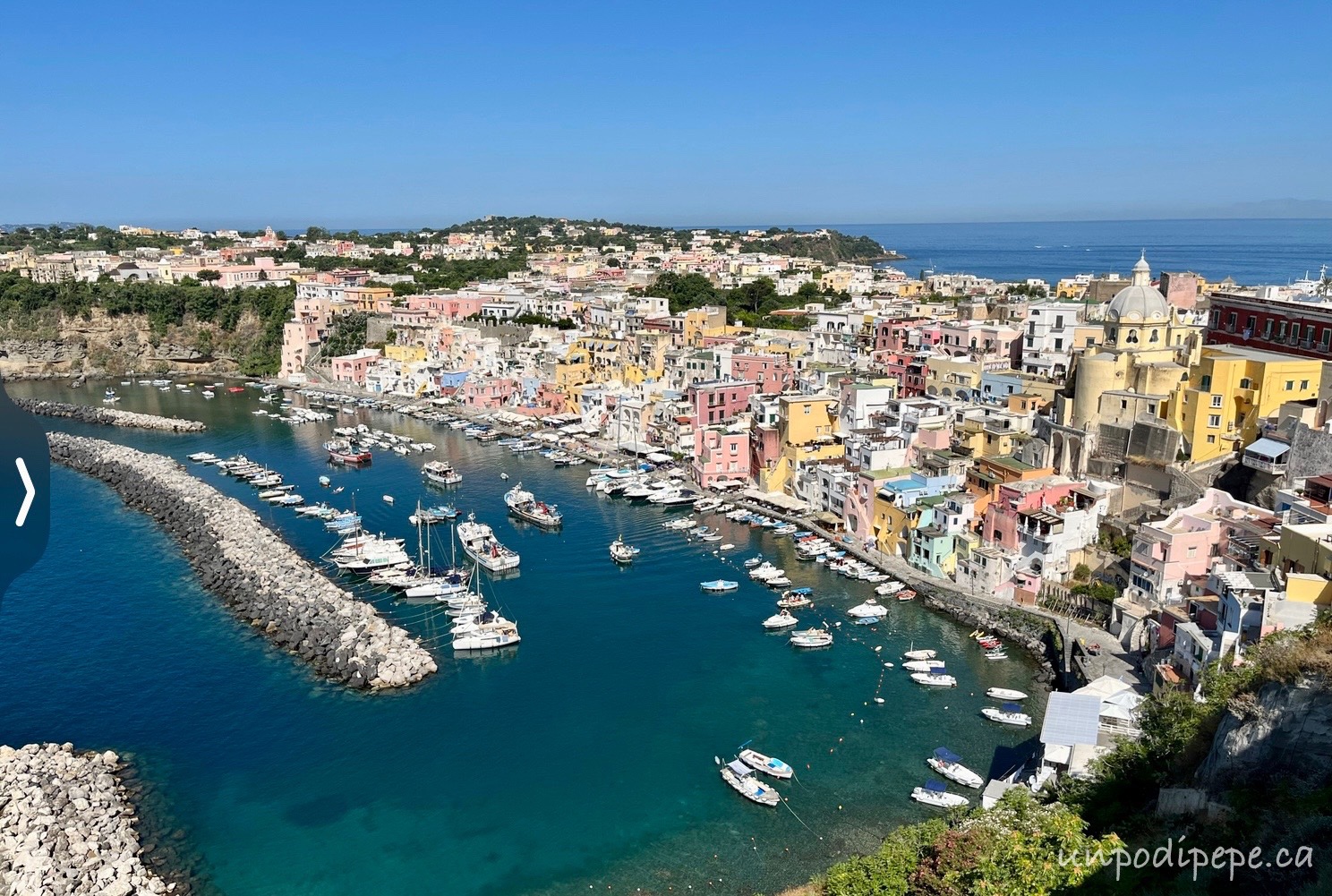
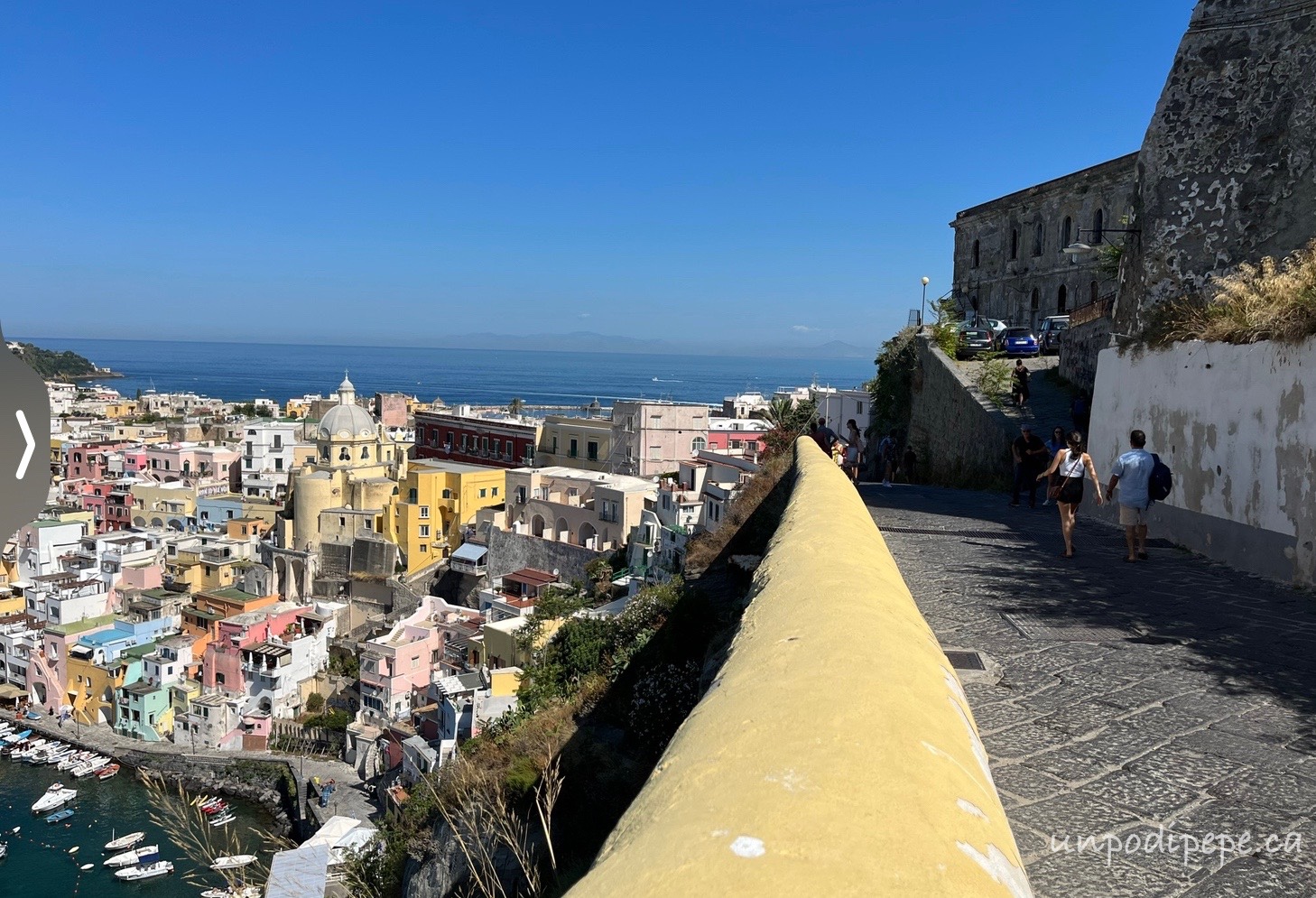
A 20 minute uphill walk from Marina Grande to the other side of the island (~20 min) brings you to the most visited area. Walking uphill towards Terra Murata is the spectacular view of Marina di Corricella with its limoncello and pink grapefruit coloured 17th century fisherman’s houses and the duomo of Santa Maria delle Grazie Incoronata. I found Marina Grande colourful and cute, but nothing compared to this view. The walk is steep, but if mobility is an issue the C2 bus stops here.
Terra Murata (walled land) the highest and oldest part of Procida, is a fortified medieval village at the top of the island. Abbazia San Michele Archangelo is an 11th Century Benedictine Abbey turned into a church. Palazzo d’Avalos built in 1563 became a prison in the 1800’s until it closed down in 1988. Tours of the prison (€13,) need to be booked at least 2 days in advance so I was not able to go. The roof has sweeping views of the entire Bay of Napoli, including Ischia, Capri and the Amalfi coast. Check out John’s blog post about the prison for more information. The 15th Century Santa Margherita Nuova monastery was under renovation, so I was not able to see that either. The postcard views from up here are absolutely mozzafiato-breathtaking! A friend asked me how I took the cover photo over Marina di Corricella. ‘Hai volato?’ Did you fly over it?
The walk down to Marina di Corricella (Kor·ree·CHEL·lah) with houses built on top of each other, is steep and looks lived in with plants and laundry hanging out to dry. Some typical features of Procidano architecture, besides the pastel colours, include exterior staircases and arched windows. This area is completely vehicle free. 
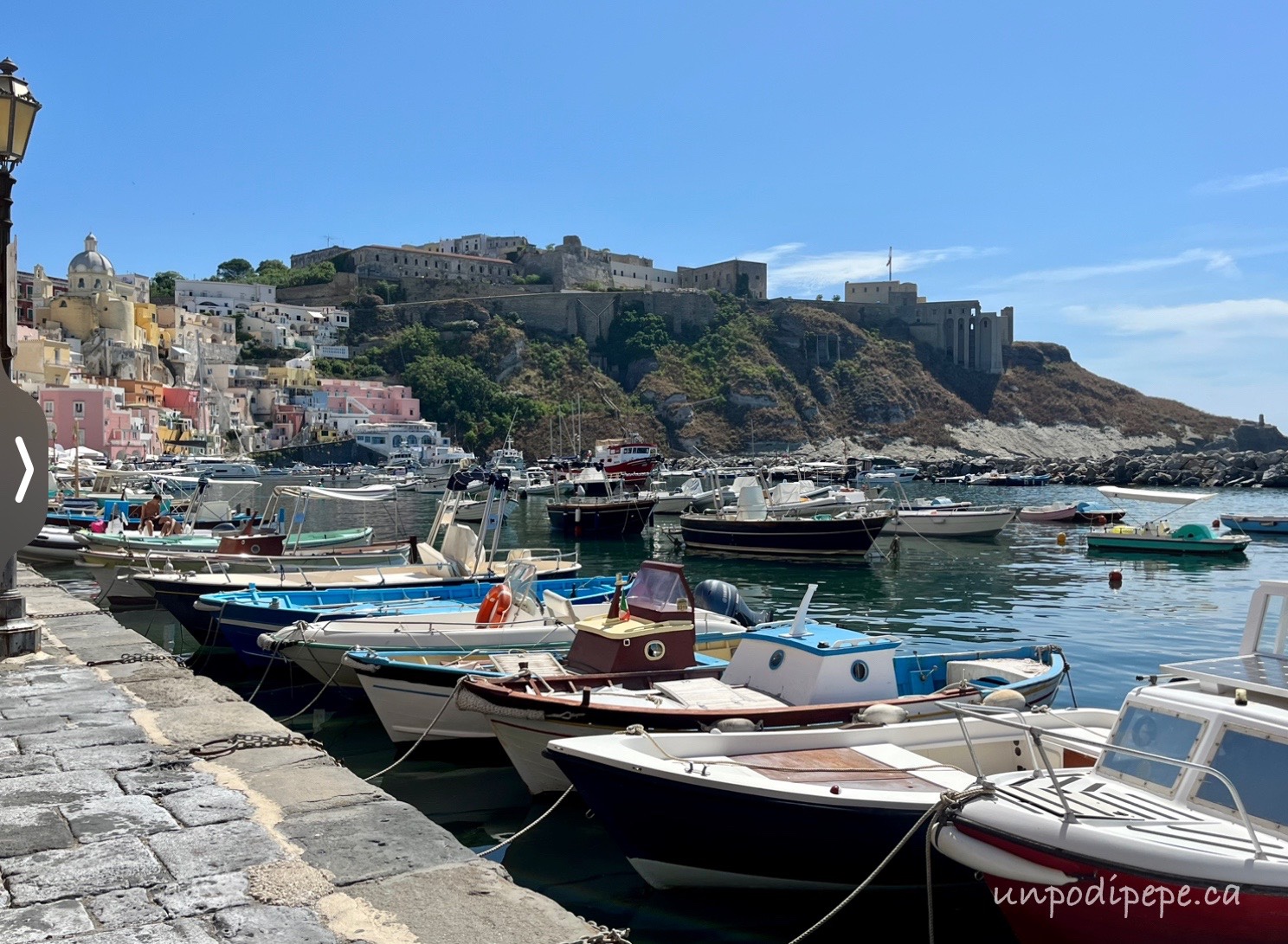
The marina is a full working harbour with colourful fishing boats, and fishermen with their nets. There are several restaurants, bars and gelaterie. I enjoyed a limoncello spritz and taralli while watching the fishing boats. La Locanda del Postino is a restaurant where Mario, il Postino, sat to write poetry to Beatrice in the movie. Some fishing boats offer a ‘giro dell’isola’ from here. Terra Murata can be seen from the Marina below.
Chiaiolella (Kyay·oh·LEL·lah) on the West tip of the island is the area where I stayed. Spiaggia Chiaiolella is a dark volcanic sand beach with warm, shallow water and amazing sunsets. At the end of the beach is a long walking bridge to Vivara, a tiny green satellite island and nature reserve. Ischia is seen past Vivara in the photo.
Around the corner is Marina di Chiaiolella, full of boats and seafood restaurants. I enjoyed a delicious, reasonably priced seafood meal with a glass of Falanghina at Crescenzo.
The walk back up to the hotel is up a narrow street lined with useful stuff like small supermercati, shops carrying beach essentials, a Tabacchino and a few takeout restaurants. There is also a gorgeous jewellery store and a linen shop where I bought Franco a coppola.
There are 4 other beaches on Procida. Spiaggia Cala del Pozzo Vecchio is the one where Il Postino was filmed. I will have to go there on my next visit. The beaches all have black volcanic sand, except for the small beach by the port, La Lingua which is rocky.
Procida can only be accessed by sea. Unless you have a private boat, that means by ferry or hydrofoil from Napoli, Pozzuoli or Ischia. Napoli to Procida is 1 hour by ferry and 40 min by hydrofoil. Ischia is 20 min away by hydrofoil-the same boat stops at both islands. From Napoli the hydrofoil cost me €19 to go and €18 to return. The ferry is about €15.
Procida can be a daytrip from Napoli or Ischia, but I would recommend staying overnight if you can. The sunsets are worth it! **Note that from November to March there are less ferries running and some restaurants and hotels are closed.
From April until October, only residents of Procida are allowed to bring cars onto the island. Scooters, bicycles and ebikes are available for rent. 4 minibuses cross the island; from the port to Chiaiolella (L1 and L2), Corricella (C2) and Il Postino Beach (C1). Tickets are €1.60 each, or get a daypass and use it like a ‘hop on/hop off’ bus. These buses go fast and the streets are only about 8 inches wider than the bus! In the mornings, you may have to wait for a few buses, as they are full of people going to the beach and going to work. Even the motorini and bikes go fast, so crossing the narrow streets can be a challenge. Everyone is in a hurry to get to the beach and drives like they are in Napoli!
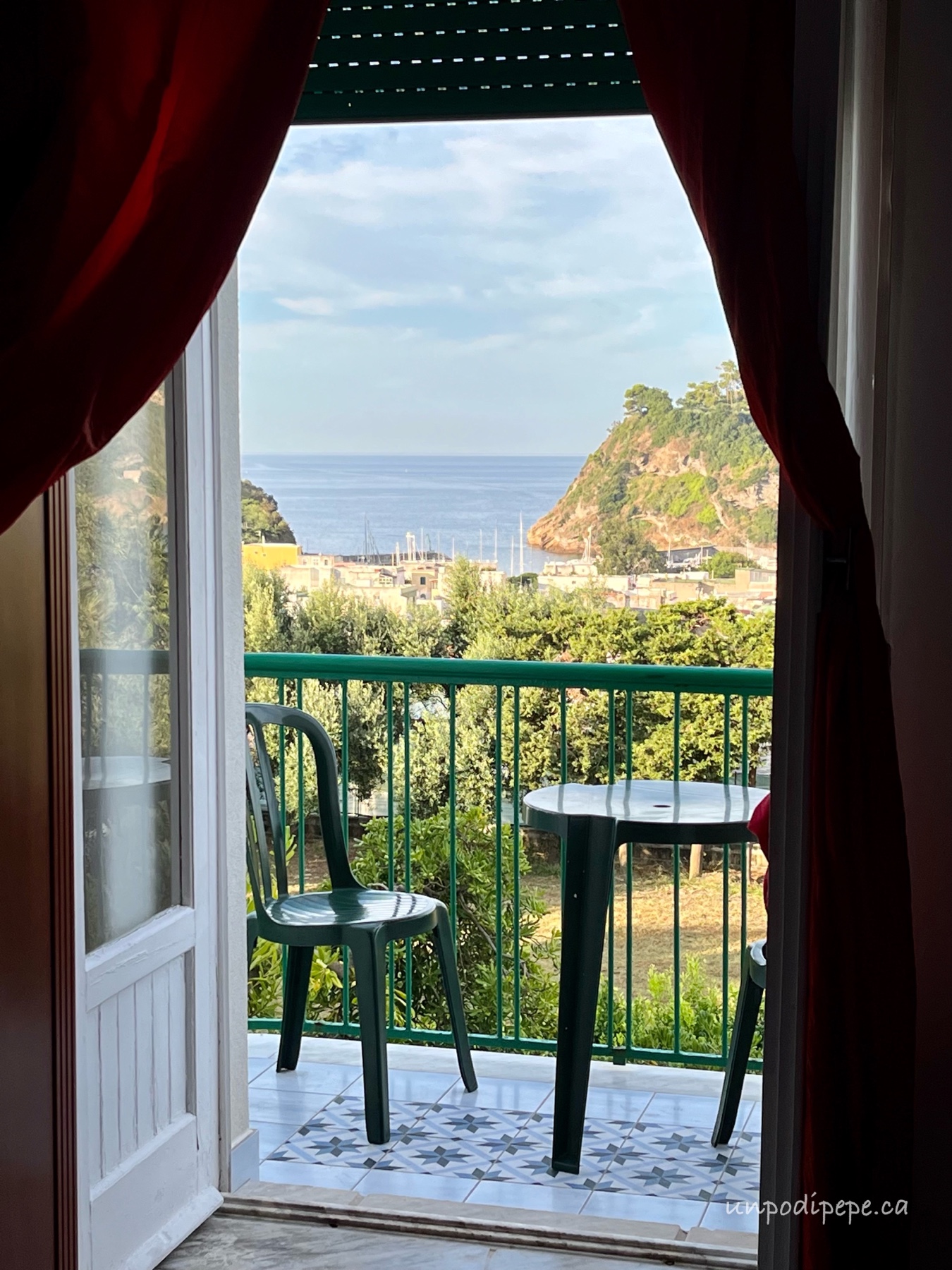
A bit about my trip….. I was in Procida with my cugina Maria from Ontario August 8th and 9th. It was not a weekend. We took the 7 am bus from Orsara di Puglia to Foggia, then the bus from Foggia to Napoli. In Napoli, we took the metro from Stazione Garibaldi to Municipio and walked the short distance to Porto Molo Beverello where we took the hydrofoil to Procida. Quite the trek to get there! We did not book the ferry in advance. We arrived at our hotel at about 2:30 pm. I booked the hotel only 2 weeks in advance. Ideally, we wanted to stay 2 nights at Hotel La Casa sul Mare which is near Santa Maria delle Grazie in Marina Corricella, but they only accept summer reservations for a 3 night minimum stay. I booked Hotel Riviera which was only available for 1 night, so we spent the second night in Napoli. Hotel Riviera was absolutely lovely-right at the bus stop and walking distance to Spiaggia Chiaiolella. We were pleasantly surprised that our room had a balcony with a view of Marina Chiaiolella, Vivara and Ischia! This is where I sat to write all of these notes while drinking €1.60 red wine and watching the sunset!
20 Tuesday Jun 2023
Tags
Cooking octopus, Imerovigli, Mattinata, Octopus and potato salad, Polpo, Santorini, Southern Italy, Traditional recipes
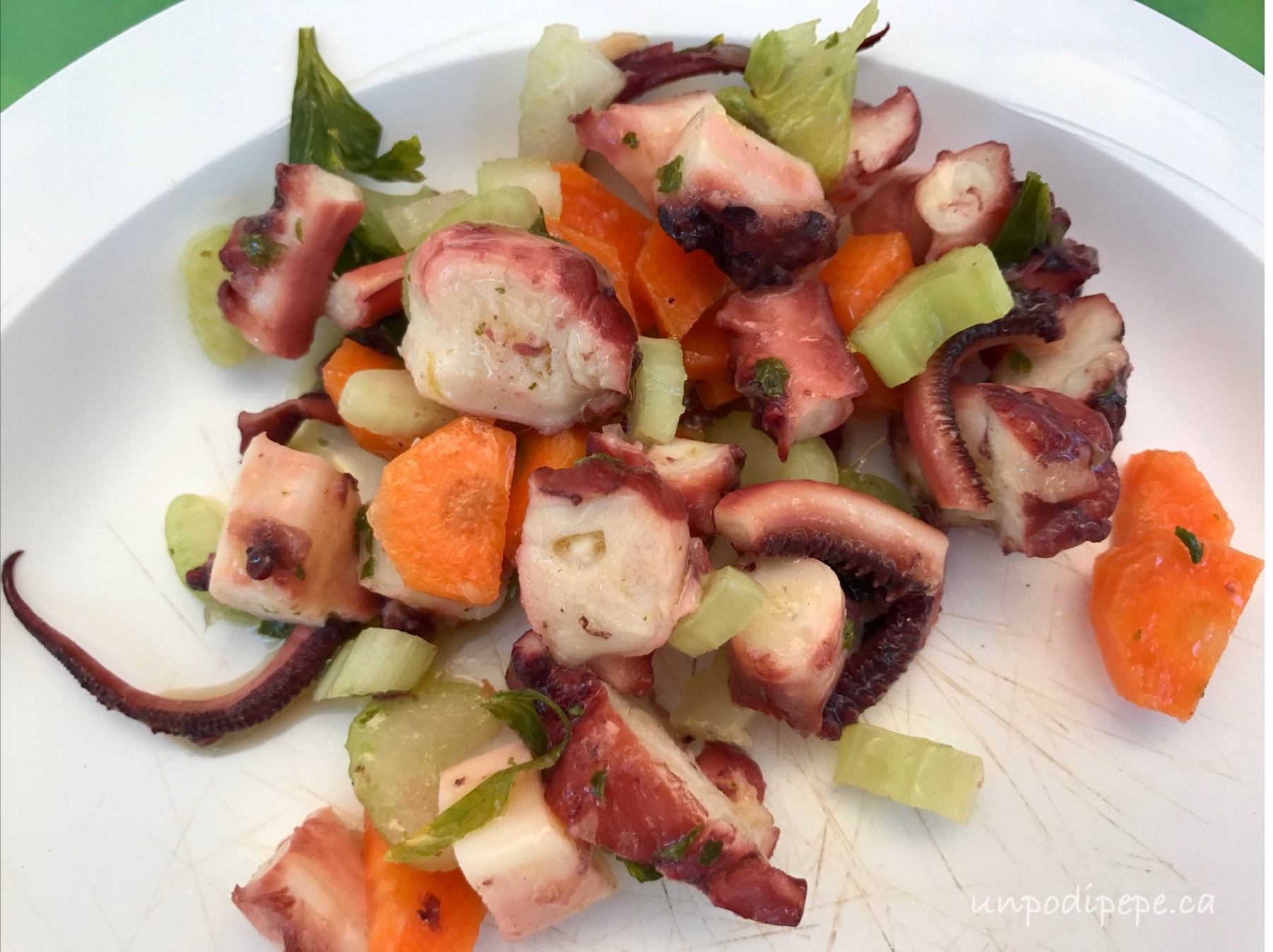
Polpo is one of the joys of visiting the Adriatic in summer. Polpo or polipo is octopus, from the ancient Greek polypous, meaning ‘many footed.’ In Italiano, polpo and polipo are both correct terms for octopus! It is one of my favourite foods…I love it grilled, or in a summer salad, especially polpo e patate, a cold potato and octopus salad. Last year, between camping on the beach in Mattinata, a family wedding, a side trip to Santorini, and mamma’s kitchen, there was a lot of polpo in my life. In this post, I will share some of my polpo photos, instructions for cooking, and how to make polpo e patate.
I had polpo each of the 5 days I was in Santorini. There it is called Octapodi χταπόδι, meaning ‘eight footed’. The view from the landing outside my hotel room in Thira was the perfect place to sketch. When I finished sketching, it was too nice to leave. Instead of going out to dinner, I walked to a restaurant and got takeout octapodi with couscous. I brought my feast back and ate it at my sketching spot while watching the sunset. Yiasou!
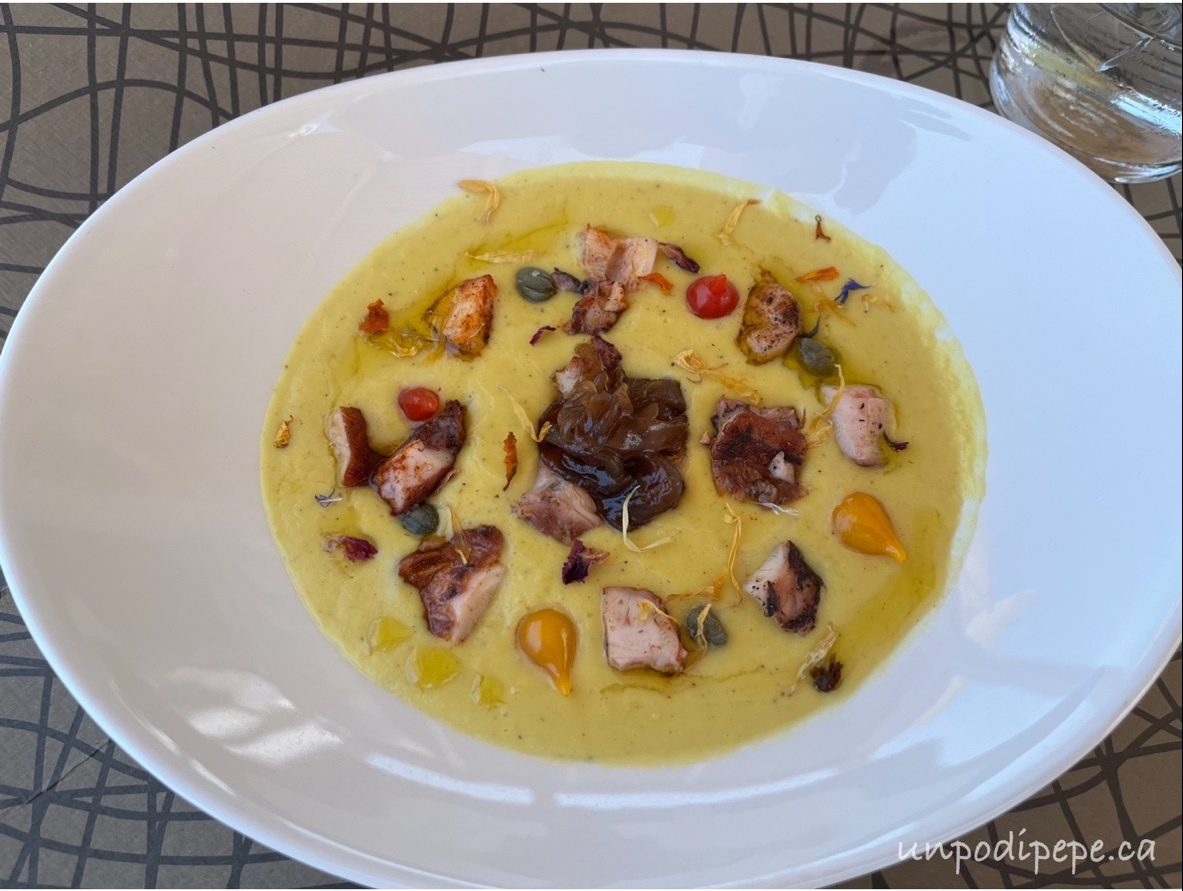
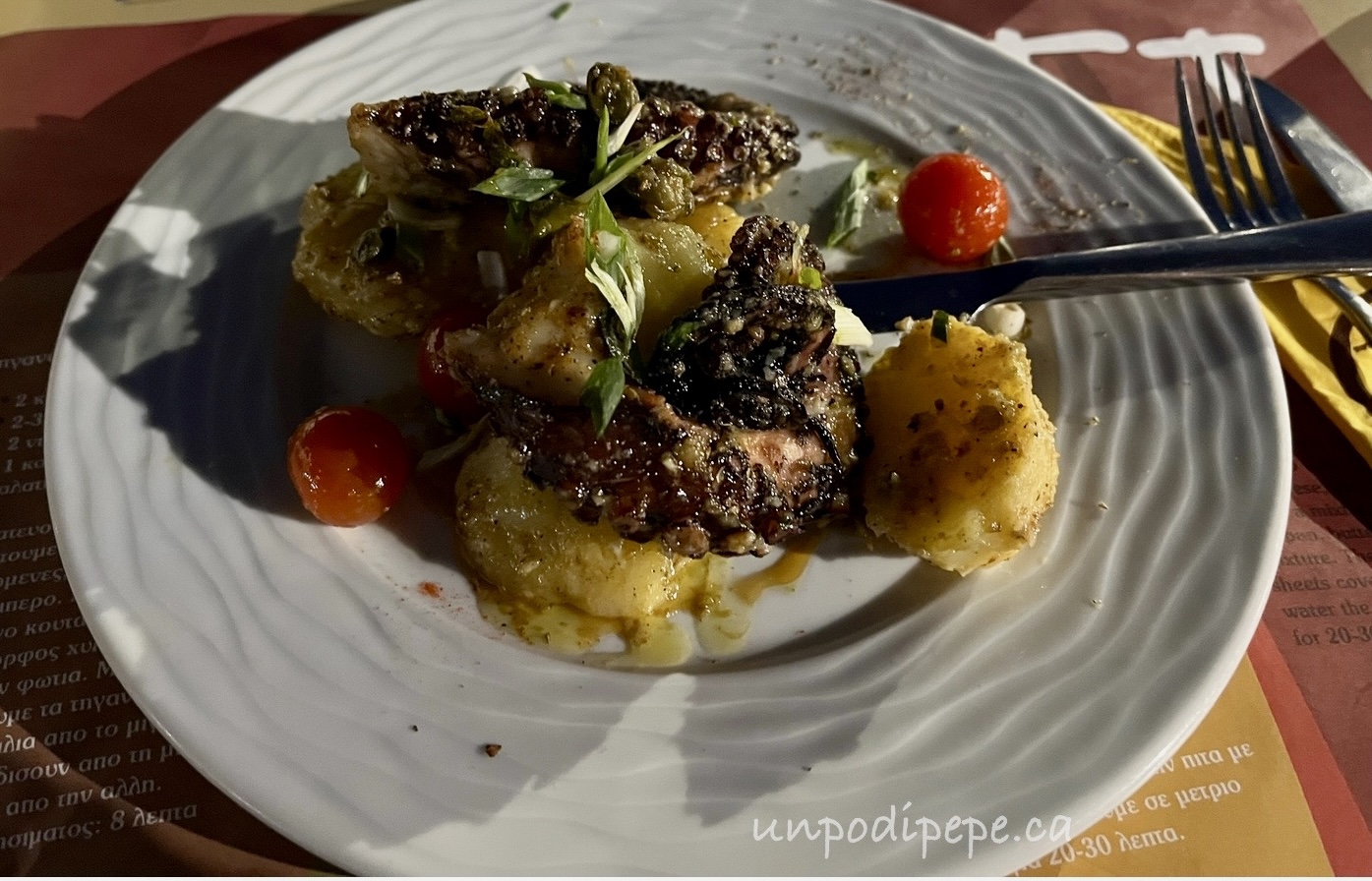
In Imerovigli, I had this orgasmic fava bean puree with grilled polpo, caramelized onions and capers. I have to try making this some time. Also in Imerovigli, I had a late night dinner of grilled octopodi on potatoes.
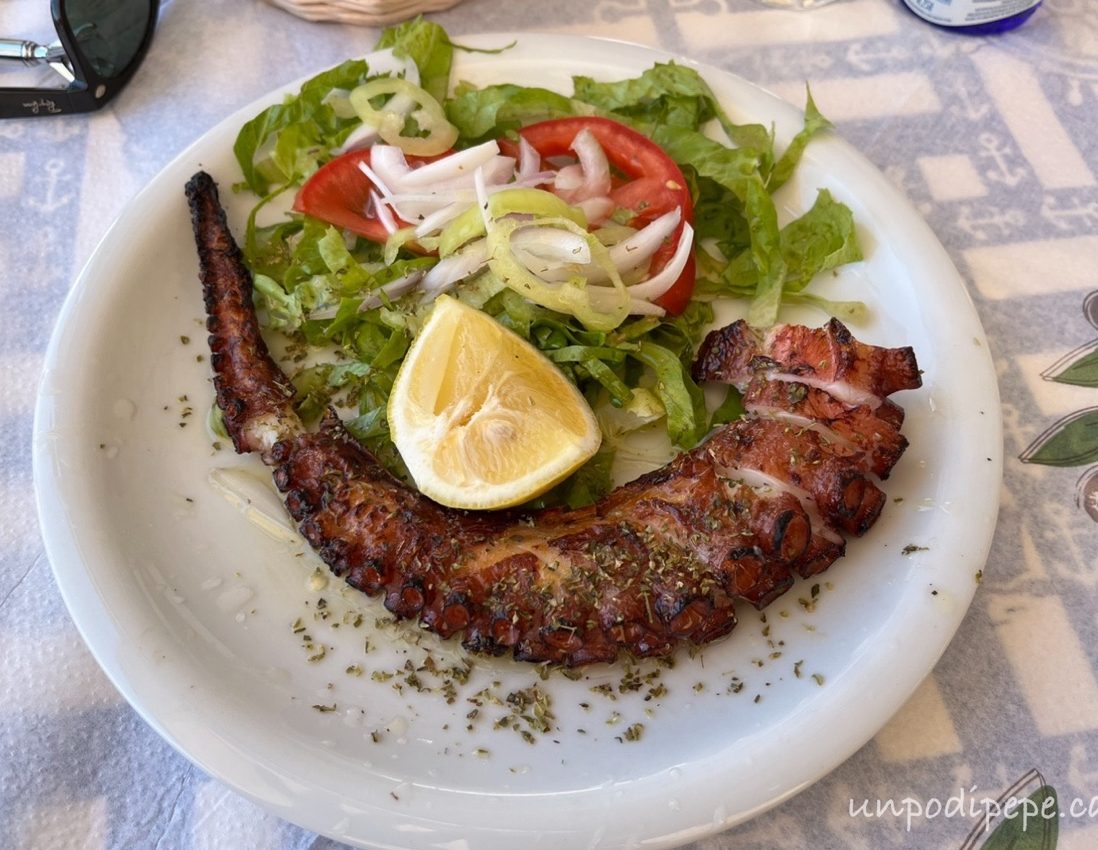
Santorini’s small port has a few seafood restaurants, where I had this very Greek grilled octopodi with oregano.
This photo was taken at the outlet mall in Molfetta. Yes, polpo is mall food in Puglia! 
The day after the matrimonio in Puglia we had a long table dinner in an olive grove by the beach in Mattinata. This is the gorgeous polpo e patate! #cookinggoals!
When camping on the beach with my cugini, we often grill polpo and then make a salad with it.
The mobile fishmonger il pescivendolo (pesh·ee·ven·DOH·loh) drives around to the different campsites selling fresh seafood. More about this in Campeggio sul Gargano. We also have polpo on the grill when we go to my nonno’s olive grove for a grigliata. 
This photo of mamma washing polpo in our tiny kitchen in Orsara di Puglia was popular on Instagram. She made a salad, without potatoes but still yummy! The second one was cooked in a tomato sauce the following day.
People apparently do all sorts of crazy things to tenderize polpo. It does not need to be beaten against rocks, bashed with a meat tenderizer, or hung on the clothesline! It just needs to cook in water long enough to tenderize the tough chewy collagen, which is about 1 hour per kg. Once cooked, it can be eaten, grilled, pan seared in olive oil or saved to use later. Freezing also helps tenderize, so previously frozen polpo does not need to cook for as long.
Polpo is hard to find in Canada! I bought a pack of 4 legs/tentacles from Spain, but then had to freeze it as I could not use it right away. Here is my ‘measurements optional’, flexible recipe for polpo e patate. It is made with the legs only, as I am not as adventurous as mamma!
Ingredients: 1 kg (2.2 lbs) polpo
500 g (1.1 lb) potatoes
Good quality extra virgin olive oil
10 ml (2 tsp) lemon juice, freshly squeezed
10 ml (2 tsp) chopped prezzemolo-Italian parsley
2-3 cherry tomatoes
1 bay leaf
Splash of vinegar
100g chopped celery and/or carrots
15 ml (1 tsp) capers
1 garlic clove, finely chopped (optional)
Peperoncino (optional)
sale, black pepper
Instructions:


I didn’t have any celery and was out of capers. Use whichever of these ingredients you have at the time. The photos weren’t taken in the best light, but it was delicious! My next one will look like the one I had in Mattinata!
Are you a polpo fan too? Have you ever cooked it yourself? Let me know in the comments. Buon appetito, Cristina
28 Sunday May 2023
Posted in Architecture, Photography, Roma, Travel
Tags
Ancient Roma, Italy travel tips, Lazio, Pantheon, Roma photography, Roma travel, Santa Maria ad Martyres, UNESCO World Heritage Sites
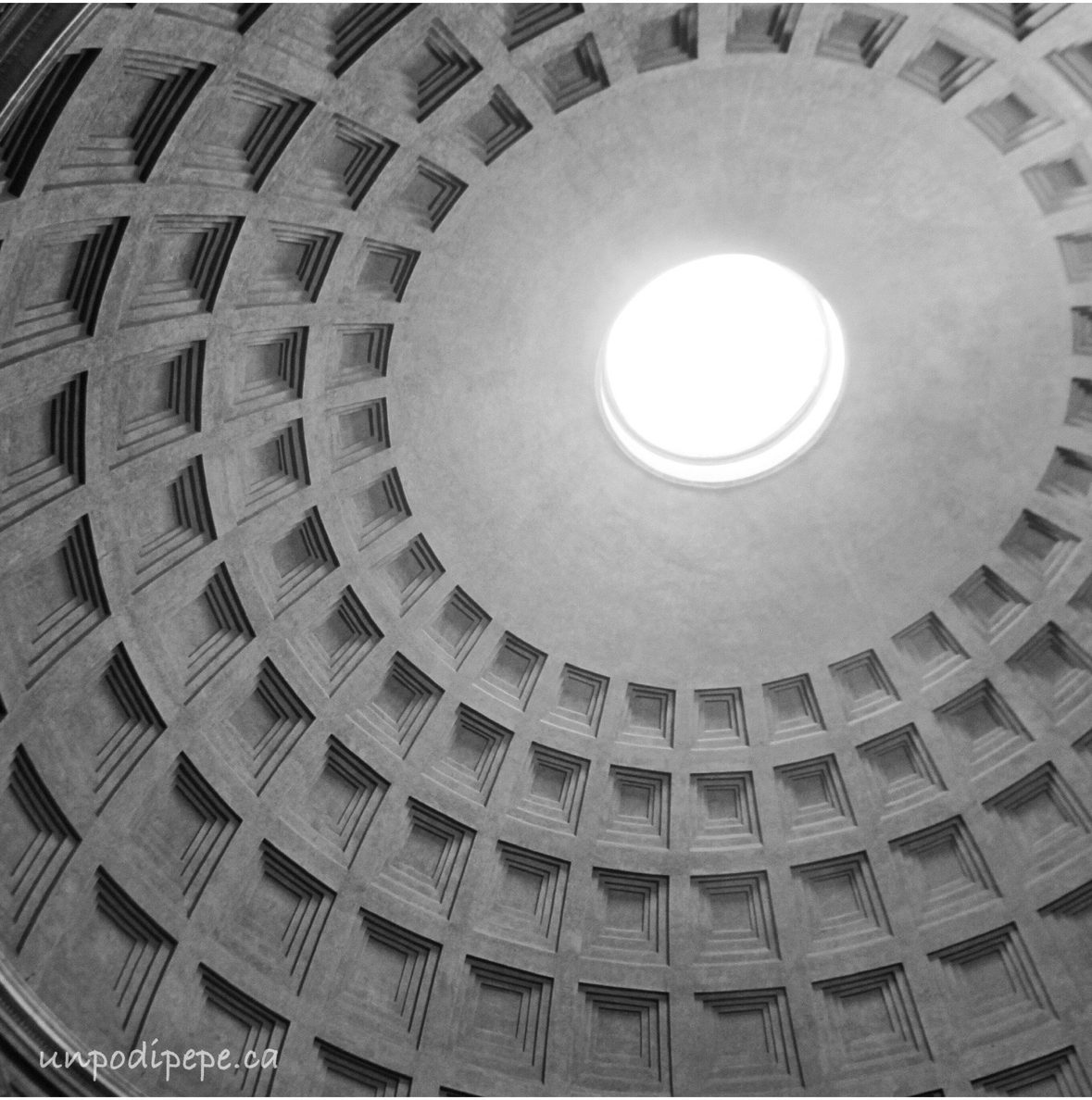
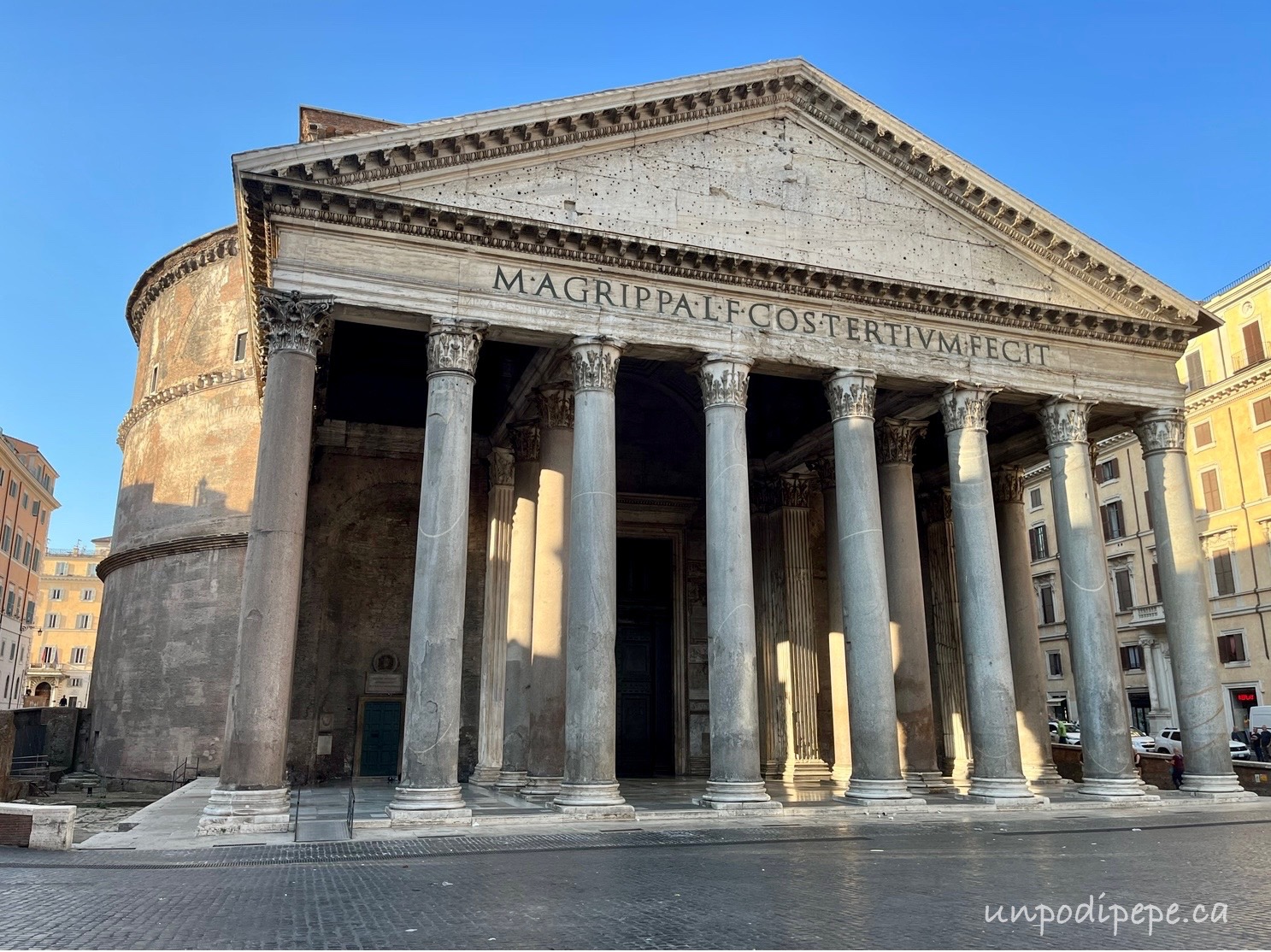
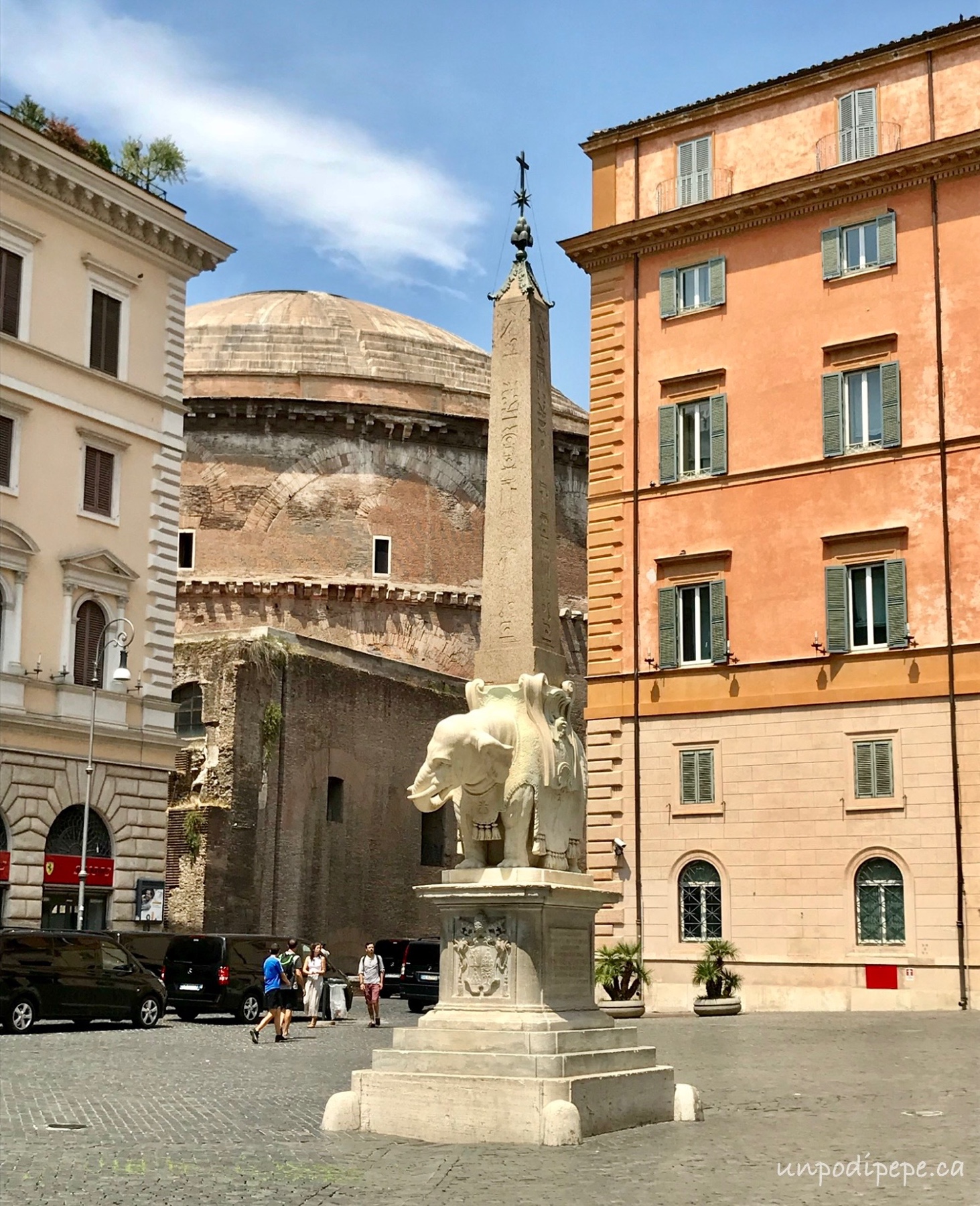
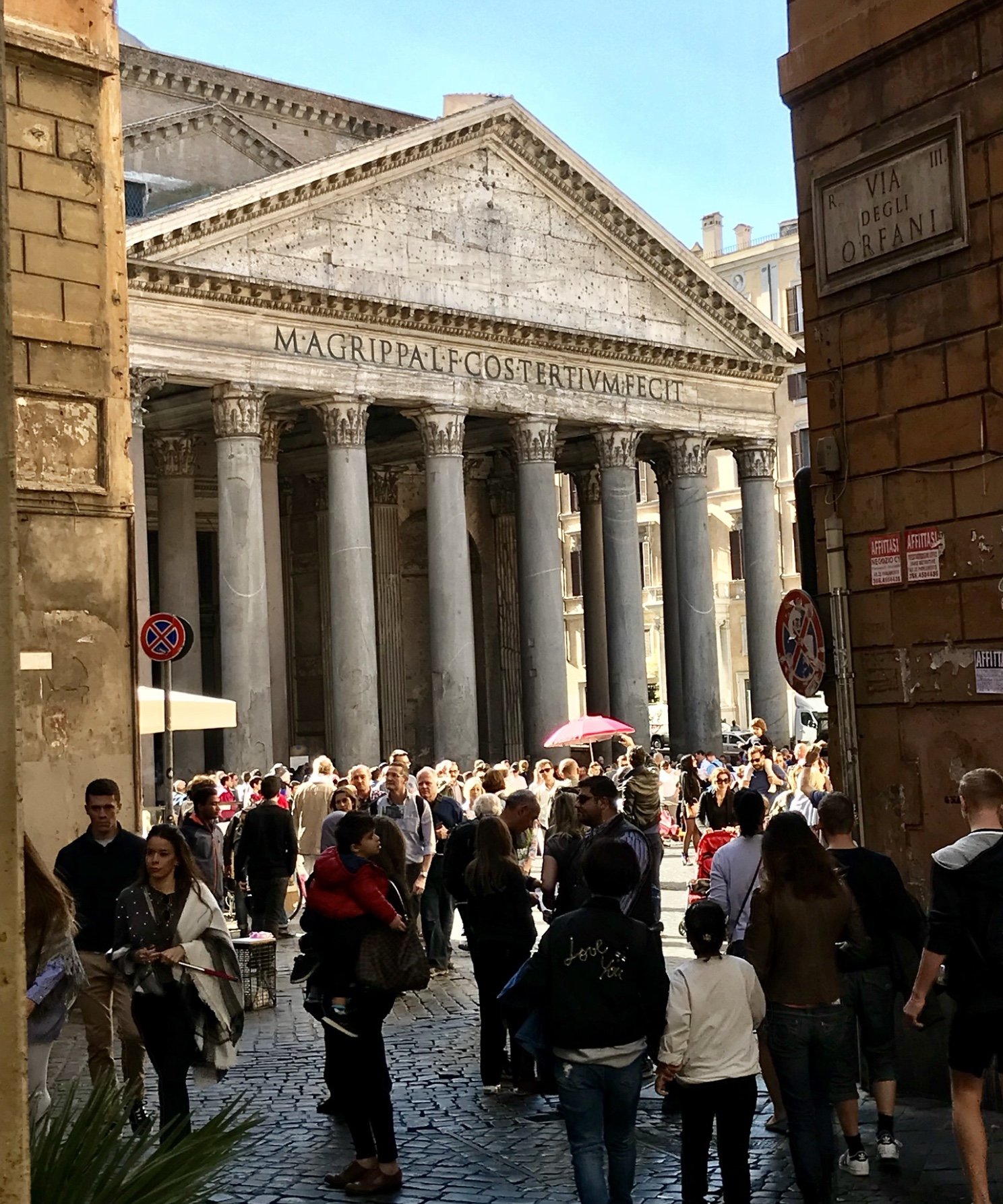
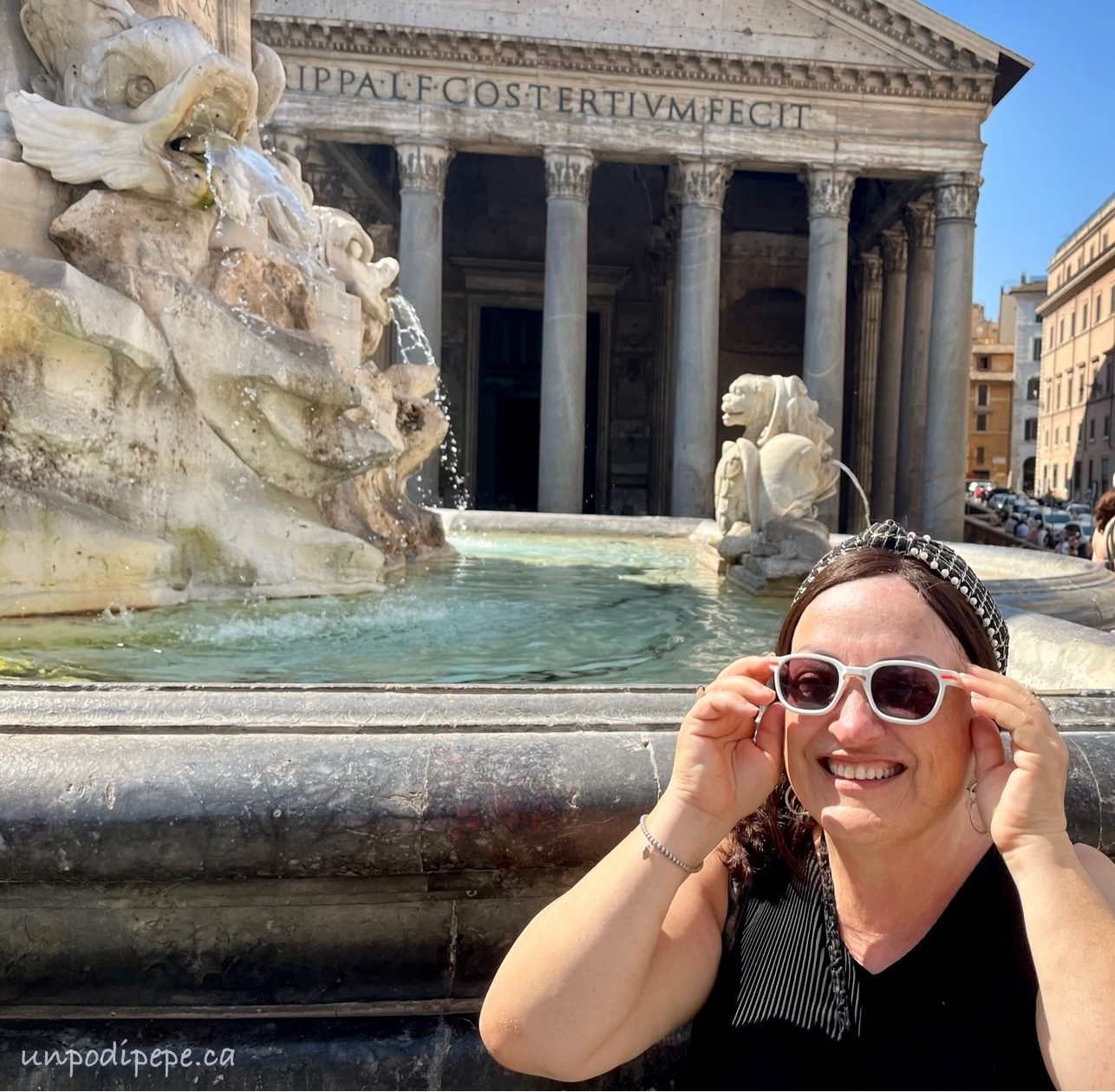
Roma is full of amazing buildings. The most amazing and best-preserved of all is the Pantheon. Imagine Michelangelo entering the Pantheon 500 years ago, looking up and saying “this looks more like the work of angels than humans’-that is how amazing it is! The perfect mathematical proportions of the Pantheon have provided inspiration for architects for almost 2,000 years. Check out the post Il Pantheon for more details on the history and structure.
Admission has always been free, and there has been talk of charging an entry fee for many years…in fact, it has been ‘announced’ several times. Well….purtroppo, the time has come. Starting July 1st 2023, there will be a €5 admission fee for entry for tourists/visitors. Admission will still be free for residents of Roma, those under 18 years old and those attending Mass. Until then, admission remains free, with booking required at least 1 day in advance only on weekends and holidays. 
The Pantheon is a classical masterpiece and a monument that requires expensive upkeep, so the need for a modest admission fee is understandable. Since the 7th century it also functions as the Church of Santa Maria ad Martyres. In Roma entry into churches is free-so that is why there has been so much effort to not charge an admission fee.
Mass is at 5 pm Saturdays, 10:30 am Sundays and public holidays, and midnight on Christmas Eve. Shoulders, midriff and knees need to be covered, although this is not as strictly enforced as the Vatican.
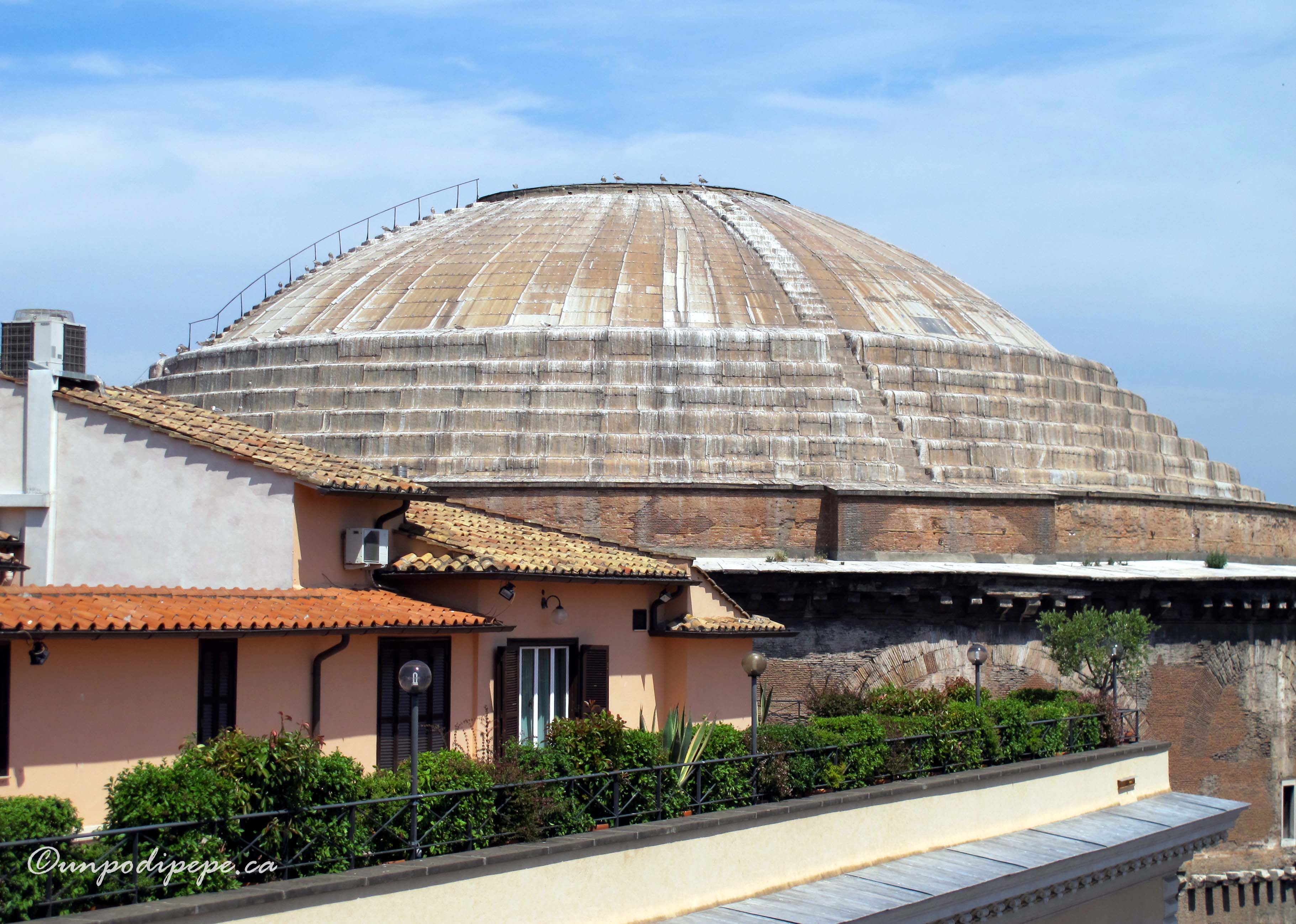
‘La Pioggia delle Rose al Pantheon’ (the rain of roses) is on my list of things to see in my lifetime. This takes place on Pentecost Sunday, 50 days after Easter. At noon, right after Mass, Roma’s Vigili del Fuoco (fire fighters) climb to the top of the dome and drop thousands of rose petals through the oculus as choirs sing. The rose petals symbolize the Holy Spirit coming down to earth. Pentecost Sunday happens to be today! I saw a video of the event this morning, and even Michelangelo would be impressed! Tickets or advance booking are not available for this event. Arriving by 7am for the 10:30 Mass is apparently necessary to get a spot inside! The ladder used by the vigili to get to the oculus is visible in the foto:
Visiting the Pantheon takes about 45 minutes. It is open daily 0900-1700 Sun 09-1800 with last entry at 18:30. The Pantheon is closed Jan 1, May 1, Aug 15 and Dec 25. An audio guide with an App can be prebooked for ~€8.50, or a 45 minute guided tour for ~€20.
Details are not yet available on how to book admission, but they should be available soon on the website. Roma is a popular weekend destination for European and Italian travelers, so I imagine tickets will easier to book during the week. There is really no ‘off season’ except for possibly the period from January 7 until the end of February.
The Pantheon is centrally located, in Piazza della Rotonda. I walk slower than most people, but it is about a 20 minute walk to Piazza di Spagna, the closest Metro stop. It is about a 20 minute walk to the Fontana di Trevi, 10 minutes to Piazza Navona and 40 minutes to Colosseo.
Read more about the Pantheon in Caffè con Caravaggio a Roma, Un Giorno a Roma and Autunno in Italia. 
Buon Viaggio, Cristina
12 Friday May 2023
Posted in Italia, Photography, Travel
Tags
Caravaggio, Napoli, Napoli Centro Storico, Southern Italy, Street art, UNESCO World Heritage Sites
Last week, after 33 years, SSC Napoli won the Series A title and the 2022/23 Scudetto. The last time they won was 1990, when Maradona played for the team. This is a big deal! The streets of Napoli are always vibrant and exciting, but I would have loved to see the celebrations. The stalls of San Gregorio Armeno likely sold more Napoli team figurines than Presepio pieces this week!
In honour of the big win, I am writing about Napoli-the city. If you have already read my post Un giorno a Napoli, this one is a continuation…..another day in Napoli! In June, I took a spontaneous trip to Santorini, flying in and out of Capodichino, Napoli’s airport. On the way back, I stayed the night and took the bus back to Orsara di Puglia the following afternoon.
My primary objective was to finally see l’ultimo Caravaggio, the artist’s last painting, which up until 1990 was attributed to one of his followers. Read about my adventure seeing the ‘wrong’ Caravaggio in the post.
Since it was close to the new location of the painting, I stayed on lively Via Toledo, near the award winning Toledo metro station and in between the port and Quartieri Spagnoli.
Read about the new exhibition space and my visit in Gallerie d’Italia Napoli. There is still 1 Caravaggio painting left for me to see in Napoli on my next visit-at the Museo di Capodimonte!
The Chiostro di Santa Chiara is another place I missed on previous day trips. The church was built starting in 1310 and the chiostro or cloister is well known for the addition of Rococo style majolica tiles in 1742.

Santa Chiara is located on the 2km long street known as ‘Spaccanapoli’ meaning ‘cut across Napoli’ because it cuts the centro storico in half. It is one of the 3 Decumani, east/west streets in the grid layout of the Greco-Roman city of Neapolis.
Napoli has the largest Centro Storico in Europe and has been a UNESCO World Heritage Site since 1995. Think of it as an open air museum. Via dei Tribunali was decorated with a lot of laundry for some reason! 
Nunspotting on Via San Gregorio Armeno. I did not buy any Presepio accessories or Napoli team figurines, but perhaps these sisters did?
I walked past the Duomo just in time to see a dramatic wedding kiss. The bride was clearly satisfied! The Duomo Santa Maria Assunta was built over the site of a temple to Neptune. It was damaged in a 15th century earthquake and repeatedly renovated, resulting in a mishmash of styles and a Neogothic facade. 
Walking down Via Toledo to the end, passing Piazza Plebescito, I ended up at the waterfront and a view of Vesuvio. Hopefully I will be back here at the port in a few months to take the ferry to Procida.
Sfogliatelle were consumed, of course. This crunchy layered pastry, filled with sweet ricotta, lemon and candied peel is amazing. Sfogliatelle in Napoli are delicious and inexpensive. I had one served hot from the oven at Antico Forno Attanasio, Via Ferrovia 1-4 just a few blocks from Piazza Garibaldi. At €1.30, why stop at just one? I bought a whole bag to bring back to Orsara! I also had one from Pintauro on Via Toledo 275, the oldest sfogliatelle place in Napoli. It was heavenly! 
More street food heaven… I had a cuopo friggitori Napoletano. This is a paper cone filled with fritto misto-a mixture of fried stuff-fish, vegetables and pizze fritte. Yum!
Graffiti is elevated to a fine art form in Napoli. I wrote a post on Napoli street art, and saw some new stuff.
‘Consumerism Street’ was taken on Via Toledo. The small print under the sardine can says ‘Alla fine siamo tutti uguali’/In the end we are all equal.
In a tradition of pay it forward, Napoli has ‘caffè sospeso‘. This is a ‘pending caffè’, paid for in advance as an anonymous gift. Someone asking if there is a caffè sospeso available would receive it for free. This is actually an old tradition that has recently had a resurgence.
Still haven’t visited Napoli? What are you waiting for? To quote myself …’Napoli is underrated, misunderstood and does not get the love it deserves, except from fans of Elena Ferrante novels. News of corruption, the Camorra and ongoing garbage crises give it a bad rep. It it ironic that everyone-including many Italians- fears for their life and thinks it is just a crime pit, when Napoli is actually safer than most large North American cities. It is vibrant, wonderfully chaotic, full of life and passionate, friendly people. Napoli has an ‘edge’ to it and is anything but boring’.
According to an old saying ‘Vedi Napoli e mori’. I hope you enjoyed un altro giorno a Napoli! When you go, have an extra sfogliatella for me! Buon viaggio, Cristina
25 Tuesday Apr 2023
Posted in Blogging, Inspiration
Auguri a me! Oggi Un po’ di pepe compie 9 anni! Yeah me! Today Un po’ di pepe turns 9! Another bloghiversario– blog anniversary. It is hard to believe it has already been 9 years since starting Un po’ di pepe. Where did the time go? It feels like only yesterday I had trouble coming up with a blog name that was not already taken. This has been an amazing, rewarding experience and I have ‘met’ so many virtual friends and even reconnected with old ones. The first thing I published was my ‘Perché questo blog/Why write a blog?’, which can be read here. My first actual post was Il Gigante, about Michelangelo’s David.
Last month, I published post #200! To celebrate this milestone, I held a giveaway. The names of the 10 readers who left a comment on the post Bialetti Moka were placed in a bowl and drawn by Mamma. The 3 winning readers of my linocut print ‘Espresso per uno‘ are Daniel P, Joanne S and Anna M! Your prints are in the mail and I hope you like them.
The actual 200th post was a link to a 90 minute zoom workshop I gave on creating a mixed media self portrait collage. It was part of a post pandemic grant received by Accenti magazine and is now up on Youtube. To read more about it or to participate in the activity, the link is Countering Isolation with Creativity and the post outlines the materials needed.
In 2022, I only published 13 posts, but I feel like I am finally recovering from the post pandemic writing blahs. Yipee! I was also away a lot, trying to make up for almost 3 years of no travel. Take a peak at my adventures in Post Pandemic Travel Postcard. I have upcoming posts about Torino, Venezia, Peggy Guggenheim, Ostia Antica, Napoli and a recipe for polpo e patate…maybe even off-topic ones on Paris and Santorini!
One of my posts was sort of a public service. Anyone planning summer travel to Italia needs to read Beat the heat-Surviving Summer in Roma. Prego! I only participated in the monthly ‘In my kitchen’ worldwide blog community once last year, and it was from my kitchen in Puglia.
April 25th is also La Festa della Liberazione d’Italia, the anniversary of the liberation of Italia from Fascist occupation in 1945. Since 1946 it has been a national holiday. Viva la libertà!
Grazie to all of you for taking the time to read, comment, send messages and especially for giving me an excuse to share my images and research and write about things that interest me! You know….’Devo fare ricerca per il blog’ (I need to do research for my blog) is my reason to do all the things I want to do! If you have any suggestions for future posts or just want to say ‘ciao‘, leave me a comment.
Grazie a tutti i lettori di ‘Un po’ di pepe’ per continuare a leggere e per avermi dato una scusa per usare le foto che ho scattato e per scrivere di cose che mi piacciono. Ormai posso usare la scusa ‘devo fare ricerca per il blog’ per tutto quello che voglio fare. Lasciatemi un messaggio se avete delle idee per un post o se semplicemente volete dire ‘ciao’. 
Un abbraccio, Cristina