• Home
  • About me/Chi sono
  • Contact

Un po' di pepe

~ …… (oon∙poh∙dee∙PEH∙peh) Cristina writes about interesting stuff /Cristina scrive di cose interessanti

Un po' di pepe

Tag Archives: Napoli

Procida

31 Thursday Aug 2023

Posted by Un po' di pepe in Italia, Photography, Travel

≈ 13 Comments

Tags

Campania, Chiaiolella, Ischia, Italian Capital of Culture, Italian islands, Marina di Corricella, Napoli, Slow travel, Southern Italy

When I mentioned to anyone that i was going to Procida, the response was ‘Where is that?’  It was the 2022 Italian Capital of Culture, but still not well known outside of Italia.  Procida (pronounced PRO·cheedah) is one of the Flegrean Islands off the coast of Napoli and is part of the city of Napoli.  It was created by the eruption of 4 volcanoes, which are now submerged and dormant.   Overshadowed by its sexier neighbours Capri and Ischia, Procida is the least visited of the 3 islands.  It has a tiny area of 4.1 km², but with a population of 11,000, Procida is one of the most populated Italian islands. It is still mainly a fisherman’s island, a living, working place where real people live.  The main industries on the island are the port and fishing. Tourism is #3.

Procida has a laid-back, slow travel vibe-even in the most popular areas. You will not find any resorts, fancy spas or tour groups and the shops cater more to locals, closing for ‘la pausa pranzo’ from 1-5 pm.  Even finding somewhere to buy a few souvenirs was hard! In the summer and on weekends, many of the visitors to Procida are Napoletani going to the beach.

Procida has been featured in movies, most notably the beautiful, multi award winning 1994 film Il Postino and the 1999 psychological thriller The Talented Mr Ripley. Both films were set in the 1950’s-60’s.  In the 1963 Elizabeth Taylor/Richard Burton film Cleopatra, Procida -with the baroque duomo clearly in the background-was briefly featured as the ancient city of Tarsus where Cleo’s barge arrived to meet Marc Antony.  There are signs posted at various filming locations on the island.
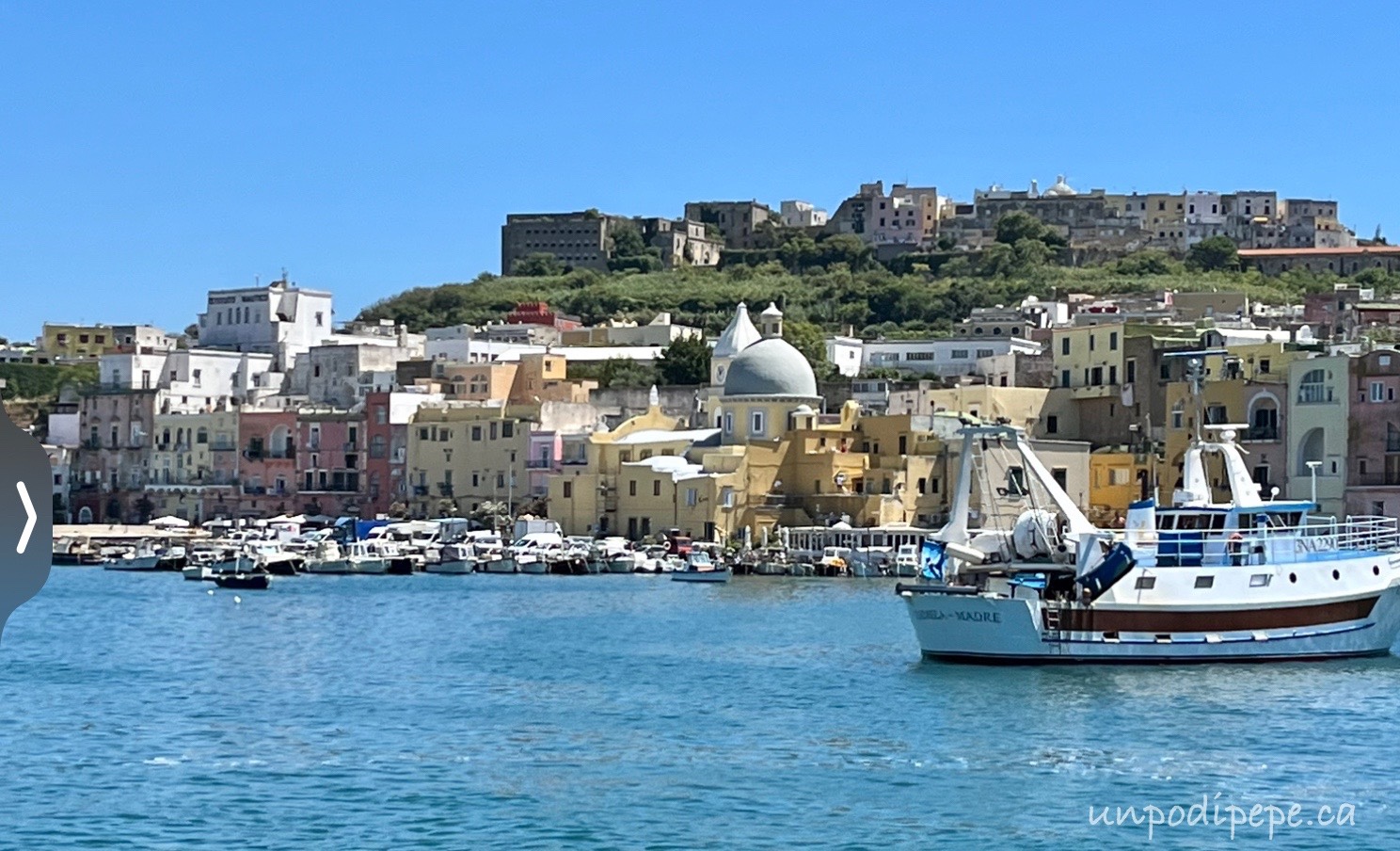
Marina Grande is the main port where ferries (traghetti) and hydrofoils (aliscafi) arrive. Here you will find sorbetto coloured buildings, the main bus stop and ferry terminal, several restaurants and bars, a gluten free bakery Il Piccolo Forno Senza Glutine, and ONE gift/souvenir shop.

A 20 minute uphill walk from Marina Grande to the other side of the island (~20 min) brings you to the most visited area.  Walking uphill towards Terra Murata is the spectacular view of Marina di Corricella with its limoncello and pink grapefruit coloured 17th century fisherman’s houses and the duomo of Santa Maria delle Grazie Incoronata.  I found Marina Grande colourful and cute, but nothing compared to this view.  The walk is steep, but if mobility is an issue the C2 bus stops here.
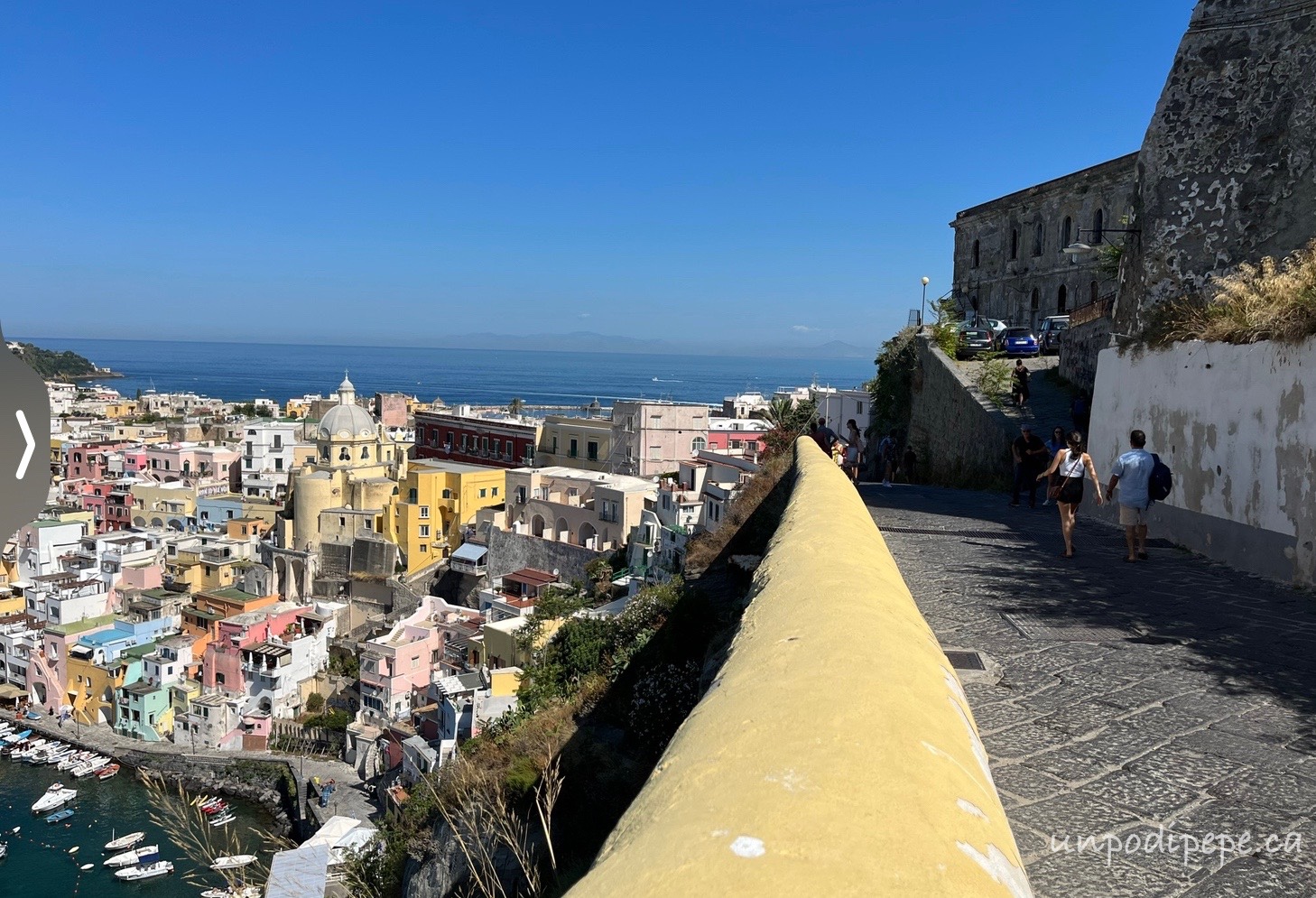
Terra Murata (walled land) the highest and oldest part of Procida, is a fortified medieval village at the top of the island.  Abbazia San Michele Archangelo is an 11th Century Benedictine Abbey turned into a church.  Palazzo d’Avalos built in 1563 became a prison in the 1800’s until it closed down in 1988.  Tours of the prison (€13,) need to be booked at least 2 days in advance so I was not able to go. The roof has sweeping views of the entire Bay of Napoli, including Ischia, Capri and the Amalfi coast.  Check out John’s blog post about the prison  for more information.  The 15th Century Santa Margherita Nuova monastery was under renovation, so I was not able to see that either.  The postcard views from up here are absolutely mozzafiato-breathtaking!  A friend asked me how I took the cover photo over Marina di Corricella. ‘Hai volato?’  Did you fly over it?

The walk down to Marina di Corricella (Kor·ree·CHEL·lah) with houses built on top of each other, is steep and looks lived in with plants and laundry hanging out to dry.  Some typical features of Procidano architecture, besides the pastel colours, include exterior staircases and arched windows.  This area is completely vehicle free.

The marina is a full working harbour with colourful fishing boats, and fishermen with their nets.  There are several restaurants, bars and gelaterie.  I enjoyed a limoncello spritz and taralli while watching the fishing boats.  La Locanda del Postino is a restaurant where Mario, il Postino, sat to write poetry to Beatrice in the movie.  Some fishing boats offer a ‘giro dell’isola’ from here.  Terra Murata can be seen from  the Marina below.Chiaiolella (Kyay·oh·LEL·lah) on the West tip of the island is the area where I stayed.  Spiaggia Chiaiolella is a dark volcanic sand beach with warm, shallow water and amazing sunsets.  At the end of the beach is a long walking bridge to Vivara, a tiny green satellite island and nature reserve. Ischia is seen past Vivara in the photo.Around the corner is Marina di Chiaiolella, full of boats and seafood restaurants.  I enjoyed a delicious, reasonably priced seafood meal with a glass of Falanghina at Crescenzo.  The walk back up to the hotel is up a narrow street lined with useful stuff like small supermercati, shops carrying   beach essentials, a Tabacchino and a few takeout restaurants.  There is also a gorgeous jewellery store and a linen shop where I bought Franco a coppola.
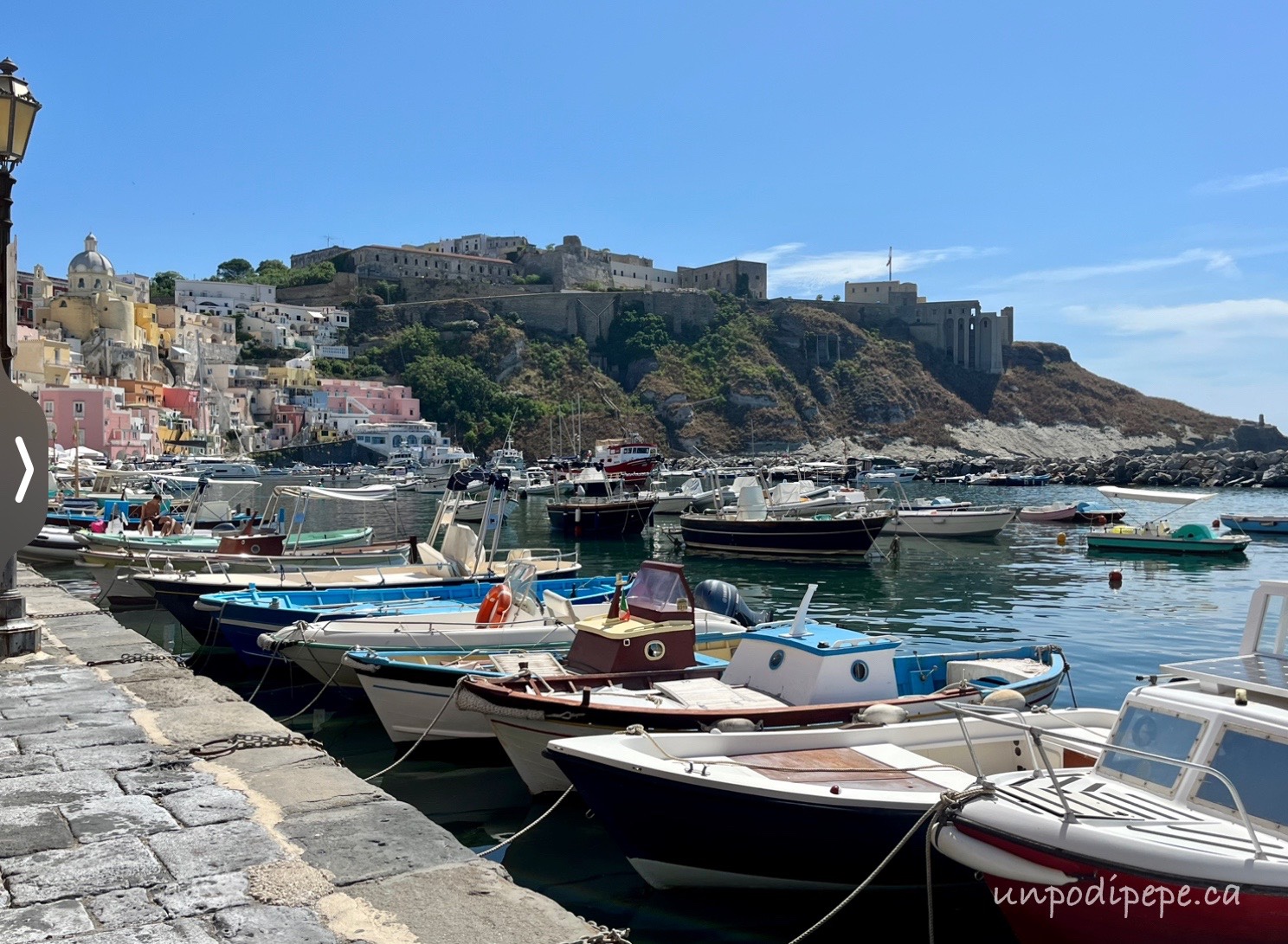
There are 4 other beaches on Procida.  Spiaggia Cala del Pozzo Vecchio is the one where Il Postino was filmed.  I will have to go there on my next visit.  The beaches   all have black volcanic sand, except for the small beach by the port, La Lingua which is rocky.

Procida can only be accessed by sea. Unless you have a private boat, that means by ferry or hydrofoil from Napoli, Pozzuoli or Ischia. Napoli to Procida is 1 hour by ferry and 40 min by hydrofoil.  Ischia is 20 min away by hydrofoil-the same boat stops at both islands.  From Napoli the hydrofoil cost me €19 to go and €18 to return.  The ferry is about €15.
Procida can be a daytrip from Napoli or Ischia, but I would recommend staying overnight if you can.  The sunsets are worth it! **Note that from November to March there are less ferries running and some restaurants and hotels are closed.

From April until October, only residents of Procida are allowed to bring cars onto the island.  Scooters, bicycles and ebikes are available for rent.  4 minibuses cross the island; from the port to Chiaiolella (L1 and L2), Corricella (C2) and Il Postino Beach (C1).  Tickets are €1.60 each, or get a daypass and use it like a ‘hop on/hop off’ bus.  These buses go fast and the streets are only about 8 inches wider than the bus!  In the mornings, you may have to wait for a few buses, as they are full of people going to the beach and going to work.  Even the motorini and bikes go fast, so crossing the narrow streets can be a challenge.  Everyone is in a hurry to get to the beach and drives like they are in Napoli!
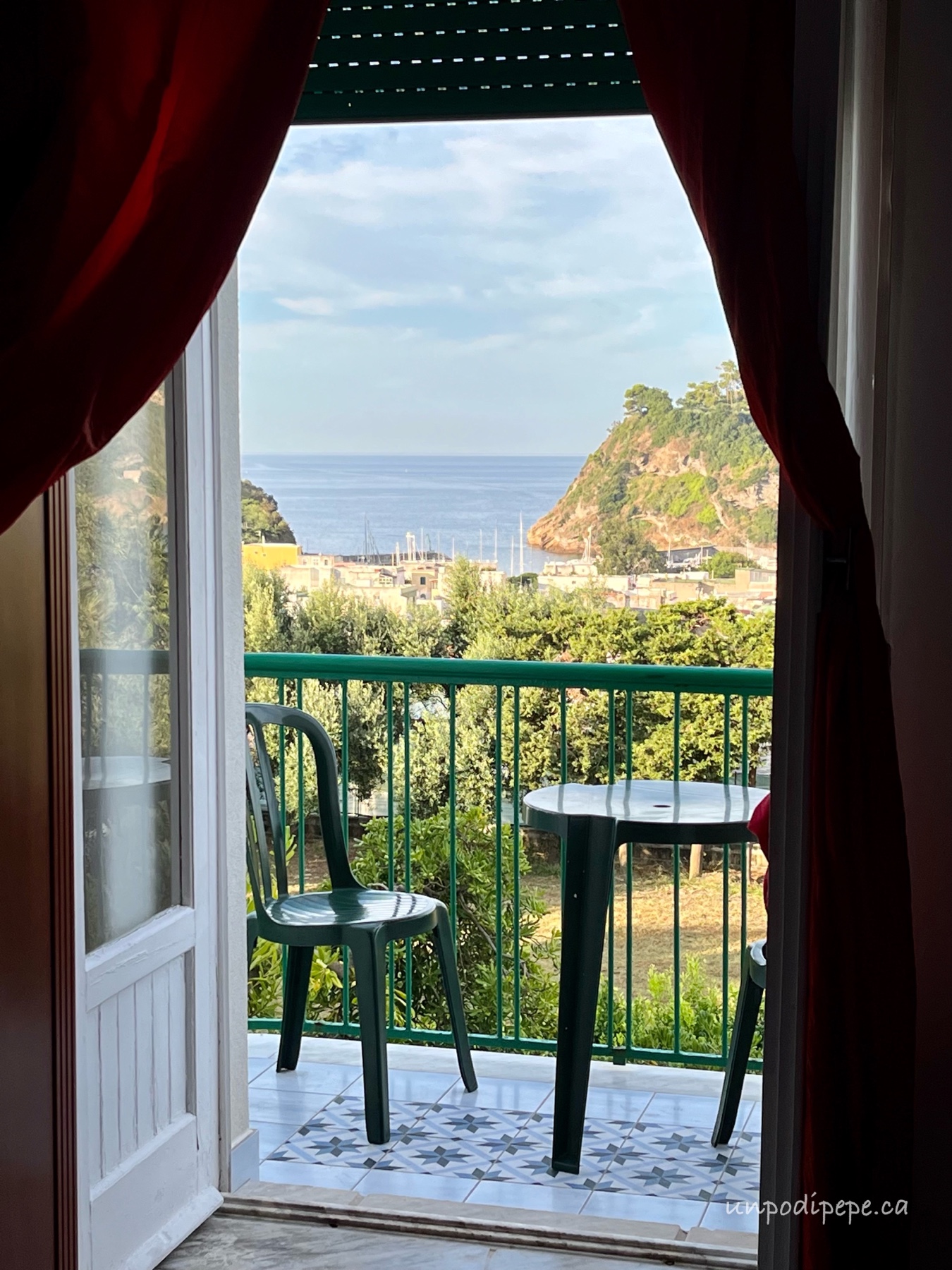
A bit about my trip….. I was in Procida with my cugina Maria from Ontario August 8th and 9th.  It was not a weekend.  We took the 7 am bus from Orsara di Puglia to Foggia, then the bus from Foggia to Napoli.  In Napoli, we took the metro from Stazione Garibaldi to Municipio and walked the short distance to Porto Molo Beverello where we took the hydrofoil to Procida.  Quite the trek to get there!  We did not book the ferry in advance.  We arrived at our hotel at about 2:30 pm. I booked the hotel only 2 weeks in advance.  Ideally, we wanted to stay 2 nights at Hotel La Casa sul Mare which is near Santa Maria delle Grazie in Marina Corricella, but they only accept summer reservations for a 3 night minimum stay.  I booked Hotel Riviera which was only available for 1 night, so we spent the second night in Napoli.  Hotel Riviera was absolutely lovely-right at the bus stop and walking distance to Spiaggia Chiaiolella.  We were pleasantly surprised that our room had a balcony with a view of Marina Chiaiolella, Vivara and Ischia!  This is where I sat to write all of these notes while drinking €1.60 red wine and watching the sunset!

Buon viaggio, Cristina

Share this:

  • Click to share on Facebook (Opens in new window) Facebook
  • Click to share on Pinterest (Opens in new window) Pinterest
  • Click to share on X (Opens in new window) X
  • Click to email a link to a friend (Opens in new window) Email
  • Click to share on WhatsApp (Opens in new window) WhatsApp
Like Loading...

Un altro giorno a Napoli

12 Friday May 2023

Posted by Un po' di pepe in Italia, Photography, Travel

≈ 10 Comments

Tags

Caravaggio, Napoli, Napoli Centro Storico, Southern Italy, Street art, UNESCO World Heritage Sites

Last week, after 33 years, SSC Napoli won the Series A title and the 2022/23 Scudetto.  The last time they won was 1990, when Maradona played for the team.  This is a big deal!  The streets of Napoli are always vibrant and exciting, but I would have loved to see the celebrations.  The stalls of San Gregorio Armeno likely sold more Napoli team figurines than Presepio pieces this week!

In honour of the big win, I am writing about Napoli-the city. If you have already read my post Un giorno a Napoli, this one is a continuation…..another day in Napoli! In June, I took a spontaneous trip to Santorini, flying in and out of Capodichino, Napoli’s airport. On the way back, I stayed the night and took the bus back to Orsara di Puglia the following afternoon.

My primary objective was to finally see l’ultimo Caravaggio, the artist’s last painting, which up until 1990 was attributed to one of his followers.  Read about my adventure seeing the ‘wrong’ Caravaggio in the post.

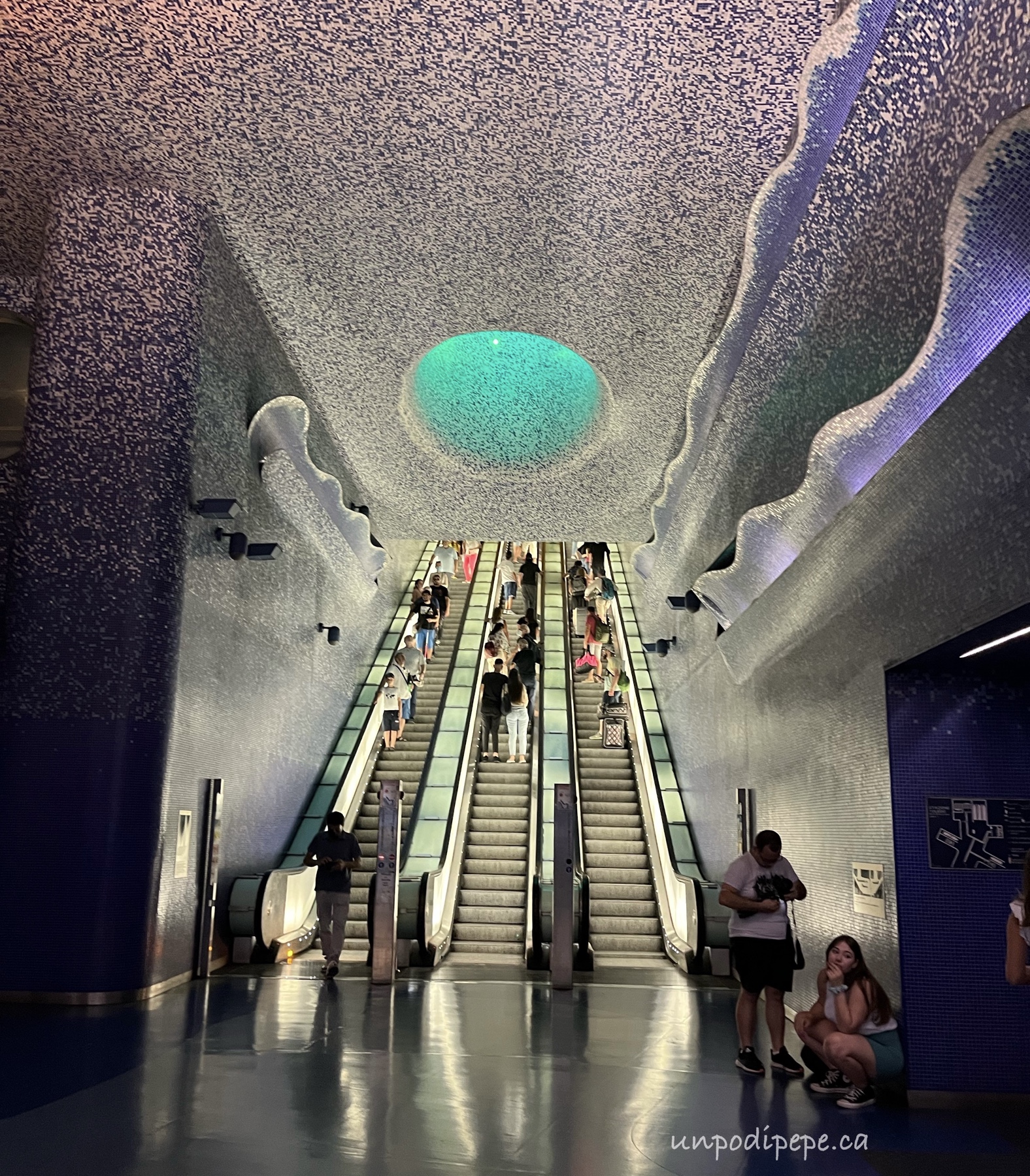
Since it was close to the new location of the painting, I stayed on lively Via Toledo, near the award winning Toledo metro station and in between the port and Quartieri Spagnoli. Read about the new exhibition space and my visit in Gallerie d’Italia Napoli. There is still 1 Caravaggio painting left for me to see in Napoli on my next visit-at the Museo di Capodimonte!

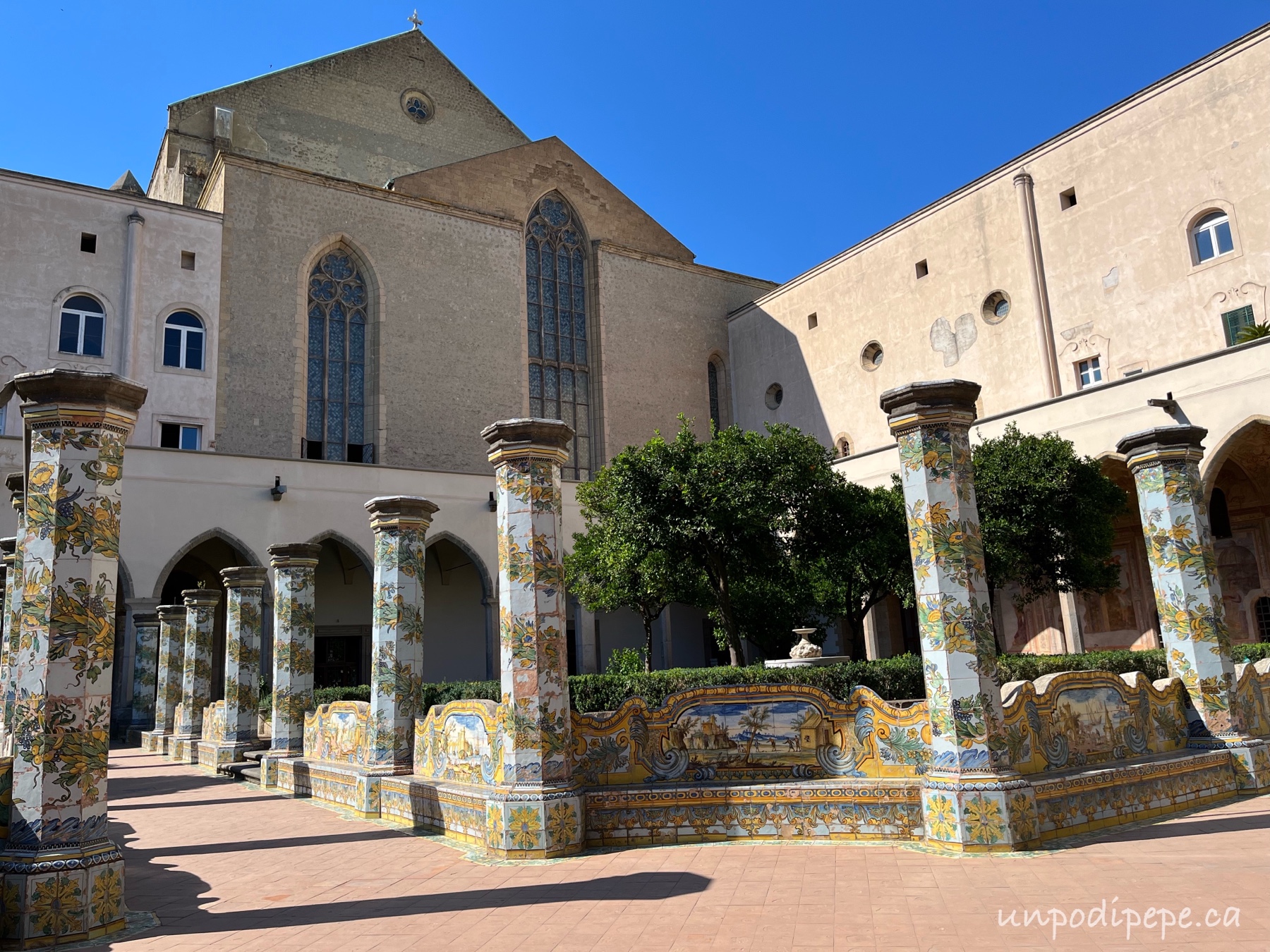
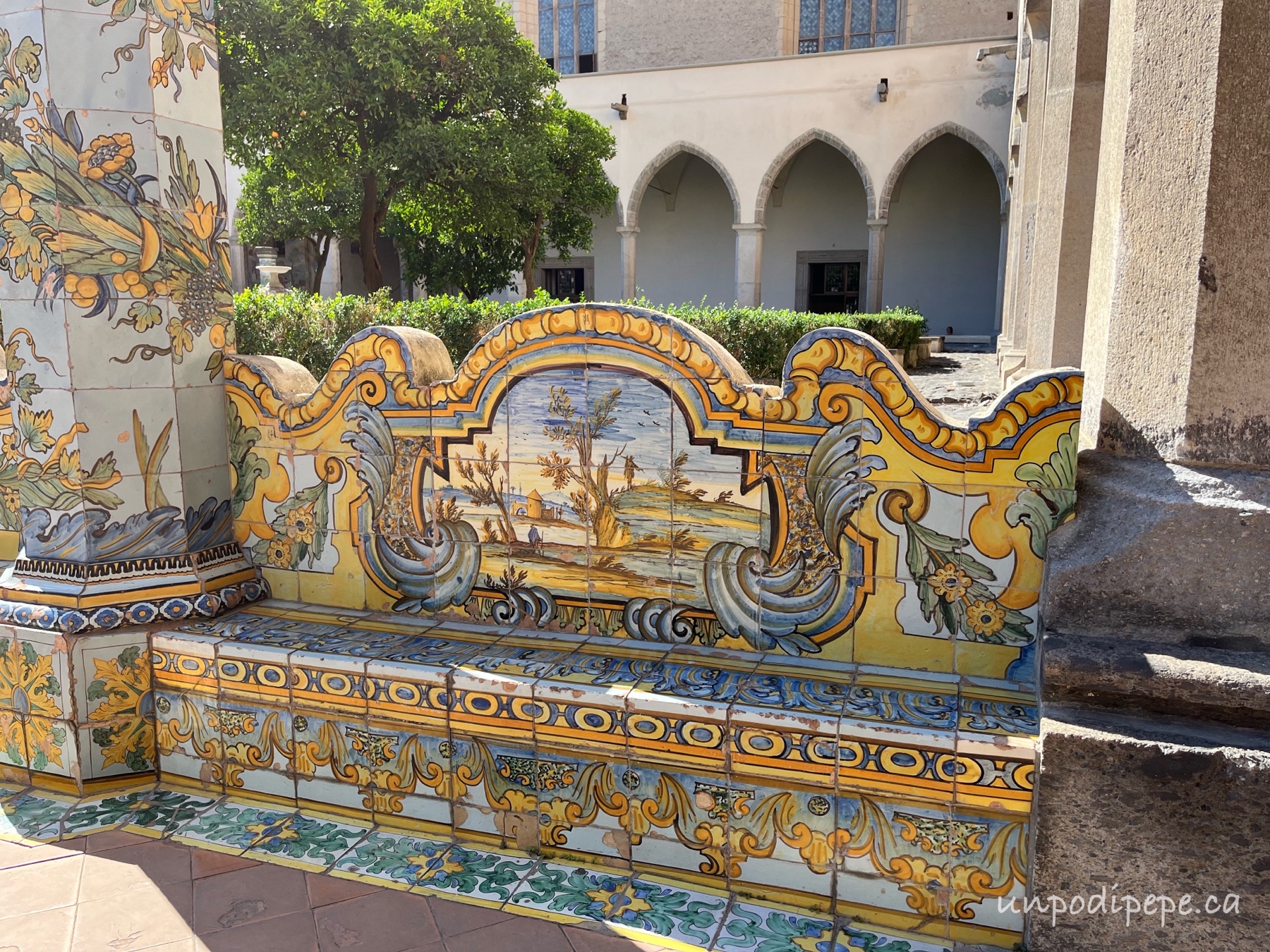
The Chiostro di Santa Chiara is another place I missed on previous day trips. The church was built starting in 1310 and the chiostro or cloister is well known for the addition of Rococo style majolica tiles in 1742.
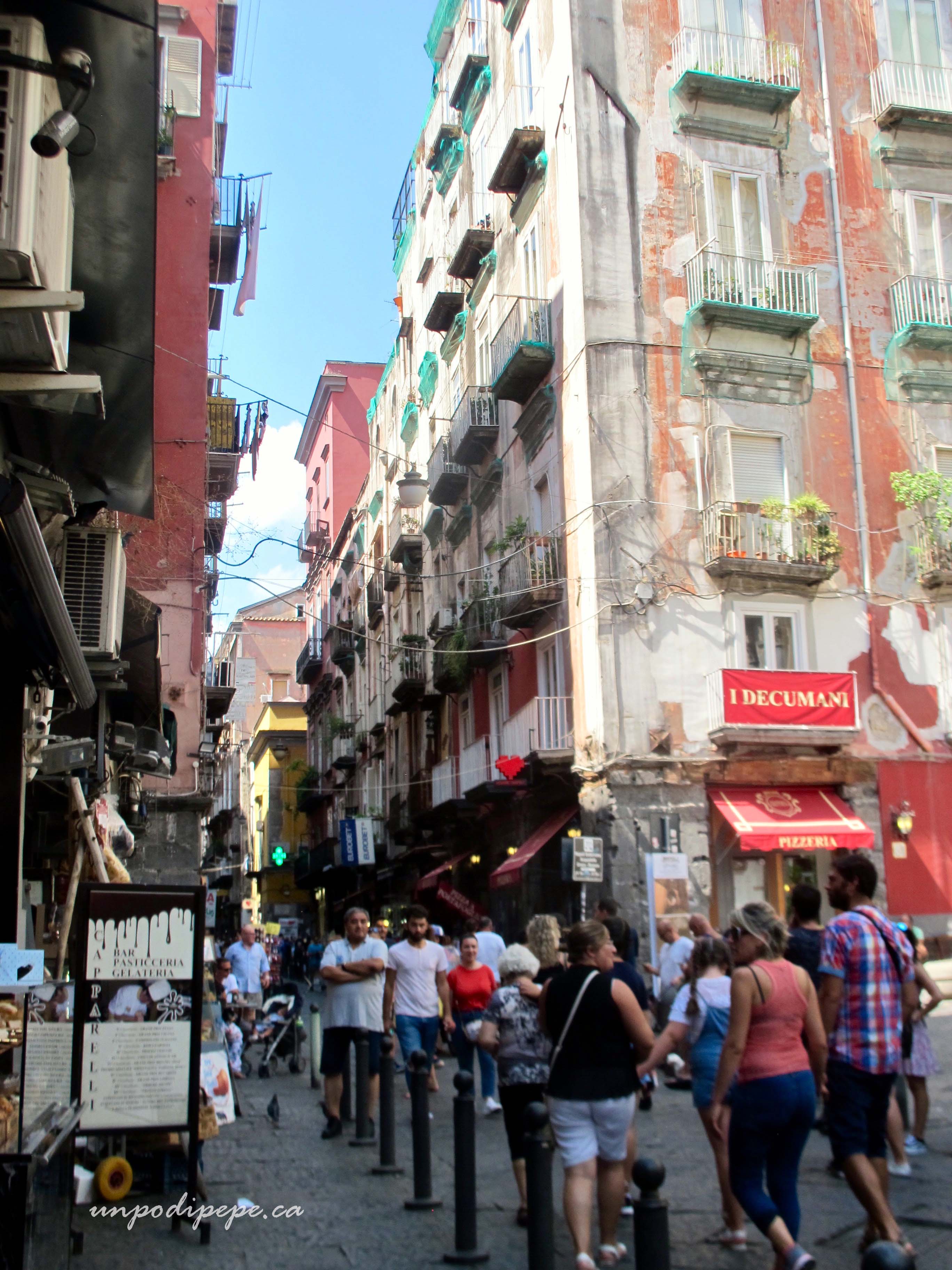
Santa Chiara is located on the 2km long street known as ‘Spaccanapoli’ meaning ‘cut across Napoli’ because it cuts the centro storico in half. It is one of the 3 Decumani, east/west streets in the grid layout of the Greco-Roman city of Neapolis.

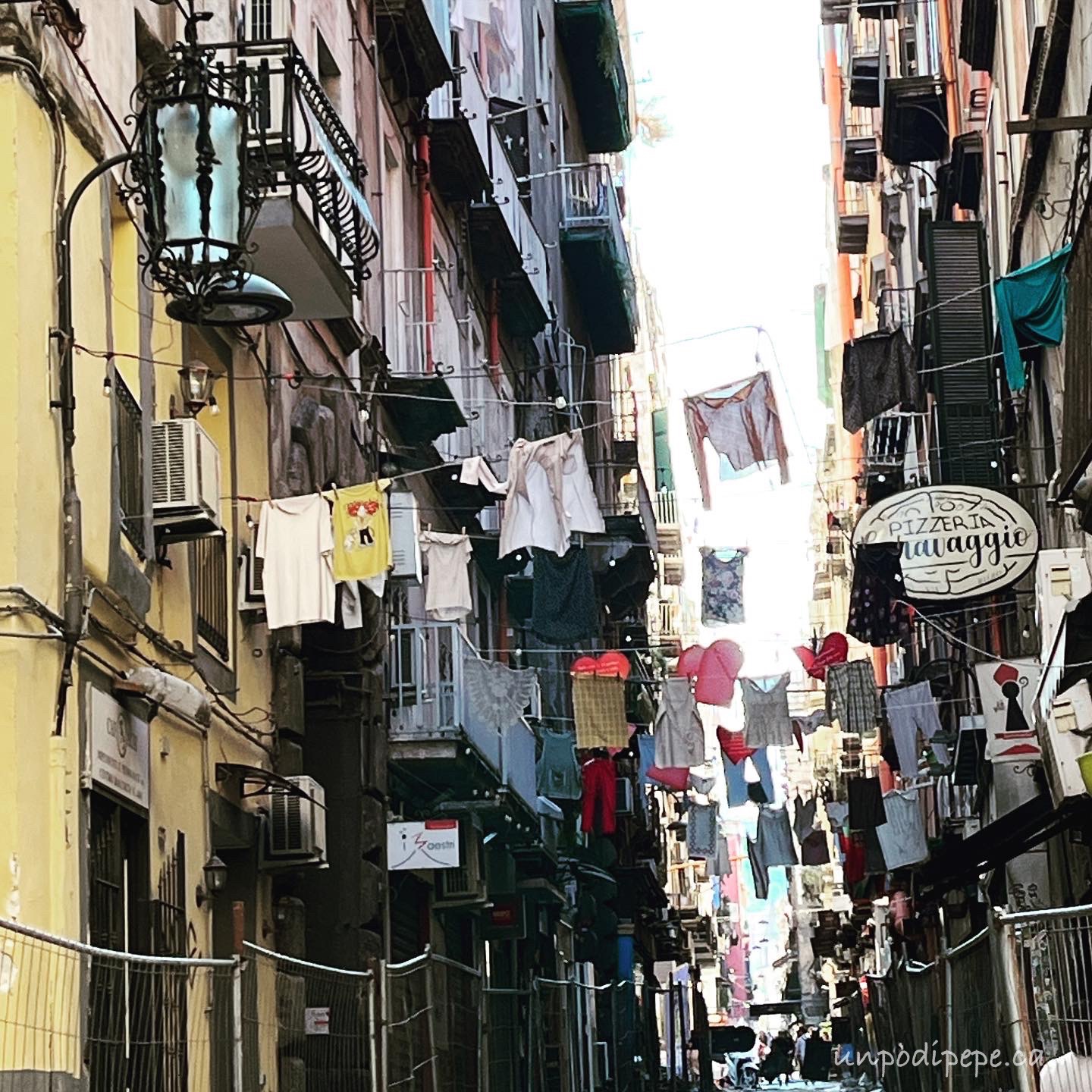
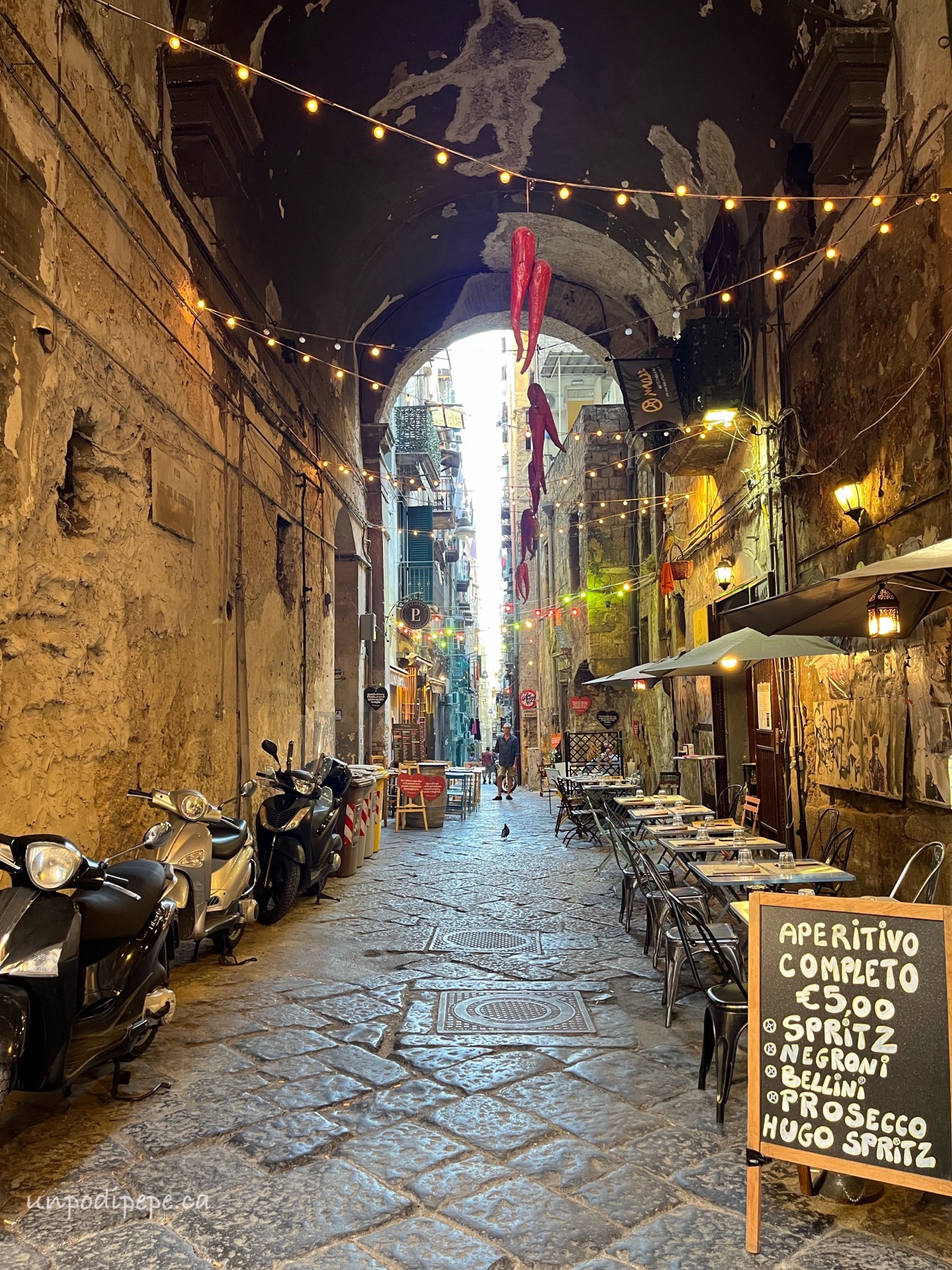
Napoli has the largest Centro Storico in Europe and has been a UNESCO World Heritage Site since 1995. Think of it as an open air museum.  Via dei Tribunali was decorated with a lot of laundry for some reason!

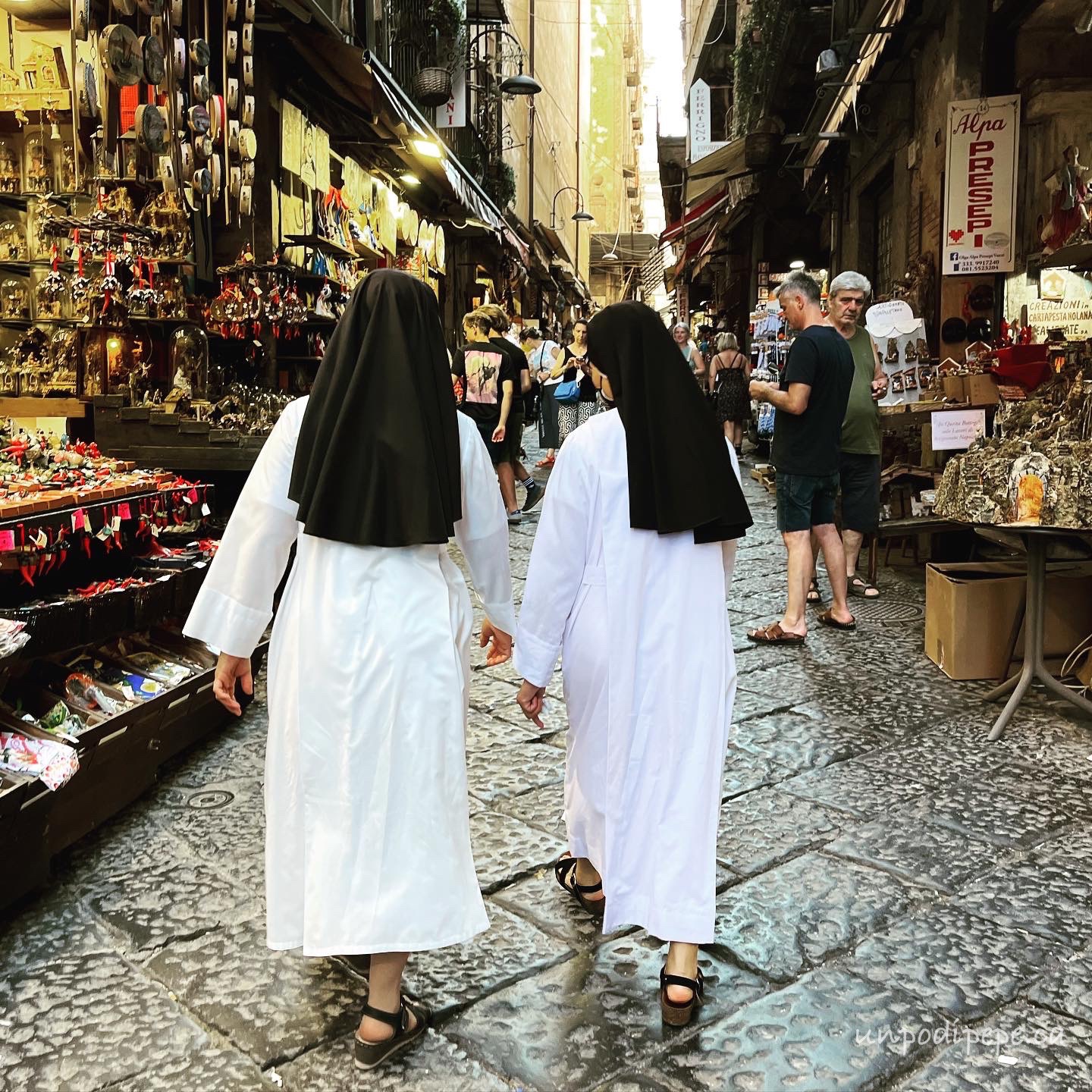
Nunspotting on Via San Gregorio Armeno.  I did not buy any Presepio accessories or Napoli team figurines, but perhaps these sisters did?

I walked past the Duomo just in time to see a dramatic wedding kiss.  The bride was clearly satisfied!  The Duomo Santa Maria Assunta was built over the site of a temple to Neptune.  It was damaged in a 15th century earthquake and repeatedly renovated, resulting in a mishmash of styles and a Neogothic facade.

Walking down Via Toledo to the end, passing Piazza Plebescito, I ended up at the waterfront and a view of Vesuvio.  Hopefully I will be back here at the port in a few months to take the ferry to Procida.

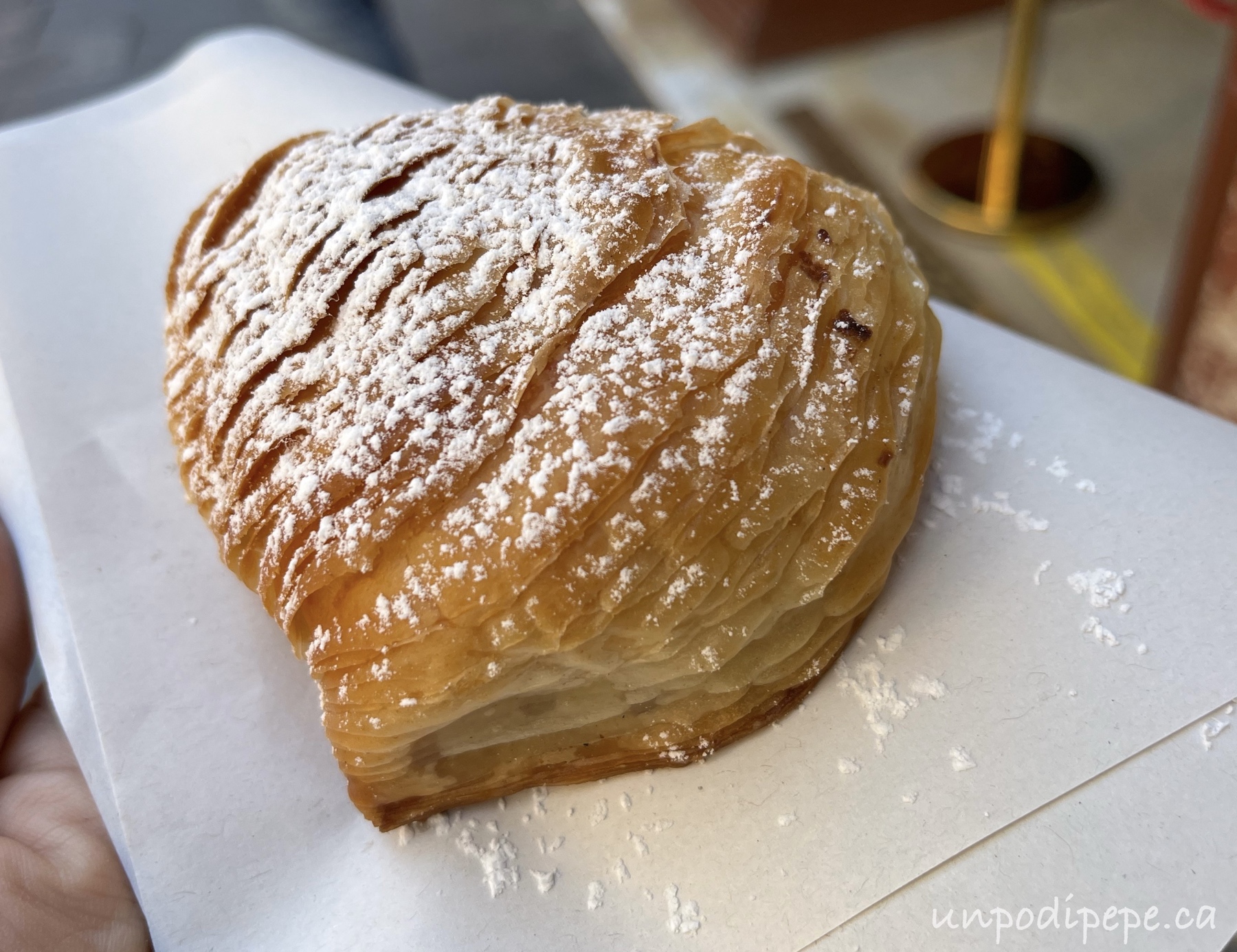
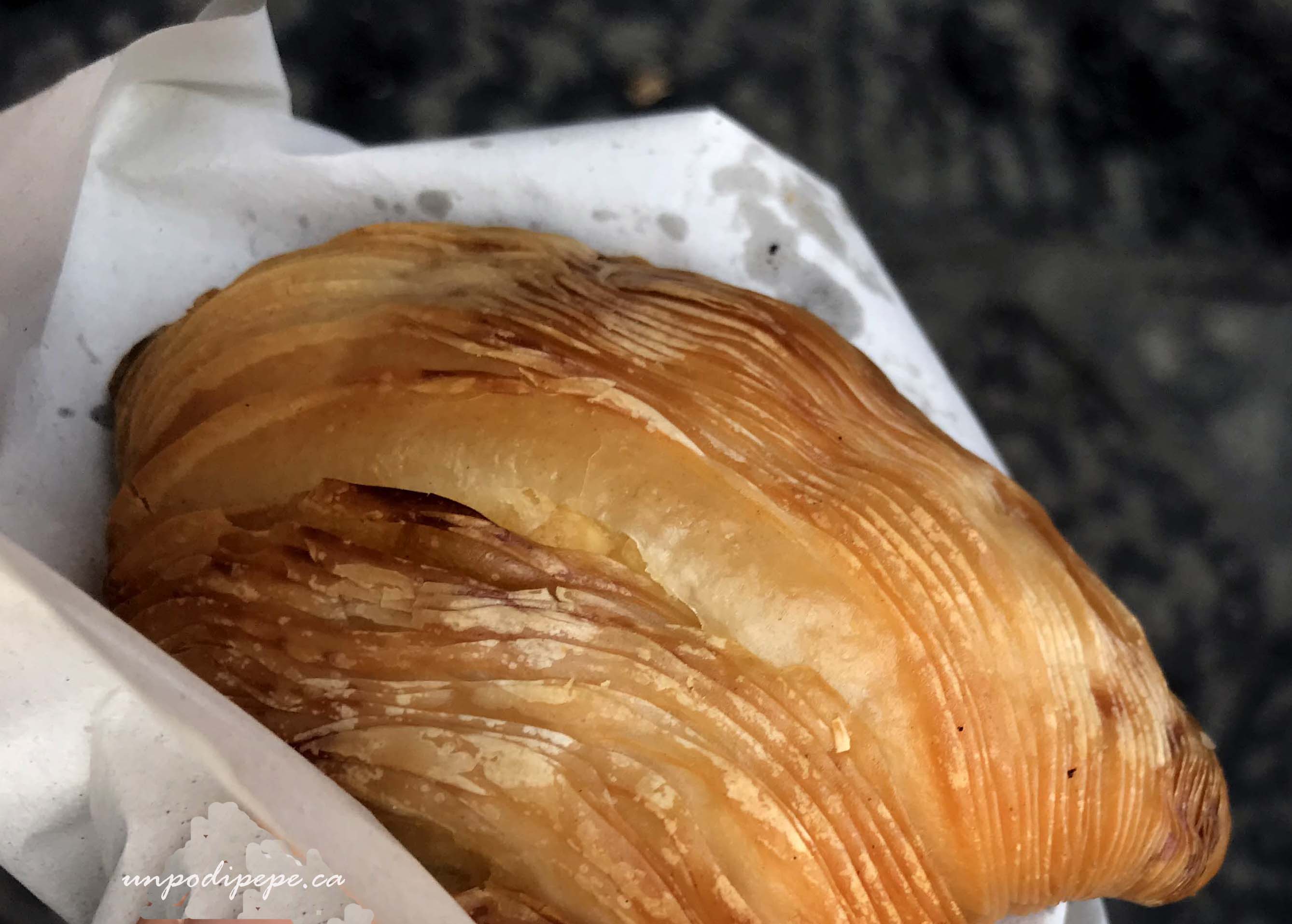
Sfogliatelle were consumed, of course.  This crunchy layered pastry, filled with sweet ricotta, lemon and candied peel is amazing. Sfogliatelle in Napoli are delicious and inexpensive.  I had one served hot from the oven at Antico Forno Attanasio, Via Ferrovia 1-4 just a few blocks from Piazza Garibaldi.  At €1.30, why stop at just one?  I bought a whole bag to bring back to Orsara!  I also had one from Pintauro on Via Toledo 275, the oldest sfogliatelle place in Napoli.  It was heavenly!

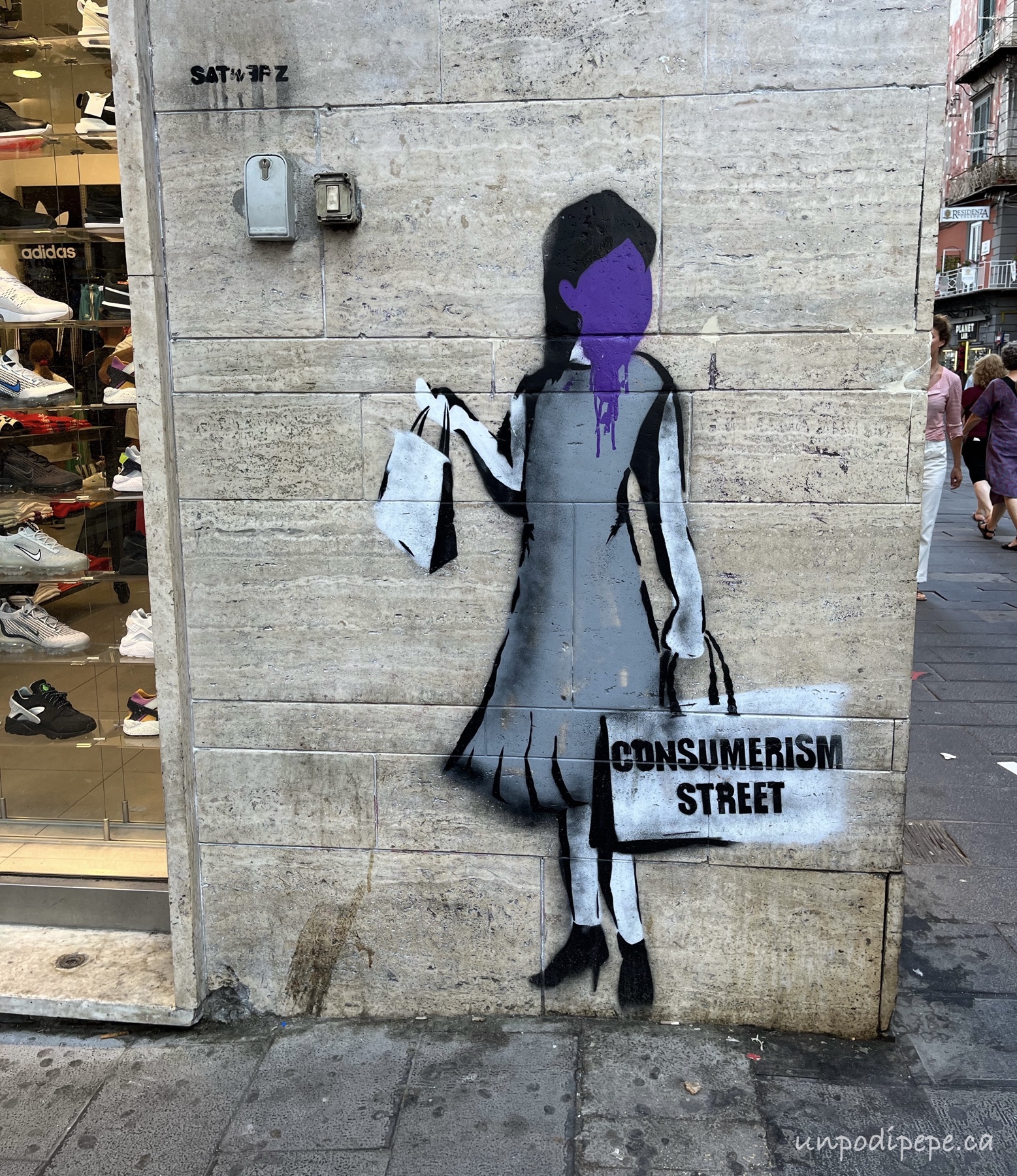
More street food heaven… I had a cuopo friggitori Napoletano.  This is a paper cone filled with fritto misto-a mixture of fried stuff-fish, vegetables and pizze fritte. Yum!Graffiti is elevated to a fine art form in Napoli.  I wrote a post on Napoli street art, and saw some new stuff. ‘Consumerism Street’ was taken on Via Toledo.  The small print under the sardine can says ‘Alla fine siamo tutti uguali’/In the end we are all equal.

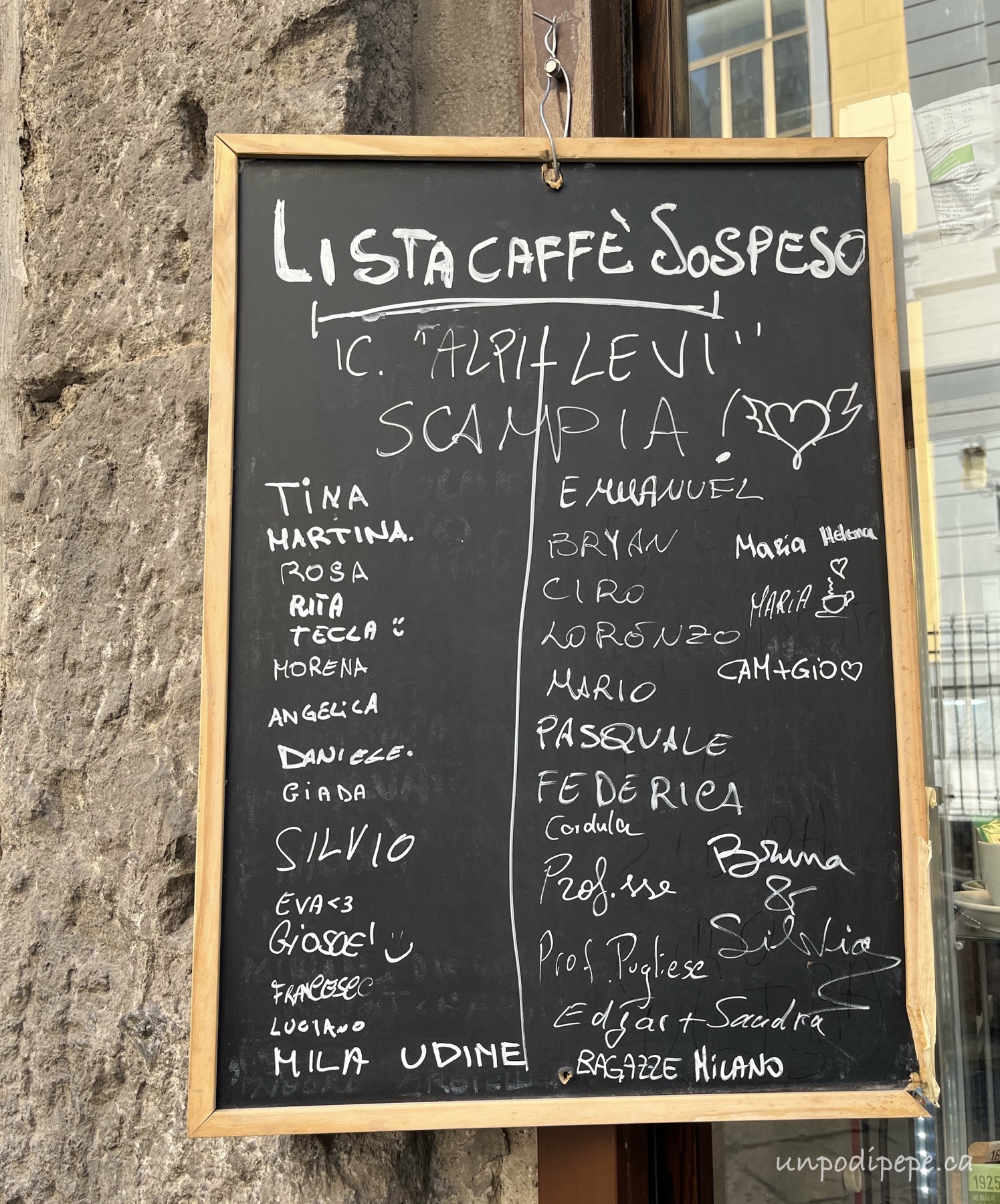
In a tradition of pay it forward, Napoli has ‘caffè sospeso‘. This is a ‘pending caffè’, paid for in advance as an anonymous gift.  Someone asking if there is a caffè sospeso available would receive it for free. This is actually an old tradition that has recently had a resurgence.

Still haven’t visited Napoli?  What are you waiting for?  To quote myself …’Napoli is underrated, misunderstood and does not get the love it deserves, except from fans of Elena Ferrante novels. News of corruption, the Camorra and ongoing garbage crises give it a bad rep. It it ironic that everyone-including many Italians- fears for their life and thinks it is just a crime pit, when Napoli is actually safer than most large North American cities. It is vibrant, wonderfully chaotic, full of life and passionate, friendly people. Napoli has an ‘edge’ to it and is anything but boring’.

According to an old saying ‘Vedi Napoli e mori’. I hope you enjoyed un altro giorno a Napoli!  When you go, have an extra sfogliatella for me! Buon viaggio, Cristina
Share this:

  • Click to share on Facebook (Opens in new window) Facebook
  • Click to share on Pinterest (Opens in new window) Pinterest
  • Click to share on X (Opens in new window) X
  • Click to email a link to a friend (Opens in new window) Email
  • Click to share on WhatsApp (Opens in new window) WhatsApp
Like Loading...

Gallerie d’Italia Napoli

26 Sunday Feb 2023

Posted by Un po' di pepe in Art, Art history, Italia

≈ 6 Comments

Tags

Artemisia Gentilleschi, Caravaggio, Napoli, Napoli Centro Storico, Sant'Orsola, Southern Italy, Via Toledo

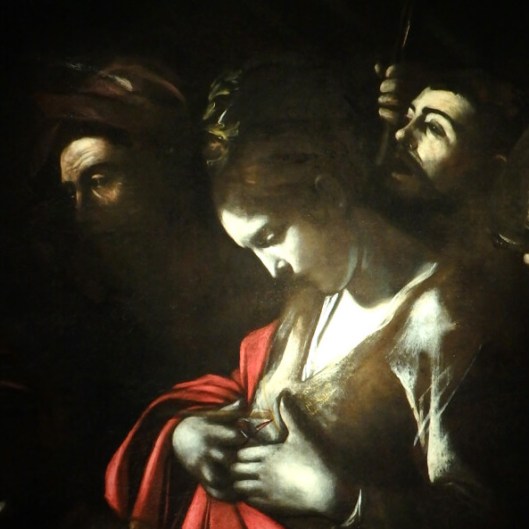
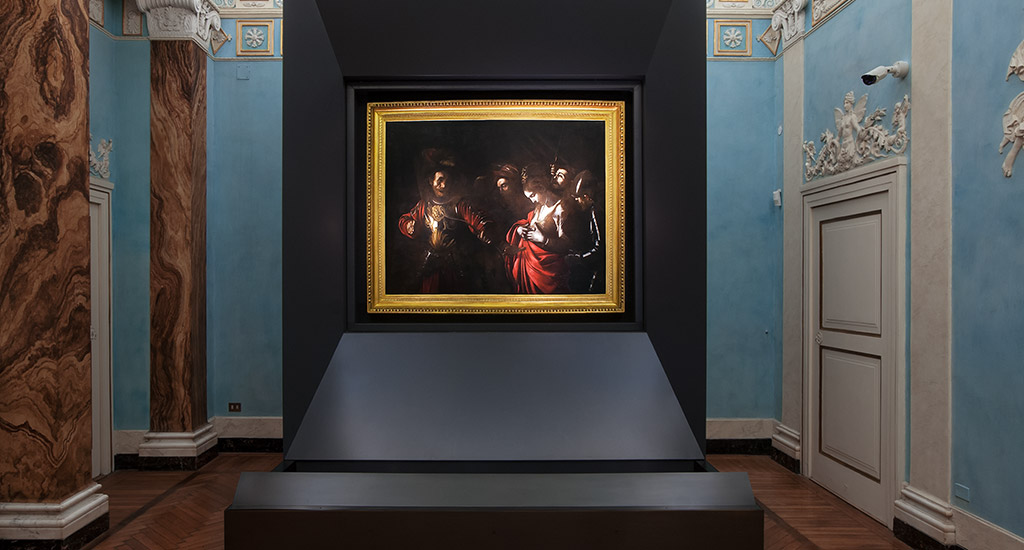
Sant’ Orsola, Caravaggio’s last painting, has a new home! If you have read my posts Pio Monte della Misericordia and L’Ultimo Caravaggio, you know about my adventure to Napoli in search of a Caravaggio painting…only to visit the wrong one.  The ‘wrong’ one was absolutely amazing, but I still wanted to see the intended one.  In June, on my way back from Santorini, I stayed a night in Napoli so I could finally see ‘Il Martirio di Sant’ Orsola/The Martyrdom of Saint Ursula’.  It was painted in May 1610, just before Caravaggio’s death.  For hundreds of years, it was believed to be painted by one of his followers or ‘Caravaggisti’, Mattia Preti.  In 1980 a letter from the agent was found, proving that Sant’ Orsola was painted by Caravaggio.  To read more about the letter and the history of the painting, see L’Ultimo Caravaggio.

I stayed on lively Via Toledo, near the Toledo metro station and in between the port and Quartieri Spagnoli, since it was close to the 1500’s Palazzo Zavalos Stigliano.  A few weeks before my visit, the Napoletano Collection of Banca Intesa Sanpaolo moved 300 m down the street to Palazzo Piacentini at 177 Via Toledo.  Newly renovated Palazzo Piacentini is the new home of Gallerie d’Italia Napoli.  It is a 1930’s building and former home of the Banco di Napoli. The design is described as a modern vision of classical architecture and has 10,000 sq ft of exhibition space.

The atrium features L’Atlante Farnese/Farnese Atlas, a 2nd Century AD sculpture on loan from MANN (Museo Archeologico Nazionale Napoli) under an enormous starry wooden ‘sky’.  At the far end of the ground floor is an actual branch of Banca Intesa Sanpaolo! The building is home to the permanent Intesa Sanpaolo Collection, which includes Napoletani artwork and paintings from the 17th to the 20th Centuries, a Magna Grecia pottery exhibit, space for temporary exhibits, a library and bookshop, and a bistro.

The star of the permanent collection is Sant’ Orsola.  Right beside it is Artemisia Gentilleschi’s Sansone e Dalila/Samson and Delilah (1630-38).  This painting is stunning, but I had to check twice to see that it was an Artemisia.  Those teeny nail scissors are so tame compared to the usual aggression in her Judith and Holofernes paintings with a giant sword and a lot of blood! Incidentally, on the other side of Sant’ Orsola is a Judith and Holofernes painting attributed to Ludovicus Finson that is a copy of a lost Caravaggio.

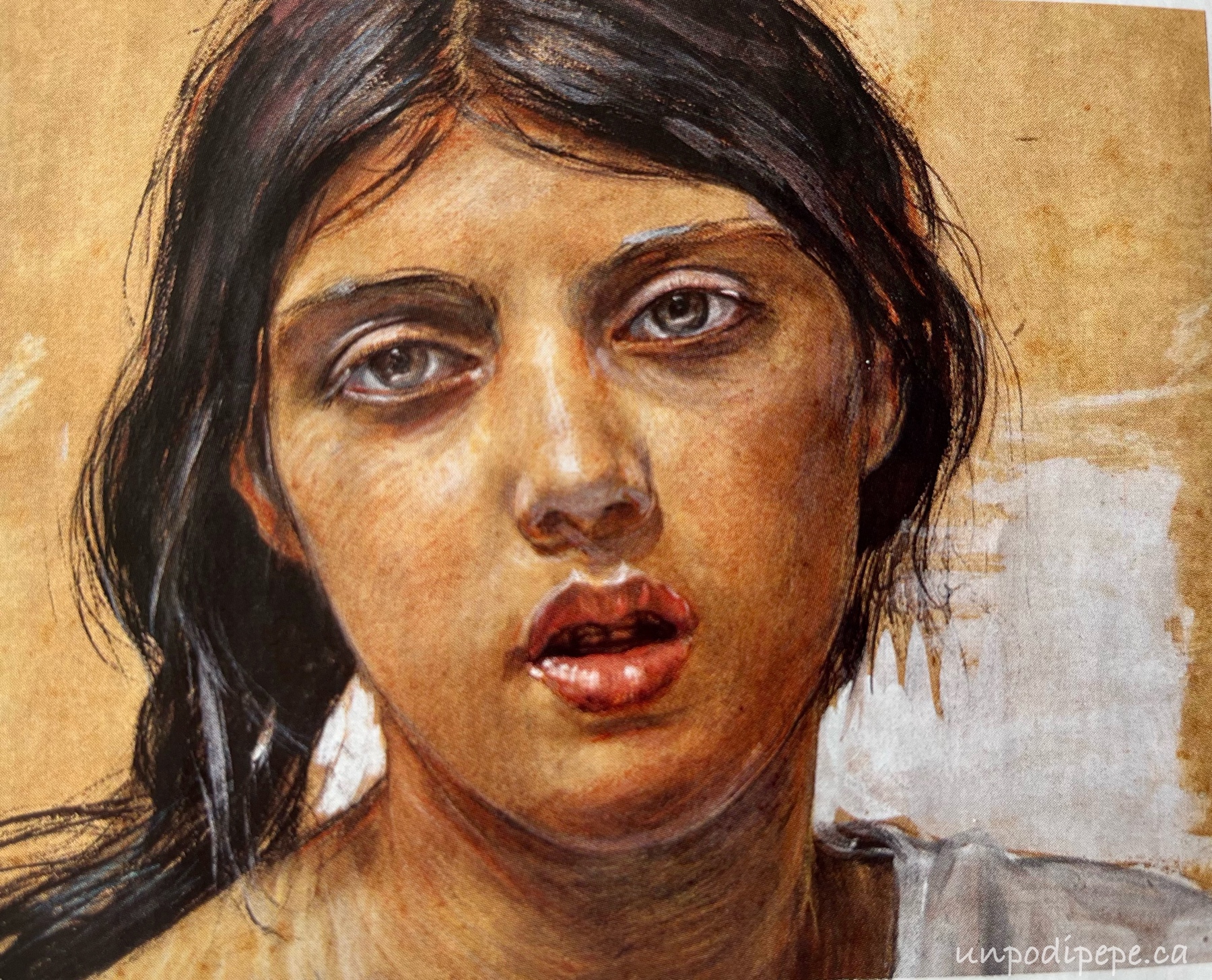
A few of my other favourites from the permanent collection include this amazing loosely sketched painting Fanciulla Napoletana o La Zingara (1885) by Vincenzo Gemito.

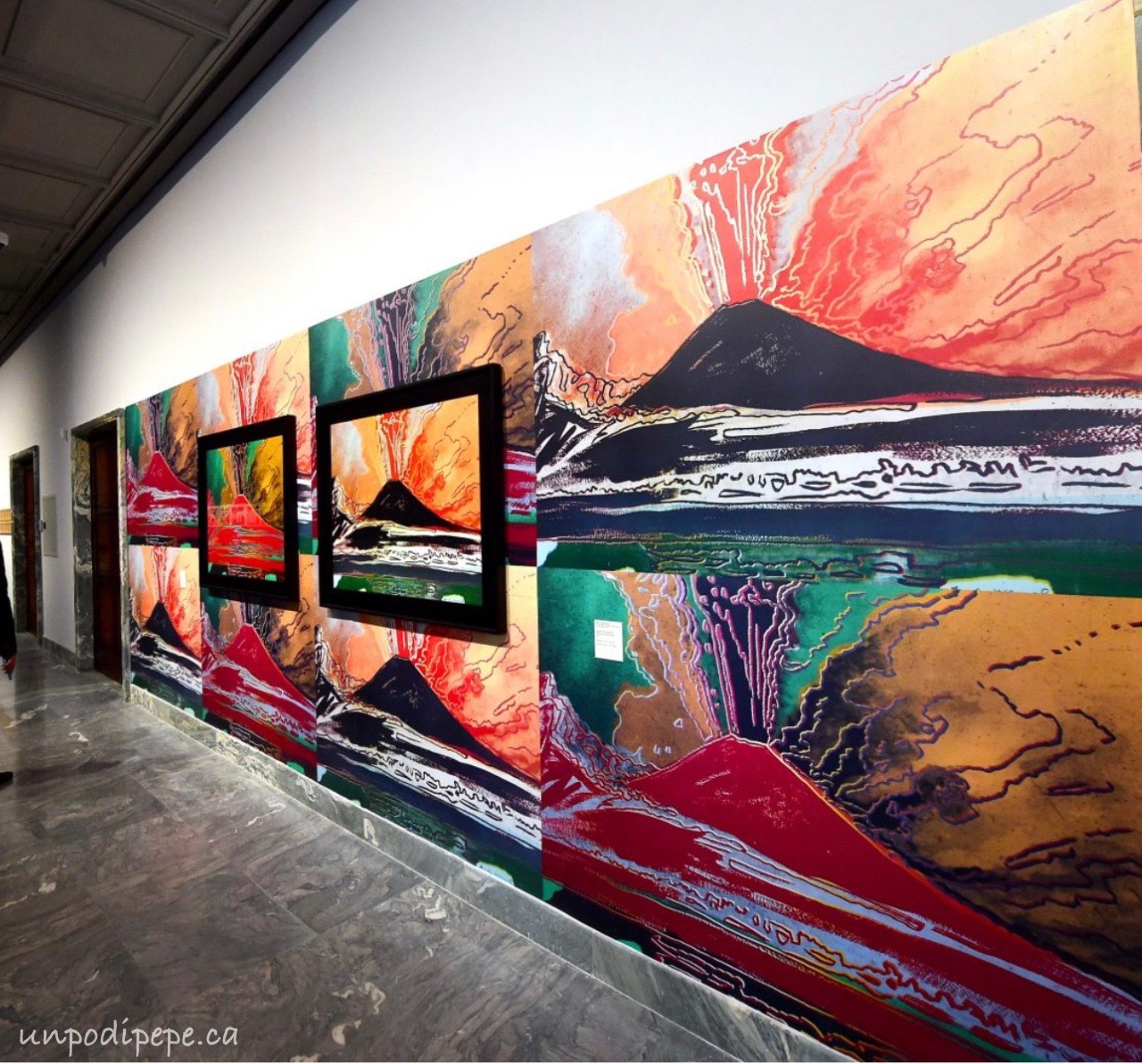
I absolutely love the screen prints Vesuvius (rosso) and Vesuvius (nero) by Andy Warhol (1985) in the 20th Century collection.

The temporary exhibit while I was visiting was ‘Restituzioni’ featuring projects and art restoration presently funded by Intesa Sanpaolo in cooperation with the Ministry of Culture.  There were 200 pieces from all over Italia including paintings, mosaics, jewellery, books and even a giant bell!

Galleria d’Italia Napoli is walking distance from the Toledo metro station.  It is open Tuesday to Friday 10-19 and Saturday/Sunday 10-20.  Mondays closed.  The first Sunday of each month admission is free.  Admission is €7.  Reduced admission is €4 and those under age 18 get in free.  Definitely worth a visit! Ciao, CristinaMartirio di Sant'Orsola Caravaggio's last painting


Share this:

  • Click to share on Facebook (Opens in new window) Facebook
  • Click to share on Pinterest (Opens in new window) Pinterest
  • Click to share on X (Opens in new window) X
  • Click to email a link to a friend (Opens in new window) Email
  • Click to share on WhatsApp (Opens in new window) WhatsApp
Like Loading...

L’ultimo Caravaggio

18 Saturday Jul 2020

Posted by Un po' di pepe in Art, Art history, Roma

≈ 19 Comments

Tags

Baroque art, Caravaggio, Life of Caravaggio, Napoli, Palazzo Zevallos Stigliano, Pio Monte della Misericordia, Roma, Sant'Orsola

Martirio di Sant'Orsola Caravaggio's last painting410 years ago today, Caravaggio died in a tavern in Porto Ercole. This is about his last painting and the time I went to see the WRONG Caravaggio. I rarely use the words wrong and Caravaggio in the same sentence, but in this case it works.

A few years ago, I had an extremely Caravaggio’d out day in Roma.  After my visit to Galleria Borghese, I stopped in to see more Caravaggio works at Santa Maria del Popolo, then met a friend at Sant’Agostino to see the Madonna dei Pellegrini. Whew!  I ended up in a Caravaggio Coma and had the best day ever!

When my friend Romano heard I was going to Sant’Agostino, he immediately offered to meet me there.  I remember thinking this was odd, since I knew he had a full day.  As soon as we approached the painting, and he said ‘Questo è il collo più sensuale nella storia dell’arte /This is the most sensuous neck in the history of art’, I realized he was a fellow Caravaggio nerd.  This was, in fact his favourite painting.  Afterwards, we went to have caffè freddo and talked about Caravaggio for an hour!

Romano had recently been to Napoli and told me about a Caravaggio painting in a former church owned by a bank.  The bank bought the building and it came with the Caravaggio!  Whaaaaat!  I knew I had to see this Caravaggio if I was ever in Napoli.  The name or subject of the painting, and the name of the palazzo was not part of our discussion.

I usually fly home from Napoli, arriving in time to have caffè marocchino and a sflogliatella at the airport, then off I go.  2 days before my departure, I decided to arrive a day early, and spend 24 hours in Napoli.

One of the 4 things on my list to see that day was the painting Romano spoke about. I quickly googled ‘Caravaggio, Napoli, decomissioned church, bank’ and all results came to the painting ‘Sette Opere di Misericordia’/Seven Acts of Mercy’ located in Pio Monte della Misericordia.  All 4 of my ‘must see’ places were walking distance from Piazza Dante, and I booked a B&B appropriately called ‘Il Paradiso di Dante’.

Caravaggio Sette opere di misericordia Pio Monte della misericordiaI had heard of ‘Sette Opere di Misericordia’ but was not familiar with the location, where it has been hanging for over 400 years.  Pio Monte della Misericordia seemed to be a functioning church, so I suspected that something was off. I was not too concerned because it was earthshatteringly amazing, as you can tell by my happy photo.  I visited the 3 other places, ate lots of sfogliatelle and had an amazing day.  Read all about it in the post Un giorno a Napoli.

Returning to the B&B-and access to wifi- that evening, I looked it up again.  As I suspected, Pio Monte della Misericordia is a functioning church with an incredible history.  It turns out I went to see the WRONG Caravaggio!  If only all of my mistakes were this amazing!Pio Monte della MisericordiaThere are 3 Caravaggio works in Napoli.  The one Romano saw was Il Martirio di Sant’Orsola /The Martyrdom of St Orsola, Caravaggio’s last painting before his death, and only recently re attributed to him.  He may have even referred to it as ‘l’ultimo Caravaggio’, which would have been a helpful clue, but I did not remember that detail.Martirio di Sant'Orsola by Caravaggio in Palazzo Zevallos Stigliano

Palazzo Zevallos Stigliano was converted to a bank from 1898-1920 and now houses the Banca Intesa San Paolo Collection.  It was not far out of my way back to Piazza Dante, so I could have made it there if I had realized my mistake earlier.  Mannaggia!

The painting was commissioned by Marcantonio Doria, a young banker and collector from Genoa.  His stepdaughter was about to enter a religious order and take the name Suor Orsola (Sister Orsola).  Lanfranco Massa, the art agent in Napoli wrote to Doria on May 11, 1610 that the painting was finished but not yet completely dry, so he had put it out in the sun (bad idea!) and the varnish had gone a bit soft.  Massa also encouraged Doria to commission more Caravaggio works, as patrons were fighting over him and this was a good opportunity.

Caravaggio arrived in Napoli for the second time in October 1609.  Within days, his violent past caught up to him and he was brutally attacked by 4 armed men.  There were rumours he had been disfigured or killed.  His recovery was long, and he produced only 3 paintings during this time.  Sant’Orsola arrived in Genoa June 18, 1610.  Soon afterwards, Caravaggio set sail for Roma to finally receive a pardon for his murder conviction from Pope Paul V.  He died enroute in Porto Ercole on July 18th 1610 from a staph infection caused by the attack.Book cover L'ultimo Caravaggio, Martirio di Sant'Orsola

The subject of the painting, Orsola, and her 11 companions were captured by the Huns on the way back from a pilgrimage to Roma.  The companions were killed, but Attila the Hun was impressed by Orsola’s modesty and beauty.  She refused to marry him and he shot her with an arrow.  The painting captures the moment of action when the arrow strikes her. She is deathly pale as she looks down at the entry wound with a surprised expression, as if to say ‘Oh my….look…there is an arrow sticking out of my chest’.  The painting is looser and more impressionistic than usual, as if it was painted in a rush.  It is very dark, less chiaro, more scuro and does not have the divine light present in most Caravaggio works.  He was going through a difficult time, which is reflected in the darkness and mood of the painting.  One of the shocked bystanders behind Orsola is Caravaggio in his last selfie.

Caravaggio-Martirio-Sant-Orsola-2

The Doria estate eventually ended up in Napoli, bringing Sant’Orsola back home. In 1854, it was listed in the inventory of Giovanni Doria’s inheritance along with Palazzo Doria D’Angri. Caravaggio only signed one of his works. The Doria family owned this painting for 300 years-so long that over time the artist was forgotten. Oops!  Caravaggio’s influence and style defined painting in Napoli for several centuries.  During a 1963 exhibit in Napoli called ‘Caravaggio e Caravaggeschi’, Sant’Orsola was attributed to Mattia Preti (1613-1699), although several art historians believed it to be  Caravaggio’s work.  In 1973 Baronessa Avezzano sold it to Banca Intesa.

In 1980, in the Doria family archives, art historian Vincenzo Pacelli (1939-2014) found the letter from the agent which I mentioned earlier, confirming that Sant’Orsola was painted by Caravaggio. Finalmente!Martirio di Sant'Orsola Caravaggio's last painting

Palazzo Zavallos Stigliano is on Via Toledo 185, Napoli, not far from the Toledo Metro station.  Admission is €5. It is closed Mondays.  Hours Tu-F 10-18, Sat/Sun 10-20

Links: For more about the life and death of the Baroque Bad Boy – Caravaggio.

To recreate my Caravaggio coma day in Roma –Caffè con Caravaggio a Roma

I hope you found my convoluted story molto interessante!

Ciao, Cristina

Share this:

  • Click to share on Facebook (Opens in new window) Facebook
  • Click to share on Pinterest (Opens in new window) Pinterest
  • Click to share on X (Opens in new window) X
  • Click to email a link to a friend (Opens in new window) Email
  • Click to share on WhatsApp (Opens in new window) WhatsApp
Like Loading...

Un Giorno a Napoli

06 Thursday Feb 2020

Posted by Un po' di pepe in Art, Italia, Travel

≈ 25 Comments

Tags

Campania, Museo Archeologico Nazionale di Napoli, Napoli, Napoli Centro Storico, Southern Italy, UNESCO World Heritage Sites

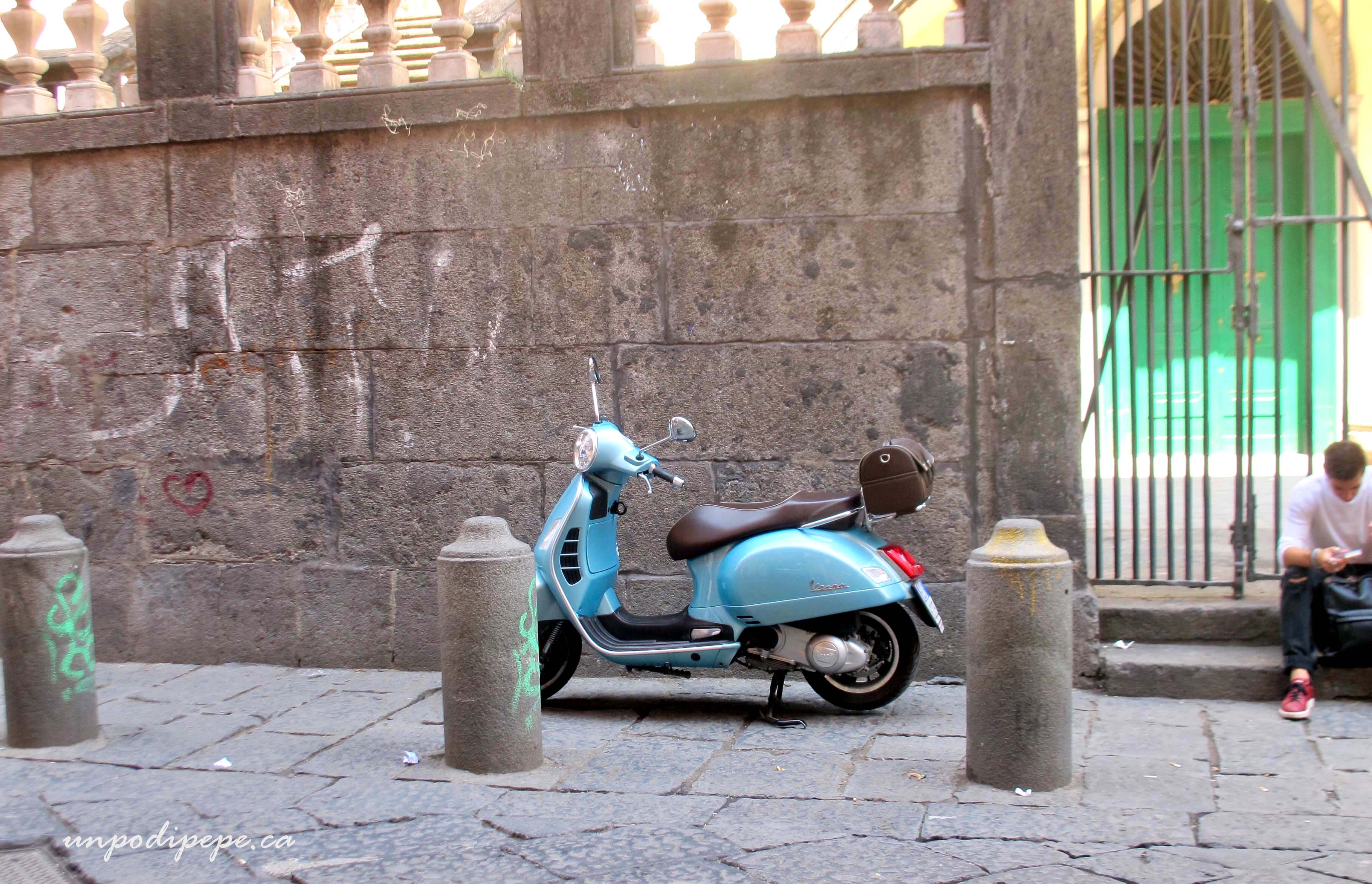
Vespa Napoli Centro StoricoNapoli is one of the oldest continually inhabited urban areas in the world.  It was founded by Greek sailors from Rhodes in 680 BC.  They named her Parthenope after the siren who tried to lure Ulysses. In 474 BC it was renamed Neapolis, meaning ‘new city’ giving us the present name as well as the anglicized Naples.  After Roma and Milano,  Napoli is the 3rd largest city in Italia.

Napoli is an open air museum layered with 2800 years of history-from Ancient to Medieval, Renaissance and Baroque, with ruins, castles, historic buildings and monuments.  It was one of the wealthiest cities in Europe before Italian unification of 1860.  Allied bombing during WWII caused severe damage, resulting in extensive reconstruction after 1945. Napoli’s Centro Storico, the largest in Europe, still has the rectangular grid layout of the original Greek streets, called Decumani and has been a UNESCO World Heritage Site since 1995.Napoli

Napoli is underrated, misunderstood and does not get the love it deserves, except from fans of Elena Ferrante novels. News of corruption, the Camorra and ongoing garbage crises give it a bad rep. It it ironic that everyone-including many Italians fears for their life and thinks it is just a crime pit, when Napoli is actually safer than most large North American cities. It is vibrant, wonderfully chaotic, full of life and passionate, friendly people. Napoli has an ‘edge’ to it and is anything but boring! Via dei Tribunali Napoli

Not even 2 hours from Orsara di Puglia, I had only been to Napoli to take ferries or fly home.  2 years ago, I decided just days in advance to arrive by bus the day before my flight and stay 24 hours.  Best plan ever!  Last year I went for the day with my cugino who had an airport pickup, and took the bus home for €11.

I would not advise anyone to see Napoli in one day. 3-4 days is needed, not including daytrips to Pompeii, the Amalfi Coast, Capri or Ischia.  However, if you have only un giorno-one day to spare, because you are headed somewhere else or taking a daytrip, this is my suggested itinerary!

My first full day in Napoli was a last minute plan.  I had 4 ‘must see’ things on my list. They were all walking distance from Piazza Dante, so I booked a night at the wonderfully named ‘Il Paradiso di Dante’. If arriving at the Stazione in Piazza Garibaldi or the bus terminal behind it, all of the destinations are easily reached on foot or by Metro.  A day ticket for the Metro is €4.50. From Capodichino airport, the Alibus is a 15 min non-stop ride to Piazza Garibaldi for €5.

I realize few people will drool over ancient frescos or Caravaggio for as much time as I do, so I am adding a few extra sites along the way.  This itinerary can be done in reverse and/or in different order. Antico forno Attanasio sfogliatelle

The first stop on any visit to Napoli is for Sfogliatelle –crunchy layered pastry, filled with sweet ricotta, lemon and candied peel. Sfogliatelle in Napoli are delicious and inexpensive.  The best are served straight from the oven at Antico Forno Attanasio, Via Ferrovia 1-4 just a few blocks from Piazza Garibaldi.  At €1.30, why stop at just one?  The lineup moves quickly.  The sign above the oven says ‘Napule tre cose tene belle….o’ mare o’ vesuvio e sfogliatelle’ / Napoli has 3 beautiful things….the sea, Vesuvius and sfogliatelle.sfogliatella

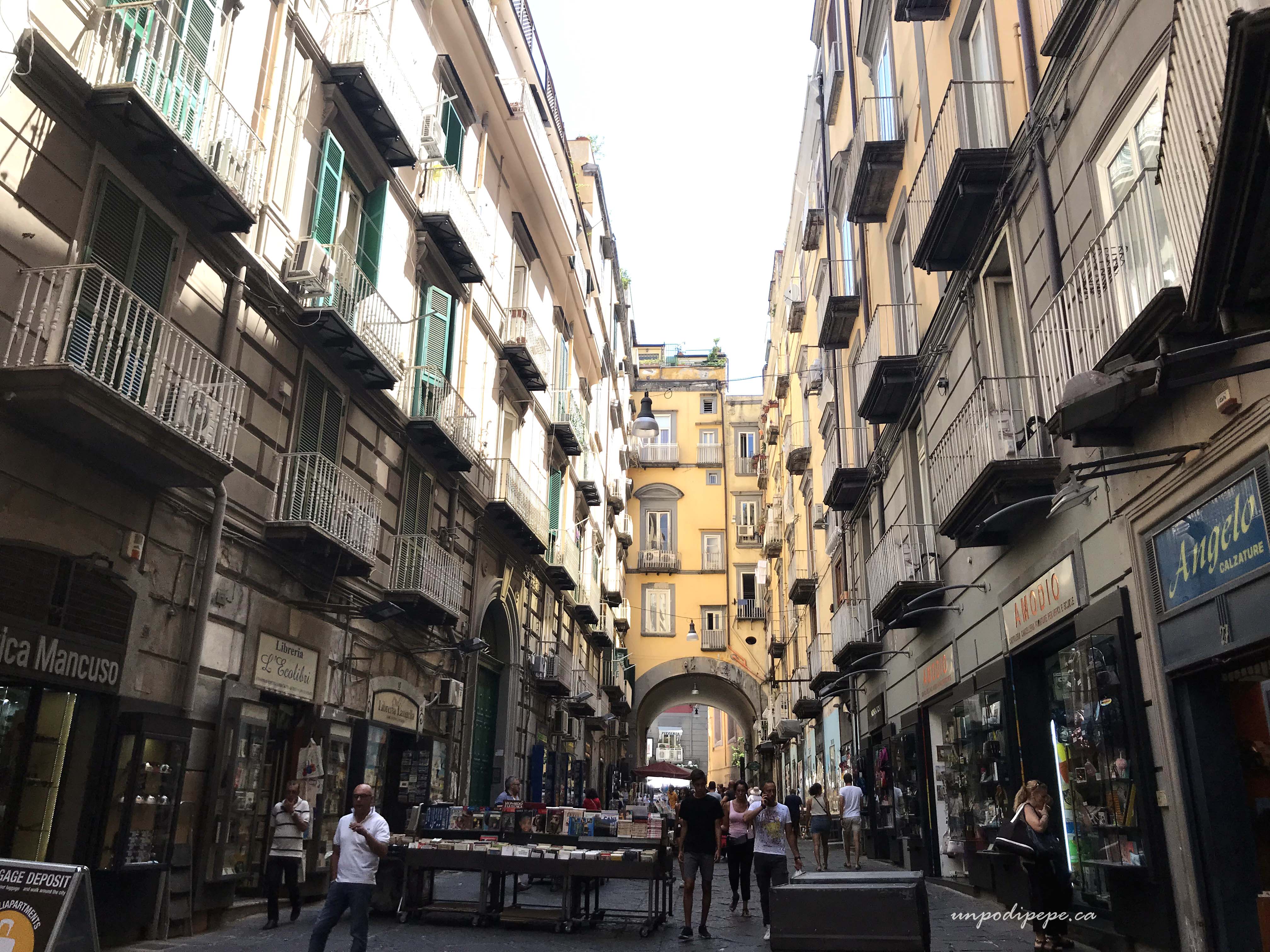
Walk down Corso Umberto I to Via Duomo (or Metro to Museo if reversing).  Turn right on Via dei Tribunali a long narrow street packed with great stuff.  It is one of the original Greek Decumani. Napoli has elevated graffiti into an art form, so keep an eye out for cool street art.

Blub Verdi, NapoliFirst stop is the small octagonal church Pio Monte della Misericordia to see Caravaggio’s masterpiece 7 opere di Misericordia-7 Acts of Mercy hanging where it has been for over 400 years. Napoli has been a capital of the Baroque since the 1606 artistic revolution following the arrival of Caravaggio. Admission is €8.  Open daily from 9:00-18:00 except Sunday it closes at 14:30. Do not miss this and click the link to read my post!Pio Monte della Misericordia

Not even 100 m away is the Duomo Santa Maria Assunta built on the site of a temple of Neptune.  It was ruined in the 1456 earthquake and repeatedly renovated, resulting in a mishmash of styles and a Neogothic facade.  The church is often called San Gennaro- Napoli’s patron saint.  The Cappella di San Gennaro contains an ampule of his blood that is brought out on the 1st Saturday in May, September 19th and December 16th for the miracle of his blood liquefying.

Facciata Duomo di Napoli

Duomo di Napoli. Image Wikimedia Commons

The entrance to Napoli Sotterranea is close by on Via dei Tribunali.  Napoli’s stratified history is visible here…..40 m below street level are Greek structures, Roman aqueducts and cisterns, catacombs, a Bourbon royal escape tunnel and stuff left over from 1945 when the underground was an air raid shelter! The tour is 1.5 hours so I have never had enough time, but it sounds fascinating!

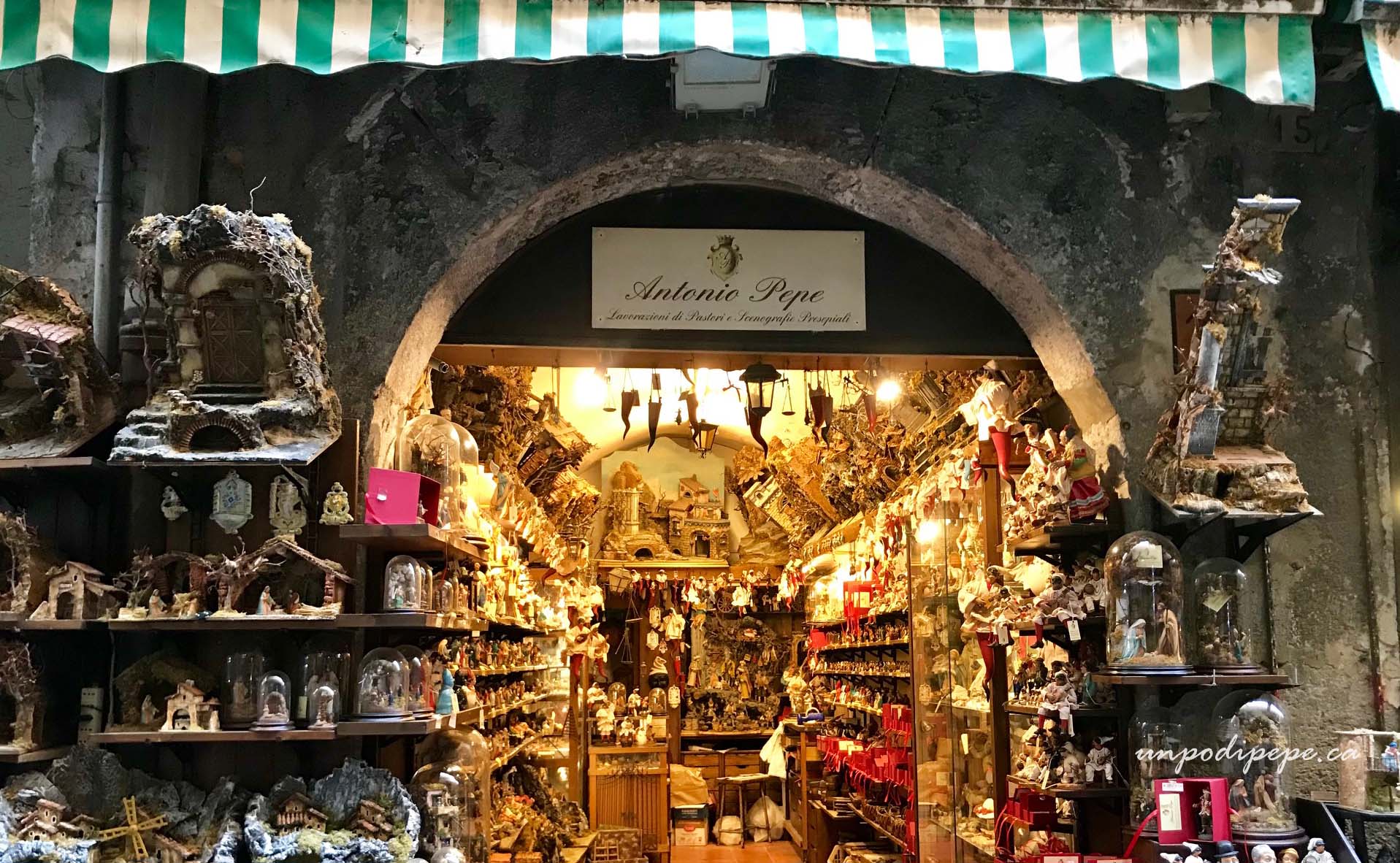
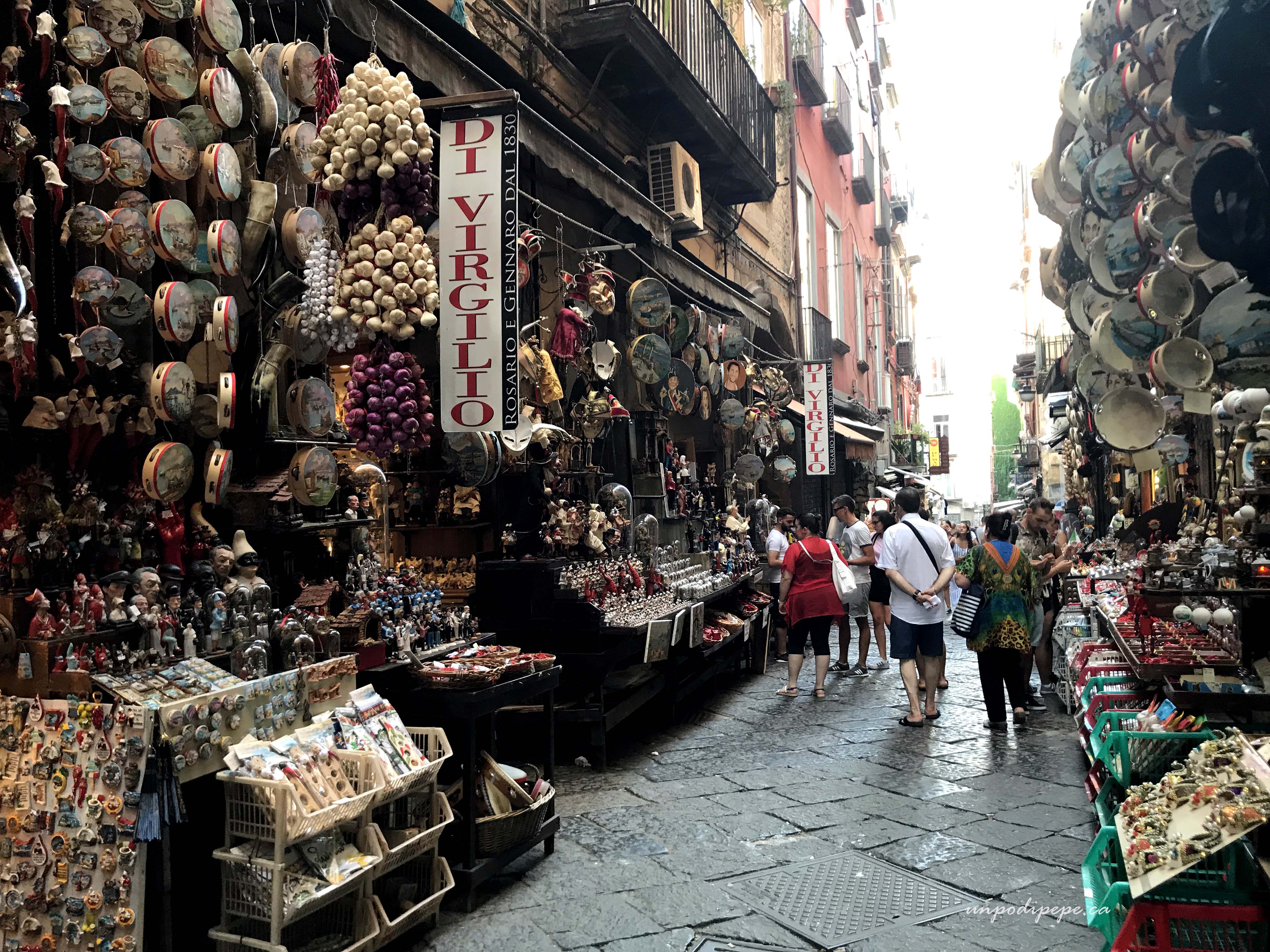
Presepio Via San Gregorio ArmenoAt Piazza San Gaetano turn left onto Via San Gregorio Armeno.  Napoli has a long presepio– Nativity Scene tradition. This street is full of artigiani– artisans making presepio pieces along with figurines of contemporary personalities.  I like to visit the bottega of Antonio Pepe.

Via San Gregorio Armeni Napoli, Antonio Pepe, www.unpodipepe.ca

‘Lavorazioni di Pastori e Scenografie Presepiati Antonio Pepe’, Via San Gregorio Armeno, Napoli (no relation!)

The end of this street intersects with the one parallel to Via dei Tribunali, another of the Decumani, called ‘Spaccanapoli’ meaning ‘cut across Napoli’ because it cuts the centro storico in half.  There may be time later to visit the Chiostro di Santa Chiara, cloisters with beautiful majolica tile work.

Back on Via dei Tribunali turn left at Piazza Luigi Miraglia to Via Francesco de Sanctis 19, the Cappella San Severo.  My Zia told me not to miss this! It is a Baroque chapel with strict security, admission limits and no photography allowed.  Lineups can be long, but I only waited 30 minutes.

The main attraction is Giuseppe Sammartino’s jaw dropping 1753 sculpture Cristo Vellato- Christ laying on a  mattress, covered in a sheer veil with a lace edge-all sculpted out of marble.  It is so lifelike, the urge to reach out and touch it is hard to resist.  The owner, Prince Raimondo di Sangro dabbled in alchemy.  Baroque urban legend is that he taught the artist how to calcify a veil with marble crystals…but it is actually sculpted. The small Chapel is filled with other magnificent works of art. Admission is €8 or online €10.  Open 9:00-18:00.  Closed Tuesdays! It may be better to see this first then walk back to Via S Gregorio Armeno.San Gregorio Armeno Napoli

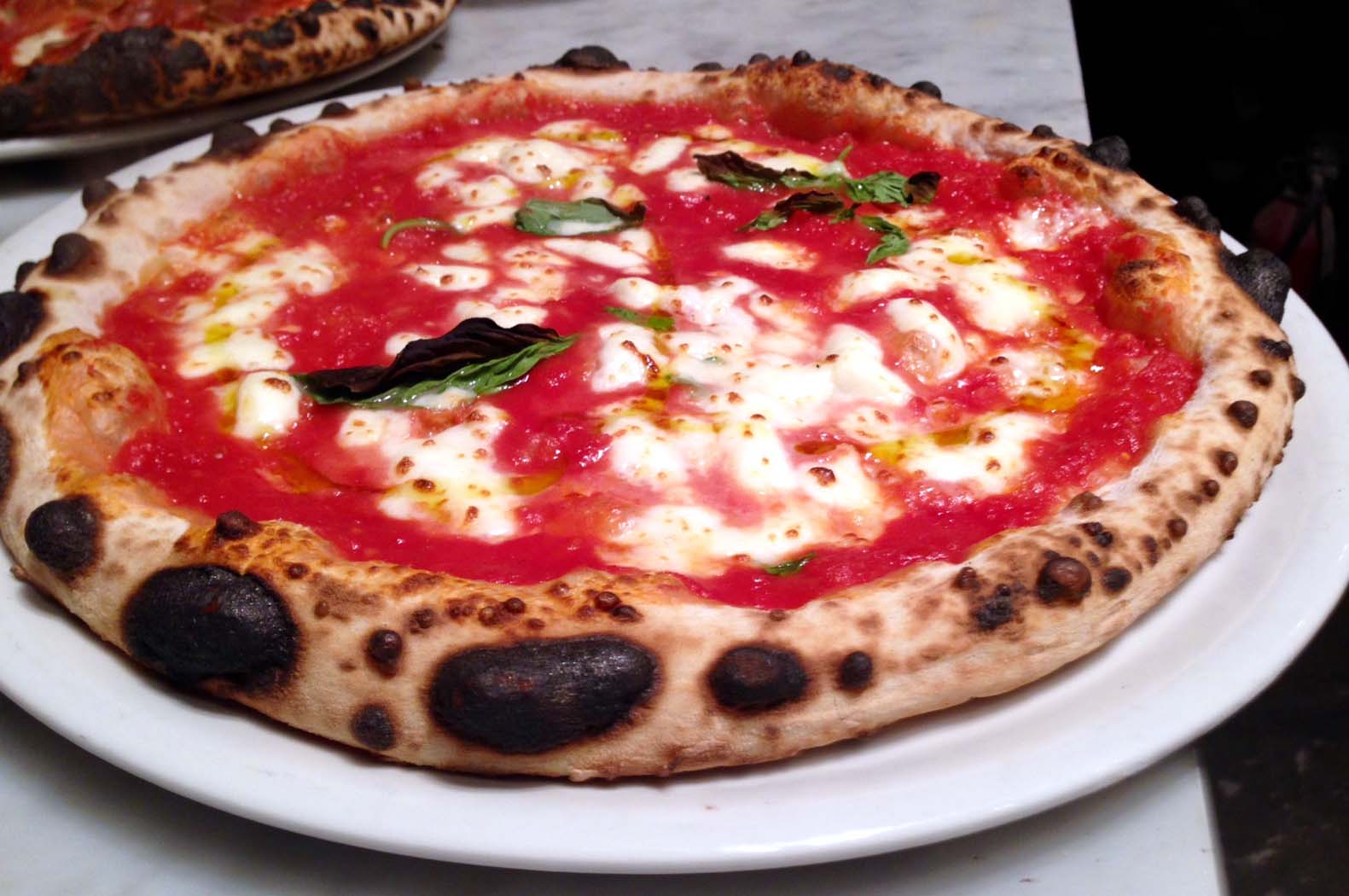
When hunger strikes, there is plenty of cibo di strada-street food available on Via dei Tribunali and Spaccanapoli. Fritto misto –fried fish or vegetables in paper cones, pizze fritte and pizza al portafoglio are all delicious. Sfogliatelle and babà are €1! Pizza Margherita

Via dei Tribunali is also home to Gino Sorbillo pizza, which always has lineups. The line moves quickly, but with a shortage of time, try one of the less known places.  It is hard to find bad pizza in Napoli!Port'Alba Via dei Tribunali Napoli

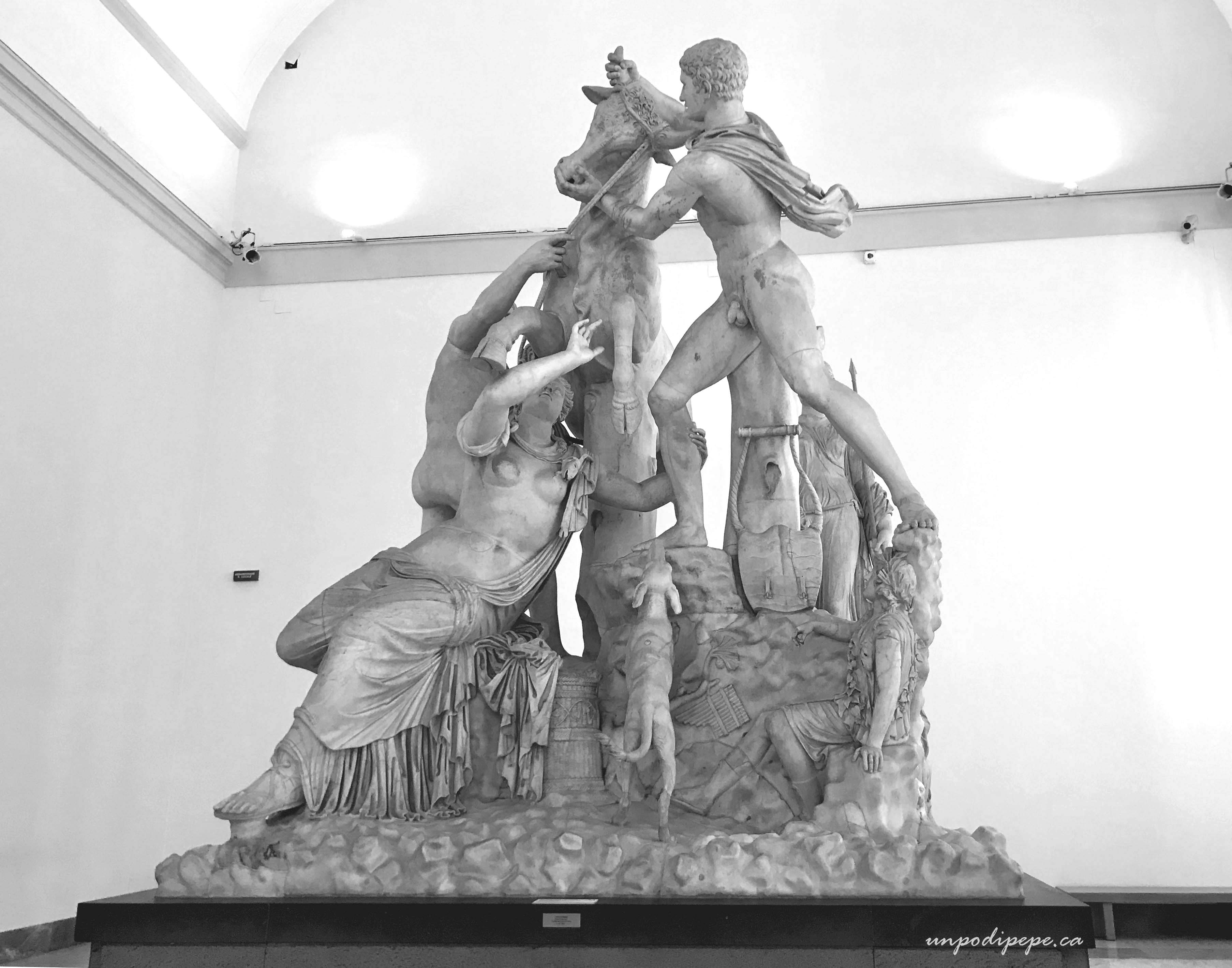
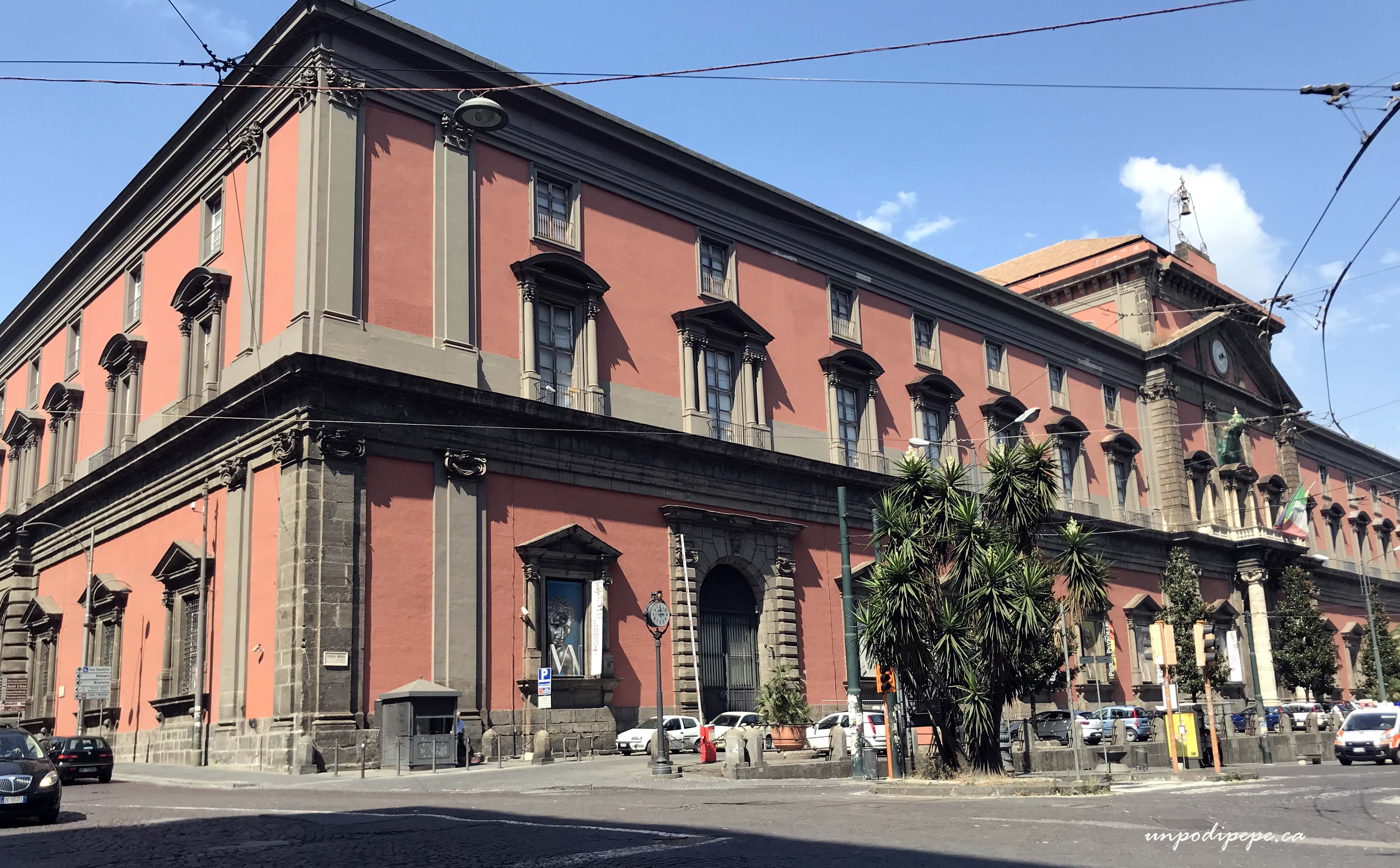
Exit Via dei Tribunali through the Port’Alba to Piazza Dante on Via Toledo. From here, walk or take the Metro 1 stop to Museo.  Walking will take almost the same amount of time.  The Museo Archeologico Nazionale Napoli (MANN) is massive and has the world’s biggest collection of Greco Roman art and artifacts.  For archeology nerds like me, this is Heaven and it needs its own post.  The frescoes and artifacts from Pompeii and Ercolano/Herculaneum are here, and the massive Farnese collection sculptures such as Toro Farnese. Marble sculpture Toro Farnese in MANNapoliThe Gabbinetto Segreto is a secret room full of ancient erotica, mostly from Pompeii’s brothel.  Admission is €18 and well worth it.  Tickets can be bought online.  Open from 9:00-19:30- later than other places, but it is closed Tuesdays! Read more about MANN in Blub a Napoli.  The day can also start at MANN, doing the itinerary in reverse.Museo Archeologico Nazionale Napoli

Depending on how much time is spent walking, visiting all of the above and when you need to leave, there may be time for more.  Take the Metro 2 stops to the award winning Toledo station, walk to the end of Via Toledo to Piazza del Plebescito, one of the largest piazze in Italia.  Piazza del Plebescito NapoliOn Via Chiaia is Caffè Gambrinus the historic caffè letterario where European intellectuals including Oscar Wilde, Hemingway, D’Annunzio and Totò hung out.  Caffe Gambrinus NapoliMussolini shut it down for being antifascist.  That alone is reason to have another sfogliatella there-even take-out will cost more due to the location, but worth it.Caffe Gambrinus Napoli

If you somehow still have time left, walk to Galleria Umberto I, Teatro San Carlo Opera House or Via Santa Lucia by the harbour and Castel dell’Ovo. Need more sfogliatelle? Stop at Pintauro, Via Toledo 275.  Then take the Metro back to Piazza Garibaldi.

Napoli is great to visit any time of year! Remember that MANN and the Cappella San Severo are closed Tuesdays.   Busier times include December for the Presepi on display and the 3 San Gennaro dates. I have only been in July or August when a lot of Napoletani are at the beach.  There are less cars on the road-according to my taxi driver-named Gennaro of course!  He was so impressed that I was able to understand him!  We had many neighbours and friend from Napoli when I was growing up so I understand Napoletano quite well.Via San Gregorio Armeno

An old saying goes ‘Vedi Napoli e mori’. I hope you enjoyed un giorno a Napoli-I guarantee you will be back! Have an extra sfogliatella for me! Buon viaggio, Cristina

Stay tuned for my next post on Napoli street art!

Share this:

  • Click to share on Facebook (Opens in new window) Facebook
  • Click to share on Pinterest (Opens in new window) Pinterest
  • Click to share on X (Opens in new window) X
  • Click to email a link to a friend (Opens in new window) Email
  • Click to share on WhatsApp (Opens in new window) WhatsApp
Like Loading...

Blub a Napoli

28 Wednesday Aug 2019

Posted by Un po' di pepe in Art, Italia, Photography

≈ 23 Comments

Tags

Art history, Blub, Contemporary art Napoli, Fresco painting, L'arte sa nuotare, Museo Archeologico Nazionale di Napoli, Napoli, Pompeii, Street art

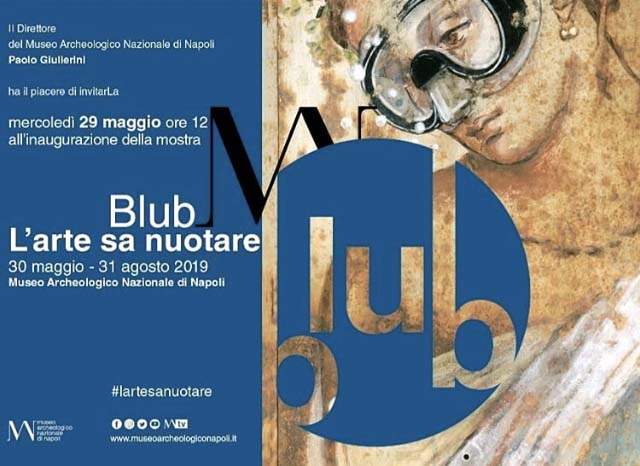
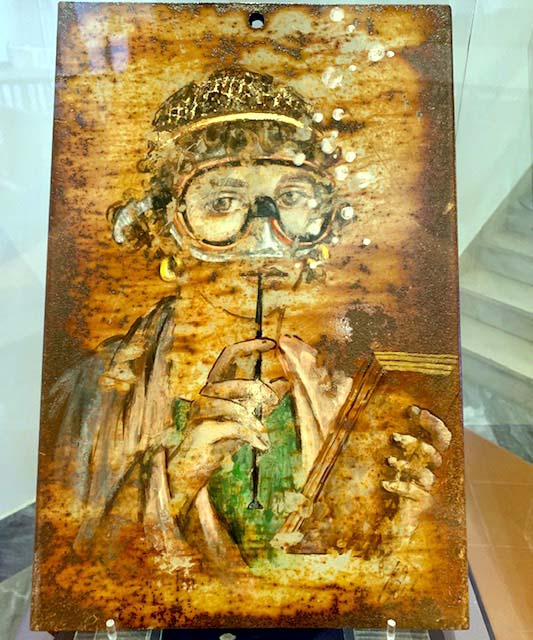
Blub Il Volo di Dedalo e la caduta di Icaro fresco MANNA few weeks ago I took a daytrip to Napoli for sfogliatelle-but also to see the Blub exhibit at MANN (Museo Archeologico Nazionale di Napoli).  If you do not know about the street artist from Firenze, make sure to read my Blub post L’Arte sa Nuotare.  Blub (Bloob) takes famous works of art and gives them a new look, immersing them underwater, complete with blue background, snorkel masks and bollicine-bubbles.  Prints are organically glued to the metallic doors of gas and electrical panels, which provide ready-made frames.

To prepare for the exhibit, Napoli’s Centro Storico was ‘Blubified’ with 40 works plastered on sportelli-the doors of gas and electrical panels. A few are specific to Napoli, for example Totò and Re Carlo III Borbone (King Charles III).Blub, Re Carlo III Borbone a Napoli

In the exhibit, which only includes 5 new works, the project ‘L’Arte sa Nuotare’ (Art knows how to swim) is extended to Pompeii.  4 paintings on metal are inspired by affreschi (frescoes) from the ruins of Pompeii.  There is also the portrait of Carlo III and some sculptures have been adorned with masks and fins, as well as the tomb in the photo below.Museo Archeologico Nazionale Napoli Blub

The nymph is a detail from the fresco ‘Il Volo di Dedalo e la caduta di Icaro’(the flight of Dedalus and the fall of Icarus) from Villa Imperiale, Pompeii.  It is an acrylic painting on a metal door and I love how the rust has been incorporated. Detail from Il Volo di Dedalo e la caduta di Icaro Blub pompeii

Terentius Neo e la moglie (Terentius Neo and his wife) is a fresco from 55-79 AD found in 1868 in the house of baker Terentius Neo, which was also the bakery. The middle class couple is well-dressed, and he holds a scroll with seal, his wife a stylus and wax tablet to demonstrate that they are literate and cultured.  His wife is portrayed as an equal, in fact she seems to be standing in front of her husband.Blub Terentius Neo e la moglie

Here is the original fresco in MANN:Terentius Neo e la moglie Pompeii

Donna con tavolette cerate e stilo (Woman with wax tablets and pen) is a tondo, a round painting found in 1760 in the Insula Occidentalis house in Pompeii.  It depicts a wealthy woman with gold earrings and a gold hair net. She is holding a stylus and 4 wax tablets, to demonstrate learning and culture.  This  fresco is known as Sappho, although it is not a portrait of the poetess, in fact the stylus and wax tablets were more likely used for accounting than poetry. Blub again incorporates the rust on the metal door to add ‘age’ to the work.'Sappho' by Blub Napoli

The original fresco in MANN:Sappho MANN

My favourite Blub here is Maschera Teatrale di Donna (Woman’s theater mask) inspired by a fresco in Casa del braciale d’oro (House of the golden bracelet) in Pompeii. The work is under glass, so my photo has glare issues.  The tag says that this Blub work is an acrylic on metal door and is in a private collection in Hingham, Massachusetts, so I think that means Blub made a sale!

Maschera Teatrale subacqua, from L’Arte sa Nuotare Facebook page

Blub quote Napoli MANN exhibit

‘….water is my element.  Life is born from water, it is the hidden side of matter.  When you are immersed, time stops and becomes weightless, while thoughts flow freely in a suspended dimension…for this I propose personalities that have transmitted an example of greatness that survives still today, as if underwater, without time.’  Blub

Seeing all the affreschi from Pompeii in MANN really inspired me to get out my bucket of plaster and pigments.  Fresco painting is not a very ‘modern’ art form, but I have dabbled in it a bit and really love it.  Below is my detail of La Cappella Sistina. My next fresco painting might be one of Giotto’s angels. I’ll be looking for rusty metal doors to paint on! Let me know if you have any.Cappella Sistina Cristina Pepe

Blub hunting in the Centro Storico was not very productive.  We found a peek-a boo Blub….a Renaissance woman mostly covered by the propped open door of a store! Blub NapoliGiuseppe Verdi looks very distinguished among the graffiti.  I was disappointed to not find a Totò, but did find a Banksy and lots of other interesting street art-which I will leave for another post!Blub Verdi, Napoli

The exhibit in MANN ends in a few days.  I hope you enjoyed this virtual Blub tour and that all of you can some day view real life ‘Blubi’! Ciao, Cristina

*Photo credit-Both photos of Terentius Neo e la moglie and Blub’s Sappho taken by my cugino and Napoli travel partner Mark ‘Peperotti‘ Pepe

Share this:

  • Click to share on Facebook (Opens in new window) Facebook
  • Click to share on Pinterest (Opens in new window) Pinterest
  • Click to share on X (Opens in new window) X
  • Click to email a link to a friend (Opens in new window) Email
  • Click to share on WhatsApp (Opens in new window) WhatsApp
Like Loading...

Pio Monte della Misericordia

11 Monday Feb 2019

Posted by Un po' di pepe in Art, Art history, Italia

≈ 15 Comments

Tags

7 Acts of Mercy, Caravaggio, Napoli

Pio Monte della Misericordia (Pious mount of mercy) is a charitable organization founded in 1601 by seven young noblemen in Napoli.  Every Friday they met at the hospital to minister to the sick.  400 years later, the organization is still in operation, assisting minors at risk, those struggling with addiction, unaccompanied migrant minors, disadvantaged families, the homeless and the terminally ill.

In 1602, the founders commissioned a small octagonal church on Via dei Tribunali. They wanted artwork to express their sense of charitable mission, which was guided by le sette opere di misericordia, the seven corporal works of mercy.  These are a set of compassionate acts concerning the material needs of others, based on the bible passage ‘For I was hungry and you gave me something to eat, I was thirsty and you gave me something to drink, I was a stranger and you invited me in. I needed clothes and you clothed me.  I was sick and you looked after me, I was in prison and you came to visit me’ Matthew 25:35:36.  Bury the dead was added later and comes from another scripture.

They hired, who else but Caravaggio to paint one of the seven works of mercy for the altar of each of 7 chapels. Caravaggio was either in a big rush or feeling like a challenge, because he incorporated all 7 onto 1 canvas!  The capolavoro is one of the most important of his works, and of the 17th Century.  It still hangs in its original position above the high central altar! Seven local Caravaggio followers, including Luca Giordano, Fabrizio Santafede and Battistello Caracciolo provided paintings for the chapels.Caravaggio Sette opere di misericordia Pio Monte della misericordia

The composition is realistic, complex and dramatic. At the top of the painting, 2 angels are supporting the Madonna di Misericordia and child in the air.  The bottom half features figures carrying out the acts of mercy.  On the right, from the myth Roman Charity, Pero secretly breastfeeds her father, Cimon, after he is imprisoned and sentenced to death by starvation. (feed the hungry and visit the imprisoned).  Behind the wall of the prison, 2 men carry a shrouded body with the feet dangling out of the blanket (bury the dead). On the left, St Martin de Tours comforts the injured beggar in the foreground (comfort the sick).  He tears his cloak and gives half to the naked beggar (clothe the naked). In the background, a pilgrim with a shell in his hat asks an innkeeper for shelter (shelter the traveler) and behind them, Samson drinks from the jawbone of a donkey (give drink to the thirsty). All of this action is taking place in a dark, mysterious vicolo, an alley that could be just around the corner. Caravaggio uses his signature strong contrasts of light and dark chiaroscuro, the bright light acting as a metaphor for mercy.

Caravaggio came to Napoli with a price on his head, on the run from a murder charge. He was idolized and successful in Napoli, but he was desperate for a pardon, so after only a year, he left Napoli for Malta where he thought the Knights of St John could help him. This may explain his decision to incorporate all of the works of mercy into one painting!  As discussed in this post, it has also been confirmed that he had lead poisoning.  Caravaggio understood Napoli like no other painter and had a profound influence on the artistic scene in the city for the next few centuries.  He left behind a lot of followers-the Caravaggesque movement.

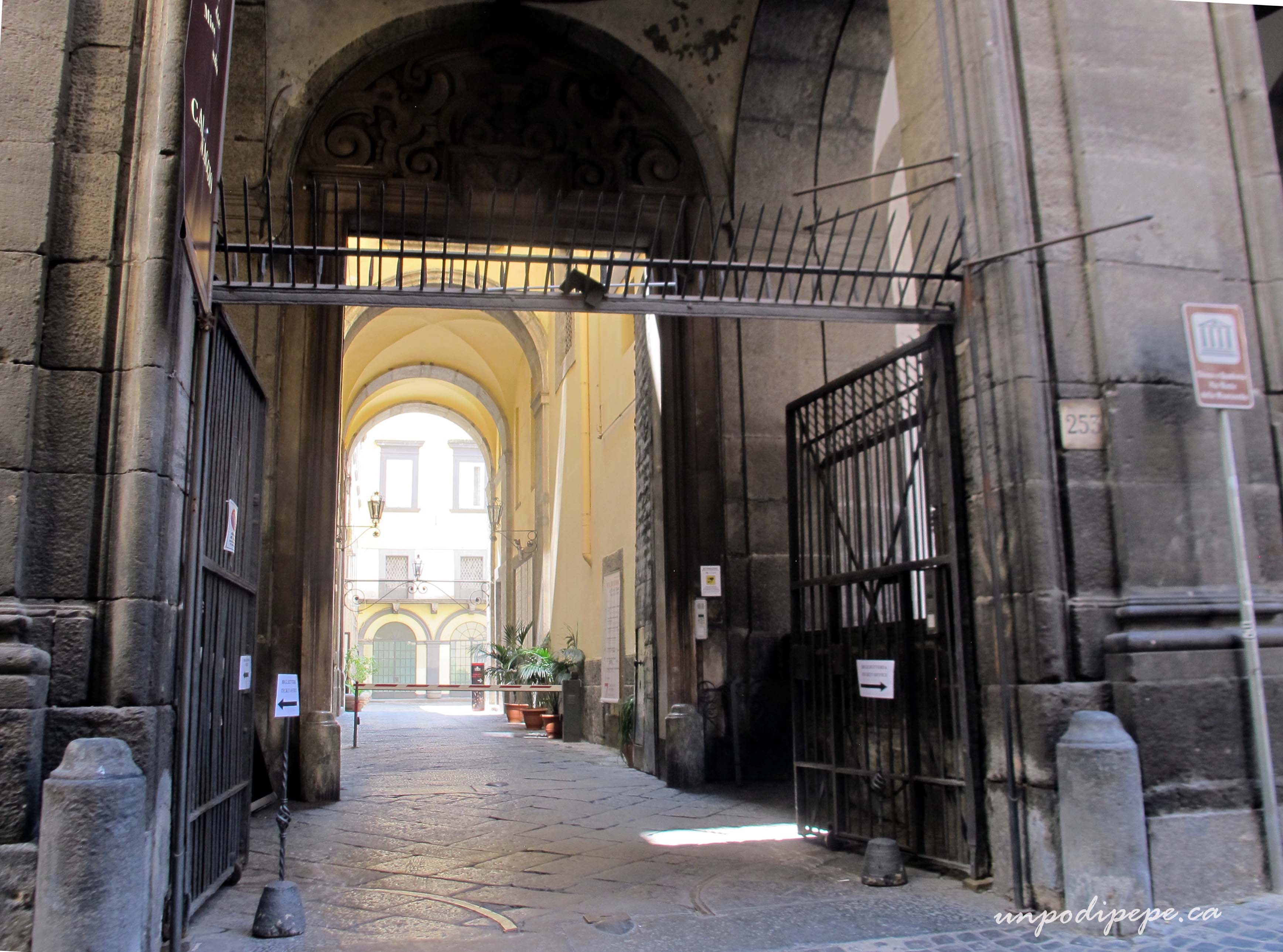
The €7 admission includes a visit to the Quadreria- Art Gallery, which contains 15th-18th Century paintings by Napoletani artists and also the original receipt for 400 ducats paid to Caravaggio.  Via dei Tribunali 253, Napoli. Open Mon-Sat 09-18, Sunday 09-14:30Pio Monte della Misericordia

Images:  Scan of Le Sette Opere di Misericordia taken from the Pio Monte della Misericordia brochure.  Photo of me with the painting taken by another visitor to the church.  He said I looked so excited he had to take my photo!

Share this:

  • Click to share on Facebook (Opens in new window) Facebook
  • Click to share on Pinterest (Opens in new window) Pinterest
  • Click to share on X (Opens in new window) X
  • Click to email a link to a friend (Opens in new window) Email
  • Click to share on WhatsApp (Opens in new window) WhatsApp
Like Loading...

A Smoky Haze

13 Sunday Aug 2017

Posted by Un po' di pepe in Italia, Travel

≈ 11 Comments

Tags

Granville Island, Incendi, Napoli, Vancouver, Vesuvio

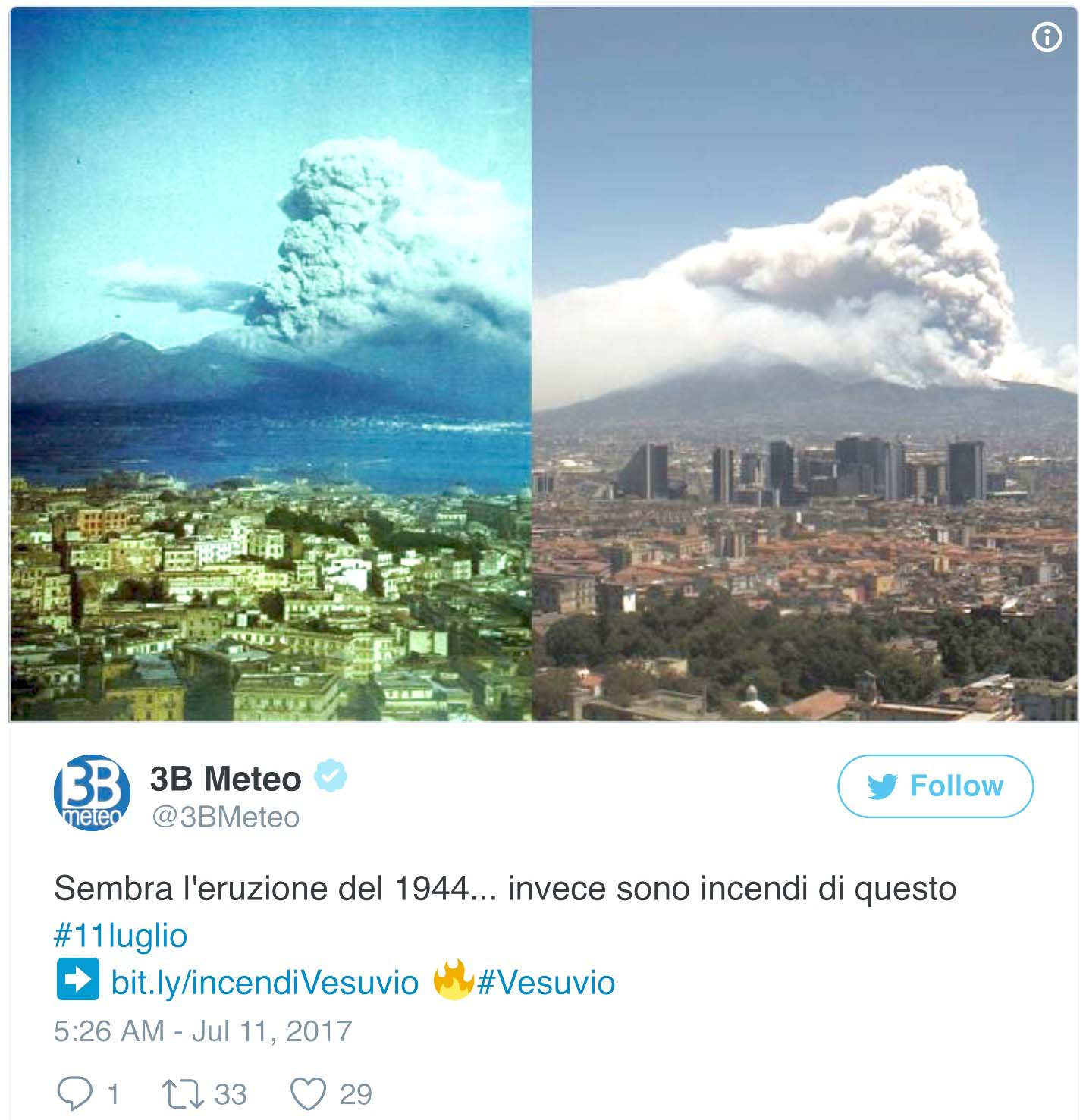
It seems a smoky haze has been following me around-and I am not talking about jet lag!  When I arrived in Napoli on July 11th, the air was grey and smoky.  As we were driving from Capodichino airport, my cugino said ‘è il fumo da Vesuvio’.  I looked over at the imposing volcano and the crater was engulfed in smoke!  I immediately thought the worst and started to panic and wonder why the 3,000,000 people living in the area were not being evacuated!  Then it was clarified…..the smoke from Vesuvio was from incendi, wildfires burning on the slopes of the volcano. The cause is thought to be intentional, although no one is really sure.  I am not even going to discuss some of the ridiculous rumours I heard. The hot weather, dry soil and wind is not helping.  This is really awful, although looking on the bright side, it is less awful than a volcanic eruption in an area with a population of 3,000,000.

July 11th tweet from 3B Meteo comparing photo of 1944 Vesuvio eruption and today’s fires!

A month later, the air in Napoli was still an atmospheric gray zone.  The day I flew home was also slightly windy.  This caused my flight to be delayed and my connecting flight in Munich left without me.  Mannaggia! I was not impressed.

A day late, I finally arrived home, and was surprised to find the air conditions to be the same smoky haze I left in Napoli!  Was this gray blanket of fog following me? To top it all off, the mountains were missing from the landscape!  It had been this way for 2 weeks due to over 150 wildfires burning in the interior of British Columbia.  The air was so smoky and gray the mountains were not visible.

Yesterday I was at Granville Island. If you are not familiar with it, this photo may look normal. There is something missing…..some very large mountains in the background!

Today the mountains were slightly visible.  Luckily it is just starting to rain now, so that will improve our air quality, and hopefully help to put out the fires.  Speriamo che piove anche a Napoli!

I wrote about my internet issues and difficulty keeping up with blogging in my last post Chiuso per Ferie.  Now that I am home, I will be catching up on reading and soon I will be publishing posts from my travels.

A presto, Cristina

Share this:

  • Click to share on Facebook (Opens in new window) Facebook
  • Click to share on Pinterest (Opens in new window) Pinterest
  • Click to share on X (Opens in new window) X
  • Click to email a link to a friend (Opens in new window) Email
  • Click to share on WhatsApp (Opens in new window) WhatsApp
Like Loading...

Il Presepio

23 Wednesday Dec 2015

Posted by Un po' di pepe in Culture, Feste, Italian life

≈ 11 Comments

Tags

Greccio, L'Immacolata, Napoli, Nativity history, Presepio, San Francesco d'Assisi, Via San Gregorio Armeno

presepio2014L’Immacolata is the feast of the conception of the Virgin Mary on December 8th.  It is a national holiday in Italia and also the official beginning of the Feste Natalizie.  Italiani usually put up l’albero di Natale (the Christmas tree) and il Presepio (the Nativity scene) on this day.

San Francesco d’Assisi created the first Presepio in 1223 in a cave in Greccio.  He had been to the birthplace of Gesù (Jesus) in Bethlehem and was inspired to recreate the scene.  This was his attempt to return the emphasis of Christmas on the birth of Christ rather than gift-giving.  I find it interesting that the ‘commercialization’ of Christmas is not a new concept at all.  Searching for ‘the true meaning of Christmas’ did not start with Charlie Brown but in the 13th Century!

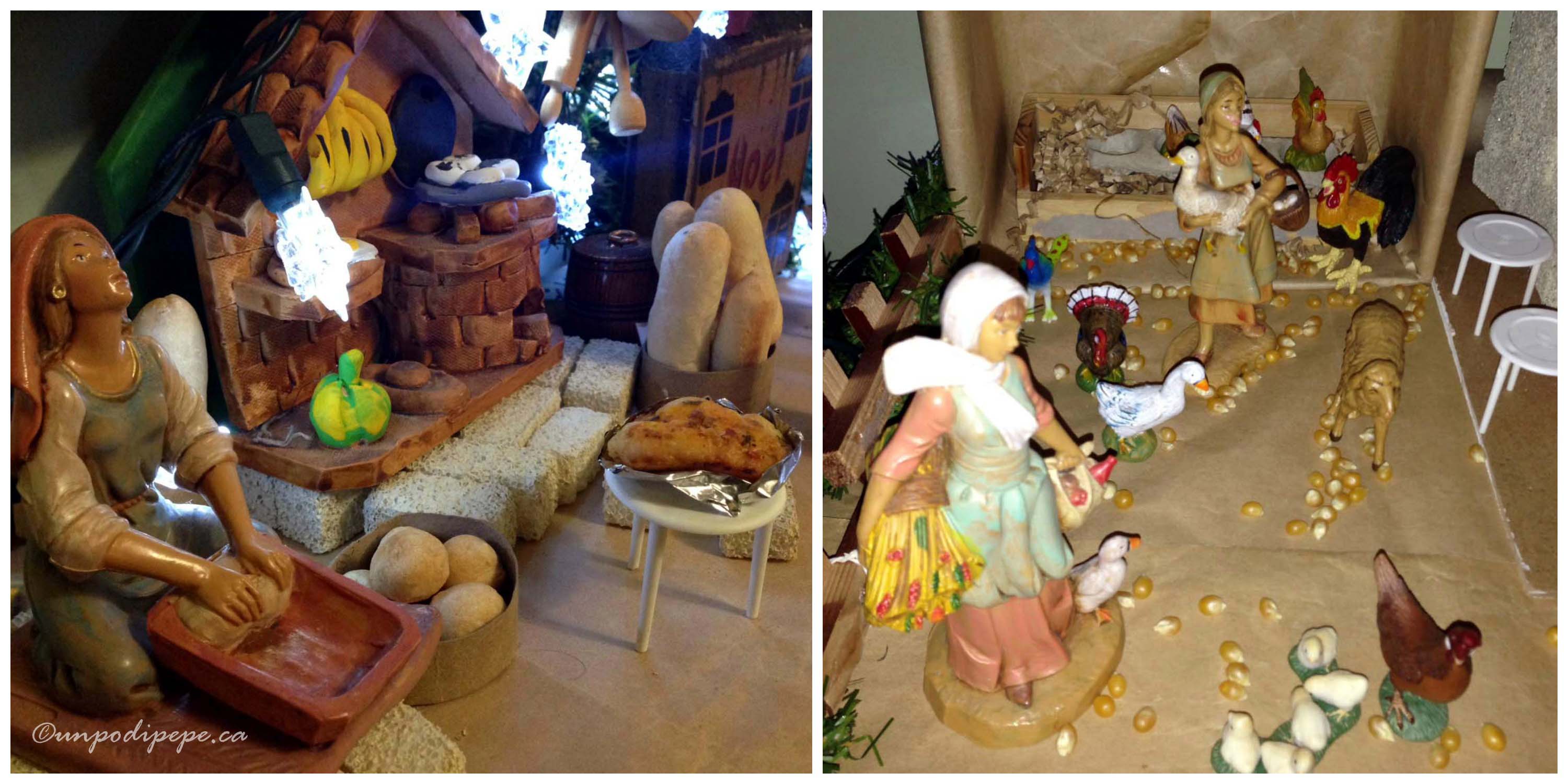
San Francesco’s was a ‘Presepio Vivente’, with real people and animals.  The live figures were eventually replaced by statues, and Presepi also started to be set up in homes.  The Presepio includes the Holy Family-although Bambino Gesù is not placed in the manger until after midnight Christmas Eve-angels, shepherds, animals, and the Re Magi (3 Wise Men).  The 3 Wise Men are at a distance, since they arrive on January 6th.  I also have my Befana figurine trailing behind them!  Several hundred years ago, Presepi also started to include scenes from village life.  Of course before Google Earth, Wikipedia, or even photography, no one actually knew what 1st Century Bethlehem looked like, so the village scenes resembled the local areas.  The tradition of the Presepio is popular throughout Italia, with most families having one. My Mamma gets very detailed and creative with her Presepio, even baking tiny bread, pizze and Panini.

Particolari del Presepio di Mamma-Details of Mamma's Presepio

Particolari del Presepio di Mamma-Details of Mamma’s Presepio

Via San Gregorio Armeno in Napoli is lined with artigiani (artisans) making presepio figurines and accessories all year round. The attention to detail is incredible! I must go and get myself a zampognaro (zam·poh·NYAH·roh) for my presepio.  This is a traditional Abruzzese bagpiping shepherd! The 2 photos below of San Gregorio Armeno artigiani were taken by my amica Anna.

san gregorio armeno 2san gregorio armeno 1

Many villages, including Orsara di Puglia, have a Presepe Vivente in December.  Like the original one, this features the live Nativity and also artisans in traditional costume working on trades and making traditional local dishes. I’d love to hear what you have in your Presepio!

Gloria2

A tutti i miei cari lettori, vi auguro un Buonissimo Natale, Cristina
Share this:

  • Click to share on Facebook (Opens in new window) Facebook
  • Click to share on Pinterest (Opens in new window) Pinterest
  • Click to share on X (Opens in new window) X
  • Click to email a link to a friend (Opens in new window) Email
  • Click to share on WhatsApp (Opens in new window) WhatsApp
Like Loading...

Enter your email address to follow 'un po' di pepe' and receive notifications of new posts by email.

Join 511 other subscribers
Follow Un po' di pepe on WordPress.com

Popular Posts

  • Hairstyling in Ancient Roma
    Hairstyling in Ancient Roma
  • Espresso Cookies
    Espresso Cookies
  • Panforte di Siena
    Panforte di Siena
  • Il Pumo Pugliese
    Il Pumo Pugliese
  • Internment of Italian Canadians
    Internment of Italian Canadians
  • San Nicola
    San Nicola
  • Panettone Fatto in Casa
    Panettone Fatto in Casa

Recent Posts

  • Castel del Monte
  • ‘The Nuances of Love’
  • Hostaria Antica Roma~Eat like an Ancient Roman
  • Santa Maria in Aracoeli
  • Casino dell’Aurora~Villa Boncompagni Ludovisi
  • Nasoni di Roma
  • Bloghiversario #11
  • Fontana di Trevi
  • Acqua Vergine
  • Giubileo 2025
  • Sanremo 2025
  • In Vino there are Memories
  • A Literary Harvest
  • 2024~Un po’ di pepe Year in Review
  • Buon Natale 2024
  • Il Bicerin
  • Mercato Porta Palazzo
  • Torino
  • Catanzaro, Calabria
  • Il Pumo Pugliese
  • Artemisia Gentileschi
  • Cavalli di San Marco
  • Panzerotti
  • Torcello
  • 10 years of Un po’ di pepe!

Categories

Amici e Famiglia Architecture Art Art history Art projects Bilingual posts Blogging Canada Culture Feste Firenze Inspiration Italia Italian Folklore Italian language Italian life Italocanadesi Libri Mangiamo! Orsara di Puglia Parole piacevoli Photography Puglia Recipes Roma Travel Travel tips Uncategorized Vino

Archives

Un po’ di pepe on Facebook

Un po’ di pepe on Facebook

Start a Blog at WordPress.com.

  • Subscribe Subscribed
    • Un po' di pepe
    • Join 511 other subscribers
    • Already have a WordPress.com account? Log in now.
    • Un po' di pepe
    • Subscribe Subscribed
    • Sign up
    • Log in
    • Report this content
    • View site in Reader
    • Manage subscriptions
    • Collapse this bar
 

Loading Comments...
 

    %d