• Home
  • About me/Chi sono
  • Contact

Un po' di pepe

~ …… (oon∙poh∙dee∙PEH∙peh) Cristina writes about interesting stuff /Cristina scrive di cose interessanti

Un po' di pepe

Category Archives: Mangiamo!

Panettone

11 Monday Dec 2017

Posted by Un po' di pepe in Feste, Italian life, Mangiamo!, Parole piacevoli

≈ 10 Comments

Tags

Alemagna, Dolci di Natale, Ludovico Sforza, Motta, Natale, Pan del Ton, Panettone, Panettone origins

Panettone is a Christmas and New Year’s tradition in Italian households. Panettone (pah∙neh∙TOH∙neh) literally means big loaf of bread. Panetto is a small loaf of bread and the suffix ‘one’ makes it a big bread.  The origins of panettone probably date back to the Ancient Romans, who made a leavened bread with honey and raisins.  Bread has always been a symbol of family ties, as in ‘breaking bread’ together. In the middle ages, a sweet leavened bread with dried fruit was incised with the sign of the cross before baking as a blessing for the new year, then distributed to the family.  A slice was also saved for the next year.  In the 1400’s it became custom to make il pane di Natale-Christmas bread, with white flour and costly, hard to find ingredients that made it special.  This was called pane di lusso-luxurious bread, which in Milanese dialect was ‘pan del ton’.  Modern panettone originated 500 years ago in Milano during the reign of Ludovico Sforza (1481-1499). There are several legends regarding its origin.

In the most romanticized legend, Ughetto, son of nobleman Giacometto degli Antellari fell in love with the beautiful Adalgisa. To be near his innamorata, he pretended to be an apprentice baker for her father Antonio, who was called ‘Toni’.  Desperate to impress Toni, Ughetto created a rich bread with yeast, butter, eggs, sugar and canditi- candied cedro and orange peel. The bread was an overwhelming success and people came from all over Milano to taste this ‘pane di toni’ – Toni’s bread.  Duchess Beatrice d’Este, wife of Ludovico Sforza, was so taken with the love story that created this bread that she convinced Giacometto to let his son marry the baker’s daughter.

Another version takes place in Ludovico’s kitchens. There was a custom to prepare a particular dolce for guests on Christmas Eve. Unfortunately, it was burnt, sending the cook into desperation.  One of the kitchen workers, a boy named Antonio, offered the bread he was making for himself using the dough left over the day before from the original dolce. It was a domed sweet bread with grapes.  When the invited guests asked what this delicious dolce was called, the cook replied ‘pan del toni’.

The final legend is the simplest, but probably the most believable.  It involves Suor Ughetta, a young nun in a very poor convent in Milano. To make Christmas Eve more festive, she made a dolce for her fellow sisters with butter, sugar, eggs, canditi and uvette.  Uvetta means raisin in Italiano, and in dialetto Milanese it is pronounced ‘ughetta‘. Whichever legend we choose to believe, today panettone is synonymous with Natale for everyone of Italian origin.

In 1919, baker Angelo Motta opened his first pasticceria in Milano. He let his panettone rise 3 times, to the familiar cupola or dome shape on a cylinder that we see today. Previously the shape of panettone was more schiacciata-lower and more compact. Motta also invented the paper wrap and box. A few years later, he had a competitor in Milano, Gioacchino Alemagna. Their competition led to industrialized production of panettone, with factories replacing the small pasticcerie. They also began exporting all over the world. Today both Motta and Alemagna are owned by Bauli, based in Verona. Last year almost 120 million panettoni were produced in Italia!

I will be enjoying my panettone and prosecco for Capodanno-New Year’s eve, and making panettone French toast with ricotta if there is any left over! I have been experimenting with making my own panettone since last December.  My next post is a recipe for Panettone fatto in casa!  Read about other dolci di Natale in this post. Buon appetito, Cristina
Share this:

  • Share on Facebook (Opens in new window) Facebook
  • Share on Pinterest (Opens in new window) Pinterest
  • Share on X (Opens in new window) X
  • Email a link to a friend (Opens in new window) Email
  • Share on WhatsApp (Opens in new window) WhatsApp
Like Loading...

Pomodoro Day!

27 Sunday Aug 2017

Posted by Un po' di pepe in Italian life, Mangiamo!

≈ 21 Comments

Tags

Italian food, Passata di pomodoro, photography, Pomodori, Pomodoro day, Pugliese Traditions, Tomato day, Tomato sauce

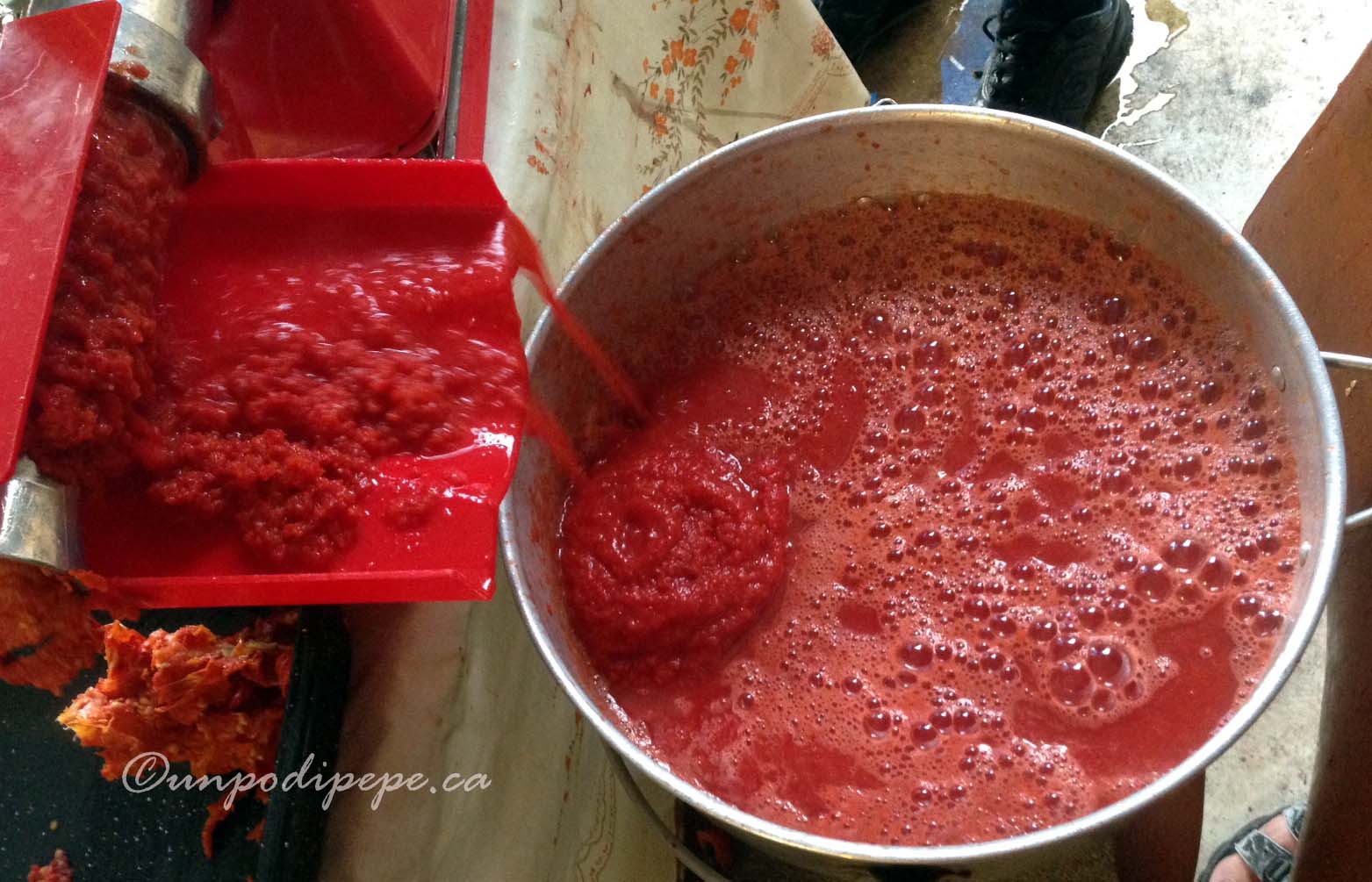
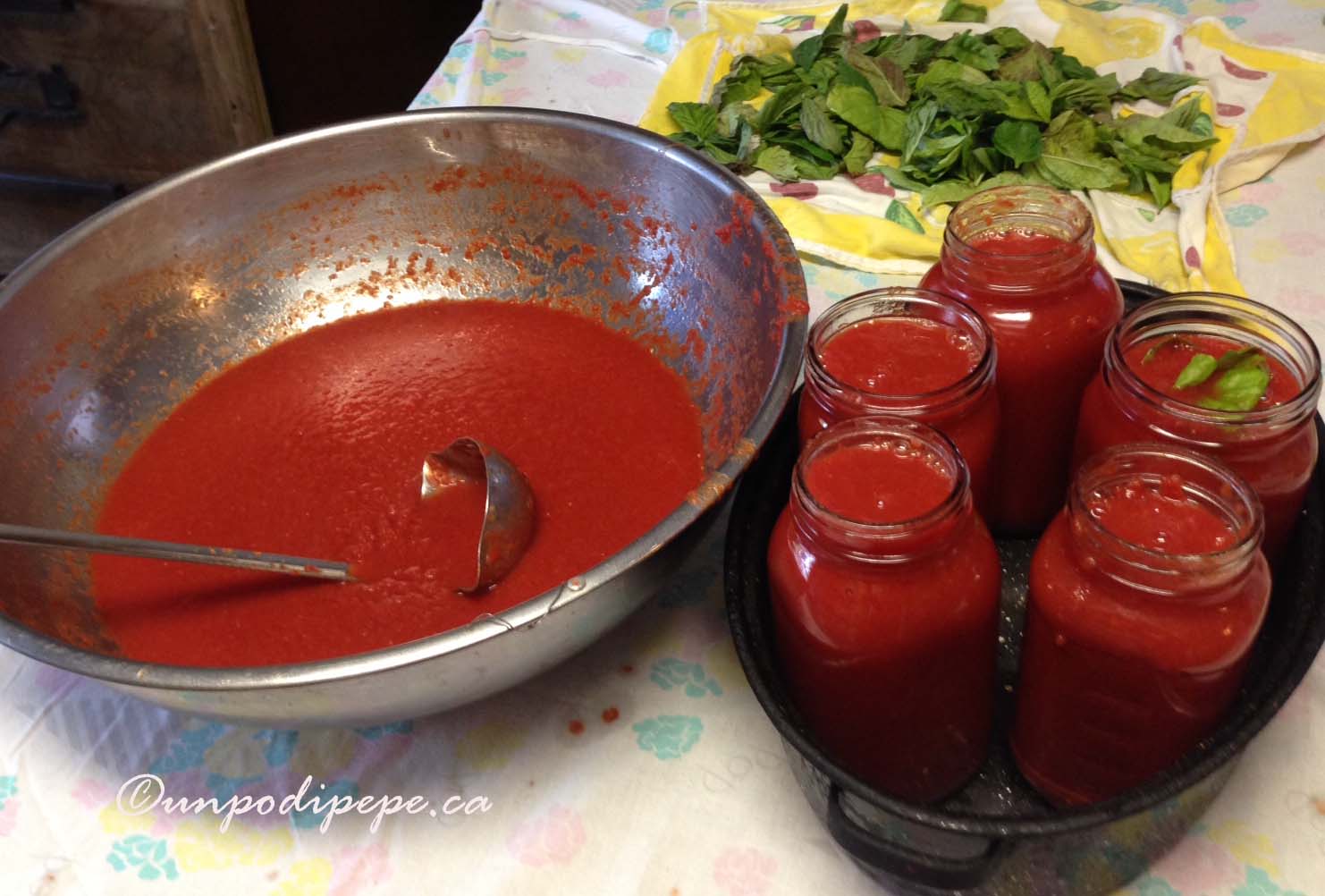
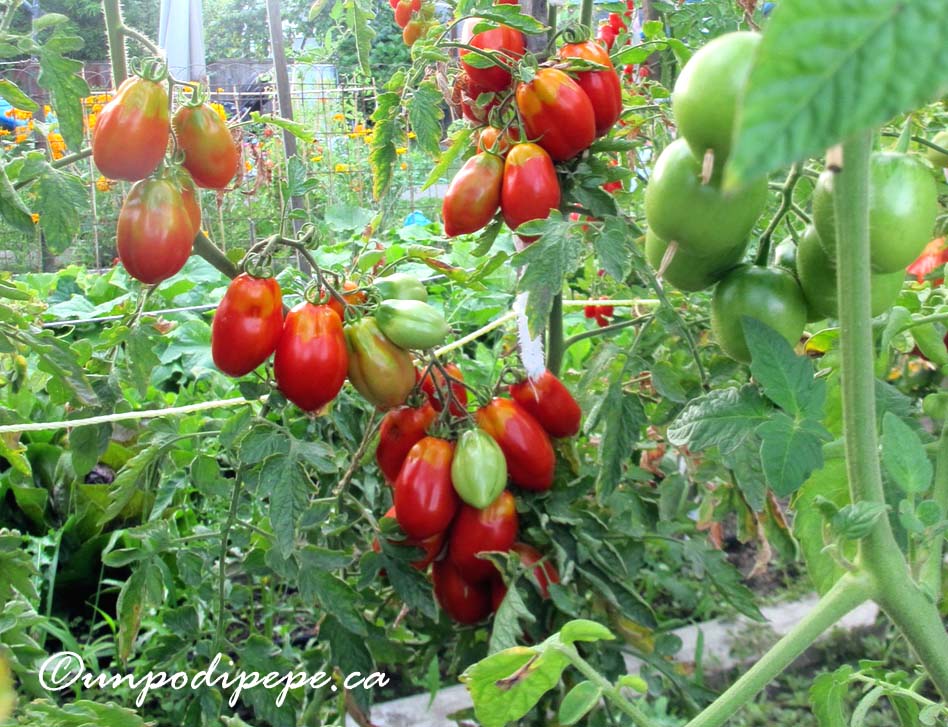
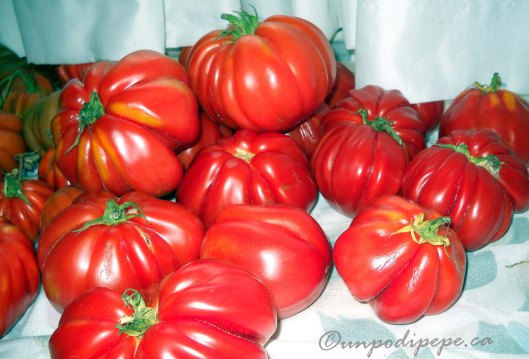
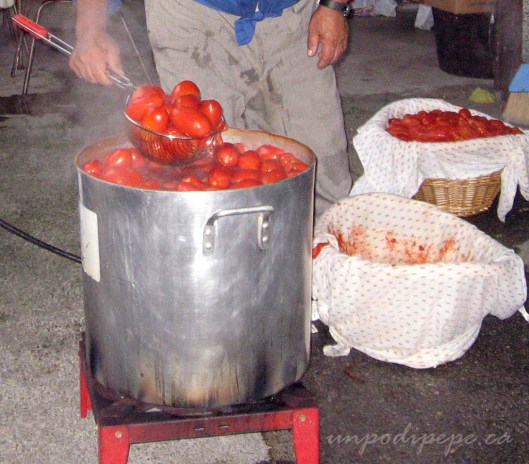
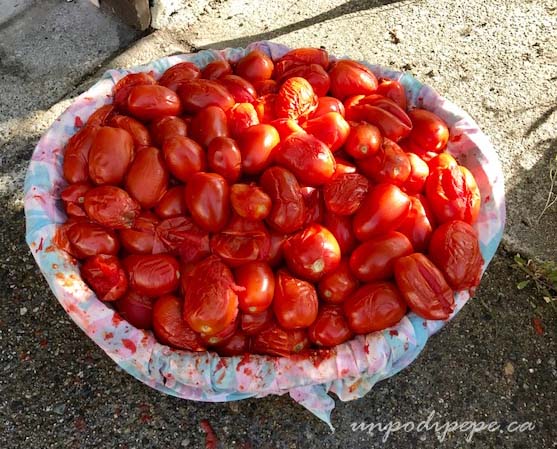
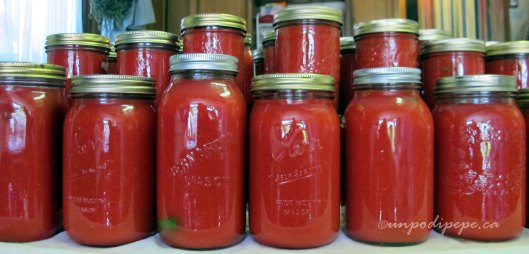
Today was my famiglia‘s annual pomodoro day.  We turned 15 boxes of pomodori, plus more from our gardens into passata di pomodoro, or as we simply call it ‘la salsa’. The boxes were 18 kg each (40 lbs)! That is 272 kg of pomodori and we made 140 litres of passata. Siamo stanchi!

For new readers of Un po’ di pepe, or those of you who have not read my previous pomodoro related posts, here they are.  Click on the appropriately coloured red links!

Passata di pomodoro

Passata di Pomodoro is a detailed description of my famiglia’s annual passata making day.  There is a lot of red in photos in this post! Rosso come un pomodoro, but no one is blushing.

Il Pomodoro discusses the history of the pomodoro and how it came to Italia and eventually became edible. You read that correctly-pomodori originally tasted really gross and were used only for ornamental purposes.  You’ve come a long way, pomodoro.

Does your famiglia make passata di pomodoro? I’d love to hear about it.  Ciao, Cristina

Share this:

  • Share on Facebook (Opens in new window) Facebook
  • Share on Pinterest (Opens in new window) Pinterest
  • Share on X (Opens in new window) X
  • Email a link to a friend (Opens in new window) Email
  • Share on WhatsApp (Opens in new window) WhatsApp
Like Loading...

Crustoli per Carnevale

19 Sunday Feb 2017

Posted by Un po' di pepe in Feste, Mangiamo!, Parole piacevoli, Recipes

≈ 27 Comments

Tags

Bugie, Carnevale, Cenci, Chiacchiere, Crustoli, Frappe

crustolipercarnevaleCarnevale season is here.  From the Latin Carnem Vale meaning farewell meat, Carnevale is the week leading up to la Quaresima (Lent). La Quaresima is the period of 40 days between Mercoledi delle Ceneri (Ash Wednesday) and Pasqua (Easter).  There are actually 46 days, but the Sundays are not included. Carnevale was traditionally a period of overindulgence before the more humble days of Lent when there was no meat, dairy, fat or sugar and sometimes even days of fasting.  Martedi Grasso (Mardi Gras or Fat Tuesday) is the last day of Carnevale and the last opportunity for excesses.

Like most religious events/festivals, Carnevale and Lent took over from pagan and folk rituals.  This time of year brings the transition from winter to spring and the return of increased daylight. I can’t wait for sunshine and more daylight! For most people, Carnevale was their last opportunity to eat well.  They did not have freezers or refrigerators, so the winter stores of food would be running out or starting to rot.  The avoiding of meat, dairy and fat was not originally for religious reasons-it was going to happen anyways. Lent was a way to mentally prepare and get through this last bit of winter!  Today it is common to not eat meat on Ash Wednesday and on Fridays during Lent.

The Carnevale di Venezia was first recorded in 1268.  It involved masked balls, parades, decorations, costumes and masks, and even dressing as the opposite sex.  You can imagine things often got out of hand!  Napoleon outlawed Carnevale in 1797, and it was only restored 182 years later, in 1979.mazatlanparade

Today Carnevale in Italia is celebrated in Venezia, Viareggio, Ivrea and Putignano. Carnevale in Viareggio is known for its parades featuring political and satirical floats.  I would like to experience Carnevale di Venezia one of these days.  Carnevale is also celebrated in other parts of the world, including Rio di Janeiro, New Orleans and Mazatlan.  For many years, I was involved with the ‘Carnaval‘ in Mazatlan, Mexico with the Seattle Seafair Clowns,  participating in 2 parades and a childrens’ festival.

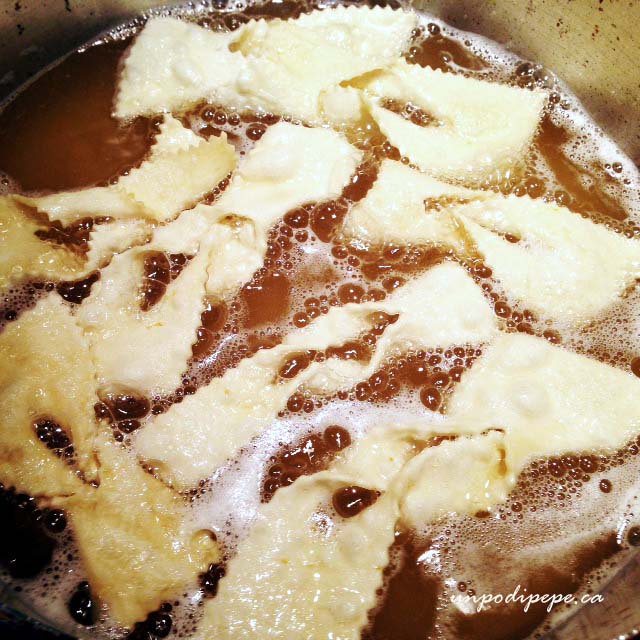
crustoli2Crustoli are fried, sweet shapes of dough made for Carnevale-as well as Christmas and Easter.  They are known by different names all over Italia.  They are Crustoli or Galani in Puglia, Bugie (lies) in Piemonte and Liguria, Cenci ( rags) in Toscana, Chiacchiere (chitchat or gossip) in Lombardia and Calabria, Crostoli in Veneto and Friuli, Frappe in Lazio and Umbria and Sfrappole in Emilia Romagna!  I hope I got them all right!  In Poland, they are known as Chušciki. Recipes vary as well, but they are all very similar.  Some have milk or baking powder and some do not.  Here is my recipe, which is quite simple:

Crustoli

1egg

15 ml (1 tablespoon) sugar

15 ml (1 tablespoon) Anice liqueur (or Grappa or Sambuca)

Grated rind of 1 orange or lemon

15 ml (1 tablespoon) olive oil or sunflower oil

~150 grams (1 cup) flour, 00 is best

Salt

Mix all ingredients together and form into a ball. Roll half of the dough at a time out thin with a mattarello (rolling pin) or use a pasta machine.  If you like them very thin and crispy, the pasta machine will work better.  I like mine a little chewier.  Cut crustoli into shapes with a pastry wheel.  I like to make mine into bows or tie them in knots, but you can also just cut rectangles or triangles.  Fry them in oil.  I use sunflower or olive oil.  Grapeseed oil can also be used.  They cook very quickly!  Drain on parchment paper or paper towels and dust with icing sugar. Note-this recipe does not make a large amount so you may want to double it!  crustoli

Buon Appetito, Cristina

Share this:

  • Share on Facebook (Opens in new window) Facebook
  • Share on Pinterest (Opens in new window) Pinterest
  • Share on X (Opens in new window) X
  • Email a link to a friend (Opens in new window) Email
  • Share on WhatsApp (Opens in new window) WhatsApp
Like Loading...

Dolci di Natale

23 Friday Dec 2016

Posted by Un po' di pepe in Feste, Italian life, Mangiamo!

≈ 15 Comments

Tags

Cartellate, Cauzuncill, Crustoli, Dolci di Natale, Panettone, Pizza con la ricotta, Pugliese Traditions

crustoli2If you have seen my Instagram photos, you know that my famiglia and I have been busy making dolci di Natale.  I decided to compile them together in a blog post. There are many other Italian dolci di Natale, but I have only included the ones we make every at home:

Cartellatecartellate

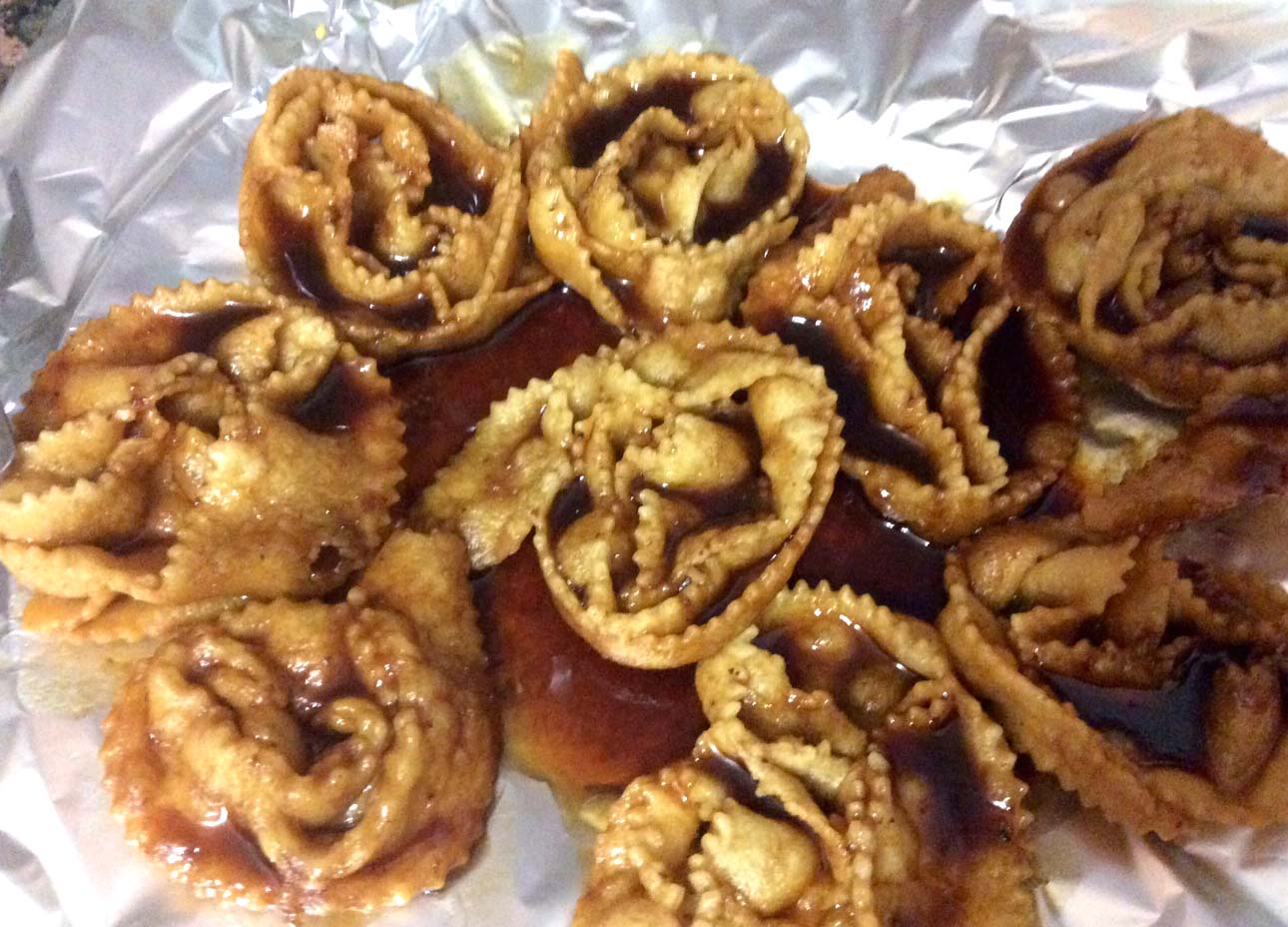
You can’t get more Pugliese than Cartellate (called Carteddate in Bari).  My Mamma and I made them last week. The dough is pinched and rolled into pinwheel or thorny rose shapes, fried, and then vino cotto is poured over them. Their shape is apparently  symbolizes the crown of thorns worn by Jesus. Vino cotto is really mosto cotto, but we call it vino cotto for some reason. The wine must is boiled and boiled down to a thick syrup and bottled.  It is like a yummy wine molasses.  cartellate2

cartellate3Cauzuncill’cauzuncillIt wouldn’t be Natale without Cauzuncill’ (cow·ZOON·cheel)  They already have their own entire blog post.  Read more about them here.

Cauzuncill' (cow-zoon-cheel) with almond and vino cotto filling, drizzled with vino cotto

Cauzuncill’ (cow-zoon-cheel) with almond and vino cotto filling, drizzled with vino cotto

Crustolicrustoli

We call these crustoli, but they are also called crostoli, chiacchiere, cenci, bugie and frappe in other parts of Italia.  The sweet dough is cut into strips or bows, fried and then dusted with icing sugar. They are also traditionally made for Carnevale.  The recipe is in this post.crustolipentola

Panettonepanettone2

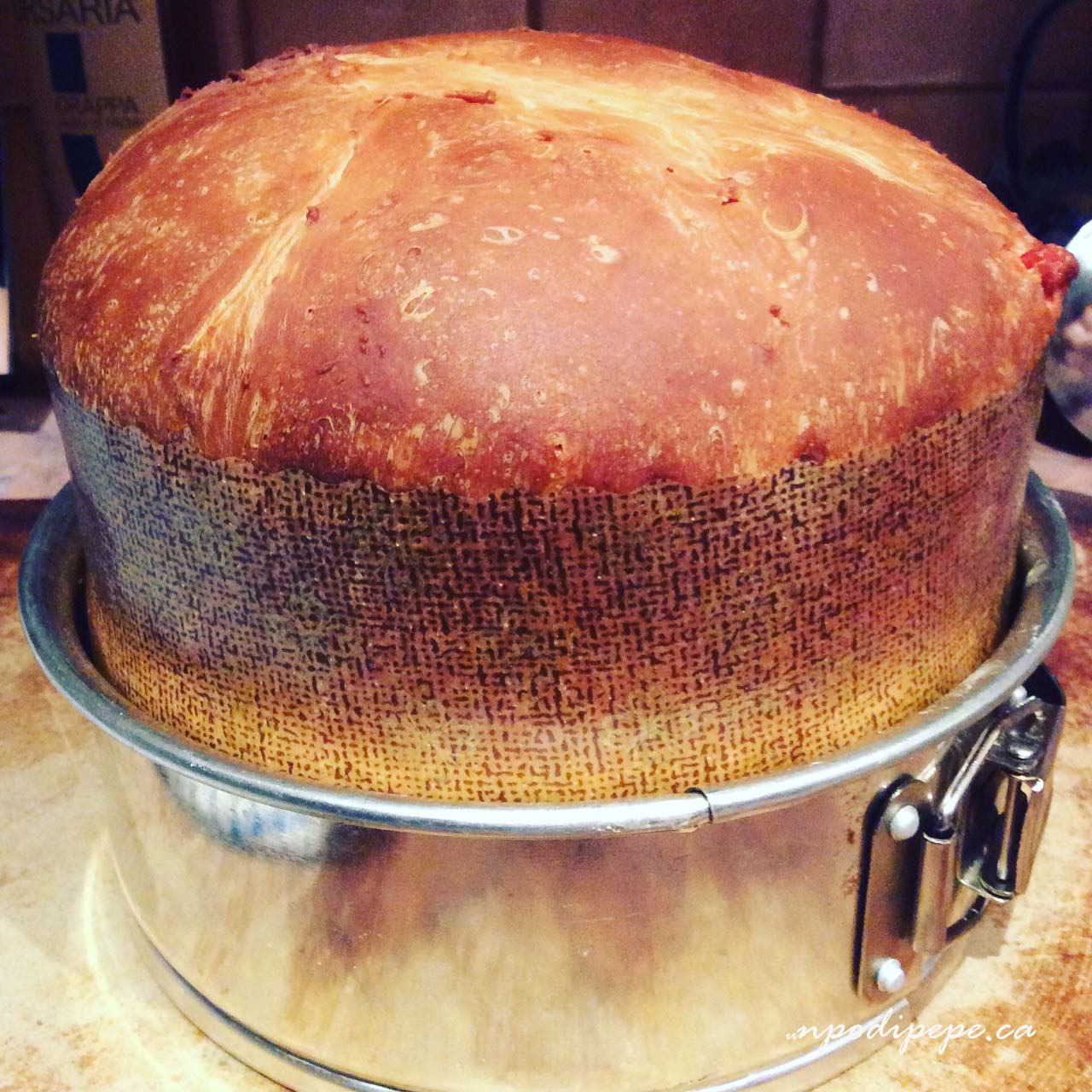
Panettone is traditionally from Milano, while Pandoro, the fruitless, star-shaped version, originated in Verona.  They are eaten throughout Italia and it wouldn’t be Natale without panettone and leftover panettone.  I love panettone french toast with fresh ricotta.  This year, I made my own panettone, and it came out quite decent!  I still have a bit of experimenting to do, but will hopefully be able to post about it for Natale 2017. The recipe is now posted here.

My first panettone fatto in casa

My first panettone fatto in casa

Pettolepettole

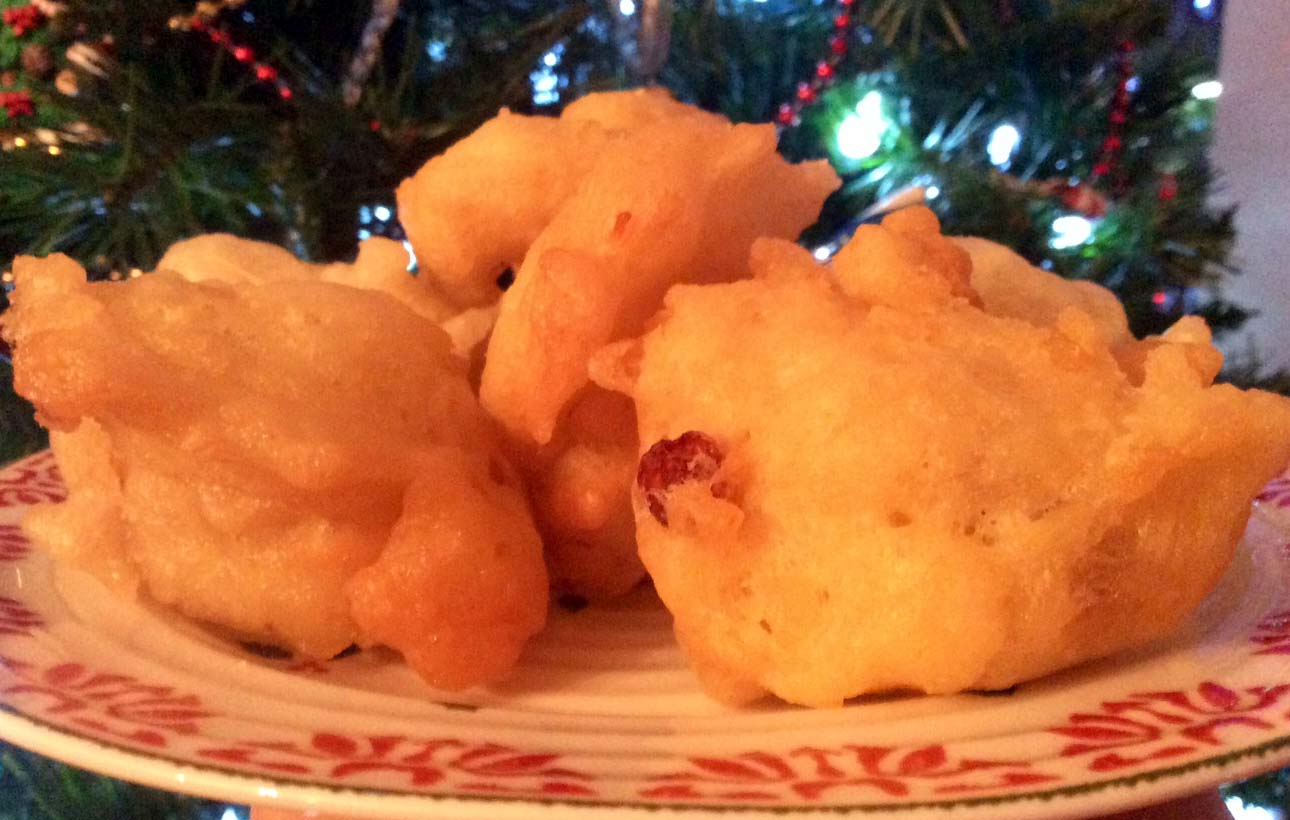
Pettole are fried balls of dough.  They are made with or without raisins and are covered in honey or vino cotto.  Pettole are traditionally eaten on the feast of l’Immacolata, Dec 8th, and on la Vigilia di Natale, Christmas Eve.  I believe these are usually called zeppole in Calabria and in the US.  In Puglia, zeppole are a completely different dolce, eaten on the feast of San Giuseppe.

Pizza con la Ricottapizzaconlaricotta

Pizza con la ricotta is another traditional Pugliese dolce, and we only make it at Natale and Pasqua.  I’m not sure why we only make it twice a year, as it is so delicious!  It is a crostata (tart) made with pasta frolla (short crust pastry) and filled with fresh ricotta, sugar, eggs and alcohol (Sambuca or Strega).  The word ‘pizza’ actually means flat and round.  Pizza con la ricotta is usually round, but today ours is rectangular.  I was not allowed to cut into it to take a cross sectional photo, so I will have to add it later!

Which dolci di Natale will be on your table tomorrow night? Buon Natale e Buon Appetito, Cristina

Share this:

  • Share on Facebook (Opens in new window) Facebook
  • Share on Pinterest (Opens in new window) Pinterest
  • Share on X (Opens in new window) X
  • Email a link to a friend (Opens in new window) Email
  • Share on WhatsApp (Opens in new window) WhatsApp
Like Loading...

Espresso Cookies

13 Tuesday Dec 2016

Posted by Un po' di pepe in Mangiamo!, Recipes

≈ 13 Comments

Tags

Dolci di Natale, Espresso cookies, Espresso shortbread cookies, Maccinacaffè

espressobiscottiI make these yummy biscottini often, and receive a lot of requests for the recipe, especially at this time of year. They are not a traditional Italian dolce, but they have been ‘italianizzati’ 🇮🇹 by the espresso.  I have been making them for over 25 years, so I don’t remember where the original recipe came from.  It may have been an article in the local paper?  Really, any shortbread or butter cookie recipe can be adapted by adding vanilla extract and instant espresso powder.

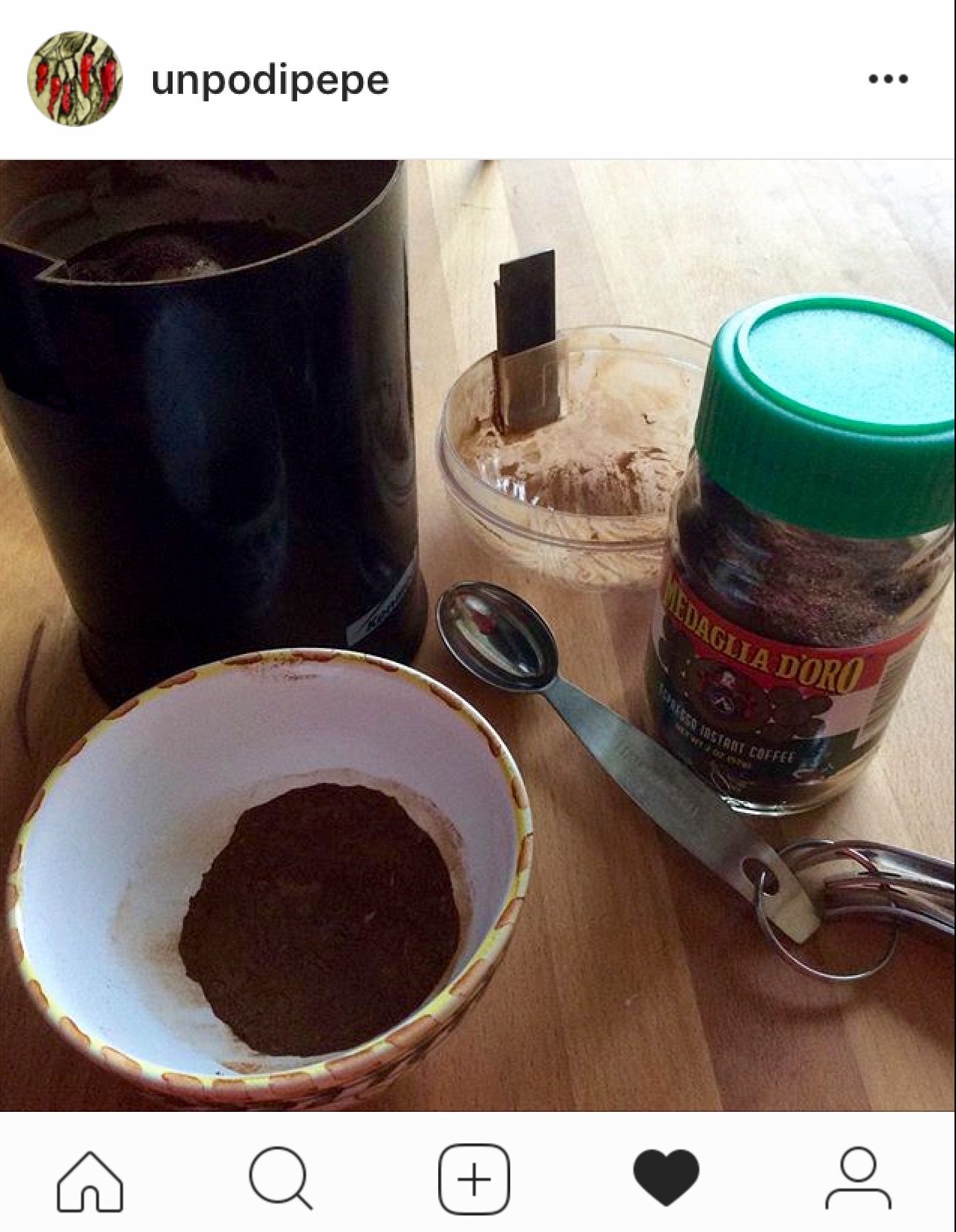
These espresso cookies are perfect with a caffè and freeze very well. They even taste good congelati -straight out of the freezer.  For best results, freeze before dipping the ends in chocolate. instagramespressoThe espresso must be ground to a very fine powder in a macinacaffè, a coffee grinder.  Instant espresso is too coarse and chunky to add straight from the jar.  Grinding espresso beans does not work well, as they do not grind fine enough.  Using real caffè does not work either, as the batter will be too liquidy.  Espresso powder is the best option.  I use Medaglia d’Oro® or Bar Italia® brand instant espresso.  Last time I made them, I accidentally doubled the caffè (oops!). My coffee loving amici thought they were even better than usual, so ‘double shot’ works too.

Espresso Cookies

10g (20 ml, 4 teaspoons) instant espresso

225g (240 ml, 1 cup) butter, at room temperature

100g (120 ml, ½ cup) sugar

3 ml (½ teaspoon) pure vanilla extract

230g (415 ml, 1¾ cups) all-purpose flour

30g (¼ cup, 60 ml) cornstarch

120g (4 ounces) good quality chocolate, melted

Grind instant espresso in coffee grinder to a fine powder. Mix together butter and sugar.  Add espresso powder and vanilla extract.  Sift flour and cornstarch together and add to the rest of the ingredients.  Roll into 2 cm balls then flatten into palm of hand to mould into oval coffee bean shape/American football shape.  Place on a baking sheet.  Before baking, make a shallow indent lengthwise down the ‘bean’ with a knife. Indenting too deep will make the cookies spread.  Bake at 180⁰ C (325⁰ F) for 15-20 minutes. When cool, dip both ends in melted chocolate and place on wax or parchment paper to dry.  Makes 36 cookies. espresso-biscottini2Buon Appetito!

Share this:

  • Share on Facebook (Opens in new window) Facebook
  • Share on Pinterest (Opens in new window) Pinterest
  • Share on X (Opens in new window) X
  • Email a link to a friend (Opens in new window) Email
  • Share on WhatsApp (Opens in new window) WhatsApp
Like Loading...

Italian Street Food Cookbook

05 Saturday Nov 2016

Posted by Un po' di pepe in Amici e Famiglia, Culture, Libri, Mangiamo!

≈ 24 Comments

Tags

Italian food, Italian Street Food Cookbook, Paola Bacchia

Italian Street Food by Paola BacchiaItalian Street Food: Recipes from Italy’s Bars and Hidden Laneways is finally available, and I just received my copy!  Some of you may remember in February I had the pleasure of being a ‘recipe tester’ for Paola Bacchia of Italy on my Mind for this book. I tested the recipe for Fiadoni Abbruzzesi which were squisito.  I have made them several times now and can’t wait to try more of the recipes.Fiadoni Abruzzesi

A country’s street food is usually reflective of its ‘real’ food…what people actually eat.  Paola draws on her own experiences growing up in an Italian family, and also her frequent ‘on site’ experiences travelling the back streets of Italian cities.  Many of the recipes are similar to things I grew up eating too.  Besides the yummy and genuine recipes, the book is visually stunning.  Most of the photos were taken by Paola.  The cover is not a teaser-the inside is just as beautiful.  Each recipe also comes with a story about the history of the food and Paola’s personal experience with where she tasted it. I know some of you are drooling and jealous reading this, but you can order your own copy from Amazon.

Paola is Italoaustraliana, living in Melbourne and her roots are in the Veneto and Istria.  She teaches cooking classes in Melbourne and is a guest instructor at the  Anna Tasca Lanza Cooking School in Sicilia.  Her blog was voted best food blog twice in the ITALY magazine blog awards.  Cool fact-Paola was also a contestant on Masterchef Australia! Buon Appetito, Cristina
Share this:

  • Share on Facebook (Opens in new window) Facebook
  • Share on Pinterest (Opens in new window) Pinterest
  • Share on X (Opens in new window) X
  • Email a link to a friend (Opens in new window) Email
  • Share on WhatsApp (Opens in new window) WhatsApp
Like Loading...

Passata di Pomodoro

05 Monday Sep 2016

Posted by Un po' di pepe in Italian life, Mangiamo!

≈ 6 Comments

This weekend was my family’s annual passata di pomodoro canning fest. For those of you interested in seeing the process, I’m reposting ‘Passata di Pomodoro’. Ciao, Cristina

Un po' di pepe's avatarUn po' di pepe

Passata di pomodoro
Every year my family gets together to make ‘la salsa’, or passata di pomodoro. Everyone participates, even the nipotini. It is a 2 day event and we are all tired today, as we made about 180 litres of salsa/passata! Some of the tomatoes came from our gardens, but most of them were purchased.

Pomodori ready to be washed Pomodori ready to be washed

Pomodori from the garden Pomodori from the garden

La pentola per i pomodori-a really big pot to cook the tomatoes! La pentola per i pomodori-a really big pot to cook the tomatoes!

The ripe pomodori are washed, then cooked in a really big pot until soft. Then they are drained in baskets lined with cloth. If they aren’t drained well, then the passata will be too watery.  To make’pomodori pelati'(peeled tomatoes) instead of passata, the skin is removed by hand and the whole pomodori are put in jars.

Cooked pomodori drained in baskets lined with cloth Cooked pomodori drained in baskets lined with cloth

Passata refers to ‘passed’ through a sieve, a passapomodoro, or an electric machine to…

View original post 220 more words

Share this:

  • Share on Facebook (Opens in new window) Facebook
  • Share on Pinterest (Opens in new window) Pinterest
  • Share on X (Opens in new window) X
  • Email a link to a friend (Opens in new window) Email
  • Share on WhatsApp (Opens in new window) WhatsApp
Like Loading...

Spaghetti all’Amatriciana

30 Tuesday Aug 2016

Posted by Un po' di pepe in Italia, Mangiamo!, Recipes, Roma

≈ 16 Comments

Tags

Amatrice, Croce Rossa Italiana, Cucina Romana, Earthquake relief Central Italy, Inspiration, Italian food, Pasta all'Amatriciana, Terremoto 2016, Traditional recipes

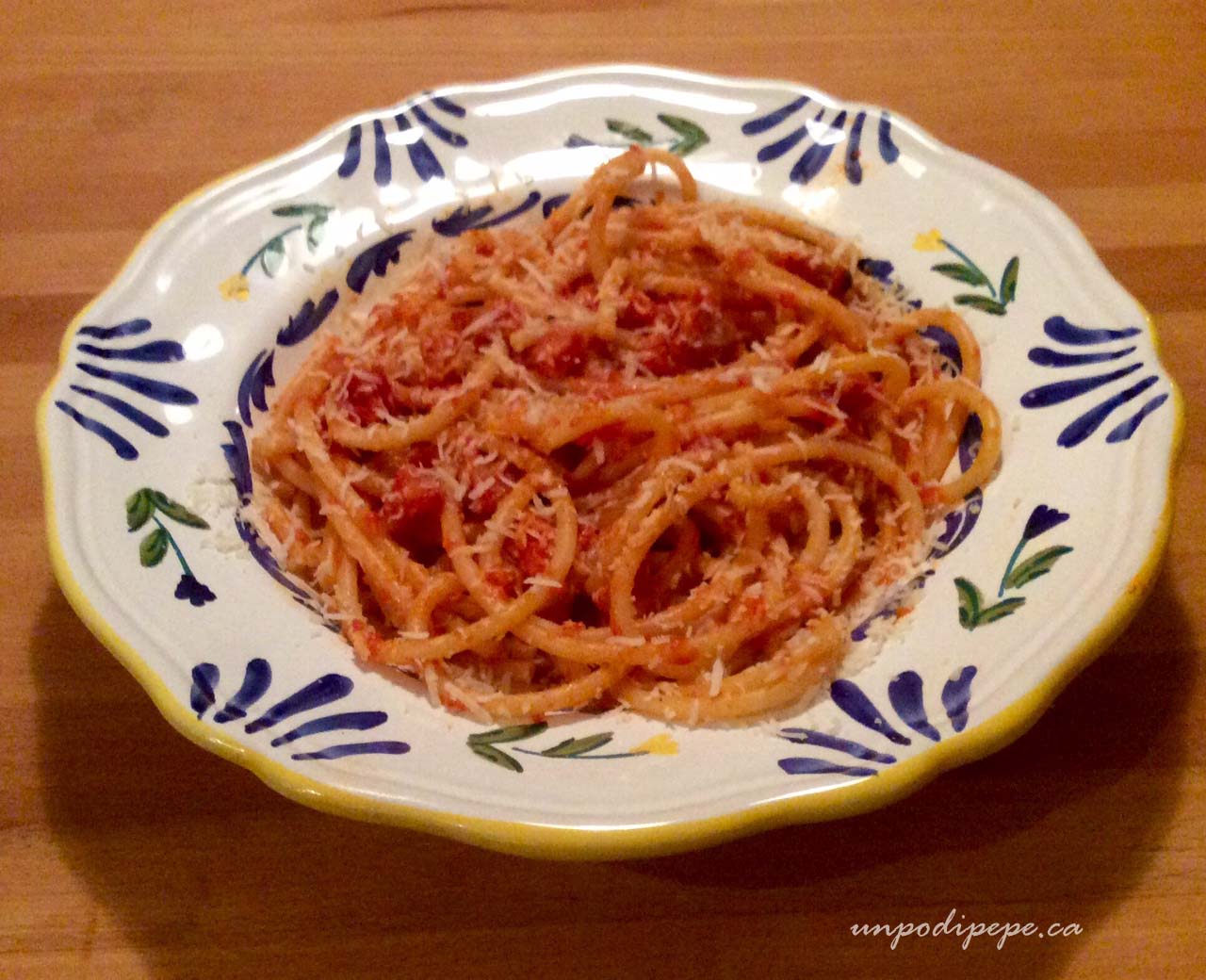
Pasta all'AmatricianaMy last post was about the terremoto in Italia and I listed ways you can help with earthquake relief.  One of these ways was to order Pasta all’Amatriciana at one of the many restaurants participating to raise money for the Croce Rossa Italiana.  I realized that not everyone will have a restaurant in their area participating, so I am posting a recipe, just in case anyone wants to host their own small fundraiser. August 27-28 would have been the Spaghetti all’Amatriciana festa in Amatrice.  Amatriciana

Pasta all’Amatriciana-also known as Pasta alla Matriciana in dialetto Romano, is made with guanciale (cured pork cheek), Pecorino Romano, and pomodoro (tomato).  Peperoncino is often added.  Pasta all’Amatriciana originated from Pasta alla Gricia, made with guanciale and Pecorino.  It is basically Pasta Carbonara with tomato instead of  eggs. Shepherds near Amatrice carried the simple ingredients with them into the fields.  The pomodoro had not been brought to Europe yet.  In Amatrice, they started making the Pasta alla Gricia with pomodoro, once it had been introduced.  When Amatriciani moved from the outlaying areas to Roma, the sauce became popular, and is now considered a staple of Cucina Romana.  In Roma, Amatriciana is made with bucatini, which are spaghetti with a hole down the middle, or rigatoni, but in Amatrice, it is only made with spaghetti! Making Amatriciana

Spaghetti all’Amatriciana

100g guanciale (pancetta can be used if guanciale not available)

350g passata di pomodoro, or pelati (peeled tomatoes)-about 1 500ml canning jar

75g Pecorino Romano, freshly grated

Black pepper, freshly grated

320g spaghetti or bucatini (80g per person)

Cut guanciale into strips or cubes. In a frying pan, cook guanciale until crispy.  When the white part becomes transparent, add tomatoes and pepper.  While this is simmering, cook spaghetti in a large pot of salted water.  Cook for 1 minute less than the time it says on the box! Drain well then add to the pan and toss in the sauce and add Pecorino.  Serve with extra Pecorino Romano on top.  Serves 4. Buon Appetito!Amatriciana

Share this:

  • Share on Facebook (Opens in new window) Facebook
  • Share on Pinterest (Opens in new window) Pinterest
  • Share on X (Opens in new window) X
  • Email a link to a friend (Opens in new window) Email
  • Share on WhatsApp (Opens in new window) WhatsApp
Like Loading...

Limoncello Cheesecake

16 Monday May 2016

Posted by Un po' di pepe in Mangiamo!, Recipes

≈ 28 Comments

Tags

Baking, Dolci, Gluten-free baking, Limoncello, Limoncello cheesecake

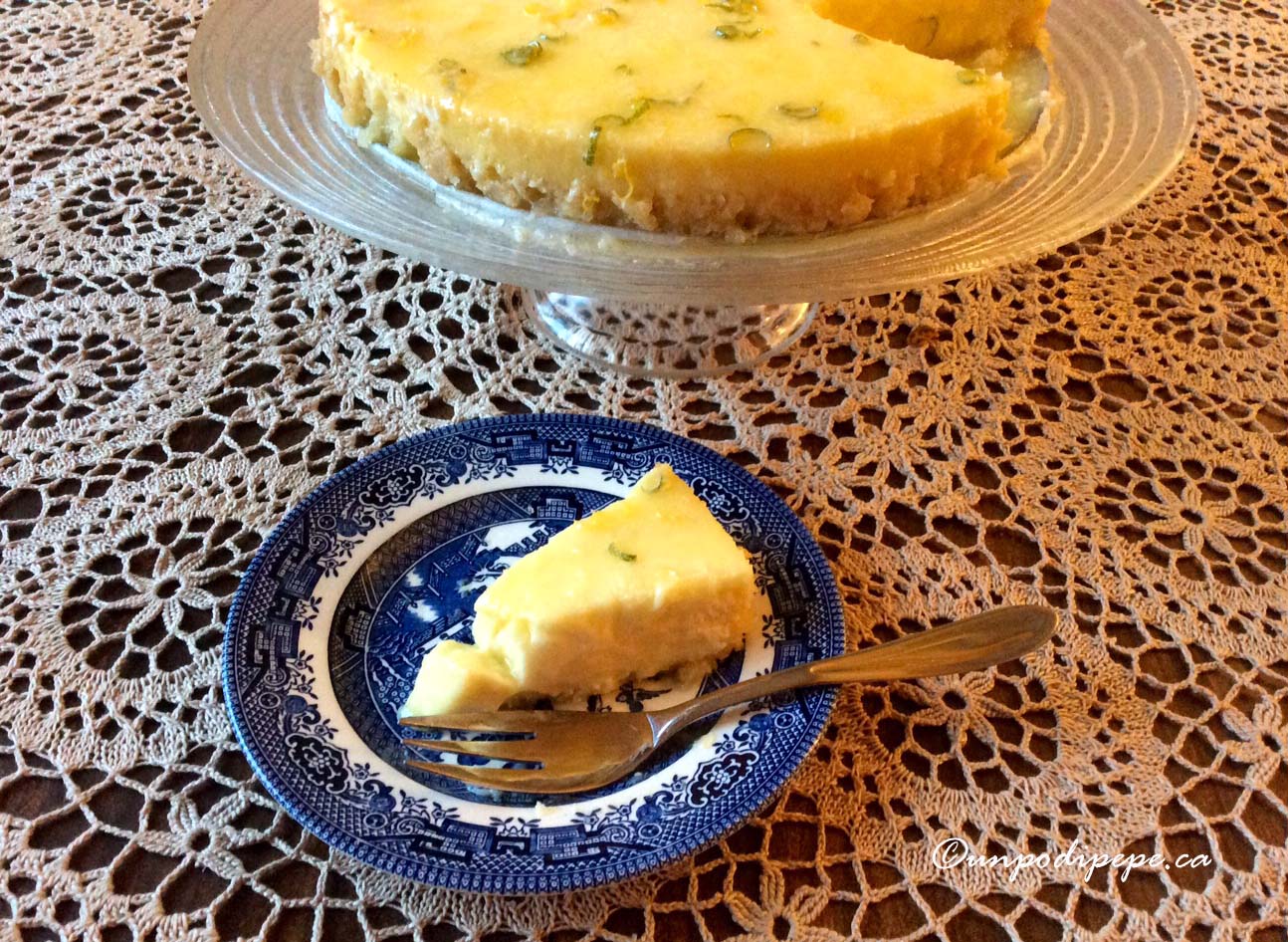
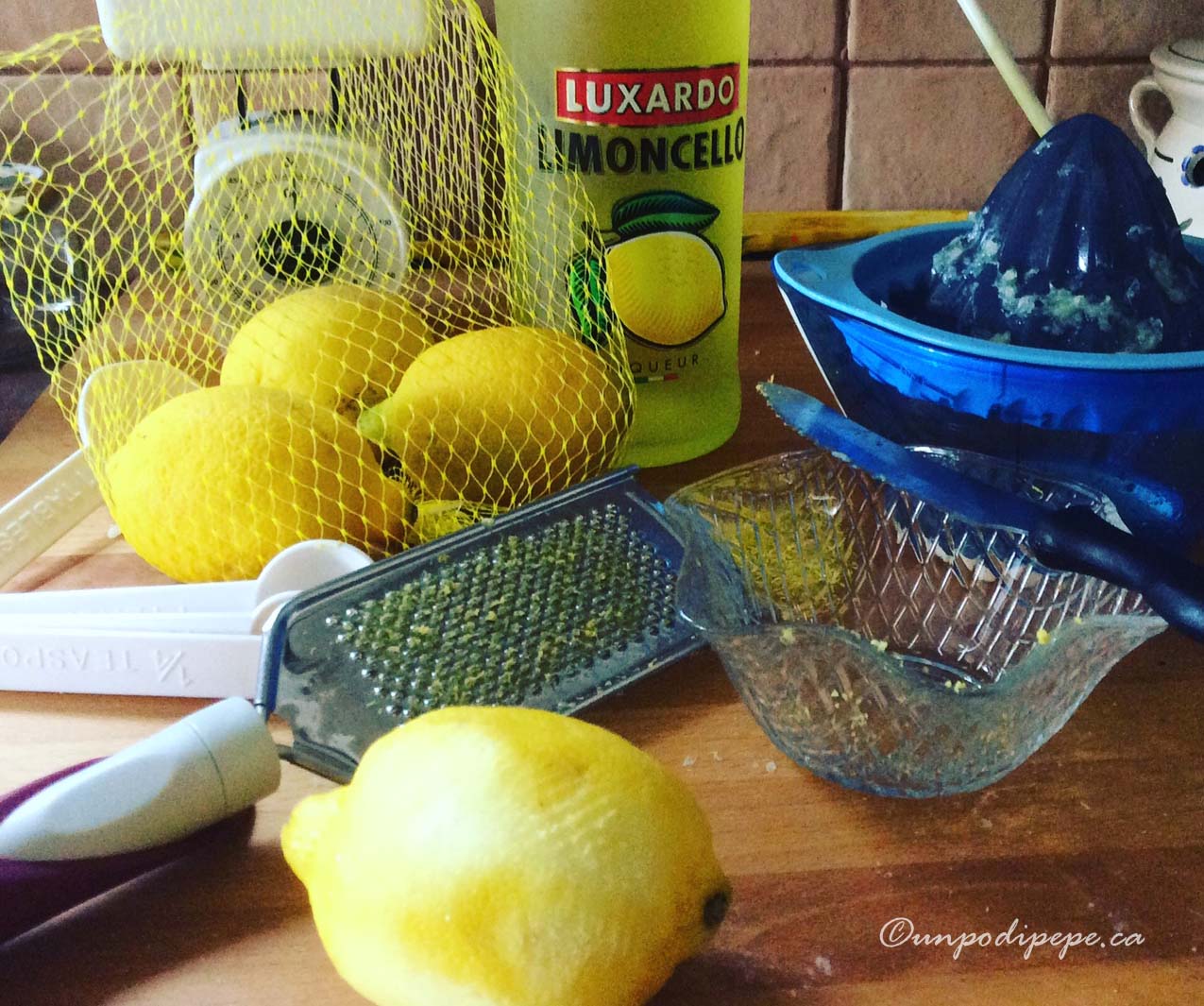
Limoncellocheesecake2Limoncello tastes like summer in a glass.  What could be even more refreshing than a nice cold glass of Limoncello?  Limoncello Cheesecake of course!  I’ve been making it for years and every time I am asked for the recipe, so I thought I would simplify things and share it here on my blog.  The coconut crust makes it taste even more summery!  I like to add a small amount of lime juice too, but you could just add more Limoncello.  This cheesecake tastes better if made a day ahead of time so it spends more time in the fridge.  If you are looking for cream cheese in Italia, it’s known as ‘Philadelphia’, pronounced Fee•la•del•FEE•ah.  Buon Appetito!

Cristina’s Limoncello Cheesecake

Crust:

  • 150 g (2 cups) unsweetened coconut
  • 30 ml (2 tbsp) sugar
  • 30 ml (2 tbsp) melted butter
  • 5 ml (1 tsp) grated lemon rind

Filling:

  • 750g (3 x 250g packages) cream cheese
  • 210 g (1 cup) sugar
  • 4 eggs at room temperature
  • 1 tsp grated lemon rind
  • 15 ml (1 tbsp) lemon juice
  • 15 ml (1 tbsp) lime juice
  • 15 ml (1 tbsp) Limoncello (or reduce the juices to add more Limoncello)
  • Pinch of salt

Topping:

  • 2 eggs @ room temp
  • 160 g (¾ cup) sugar
  • 10 ml (2 tsp) coarsely grated lemon and lime rinds
  • 30 ml (2 tbsp) lemon juice
  • 30 ml (2 tbsp) lime juice
  • 30 ml (2 tbsp) butter
  • 30 ml (2 tbsp) Limoncello
  • Shredded coconut and citrus rinds for garnishLimoncellocheesecake5

Crust-Preheat oven to 180° C (350 ° F). Combine ingredients and press onto bottom of 22-25 cm (9-10 inch) springform pan. Bake 10-12 minutes until lightly toasted. Be careful not to burn the coconut.

Filling–Blend cream cheese until smooth. Add sugar, then eggs, one at a time.  Add juices, rinds, salt and Limoncello.  Make sure there are no lumps and pour over toasted crust, smoothing the top.  Bake at 180° C (350° F) for 45 minutes or until set.  Turn off the oven and leave cheesecake in for another 10 minutes.  Open the door and let cheesecake cool in the oven for another 10-15 minutes.  This will prevent the cheesecake from ‘falling’ or cracking all over the surface.  Run a knife around the rim of the pan and continue to cool at room temperature, then chill in refrigerator.

Topping-Whisk eggs until foamy. Combine with sugar, juices, rinds and butter in a small saucepan.  Cook over low heat, stirring constantly until smooth and thick. Remove from heat and add Limoncello.  Let cool and then spread over cheesecake while the springform pan is still attached.  Garnish top with coconut and coarsely grated lemon and lime zest.  Return to refrigerator for at least a few hours.  Serves 12-16 people.Limoncellocheesecake

Buon Appetito!

©2016unpodipepe.ca

Share this:

  • Share on Facebook (Opens in new window) Facebook
  • Share on Pinterest (Opens in new window) Pinterest
  • Share on X (Opens in new window) X
  • Email a link to a friend (Opens in new window) Email
  • Share on WhatsApp (Opens in new window) WhatsApp
Like Loading...

Fiadoni Abruzzesi

12 Saturday Mar 2016

Posted by Un po' di pepe in Amici e Famiglia, Mangiamo!

≈ 8 Comments

Tags

Abruzzo, Fiadoni, Italian food, Italian Street Food, Italyonmymind

Fiadoni AbruzzesiThis weekend I had the pleasure of being a ‘recipe tester’ for Paola of Italy on my Mind for her upcoming cookbook on Italian street food and bar food. Paola is Italoaustraliana, living in Melbourne and her roots are in the Veneto and Istria.  She runs cooking classes in Melbourne.  In September she will be a guest instructor at the Anna Tasca Lanza Cooking School in Sicilia.  Paola was also a contestant on Masterchef Australia!

These cheese-filled Fiadoni were squisito and I will definitely be making them again soon.  I’m not able to share the recipe here-we’ll have to wait for Paola’s book!  Ciao, Cristina
Share this:

  • Share on Facebook (Opens in new window) Facebook
  • Share on Pinterest (Opens in new window) Pinterest
  • Share on X (Opens in new window) X
  • Email a link to a friend (Opens in new window) Email
  • Share on WhatsApp (Opens in new window) WhatsApp
Like Loading...
← Older posts
Newer posts →

Enter your email address to follow 'un po' di pepe' and receive notifications of new posts by email.

Join 511 other subscribers
Follow Un po' di pepe on WordPress.com

Popular Posts

  • Hairstyling in Ancient Roma
    Hairstyling in Ancient Roma
  • Cucina Italiana Patrimonio UNESCO
    Cucina Italiana Patrimonio UNESCO
  • Grano Arso
    Grano Arso
  • Napoli Street Art
    Napoli Street Art
  • Dolci di Natale
    Dolci di Natale
  • Italiano per Ristoranti~How to pronounce your restaurant menu
    Italiano per Ristoranti~How to pronounce your restaurant menu
  • Hostaria Antica Roma~Eat like an Ancient Roman
    Hostaria Antica Roma~Eat like an Ancient Roman

Recent Posts

  • Cucina Italiana Patrimonio UNESCO
  • 2025~Un po’ di pepe Year in Review
  • Castel del Monte
  • ‘The Nuances of Love’
  • Hostaria Antica Roma~Eat like an Ancient Roman
  • Santa Maria in Aracoeli
  • Casino dell’Aurora~Villa Boncompagni Ludovisi
  • Nasoni di Roma
  • Bloghiversario #11
  • Fontana di Trevi
  • Acqua Vergine
  • Giubileo 2025
  • Sanremo 2025
  • In Vino there are Memories
  • A Literary Harvest
  • 2024~Un po’ di pepe Year in Review
  • Buon Natale 2024
  • Il Bicerin
  • Mercato Porta Palazzo
  • Torino
  • Catanzaro, Calabria
  • Il Pumo Pugliese
  • Artemisia Gentileschi
  • Cavalli di San Marco
  • Panzerotti

Categories

Amici e Famiglia Architecture Art Art history Art projects Bilingual posts Blogging Canada Culture Feste Firenze Inspiration Italia Italian Folklore Italian language Italian life Italocanadesi Libri Mangiamo! Orsara di Puglia Parole piacevoli Photography Puglia Recipes Roma Travel Travel tips Uncategorized Vino

Archives

Un po’ di pepe on Facebook

Un po’ di pepe on Facebook

Start a Blog at WordPress.com.

  • Subscribe Subscribed
    • Un po' di pepe
    • Join 511 other subscribers
    • Already have a WordPress.com account? Log in now.
    • Un po' di pepe
    • Subscribe Subscribed
    • Sign up
    • Log in
    • Report this content
    • View site in Reader
    • Manage subscriptions
    • Collapse this bar
 

Loading Comments...
 

    %d