Cari amici di ‘Un po’ di pepe’, auguro un buonissimo Natale e un meraviglioso nuovo anno piena di gioia e salute a voi e alle vostre famiglie!
Dear friends of ‘Un po’ di pepe’, wishing you and your families an incredibly Merry Christmas and a marvelous new year filled with joy and good health.
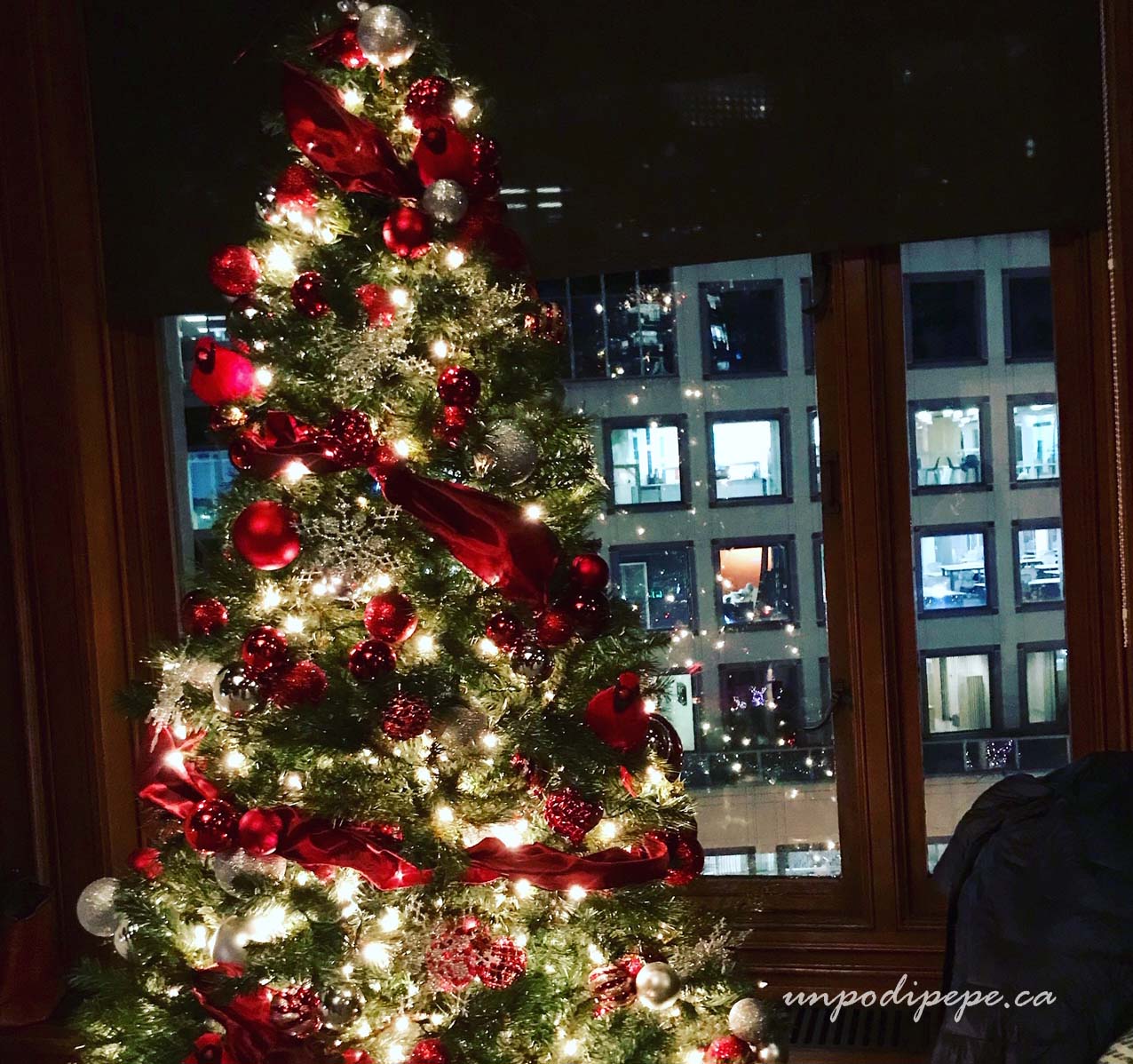
I love addobbi di Natale-Christmas ornaments and decorations. They help me make it through the blah winter weather! Here are some photos taken in and around my house to spread the cheer, starting with my corona dell’Avvento /Advent wreath.
My newest addobbo/ornament was a gift from Roma in July. I love how it sparkles in the tree.The title photo is of my presepio. I may have to find a bigger space for it next year. Below is the panificio corner of Mamma’s presepio. Notice how she bakes tiny bread loaves and baguettes-even focaccia Pugliese!Next is Mamma’s vicolo dei lavandai/ washerwomen’s alley. I love the attention to detail, especially the washboards and clothesline. The lavandaia on the left with the red scarf is from Via San Gregorio Armeni in Napoli.
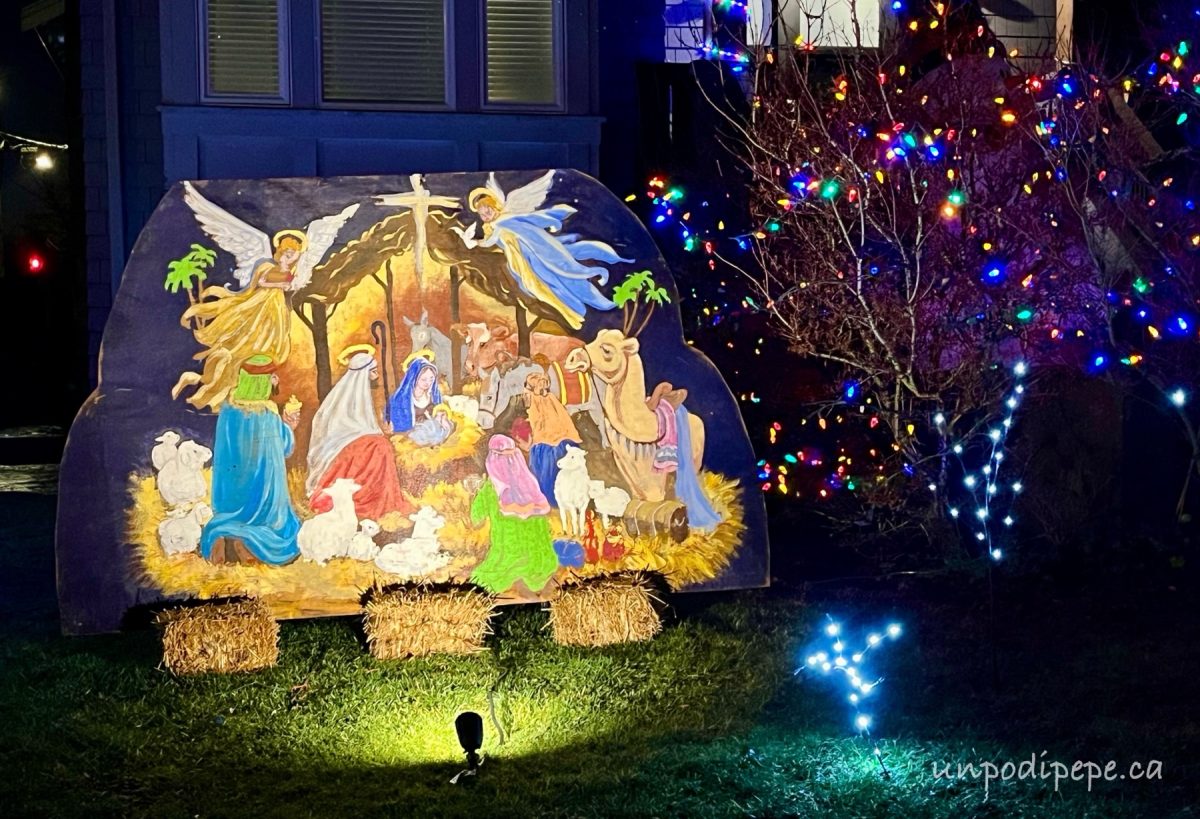
This beautiful outdoor presepio in my neighbourhood looks like it was handpainted.
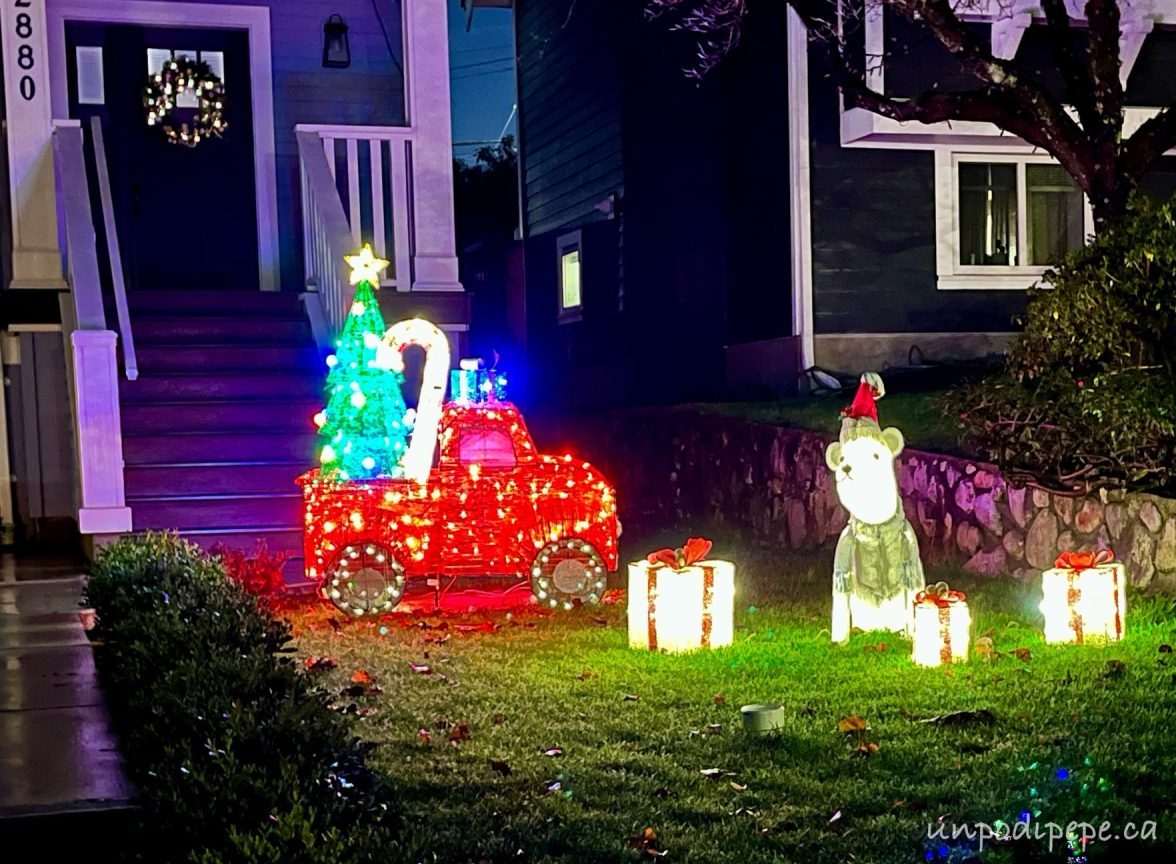
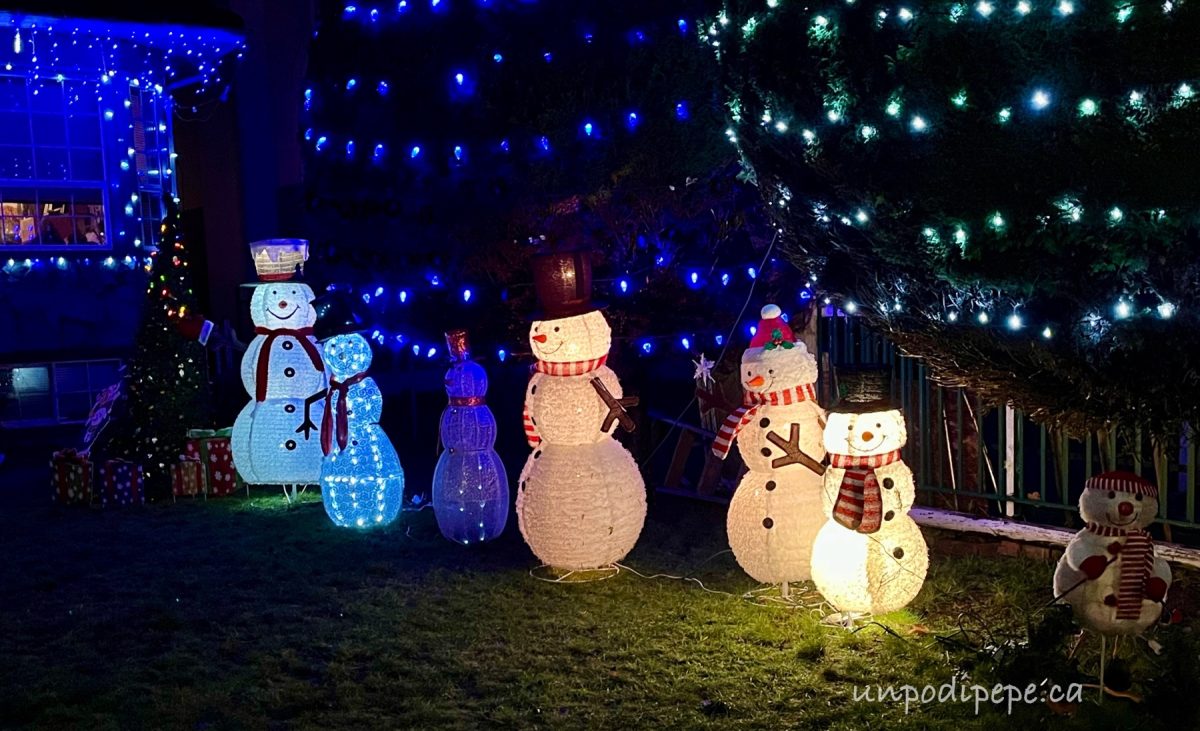
On the same street, Santa’s sleigh is pulled by weiner dogs!These classic old homes look beautiful all lit up-minus the inflatable Santa and Frosty. And finally, the snowman family is adorable!Un abbraccio, Cristina
December 8th is a national holiday in Italia and the official start of le feste Natalizie-the Christmas season. It is also the day most Italiani put up and decorate their Christmas tree, l’ albero di Natale.
The most well-known albero di Natale is probably the one in Rockefeller Plaza in New York. It is known around the world and visited by 125 million people each year. Usually, the tree is a giant Norway Spruce from upstate NY, sometimes it is even from Canada. The tree goes up on the Wednesday evening after American Thanksgiving* and is lit from 5 am to midnight until after the epiphany.
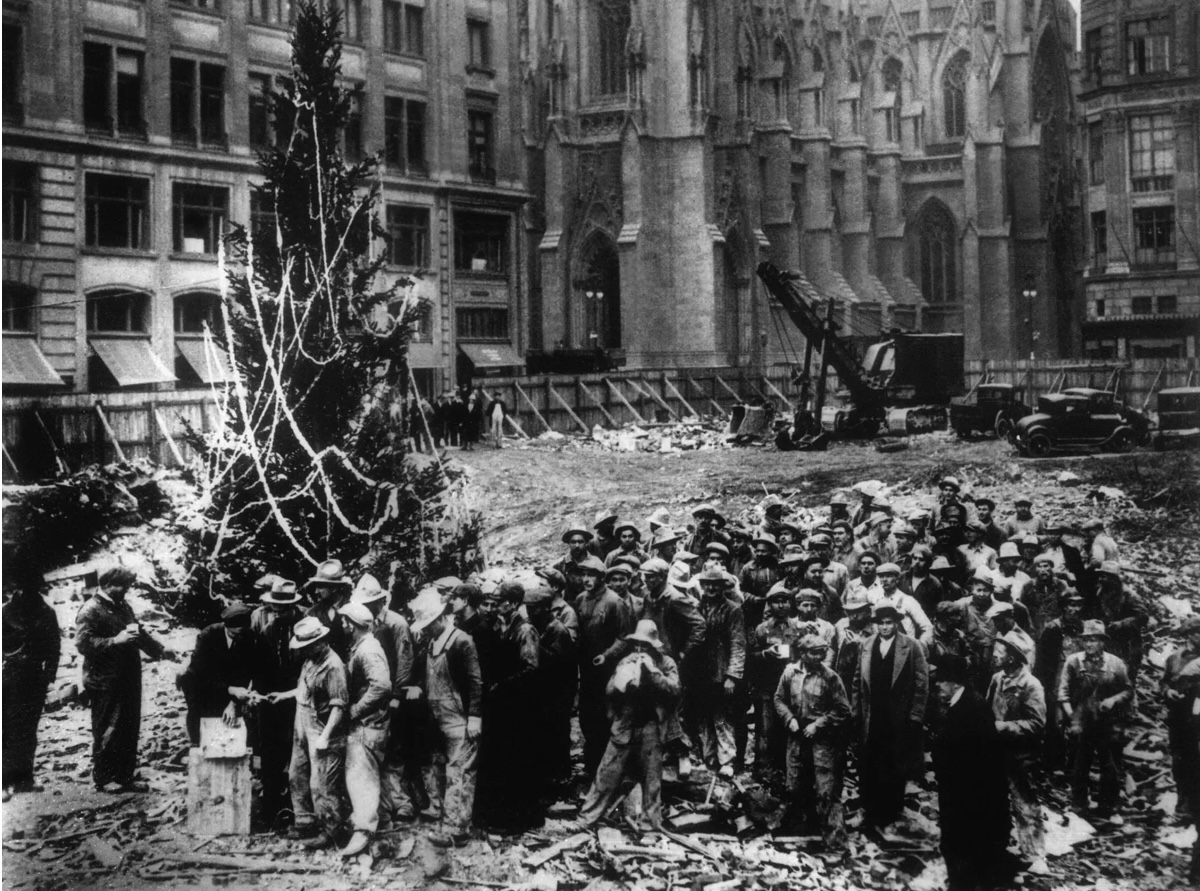
The tree may not go up on December 8th, but I recently found out that this famous tree tradition was started by Italian immigrant excavation workers. On December 24th 1931 work had just begun on the future site of Rockefeller Center. The first tree, a ‘small’ 6.1 m (20 ft) Balsam fir was brought to the site by Cesidio Perruzza. Originally from Frosinone, he was one of a group of Italian excavation workers who built a lot of Manhattan. They pooled their money to buy the tree, wanting to bring Christmas cheer and to be thankful for being employed during economic depression. The tree was decorated with paper garlands made by their families, gum wrappers, and the foil wrappers from blasting caps-since their job was blowing things up!
The photo from the Rockefeller Centre’s website shows workers lining up to collect their wages on Christmas Eve 1931 beside the tree.
By Christmas 1933, the job was completed and 30 Rockefeller Plaza opened. The first ‘official’ tree was lit in the plaza and it was made an annual tradition. It was a 15 m (50 ft) tree and according the Rockefeller Centre’s website, was intended as ‘a holiday beacon for New Yorkers and visitors alike’. The skating rink was added below the tree in 1936. This is how a group of Italian excavation workers with hope and Christmas spirit started a beloved tradition.
Perhaps this is common knowledge for Italian Americans? Did any of you know about this? Let me know in the comments.
*I specify American Thanksgiving because in Canada Thanksgiving is in October, the same time as American Columbus Day
Photos of 2023 Rockefeller Center Christmas tree taken last week by my cuginetto, paparazzo Luciano Pepe
Photos of Dec 24, 1931 from Rockefeller Center website
Need to brush up on the Italian Christmas vocabulary? Any excuse to improve vocabulary and language skills is a good one. Try using these Italian Christmas season related words, greetings and phrases to impress friends and relatives at events and in Whatsapp/text messages or Christmas cards. It may be too late this year for cards, but get a head start for next year! For a review of how to pronounce Italian words, and my own funky way of showing pronunciation, check out the post Italiano per Ristoranti-How to pronounce your restaurant menu.
In Italia, le Feste Natalizie-the Christmas Festivities/Holidays officially start on December 8th, which is la festa dell’Immacolata Concezione, the feast day of the Immaculate Conception. This is a national holiday and the day most families put up their presepio and tree. Le Feste Natalizie end on January 6th, l’Epifania or the Epiphany, which is also a national holiday. January 6th the tree and decorations come down. As the expression goes ‘L’Epifania tutte le feste porta via’-the Epiphany carries away all of the festivities.
Buon Natale (BWON na·TA·leh) is how Merry Christmas is expressed in Italiano. Natale comes from the Latin ‘dies Natalis’ which means ‘day of birth’, so Buon Natale literally means ‘good day of birth’. Buone Feste(BWON·eh FES·teh) which is ‘good festivities’ is also common. This refers to the whole season, from December 8th to January 6th.
Auguri means best wishes
Tanti auguri di Buon Natale (TAN·tee ow·GOO·ree dee BWON na·TA·leh) = Lots of good wishes for a Merry Christmas
Ti/vi auguro un Buon Natale (tee ow·GOO·roh oon BWON na·TA·leh) = I wish you a Merry Christmas
Buone Feste can be used interchangeably in both of these phrases.
Auguri per le Feste Natalizie (ow·GOO·ree per leh FES ·teh na·tah·LEEZ·yeh) = Best wishes for the Christmas festivities/season
Auguri per un Natale sereno (ow·GOO·ree per oon na·TA·leh seh·REY·noh) = Best wishes for a serene/peaceful Christmas
I miei migliori auguri per un Buon Natale (ee MEE·ay mee·LYOH·ree ow·GOO·ree per oon BWON na·TA·leh) = My best wishes/greetings for a Merry Christmas. ‘Per un Buon Natale’ can also be replaced with ‘per le Feste’.
Felice Anno Nuovo (feh·LEE·cheh anno NWOH·voh) = Happy New Year!
Cosa farai a Capodanno? (CO·sah FA·rahee a capoh·DAN·noh) = What are you doing New Year’s?
If someone wishes you well, reply with:
Grazie, altrettanto (GRA·zyeh al·tret·TANtoh) = Thank you! Same to you! or with
Grazie, anche a te/voi (GRA·zyeh AN·kay a teh/voey) = Thank you, also to you.
What do I write in my cartoline di Natale? I tend to be extremely thorough in my positive greetings so I usually write something like this mini-essay:
Auguro a te e alla tua famiglia un Buonissimo Natale e un nuovo anno pieno di salute, pace, amore e gioia (ow·GOO·roh a teh eh AL·lah tooah fah·MEE·lyah oon bwon·ees·SEE·moh na·TA·leh eh oon noo·OH·voh AN·noh PYEH·noh dee sal·OO·teh, PAH·chay, am·OH·reh eh gee·OH·yah) = Wishing you and your family an extremely good Christmas and a new year filled with health, peace, love and joy.
Luci Natalizie di Mamma e Papa/ My parents’ Christmas lights
Vocabolario di Natale:
Addobbo/addobbi di Natale (ad·DOHB·boh/ ad·DOHB·bee) = Decorations and ornaments
Click on the links to read more about some of these vocabolario items! Let me know in the comments if you get to use any new words this Natale!
Cari Lettori di Un po’ di pepe…..Auguro a voi e alle vostre famiglie un Buonissimo Natale e un nuovo anno pieno di salute, pace, amore e gioia! Baci e abbracci, Cristina
Panforte is un dolce Natalizie- a seasonal treat from Siena, although it is sold all year round. A chewy, sweet cake, panforte leaves a wonderful aftertaste of candied citrus, almonds and a bold hit of spices.
Panforte dates back to the introduction of exotic spices from the East, via the port of Pisa. The earliest known record is from the 13th Century. Documents in the State Archive of Siena state that a bread rich with pepper, spices and honey was paid as a tax to the monastery of Monte Celso on the seventh of February, 1205.
Panforte was originally made with flour, water, honey and spices, mixed with chunks of fresh autumn fruits such as grapes, figs and plums. The water content of the fruit kept the bread moist and after a few days, fermentation gave it an acidy flavour. This is where the name panes fortis, or ‘strong bread’ comes from. It was also known as panpepato because of the abundance of pepper and other spices and the dusting of black pepper on top.
Panpepato/panforte was made by speziali, spice sellers who could be considered medieval pharmacists. It was valued not only as a food but also as a medicinal remedy because of the spices it contained.
Siena was on the Via Francigena, the ancient pilgrimage route running through France to Roma, then to Puglia where the ports of Bari, Brindisi and Otranto were transit points for the Holy Land. This made Panforte known outside of Tuscany. A sweet cake with energy and sustenance, Crusaders carried it on their travels…like medieval energy bars! In 1515, a nun named Suor Berta changed the fruit to canditi-honeyed or candied fruit. The canditi were usually citrus fruits (orange, lemon and cedro/citron) and dark melon or pumpkin.
Canditi, nuts and especially spices were $$$ costosissimi-making Panforte an extremely expensive item. Only the wealthy could afford the extravagance. It was also given to the clergy as a gift on special occasions such as Christmas or local feast days.
The recipe remained the same for centuries, almonds, flour, honey, canditi and spices, dusted with black pepper and held together at the bottom with foglie di ostie-a sheet of unconsecrated communion host! That was until 1879, when Regina Margherita di Savoia– of pizza Margherita fame-visited Siena. In her honour, a local speziero made a more delicate ‘white’ version of panforte, without the black candied melon and covered with a dusting of vanilla icing sugar instead of black pepper. It was called Panforte Margherita and is the version most often sold today. In 2014, Panforte di Siena received the PGI (Protected Geographical Indication) European Union designation of quality label.
In Siena it is thought that Panforte should contain 17 different ingredients. This is because 17 is the number of Contrade or districtsin Siena. Representatives from the Contrade take part in the Palio di Siena horserace every July 2 and August 16.
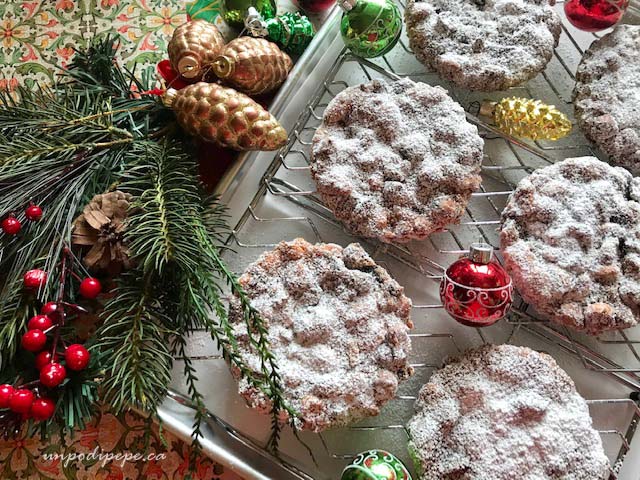
A thin wedge of panforte makes a delicious treat with caffè or liqueur after a meal. Panforte makes a beautiful edible gift-but only for very special people! I made mine small, wrapped them in parchment paper then in Florentine paper and sealed the bottom with a large gold sticker.
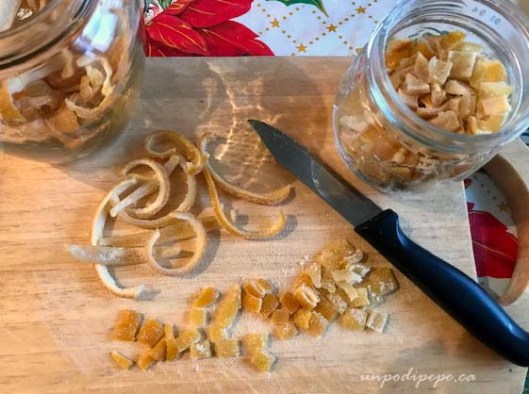
I use white pepper, as the flavour is more delicate, while still providing heat. It is hard to find good canditi, so I made my own with organic orange and lemon peels using Domenica’s recipe.
My homemade canditi ran out after 2 batches, then I substituted chopped dried Kalamata and Mission figs and sour cherries. The zest of an orange added a bit of citrus flavour. For the ostie, I used something called ‘edible wafer paper’ made with potato starch. Edible rice paper is also available at specialty food stores.
Panforte di Siena
Ingredients:
125g (1 cup) hazelnuts
200g (1½ cups) blanched almonds
175g (1½ cups) icing sugar, sifted
200g (⅔ cup) good quality honey
30ml (2 tbsp) water
300g candied fruit peel (orange, lemon, citron) and/or dried fruit
Grated orange or lemon zest
5g (1 tsp) ground cinnamon
2g (¼ tsp) ground ginger
2g (¼ tsp) ground cloves
2g (¼ tsp) ground star anise
3g (½ tsp) ground coriander
2g (¼ tsp) ground nutmeg
2g (¼ tsp) ground white pepper
175g (1½ cup) flour, sifted
Ostie-unconsecrated communion wafer /wafer paper/rice paper
Icing sugar to coat
Instructions:
Using a heavy saucepan and a low flame, set the icing sugar, honey and water to boil. Stir frequently with a wooden spoon, being careful to keep the syrup from sticking. This will take a while, so in the meantime, do steps 2 and 3.
Use tart pan(s) with removable bottoms. Line with the ostie/wafer paper. If needed, grease and dust the sides with cocoa powder.
Toast the nuts lightly for 6-10 min in a 200°C (400ºF) oven.
Coarsely chop the nuts with a knife, or leave whole. Dice the candied fruit and mix with the spices and nuts, then add in the sifted flour.
When the syrup in step 1 reaches at least 100°C (200°F ), remove pot from heat and stir into the nut mixture. If you do not have a candy thermometer, use a toothpick to pick up a bit of syrup and pass it under cold water. If it becomes solid, it is ready.
Working quickly, using wet hands and 2 tablespoons, divide the batter into the tart pan(s), smoothing the top with damp fingers or the back of a wet spoon. It can also be pressed down with the bottom of a glass.
Bake in a 150° C (300°F) oven for 35-40 minutes. Do not let the panforte brown, or it will be too hard.
Remove the panforte from the pans and let it cool completely on a rack. Dust with icing sugar on all sides. and serve cut into thin wedges.
Panforte keeps well for a month if wrapped in parchment paper or in an airtight container and stored in a cool, dark place. Do not store in the fridge.
This recipe makes one 22cm (9½ inch) panforte in a springform pan or six-seven 10cm (4 inch) panforte in tart pans. A 25cm (10 inch) round of parchment paper and fancy paper wraps the 10cm size.Doubling the dose is not a great idea since you need to work fast. If you make 2-4 doses in a row like I do, you can prepare everything in advance. I measure all the spices for each dose in a little jar so they are ready to add in, toast the nuts in advance, and have a separate bowl for each dose so I can work quickly. I also have the wafer paper cut in advance and the tart pans ready on a baking sheet.
Let me know how your panforte comes out! Buon appetito e Buone Feste, Cristina
Il Zampognaro (zahm•poh•NYAH•roh) is a part of most Italian Presepi or Nativity scenes. Zampognari are traditional Abruzzese shepherds, playing bagpipes known as zampogne (zahm•POH•nyeh). I have wanted one for a long time, and wrote about it in Il Presepio and Il Presepio di Mamma. Last year in Napoli’s Via San Gregorio Armeno I was so overwhelmed that I forgot to look for one!
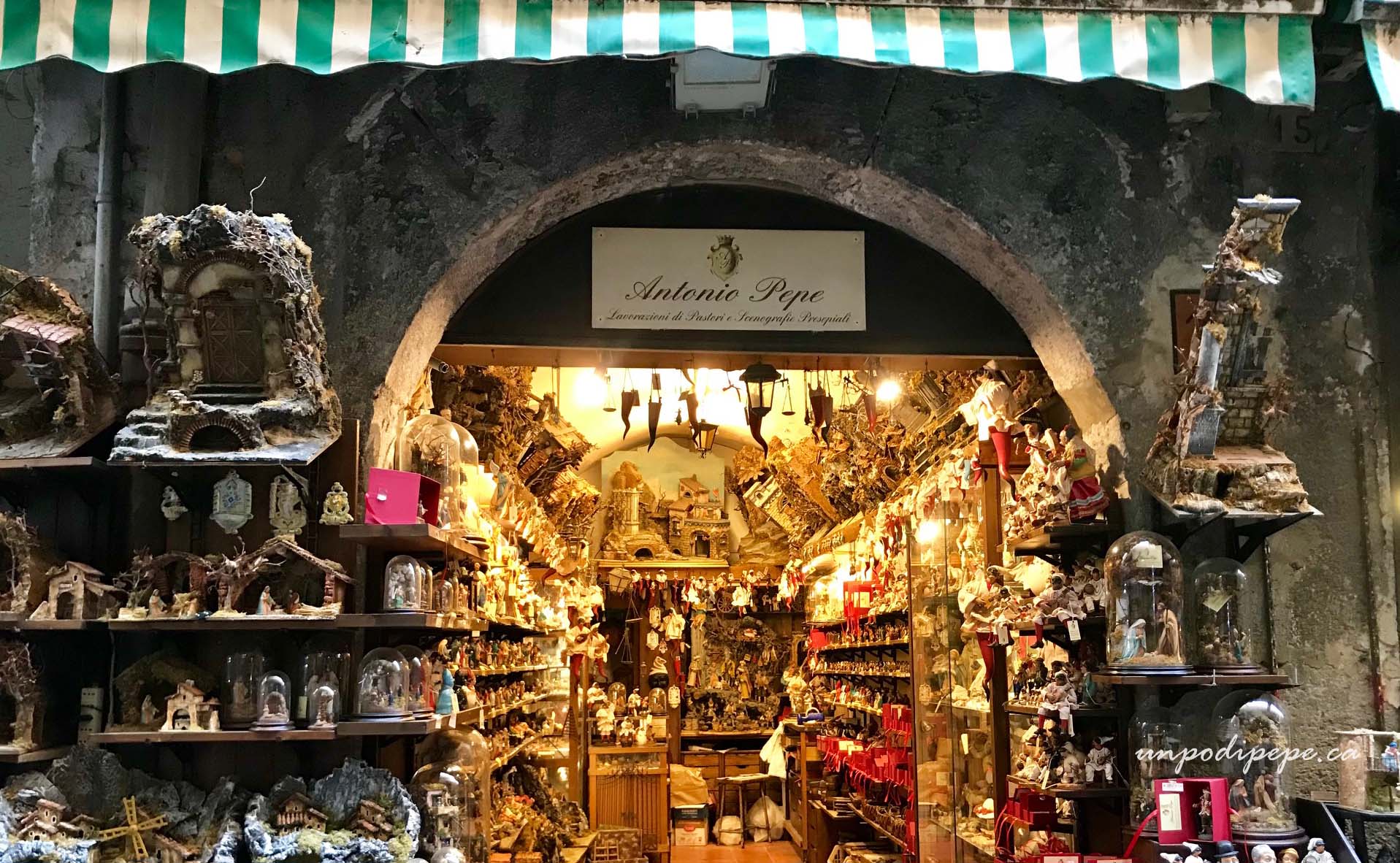
‘Lavorazioni di Pastori e Scenografie Presepiati Antonio Pepe’, Via San Gregorio Armeno, Napoli (no relation!)
This year, I spent a few days in Lecce before going to Napoli. Lecce is known for cartapesta-papier maché and I saw Nativity figures, so I searched and found my hand made glazed terra cotta zampognaro. He is smaller and does not look like the other figures, but he has so much character with his puffy cheeks, I can almost hear him playing Tu Scende dalle Stelle….
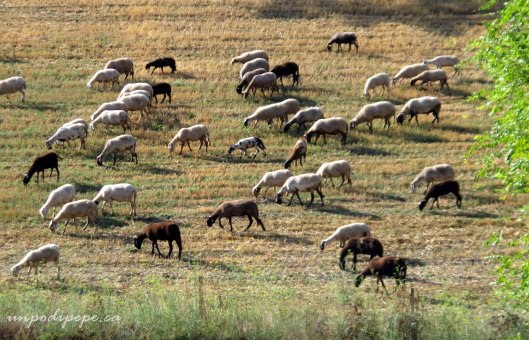
Are you wondering why Abruzzese bagpiping shepherds are in Italian presepi? It has to do with la transumanza, the migration of animals along tratturi-established paths in use since pre Roman times that were protected by royal decree. Pastori-shepherds moved their animals from the mountains of Abruzzo and Molise where they grazed in the summer, to la pianura, the lowlands of Puglia. They did this to escape the snow, and in spring the sheep and goats were herded back to Abruzzo. The tratturi were used into the 1960’s, then trucks replaced the crossing by foot.
During le feste Natalizie, December 8th to January 5th, zampognari in traditional dress would go to the villages to play for extra money or food, thus the zampognaro became symbolic of Christmas in Italia and earned a place in the Presepio.
La Transumanza: Cammino Reale/Royal Shepherd’s Track has been on the tentative list of UNESCO’s World Heritage Sites since 2006. On December 11, 2019, it received UNESCO designation as ‘intangible cultural heritage of humanity’! Auguri zampognari! Do any of you have unzampognaro?
Cari lettori di Un po’ di pepe, Vi augura un Buonissimo Natale e un meraviglioso 2020 piena di gioia e salute!
Dear readers of Un po’ di pepe, I wish you a very Merry Christmas and a marvelous 2020 filled with health and joy!
It’s beginning to look a lot like Christmas in my kitchen! The traditional dolci di Natale baking is not until next week, but here is what has been happening in my kitchen so far this month.
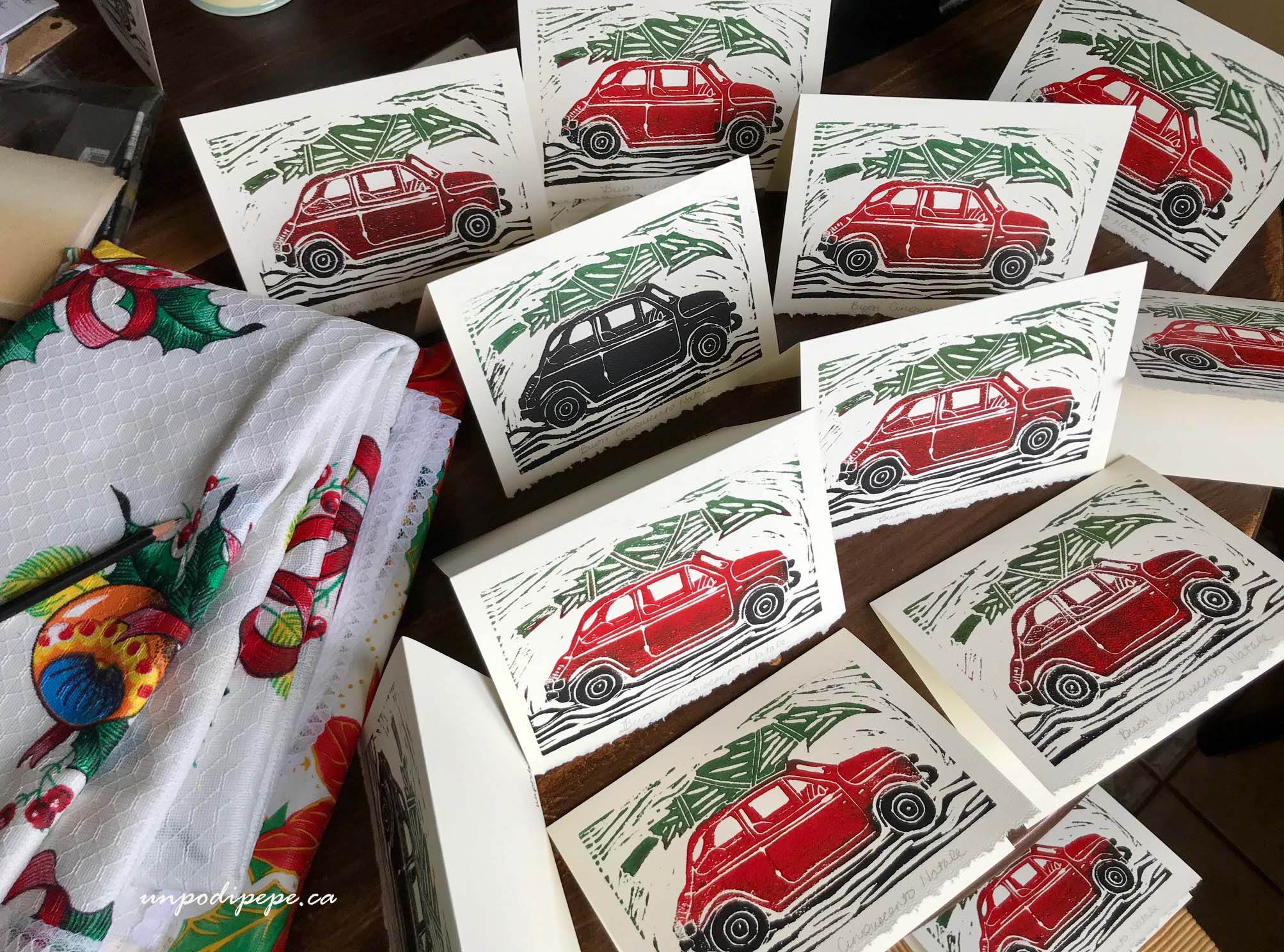
Once again, I had a bancarella at the Italian Christmas Mercato, selling handpulled original prints and handmade cards. A few days before the event, I decided to make another new Christmas card. My kitchen table turned into a ‘studio annex’, full of sketches and linoleum carving tools for a few days!
I carved a Fiat Cinquecento (500) carrying a tree on the roof. The prints barely dried in time, but were very popular! More photos are on my instagram feed, which is linked in the sidebar. This is the original 1957 Cinquecento model, with porte di suicidio-suicide doors that hinge on the left. Find out more in the post The Original Cinquecento. Many of the purchasers had personal stories to tell me about what attracted them to it. A subject for another post!
As usual, I made cookies to offer friends who came to visit me at the mercato. This time I made espresso cookies. Recipe available in Espresso Cookies.
Saturday was Papà’s birthday. He had urgent heart surgery in September, so we were very happy to celebrate this birthday! Mamma and I made his favourite pasta, tagliatelle the week before and froze them in little nests on cookie sheets. They were dropped into boiling water straight from the freezer.
Last Christmas a friend brought Baci made with ruby cocoa beans from Italy. This year I received a box as a gift, purchased from my local Italian deli. What is ruby chocolate? It is not white chocolate with pink coloring! It is milk chocolate made with Brazilian cocoa beans that are a dark purple colour. They are only fermented for a few days, so they do not turn brown, then citric acid is added to keep the pinky colour. This is the same idea as squirting lemon juice on apples when making apple pie, to keep them from going brown. The taste is very slightly berryish and lemony-because of the citric acid. There are no other ingredients or flavourings added. Is this just a marketing ploy? Yes! But since raspberry and lemon are my 2 favourite flavours, I like them anyways. Have you tried Ruby Baci?
Panettone is plentiful in December, and I love panettone french toast. The panettone already has so much flavour that all you really need to do is soak it in eggs and milk then cook it on the stovetop, or even bake it. I added a bit of orange zest and topped it with fresh ricotta and a drizzle of maple syrup-I do live in Canada after all! Do not use expensive or homemade panettone for this. The cheap cellophane wrapped ones are good for french toast.
I made my favourite winter salad, Insalata Purtuall’ with fennel and oranges. Since the oranges had to be peeled, I candied the rind to use later this month for panettone or biscotti.The only Christmas baking so far in my kitchen are cranberry pistachio orange biscotti. It was my first time making them and will definitely make them again.
Read more about my family’s traditional Christmas baking in a previous post Dolci di Natale. Links for my recipe for Panettone with Orange Walnuts and Figs and for Crustoli can be found in this post. We will be making Cauzuncill’ and Cartellate in a few days.
Thanks Sherry from Australia for hosting the monthly food blogging event, In My Kitchen (IMK). Read about what is happening in other world kitchens in December by clicking the link to Sherry’s Pickings.
It is probably obvious from my photos that I love le feste Natalizie-the Christmas season. Festive décor, lights, music and baking help me get through the early darkness and awful weather at this time of year. I decorate every room in my house, but my favourite piece of Christmas is definitely the Presepio. A few years ago, I wrote a blog post about the history of Il Presepio and have included photos of mine in previous December posts.
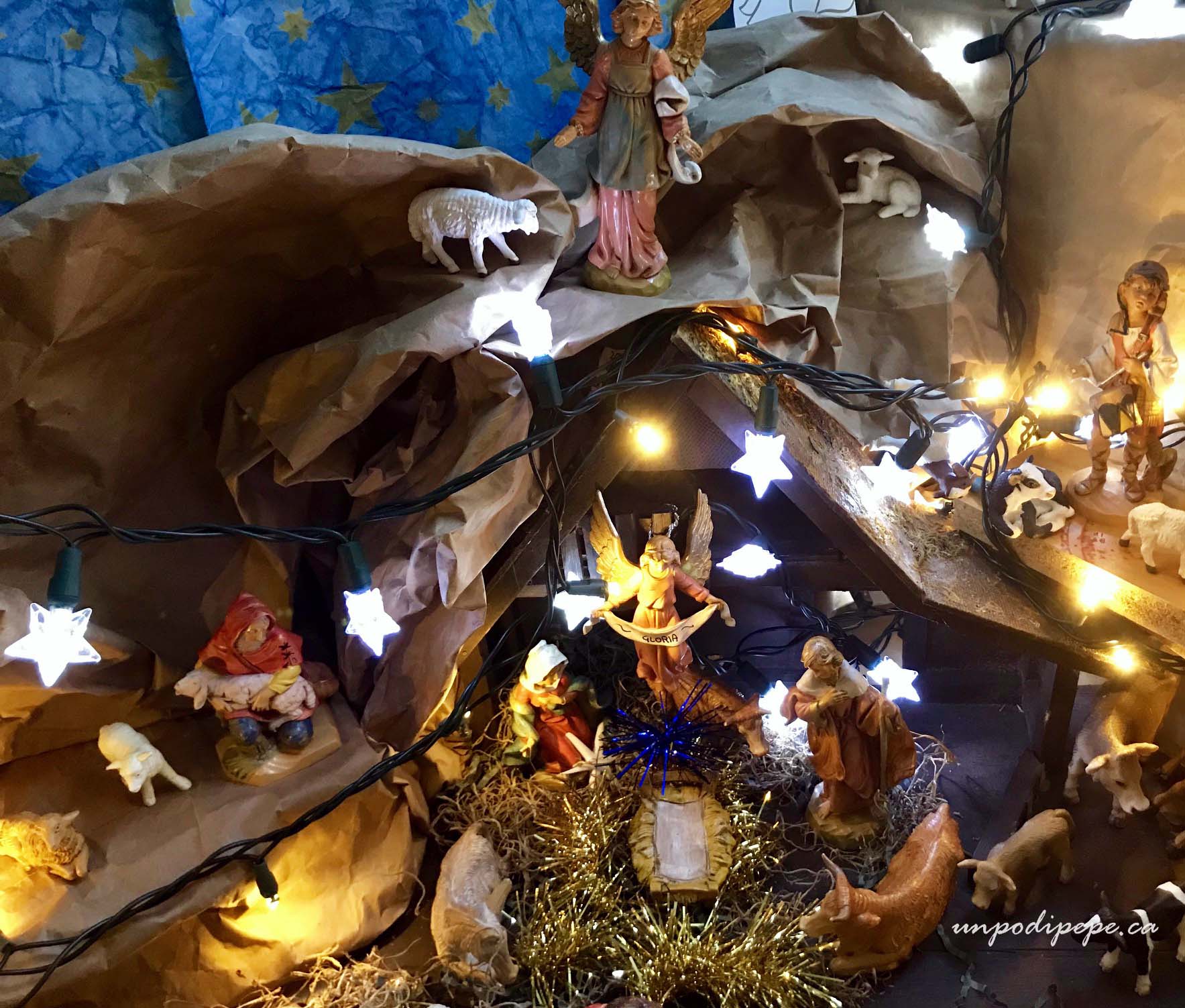
My Presepio has grown over the years, but includes mostly the ‘main players’. My Mamma’s Presepio also started out this way, but is now a whole village. It was originally placed under the tree, since l’albero di Natale was a new tradition for most new italocanadesi. It was eventually moved to the fireplace hearth, and then to a table. The stable was originally ‘rustic’, made with one of those large paper grocery bags, with the rim folded down many times and a window cut out the back for a light, or a mandarin orange box covered in brown butcher paper. The figures were the Holy Family, an angel, and ox and donkey, a shepherd with a few sheep and the 3 Wise Men. The manger is empty in the photo, as Baby Gesù does not get placed there until tonight, la Vigilia di Natale.The 3 Wise Men or Rè Magi are far off in the hills since they do not arrive in Bethlehem until the l’Epifania, January 6th. Trailing behind is La Befanatrying to catch up to them.
Presepio figures are not easy to find in Vancouver, but she slowly acquired village people, more shepherds, camels and lots of other animals. Various pieces were purchased in Assisi, the Vatican and Mexico, even a napkin holder from Venezuela doubles as il forno. The beautiful starry sky was brought by a friend from Roma. In August I went to Via San Gregorio Armeno in Napoli, the street famous for Presepio making artigiani.
‘Lavorazioni di Pastori e Scenografie Presepiati Antonio Pepe’, Via San Gregorio Armeno, Napoli (no relation!)
The Presepio inventory is low in summer, but I bought a terra cotta prosciutto, capicollo and cacciotta and a cestino of eggs which you can see in the photo below. I also bought 2 tiny chairs just like the ones we have in Orsara. I forgot to buy a zampognaro-an Abruzzese bagpiping shepherd-so I will have to go back to Napoli!
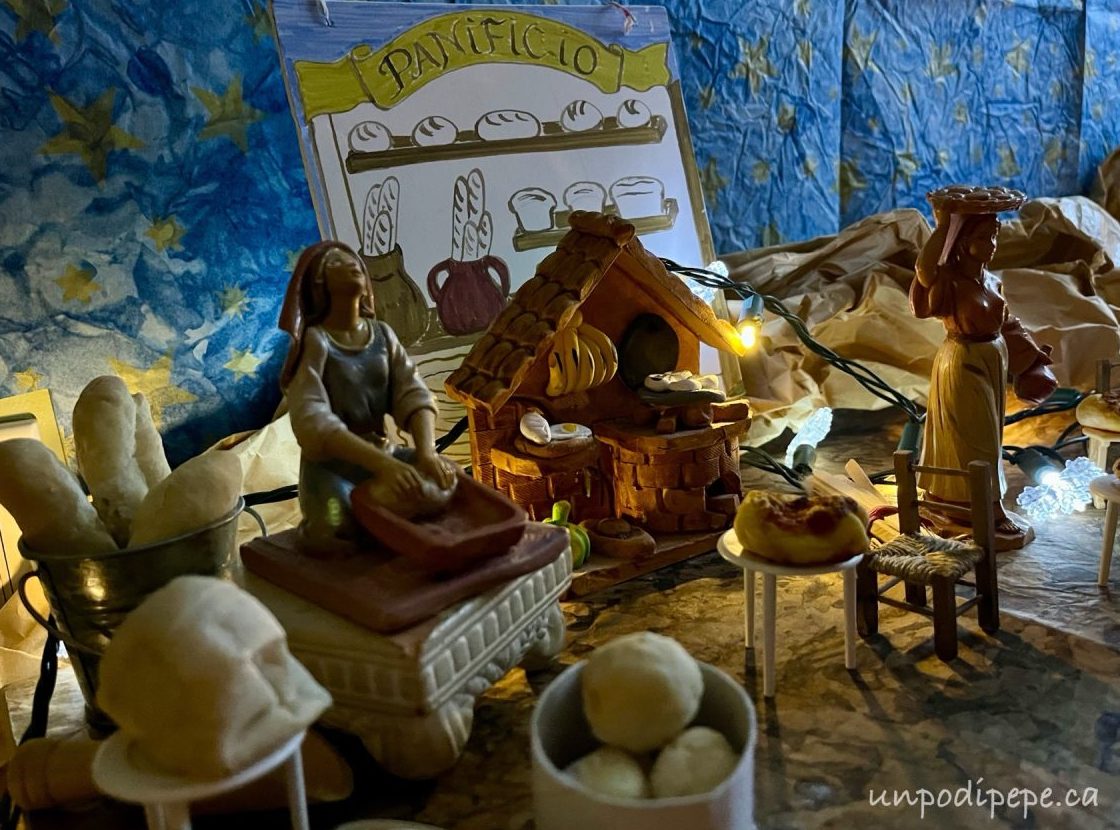
Mamma gets very detailed and creative with her Presepio. She starts working on it mid November and really enjoys putting it together. I am often asked to help create accessories. The cutest detail is the tiny loaves of bread, panini and focaccia Pugliese that she bakes for the forno.
It is interesting to note that San Francesco d’Assisi created the first Presepio in 1223 in an attempt to return to the true meaning of Christmas and take the focus off of gift-giving. So Charlie Brown was not the first to search for ‘the true meaning of Christmas’! If any of you have a Presepio, I would love to hear about it!
Cari lettori di Un po’ di pepe, Vi augura un Buonissimo Natale e un meraviglioso 2019 piena di gioia e salute!
Dear readers of Un po’ di pepe, I wish you a very Merry Christmas and a marvelous 2019 filled with health and joy!
L’albero di Natale, my Christmas tree is now up and decorated. I usually have it all done by now, but I am behind this year. It was not planned, but I did the Italian thing this year! December 8th is l’Immacolata Concezione, the festa celebrating the conception of the Vergine Maria. It is a national holiday in Italia and the official start of le feste Natalizie-the Christmas season. It is also the day most Italiani put up and decorate their albero di Natale and presepio. The Christmas decorations-addobbi Natalizie stay up until January 6th, la festa del Epifania-after a visit from La Befana. Earlybirds decorate on December 6th the festa di San Nicola.L’albero di Natale is long standing tradition in Northern European countries, but a much newer custom in Italia. Alberi sempervivi-evergreen trees, have symbolized life, regeneration and immortality. The Celts, Vikings and pre-Christian Germanic tribes decorated evergreens during Solstice celebrations. In the harsh northern winters evergreen trees, holly and mistletoe were the only things that stayed green, so they were thought to have magical powers. Wreaths and evergreen branches were hung over doors as a defense against evil spirits and a symbolic defense against the harsh winter. I can totally relate to this last one. My addobbi Natalizie help me get through the winter! ‘Modern’ use of l’albero di Natale started in the 13th Century and became a custom in Northern Europe. In Southern Europe, it was seen as more of a Protestant custom and did not catch on. In 1848, when Prince Albert of Germany married Queen Victoria, he brought the Christmas tree custom with him, which spread through the British Empire.
Regina Margherita di Savoia-yes she of pizza fame-was the first to decorate unalbero di Natale in Italia in the late 1800’s at the Palazzo Quirinale. The custom spread slowly, but grew in popularity after WWII. In 1982, Pope Giovanni Paolo II first introduced a tree in Piazza San Pietro. Now most families have un albero di Natale, and the presepio is often placed under the tree. Is your albero di Natale up yet? Buon Natale, Cristina
Panettone is a Christmas and New Year’s tradition in Italian households. Panettone (pah∙neh∙TOH∙neh) literally means big loaf of bread. Panetto is a small loaf of bread and the suffix ‘one’ makes it a big bread. The origins of panettone probably date back to the Ancient Romans, who made a leavened bread with honey and raisins. Bread has always been a symbol of family ties, as in ‘breaking bread’ together. In the middle ages, a sweet leavened bread with dried fruit was incised with the sign of the cross before baking as a blessing for the new year, then distributed to the family. A slice was also saved for the next year. In the 1400’s it became custom to make il pane di Natale-Christmas bread, with white flour and costly, hard to find ingredients that made it special. This was called pane di lusso-luxurious bread, which in Milanese dialect was ‘pan del ton’. Modern panettone originated 500 years ago in Milano during the reign of Ludovico Sforza (1481-1499). There are several legends regarding its origin.
In the most romanticized legend, Ughetto, son of nobleman Giacometto degli Antellari fell in love with the beautiful Adalgisa. To be near his innamorata, he pretended to be an apprentice baker for her father Antonio, who was called ‘Toni’. Desperate to impress Toni, Ughetto created a rich bread with yeast, butter, eggs, sugar and canditi- candied cedro and orange peel. The bread was an overwhelming success and people came from all over Milano to taste this ‘pane di toni’ – Toni’s bread. Duchess Beatrice d’Este, wife of Ludovico Sforza, was so taken with the love story that created this bread that she convinced Giacometto to let his son marry the baker’s daughter.
Another version takes place in Ludovico’s kitchens. There was a custom to prepare a particular dolce for guests on Christmas Eve. Unfortunately, it was burnt, sending the cook into desperation. One of the kitchen workers, a boy named Antonio, offered the bread he was making for himself using the dough left over the day before from the original dolce. It was a domed sweet bread with grapes. When the invited guests asked what this delicious dolce was called, the cook replied ‘pan del toni’.
The final legend is the simplest, but probably the most believable. It involves Suor Ughetta, a young nun in a very poor convent in Milano. To make Christmas Eve more festive, she made a dolce for her fellow sisters with butter, sugar, eggs, canditi and uvette. Uvetta means raisin in Italiano, and in dialetto Milanese it is pronounced ‘ughetta‘. Whichever legend we choose to believe, today panettone is synonymous with Natale for everyone of Italian origin.
In 1919, baker Angelo Motta opened his first pasticceria in Milano. He let his panettone rise 3 times, to the familiar cupola or dome shape on a cylinder that we see today. Previously the shape of panettone was more schiacciata-lower and more compact. Motta also invented the paper wrap and box. A few years later, he had a competitor in Milano, Gioacchino Alemagna. Their competition led to industrialized production of panettone, with factories replacing the small pasticcerie. They also began exporting all over the world. Today both Motta and Alemagna are owned by Bauli, based in Verona. Last year almost 120 million panettoni were produced in Italia!
I will be enjoying my panettone and prosecco for Capodanno-New Year’s eve, and making panettone French toast with ricotta if there is any left over! I have been experimenting with making my own panettone since last December. My next post is a recipe for Panettone fatto in casa! Read about other dolci di Natale in this post. Buon appetito, Cristina
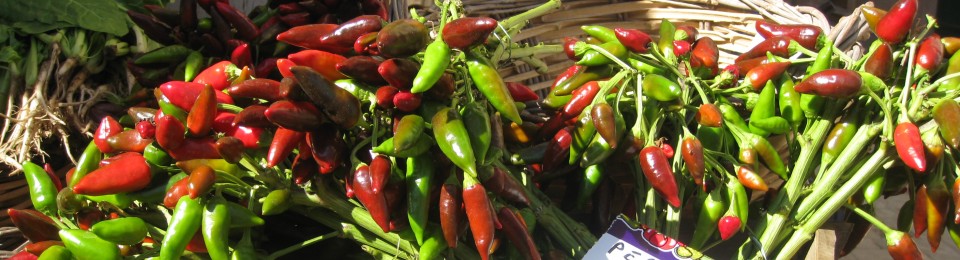
 Cari amici di ‘Un po’ di pepe’, auguro un buonissimo Natale e un meraviglioso nuovo anno piena di gioia e salute a voi e alle vostre famiglie!
 The title photo is of my presepio. I may have to find a bigger space for it next year. Below is the panificio corner of Mamma’s presepio. Notice how she bakes tiny bread loaves and baguettes-even focaccia Pugliese!
 Next is Mamma’s vicolo dei lavandai/ washerwomen’s alley. I love the attention to detail, especially the washboards and clothesline. The lavandaia on the left with the red scarf is from Via San Gregorio Armeni in Napoli.

 These classic old homes look beautiful all lit up-minus the inflatable Santa and Frosty.
 And finally, the snowman family is adorable!
 Un abbraccio, Cristina








 Doubling the dose is not a great idea since you need to work fast. If you make 2-4 doses in a row like I do, you can prepare everything in advance. I measure all the spices for each dose in a little jar so they are ready to add in, toast the nuts in advance, and have a separate bowl for each dose so I can work quickly. I also have the wafer paper cut in advance and the tart pans ready on a baking sheet.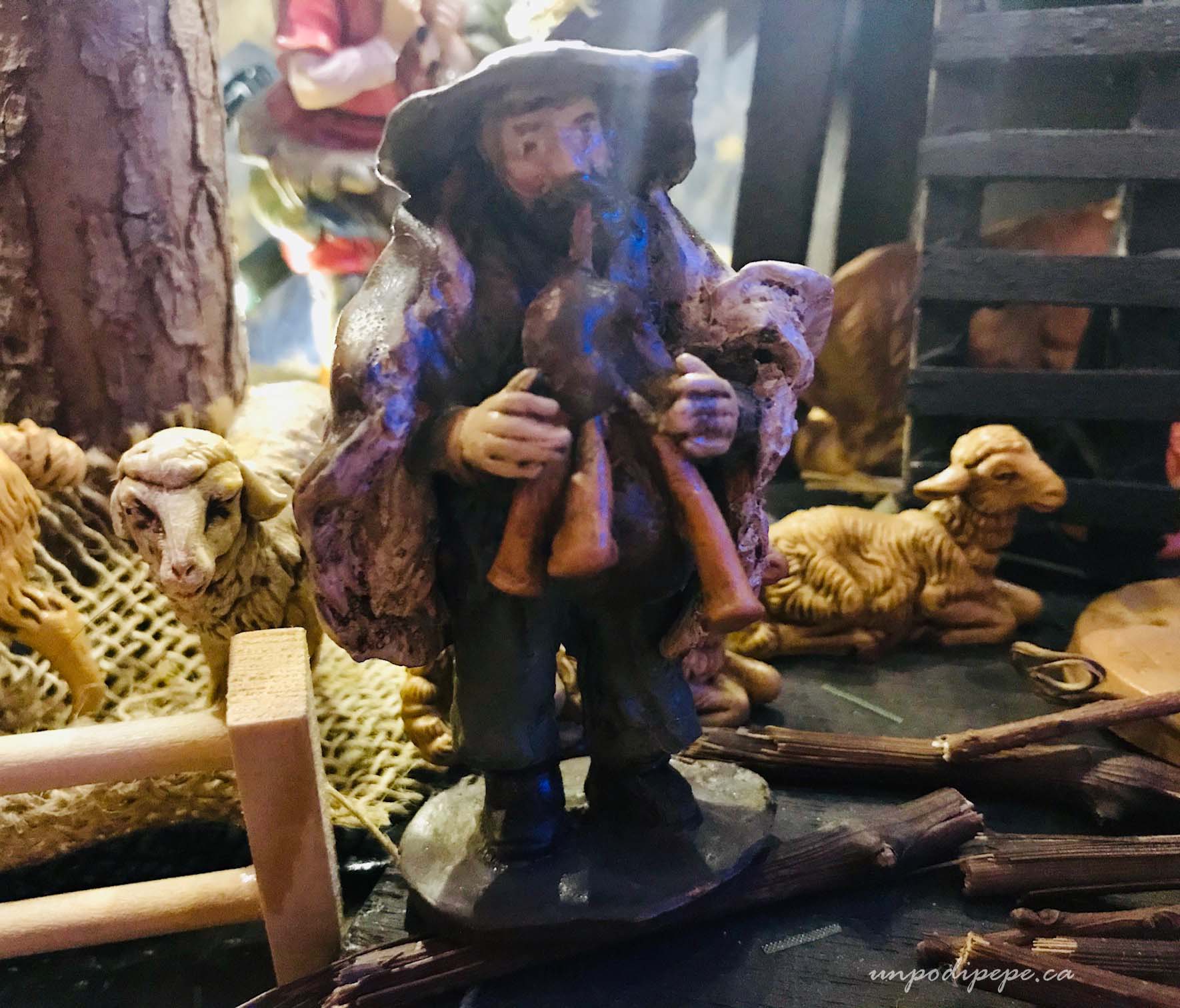








 Regina


 Un po' di pepe