• Home
  • About me/Chi sono
  • Contact

Un po' di pepe

~ …… (oon∙poh∙dee∙PEH∙peh) Cristina writes about interesting stuff /Cristina scrive di cose interessanti

Un po' di pepe

Author Archives: Un po' di pepe

700 Years of Dante

28 Thursday Jan 2021

Posted by Un po' di pepe in Firenze, Italia, Italian language

≈ 13 Comments

Tags

Accademia della Crusca, Dante, Dante Alighieri, Firenze, Italian history, Italian language, Italian literature, La Divina Commedia

Dante Alighieri profile2021 is the 700th anniversary of the death of Dante Alighieri.  Dante is known as the ‘Father of the Italian Language’.  His most famous work La Divina Commedia (The Divine Comedy) is considered a masterpiece, the first and still the greatest work of literature in the Italian language and a precursor to modern fiction.  In the late medieval period, Latin was the only language for education, literature and religion.  La Divina Commediawas the first major work written in a language of ordinary speech or vulgare, the way people actually spoke at home. Dante combined Tuscan and other dialects, including Sicilian and Latin, establishing the modern Italian language.  Even though La Divina Commedia was written in 1308-20 the language is understandable today.Dante Divina Commedia

La Divina Commedia is a 3 part epic poem written in the first person, emphasizing the importance of salvation and Divine love in the redemption of humanity. It explores Dante’s imaginary trip to Paradiso (Heaven), passing through L’Inferno (Hell) and Purgatorio (Purgatory).  It is also a critique of famous figures of his time. The work is filled with historical, mythological and biblical references and discusses politics, religion, science, ethics and love. La Divina Commedia does not contain jokes nor is it funny.  The reason it is termed a commedia is because it is not a tragedia (trajedy) and it has a happy ending.

Dante was born in Firenze in 1265.  He studied philosophy, poetry, and was also an apothecary-a medieval pharmacist.  This is not as strange as it sounds, since nobles in public office had to belong to one of the city guilds and books were sold by apothecaries at the time. He married Gemma Donati in 1285 and they had 3 children.  Dante’s family was involved in the Guelfi/Ghibellini (Guelph/Ghibelline) power struggles.  The Guelfi supported the Papacy and the Ghibellini supported the Holy Roman Emperor -even though there was not one at the time. 

The Guelfi split into 2 groups because the Pope kept interfering with internal matters in Firenze.  Guelfi Bianchi (White Guelphs) did not want the Pope involved in city politics and Guelfi Neri (Black Guelphs) supported complete Pope authority. Dante’s family were Guelfi Bianchi.  In 1302, while Dante was in Roma as an ambassador, Firenze was occupied by the Guelfi Neri.  The Guelfi Bianchi, including Dante and his sons, were exiled. A few years later, other Guelfi Bianchi in exile were pardoned- but not Dante.  He was quite the badass in exile and burnt his bridges by writing many nasty letters.  Dante was offered amnesty in 1315, but it came with conditions and a heavy fine, which he was not able to pay.

Dante wrote La Divina Commedia while in exile and ruthlessly sends everyone responsible for his banishment to eternal damnation in L’Inferno.  He put a lot of effort and imagination into coming up with the horrible details! If Dante were alive today, he would probably be writing political satire.

Dante never did return to his beloved Firenze.  He stayed in Roma, then moved to Ravenna, where he completed Paradiso in 1320 and died of malaria Sept 14th 1321.  He is buried in the church of San Francesco. Jacopo Alighieri (1289-1348), also a poet, regained possession of his father’s confiscated property in 1343.

Firenze regretted Dante’s exile, and repeatedly asked Ravenna for his remains. A tomb was even built in 1829 in Santa Croce but all requests were refused and the tomb is empty. In June 2008, Firenze finally passed a motion rescinding his sentence and exile.  As my Mamma says ‘meglio tardi che mai’-Better late than never!

700th anniversary celebrations are happening throughout 2021, although most of them will depend on ever changing COVID 19 restrictions.  There is a website for all of the 700 Dante Firenze festivities. A few examples:

Museo di Casa di Dante has a new multimedia display and a virtual tour.
 
L’Accademia della Crusca, Italia’s fun ‘language police’ was established in Firenze in the 16th Century to safeguard the study of the Italian language.  Their website includes ‘Parola di Dante fresca di giornata’ a Dante word of the day for each day of 2021!

La Divina Commedia is as relevant today as it was in 1320.  I will leave you with an encouraging message of hope from the final phrase of l’Inferno…

             ‘e quindi uscimmo a riveder le stelle’– ‘hence we came forth to see the stars again’

Ciao, Cristina


Statue of Dante in Piazza Santa Croce, Firenze

Share this:

  • Share on Facebook (Opens in new window) Facebook
  • Share on Pinterest (Opens in new window) Pinterest
  • Share on X (Opens in new window) X
  • Email a link to a friend (Opens in new window) Email
  • Share on WhatsApp (Opens in new window) WhatsApp
Like Loading...

Buon Anno 2021

07 Thursday Jan 2021

Posted by Un po' di pepe in Blogging, Inspiration

≈ 11 Comments

Tags

2020 year in review, Blog year in review, Blogging, Italia


Buon Anno a tutti i lettori di ‘Un po’ di pepe’, vicini e lontani!  Spero che 2021 porta buona salute e gioia a voi e ai vostri cari
.  Happy New Year readers of  ‘Un po’ di pepe’, near and far.  I hope 2021 brings good health and joy to you and your loved ones!

I usually write a Buon Anno post on New Year’s Day, looking back at the blog year.  I am late in writing this one, since I wrote an end of year post Reflecting on 2020, summing up and bidding good riddance to 2020-although I was not that polite in my sendoff!

WordPress keeps end of year stats which I love to share because they are so interesting.*  In 2020, Un po’ di pepe had over 14,000 views from over 100 different countries!  I wish I could visit all of of them!  The top posts of 2020 are listed here, in case you missed any of them.  Lots of links included!  Based on the number of views, the top posts of 2020 are:

#10 Viaggio con Isabella A summary of a trip to Italia with my super-photogenic energetic travel buddy, my nipotina* Isabella.  Since travel is still not possible, enjoy a virtual trip with us!Piazza della Repubblica selfie
#9  Limoncello Because the pandemic caused a hand-sanitizer shortage, I was able to get some grain alcohol.  When life gives you lemons……This post includes instructions and photos of the process to make limoncello at home.Limoncello steeping

#8 Cinquecento Love In May I published an article/photo essay about my lifelong obsession with the huggable Fiat 500 in a special print edition of Accenti Magazine.  This post links to the full online article.Fiat Cinquecento wedding car

#7 The recipe for Olive oil Limoncello Cake was inspired by an art retreat at Casa Berti near Lucca, surrounded by 900 olive trees, freshly pressed olive oil and limoncello.Olive oil limoncello cake

#6 Napoli  Street  Art I just love Napoli a perfect place for self-expression for the last few thousand years.  Join me on a graffiti/street art tour in the Centro Storico.volto di Sophia Loren Napoli street art

#5 I was happy to see La Trinità di Masaccio on this list yet again! When I first published this art history lesson, it had about 30 views, but I discovered that it comes up as the 1st listing in a google search! This explains the steady trickle of views. I also suspect that it is on some sort of a reading list for art history classes in the US, because I have noticed a lot of views referred from the course websites of Santa Monica College and a high school in Pittsburgh! How cool is that?  Didn’t I say the stats were fascinating?

My quick sketches of the vanishing point, perspective lines and triangular composition. The colour image is my entry ticket from 2004!

#4  I am so super thrilled that L’Arte sa Nuotare  made my top list again! During my trip with my nipotina** Isabella we were on constant lookout for street art by Blub, the talented artist who plunges famous works of art underwater. This post also comes up 4th on a google search.  Spread the Blub love- read about more Blub in Blub a Napoli.Blub street art Firenze

#3 The Last Medici As an art history nerd, this post was my personal thanks to Anna Maria Luisa De’ Medici (AMLDM) the last of the Medici family, for leaving the world her family’s legacy of art treasures.  I was thrilled to see it get some love!

#2 Italiano per Ristoranti-How to Pronounce your Restaurant Menu, this handy Italian menu pronunciation guide has been #1 every year until now.  In a google search for ‘Italian pronunciation guide restaurant’ and ‘Italian menu pronunciation’ it comes out as the top suggestion! Molto cool! This post is available as a 6 page downloadable PDF via a link on the post.  Someday, I plan to expand and turn it into an ebook. Speriamo!

Bruschetta (broo.SKET.tah)

#1 For the first time ever a different post is #1.  I wish I had not had to write this post,  but I am glad I did.  COVID 19-Andra tutto bene was my top post for 2020.  A lot has been written since, but I wrote this early into the pandemic, after overhearing too many people saying that it was all a hoax and more people die from the seasonal flu.  As a health professional, I felt I needed to provide some education as a public service. I followed it with another post COVID 19-Insieme ce la faremo.

For 2021 my goals are simple….lots of travel-if we are able, less stress, more exercise, more art and writing!

I would love to hear which post you liked best, and what you would like to read more about in 2021 on Un po’ di pepe?  Let me know in the comments.  Looking forward to writing more cose interresanti /interesting stuff in 2021.

Vi auguro un 2021 piena di gioia e buona salute!  Ciao, Cristina

*Note…WordPress’ method of collecting stats is odd.  The newest post counts as a ‘Home page’ view until the next one is published and I am not sure how much this changes the results.

**Nipote or nipotina means both niece and granddaughter in Italiano.  In this case, it means niece.


Share this:

  • Share on Facebook (Opens in new window) Facebook
  • Share on Pinterest (Opens in new window) Pinterest
  • Share on X (Opens in new window) X
  • Email a link to a friend (Opens in new window) Email
  • Share on WhatsApp (Opens in new window) WhatsApp
Like Loading...

Reflecting on 2020

30 Wednesday Dec 2020

Posted by Un po' di pepe in Blogging, Inspiration

≈ 26 Comments

Tags

Coronavirus, COVID19, COVID19 pandemic, Sottosopra, Street art

5 masks hanging on a clotheslineAddio 2020!  Is that too polite? How about vai via 2020?  Via al inferno 2020?  Vaffanculo 2020 may be the most appropriate send off to this year that most of us would like to forget.  COVID 19 has affected life for everyone.  Even in my weirdest dreams, I never imagined plague and pestilence in the form of a planetary health crisis during my lifetime…..yet here we are.

My word of the year is sottosopra (sot•toh•SOH•prah)…..upside down.  I doubt I am alone feeling like an extra in a bad science fiction movie, where everything in the world is upside down. Kisses and hugs spread disease, lounging on the couch binge watching Netflix is responsible adult behaviour, NOT visiting family is a sign of love, and losers are the ones who DO go out on New Year’s Eve!Personal Protective Equipment

The loss of life, paralysis of the world economy, and mental health effects of this pandemic have been devastating.  It has been more stressful than most of us are willing to admit.  Each of us copes differently with the confusion, fear and stress of quarantine, distancing, and finding distraction from all things 2020.  Some of us are madly productive, and others slow right down.  As long as our activities help us cope and we follow local guidelines to help everyone stay safe, it does not really matter.

This has been a time for many of us to reflect about what is important, especially so in this quieter of Christmas seasons.  There are not many positive things to discuss during a global pandemic.  Even so, I have felt humbled by the outpouring of kindness, humanity and creativity that has come out of this terrible situation and speak to the resilience of the human spirit.  Just a few of my favourite examples include:

  • The adaptability and creativity of businesses, workplaces, schools and social groups, offering their services differently and online.  I have been doing zoom yoga 3-4 times a week! Many of these practices will likely continue in some form when the world is no longer sottosopra!
  • The world becoming emotional watching videos of neighbourhoods throughout Italia singing in solidarity from their balconies and windows.  This uplifting show of unity and community support spread positivity around the world.
  • Collective rounds of applause and banging of pots for frontline health care workers.  As a healthcare worker, I thank you all for your enthusiasm! This video ‘A Violin flies over Cremona’ of Lena Yokoyama playing Ennio Morricone for health care workers on the roof of the hospital in Cremona makes me cry.  The full 15 minute documentary, with English voice over by my amica Anna Ambrosini is available here 
  • Pandemic street art!  A creative response to the pandemic, often with a dose of humour.  I wrote about street art for International Nurses Day and have another post planned soon.John Doh street art
  • Volunteers helping the elderly with groceries and errands, sewing masks, donating blood and many other wonderful things.
  • Nerdy science geeks are finally cool!
  • The elementary school near home had to cancel their Christmas concert.  They walked around and sang in front of the homes of the older and housebound neighbours instead.  Singing with their antlers and little masks on-they were adorable.  My parents were so thrilled, as was 98 year old Pasquale across the street.
  • The extra effort to spread Christmas cheer this year with outdoor decorations and lights.   Tree lots here sold out the in first week and many stores almost sold out of seasonal stuff by mid-December.  My lights and decorations always help me get through the cold, wet, dark, depressing days of winter, so I have really appreciated this.


    2020
    was consistent…ha fatto schifo dall’inizio fino alla fine! It sucked from beginning to end!

    Please remember the global Christmas message of goodwill towards everyone.  We are all facing challenges that are not visible.  Do not assume you know what others are going through. As our Chief Medical Health Officer Dr. Bonnie Henry says ‘Be safe, be calm, be kind’.

    Il Bacio TV Boy Pandemic street art

    Wishing all readers of Un po’ di pepe a safe, healthy, happy, better New Year, where the world is not upside down!

    Tanti auguri a tutti i lettori di Un po’ di pepe per un migliore Anno Nuovo piena di gioia, salute e sicurezza, dove il mondo non è sottosopra5 masks hanging on a clothesline

     Forza!  Hang in there everyone!

     Virtual baci e abbracci, Cristina

    Street art images from the artist’s instagram:

  • No need to shit yourself @johndohart
  • Trust Science, not Morons, Mike Dellaria @dellarious
  • Il Bacio @TVBoy

Share this:

  • Share on Facebook (Opens in new window) Facebook
  • Share on Pinterest (Opens in new window) Pinterest
  • Share on X (Opens in new window) X
  • Email a link to a friend (Opens in new window) Email
  • Share on WhatsApp (Opens in new window) WhatsApp
Like Loading...

Panforte di Siena

12 Saturday Dec 2020

Posted by Un po' di pepe in Feste, Mangiamo!, Recipes

≈ 26 Comments

Tags

Cucina Toscana, Dolci, Dolci di Natale, Gastronomic history, Italian Christmas, Natale, Panforte Margherita, Panpepato, Siena, Via Francigena

Panforte di Siena

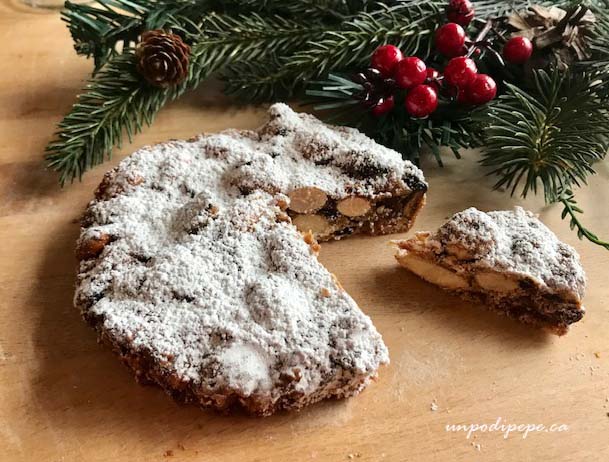
Panforte is un dolce Natalizie- a seasonal treat from Siena, although it is sold all year round.  A chewy, sweet cake, panforte leaves a wonderful aftertaste of candied citrus, almonds and a bold hit of spices.

Panforte dates back to the introduction of exotic spices from the East, via the port of Pisa.  The earliest known record is from the 13th Century.  Documents in the State Archive of Siena state that a bread rich with pepper, spices and honey was paid as a tax to the monastery of Monte Celso on the seventh of February, 1205.

Panforte di Siena

Panforte was originally made with flour, water, honey and spices, mixed with chunks of fresh autumn fruits such as grapes, figs and plums.  The water content of the fruit kept the bread moist and after a few days, fermentation gave it an acidy flavour. This is where the name panes fortis, or ‘strong bread’ comes from.  It was also known as panpepato because of the abundance of pepper and other spices and the dusting of black pepper on top.

Panforte di Siena ingredients

Panpepato/panforte was made by speziali, spice sellers who could be considered medieval pharmacists.  It was valued not only as a food but also as a medicinal remedy because of the spices it contained.

Siena was on the Via Francigena, the ancient pilgrimage route running through France to Roma, then to Puglia where the ports of Bari, Brindisi and Otranto were transit points for the Holy Land.  This made Panforte known outside of Tuscany. A sweet cake with energy and sustenance, Crusaders carried it on their travels…like medieval energy bars! In 1515, a nun named Suor Berta changed the fruit to canditi-honeyed or candied fruit.  The canditi were usually citrus fruits (orange, lemon and cedro/citron) and dark melon or pumpkin.

Canditi, nuts and especially spices were $$$ costosissimi-making Panforte an extremely expensive item.  Only the wealthy could afford the extravagance.  It was also given to the clergy as a gift on special occasions such as Christmas or local feast days.Panforte confezionato

The recipe remained the same for centuries, almonds, flour, honey, canditi and spices, dusted with black pepper and held together at the bottom with foglie di ostie-a sheet of unconsecrated communion host! That was until 1879, when Regina Margherita di Savoia– of pizza Margherita fame-visited Siena. In her honour, a local speziero made a more delicate ‘white’ version of panforte, without the black candied melon and covered with a dusting of vanilla icing sugar instead of black pepper. It was called Panforte Margherita and is the version most often sold today.  In 2014, Panforte di Siena received the PGI (Protected Geographical Indication) European Union designation of quality label. Panforte di Siena with holly and greenery

In Siena it is thought that Panforte should contain 17 different ingredients.  This is because 17 is the number of Contrade or districts in Siena.  Representatives from the Contrade take part in the Palio di Siena horserace every July 2 and August 16.

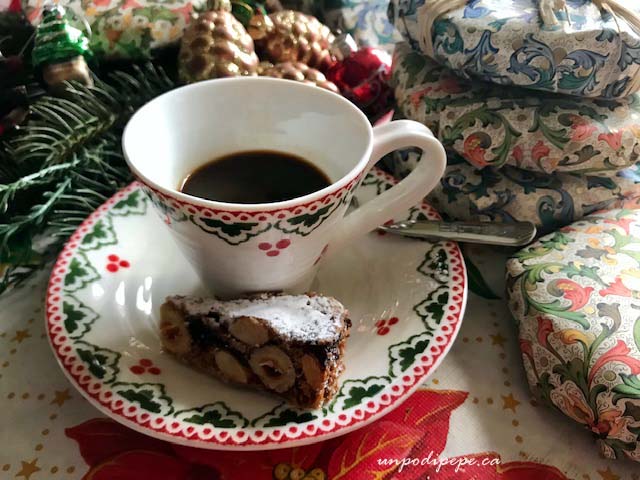
A thin wedge of panforte makes a delicious treat with caffè or liqueur after a meal. Panforte makes a beautiful edible gift-but only for very special people! I made mine small, wrapped them in parchment paper then in Florentine paper and sealed the bottom with a large gold sticker.Homemade panforte di Siena

I use white pepper, as the flavour is more delicate, while still providing heat.  It is hard to find good canditi, so I made my own with organic orange and lemon peels using Domenica’s recipe. canditi

My homemade canditi ran out after 2 batches, then I substituted chopped dried Kalamata and Mission figs and sour cherries. The zest of an orange added a bit of citrus flavour. For the ostie, I used something called ‘edible wafer paper’ made with potato starch. Edible rice paper is also available at specialty food stores.

Panforte di Siena

Ingredients:

125g (1 cup) hazelnuts

200g (1½ cups) blanched almonds

175g (1½ cups) icing sugar, sifted

200g (⅔ cup) good quality honey

30ml (2 tbsp) water

300g candied fruit peel (orange, lemon, citron) and/or dried fruit

Grated orange or lemon zest

5g (1 tsp) ground cinnamon

2g (¼ tsp) ground ginger

2g (¼ tsp) ground cloves

2g (¼ tsp) ground star anise

3g (½ tsp) ground coriander

2g (¼ tsp) ground nutmeg

2g (¼ tsp) ground white pepper

175g (1½ cup) flour, sifted

Ostie-unconsecrated communion wafer /wafer paper/rice paper

Icing sugar to coat

 Instructions:

  1. Using a heavy saucepan and a low flame, set the icing sugar, honey and water to boil. Stir frequently with a wooden spoon, being careful to keep the syrup from sticking. This will take a while, so in the meantime, do steps 2 and 3.
  2. Use tart pan(s) with removable bottoms.  Line with the ostie/wafer paper. If needed, grease and dust the sides with cocoa powder.
  3. Toast the nuts lightly for 6-10 min in a 200°C (400ºF) oven.Panforte dry ingredients
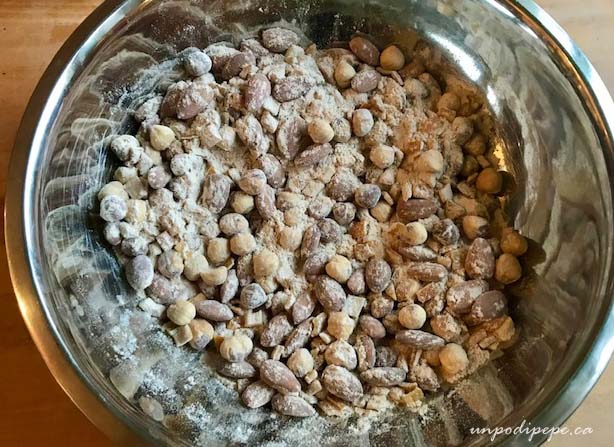
  4. Coarsely chop the nuts with a knife, or leave whole.  Dice the candied fruit and mix with the spices and nuts, then add in the sifted flour.
  5. When the syrup in step 1 reaches at least 100°C (200°F ), remove pot from heat and stir into the nut mixture. If you do not have a candy thermometer, use a toothpick to pick up a bit of syrup and pass it under cold water. If it becomes solid, it is ready.Panforte syrup in a pot
  6. Working quickly, using wet hands and 2 tablespoons, divide the batter into the tart pan(s), smoothing the top with damp fingers or the back of a wet spoon. It can also be pressed down with the bottom of a glass.Panforte crudo
  7. Bake in a 150° C (300°F) oven for 35-40 minutes. Do not let the panforte brown, or it will be too hard. Panforte cooking in the oven
  8. Remove the panforte from the pans and let it cool completely on a rack. Dust with icing sugar on all sides. and serve cut into thin wedges.
  9. Panforte keeps well for a month if wrapped in parchment paper or in an airtight container and stored in a cool, dark place. Do not store in the fridge.
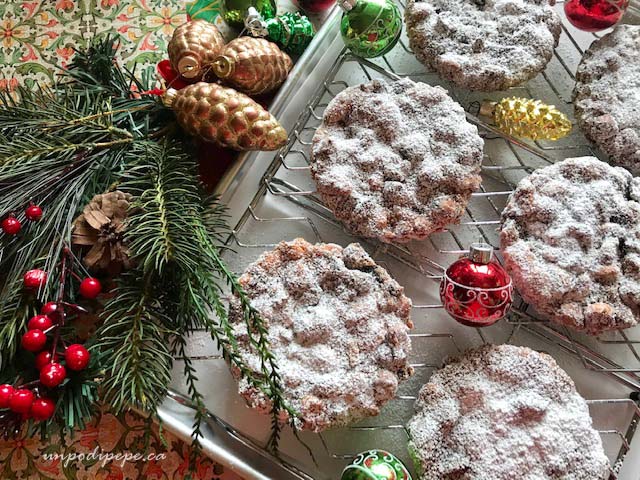
  10. This recipe makes one 22cm (9½ inch) panforte in a springform pan or six-seven 10cm (4 inch) panforte in tart pans. A 25cm (10 inch) round of parchment paper and fancy paper wraps the 10cm size.Panforte di Siena wedge with espresso and Christmas ornamentsDoubling the dose is not a great idea since you need to work fast. If you make 2-4 doses in a row like I do, you can prepare everything in advance.  I measure all the spices for each dose in a little jar so they are ready to add in, toast the nuts in advance, and have a separate bowl for each dose so I can work quickly. I also have the wafer paper cut in advance and the tart pans ready on a baking sheet.

Let me know how your panforte comes out! Buon appetito e Buone Feste, Cristina

Share this:

  • Share on Facebook (Opens in new window) Facebook
  • Share on Pinterest (Opens in new window) Pinterest
  • Share on X (Opens in new window) X
  • Email a link to a friend (Opens in new window) Email
  • Share on WhatsApp (Opens in new window) WhatsApp
Like Loading...

Museo Faggiano

22 Sunday Nov 2020

Posted by Un po' di pepe in Architecture, Puglia, Travel

≈ 19 Comments

Tags

Archeology, Lecce, Museo Faggiano, Southern Italy

Museo Faggiano is a family run, independent archeology museum in Lecce and also a working archeological site.  This is a small museum with big history! In 2001, Luciano Faggiano planned to open a restaurant with his 3 sons Marco, Andrea and Davide in a building he owned in Lecce’s Centro Storico.
The building had issues with dampness and sewage backup, likely caused by broken pipes.  Since a working toilet is kind of important, the Faggiano family planned all took 1 week off to work on the plumbing themselves.

Museo Faggiano archeologyThey started digging and found a false floor.  Beneath that, they uncovered 4 subterranean levels to other worlds.  They found Messapii tombs and an ossuary from the 5th Century BC.  The Messapii were from Crete and settled in Southern Italia.  They also uncovered a Roman granary, silo, cisterns a 10 m deep well and even an underground escape tunnel leading to the Roman anfiteatro a few blocks away.  From 1000-1200, the building was a House of the Knights Templar, who left their emblems on frescoes and wall etchings.  A Franciscan chapel and religious artifacts were found from the convent of Sisters of Santa Chiara, which the building was from 1200-1609.  Each of these populations left their traces in the unassuming little building.

Artifacts in Museo FaggianoAfter 7 years of excavation, the museum opened to the public in 2008.  All of the work was financed by Signor Faggiano, under the supervision of the Archeology superintendent of Taranto.  In Italia, anything found underground belongs to the government no matter who owns the property.  This was clearly a labour of love.

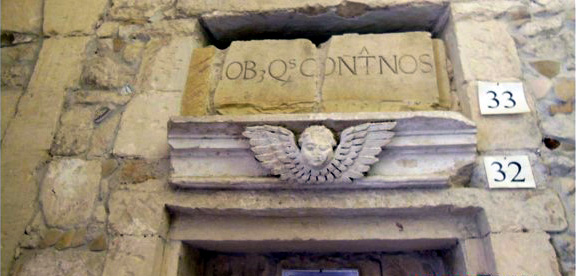
In addition to the architectural elements of the builing, treasures found include a gold and emerald Jesuit bishop’s ring, coins, lots of pottery fragments and a stone sculpture with the abbreviated Latin inscription ‘Si deus pro nobis quis contra nos’ -If God is with us, who can be against us?Sculpture found in Museo Faggiano

In 2015, Museo Faggiano was featured in a NY Times article.

Museo Faggiano is at Via Ascanio Grandi 58, a short walk from Piazza Sant’Oronzo.  It is open daily from 9:30am-8pm.  Admission is €5.  Often one of the family members is there to answer questions.  A numbered sheet with self-guided tour is available in many languages.

Imagine 2500 years of history in one small house!  If you are like me and have an inner Indiana Jones, and your palms sweat when surrounded by unique archeology, you will be fascinated by Museo Faggiano!

Luciano Faggiano finally did open his restaurant Quo Vadis, next door in June 2019. He is not planning to dig up the pavimento!

Share this:

  • Share on Facebook (Opens in new window) Facebook
  • Share on Pinterest (Opens in new window) Pinterest
  • Share on X (Opens in new window) X
  • Email a link to a friend (Opens in new window) Email
  • Share on WhatsApp (Opens in new window) WhatsApp
Like Loading...

World Pasta Day

25 Sunday Oct 2020

Posted by Un po' di pepe in Mangiamo!, Recipes

≈ 10 Comments

Tags

Corzetti, Gnocchi di zucca, Pasta, Pasta all'Amatriciana, Pasta fatta a mano, Ravioli, Ricotta tortelloni, World Pasta Day


October 25th is World Pasta Day.  Am I the only one who thought that was every day?  I am not sure who comes up with these dates, but since it seems sort of official, I am posting links to 5 pasta recipe posts from the archives.

Gnocchi di zucca-I like to recycle my Hallowe’en pumpkin by turning it into Gnocchi di zucca.  If Hallowe’en is not happening this year, I will buy one anyways.  Squash will work too.  Zucca actually means both pumpkin and squash, although sometimes squash is called zucca gialla. gnocchi di zucca

These gnocchi are topped with a simple sauce of olive oil, sage and Parmigiano Reggiano.

Spaghetti all’Amatriciana–I posted this recipe for Spaghetti all’Amatriciana following the terremoto, the earthquake in Amatrice a few years ago.

Swap the eggs in Pasta Carbonara for tomato sauce, and you have Pasta Amatriciana! The other 4 ingredients stay the same.

Ravioli di ricotta e spinaci-Stuffed pasta is so fun to make, and turns any meal into a special occasion.  I made these lovely ravioli with my nipotina Francesca this summer.  Making them is not as hard as it looks!  They freeze well, and can go into the pot of boiling water straight from the freezer.Ravioli di ricotta e spinaci

Corzetti-Corzetti are a traditional pasta of Liguria.  The shape is based on medieval coins.  I bought a corzetti stamp in Vernazza during my trip to the Cinque Terre last year and have used it several times.  If you do not have a corzetti stamp, use a glass to cut the circles, and find something around the house to imprint a design.  Be creative. Corzetti pasta con pesto GenoveseThis post includes a few different sauces to try, including Pesto Genovese.

Tortelloni di ricotta– The first time I made these was as a recipe test for a cookbook.  It was during a snowstorm and I had to go out in the snow with a flashlight, dressed like an eskimo, to forage for sage in the garden!  The link to the recipe is in the post.  

The post Grano Arso does not include recipes, but is interesting to read if you are interested in pasta and gastronomic history.
Let me know which one is your favourite. I hope you all enjoy a delicious plate of pasta today. Buon appetito, Cristina

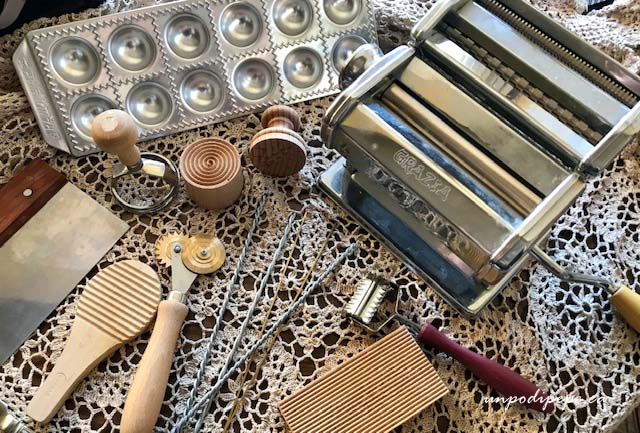
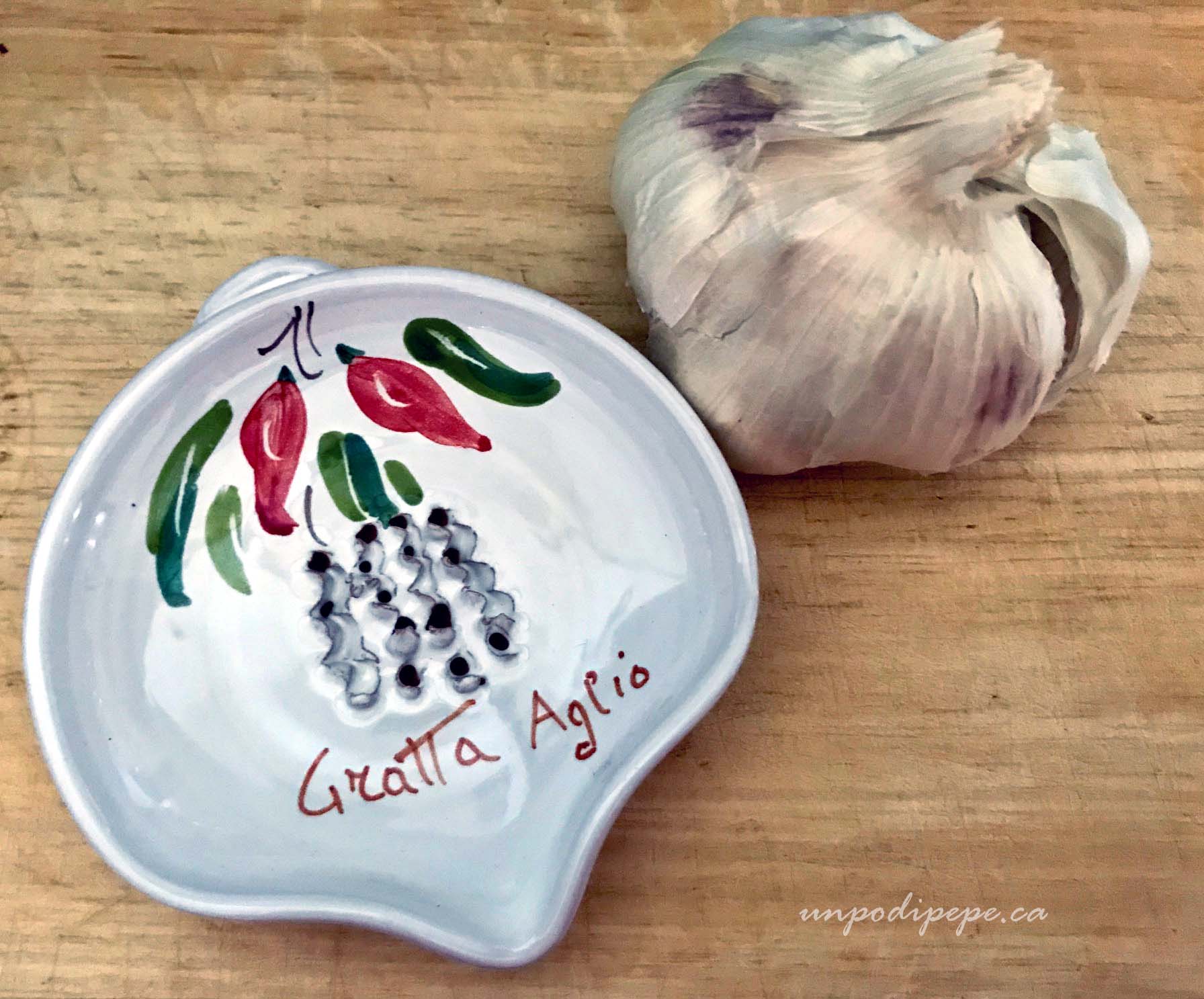
Pasta tools

Share this:

  • Share on Facebook (Opens in new window) Facebook
  • Share on Pinterest (Opens in new window) Pinterest
  • Share on X (Opens in new window) X
  • Email a link to a friend (Opens in new window) Email
  • Share on WhatsApp (Opens in new window) WhatsApp
Like Loading...

MOSE

09 Friday Oct 2020

Posted by Un po' di pepe in Italia

≈ 20 Comments

Tags

Acqua alta, Flood barriers, MOSE, Venezia

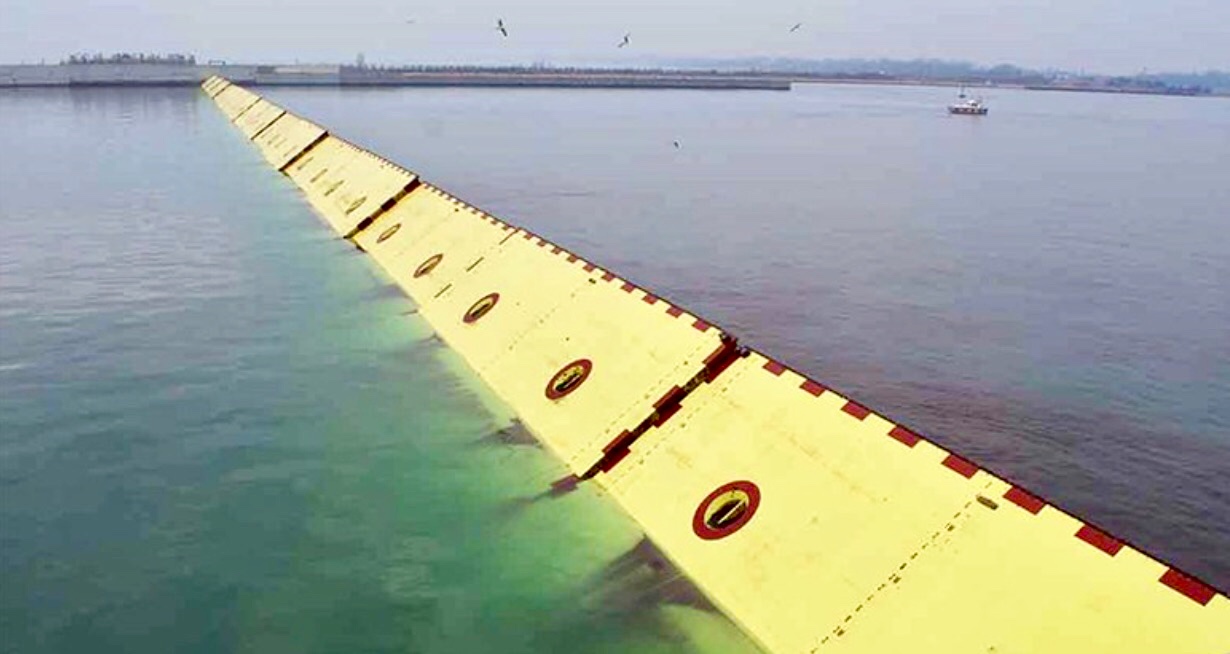
MOSE flood barrier Venezia

2020 has been a crappy year, but finally something has gone right.  On October 3rd, MOSE (moh•ZEH) was activated for the first time and prevented flooding in Venezia caused by high tide! Yeah!

MOSE stands for MOdulo Sperimentale Elettromeccanico (experimental electromechanical model). Whoever came up with the acronym is brilliant, because in Italian, Mosè, with an accent on the ‘e’, is Moses, who parted the Red Sea.

MOSE is floating architecture-a series of temporary barriers formed by 78 bright yellow mobile gates at the bottom of the seabed.  The 4 barriers are located at the 3 inlets; 2 at the Lido, 1 at Malamocco and 1 at Chioggia.

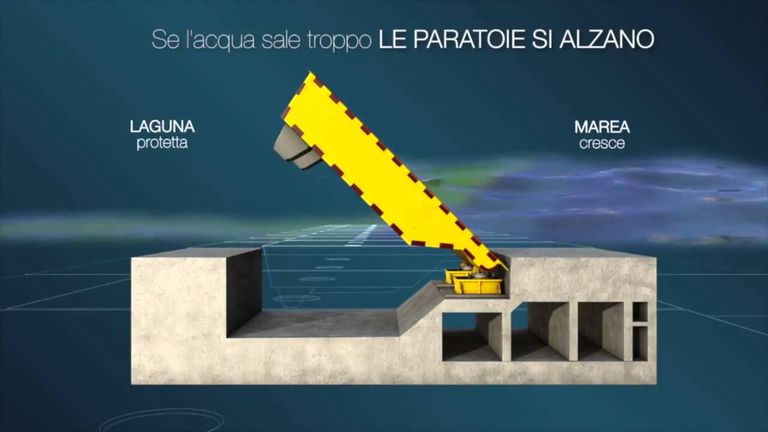
How MOSE works to keep high tide water in the Adriatic Sea and out of the Venetian lagoon. mosevenezia.eu/project/?lang=eng

During normal conditions, the gates are full of water and resting out of view within their housing structures. When a high tide is predicted, compressed air is introduced into the gates to empty them of water. This causes them to rotate around the hinge axis and rise up above the water to block the tide from entering the lagoon. When the tide has dropped, the gates are filled with water and return to their resting places.

It takes about 30 minutes to raise the gates and 15 to lower them. MOSE is designed to protect Venezia from tides of up to 3meters (10 ft). A video on how the system works can be found on the Mosevenezia website.

Acqua alta (high water) occurs mostly from October to March and has always been a problem in the Venetian lagoon. The first documentation of it was on October 17, 589! It has gotten worse since 1935, mostly due to environmental issues. Last year, on November 12, 2019 187 cm of water was the worst flooding since 194cm in 1966.

MOSE has been plagued with delays and cost overruns. Hopefully now that it works, it will stop the worst of the flooding. Measures are also being implemented to improve the lagoon environment, decrease erosion, restore the environment of the smaller islands in the lagoon and decrease pollution in the industrial Porto Marghera. Hopefully they ban cruise ships soon too!

MOSE flood barrier Venezia

Fingers crossed MOSE will continue to work. It has been 26 years since I visited Venezia, and I would like it to still be standing when I manage to get back! Ciao, Cristina

Share this:

  • Share on Facebook (Opens in new window) Facebook
  • Share on Pinterest (Opens in new window) Pinterest
  • Share on X (Opens in new window) X
  • Email a link to a friend (Opens in new window) Email
  • Share on WhatsApp (Opens in new window) WhatsApp
Like Loading...

Lecce

25 Friday Sep 2020

Posted by Un po' di pepe in Architecture, Italia, Photography, Travel

≈ 24 Comments

Tags

Barocco Leccese, Baroque art, Negroamaro, Puglia, Salento, Southern Italy, UNESCO World Heritage Sites

Santa Croce facade black and whiteLecce reminds me of a Caravaggio painting-Baroque, dramatic and opulent, with attention to detail.  It is unfortunate he did not live long enough to visit the city!  Lecce, in the Salento area of Southern Puglia is over 2000 years old and rich in tradition and local customs.  Originally called Syvar, it was founded by the Mesapii(Mesapians) from Crete.  There is a long history of Greek settlement here, in fact there is still a group of 9 towns called ‘Grecia Salentino’ where ‘Griko’ dialetto is spoken.

Conquered by the Romans in the 3rd Century BC, it was renamed Lupiae.  Hadrian moved the city 3 Km northeast in the 2nd Century AD and called it Licea. Then came the Byzantines in 549, followed by Orthodox monks.  Lecce and the Salento were an independent country from 1043 until 1463 when Emperor Carlo V conquered Puglia, and they became part of the Kingdom of Napoli until Italian unification in 1861.  Lecce was an important commercial city, with a building and cultural boom. Baroque doorway Lecce

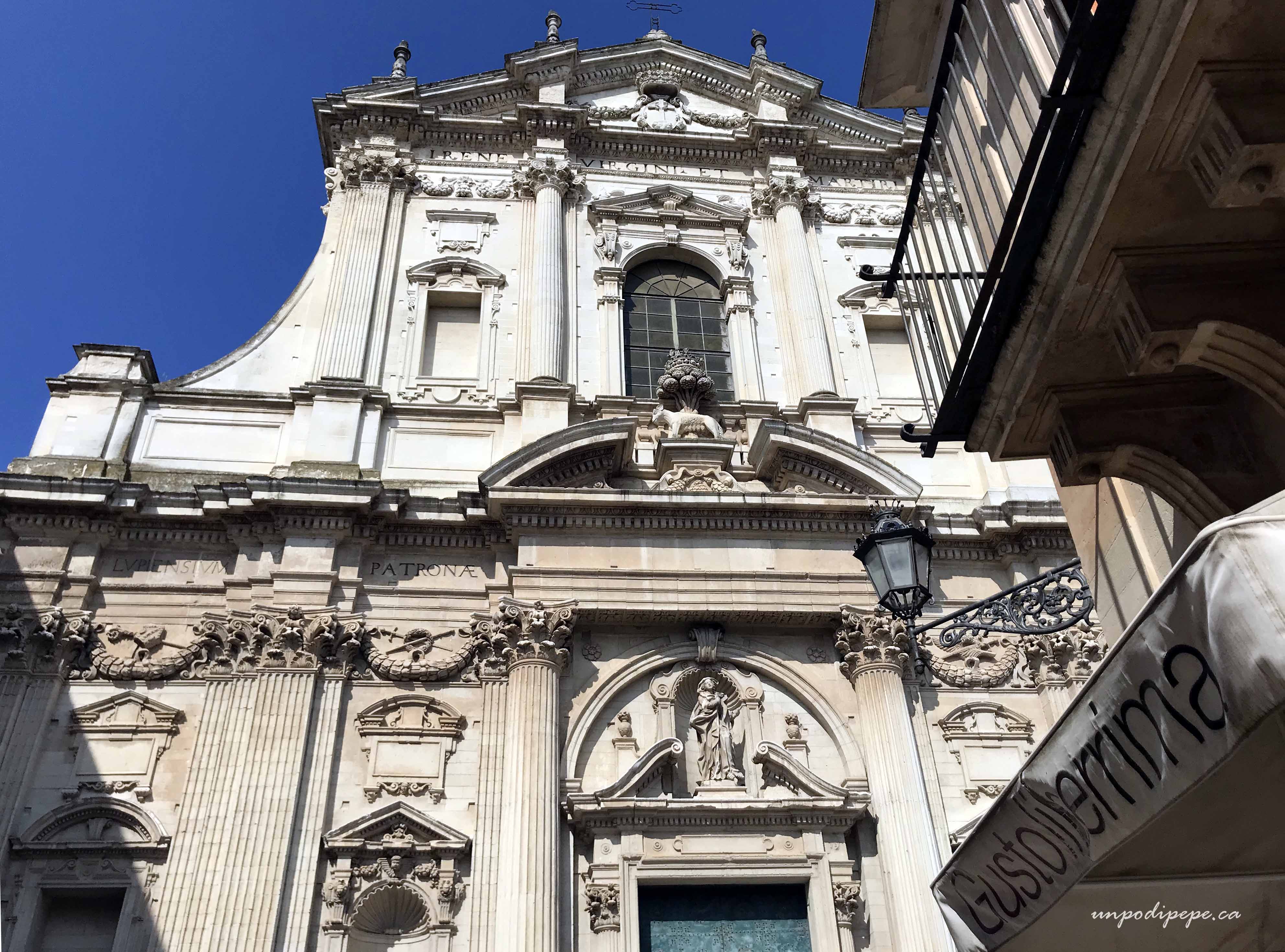
Lecce is best known for its dramatic Baroque architecture and ornamentation, which even has its own name-Barocco Leccese.  The style was around from the mid 1500’s to the early 1700’s, so even among buildings constructed at different times there is continuity of style.Sant'Irene Lecce Interior

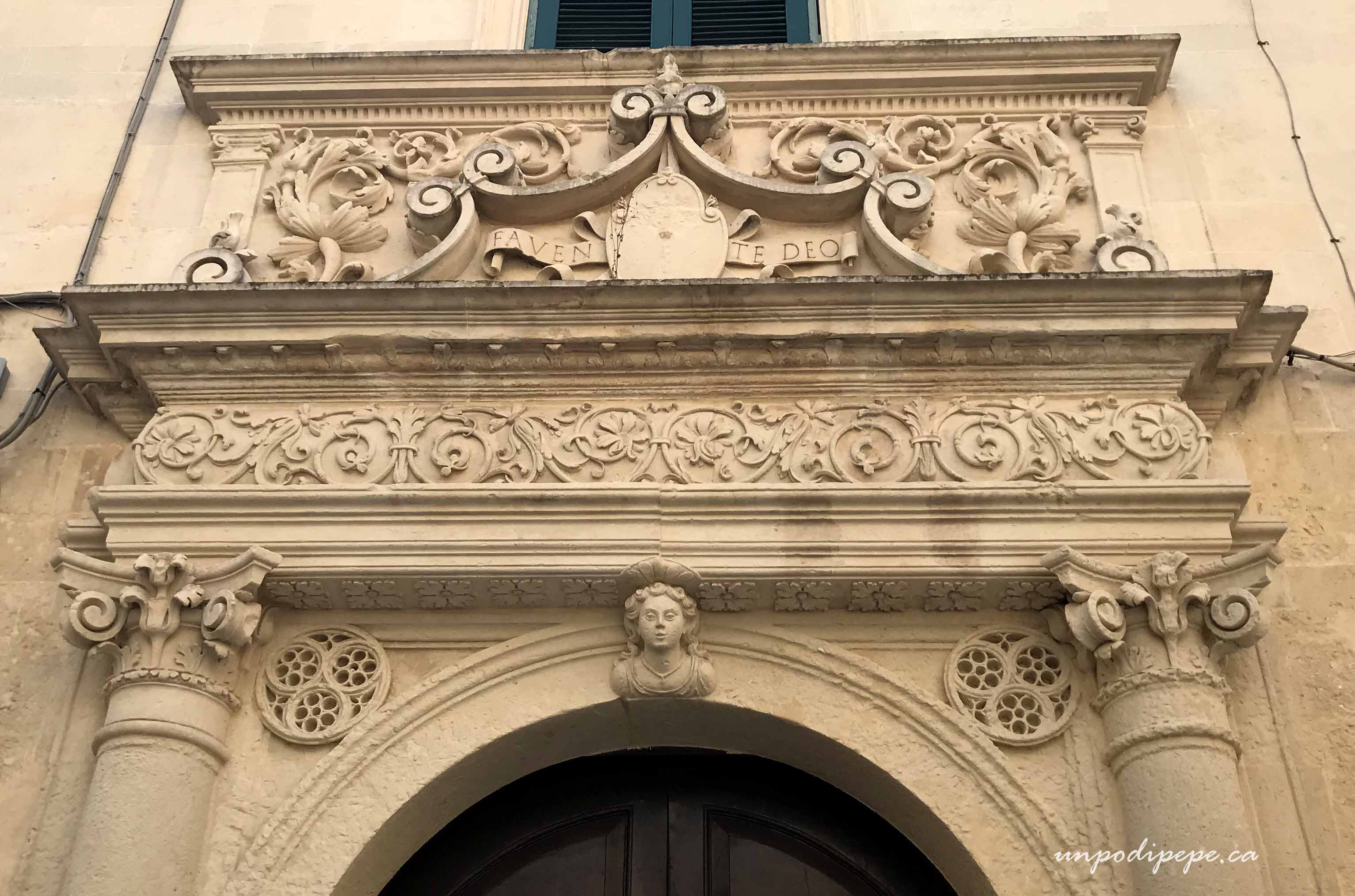
The Baroque style features over the top details and intricate carvings that create a sense of movement.  Barocco Leccese is even more expressive and unique.  Windows, balconies and loggias are elaborately ornamented with twisting columns, scrolls and cornices.  They are carved with human figures, animals, wreaths, vines and gargoyles.  There is also a lot of marble, gilt and bronze involved.  Corbels supporting balconies are a common decorative element in Lecce.Duomo Lecce

‘Salento and the Barocco Leccese, including Lecce, Nardò, Gallipoli, Martina Franca, Ostuni, Francavilla, Galatina and Galatone’ are on the UNESCO World Heritage tentative list since 2006. This is the step before becoming a World Heritage Site.Vespa Lecce Puglia

Lecce’s buildings are made of Pietra Leccese, a local, honey coloured porous limestone.  It is soft and workable for sculpture, and was hardened and weatherproofed by soaking in a liquid solution made with whole milk.  Pietra Leccese is still one of the area’s main exports, mined in open quarries.Vicolo, Lecce

What to see in Lecce:

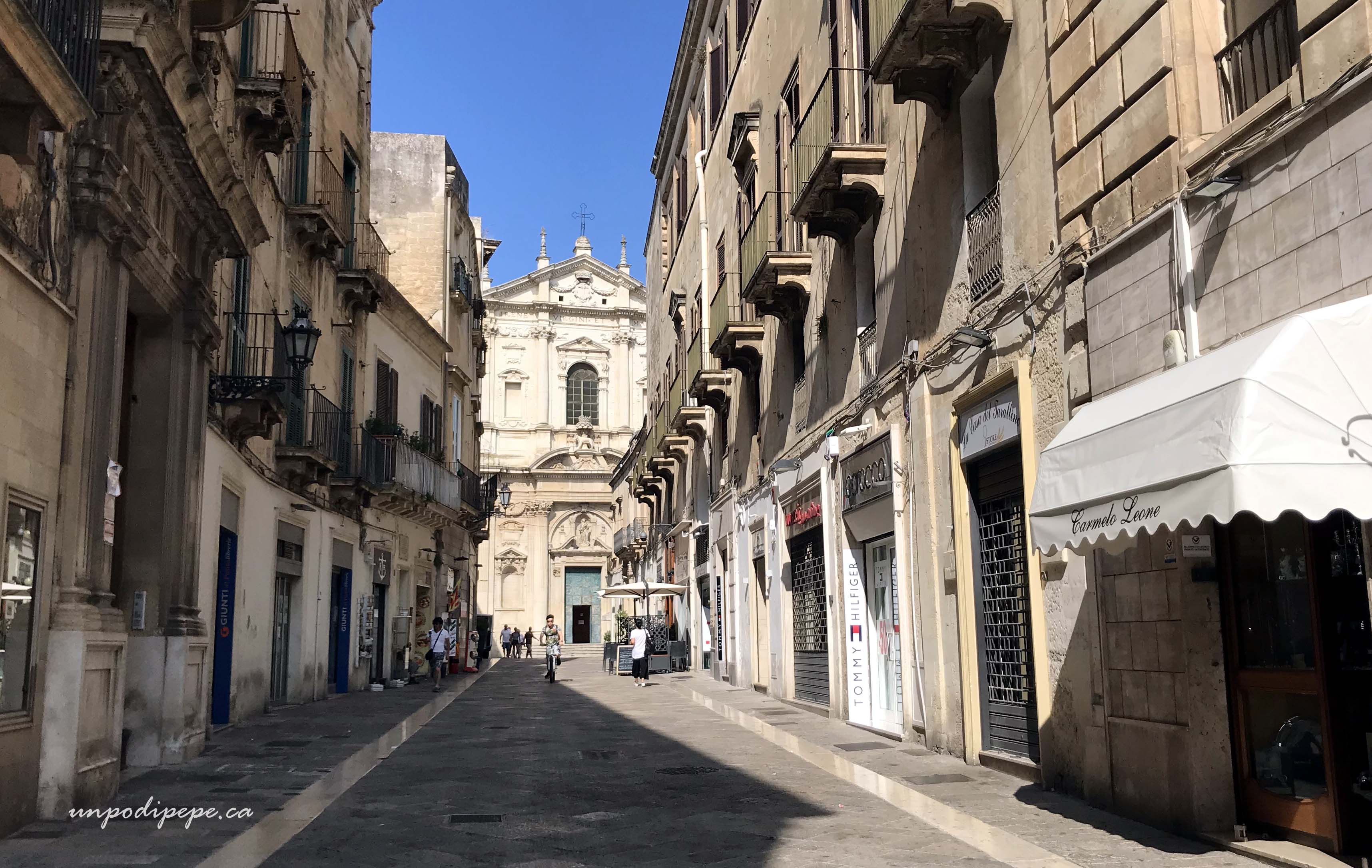
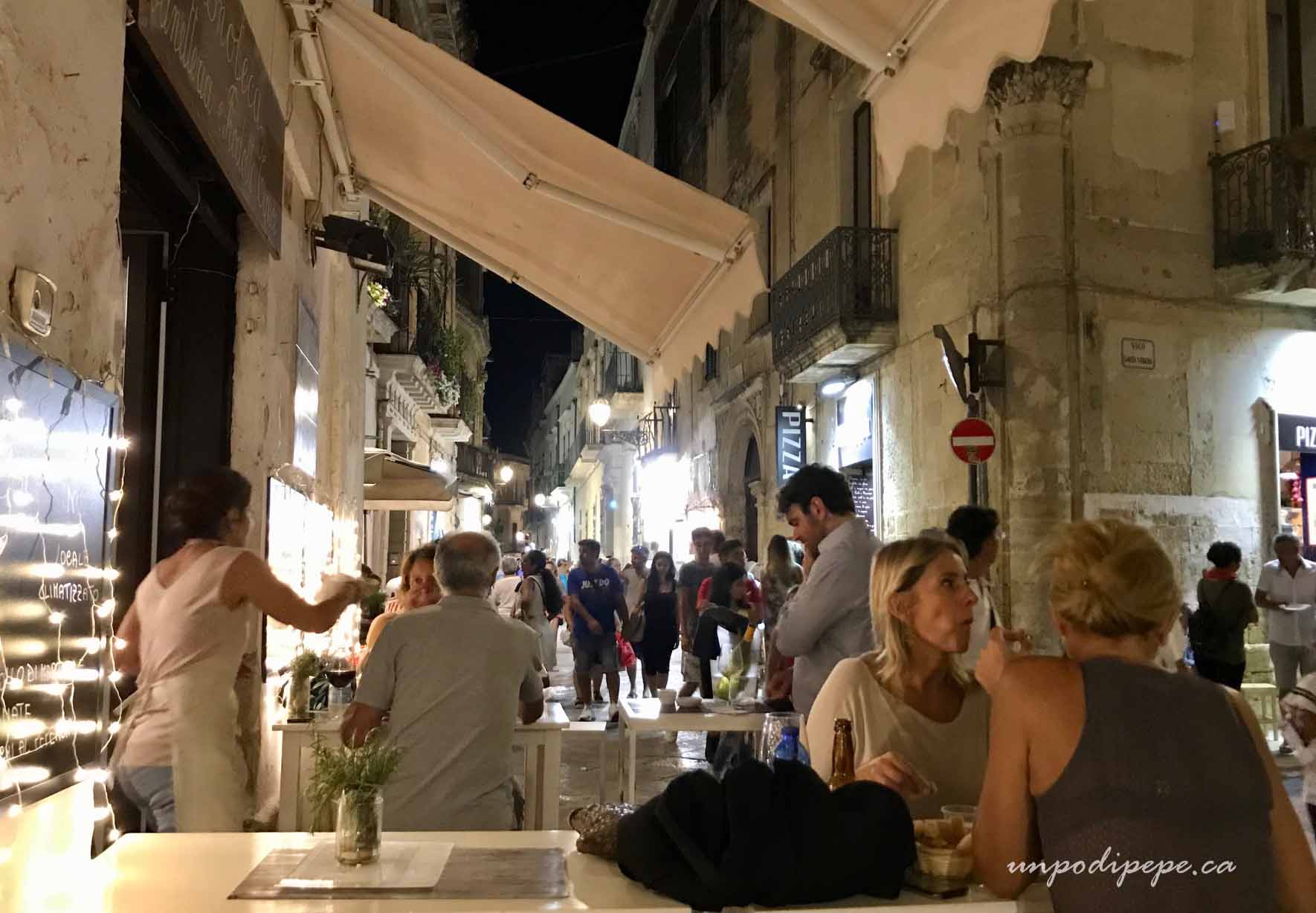
The Centro Storico of Lecce, with its narrow stone streets, 22 churches and unique architecture is a historically preserved walking museum.  It is mostly pedestrian only and very walkable.  Corso Vittorio Emanuele e Sant'Irene LecceAfter dark the streets are lined with outdoor seating for vino and aperitivo, and everyone is out for passeggiata.Lecce di notte

Lecce’s defensive walls are gone, but 3 gates remain: Porta Rudiae, Porta San Biagio and Porta Napoli, which marked the starting point of the road to Napoli.Piazza Duomo Lecce

The 2 main piazze are Piazza Duomo and Piazza Sant’Oronzo, which are connected by Corso Vittorio Emanuele.  Piazza Duomo is a large open space, but you can almost walk by and miss it!  There is only one entrance, and it is closed off on 3 sides.  The Duomo is unique as it has 2 facades.  This was done so that visitors to the piazza did not have to face a big blank side wall as they entered.  Campanile Piazza Duomo LecceThe Campanile is the tallest in Italia at 68 m.  Piazza Duomo also contains the Palazzo Vescovile and Seminario, which is used mainly for exhibitions.

Piazza Sant’Oronzo, named for the first Christian bishop and the patron saint of Lecce, was the site of the mercato.  The 2nd Century AD Roman anfiteatro was discovered in 1901 during construction of a new Banca d’Italia. Anfiteatro LecceThe 20,000 seat arena was originally built outside of the walls of Lecce and was still in use in the 12thCentury. More than half of it has not been excavated!

Looking down over the anfiteatro is Il Sedile, a 1590 Gothic structure which was the seat of the town hall.  It is now the Tourist information office.Anfiteatro and Il Sedile, Lecce, Puglia

The Colonna di S Oronzo, is a column topped with a bronze statue of Sant’Oronzo.  It was originally built in 110 AD-one of a pair of Turkish marble columns marking the end of the Via Appia from Roma to Brindisi.  This one toppled and broke in 1528 and its twin is still standing in Brindisi. In 1659, the broken remains were given to Lecce to thank Sant’Oronzo for saving Brindisi from the 1656 plague.  The Brindisini have wanted it back ever since!

Not far from the piazza is Museo Faggiano- a unique museum, especially for archeology nerds like me!  Plumbing issues result in DIY renovations that uncover layers of history…..Blog post coming!Santa Croce lecce under renovation. Black and white

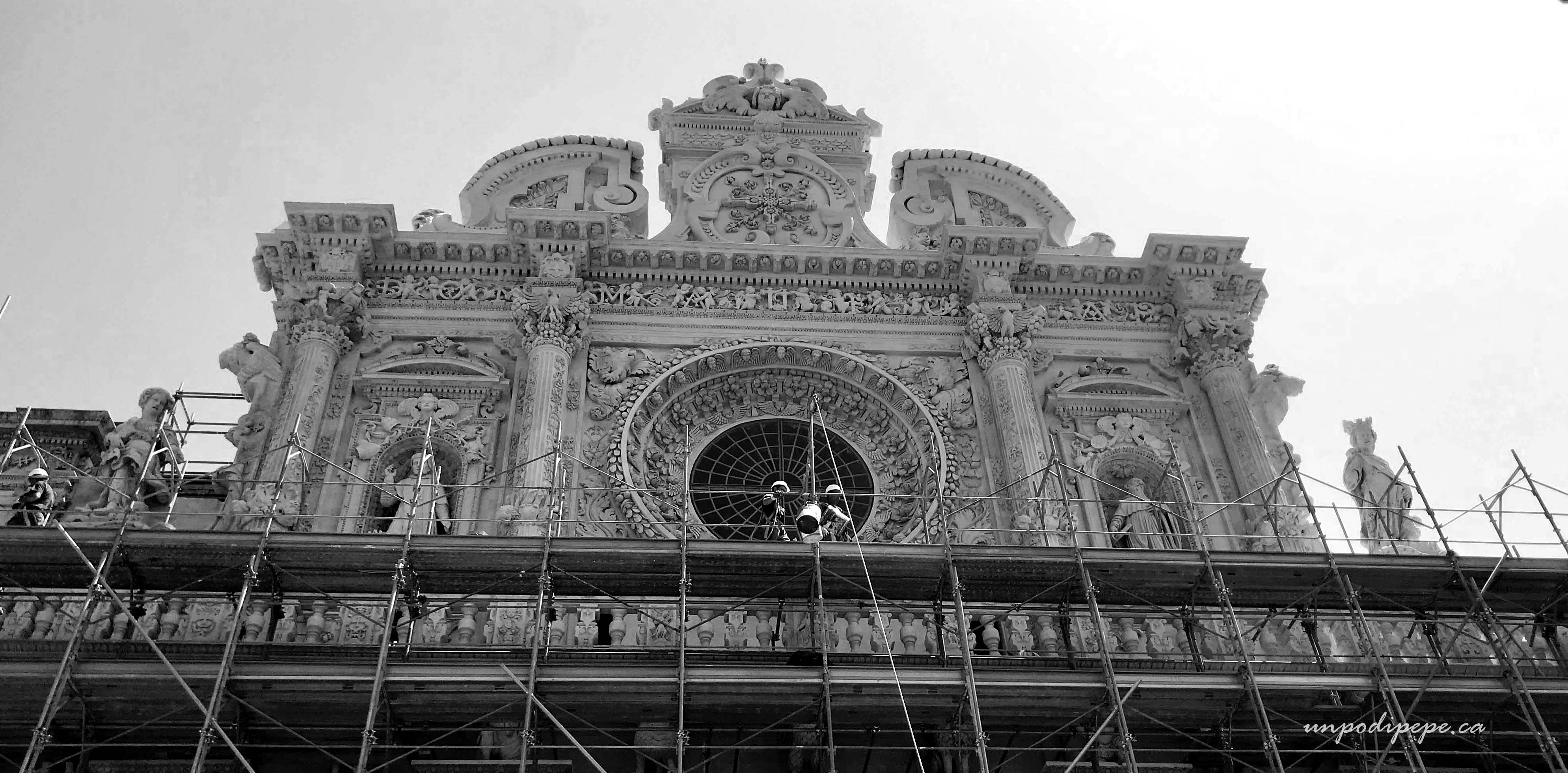
Santa Croce’s façade is the masterpiece of Barocco Leccese.  It took 200 years to build.  The exterior was recently cleaned and renovated.  The interior has a gilded coffered ceiling and 14 chapels with carved, twisting columns.Santa Croce interior Lecce

Sant’Irene is dedicated to the ancient protector of the city 1591-1639.  The interior is simple, but has twin Baroque side altars.  My amazing balcony at Palazzo Belli B&B looked out onto the side entrance.Sant'Irene Lecce

Santa Chiara built in 1687 has an unusual façade and an extravagant interior with a wooden ceiling. There are loads of other beautiful churches to see in Lecce, but i have only mentioned the main ones. Santa Chiara Lecce

Sometimes the scenery looks like an old movie set!  Walk down Via Palmieri, lined with grand palazzi, ending at Porta Napoli.  Via Palmieri Lecce Puglia

Things I did not have time to see include the Castello Carlo V and its carta pesta (papier maché) museum, the Teatro Romano and the Museo Provinciale.

Lecce is a great place to shop.  Specialties include colourful Pugliese ceramics, carta pesta, olive oil and vino.  Lecce observes the pausa pranzo which means shops are closed from 2-5pm.Lecce ceramic souvenirs

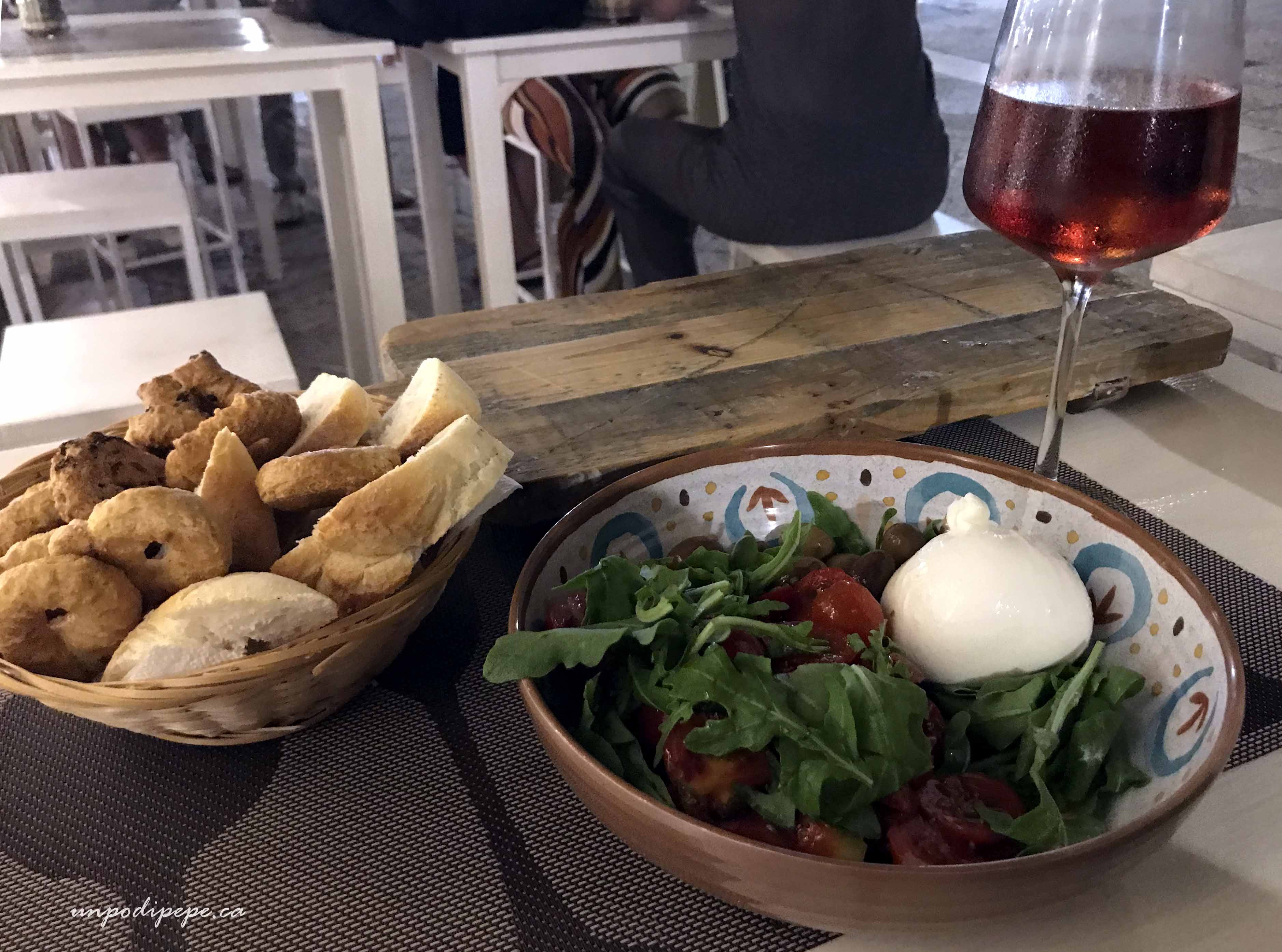
Make sure to try pasticciotto.  My favourite is the kind with crema and amarena. Yum! Colazione LecceSit outside to have Caffè Leccese –espresso on ice with almond milk and of course local vino, especially my favourite-Negroamaro.  Here is my cena with Negroamaro rosé.  Burratina, taralli e Negroamaro Rose,

Since the centro storico is car free, dealing with a car in Lecce can be a pain.  During high season, it is easier to get around by bus or local train.  During low season, a car will make it easier to visit places that are not on the main train line. Lecce is between 2 seas, the Adriatic is 11km away and the Ionian 23 km away.

Lecce (pop. 96,000) is on the Adriatico train route that starts in Bologna.  The Stazione is a flat walk, 1 km south of the Centro Storico.  Last year, I took the train from Foggia (3 hours) staying 3 days in Lecce and 1 in Nardò. It was late July/early August, and not crowded at all. I booked my train and accomodation 3 days in advance. Try to avoid making Lecce a daytrip, as you will miss the beautiful evenings and fun nightlife. I am looking forward to going back as soon as possible!Via Palmieri Lecce black and white

Buon viaggio, Cristina

Share this:

  • Share on Facebook (Opens in new window) Facebook
  • Share on Pinterest (Opens in new window) Pinterest
  • Share on X (Opens in new window) X
  • Email a link to a friend (Opens in new window) Email
  • Share on WhatsApp (Opens in new window) WhatsApp
Like Loading...

Writing about Italian Canadian Food Culture

04 Friday Sep 2020

Posted by Un po' di pepe in Bilingual posts, Italocanadesi, Mangiamo!

≈ 12 Comments

Tags

AICW, Culinary Culture, Food writing, Gastronomic history, Grano Arso, Italian Canadian Literature, Italocanadese life

The Italian Cultural Institute of Montreal and the Association of Italian Canadian Writers (AICW), as part of a webinar series dedicated to writing, an experience animated by Italian-Canadian authors, translators, journalists, publishers and bloggers, are pleased to present “Can you smell the garlic? Writing About Italian-Canadian Food Culture”

Tuesday, September 8, 2020 – 5:00 pm EST

Nonna stirs tomato sauce bubbling in a cauldron in the garage, papà proudly pours a glass of his homemade wine, zie gather to make taralli and biscotti in the basement kitchen…

These culinary traditions are a treasure trove of material for the Italian-Canadian writer. How does nostalgia affect the relationship to food and writing about food? Push past the clichés, what complicates the rosy images? Is it more difficult to write in a critical or unsentimental mode about food and Italian-Canadian identity?

Domenico Capilongo, Monica Meneghetti, Cristina Pepe and Jim Zucchero will read mouth-watering prose and poetry and talk about the connections between food and their writing. The webinar will be moderated by former restaurant critic, Francesca M. LoDico. The series is hosted by the Secretary of the AICW Executive, Giulia Verticchio.

Event details & bios: https://iicmontreal.esteri.it/iic_montreal/en/gli_eventi/calendario/2020/09/senti-l-aglio-scrivere-sulla-cultura.html

Italiano: https://iicmontreal.esteri.it/iic_montreal/it/gli_eventi/calendario/2020/09/senti-l-aglio-scrivere-sulla-cultura.html

I will be reading about Grano Arso.  The webinar will be available to view later on the Istituto Italiano di Cultura-Montreal’s website and Facebook page.

In Italiano:
L’Istituto Italiano di Cultura di Montréal e l’Associazione degli Scrittori italo-canadesi (AICW), nell’ambito della serie di webinar dedicata all’opera della scrittura, un’esperienza animata da autori italocanadesi, traduttori, registi, giornalisti, editori, bloggers…, sono lieti di presentare il webinar intitolato “Senti l’aglio? Scrivere sulla cultura culinaria italocanadese”.
Nonna mescola la salsa di pomodoro che ribolle in un calderone nel garage, papà versa orgoglioso un bicchiere del suo vino fatto in casa, le zie si riuniscono per fare taralli e biscotti nella cucina del seminterrato… Queste tradizioni culinarie sono un tesoro di materiale per lo scrittore italo-canadese. In che modo la nostalgia influenza il rapporto con il cibo e la scrittura sul cibo? Superare i cliché, cosa complica le rosee immagini? È più difficile scrivere in modo critico o non sentimentale sul cibo e sull’identità italo-canadese?
Domenico Capilongo, Monica Meneghetti, Cristina Pepe e Jim Zucchero leggeranno brani e poesie da “leccarsi i baffi” e parleranno delle connessioni tra il cibo e la loro scrittura. Il webinar sarà moderato dal già critico di ristoranti, Francesca M. LoDico. La serie è ospitata dalla Segretaria dell’Esecutivo AICW, Giulia Verticchio.
**********
Buon appetito, Cristina

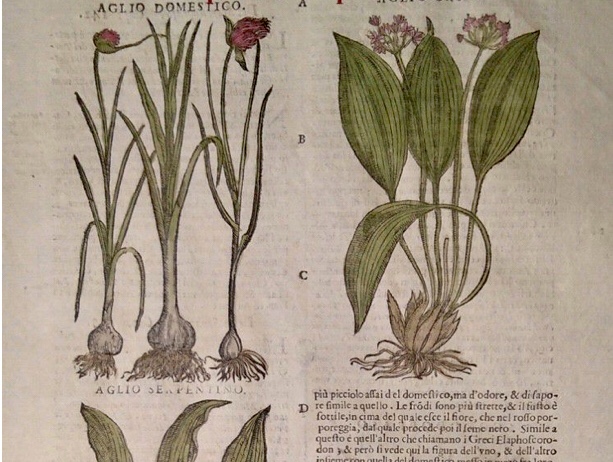
Garlic drawings

Share this:

  • Share on Facebook (Opens in new window) Facebook
  • Share on Pinterest (Opens in new window) Pinterest
  • Share on X (Opens in new window) X
  • Email a link to a friend (Opens in new window) Email
  • Share on WhatsApp (Opens in new window) WhatsApp
Like Loading...

Limoncello

07 Friday Aug 2020

Posted by Un po' di pepe in Italia, Recipes

≈ 25 Comments

Tags

Campania, Homemade liqueur, Limoncello, Southern Italy

LimoncelloQuando la vita ti da limoni…fai il limoncello! When life gives you lemons…make limoncello! This is a good motto for life.  I usually make homemade limoncello or other infused liqueurs with vodka, as 90% grain alcohol is not available in Canada.  With the hand sanitizer shortage 3 years ago at the beginning of the pandemic, my fratello was able to order 151 proof (71%) Everclear grain alcohol to make his own. When hand sanitizer was available again, he had an extra bottle, so I used it to make limoncello.  It is not the 191 proof (90%) alcohol that liqueurs are usually made with-but close enough, and definitely better than using vodka.

Limoncello (lee·mohn·CHEL·loh) is an Italian liqueur, made mostly in Southern Italy, especially in the Amalfi/Sorrento area where the limoni are large and fragrant. It is usually served chilled as an after dinner digestivo. I use it in many of my desserts too!Limoni organic lemons

To make limoncello, you need 1L (4 cups) of grain alcohol and 8-10 organic lemons.  Limoncello is made only with the scorza, or lemon peel, so the lemons must be untreated.  I used the juice to make limonata.Making limoncello

Peel lemons with a vegetable or potato peeler, taking only the peel, not the pith (the white stuff). If a bit of pith snuck in there, scrape it off with a knifeMaking limoncello

Place the lemon peels in a large airtight glass jar.  I used a 2L jar that used to hold artichokes, rinsing it out with vinegar and soap to remove any smell.Limoncello steeping

Cover lemon peels with alcohol and leave the jar to steep in a dark cool place for 2 weeks or more.  A cantina is ideal if you have one.  Give the jar a good shake every few days.  When the peels are very pale, almost white, it is done.  The liquid will be a gorgeous golden colour.Discarded lemon peels from limoncello production

Mix 750 ml-1L (3-4 cups) water with 500 ml (2 cups) sugar in a saucepan.  Simmer over medium heat until the sugar is dissolved, then let the syrup cool.Bottling limoncello

Strain lemon peels from the alcohol and add cooled syrup.  It will be a cloudy yellow once the lemon essential oils and water mix together.  If using vodka instead of grain alcohol, use less syrup.  Shake the jar and leave it in the cantina or a cold, dark place for 1-2 weeks.  Then ladle into small bottles with pop-tops or secure tops and leave for 1 more week to intensify the lemon flavour.Making limoncello

Il limoncello è pronto. Salute!

Posts with recipes using limoncello:

Limoncello Cheesecake

Limoncello Ricotta Cookies

Olive oil Limoncello Cake

Ciao, Cristina

(originally posted in August 2020, and somehow was accidentally deleted!)

Share this:

  • Share on Facebook (Opens in new window) Facebook
  • Share on Pinterest (Opens in new window) Pinterest
  • Share on X (Opens in new window) X
  • Email a link to a friend (Opens in new window) Email
  • Share on WhatsApp (Opens in new window) WhatsApp
Like Loading...
← Older posts
Newer posts →

Enter your email address to follow 'un po' di pepe' and receive notifications of new posts by email.

Join 511 other subscribers
Follow Un po' di pepe on WordPress.com

Popular Posts

  • Hairstyling in Ancient Roma
    Hairstyling in Ancient Roma
  • Cucina Italiana Patrimonio UNESCO
    Cucina Italiana Patrimonio UNESCO
  • Grano Arso
    Grano Arso
  • Napoli Street Art
    Napoli Street Art
  • Venezia~La Serenissima
    Venezia~La Serenissima
  • Italiano per Ristoranti~How to pronounce your restaurant menu
    Italiano per Ristoranti~How to pronounce your restaurant menu
  • Dolci di Natale
    Dolci di Natale

Recent Posts

  • Cucina Italiana Patrimonio UNESCO
  • 2025~Un po’ di pepe Year in Review
  • Castel del Monte
  • ‘The Nuances of Love’
  • Hostaria Antica Roma~Eat like an Ancient Roman
  • Santa Maria in Aracoeli
  • Casino dell’Aurora~Villa Boncompagni Ludovisi
  • Nasoni di Roma
  • Bloghiversario #11
  • Fontana di Trevi
  • Acqua Vergine
  • Giubileo 2025
  • Sanremo 2025
  • In Vino there are Memories
  • A Literary Harvest
  • 2024~Un po’ di pepe Year in Review
  • Buon Natale 2024
  • Il Bicerin
  • Mercato Porta Palazzo
  • Torino
  • Catanzaro, Calabria
  • Il Pumo Pugliese
  • Artemisia Gentileschi
  • Cavalli di San Marco
  • Panzerotti

Categories

Amici e Famiglia Architecture Art Art history Art projects Bilingual posts Blogging Canada Culture Feste Firenze Inspiration Italia Italian Folklore Italian language Italian life Italocanadesi Libri Mangiamo! Orsara di Puglia Parole piacevoli Photography Puglia Recipes Roma Travel Travel tips Uncategorized Vino

Archives

Un po’ di pepe on Facebook

Un po’ di pepe on Facebook

Start a Blog at WordPress.com.

  • Subscribe Subscribed
    • Un po' di pepe
    • Join 511 other subscribers
    • Already have a WordPress.com account? Log in now.
    • Un po' di pepe
    • Subscribe Subscribed
    • Sign up
    • Log in
    • Report this content
    • View site in Reader
    • Manage subscriptions
    • Collapse this bar
 

Loading Comments...
 

    %d