• Home
  • About me/Chi sono
  • Contact

Un po' di pepe

~ …… (oon∙poh∙dee∙PEH∙peh) Cristina writes about interesting stuff /Cristina scrive di cose interessanti

Un po' di pepe

Category Archives: Italia

L’arte sa nuotare

08 Saturday Jun 2019

Posted by Un po' di pepe in Art, Firenze, Italia, Photography

≈ 31 Comments

Tags

Blub, Contemporary art Firenze, Firenze street art, L'arte sa nuotare, Street art

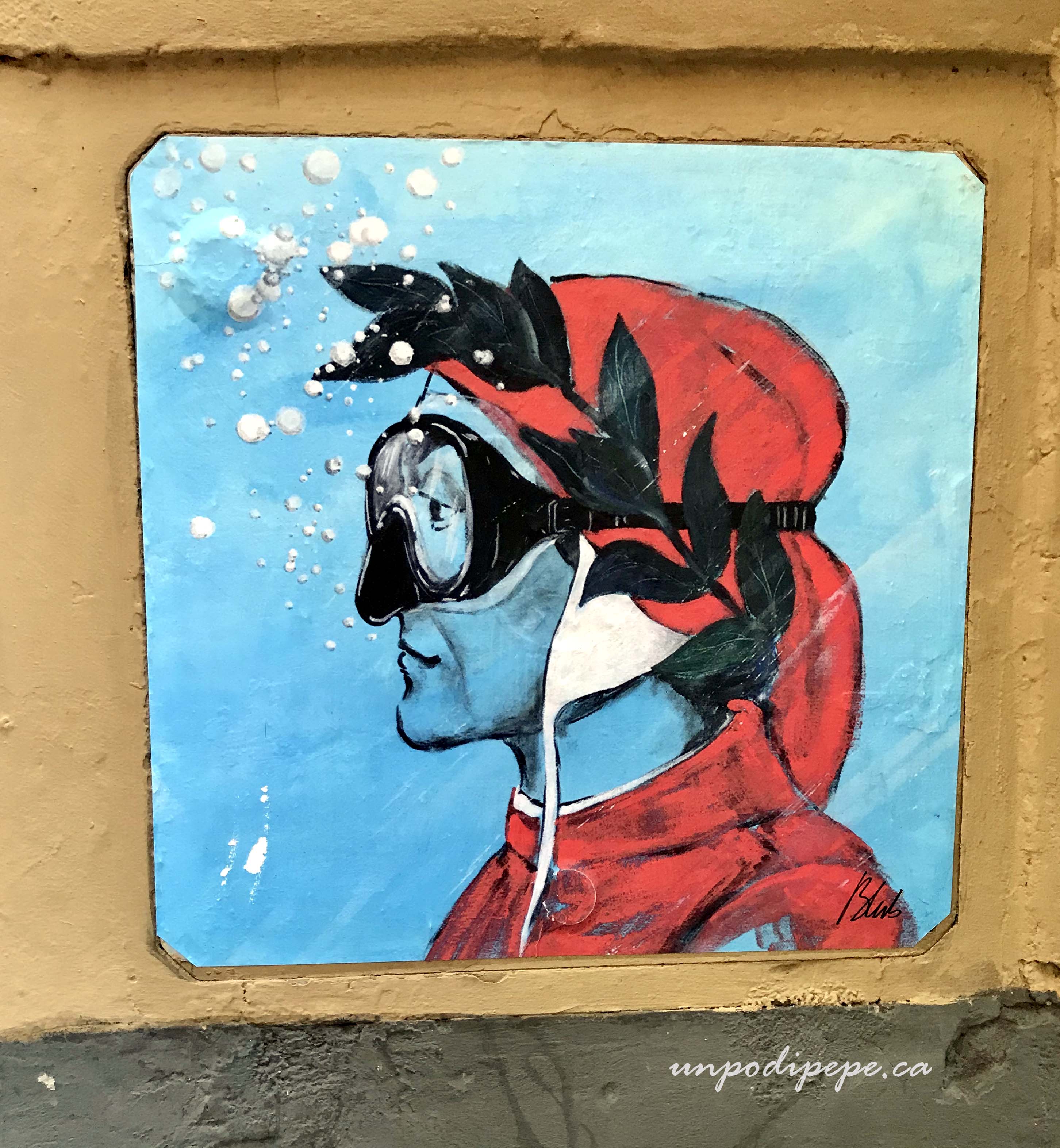
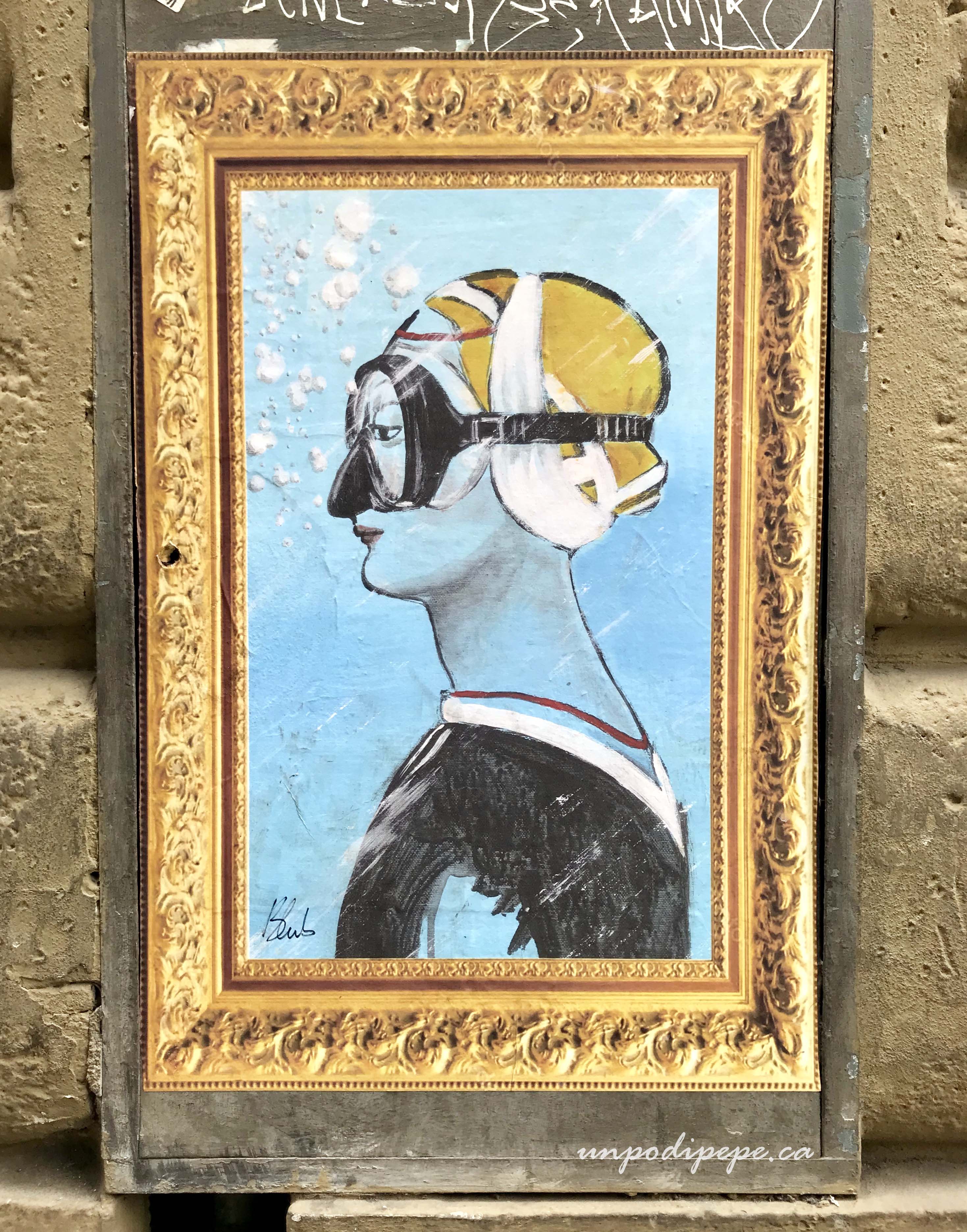
Putto Raffaello Firenze street art BlubL’arte sa Nuotare -art knows how to swim- is a project by Italian street artist Blub (Bloob).  Anyone who has been to Firenze in the last few years has likely seen Blub’s work plastered onto the city’s sportelli di gas e di luce- the metallic doors of gas and electrical panels. Blub street art FirenzeI was recently in Firenze with my nipotina Isabella. We were constantly on the lookout for ‘Blubi’ (BLOO•bee).  It was like a scavenger hunt! We even spotted a few in Lucca, but none in Siena.  Blub street art Firenze Dante l'arte sa nuotareNo one has met mysterious street artist Blub.  All we know about Blub is that he…..or she….. is from Firenze and is a talented artist with a fun, quirky sense of humour.Blub street artist Firenze, the Creation of AdamBlub’s series “L’arte sa Nuotare’ takes famous works of art and gives them a new look, immersing them underwater, complete with blue background, snorkel masks and bollicine-bubbles! Blub street art La Dolce Vita Shannon Milar L'arte sa nuotare

More recent works receiving the Blub treatment are contemporary icons such as the kiss from La Dolce Vita, Freddie Mercury and Amy Winehouse.  Blubi have a magnetic attraction to anyone passing by. Blub Modigliani street art Lucca l'arte sa nuotareThe works are not graffiti painted directly onto the precious, crumbling renaissance walls. Blub paints 1 original acrylic on canvas or metal, then makes posters in sizes to fit the sportelli and pastes them up with 100% plant based glue. Sportelli also provide ready made frames.Ragazza con l'orecchina di perla Blub street artist Firenze, Girl with a pearl earring

How did this series start?  According to a February 2019 interview (in Italiano) with Firenze Urban Lifestyle Magazine, Blub claims that for fun, the first ‘masked’ triad were Da Vinci works-La Gioconda (aka Mona Lisa), Dama con l’ermellino, and a self portrait of Leonardo.  One night, with the help and encouragement of friends, they were pasted up on sportelli in the San Niccolò area. Blub Leonardo Da Vinci Donna con l'ermellino Firenze street art

It was originally a way of remembering the flood of the Arno in 1966 and the saving of Firenze’s priceless artwork from the muddy water that ravaged the city.  That night ‘l’arte non affoga’ (art does not drown) became ‘l’arte sa nuotare’.

Firenze Duomo Blub street artAside from the reference to the 1966 flood, the series brings together the past and contemporary world, pays tribute to the personality of Firenze and is dedicated to those who find solutions in a sea of difficulty. The expression ‘sink or swim’ comes to mind.Van Gogh Blub street art l'arte sa nuotare

Water generates life and is a symbol of rebirth and purification.  Time stands still underwater, placing the immersed works that have left their mark and survive today in another dimension.  With this series of work, Blub is trying to incite curiosity rather than controversy.

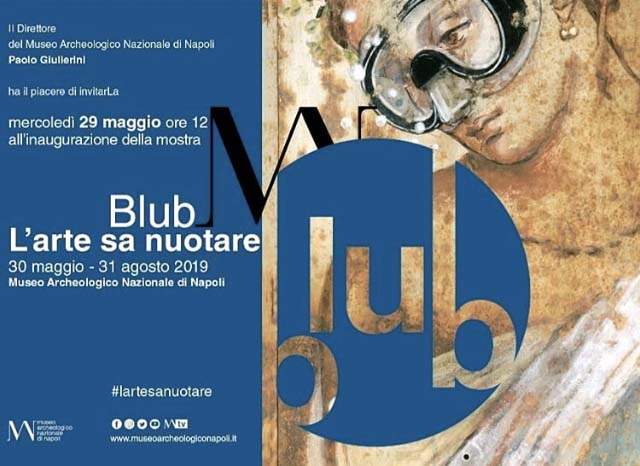
Blub street art firenze L'arte sa nuotareBlub hunting will now also be possible in Napoli!  Blub has 6 new works on display at the Museo Archeologico Nazionale di Napoli until August 31!  Frescoes from Pompeii underwater!  I will definitely try to see this exhibit!  Update!  I did  make  it  to  Napoli.  Read  about  it  in  Blub  a Napoli. I hope you enjoyed this Blub photo exhibit! Have you had the pleasure of finding Blubi? If you like to view artwork al fresco and un po’ bagnato, happy Blub hunting!  More Blub images are available on instagram #lartesanuotare.

Ciao, Cristina

*La Dolce Vita photo taken by Shannon Milar in Lucca.  All other photos taken by me in Firenze, except the Amedeo Modigliani which was taken in Lucca.Putto Raffaello Blub street artist Firenze


Share this:

  • Share on Facebook (Opens in new window) Facebook
  • Share on Pinterest (Opens in new window) Pinterest
  • Share on X (Opens in new window) X
  • Email a link to a friend (Opens in new window) Email
  • Share on WhatsApp (Opens in new window) WhatsApp
Like Loading...

Puglia~Mia Regione Preferita

26 Sunday May 2019

Posted by Un po' di pepe in Italia, Photography, Puglia, Travel, Vino

≈ 26 Comments

Tags

Cucina povera, Cucina Pugliese, Diomedes, Dolcevitabloggers, Parco Nazionale del Gargano, Romanico Pugliese, Southern Italy, Top 10 reasons to love Puglia, Trabucchi del Gargano, UNESCO World Heritage Sites, Vini di Puglia

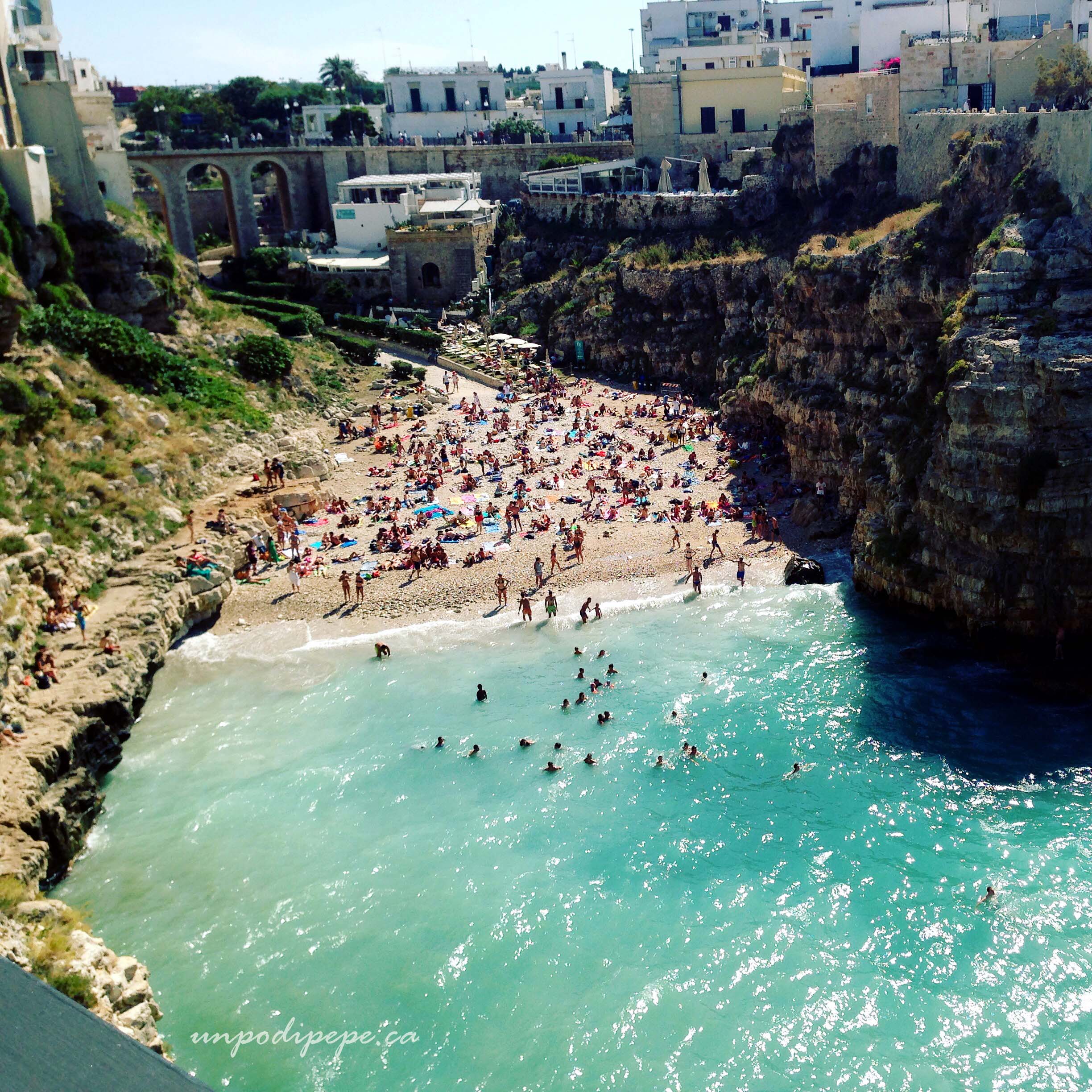
Italia has 20 regioni /regions. So far, I have been to 14 of them.  I love them all, but my absolute favourite is Puglia.  Why?  Well, aside from the obvious reason that it is home, there are countless others.  I have narrowed this post down to my top 10 reasons to love Puglia-in no particular order.  There are a lot of links to previous posts included here.  Please check them out!  Many of my Puglia posts were written when this blog only had about 27 readers, 80% of them related to me.  These posts need some new love!1) 840 km of coastline-That is a lot of beach!  The transparent turquoise colour of the water is real.Earlier this month, 13 Pugliese beaches received the environmental designation Bandiera Blu, including Polignano a Mare, Margherita di Savoia and Peschici.

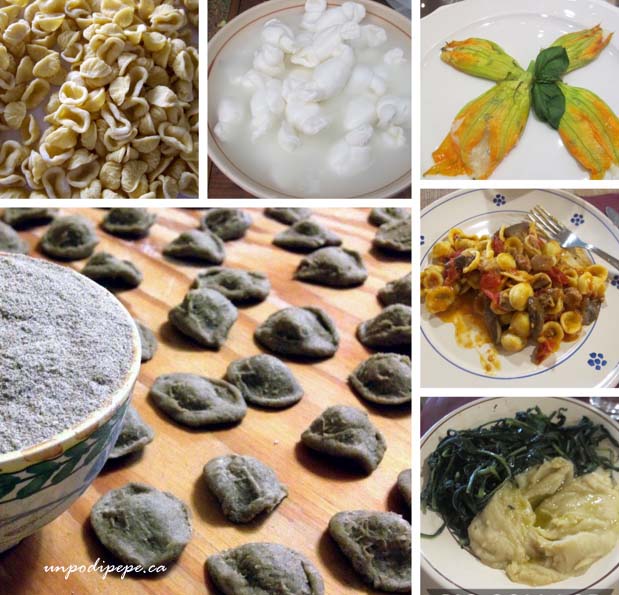
2) Cucina Pugliese is rustic cucina povera or peasant food, focusing on the freshness and simplicity of the ingredients that are in season.   Orecchiette con sugo

Pugliese specialties include orecchiette al sugo, orecchiette con cime di rape, grano arso, fave e cicorie, burrata, pancotto e patate, panzerotti, polpo, pesce, focaccia Pugliese, taralli, cartellate, pasticciotto, and pizza con la ricotta.  Everything is drizzled with Pugliese ‘liquid gold’, extra virgin olive oil.Cucina Pugliese 1

Cucina PuglieseI hope I have made you hungry.  Buon appetito!

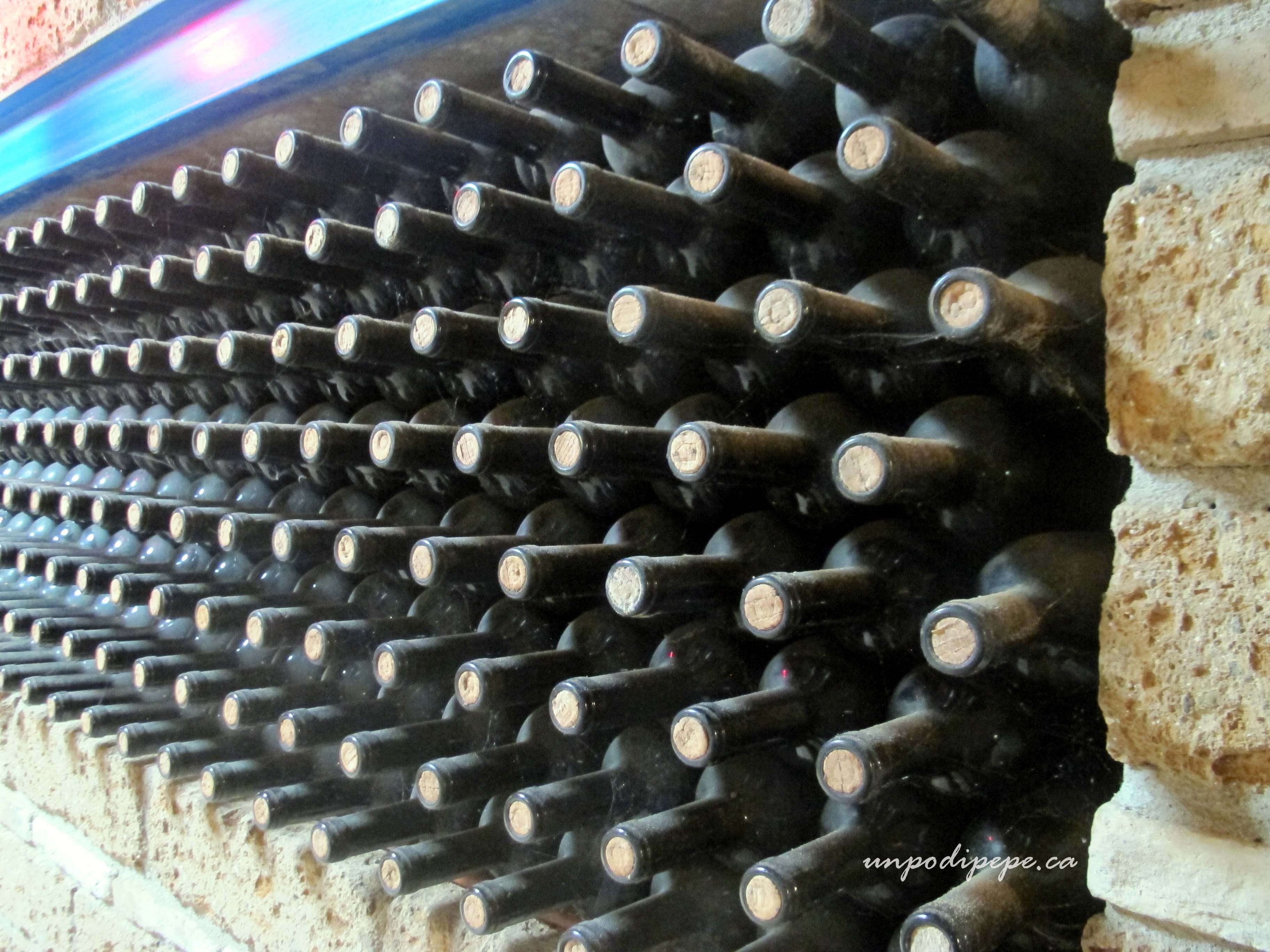
3) Vino- Oenotria ‘Land of Wine’ is the name the ancient Greeks gave Puglia. 425 km long, Puglia has a diverse agricultural landscape with mountains, plains, the Mediterranean sun, coastal sea breezes and fertile soil.  The climate is hot and dry, especially during the summer.  The name Puglia comes from the Latin ‘a pluvia’ meaning without rain. These environmental features, plus the presence of vitigni autoctoni (Native or Indigenous species of grapes) create an ideal environment for growing grapes and producing vino.

Vino is my favourite topic of research.  A few years ago, I published a Vini di Puglia trilogy-a series of 3 blog posts on the wines of Puglia!  Vini di Puglia is about the ‘big 3’ Negroamaro, Nero di Troia and Primitivo.  Part 2 Aglianico to Zibibbo is about all the other grapes of Puglia plus a glossary of viniculture terms in Italiano.  Il Tuccanese a grape native to Orsara di Puglia is the last post in the trilogy. Salute!

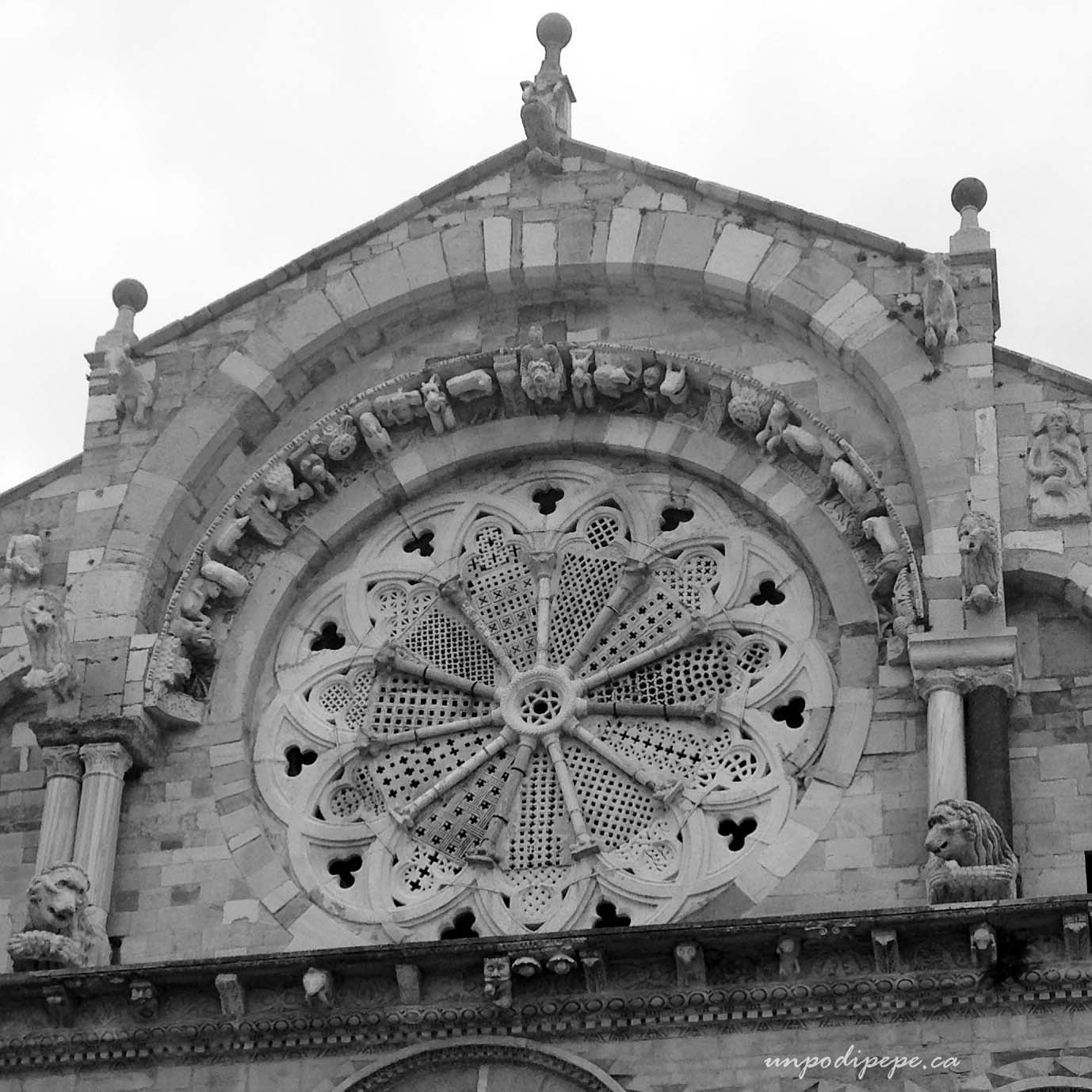
4) Architettura. Puglia has it’s own architectural style-Romanico Pugliese (Pugliese Romanesque).  Puglia was at the crossroads between Europe and the Crusades in the 11th-13th Century.  Many cattedrale were built in this style,  including those in Troia, Trani, Bari, Otranto, Molfetta, Bitonto, Siponto and Ruvo di Puglia.  Romanico Pugliese is a unique architectural style distinguished by elements of both Eastern and Western elements. These include vaulted ceilings, Byzantine semicircular cupolas, porticoes held up by marble lions, and intricate decorations with classical Byzantine and Arab features. The Romanesque Cathedrals in Puglia are on the UNESCO heritage sites tentative list, which is the step before heritage designation.  Troia cattedrale Romanica Pugliese

The 11 sectioned rosone pictured here of the Cattedrale di Troia built in 1145 AD looks like it is woven in stone.  Other architectural styles specific to Puglia are the Barrocco Leccese found in Lecce and the mysterious Castel del Monte near Andria built by Federico II, which is its own unique entity.

5) Promontorio del Gargano One of the most beautiful areas on earth, Il Promontorio del Gargano (gar·GAH·noh) is the promontory sticking out above ‘il tacco’, the heel of Italia.  You can also think of it as la caviglia-the ankle spur of Italia.  Surrounded by the Adriatico on 3 sides, the area is more like an island; biodiverse with unique flora and fauna. Most of the promontorio is a protected area and marine reserve, Il Parco Nazionale del Gargano, which includes le Isole Tremiti and the ancient Foresta Umbra. Fortunately, this has prevented development by large multinational hotels and resorts.San Domino Isole Tremiti, Puglia

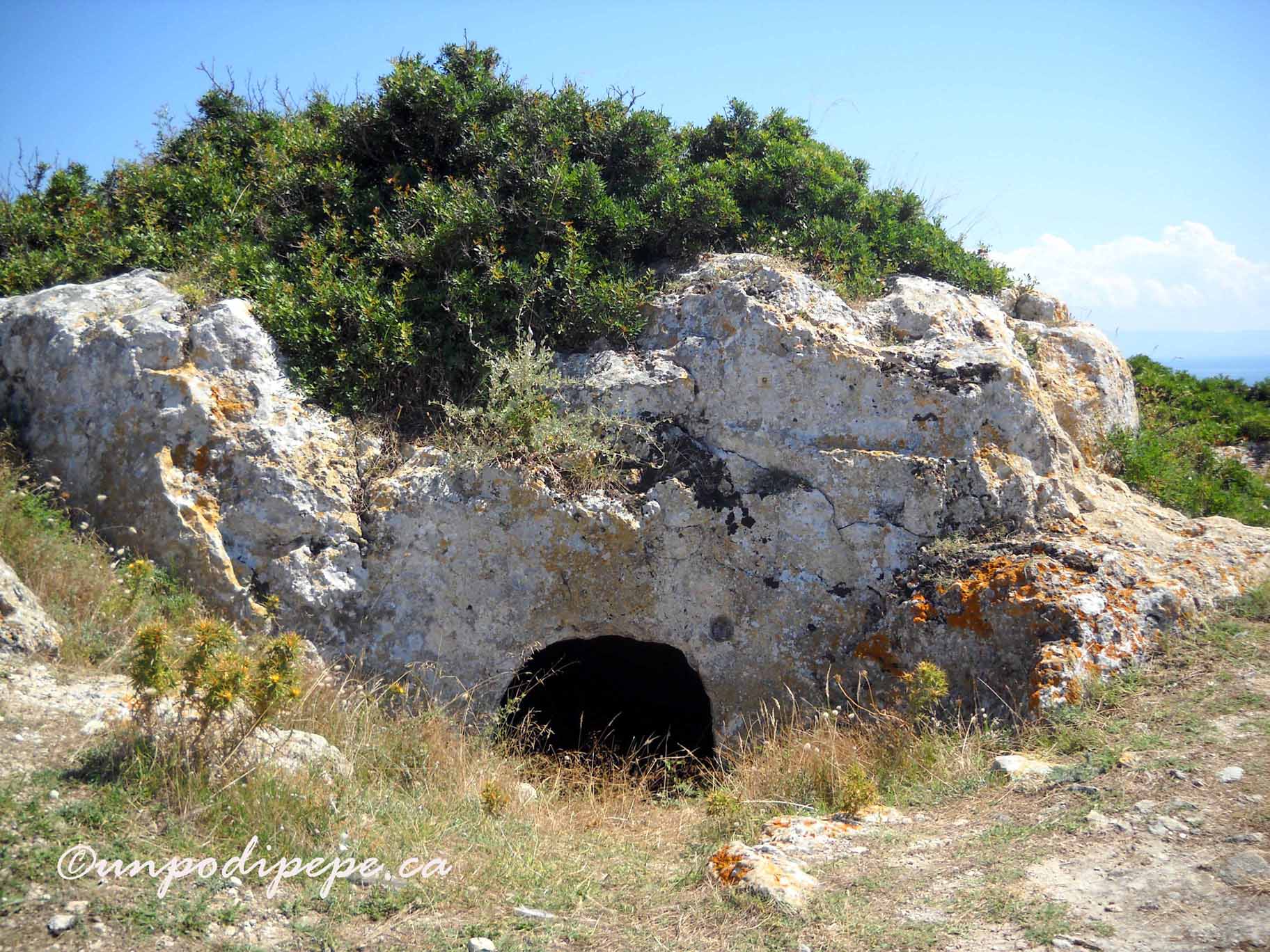
Il Gargano is famous for picchi (woodpeckers) and other birds, 300 varieties of orchids, almonds and olives.  There are endless ancient hillside olive groves, pine forests, sea grotte, limestone cliffs, rocky shores, crystalline water and fresh seafood.

Baia delle Zagare, Puglia

Baia delle Zagare

The winding road around the Gargano, SS 89 from Foggia, has sharp turns and viste mozzafiato (VIS·teh moz·zah·FYAH·toh)-breathtaking views. One of my favourite viewpoints is La Baia delle Zagare, where the battle scene between the Amazons and Germans in the movie Wonder Woman were filmed!

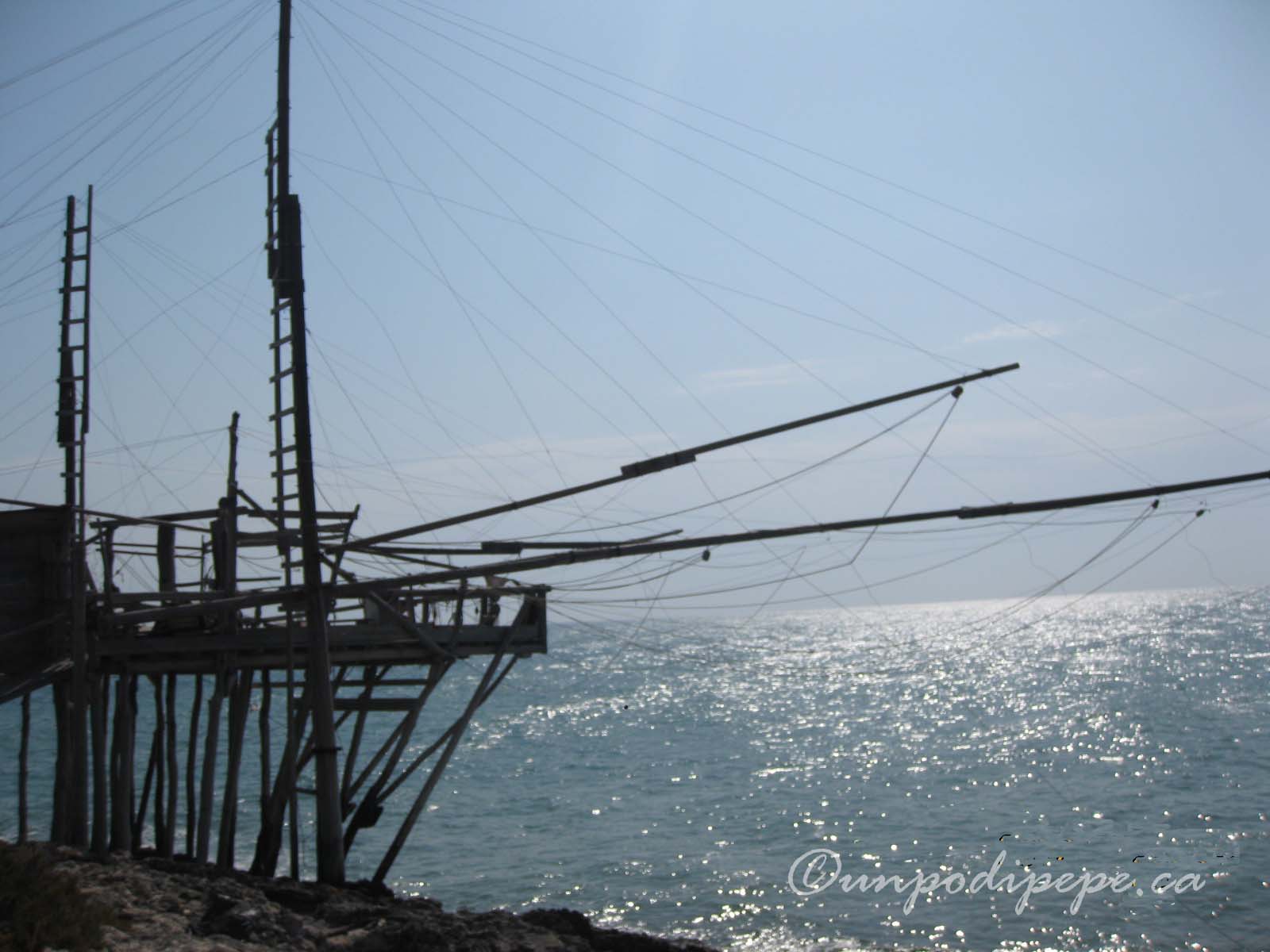
6)Trabucchi  Trabucchi (tra∙BOO∙kkee) are old fishing contraptions found on the Adriatic coast of Abruzzo, Molise and Puglia. The design probably dates back to the ancient Phoenicians.  Trabucchi have fascinated me since I was a child, taking l’Adriatico, the night train from Bologna to Foggia on a stormy night.  They looked like giant alien octopi coming out of the sea!  There are 13 functioning trabucchi on the coast of the Promontorio del Gargano between Peschici and Vieste, the oldest dating back to the 18th century.  They are protected as National cultural heritage sites within the Parco Nazionale del Gargano. Read more in I Trabucchi del Gargano.

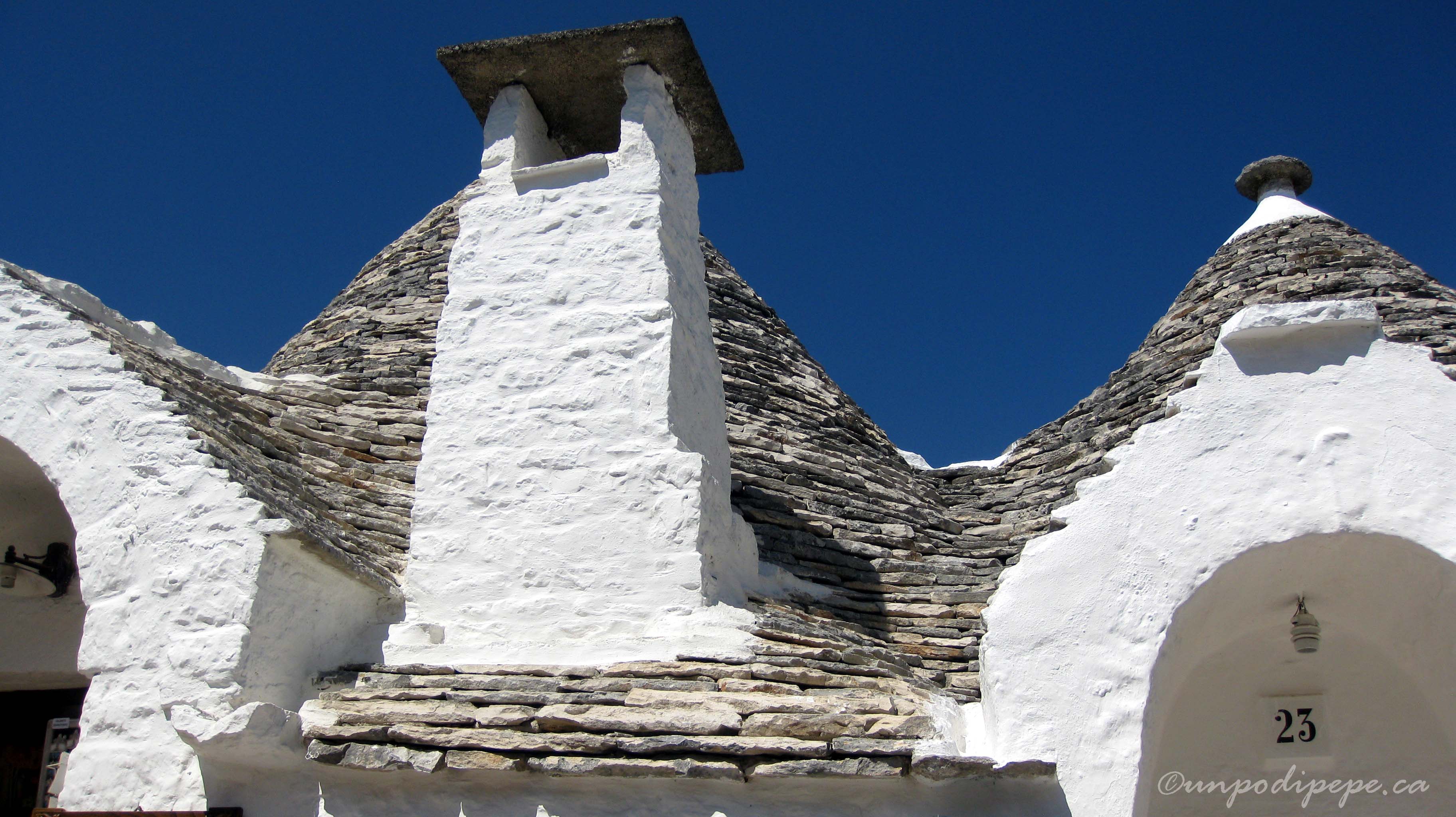
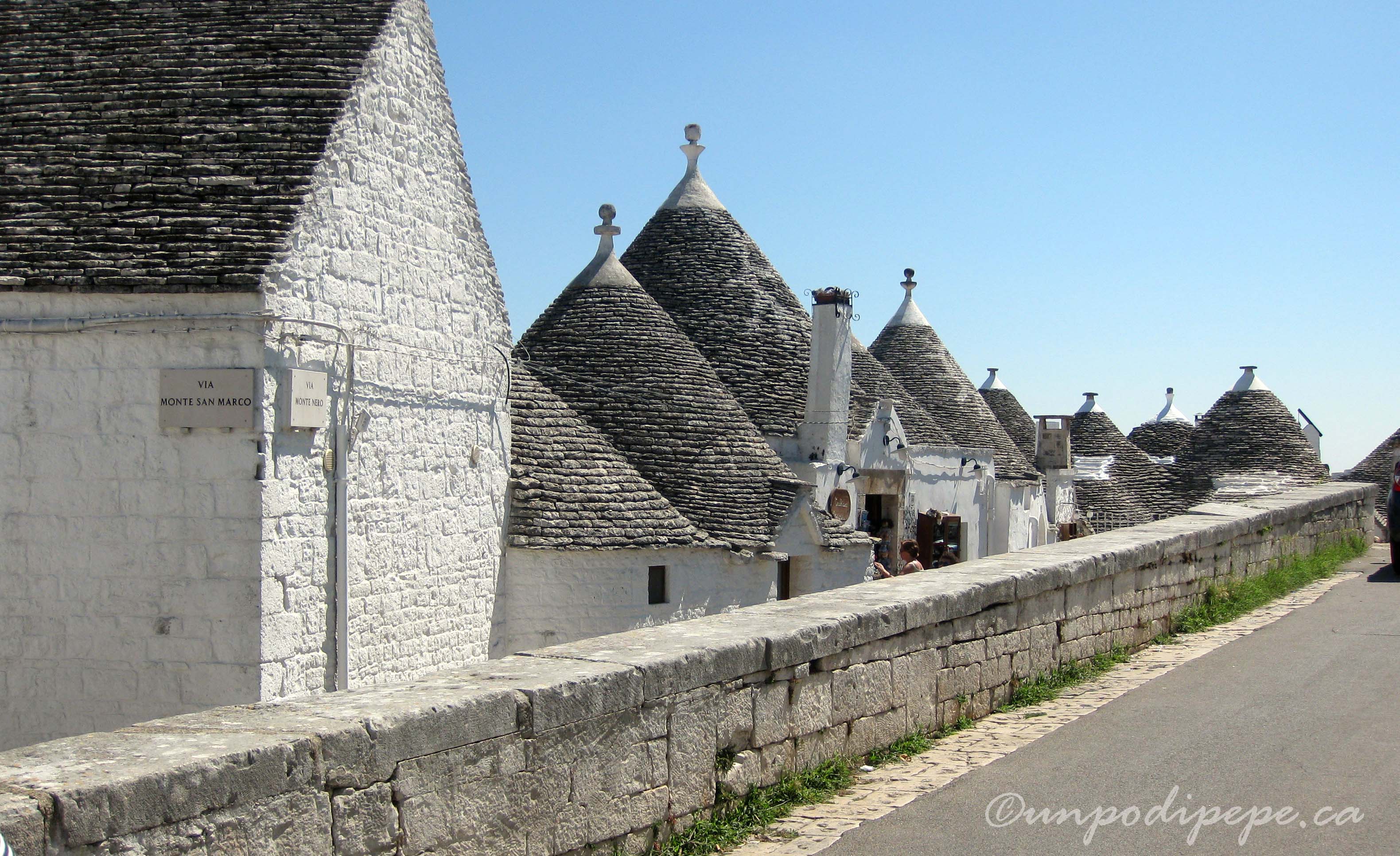
7) Trulli-These traditional limestone houses are unique to the Val d’Itria in Southern Puglia.  They were built ‘a secco’, which means dry-without mortar.  Trulli have domed cone-shaped roofs built up of overlapping grey limestone slabs called chiancharelle (kyan•ka•REL•leh). 

‘La Zona dei Trulli’ includes the areas around Locorotondo, Fasano, Cisternino, Martina Franca, Ceglie Massapica and the largest concentration of 1,620 trulli in Alberobello.  Alberobello and its trulli are a UNESCO World Heritage Site.  Read more about trulli in I Trulli di Alberobello.   Trulli Alberobello8) History/Connection to the Iliad  Can any other region say it was founded by a Trojan War hero?  According to legend, after the fall of Troy the mythical hero Diomede (Diomedes) found out his wife had been unfaithful.  Instead of returning home to Argos, he sailed the Adriatic, created the Isole Tremiti, and then was invited by Daunus, King of the Daunia (modern Provincia di Foggia) to settle there.  Diomede allegedly planted the first grape vines in Puglia, brought with him from Greece. He also founded many other towns in Puglia.  Diomede was allegedly shipwrecked and died near the Isole Tremiti.

tomba di Diomede Isole Tremiti

La tomba di Diomede on San Nicola.

An unmarked Hellenic period tomb on San Nicola is known as ‘la tomba di Diomede’. According to legend, his crew was so upset that the Goddess Venus took pity on the grieving men and turned them into birds that continue to cry for their loss. The scientific name for the Great Albatross common in the area is ‘Diomedea’.  These birds look like seagulls and sounds like a crying newborn.  There is a scene in Fellini’s fim ‘Otto e mezzo’ (8½), where a cardinal tells this story to Guido (Marcello Mastroianni).

A Diomedea, San Domino

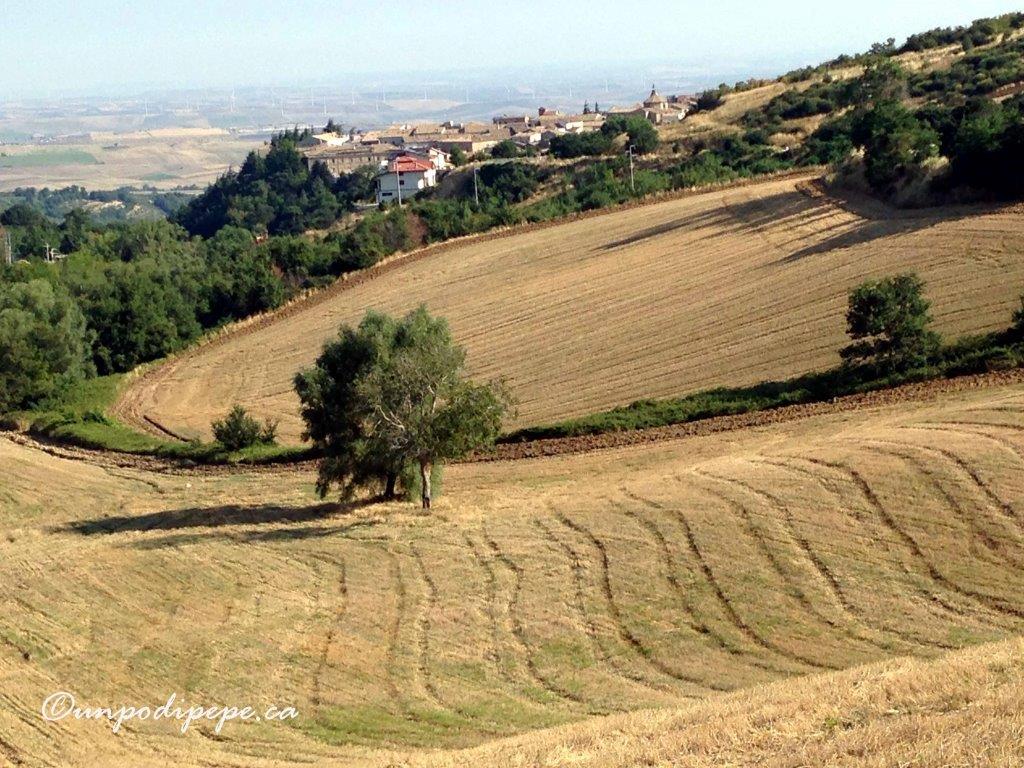
Orsara di Puglia landscape9)Paesaggi- The landscape of Puglia is varied and beautiful, made up of wheat fields, olive groves, vineyards and rocky coastline.  The region has 60 million olive trees,  including ulivi secolari-centuries old trees with knotted, gnarled trunks that have been twisted by time and wind.  Puglia’s trees produce 40% of the olive oil in Italia.

10) Slower pace Most of Puglia is still very much ‘real italia’, less commercialized and touristy, with great places to visit.  I am often told my photos look like they are from old movie sets.  Even though Puglia is often on the ‘places to see this year’ lists, it is uncrowded.  This is partly because it is poorly served by public transportation, and also because most foreigners visiting Puglia only go to the Salento and Alberobello! Italians from other regions travel to Puglia a lot, making it a great place to practice speaking italiano! Check out the posts A Perfect day in Italia and Il Sole di Metà Pomeriggio for more paese scenes.Fiat 500K Giardiniera AutobianchiHave you been to Puglia, mia regione preferita?  Let me know in the comments.

This post is written as part of the #dolcevitabloggers monthly blogging linkup, hosted by Jasmine, Kelly and Kristie the 3rd Sunday of the month.  Click the link to check out what the rest of the Dolce Vita bloggers have written on this month’s topic.Porto, San Domino, Isole Tremiti, Puglia

Ciao, Cristina

Share this:

  • Share on Facebook (Opens in new window) Facebook
  • Share on Pinterest (Opens in new window) Pinterest
  • Share on X (Opens in new window) X
  • Email a link to a friend (Opens in new window) Email
  • Share on WhatsApp (Opens in new window) WhatsApp
Like Loading...

Pio Monte della Misericordia

11 Monday Feb 2019

Posted by Un po' di pepe in Art, Art history, Italia

≈ 15 Comments

Tags

7 Acts of Mercy, Caravaggio, Napoli

Pio Monte della Misericordia (Pious mount of mercy) is a charitable organization founded in 1601 by seven young noblemen in Napoli.  Every Friday they met at the hospital to minister to the sick.  400 years later, the organization is still in operation, assisting minors at risk, those struggling with addiction, unaccompanied migrant minors, disadvantaged families, the homeless and the terminally ill.

In 1602, the founders commissioned a small octagonal church on Via dei Tribunali. They wanted artwork to express their sense of charitable mission, which was guided by le sette opere di misericordia, the seven corporal works of mercy.  These are a set of compassionate acts concerning the material needs of others, based on the bible passage ‘For I was hungry and you gave me something to eat, I was thirsty and you gave me something to drink, I was a stranger and you invited me in. I needed clothes and you clothed me.  I was sick and you looked after me, I was in prison and you came to visit me’ Matthew 25:35:36.  Bury the dead was added later and comes from another scripture.

They hired, who else but Caravaggio to paint one of the seven works of mercy for the altar of each of 7 chapels. Caravaggio was either in a big rush or feeling like a challenge, because he incorporated all 7 onto 1 canvas!  The capolavoro is one of the most important of his works, and of the 17th Century.  It still hangs in its original position above the high central altar! Seven local Caravaggio followers, including Luca Giordano, Fabrizio Santafede and Battistello Caracciolo provided paintings for the chapels.Caravaggio Sette opere di misericordia Pio Monte della misericordia

The composition is realistic, complex and dramatic. At the top of the painting, 2 angels are supporting the Madonna di Misericordia and child in the air.  The bottom half features figures carrying out the acts of mercy.  On the right, from the myth Roman Charity, Pero secretly breastfeeds her father, Cimon, after he is imprisoned and sentenced to death by starvation. (feed the hungry and visit the imprisoned).  Behind the wall of the prison, 2 men carry a shrouded body with the feet dangling out of the blanket (bury the dead). On the left, St Martin de Tours comforts the injured beggar in the foreground (comfort the sick).  He tears his cloak and gives half to the naked beggar (clothe the naked). In the background, a pilgrim with a shell in his hat asks an innkeeper for shelter (shelter the traveler) and behind them, Samson drinks from the jawbone of a donkey (give drink to the thirsty). All of this action is taking place in a dark, mysterious vicolo, an alley that could be just around the corner. Caravaggio uses his signature strong contrasts of light and dark chiaroscuro, the bright light acting as a metaphor for mercy.

Caravaggio came to Napoli with a price on his head, on the run from a murder charge. He was idolized and successful in Napoli, but he was desperate for a pardon, so after only a year, he left Napoli for Malta where he thought the Knights of St John could help him. This may explain his decision to incorporate all of the works of mercy into one painting!  As discussed in this post, it has also been confirmed that he had lead poisoning.  Caravaggio understood Napoli like no other painter and had a profound influence on the artistic scene in the city for the next few centuries.  He left behind a lot of followers-the Caravaggesque movement.

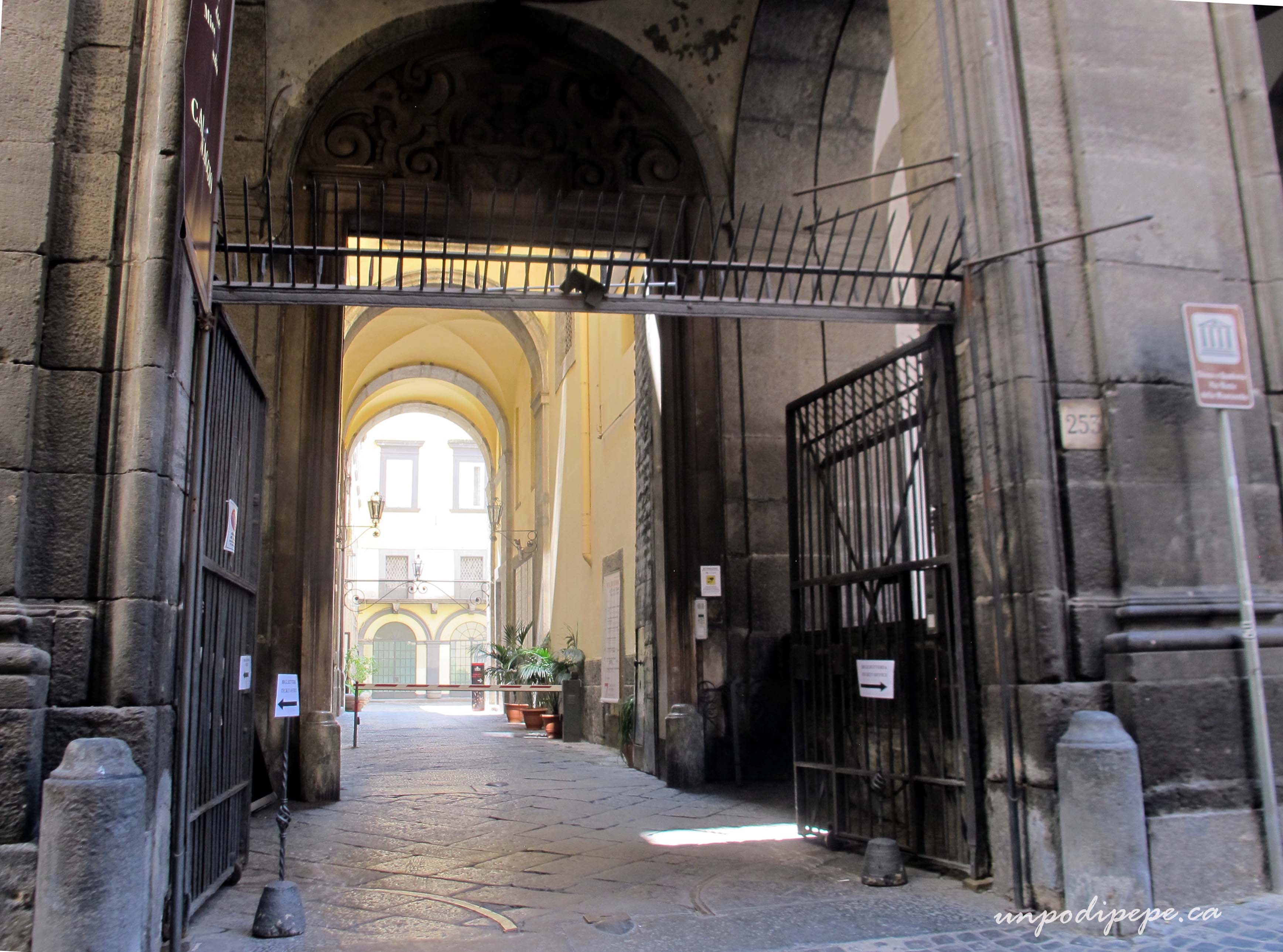
The €7 admission includes a visit to the Quadreria- Art Gallery, which contains 15th-18th Century paintings by Napoletani artists and also the original receipt for 400 ducats paid to Caravaggio.  Via dei Tribunali 253, Napoli. Open Mon-Sat 09-18, Sunday 09-14:30Pio Monte della Misericordia

Images:  Scan of Le Sette Opere di Misericordia taken from the Pio Monte della Misericordia brochure.  Photo of me with the painting taken by another visitor to the church.  He said I looked so excited he had to take my photo!

Share this:

  • Share on Facebook (Opens in new window) Facebook
  • Share on Pinterest (Opens in new window) Pinterest
  • Share on X (Opens in new window) X
  • Email a link to a friend (Opens in new window) Email
  • Share on WhatsApp (Opens in new window) WhatsApp
Like Loading...

Cristo si è Fermato a Eboli

20 Sunday Jan 2019

Posted by Un po' di pepe in Inspiration, Italia, Libri

≈ 32 Comments

Tags

Aliano, Basilicata, Carlo Levi, Dolcevitabloggers, Italian literature, Matera, Southern Italy

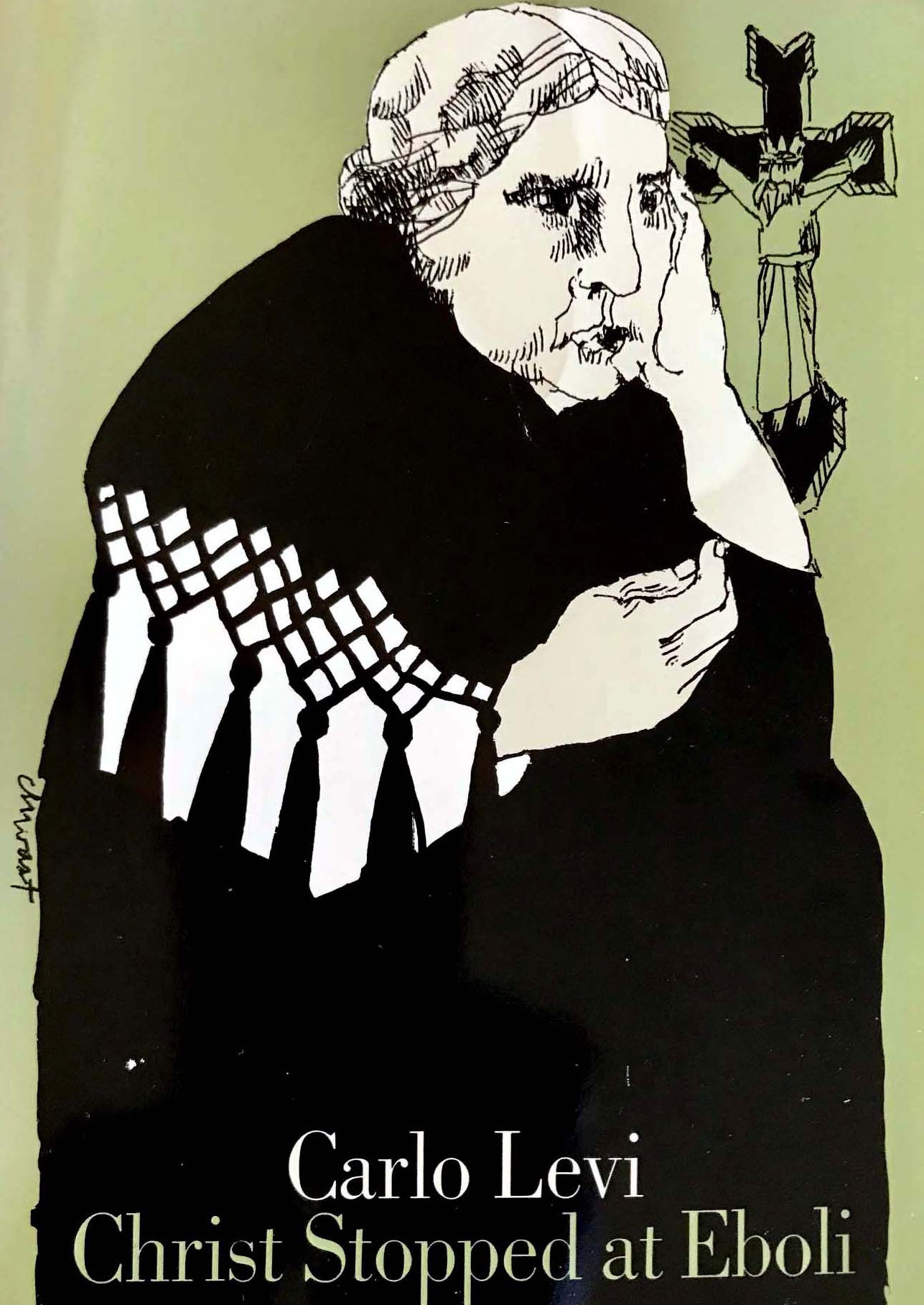
Christ Stopped at Eboli‘Cristo si è Fermato a Eboli’ /Christ Stopped at Eboli is Carlo Levi’s memoir about his year as a political prisoner in Basilicata in 1935-36. Levi (pronounced LEV∙ee) was a doctor, writer and artist from a wealthy Jewish family in Torino.  He was exiled to Aliano*, a small village in Basilicata for his Anti-fascist views and writing. Eboli is south of Napoli, where the road forks inland and the railway does not. The title is a local expression suggesting that even Christ didn’t make it as far as Basilicata so they are a God forsaken land beyond civilization and beyond hope. Obviously the Mussolini government agreed, since their strategy to silence outspoken critics was house arrest in the south! Levi comes into contact with profound poverty, distrust, class differences, spells and superstition in a remote, neglected part of Italia.

Levi graduated from medical school in 1924 and did 4 years of lab research, but had not actually practiced medicine on humans.  He was not keen on practicing, but reluctantly did so, since the 2 doctors in Aliano were incompetent and lacked any compassion. The people did not fully understand him or why he was there, often commenting ‘someone in Rome must have it in for you’.  Levi comes to empathize with the peasants, becoming a much loved member of the community.

Published in 1945 after the liberation of Italia, Cristo si è Fermato a Eboli was an immediate hit with both the public and critics. It gave the people a voice and brought attention to the region, including the socioeconomic problems and political neglect. 

Cristo si è Fermato a Eboli /Christ Stopped at Eboli is required reading before visiting Matera, the 2019 European Capital of Culture. Near the beginning of the book, Carlo’s sister Luisa, a practicing doctor, visits and brings medical supplies. She needs a form stamped at the police station in Matera before she is allowed to see him. Luisa describes the Sassi as:

‘a schoolboy’s idea of Dante’s Inferno’…….‘I felt, under the blinding sun as if I were in a city stricken by the plague. I have never in all my life seen such a picture of poverty. ..This is how 20,000 people live!’

There was a 50% infant mortality rate, malaria, dysentery and trachoma. Carlo spends a few hours in Matera near the end of the book and says:

‘I had time to see the town and then I understood my sister’s horror, although at the same time I was struck by it’s tragic beauty’.

Matera’s situation continued on unnoticed- until the 1945 release of this book. If you have not read my Matera post, please click on ‘I Sassi di Matera’.

I have read this book in both english and italian. If I had to pick a favourite Italian book or book about Italy, this is it. It is very philosophical and it is obvious from Levi’s writing and paintings that this experience affected him profoundly. He writes with great sensitivity and his paintings from Basilicata show an unbelievable amount of emotion and humanity.  The paintings are on permanent display in the Museo di Arte Medievale e Moderna in Palazzo Lanfranchi, Matera and in the Museo della Civiltà Contadina in Aliano.  Levi fought for social justice and went on to become a Senator of the Italian Republic. He is buried in Aliano, where he had requested to be ‘between the peasants’ whose endurance he so greatly admired.

Have you read Cristo si è Fermato a Eboli? Let me know your thoughts in the comments.  Buona lettura, Cristina

This post is written as part of the dolcevitabloggers linkup, hosted by Jasmine, Kelly and Kristie the 3rd Sunday of every month.  Click #dolcevitabloggers to read blog posts by other participants

Images:

-my 1996 English edition nonna cover

-detail from Lucania ’61 mural by Carlo Levi in Palazzo Lanfranchi, Matera, Wikimedia Commons

-my 1978 Italian edition book cover with the painting ‘Il figlio della parroccola’ Pricetag says £ 1.800!

*Note-Aliano is called Gagliano in the book, although no explanation is given

Share this:

  • Share on Facebook (Opens in new window) Facebook
  • Share on Pinterest (Opens in new window) Pinterest
  • Share on X (Opens in new window) X
  • Email a link to a friend (Opens in new window) Email
  • Share on WhatsApp (Opens in new window) WhatsApp
Like Loading...

La Raccolta delle Olive

22 Thursday Nov 2018

Posted by Un po' di pepe in Italia, Italian life, Orsara di Puglia, Photography

≈ 13 Comments

Tags

Casa Berti, Frantoio, Olive harvest, Olive oil, Olive oil production

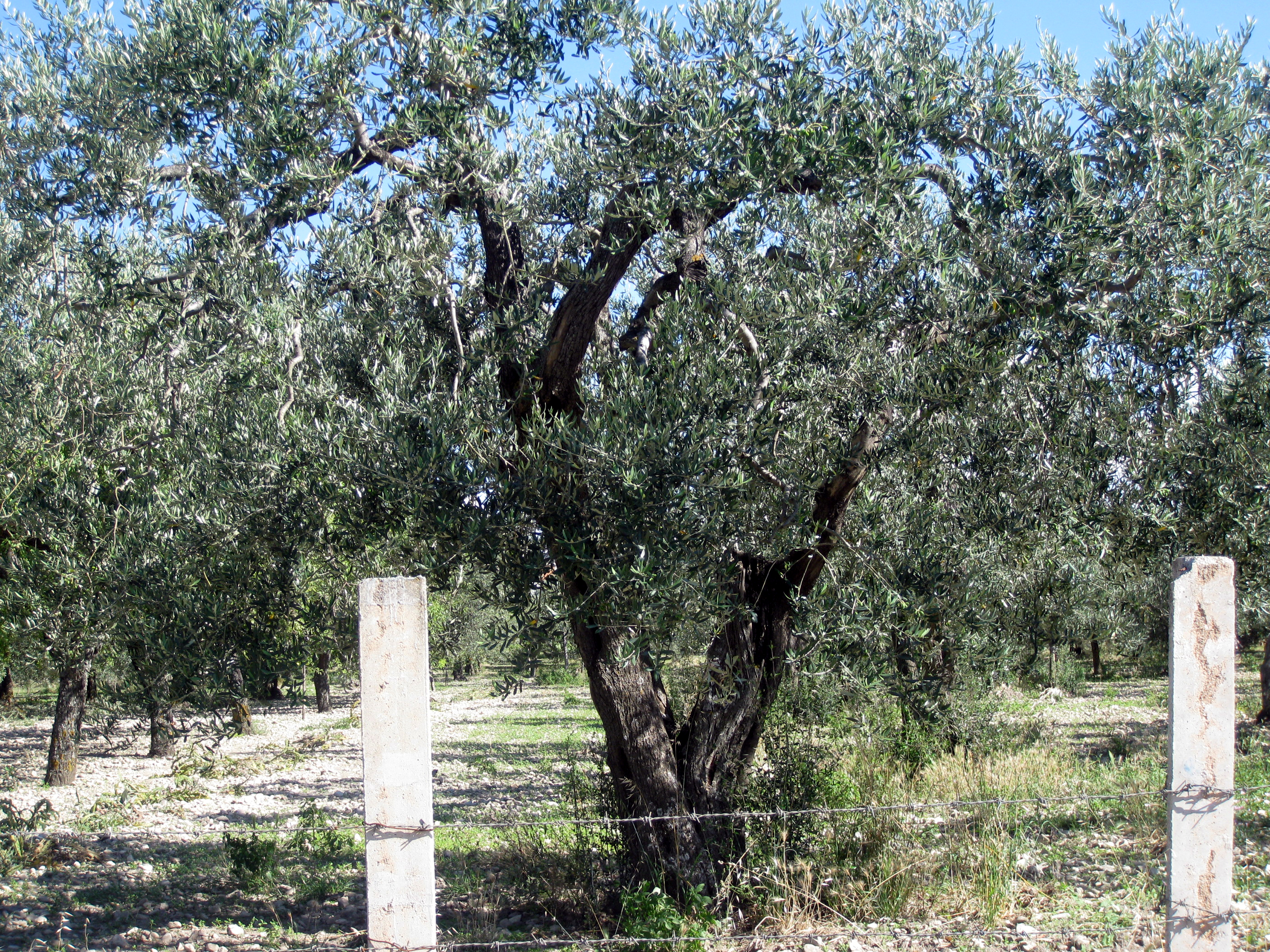
The olive tree has been essential to Mediterranean life for over 4,000 years. In addition to being a staple ingredient of the Mediterranean diet and an ancient trading commodity, olive oil has been used as a medication, soap, hair and skin moisturizer, terra cotta lamp fuel, furniture polish, and for cleaning and waterproofing leather.  Olive trees have a strong root system and can live for centuries. It takes up to 8 years before a tree produces its first olives. They grow well in lime and stony, poorly aerated soil, in areas with rainy winters and hot, dry summers. Olive trees have been considered sacred and symbolic. The olive branch has been a symbol of peace and the endurance of life since Genesis 8:11 ‘the dove came back to him in the evening; and, behold, in her mouth was a freshly plucked olive leaf: so Noah knew that the waters had subsided from the earth’. The shape and form of olive trees has always captivated me. I still have not mastered their tangled growth of trunks and leaves with a silvery green underside, but they are frequent subjects in my sketchbook. While in Italia last November, I encountered a lot of olives.  Seeing the trees heavy with ripe black and purple olives was new for me, as I had only ever seen them in their small green state! Every road near Orsara di Puglia was full of parked cars where families were harvesting their olives.  Unfortunately, I missed my family’s olive harvest by one day, but I was in Gugliano near Lucca during their harvest.  I used Casa Berti’s fresh olio nuovo to make Olive Oil Limoncello Cake.

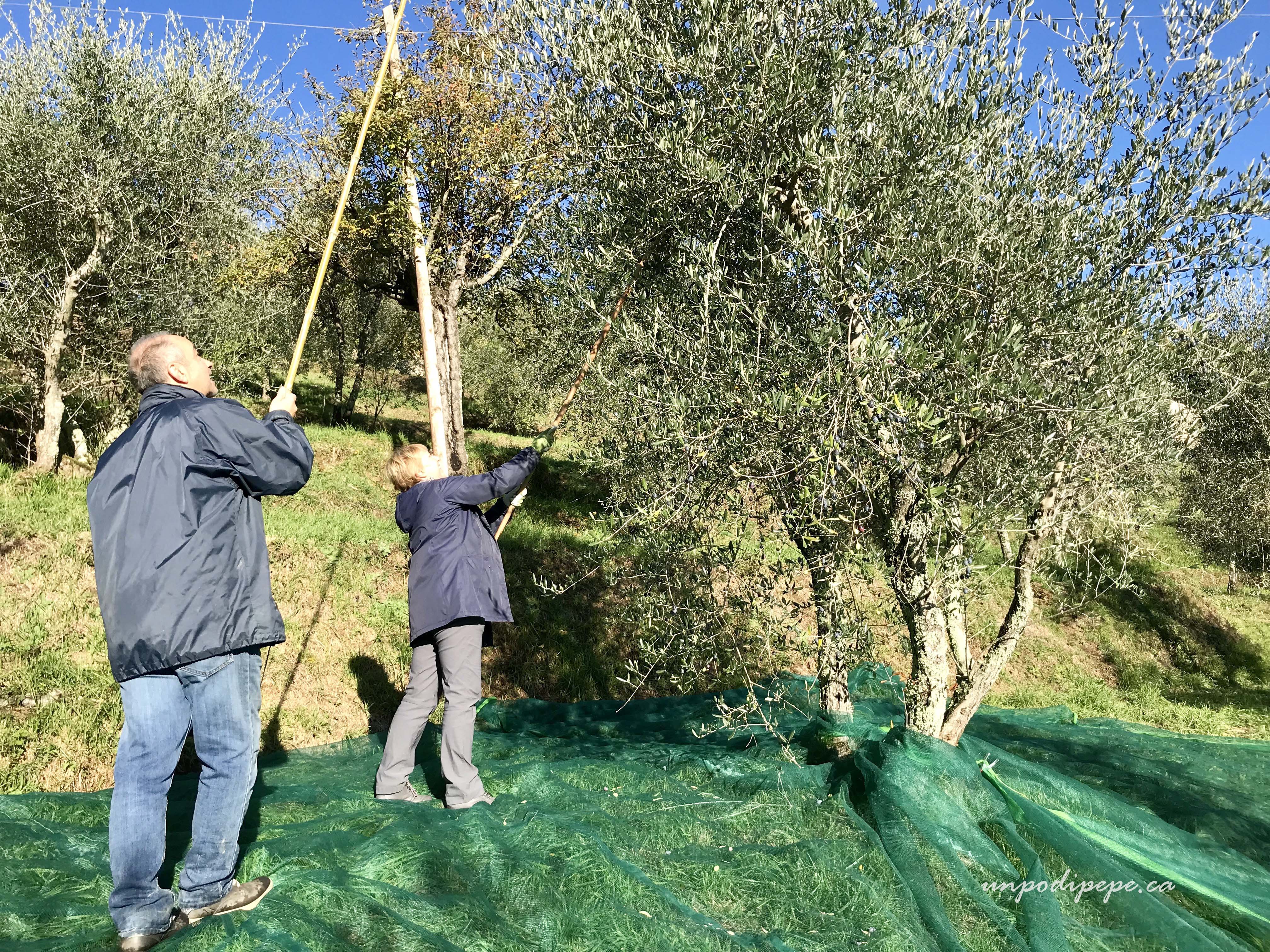
La Raccolta delle olive-the olive harvest, is usually in late October/early November before the first frost. Nylon nets with a split down the middle are spread under trees and wrapped tightly around trunks to catch falling olives. On sloping hills, the edges of the nets are supported with sticks so olives do not go rolling away.Olive harvesting does not go well with mechanization. The more gently olives are picked, handled and stored, the better the quality of the oil they produce. Olives are harvested using a combination of the following methods:

Brucatura (broo·ca·TOO·rah) is picking olives by hand and putting them straight into un cestino-a basket, or a bucket.  This preserves the integrity of the olives and does not damage the tree or branches.  Ladders are used for the higher, hard to reach branches.  This method is slow, with a lower yield, but produces the best oil, with the least acidity.  Olive, Casa Berti www.unpodipepe.ca

Pettinatura (pet·teen·ah·TOO·rah) is ‘combing’ olives off the branches with long handled combs/rakes and collecting them into buckets or nets.  Families producing olive oil for their own consumption harvest mainly by brucatura and pettinatura.

Bacchiatura (bahk·kee·ah·TOO·rah) is beating fruit off trees with long poles so they fall into the nets. A long-handled electric version for higher branches looks like 2 rakes facing each other that vibrate in opposite directions. If not done carefully, bacchiatura can cause bruising to the olives and damage to twigs and branches.

Raccattatura (rak·kat·tah·TOO·rah) is collecting ripe olives that fall spontaneously into nets. If not gathered right away, the olives can be rotting, with mold or bacteria, especially if it is damp or rainy.  Raccattatura produces oil with increased acidity

Scrollatura (scrol·lah·TOO·rah) A mechanical arm attached to a tractor wraps around the trunk and shakes the tree until all of the olives fall off into nets.  This method is efficient for large olive groves, but damaging to the tree and can produce inferior oil.  Luckily this method is not possible on terraced land or if there is not enough space between trees for a tractor.

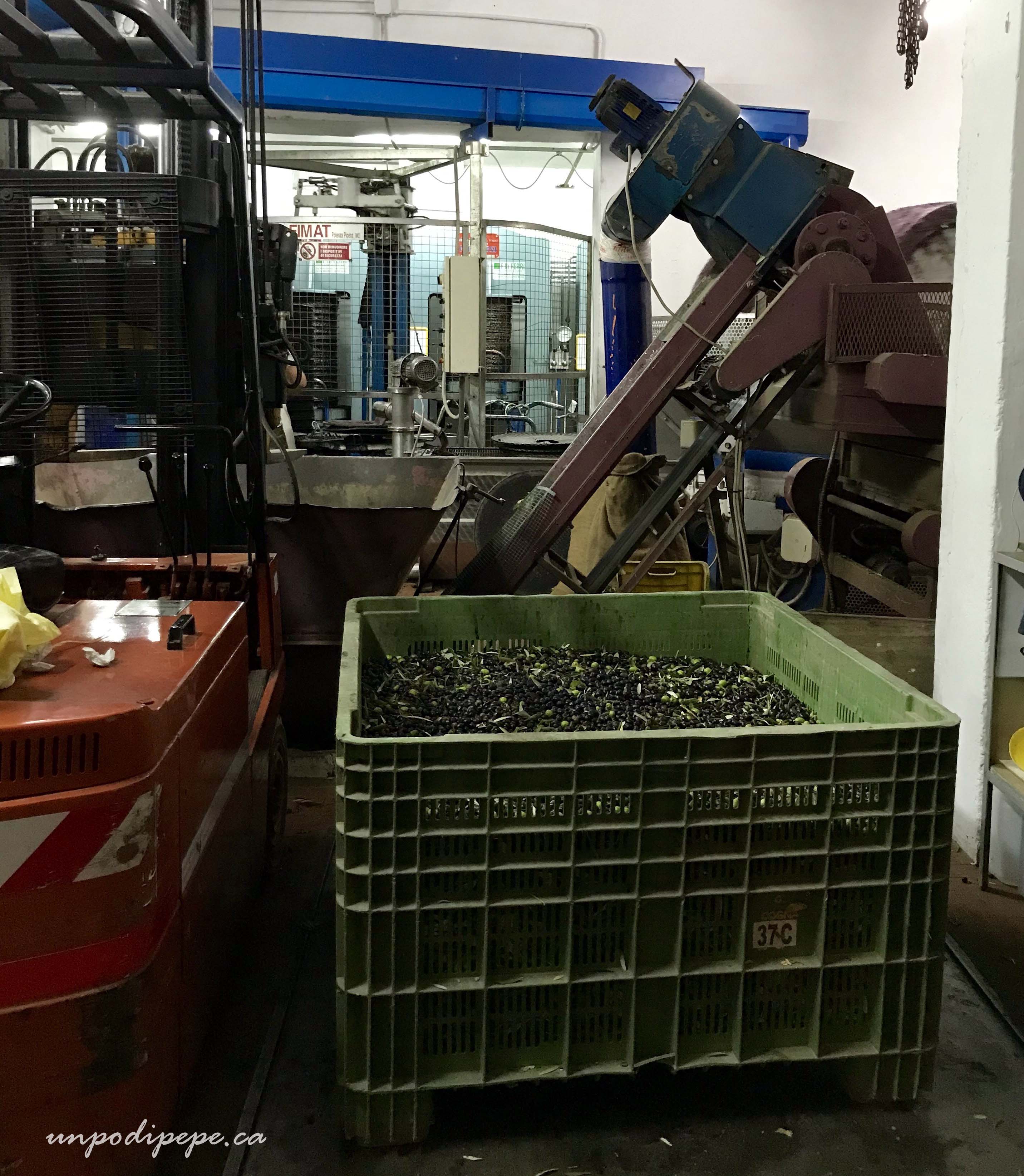
Olives are stored briefly in crates to get warm and release oil more easily. Then they are taken to the frantoio, the olive mill.  Extracting  within 24 hours of harvest produces the best quality oil with the lowest acidity.La raccolta delle olive www.unpodipepe.ca

One evening while I was in Orsara di Puglia, I was lured by the divine smell of olives. It was the frantoio, which of course is closed the rest of the year.  During la raccolta delle olive, it is open all the time and is a busy, social place. The frantoio is as cold as outside, since cold prevents oxidation and preserves the nutrients, colour and flavour of olive oil.  I was curious to see the olive oil extraction process.

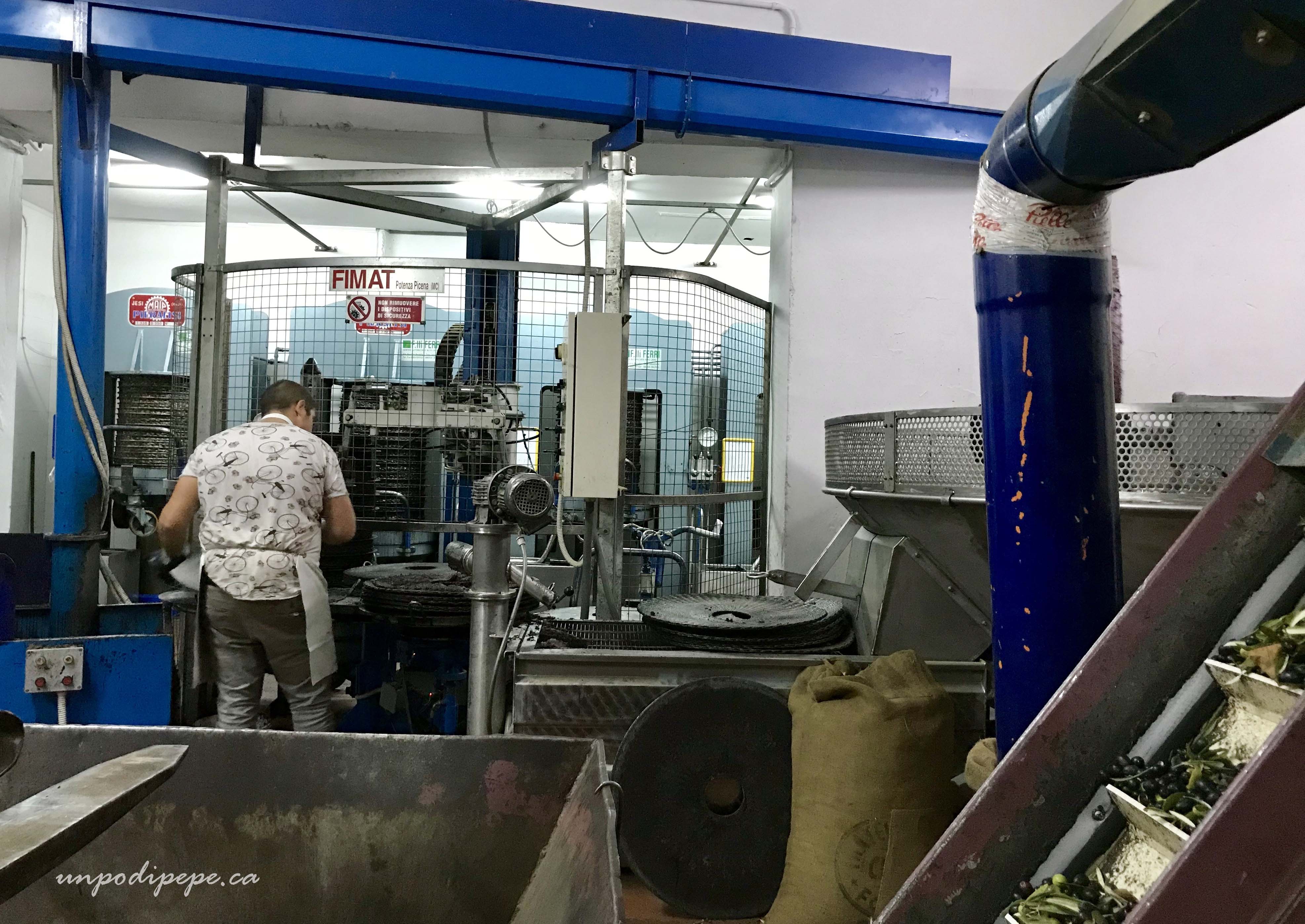
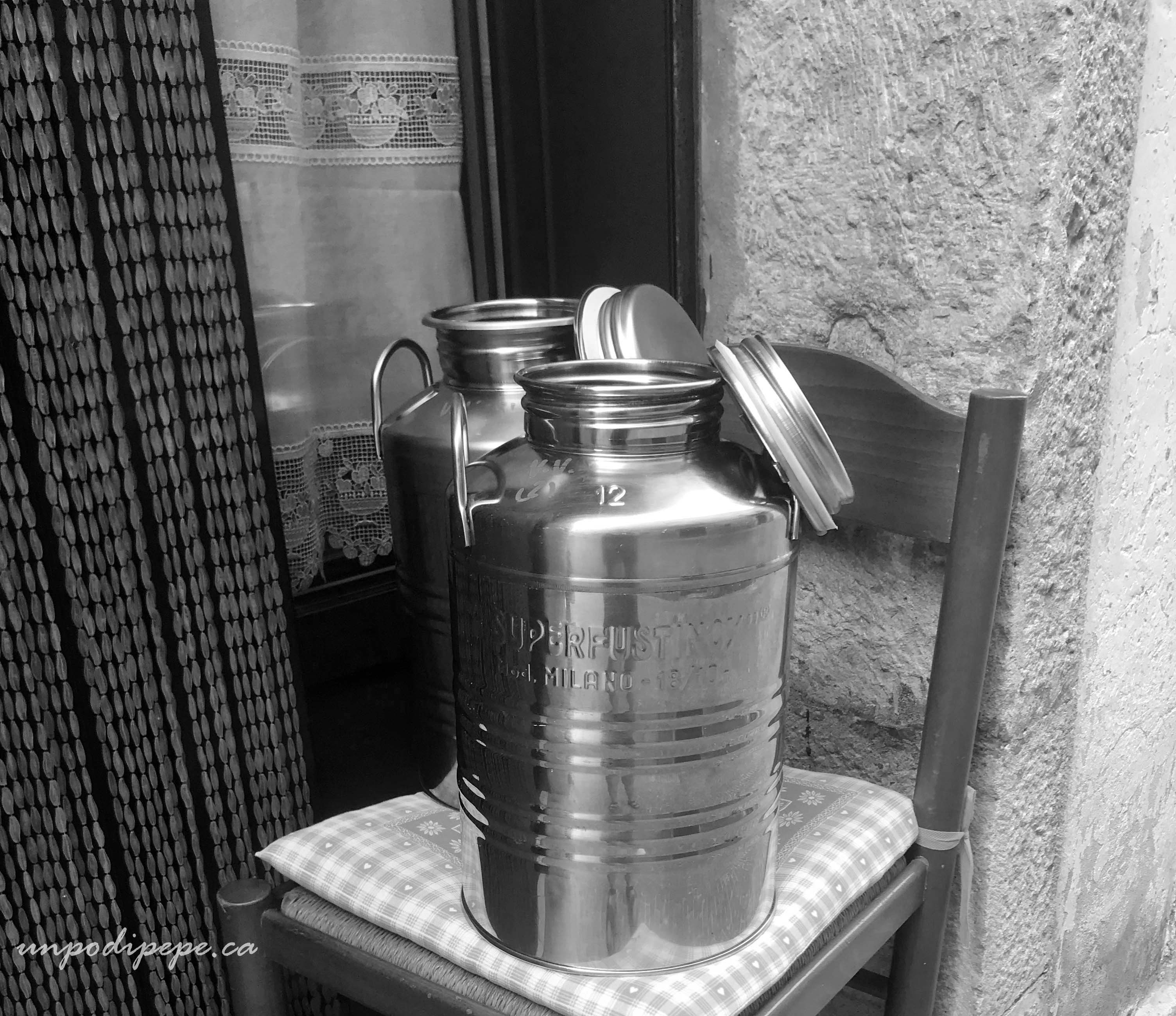
The olives are separated from branches, leaves and debris then weighed, rinsed in cold water and passed along a conveyor belt between rollers. Then they go into a vat with blades that mash or grind the olives into a paste- including the pits!  This used to be done with stone or granite wheels like a giant mortar and pestle. The olive paste is spread evenly over pressing discs/mats, which are stacked onto a press plate to evenly distribute the pressure.  The paste is not heated to extract oil, as cold prevents oxidation.  Oil and water are separated and sediment removed using a centrifuge, then precious liquid gold, unfiltered olive oil pours out a spout draining into a steel basin.The colour of olive oil can range from grassy green to bright yellow gold, depending on the ripeness and type of olives and the level of chlorophyll in leaves. The fresh oil is stored in stainless steel vats until it is bottled.

The yield of oil per quintale (100kg/ 220lbs) of olives varies each year. It takes approximately 2,000 olives or 1 tree to produce 1L of olive oil! No wonder it is expensive!

The fresh oil is virgin olive oil.  It can be designated as ‘extra virgin’ only if the % acidity is less than 0.8% and it has superior taste and aroma.  For more on olive oil terms, read the post Olio d’Oliva.

Photos featured in this post were taken at Frantoio Oleario di Nico Manna in Orsara di Puglia, my family’s olive grove in frazione La Cupa, Orsara di Puglia, and Casa Berti in Gugliano, Lucca.

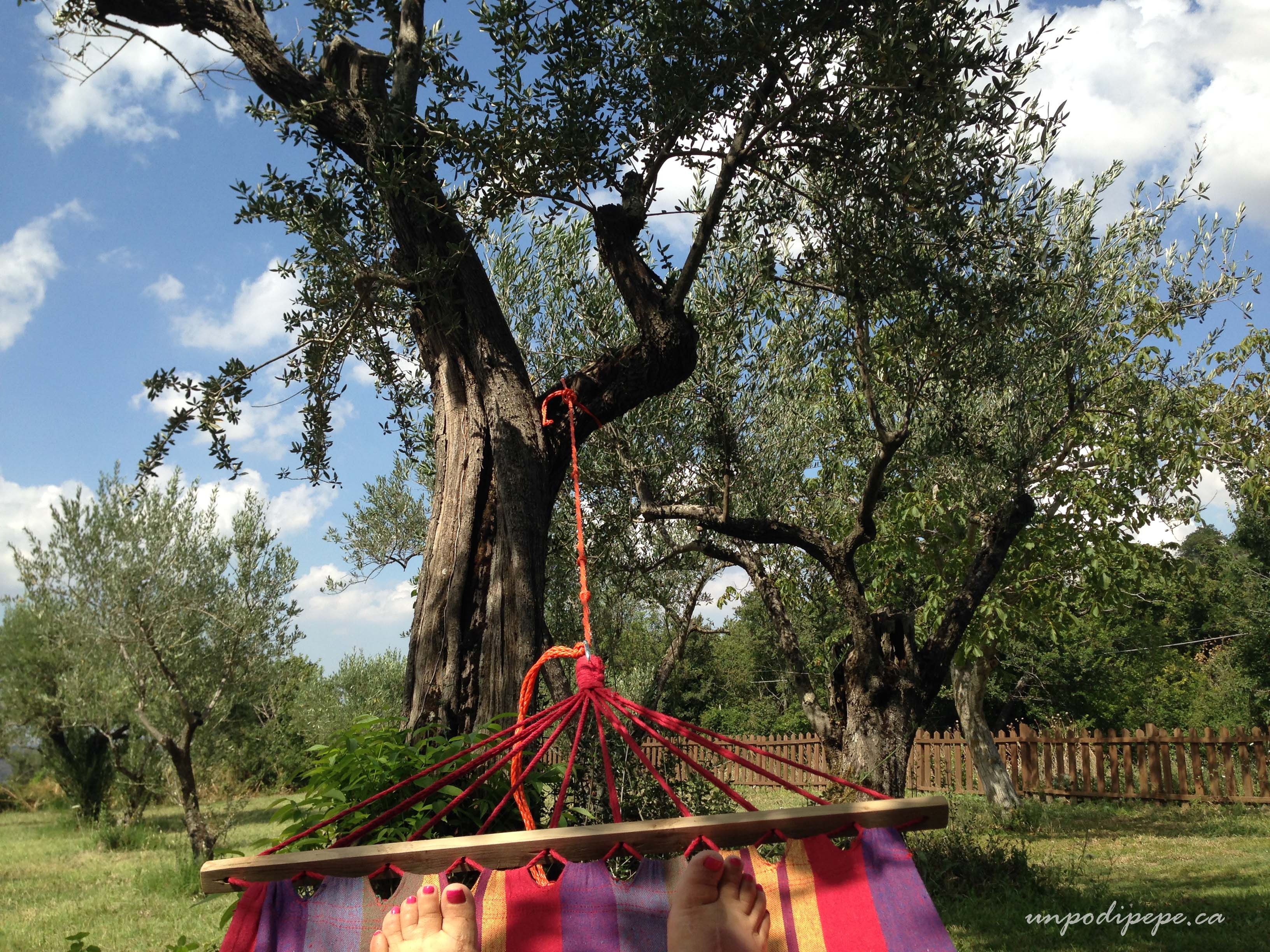
Ciao from my amaca under the olive trees, Cristina

Share this:

  • Share on Facebook (Opens in new window) Facebook
  • Share on Pinterest (Opens in new window) Pinterest
  • Share on X (Opens in new window) X
  • Email a link to a friend (Opens in new window) Email
  • Share on WhatsApp (Opens in new window) WhatsApp
Like Loading...

Tutti i Santi

01 Thursday Nov 2018

Posted by Un po' di pepe in Feste, Italia, Italian Folklore, Orsara di Puglia, Photography, Puglia

≈ 12 Comments

Tags

#quinonehalloween, All Saints' Day, Falò e Teste del Purgatorio, Fucacoste e Cocce Priatorje, Muscitaglia, November 1st, Pugliese Traditions, Pumpkin carving, Southern Italy, Tutti i Santi Festa

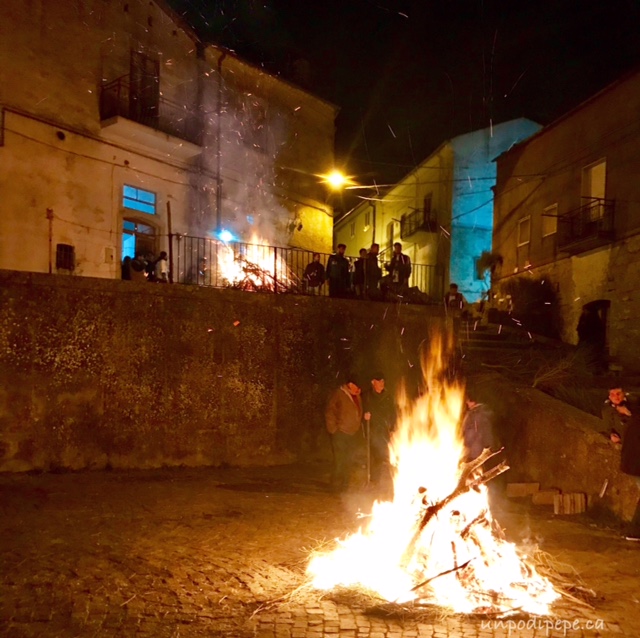
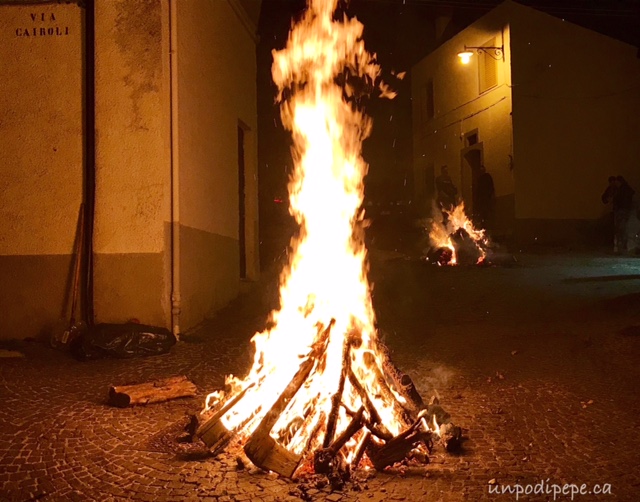
November 1st is Tutti i Santi-All Saints’ Day and is a national holiday in Italia.  It was created in the 9th century when the Pope superimposed a Christian feast day onto existing rituals, so this festa has been around for a very long time. Tonight is also an ancient festa celebrated in Orsara di Puglia called Fucacoste e Cocce Priatorje which is dialetto Orsarese for ‘Falò e teste del Purgatorio’.  This translates to ‘Bonfires and heads from purgatory’ the ‘heads’ being zucche lanterne-carved pumpkin lanterns. For simplicity, it is also called ‘Tutti i Santi’ or ‘La Festa dei Morti’.

The night between November 1stand 2nd provides the opportunity to honour, reconnect and pay respect to the spirits of loved ones.  I wrote about the festa in a 2014 post Fucacoste e Cocce Priatorje, but at that time I had not attended.  I had only heard about it from my parents, family and friends.  Last year I had the opportunity to attend. It was cold but the night was clear and an absolutely amazing, magical, spriritual experience-for me and at least 20,000 others. Orsaresi who live in other parts of Italia and Europe come home for the festa, and visitors come from all over Puglia. Since it is a holiday, many families are able to take an extra long weekend known as il Ponte dei morti.

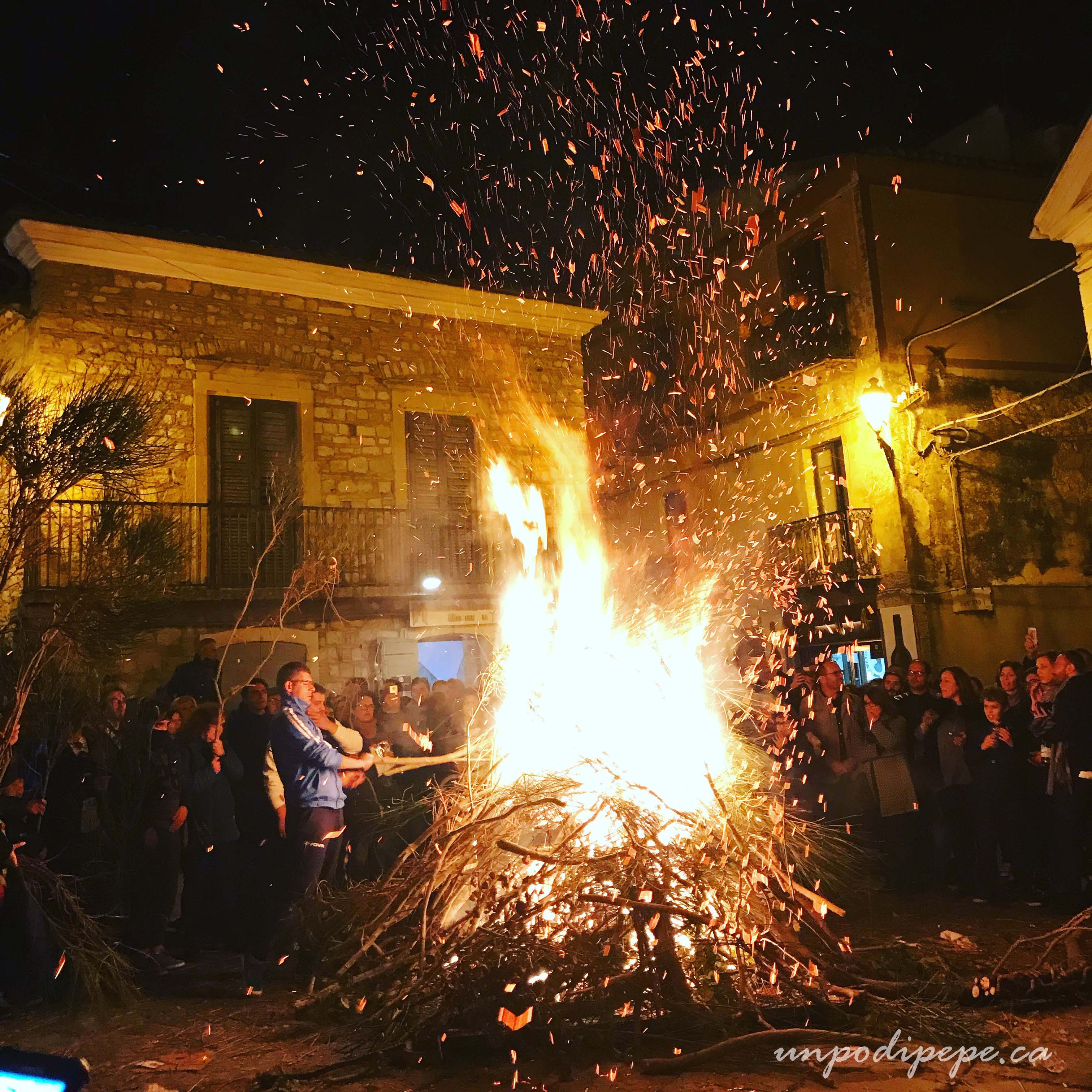
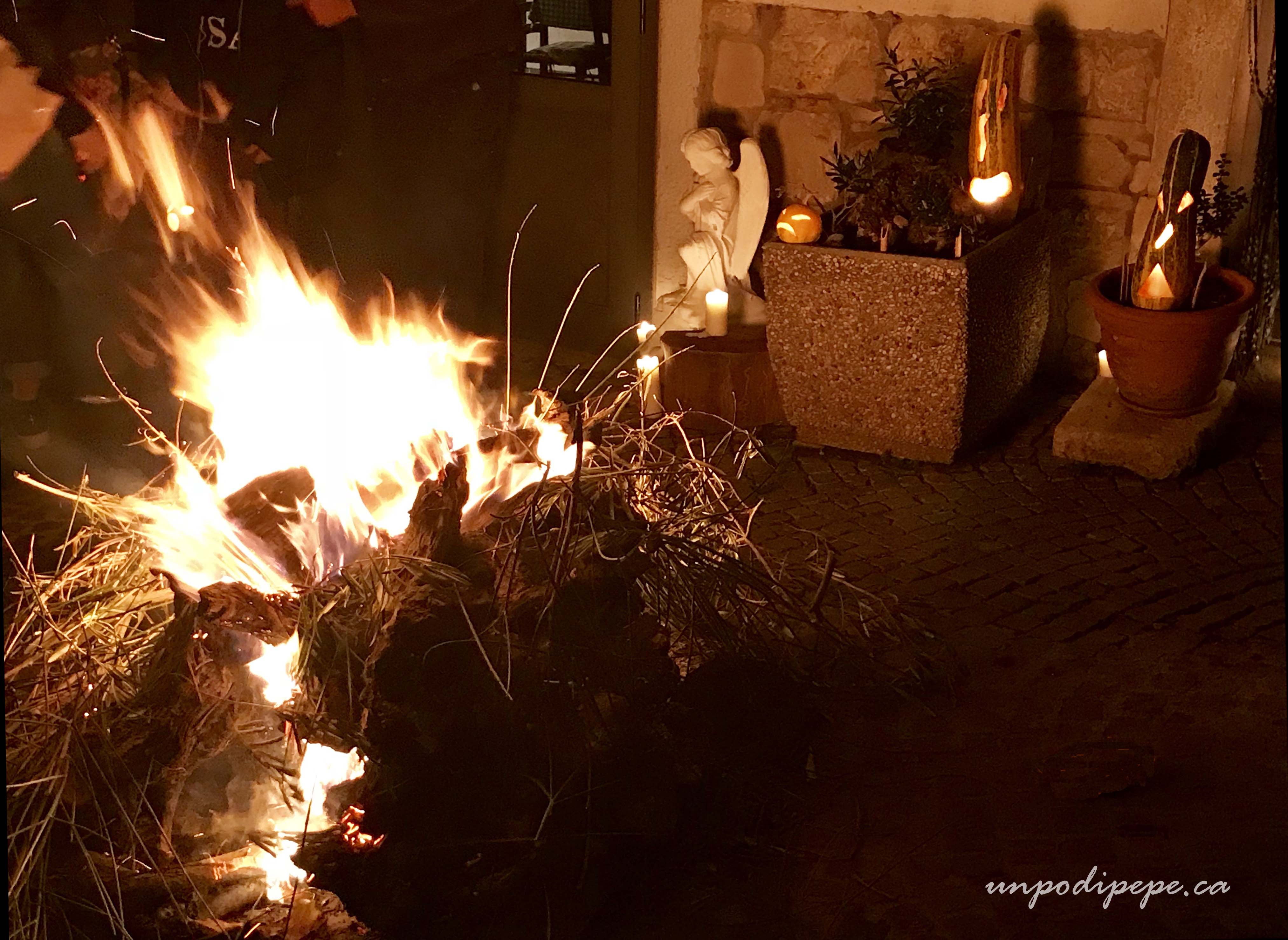
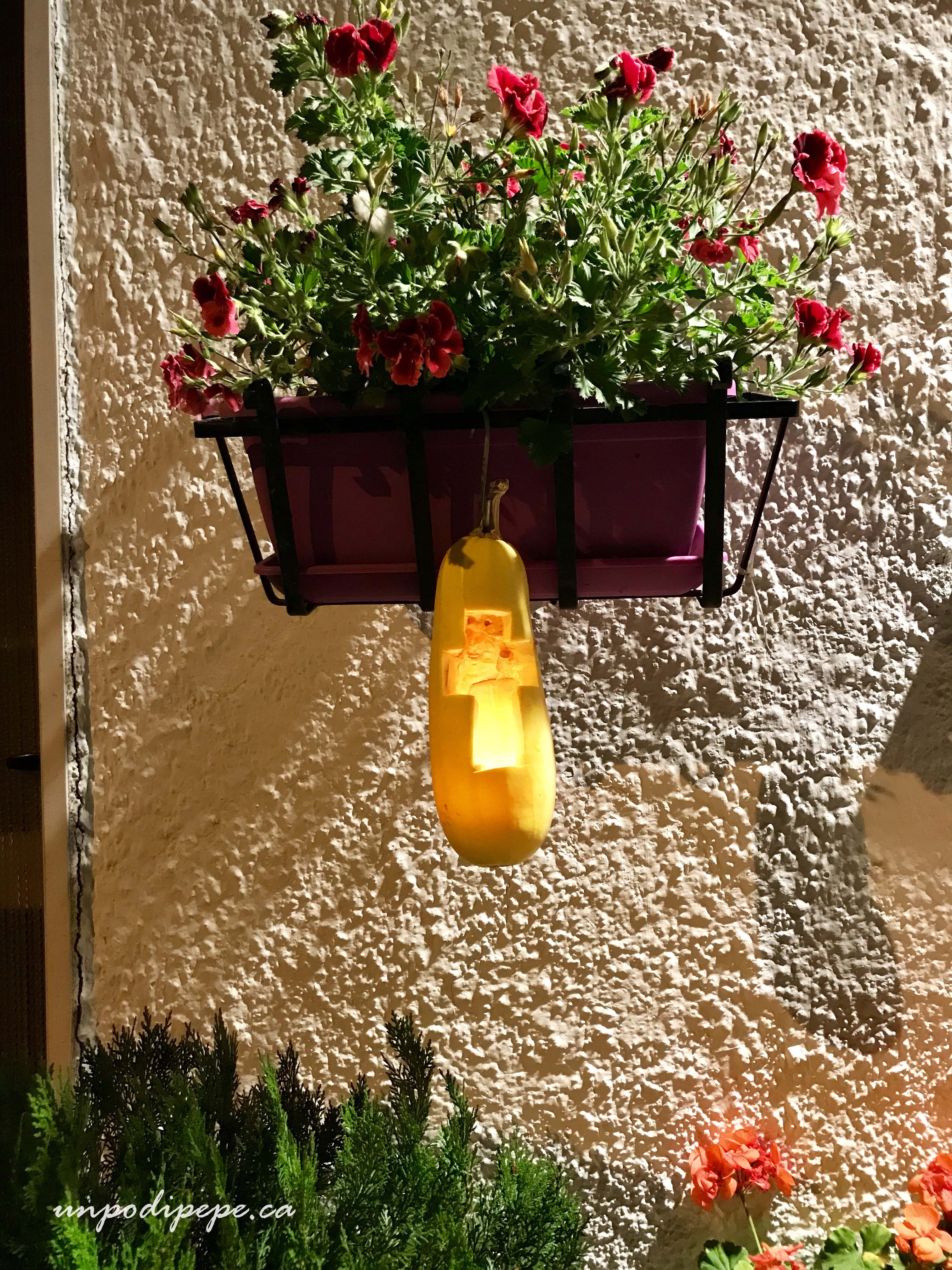
It is believed that this night between Nov 1 and 2, the souls of the recently dead return among the living to visit their relatives and their former homes before moving on to Paradiso.  Bonfires are lit with wood and branches of ginestra (broom). The light of the fires and the crackling and sparks of the ginestra reaching for the sky attract the spirits, to reunite the living with those who continue to live only in our memories. Fucacoste e Cocce Priatorje www.unpodipepe.caThe light inside ‘cocce priatorje’, pumpkin lanterns carved to look like heads or carved with crosses-light their way to find their former home.

My paesani are busy preparing for the festa for days.  Preparation involves gathering firewood and ginestra, preparing food for family and friends and picking hundreds of locally grown zucche which are carved and placed all over Orsara.  Restaurants and bars prepare for one of their busiest nights of the year.  There is even a laboratorio di intaglio delle zucche– a pumpkin carving workshop.  My street, balcony and front door were decorated with zucche.  In the evening zucche are exhibited and there is a contest for ‘la zucca più bella’.

When the campanile, the church bell tower, strikes 1900 hours, Orsara di Puglia ‘catches fire’.  Bonfires are simultaneously lit in every street and piazza and remain lit through the night.  The fires, illuminated zucche, music and people in the streets create a magical, enchanted atmosphere. There are 3 large municipal falò, and every quartiere – neighbourhood, and many families also light their own.

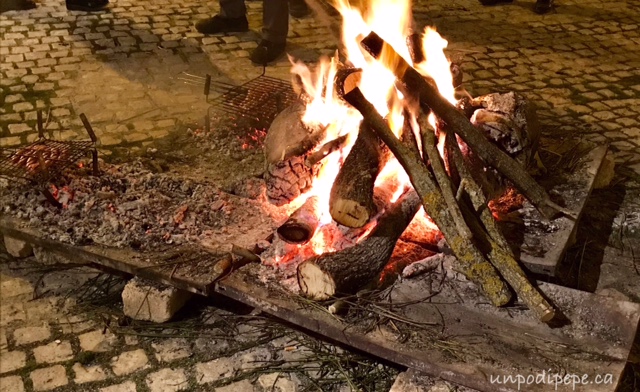
I made a point of getting off of the main Corso to visit some of the smaller personal falò. In honour of the dead, simple but symbolic seasonal foods are cooked on the open fires and also served as cibo di strada-street food.  These include patate -potatoes, cipolle-onions, salsicce-sausages, castagne-chestnuts and pane cotto-bread cooked with garlic, potatoes and greens.

Salsicce e pancetta nel fuoco

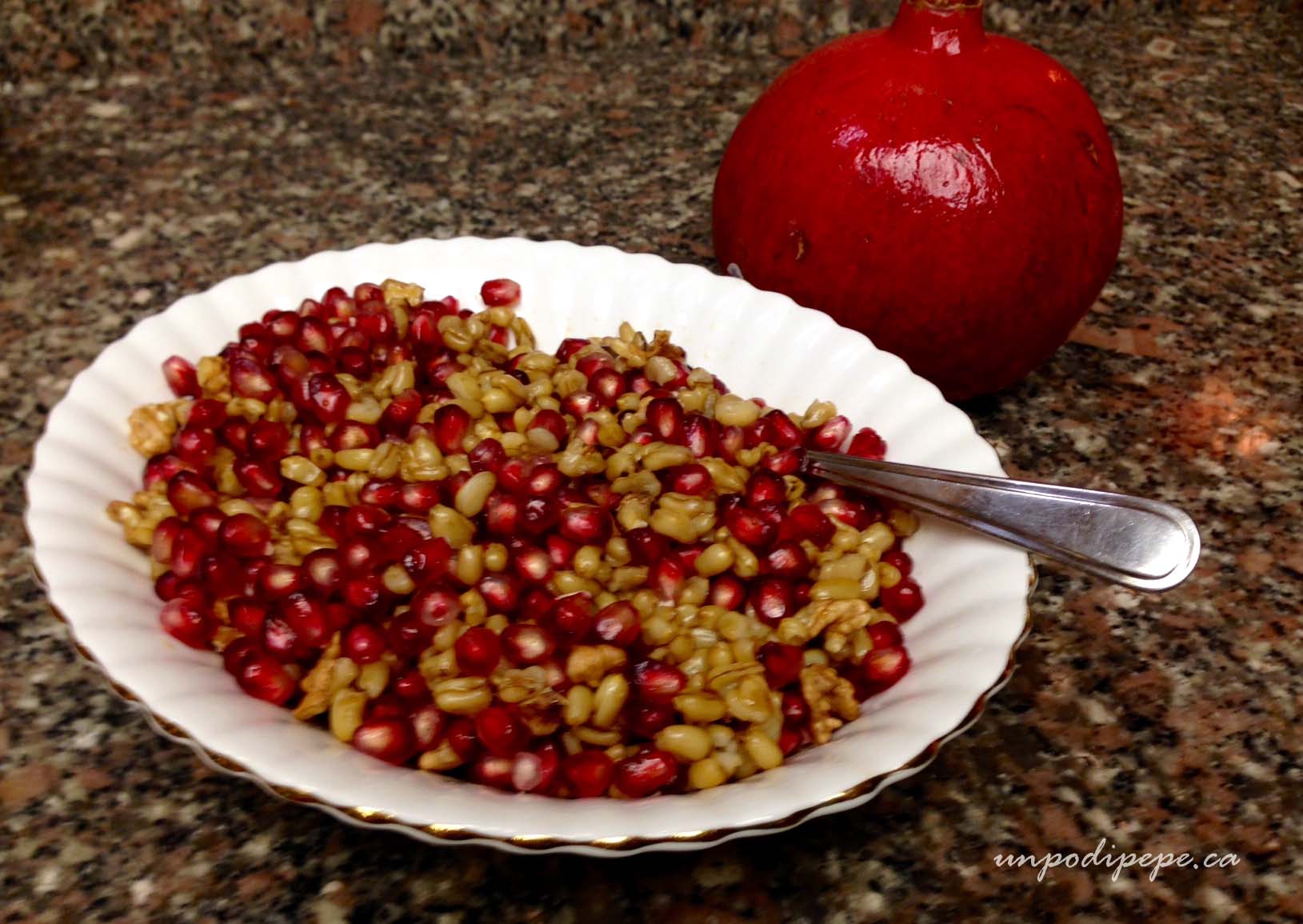
Muscitaglia (moo•shee•tah•lyah) is a traditional dish served November 1st likely dating back from the ancient Greeks and Byazantines. Muscitaglia is made up of the Greek and Latin words mosto (wine must) and talia (grain). The ingredients include boiled grain and vino cotto. Semi di melagrana e pezzi di noci -pomegranate seeds and walnut pieces are often added.  These ingredients are symbols of fertility and abundance, but also of honour and respect for the dead.

Il fuoco e le zucche di Antonella e Domenico

Fucacoste e Cocce Priatorje has often been confused by visitors with the Anglosaxon Hallowe’en, but it is an entirely different event.  Besides the obvious fact that the date is different, dressing up in costume is not part of the custom and there is nothing scary or evil about it.  This is the reason for the hashtag #quinonèhalloween. There are more similarities with Mexico’s Dia de los Muertos/Day of the Dead.  This event is about being together in community to celebrate the bond between the living and those who we remember in our hearts.  It is also to remind us that our time on earth is precious. The following day, November 2nd is l’Anime dei Morti-All Soul’s Day, and it is customary to go to the cemetery to pay respects at the resting place of loved ones.

The 9 minute video below features 94 year old Z’Gaetan talking about the festa and its significance.

This lively 48 second video from 2016 featuring the music of Tarantula Garganica will make you all wish you were there tonight:

If you did not watch the video….watch it now!  I did not make it there this year, but am looking forward to my next trip to Fucacoste e Cocce Priatorje!  Now I am off to my Mamma’s to have muscitaglia! Ciao, Cristina

Share this:

  • Share on Facebook (Opens in new window) Facebook
  • Share on Pinterest (Opens in new window) Pinterest
  • Share on X (Opens in new window) X
  • Email a link to a friend (Opens in new window) Email
  • Share on WhatsApp (Opens in new window) WhatsApp
Like Loading...

Caffè con Caravaggio a Roma

09 Tuesday Oct 2018

Posted by Un po' di pepe in Art, Art history, Italia, Roma, Travel tips

≈ 19 Comments

Tags

Caffe Greco, Caffe Sant'Eustachio, Caravaggio, Caravaggio free walking tour, Maddalena Antognetti, Madonna dei Pellegrini, Roma walking tour, San Luigi dei Francesi, Sant'Agostino, Santa Maria del Popolo, Tazza d'oro

Caravaggio spent 14 years in Roma, and lucky for us, he left behind a lot of work. There are 23 capolavori-masterpieces by Caravaggio at 9 different sites in Roma, including 6 works that can be viewed for free! Si!  Free, gratis, senza pagamento. These 6 paintings are not in museums, they are still in the 3 churches they were originally painted for and have been hanging for over 400 years.  No entrance fee, no reservations or pre booking required, and usually no lineups!  The best thing about seeing artwork ‘in situ’-where it was created to be viewed- is that you can walk in and see the work where it was meant to go, just like someone in the 17th Century did.

It is possible to do a walking tour, visiting all 3 churches in a few hours.  As a bonus, along the way, this walking tour also makes 2 or 3 caffè stops.  If you missed my last post on the life of Caravaggio, read it here.

***Important Note before we start– the 3 churches on this wonderful passeggiata are primarily places of worship, so please be respectful.  Dress appropriately, speak quietly-if the artwork does not render you speechless, and avoid Mass times, especially on Sundays.  It may not be possible to visit during Mass.  There is no charge to visit the churches, but I always like to light a candle when I visit (€.50-€1).  You can also put €1 in a box to turn on the brighter lights if you need them to take a photo.

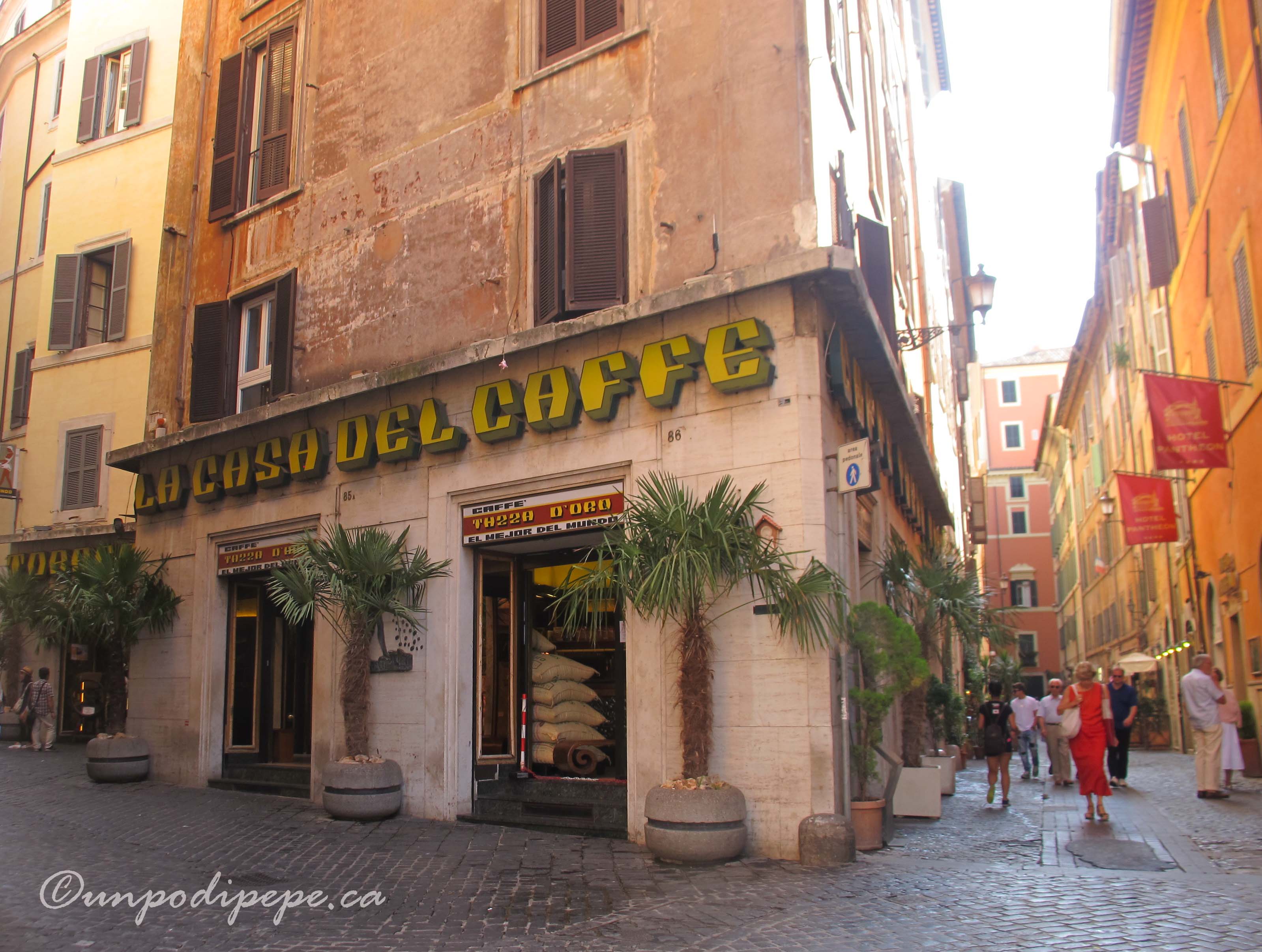
Andiamo!  Our passeggiata starts at Piazza della Rotonda, in front of the Pantheon.  It can also start at Piazza Navona, but I never miss the opportunity to visit the magnificent  Pantheon especially while there is still no entry fee.

Tazza d’Oro, Via degli Orfani 84

Facing away from the Pantheon, cross the street diagonally to the right and arrive at Tazza d’Oro, Via degli Orfani 84, known for their bitter roast caffè.  I seriously recommend ordering the granita di caffè!

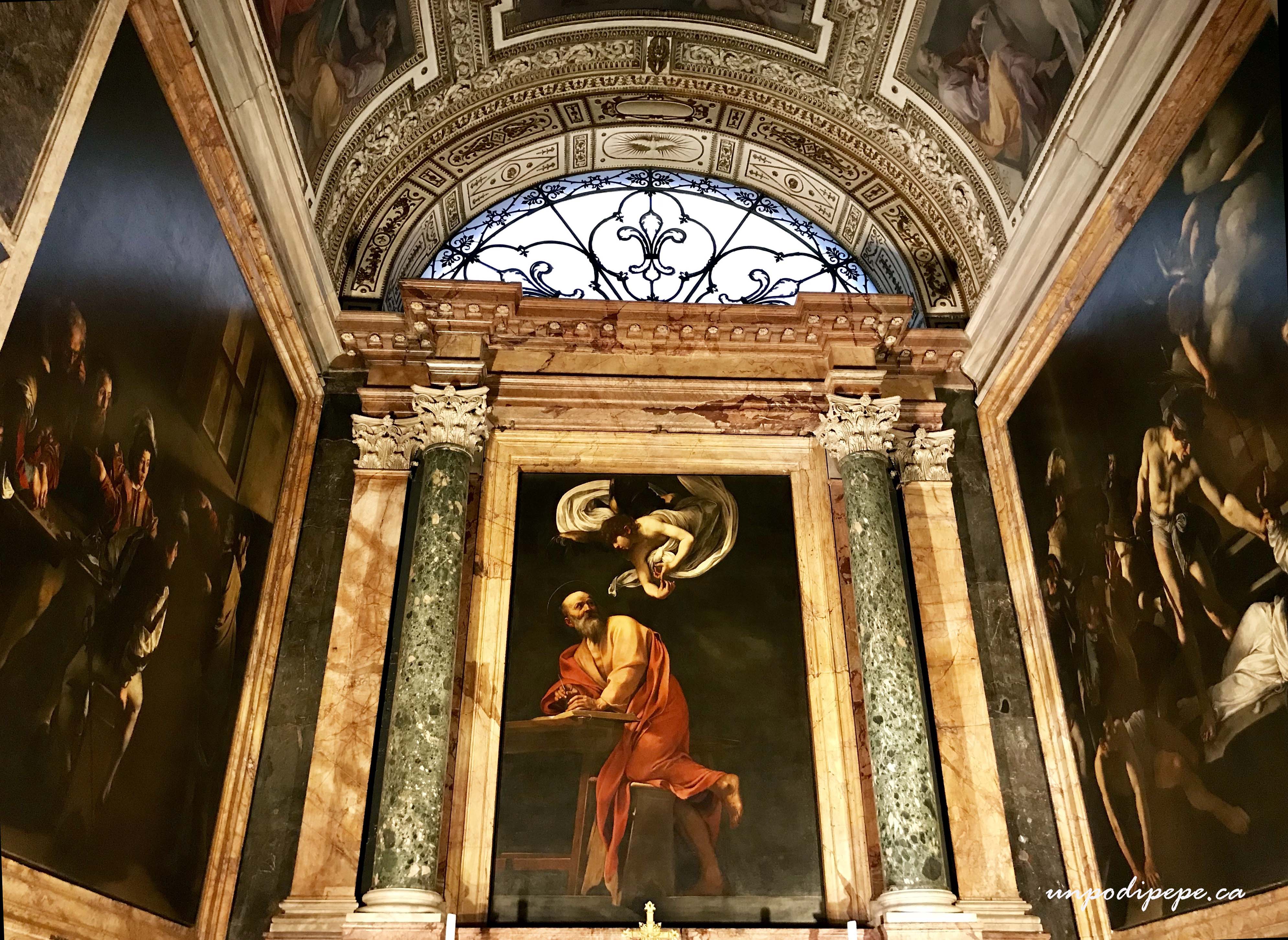
Next, a short walk to the Baroque church of San Luigi dei Francesi, the national church of France in Roma.  San Luigi is open 0930-1245 and 1430-1830 daily, except Sunday the morning hours are 1130-1245.  Walk to the front of the church and on the left side is the Cappella Contarelli-Contarelli Chapel. Here you will find Caravaggio’s 3 paintings on the life of San Matteo-called the St Matthew Cycle in english. When 2 of the works were installed in 1600, they made Caravaggio an instant success. Roma had not seen painting with such intense realism and drama before.
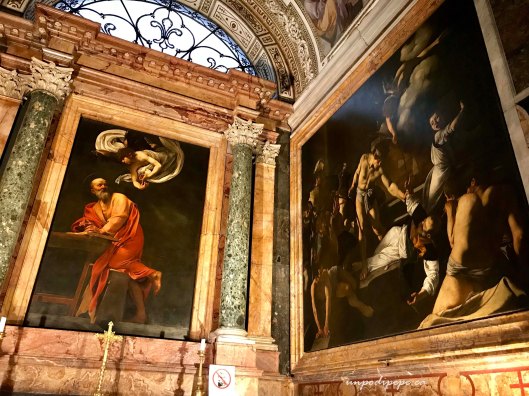
The dark and mysterious Martyrdom of St Matthew is on one side of the altar.  I say mysterious because it is not clear who the murderer is.  Is it the slave offering his hand, the man fallen on the ground, or the shadowy figure lurking in the background with the face of Caravaggio?  Hmmm.  The Calling of St Matthew is on the other side, and originally a sculpture by another artist was to go above the altar in between them.  Since all other work seemed inferior between these 2 masterpieces, an altarpiece was commissioned from Caravaggio in 1602. This painting, San Matteo con l’angelo-St Matthew and the angel, is a ‘redo’.  The first version was rejected as it portrayed San Matteo as an old peasant with the angel moving his hand, as if he could not write.  The painting was destroyed in Berlin during WWII, and only black and white photos of it remain.

My favourite of the series is on the other side of the altar, The Calling of St Matthew.  This painting has the best ever use of shadow and light in a work of art.  A group of men are counting money in a dingy tavern room.  A brilliant beam of light coming from an unseen window symbolizes the light of God.  The shape of the shadow is in line with the finger of Jesus, pointing at Matthew the tax collector.  He is the one who has a ‘huh, who me?’ look on his face while he points at himself.  The pointing finger may be a reference to that other Michelangelo, looking like the iconic finger of God in the Sistine Chapel Creation of Adam. I always leave San Luigi in an overwhelmed but contented state of ‘Wow’.

Leaving San Luigi we go left and walk ~200m turning left at the brown sign for Sant’Agostino.  This was the first Renaissance church in Roma at Piazza Sant’Agostino, close to Piazza Navona.  It is open 7:45-12 and 16:30-19:30.  Here you will also find works by Raphael, Guercino and Andrea Sansovino.  In the Cappella Cavalletti, the first chapel on the left, is Caravaggio’s magnificent Madonna dei Pellegrini-Madonna of the Pilgrims (1605), sometimes called the Madonna di Loreto.
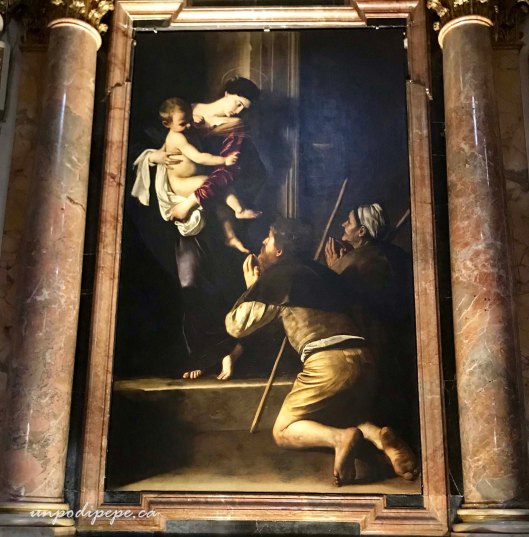
The Madonna is usually portrayed dressed in fine fabrics, seated and surrounded by cherubs and clouds.  In this painting, she is a beautiful but ordinary woman answering the door of an ordinary house in bare feet and holding a rather large baby Gesù.  The kneeling pilgrims have dirty feet.  If the Madonna looks familiar, she is the same model from the Madonna dei Palafrenieri (1606) discussed in my Galleria Borghese post. She is thought to be Maddalena ‘Lena’ Antognetti, a well-known prostitute, and possibly Caravaggio’s lover at the time.  These details were all quite scandalous at the time.  I was mesmerized by the beauty of this painting.  My Roman friend recently came with me to Sant’Agostino and I found out this is his favourite painting.  To quote  his comment  …..‘Questo è il collo più sensuale nella storia dell’arte‘-‘This is the most sensuous neck in the history of art’!
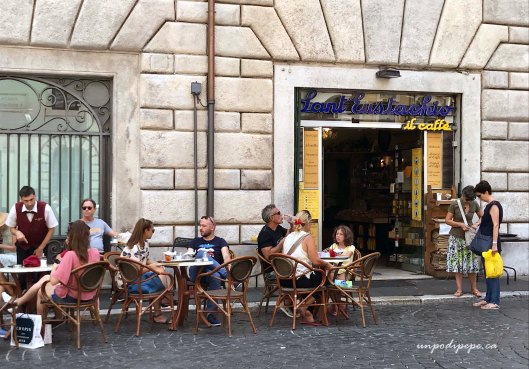
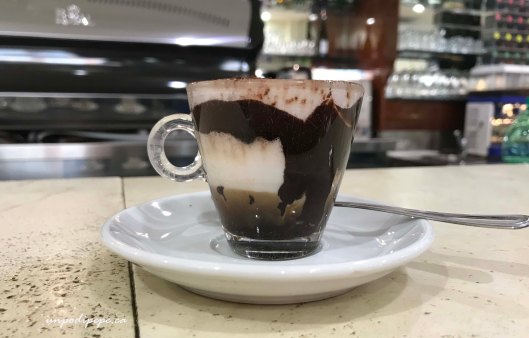
Our next stop is Caffè Sant’Eustachio a few blocks away in Piazza Sant’Eustachio 82. Operating since 1938, their caffè is pre-zuccherato.  They whip in a spoonful of sugar while making the caffè and it always tastes perfect.  A sign states that if you do not want sugar added, let them know in advance!  My favourite beverage is un marrone-usually called un marrocchino everywhere else. Every bar in Italia makes un marrocchino differently, but it is always delicious. Sant’Eustachio ties with the Aeroporto Capodichino, Napoli for the best!
The last church on this Caravaggio passeggiata is a father walk.  There are 3 streets leading to Piazza del Popolo, but I usually get back onto Via del Corso, the long shopping street that leads straight there.

If you are not yet sufficiently caffeinated, turn right on Via dei Condotti, Roma’s most expensive shopping street and, before reaching Piazza di Spagna, stop at #86, Antico Caffè Greco. Roma’s oldest and Italia’s second oldest coffee bar, it has been around and frequented by literary types since 1760. Byron, Keats, Stendahl and Goethe are among those who have enjoyed caffè here.  In my photo below, Caffè Greco is on the left, approximately below the flag.  Caffè Greco is in danger of closing due to the exhorbitant rents on Via dei Condotti!

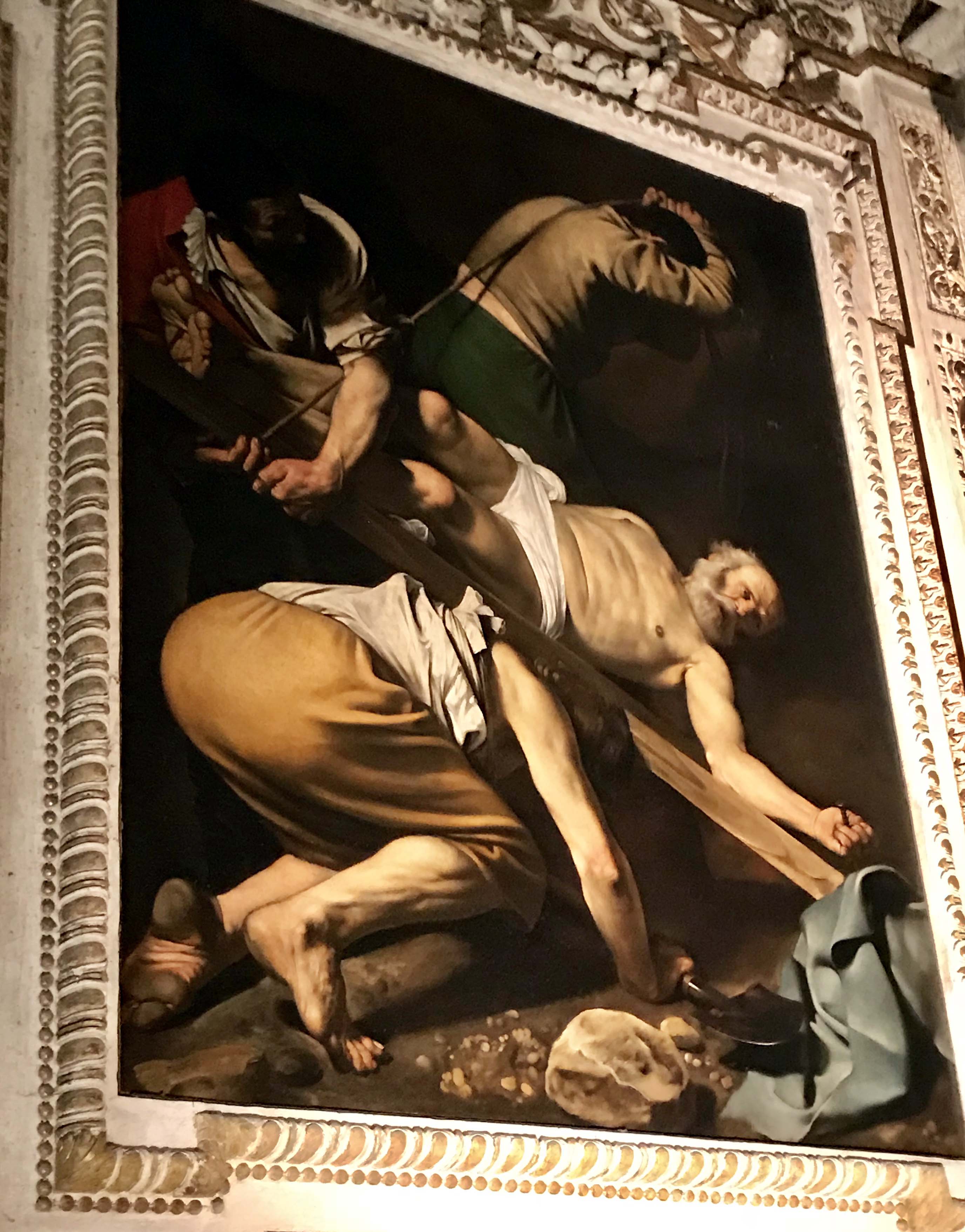
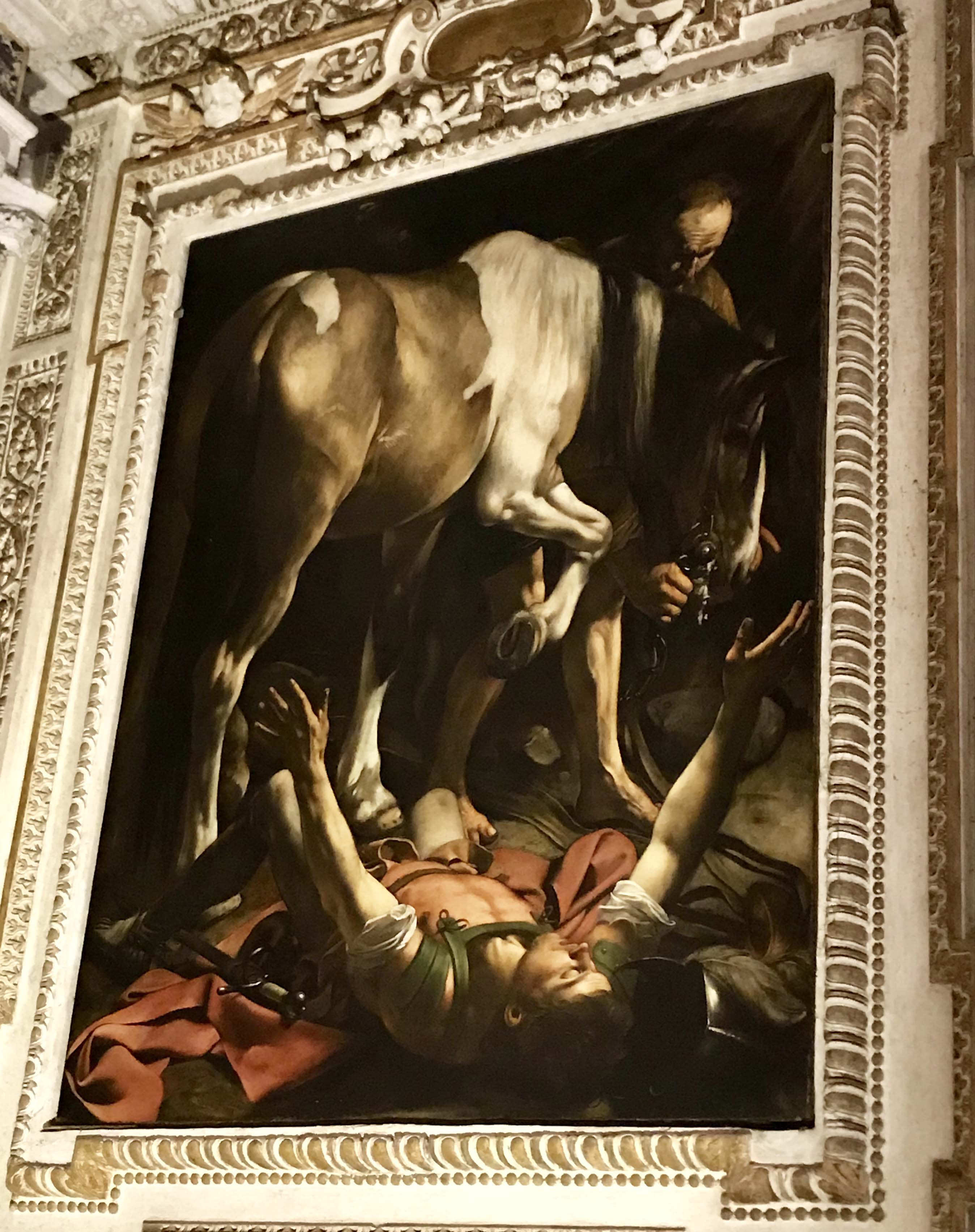
Piazza del Popolo can be reached by Via del Babuino, Via del Corso or Via di Ripetta. Santa Maria del Popolo, Piazza del Popolo 12, was designed by Bernini and is in the north-east corner of the piazza.  It is open 0930-1230 and 1630-1900, except for Saturday when it is open 0730-1900.  At the front, left side of the church is the Cappella Cerasi-Cerasi Chapel where we find the last 2 Caravaggio works on our passeggiata.  Both painted in 1601, on the left is The Crucifixion of St Peter and on the right The Conversion of St Paul on the way to Damascus.  The work above the altar between them is by Annibale Caracci.  Both paintings have dark backgrounds with awe-inspiring light and colour on the figures, which take up the whole canvas.  In the Crucifixion, you can feel the pull and weight of gravity even pushing out past the borders of the canvas.

The second painting captures the moment from the Acts of the Apostles when Saul-whose job was to persecute Christians, heard the voice of God and was blinded by the light, falling from his horse.  In case the name is confusing, he later slightly changed his name and became the apostle Paul.  This painting was often criticized for the ‘horse’s ass’ taking up so much of the picture plane.

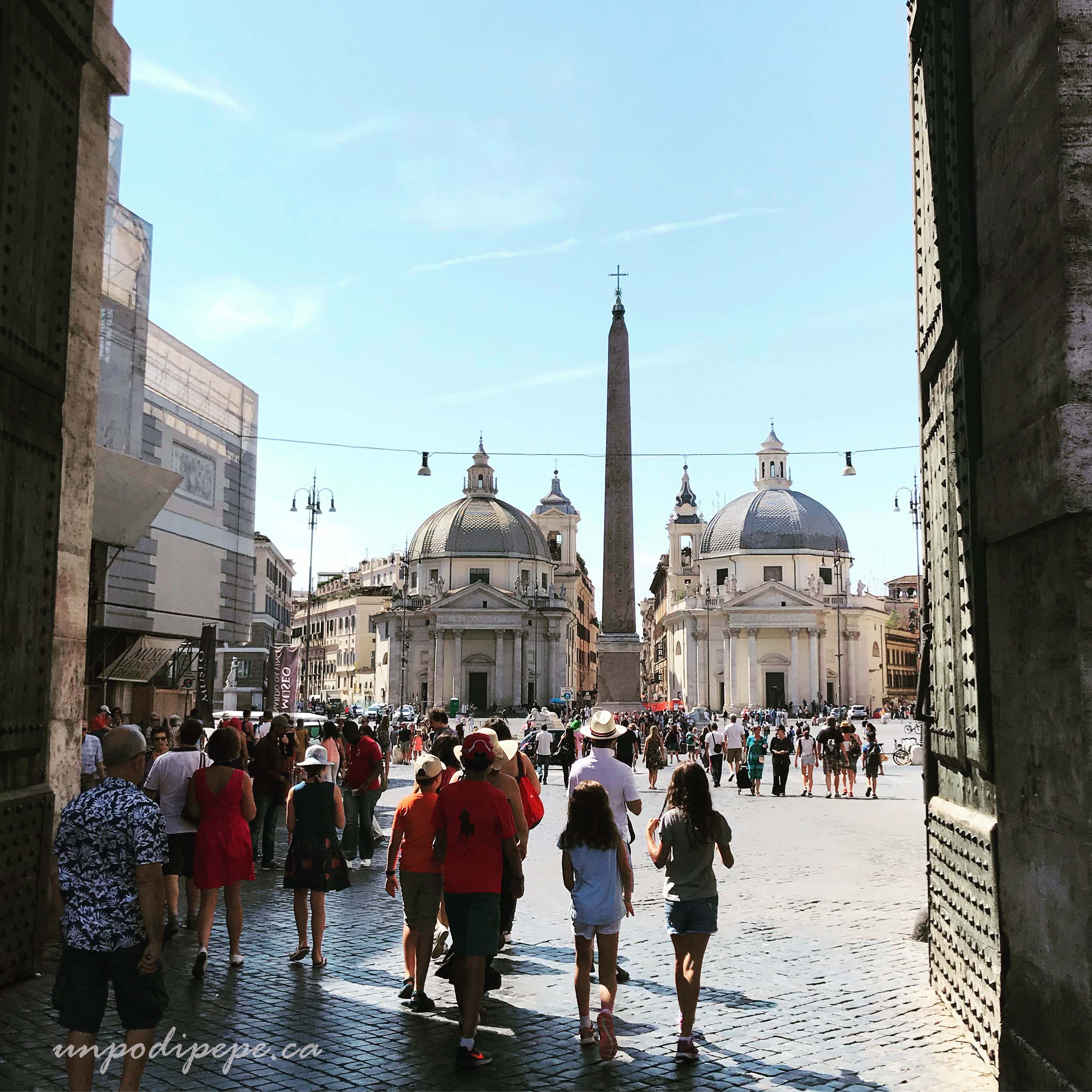
This is the end of the Caffè con Caravaggio for free walking tour.  Scusi for the poor quality map!  I will replace it as soon as I figure out how to imbed one.If you want to see more Caravaggio works—no problem!  This passeggiata can be extended from both ends!  From Piazza del Popolo, Galleria Borghese room VIII has 6 Caravaggio works and is an uphill walk or short bus ride away.  Unfortunately it is not free, and reservations must be booked in advance. Read about the booking process here. Galleria Borghese can be visited either before or after this walk-my recommendation is before. In the photo below, Santa Maria del Popolo is to the left of the gate, under renovation.  Via del Corso is straight ahead, and past the gate is the walk to Galleria Borghese.

Piazza del Popolo

Walking back down Via del Corso, just before Piazza Venezia, stop at #305, Galleria Doria Pamphilj. Here you can see 2 Caravaggio works, including his only landscape painting Riposo durante la fuga in Egitto -Rest on the flight to Egypt (1597). Galleria Doria Pamphilj also has an entry fee of €12 but does not require a reservation. Galleria Borghese, followed by the free Caffè con Caravaggio tour, then the Galleria Pamphilj will take up most of a day and leave you in a wonderfully warm and fuzzy ‘Caravaggio coma’! I hope you all have the opportunity to take this passeggiata some day.

Ciao e buon viaggio, Cristina
Share this:

  • Share on Facebook (Opens in new window) Facebook
  • Share on Pinterest (Opens in new window) Pinterest
  • Share on X (Opens in new window) X
  • Email a link to a friend (Opens in new window) Email
  • Share on WhatsApp (Opens in new window) WhatsApp
Like Loading...

Baia di Campi

08 Friday Jun 2018

Posted by Un po' di pepe in Italia, Puglia, Travel

≈ 17 Comments

Tags

Baia di Campi, Dolcevitabloggers, Gargano campsites, Il Gargano, Parco Nazionale del Gargano, Vieste

One of the most beautiful areas on earth, Il Promontorio del Gargano (gar·GAH·noh) is the promontory sticking out above ‘il tacco’, the heel of Italia.  You can also think of it as la caviglia-the ankle spur of Italia.  Surrounded by the Adriatico on 3 sides, the area is more like an island; biodiverse with unique flora and fauna. Most of the promontorio is a protected area and marine reserve, Il Parco Nazionale del Gargano, which includes le Isole Tremiti and the ancient Foresta Umbra. Fortunately, this has prevented overdevelopment by large multinational hotels and resorts.

Il Gargano is full of campsites, inexpensive, rustic accommodation and B & B’s.  The campeggi e villaggi turistici -campsites and tourist villages, are ben attrezzati-well equipped. Go with a camper and all the gear, or just a vehicle and a tent.  There are villette-little cabins for rent, but you need to bring your own sheets and towels, so these are mostly used by locals. This website (in Italiano) lists Gargano campsites. I have spent many weekends at different sites in the Gargano  with my cugini and their camper.  In July, we stayed at Campeggio Baia di Campi, near Vieste. Here is a video of the private beach during my windy morning walk:

Baia di Campi

Baia di Campi

Nothing like having a spiaggia all to myself! We were going to paddle by canoa-kayak to la Grotta dei due occhi, a sea cave 10 minutes away.  Unfortunately, it became too windy to go, so I will hopefully have the opportunity to go again. The campsite had a shuttle bus to whitewashed Vieste, 20 minutes away. Read about other campsites I have stayed at in Campeggio sul Gargano.

View of Vieste from the SS89

The winding road around the Gargano, SS 89 from Foggia, has sharp turns and viste mozzafiato (VIS·teh moz·zah·FYAH·toh)-breathtaking views.  You will not see any dehydrated (yuk!) camping food in Puglia.  Most campsites have a little market selling fresh fruit, giant watermelon, mozzarelle and other necessities.  Fresh fish is never far away, so I get to enjoy Mauro’s insalata di polpo ubriaco-drunken octopus salad!Most of the tourists visiting the Gargano area are Italian, especially in the summer.  Many Germans drive their campers down too, but you will not meet many North Americans here.  Il Gargano is the place to visit to improve your Italiano!  This post is written as part of the monthly #dolcevitabloggers linkup, hosted by Jasmine of Questa Dolce Vita, Kelly of Italian at Heart and Kristie of Mamma Prada the 7th -14th of every month. This month’s topic is ‘Hidden gems’.  Il Gargano is not so much ‘hidden’, as remote, unknown and not easily accessible without either a car or a lot of time.  I hope you all make it here one day!  As the Gargano website says, visit il Gargano ‘per una vacanza tra natura, mare e cultura’…for a holiday among nature, sea and culture!
More Il Gargano posts by Cristina: Isole Tremiti, I Trabucchi del Gargano, Campeggio sul Gargano, Santa Maria di Siponto.

Ciao e buon viaggio, Cristina

Share this:

  • Share on Facebook (Opens in new window) Facebook
  • Share on Pinterest (Opens in new window) Pinterest
  • Share on X (Opens in new window) X
  • Email a link to a friend (Opens in new window) Email
  • Share on WhatsApp (Opens in new window) WhatsApp
Like Loading...

Il Sole di Metà Pomeriggio

23 Wednesday May 2018

Posted by Un po' di pepe in Italia, Orsara di Puglia, Photography, Puglia

≈ 16 Comments

Tags

Italy photography, La luce del sole, Orsara di Puglia, Southern Italy

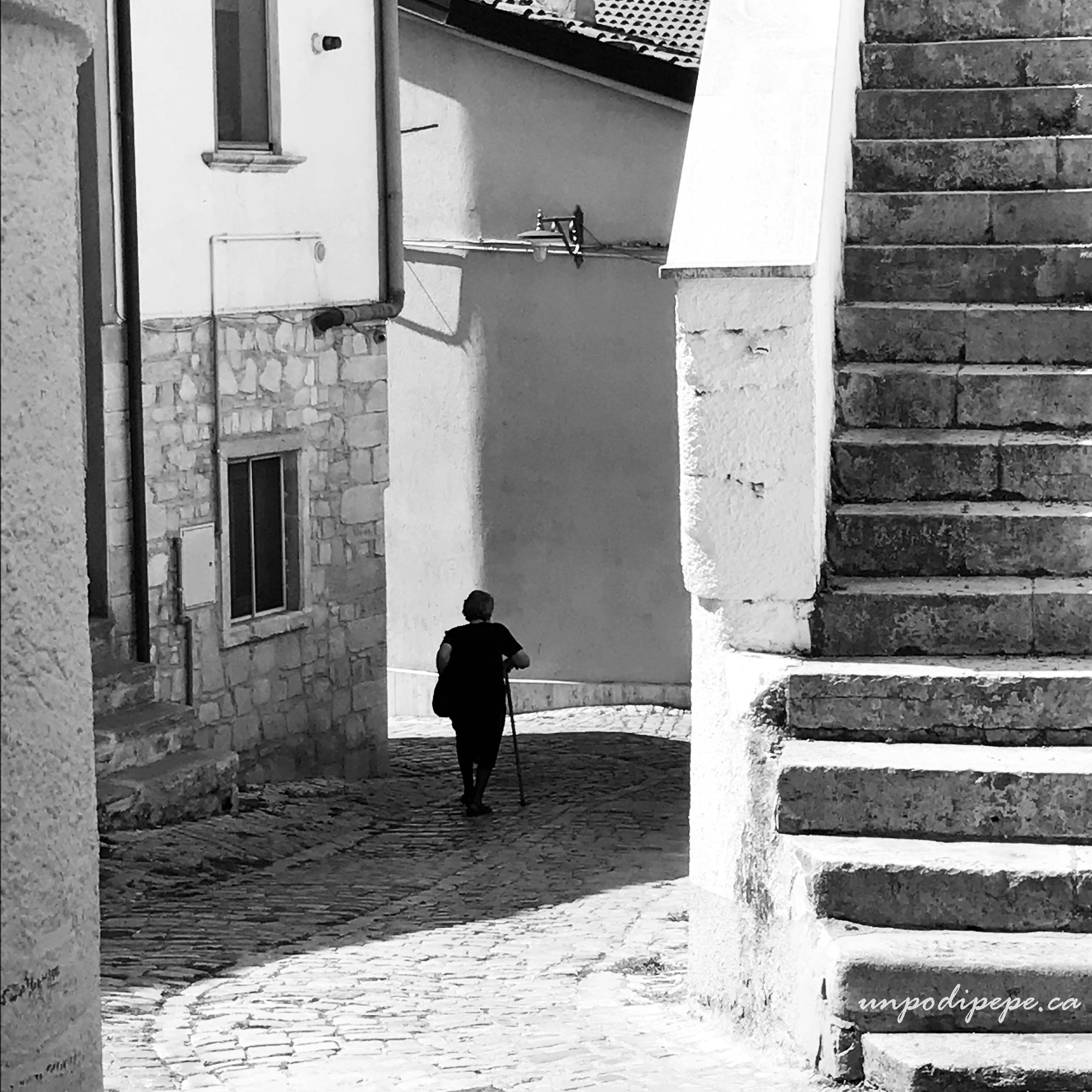
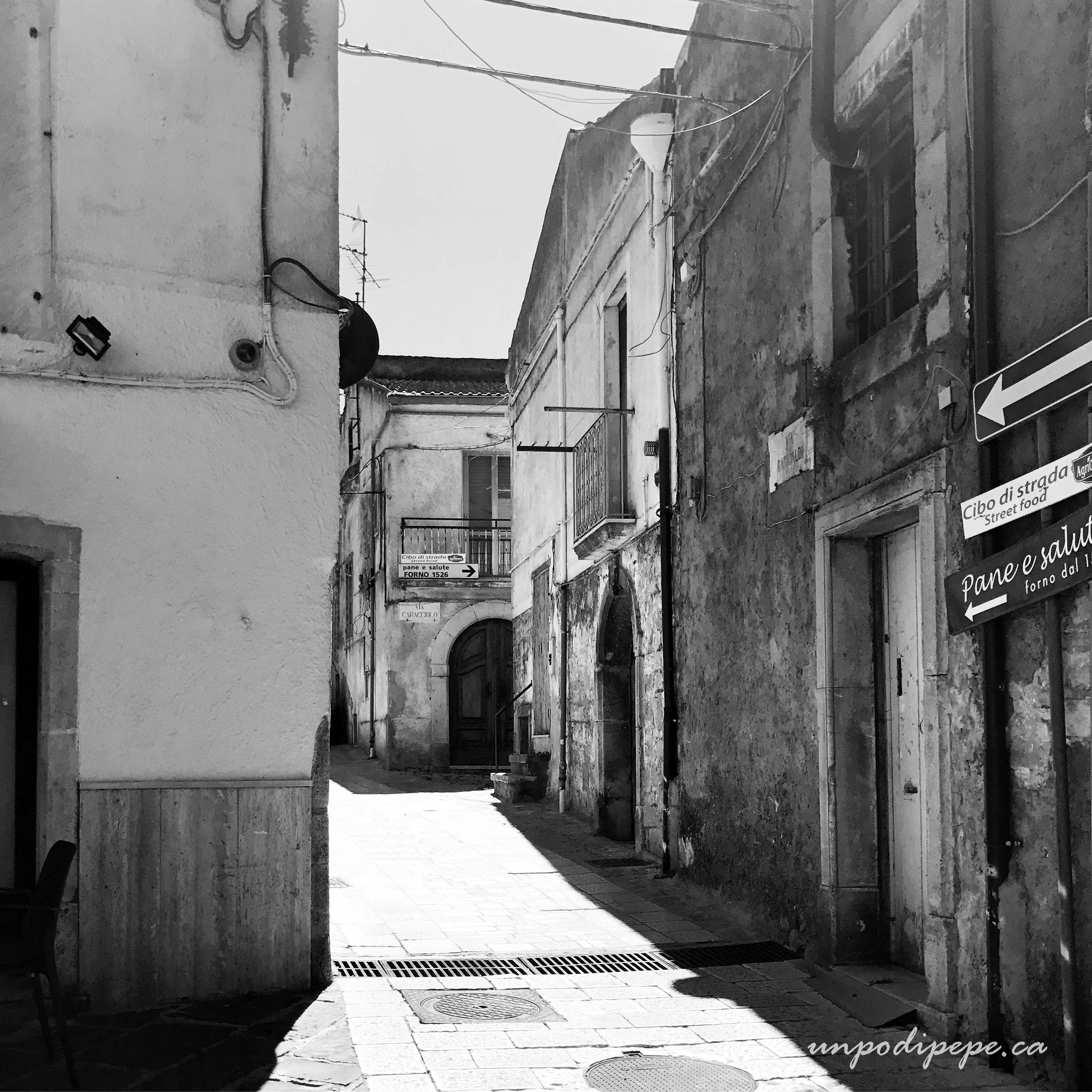
La luce del sole di metà pomeriggio- the light of the mid-afternoon Mediterranean sun is absolutely stunning.  In the backdrop of a medieval hilltop village, cast shadows create abstract shapes among the stone walls, staircases and winding cobblestone streets.

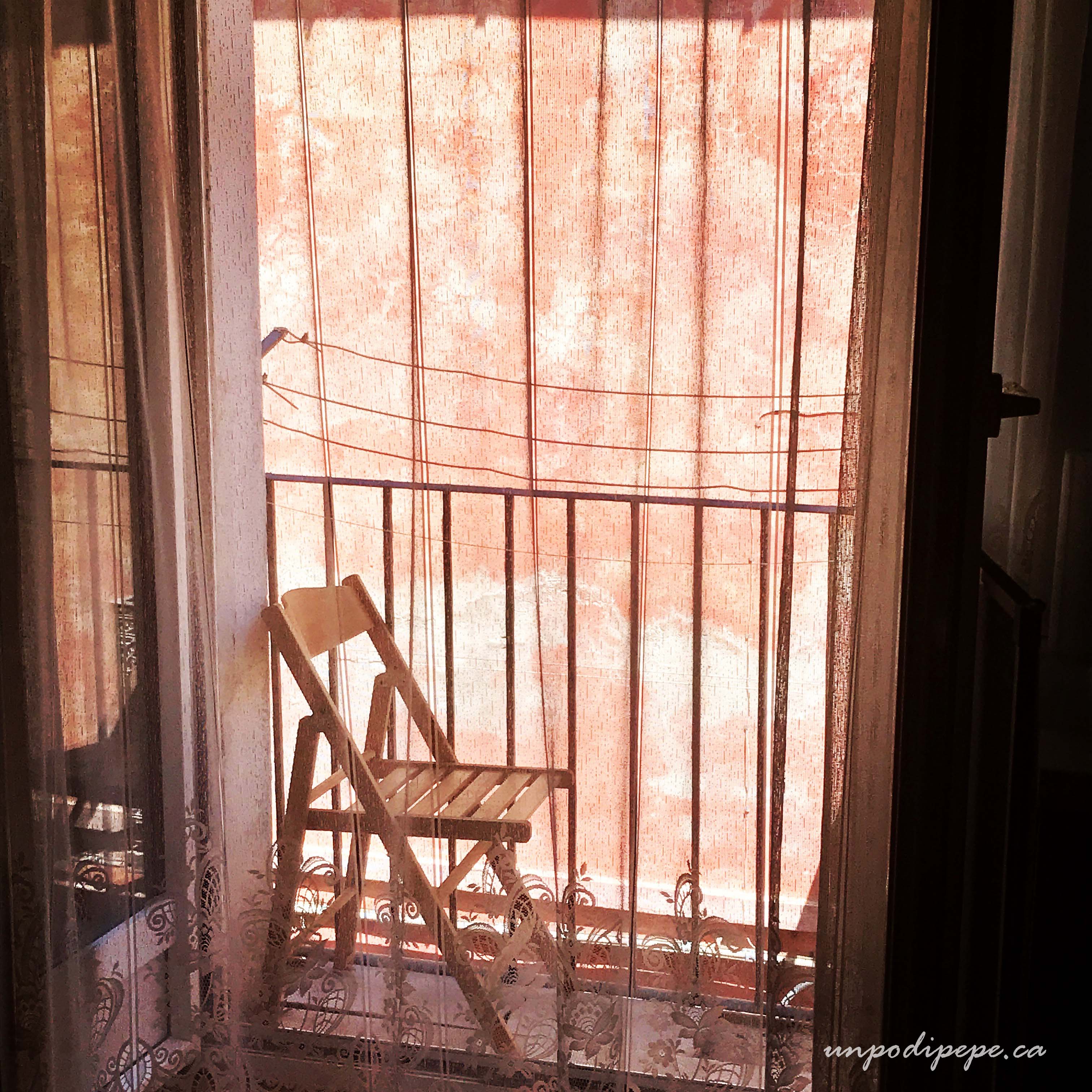
Last summer was exceptionally hot, even at an altitude of 750m like Orsara di Puglia.  Both of the negozi elettrodomestici, the appliance stores, repeatedly ran out of portable electric fans.  Most people remained indoors after pranzo, until at least 4pm.  While everyone else was resting in the cool enclaves of their stone houses,  I often ventured out to try and capture the light with my camera.Here are some of my results….mostly monochromatic, mostly square, abstract shapes cast by the magnificent light of the mid-afternoon sun.Even my tiny balcony on narrow Via Regina Margherita is flooded with la luce del sole!

Imagine the smell of orecchiette con sugo wafting down empty Via XX Settembre just before pranzo. Yum!

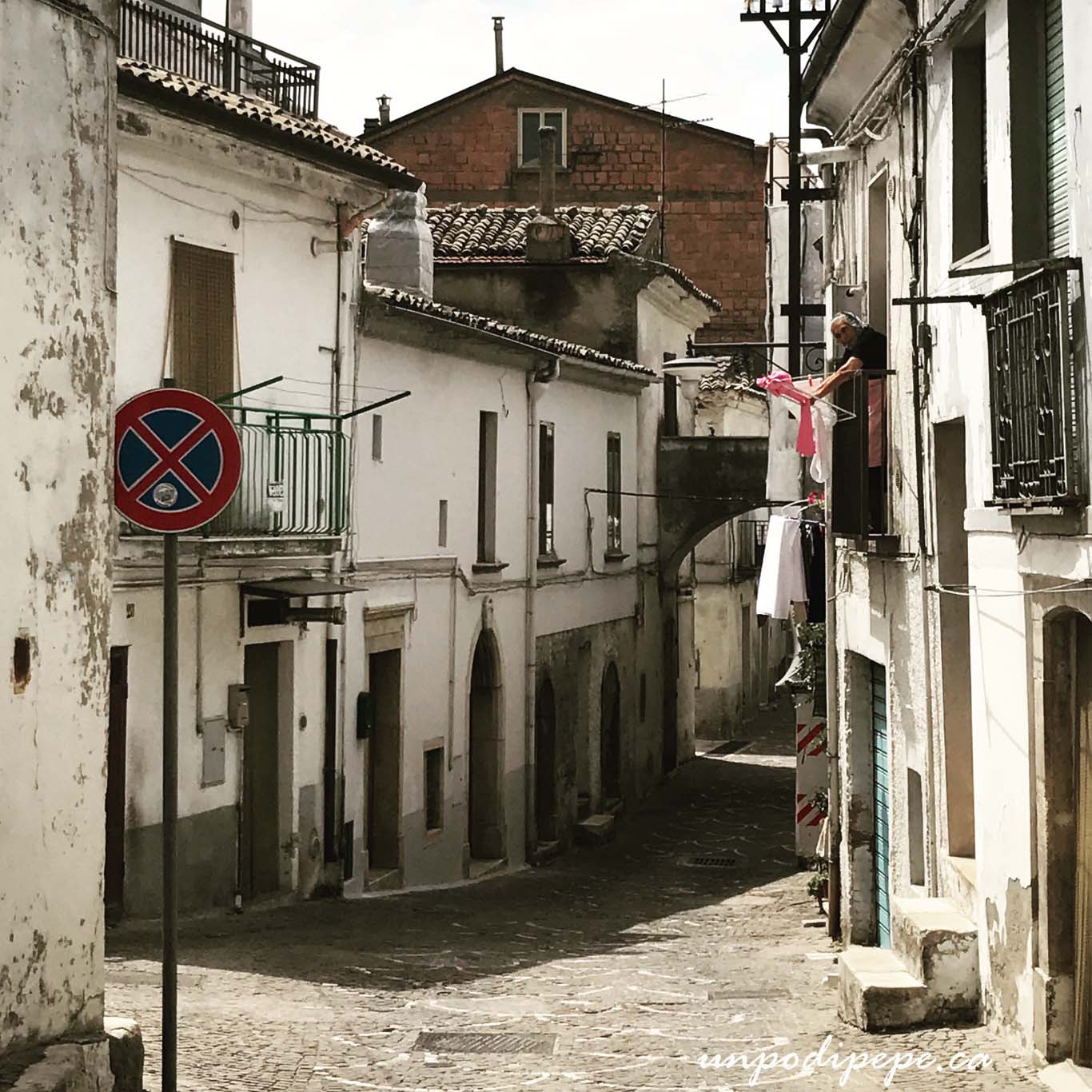
Laundry dries in no time with the heat of the afternoon sun, and the shadows make interesting shapes on the old stone walls. This Nonna on Via Cavour wonders what I am doing out in this heat!My Cinquecento radar spots a visiting specimen in town.  The light makes interesting reflections and cast shadows on the street.

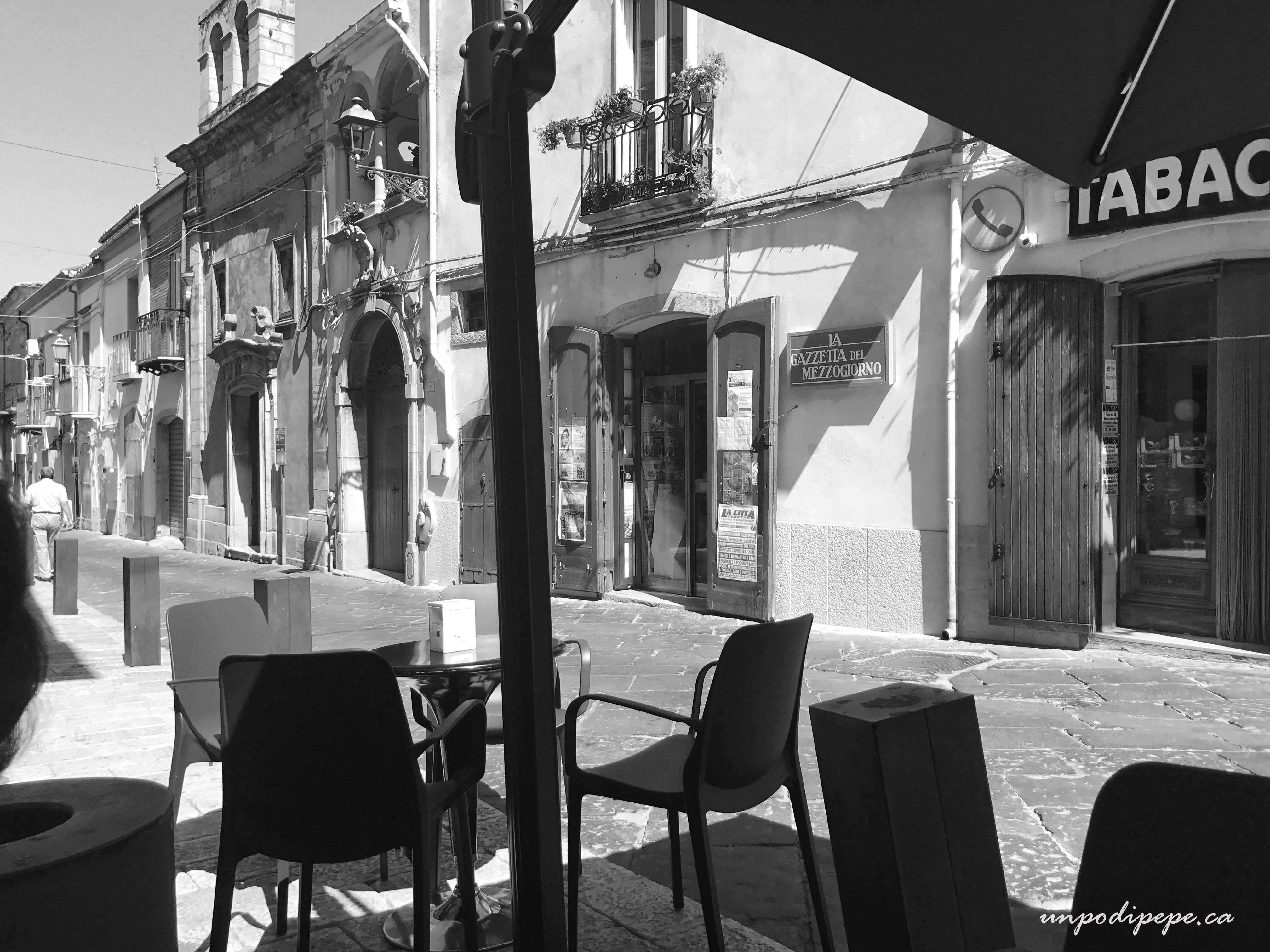
Shade under the ombrellone at the local bar.          I hope you enjoyed my attempt to capture ‘la luce’ in these photos!    Ciao, Cristina

Share this:

  • Share on Facebook (Opens in new window) Facebook
  • Share on Pinterest (Opens in new window) Pinterest
  • Share on X (Opens in new window) X
  • Email a link to a friend (Opens in new window) Email
  • Share on WhatsApp (Opens in new window) WhatsApp
Like Loading...

A Perfect Day in Italia

10 Tuesday Apr 2018

Posted by Un po' di pepe in Italia, Italian life, Orsara di Puglia, Puglia

≈ 41 Comments

Tags

Dolcevitabloggers, Orsara di Puglia, Pugliese Traditions, Southern Italy

The Dolce Vita Bloggers link-up theme this month is ‘a perfect day in Italy’. What a topic!  There are so many possibilities.  I have written about many wonderfully perfect days, in Roma, Matera, Alberobello, the Val d’Orcia, Polignano a Mare….  How do I narrow down what to write about? With too much material to choose from, I decided to write about a typical day ‘at home’ in Orsara di Puglia, where most days are laid back, spontaneous and pretty darn perfetto!

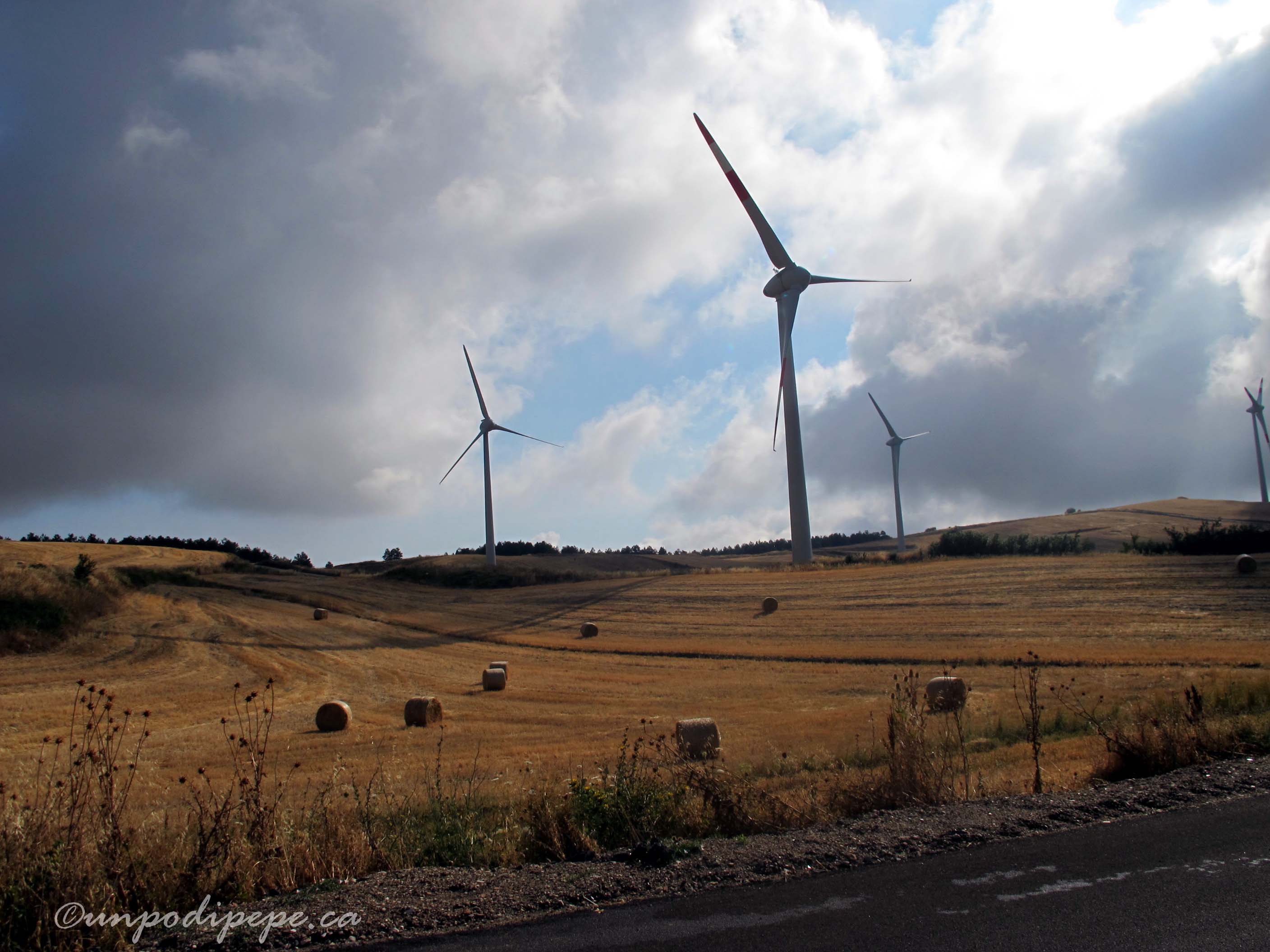
My day usually starts out with a long, early morning passeggiata to la Montagna Spaccata.  I call it ‘la Palestra di Madre Natura’ or ‘mother nature’s gym’, an uphill zig-zag walk up the mountain towards Campania with fresh aria di montagna, breathtaking views and encounters with fellow walkers.  I usually walk to the border with Campania, when I reach the pale eoliche (PAH•leh Eh•oh•LEH•keh).

Pale eoliche (wind turbines) near Montaguto

I have also walked all the way to Montaguto, in Campania 6 km away . I am not a ‘morning person’, but in the summer, the walk must be early, otherwise it gets too hot to walk on the way back. Long walks are necessary when you spend weeks eating lots yummy food and still want to fit into your clothes!

When I am back from my walk, cleaned up and changed, I often stop at the bar for an espressino, known as caffè marocchino in the rest of italia.  I also sneak in a few minutes of wifi.  Sometimes I walk to Piano Paradiso and have caffè with Peppe Zullo in the morning or afternoon.  Then I usually do servizi-errands, including shopping for food. Refrigerators are small, and most people shop at least every other day for fresh local ingredients.  Fresh bread and taralli are purchased at il forno.  Generi Alimentari are delis and also carry general grocery items.  My favourite items to purchase are fresh mozzarelle and the local specialty, cacioricotta.  Once a week, mozzarelle di bufala arrive and I am first in line! Fruit and vegetables are from the fruttivendolo-unless the neighbours give you produce from their orto.  There are also travelling fruttivendoli, selling out of small trucks.

Il fruttivendolo barely fits in Via Regina Margherita!

I celebrate when fiori di zucca are available!  Another local specialty is Tuccanese, vino made from a local native grape. As in most non-touristy towns in Italia, shops close at 1pm for la pausa pranzo and reopen at 5pm, until 8pm.
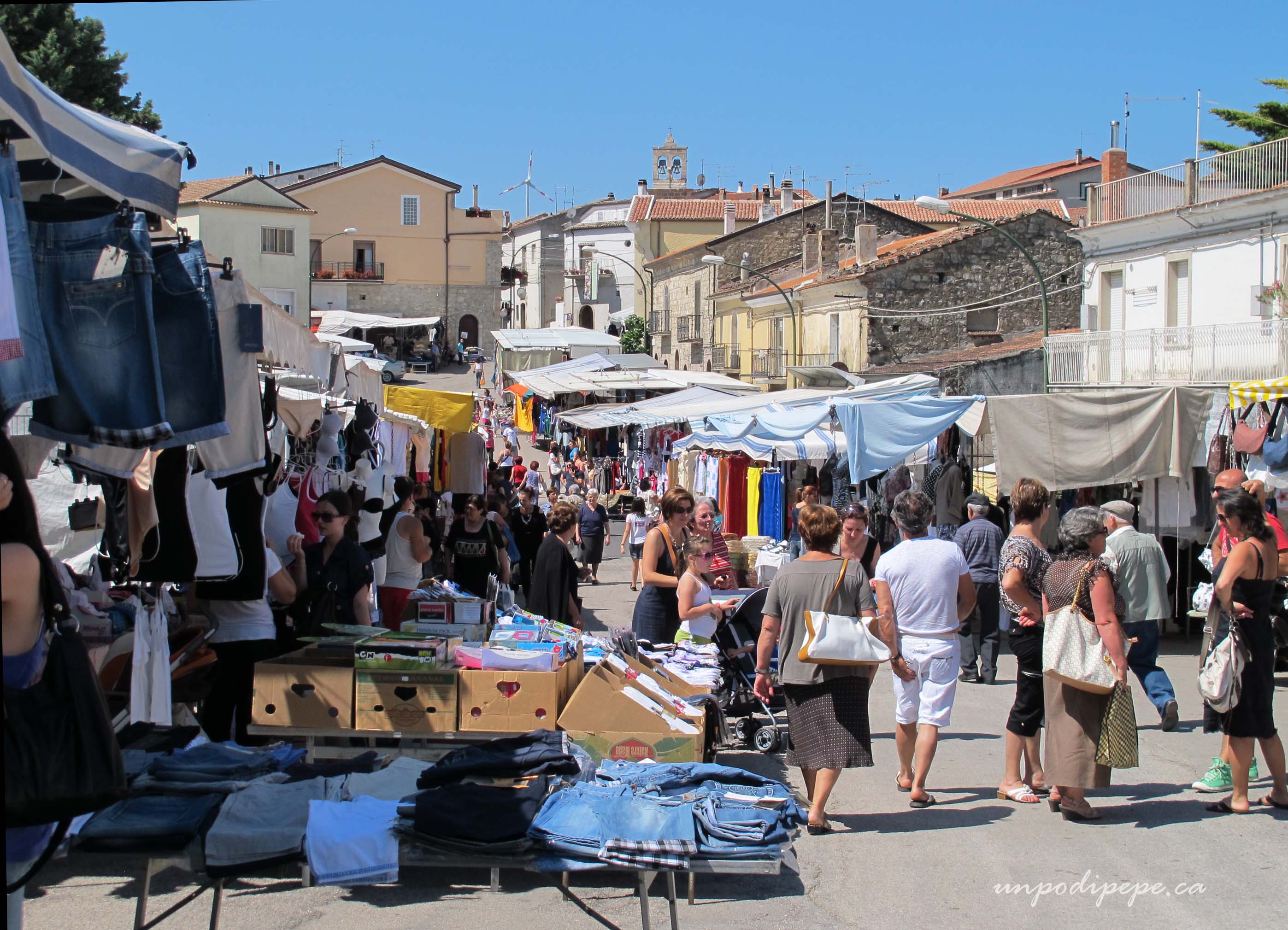
Giovedi mattina-Thursday morning is the mercato in Orsara.  The street is lined with bancarelle selling everything from fresh formaggi to produce, linens, shoes and household stuff.  A great spot to run into everyone in town, including visitors. Il postino likes giovedi, as he can hand everyone their mail on their way to the mercato.

The rest of the morning is usually spent helping to prepare pranzo, the main meal of the day, at 1pm.  In the summer, my parents are also in Orsara, sometimes my sister and her family too, so there is lots of food preparation going on, using ultra fresh local ingredients.

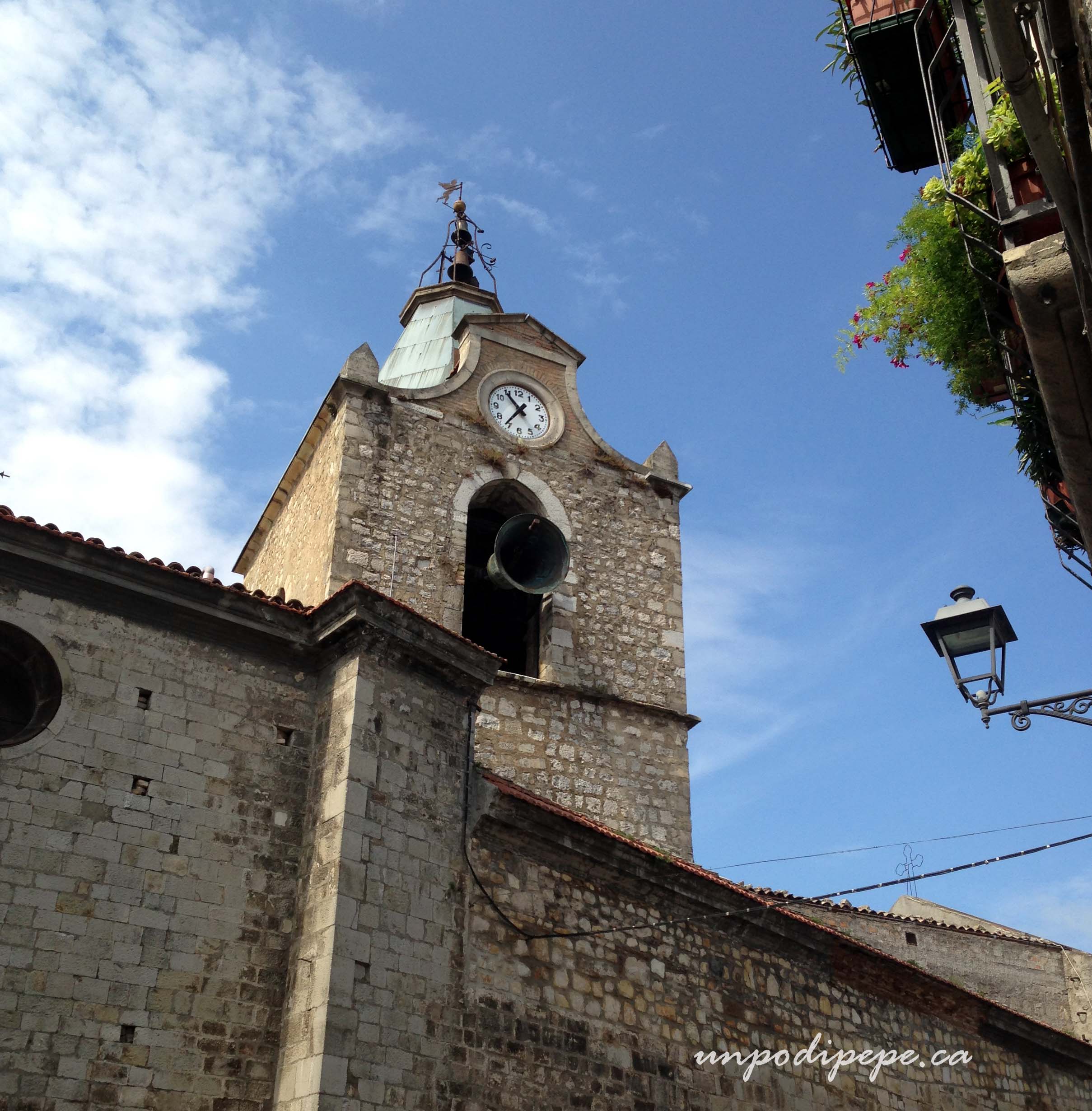
There is no need for a watch. My casa is right near the main church and the campanile– bell tower.  La campana rings every 15 minutes.  On the hour, there is one ‘ding’ for each hour, and every 15 minutes there is a higher pitched ‘ding’.  For example, at 12:45 la campana rings 12 times, followed by 3 higher pitched rings.  Back in the day when no one had a watch, contadini working in the fields would know the time. You might think this would get annoying, but la campana was broken for a year, and it was really missed! Once the dishes are done, it is orario di riposo-quiet time, as it is too hot to do much else.  Most people do not nap every afternoon, but they at least stay home and have a riposo, a rest. A short pisolino is quite civilized if you are up very early and plan to stay out late! The afternoon rest is not called a siesta in italiano- riposo or la pausa. I often read or do clean up stuff around the house, like hang laundry to dry. There are no dryers here as electricity is ridiculously expensive and sunlight is free. I may brave the mid afternoon sun to go out and take photos. The maze of steep, windy, cobblestone streets and alleys are empty and I am alone with the light and the incredible shadows.  To quote myself…

’ la luce … la gloriosa e magnifica luce del sole di metà pomeriggio è incredibile. Vorrei dipingere quella luce! / the light….the glorious and magnificent light of the mid-afternoon sun is incredible.  I want to paint that light!’ (Cristina, October 2017).

At 5pm shops and bars reopen and the streets come to life again.  I visit friends and relatives, meet for gelato, shop, or find somewhere to sit with my sketchbook. I also love to walk to La Cupa, the olive grove that used to belong to my Nonno to pick plums, figs and pears. I usually need to stop at one of the bars to use wifi, although as I explained in Chiuso per Ferie in August, this can end up seeming quite antisocial.

Sundays, I sleep in, unless going on a daytrip.  I love to have cappuccino and a cornetto crema di pistacchio before 11:00 Mass in the ancient Grotta di San Michele Arcangelo. At least one Sunday, I look forward to a barbecue at La Cupa with my extended family.

‘un po’ di relax’ under the olive trees

After 9pm, it is time for the evening passeggiata, walking up and down ‘il Corso’ and socializing. There are pizzerie and bars with outdoor seating along il Corso. On summer evenings, there are often concerts or special events.My favourite part of the passeggiata is walking all the way to the top of the Corso, past where the houses stop, then the streetlights stop.  It is buio (BOO•yoh) -dark, you can hear grille (GREEL•leh)-crickets, and see the stars.  On clear, windless nights, lucciole (looch•CHEEOH•leh)-fireflies make the night absolutely magical. There is usually a stop for a drink at an outdoor table before ending up back at home…never before midnight though! Buonanotte, Cristina.

Click on these links to read previous posts about wonderfully perfect days spent in… Alberobello, the Isole Tremiti, Matera, Polignano a Mare, Paestum, Roma, Trani and the Val d’Orcia.

This post is written as part of the monthly #dolcevitabloggers linkup, hosted by Jasmine of Questa Dolce Vita, Kelly of Italian at Heart and Kristie of Mamma Prada the 7th -14th of every month.

Share this:

  • Share on Facebook (Opens in new window) Facebook
  • Share on Pinterest (Opens in new window) Pinterest
  • Share on X (Opens in new window) X
  • Email a link to a friend (Opens in new window) Email
  • Share on WhatsApp (Opens in new window) WhatsApp
Like Loading...
← Older posts
Newer posts →

Enter your email address to follow 'un po' di pepe' and receive notifications of new posts by email.

Join 511 other subscribers
Follow Un po' di pepe on WordPress.com

Popular Posts

  • Hairstyling in Ancient Roma
    Hairstyling in Ancient Roma
  • Cucina Italiana Patrimonio UNESCO
    Cucina Italiana Patrimonio UNESCO
  • Grano Arso
    Grano Arso
  • Napoli Street Art
    Napoli Street Art
  • Dolci di Natale
    Dolci di Natale
  • Italiano per Ristoranti~How to pronounce your restaurant menu
    Italiano per Ristoranti~How to pronounce your restaurant menu
  • Hostaria Antica Roma~Eat like an Ancient Roman
    Hostaria Antica Roma~Eat like an Ancient Roman

Recent Posts

  • Cucina Italiana Patrimonio UNESCO
  • 2025~Un po’ di pepe Year in Review
  • Castel del Monte
  • ‘The Nuances of Love’
  • Hostaria Antica Roma~Eat like an Ancient Roman
  • Santa Maria in Aracoeli
  • Casino dell’Aurora~Villa Boncompagni Ludovisi
  • Nasoni di Roma
  • Bloghiversario #11
  • Fontana di Trevi
  • Acqua Vergine
  • Giubileo 2025
  • Sanremo 2025
  • In Vino there are Memories
  • A Literary Harvest
  • 2024~Un po’ di pepe Year in Review
  • Buon Natale 2024
  • Il Bicerin
  • Mercato Porta Palazzo
  • Torino
  • Catanzaro, Calabria
  • Il Pumo Pugliese
  • Artemisia Gentileschi
  • Cavalli di San Marco
  • Panzerotti

Categories

Amici e Famiglia Architecture Art Art history Art projects Bilingual posts Blogging Canada Culture Feste Firenze Inspiration Italia Italian Folklore Italian language Italian life Italocanadesi Libri Mangiamo! Orsara di Puglia Parole piacevoli Photography Puglia Recipes Roma Travel Travel tips Uncategorized Vino

Archives

Un po’ di pepe on Facebook

Un po’ di pepe on Facebook

Start a Blog at WordPress.com.

  • Subscribe Subscribed
    • Un po' di pepe
    • Join 511 other subscribers
    • Already have a WordPress.com account? Log in now.
    • Un po' di pepe
    • Subscribe Subscribed
    • Sign up
    • Log in
    • Report this content
    • View site in Reader
    • Manage subscriptions
    • Collapse this bar
 

Loading Comments...
 

    %d